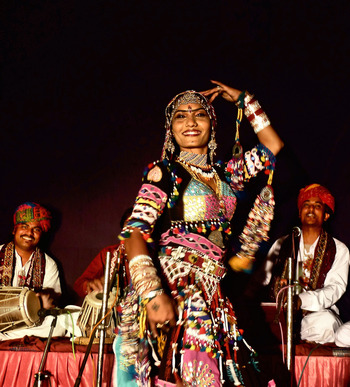


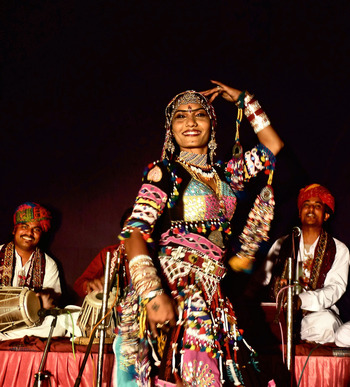
Beginning in the late 1980s, a few women of the Kalbeliya (Kālbeliyā) community in Rajasthan (northwestern India) began to work as professional dancers, performing at transnational world music festivals and national (Indian) folk fairs.Footnote 1 Since then, increasing numbers of young female dancers with their dazzling appearance are being put into the limelight of such performances on global stages and have consequently turned into the poster girls of the whole Kalbeliya community. Their dance has become internationally famous as either a so-called Indian form of Gypsy dance or a traditional folk dance of snake charmers. While the intricately decorated black dress, colorful bead jewelry, and expressive makeup distinguish the Kalbeliya dancer's visual identity, striking hip movements, fast spins, acrobatic tricks, and rhythmic footwork typify her dance (see Photo 1).Footnote 2
Kalbeliya dancer, Khatu Sapera, performing on stage in Jodhpur, 2014. Photo by Ayla Joncheere.
The hitherto small number of academic authors who refer to Kalbeliyas, often portray this community as “service nomads” alias “Gypsies” (Angelillo Reference Angelillo2013, 79), who typically perform a kind of ritualized begging. Because of these begging activities, Kalbeliyas have also been described as “sham ascetics” (Higgins Reference Higgins2010, 1) or buskers playing for alms. Wandering around the streets of their native villages and travelling to surrounding areas, most Kalbeliya families are known to be street musicians, performing as female singers (Wickett Reference Wickett2013) and male musicians (Neuman, Chaudhuri, and Kothari Reference Neuman, Chaudhuri and Kothari2006, 238–39).Footnote 3 They are also notorious for catching poisonous animals including snakes, which gave them the metonymic signifier of being snake charmers (Jodh Reference Jodh2011; Robertson Reference Robertson2004). Partially based on such scholarly depictions of Kalbeliyas, subsequent popular representations of this Indian community have largely been adapted to and spread by growing global commercial cultural industries and local tourismFootnote 4 over the past three decades.
Although Kalbeliyas have thus far been generally portrayed in academic as well as popular texts as traditional gypsies, snake charmers, and street musicians, I argue that the community's dance displays do not necessarily entail such historical roots. This article traces the origin of public Kalbeliya dance practice to the early 1980s, thereby demonstrating that it is a recently constructed tradition. It highlights the rapid development and further establishment of the dance as a distinctive genre in the transnational market and later within the framework of national cultural policy. The dance's integration into a national discourse has led to its institutionalization as a national folk heritage, and ultimately, to its UNESCO recognition in 2010. In this article, I reflect on the significance of the claims for authenticity and narrative legitimization within a shifting process of adaption to fit into multiple discourses, ranging from political folklorism to commercial tourism. The creative search for ritual functions and symbolic character behind the cultural practice of Kalbeliya dance implies a desire to prove that it has been handed down uninterruptedly throughout history.Footnote 5 I consider how Kalbeliya dance burgeoned in the past three decades for two reasons: first, a transnational pursuit for the uncovering of “Indian Gypsy culture,” and second, a national cultural policy increasingly promoting “folk” dance forms. These two cultural and political discursive dynamics were also encouraged by a half-century expansion of local tourism in Rajasthan and by the more recent socioeconomic benefits of a few successful Kalbeliya dancers that motivated an increasing number of community members to pick up this profession. Although Kalbeliya dance nowadays seems to be generally accepted within its community, my research shows that public dance displays by Kalbeliya women were considered disreputable until a few decades ago and were usually forbidden by the community itself.
In the first part of this article, the 1980s framework for Kalbeliya artists and the staging of the first dancer of the community, Gulabi Sapera, are set in context. From there, the article illuminates how the conceptualization of Kalbeliya dance is the product of romantic and exoticizing neo-orientalist narratives living within a growing world music industry, where transnational cultural managers sought to retrace common origins of (the European) Gypsies back to India. When Kalbeliya dance developed in the mid-1980s, artists and world music managers used the encounter with the dance as an argument to support the so-called Indian connection hypothesis, which proposes that gypsies originated in India and from there migrated around the world.Footnote 6 This theory is founded on linguistic evidence that reveals that Gypsy languages, such as Romani, are related to Indo-Aryan languages (see, for example, Matras Reference Matras2002; Kenrick Reference Kenrick2004; Hancock and Karanth Reference Hancock and Karanth2010). At a sociopolitical level, the trope of the “artist-Gypsy” as a popular image facilitates the assimilation of those considered to be gypsies into a “transnational Gypsy” world (Angelillo Reference Angelillo2012, 197–98). As contemporary descendants of the “original” gypsies, Kalbeliya dancers have become a familiar feature in the Gypsy-focused international world music market.
The article will then highlight the self-exoticizing agency of Kalbeliya dancers and their families and how they keep on transforming their dance in line with contemporary cultural discourses. The final section of the article focuses on the initial marginal position of Kalbeliya dance within local and national sociocultural spheres and its subsequent UNESCO recognition in 2010, which has improved the status of Kalbeliya dance within the national performing arts scene. With the support of Indian middle-class cultural brokers, or what I call, “folklorist-managers,” Kalbeliya dance has increasingly been depicted as a marketable product for larger national audiences (mainly in the context of tourist-like environments, such as luxury hotels, desert safari camps, or local restaurants). These folklorist-managers transformed the dance into a form of attractive folklore and relabeled it as a “traditional folk dance” of Rajasthan. Its alleged ancestry and authenticity lend this dance form credibility on Indian stages. To establish a sense of continuity, an artificial link was introduced between the dance and the practice of snake charming.
In sum, this article sets out to demonstrate the powerful interplay of multiple parallel commercial, political, and sociocultural discourses and their agents, which facilitated the development of Kalbeliya dance in both transnational and national spaces. Whereas the global romanticist perspective embedded Kalbeliya culture and its dance within a (re)unifying notion of transnational Gypsyhood, Kalbeliya dance is increasingly used as a case for the post-1980s Indian nationalist cultural motto of unity in diversity.Footnote 7 In the case of performing arts, unity in diversity describes a rich variety (diversity) of patrimonial art forms within a nationwide cohesive (unity), tripartite framework of classical, folk, and tribal practices. The 2010 UNESCO recognition of Kalbeliya “folk” dance as intangible heritageFootnote 8 has fostered interest in the dance among Indian and Rajasthani crowds, an interest that until recently had been more or less absent. The UNESCO recognition further increased the Kalbeliya community's national and international renown, as Kalbeliya dancers are now seen as one of the main representatives of “traditional” Rajasthani performing arts.
Unfolding Kalbeliya Creations: A Short Note on Methodology
The musical score of the world-famous Gypsy documentary movie Latcho Drom (1993) induced me to begin my PhD research project on Kalbeliya dancing. The audio-copy I received from my older brother for my twelfth birthday became a symbolic milestone for my future. First the sweeping audio and later the video images transformed me temporarily into a romanticist who was completely obsessed with transnational Gypsy connections and, more particularly, with the performing arts of Gypsy communities. “I want to dance like those girls of Latcho Drom,” I told my mother. Coincidentally, a friend of my mother had heard of a group of Rajasthani musicians permanently based in Ghent, my native town. That is how I, a teenage Belgian girl, ended up dancing with a group of Rajasthani performers, members of Musafir (one of the pioneering “Gypsies of Rajasthan” troupes), who spent their summers in Europe touring various world music festivals. Since 2001 I have spent most of my free time learning Kalbeliya dance.
Since the age of eighteen, I have regularly traveled to Rajasthan and lived with Kalbeliya dance families in Jodhpur, continuing what I would call a period of unconscious fieldwork (2001–12). While this article is primarily based on the formal fieldwork I conducted for my PhD research in the winters of 2012–2015 (twelve months in total), it ineluctably draws as much on preacademic experiences. My ethnographic research is based on qualitative methods: conversational interviews, fieldnotes and reflexive journals, participant observation, and video recordings of performances (245 recordings between 2005 and 2012 and 395 recordings during my PhD project, 2012–15).
From Local Street Musicians to International Gypsy Dancers on Stage: Kalbeliya Dance in the Context of the 1980s
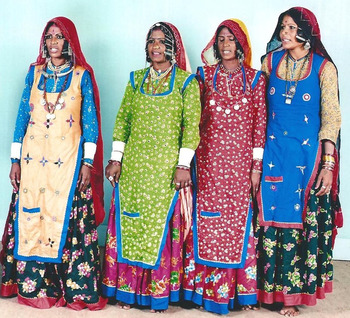
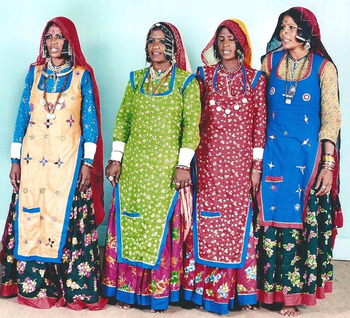
Lumnath, a Kalbeliya musician from Jodhpur, remembers that during his childhood days, he would roam around with his father playing mañjīrā (hand cymbals) for whoever wanted them to play. At the end of the day, he had earned approximately two rupees. He used to be pleased with that. His mother together with some of his aunts also wandered around locally (in Jodhpur and its surrounding villages) to sing and beg. Lumnath's younger sisters, however, never had to beg or sing, as the folklorist Komal KothariFootnote 9 had selected them at a very young ageFootnote 10 to perform dance on international stages (L. Kalbeliya, interview, Reference Kalbeliya2013, author's paraphrase from Hindi). Most Kalbeliya interviewees (fifty-four dancers and their family members) remember a time when parts of the Kalbeliya community worked as street musicians, making rounds (in Hindi: pherī lagānā) for small gifts, clothes, food, or other alms. Performing as singers, Kalbeliya women actively participated in this public occupation (see also, for example, Samar Reference Samar1979, 13; Verma Reference Verma1987, 87; Neuman, Chaudhuri, and Kothari Reference Neuman, Chaudhuri and Kothari2006, 238).Footnote 11 None of my Kalbeliya informants attested to the performance of public dance by Kalbeliya women before the 1980s. The development of local (cultural) tourism from the late 1960s onward, the establishment of a transnational world music industry, and an emergent national interest in folk arts since the 1980s enabled a few Kalbeliya families to shift their livelihood from street begging to international performance renown (Photo 2).
Kalbeliya female singers performing in Delhi, 1989. Courtesy of Sangeet Natak Akademi.
Gulabi Sapera is widely acknowledged by other Kalbeliya artists as the pioneer and first Kalbeliya dancer. My fieldwork interviews with dancers reveal that when Gulabi first started dancing, “nobody could dance” (in Hindi: koī nāc nahīṃ saktī) in the community, at least not in the current style of Kalbeliya dance. In the past, during the spring month (February–March) of Phagun (Phāgun) and for the Holi (Holī) festival celebrations, large groups of Kalbeliya men and women (they would veil their faces [in Hindi: ghūṅghaṭ karnā] during these public appearances) used to dance publicly for alms to the accompaniment of the caṅg (large frame drum) (see Higgins Reference Higgins2010, 138–45). According to Kalbeliya dancers, since the first staged performances in the mid-1980s, that activity has shifted from a rather public event to a more privatized practice in the domestic sphere of community celebrations. Kalbeliya community members themselves hardly ever make the link between the festive spring dancing and present staged Kalbeliya dance performances. Kalbeliya dancers consider the celebratory dancing that occurs at this festival a leisurely community activity, similar to festive dancing at community weddings,Footnote 12 utterly distinct from “professional” dance practice as it developed later. Contrary to these Kalbeliyas’ testimonies about their former dance practices, the online UNESCO documentation file and its corresponding video feature matku (Maṭkū) and loor (Luṛ) danceFootnote 13 as the precursors to current Kalbeliya dance. However, Kalbeliya dancers and older Kalbeliya family members have never heard of matku and are unfamiliar with loor (see Joncheere Reference Joncheere2015, 81). Current Kalbeliya dancers consider themselves the first generation of skilled dancers. Older women of the community affirm that they never performed as dancers and that they never taught their daughters how to perform:
Our daughters learned to dance on their own, following the example of Gulabi. We never taught them. However, we encourage our daughters to dance. We live more comfortably now. Food is always available, and we have many clothes.
Author: So you never danced?
No, I can't dance. [Her children and grandchildren are nodding affirmatively and start laughing] I only dance at our own wedding celebrations, to slow music. I don't know any dance steps. It is just for fun. (L. Devi, interview, Reference Devi2014. Author's translation from Hindi and Marwari)
Such testimonials from Kalbeliya dancers regarding the recent origins of their dance and the legacy of Gulabi raises questions as to how one woman could have “invented” a (currently) distinct dance style that has risen to the level of an officially recognized cultural heritage in such a short time span.
In 1981, when Gulabi, a young Kalbeliya girl in her early teens, stayed in her family's temporary nomadic encampment just outside of the PushkarFootnote 14 Camel Fair, Tripti Pandey and Hanumat Singh, at that time officers of the local governmental Rajasthani Tourist Department, spotted her dancing to the tune of her father's puṅgi (double reed wind instrument). Tripti Pandey appreciated Gulabi's dance and convinced Gulabi's father to let his daughter perform at the festival in the evening. Gulabi's performance was a major success. Disregarding the regular bans and exclusions imposed by her community (samāj), which considered Gulabi's public dancing rather vulgar and inappropriate, and mainly attracted by the financial opportunity, Gulabi and her father accepted Pandey's further invitations to perform. In this context, Gulabi performed in 1982 for Rajiv Sethi, also known as Rajiv Gandhi and a friend of Tripti Pandey.Footnote 15 He invited Gulabi to join the Festival of India tours, a governmental cultural production that focused on creating international awareness of Indian culture and having a large diplomatic resonance (as the festival was combined with political and business-related missions between nations). Rajiv Gandhi firmly supported the state's “packaging of culture and gave the official stamp of approval to the ethnicity boom” (Chand 1991, 272), consciously aiming to portray India as a rich and diverse cultural nation (cf. unity in diversity). When he saw Gulabi, Rajiv Gandhi was scouting for talented artists for each of the three categories, classical, folk, and tribal, identified by the national scheme, from all over the country. Her unfamiliar dance fitted well within his effort to spotlight unknown performing arts, and so she was invited to join the festival tour in 1986.Footnote 16 During these performances abroad, Gulabi received two nicknames, Sapera or “snake charmer”Footnote 17 because of her father's profession and “Gypsy girl” because of her nomadic roots. Her further international career was launched under the appellation of “the Gypsy dancer from India.”Footnote 18
Gulabi Sapera emphatically considers herself the pioneer and creator of Kalbeliya dance (G. Sapera, interview, 2013, author's paraphrase from Hindi). She asserts being the first Kalbeliya woman to dance on stage and confirms that she gradually developed this dance form during her first performances in the late 1980s. It is clear from the earliest video recordings of Gulabi's dance (Lok Utsav, 1985, in New Delhi, archived at the Sangeet Natak Akademi) that at that point she had not yet developed many of the techniques that are currently defined as the basic skills and movements of the Kalbeliya dance. Primarily, she sang to the accompaniment of her uncle playing puṅgi (flute) and her brothers playing ḍaphlī (frame drum), and bapaṅg (friction drum with cord). She concluded the performance with a dance consisting of simple spins on her axis, similar to the Chakri (cakkarī) dance of the Kanjar (Kañjar) community, and steps that are now associated with Ghoomar (ghūmar) dance.Footnote 19 Post facto Gulabi attributes her innovation of dance steps to “fantasy visions and dreams about snakes” (G. Sapera, interview, 2013, author's translation from Hindi). Recordings of the Sangeet Natak Akademi (Lok Utsav 1998), however, show that she was mainly trained to transform her natural dance talent into a streamlined stage performance in the late 1980s and 1990s during international tours with the governmental Festival of India programs and with commercial Rajasthani Gypsy fusion groups, such as Musafir.
When the demand for Kalbeliya dance performances increased, she started training (in Hindi: sikhānā)Footnote 20 other Kalbeliya women to dance like her (G. Sapera, interview, Reference Sapera2013, author's translation from Hindi). Contemporary Kalbeliya dance performances have evolved into up-tempo adaptations to preexisting local Rajasthani dance forms. The borrowing of steps and techniques from other dance styles and the fast-changing natureFootnote 21 of the dance indicate the relative importance of legacy. Kalbeliya dance performances feature a fair amount of improvisation, and the dance moves change constantly in response to trends among the dancers and personal taste. At present, there are a few dancers’ families who account for a very small percentageFootnote 22 of the total number of Kalbeliyas. The dancer subgroups of the Kalbeliyas are presently based in Pushkar (Gulabi's native village), Jaipur (the current hometown of Gulabi), and Jodhpur (where folklore research centers, such as the Rupayan SansthanFootnote 23 and the Rajasthani branch of the Sangeet Natak Akademi are located, see below). Some dancers’ families from Pushkar, Jaipur, or Jodhpur have moved to other tourist cities in Rajasthan, such as Jaisalmer and Udaipur, in pursuit of performing opportunities.
The Roots of the Gypsies: Kalbeliya Dance and Neo-Orientalist Discourses of Romanticism and Exoticism
Since the 1980s, a dominant cultural ideology was legitimated in the commercial world music industry and through an “independent” (Lozanski Reference Lozanski2010, 742) travelers’ hype in the search of “authentic” cultural experiences. After Gulabi Sapera's first performance in the United States (1986), numerous artists, musicians, dancers, and world music managersFootnote 24 with an inventive “globalized post-industrial” (Locke Reference Locke2009, 8) cultural background, began involving the Kalbeliyas in creative projects. Cooperation with travelling international artists and managers has intensified the association of Rajasthani performing arts, including Kalbeliya dance, with the global Gypsy community and, more specifically, with the Indian origin of the gypsies (cf. Silverman Reference Silverman2012, 247). Combined with the world music industry's romantic interest in the concept of the Gypsy artist, these encounters led to the popular perception that Kalbeliyas, among other Rajasthani communities, were the ancestors of the European gypsies.Footnote 25 Rajasthani troupes currently comprise a marketable mix of artists from various communities, including Kalbeliyas, Langas (Langā), Manganiyars (Māngaṇiyār), Kavas or Mirasis (Kavā/Mīrāsī), Solankis (Solaṅkī), Bhopas (Bhopā), and Dholis (Ḍholi). Footnote 26 A female Kalbeliya dancer and a male acrobat-dancer (a so-called faqir)Footnote 27 are visually appealing to international audiences and therefore generally accompany internationally touring Rajasthani musicians’ troupes. A primarily linguistic academic hypothesis of the gypsies’ Indian ancestry was further encouraged by popular and commercial platforms, such as the production of documentary films (e.g., Gatlif's influential Reference Gatlif1993 Latcho Drom).Footnote 28 The concept of “Gypsy” ancestry has also been sustained by the creation of an artificial fellowship among so-called Gypsy artists, from Balkan brass bands to flamenco dancers.Footnote 29
The persona of the Gypsy artist has a twofold, ostensibly paradoxical, but also magnetic attraction especially in Europe and other parts of the world. Locke (Reference Locke2009, 136) has characterized the European Gypsy artist as an “internal outsider,” capitalizing on his/her peripheral status and enjoying “the double advantage of being just distant enough to be somewhat intriguing” (Locke Reference Locke2009, 150). First, in the romantic perspective of universal artisthood, the concept of familiar universalism proposes that cultural differences are irrelevant. The romantic utopia of a common, comprehensive vision of the world founded on mutual understanding between the “East” as the other and the “Western” self remains prevalent in a contemporary cosmopolitan marketplace (Latronche Reference Latronche2008, 490). This Western logocentrism and exotic ideas about the East fed into an idealistic belief in a universal world. With a focus on artistic communication, Dox (Reference Dox2006, 55) explains that participating in “cultural alterity” dissolves ethnic, class, and national distinctions and creates a feeling of “universalism.” So-called Gypsy performances, especially collaboration projects between Romas and the presumed Indian ancestors, fit perfectly the postmodern urge for transnational (re)union. Moreover, the notion of “Gypsy music” is particularly easy to appreciate and assimilate because of its regular interactions with various European musical traditions over the centuries. The long presence of Gypsy music in EuropeFootnote 30 has taken on mythical proportions in the European imagination.
Second, European romanticism was and still is amplified by the discourses of neo-orientalism and exoticism. The creation of this new and universal Gypsy world is therefore based on, in the words of Trimillos (Reference Trimillos and Gere1995, 30), “parameter[s] for authenticity.” These parameters correspond to perceptions of the other as exotic, mysterious, and even bizarre. Forms of staged authenticity are giving the impression of opening a window, so as to witness such “new” vis-à-vis “unknown” exotic forms of performance, thereby satisfying the postmodern traveler's desire for discovery. This lure of the unfamiliar or the other and the powerful imagery of “Elsewhere” (Locke Reference Locke2009, 3) gave Roma performances throughout Europe an “aura of Easternness” (Locke Reference Locke2009, 156). In this historicized reception, transnational cultural managers working with Gypsy musicians were driven to explore the Indian roots of these people. These perceptual frameworks of romanticism and exoticism transformed into “often-distorted reflections of reality” (Locke Reference Locke2009, 3) and even led to the creation of a popular metahistorical Gypsy past.
Becoming a Gypsy-Artist: Self-Exotification and Kalbeliya Agency
The ongoing search for the historically fixed, authentic “other” (in this case, the ancestral Indian Gypsy-artist) indeed generates an “evocation of anachronistic space” (McClintock Reference Mcclintock1995, 41). Lozanski (Reference Lozanski2010, 743) builds further on this idea of anachronistic space by adding that the supposed authentic others become “ahistorical atavists who lack agency.” As I argued, Kalbeliya dancers are often represented as the ancestors of European gypsies and are merged with certain other Indian communities into a distorted image of a folkloristic proto-Gypsy. Since “the sensitivity around stereotypes and distortions largely arises … from the powerlessness of historically marginalized groups to control their own representation” (Stam and Shohat Reference Stam and Shohat2012, 184), I want to go deeper into the issue of indigenous power(lessness) here. Postcolonial critiques have sought to highlight resistance by indigenous people against colonial legacies, such as stereotypical representations, but indigenous voices themselves do not always agree with such arguments (Stam and Shohat Reference Stam and Shohat2012, 374–75). Viewed from Homi Bhabha's (Reference Bhabha1994) perspective of cultural hybridity even the “insider viewpoint” never develops as something “pure,” but is always in dialogue and negotiation with the “outsider” perspective. However, I contend that the popular manufacturing of metropolitan and (post)colonial cultures, such as the notion of a universal Gypsy culture, “record[s] intellectual encounters which were marked by a mutual exchange of knowledge and a mutual adaptation of self-perception” (Franklin Reference Franklin2006, 18). The emergence of Rajasthani Gypsy dance appears to be more than a mere product of transnational romantic interest in universal artist-hood or exotic fantasies of the bizarre Gypsy-other. The agency of the Kalbeliya community itself equally aided women to become professional dancers. The community's transition to an embodied occupation on stage is connected with the prospect of financial gain and the social emancipation of this “outcaste” community.Footnote 31 Many Kalbeliya dance families have been able to raise their standard of living because of the growing popularity of their performing art, for example, in one account of Sugni Sapera:
We are from the Kalbeliya caste (jati). We wandered in the jungle before, catching snakes and making them dance in front of the villagers. We earned a little bit of money for food and clothes. Afterwards, we moved to the city, and all girls [of the family] started to dance, just like Gulabi—she is world famous. After a while, people started to like our dance, and now we have good food and clothes every day. (S. Sapera, interview, Reference Sapera2012)Footnote 32
In India, multiple local artist communitiesFootnote 33 have now ostensibly reified and commercially transformed their former nomadic lifestyle in an assimilation process referred to by Kovalcsik (Reference Kovalcsik1987, 47) as a “Gypsifying process.” In particular, artist communities associate themselves with other imagined “gypsy” communities because it is socioeconomically beneficial for them to be affiliated with the “Gypsy world.” Benefits for Kalbeliya dancers and their families range from being remarkably wealthier,Footnote 34 having more access to education,Footnote 35 achieving social and economic emancipation of women, etc.Footnote 36 Following the example of Gulabi, many Kalbeliya families willingly exoticized themselves as Gypsy performers beginning in the 1990s. Allied with the transnational world music industry, they succeeded in creating a romanticized and exotic fantasy image of themselves as the artistic ancestors of the gypsies.
However, the perceptions of Kalbeliya dancing within the national and local contexts differ significantly from the transnational view. At its outset, the novelty of this dance form flustered the nationalist categorizing of performing arts. Kalbeliya dance did not fit easily within any of the three existing performance categories of the classical, folk, and tribal; however, claims about the authenticity of Kalbeliya music and its link with snake charming were used to validate the “traditional” nature of the dance. With this legitimation, Kalbeliya dance has recently been acknowledged as a national folk dance with roots in ancient snake charmers’ practices. The following section analyzes the transformation of Kalbeliya dance as a contemporary dance genre created by Gulabi into a “traditional” folk dance genre. It highlights the importance of what I term “folklorist-managers” in developing Kalbeliya dance as a full-fledged folk art. These local Rajasthani middle-class cultural brokers were able to affect this genre and gain support of the nationalistic cultural policy.
“Snake” Dance? Kalbeliya Dance, Customized Hybridization, and Folk Heritage
Some Rajasthani folkloristsFootnote 37 today deplore the collaborations of local artists from different communities, including Kalbeliyas, and their engagement in international and Indian commercial circuits, particularly in Mumbai.Footnote 38 They consider this collaboration a “hybridization” that will lead to the impoverishment of individual, purportedly authentic, “folk” styles. Bharucha (Reference Bharucha2003, 242–43) noted that a prevalent intellectual attitude in India stresses “the necessity of reviving/re-inventing folk culture, as well as of keeping it free from urban contamination.” Other folklorists fear the disappearance of the “original” or “authentic” folk styles and predict that “Rajasthani Gypsy dance” will soon lose its appeal to transnational romantic audiences, with detrimental effects for the Kalbeliya community and culture.Footnote 39 Such thoughts seem to reveal tensions between the ethics of folkloric research, which seeks to preserve the apparent “authenticity” and “tradition” of local art forms, and more pragmatic concerns of short-term economic gain. Inversely, many of these idealistic folklorists are also involved in promoting and organizing these same profitable Rajasthani fusion projects they purport to abhor.Footnote 40 In this context, such influential local figures may best be designated as “folklorist-managers.” I understand folklorist-managers to be individuals who are generally recognized as experts on Rajasthan's folk heritage while simultaneously fulfilling the role of organizers and managers of music and dance shows both in India and abroad. The Rajasthani folklorists, employed by or independent of the government, generally aimed to reorient local hereditary musicians’ practices into contemporary stage shows. They began marketing their ethnomusicological research and transformed themselves into folklorist-managers. As folklorist-managers, they are relatively unconcerned with historical accuracy or scholarly representations of the artists they are working with. Instead, they have learned that collaborating with (commercial) national and international artistic industries and responding to their demands increases interest in their research and gains them and the artists they represent financial profit. By doing so, folklorist-managers have helped to create new cultural identities, catering to contemporary and transnational tastes for world music. They now frequently act as interpreters and cultural brokers for so-called Gypsy artist communities of Rajasthan. With a chameleonlike demeanor,Footnote 41 they recently also started to present the same newly collaborative performances for Indian audiences under another name, “Rajasthani folk.”
There is a notable difference between Rajasthani performances for Indian audiences and those organized for international audiences. Transnational concert organizers, equally in collaboration with local folklorist-managers, refer to these shows as Gypsy dance. Indian performance directors, on the other hand, refer to it as Rajasthani folk dance. This difference is partly a response to the idea of Gypsy. In India, the Indian connection hypothesis and its transnational Gypsy image are essentially unfamiliar and therefore not marketable.
Notwithstanding their sudden achievement of international fame as Gypsy artists, Kalbeliya dancers were not initially granted a valuable place in the Indian cultural scene. Because Kalbeliya dancing could not be accepted as a “traditional” dance form with historical authentication, it was brushed into the container category of “entertainment.” At the outset, in the period from the late 1980s to the 1990s, Kalbeliya dancers found themselves at the bottom of what Morcom (Reference Morcom2013, 12) named India's “cultural hierarchy,” often decried as artificial by other Rajasthani communities, including some members of the Kalbeliya community itself.Footnote 42 They were regularly considered merely entertainers or even regarded as prostitutes (Joncheere Reference Joncheere2015, 2). As similarly observed by Reed (Reference Reed and Wolf2009, 9) during her study of Kandyan dance in Sri Lanka, the public display of the dancers’ body and the “assertiveness they dispose on stage” conflict with South-Asian ideals of womanhood. The perceived emancipative capacity and financial gain from being included in the nationalist tripartite structure of Indian performing arts (classical, folk, and tribal) has influenced the choice of applying the folk label to Kalbeliya dance. For the past ten years, local folklorist-managers have developed a national platform and a market for the dance that resulted in its acceptance into the category of folk dance. In particular, UNESCO's formal recognition in 2010 increased the status of Kalbeliya artists and noticeably augmented the requests for Kalbeliya dancers on Indian stages.Footnote 43
The relatively late increase of local interest in folk arts in Rajasthan is intertwined with the recent flourishing of local tourism in the current decade with steeply increasing numbers of middle-class Indians starting to travel in their own country, including to Rajasthan. The increased interest also relates, however, to the larger political stance on performing arts in postcolonial India.
After India obtained independence in 1947, Indian dances were formally divided into categories: an elite minority of “classical dance” forms that were revived or recreated based on regional characteristics and an extensive gamut of “folk dance” styles representing the countless regional cultural dance forms of India's new nation state (Erdman Reference Erdman and Morris1996, 299). Five years later, in 1952, the Sangeet Natak Akademi was founded to promote music, dance, and drama, reflecting the cultural discourse of the new nation. Initially, however, Sangeet Natak Akademi focused primarily on classical art forms.Footnote 44 Not too long after its establishment, the institution was repeatedly criticized for neglecting the rich diversity of the country's performing arts. In response, some thirty years later, the Sangeet Natak Akademi and the State Ministries of Culture established seven Zonal Cultural Centers in 1985.Footnote 45 These institutions were appointed to research, preserve, and teach local folk arts, and the country “redoubled its ongoing multiple efforts at the chimerical goal of ‘national integration’” (Purohit Reference Purohit1988, 1172). Rajiv Gandhi, who was also actively involved in the establishment of the Zonal Cultural Centers, wanted to expose the “cocooned middle class, which always believed that culture began and ended in the cities, to ‘the splendor of folk culture’” (Chand Reference Chand1991, 272). His campaigns were considered helpful in “bridging the cultural gap that divides metropolitan India from its vast hinterland” (Chand Reference Chand1991, 272). According to a report of the committee on Zonal Cultural Centers that explains the 1980s establishment of local cultural centers,
it was at that meeting that Prime Minister Rajiv Gandhi enquired about the arrangements made by the Ministry of Culture to take the resurgent cultures of India out to the masses where they live instead of confining the Indian Cultural Renaissance to auditoria and galleries largely limited to elite city audiences and viewers. (Aiyar Reference Aiyar2011, 1)
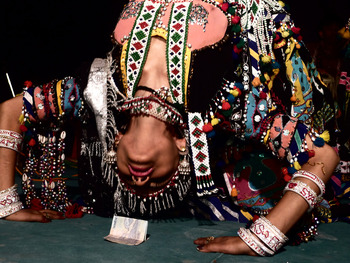
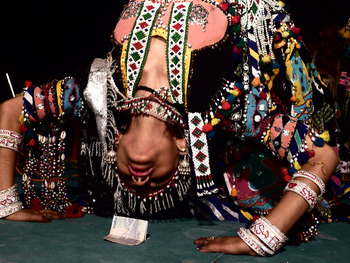
It is no coincidence that the establishment of these regional folk institutions and the appearance of Kalbeliya dance, beginning with the discovery of Gulabi Sapera, occurred simultaneously. Gulabi Sapera's dance fitted neatly into this search for “undiscovered/unknown,” “traditional,” and local Indian dance forms. The lively, up-tempo dance and its catchy musical accompanimentFootnote 46 drew the attention of many Indian organizers (Photo 3). However, local public opinion was initially less positive. Local art-loving, typically upper-class, Rajasthanis felt that their “real” (cf. inherited) traditions were being neglected in favor of an “artificial”’ (cf. new) form of entertainment. Rajasthani folklorists initially supported this perception of Kalbeliya dance as inferior “entertainment” and did not involve Kalbeliya dancers in their projects. Komal Kothari, one of the most respected Rajasthani folklorists and ethnomusicologists, did start including Kalbeliya dance in his programs. However, he explicitly introduced it as “newly–created.”Footnote 47 The commercial potential of Kalbeliya dance eventually persuaded many local folklorist-managers to advertise it as a main attraction of the Rajasthani tourist industry in their attempts to target an international audience. To justify the inclusion of Kalbeliya dance in Rajasthani folk performances and to relate Kalbeliya dance back to other, older, or traditional practices of the community, folklorist-managers looked for supposed ritual or symbolic functions of the dance. They conjured up an “authentic illusion” (Skounti Reference Skounti, Smith and Akagawa2009, 74) that transformed Kalbeliya dance from a modern transnational Gypsy dance into a supposedly ancient folk dance of snake charmers.
Indu Sapera picks up a bank note with her eye, demonstrating the flexibility of a Kalbeliya dancer. Photo by Ayla Joncheere, 2014.
Indeed, Kalbeliyas are frequently associated with snake charming and represented as such. Because of this profession of theirs, Kalbeliyas are often called Sapera (saperā),Footnote 48 which literally translates as “snake charmer.” Reflecting this historical practice of some Kalbeliya men, the dance performed by Kalbeliya women is in the present day commonly compared to the movement of snakes, and the so-called saperā dance is likewise translated as “the dance of the snake charmers.” This artificial association leads to fanciful descriptions of the dance form. Mahendra Bhanavat (Reference Bhanavat2004, 40), attaché of the West Zone Cultural Center in Udaipur, for example, writes in his book about Rajasthani folk dances, “Kalbeliya women are very talented dancers. They copy the movements of snakes with the same flexibility—as if they don't have a spine—and they make high-speed turn movements. Actually, it seems like their body does not have a spine at all.”Footnote 49 The Kalbeliya UNESCO report describes how, when the profession of snake charming was banned by the Wildlife Act of 1972, Kalbeliya women were obliged to replace the snakes by dancing.Footnote 50 Both recent popular narratives and scholarly accounts, which portray Kalbeliyas as a singular group of professional snake charmers, require a more nuanced approach. Kalbeliya dancers are currently presented as substitute ritual performers in an old, banned tradition where snakes were charmed by the tunes of the puṅgi (flute). Robertson (Reference Robertson2004, 1) considers snake charming the Kalbeliyas’ “traditional occupation,” while Angelillo (Reference Angelillo2012, 194) views it as “the main social characteristic of caste.” In contrast to the statements of Robertson and Angelillo referenced above, Komal Kothari estimates that only approximately five percent of the Kalbeliyas are actually involved in snake charming or snake worship (cited in Bharucha Reference Bharucha2003, 53–54; Singh Reference Singh1998, 474). While this is likely to be a well-reasoned guess, it does counter the predominant view that most Kalbeliyas are practitioners of the snake charming profession. The estimated low number of Kalbeliya snake charmers today has been attributed to the legal prohibition of snake catching. The Wildlife (Protection) Act of 1972 seeks to protect India's fast depleting wildlife and outlawed the profession of snake charming. However, it seems rather unlikely that the number of Kalbeliya snake charmers has diminished (according to Robertson Reference Robertson2004 and Angelillo Reference Angelillo2012) to the extent of becoming a minority livelihood for the community (or five percent, according to Kothari in Bharucha Reference Bharucha2003) in a single generation.
The Kalbeliya dancers I have worked with and their families did not keep snakes at home and did not professionally catch snakes; many even claimed to be afraid of them. The majority of the members of the older generation (the parents and grandparents of the Kalbeliya dancers) who were interviewed did not recall the practice of snake charming in their families. This means that if the Kalbeliya dancers’ ancestors were snake charmers, they must have left the profession at least three generations ago. Countering the current popular portrayal of Kalbeliya snake charmers as having recently lost their traditional occupation and thus their social identity as a distinguished caste, I would argue that snake charming as a metonymic signifier for the community is essentially exaggerated. The process of religious ritualization, especially the construction of the Kalbeliyas as “the priests of the snake” (Bharucha Reference Bharucha2003, 53) and of the dancer as the spiritual representation of the snake (as “a form of Lord Śiva” [Angellilo, 2012, 201]), has been used to legitimize Kalbeliya dance as a full-fledged heritage and ancient tradition. The prohibition of snake catching since the 1970s helps to explain the recent shift from using dancing snakes, a sort of “folk dance in its first existence” (Hoerburger Reference Hoerburger1968, 31; Shay Reference Shay1999, 32), to using Kalbeliya female dancers to personify and replace the ancient function of these “sacred” animals, or a “folk dance in its second existence” (Hoerburger Reference Hoerburger1968, 31; Shay Reference Shay1999, 32). Although the link between the dance and snake charming practices is evidently contrived and consciously encouraged by Rajasthani folklorist-managers, these same individuals promoted the dance's UNESCO nomination as authentic, intangible heritage (Joncheere Reference Joncheere2015).
Conclusion
The aim of this article was to demonstrate that the recent assertion of the premodern origins and hence historical continuity as well as “authenticity” of Kalbeliya dance is largely a constructed narrative. This position can be found in a few academic writings, but more importantly in the tourist and entertainment industries and in UNESCO documents. Instead, this article proposes that far from being a centuries-old expression of the Kalbeliya community, the dance is a creation dating back no farther than the 1980s. By focusing on the Kalbeliya case, I have offered a critique of the constructedness of folklore, prompted by the financial profits and status that tourist industries entail. Therefore, I consider Kalbeliya dance to be a product that arose at the crossroads of local conditions and economic realities in Rajasthan as well as of a transnational commercial interest in an Indian “authentic Gypsy culture.” The validation of Indian performances and their inclusion in dominant Indian culture is part of a much wider global discourse on the ideal of “culture,” neo-orientalism and folklorism. Kalbeliya dance, thus, developed as a neo-orientalist coalescence of global post-colonial, cultural, and nationalist developments in India. Particularly in Rajasthan, the dance emerged from a commercial desire to promote international cultural tourism, the search for Gypsy artists as a popularized proof of the Indian connection hypothesis, and the Kalbeliya community's need for social and economic improvement. This later resulted in the categorical upgrading of Kalbeliya dance from a form of oriental “Gypsy” entertainment to a traditional folk art, and ultimately, to the UNESCO declaration of Kalbeliya dance as an intangible cultural heritage.
The romantic fascination, the attraction to mystical exoticism, and the bodily desires that accompanied an imagination of the cultural other from the “East” have guided routes of development for music and dance. Therefore, it is important to further investigate the complex social and cultural process associated with the continuing commodification of neo-orientalism. By analyzing these discursive processes, attention is given to the transnational dynamics of the performing arts and contemporary realities of Indian dance. Although multiple discourses approach the Kalbeliya dance case from various angles, they often conceptualize it in overlapping ways with the aim of creating a novel and imaginary artistic practice and linking the dance to preexisting cultures. By accepting these perpetual categorizing divisions (as in this case, “traditional folk” or “authentic Gypsy”), the underlying discursive strategies of representational cultural practices are often overlooked, and the dynamic character of embodied practice is ignored. Dance practice is reduced within these discourses to a static reflection of its social environment, and its practitioner's agency is often constrained to merely replicating his/her (invented) heritage (O'Shea Reference O'Shea2007, 12). Dance practice then becomes legitimate only if it lives up to predetermined categories as well as audience expectations.
Similarly, by presenting the case of Kalbeliya dance, I have also shown how dance practices are being transformed to fit representational discourses, to endure in the public eye, and to be globally commercialized. The first discourse is the transnational discourse surrounding Gypsy performances as one of the recent (since the late 1980s) figureheads of the world music industry. The second discourse is the dichotomous discourse of classical versus folk performances as national representatives of the postcolonial Indian nation. Kalbeliya dance performances have been reformed as indigenous folk dances that represent a local practice based on the snake charming profession of male community members. Kalbeliya dance thus appears to be a “character dance” (Shay Reference Shay2006, 30) form representing a popular mishmash of ethnic Rajasthan. Kalbeliya dance practice reflects “expressive eclecticism” (Allen Reference Allen1998, 227–28) or multiple cultural orientations, organically combining postmodern aesthetics with traditional (premodern or modern) characteristics.
In reality, Kalbeliya dance practice per se does not cater to the nationalist standards of folk dance, but the constructed orientalist narrative behind it does. The double historical narrative (Gypsy and folk) behind the Kalbeliya dance form is not derived from an intentional engagement with the past, nor from an uninterrupted oral tradition that has adapted itself to modern times. I suggest that the problem does not lie in the fictitious authenticity of Kalbeliya dance as such because it appears to be an unattainable exercise for embodied practices to truly identify their authentic forms. Instead, the problem lies in the paradox that the supposedly authentic representation of Kalbeliya dance is a mediated conception of the dance itself and projects the dance through the hybrid lens of commercialism, nationalism, and neo-orientalist knowledge. It is interesting to question the very existence and importance of “authenticity” as regards embodied practices that claim historical and cultural accuracy, instead of highlighting the fact that performers create culture in the present (Scheelar Reference Scheelar, McDonald and Sellers-Young2013, 132). A dance's journey across time, whether it has extensive historical roots or not, is not necessarily smooth and is often negotiated both by the artistic imagination of the individuals who reembody these forms and by sociopolitical factors of the time in which the dance is practiced.