



1 Introduction
The main purpose of this article is to consider sequences
 $c(n)$
of real numbers of the form
 $$ \begin{align} c(n) \sim \frac C{n^\kappa} \exp\left(\sum_{\lambda\in\mathcal S}A_\lambda n^\lambda \right) \sum_{\mu\in\mathcal T} \frac{\beta_\mu}{n^\mu} \qquad (n \to \infty). \end{align} $$
Here,
 $\kappa \in \mathbb R$
,
 $\mathcal S\subset \mathbb Q^+ \cap (0,1)$
is finite,
 $\mathcal T\subset \mathbb Q_{0}^+$
is finite, C,
 $A_\lambda $
,
 $\beta _\mu \in \mathbb R$
with
 $\beta _0 = 1$
if
 $0\in \mathcal T$
. This general form was introduced by Bringmann, Franke, and Heim [Reference Bringmann, Franke and Heim5], including the asymptotical expression of the numbers of the unimodal sequences [Reference Bridges and Bringmann3], the strongly unimodal sequences [Reference Rhoades23], the partition without sequence [Reference Mauth18], the plane partition [Reference Wright28], the partition into k-gonal numbers [Reference Bridges, Brindle, Bringmann and Franke2], the finite-dimensional representations of groups
 $\mathfrak {su}(3)$
[Reference Bringmann and Franke4] and
 $\mathfrak {so}(5)$
[Reference Bridges, Brindle, Bringmann and Franke2] and the coefficients of the infinite product generating functions [Reference Bringmann, Franke and Heim5]. Bringmann, Franke, and Heim [Reference Bringmann, Franke and Heim5] proved that
 $c(n)$
satisfies the Turán inequality for sufficiently large n and put forward an open problem concerning with the Turán inequalities of higher order.
Recall that a real entire function
 $$ \begin{align} \psi(x)=\sum_{k=0}^{\infty} \gamma_k\frac{x^k}{k!} \end{align} $$
is said to be in the Laguerre–Pólya class, denoted by
 $\psi (x) \in \mathcal {LP}$
, if it can be represented in the form
 $$ \begin{align*} \psi(x)=c x^m e^{-\alpha x^{2}+\beta x} \prod_{k=1}^{\infty}\left(1+x/x_{k}\right)e^{- x/x_k}, \end{align*} $$
where c,
 $\beta $
, and
 $x_{k}$
are real numbers,
 $\alpha \geq 0$
, m is a nonnegative integer, and
 $\sum x^{-2}_{k}< \infty $
. The
 $\mathcal {LP}$
class has attracted much attention in view of its connection with Riemann hypothesis.
The Riemann
 $\Xi $
-function is defined as
 $$ \begin{align*} \Xi(z):=\frac{1}{2}\left(-z^2-\frac{1}{4}\right)\pi^{\frac{iz}{2}-\frac{1}{4}}\Gamma \left(-\frac{iz}{2}+\frac{1}{4}\right)\zeta\left(-iz+\frac{1}{2}\right). \end{align*} $$
Following [Reference Csordas, Norfolk and Varga8], the Riemann
 $\Xi $
-function can be written in Taylor series form as
 $$ \begin{align*}F(z):=\frac{1}{8}\Xi\left(\frac{z}{2}\right)=\sum \limits_{n=0}^{\infty}\frac{\gamma(n)}{n!}z^{2n}.\end{align*} $$
We say that a polynomial with real coefficients is hyperbolic if all of its zeros are real. The d-th associated Jensen polynomial with shift n of an arbitrary sequence {
 $\alpha (0), \alpha (1), \alpha (2),\ldots $
} of real numbers is the polynomial
 $$ \begin{align} J_{\alpha}^{d,n}(x)=\sum_{k=0}^{d}{ d\choose{k}} \alpha_{k+n} x^k. \end{align} $$
The hyperbolicity of degree d Jensen polynomial associated with the sequence
 $\{\alpha (n)\}$
is equivalent to the Turán inequality for
 $\{\alpha (n)\}$
of order d. Pólya and Schur proved that the Riemann hypothesis holds if and only if the function
 $F(z)$
belongs to
 $\mathcal {LP}$
class, i.e., having only real zeros, or equivalently, all Jensen polynomials having only real zeros.
Griffin, Ono, Rolen, and Zagier [Reference Griffin, Ono, Rolen and Zagier12] proved that under some conditions, the degree d Jensen polynomials associated with the sequence
 $\{\alpha (n)\}$
are hyperbolic for any d and sufficiently large n. In fact, they established the following theorem.
Theorem 1.1 (Griffin, Ono, Rolen, and Zagier)
Let
 $\alpha (n)$
,
 $A(n)$
, and
 $\delta (n)$
be sequences of positive real numbers with
 $\delta (n)$
tending to zero and satisfying
 $$\begin{align*}\log \left(\frac{\alpha(n+j)}{\alpha(n)}\right)=A(n)j-\delta(n)^2j^2+\sum_{i=3}^{d}g_i(n)j^i+o\left(\delta(n)^d\right) \quad \mbox{as}\quad n\rightarrow \infty \end{align*}$$
for some
 $d\geq 1$
, all
 $0\leq j\leq d$
and some
 $g_i(n)=o\left (\delta (n)^i\right )$
. Then, we have
 $$\begin{align*}\lim_{n\rightarrow \infty}\left(\frac{\delta(n)^{-d}}{\alpha(n)}J_{\alpha}^{d,n}\left(\frac{\delta(n)X-1}{\exp (A(n))}\right)\right)=H_d(X) \end{align*}$$
uniformly for X in any compact subset of
 $\mathbb {R}$
, where
 $H_d(X)$
are the Hermite polynomials.
Recall that a sequence
 $\{a_n\}_{n\geq 0}$
is called to satisfy the Turán inequality, if
 $$ \begin{align*} T(a_n)\colon={a_n}^2-a_{n-1}a_{n+1}\geq0. \end{align*} $$
We say that
 $\{a_n\}_{n\geq 0}$
satisfies the double Turán inequality, if
 $$ \begin{align*} T(T(a_n))\colon=({a_n}^2-a_{n-1}a_{n+1})^2-({a_{n-1}}^2-a_{n-2}a_{n})({a_{n+1}}^2-a_na_{n+2})\geq0. \end{align*} $$
A sequence
 $\{a_n\}_{n\geq 1}$
is called to satisfy the Laguerre inequality of order m [Reference Wang and Yang26], if
 $$ \begin{align} L_m(a_n):=\frac{1}{2}\sum_{k=0}^{2m}(-1)^{k+m}{2m\choose k}a_{n+k}a_{n+2m-k}\geq 0. \end{align} $$
The Laguerre inequalities have profound connections to the Riemann hypothesis and the Laguerre–Pólya class (see [Reference Csordas and Vishnyakova9, Reference Gasper11, Reference Laguerre15, Reference Patrick21, Reference Patrick22]). Recently, the Laguerre inequalities for the Maclaurin coefficients of the Riemann
 $\Xi $
-function, the partition function, and some celebrated sequences have been extensively studied (see [Reference Banerjee1, Reference Chen7, Reference Dou, Wang and Yang10, Reference Wagner25–Reference Wang and Yang27]). Denote the sum of the terms with positive (negative, respectively) coefficients of
 $L_m(a_n)$
by
 $L^+_m(a_n)$
(
 $L^-_m(a_n)$
, respectively). One can see that (1.4) equals to
 $\frac {L^+_m(a_n)}{L^-_m(a_n)}\geq 1$
. It is also interested to consider the companion Laguerre inequalities, i.e., give an upper bound for
 $\frac {L^+_m(a_n)}{L^-_m(a_n)}$
. For more recent work, see [Reference Banerjee1, Reference Chen7, Reference Dou, Wang and Yang10].
In this article, we will investigate these inequalities for
 $c(n)$
. This article is organized as follows. In Section 2, we shall prove that as
 $n \rightarrow \infty $
,
 $c(n)$
satisfies the Turán inequality of any order and the double Turán inequality. In Section 3, we will show that
 $c(n)$
satisfies the companion Turán inequality for sufficiently large n. In Section 4, we will show that
 $c(n)$
asymptotically satisfies the Laguerre inequality of any order and its companion version. In Section 5, as applications, we will show that the numbers of commuting
 $\ell $
-tuples in
 $S_n$
, the partition without sequence, the plane partition, the partition into k-gonal numbers, the finite-dimensional representations of groups
 $\mathfrak {su}(3)$
and
 $\mathfrak {so}(5),$
and the coefficients of infinite product generating functions asymptotically satisfy these inequalities.
2 Turán-type inequalities
In this section, we will prove that as
 $n \rightarrow \infty $
,
 $c(n)$
meets the requires of the Turán inequality of any order and the double Turán inequality.
To prove that
 $c(n)$
fulfills the Turán inequality of any order, we just need to verify
 $c(n)$
conform to the conditions of Theorem 1.1.
Theorem 2.1 Assume that
 $c(n)$
is a sequence of the form (1.1), let
 $\mathcal S\colon =\left \lbrace \lambda _1,\ldots , \lambda _s \right \rbrace $
, where
 $1>\lambda _1\geq \lambda _2\geq \cdots \geq \lambda _s>0$
and
 $\mathcal T\colon =\left \lbrace \mu _1, \ldots , \mu _t \right \rbrace $
, where
 $\mu _1\geq \mu _2\geq \cdots \geq \mu _t\geq 0$
,
 $\kappa $
, C,
 $A_\lambda $
,
 $\beta _\mu \in \mathbb R$
with
 $\beta _0 = 1$
if
 $0\in \mathcal T$
. If
 $A_{\lambda _1}>0$
, then for sufficiently large n,
 $c(n)$
fulfills the Turán inequality of any order.
Proof By the Taylor expansion of
 $\log x$
, we have that
 $$ \begin{align} \log(x)=x-1-\frac{(x-1)^2}{2}+\cdot\cdot\cdot+(-1)^{r-1}\frac{(x-1)^r}{r}+o(x^r),\ x\rightarrow 1. \end{align} $$
From (1.1), we get
 $$ \begin{align} \log \frac{c({n+j})}{c(n)}\sim \sum_{\lambda\in\mathcal S}A_\lambda (n+j)^\lambda-\sum_{\lambda\in\mathcal S}A_\lambda n^\lambda+\log\frac{n^\kappa}{(n+j)^\kappa}+\log\frac{\sum_{\mu\in\mathcal T} \frac{\beta_\mu}{(n+j)^\mu}}{\sum_{\mu\in\mathcal T} \frac{\beta_\mu}{n^\mu}}. \end{align} $$
We proceed to estimate
 $\sum _{\lambda \in \mathcal S}A_\lambda \left ((n+j)^\lambda -n^\lambda \right )$
3,
 $\log \frac {n^\kappa }{(n+j)^\kappa }$
and
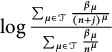 $\log \frac {\sum _{\mu \in \mathcal T} \frac {\beta _\mu }{(n+j)^\mu }}{\sum _{\mu \in \mathcal T} \frac {\beta _\mu }{n^\mu }}$
, respectively.
First, we estimate
 $\sum _{\lambda \in \mathcal S}A_\lambda \left ((n+j)^\lambda -n^\lambda \right )$
. Since
 $$ \begin{align} (n+j)^\lambda-n^\lambda=\sum_{i=1}^{N}{\lambda\choose i} n^{-i + \lambda}j^i+o(n^{-N+\lambda}) \quad\quad (N\geq r). \end{align} $$
Thus,
 $$ \begin{align} \sum_{\lambda\in\mathcal S}A_\lambda \left((n+j)^\lambda-n^\lambda\right)=\sum_{\lambda\in\mathcal S}A_\lambda\sum_{i=1}^{N}{\lambda\choose i} n^{-i + \lambda} j^i+o(n^{-N+\lambda}) \quad\quad (N\geq r). \end{align} $$
Next, we turn to estimating
 $\log \frac {n^\kappa }{(n+j)^\kappa }$
. Since
 $$ \begin{align} \frac{n^\kappa}{(n+j)^\kappa} =\sum_{i=0}^{N}{-\kappa\choose i} n^{-i} j^i+O(n^{-N-1}), \end{align} $$
by (2.1), we obtain
 $$ \begin{align} \log\frac{n^\kappa}{(n+j)^\kappa} =\sum_{i=1}^{N}f_i(\kappa) n^{-i}j^i+O(n^{-N-1}), \end{align} $$
where
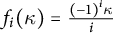 $f_i(\kappa )=\frac {(-1)^i\kappa }{i}$
.
Finally, we only need to estimate
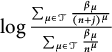 $\log \frac {\sum _{\mu \in \mathcal T} \frac {\beta _\mu }{(n+j)^\mu }}{\sum _{\mu \in \mathcal T} \frac {\beta _\mu }{n^\mu }}$
. Since
 $$ \begin{align} \sum_{\mu\in\mathcal T} \frac{\beta_\mu}{n^\mu}=\sum_{i=1}^{t}\beta_{\mu_i}n^{-\mu_i},\quad \sum_{\mu\in\mathcal T} \frac{\beta_\mu}{(n+j)^\mu}=\sum_{i=1}^{t}\beta_{\mu_i}(n+j)^{-\mu_i}, \end{align} $$
from (2.1), we deduce that
 $$ \begin{align} \log\frac{\sum_{\mu\in\mathcal T} \frac{\beta_\mu}{(n+j)^\mu}}{\sum_{\mu\in\mathcal T} \frac{\beta_\mu}{n^\mu}} =\sum_{i=1}^{N}G_i(n)j^i+o(G_N(n)), \end{align} $$
where
 $G_{i}(n)$
are certain polynomials of n with degree no more than
 $-i$
and
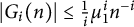 ${|G_i(n)|\leq \frac {1}{i}\mu _1^in^{-i}}$
.
Combining (2.4), (2.6), and (2.8), as
 $n\rightarrow \infty ,$
we get that
 $$ \begin{align} \begin{aligned} \log \frac{c({n+j})}{c(n)}&\sim \sum_{\lambda\in\mathcal S}A_\lambda\sum_{i=1}^{N}{\lambda\choose i} n^{-i + \lambda}j^i +\sum_{i=1}^{N}f_i(\kappa) n^{-i}j^i+\sum_{i=1}^{N}G_i(n)j^i +o(n^{-N+\lambda})\\ &=:\sum_{i=1}^{N}\left(\sum_{\lambda\in\mathcal S}B_{\lambda,i}(n)+F_i(n)\right)j^i+o(n^{-N+\lambda}), \end{aligned} \end{align} $$
where
 $B_{\lambda ,i}(n)=A_\lambda {\lambda \choose i} n^{-i + \lambda }$
,
 $F_i(n)=f_i(\kappa )n^{-i}+G_i(n)$
. Employing (2.6) and (2.8), we get
 $|F_i(n)|\leq \frac {1}{i}(\mu _1^i+\kappa )n^{-i}$
.
Let
 $A(n)=\sum _{\lambda \in \mathcal S}B_{\lambda ,1}(n)+F_1(n)$
,
 $\delta (n)=\sqrt {-\sum _{\lambda \in \mathcal S}B_{\lambda ,2}(n)-F_2(n)}$
,
 $g_i(n)=\sum _{\lambda \in \mathcal S}B_{\lambda ,i}(n)+F_i(n) (i\geq 3)$
. Then,
 $i\geq 3$
, we get
 $$ \begin{align} \begin{aligned} \lim_{n \rightarrow \infty}\frac{g_i(n)}{\delta(n)^i} &=\lim_{n \rightarrow \infty}\frac{\sum_{\lambda\in\mathcal S}B_{\lambda,i}(n)+F_i(n)}{\left(-\sum_{\lambda\in\mathcal S}B_{\lambda,2}(n)-F_2(n)\right)^{\frac{i}{2}}}\\&=\lim_{n \rightarrow \infty}\frac{\sum_{\lambda\in\mathcal S}A_\lambda{\lambda\choose i} n^{-i + \lambda}}{(-\sum_{\lambda\in\mathcal S}A_\lambda{\lambda\choose 2} n^{-2 + \lambda})^{\frac{i}{2}}}\\&=\lim_{n \rightarrow \infty}\frac{\sum_{\lambda\in\mathcal S}A_\lambda{\lambda\choose i}}{(-\sum_{\lambda\in\mathcal S}A_\lambda{\lambda\choose 2})^{\frac{i}{2}}}n^{\lambda(1-\frac{i}{2})}\\&=0. \end{aligned} \end{align} $$
In summary, we have that
 $c(n)$
satisfies the conditions of Theorem 1.1. Thus, for sufficiently large n,
 $c(n)$
satisfies the Turán inequality of any order.
Now, we turn to proving the double Turán inequality for
 $c(n)$
.
Theorem 2.2 For sufficiently large n,
 $c(n)$
satisfies the double Turán inequality, i.e.,
 $$ \begin{align} \begin{aligned} T(T(c(n)))&=({c(n)^2}-c{(n-1)}c({n+1}))^2\\ &\quad -(c({n-1})^2-c({n-2})c({n}))({c({n+1})^2}-c(n)c({n+2}))\geq0. \end{aligned} \end{align} $$
Proof Following the framework in the proof of Theorem 1.3 in [Reference Bringmann, Franke and Heim5], we claim that for all
 $\lambda \in \mathcal {S}$
,
 $$ \begin{align*} \exp\left(A_\lambda\left(2n^\lambda-(n+1)^\lambda-(n-1)^\lambda\right)\right) = 1 - \frac{\gamma_{\lambda,1}}{n^{2-\lambda}} +\frac{\gamma^2_{\lambda,1}}{2n^{4-2\lambda}} + o\left(n^{-4+2\lambda}\right), \end{align*} $$
where
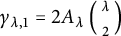 $\gamma _{\lambda ,1}=2A_\lambda \left (\begin {smallmatrix}\lambda \\\\2\end {smallmatrix}\right )$
,
 $$ \begin{align*} \exp\left(A_\lambda\left(n^\lambda+(n+2)^\lambda-2(n+1)^\lambda\right)\right) = 1 + \frac{\mu_{\lambda,1}}{n^{2-\lambda}} + \frac{\mu_{\lambda,2}}{n^{3-\lambda}} +\frac{\mu^2_{\lambda,1}}{2n^{4-2\lambda}} + o\left(n^{-4+2\lambda}\right), \end{align*} $$
where
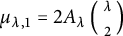 $\mu _{\lambda ,1}=2A_\lambda \left (\begin {smallmatrix}\lambda \\\\2\end {smallmatrix}\right )$
and
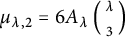 $\mu _{\lambda ,2}=6A_\lambda \left (\begin {smallmatrix}\lambda \\\\3\end {smallmatrix}\right )$
,
 $$ \begin{align*} \exp\left(A_\lambda\left(n^\lambda+(n-2)^\lambda-2(n-1)^\lambda\right)\right) = 1 + \frac{\omega_{\lambda,1}}{n^{2-\lambda}} + \frac{\omega_{\lambda,2}}{n^{3-\lambda}} +\frac{\omega^2_{\lambda,1}}{2n^{4-2\lambda}} + o\left(n^{-4+2\lambda}\right), \end{align*} $$
where
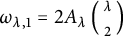 $\omega _{\lambda ,1}=2A_\lambda \left (\begin {smallmatrix}\lambda \\\\2\end {smallmatrix}\right )$
and
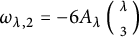 $\omega _{\lambda ,2}=-6A_\lambda \left (\begin {smallmatrix}\lambda \\\\3\end {smallmatrix}\right )$
.
Then, we get that
 $$ \begin{align} &\quad \exp\left(\sum_{\lambda\in\mathcal S}A_\lambda\left(2n^\lambda-(n-1)^\lambda-(n+1)^\lambda\right)\right)\nonumber\\&= \prod_{\lambda \in \mathcal{S}} \left( 1 - \frac{\gamma_{\lambda,1}}{n^{2-\lambda}} +\frac{\gamma^2_{\lambda,1}}{2n^{4-2\lambda}} + o\left(n^{-4+2\lambda}\right)\right) \nonumber\\&= 1 - \frac{\gamma_{\lambda_1,1}}{n^{2-\lambda_1}}-\cdot\cdot\cdot - \frac{\gamma_{\lambda_2,1}}{n^{2-\lambda_2}} + \frac{\gamma^2_{\lambda_1,1}}{2n^{4-2\lambda_1}}+ o\left( n^{-4+2\lambda_1}\right),\nonumber\\&\quad \exp\left(\sum_{\lambda\in\mathcal S}A_\lambda\left(n^\lambda+(n+2)^\lambda-2(n+1)^\lambda\right)\right)\nonumber\\& = \prod_{\lambda \in \mathcal{S}} \left( 1 + \frac{\mu_{\lambda,1}}{n^{2-\lambda}} + \frac{\mu_{\lambda,2}}{n^{3-\lambda}} +\frac{\mu^2_{\lambda,1}}{2n^{4-2\lambda}} + o\left(n^{-4+2\lambda}\right)\right) \\&= 1 + \frac{\mu_{\lambda_1,1}}{n^{2-\lambda_1}} +\cdot\cdot\cdot+ \frac{\mu_{\lambda_s,1}}{n^{2-\lambda_s}} + \frac{\mu_{\lambda_1,2}}{n^{3-\lambda_1}}+\cdot\cdot\cdot+ \frac{\mu_{\lambda_{s'},2}}{n^{3-\lambda_{s'}}} + \frac{\mu^2_{\lambda_1,1}}{2n^{4-2\lambda_1}}+ o\left( n^{-4+2\lambda_1}\right),\nonumber\\&\quad \exp\left(\sum_{\lambda\in\mathcal S}A_\lambda\left(n^\lambda+(n-2)^\lambda-2(n-1)^\lambda\right)\right)\nonumber\\& = \prod_{\lambda \in \mathcal{S}} \left( 1 + \frac{\omega_{\lambda,1}}{n^{2-\lambda}} + \frac{\omega_{\lambda,2}}{n^{3-\lambda}} +\frac{\omega^2_{\lambda,1}}{2n^{4-2\lambda}} + o\left(n^{-4+2\lambda}\right)\right) \nonumber\\&= 1 + \frac{\omega_{\lambda_1,1}}{n^{2-\lambda_1}} +\cdot\cdot\cdot+ \frac{\omega_{\lambda_s,1}}{n^{2-\lambda_s}} + \frac{\omega_{\lambda_1,2}}{n^{3-\lambda_1}}+\cdot\cdot\cdot+ \frac{\omega_{\lambda_{s'},2}}{n^{3-\lambda_{s'}}} + \frac{\omega^2_{\lambda_1,1}}{2n^{4-2\lambda_1}}+ o\left( n^{-4+2\lambda_1}\right).\nonumber \end{align} $$
Here,
 $\lambda _{s'}>2\lambda _{1}-1$
.
A direct calculation gives that for
 $n>1$
,
 $$ \begin{align} \begin{aligned} &\frac1 {n^{2\kappa}} =\frac1{(n-1)^{\kappa}(n+1)^\kappa} \left(1+\sum_{j\ge2}\frac{a_j}{n^{j}}\right),\\&\frac1{n^\kappa(n+2)^{\kappa}} = (n+1)^{-2\kappa} \left(1+\sum_{j\ge2}\frac{b_j}{n^{j}}\right),\\&\frac1{n^{\kappa}(n-2)^{\kappa}} =(n-1)^{-2\kappa} \left(1+\sum_{j\ge2}\frac{c_j}{n^{j}}\right). \end{aligned} \end{align} $$
According to (2.12) and (2.13), we have
 $$ \begin{align*} &T(T(c(n))) \sim C^4 \frac{\exp\left(2\sum_{\lambda\in\mathcal S}A_\lambda ((n-1)^\lambda+(n+1)^\lambda)\right)}{(n-1)^{2\kappa}(n+1)^{2\kappa}}\left(C^{\prime2}-A'B'\right), \end{align*} $$
where
 $$ \begin{align*} A'&=\left(\sum_{\mu\in\mathcal T}\frac{\beta_\mu}{(n+1)^\mu}\right)^2\\&\quad - \left(1 + \frac{\mu_{\lambda_1,1}}{n^{2-\lambda_1}} +\cdot\cdot\cdot+ \frac{\mu_{\lambda_s,1}}{n^{2-\lambda_s}} + \frac{\mu_{\lambda_1,2}}{n^{3-\lambda_1}}+\cdot\cdot\cdot+ \frac{\mu_{\lambda_{s'},2}}{n^{3-\lambda_{s'}}} + \frac{\mu^2_{\lambda_1,1}}{2n^{4-2\lambda_1}}+ o\left( n^{-4+2\lambda_1}\right)\right)\\&\quad \times \left(1+ O\left(n^{-2}\right)\right) \sum_{\mu\in\mathcal T} \frac{\beta_\mu}{n^{\mu}} \sum_{\nu\in\mathcal T} \frac{\beta_\nu}{(n+2)^\nu},\\B'&=\left(\sum_{\mu\in\mathcal T}\frac{\beta_\mu}{(n-1)^\mu}\right)^2\\&\quad - \left(1 + \frac{\omega_{\lambda_1,1}}{n^{2-\lambda_1}} +\cdot\cdot\cdot+ \frac{\omega_{\lambda_s,1}}{n^{2-\lambda_s}} + \frac{\omega_{\lambda_1,2}}{n^{3-\lambda_1}}+\cdot\cdot\cdot+ \frac{\omega_{\lambda_{s'},2}}{n^{3-\lambda_{s'}}} + \frac{\omega^2_{\lambda_1,1}}{2n^{4-2\lambda_1}}+ o\left( n^{-4+2\lambda_1}\right)\right)\\&\quad \times \left(1+ O\left(n^{-2}\right)\right) \sum_{\mu\in\mathcal T} \frac{\beta_\mu}{n^{\mu}} \sum_{\nu\in\mathcal T} \frac{\beta_\nu}{(n-2)^\nu},\\C'&=\sum_{\mu\in\mathcal T} \frac{\beta_\mu}{(n-1)^{\mu}} \sum_{\nu\in\mathcal T} \frac{\beta_\nu}{(n+1)^\nu} \\&\quad - \left(1 - \frac{\gamma_{\lambda_1,1}}{n^{2-\lambda_1}} -\cdot\cdot\cdot- \frac{\gamma_{\lambda_s,1}}{n^{2-\lambda_s}}-\cdot\cdot\cdot + \frac{\gamma^2_{\lambda_1,1}}{2n^{4-2\lambda_1}}+ o\left( n^{-4+2\lambda_1}\right)\right)\\& \quad \times \left(1+ O\left(n^{-2}\right)\right)\left(\sum_{\mu\in\mathcal T}\frac{\beta_\mu}{n^\mu}\right)^2. \end{align*} $$
As
 $\beta _0 = 1$
, we take A mod
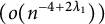 $(o(n^{-4+2\lambda _1}))$
,
 $$ \begin{align} &\sum_{\substack{\mu,\nu\in\mathcal T\\0\le \mu+\nu\le4-2\lambda_1}}\!\! \frac{\beta_\mu\beta_\nu}{(n+1)^{\mu+\nu}} - \left(\sum_{\substack{\mu,\nu\in\mathcal T\\0\le \mu+\nu\le4-2\lambda_1}} \frac{\beta_\mu\beta_\nu}{n^\mu(n+2)^\nu} + \sum_{i=1}^{s}\frac{\mu_{\lambda_i,1}}{n^{2-\lambda_i}}\!\sum_{\substack{\mu,\nu\in\mathcal T\\0\le \mu+\nu\le2-2\lambda_1+\lambda_i}} \!\frac{\beta_\mu\beta_\nu}{n^\mu(n+2)^\nu}\right.\nonumber\\&\qquad \left.+\sum_{i=1}^{s'}\frac{\mu_{\lambda_i,2}}{n^{3-\lambda_i}}+\frac{\mu^2_{\lambda_1,1} }{2n^{4-2\lambda_1}}\right) \nonumber\\&\quad = 2\sum_{\substack{\mu\in\mathcal T\\0\le \mu\le2-\lambda_1}} \beta_\mu^2 \left(\frac{1}{(n+1)^{2\mu}}-\frac{1}{n^\mu(n+2)^\mu}\right)\nonumber\\& \qquad + \sum_{\substack{\mu\in\mathcal T\\0\le\mu<\nu\\1\le \mu+\nu\le4-2\lambda_1}} \beta_\mu \beta_\nu \left(\frac2{(n+1)^{\mu+\nu}}-\frac1{n^\mu(n+2)^\nu}-\frac1{n^\nu(n+2)^\mu}\right)\nonumber\\&\quad\quad-\left(\sum_{i=1}^{s}\frac{\mu_{\lambda_i,1}}{n^{2-\lambda_i}} +\sum_{i=1}^{s}\frac{\mu_{\lambda_i,1}}{n^{2-\lambda_i}}\sum_{\substack{\mu,\nu\in\mathcal T\\1\le \mu+\nu\le2-2\lambda_1+\lambda_i}} \frac{\beta_\mu\beta_\nu}{n^\mu(n+2)^\nu}+\sum_{i=1}^{s'}\frac{\mu_{\lambda_i,2}}{n^{3-\lambda_i}}+\frac{\mu^2_{\lambda_1,1} }{2n^{4-2\lambda_1}}\right)\nonumber\\&\quad =\left\{ \begin{aligned} &-\frac{2\beta_1}{n^3}-\sum_{i=1}^{s}\frac{\mu_{\lambda_i,1}}{n^{2-\lambda_i}} -2\beta_1\sum_{i=1}^{s'}\frac{\mu_{\lambda_i,1}}{n^{3-\lambda_i}}-\sum_{i=1}^{s'}\frac{\mu_{\lambda_i,2}}{n^{3-\lambda_i}} -\frac{\mu^2_{\lambda_1,1} }{2n^{4-2\lambda_1}}, \ &0<\lambda_1\leq\frac{1}{2},\\ &-\sum_{i=1}^{s}\frac{\mu_{\lambda_i,1}}{n^{2-\lambda_i}} -2\beta_1\sum_{i=1}^{s'}\frac{\mu_{\lambda_i,1}}{n^{3-\lambda_i}}-\sum_{i=1}^{s'}\frac{\mu_{\lambda_i,2}}{n^{3-\lambda_i}} -\frac{\mu^2_{\lambda_1,1} }{2n^{4-2\lambda_1}},\ &\frac{1}{2}<\lambda_1<1. \end{aligned} \right. \nonumber\\ \end{align} $$
Similarly,
 $$ \begin{align} &B'\left(\bmod (o(n^{-4+2\lambda_1}))\right)\nonumber\\& \quad =\left\{ \begin{aligned} &-\frac{2\beta_1}{n^3}-\sum_{i=1}^{s}\frac{\omega_{\lambda_i,1}}{n^{2-\lambda_i}} -2\beta_1\sum_{i=1}^{s'}\frac{\omega_{\lambda_i,1}}{n^{3-\lambda_i}}-\sum_{i=1}^{s'}\frac{\omega_{\lambda_i,2}}{n^{3-\lambda_i}} -\frac{\omega^2_{\lambda_1,1} }{2n^{4-2\lambda_1}}, &0<\lambda_1\leq\frac{1}{2},\\&-\sum_{i=1}^{s}\frac{\omega_{\lambda_i,1}}{n^{2-\lambda_i}} -2\beta_1\sum_{i=1}^{s'}\frac{\omega_{\lambda_i,1}}{n^{3-\lambda_i}}-\sum_{i=1}^{s'}\frac{\omega_{\lambda_i,2}}{n^{3-\lambda_i}} -\frac{\omega^2_{\lambda_1,1} }{2n^{4-2\lambda_1}}, &\frac{1}{2}<\lambda_1<1 \end{aligned} \right. \end{align} $$
and
 $$ \begin{align} C' \left(\bmod (o(n^{-4+2\lambda_1}))\right)=\left\{ \begin{aligned} &\frac{2\beta_1}{n^3}+\sum_{i=1}^{s}\frac{\gamma_{\lambda_i,1}}{n^{2-\lambda_i}} +2\beta_1\sum_{i=1}^{s'}\frac{\gamma_{\lambda_i,1}}{n^{3-\lambda_i}}-\frac{\gamma^2_{\lambda_1,1} }{2n^{4-2\lambda_1}}, &0<\lambda_1\leq\frac{1}{2},\\ &\sum_{i=1}^{s}\frac{\gamma_{\lambda_i,1}}{n^{2-\lambda_i}} +2\beta_1\sum_{i=1}^{s'}\frac{\gamma_{\lambda_i,1}}{n^{3-\lambda_i}}-\frac{\gamma^2_{\lambda_1,1} }{2n^{4-2\lambda_1}}, &\frac{1}{2}<\lambda_1<1. \end{aligned} \right.\nonumber\\ \end{align} $$
Combining (2.14)–(2.16), we get that for
 $0<\lambda _1\leq \frac {1}{2}$
,
 $C^{\prime 2}-A'B'$
can be simplified to
 $$ \begin{align*} &\left(\frac{2\beta_1}{n^3}+\sum_{i=1}^{s}\frac{\gamma_{\lambda_i,1}}{n^{2-\lambda_i}} +2\beta_1\sum_{i=1}^{s'}\frac{\gamma_{\lambda_i,1}}{n^{3-\lambda_i}}-\frac{\gamma^2_{\lambda_1,1} }{2n^{4-2\lambda_1}}\right)^2\\&\qquad -\left(-\frac{2\beta_1}{n^3}-\sum_{i=1}^{s}\frac{\mu_{\lambda_i,1}}{n^{2-\lambda_i}} -2\beta_1\sum_{i=1}^{s'}\frac{\mu_{\lambda_i,1}}{n^{3-\lambda_i}}-\sum_{i=1}^{s'}\frac{\mu_{\lambda_i,2}}{n^{3-\lambda_i}} -\frac{\mu^2_{\lambda_1,1} }{2n^{4-2\lambda_1}}\right)\\&\qquad \times \left(-\frac{2\beta_1}{n^3}-\sum_{i=1}^{s}\frac{\omega_{\lambda_i,1}}{n^{2-\lambda_i}} -2\beta_1\sum_{i=1}^{s'}\frac{\omega_{\lambda_i,1}}{n^{3-\lambda_i}}-\sum_{i=1}^{s'}\frac{\omega_{\lambda_i,2}}{n^{3-\lambda_i}} -\frac{\omega^2_{\lambda_1,1} }{2n^{4-2\lambda_1}}\right)\\&\quad =-\frac{16A^3_{\lambda_1}\left(\begin{smallmatrix}\lambda_1\\\\2\end{smallmatrix}\right)^3}{n^{-6+3\lambda_1}}+o(n^{-6+3\lambda_1}). \end{align*} $$
For
 $\frac {1}{2}<\lambda _1<1$
,
 $C^{\prime 2}-A'B'$
can be simplified to
 $$ \begin{align*} &\left(\sum_{i=1}^{s}\frac{\gamma_{\lambda_i,1}}{n^{2-\lambda_i}} +2\beta_1\sum_{i=1}^{s'}\frac{\gamma_{\lambda_i,1}}{n^{3-\lambda_i}}-\frac{\gamma^2_{\lambda_1,1} }{2n^{4-2\lambda_1}}\right)^2\\& \quad - \left(-\sum_{i=1}^{s}\frac{\mu_{\lambda_i,1}}{n^{2-\lambda_i}} -2\beta_1\sum_{i=1}^{s'}\frac{\mu_{\lambda_i,1}}{n^{3-\lambda_i}}-\sum_{i=1}^{s'}\frac{\mu_{\lambda_i,2}}{n^{3-\lambda_i}} -\frac{\mu^2_{\lambda_1,1} }{2n^{4-2\lambda_1}}\right)\\&\quad \times \left(-\sum_{i=1}^{s}\frac{\omega_{\lambda_i,1}}{n^{2-\lambda_i}} -2\beta_1\sum_{i=1}^{s'}\frac{\omega_{\lambda_i,1}}{n^{3-\lambda_i}}-\sum_{i=1}^{s'}\frac{\omega_{\lambda_i,2}}{n^{3-\lambda_i}} -\frac{\omega^2_{\lambda_1,1} }{2n^{4-2\lambda_1}}\right)\\& \quad =-\frac{16A^3_{\lambda_1}\left(\begin{smallmatrix}\lambda_1\\\\2\end{smallmatrix}\right)^3}{n^{-6+3\lambda_1}}+o(n^{-6+3\lambda_1}). \end{align*} $$
Since
 $A_{\lambda _1}>0$
and
 $0<\lambda _1<1$
, we conclude that
 $$ \begin{align} \mathrm{sgn}\left(-16A^3_{\lambda_1}\left(\begin{smallmatrix}\lambda_1\\\\2\end{smallmatrix}\right)^3\right)=1. \end{align} $$
This completes the proof.
3 The companion Turán inequality
In this section, we will show that
 $c(n)$
adheres the companion Turán inequality for sufficiently large n.
Theorem 3.1 Assume that
 $c(n)$
satisfies the form (1.1), then
 $c(n)$
asymptotically satisfies the companion Turán inequality, i.e.,
 $$ \begin{align} c(n)^2 -\left(1+\frac{\overline{\gamma}}{n^{2-{\lambda_1}}}\right) c(n+1) c(n-1)\leq0, \end{align} $$
where
 $\gamma _{\lambda _1,1}$
is defined as in Theorem 2.2 and
 $\overline {\gamma }$
is any real number larger than
 $-\gamma _{\lambda _1,1}$
.
Proof We have

The sign of this is dictated by
 $$ \begin{align*}\sum_{\mu,\nu\in T}\frac{\beta_{\mu}\beta_{\nu}}{n^{\mu+\nu}}-\left(1+\frac{\overline{\gamma}}{n^{2-{\lambda_1}}} \right) \left(1+\frac{\gamma_{\lambda_1,1}}{n^{2-\lambda_1}}+o\left(n^{-2+\lambda_1}\right)\right)\left(1+O\left(n^{-2}\right)\right)\sum_{\mu\in T}\frac{\beta_{\mu}}{(n+1)^{\mu}}\sum_{\nu\in T}\frac{\beta_{\nu}}{(n-1)^{\nu}}.\end{align*} $$
As
 $\beta _0=1$
, the above formula
 $\mod \left ( o(n^{-2+\lambda _1})\right )$
equals,
 $$ \begin{align} \begin{aligned} &\sum_{\mu,\nu\in\mathcal{T}}\frac{\beta_{\mu}\beta_{\nu}}{n^{\mu+\nu}}-\left( \sum_{\mu,\nu\in\mathcal{T}}\frac{\beta_{\mu}\beta_{\nu}}{(n+1)^{\mu}(n-1)^{\nu}}+\frac{\gamma_{\lambda_1,1}}{n^{2-\lambda_1}}+\frac{\overline{\gamma}}{n^{2-{\lambda_1}}}\right)\\& \quad = 2\sum_{\substack{\mu\in\mathcal T\\0\le \mu\le1-\frac{\lambda_1}{2}}}\beta_{\mu}^2\left(\frac{1}{n^{2\mu}}-\frac{1}{(n+1)^{\mu}(n-1)^{\mu}}\right) \\& \qquad + \sum_{\substack{\mu,\nu\in\mathcal T\\0\le \mu<\nu\\1\le \mu+\nu\le2-\lambda_1}}\beta_{\mu}\beta_{\nu}\left(\frac{2}{n^{\mu+\nu}}- \frac{1}{(n+1)^{\mu}(n-1)^{\nu}}- \frac{1}{(n+1)^{\nu}(n+1)^{\mu}}\right)\\& \qquad - \frac{\gamma_{\lambda_1,1}}{n^{2-\lambda_1}}-\frac{\overline{\gamma}}{n^{2-{\lambda_1}}}. \end{aligned} \end{align} $$
For
 $n>1$
,
 $$ \begin{align*}\frac{1}{(n+1)^{\nu}(n+1)^{\mu}}=n^{-2\mu}+O\left(n^{-2\mu-2} \right)\end{align*} $$
and
 $$ \begin{align*}\frac{1}{(n+1)^{\mu}(n-1)^{\nu}}-\frac{1}{(n+1)^{\nu}(n+1)^{\mu}}= 2n^{-\mu-\nu} \left(1+\sum_{r \geq 1}\frac{p_r}{n^{2r}} \right) .\end{align*} $$
Thus, (3.2) becomes
 $$\begin{align*}O(n^{-2+\lambda_1})-\frac{\gamma_{\lambda_1,1}+\overline{\gamma}}{n^{2-{\lambda_1}}}.\end{align*}$$
When
 $\overline {\gamma }>-\gamma _{\lambda _1,1}$
, it is obvious that (3.1) holds for sufficiently large n.
4 Laguerre inequalities
In this section, we demonstrate that
 $c(n)$
fulfills the Laguerre inequality and their companion inequality of any order. Recently, Wang and Yang [Reference Wang and Yang27] proved that for any r and sufficiently large n, one has
 $L_r(\alpha (n))>0$
.
Theorem 4.1 (Wang and Yang)
Let
 $\{\alpha (n)\},\{\delta (n)\},\{A_i(n)\}$
be sequences with
 $\alpha (n)$
positive,
 $\delta (n)\to 0^+$
,
 $A_2(n)<0$
,
 $A_2(n)=\Theta (\delta (n)^{t})$
and
 $A_{2i}(n)=o(\delta (n)^{it})\ (i\geq 2)$
for some positive t, and for
 $-r<j<r$
,
 $$ \begin{align} \log\left(\frac{\alpha(n+j)}{\alpha(n)}\right)=\sum_{i=1}^{2r}A_i(n)j^i+o\left(\delta(n)^{tr}\right), \end{align} $$
then for sufficiently large n,
 $$ \begin{align} L_r(\alpha(n))=\frac{1}{2}\sum_{k=0}^{2r}(-1)^{k+r}{2r\choose k}\alpha(n+k)\alpha(n+2r-k)>0. \end{align} $$
Since the conditions of Theorem 1.1 are stronger than those of Theorem 4.1, we get that
 $c(n)$
meets the requirements of the above theorem from the proof of Theorem 2.1. Thus,
 $c(n)$
fulfills the Laguerre inequality of any order for sufficiently large n. Next, we prove that
 $c(n)$
satisfies the companion Laguerre inequalities. First, let us recall two combinatorial identities which will be used in our proofs (see [Reference Dou, Wang and Yang10, Reference Wang and Yang27]).
Lemma 4.2 For positive integers m and
 $t\leq 2m$
,
 $$ \begin{align} \sum_{k=0}^{2m}(-1)^k {2m\choose k}(m-k)^t=\left\{ \begin{aligned} &0, \ &t<2m,\\ &(2m)!,\ &t=2m. \end{aligned} \right. \end{align} $$
Lemma 4.3 For positive integers r,
 $$ \begin{align} \sum_{k=0}^{2r}{2r\choose k}(r-k)^2=2^{2r-1}r. \end{align} $$
Now, we are in a position to establish the companion Laguerre inequalities for
 $c(n)$
.
Theorem 4.4 For any fixed
 $r\geq 2$
and sufficiently large n,
 $c(n)$
satisfies the companion Laguerre inequality of order r, i.e.,
 $$ \begin{align} \left(1+\frac{(2r)!}{r!}2^{1-r}(-A_{\lambda_1})^{r}{\lambda_1\choose 2}^r n^{(-2+\lambda_1)(r-1)}\right)L_r^-(c(n-r))>L_r^+(c(n-r)). \end{align} $$
Proof The inequality (4.5) can be rewritten as
 $$ \begin{align} \begin{aligned} &\frac{(2r)!}{r!}2^{1-r}(-A_{\lambda_1})^{r}{\lambda_1\choose 2}^r n^{(-2+\lambda_1)(r-1)}\frac{L_r^-(c(n-r))}{c(n)^2}\\& \quad >\frac{L_r^+(c(n-r))}{c(n)^2}-\frac{L_r^-(c(n-r))}{c(n)^2}\\& \quad =\frac{L_r(c(n-r))}{c(n)^2}. \end{aligned} \end{align} $$
The right-hand side of the above inequality can be expressed as
 $$ \begin{align*} \frac{L_{r}(c(n-r))}{c(n)^2}=\frac{1}{2}\sum_{j=0}^{2r}(-1)^{j+r}{2r\choose j}\frac{c(n-r+j)c(n+r-j)}{c(n)^2}. \end{align*} $$
From (2.9), we get

where
 $B_{2i}(n)$
are certain polynomials of n with degree no more than
 $-2i+\lambda _1$
and the coefficient of
 $n^{-2i+\lambda _1}$
is
 $A_{\lambda _1} \left (\begin {smallmatrix}\lambda _1\\\\2i\end {smallmatrix}\right )$
.
Let
 $$ \begin{align} \phi_r(x):=\sum_{i=1}^{2r}\frac{x^i}{i!}=\exp(x)+o\left(x^{2r}\right). \end{align} $$
Then, as
 $n\to \infty $
, we get
 $$ \begin{align*} &\frac{L_{r}(c(n-r))}{c(n)^2}\\& \quad =\frac{1}{2}\sum_{j=0}^{2r}(-1)^{j+r}{2r\choose j}\exp\left(\sum_{i=1}^N B_{2i}(n)2(r-j)^{2i}+o(B_{2N}(n)\right)\\& \quad =\frac{1}{2}\sum_{j=0}^{2r}(-1)^{j+r}{2r\choose j}\exp\left(\sum_{i=1}^N B_{2i}(n)2(r-j)^{2i}\right)\exp\left(o(B_{2N}(n)\right)\\& \quad =\left(\frac{1}{2}\sum_{j=0}^{2r}(-1)^{j+r}{2r\choose j}\phi_r\left(\sum_{i=1}^N B_{2i}(n)2(r-j)^{2i}\right)+o\left(B_{2N}(n)^{2Nr}\right)\right)\exp\left(o(B_{2N}(n)\right)\\& \quad =\frac{1}{2}\sum_{j=0}^{2r}(-1)^{j+r}{2r\choose j}\phi_r\left(\sum_{i=1}^N B_{2i}(n)2(r-j)^{2i}\right)+o\left(B_{2N}(n)\right). \end{align*} $$
Now, we focus on the expression
 $$ \begin{align} \frac{1}{2}\sum_{j=0}^{2r}(-1)^{j+r}{2r\choose j}\phi_r\left(\sum_{i=1}^N B_{2i}(n)2(r-j)^{2i}\right). \end{align} $$
The
 $\phi _r$
-terms can be viewed as a polynomial in
 $(r-j)^2$
, i.e., there exist coefficients
 $B^{\prime }_{2i}(n) (0\leq i\leq 2rN)$
such that
 $$ \begin{align} \phi_r\left(\sum_{i=1}^NB_{2i}(n)2(r-j)^{2i}\right)=\sum_{i=0}^{2rN}B^{\prime}_{2i}(n)(r-j)^{2i}, \end{align} $$
where
 $B^{\prime }_{2i}(n)$
are certain polynomials of n with degree no more than
 $(-2+\lambda _1)i$
and the coefficient of
 $n^{(-2+\lambda _1)i}$
is
 $\frac {2^i A^i_{\lambda _1}{\lambda _1\choose 2}^i}{i!}$
.
By Lemma 4.2, one can see that
 $$ \begin{align} \begin{aligned} &\frac{1}{2}\sum_{j=0}^{2r}(-1)^{j+r}{2r\choose j}\phi_r\left(\sum_{i=1}^NB_{2i}(n)2(r-j)^{2i}\right)\\& \quad =\frac{1}{2}\sum_{j=0}^{2r}(-1)^{j+r}{2r\choose j}\sum_{i=0}^{2rN}B^{\prime}_{2i}(n)(r-j)^{2i}\\& \quad =\frac{1}{2}\sum_{i=0}^{2rN}B^{\prime}_{2i}(n)\sum_{j=0}^{2r}(-1)^{j+r}{2r\choose j}(r-j)^{2i}\\& \quad =\frac{1}{2}\sum_{i=r}^{2rN}B^{\prime}_{2i}(n)\sum_{j=0}^{2r}(-1)^{j+r}{2r\choose j}(r-j)^{2i}. \end{aligned} \end{align} $$
(The sum of terms with
 $i<r$
vanishes.) It implies that as
 $n\to \infty $
, we have
 $$ \begin{align} \begin{aligned} &\frac{1}{2}\sum_{j=0}^{2r}(-1)^{j+r}{2r\choose j}\phi_r\left(\sum_{i=1}^NB_{2i}(n)2(r-j)^{2i}\right)\\& \quad =\frac{1}{2}B^{\prime}_{2r}(n)\sum_{j=0}^{2r}(-1)^{j+r}{2r\choose j}(r-j)^{2r}+o\left(B^{\prime}_{2r}(n)\right)\\& \quad =\frac{(2r)!}{r!} 2^{r-1}(-1)^r A^r_{\lambda_1}{\lambda_1\choose 2}^r n^{(-2+\lambda_1)r}+o\left(n^{(-2+\lambda_1)r}\right). \end{aligned} \end{align} $$
On the other hand, we obtain
 $$ \begin{align} \begin{aligned} &\frac{c(n+2j+1)c(n-2j-1)}{c(n)^2}\sim \exp\left(2\sum_{i=1}^nB_{2i}(n)(2j+1)^{2i}+o(B_{2N}(n))\right)\\&\quad =1+2A_{\lambda_1}{\lambda_1\choose 2}(2j+1)^2n^{-2+\lambda_1}+o\left(n^{-2+\lambda_1}\right). \end{aligned} \end{align} $$
Thus, by Lemma 4.3, we get
 $$ \begin{align} &\frac{L_r^-(c(n-r))}{c(n)^2}=\frac{1}{2}\sum_{j=-[r-1/2]}^{[r-1/2]}{2r\choose r+2j+1}\frac{c(n+2j+1)c(n-2j-1)}{c(n)^2}\nonumber\\& \quad =2^{2r-2}+\frac{1}{2}\sum_{j=-[r-1/2]}^{[r-1/2]}{2r\choose r+2j+1}\left(2A_{\lambda_1}{\lambda_1\choose 2}(2j+1)^2n^{-2+\lambda_1}+o\left(n^{-2+\lambda_1}\right)\right)\nonumber\\& \quad =2^{2r-2}+\frac{1}{2}A_{\lambda_1}{\lambda_1\choose 2}n^{-2+\lambda_1}\left(2\sum_{j=-[r-1/2]}^{[r-1/2]}{2r\choose r+2j+1}(2j+1)^2\right)+o\left(n^{-2+\lambda_1}\right)\nonumber\\& \quad =2^{2r-2}+\frac{1}{2}A_{\lambda_1}{\lambda_1\choose 2}n^{-2+\lambda_1}\left(\sum_{j=-[r-1/2]}^{[r-1/2]}{2r\choose r+2j+1}(2j+1)^2+\sum_{j=-[r/2]}^{[r/2]}{2r\choose r+2j}(2j)^2\right)\nonumber\\& \qquad +o\left(n^{-2+\lambda_1}\right)\nonumber\\& \quad =2^{2r-2}+\frac{1}{2}A_{\lambda_1}{\lambda_1\choose 2}n^{-2+\lambda_1}\sum_{j=-r}^r{2r\choose r+j}j^2+o\left(n^{-2+\lambda_1}\right)\nonumber\\& \quad =2^{2r-2}+2^{2r-2}rA_{\lambda_1}{\lambda_1\choose 2}n^{-2+\lambda_1}+o\left(n^{-2+\lambda_1}\right).\nonumber\\ \end{align} $$
Combining (4.11) and (4.13) gives
 $$ \begin{align} &\left(1+\frac{(2r)!}{r!}2^{1-r}(-A_{\lambda_1})^{r}{\lambda_1\choose 2}^r n^{(-2+\lambda_1)(r-1)}\right)\frac{L_r^-(c(n-r))}{c(n)^2}-\frac{L_r^+(c(n-r))}{c(n)^2}\nonumber\\& \quad =\frac{(2r)!}{r!}2^{r-1}(-A_{\lambda_1})^{r}{\lambda_1\choose 2}^r n^{(-2+\lambda_1)(r-1)}+\frac{(2r)!}{(r-1)!}2^{r-1}(-1)^r(A_{\lambda_1})^{r+1}{\lambda_1\choose 2}^{r+1} n^{(-2+\lambda_1)r}\nonumber\\& \qquad -\frac{(2r)!}{r!}2^{r-1}(-1)^r A^r_{\lambda_1}{\lambda_1\choose 2}^rn^{(-2+\lambda_1)r}+o(n^{(-2+\lambda_1)r})\nonumber\\& \quad =\frac{(2r)!}{r!}2^{r-1}A_{\lambda_1}^{r}(-1)^{r}{\lambda_1\choose 2}^r n^{(-2+\lambda_1)(r-1)}+o(n^{(-2+\lambda_1)(r-1)}). \nonumber\\ \end{align} $$
In view of
 $\lambda _1\in (0,1)$
, we get
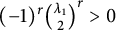 $(-1)^{r}{\lambda _1\choose 2}^r>0$
. Hence, we conclude the positivity of (4.14) as
 $n\rightarrow \infty $
.
5 Applications
In this section, we will apply Theorems 2.1, 2.2, 3.1, and 4.4 to show that some sequences of the form
 $c(n)$
satisfy the companion Turán inequality, the double Turán inequality, the Turán inequality of any order, the Laguerre inequality of any order
 $r,$
and its companion version.
The number of commuting
 $\boldsymbol {\ell }$
-tuples in
 ${\mathbf {S_{n}}}$
. Denote by
 $N_{\ell }(n)$
the number of
 $\ell $
-tuples of elements in the symmetric group
 $S_n$
with commuting components, normalized by the order of
 $S_n$
. Notice that
 $N_2(n)=p(n)$
, where
 $p(n)$
denotes the number of partitions of n. Bringmann, Franke, and Heim [Reference Bringmann, Franke and Heim5] gave the asymptotical formulas for
 $N_\ell (n)$
for arbitrary
 $\ell $
as follows.
Theorem 5.1 (Bringmann, Franke, and Heim)
We have, as
 $n \to \infty $
,
 $$ \begin{align*} N_{3}(n) \sim \frac{e^{-\frac{\zeta'(-1)}2 -\frac{\pi ^2}{288 \zeta (3)}}\zeta(3)^{\frac{11}{72}}}{2^{\frac{11}{24}} \cdot 3^{\frac{47}{72}} \cdot \pi^{\frac{11}{72}} \cdot n^{\frac{47}{72}}} \exp\left( \frac{(3\pi)^{\frac23} \zeta(3)^{\frac13}}{2} n^{\frac23} - \frac{\pi^{\frac{4}{3}}}{4 \cdot 3^{\frac23} \cdot \zeta(3)^{\frac13}} n^{\frac{1}{3}} \right)\left( 1 + \sum_{j=1}^\infty \frac{B_{3,j}}{n^{\frac{j}{3}}}\right) \end{align*} $$
for certain numbers
 $B_{3,j}$
,
 $$ \begin{align*} N_{4}(n) & \sim \frac{e^{\frac{\zeta'(-2)}{24}} \pi^{\frac{1}{4}} \zeta(3)^{\frac{1}{8}}}{2^{\frac{13}{8}}\cdot 3^{\frac{1}{4}}\cdot 5^{\frac{1}{8}} \cdot n^{\frac{5}{8}}} \\ & \times \exp\left( \frac{2^{\frac{7}{4}} \cdot \pi ^{\frac{3}{2}} \cdot \zeta(3)^{\frac{1}{4}}}{3^{\frac{3}{2}} \cdot 5^{\frac14}}n^{\frac{3}{4}} + A_{4,2}n^{\frac12} + A_{4,3}n^{\frac{1}{4}} + A_{4,4}\right) \left( 1 + \sum_{j=1}^\infty \frac{B_{4,j}}{n^{\frac{j}{4}}}\right),\\ N_{5}(n) & \sim \frac{e^{\frac{\zeta'(-2)}{2880}}(\pi \zeta(3) \zeta(5))^{\frac{1}{10}}}{2^{\frac25} \cdot 3^{\frac15} \cdot 5^{\frac35} \cdot n^{\frac{3}{5}}} \\ & \times \exp\left( \frac{5^{\frac{4}{5}} \cdot \pi ^{\frac{6}{5}} \cdot (\zeta (3) \zeta (5))^{\frac{1}{5}}}{2^{\frac{9}{5}} \cdot 3^{\frac{2}{5}}}n^{\frac{4}{5}} + A_{5,2}n^{\frac{3}{5}} + A_{5,3}n^{\frac{2}{5}} + A_{5,4}n^{\frac{1}{5}} + A_{5,5}\right) \left( 1 + \sum_{j=1}^\infty \frac{B_{5,j}}{n^{\frac{j}{5}}}\right), \end{align*} $$
with computable constants
 $A_{4,j}$
(
 $2 \leq j \leq 4$
) and
 $A_{5,j}$
(
 $2 \leq j \leq 5$
) and certain
 $B_{4,j}$
and
 $B_{5,j}$
, and for
 $\ell \geq 6$
,
 $$ \begin{align*} N_\ell(n) \sim \frac{(\ell-1)!^{\frac{1}{2\ell}} \sqrt{Z_\ell}}{\sqrt{2\pi \ell} n^{\frac{\ell+1}{2 \ell}}} \exp\left( \frac{\ell \Gamma(\ell)^{\frac{1}{\ell}}Z_\ell}{\ell-1} n^{\frac{\ell-1}{\ell}} + \sum_{k=2}^{\ell} A_{\ell,k} n^{\frac{\ell-k}{\ell}}\right)\left( 1 + \sum_{j=1}^\infty \frac{B_{\ell,j}}{n^{\frac{j}{\ell}}}\right), \end{align*} $$
where
 $Z_\ell := (\zeta (2) \cdot \zeta (3) \cdots \zeta (\ell ))^{\frac {1}{\ell }}$
for certain
 $A_{\ell ,k}$
and
 $B_{\ell ,j}$
.
Theorem 5.1 suggests that the asymptotical formulas for
 $N_\ell (n)$
satisfy the form of
 $c(n)$
. Combining Theorems 2.1 and 2.2, we get that for sufficiently large n,
 $N_\ell (n)$
satisfies the Turán inequality of any order and the double Turán inequality.
Theorem 5.2 For
 $\ell \geq 2$
and sufficiently large n,
 $N_\ell (n)$
satisfies the Turán inequality of any order and the double Turán inequality.
Set
 $\lambda _1=\frac {\ell -1}{\ell }$
and
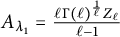 $A_{\lambda _1}=\frac {\ell \Gamma (\ell )^{\frac {1}{\ell }}Z_\ell }{\ell -1}$
. Theorem 3.1 gives that
 $N_\ell (n)$
satisfies the following companion Turán inequality.
Theorem 5.3 For
 $\ell \geq 2$
and sufficiently large n, we have that
 $N_\ell (n)$
satisfies the companion Turán inequality, i.e.,
 $$ \begin{align*} N_\ell(n)^2 -\left(1+\frac{\overline{\gamma}}{n^{1+\frac{1}{\ell}}}\right) N_\ell(n+1) N_\ell(n-1)\leq0, \end{align*} $$
where
 $\overline {\gamma }$
is any real number larger than
 $\frac {\Gamma (\ell )^{\frac {1}{\ell }}Z_\ell }{\ell }$
.
Since
 $1+\frac {1}{\ell }>1$
, from Theorem 5.3, we deduce that the log-convexity of
 $|C_{\ell ,n}|=n!N_\ell (n)$
, which give an affirmative answer to the open question
 $(3)$
proposed by Bringmann, Franke, and Heim in [Reference Bringmann, Franke and Heim5].
Corollary 5.4 For
 $\ell \geq 3$
and sufficiently large n, we have that
 $|C_{\ell ,n}|$
is log-convex.
For Laguerre inequalities, we get that
 $N_\ell (n)$
satisfies the Laguerre inequality of any order r and its companion version from Theorem 4.4.
Theorem 5.5 For
 $\ell \geq 2$
,
 $r\geq 2$
and sufficiently large n, we have
 $$ \begin{align*} 1<\frac{L_r^+(N_\ell(n-r))}{L_r^-(N_\ell(n-r))}<1+\frac{(2r)!}{r!}2^{1-r}\left(-\frac{\ell \Gamma(\ell)^{\frac{1}{\ell}}Z_\ell}{\ell-1}\right)^{r}{\frac{\ell-1}{\ell}\choose 2}^r n^{(-1-\frac{1}{\ell})(r-1)}. \end{align*} $$
The following sequences have also the asymptotical behavior of the form
 $c(n)$
, then we can obtain results similar to
 $ N_\ell (n)$
.
Partitions without sequences. The partition without sequence is the partition of n that do not contain any consecutive integers as parts. Let
 $p_2(n)$
denote the number of partitions without sequence of n. Bringmann and Mahlburg [Reference Bringmann and Mahlburg6] first succeeded in proving an asymptotic formula for
 $p_2(n)$
. Mauth [Reference Mauth18] gave the following formula and proved the log-concavity of
 $p_2(n)$
for
 $n\geq 482$
,
 $$ \begin{align*} p_2(n)=\frac{e^{\frac{2\pi\sqrt{n}}{3}}}{n^{\frac{3}{4}}}\left( \sum_{i=0}^{9} \frac{ \beta_i}{n^{\frac{i}{4}}}+O\left( \frac{1}{n^{\frac{5}{2}}}\right) \right), \end{align*} $$
where
 $\beta _i$
are constants. Note that
 $p_2(n)$
have the form (1.1) with
 $\lambda _1=\frac {1}{2}$
and
 $\ A_{\lambda _1}=\frac {2\pi }{3}$
. Hence, by the theorems above, we deduce the following result.
Theorem 5.6 For any
 $r\geq 2$
and sufficiently large n,
 $p_2(n)$
satisfies the double Turán inequality, the Turán inequality of any order, and the following companion Turán inequality:
 $$ \begin{align*} p_2(n)^2 -\left(1+\frac{\overline{\gamma}}{n^{\frac{3}{2}}}\right) p_2(n+1) p_2(n-1)\leq0, \end{align*} $$
where
 $\overline {\gamma }$
is any real number larger than
 $\frac {\pi }{6}$
, the Laguerre inequality of any order
 $r,$
and its companion version as follows:
 $$ \begin{align*} 1<\frac{L_r^+(p_2(n-r))}{L_r^-(p_2(n-r))}<1+\frac{(2r)!}{r!}2^{1-r}\left(-\frac{2\pi}{3}\right)^{r}{\frac{1}{2}\choose 2}^r n^{-\frac{3}{2}(r-1)}. \end{align*} $$
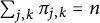
Plane partition. A plane partition of size n is a two-dimensional array of non-negative integers
 $\pi _{j,k}$
, for which
 $ \sum _{j,k}\pi _{j,k}=n$
, such that
 $\pi _{j,k}\geq \pi _{j,k+1}$
and
 $\pi _{j,k}\geq \pi _{j+1,k}$
for any
 $j,k \in N$
, denote the number of plane partitions of size n by
 $ \mathrm {PL}(n)$
. Wright [Reference Wright28] proved that
 $$ \begin{align*}\mathrm{PL}(n)=\frac{C}{n^{\frac{25}{36}}}e^{A_1n^{\frac{2}{3}}}\left(1+\sum_{j=2}^{N+1}\frac{B_j}{n^{\frac{2(j-1)}{3}}}+O\left(n^{-\frac{2(N+1)}{3}}\right)\right),\end{align*} $$
where
 $A_1>0$
, and C and
 $B_j$
are constants.
Heim, Neuhauser, and Tröger [Reference Heim, Neuhauser and Tröger14] conjectured that plane partition is log-concave and proved the conjecture for almost all n. Ono, Pujahari, and Rolen [Reference Ono, Pujahari and Rolen19] derived the following explicit asymptotic formula and proved that
 $J_{ \mathrm {PL}}^{d,n}(x)$
is hyperbolic for sufficiently large n.
Theorem 5.7 (Ono, Pujahari, and Rolen)
If
 $r\in \mathbb Z^{+},$
then for every integer
 $n\geq \max (n_r, \ell _r, 87)$
, we have
 $$ \begin{align*}\mathrm{PL}(n)=\frac{e^{c+3AN_n^2}}{2\pi }\sum_{s=0}^{r+1}\sum_{m=0}^{r+1}\frac{(-1)^m\beta_sb:{s,m}\Gamma\left(m+\frac{1}{2}\right)}{A^{m+\frac{1}{2}}N_n^{2s+2m+\frac{25}{12}}}+E_r^{{\mathrm{maj}}}(n)+E^{\min}(n), \end{align*} $$
where
 $|E_r^{{\mathrm {maj}}}(n)|\leq \widehat {E}_r^{{\mathrm {maj}}}(n)$
,
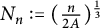 $N_n:=(\frac {n}{2A})^{\frac {1}{3}}$
, and
 $$ \begin{align*}|E^{\min}(n)|\leq \exp\left(\left(3A-\frac{2}{5}\right)n^2/(2A)^{\frac{2}{3}}\right).\end{align*} $$
Pandey [Reference Pandey20] found a lower bound such that
 $J_{ \mathrm {PL}}^{d,n}(x)$
has all real roots for all
 $n\geq N_{\mathrm {PL}}(d)$
, where
 $$ \begin{align*}N_{ \mathrm{PL}}(d)\leq279928\times d(d-1)\left(6d^3(22.2)^{\frac{3(d-1)}{2}}\right)^{2d}e^{\frac{\Gamma(2d^2)}{(2\pi)^{2d+2}}}.\end{align*} $$
Obviously,
 $\mathrm {PL}(n)$
have the form (1.1) with
 $\lambda _1=\frac {2}{3}$
and
 $\ A_{\lambda _1}=A_1$
. Thus, employing the theorems above, we get the following result.
Theorem 5.8 For any
 $r\geq 2$
and sufficiently large n,
 $ \mathrm {PL}(n)$
satisfies the double Turán inequality, the Turán inequality of any order, and the following companion Turán inequality:
 $$ \begin{align*} \mathrm{PL}(n)^2 -\left(1+\frac{\overline{\gamma}}{n^{\frac{4}{3}}}\right) \mathrm{PL}(n+1) \mathrm{PL}(n-1)\leq0, \end{align*} $$
where
 $\overline {\gamma }$
is any real number larger than
 $\frac {2A_1}{9}$
, the Laguerre inequality of any order
 $r,$
and its companion version as follows:
 $$ \begin{align*} 1<\frac{L_r^+( \mathrm{PL}(n-r))}{L_r^-( \mathrm{PL}(n-r))}<1+\frac{(2r)!}{r!}2^{1-r}\left(-A_1\right)^{r}{\frac{2}{3}\choose 2}^r n^{-\frac{4}{3}(r-1)}. \end{align*} $$
The coefficients of infinite product generating functions.
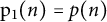
 $\mathrm {p}_d(n)$
is defined by the generating function [Reference Heim and Neuhauser13]
 $$ \begin{align*}\sum_{n=0}^\infty \mathrm p_d(n)q^n\colon=\prod_{n=1}^\infty\left(1-q^n\right)^{-n^{d-1}}.\end{align*} $$
Note that
 $\mathrm p_1(n)=p(n)$
and
 $\mathrm {p}_2(n)=\mathrm {PL}(n)$
. Bringmann, Franke, and Heim [Reference Bringmann, Franke and Heim5] provided that
 $$ \begin{align*}\mathrm{p}_d(n)\sim\frac{C}{n^b}e^{A_1n^{\frac{d+1}{d+2}}}\left(1+\sum_{j\geq1}\frac{E_{d,j}}{n^{\frac{j}{d+2}}}\right),\end{align*} $$
where C,
 $A_1$
,
 $b,$
and
 $E_{d,j}$
are constants. One can see that
 $\mathrm {p}_d(n)$
have the form (1.1) with
 $\lambda _1=\frac {d+1}{d+2}$
and
 $\ A_{\lambda _1}=A_1$
. Thus, we can get the following result by the theorems above.
Theorem 5.9 For any
 $r\geq 2$
and sufficiently large n,
 $\mathrm {p}_d(n)$
satisfies the double Turán inequality, the Turán inequality of any order, and the following companion Turán inequality:
 $$ \begin{align*} \mathrm{p}_d(n)^2 -\left(1+\frac{\overline{\gamma}}{n^{1+\frac{1}{d+2}}}\right) \mathrm{p}_d(n+1) \mathrm{p}_d(n-1)\leq0, \end{align*} $$
where
 $\overline {\gamma }$
is any real number larger than
 $\frac {A_1(d+1)}{(d+2)^2}$
, the Laguerre inequality of any order
 $r,$
and its companion version as follows:
 $$ \begin{align*} 1<\frac{L_r^+(\mathrm{p}_d(n-r))}{L_r^-(\mathrm{p}_d(n-r))}<1+\frac{(2r)!}{r!}2^{1-r}\left(-A_1\right)^{r}{\frac{d+1}{d+2}\choose 2}^r n^{(-1-\frac{1}{d+2})(r-1)}. \end{align*} $$
Partitions into
 $\mathbf {k}$
-gonal numbers. We denote the number of partitions of n into k-gonal numbers by
 $p_k(n)$
. We have the generating function
 $$ \begin{align*}\sum_{n\geq0}p_k(n)q^n=\prod_{n\geq1}\frac{1}{1-q^{P_k(n)}},\end{align*} $$
where
 $$ \begin{align*}P_k(n):=\frac12\left((k-2)n^2+(4-k)n\right)\end{align*} $$
is the n-th k-gonal number. Bridges, Brindle, Bringmann, and Franke [Reference Bridges, Brindle, Bringmann and Franke2] provided that
 $$ \begin{align*}\begin{aligned} p_k(n)&=\frac{C(k)e^{A(k)n^{\frac{1}{3}}}}{n^{\frac{5k-6}{6(k-2)}}}\left(1+\sum_{j=1}^N\frac{B_{j,k}}{n^{\frac{j}{3}}}+O_N\left(n^{-\frac{N+1}3}\right)\right), \end{aligned}\end{align*} $$
where
 $C(k)$
,
 $A(k),$
and
 $B_{j,k}$
are constants.
Note that
 $p_k(n)$
have the form (1.1) with
 $\lambda _1=\frac {1}{3}$
and
 $\ A_{\lambda _1}=A(k)$
. Then, we can get the following result by the theorems above.
Theorem 5.10 For any
 $r\geq 2$
and sufficiently large n,
 $p_k(n)$
satisfies the double Turán inequality, the Turán inequality of any order, and the companion Turán inequality
 $$ \begin{align*} p_k(n)^2 -\left(1+\frac{\overline{\gamma}}{n^{\frac{5}{3}}}\right) p_k(n+1) p_k(n-1)\leq0, \end{align*} $$
where
 $\overline {\gamma }$
is any real number larger than
 $\frac {2A(k)}{9}$
, the Laguerre inequality of any order
 $r,$
and its companion version as follows:
 $$ \begin{align*} 1<\frac{L_r^+(p_k(n-r))}{L_r^-(p_k(n-r))}<1+\frac{(2r)!}{r!}2^{1-r}\left(-A(k)\right)^{r}{\frac{1}{3}\choose 2}^r n^{-\frac{5}{3}(r-1)}. \end{align*} $$
The finite-dimensional representations of groups
 $\boldsymbol {\mathfrak {su}(3)}$
. The unitary group
 $\mathfrak {su}(3)$
, whose irreducible representations
 $W_{j,k}$
indexed by pairs of positive integers. The numbers
 $r_{\mathfrak {su}(3)}(n)$
of n-dimensional representations have the generating function
 $$ \begin{align*} \sum_{n\ge0} r_{\mathfrak{su}(3)}(n)q^n = \prod_{j,k\ge1} \frac{1}{1-q^{\frac{jk(j+k)}{2}}}, \end{align*} $$
with
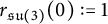 $r_{\mathfrak {su}(3)}(0):=1$
. In [Reference Romik24], Romik proved that, as
 $n\to \infty $
,
 $$ \begin{align*} r_{\mathfrak{su}(3)}(n) \sim \frac{C_0}{n^{\frac 35}} \exp\left(A_1n^{\frac 25}+A_2n^{\frac{3}{10}}+A_3n^{\frac 15}+A_4n^{\frac{1}{10}}\right), \end{align*} $$
with explicit constants
 $C_0,A_1,A_2,A_3,A_4$
expressible in terms of zeta and gamma values. Romik asked for lower order terms in the asymptotical expansion of
 $r_{\mathfrak {su}(3)}(n)$
. Bringmann and Franke [Reference Bringmann and Franke4] showed the following form of
 $r_{\mathfrak {su}(3)}(n)$
.
Theorem 5.11 (Bringmann and Franke)
As
 $n\to \infty $
, for any
 $N\in \mathbb N$
,
 $$ \begin{align*} r_{\mathfrak{su}(3)}(n)=\frac{C_0}{n^{\frac 35}}e^{A_1n^{\frac 25}+A_2n^{\frac{3}{10}}+A_3n^{\frac 15}+A_4n^{\frac{1}{10}}}\left(1+\sum_{j=1}^{N}\frac{C_j}{n^{\frac{j}{10}}}+O_N\left(n^{-\frac{N}{10}-\frac{3}{80}}\right)\right), \end{align*} $$
where the constants
 $C_j$
do not depend on N and n and can be calculated explicitly.
Note that
 $r_{\mathfrak {su}(3)}(n)$
have the form (1.1) with
 $\lambda _1=\frac {2}{5}$
and
 $\ A_{\lambda _1}=A_1$
. Hence, we can deduce the following result by the theorems above.
Theorem 5.12 For any
 $r\geq 2$
and sufficiently large n,
 $r_{\mathfrak {su}(3)}(n)$
satisfies the double Turán inequality, the Turán inequality of any order, and the companion Turán inequality
 $$ \begin{align*} r_{\mathfrak{su}(3)}(n)^2 -\left(1+\frac{\overline{\gamma}}{n^{\frac{8}{5}}}\right) r_{\mathfrak{su}(3)}(n+1) r_{\mathfrak{su}(3)}(n-1)\leq0, \end{align*} $$
where
 $\overline {\gamma }$
is any real number larger than
 $\frac {6A_1}{25}$
, the Laguerre inequality of any order
 $r,$
and its companion version
 $$ \begin{align*} 1<\frac{L_r^+(r_{\mathfrak{su}(3)}(n-r))}{L_r^-(r_{\mathfrak{su}(3)}(n-r))}<1+\frac{(2r)!}{r!}2^{1-r}\left(-A_1\right)^{r}{\frac{2}{5}\choose 2}^r n^{-\frac{8}{5}(r-1)}. \end{align*} $$
The finite-dimensional representations of groups
 $\mathbf {\mathfrak {so}(5)}$
. This framework generalizes to other groups. For example, one can investigate the Witten zeta function for
 $\mathfrak {so}(5)$
, which is (for more background to this function, see [Reference Matsumoto16, Reference Matsumoto and Tsumura17])
 $$ \begin{align*} \zeta_{\mathfrak{so}(5)}(s)\colon= \sum_\varphi \frac{1}{\dim(\varphi)^{s}} = 6^s\sum_{n,m\ge1}\frac1{ m^{s}n^{s}(m+n)^{s}(m+2n)^{s}}, \end{align*} $$
where the
 $\varphi $
are running through the finite-dimensional irreducible representations of
 $\mathfrak {so}(5)$
. Bridges, Brindle, Bringmann, and Franke [Reference Bridges, Brindle, Bringmann and Franke2] showed the following form of
 $r_{\mathfrak {so}(5)}(n)$
.
Theorem 5.13 (Bridges, Brindle, Bringmann, and Franke)
As
 $n\to \infty $
, for any
 $N\in \mathbb N$
,
 $$ \begin{align*} r_{\mathfrak{so}(5)}(n)=\frac{C}{n^{\frac{7}{12}}}e^{A_1 n^{\frac{1}{3}} + A_2 n^{\frac{2}{9}} + A_3 n^{\frac{1}{9}} + A_4 }\left(1+\sum_{j=2}^{N+1}\frac{B_j}{n^{\frac{j-1}{9}}}+O_N\left(n^{-\frac{N+1}{9}}\right)\right), \end{align*} $$
where C,
 $A_1$
,
 $A_2$
,
 $A_3$
,
 $A_4$
, and
 $B_j$
are constants.
Bringmann, Franke, and Heim [Reference Bringmann, Franke and Heim5] have proved that
 $r_{\mathfrak {su}(3)}(n)$
and
 $r_{\mathfrak {so}(5)}(n)$
asymptotically satisfy the Turán inequality. Note that
 $r_{\mathfrak {so}(5)}(n)$
have the form (1.1) with
 $\lambda _1=\frac {1}{3}$
and
 $\ A_{\lambda _1}=A_1$
. Thus, we can get the following result by the theorems above.
Theorem 5.14 For any
 $r\geq 2$
and sufficiently large n,
 $r_{\mathfrak {so}(5)}(n)$
satisfies the double Turán inequality, the Turán inequality of any order, and the following companion Turán inequality:
 $$ \begin{align*} r_{\mathfrak{so}(5)}(n)^2 -\left(1+\frac{\overline{\gamma}}{n^{\frac{5}{3}}}\right) r_{\mathfrak{so}(5)}(n+1) r_{\mathfrak{so}(5)}(n-1)\leq0, \end{align*} $$
where
 $\overline {\gamma }$
is any real number larger than
 $\frac {2A_1}{9}$
, the Laguerre inequality of any order
 $r,$
and its companion version
 $$ \begin{align*} 1<\frac{L_r^+(r_{\mathfrak{so}(5)}(n-r))}{L_r^-(r_{\mathfrak{so}(5)}(n-r))}<1+\frac{(2r)!}{r!}2^{1-r}\left(-A_1\right)^{r}{\frac{1}{3}\choose 2}^r n^{-\frac{5}{3}(r-1)}. \end{align*} $$



