


1 Introduction
Iterating geometric transformations of convex bodies and understanding the limit shapes that emerge is a classical theme in convex geometry. A central example is Steiner symmetrisation: by repeatedly symmetrising, one drives a body towards the Euclidean ball, a mechanism underlying many isoperimetric principles and related inequalities (see, for instance, the survey [Reference Bianchi, Gardner and Gronchi2]). This viewpoint naturally raises a quantitative question about the speed of convergence, for which sharp and near-sharp results are known in several settings [Reference Klartag14]. Within this broader picture, the limiting symmetry is known to depend on arithmetic features of the directions: in planar Steiner symmetrisation with an axis that rotates by a fixed angle at each step, an irrational angle leads the iteration towards a disk, whereas a rational angle confines the process to finitely many directions, as in Klain’s finite-direction framework [Reference Klain12]. Motivated by these phenomena, we study the rigid dynamics obtained by replacing a body with a weighted Minkowski average of itself and its rotation by a fixed angle. The resulting map is linear on support functions and amenable to spectral analysis, which yields a unified treatment, a complete classification of limit shapes and sharp quantitative convergence rates.
We fix parameters
$0<\lambda <1$
 and
$\theta \in (0,2\pi )$
 , and work on the phase space

where
$s(K)$
 is the Steiner point and

is the mean width in terms of the support function
$ h_K(\varphi )=\max _{x\in K}\langle x,(\cos \varphi ,\sin \varphi )\rangle. $
 Throughout, a convex body means a nonempty, compact, convex subset of
$\mathbb R^2$
 with nonempty interior. Standard background, including Minkowski addition and support functions, can be found in [Reference Schneider17]. Support functions and convex bodies are in one-to-one correspondence (up to translation), which legitimises working at the level of support functions. For
$K\in \mathcal K_*$
 , we define the one-step map

where
$R_\theta $
 is rotation by
$\theta $
 and
$\oplus $
 denotes Minkowski addition. The step preserves the Steiner point and the mean width: both are Minkowski linear (and rotation equivariant/invariant, respectively). So,
$\mathcal K_*$
 is invariant and no further normalisation is needed (see Lemma 2.1 and [Reference Schneider17]). Starting from
$K_0\in \mathcal K_*$
 , we iterate
$K_{n+1}=\Phi _{\lambda ,\theta }(K_n)$
 . Passing to support functions and writing
$(S_\theta h)(\varphi )=h(\varphi -\theta )$
 , the update reads

and
$w(K_n)\equiv 1$
 by invariance. We write
$\mathbb T=\mathbb R/2\pi \mathbb Z$
 for the circle; we freely pass between
$K_n$
 and
$h_n$
 , and use the
$L^2(\mathbb T)$
 and
$C^\alpha (\mathbb T)$
 topologies.
Classical symmetrisation procedures such as Steiner and Minkowski symmetrisations are known to round convex bodies under suitable choices of directions. Beyond qualitative convergence (see Schneider’s monograph for Hadwiger’s early result on Minkowski averages [Reference Schneider17, Theorem 3.3.5]), a quantitative and structural theory has emerged: sharp and near-sharp rates for iterative symmetrisations [Reference Klartag14], isomorphic rounding by a bounded number of Steiner steps [Reference Klartag and Milman15], and dimension-efficient Minkowski symmetrisations towards near-Euclidean balls [Reference Klartag13]. Refined proximity results for single symmetrals [Reference Bianchi and Gronchi4] and equality/stability for the perimeter inequality under Steiner symmetrisation [Reference Chlebík, Cianchi and Fusco9] further anchor the isoperimetric applications. Foundational regularity facts such as continuity of Steiner symmetrisation in
$W^{1,p}$
 also support a functional-analytic viewpoint [Reference Burchard6] (see the survey [Reference Bianchi, Gardner and Gronchi2] for a broader account).
Iteration schemes and the choice of directions have been studied along several axes. Convergence in shape and the existence of universal orderings of directions are known [Reference Bianchi, Burchard, Gronchi and Volčič1, Reference Volčič20], with convergence established for finite and countable direction sets [Reference Bianchi, Klain, Lutwak, Yang and Zhang5, Reference Klain12]. Randomised models exhibit almost-sure convergence for sets and functions, and provide complementary rate phenomena [Reference Burchard and Fortier7, Reference Coupier and Davydov10, Reference Mani-Levitska16, Reference Volčič19]. More recently, general criteria unify many of these processes across families of symmetrisations [Reference Bianchi, Gardner and Gronchi3, Reference Ulivelli18]. Against this background, we fix a single rotation and iterate a weighted Minkowski average, yielding rigid one-parameter averaging dynamics on support functions; its linear, Fourier-diagonalisable structure enables a complete limit-shape classification together with sharp quantitative rates.
The asymptotics is completely rigid. If
$\theta /2\pi $
 is irrational, then
$K_n$
 converges to the unit mean width disk; if
$\theta =2\pi p/q$
 is rational, then
$K_n$
 converges to the explicit q-fold rotational average. Quantitatively, in the resonant case, the decay is uniform and exponential with a spectral rate. In the nonresonant case with Diophantine
$\theta $
 , we obtain polynomial decay (up to a logarithmic loss) for
$C^\alpha $
 data, while analytic data exhibit stretched-exponential decay; in the bounded-type case, we obtain matching subsequence lower bounds. Consequently, the induced map is nonexpansive on the natural function spaces, the topological entropy is zero and, in the irrational case, the global attractor is a single point.
For terminology: by a Diophantine angle, we follow the classical conventions from Diophantine approximation (see Cassels and Khinchin [Reference Cassels8, Reference Khinchin11]) and for topological entropy, we refer to Walters [Reference Walters21].
2 Limit-shape classification
We now determine the limit shape selected by the iteration on
$\mathcal K_*$
 . Throughout, we assume
$0<\lambda <1$
 . On support functions, we write
$T=(1-\lambda )I+\lambda S_\theta $
 , as the normalisation is immaterial on
$\mathcal K_*$
 .
Lemma 2.1. Fix
$0<\lambda <1$
 and
$\theta \in (0,2\pi )$
 . For
$K\in \mathcal K_*$
 , set

Then,
$s(K')=0$
 and
$w(K')=1$
 . In particular, the one-step map on
$\mathcal K_*$
 may be written without normalisation as
$K\mapsto (1-\lambda )K\oplus \lambda R_\theta K$
 . Equivalently, on support functions, the update is

and this map preserves mean width
$w\equiv 1$
 .
Proof. We use standard identities for support functions. For convex bodies
${A,B\subset \mathbb R^2}$
 and
$t\ge 0$
 ,
$ h_{A\oplus B}=h_A+h_B, h_{tA}=th_A, h_{R_\theta A}(\varphi )=h_A(\varphi -\theta ). $
 These identities and the representation formulae below are classical (see Schneider [Reference Schneider17]). The Steiner point admits the representation

hence, it is Minkowski linear and rotation equivariant, and

Likewise, the mean width can be written as

so w is Minkowski linear and rotation invariant:

Apply these to
$K'=(1-\lambda )K\oplus \lambda R_\theta K$
 . Since
$K\in \mathcal K_*$
 has
$s(K)=0$
 and
$w(K)=1$
 ,

Thus,
$K'\in \mathcal K_*$
 . Passing to support functions, the step is exactly
$h\mapsto (1-\lambda )h+\lambda S_\theta h$
 and the above computation shows that it preserves
$w\equiv 1$
 .
Lemma 2.2. Let
$T=(1-\lambda )I+\lambda S_\theta $
 act on
$2\pi $
 -periodic functions on the circle, where
$(S_\theta h)(\varphi )=h(\varphi -\theta )$
 and
$0<\lambda <1$
 ,
$\theta \in (0,2\pi )$
 . For the Fourier modes
$e_k(\varphi )=e^{ik\varphi }$
 ,
$k\in \mathbb Z$
 ,

so
$\{e_k\}_{k\in \mathbb Z}$
 is a basis of eigenfunctions and T is diagonal in the Fourier basis. Consequently, if
$h(\varphi )=\sum _{k\in \mathbb Z}c_k e^{ik\varphi }$
 in
$L^2(\mathbb T)$
 , then

In particular,
$\mu _0=1$
 , and for
$k\ne 0$
 , one has
$|\mu _k|<1$
 if and only if
$k\theta \notin 2\pi \mathbb Z$
 , while
$\mu _k=1$
 if and only if
$k\theta \in 2\pi \mathbb Z$
 .
Proof. For
$e_k(\varphi )=e^{ik\varphi }$
 , we compute directly

hence,

By linearity and completeness of the Fourier basis in
$L^2(\mathbb T)$
 , if
$h=\sum c_k e^{ik\varphi }$
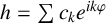 , then
$Th=\sum \mu _k c_k e^{ik\varphi }$
 and iterating yields
$T^n h=\sum \mu _k^{\,n} c_k e^{ik\varphi }$
 .
It remains to characterise
$|\mu _k|$
 . For any real
$\alpha $
 ,

with equality if and only if
$\cos \alpha =1$
 , that is,
$\alpha \in 2\pi \mathbb Z$
 . Taking
$\alpha =k\theta $
 gives
$|\mu _k|<1$
 exactly when
$k\theta \notin 2\pi \mathbb Z$
 , and
$\mu _k=1$
 exactly when
$k\theta \in 2\pi \mathbb Z$
 . Since
$e^{0\cdot i\varphi }\equiv 1$
 , we also have
$\mu _0=(1-\lambda )+\lambda =1$
 , which corresponds to preservation of the mean (and hence of the mean width).
Theorem 2.3. Assume
$0<\lambda <1$
 and
$\theta \in (0,2\pi )$
 . Let
$K_{n+1}=(1-\lambda )K_n\oplus \lambda R_\theta K_n$
 be the iteration on
$\mathcal K_*$
 and let
$h_n$
 be the support function of
$K_n$
 . Then, with the map
$T=(1-\lambda )I+\lambda S_\theta $
 acting on support functions,

Moreover, we have the following.
-
(i) Nonresonant case. If $\theta /2\pi \notin \mathbb Q$
 , then
$h_n\to \bar h$
in
$L^2(\mathbb T)$
, where $$ \begin{align*} \bar h\equiv \frac{1}{2\pi}\int_0^{2\pi}h_0(\varphi)\,d\varphi=\frac12 \end{align*} $$is the constant function corresponding to the unit mean width disk. In particular, $K_n$
converges, in the
$L^2$
-support-function sense, to the unit mean width disk.
-
(ii) Resonant case. If $\theta =2\pi p/q$
with coprime
$p,q\in \mathbb N$
, then
$h_n\to P_q h_0$
in
$L^2(\mathbb T)$
, where $$ \begin{align*} P_q=\frac1q\sum_{j=0}^{q-1}S_{j\theta} \end{align*} $$is the averaging projector onto the $S_\theta $
-invariant subspace. Equivalently, $$ \begin{align*} K_n\longrightarrow K_\infty=\frac1q\sum_{j=0}^{q-1}R_{j\theta}K_0\in\mathcal K_*, \end{align*} $$whose support function is $h_\infty =P_q h_0$
and which has q-fold rotational symmetry.


The limit is unique and depends on
$K_0$
 only through its projection onto the
$S_\theta $
 -invariant subspace.
Proof. By Lemma 2.1, on
$\mathcal K_*$
 , the one-step map is
$K\mapsto (1-\lambda )K\oplus \lambda R_\theta K$
 and, on support functions,
$h\mapsto Th=(1-\lambda )h+\lambda S_\theta h$
 . Write the Fourier expansion
$h_0(\varphi )=\sum _{k\in \mathbb Z}c_k e^{ik\varphi }$
 in
$L^2(\mathbb T)$
 . Lemma 2.2 yields
$ T e_k=\mu _k e_k,\; \mu _k=(1-\lambda )+\lambda e^{-ik\theta }, $
 hence,

For case (i), if
$\theta /2\pi \notin \mathbb Q$
 , then
$k\theta \notin 2\pi \mathbb Z$
 for all
$k\ne 0$
 , so
$|\mu _k|<1$
 by Lemma 2.2. Therefore,
$\mu _k^{\,n}\to 0$
 for
$k\ne 0$
 , while
$\mu _0=1$
 . It follows that
$T^n h_0\to c_0 e^{i0\varphi }=\bar h$
 in
$L^2(\mathbb T)$
 . Since the iteration preserves the mean width
$w\equiv 1$
 (Lemma 2.1), we have
$\bar h=\frac 12$
 , which is the support function of the unit mean width disk. This identifies the limit shape.
For case (ii), let
$\theta =2\pi p/q$
 with
$(p,q)=1$
 . Then,
$\mu _k=1$
 exactly when
$k\equiv 0\pmod q$
 , and
$|\mu _k|<1$
 otherwise (Lemma 2.2). Hence,
$T^n h_0\to \sum _{m\in \mathbb Z}c_{mq} e^{i(mq)\varphi }$
 in
$L^2(\mathbb T)$
 . The operator

acts on Fourier modes by
$P_q e_k=e_k$
 if
$k\equiv 0\pmod q$
 and
$P_q e_k=0$
 otherwise, so indeed,
$T^n h_0\to P_q h_0$
 in
$L^2(\mathbb T)$
 . By Minkowski linearity of support functions and rotation covariance,

while s and w are preserved under this averaging (as in Lemma 2.1), so the geometric limit is exactly

Uniqueness follows from the
$L^2$
 convergence of
$T^n h_0$
 to the indicated limit and linearity.
3 Sharp rates and dynamics
In this section, we quantify the convergence established above. For resonant angles
$\theta =2\pi p/q$
 , we obtain uniform exponential decay towards
$P_q h_0$
 with an explicit spectral constant
$\rho \in (0,1)$
 . For nonresonant angles with Diophantine
$\theta $
 , we obtain quantitative polynomial decay (up to a logarithmic loss) for
$C^\alpha $
 data and, under the same assumption, analytic data yield stretched-exponential decay; for bounded-type angles, the exponent is optimal along subsequences. We then record dynamical consequences: the averaging map is nonexpansive, the topological entropy is zero, the global attractor is a single point in the irrational case, and in the rational case, it is the
$S_\theta $
 -invariant subspace.
Theorem 3.1. Assume
$0<\lambda <1$
 and
$\theta \in (0,2\pi )$
 , and let
$T=(1-\lambda )I+\lambda S_\theta $
 act on support functions as above.
-
(i) Resonant case ( $\theta =2\pi p/q$
with
$(p,q)=1$
). Let $$ \begin{align*} P_q=\frac1q\sum_{j=0}^{q-1}S_{j\theta},\quad \rho=\max_{1\le r\le q-1}|(1-\lambda)+\lambda e^{-2\pi i r/q}|\in(0,1). \end{align*} $$
Then, for all $h_0\in L^2(\mathbb T)$
, $$ \begin{align*} \|T^n h_0-P_q h_0\|_{L^2}\ \le\ \rho^{\,n}\,\|h_0-P_q h_0\|_{L^2}\quad(n\ge 1), \end{align*} $$and if $h_0\in C^\alpha (\mathbb T)$
for some
$\alpha>0$
, there exists
$C_\alpha =C_\alpha (\alpha ,\lambda ,q)$
such that $$ \begin{align*} \|T^n h_0-P_q h_0\|_{L^\infty}\ \le\ C_\alpha\,\rho^{\,n}\,\|h_0\|_{C^\alpha}\quad(n\ge 1). \end{align*} $$
-
(ii) Nonresonant (Hölder data) ( $\theta /2\pi \notin \mathbb Q$
). Assume
$\theta $
is Diophantine of type
$(c,\tau )$
, that is, $$ \begin{align*} \operatorname{dist}(k\theta,2\pi\mathbb Z)\ \ge\ c\,|k|^{-\tau}\quad(k\in\mathbb Z\setminus\{0\}), \end{align*} $$and $h_0\in C^\alpha (\mathbb T)$
for some
$\alpha>0$
. Then, there exists
$C>0$
depending only on
$(\alpha ,\tau ,\lambda ,c)$
and
$\|h_0\|_{C^\alpha }$
such that, for all
$n\ge 2$
, $$ \begin{align*} \|T^n h_0-\bar h\|_{L^\infty}\ \le\ C\,n^{-{\alpha}{/2\tau}}(\log n)^{{\alpha}/{2\tau}}, \end{align*} $$where $\bar h\equiv {1}/({2\pi })\int _0^{2\pi }h_0(\varphi )\,d\varphi =\frac 12$
. The implicit constants depend only on
$(\alpha ,\tau ,\lambda ,c)$
and
$\|h_0\|_{C^\alpha }$
.
-
(iii) Nonresonant (analytic data, Diophantine) ( $\theta /2\pi \notin \mathbb Q$
and
$\theta $
is Diophantine of type
$(c,\tau )$
). If
$h_0$
extends analytically to the strip
$\{|\Im \varphi |<\sigma \}$
for some
$\sigma>0$
(equivalently
$|c_k|\le C_0 e^{-\sigma |k|}$
for its Fourier coefficients), then there exist constants
$C,c'>0$
depending only on
$(\sigma ,\tau ,\lambda ,c)$
and
$\|h_0\|_{L^\infty }$
such that $$ \begin{align*} \|T^n h_0-\bar h\|_{L^\infty}\ \le\ C\,\exp(-\,c'\,n^{{1}/{(2\tau+1)}})\quad(n\ge 1). \end{align*} $$


Proof. Write the Fourier expansion
$h_0(\varphi )=\sum _{k\in \mathbb Z}c_k e^{ik\varphi }$
 in
$L^2(\mathbb T)$
 . By Lemma 2.2,
$ \mu _k=(1-\lambda )+\lambda e^{-ik\theta },\;T e_k=\mu _k e_k, $
 hence,
$T^n h_0=\sum _k \mu _k^{\,n} c_k e^{ik\varphi }$
 .
-
(i) Resonant. If $\theta =2\pi p/q$
, then
$\mu _k=1$
exactly when
$k\equiv 0\pmod q$
and otherwise,
$|\mu _k|\le \rho <1$
. Since
$P_q e_k=e_k$
for
$k\equiv 0\pmod q$
and
$0$
otherwise, $$ \begin{align*} T^n h_0-P_q h_0=\sum_{k\not\equiv 0\,(q)}\mu_k^{\,n} c_k e^{ik\varphi}. \end{align*} $$
Parseval gives the $L^2$
estimate. If
$h_0\in C^\alpha $
, then
$|c_k|\le C_\alpha \|h_0\|_{C^\alpha }|k|^{-(1+\alpha )}$
, so
$\sum _k |c_k|<\infty $
and $$ \begin{align*} \|T^n h_0-P_q h_0\|_{L^\infty}\ \le\ \sum_{k\not\equiv 0\,(q)}|\mu_k|^{n}|c_k| \ \le\ \rho^{\,n}\sum_{k\not\equiv 0\,(q)}|c_k| \ \le\ C_\alpha\,\rho^{\,n}\,\|h_0\|_{C^\alpha}. \end{align*} $$
-
(ii) Hölder. For any real x, set $t:=2\lambda (1-\lambda )(1-\cos x)\in [0,4\lambda (1-\lambda )]$
. Then, $$ \begin{align*} |(1-\lambda)+\lambda e^{-ix}|^2=1-t,\quad |(1-\lambda)+\lambda e^{-ix}|=\sqrt{1-t}\le e^{-t/2}, \end{align*} $$and hence,
$$ \begin{align*} |(1-\lambda)+\lambda e^{-ix}|\le \exp(-\lambda(1-\lambda)(1-\cos x)) \end{align*} $$and $1-\cos x\ge ({2}/{\pi ^2})\operatorname {dist}(x,2\pi \mathbb Z)^2$
. With the Diophantine bound, this yields $$ \begin{align*} |\mu_k|^n\ \le\ \exp(-a_0\,n\,|k|^{-2\tau}),\quad a_0=a_0(\lambda,c)>0. \end{align*} $$
Hence,
$$ \begin{align*} \|T^n h_0-\bar h\|_{L^\infty}\ \le\ \sum_{k\ne 0}\! e^{-a_0 n |k|^{-2\tau}}\,|c_k|. \end{align*} $$
Split at a cutoff $K\ge 1$
: $$ \begin{align*} \sum_{1\le |k|\le K}\! e^{-a_0 n |k|^{-2\tau}}|c_k|\ \le\ e^{-a_0 n K^{-2\tau}}\sum_{1\le |k|\le K}\! |c_k| \ \le\ C_1\,e^{-a_0 n K^{-2\tau}}\|h_0\|_{C^\alpha}, \end{align*} $$and using $|c_k|\le C_\alpha \|h_0\|_{C^\alpha }|k|^{-(1+\alpha )}$
, $$ \begin{align*} \sum_{|k|>K}\!|c_k|\ \le\ C_2\,\|h_0\|_{C^\alpha}\,K^{-\alpha}. \end{align*} $$
Choose $K=K(n)$
so that
$e^{-a_0 n K^{-2\tau }}\approx K^{-\alpha }$
, that is,
$a_0 n K^{-2\tau }\sim \alpha \log K$
. For
$n\ge 2$
, one may take $$ \begin{align*} K\asymp \bigg(\frac{n}{\log n}\bigg)^{\!1/(2\tau)}, \end{align*} $$which gives
$$ \begin{align*} \|T^n h_0-\bar h\|_{L^\infty}\ \le\ C\,\|h_0\|_{C^\alpha}\,K^{-\alpha} \ \le\ C\,\|h_0\|_{C^\alpha}\,n^{-{\alpha}/{2\tau}}(\log n)^{{\alpha}/{2\tau}}. \end{align*} $$
-
(iii) Analytic. If $|c_k|\le C_0 e^{-\sigma |k|}$
, then $$ \begin{align*} \|T^n h_0-\bar h\|_{L^\infty}\ \le\ C_0\sum_{k\ge1}\exp(-a_0 n k^{-2\tau}-\sigma k). \end{align*} $$
Let $k_\ast \asymp (n)^{1/(2\tau +1)}$
be the minimiser of
$a_0 n k^{-2\tau }+\sigma k$
. Then, for
$k\le k_\ast $
, we have
$a_0 n k^{-2\tau }\ge c\,n^{{1}/{(2\tau +1)}}$
, while for
$k\ge k_\ast $
,
$\sigma k\ge c\,n^{{1}/{(2\tau +1)}}$
. Hence, for all
$k\ge 1$
, $$ \begin{align*} \exp(-a_0 n k^{-2\tau}-\sigma k)\ \le\ \exp(-c\,n^{{1}/{(2\tau+1)}})\,e^{-{\sigma k}/{2}}, \end{align*} $$and summing the geometric tail $\sum _{k\ge 1}e^{-\sigma k/2}$
yields $$ \begin{align*} \|T^n h_0-\bar h\|_{L^\infty}\ \le\ C\,\exp(-\,c'\,n^{{1}/{(2\tau+1)}}). \\[-35pt] \end{align*} $$


Proposition 3.2. Assume
$0<\lambda <1$
 and
$\theta /2\pi \notin \mathbb Q$
 is of bounded type (equivalently, Diophantine with exponent
$\tau =1$
 ). Then, there exist
$h_0\in \mathcal K_*$
 , analytic in a strip
${\{|\Im \varphi |<\sigma _0\}}$
 , and an increasing sequence
$n_j\to \infty $
 such that

for some constants
$C,C'>0$
 depending only on
$\lambda $
 , on the bounded-type constants of
$\theta $
 and on the analyticity width of
$h_0$
 . The stretched-exponential exponent
$1/3$
 in Theorem 3.1(iii) cannot be improved along subsequences for bounded-type angles.
Proof. Let
$(q_\ell )$
 be the convergents of
$\theta /2\pi $
 . Since
$\theta $
 is of bounded type, there exists
$M\ge 1$
 such that
$q_{\ell +1}\le M q_\ell $
 for all
$\ell $
 . Choose a sparse subsequence
$(k_j)$
 by setting
$k_j:=q_{m_j}$
 with
$m_{j+1}$
 large enough that
$k_{j+1}\ge k_j^2$
 and
$k_1\ge 2$
 . Define

and fix
$\sigma>0$
 so that
$\sum _j b_j k_j^2\le \frac 14$
 . Then,
$h_0$
 is analytic in
$\{|\Im \varphi |<\sigma \}$
 ,
$h_0+h_0"\ge \frac 14>0$
 , and since the first harmonic is absent and the mean is
$\frac 12$
 , we have
$K_0\in \mathcal K_*$
 .
For convergents, one has

Set
$t:=2\lambda (1-\lambda )(1-\cos x)$
 . For
$t\in [0,\frac 12]$
 , we have
$\sqrt {1-t}\ge e^{-t}$
 . Thus, for j large enough,

with
$C_2=C_2(\lambda ,M)$
 . Choose

Then,
$|\mu _{k_j}|^{\,n_j}\ge \exp (-\sigma k_j/2)$
 , so the principal mode contributes at least
$b_j e^{-\sigma k_j/2}$
 at
$n_j$
 .
It remains to show that the contribution of the other modes is negligible. Since bounded type implies a Diophantine lower bound
$\,\operatorname {dist}(k\theta ,2\pi \mathbb Z)\ge c_0/k\,$
 for all
$k\ge 1$
 ,

For indices
$i<j$
 ,

using
$k_{j-1}\le \sqrt {k_j}$
 . For
$i>j$
 , we simply use
$|\mu _{k_i}|^{n_j}\le 1$
 and the tail of the analytic coefficients,

Since
$n_j\asymp k_j^3$
 , we conclude
$ \|T^{n_j}h_0-\bar h\|_{L^\infty } \ge C \exp (-C'\,n_j^{1/3}), $
 as claimed.
Proposition 3.3. Assume
$0<\lambda <1$
 and
$\theta \in (0,2\pi )$
 .
-
(i) Resonant case ( $\theta =2\pi p/q$
with
$(p,q)=1$
). Let $$ \begin{align*} \rho=\max_{1\le r\le q-1} |(1-\lambda)+\lambda e^{-2\pi i r/q} |\in(0,1). \end{align*} $$
There exists $h_0\in C^\infty (\mathbb T)$
which is the support function of some
$K_0\in \mathcal K_*$
such that $$ \begin{align*} \|T^n h_0-P_q h_0\|_{L^\infty} \ge c \rho^{\,n}\quad\text{for all }n\ge 1, \end{align*} $$for some $c>0$
depending on
$h_0$
and
$\lambda ,q$
. Hence, the exponential rate
$\rho $
in Theorem 3.1(i) cannot be improved in general.
-
(ii) Nonresonant case ( $\theta /2\pi \notin \mathbb Q$
). For every
$\rho _0\in (0,1)$
and every
$\alpha>0$
, there exists
$h_0\in C^\infty (\mathbb T)$
which is the support function of some
$K_0\in \mathcal K_*$
such that for all
$C>0$
, the bound $$ \begin{align*} \|T^n h_0-\bar h\|_{L^\infty} \le C \rho_0^{\,n}\quad(n\ge 1) \end{align*} $$fails. In particular, no uniform exponential rate holds in the irrational case.


Proof. We work on support functions and use Lemma 2.2. Throughout, we ensure that the constructed
$h_0$
 is a valid support function in
$\mathcal K_*$
 by taking a small Fourier perturbation of the constant
$\frac 12$
 , which fixes the mean width and, if needed, avoids the first harmonic to keep the Steiner point at the origin.
-
(i) Resonant. Choose $r_*\in \{1,\ldots ,q-1\}$
attaining the maximum in the definition of
$\rho $
. Pick an integer
$k\ge 2$
with
$k\equiv r_*\pmod q$
. Let $$ \begin{align*} h_0(\varphi)=\frac12+\varepsilon\cos(k\varphi),\quad 0<\varepsilon\le \frac{1}{2\,(k^2-1)}. \end{align*} $$
Then, $h_0\in C^\infty $
and
$h_0+h_0"=\frac 12+\varepsilon (1-k^2)\cos (k\varphi )\ge 0$
, so
$h_0$
is the support function of a convex body; its mean is
$\frac 12$
and the
$k\!=\!1$
mode is absent, and hence,
$K_0\in \mathcal K_*$
. Since
$k\not \equiv 0\pmod q$
, we have
$P_q h_0=\frac 12$
. By Lemma 2.2, $$ \begin{align*} T^n h_0-P_q h_0=\varepsilon\,\Re (\mu_k^{\,n}e^{ik\varphi}), \quad \mu_k=(1-\lambda)+\lambda e^{-ik\theta}. \end{align*} $$
Because $k\equiv r_*\pmod q$
and
$\theta =2\pi p/q$
, we have
$e^{-ik\theta }=e^{-2\pi i r_*/q}$
and thus,
$|\mu _k|=\rho $
. Taking
$L^\infty $
norms gives
$ \|T^n h_0-P_q h_0\|_{L^\infty }=\varepsilon \,|\mu _k|^{\,n}=\varepsilon \,\rho ^{\,n}, $
so the claim holds with
$c=\varepsilon $
. In particular, no smaller base than
$\rho $
can work uniformly. -
(ii) Nonresonant. Fix $\rho _0\in (0,1)$
. Since
$\theta /2\pi $
is irrational, the set
$\{e^{-ik\theta }:k\in \mathbb Z\}$
is dense on the unit circle, and hence there exists
$k\ge 2$
such that $$ \begin{align*} |\mu_k|=|(1-\lambda)+\lambda e^{-ik\theta}|> \rho_0. \end{align*} $$
Define $h_0(\varphi )=\frac 12+\varepsilon \cos (k\varphi )$
with
$0<\varepsilon \le 1/(2(k^2-1))$
as above, so
$h_0$
is the support function of a body in
$\mathcal K_*$
. Then, exactly as in part (i),
$ \|T^n h_0-\bar h\|_{L^\infty }=\varepsilon \,|\mu _k|^{\,n}. $
Given any
$C>0$
, since
$|\mu _k|/\rho _0>1$
, the ratio $$ \begin{align*} \frac{\varepsilon |\mu_k|^{\,n}}{C \rho_0^{\,n}}=\frac{\varepsilon}{C}\bigg(\frac{|\mu_k|}{\rho_0}\bigg)^{\!n}\ \to\ \infty\quad(n\to\infty), \end{align*} $$so the putative bound $\|T^n h_0-\bar h\|_{L^\infty }\le C\rho _0^{\,n}$
fails for all large n. Therefore, no uniform exponential estimate can hold over all admissible initial data in the irrational case.


Proposition 3.4. Assume
$0<\lambda <1$
 and
$\theta \in (0,2\pi )$
 , and let
$T=(1-\lambda )I+\lambda S_\theta $
 act on support functions.
-
(i) Nonexpansiveness. For $X=L^2(\mathbb T)$
or
$X=C^\alpha (\mathbb T)$
(with
$\alpha \ge 0$
), we have
$\|Th-Tg\|_X\ \le \ \|h-g\|_X\ (\mbox {for all } h,g\in X).$
In particular, T is
$1$
-Lipschitz on these spaces. Equivalently, in the geometric picture,
$K\mapsto (1-\lambda )K\oplus \lambda R_\theta K$
is nonexpansive in the
$L^\infty $
support-function metric; for compact convex bodies, one has
$d_H(K,L)=\|h_K-h_L\|_{L^\infty }$
(no centring assumption is needed). -
(ii) Zero topological entropy. The Bowen topological entropy of T is $0$
: for every compact
$K\subset X$
and every
$\varepsilon>0$
, the maximal cardinality of
$(n,\varepsilon )$
-separated sets in K is bounded independently of n, and hence,
$h_{\mathrm {top}}(T|_K)=0$
and so
$h_{\mathrm {top}}(T)=0$
. -
(iii) Attractor / limit set. If $\theta /2\pi \notin \mathbb Q$
, then
$\mathrm {Fix}(T)=\{\text {constants}\}$
and, within the normalised class,
$\mathrm {Fix}(T)=\{\bar h\}$
with
$\bar h\equiv \frac 12$
. For every
$h_0$
, one has
$T^n h_0\to \bar h$
; thus, the global (point) attractor is the single point
$\bar h$
. If
$\theta =2\pi p/q$
, then
$\mathrm {Fix}(T)=\mathrm {Range}(P_q)$
. For every
$h_0$
, one has
$T^n h_0\to P_q h_0\!\in \!\mathrm {Fix}(T)$
. Hence, the invariant set
$A_q=\mathrm {Range}(P_q)\cap \{s=0, w=1\}$
attracts every initial datum, and each orbit converges to a single point in
$A_q$
.


Proof.
-
(i) For any normed space X among $L^2$
,
$L^\infty $
,
$C^\alpha $
, the shift
$S_\theta $
is an isometry:
$\|S_\theta f\|_X=\|f\|_X$
. Hence, $$ \begin{align*} \|Th-Tg\|_X&=\|(1-\lambda)(h-g)+\lambda(S_\theta h-S_\theta g)\|_X\\ & \le (1-\lambda)\|h-g\|_X +\lambda\|S_\theta(h-g)\|_X=\|h-g\|_X, \end{align*} $$showing $1$
-Lipschitz. For convex bodies,
$\|h_{K}-h_{L}\|_{L^\infty }$
equals the Hausdorff distance
$d_H(K,L)$
, so nonexpansiveness transfers to the geometric map.
-
(ii) Let $K\subset X$
be compact and fix
$\varepsilon>0$
. If
$\{x_1,\ldots ,x_M\}\subset K$
is
$(n,\varepsilon )$
-separated (in Bowen’s sense), then for some
$0\le j<n$
, we must have
$\|T^j x_a-T^j x_b\|_X\ge \varepsilon $
whenever
$a\ne b$
. Since T is
$1$
-Lipschitz,
$\|x_a-x_b\|_X\ge \varepsilon $
already at time
$0$
. Thus, M is bounded by the
$\varepsilon $
-packing number of K, which depends on
$K,\varepsilon $
but not on n. Therefore, the exponential growth rate of
$(n,\varepsilon )$
-separated sets is zero, that is,
$h_{\mathrm {top}}(T|_K)=0$
. Taking the supremum over compact K gives
$h_{\mathrm {top}}(T)=0$
. -
(iii) The description of $\mathrm {Fix}(T)$
follows from Lemma 2.2:
$T e_k=\mu _k e_k$
with
$\mu _k=1$
if and only if
$k=0$
in the irrational case, and if and only if
$k\equiv 0\pmod q$
in the resonant case. The convergence statements are exactly Theorem 2.3. In particular, every orbit converges to a single point in the relevant fixed set: to
$\bar h$
when
$\theta /2\pi \notin \mathbb Q$
and to
$P_q h_0$
when
$\theta =2\pi p/q$
. This proves the stated attractor properties.



