















1 Introduction
We employ notation, standard for Extremal Set Theory:
$[n]$
 denotes the set
$\{1,\ldots , n\}$
 , and, given a set
$X$
 and an integer
$k$
 , we denote by
$2^X$
 (
$\binom {X}{k}$
 ) the family of all subsets of
$X$
 (all subsets of
$X$
 of size
$k$
 ). If a family
$\mathcal {F}\subset {[n]\choose k}$
 then we say that
$\mathcal {F}$
 is
$k$
 -uniform. We call a family of
$s$
 sets
$\{F_1, \ldots , F_s\}$
 a
$\Delta (s)$
 -system or a sunflower with
$s$
 petals if, for any distinct
$i, j \in [s]$
 , one has
$F_i \cap F_j = \cap _{u = 1}^s F_u$
 . The set
$C = \cap _{u = 1}^s F_u$
 is called the core or kernel of the sunflower.
One of the founding papers for extremal set theory (and probably the second paper written on the subject) studies
$\Delta $
 -systems in families of sets. In 1960, Erdős and Rado [Reference Erdős and Rado19] proved a result of Ramsey-theoretic flavor that states that a
$k$
 -uniform family of size bigger than
$k!(s-1)^k$
 contains a
$\Delta (s)$
 -system. The central object of their study plays one of the key roles in our paper.
Definition 1. Given positive integers
$s, k$
 , define a function
$\phi (s, k)$
 as the maximum size of a
$k$
 -uniform family
$\mathcal {T}$
 that does not contain a
$\Delta (s)$
 -system.
Erdős and Rado also showed that
$\phi (s,k)> (s-1)^{k+1}$
 and stated that “it is not improbable that”
$\phi (s, k) \leqslant (C s)^{k+1}$
 , where
$C$
 is some absolute constant. This is one of the most important unsolved problems in Extremal Combinatorics and one of Paul Erdős’ 1000$ problems.
Over a long period of time, the best known upper bound on
$\phi (s,t)$
 was of the form
$t^{t (1 + o(1))}$
 , where the
$o(1)$
 term depends on
$s$
 , until Alweiss, Lovett, Wu, and Zhang in a breakthrough paper [Reference Alweiss, Lovett, Wu and Zhang1] proved that
$\phi (s, t) \leqslant (C s^3 (\ln t) \ln \ln t)^t$
 for some absolute constant
$C$
 . This result was pushed a bit further in several papers [Reference Rao53, Reference Bell, Chueluecha and Warnke5] and blogposts.Footnote
1
The current record
$\phi (s, t) \leqslant (C s \ln t)^t$
 with an absolute constant
$C$
 is due to Bell, Chueluecha, and Warnke [Reference Bell, Chueluecha and Warnke5].
This paper is devoted to the study of the following closely related problem, which dates back to Duke and Erdős [Reference Duke and Erdős15].
Probem 1 (Duke and Erdős, 1977)
Suppose that a family
$\mathcal {F} \subset \binom {[n]}{k}$
 does not contain a sunflower with
$s$
 petals and core of size
$t - 1$
 . What is the maximum size of
$\mathcal {F}$
 ?
In the 1970s, Erdős and coauthors posed several very general problems that became defining for the field of Extremal Set Theory. Problem 1 generalizes the famous forbidden one intersection problem of Erdős and Sós. In 1971, Erdős and Sós (see [Reference Erdős21]) conjecturedFootnote
2
that for
$k \geqslant 2t$
 and
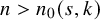
$n>n_0(k)$
 , the largest family
$\mathcal {F}\subset {[n]\choose k}$
 with no
$A,B\in \mathcal {F}$
 such that
$|A\cap B|=t-1$
 has the form

for some
$T$
 of size
$t$
 . The conjecture was resolved by Frankl and Füredi in a highly influential paper [Reference Frankl and Füredi27]. Great progress was made by Keller and Lifshitz [Reference Keller and Lifshitz40] who solved the Erdős-Sós problem for
$n$
 linear in
$k$
 , but with unspecified dependence on
$t$
 . Their result was further refined by Ellis, Keller, and Lifshitz [Reference Ellis, Keller and Lifshitz17], who managed to extend it to the regime
$k \leqslant (1/2 - \varepsilon )n$
 for arbitrarily small
$\varepsilon $
 and
$n>n_0(t,\varepsilon )$
 . Recently, Kupavskii and Zakharov [Reference Kupavskii and Zakharov49] showed that any extremal example in the Erdős-Sós problem is isomorphic to (1.1) under polynomial dependencies between
$n, k$
 , and
$t$
 : that is, for
$n =k^\alpha $
 and
$t=k^\beta $
 with
$0<\beta <1/2$
 and
$\alpha>1+2\beta $
 , provided
$k>k_0$
 . A part of the reason the problem of Erdős and Sós received a lot of attention is because of its numerous applications: in discrete geometry [Reference Frankl and Rödl29], communication complexity [Reference Sgall55] and quantum computing [Reference Buhrman, Cleve and Wigderson10]. We remark that, in the applications, it is important to allow
$t$
 to grow with
$n$
 .
In 1978, Deza, Erdős, and Frankl [Reference Deza, Erdős and Frankl13] studied the following generalization of the Erdős–Ko–Rado theorem [Reference Erdős, Ko and Rado20] and the Erdős–Sós problem. For positive integers
$n,k$
 and a set
$L\subset \{0,\ldots ,k-1\}$
 , an
$(n,k,L)$
 -system is a family
$\mathcal {F}\subset {[n]\choose k}$
 such that
$|A\cap B|\in L$
 for any
$A,B\in L$
 . Deza, Erdős, and Frankl proved a general bound on the size of the largest
$(n,k,L)$
 -system with
$|L|=r$
 , provided
$n>n_0(k).$
 In this paper, they introduced the Delta-system method, which makes use of large sunflowers in the family in order to discern its lower-uniformity structure. The method was later developed in the works by Frankl and Füredi and had a huge impact on Extremal Set Theory, see [Reference Frankl and Füredi26, Reference Frankl and Füredi27, Reference Füredi and Keedwell35, Reference Mubayi and Verstraëte50]. We discuss some aspects of the Delta-system method in Section 5.1. We note here that “forbidden intersections” or “allowed intersections” problems often have algebraic flavor. In particular, there are numerous results that use linear-algebraic methods [Reference Babai and Frankl3], as well as many of these questions are directly related to the existence of designs of a certain type (cf., e.g., [Reference Frankl23]).
Another particular case of Problem 1 of great importance is as follows. We say that sets
$F_1, \ldots , F_s$
 form a matching of size
$s$
 if they are pairwise disjoint. A matching is a sunflower with
$s$
 petals and empty core. That is, if we substitute
$t = 1$
 in Problem 1, we get the following famous problem. The Erdős Matching Conjecture [Reference Erdős18] states that any family
$\mathcal {F}\subset {[n]\choose k}$
 with no matching of size
$s$
 satisfies

provided
$n \geqslant k s - 1$
 . Erdős [Reference Erdős18] proved the conjecture for
$n \geqslant f(k) s$
 . After numerous improvements [Reference Bollobás, Daykin and Erdős6, Reference Huang, Loh and Sudakov36, Reference Frankl, Łuczak and Mieczkowska33, Reference Frankl24], it was shown [Reference Frankl and Kupavskii28] that the conjecture holds for
$n \geqslant \frac {5}{3} sk$
 and
$s>s_0$
 . In [Reference Kolupaev and Kupavskii44] the conjecture was proved in the regime when
$n$
 is only slightly bigger than
$sk$
 .
Let us return to the question of Duke and Erdős. In their seminal paper [Reference Frankl and Füredi26], Frankl and Füredi derived the following asymptotic bound on a sunflower-free family
$|\mathcal {F}|$
 when
$s, k, t$
 are fixed and
$n$
 tends to infinity.
Theorem 1.1. Let
$s, k, t$
 be integers,
$k \geqslant 2t + 1$
 . Suppose that
$s, k, t$
 are fixed and
$n\to \infty $
 . Then

Frankl and Füredi also showed that this bound is asymptotically the best possible. The extremal example is given in Section 3. Theorem 1.1 holds even though we know little about the behavior of the function
$\phi (s, t)$
 , which actually is a major complication for the study of the problem. The proof of the theorem is one of the pinnacles of the Delta-system method. (The authors use sunflowers in order to find sunflowers!) Previous to [Reference Frankl and Füredi26], partial cases
$t \in \{2, 3\}$
 ,
$k = 3$
 and arbitrary
$s$
 were studied by Duke and Erdős [Reference Duke and Erdős15], Frankl [Reference Frankl22], Chung [Reference Chung11], and Frankl and Chung [Reference Chung and Frankl12]. Recently, the case
$k = 4$
 was studied by Bucić et al. in [Reference Bucić, Draganić, Sudakov and Tran9]. Later, Bradač, Bucić, and Sudakov [Reference Bradač, Bucić and Sudakov8] proved that an extremal family in Problem 1 has size
$O_k(n^{k - t} s^t)$
 when
$n$
 tends to infinity,
$s$
 grows arbitrarily with
$n$
 , and
$k$
 is fixed. It is also worth mentioning some recent results on generalizations of the Duke–Erdős problem [Reference Janzer, Jin, Sudakov and Wu37]. The authors of [Reference Janzer, Jin, Sudakov and Wu37] address the case where sunflowers whose core sizes belong to a set
$L$
 are forbidden.
In this paper, we deal with the case when
$n$
 is potentially linear in
$k$
 , while
$s$
 is small. The following is a coarse version of our main result, stated and discussed in Section 3.
Theorem 1.2. Fix integers
$n, k, t$
 ,
$t \geqslant 2$
 . There exists a function
$f_0(s, t)$
 , polynomial in both
$s$
 and
$t$
 , such that if
$n \geqslant f_0(s, t) \cdot k$
 ,
$k \geqslant 2t + 1$
 and
$n \geqslant n_0(s, t)$
 , then the following holds. Let
$\mathcal {F} \subset \binom {[n]}{k}$
 be a family without a sunflower with
$s$
 petals and the core of size
$t - 1$
 . Then, we have

Moreover, we prove similar results for subfamilies of permutations and subfamilies of
$\binom {[n]}{k/w}^w$
 , see Section 7.
The following question has been raised as one of the initial problems in the proposal by Kalai for the Polymath projectFootnote
3
on the Erdős–Rado Delta-system conjecture. In their paper [Reference Bradač, Bucić and Sudakov8], Bradač et al. reiterated it. How big could a family
$\mathcal {F}$
 be if we forbid sunflowers with the core at most
$t - 1$
 ? While Problem 1 generalizes the Erdős Matching Conjecture and the Erdős-Sós forbidden one intersection problem, this question generalizes the Erdős Matching Conjecture and the Erdős–Ko–Rado Theorem [Reference Erdős, Ko and Rado20]. In this paper, we answer this question.
Theorem 1.3. Suppose that
$n/k \geqslant 4 s^2 (t + 1)^3 \log _2^3 (n/k)$
 and
$n \geqslant 2^{10} s k \log _2 k$
 . Suppose that a family
$\mathcal {F} \subset \binom {[n]}{k}$
 does not contain a sunflower with
$s$
 petals and core of size at most
$t - 1$
 . Then, the following bound holds:

In Section 4 we show that the theorem is tight up to second-order terms. Moreover, we prove that similar results hold if
$\mathcal {F}$
 is a subfamily of any of the following domains:
-
○ $[n]^k$
 ;
-
○ $\prod _{i = 1}^w \binom {[n]}{k_i}$
; -
○ the set of permutations $\Sigma _n$
on
$n$
elements; -
○ the $k$
-th layer of a simplicial complex with rank at least
$n$
.


All these cases can be included in the general framework developed in [Reference Kupavskii and Zakharov49, Reference Kupavskii45, Reference Kupavskii46], which we further develop in this paper. See Section 4 for the general statement and proofs. In the remaining part of the introduction, we discuss the methods of this and other works.
The starting point for us is the result of Alweiss, Lovett, Wu, and Zhang [Reference Alweiss, Lovett, Wu and Zhang1]. The core of their proof is the so-called spread lemma. Very roughly, the lemma states that a “pseudorandom” family
$\mathcal {F} \subset \binom {[n]}{k}$
 is likely to contain a matching of size
$s$
 that with good probability respects a random partition, for an appropriate notion of pseudorandomness. The authors show that for any large enough family
$\mathcal {F}$
 there is a set
$A$
 ,
$|A| < k$
 , such that the restriction

is “pseudorandom,” and, therefore, contains a matching
$F_1, \ldots , F_s$
 . Thus,
$A \cup F_1, \ldots , A \cup F_s \in \mathcal {F}$
 is a sunflower in
$\mathcal {F}$
 of size
$s$
 . We discuss this argument and its applications in our setting in Section 4.1.1. Based on the spread lemma and the notion of
$\tau $
 -homogeneity that they introduced, Kupavskii and Zakharov [Reference Kupavskii and Zakharov49] developed the spread approximation technique and used it to obtain progress in several hypergraph Turán-type problems. The technique was refined in the follow-up papers [Reference Kupavskii45, Reference Kupavskii46, Reference Kupavskii47]. That was the first method giving polynomial bounds in the Erdős–Sós problem. The method works when
$n \geqslant \mathrm {poly}(t) k \log k$
 and
$k \geqslant \mathrm {poly}(t) \log n$
 . In this paper, we add several new structural ingredients and merge their approach with the Delta-system technique and the method of Bradač et al [Reference Bradač, Bucić and Sudakov8] to extend the spread approximation results beyond
$k \geqslant \mathrm {poly}(t) \log n$
 , see Section 8. We should say that for
$k<\sqrt n$
 , we no longer need to rely on the spread lemma, and develop other combinatorial techniques instead, which, nevertheless, are in line with the general spread approximations framework.
One fruitful point of view on the spread lemma is as a sharp threshold result; see Section 5.5 for the definition of sharp thresholds and its applications in our setting. This connection was used to settle Talagrand’s conjecture on fractional-expectation thresholds in random graphs [Reference Frankston, Kahn, Narayanan and Park34] and the well-known Kahn–Kalai conjecture [Reference Park and Pham52]. The spread lemma, however, is not the only way to establish sharp thresholds in pseudorandom families. In [Reference Keller and Lifshitz40], Keller and Lifshitz showed that a type of pseudorandom families called uncapturable admits a sharp threshold phenomenon. Based on this fact, they extended the junta method of Dinur and Friedgut [Reference Dinur and Friedgut14], and using it they obtained significant progress in the famous Chvátal Simplex conjecture. Later, their method was refined by Keevash et al. [Reference Keevash, Lifshitz, Long and Minzer38] and applied to a number of hypergraph Turan-type problems. Finally, Keller et al. [Reference Keller, Lifshitz and Marcus41] using a variant of the notion of
$\tau $
 -homogeneity of Zakharov and the author as the notion of pseudorandomness, showed that such pseudorandom Boolean functions admit the hypercontractivity property (see Section 5.5 for definitions). This led to new results in sharp thresholds for pseudorandom families and has found several consequences in Extremal Combinatorics and beyond. We refer the reader to the follow-up papers of Keller et al. [Reference Keller, Lifshitz, Minzer and Sheinfeld42, Reference Keller, Lifshitz and Sheinfeld43]. We apply their results to study Problem 1 when
$n = \mathrm {poly}(s, t) k$
 .
At this point of development of these methods, it seems that none of the Delta-system, spread approximation, and hypercontractivity approaches can be fully replaced by the others. One of the goals of this paper is to take the best of each of these methods and combine them to investigate Problem 1.
The paper is organized as follows. In Section 2, we introduce the notation used in our paper. In Section 3, we discuss Theorem 1.2 and present its version with the dependencies stated explicitly. In Section 4, we give a proof of Theorem 1.3 and present a key tool for the proof of Theorem 1.2. In Section 5, we introduce certain preliminary results necessary for the proof of Theorem 1.2. In Section 6, we present the reduction of Theorem 1.2 to several cases, which are treated in Section 8 and Section 9. In Section 7, we generalize our results for subfamilies of permutations and
$[n]^k, \binom {[n]}{k/w}^w$
 . Section 10 contains some proofs omitted in Section 7.
2 Notation
Given a set
$X$
 and an integer
$h$
 , we denote by
$\binom {X}{h}$
 the family of subsets of
$X$
 of size
$h$
 . Families of tuples
$\binom {[n]}{k/w}^w$
 and
$[n]^k$
 are understood as subfamilies of
$\binom {[wn]}{k}$
 and
$\binom {[kn]}{k}$
 respectively.
For a family
$\mathcal {F}$
 and sets
$A, B$
 , we define

If
$A = B$
 , we denote
$\mathcal {F}(B) = \mathcal {F}(B, B)$
 . If
$B$
 is a singleton
$\{x\}$
 , we omit braces and use
$\mathcal {F}(x) = \mathcal {F}(\{x\})$
 . Next, if
$\mathcal {B}$
 is a family of sets, then we define

If
$\mathcal {B} = \{B\}$
 is a singleton of a set
$B$
 , we omit braces and use
$\mathcal {F}[B] = \mathcal {F}[\{B\}]$
 . We define the support of a family
$\mathcal {F}$
 as
$\mathrm {supp}(\mathcal {F}) = \bigcup _{F\in \mathcal {F}}F$
 . For families
$\mathcal {F}$
 and
$\mathcal {B}$
 , we define

A family
$\mathcal {F}$
 is
$k$
 -uniform (
$\leqslant k$
 -uniform), if all sets in
$\mathcal {F}$
 have size exactly
$k$
 (at most
$k$
 ). Given a family
$\mathcal {F}$
 and a number
$h$
 , we define its
$h$
 -th layer
$\mathcal {F}^{(h)}$
 as follows:

The shadow of a family
$\mathcal {F}$
 on the layer
$h$
 is defined as follows:

We put
$\partial _{\leqslant h} \mathcal {F} = \bigcup _{h' \leqslant h} \partial _{h'} \mathcal {F}$
 . For a family
$\mathcal {F} \subset 2^{[n]}$
 , we define the upper-closure of a family
$\mathcal {F}$
 as follows:

We say that a set
$T$
 is a transversal of a family
$\mathcal {F}$
 , if each
$F \in \mathcal {F}$
 intersects
$T$
 . The covering number
$\tau (\mathcal {F})$
 of a family
$\mathcal {F}$
 is the minimal cardinality of its transversal. This notation should not be confused with
$\tau $
 -homogeneity, defined below.
3 Main result
Here we present our main result with the parameter dependencies stated explicitly. Theorem 1.2 is its obvious corollary.
Theorem 3.1. For integers
$n, k, t$
 ,
$t \geqslant 2$
 , suppose that

$n \geqslant n_0(s, t)$
 and
$k \geqslant 2t + 1$
 , where
$n_0(s, t)$
 is some function depending on
$s, t$
 only. Let
$\mathcal {F} \subset \binom {[n]}{k}$
 be a family without a sunflower with
$s$
 petals and the core of size
$t - 1$
 . Then it holds that

Moreover, if
$k \geqslant 5t$
 , then
$n_0(s, t)$
 can be chosen to have the form
$s^{O(t)} \cdot g_0(t)$
 , where
$g_0(t)$
 is some function depending on
$t$
 only.
The minimum in the lower bound on
$n$
 corresponds to two different strategies of obtaining bound (3.1). If
$n = \Omega (sk \log k)$
 , then one can prove the result using the spread lemma. Otherwise, if
$n \geqslant \mathrm {poly}(s, t) \cdot k$
 , the result can be proved using Boolean analysis. Note the latter leads to worse dependencies on
$s, t$
 .
The proof is moved to Section 6. Intriguingly, the analysis is significantly simpler when
$k \geqslant 33 s t^2 \ln n$
 . A similar effect was observed in [Reference Keevash, Lifshitz, Long and Minzer38] and [Reference Keller and Lifshitz40]. In this regime, the result holds without the assumption
$n \geqslant n_0(s, t)$
 , and the lower bound of the form
$n \geqslant \mathrm {poly}(s, t) \cdot k$
 is enough. In the follow-up of this paper [Reference Kupavskii and Noskov48], we will show that one can prove Theorem 3.1 in the regime when
$n \geqslant \mathrm {poly}(s, t) \cdot k$
 and
$k \geqslant \mathrm {poly}(s, t)$
 without the assumption that
$n \geqslant n_0(s, t)$
 , that is, the dependencies between all parameters
$n, k, s, t$
 are polynomial and there is no lower bound on
$n$
 .
Compared to our theorem, Theorem 1.1 requires
$n \geqslant n_0(s, k)= s^{2^{k}} \cdot \hat g_0(k)$
 for some function
$\hat g_0(k)$
 depending on
$k$
 only. We use Theorem 1.1 only if
$k < 5t$
 , which requires
$n \geqslant s^{2^{5t}} \cdot \hat g_0(t)$
 in this case. We mentioned the case
$k \geqslant 5t$
 separately, since then we obtain a significant improvement in the lower bound on
$n$
 . Unfortunately, both functions
$g_0(t), \hat g_0(t)$
 are doubly-exponential in
$t$
 .
Note that Theorem 3.1 is tight up to second-order terms, as the following example demonstrates.
Example 3.2 (Example 2.3 [Reference Frankl and Füredi26])
Suppose that
$n> t \phi (s, t)$
 . Choose a family
$\mathcal {T} \subset \binom {[n]}{t}$
 that does not contain a sunflower with
$s$
 petals and
$|\mathcal {T}| = \phi (s, t)$
 . Then, define a family
$\mathcal {F}$
 as follows:

The family
$\mathcal {F}$
 does not contain a sunflower with
$s$
 petals and the core of size
$t - 1$
 .
The family
$\mathcal {T}$
 has support of size at most
$t \phi (s, t)$
 . Therefore, for the family
$\mathcal {F}$
 from Example 3.2, we have

Theorem 1.3 is closely related to Theorem 3.1, and even can be considered as an intermediate step in the proof of Theorem 3.1. Therefore, before we establish Theorem 3.1, we present the proof of Theorem 1.3.
4 Theorem 1.3 for spread domains
In order to state the promised generalizations of Theorem 1.3, we need some preliminaries.
4.1 Preliminaries I
4.1.1 Spread lemma
We start this section with the following definitions:
Definition 2. A probability measure
$\mu $
 on
$2^{[n]}$
 is said to be
$R$
 -spread, if for any
$X \in 2^{[n]}$
 one has

Definition 3. A random set
$\mathbf {W}$
 is called a
$p$
 -random subset of
$[n]$
 if elements
$j \in [n]$
 belong to
$\mathbf {W}$
 independently with probability
$p$
 .
One of the main reasons why the definition of
$R$
 -spreadness is so important for us is the following theorem called “the Spread lemma”:
Theorem 4.1 (Spread lemma)
If for some
$n, R \geqslant 1$
 a measure
$\mu : 2^{[n]} \to [0, 1]$
 is
$R$
 -spread and
$\mathbf {W}$
 is an
$m \delta $
 -random subset of
$[n]$
 , where
$m$
 is an integer, then

The spread lemma was initially established in the seminal paper by Alweis et al. [Reference Alweiss, Lovett, Wu and Zhang1] with nonoptimal dependencies. The proof relies on the coding techniques in the spirit of Razborov’s proof of the Håstad switching lemma (see Chapter 14.1 of [Reference Arora and Barak2]). It was refined by Rao in [Reference Rao53]. Later, TaoFootnote
4
provided a new proof based on entropy, but his derivations contain a mistake. Later, the proof was fixed and simplified by Hu.Footnote
5
StoecklFootnote
6
established Theorem 4.1 with
$1 + h_2(\delta ) \leqslant 2$
 instead of constant
$2$
 , where
$h_2(\delta ) = - \delta \log _2 \delta - (1 - \delta ) \log _2 (1 - \delta )$
 is the binary entropy of
$\delta $
 .
Note that Theorem 4.1 can be applied to families of sets. We say that a family
$\mathcal {F}$
 is
$R$
 -spread if the measure induced by uniform sampling from
$\mathcal {F}$
 is
$R$
 -spread. In other words,
$\mathcal {F}$
 is
$R$
 -spread if and only if for each
$X \in 2^{[n]}$
 , one has

Note that for a
$k$
 -uniform family
$\mathcal {F}$
 , one may obtain a restriction
$X$
 such that
$\mathcal {F}(X)$
 is
$R$
 -spread (assuming that the family consisting only of the empty set is arbitrarily spread).
Observation 4.2 (Lemma 2 from T. Tao’s blogpostFootnote 7 )
Let
$X$
 be the largest set such that
$|\mathcal {F}(X)| \geqslant R^{-|X|} |\mathcal {F}|$
 holds. Then, the family
$\mathcal {F}(X)$
 is
$R$
 -spread.
The observation is nontrivial, provided
$|\mathcal {F}|> R^k$
 . In that case, we have
$|\mathcal {F}(X)|> R^{-|X|} R^k = R^{k - |X|}$
 . In particular, this implies
$|X| < k$
 .
For families of sets, Theorem 4.1 can be efficiently combined with the following lemma by Keevash et al. [Reference Keevash, Lifshitz, Long and Minzer38]. We say that a family
$\mathcal {G}$
 is upward closed if for any
$A \in \mathcal {G}$
 and
$B, A \subset B,$
 one has
$B \in \mathcal {G}$
 .
Lemma 4.3. Let
$X_1, \ldots , X_s$
 be such that
$X_i$
 is a
$p_i$
 -random subset of
$[n]$
 . Let
$\mathcal {G}_1, \ldots , \mathcal {G}_s$
 be upward closed subfamilies of
$2^{[n]}$
 such that

Then there exist disjoint sets
$G_1 \in \mathcal {G}_1, \ldots , G_s \in \mathcal {G}_s$
 .
Together, Theorem 4.1 and Lemma 4.3 imply the following proposition which is the main tool in our analysis.
Proposition 4.4. Let
$\mathcal {G}_1, \ldots , \mathcal {G}_s$
 be
$R$
 -spread uniform families of uniformity at most
$k$
 . Suppose that
$R> 2^{7} s \lceil \log _2 k \rceil $
 . Then, there exist pairwise disjoint sets
$F_1 \in \mathcal {G}_1, \ldots , F_s \in \mathcal {G}_s$
 .
Proof. Put
$p = 1/8s$
 and consider a
$p$
 -random set
$\mathbf {W}$
 of
$[n]$
 . Choose
$m = \lceil \log _2 k \rceil $
 . Due to Theorem 4.1, for each
$i = 1, \ldots , s$
 , we have

We get

By Lemma 4.3, there exist pairwise disjoint sets
$G_i \in \mathcal {G}_i^{\uparrow }$
 , and so for some disjoint sets
$F_i \subset G_i$
 ,
$i = 1, \ldots , s$
 , we have
$F_1 \in \mathcal {G}_1, \ldots , F_s \in \mathcal {G}_s$
 .
Proposition 4.4 yields the following bound on
$\phi (s, t)$
 :
Claim 4.5. We have
$\phi (s, t) \leqslant (2^{7} s \log _2 t)^t$
 .
Proof. To obtain it, one should consider a family
$|\mathcal {F}|> (2^{7} s \log _2 t)^t$
 of uniformity
$t$
 , choose
$R = 2^{6} s \lceil \log _2 t \rceil $
 and find a maximal
$X$
 such that
$|\mathcal {F}(X)| \geqslant R^{-|X|} |\mathcal {F}|$
 . Note that
$|X| < t$
 . Observation 4.2 guarantees that
$\mathcal {F}(X)$
 is
$R$
 -spread, and Proposition 4.4 implies that
$\mathcal {F}(X)$
 contains a matching
$F_1, \ldots , F_s$
 of size
$s$
 . Thus,
$\mathcal {F}$
 contains a sunflower
$X \cup F_1, \ldots , X \cup F_s$
 of size
$s$
 .
Note that the constant
$2^{7}$
 in Claim 4.5 is not optimal. For example, one may obtain
$\phi (s, t) \leqslant (2^6 s \log _2 t)^t$
 (see M. Stoeckl’s blogpostFootnote
8
). For a short self-contained proof of Claim 4.5, we refer the reader to a recent paper of Rao [Reference Rao54].
In what follows, we will also use the following property of
$R$
 -spread families.
Claim 4.6. Let
$\mathcal {G}$
 be an
$R$
 -spread family. Consider an arbitrary
$X$
 of size less than
$R$
 . Then, the family
$\mathcal {G}(\varnothing , X)$
 is
$\hat R$
 -spread, where

and has size at least
$\left (1 - \frac {|X|}{R} \right ) |\mathcal {G}|$
 .
Proof. We have

Let
$A$
 be an arbitrary nonempty set disjoint from
$X$
 . Then, we have

so
$\mathcal {G}(\varnothing , X)$
 is indeed
$\hat {R}$
 -spread.
Claim 4.6 yields the following simple but important corollary.
Claim 4.7. Let
$\mathcal {G}$
 be an arbitrary
$R$
 -spread family. Then the covering number of
$\mathcal {G}$
 is at least
$R$
 .
Proof. Let
$X = \{x_1, \ldots , x_\ell \}$
 be a transversal of
$\mathcal {G}$
 . If
$\ell < R$
 , then, by Claim 4.6, we have

contradicting the definition of a transversal.
4.1.2 Spread domains
An important topic in Extremal Set Theory is to study families
$\mathcal {F}$
 , satisfying some restrictions in domains
$\mathcal {A}$
 different from
$\binom {[n]}{k}$
 . There is a wide range of such works, for example, generalizations of the Erdős–Ko–Rado theorem for vector fields [Reference Frankl and Wilson31], integer sequences [Reference Frankl and Tokushige30], layers of simplicial complexes [Reference Borg7] and permutations [Reference Frankl and Deza25], generalizations of the Kruskal–Katona theorem for
$[n]^k$
 [Reference Frankl, Füredi and Kalai32], generalizations of the Erdős-Sós problem for codes [Reference Keevash, Lifshitz, Long and Minzer39] and linear maps [Reference Ellis, Kindler and Lifshitz16].
Zakharov and the first author [Reference Kupavskii and Zakharov49] developed the machinery of spread approximations that can be used to deduce extremal set theory results for subfamilies of domains different from
$\binom {[n]}{k}$
 . To discuss these results, we shall need the following definition.
Definition 4. We say that a family
$\mathcal {A}$
 is
$(r, t)$
 -spread, if for any
$T \in \partial _{\leqslant t} \mathcal {A}$
 , the family
$\mathcal {A}(T)$
 is
$r$
 -spread.
Here, we illustrate the definition of
$(r, t)$
 -spreadness with several examples, including
$\binom {[n]}{k}$
 .
Proposition 4.8. Fix integers
$n, k, t$
 such that
$k \geqslant t$
 and
$n \geqslant k$
 . Then the following holds:
-
1. The family $\binom {[n]}{k}$
is
$\left (\frac {n}{k}, t \right )$
-spread; -
2. The family $[n]^k$
is
$(n, t)$
-spread; -
3. Fix $w\leqslant k$
and
$k_1, \ldots , k_w$
such that
$\sum _{i} k_i = k$
. The family
$\binom {[n]}{k_1} \times \ldots \times \binom {[n]}{k_w}$
is
$(r, t)$
-spread for
$r = \min _i \frac {n}{k_i}$
.


Proof. It is enough to prove 3, since 1 and 2 follow from it. Set

where
$|I_i| = n$
 . Fix some set
$T$
 of size at most
$t$
 , and let
$T_i = T \cap I_i$
 . Since
$T \in \partial _t \mathcal {A}$
 , we have
$|T_i| \leqslant k_i$
 . We aim to show that the family

is
$r$
 -spread. Consider an arbitrary
$S$
 disjoint from
$T$
 , and let
$S_i = S \cap (I_i \setminus T_i)$
 . We may assume that
$|S_i| \leqslant k_i - |T_i|$
 , since otherwise
$|\mathcal {A}(T)(S)| = 0$
 and the spreadness definition is trivially satisfied. We have

Then, we have

Next, we give some more sophisticated examples of families that are
$(r, t)$
 -spread.
Consider the family
$\Sigma _n$
 of permutations on
$[n]$
 . One can consider
$\Sigma _n$
 as a subfamily of
$\binom {[n]^2}{n}$
 . For each
$\sigma \in \Sigma _n$
 , consider the following set
$F_{\sigma } \in \binom {[n]^2}{n}$
 :

We denote by
$\mathfrak {S}_n$
 the family of sets
$\{F_{\sigma } \,:\, \sigma \in \Sigma _n\}$
 . Clearly, the family
$\mathfrak {S}_n$
 is
$n$
 -uniform. The following proposition ensures that it is
$(r, t)$
 -spread for a suitable
$r$
 .
Proposition 4.9 (Section 3.4 from [Reference Kupavskii and Zakharov49])
Suppose that
$n> 4t$
 . Then, the family
$\mathfrak {S}_n$
 is
$(n/4, t)$
 -spread.
The restrictions that a family
$\mathcal {F} \subset \Sigma _n$
 obeys are translated into the restrictions on the corresponding family
$\mathfrak {F} = \{F_\sigma \,:\, \sigma \in \mathcal {F}\}$
 . For example, if for any
$\sigma _1, \sigma _2 \in \mathcal {F}$
 there exists
$x$
 such that
$\sigma _1(x) = \sigma _2(x)$
 , then the family
$\mathfrak {F}$
 is intersecting, that is, for any
$F_1, F_2 \in \mathfrak {F}$
 we have
$|F_1 \cap F_2| \geqslant 1$
 . To formulate the counterpart of Theorem 1.3 for permutations, we need to elaborate the corresponding sunflower restriction for them.
Definition 5. Consider
$s$
 permutations
$\sigma _1, \ldots , \sigma _s$
 . If
-
1. there exists a set $X = \{x_1, \ldots , x_{m}\}$
such that
$\sigma _1(x_i) = \ldots = \sigma _s(x_i)$
for each
$i = 1, \ldots , m$
, -
2. for any $x \in [n] \setminus X$
, all values
$\sigma _1(x), \ldots , \sigma _s(x)$
are distinct,





then we say that
$\sigma _1, \ldots , \sigma _s$
 form a sunflower with
$s$
 petals and the core of size
$m$
 .
Note that
$\mathcal {F} \subset \Sigma _n$
 does not contain a sunflower with
$s$
 petals and the core of size
$t - 1$
 if and only if the corresponding family of sets
$\mathfrak {F} \subset \mathfrak {S}_n$
 does not contain a sunflower with
$s$
 petals and the core of size
$t - 1$
 . Using this correspondence, we can establish the counterpart of Theorem 1.3 for permutations.
Another nonobvious example of an
$(r, t)$
 -spread family is the
$k$
 -th layer of a simplicial complex of large rank. The rank of a simplicial complex is the size of its smallest inclusion-maximal set. Consider a simplicial complex
$\mathcal {C}$
 of rank
$n$
 . Let
$n \geqslant k \geqslant t$
 . Consider the
$k$
 -th layer
$\mathcal {C}^{(k)}$
 of
$\mathcal {C}$
 :

The following lemma states that the family
$\mathcal {C}^{(k)}$
 is
$(r, t)$
 -spread for a suitable
$r$
 .
Lemma 4.10 (Lemma 4 from [Reference Kupavskii46])
The family
$\mathcal {C}^{(k)}$
 is
$(n/k, t)$
 -spread.
Thus, there is a wide range of
$(r, t)$
 -spread families
$\mathcal {A}$
 . In Section 4.2, we show that for each such
$\mathcal {A}$
 and
$\mathcal {F} \subset \mathcal {A}$
 some counterpart of Theorem 1.3 holds.
4.2 Theorem 1.3 for spread domains
In order to formulate a generalization of Theorem 1.3 for
$\mathcal {F}$
 being a subfamily of an
$(r, t)$
 -spread domain (or ambient family)
$\mathcal {A}$
 , we require some natural equivalents of the quantities used in the bound on
$|\mathcal {F}|$
 . One such quantity replaces
$\binom {n - t}{k - t}$
 . We denote by
$A_t$
 the following quantity:

Using this notation, we present the main result of this section.
Theorem 4.11. Let
$\mathcal {A}$
 be a
$k$
 -uniform and
$(r, t)$
 -spread ambient family. Assume that
$r \geqslant 4 s^2 (t + 1)^3 \log _2^3 r$
 and
$r \geqslant 2^{10} s \log _2 k$
 . Suppose that a family
$\mathcal {F} \subset \mathcal {A}$
 does not contain a sunflower with
$s$
 petals and the core of size at most
$t - 1$
 . Then, there exists a family
$\mathcal {T} \subset \partial _{t} \mathcal {A}$
 that does not contain a sunflower with
$s$
 petals such that

We prove Theorem 4.11 in Section 4.3.
Obviously, the theorem yields the following upper bound on
$\mathcal {F}$
 :

where the maximum is taken over all families
$\mathcal {T} \subset \partial _t \mathcal {A}$
 that do not contain a sunflower with
$s$
 petals. If
$\mathcal {A} = \binom {[n]}{k}$
 , then we have
$r = n/k$
 due to Proposition 4.8, and the following bound holds:

Thus, Theorem 1.3 follows.
We claim that the bound (4.1) is tight up to remainder terms of order
$\log _2^3r/r$
 . The corresponding example below generalizes that of [Reference Frankl and Füredi26]. Consider a family
$\mathcal {T}^* \subset \partial _t \mathcal {A}$
 that maximizes
$|\mathcal {A}[\mathcal {T}]|$
 and does not contain a sunflower with
$s$
 petals. Denote

Then, define

We claim that
$\mathcal {F}^*$
 does not contain a sunflower with
$s$
 petals and the core of size at most
$t - 1$
 . Indeed, if such a sunflower
$F_1, \ldots , F_s$
 exists, then
$F_1 \cap \mathrm {supp} \mathcal {T}^*, \ldots , F_s \cap \mathrm {supp} \mathcal {T}^*$
 form a sunflower with
$s$
 petals and the core of size at most
$t - 1$
 . By construction,
$F_1 \cap \mathrm {supp} \mathcal {T}^*, \ldots , F_s \cap \mathrm {supp} \mathcal {T}^*$
 belongs to
$\mathcal {T}^*$
 , a contradiction.
Next, we have

Since
$\mathcal {A}$
 is
$(r, t)$
 -spread, we can bound
$|\mathcal {A}(T \sqcup \{x\})| \leqslant r^{-1} |\mathcal {A}(T)|$
 . Therefore, we have

so
$|\mathcal {F}^*| \geqslant \max _{\mathcal {T}} |\mathcal {A}[\mathcal {T}]| - \frac {t \phi ^2(s, t)}{r} A_t$
 , which matches bound (4.1) up to second-order terms.
Next, we present a corollary of Theorem 4.11 for subfamilies of a simplicial complex. Using Lemma 4.10, we obtain the following.
Corollary 4.11.1. Consider a simplicial complex
$\mathcal {C}$
 with rank at least
$n$
 . Fix numbers
$s, k, t$
 such that
$k \geqslant t$
 ,
$n/k \geqslant 4 s^2 (t + 1)^3 \log _2^3(n/k)$
 and
$n \geqslant 2^{10} s k \log _2 k$
 . Suppose that a family
$\mathcal {F} \subset \mathcal {C}^{(k)}$
 does not contain a sunflower with
$s$
 petals and the core of size at most
$t - 1$
 . Then, there exists a family
$\mathcal {T} \subset \mathcal {C}^{(t)}$
 that does not contain a sunflower with
$s$
 petals such that

To state the corollary of Theorem 4.11 for permutations, we need one more definition. We say that a function
$\nu $
 is a partial permutation of size
$t$
 , if
$\nu $
 is an injection from some set
$T \subset [n]$
 of size
$t$
 to
$[n]$
 . We define the family of partial permutations of size
$t$
 by
$\Sigma ^{(t)}_n$
 . Definition 5 of a sunflower generalizes trivially to partial permutations. Since any such injection can be extended to a bijection from
$[n]$
 to
$[n]$
 , there is a one-to-one correspondence between elements of
$\Sigma ^{(t)}_n$
 and the shadow
$\partial _t \mathfrak {S}_n$
 . Using it and Proposition 4.9, we deduce the following corollary (note that in our case the uniformity
$n$
 and the spreadness
$n/4$
 are the same up to multiplicative constants, so we have only one inequality on
$n$
 instead of two inequalities on
$r$
 in Theorem 4.11).
Corollary 4.11.2. Fix numbers
$n, s, t$
 such that
$n \geqslant 2^{20} s (t + 1) \log _2 n$
 . Suppose that a family
$\mathcal {F} \subset \Sigma _n$
 of permutations does not contain a sunflower with
$s$
 petals and the core of size at most
$t - 1$
 . Then, there exists a family
$\mathcal {T} \subset \Sigma ^{(t)}_n$
 of partial permutations that does contain a sunflower with
$s$
 petals and the core of size at most
$t - 1$
 , such that

Here
$\mathcal {F}[\mathcal {T}]$
 is the family of all permutations
$\sigma $
 in
$\mathcal {F}$
 such that there exists a partial permutation
$\nu \in \mathcal {T}$
 which coincides with
$\sigma $
 on the support of
$\nu $
 .
4.3 Proof of Theorem 4.11
Set
$w = (t + 1) \log _2 r$
 . Consider two cases.
Case 1. We have
$k \leqslant w$
 . In this case, we apply the following lemma with
$\mathcal {F}$
 in place of
$\mathcal {S}$
 with
$q = k$
 .
Lemma 4.12. Let
$\mathcal {A}$
 be a
$k$
 -uniform
$(r, t)$
 -spread family. Fix some
$q \leqslant k$
 and
$\varepsilon \in (0, 1)$
 . Assume that
$\varepsilon r \geqslant s^2 q^3$
 . Suppose that a family
$\mathcal {S} \subset \partial _{\leqslant q} \mathcal {A}$

-
○ does not contain an $s$
-sunflower with the core of size
$\leqslant t - 1$
; -
○ consists of sets of cardinality at least $t$
.


Then, there exists a family
$\mathcal {T} \subset \partial _{t} \mathcal {A}$
 which does not contain any sunflower with
$s$
 petals and

We prove Lemma 4.12 in Section 4.4. We apply it with
$\varepsilon = \frac {s^2q^3}r\leqslant \frac {s^2(t+1)^3\log _2^3 r}{r}$
 . Note that the condition on
$r$
 from the theorem implies that
$\varepsilon <1.$

The lemma gives suboptimal bounds if
$k \geqslant (t + 1) \log _2 r$
 . Indeed, if we apply it with
$k$
 in place of
$q$
 , it gives the result for
$r> s^2 k^3$
 , while we can establish the theorem provided
$r \geqslant 2 s^2 (t + 1)^3 \log ^3 r$
 and
$r \geqslant 2^{10} s \log _2 k$
 .
Case 2. We have
$k> (t + 1) \log _2 r$
 . In this case, we use the following iterative process to obtain some structure within the family
$\mathcal {F}$
 , cf. [Reference Kupavskii45, Reference Kupavskii46].
Set
$\mathcal {F}_0 = \mathcal {F}$
 . Given a family
$\mathcal {F}_{i}$
 , we obtain a family
$\mathcal {F}_{i + 1}$
 by the following procedure.
Set
$R = r/2$
 . Let
$S_i$
 be the maximal set such that
$|\mathcal {F}_{i}(S_i)| \geqslant R^{-|S_i|} |\mathcal {F}_i|$
 . Note that
$\mathcal {F}_i(S_i)$
 is
$R$
 -spread due to Observation 4.2. If
$|S_i|> w$
 , then stop. Otherwise, set
$\mathcal {F}_{i + 1} = \mathcal {F}_i \setminus \mathcal {F}_i[S_i].$

Suppose that the procedure above stops at step
$m$
 . It means that
$|S_m| \geqslant w + 1$
 and

for some
$T \subset S_m$
 of size
$t$
 . Define
$\mathcal {S} = \{S_1, \ldots , S_{m - 1}\}$
 and
$\mathcal {F}_{S_i} = \mathcal {F}_i(S_i)$
 . Note that
$\mathcal {F}$
 admits the following decomposition:

and each
$\mathcal {F}_S$
 is
$R$
 -spread.
We claim the following.
Claim 4.13. The family
$\mathcal {S}$
 possesses two properties:
-
1. it does not contain a sunflower with $s$
petals and the core of size at most
$t - 1$
; -
2. it consists of sets of cardinality at least $t$
.


Proof. Arguing indirectly, assume that
$\mathcal {S}$
 contains a sunflower
$S_1, \ldots , S_s$
 with
$s$
 petals and the core of size at most
$t - 1$
 . Note that one may consider
$s$
 copies of a set
$S$
 of size at most
$t - 1$
 as a sunflower with
$s$
 empty petals and the core of size at most
$t - 1$
 . The proof below does not require
$S_1, \ldots , S_s$
 to be distinct, so it implies both 1 and 2.
The families
$\mathcal {F}_{S_1}, \ldots , \mathcal {F}_{S_s}$
 are
$R$
 -spread. Put
$S = \cup _j S_j$
 . Consider the families
$\mathcal {G}_i = \mathcal {F}_{S_i}(\varnothing , S\setminus S_i)$
 ,
$j\in [s]$
 . Due to Claim 4.6,
$\mathcal {G}_i$
 are
$\hat R$
 -spread for

since
$R \geqslant 2 s w$
 . Next,
$\hat R \geqslant R/2 \geqslant 2^{8} s \log _2 k \geqslant 2^{7} s \lceil \log _2 k \rceil $
 , so Proposition 4.4 implies that there are disjoint
$G_1 \in \mathcal {G}_1, \ldots , G_s \in \mathcal {G}_s$
 . Therefore,
$\mathcal {F}$
 contains a sunflower
$S_1 \cup G_1, \ldots , S_s \cup G_s$
 with
$s$
 petals and the core of size at most
$t - 1$
 , a contradiction.
Note that
$\mathcal S\subset \partial _{\leqslant w} \mathcal A$
 by definition. Then, we apply Lemma 4.12 with
$q = w$
 and
$\varepsilon = \frac {s^2w^3}r=\frac {s^2(t+1)^3\log _2^3 r}{r}$
 to
$\mathcal {S}$
 , and obtain

Therefore, we have

4.4 Proof of Lemma 4.12: a simplification argument
Lemma 4.12 is the key ingredient in the proofs of Theorems 3.1 and 4.11. As a reminder, let us restate the lemma.
Lemma 4.12. Let
$\mathcal {A}$
 be a
$k$
 -uniform
$(r, t)$
 -spread family. Fix some
$q \leqslant k$
 and
$\varepsilon \in (0, 1)$
 . Assume that
$\varepsilon r \geqslant s^2 q^3$
 . Suppose that a family
$\mathcal {S} \subset \partial _{\leqslant q} \mathcal {A}$

-
○ does not contain an $s$
-sunflower with the core of size
$\leqslant t - 1$
; -
○ consists of sets of cardinality at least $t$
.


Then, there exists a family
$\mathcal {T} \subset \partial _{t} \mathcal {A}$
 which does not contain any sunflower with
$s$
 petals and

We will obtain
$\mathcal {T}$
 at the end of the following process. Set
$\mathcal {T}_0 = \mathcal {S}$
 . Given a family
$\mathcal {T}_{i}$
 , we will construct a family
$\mathcal {T}_{i + 1}$
 by Procedure 1 starting from
$i = 0$
 .
Simplification procedure.

Procedure 1 Long description
The algorithm consists of 11 numbered steps.
* Step 1: Set W sub i gets T sub i super (q minus i) and T prime sub i plus 1 gets the empty set symbol.
* Step 2: Set alpha gets s q.
* Step 3: Find a maximal set T such that the absolute value of W sub i (T) is greater than or equal to alpha to the power of negative absolute value of T times the absolute value of W sub i.
* Step 4: A while loop begins with the condition that the absolute value of T is less than or equal to q minus i minus 1.
* Step 5: Define T sub i, T gets W sub i (T).
* Step 6: Remove sets containing T from W sub i using the operation W sub i gets W sub i minus W sub i [T].
* Step 7: Add T to T prime sub i plus 1 using the operation T prime sub i plus 1 gets T prime sub i plus 1 union the set containing T.
* Step 8: Find a maximal set T prime such that the absolute value of W sub i (T prime) is greater than or equal to alpha to the power of negative absolute value of T prime times the absolute value of W sub i.
* Step 9: Set T gets T prime.
* Step 10: End while loop.
* Step 11: Set T sub i plus 1 gets T prime sub i plus 1 union T sub i super (less than or equal to q minus i minus 1).
In what follows, we define families
$\mathcal {T}_{i + 1}, \mathcal {W}_i, \mathcal {T}_{i, T}, \mathcal {T}_{i + 1}'$
 as obtained after this procedure. The desired family
$\mathcal {T}$
 is
$\mathcal {T}_{q - t}$
 . Note that each set in
$\mathcal {T}_i$
 has size at most
$q - i$
 . Finally, for any
$T \in \mathcal {T}_{i + 1}'$
 , there exists an
$\alpha $
 -spread family
$\mathcal {T}_{i, T}$
 such that

In order to establish Lemma 4.12, we need the following three claims.
Claim 4.14. For each
$i = 0, \ldots , q - t$
 ,
$\mathcal {T}_i$
 admits two properties:
-
○ does not contain a sunflower with the core of size $\leqslant t - 1$
and
$s$
petals; -
○ each set of $\mathcal {T}_i$
has size at least
$t$
.


Proof. The proof is by induction on
$i$
 . For
$i = 0$
 the statement holds by the assumptions of Lemma 4.12. Assume that
$\mathcal {T}_{i}$
 satisfies both properties. We prove that
$\mathcal {T}_{i + 1}$
 does also.
Assume that
$\mathcal {T}_{i + 1}$
 contains a sunflower with the core of size
$\leqslant t - 1$
 and
$s$
 petals. Consider such a sunflower
$T_1, \ldots , T_s \in \mathcal {T}_{i + 1}$
 . Recall that
$\mathcal {T}_{i + 1} = \mathcal {T}_{i}^{(\leqslant q - i - 1)}\cup \mathcal {T}_{i + 1}'$
 . Thus, we may assume that
$T_1, \ldots , T_\ell \in \mathcal {T}_{i +1}'$
 for some
$\ell $
 ,
$0\leqslant \ell \leqslant s$
 , and the remaining sets
$T_{\ell + 1}, \ldots , T_s \in \mathcal {T}_{i}^{(\leqslant q - i - 1)}$
 .
Families
$\mathcal {T}_{i, T_{w}}, w = 1, \ldots , \ell ,$
 defined by the procedure, are
$\alpha $
 -spread. Claim 4.7 implies that their covering number is at least
$\alpha = s q$
 . We claim that there are disjoint
$F_1 \in \mathcal {T}_{i, T_1}, \ldots , F_\ell \in \mathcal {T}_{i, \ell }$
 that do not intersect
$\bigcup _{p = 1}^s T_p$
 . Assume that the opposite holds and let
$j$
 be the maximum integer such that there are disjoint
$F_1 \in \mathcal {T}_{i, T_1}, \ldots , F_j \in \mathcal {T}_{i, T_j}$
 that do not intersect
$\bigcup _{p = 1}^s T_p$
 . It means that
$\bigcup _{p = 1}^j (F_j \cup T_j) \cup \bigcup _{p = j + 2}^s T_p$
 is a transversal for
$\mathcal {T}_{i, T_{j + 1}}$
 , so the covering number of
$\mathcal {T}_{i, T_j}$
 is at most
$j (q - i) + (s - 1 - j) (q - i) < s (q - i)$
 , a contradiction. Therefore,
$\mathcal {T}_{i}$
 contains sets
$T_1 \cup F_1, \ldots , T_\ell \cup F_\ell , T_{\ell + 1}, \ldots , T_s$
 , which form a sunflower with the core of size
$\leqslant t - 1$
 , a contradiction.
Next, assume that
$\mathcal {T}_{i + 1}$
 contains a set
$T$
 of size at most
$t - 1$
 . By the induction hypothesis, we may assume that
$T \in \mathcal {T}_{i + 1}'$
 . Then, the family
$\mathcal {T}_{i, T}$
 is
$\alpha $
 -spread, and, thus, its covering number is at least
$\alpha _i$
 . Arguing as before, we find disjoint sets
$F_1, \ldots , F_s \in \mathcal {T}_{i, T}$
 . Thus,
$\mathcal {T}_{i}$
 contains a sunflower
$T \cup F_1, \ldots , T \cup F_s$
 with the core
$T$
 ,
$|T| \leqslant t - 1$
 , a contradiction.
Claim 4.15. We have
$|\mathcal {W}_i| \leqslant 2 \binom {q - i}{t} \phi (s, q - i) \alpha ^{q - i - t}$
 .
Proof. We define a graph
$G = (\mathcal {W}_i, E)$
 such that two sets
$W_1, W_2$
 are connected by an edge if they intersect in at least
$t$
 elements. We prove below that the maximal degree in this graph is at most
$\binom {q - i}{t} \alpha ^{q - i - t}$
 . Consider a set
$W \in \mathcal {W}_i$
 . Then all neighbors of
$W$
 in the graph
$G$
 belong to a set

We claim that
$|\mathcal {W}_i(T)| \leqslant \alpha ^{q - i - t}$
 . Consider two cases.
Case 1. We have
$|\mathcal {W}_i(T)| \leqslant \alpha ^{-|T|} |\mathcal {W}_i|$
 . By the construction of
$\mathcal {W}_i$
 , the bound
$\alpha ^{-|X|}|\mathcal {W}_i| \leqslant |\mathcal {W}_i(X)|$
 holds for some
$X$
 of size
$q - i$
 . But
$|\mathcal W_i(X)| = 1$
 , therefore,
$|\mathcal {W}_i| \leqslant \alpha ^{q - i}$
 , and so
$|\mathcal {W}_i(T)| \leqslant \alpha ^{q - i - t}$
 .
Case 2. We have
$|\mathcal {W}_i(T)|> \alpha ^{-|T|} |\mathcal {W}_i|$
 . Consider the maximal
$X$
 disjoint from
$T$
 such that
$|\mathcal {W}_i(X \sqcup T)| \geqslant \alpha ^{-|X|} |\mathcal {W}_i(T)|$
 . Since we have
$|\mathcal {W}_i(X \sqcup T)|> \alpha ^{-|X| - |T|} |\mathcal {W}_i|$
 by the assumption of the case, the size of
$X$
 should be
$q - i - t$
 by the construction of
$\mathcal {W}_i$
 . Hence, we have
$1 = |\mathcal {W}_i(X \sqcup T)| \geqslant \alpha ^{-(q - i - t)} |\mathcal {W}_i(T)|$
 , and so
$|\mathcal {W}_i(T)| \leqslant \alpha ^{q - i - t}$
 .
Therefore, the set
$W$
 has at most
$\sum _{T\in {W\choose t}}|\mathcal W_i(T)|\leqslant \binom {q - i}{t} \alpha ^{q - i - t}$
 neighbors. It implies that the maximal degree of the graph
$G$
 is at most
$\binom {q - i}{t} \alpha ^{q - i - t}$
 . Using a standard greedy argument, one can show that the size of the largest independent set in
$G$
 is at least

Therefore, there exists a family
$\mathcal {I} \subset \mathcal {W}_i$
 of size at least the RHS of (4.2), such that any two distinct sets
$F_1, F_2 \in \mathcal {I}$
 intersect in at most
$t - 1$
 elements.
We claim that
$\mathcal {I}$
 does not contain a sunflower with
$s$
 petals. Suppose that such a sunflower
$F_1, \ldots , F_s \in \mathcal {I}$
 exists. Then, the core of this sunflower must have size at most
$t - 1$
 . Since
$\mathcal {W}_i$
 is a subset of
$\mathcal {T}_i$
 , the sets
$F_1, \ldots , F_s$
 belong to
$\mathcal {T}_i$
 , contradicting Claim 4.14. Therefore, (4.2)
$ {\leqslant}\ |\mathcal {I}| \leqslant \phi (s, q - i)$
 , and so

The claim follows.
Next, we adapt the proof of the Erdős–Rado Theorem [Reference Erdős and Rado19] to bound
$\phi (s, q - i)$
 via
$\phi (s, t)$
 .
Claim 4.16. For any
$a \leqslant b$
 , we have
$\phi (s, b) \leqslant \phi (s, a) \cdot (sb)^{b - a}$
 .
Proof. Let
$\mathcal {G}$
 be a
$b$
 -uniform family without a sunflower with
$s$
 petals and such that
$|\mathcal {G}| = \phi (s, b)$
 . Consider the maximal matching
$F_1, \ldots , F_m$
 in
$\mathcal {G}$
 . Since
$\mathcal {G}$
 does not contain a sunflower with
$s$
 petals, we have
$m < s$
 . Since the matching is maximal, each set
$G \in \mathcal {G}$
 intersects
$M = \bigcup _{j = 1}^m F_m$
 , where
$|M| \leqslant (s - 1)b$
 . Therefore, the size of
$\mathcal {G}$
 is at most
$\sum _{x \in M} |\mathcal {G}(x)|$
 . Each family
$\mathcal {G}(x)$
 in the latter sum does not contain a sunflower with
$s$
 petals, so
$|\mathcal {G}(x)| \leqslant \phi (s, b - 1)$
 . It yields the bound

Iterating the inequality above, we obtain

Finally, we are ready to prove Lemma 4.12.
Proof of Lemma 4.12
Decomposing
$\mathcal {A}[\mathcal {S} \setminus \mathcal {S}[\mathcal {T}]]$
 into the union of
$\mathcal {A}[\mathcal {W}_i], i = 0, \ldots , q - t - 1$
 , we obtain

Since
$\varepsilon r \geqslant \alpha sq^2$
 , the last sum is at most

5 Preliminaries II
5.1 Delta-systems
The original method of Frankl and Füredi heavily relies on the following lemma (see Lemma 7.4 from [Reference Frankl and Füredi26]).
Lemma 5.1. Let
$\mathcal {F} \subset \binom {n}{k}$
 . Fix numbers
$p, t$
 , such that
$p \geqslant k \geqslant 2 t + 1$
 . Suppose that
$\mathcal {F}$
 does not contain a sunflower with
$p$
 petals and the core of size
$t - 1$
 . Then, there exists a subfamily
$\mathcal {F}^* \subset \mathcal {F}$
 that admits the following properties:
-
1. for any $F \in \mathcal {F}^*$
, there exists a subset
$T \subset F$
of size
$t$
such that each set
$E$
,
$T \subset E \subsetneq F$
, is a core of a sunflower with
$p$
petals in
$\mathcal {F}^*$
; -
2. $|\mathcal {F} \setminus \mathcal {F}^*| \leqslant c(p, k) \binom {n}{k - t - 1}$
,


where
$c(p, k)$
 is some function that can be bounded by
$p^{2^k} \cdot 2^{2^{Ck}}$
 for some absolute constant
$C$
 .
While the paper [Reference Frankl and Füredi26] omits precise numerical dependencies between
$n, k$
 and
$t$
 , we need them stated explicitly. For the sake of completeness, we present here a proof of the sunflower theorem by Frankl and Füredi. Moreover, the core idea will be used in the proof of our result.
Theorem 5.2. Let
$k \geqslant 2t + 1$
 . Suppose that a family
$\mathcal {F}$
 does not contain a sunflower with
$s$
 petals and the core of size
$t - 1$
 . Then

Proof. Applying Lemma 5.1 with
$p = sk$
 , we infer that there exists
$\mathcal {F}^* \subset \mathcal {F}$
 ,
$|\mathcal {F} \setminus \mathcal {F}^*| \leqslant c(sk, k) \binom {n}{k - t - 1}$
 , such that for any
$F \in \mathcal {F}^*$
 there is a subset
$T \subset F$
 of size
$t$
 such that any
$E$
 ,
$T \subset E \subsetneq F$
 , is a core of a sunflower with
$sk$
 petals in
$\mathcal {F}^*$
 . For each
$F \in \mathcal {F}^*$
 , fix one such
$T = T(F)$
 . Then, we have

Define
$\mathcal {F}_D = \{T(F) \,:\, F \in \mathcal {F}^* \text { and } F \setminus D = T(F) \}$
 . We claim that
$\mathcal {F}_D$
 does not contain a sunflower with
$s$
 petals and arbitrary core. Otherwise choose such a sunflower
$T_1, \ldots , T_s \in \mathcal {F}_D$
 . Choose
$X \subset D$
 ,
$|X| = t - 1 - |\cap _i T_i|$
 . Each
$T_i \cup X$
 is the core of a sunflower in
$\mathcal {F}^*$
 with
$sk$
 petals. Let
$m$
 be the maximum number such that there are disjoint
$F_1 \in \mathcal {F}^*(T_1 \cup X), \ldots , F_m \in \mathcal {F}^*(T_m \cup X)$
 that do not intersect
$\cup _{i = 1}^m T_i$
 . Since
$\mathcal {F}^*$
 does not contain a sunflower with
$s$
 petals and the core of size
$t - 1$
 ,
$m$
 is strictly less than
$s$
 . Consider a family
$\mathcal {F}^*(T_{m + 1} \cup X)$
 . By the definition of
$\mathcal {F}^*$
 , it contains pairwise disjoint sets
$G_1, \ldots , G_{sk}$
 . At least one such set does not intersect
$\cup _{i = 1}^m (T_i \cup X \cup F_i)$
 since
$|\cup _{i = 1}^m (T_i \cup X \cup F_i)| \leqslant (s - 1) k < sk$
 . Hence, we can choose
$F_{m + 1} \in \mathcal {F}^*(T_i \cup X)$
 , that does not intersect
$\cup _{i = 1}^{m + 1} T_i \cup X$
 , contradicting the maximality of
$m$
 .
Therefore,
$\mathcal {F}_D \subset \binom {n}{t}$
 does not contain a sunflower with
$s$
 petals, and so
$|\mathcal {F}_D| \leqslant \phi (s, t)$
 . Since

we have

We shall use Theorem 5.2 for
$k < 5t$
 . For larger
$k$
 , we use different techniques, which are built on the results presented in the following sections.
5.2 Sunflower Turán number: the result of Bradač et al
Theorem 5.2 is quite restrictive, as it requires the lower bound on
$n$
 of the form
$(st)^{2^{\Omega (t)}}$
 . To relax this restriction, we employ the following result due to Bradač et al. [Reference Bradač, Bucić and Sudakov8].
Theorem 5.3. Let
$\mathcal {F} \subset \binom {[n]}{k}$
 be a family that does not contain a sunflower with
$s$
 petals and the core of size exactly
$t - 1$
 . Then, for each
$k$
 there is some constant
$C_k$
 depending on
$k$
 only, such that

The bounds provided by Theorem 5.3 are tight up to the dependence on
$k$
 . The example can be constructed using a nice probabilistic argument, see Lemmas 10 and 11 of [Reference Bradač, Bucić and Sudakov8].
We will use this theorem for
$k \leqslant 2t + 1$
 . In that regime,
$C_k \sim t! \cdot t^{\binom {2t - 1}{t}}$
 , so
$C_k$
 is double-exponential in
$k$
 . In what follows, we assume that
$C_k$
 is increasing in
$k$
 and larger than
$1$
 .
5.3 Homogeneity and general domains
While the main theorem of our paper deals with subfamilies of
$\binom {[n]}{k}$
 , some parts of the analysis can be extended to other domains. As in Theorem 4.11, we consider families
$\mathcal {F}$
 that are subfamilies of some
$k$
 -uniform family
$\mathcal {A}$
 which satisfies a number of assumptions.
When dealing with the uniform families
$\mathcal {F} \subset \mathcal {A}$
 , it is convenient to replace the notion of
$R$
 -spreadness with the notion of
$\tau $
 -homogeneity, introduced in [Reference Kupavskii and Zakharov49].
Definition 6. A family
$\mathcal {F}$
 is
$\tau $
 -homogeneous if for each
$X$
 , we have

In what follows, we use the notation
$\mu (\mathcal {F}) = |\mathcal {F}| / |\mathcal {A}|$
 . Using this, we can rewrite the condition above as follows:
$\mu (\mathcal {F}(X))\leqslant \tau ^{|X|}\mu (\mathcal {F})$
 . A variant of the definition of
$\tau $
 -homogeneity, called
$\tau $
 -globalness, was used in [Reference Keller, Lifshitz and Marcus41], see Definition 8. If the domain
$\mathcal {A}$
 is
$r$
 -spread, a
$\tau $
 -homogeneous family
$\mathcal {F}$
 is
$r/\tau $
 -spread. Indeed, we have

In general, we require
$\mathcal {A}(S)$
 to be
$r$
 -spread for any
$S$
 that has size smaller than some integer
$q$
 ,
$q \geqslant t$
 . That implies the first assumption on the domain
$\mathcal {A}$
 , which strengthens the corresponding assumption of Theorem 4.11.
Assumption 1. Let
$q$
 be an integer. The family
$\mathcal {A}$
 is
$k$
 -uniform and
$(r, q + t - 1)$
 -spread.
The necessary
$q$
 will be chosen later.
Solutions of hypergraph Turan-type problems in
$\binom {[n]}{k}$
 often involve the binomial coefficient
$\binom {n - t}{k - t}$
 , which is the number of sets in
$\binom {[n]}{k}$
 containing some set of size
$t$
 . We recall a natural equivalent for this quantity in arbitrary domains:

The second assumption on
$\mathcal {A}$
 requires
$A_t$
 to be not too small.
Assumption 2. Let
$\eta \geqslant 1$
 be a real number. We have
$A_t \geqslant r^{-\eta t} |\mathcal {A}|$
 .
The next two assumptions concern the shadow of
$\mathcal {A}$
 .
Assumption 3. For any set
$S \in \partial _{\leqslant q} \mathcal {A}$
 , a family
$\mathcal {F} \subset \mathcal {A}(S)$
 , and
$h \leqslant t - 1$
 , we have

or, equivalently, for a random set
$\mathbf {H}$
 uniformly distributed on
$\partial _h (\mathcal {A}(S)) $
 , we have
$ \mu (\mathcal {F}) = \mathbb {E} \mu (\mathcal {F}(\mathbf {H})).$

Assumption 4. For any set
$R \in \partial _{\leqslant q} \mathcal {A}$
 , an integer
$h$
 ,
$h \leqslant t$
 , and some
$\mu> 1$
 , it holds

The natural question is when these assumptions are satisfied. The following propositions show that some interesting domains fit these assumptions.
Proposition 5.4. Suppose that
$n, k \geqslant q + t$
 ,
$q \geqslant t$
 and
$n> 8k$
 . Then, the following holds:
-
1. Suppose additionally that $n \geqslant 2k t$
. Then
$\binom {n}{k}$
satisfies Assumptions 1-4 with
$r = n/k, \mu = n/2k, \eta = 2$
; -
2. Suppose that $n \geqslant 2t, k \geqslant 2 q$
. Then
$[n]^k$
satisfies Assumptions 1-4 with
$r = n, \mu = 1/2, \eta = 2$
; -
3. Fix an integer $w$
, such that
$n\geqslant 2kt/w$
and
$w|k$
. Then
$\binom {[n]}{k / w}^w$
satisfies Assumptions 1-3 with
$r = \frac {wn}{k}$
and
$\eta = 2$
. Moreover, if
$k \geqslant w (q + t)$
, then
$\binom {[n]}{k/w}^w$
satisfies Assumption 4 with
$\mu = n/2k$
.


Proof. By taking
$w = 1$
 and
$w = k$
 respectively, satisfiability of Assumptions 1-3 for
$[n]^k, \binom {[n]}{k}$
 follows from the third statement, so we consider only the family
$\binom {[n]}{k/w}^w$
 for these assumptions. Assumption 1 is satisfied due to Proposition 4.8, which is used with
$q + t - 1$
 in place of
$t$
 .
Next, we check Assumption 2. Consider a set
$T$
 of size
$t$
 , and set
$t_i = |T \cap I_i|$
 . Then, we have

If
$t \leqslant k/2w$
 , then the latter product is at least

provided
$n \geqslant 2 k/w$
 . In particular, this bound implies that Assumption 2 holds for
$\binom {[n]}{k}$
 , since
$k \geqslant 4q \geqslant 2t$
 . If
$t \geqslant k/2w$
 , then we bound the RHS of (5.1) as follows:

where we used
$w n \geqslant 2t k$
 in the last inequality. Hence, Assumption 2 holds with
$\eta = 2$
 .
Similarly to Proposition 4.8, we assume that
$\mathcal {A}$
 has the form

where disjoint sets
$I_1, \ldots , I_w$
 have size
$n$
 . The following claim ensures that Assumption 3 holds for any domain of the form

We need this claim stated separately, because we use it in what follows.
Claim 5.5. Let
$I_1, \ldots , I_w$
 be arbitrary disjoint sets and
$k_1 \leqslant |I_1| , \ldots , k_w \leqslant |I_w|$
 be integer numbers. Then the family

satisfies Assumption 3.
Proof. Fix
$S$
 of size at most
$q$
 , and consider a set
$\mathbf {H}$
 uniformly distributed on
$\partial _h (\mathcal {A}(S))$
 . Let
$\mathbf {h}_1 = |\mathbf {H} \cap I_1 \setminus S|, \ldots , \mathbf {h}_w = |\mathbf {H} \cap I_w \setminus S|$
 and
$\mathbf {h} = (\mathbf {h}_1, \ldots , \mathbf {h}_w)$
 . Let
$\partial _{\mathbf {h}}(\mathcal {A}(S))$
 be a family of sets
$H$
 from
$\partial _h (\mathcal {A}(S))$
 such that
$|H \cap I_i| = \mathbf {h}_i$
 . Then, for a family
$\mathcal {F} \subset \mathcal {A}(S)$
 , we have

Each set
$F \in \mathcal {F}$
 is counted
$\prod _{i = 1}^w \binom {k_i - |S \cap I_i|}{\mathbf {h}_i}$
 times, so we have

where
$\mu (\mathcal {F}) = |\mathcal {F}| / |\mathcal {A}(S)|$
 . The multiplicative factor of
$\mu (\mathcal {F})$
 on the right-hand side equals

so
$\mathbb {E} [\mu (\mathcal {F}(\mathbf {H})) \,|\, \mathbf {h}] = \mu (\mathcal {F})$
 , and, by taking the expectation of both sides, Assumption 3 follows.
Then, we check Assumption 4 for
$\binom {[n]}{k/w}^w$
 . By taking
$w = 1$
 , it implies the first statement of the proposition. Consider arbitrary
$R , |R| \leqslant q$
 . If
$k / w \geqslant q + t$
 , then
$k \geqslant w (|R| + t)$
 . For a partition of
$h$
 into nonnegative ordered summands
$h_1, \ldots , h_w$
 , define
$\overline {h} = (h_1, \ldots , h_w)$
 , and note that
$h_i \leqslant t \leqslant k / w - |R|$
 . Thus, we have

so Assumption 4 is satisfied with
$\mu = n/2k$
 .
Thus, the first and the third statements of the proposition are proved. It remains to check that
$[n]^k$
 satisfies Assumption 4 with
$\mu = 1/2$
 . For any
$R$
 , we have

so

provided
$k \geqslant 2 q$
 . It implies the second statement of the proposition.
It turns out that under mild restrictions on
$n, t, q$
 the family of permutations
$\Sigma _n$
 as the family of sets
$\mathfrak {S}_n$
 (see Section 4.1.2) also satisfies Assumptions 1-4. Note that
$n$
 plays the role of uniformity of the family
$\Sigma _n$
 .
Proposition 5.6. Suppose that
$n> 4( q + t)$
 ,
$n \geqslant 16$
 and
$q \geqslant t$
 . Then,
$\mathfrak {S}_n$
 satisfies Assumptions 1-4 with
$k = n, r = n/4$
 ,
$\eta = 2$
 and
$\mu = 1/4$
 .
Proof. Since
$n> 4(q + t)$
 , Proposition 4.9 implies that
$\mathfrak {S}_n$
 is
$(r, q + t - 1)$
 -spread for
$r = n/4$
 , so Assumption 1 is satisfied.
Next, we check Assumption 2. We have

since
$n \geqslant 16$
 . Therefore, Assumption 2 holds with
$\eta = 2$
 .
Then, we check Assumption 3. We may consider a set
$S \in \partial _{\leqslant q} \mathfrak {S}_n$
 as an injection that maps some set
$\mathrm {Dom} S$
 of size
$|S|$
 to a subset
$\mathrm {Im} S$
 of
$[n]$
 . Thus,
$\mathfrak {S}_n(S)$
 can be considered as a family of such permutations that coincide with
$S$
 on the domain
$\mathrm {Dom} S$
 of
$S$
 . The shadow
$\partial _h (\mathfrak {S}_n)$
 can be considered as a number of bijections from a subset of
$[n] \setminus \mathrm {Dom} S$
 of size
$h$
 to a subset of
$[n] \setminus \mathrm {Im} S$
 . It yields

for any
$H \in \partial _h (\mathfrak {S}_n(S))$
 . Finally, we have

It implies

and Assumption 3 follows.
Finally, we check Assumption 4. Fix a set
$R \in \partial _{\leqslant q} \mathfrak {S}_n$
 , and bound

so Assumption 4 holds with
$\mu = 1/4$
 .
We complete this section with three statements about
$\tau $
 -homogeneous families. The first one shows that most restrictions of a
$\tau $
 -homogeneous family
$\mathcal {F}$
 are also homogeneous.
Proposition 5.7. Suppose that Assumption 3 holds. Let
$\mathcal {F} \subset \mathcal {A}(S)$
 ,
$S \in \partial _{\leqslant q}\mathcal {A}$
 , be a
$\tau $
 -homogeneous family. Let
$h$
 be a positive integer less than
$k$
 and
$\alpha \in (0, 1)$
 . Suppose that
$\tau \leqslant (1 - \alpha \rho )^{-1/h}$
 . Then, for all but
$\alpha \left | \partial _h \mathcal {A} \right |$
 sets
$H \in \partial _h \mathcal {A} $
 , the family
$\mathcal {F}(H)$
 is
$\hat {\tau }$
 -homogeneous for
$\hat \tau = \tau / (1 - \rho )$
 and
$\mu (\mathcal {F}(H)) \geqslant (1 - \rho ) \cdot \tau ^h \cdot \mu (\mathcal {F})$
 .
Proof. If
$\mathcal {F}(H)$
 is not
$\hat \tau $
 -homogeneous, then there exists
$Z$
 such that

Since
$\mathcal {F}$
 is
$\tau $
 -homogeneous, we have

so
$\mu (\mathcal {F}(H)) \leqslant \left (\frac {\tau }{\hat \tau } \right )^{|Z|} \cdot \tau ^{|H|} \mu (\mathcal {F}) \leqslant \tau / \hat {\tau } \cdot \tau ^{|H|} \mu (\mathcal {F})$
 . Define

Due to Assumption 3, we have

For each
$H \in \mathcal {H}$
 , we have
$\mu (\mathcal {F}(H)) \leqslant \frac {\tau }{\hat \tau } \cdot \tau ^h \mu (\mathcal {F})$
 by the reasoning above. If
$H \not \in \mathcal {H}$
 , we bound
$\mu (\mathcal {F}(H)) \leqslant \tau ^{|H|} \mu (\mathcal {F})$
 by the
$\tau $
 -homogeneity of
$\mathcal {F}$
 , and obtain

where
$\mu (\mathcal {H}) = |\mathcal {H}| / |\partial _h (\mathcal {A}(S))|$
 . Rearranging the terms, we get

Next, we show that
$\tau $
 -homogeneous families have large shadows.
Proposition 5.8. Suppose that Assumption 3 holds. Let
$\mathcal {F} \subset \mathcal {A}(S)$
 ,
$S \in \partial _{\leqslant q} \mathcal {A},$
 be a nonempty
$\tau $
 -homogeneous family. Then, we have
$\mu (\partial _h \mathcal {F}) \geqslant \tau ^{-h}$
 for any
$h \leqslant k$
 .
Proof. Due to Assumption 3, we have

Rearranging the terms, we obtain the claim.
Finally, we show that homogeneity can be preserved after removing elements from the support of a
$\tau $
 -homogeneous family.
Claim 5.9. If
$\mathcal {G} \subset \mathcal {A}$
 is
$\tau $
 -homogeneous for some
$r$
 -spread
$\mathcal {A}$
 , and
$|X| < r / \tau $
 , then
$\mathcal {G}(\varnothing , X)$
 is nonempty and
$\tau '$
 -homogeneous for

Proof. If
$\mathcal {G}$
 is
$\tau $
 -homogeneous, then it is
$r/ \tau $
 -spread, so

due to Claim 4.6. It yields

5.4 Spread approximation
There is a natural counterpart of Observation 4.2 for the
$\tau $
 -homogeneity property.
Observation 5.10 (Observation 1 from [Reference Kupavskii and Zakharov49])
Let
$\mathcal {F} \subset \mathcal {A}$
 be an arbitrary subfamily of a
$k$
 -uniform family
$\mathcal {A}$
 . Fix some
$\tau> 1$
 . Let
$\mathcal {S}$
 be the maximal set such that
$\mu (\mathcal {F}(S)) \geqslant \tau ^{-|S|} \mu (\mathcal {F})$
 . Then, the family
$\mathcal {F}(S)$
 is
$\tau $
 -homogeneous as a subfamily of
$\mathcal {A}(S)$
 .
Using it, one may obtain the following lemma that allows applying the
$\tau $
 -homogeneity machinery in an arbitrary Turan-type problem.
Lemma 5.11 [Reference Kupavskii and Zakharov49]
Fix an integer
$q$
 and a real number
$\tau> 1$
 . Let
$\mathcal {A}$
 be a
$k$
 -uniform
$r$
 -spread family. Let
$\mathcal {F} \subset \mathcal {A}$
 . Then there exists a family
$\mathcal {S} \subset \partial _{\leqslant q} \mathcal {A}$
 and a partition of
$\mathcal {F}$
 into families
$\mathcal {R}$
 and
$\mathcal {F}_S \subset \mathcal {A}(S), S \in \mathcal {S}$
 :

such that each
$\mathcal {F}_S$
 is
$\tau $
 -homogeneous as a subfamily of
$\mathcal {A}(S)$
 and
$|\mathcal {R}| \leqslant \tau ^{- (q + 1)} |\mathcal {A}|$
 .
Informally, we refer to the family
$\mathcal {S}$
 as the spread approximation of
$\mathcal {F}$
 . Depending on the problem,
$\mathcal {S}$
 possesses numerous useful properties. For example, if
$\mathcal {F}$
 does not contain two sets intersecting in exactly
$t - 1$
 elements, then each two elements of
$\mathcal {S}$
 intersect in at least
$t$
 elements under some assumptions on
$r, k$
 and
$t$
 [Reference Kupavskii and Zakharov49]. The accurate analysis of
$\mathcal {S}$
 depending on
$n, k$
 and
$t$
 is the core of our approach.
However, Lemma 5.11 is not the only way to obtain a spread approximation of
$\mathcal {F}$
 . Later, we present other ways, so we require a precise definition of such families
$\mathcal {S}$
 .
Definition 7. A family
$\mathcal {S}$
 is an
$R$
 -spread (
$\tau $
 -homogeneous) core of
$\mathcal {F}$
 , if
$\mathcal {F}$
 admits a decomposition

where families
$\mathcal {F}_S \subset \mathcal {F}(S)$
 are
$R$
 -spread (
$\tau $
 -homogeneous).
5.5 Boolean analysis
When
$k$
 is extremely large (namely,
$k \geqslant 2^{(st)^C}$
 for some large constant
$C$
 ), techniques based on
$\tau $
 -homogeneous approximation give suboptimal results. The reason is that the spread lemma works for the families without any assumption on their measure. In general, the factor
$\log k$
 in applications of Theorem 4.1 is unavoidable, as was shown in [Reference Alweiss, Lovett, Wu and Zhang1], but in our special case it can be removed.
The idea is to use recent results in Boolean Analysis from papers [Reference Keevash, Lifshitz, Long and Minzer38] and [Reference Keller, Lifshitz and Marcus41]. Before we start, we give a number of definitions.
We consider the Boolean cube
$\{0, 1\}^n$
 with the
$p$
 -biased measure
$\mu _p$
 ,
$\mu _p(x) = p^{\sum _{i} x_i} (1 - p)^{n - \sum _i x_i}, x \in \{0, 1\}^n$
 . Next, for the linear space of functions
$f : \{0, 1\}^n \to \mathbb {R}$
 , we define the scalar product

We denote the obtained Hilbert space by
$L_2(\{0, 1\}^n, \mu _p)$
 . We define the
$q$
 -norm of the function
$f$
 as

We denote expectation
$\mathbb {E}_{x \sim \mu _p} f(x)$
 of
$f$
 by
$\mu _p(f)$
 . There is a natural correspondence between the Boolean functions
$f: \{0, 1\}^n \to \{0, 1\}$
 and families of subsets
$\mathcal {F}$
 of the Boolean cube, defined as follows:
$f(x) = 1$
 if and only if for the corresponding family
$\mathcal {F}$
 it holds that
$\mathrm {supp}(x) \in \mathcal {F}$
 . Then, the measure
$\mu _p(\mathcal {F})$
 is just the expectation
$\mu _p(f)$
 of the corresponding Boolean function and can be obtained as follows:

One can interpret
$\mu _p(\mathcal {F})$
 as the probability that
$\mathcal {F}$
 contains a
$p$
 -random subset
$\mathbf {X}$
 of
$[n]$
 .
When dealing with the uniform families
$\mathcal {F} \subset \binom {[n]}{k}$
 , one can use techniques from Boolean Analysis, by applying them to the upper-closure
$\mathcal {F}^\uparrow $
 of the family
$\mathcal {F}$
 . There is a simple inequality, which relates the
$p$
 -biased measure of
$\mathcal {F}^\uparrow $
 and the size of
$\mathcal {F}$
 :
Claim 5.12 (Lemma IV.2.2. [Reference Keevash, Lifshitz, Long and Minzer38])
Let
$\mathcal {F}$
 be a subfamily of
$\binom {[n]}{k}$
 and set
$p = \frac {k}{n}$
 , then
$ \mu _p(\mathcal {F}^\uparrow ) \geqslant \frac {|\mathcal {F}|}{4 \binom {n}{k}}. $

When dealing with the restrictions
$\mathcal {F}(A, B)$
 of a family
$\mathcal {F}$
 , one should be careful with the
$p$
 -biased measure of
$\mathcal {F}(A, B)$
 . Indeed, for a set
$B$
 , one can treat
$\mathcal {F}(\varnothing , B)$
 either as a subfamily of the Boolean cube
$2^{[n]}$
 or as a subfamily of the Boolean cube
$2^{[n] \setminus B}$
 . Both cases arise in our proofs, so we define
$\mu _p^{-B}$
 for the
$p$
 -biased measure on
$2^{[n] \setminus B}$
 and
$\mu _p^{[n]}$
 for
$2^{[n]}$
 . We may omit the superscript if the measure and the domain are clear from the context. For restrictions of the form
$\mathcal {F}(B)$
 , we assume that the measure
$\mu _p^{-B}(\mathcal {F}(B))$
 is considered by default.
The next definition, which is a variant of
$\tau $
 -homogeneity, is the core notion of this section.
Definition 8. A family
$\mathcal {F} \subset 2^{[n]}$
 is
$\tau $
 -global with respect to the measure
$\mu _p^{[n]}$
 , if for any set
$B$
 and a subset
$A \subset B$
 , the following holds:

In terms of the Boolean functions
$f : \{0, 1\}^n \to \{0, 1\}$
 ,
$\tau $
 -globalness is defined as follows:

for any
$S \subset [n]$
 and any
$x \in \{0, 1\}^S$
 , where the function
$f_{S \to x}: \{0, 1\}^{[n] \setminus S} \to \{0, 1\}$
 is the restriction of
$f$
 to
$S$
 , that is, it equals
$f(x, y)$
 for any
$y \in \{0, 1\}^{[n] \setminus S}$
 . In the set families notation,
$f_{S\to x}$
 vs
$f$
 corresponds to
$\mathcal {F}(A,S)$
 vs
$\mathcal {F},$
 where
$A = \{i\in S: x_i=1\}.$

Importantly, given a family
$\mathcal {F}$
 , it is relatively simple to obtain a restriction
$B$
 ,
$A \subset B$
 , such that
$\mathcal {F}(A, B)$
 is
$\tau $
 -global.
Observation 5.13 (Section 2.3 [Reference Keller, Lifshitz, Minzer and Sheinfeld42])
For a family
$\mathcal {F} \subset 2^{[n]}$
 , consider a pair of sets
$A, B$
 ,
$A \subset B$
 , that maximizes the quantity
$\tau ^{-|B|} \mu _p^{-B}(\mathcal {F}(A, B))$
 . Then,
$\mathcal {F}(A, B)$
 is
$\tau $
 -global with respect to
$\mu _p$
 . Additionally, if
$\frac {1}{1 - p} < \tau $
 , then the maximum is attained when
$A = B$
 .
Before we state the main theorem of this section, we need several other definitions. For a vector
$x \in \{0, 1\}^n$
 , we say a random vector
$y$
 is
$\rho $
 -correlated with
$x$
 , if it can be obtained as follows: independently for all
$i$
 , with probability
$\rho $
 set
$y_i = x_i$
 and with probability
$1 - \rho $
 sample
$y_i$
 from the measure
$\mu _p$
 on
$\{0, 1\}$
 . We denote the resulting distribution as
$N_\rho (x)$
 .
Next, we define the following linear operator on
$L_2(\{0,1 \}^n, \mu _p)$
 . For a function
$f \in L_2(\{0,1 \}^n, \mu _p)$
 , set
$(T_\rho f)(x) = \mathbb {E}_{y \sim N_{\rho }(x)} f(y)$
 . The operator
$T_\rho $
 is called the noise operator.
In general, for small enough
$\rho $
 , the operator
$T_\rho $
 admits the following property:
$\Vert T_\rho f \Vert _q \leqslant \Vert f \Vert _2$
 for
$q>2$
 . Such a property is referred to as hypercontractivity. For an extensive introduction to Boolean Analysis and hypercontractivity on the Boolean cube, we refer the reader to the seminal book by O’Donnel [Reference O’Donnell51]. For general hypercontractivity and its connections to Markov chains and functional analysis, we recommend the book [Reference Bakry, Gentil and Ledoux4] by Bakry, Gentil, and Ledoux.
For a function
$f$
 , one may also consider the following quantity, which is called the stability of
$f$
 :

In general, if the
$q$
 -th norm of
$T_{\rho }f$
 is efficiently bounded, one can control
$\mathrm {Stab}_{\rho }(f)$
 via the Hölder inequality, see the proof of Lemma 5.16.
The main result of the paper [Reference Keller, Lifshitz and Marcus41] is that the hypercontractivity phenomenon happens for
$\tau $
 -global functions
$f$
 .
Theorem 5.14 (Theorem 1.4 [Reference Keller, Lifshitz and Marcus41])
Let
$f: \{0, 1\}^n \to \{0, 1\}$
 be a
$\tau $
 -global Boolean function, that is,

for all
$S \subset [n]$
 and all
$x \in \{0,1\}^S$
 . Then for any
$q> 2$
 and
$\rho \leqslant \frac {\ln q}{16 \tau q}$
 we have
$\Vert T_{\rho } f \Vert _q \leqslant \Vert f \Vert _2$
 .
The theorem holds for any function
$f : \{0, 1\}^n \to \mathbb {R}$
 , but we do not use this fact. The result has numerous applications in combinatorics, as it was shown by the authors in the follow-up papers [Reference Keller, Lifshitz, Minzer and Sheinfeld42, Reference Keller, Lifshitz and Sheinfeld43]. Intriguingly, in some cases, techniques based on the spread approximation and techniques based on the hypercontractivity can be used to obtain almost the same result, see papers [Reference Kupavskii and Zakharov49, Reference Keller, Lifshitz, Minzer and Sheinfeld42, Reference Kupavskii47].
To apply Theorem 5.14 in our special case, we notice the following. We use the spread Lemma 4.1 to prove that
$R$
 -spread families have large
$\mu _{1/8s}$
 measure, and, therefore, they contain a matching. In Boolean Analysis, the phenomenon when the
$p$
 -biased measure
$\mu _p(f)$
 of a function
$f$
 is rapidly increasing when
$p$
 is slightly increasing is known as the sharp threshold phenomenon. The fact that pseudorandom families (such as spread or global) admit sharp thresholds was exploited before to obtain the Chvátal Simplex conjecture in the seminal paper [Reference Keller and Lifshitz40] by Ellis, Keller, and Lifshitz. Later, this tool was further developed in paper [Reference Keevash, Lifshitz, Long and Minzer38], where the following proposition is presented.
Proposition 5.15 (Proposition III.3.4 [Reference Keevash, Lifshitz, Long and Minzer38])
Let
$f: \{0, 1\}^n \to \{0, 1\}$
 be a monotone Boolean function. Let
$0 < p < \widetilde {p} < 1$
 and
$\rho = \frac {p (1 - \widetilde p)}{\widetilde p ( 1- p)}$
 . Then

where
$\mathrm {Stab}_{\rho }$
 is w.r.t. the measure
$\mu _p$
 .
This result together with the hypercontractivity bound will be used in Section 5.6 to reprove the results of Sections 5.3 and 8.1 for
$\mu _p$
 in the case when
$n$
 is linear in
$k$
 .
5.6 Sharp thresholds and matchings
We start with the following lemma, which will be a building block for the
$\mu _p$
 -counterpart of Theorem 4.1.
Lemma 5.16. Suppose that an upper-closed family
$\mathcal {F}$
 is
$\tau $
 -global. For a number
$p \in (0; 2^{-7}/\tau )$
 , define
$\widetilde p = 2^{6} \tau p$
 . Then, the following holds:

Proof. We consider
$\mathcal {F}$
 as a monotone Boolean function. Set
$\rho = \frac {p ( 1- \widetilde p)}{\widetilde p ( 1- p)}$
 . Since
$p \leqslant \widetilde p$
 , we have
$1 - \widetilde p \leqslant 1- p$
 , and
$\rho \leqslant \frac {p}{ \widetilde p} = \frac {1}{2^6 \tau }$
 . Hence, we may apply Theorem 5.14 with
$q = 4$
 and obtain
$\Vert T_\rho f \Vert _4 \leqslant \Vert f \Vert _2$
 . An application of Hölder’s inequality implies

Since
$f$
 is Boolean,
$\Vert f \Vert _2 = \mu _p^{1/2}(f)$
 and
$\Vert f \Vert _{4 / 3} = \mu _p^{3/4}(f)$
 . Therefore,
$\mathrm {Stab}_\rho (f) \leqslant \mu _p^{5/4}(f)$
 . By our choice of
$\rho $
 , we can apply Proposition 5.15 and obtain

The main idea is to iterate Lemma 5.16. Applying Lemma 5.16 several times to a family
$\mathcal {F}$
 , one may obtain that
$\mu _{\widetilde p}(\mathcal {F})$
 is large for
$\widetilde p$
 much greater than
$p$
 .
Corollary 5.16.1. Fix integers
$m, z$
 and
$\tau \geqslant 2$
 . Let
$\mathcal {F}$
 be an upward closed family such that
$\mu _p(\mathcal {F}) \geqslant \tau ^{-z}$
 and
$p \in (0; (2^6 \tau )^{-m} / 2)$
 . Then, there exists a set
$R$
 of size at most
$4 z$
 such that, for
$\widetilde p = (2^6 \tau )^m p$
 , the following holds

and
$\mathcal {F}(R)$
 is
$\tau $
 -global w.r.t the measure
$\mu _{\widetilde p}^{-R}$
 .
Proof. We obtain the result by an iterative application of Lemma 5.16. Set
$\mathcal {F}_0 = \mathcal {F}, p_0 = p$
 . Note that
$\mu _{p_0}(\mathcal {F}_0) \geqslant \tau ^{-z}$
 . At step
$i$
 , find
$R_i$
 that maximizes the quantity
$\tau ^{-|S|} \mu _{p_i}(\mathcal {F}_i(R_i))$
 and set
$\mathcal {F}_{i + 1} = \mathcal {F}_i(R_i)$
 . We prove by induction that
$\mu _{p_i}(\mathcal {F}_i) \geqslant \mu _p(\mathcal {F})^{\left ( \frac {3}{4} \right )^i} \geqslant \tau ^{-z \left ( \frac {3}{4} \right )^i}$
 . Clearly, the base
$i = 0$
 holds.
Due to Observation 5.13,
$\mathcal {F}_i(R_i)$
 is
$\tau $
 -global. By the inductive assumption and the choice of
$R$
 , we have

and, therefore, the set
$R_i$
 has size at most
$z \left ( \frac {3}{4}\right )^i$
 . Define
$p_{i + 1} = 2^6 \tau p_i$
 and
$\mathcal {F}_{i + 1} = \mathcal {F}_i (R_i)$
 . Due to Lemma 5.16, we have

and the induction step is proved.
Stop the procedure after
$m$
 steps and set
$R = \bigsqcup _{i = 1}^m R_i$
 . We have

We have
$\mathcal {F}_m = \mathcal {F}(R)$
 , and the corollary follows.
Corollary 5.16.1 is a counterpart of Theorem 4.1. To obtain a statement corresponding to Proposition 4.4, we need the following claim, which coincides with Claim 5.9 up to the measure used.
Claim 5.17. Fix numbers
$\tau , p$
 ,
$p < 1 < \tau $
 . Let
$X$
 be a set of size strictly less than
$1 / \tau p$
 . Suppose that a family
$\mathcal {F} \subset 2^{[n]}$
 is
$\tau $
 -global w.r.t. measure
$\mu _p^{[n]}$
 . Then the family
$\mathcal {G} = \mathcal {F}(\varnothing , X)$
 is
$\hat \tau $
 -global w.r.t.
$\mu _p^{[n]}$
 for

and
$\mu _p(\mathcal {G}) \geqslant (1 - |X| p \tau ) \mu _p(\mathcal {F})$
 .
Proof. Let
$\mathcal {G} = \mathcal {F}(\varnothing , X)$
 . Consider an arbitrary nonempty
$B$
 and
$A \subset B$
 . We have

since
$\mathcal {F}$
 is
$\tau $
 -global. We claim that
$\mu _p^{[n]} (\mathcal {F}[x]) \leqslant p \tau \mu _p(\mathcal {F})$
 for any
$x \in [n]$
 . Indeed, we have

It yields
$\mu _p^{[n]}(\mathcal {G}) \geqslant \mu _p(\mathcal {F}) - \sum _{x \in X} \mu _p^{[n]} (\mathcal {F}[x]) \geqslant (1 - p \tau |X|) \mu _p(\mathcal {F})$
 . Substituting it into (5.3), we get

so
$\mathcal {G}$
 is indeed
$\hat \tau $
 -global.
Finally, we obtain a counterpart of Proposition 4.4. The difference is that we require the families to have not too small measure, so that we can upscale it by Corollary 5.16.1.
Lemma 5.18. Let
$z$
 be an integer and
$\tau \geqslant 4$
 some positive number. Let
$\mathcal {F}_1 \subset \binom {[n]}{k_i}, \ldots , \mathcal {F}_s \subset \binom {[n]}{k_s}$
 be
$\tau /2$
 -homogeneous families with
$|\mathcal {F}_i| \geqslant 8 \tau ^{-z} \binom {[n]}{k_i}$
 . Set
$p_i = k_i/n$
 and
$m = \left \lceil \log _{4/3} \left ( \frac {z \log \tau }{\log 2} \right ) \right \rceil $
 . Suppose that
$s z (2^6 \tau )^m \tau p_i < 1/64$
 for each
$i = 1, \ldots , s$
 . Then, there exist pairwise disjoint sets
$F_1 \in \mathcal {F}_1, \ldots , F_s \in \mathcal {F}_s$
 .
Proof. We apply Corollary 5.16.1 to the upper closures of families
$\mathcal {F}_1, \ldots , \mathcal {F}_s$
 step by step. By our choice of
$m$
 , we have

Set
$p = k_i/n$
 and
$\widetilde p_i = (2^6 \tau )^m p_i$
 . Consider the upper closure
$\mathcal {Q}_1 = \mathcal {F}_1^\uparrow $
 of the family
$\mathcal {F}_1$
 . Due to Claim 5.12, we have
$\mu _{p_1}(\mathcal {Q}_1) \geqslant \mu (\mathcal {F}_1) / 4 \geqslant \tau ^{-z}$
 . Applying Corollary 5.16.1 to
$\mathcal {Q}_1$
 , we obtain a set
$R_1$
 ,
$|R_1| \leqslant 4 z$
 , such that

and
$\mathcal {Q}_1(R_1)$
 is
$\tau $
 -global.
Then we proceed inductively. At step
$i + 1$
 , suppose that we have obtained disjoint sets
$R_1, \ldots , R_i$
 . Set
$R_{\leqslant i} = \bigsqcup _{j = 1}^i R_j$
 ,
$|R_{\leqslant i}| \leqslant 4 i z$
 . By Proposition 4.8, the family
$\binom {[n]}{k_i}$
 is
$n/k_i$
 -spread. Put
$r_i = n/k_i$
 . By Claim 5.9, the family
$\mathcal {F}_{i + 1}(\varnothing , R_{\leqslant i})$
 is
$\hat \tau $
 -homogeneous for

and

Consider the upper closure
$\mathcal {Q}_{i + 1} = [\mathcal {F}_{i + 1}(\varnothing , R_{\leqslant i})]^\uparrow $
 of the family
$\mathcal {F}_{i + 1}(\varnothing , R_{\leqslant i})$
 w.r.t
$[n] \setminus R_{\leqslant i}$
 . Due to Claim 5.12, we have
$\mu _{p_{i + 1}}^{-R_{\leqslant i}}(\mathcal {Q}_{i + 1}) \geqslant \tau ^{-z}$
 . Apply Corollary 5.16.1 and obtain a set
$R_{i + 1}, |R_{i + 1}| \leqslant 4 z$
 , such that
$\mu _{\widetilde p_{i + 1}}^{-(R_{\leqslant i} \sqcup R_{i + 1})} (\mathcal {Q}_{i + 1}(R_{i + 1})) \geqslant 1/2$
 and
$\mathcal {Q}_{i + 1}(R_{i + 1})$
 is
$\tau $
 -global.
When the procedure stops, define
$R = \bigsqcup _{i = 1}^s R_i$
 . Set
$\mathcal {G}_i = \mathcal {Q}_{i}(R_{i}, R)$
 . Due to Claim 5.17, we have

with the convention
$R_{\leqslant 0} = \varnothing $
 . Since
$\mu _{\widetilde p_i}^{-R}(\mathcal {G}_i) \geqslant \mu _{\widetilde p_i}^{-R_{\leqslant i}}(\mathcal {G}_i)$
 , we have
$\mu _{\widetilde p_i}^{-R}(\mathcal {G}_i) \geqslant 1/4$
 . Since
$s \widetilde p_i \leqslant 1/16$
 , we have
$\mu _{\widetilde p_i}^{-R}(\mathcal {G}_i) \geqslant 3 s \widetilde p_i$
 . Therefore, there exist disjoint sets
$G_1 \in \mathcal {G}_1, \ldots , G_s \in \mathcal {G}_s$
 due to Lemma 4.3. Thus, there exist disjoint sets
$R_1 \cup G_1 \in \mathcal {F}_s, \ldots , R_s \cup G_s \in \mathcal {F}_s$
 , and the lemma follows.
6 Proof of Theorem 3.1
Proof. We consider several cases depending on the behavior of
$k$
 as a function of
$n$
 .
Case 1:
$\mathbf {k \geqslant 33 s t^2 \ln n}$
 . Here
$\ln (\cdot )$
 stands for the natural logarithm. We apply the following theorem, which is proved in Section 8. Moreover, using this theorem, we will derive analogs of Theorem 3.1 for subfamilies of
$\Sigma _n$
 and
$[n]^k$
 . The statement of the theorem is given in the notation of Assumptions 1-4.
Theorem 6.1. Suppose that
$\mathcal {A}$
 satisfies Assumptions 1-4 with
$ \varepsilon r \geqslant s^2q^3$
 for some
$\varepsilon \in (0, 1/2]$
 and
$q = \lceil 16 \eta s t^2 \ln r \rceil $
 . Suppose additionally, that at least one of the following two conditions holds:
-
i) $r \geqslant 2^{11} s \lceil \log _2 k \rceil $
; -
ii) $\mathcal {A} = \binom {[n]}{k}$
(so
$\eta = 2, r=n/k, q = \lceil 32 s t^2 \ln \frac {n}{k} \rceil , \mu = n/k$
due to Proposition 5.4) and
$n / k \geqslant 2^{390}s^{43} t^{82} + 2^{23000}$
.


Assume that
$k \geqslant 2 t + q$
 ,
$\mu k \geqslant 2 s t q $
 . Let
$\mathcal {F} \subset \mathcal {A}$
 be a family without a sunflower with
$s$
 petals and the core of size exactly
$t - 1$
 . Then, there exists a family
$\mathcal {T} \subset \partial _t \mathcal {A}$
 of uniformity
$t$
 without a sunflower with
$s$
 petals (and the core of arbitrary size), such that

The proof of Theorem 6.1 is postponed to Section 9.
Let us discuss the case
$\mathcal A = {[n]\choose k}$
 . Note that
$\mathcal {A} = \binom {[n]}{k}$
 can satisfy both 6.1 and 6.1, depending on
$n$
 and
$k$
 . First, we check when the conditions of the theorem are satisfied. Due to Proposition 5.4, we have
$r = n/k$
 ,
$\eta = 2$
 ,
$\mu = n/k$
 and
$q = \lceil 32 s t^2 \ln r\rceil \leqslant 33 s t^2 \ln (n/k)$
 . Thus, the condition
$\varepsilon r \geqslant s^2 q^3$
 for some
$\varepsilon \leqslant 1/2$
 is satisfied if

If
$n/k \geqslant 2^{25}$
 , then
$\ln (n/k) \leqslant (n/k)^{1/6}$
 . Therefore, it is enough to guarantee the following two inequalities

Both of them are satisfied if
$n \geqslant 2^{33} s^{10} t^{12} k$
 . Condition 6.1 is satisfied if
$n \geqslant 2^{11} s k \log _2 k$
 . Condition 6.1 is satisfied if
$n \geqslant (2^{390} s^{43} t^{82} + 2^{23000}) k$
 . The condition
$\mu k \geqslant 2 s t q$
 is satisfied, since
$\mu = n/k$
 and
$n \geqslant 2 s^2 q^3 \geqslant 2 s t q$
 . Finally, we have
$k \geqslant 33 st^2 \ln n \geqslant 2t + q$
 , and so Theorem 6.1 is applicable.
By the definition, we have
$|\mathcal {T}| \leqslant \phi (s, t)$
 . Choosing
$\varepsilon = \frac {s^2 q^3}{r}$
 , we obtain

The above argument gives us the following lower bound on
$n$
 :

It remains to study the case
$k \leqslant 33 s t^2 \ln n$
 , or, equivalently,
$n \geqslant e^{k/33 s t^2}$
 .
Case 2. We have
$\mathbf {n \geqslant e^{k/33st^2}}$
 and
$\mathbf {k \geqslant 2^{10} s t^3 \ln k}$
 . In this case, we use the fact that
$n \geqslant s^{40 t} \cdot g_0(t)$
 for some large enough function
$g_0(\cdot )$
 depending on
$t$
 . For such
$k$
 , we have
$k^{20 t} \leqslant e^{k/33 st^2}$
 , and thus, we may apply the following theorem.
Theorem 6.2. Let
$\mathcal {A} = \binom {[n]}{k/w}^w$
 for some
$w | k$
 . Suppose that
$n \geqslant k^{20 t}$
 ,
$n \geqslant s^{40 t} \cdot g_0(t)$
 and
$k \geqslant 5t$
 , where
$g_0(t) \geqslant (2^{20} t^6)^{20t}$
 . Let
$\mathcal {F} \subset \mathcal {A}$
 be a family without a sunflower with
$s$
 petals and the core of size exactly
$t - 1$
 . Then, we have

The proof of Theorem 6.2 is postponed to Section 9.
For the ambient family
$\mathcal {A} = \binom {[n]}{k}$
 , we have
$|\partial _{k - t} \mathcal {A}| = \binom {n}{k - t}$
 . Therefore, the family
$\mathcal {F}$
 as in Theorem 6.2 has size at most

Bounding

we obtain

Cases 1 and 2 together cover the regime

and
$k \geqslant 2^{10} s t^3 \log k$
 . It remains to consider the case
$2t + 1 \leqslant k \leqslant 2^{13} s t^3 \log k$
 .
Case 3. We have
$\mathbf {5t \leqslant k \leqslant 2^{10} s t^3 \log k}$
 . In particular, we have
$k \leqslant 2^{20} s^2 t^6$
 , and, since
$n \geqslant s^{40t} \cdot g_0(t) \geqslant k^{20 t}$
 , we may again apply Theorem 6.2 and obtain

as before.
Case 4. We have
$\mathbf {2t + 1\leqslant k < 5t}$
 . In this case, we apply Theorem 5.2, and, obtain

for some absolute constant
$C$
 . The desired bound holds provided
$n \geqslant n_0(s, t)$
 .
7 Erdős–Duke problem for spread domains
Before we move on to proofs of Theorems 6.1,6.2, let us discuss how results of Section 6 can be generalized to other domains.
7.1 Permutations
Let us show that Theorem 6.1 can be applied to families of permutations. Due to Proposition 5.6, the family
$\mathfrak {S}_n$
 satisfies Assumptions 1-4 with
$k = n$
 ,
$r = n/4$
 ,
$\eta = 2$
 and
$\mu = 4$
 . Hence, the condition
$\varepsilon r \geqslant s^2 q^3$
 for
$\varepsilon \leqslant 0.5$
 of Theorem 6.1 requires
$n/4 \geqslant 2 s^2 q^3 = 2 s^2 \lceil 32 s t^2 \ln (n/4)\rceil ^3$
 . This inequality is fulfilled if
$n \geqslant 2^7 s^5 t^6 \ln ^3 n$
 . Next, the condition
$r \geqslant 2^{11} s \lceil \log _2 k \rceil $
 is implied by
$n/4 \geqslant 2^{12} s \ln (n/4) / \ln (2)$
 . Thus, if
$n \geqslant 2^{15} s^5 t^6 \ln ^3 n$
 , both conditions are satisfied. Under this assumption, the inequalities
$k = n \geqslant 2t + q$
 and
$\mu k = n/2 \geqslant 2 s t q$
 hold, so we can deduce the following corollary of Theorem 6.1 with
$\varepsilon = 4s^2 q^3/n$
 .
Corollary 7.0.1. Suppose that
$n \geqslant 2^{15}s^5 t^6 \ln ^3 n$
 . Let
$\mathcal {F} \subset \Sigma _n$
 be a family of permutations that does not contain a sunflower with
$s$
 petals and the core of size
$t -1$
 in the sense of Definition 5. Then, we have

Proof. Consider the subfamily
$\mathfrak {F} \subset \mathfrak {S}_n$
 of sets corresponding to the family
$\mathcal {F} \subset \Sigma _n$
 , see Section 4.1.2. Then,
$\mathfrak {F}$
 meets conditions of Theorem 6.1 by the reasoning above. It implies

One can construct an example similar to Example 3.2, which shows that Corollary 7.0.1 is tight up to second-order terms.
Proposition 7.1. Let
$n>t \phi (s, t) + t$
 . Then, there exists a family
$\mathcal {F} \subset \Sigma _n$
 without a sunflower with
$s$
 petals and the core of size
$t - 1$
 , such that

Proof. Let
$\mathcal {G}$
 ,
$|\mathcal {G}| = \phi (s, t)$
 , be an extremal family of uniformity
$t$
 without a sunflower with
$s$
 petals. Assume that
$n \geqslant t^2 \phi ^2(s, t) \geqslant |\mathrm {supp} \mathcal {G}|^2$
 and
$\mathrm {supp} \mathcal {G} \subset [n]$
 . We will construct a family
$\mathcal {F} \subset \Sigma _n$
 without a sunflower with
$s$
 petals as the family of all permutations
$\sigma $
 for which there exists
$G \in \mathcal {G}$
 with the following properties:
-
1. for any $x \in G$
, we have
$\sigma (x) = x$
; -
2. for any $x \in (\mathrm {supp} \mathcal {G}) \setminus G$
, we have
$\sigma (x) \neq x$
.


The number of permutations such that for some set
$Y$
 we have
$\sigma (y) = y$
 for any
$y \in Y$
 , and for some set
$X$
 we have
$\sigma (x) \neq x$
 for any
$x \in X$
 , is at least

Hence, we can bound the size of
$\mathcal {F}$
 as follows:

It remains to show that
$\mathcal {F}$
 does not contain a sunflower with
$s$
 petals. Suppose that
$\sigma _1, \ldots , \sigma _s$
 form a sunflower with the core of size
$t - 1$
 . Define
$G_i$
 as the set of all
$x \in \mathrm {supp} \mathcal {G}$
 such that
$\sigma _i(x) = x$
 . Note that by the construction of
$\mathcal {F}$
 , we have
$G_i \in \mathcal {G}$
 . We claim that
$G_1, \ldots , G_s$
 form a sunflower with the core of size at most
$t - 1$
 . Indeed, if
$x \in G_i \cap G_j$
 , then
$\sigma _i(x) = \sigma _j(x) = x$
 . Then, we have
$\sigma _1(x) = \sigma _2(x) = \ldots = \sigma _s(x) = x$
 by Definition 5 of sunflowers for permutations. By the construction of the family
$\mathcal {F}$
 , we have
$x \in G_\ell $
 for all
$\ell \in [s]$
 , and so
$G_i \cap G_j = \cap _\ell G_\ell $
 . Thus,
$G_1, \ldots , G_s$
 form a sunflower with
$s$
 petals and the core of size at most
$t - 1$
 , contradicting the definition of
$\mathcal {G}$
 .
7.2 Subfamilies of product domains
In contrast to the case of permutations, one should study the regime when
$k \leqslant \ln n$
 to obtain a counterpart of Theorem 3.1 for
$\mathcal {A} = \binom {[n]}{k/w}^w$
 . Theorem 6.2 gives suboptimal bounds. For example, for
$\mathcal {A} = [n]^k$
 , we have
$|\partial _{k - t} \mathcal {A}| = \binom {k}{t} n^{k - t}$
 and so, for an extremal family
$\mathcal {F}$
 , Theorem 6.2 implies
$|\mathcal {F}| \leqslant (1 + o(1)) \binom {k}{t} \phi (s, t) n^{k - t}$
 as
$n$
 tends to infinity. It turns out that with additional effort, this bound can be improved to
$|\mathcal {F}| \leqslant \left (1 + O(\sqrt {t/k}) \right ) \phi (s, t) n^{k - t}$
 . The next two theorems show that the result of Theorem 6.2 can be made essentially sharp for subfamilies of
$\binom {[n]}{k/w}^w$
 .
Theorem 7.2. Let
$\mathcal {F} \subset [n]^k$
 be a family without a sunflower with
$s$
 petals and the core of size
$t - 1$
 . Suppose that
$k \geqslant 5t$
 ,
$n \geqslant s^{80t} \cdot \tilde g_0(t)$
 for some large enough function
$\tilde g_0(t)$
 , and

Then, we have

Theorem 7.3. Consider an ambient family
$\mathcal {A} = \binom {[n]}{k/w}^w$
 for
$k \geqslant 2^{12} w^6 t$
 . Suppose that
$n \geqslant s^{60t} \cdot \tilde g_0(t)$
 for a large enough function
$\tilde g_0(t)$
 , and

Then, for any family
$\mathcal {F} \subset \mathcal {A}$
 that does not contain a sunflower with
$s$
 petals and the core of size exactly
$t - 1$
 , we have

We prove both theorems simultaneously. Here
$\mathcal {A}$
 stands for the ambient family, which is
$[n]^k$
 for Theorem 7.2 and
$\binom {[n]}{k/w}^w$
 for Theorem 7.3.
Proof. As in the proof of Theorem 3.1, we consider several cases.
Case 1:
$\mathbf {k \geqslant 33 ws t^2 \ln n}$
 if
$\mathcal {A} = \binom {[n]}{k/w}^w$
 and
$\mathbf {k \geqslant 33st^2 \ln n}$
 if
$\mathbf {\mathcal {A} = [n]^k}$
 . In this case, we apply Theorem 6.1. We check its conditions for both families.
-
○ If $\mathcal {A} = \binom {[n]}{k/w}^w$
for
$k \geqslant 33 ws t^2 \ln n$
, then
$\mathcal {A}$
satisfies Assumptions 1-4 with
$r = \frac {wn}{k}$
,
$\eta = 2$
,
$\mu = n/k$
and
$q = \lceil 32 st ^2 \ln r \rceil $
due to Proposition 5.4. The condition
$\varepsilon r \geqslant s^2 q^3$
for some
$\varepsilon \leqslant 1/2$
is satisfied if $$ \begin{align*} \frac{wn}{k} \geqslant 2s^2 (33 s t^2 \ln(n/k))^3 = 2 \cdot 33^2 s^5 t^6 \ln^3 \left (\frac{wn}{k} \right). \end{align*} $$
If $\frac {wn}{k} \geqslant 2^{25}$
, then
$\ln \left ( \frac {wn}{k} \right ) \leqslant \left ( \frac {wn}{k} \right )^{1/6}$
. Thus, it is enough to guarantee the following two inequalities: $$ \begin{align*} \frac{wn}{k} \geqslant 2^{25} \quad \text{and} \quad \frac{wn}{k} \geqslant (2 \cdot 33^3)^2 s^{10} t^{12}. \end{align*} $$
Both are satisfied if $wn \geqslant 2^{33} s^{10} t^{12}k$
. The condition
$r \geqslant 2^{11} s \lceil \log _2 k \rceil $
holds if
$wn \geqslant 2^{12} s k \log _2 k$
. Assumptions
$k \geqslant 2t + q$
and
$n = \mu k \geqslant 2 st q$
are satisfied provided
$k \geqslant 33 s w t^2n \ln n$
and
$n \geqslant \frac {wn}{k} \geqslant 2 s^2 q^3$
. The conclusion of Theorem 6.1 yields $$ \begin{align*} |\mathcal{F}| & \leqslant \phi(s, t) A_t + 32 \left ( \frac{wn}{k} \right )^{-2t} A_t+ \frac{4 s^2 (33 s t^2 \ln (wn/k))^3}{wn/k} \phi(s, t) A_t \\ & \leqslant \left (1 + \frac{2^{18}s^5 t^6 \ln^3 (wn/k)}{wn/k} \right ) \phi(s, t) \cdot A_t. \end{align*} $$
We summarize the observations above in the following lemma.
Lemma 7.4. Let $\mathcal {A} = \binom {[n]}{k/w}^w$
for
$k \geqslant 33 w st^2 \ln n$
and
$wn \geqslant (2^{33} s^{10} t^{12} + 2^{12} s \log _2 k) \cdot k$
. Then, for any family
$\mathcal {F} \subset \mathcal {A}$
without a sunflower with
$s$
petals and the core of size
$t - 1$
, we have $$ \begin{align*} |\mathcal{F}| \leqslant \left (1 + \frac{2^{18}s^5 t^6 \ln^3 (wn/k)}{wn/k} \right ) \phi(s, t) \cdot A_t. \end{align*} $$
-
○ If $\mathcal {A} = [n]^k$
for
$k \geqslant 2^8 s^2 t^3 \ln n$
, then
$\mathcal {A}$
satisfies Assumptions 1-4 with
$r = n$
,
$\eta = 2$
,
$\mu = 1/2$
and
$q = \lceil 32 s t^2 \ln n \rceil $
due to Proposition 5.4. The condition
$\varepsilon r \geqslant s^2 q^3$
for some
$\varepsilon \leqslant 1/2$
is satisfied if $$ \begin{align*} n \geqslant 2 s^2 (33 s t^2 \ln n)^3 = 2 \cdot 33^3 s^5 t^6 \ln^3 n. \end{align*} $$
If $n \geqslant 2^{25}$
, then
$\ln n \leqslant n^{1/6}$
. Thus, it is enough to guarantee the following two inequalities: $$ \begin{align*} n \geqslant 2^{25} \quad \text{and} \quad n \geqslant (2 \cdot 33^3)^2 s^{10} t^{12}. \end{align*} $$
Both are satisfied if $n \geqslant 2^{33} s^{10} t^{12}$
. The condition
$r \geqslant 2^{11} s \lceil \log _2 k \rceil $
holds if
$n \geqslant 2^{12} s \log _2 k$
. Assumptions
$k \geqslant 2t + q$
and
$k/2 = \mu k \geqslant 2 s t q$
are satisfied since
$k \geqslant 2^8 s^2 t^3 \ln n \geqslant 4 s t q $
. The conclusion of Theorem 6.1 implies $$ \begin{align*} |\mathcal{F}| & \leqslant \phi(s, t) n^{k - t} + 32 n^{-2t} n^{k - t} + \frac{4 s^2 (33 s t^2 \ln n)^3}{n} \phi(s, t) n^{k - t} \\ & \leqslant \left (1 + \frac{2^{18} s^5 t^6 \ln^3 n}{n} \right ) \phi(s, t) \cdot n^{k - t}. \end{align*} $$
We summarize the above analysis in the following lemma.
Lemma 7.5. Let $n, k, s, t$
be integers such that
$n \geqslant 2^{33} s^{10} t^{12} + 2^{12} s \log _2 k$
and
$k \geqslant 2^8 s^2 t^3 \ln n$
. Let
$\mathcal {F} \subset [n]^k$
be a family without a sunflower with
$s$
petals and the core of size
$t - 1$
. Then, we have $$ \begin{align*} |\mathcal{F}| \leqslant \left (1 + \frac{2^{18} s^5 t^6 \ln^3 n}{n} \right ) \phi(s, t) \cdot n^{k - t}. \end{align*} $$
We conjecture that the lower bound $n \geqslant 2^{33} s^{10} t^{12} + 2^{12} s \log _2 k$
in the above lemma can be replaced with
$n \geqslant \mathrm {poly}(s, t)$
, using the semigroup technique introduced in [Reference Keevash, Lifshitz, Long and Minzer39].


Thus, the case is resolved by Lemmas 7.4 and 7.5.
Case 2:
$\mathbf {\max \{2^{10} w s t^3 \ln k, 2^{12} w^6 t\} \leqslant k \leqslant 33w st^2 \ln n}$
 for
$\mathbf {\mathcal {A} = \binom {[n]}{k/w}^w}$
 and
$\mathbf {2^{13} s^2 t^4 \ln k \leqslant k \leqslant} \mathbf{2^8 s^2 t^3 \ln n}$
 for
$\mathbf {\mathcal {A} = [n]^k}$
 . In this case, we apply the following theorem.
Theorem 7.6. Assume that one of the following two conditions holds:
-
1. $\mathcal {A} = \binom {[n]}{k/w}^w$
for
$k \geqslant 2^{12} w^6 t$
; -
2. $\mathcal {A} = [n]^k$
.


Suppose that
$n \geqslant k^{20t}$
 ,
$n \geqslant s^{40t} \cdot g_0(t)$
 and
$k \geqslant 5t$
 , where
$g_0(t) \geqslant (2^{20}t^6)^{20t}$
 . Let
$\mathcal {F} \subset \mathcal {A}$
 be a family without a sunflower with
$s$
 petals and the core of size exactly
$t - 1$
 . Then, we have

The proof of Theorem 7.6 is sketched in Section 10.
-
○ If $\mathcal {A} = \binom {[n]}{k/w}^w$
and
$k \leqslant 33w s t^2 \ln n$
, then
$n \geqslant e^{k/33 st^2}$
. Since
$k \geqslant 2^{10} w s t^3 \ln k$
,
$n \geqslant k^{20t}$
and since
$k \geqslant 2^{12} w^6 t$
, we can apply Theorem 7.6, and obtain $$ \begin{align*} |\mathcal{F}| \leqslant \left ( 1 + 7 \sqrt{\frac{t}{k}}\right ) \phi(s, t) A_t, \end{align*} $$provided $n \geqslant s^{40t} \cdot g_0(t)$
.
-
○ If $\mathcal {A} = [n]^k$
and
$k \leqslant 2^{8} s^2 t^3 \ln n$
, then
$n \geqslant e^{k/2^{8} s^{2} t^{3}}$
. Since
$k \geqslant 2^{13} s t^4 \ln k$
, we have
$n \geqslant k^{20t}$
, so we can apply Theorem 7.6, and obtain $$ \begin{align*} |\mathcal{F}| \leqslant \left ( 1 + 7 \sqrt{\frac{t}{k}}\right ) \phi(s, t) A_t, \end{align*} $$provided $n \geqslant s^{40t} g_0(t)$
.


Case 3. We have
$\mathbf {2^{12}w^6 t \leqslant k \leqslant 2^{10} w s t^3 \ln k}$
 if
$\mathbf {\mathcal {A} = \binom {[n]}{k/w}^w}$
 and
$\mathbf {5t \leqslant k \leqslant 2^{13} s^2 t^4 \ln k}$
 if
$\mathbf {\mathcal {A} = [n]^k}$
 . Consider two cases:
-
○ If $\mathcal {A} = \binom {[n]}{k/w}^w$
and
$2^{12} w^6 t \leqslant k \leqslant 2^{10} w s t^3 \ln k$
, then $$ \begin{align*} k & \leqslant 2^{10} \left ( \frac{k}{2^{12} t} \right )^{1/6} s t^3 \ln k \leqslant 2^8 k^{1/6} s t^3 \ln k \\ & \leqslant 2^8 s t^3 k^{2/3}, \end{align*} $$so $k \leqslant 2^{24} s^3 t^9$
. Since
$n \geqslant s^{60t} \cdot \tilde g_0(t)$
for large enough
$\tilde g_0(t)$
, we have
$n \geqslant k^{20t}$
. Thus, we can apply Theorem 7.6, and obtain Theorem 7.3.
-
○ If $\mathcal {A} = [n]^k$
and
$5t \leqslant k \leqslant 2^{10} s^2 t^4 \ln k$
, then, in particular, we have
$k \leqslant 2^{20} s^4 t^8$
. Since
$n \geqslant s^{80t} \cdot \tilde g_0(t)$
for a large enough function
$\tilde g_0(t)$
, we have
$n \geqslant k^{20t}$
. Thus, we can apply Theorem 7.6, and obtain Theorem 7.2.


8 Proof of Theorem 6.1
We start by presenting the proof sketch. First, using a bit modified variant of Lemma 5.11 with
$\tau = e^{1/8st}$
 , we find a family
$\mathcal {S} \subset \partial _{\leqslant q} \mathcal {A}$
 , such that

We prove that
$\mathcal {S}$
 admits the following two properties:
-
○ it does not contain a sunflower with $s$
petals and the core of size at most
$t - 1$
; -
○ it consists of sets of cardinality at least $t$
.


This is done in Lemma 8.1.
Next, using Lemma 4.12, we obtain a simplification of
$\mathcal {S}$
 , that is, a family
$\mathcal {T}$
 that possesses the same properties as
$\mathcal {S}$
 , consists of sets of size exactly
$t$
 , and is such that

While
$\mathcal {S}$
 does not contain a sunflower with the core of size at most
$t - 1$
 ,
$\mathcal {T}$
 does not contain a sunflower with an arbitrary core. Thus, the theorem follows.
8.1 Spread approximation
Lemma 8.1. Let
$\mathcal {F}, \mathcal {A}, q$
 be from the statement of Theorem 6.1. Then, there exists a family
$\mathcal {S}$
 such that
-
1. it does not contain a sunflower with $s$
petals and the core of size at most
$t - 1$
; -
2. it consists of sets of size at least $t$
; -
3. the following inequality holds:
$$ \begin{align*} |\mathcal{F} \setminus \mathcal{A}[\mathcal{S}]| \leqslant 32 \cdot r^{-\eta t} A_t. \end{align*} $$


Note that property 2 follows from property 1, but we state it explicitly. Indeed, as we have already mentioned,
$s$
 copies of a set of size at most
$t - 1$
 form a sunflower with
$s$
 empty petals and the core of size at most
$t - 1$
 .
Proof of Lemma 8.1
For our purposes, we modify Lemma 5.11 a bit.
Lemma 8.2. Fix an integer
$q$
 and a real number
$\tau> 1$
 . Let
$\mathcal {A}$
 be a
$k$
 -uniform
$r$
 -spread family. Let
$\mathcal {F} \subset \mathcal {A}$
 . Then there exists a family
$\mathcal {S} \subset \partial _{\leqslant q} \mathcal {A}$
 and a partition of
$\mathcal {F}$
 into families
$\mathcal {R}$
 and
$\mathcal {F}_S \subset \mathcal {A}(S), S \in \mathcal {S}$
 :

such that each
$\mathcal {F}_S$
 is
$\tau $
 -homogeneous as a subfamily of
$\mathcal {A}(S)$
 ,
$\mu (\mathcal {F}_S) = \frac {|\mathcal {F}_S|}{|\mathcal {A}(S)|} \geqslant 32 \tau ^{-q}$
 and
$|\mathcal {R}| \leqslant 32 \tau ^{- q} |\mathcal {A}|$
 .
Proof. We construct the spread approximation
$\mathcal {S}$
 iteratively. Set
$\mathcal {F}_0 = \mathcal {F}$
 and
$\mathcal {S} = \varnothing $
 . Given a family
$\mathcal {F}_i$
 , we construct a family
$\mathcal {F}_{i + 1}$
 as follows. Let
$S_i$
 be the maximal set such that
$\mu (\mathcal {F}_i(S_i))> \tau ^{|S_i|} \mu (\mathcal {F}_i)$
 holds. If
$|S_i| \geqslant q + 1$
 or
$\mu (\mathcal {F}_i(S_i)) < 32 \tau ^{-q}$
 , we stop and put
$\mathcal {R} = \mathcal {F}_i$
 . Otherwise, we add
$S_i$
 to
$\mathcal {S}$
 , set
$\mathcal {F}_{S_i} = \mathcal {F}_i(S_i)$
 and put
$\mathcal {F}_{i + 1} = \mathcal {F}_i \setminus \mathcal {F}_i[S_i]$
 . Note that
$\mathcal {F}_{S_i}$
 is
$\tau $
 -homogeneous by Observation 5.10.
Suppose that the procedure stops at step
$m$
 . Then, we have
$|S_m| \geqslant q + 1$
 or
$\mu (\mathcal {F}_m(S_m)) \leqslant 32 \tau ^{-q}$
 . In the former case, we have

In the latter case, we have

In either case, we obtain the desired bound on
$\mu (\mathcal {R})$
 . This completes the proof.
Applying Lemma 8.2 with
$\tau = e^{1 / (8 s t)}$
 and
$q = \lceil 16 \eta s t^2 \ln r\rceil $
 , we obtain a family
$\mathcal {S} \subset \partial _{\leqslant q} \mathcal {A}$
 and families
$\mathcal {F}_S$
 such that

and
$\mathcal {F}_S$
 are
$\tau $
 -homogeneous.
First, we have

Since each
$\mathcal {F}_S$
 is a subset of
$\mathcal {A}(S)$
 , it implies that
$|\mathcal {F} \setminus \mathcal {A}[S]| \leqslant |\mathcal {R}| \leqslant 32 r^{- \eta t} A_t$
 , and property 3 holds.
Next, we check property 1. Suppose that
$S_1, \ldots , S_s \in \mathcal {S}$
 form a sunflower with the core of size
$t - 1 - h$
 , where
$h \leqslant t - 1$
 . Each family
$\mathcal {F}_{S_i}$
 is
$\tau $
 -homogeneous. Define
$\mathcal {G}_k = \mathcal {F}_{S_k} (\varnothing , \bigcup _{i = 1}^s S_i)$
 . According to Claim 5.9, they are
$\tilde \tau $
 -homogeneous for

where we use
$- \log (1 - x) \leqslant 2 x$
 for any
$x < 0.5$
 and
$r \geqslant 2s^2 q^3 \geqslant 32 s^2 t q$
 . Moreover, we have

where we used the property
$\mu (\mathcal {F}_{S_i}) \geqslant 32 \tau ^{-q}$
 guaranteed by Lemma 8.2.
Consider two cases.
Case 1. We have
$\mathbf {h = 0}$
 . Consider two cases again.
Case 1a. Condition 6.1 of Theorem 6.1 holds. Subfamilies
$\mathcal {A}(S)$
 are
$r$
 -spread, so
$\mathcal {G}_i \subset \mathcal {A}(S_i), i = 1, \ldots , s,$
 are
$r / \tilde \tau $
 -spread. Since
$r \geqslant 2^{8} s \lceil \log _2 k \rceil \geqslant \tilde {\tau } \cdot 2^{7} s \lceil \log _2 k \rceil $
 , Proposition 4.4 ensures that there are
$s$
 disjoint sets
$F_1 \in \mathcal {G}_1, \ldots , F_s \in \mathcal {G}_s$
 that do not intersect
$\bigcup _{i = 1}^s S_i$
 by the definition of
$\mathcal {G}_i$
 . From decomposition (8.1),
$\mathcal {F}$
 contains a sunflower
$S_1 \cup F_1, \ldots , S_s \cup F_s$
 with the core of size exactly
$t-1$
 , a contradiction.
Case 1b. Condition 6.1 of Theorem 6.1 holds. To prove that families
$\mathcal {G}_i$
 ,
$i = 1, \ldots , s$
 , contain disjoint sets
$F_i \in \mathcal {G}_i$
 , we are going to use Lemma 5.18. First, we check that conditions of the lemma are satisfied.
Claim 8.3. Suppose that
$n / k \geqslant 2^{390}s^{43} t^{82} + 2^{23000}$
 . Fix numbers
$n' \geqslant n/2$
 ,
$k_i \leqslant k$
 ,
$i = 1, \ldots , s$
 and
$\tau \leqslant 16$
 . Consider arbitrary
$\tau $
 -homogeneous families
$\mathcal {F}_1 \subset \binom {[n']}{k_1}, \ldots , \mathcal {F}_s \subset \binom {[n']}{k_s}$
 ,
$\mu (\mathcal {F}_i) \geqslant 8 \tau ^{-q}$
 . Then, conditions of Lemma 5.18 hold with
$z = q$
 and
$n'$
 in place of
$n$
 .
Proof. In terms of Lemma 5.18, we have
$\tau \leqslant 32$
 . Therefore, it holds that

where
$m = \left \lceil \log _{4/3} \left ( \frac {z \log \tau }{\log 2} \right ) \right \rceil $
 by the condition of Lemma 5.18. Thus, it is enough to ensure that

where
$p_i = n'/k_i \geqslant n/2k$
 . Since
$q = 2^5 s t^2 \ln \frac {n}{k} \leqslant 2^6 s t^2 \ln \frac {1}{p_i}$
 , the above is implied by
$2^{139} s (2^6 s t^2)^{40} p_i \cdot \ln ^{40} \frac {1}{p_i} < 1$
 . Numerically, we checked that provided
$p_i \leqslant 2^{-22999}$
 , we have
$\ln ^{40} \frac {1}{p_i} \leqslant p_i^{-1/41}$
 . Therefore, it is enough to ensure
$2^{379} s^{41} t^{80} p_i^{40/41} < 1$
 and
$p_i \leqslant 2^{-22999}$
 , or
$n' \geqslant 2^{389} t^{82} s^{43} k$
 and
$n' \geqslant 2^{22999} k$
 . Both inequalities are satisfied, since
$n' \geqslant n/2$
 and
$n / k \geqslant 2^{390} s^{43} t^{82} + 2^{23000}$
 .
It is easy to check that
$\mathcal {G}_1, \ldots , \mathcal {G}_s$
 meet the conditions of Claim 8.3 with
$n' = n - |\cup _i S_i|$
 and
$k_i = k - |S_i|$
 . Thus, there are disjoint sets
$G_1 \in \mathcal {G}_1, \ldots , G_s \in \mathcal {G}_s$
 , and so
$\mathcal {F}$
 contains a sunflower
$G_1 \cup S_1, \ldots , G_s \cup S_s$
 with the core of size exactly
$t - 1$
 , a contradiction.
Case 2. We have
$\mathbf {h> 0}$
 . Set
$\alpha = 1/2s$
 and
$\rho = 1/2$
 . Recall that
$\mathcal {G}_1, \ldots , \mathcal {G}_s$
 are
$\tilde \tau $
 -homogeneous with
$\tilde \tau = e^{1/4st}$
 . We have

thus, due to Proposition 5.7, for each
$S \in \mathcal {S}$
 and for all but
$\alpha |\partial _{h} (\mathcal {A}(S))|$
 sets
$H$
 families
$\mathcal {G}_i(H)$
 are
$2 \tilde {\tau }$
 -homogeneous and
$\mu (\mathcal {G}_i(H)) \geqslant \mu (\mathcal {G}_i) / 2 \geqslant 8 \cdot (2 \tilde {\tau })^{-q}$
 , where we used the lower bound (8.2). Thus, for a random
$\mathbf {H}$
 uniformly distributed on
$\partial _{h} \mathcal {A}$
 , we have

where
$\mu (\mathcal {G}_i(\mathbf {H}))$
 is defined w.r.t.
$\mathcal {A}(S_i \cup \mathbf {H}, \cup _i S_i \cup \mathbf {H})$
 , that is,
$\mu (\mathcal {G}_i(\mathbf {H})) = \frac {|\mathcal {G}_i(\mathbf {H})|}{|\mathcal {A}(S_i \cup \mathbf {H}, \cup _i S_i \cup \mathbf {H})|}$
 . Due to Assumption 4 and the condition
$\mu k \geqslant 2 st q$
 , we have

Hence, we have

which by the union bound implies

Here we have
$2 \tilde \tau \leqslant 4$
 . Therefore, there exists a set
$H \in \partial _h \mathcal {A}$
 such that all
$\mathcal {G}_i(H)$
 ,
$i = 1, \ldots , s,$
 are
$4$
 -homogeneous and
$\mu (\mathcal {G}_i(H)) \geqslant 8 \cdot 4^{-q}$
 . Again, we consider two different cases.
Case 2a. Condition 6.1 of Theorem 6.1 holds. Since each
$\mathcal {G}_i(H)$
 is
$4$
 -homogeneous, they are
$r/4$
 -spread due to Assumption 1. Proposition 4.4 implies that there exist disjoint sets
$F_1 \in \mathcal {G}_i(H), \ldots , F_s \in \mathcal {G}_i(H)$
 . These sets do not intersect
$H \cup \bigcup _{i = 1}^s S_i$
 , so decomposition (8.1) implies that
$\mathcal {F}$
 contains a sunflower
$H \cup S_1 \cup F_1, \ldots , H \cup S_s \cup F_s$
 with
$s$
 petals and the core
$H \cup \bigcap _{i = 1}^s S_i$
 of size exactly
$t - 1$
 , a contradiction.
Case 2b. Condition 6.1 of Theorem 6.1 holds. Since
$\mathcal {G}_i(H)$
 are 4-homogeneous and
$\mu (\mathcal {G}_i(H)) \geqslant 8 \cdot 4^{-q}$
 , they meet the conditions of Claim 8.3 with
$n' = n - |\cup _i S_i| - |H|$
 and
$k_i = k - |S_i| - |H|$
 , and, therefore, there are disjoint sets
$G_1 \in \mathcal {G}_1(H), \ldots , G_s \in \mathcal {G}_s(H)$
 . Thus,
$\mathcal {F}$
 contains a sunflower
$S_1 \cup H \cup G_1, \ldots , S_s \cup H \cup G_s$
 with the core of size exactly
$t - 1$
 , a contradiction.
8.2 Proof of Theorem 6.1
Proof of Theorem 6.1
Combining Lemma 8.1 and Lemma 4.12, we get

9 Proof of Theorem 6.2
We divide the proof into two parts, the first one, Section 9.1, can be applied to
$\mathcal {A}$
 that satisfies Assumptions 1,3, and the second one (Sections 9.2-9.3) is specific for
$\mathcal {A} = \binom {[n]}{k/w}^w$
 , where
$w$
 is an arbitrary integer such that
$w | k$
 .
The reason why the case of small
$k$
 requires a different approach is that it is much harder, if even possible, to obtain stability results, that is, find a family
$\mathcal T$
 of uniformity
$t$
 and with no
$s$
 -sunflower, such that most of
$\mathcal {F}$
 is contained in
$\mathcal A[\mathcal T]$
 . In Section 10, we will see that a direct approach based on the Kruskal–Katona theorem gives the desired result up to a remainder that depends on
$k$
 instead of
$n$
 . Thus, there is little chance to obtain a result like Theorem 6.1 by our methods in general. However, for
$k \geqslant 5t$
 , we can get some structural information on the extremal example. As we saw in Section 5.1, the case
$k < 5t$
 can be resolved by Theorem 5.2.
Section 9.1 develops tools to obtain the aforementioned structural results. Applying them with a number of tricks, we show in Section 9.2 that there exists a family
$\mathcal {C}^* \in \partial _t \mathcal {A}$
 , such that
$|\mathcal {C}^*| \leqslant 70 t 2^t \phi (s, t) \sqrt {n} \log n$
 and

where
$C_t$
 is some constant depending on
$t$
 only.
The rest of the proof is pretty simple and similar to what Frankl and Füredi did in [Reference Frankl and Füredi26]. One can apply to each
$\mathcal {F}(C)$
 ,
$C \in \mathcal {C}^*$
 a technique similar to Lemma 5.1, and then repeat the proof of Theorem 5.2.
9.1 Intersection reduction
When
$k$
 is much smaller than
$\log r$
 , we cannot obtain
$\mathcal {S}$
 with properties as strong as in Lemma 5.11. Fortunately,
$\mathcal {S}$
 inherits restrictions imposed on
$\mathcal {F}$
 , namely, it does not contain a sunflower with
$s$
 petals and the core of size
$t - 1$
 . Additionally, all sets of
$\mathcal {S}$
 have cardinality at least
$t$
 .
Proposition 9.1. Suppose that Assumptions 1,3 hold for some
$q$
 and
$r$
 . Let
$\mathcal {S} \subset \partial _{\leqslant q} \mathcal {A}$
 be a
$\tau $
 -homogeneous core of a family
$\mathcal {F} \subset \mathcal {A}$
 ,
$\mathcal {F}$
 does not contain a sunflower with
$s$
 petals and the core of size
$t - 1$
 . Assume that
$r> 2^{10} \tau ^t s \lceil \log _2 k \rceil $
 and
$r \geqslant 2 q s \tau $
 . Then, it holds that
-
1. $\mathcal {S}$
does not contain a sunflower with
$s$
petals and the core of size
$t - 1$
; -
2. each $S \in \mathcal {S}$
has cardinality at least
$t$
.


Proof. Suppose that
$\mathcal {S}$
 contains a sunflower
$S_1, \ldots , S_s$
 with the core of size
$t - 1$
 . For each
$\mathcal {F}_{S_i}$
 , define
$\mathcal {G}_i = \mathcal {F}_{S_i}\left (\varnothing , \bigcup _{p = 1}^s S_p \right )$
 . Since
$\mathcal {F}_{S_i}$
 is
$\tau $
 -homogeneous,
$\mathcal {G}_i$
 is
$\tau '$
 -homogeneous for

due to Claim 5.9. Hence,
$\mathcal {G}_i, i \in [s],$
 are
$R$
 -spread for

Proposition 4.4 guarantees that there exist disjoint
$G_1 \in \mathcal {G}_1, \ldots , G_s \in \mathcal {G}_s$
 . By the definition of
$\mathcal {G}_i$
 , they do not intersect
$\bigcup _{p = 1}^s S_p$
 . Hence,
$S_1 \cup G_1, \ldots , S_s \cup G_s$
 form a sunflower with the core of size
$t - 1$
 , a contradiction. That proves property 1.
Next, assume that there exists
$S \in \mathcal {S}$
 of size at most
$t - 1$
 . Set
$h = t - 1 - |S|$
 and consider two cases.
Case 1. We have
$\mathbf {h = 0}$
 . Since
$\mathcal {F}_S$
 is
$\tau $
 -homogeneous, it is
$R$
 -spread for
$R = r / \tau> 2^{7} s \lceil \log _2 k \rceil $
 . Due to Proposition 4.4, it contains a matching
$F_1, \ldots , F_s$
 . Thus,
$\mathcal {F}$
 contains a sunflower
$S \cup F_1, \ldots , S \cup F_s$
 , a contradiction.
Case 2. We have
$\mathbf {h> 0}$
 . We are going to apply Proposition 5.7 with
$\alpha = \rho = 1 - \tau ^{-(t - 1)} / 2$
 . Let us check that the conditions of the proposition hold. We have

and so there exists
$H \in \partial _h \mathcal {A}(S)$
 such that
$\mathcal {F}_S(H)$
 is
$2 \tau ^{t}$
 -homogeneous. In particular, it is
$R$
 -spread for

Thus,
$\mathcal {F}_S(H)$
 contains
$s$
 disjoint sets
$F_1, \ldots , F_s$
 , and
$F_1 \cup S \cup H, \ldots , F_s \cup S \cup H$
 belong to
$\mathcal {F}$
 and form a sunflower with the core of size
$t - 1$
 , a contradiction.
Thus, property 2 holds.
We can impose some additional restrictions on
$\mathcal {S}$
 . The key element for doing that is the following simple lemma.
Lemma 9.2. Let
$\mathcal {F} \subset \mathcal {A}$
 be a
$\tau $
 -homogeneous family. Then, for arbitrary
$\alpha \leqslant 1/2k$
 , there exists a subfamily
$\mathcal {G} \subset \mathcal {F}$
 , such that
-
○ $|\mathcal {G}| \geqslant (1 - 2 \alpha k ) |\mathcal {F}|$
; -
○ for any $P$
of size at most
$t - 1$
, if
$\mathcal {G}(P)$
is not empty, then
$\mathcal {F}(P)$
is
$\alpha (\tau / \alpha )^t$
-homogeneous.


Proof. Define

Then, let
$\mathcal {G} = \mathcal {F} \setminus \mathcal {F}[\mathcal {P}]$
 . We have

Since

we have
$|\mathcal {G}| \geqslant (1 - 2 \alpha k)|\mathcal {F}|$
 .
Clearly, if
$\mathcal {G}(P)$
 is not empty, then
$\mu (\mathcal {F}(P)) \geqslant \alpha ^{|P|} \mu (\mathcal {F})$
 . Then, it is
$\alpha (\tau / \alpha )^{t}$
 -homogeneous, since otherwise we get

for some nonempty
$S$
 and
$P$
 of size
$\leqslant t - 1$
 , a contradiction.
The idea is to apply Lemma 9.2 to each
$\mathcal {F}_S, S \in \mathcal {S}$
 , and obtain a large and well-structured subfamily of
$\mathcal {F}$
 . The established property is somewhat similar to the one given in Lemma 5.11, but much weaker.
Lemma 9.3. Suppose that Assumptions 1,3 hold for some
$q$
 and
$r$
 ,
$k \geqslant q + (t - 1)$
 . Let
$\mathcal {F}$
 be a family that does not contain a sunflower with
$s$
 petals and the core of size
$t - 1$
 . Let
$\mathcal {S} \subset \partial _{\leqslant q} \mathcal {A}$
 be its
$\tau $
 -homogeneous core. Assume that
$r> \max \{ 2^{10} \lceil \log _2 k \rceil , 2 q\} \cdot s \alpha ^{1 - t} \tau ^t$
 for some
$\alpha \in (0, (4 k)^{-1}]$
 . Then there exist families
$\mathcal {U}_S \subset \mathcal {F}_S, S \in \mathcal {S}$
 , such that
-
1. $|\mathcal {U}_S| \geqslant (1 - 2 \alpha k) |\mathcal {F}_S|$
for each
$S \in \mathcal {S}$
, -
2. $\mathcal {S}$
does not contain a sunflower with
$s$
petals and the core of size
$t - 1$
; if
$S_1, \ldots , S_s \in \mathcal {S}$
form a sunflower with
$s$
petals and the core of size at most
$t - 2$
, then for any
$F_1 \in \mathcal {U}_{S_1}, \ldots , F_s \in \mathcal {U}_{S_s}$
we have
$|\bigcap _{p = 1}^s F_p| \leqslant t - |\bigcap _{p = 1}^s S_s| - 2$
, -
3. let $\tau ' \leqslant \tau $
be the minimal homogeneity of
$\mathcal {F}_S$
, then
$|\partial _{h} (\mathcal {U}_S)| \geqslant \left ( \frac {\tau '}{1 - 2 \alpha k} \right )^{-h}|\partial _{h} \mathcal {A}(S)|$
for any
$h < k$
.


Proof. We have

and for each
$S \in \mathcal {S}$
 ,
$\mathcal {F}_S$
 is
$\tau $
 -homogeneous. Define
$\mathcal {U}_S$
 as a family
$\mathcal G$
 obtained via Lemma 9.2 for
$\mathcal {F}_S$
 . If
$\tau '$
 is the minimal homogeneity of
$\mathcal {F}_S$
 , then
$\mathcal {U}_S$
 is
$\tau ' / (1 - 2 \alpha k)$
 -homogeneous, and so
$\mu (\partial _h \mathcal {U}_S) \geqslant \left ( \frac {\tau '}{1 - 2 \alpha k} \right )^{-h}$
 for any
$h$
 due to Proposition 5.8.
Due to Proposition 9.1,
$\mathcal {S}$
 does not contain a sunflower with
$s$
 petals and the core of size
$t - 1$
 . Consider
$s$
 sets
$S_1, \ldots , S_s \in \mathcal {S}$
 that form a sunflower with the core
$C$
 of size at most
$t - 1$
 . Suppose that there exist
$F_i \in \mathcal {U}_{S_i},i \in [s]$
 such that
$\left |\bigcap _{p = 1}^s F_p \right | \geqslant t - |C| - 1$
 . Choose
$P \subset \bigcap _{p = 1}^s F_p$
 of size exactly
$t - |C| - 1$
 . Lemma 9.2 implies that
$\mathcal {F}_{S_i}(P), i \in [s],$
 are
$\alpha ^{1 - t} \tau ^t$
 -homogeneous. Note that we need the assumption
$k \geqslant q + (t - 1)$
 to ensure that
$\mathcal {F}_{S_i}(P)$
 is not empty. Due to Claim 5.9,
$\mathcal {F}_{S_i} \left (P, P \cup \bigcup _{p = 1}^s S_p \right )$
 is
$\tau '$
 -homogeneous for

Thus, each
$\mathcal {G}_i = \mathcal {F}_{S_i}\left (P, P \cup \bigcup _{p = 1}^s S_p \right )$
 is
$R$
 -spread, for

Proposition 4.4 implies that there are
$s$
 disjoint sets
$G_1 \in \mathcal {G}_1, \ldots , G_s \in \mathcal {G}_s$
 . By the definition of
$\mathcal {G}_i$
 , they do not intersect
$P \cup \bigcup _{p = 1}^s S_p$
 , hence, sets
$P \cup S_1 \cup G_1, \ldots , P \cup S_s \cup G_s$
 are contained in
$\mathcal {F}$
 and form a sunflower with
$s$
 petals and the core
$C \cup P$
 of size
$t - 1$
 , a contradiction.
Definition 9. Let
$\mathcal {S}\subset \bigcup _{p = t}^q \partial _p \mathcal {A}$
 be a family that does not contain a sunflower with
$s$
 petals and the core of size
$t - 1$
 . We say that a family
$\mathcal {B} \subset \mathcal {A}$
 is an
$(\mathcal {S}, s, t)$
 -system, if
$\mathcal {B}$
 can be decomposed into disjoint families
$\mathcal {B}_S \vee \{S\}$
 ,
$S\in \mathcal S$
 and
$\mathcal {B}_S \subset \mathcal {A}(S)$
 , such that for any
$s$
 sets
$S_1, \ldots , S_s \in \mathcal {S}$
 the following properties hold.
-
○ $S_1,\ldots , S_s$
do not form a sunflower with the core of size exactly
$t - 1$
. -
○ if $S_1,\ldots , S_s$
form a sunflower with the core of size at most
$t - 2$
, then for any
$F_i \in \mathcal {B}_{S_i}, i \in [s]$
we have
$\left |\bigcap _{i = 1}^s F_i \right | \leqslant t - |S_1 \cap S_2| - 2$
.


Given a
$\tau $
 -homogeneous core
$\mathcal {S}$
 of a family
$\mathcal {F}$
 without a sunflower with
$s$
 petals and the core of size
$t - 1$
 , define

where
$\mathcal {U}_S, S \in \mathcal {S},$
 are families obtained from Lemma 9.3. Then, Proposition 9.1 guarantees that the family
$\mathcal {S}$
 does not contain a sunflower with
$s$
 petals and the core of size
$t - 1$
 , and each of its sets has size at least
$t$
 . Applying Lemma 9.3, we infer that
$\mathcal {U}$
 is an
$(\mathcal {S}, s, t)$
 -system.
We shall use reduction to
$(\mathcal {S}, s, t)$
 -systems to prove that
$\mathcal {F}$
 admits some nice decomposition up to a polynomial-size remainder.
Proposition 9.4. Let
$\mathcal {A}$
 be a
$k$
 -uniform
$(r, t)$
 -spread family and
$\mathcal {U}$
 be an
$(\mathcal {S}, s, t)$
 -system such that
$|\partial _{t - 1} \mathcal {U}_S| \geqslant \lambda |\partial _{t - 1} \mathcal {A}|$
 for every
$S \in \mathcal {S} \subset \partial _{\leqslant q} \mathcal {A}$
 . Suppose that
$r \geqslant 2 s^2 q^3$
 . Then, there exists a family
$\hat {\mathcal {T}} \subset \partial _{t} \mathcal {A}$
 , such that

and

Proof. The set
$\hat {\mathcal {T}}$
 is formed by the following procedure. Set
$\mathcal {S}^0 = \mathcal {S}$
 . For a defined
$\mathcal {S}^i$
 , consider two cases. If
$|\mathcal {S}^i| \leqslant \frac {1}{\lambda }$
 , then put
$m: = i$
 and stop. Otherwise, we claim that there exists
$H_i \in \partial _{t - 1} \mathcal {A}$
 , such that

has size at least
$\lambda |\mathcal {S}^i|$
 . This follows from a double-counting argument. Consider a bipartite graph with vertices
$\mathcal {S}^i$
 and
$\partial _{t - 1} \mathcal {A}$
 , and connect
$S \in \mathcal {S}^i$
 and
$H \in \partial _{t - 1} \mathcal {A}$
 , if
$H \in \partial _{t - 1} (\mathcal {U}_S)$
 . The assumptions of the lemma imply that the number of edges is at least
$\sum _{S \in \mathcal {S}^i} |\partial _{t - 1} \mathcal {U}_S| \geqslant \lambda |\partial _{t - 1} \mathcal {A}| |\mathcal {S}^i|$
 . Thus, there exists
$H_i \in \partial _{t - 1} \mathcal {A}$
 that is connected to at least
$\lambda |\partial _{t - 1} \mathcal {A}| |\mathcal {S}^i| / |\partial _{t - 1} \mathcal {A}| = \lambda |\mathcal {S}^i|> 1$
 indices
$S$
 in
$\mathcal {S}^i$
 .
By Definition 9 of an
$(\mathcal {S}^i, s, t)$
 -system, the family
$\mathcal {S}^i_{H_i}$
 does not contain a sunflower with
$s$
 petals and the core of size at most
$t - 1$
 . Due to Lemma 4.12, there exists a family
$\mathcal {T}_i$
 of uniformity
$t$
 such that

and
$\mathcal {T}_i$
 does not contain a sunflower with
$s$
 petals. Define
$\mathcal {S}^{i + 1} = \mathcal {S}^i \setminus \mathcal {S}^i_{H_i}$
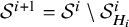 and repeat the procedure.
Once the procedure stops, put
$\mathcal {T}_m$
 to be the smallest family of uniformity
$t$
 such that
$\mathcal {S}^m = \mathcal {S}^m[\mathcal {T}_m] $
 . Clearly,
$|\mathcal {T}_m| \leqslant |\mathcal {S}^m| \leqslant \frac {1}{\lambda }$
 . Then, define

Next, we bound the number of steps
$m$
 . Since
$|\mathcal {S}^i_H| \geqslant \lambda |\mathcal {S}^i|$
 , we have
$|\mathcal {S}^{i + 1}| \leqslant (1 - \lambda ) |\mathcal {S}^i|$
 . If
$m> 0$
 and so
$\lambda |\mathcal {S}|> 1$
 , let
$\tilde {m}$
 be defined as the least integer such that
$e^{-\lambda \tilde {m}} |\mathcal {S}| \leqslant \frac {1}{\lambda }$
 , that is
$\tilde {m} = \lceil \frac {1}{\lambda } \ln (\lambda |\mathcal {S}|) \rceil $
 . We claim that
$m \leqslant \tilde m$
 . Otherwise, we have
$\tilde m < m$
 and, therefore,
$\mathcal {S}^{\tilde m}$
 is defined,
$|\mathcal {S}^{\tilde m}|> \frac {1}{\lambda }$
 and

a contradiction. Thus, we have

and
$|\hat {\mathcal {T}}| \leqslant m \phi (s, t) + \frac {1}{\lambda } \leqslant \frac {1}{\lambda } \left (1 + 2 \phi (s, t) \ln (\lambda |\partial _{\leqslant q} \mathcal {A}|) \right )$
 , which proves (9.1).
Finally, we bound the sum
$\sum _{S \in \mathcal {S} \setminus \mathcal {S}[\hat {\mathcal {T}}]} |\mathcal {U}_S|$
 :

9.2 Simplification argument II
The main result of this section is the following lemma:
Lemma 9.5. Assume that
$\mathcal {A} = \binom {[n]}{k/w}^w$
 for some
$w | k$
 . Suppose that
$n \geqslant 2^{30}(s k^2)^{4t + 2}$
 and
$k \geqslant 5 t$
 . Let
$\mathcal {F} \subset \binom {[n]}{k/w}^w$
 be a family without a sunflower with
$s$
 petals and the core of size
$t - 1$
 . Then there exists a family
$\mathcal {C}^* \subset \partial _{t} \mathcal {A}$
 , such that
$|\mathcal {C}^*| \leqslant 70 t \cdot 2^t \phi (s, t) \sqrt {n} \ln n$
 and

where
$C_t$
 is some constant depending on
$t$
 only.
We will construct
$\mathcal {C}^*$
 via iterative simplification of
$\mathcal {F}$
 . First, we find a family
$\mathcal {T}$
 that has small uniformity and covers
$\mathcal {F}$
 almost completely.
Lemma 9.6. Assume that
$\mathcal {A} = \binom {[n]}{k/w}^w$
 for some
$w | k$
 . Suppose that
$w n \geqslant 2 (s k^2)^{4t + 2}$
 and
$k \geqslant 2t + 1$
 . Let
$\mathcal {F} \subset \binom {[n]}{k/w}^w$
 be a family without a sunflower with
$s$
 petals and the core of size
$t - 1$
 . Then, there exists a family
$\mathcal {T} \subset \partial _{2t} \mathcal {A} \cup \partial _{2t + 1} \mathcal {A}$
 such that
$\mathcal {T}$
 does not contain a sunflower with
$s$
 petals and the core of size
$t - 1$
 , and

where
$\tilde C_t$
 is some constant depending on
$t$
 only.
Proof. The simplification argument is a modification of that of Lemma 4.12. We will obtain
$\mathcal {T}$
 at the end of the following iterative process. Set
$\mathcal {T}_0 = \mathcal {F}$
 . Given a family
$\mathcal {T}_{i}$
 , we will construct a family
$\mathcal {T}_{i + 1}$
 by the following procedure:

Procedure 2 Long description
The pseudocode is organized into 11 numbered lines.
Line 1: Initialization. Set W sub i is assigned script T sub i super (k minus i). Alpha is set to s k. U sub i plus 1 is assigned the empty set symbol.
Line 2: While loop condition. While there exists a set T such that the absolute value of T is less than or equal to k minus i minus 1 and W sub i (T) is alpha-spread, do the following.
Line 3: Find a maximal set T satisfying the conditions in line 2.
Line 4: Define script T sub i plus 1, T as W sub i (T).
Line 5: Remove sets containing T from W sub i. This is expressed as W sub i is assigned W sub i backslash W sub i [T].
Line 6: If condition. If the absolute value of T is greater than 2 t minus 1, then proceed to line 7.
Line 7: Add T to script T sub i plus 1. Expressed as script T sub i plus 1 is assigned script T sub i plus 1 union the set containing T.
Line 8: Else branch.
Line 9: Add T to U sub i plus 1. Expressed as U sub i plus 1 is assigned U sub i plus 1 union the set containing T.
Line 10: End if.
Line 11: End while.
We define
$\mathcal {T}$
 as
$\mathcal {T}_{k - (2t + 1)}$
 . Since any set from
$\mathcal {T}_i$
 has cardinality between
$2t$
 and
$k - i$
 by the construction,
$\mathcal {T}$
 consists of sets of size either
$2t$
 or
$2t + 1$
 .
First, we describe several properties of the obtained system.
Claim 9.7. The family
$\bigcup _{i = 0}^{k - (2 t + 1)} (\mathcal {T}_i \cup \mathcal {U}_i)$
 does not contain a sunflower with
$s$
 petals and the core of size
$t - 1$
 .
Proof. Let
$T_{1} \in \mathcal {T}_{i_ 1} \cup \mathcal {U}_{i_1}, \ldots , T_s \in \mathcal {T}_{i_s} \cup \mathcal {U}_{i_s}$
 be such a sunflower that
$(i_1, \ldots , i_s)$
 is minimal in the lexicographical order. If
$i_1, \ldots , i_s = 0$
 , then
$T_1, \ldots , T_s$
 belong to the initial family
$\mathcal {F}$
 , a contradiction. Thus, there is at least one
$\ell \in [s], i_\ell> 0$
 . It means that for some
$j< i_{\ell }$
 ,
$\mathcal {T}_{i_\ell , T_{\ell }} \subset \mathcal {T}_{j}(T_{\ell })$
 is
$\alpha $
 -spread. Due to Claim 4.7, the covering number of
$\mathcal {T}_{j}(T_{\ell })$
 is at least
$\alpha = sk$
 . Thus, we may find
$F \in \mathcal {T}_{j}(T_{i_\ell })$
 that does not intersect
$\bigcup _{p = 1}^s T_p$
 . Note that
$T_1 \in \mathcal {T}_{i_1} \cup \mathcal {U}_{i_1}, \ldots , F \cup T_{\ell } \in \mathcal {T}_{j}, \ldots , T_s \in \mathcal {T}_{i_s} \cup \mathcal {U}_{i_s}$
 form a sunflower with
$s$
 petals and the core of size
$t - 1$
 , while
$(i_1, \ldots , i_{\ell - 1}, j, i_{\ell + 1}, \ldots , i_s)$
 is strictly less than
$(i_1, \ldots , i_s)$
 in the lexicographical order, contradicting the minimality of the latter tuple.
Thus,
$\mathcal {T}$
 does not contain such a sunflower, as stated. The second property we establish allows us to bound the size of
$\mathcal {W}_{i}$
 and
$\mathcal {T}_i[\mathcal {U}_{i + 1}]$
 .
Claim 9.8. We have
$|\mathcal {W}_i| \leqslant \alpha ^{k - i}$
 and

where a constant
$\tilde {C}_t$
 depends on
$t$
 only.
Proof. In order to bound
$|\mathcal {W}_i|$
 , note that there is no set
$T$
 with
$|T| \leqslant k - i - 1$
 such that
$\mathcal {W}_i(T)$
 is
$\alpha $
 -spread. In this case, choose maximal
$X$
 such that
$|\mathcal {W}_i(X)| \geqslant \alpha ^{|X|} |\mathcal {W}_i|$
 . We have
$|X| = k - i$
 , and so
$|\mathcal {W}_i| \leqslant \alpha ^{k - i}$
 .
Next, we bound
$|\mathcal {T}_i[\mathcal {U}_{i + 1}]|$
 . For some
$j \in [2t - 1]$
 , consider the layer
$\mathcal {U}_{i + 1}^{(j)}$
 :

Define the upper shadow
$\partial ^u \mathcal {U}_{i + 1}^{(j)}$
 of the family
$\mathcal {U}^{(j)}_{i + 1}$
 as follows:

Consider a set
$T'$
 that belongs to the upper shadow and some set
$T \in \mathcal {U}_{i + 1}^{(j)}$
 such that
$T \subset T'$
 . Due to the third line of the procedure above, the family
$\mathcal {T}_{i + 1, T}(T' \setminus T)$
 is not
$\alpha $
 -spread. Choose a maximal
$X$
 disjoint from
$T'$
 such that
$|\mathcal {T}_{i + 1, T}((T' \setminus T) \cup X)| \geqslant \alpha ^{|X|} |\mathcal {T}_{i + 1, T}(T' \setminus T)|$
 . Since
$\mathcal {T}_{i + 1, T}(T' \setminus T)$
 is not
$\alpha $
 -spread,
$X$
 is not empty. It implies that
$|X| = k - i - |T'|$
 , since otherwise,
$\mathcal {T}_{i+1, T}(T' \cup X)$
 is
$\alpha $
 -spread due to Observation 4.2, and we may choose
$X \cup T'$
 in the third line of the procedure instead of
$T$
 . Therefore,
$|\mathcal {T}_{i + 1, T}(T' \setminus T)| \leqslant \alpha ^{k - i - (j+1)}$
 .
Hence, we may bound
$|\mathcal {T}_i[\mathcal {U}_{i+1}^{(j)}]|$
 . Indeed, it admits a decomposition

If
$j < t$
 , then we can bound
$|\mathcal {U}^{(j)}_{i + 1}| \leqslant \binom {wn}{t - 1} \leqslant w^{t - 1} n^{t - 1}$
 . Otherwise, we use Theorem 5.3. Claim 9.7 ensures that
$\mathcal {U}^{(j)}_{i + 1}$
 does not contain a sunflower with
$s$
 petals and the core of size
$t - 1$
 . We consider
$\mathcal {U}^{(j)}_{i + 1}$
 as a subfamily of
$\binom {[wn]}{j}$
 , and apply Theorem 5.3, which implies
$|\mathcal {U}^{(j)}| \leqslant C_{j} w^{t - 1} n^{t - 1} s^{j - t + 1}$
 .
Thus, in either case, we have
$|\mathcal {U}^{(j)}_{i + 1}| \leqslant C_t w^{t - 1} n^{t - 1} s^{t}$
 , since
$C_t$
 is increasing in
$t$
 . Substituting this bound into (9.4), we get

where we introduced a constant
$\tilde C_t$
 that depends on
$t$
 only.
To bound
$|\mathcal {F} \setminus \mathcal {F}[\mathcal {T}]|$
 , note that for each
$F \in \mathcal {F} \setminus \mathcal {F}[\mathcal {T}]$
 there exists
$i \leqslant k - (2t + 1)$
 such that some subset
$F' \subset F$
 of size
$k - i$
 belongs to
$\mathcal {T}_i[\mathcal {U}_{i + 1}] \cup \mathcal {W}_i$
 . It yields

where we used
$(wn/k, t)$
 -spreadness of
$\mathcal {A}=\binom {[n]}{k/w}^w$
 due to Proposition 4.8. Next, we bound the sum. We have

Recall that
$\alpha = sk$
 . Since
$w n \geqslant (\alpha k)^{4t + 2}$
 by assumptions of the lemma, the above is at most
$2 / \sqrt {n}$
 . Thus, we have

Now we are ready to prove Lemma 9.5.
Proof of Lemma 9.5
Take
$\mathcal {T}$
 as in Lemma 9.6. Consider an arbitrary partition of
$\mathcal {F}[\mathcal {T}]$
 into
$|\mathcal {T}|$
 families
$\mathcal {F}_T \subset \mathcal {F}(T)$
 ,
$T \in \mathcal {T}$
 , so

Choose
$\tau = n^{1/2t}$
 ,
$q = 2t$
 , and for each
$T \in \mathcal {T}$
 apply Lemma 5.11 to
$\mathcal {F}_T$
 . We obtain a family
$\mathcal {S}_T$
 , a remainder
$\mathcal {R}_T \subset \mathcal {A}[T]$
 and a decomposition:

such that each
$\mathcal {F}_{T \sqcup S}$
 is
$\tau $
 -homogeneous and
$|\mathcal {R}_T| \leqslant n^{-1} A_{|T|}$
 . Then, we have

Due to Theorem 5.3, for each layer
$j = 2t, 2t + 1$
 , we have

Using
$(wn/k, t)$
 -spreadness of
$\mathcal {A} = \binom {[n]}{k/w}^w$
 , guaranteed by Proposition 4.8, we obtain

Define

Then,
$\mathcal {S}^*$
 is a
$\tau $
 -homogeneous core of
$\mathcal {F}[\mathcal {T}] \setminus \bigsqcup _{T \in \mathcal {T}} (\{T\} \vee \mathcal {R}_T)$
 . Since
$k \geqslant 5t \geqslant |T| + q + (t - 1)$
 and
$wn/k \geqslant \sqrt {2^{30}(s k^2)^{4t + 2}} / k \cdot \sqrt {n} \geqslant 2^{10} (4k)^t s \sqrt {n}$
 , we may apply Lemma 9.3 with
$\alpha = 1/4k$
 ,
$r = wn/k$
 ,
$q = 4t + 1$
 to
$\mathcal {S}^*$
 , and obtainFootnote
9
$(\mathcal {S}^*, s, t)$
 system
$\mathcal {U}$
 , such that for each
$V \in \mathcal {S}^*$


for any
$h < k - |V|$
 . Applying Proposition 9.4 with
$\lambda = 2^{-t} n^{-1/2}$
 and
$r = wn/k$
 , we infer that there exists a family
$\hat {\mathcal {T}}$
 such that

and

Employing the bound from Claim 4.5, we conclude that there is some constant
$C_t'$
 depending on
$t$
 only such that the following holds:

where
$\hat {C}_t$
 is some constant depending on
$t$
 only. Setting
$\mathcal {C}^* = \hat {\mathcal {T}}$
 , we obtain the lemma.
9.3 Proof of Theorem 6.2
Proof. We have
$n \geqslant k^{20 t} \cdot s^{10t} \sqrt {g_0(t)}$
 , so conditions of Lemma 9.5 are satisfied, provided
$g_0(t)$
 is a large enough function of
$t$
 . Due to Lemma 9.5, we have a family
$\mathcal {C}^* \in \binom {n}{t}$
 of size at most
$70 t 2^t \phi (s, t) \sqrt {n} \ln n$
 , such that

Consider an arbitrary partition of
$\mathcal {F}[\mathcal {C}^*]$
 into
$|\mathcal {C}^*|$
 families
$\mathcal {F}_C$
 ,
$C \in \mathcal {C}^*,$
 such that
$\mathcal {F}_C \subset \mathcal {F}(C)$
 and

For each
$\mathcal {F}_C$
 , we construct a family
$\mathcal {F}^*_C$
 as follows:

Then, using
$(wn/k, t)$
 -spreadness of
$\mathcal {A}$
 from Proposition 4.8, we obtain

where
$\tau (\mathcal {F}_C(X))$
 stands for the covering number of
$\mathcal {F}_C(X)$
 . Finally, we consider the decomposition

Given
$F \in \partial _{k-t}\mathcal A$
 , we denote
$\mathcal {C}_F = \{C \in \mathcal {C}^* \,:\, F \in \mathcal {F}_C^*\}$
 . We claim that
$\mathcal {C}_F$
 does not contain a sunflower with
$s$
 petals and the core of arbitrary size. Indeed, let
$C_1, \ldots , C_s \in \mathcal {C}_F$
 be such a sunflower. Take any
$X \subset F$
 of size
$t - 1 - \left |\cap _{\ell = 1}^s C_\ell \right |$
 , and note that
$X$
 can be empty. Then, for each
$\ell = 1, \ldots , s$
 ,
$\mathcal {F}_{C_\ell }(X)$
 has covering number at least
$sk$
 . Take the maximum number of pairwise disjoint sets
$F_1 \in \mathcal {F}_{C_1}(X), \ldots , F_m \in \mathcal {F}_{C_m}(X)$
 , that do not intersect
$\cup _{\ell = 1}^m C_\ell $
 . To avoid contradiction, we should assume that
$m < s$
 , and so consider
$\mathcal {F}_{C_{m + 1}}(X)$
 . But since the covering number of
$\mathcal {F}_{C_{m + 1}}(X)$
 is at least
$sk$
 , there is a set
$F_{m + 1}$
 that does not intersect
$\cup _{\ell = 1}^m C_\ell \cup F_\ell $
 , contradicting the maximality of
$m$
 . Hence, we have

Combining the above, (9.6) and (9.5), we obtain

Since
$|\mathcal {C}^*| \leqslant 14 t \cdot 2^t \phi (s, t) \sqrt {n} \ln n$
 , using Claim 4.5, we get that
$|\mathcal {C}^*| \leqslant C^{\prime }_t s^t \sqrt {n} \ln n$
 for some constant depending on
$t$
 only. Therefore, we have

for some constant
$\tilde C_t$
 depending on
$t$
 only. By the conditions of the theorem,
$n \geqslant k^{20 t}$
 , so
$k^t \leqslant n^{1/20}$
 . Similarly, we have that
$s^t \leqslant n^{1/40}$
 and
$C^{\prime }_t \ln n \leqslant n^{1/40}$
 , provided
$g_0(t)$
 is large enough. Therefore, we have

and so

10 Proof sketch of Theorem 7.6
We start by applying Lemma 9.5 to
$\mathcal {F}$
 . Then, we obtain a family
$\mathcal {C}^* \subset \partial _t \mathcal {A}$
 ,
$|\mathcal {C}^*| \leqslant 70 t \cdot 2^t \phi (s, t) \sqrt {n} \ln n$
 , such that

Consider an arbitrary partition of
$\mathcal {F}[\mathcal {C}^*]$
 into
$|\mathcal {C}^*|$
 families
$\mathcal {F}_C, C \in \mathcal {C}^*,$
 such that
$\mathcal {F}_C \subset \mathcal {F}(C)$
 and

As in the proof of Theorem 6.2, we define

Due to (9.6), we have

The idea of the proof is to apply a Kruskal–Katona–type result to show that the number of
$C \in \mathcal {C}^*$
 , such that the shadow of
$\mathcal {F}_C$
 is large, is at most
$\left ( 1 + e^{-O(k/t)} \right )\phi (s, t)$
 , and if the shadow of
$\mathcal {F}_C$
 is small, then the impact of
$\mathcal {F}_C$
 on
$|\mathcal {F}|$
 is negligible. Although the exact counterpart of the Kruskal–Katona theorem for
$[n]^{k}$
 is known [Reference Frankl, Füredi and Kalai32], we would like to highlight that a similar but less accurate result can be deduced from Assumptions 3,4.
Proposition 10.1. Suppose that a
$k$
 -uniform
$\mathcal {A}$
 satisfies Assumptions 3,4 with
$q = \gamma k$
 for some
$\gamma < \min \{1, \mu \}$
 . Let
$\mathcal {F} \subset \mathcal {A}$
 be any family such that
$\mu (\partial _h \mathcal {F}) \leqslant x$
 . Then, we have

Proof. We assume that
$x^{1/h} < \left (1 - \frac {\gamma }{\mu } \right )$
 , since otherwise there is nothing to prove. Consider an arbitrary
$\tau $
 such that
$1 < \tau < x^{-1/h} (1 - \gamma /\mu )$
 . Consider the largest
$R$
 such that
$\mu (\mathcal {F}(R)) \geqslant \tau ^{|R|}\mu (\mathcal {F})$
 . In particular,
$\mathcal {F}(R) \subset \mathcal {A}(R)$
 is
$\tau $
 -homogeneous and
$\mu (\mathcal {F}) \leqslant \tau ^{-|R|}$
 .
If
$|R| \leqslant \gamma k = q$
 , then by Proposition 5.8, we have

Since
$|\partial _h(\mathcal {F}(R))| \leqslant |\partial _h\mathcal {F}|$
 , the measure
$\mu (\partial _h(\mathcal {F}(R)))$
 is at most

We bound the above using Assumption 4, and obtain

contradicting the definition of
$\tau $
 . Thus,
$|R|> \gamma k$
 , and we have

Since
$\tau $
 is an arbitrary number less than
$ x^{-1/h} (1 - \gamma /\mu )$
 , the displayed chain of inequalities above implies the proposition.
Next, we show that Proposition 10.1 can be applied to
$\mathcal {A}(C)$
 ,
$C \in \mathcal {C}^*$
 .
Claim 10.2. Suppose that
$\mathcal {A} = \binom {[n]}{k/w}^w$
 for some
$w | k$
 such that
$k \geqslant 4w t$
 . Then, for any
$C \in \partial _t \mathcal {A}$
 and
$\mathcal {F} \subset \mathcal {A}(C)$
 such that
$\mu (\partial _h\mathcal {F}) \leqslant x$
 , we have

Proof. We are going to show that Assumptions 3,4 are satisfied for
$\mathcal {A}(C)$
 with
$q = (k - t) /2w$
 . Assumption 3 is satisfied due to Claim 5.5. It remains to show that for any
$R$
 of size at most
$q = (k - t)/2w$
 , we have

so the condition of Proposition 10.1 holds with
$\gamma = 1/2w$
 and
$\mu = \mu '$
 ,
$k - t$
 in place of
$k$
 . Note that

where we used
$k \geqslant 4wt$
 , so due to Proposition 5.4 applied with
$q = 3k/4w$
 , we have

Then, Proposition 10.1 implies the desired bound on
$\mu (\mathcal {F})$
 .
Given a real number
$\delta \in (0, 1)$
 , define a family
$\mathcal {C}^*_\delta $
 as follows:

Let us show that
$|\mathcal {C}^*_\delta | \leqslant \phi (s, t)/ \delta $
 . First, by double-counting, there exists
$X \in \partial _{t - 1} \mathcal {A}$
 and a family
$\mathcal {C}' \subset \mathcal {C}^*_{\delta }$
 of size at least
$\delta |\mathcal {C}^*_{\delta }|$
 such that
$X \in \partial _{t - 1} \mathcal {F}^*_C$
 for any
$C \in \mathcal {C}'$
 . We claim that
$\mathcal {C}'$
 does not contain a sunflower with
$s$
 petals. Arguing indirectly, let
$C_1, \ldots , C_s$
 be a sunflower in
$\mathcal {C}'$
 . Choose
$Y \subset X$
 of size
$t - 1 - |\cap _{j \in [s]} C_j|$
 . Then,
$C_1 \cup Y, \ldots , C_s \cup Y$
 form a sunflower with
$s$
 petals and the core of size
$t - 1$
 . Since the covering number of
$\mathcal {F}_{C_i}(Y)$
 is at least
$sk$
 for each
$i = 1, \ldots , s$
 , we can find a sunflower with the core of size
$t - 1$
 in
$\mathcal {F}$
 , a contradiction. Thus,
$|\mathcal {C}'| \leqslant \phi (s, t)$
 , and
$|\mathcal {C}^*_\delta |\leqslant \phi (s,t) / \delta $
 .
Fix
$\delta = \left ( 1 - \sqrt {\frac {t}{k}} \right )$
 . Then, we decompose the sum
$\sum _{C \in \mathcal {C}^*} |\mathcal {F}_C|$
 as follows:

Consider two cases.
Case 1. We have
$\mathbf {\mathcal {A} = \binom {[n]}{k/w}^w}$
 for
$\mathbf {k \geqslant 2^6 w^6 t}$
 . For each
$j$
 and
$C \in \mathcal {C}^*_{\delta ^{j + 1}} \setminus \mathcal {C}_{\delta ^j}$
 , we have

where the second fact follows from Claim 10.2. We have

Next, we bound

where we used
$k \geqslant 2^{12} w^6 t \geqslant 2(t + 2w(t - 1))$
 . We have
$k \geqslant 2^{12} w^6 t \geqslant 2^{18} t \geqslant e^5 t$
 , so
$\left ( \frac {k}{t} \right )^{1/3} \geqslant \frac {1}{2} \ln \frac {k}{t} $
 , and

Since
$k \geqslant 2^{12} w^6 t$
 , we have

Using the displayed inequality, we may continue (10.3) as follows.

Using
$k \geqslant 2^{12} w^6 t \geqslant 4 t$
 , we bound

Similarly, since
$wn \geqslant k^{20t} \geqslant 5^{18} k^2 t$
 , we bound

Combining the above and (10.4), we obtain

Case 2. We have
$\mathcal {A} = [n]^k$
 . In this case, instead of Claim 10.2, we will use the following theorem due to Frankl, Füredi and Kalai.
Theorem 10.3 (Theorem 5.1 of [Reference Frankl, Füredi and Kalai32])
Let
$\mathcal {F} \subset [n]^k$
 , such that
$|\mathcal {F}| = y^k$
 for some real
$y$
 . Then, for any
$h \in [k]$
 , we have

Since
$|\partial _h [n]^k| = \binom {k}{h} n^h$
 , this theorem implies the following corollary:
Corollary 10.3.1. Consider a family of sets
$\mathcal {F} \subset [n]^k$
 , and suppose that
$\mu (\partial _h \mathcal {F}) \leqslant x$
 . Then, we have
$\mu (\mathcal {F}) \leqslant x^{k/h}$
 .
Hence, for each
$j \geqslant 1$
 and
$C \in \mathcal {C}^*_{\delta ^{j + 1}} \setminus \mathcal {C}^*_{\delta ^j}$
 , we have

Substituting the above inequalities into (10.2), we obtain

Since
$k \geqslant 5t$
 and
$\sqrt {y} \geqslant \ln y$
 for any positive
$y$
 , we can bound

and obtain

Thus, the above bound holds for both
$\binom {n}{k/w}^w$
 ,
$k \geqslant 2^{12}w^6 t$
 , and
$[n]^k$
 . Using (10.1), we get

where we use the bound on
$|\mathcal {C}^*|$
 from Lemma 9.5. Using the bound on
$|\mathcal {F} \setminus \mathcal {F}[\mathcal {C}^*]|$
 provided by this lemma, we get

Since
$n \geqslant k^{20t}$
 and
$n \geqslant s^{40t} \cdot g_0(t)$
 , for large enough
$g_0(t)$
 , we have

11 Conclusion
In the present paper, we provide new bounds for the problem of Erdős–Duke on forbidden sunflowers with prescribed core size. In particular, we extend the result of Frankl and Füredi [Reference Frankl and Füredi26] to the case when
$n$
 is allowed to depend linearly on
$k$
 with the factor polynomial in
$s, t$
 . To obtain this result, we combine the hypercontractivity technique of Keller, Lifshitz, Keevash et al. [Reference Keevash, Lifshitz, Long and Minzer38, Reference Keller, Lifshitz and Marcus41], the spread approximation technique of Kupavskii and Zakharov [Reference Kupavskii and Zakharov49], the result on forbidden sunflowers of Bradač et al. [Reference Bradač, Bucić and Sudakov8] and some ideas from the original proof of Frankl and Füredi [Reference Frankl and Füredi26]. As a byproduct, we answer the question of KalaiFootnote
10
and Bradač et al. [Reference Bradač, Bucić and Sudakov8] about the maximal size of families without sunflowers with the core of size at most
$t - 1$
 in the regime when
$s \leqslant (t\ln (n/k))^{-3} \sqrt {n/k}$
 and
$n \geqslant 2^{11} s k \log _2 k$
 .
It turns out that our methods are quite general and can be applied to obtain similar results for subfamilies of permutations and
$\binom {[n]}{k/w}^w$
 for certain ranges of values
$w$
 .
When looking through the proof of Theorem 3.1, one can ask the following question: could we employ modern techniques to improve dependencies in the Delta-system method? In our problem,
$k \geqslant 5t$
 is enough to significantly decrease the lower bound on
$n$
 . Could we go further and avoid double-exponential dependence on
$t$
 ? Could we improve similar lower bounds for other Turán-type problems? After we published the first version of our paper as a preprint, it was discovered that the answer is positive and double-exponential dependencies in most applications of the delta-system method could be avoided [Reference Janzer, Jin, Sudakov and Wu37]. However, we hope that dependencies between parameters in hypergraph Turán-type problems will be further improved in the near future.
Acknowledgments
Fedor Noskov is a winner of the all-Russia mathematical August Moebius contest of graduate and undergraduate student papers and thanks the jury and the board for the high praise of his work.
Competing interests
The authors have no competing interest to declare.
Financial Support
The work of Fedor Noskov reported in Sections 5, 6, 8, 9 is an output of a research project BR-2026-002 implemented as part of the Basic Research Program at HSE University. The research of Andrey Kupavskii reported in Sections 4, 7, 10 is supported by the Ministry of Science and Higher Education of the Russian Federation (Goszadaniye), project No. FSMG-2024-0025.


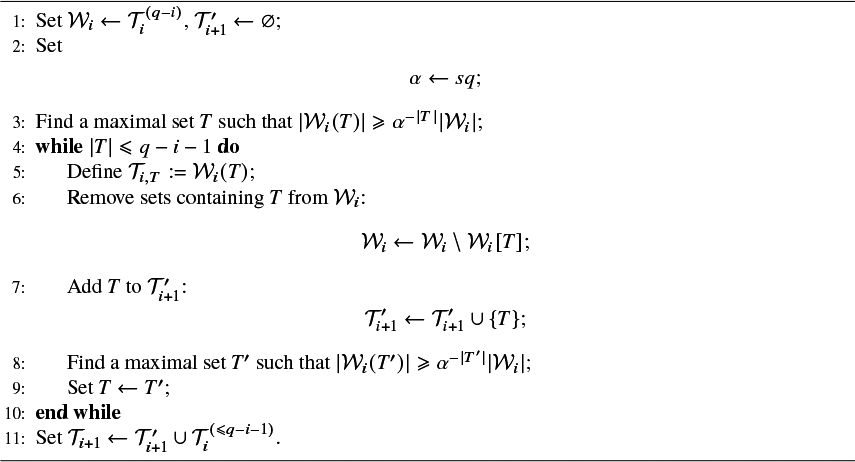
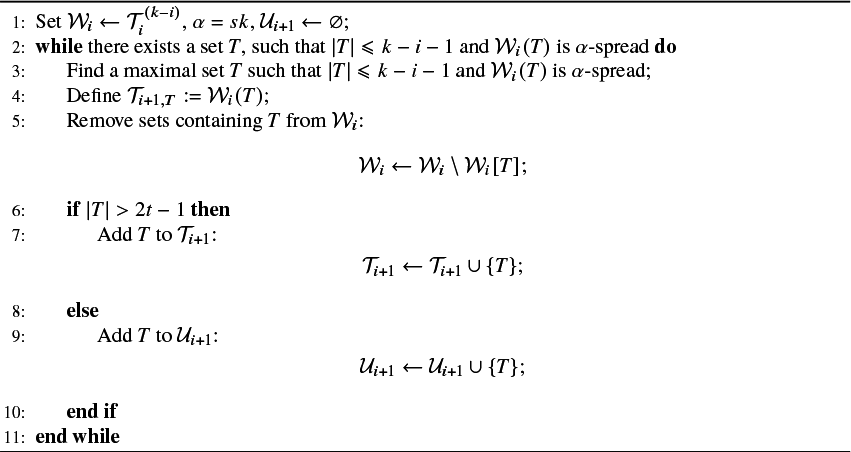

 Open access

