Introduction
Theories based on cognitive and neuroscience research in adults relate deficient attention control to anxiety (Eysenck et al. Reference Eysenck, Derakshan, Santos and Calvo2007; Bishop, Reference Bishop2008). According to attention control theory (Eysenck et al. Reference Eysenck, Derakshan, Santos and Calvo2007), high anxiety impairs one's ability to inhibit processing of task-irrelevant information and switch attention between different tasks. Moreover, poor attention control may contribute to anxiety through difficulty inhibiting processing of task-irrelevant information impairing cognitive and emotional responses to stress (Rueda et al. Reference Rueda, Posner and Rothbart2005; Posner & Rothbart, Reference Posner and Rothbart2007).
Studies in adults using objective measures of attention control (e.g. effect of distracting stimuli on primary task performance) relate high non-clinical anxiety to reduced efficiency of executive attention (Eysenck et al. Reference Eysenck, Derakshan, Santos and Calvo2007; Eysenck & Derakshan, Reference Eysenck and Derakshan2011). However, evidence of executive attention deficits in adults with anxiety disorders is mixed (Airaksinen et al. Reference Airaksinen, Larsson and Forsell2005; Castaneda et al. Reference Castaneda, Tuulio-Henriksson, Marttunen, Suvisaari and Lönnqvist2008), with some studies failing to find anxiety-related deficits (Castaneda et al. Reference Castaneda, Suvisaari, Marttunen, Perälä, Saarni, Aalto-Setälä, Lönnqvist and Tuulio-Henriksson2011). Inconclusive findings may be partly explained by confounding effects of medication use and type of anxiety disorder included in the studies (Castaneda et al. Reference Castaneda, Tuulio-Henriksson, Marttunen, Suvisaari and Lönnqvist2008). In one investigation, adults with mixed anxiety disorders showed impaired visual attention and task switching, whereas those with ‘pure’ specific phobia showed no deficits (Airaksinen et al. Reference Airaksinen, Larsson and Forsell2005). Specific phobia is commonly regarded as distinct from other anxiety disorders, since it is more circumscribed, less persistent across childhood, and less likely to be characterized by general anxiousness (Pine et al. Reference Pine, Cohen, Gurley, Brook and Ma1998; Costello et al. Reference Costello, Mustillo, Erkanli, Keeler and Angold2003; Craske & Waters, Reference Craske and Waters2005). Consequently, it did not seem surprising that adults with specific phobias have similar executive functioning to healthy controls (Airaksinen et al. Reference Airaksinen, Larsson and Forsell2005).
Few studies extend this research to children. In a non-clinical sample of 8- to 12-year-old children, high anxiety was negatively associated with self-reported attention control, but not with a behavioral performance-based measure of attention control, after accounting for age and gender (Muris et al. Reference Muris, van der Pennen, Sigmond and Mayer2008). A clinical study using neuropsychological tests found no attention deficits in youths with anxiety disorders compared with healthy controls (Günther et al. Reference Günther, Holtkamp, Jolles, Herpertz-Dahlmann and Konrad2004). Another investigation found that youths with anxiety disorders had better sustained attention and attention shifting than those with attention-deficit/hyperactivity disorder (ADHD) (Weissman et al. Reference Weissman, Chu, Reddy and Mohlman2012), but this study did not include a disorder-free comparison group. Comparison of results across studies is further complicated by heterogeneity in measures of attention. Posner parses attention into three dissociable networks: ‘executive attention’, which monitors and resolves conflict in processing competing stimuli and responses; ‘alerting’, which controls readiness to respond to incoming stimuli; and ‘orienting’, which prioritizes the source of sensory information (Posner & Rothbart, Reference Posner and Rothbart2007; Petersen & Posner, Reference Petersen and Posner2012).
The Attention Network Task (ANT) has been widely used to assess these networks in adults and children (Fan et al. Reference Fan, McCandliss, Sommer, Raz and Posner2002; Posner & Rothbart, Reference Posner and Rothbart2007), although few studies have examined relationships with anxiety. In a non-clinical study, adults with high trait anxiety showed greater ANT conflict scores (poorer executive attention) than those with low trait anxiety (Pacheco-Unguetti et al. Reference Pacheco-Unguetti, Acosta, Callejas and Lupiáñez2010). Two other studies failed to replicate this finding, possibly due to differences in sampling (Moriya & Tanno, Reference Moriya and Tanno2009; Reinholdt-Dunne et al. Reference Reinholdt-Dunne, Mogg and Bradley2013). A clinical study suggested that executive attention is impaired in adults with mixed anxiety disorders (Pacheco-Unguetti et al. Reference Pacheco-Unguetti, Acosta, Marqués and Lupiáñez2011). The main aim of the present study was to extend such research to children with anxiety disorders and high levels of non-clinical anxiety.
Research in developmental psychopathology often finds non-specific associations between information-processing deficits and a range of disorders. Therefore another aim of the study was to examine the specificity of the putative executive attention deficit to anxiety disorders, relative to ADHD, in which impaired executive attention has been implicated (Sergeant et al. Reference Sergeant, Geurts and Oosterlaan2002; Millan et al. Reference Millan, Agid, Brüne, Bullmore, Carter, Clayton, Connor, Davis, Deakin, DeRubeis, Dubois, Geyer, Goodwin, Gorwood, Jay, Joëls, Mansuy, Meyer-Lindenberg, Murphy, Rolls, Saletu, Spedding, Sweeney, Whittington and Young2012). Some studies using the ANT reported higher conflict scores (i.e. impaired executive attention) in ADHD children relative to controls (Konrad et al. Reference Konrad, Neufang, Hanisch, Fink and Herpertz-Dahlmann2006; Johnson et al. Reference Johnson, Robertson, Barry, Mulligan, Daibhis, Daly, Watchorn, Gill and Bellgrove2008), although this is not always found (Booth et al. Reference Booth, Carlson and Tucker2007; Adólfsdóttir et al. Reference Adólfsdóttir, Sørensen and Lundervold2008; Kratz et al. Reference Kratz, Studer, Malcherek, Erbe, Moll and Heinrich2011).
The current study tested four hypotheses: in comparison with disorder-free children, executive attention is impaired in children with anxiety disorders (hypothesis 1) and children with ADHD (hypothesis 2). We also examined whether there is heterogeneity among anxiety disorders (Airaksinen et al. Reference Airaksinen, Larsson and Forsell2005); specifically, whether impaired executive attention is limited to anxiety disorders other than specific phobias (hypothesis 3). Regarding children without psychiatric disorders, we predicted that executive attention is less efficient in those with high, relative to low, levels of anxiety symptoms (hypothesis 4). Supplementary analyses explored whether anxiety and ADHD were associated with deficits in the two other attention networks: alerting and orienting.
Method
Participants
Participants were drawn from a community sample of 9937 Brazilian children, aged 6–12 years at screening. From these 9937 children, a subset of 2512 was selected for further evaluation (38% randomly selected; 62% selected as high risk according to screening child and family psychiatric symptoms; for details of recruitment and selection, see Salum et al. Reference Salum, Gadelha, Pan, Moriyama, Graeff-Martins, Tamanaha, Alvarenga, Krieger, Fleitlich-Bilyk, Jackowski, Sato, Brietzke, Polanczyk, Brentani, de Jesus Mari, do Rosário, Manfro, Affonseca-Bressan, Mercadante, Miguel and Rohde2015). From these 2512 children, 1015 completed the ANTFootnote † Footnote 1 (37% randomly selected; 63% high risk). To address the hypotheses, participants were eligible for inclusion for this study if they had ANT data and one of the following: diagnosis of anxiety disorder, ADHD or no disorder. Of those eligible (n = 937), participants were excluded if they were currently using medication (n = 20); did not have complete ANT scores due to excessive errors (n = 19) or extreme outliers (n = 5) described later; or had a co-morbid diagnosis of pervasive developmental disorders, tics, eating disorders, psychosis or attachment disorder (n = 8). There were no cases of manic episodes, stereotypies or selective mutism. To select diagnostically homogeneous groups, children with anxiety or ADHD who had co-morbid depressive disorders (n = 8) or co-morbid post-traumatic stress disorder (n = 3) were excluded (there were too few cases to examine effects of these co-morbidities). Children with co-morbid ADHD and disruptive behavioral disorders (oppositional defiant disorder and conduct disorder; ODD/CD) were not excluded from the ADHD group given high co-morbidity between these behavioral disorders. To prevent overlap in diagnoses between the two main diagnostic groups, children were excluded if they had co-morbid anxiety and ADHD (n = 12) or co-morbid anxiety and ODD/CD (n = 2). There were no cases of panic disorder or obsessive–compulsive disorder after these exclusions.
Thus, the final sample comprised 860 children in three main diagnostic groups used to test hypotheses 1 and 2: (1) anxiety disorders, including social phobia, agoraphobia, separation anxiety, generalized anxiety disorder (GAD), specific phobia and other anxiety disorder (n = 67); (2) ADHD with or without co-morbid ODD/CD (n = 67); and (3) no psychiatric disorder (n = 726). Differences among diagnostic subgroups were examined in secondary analyses, in which anxiety disorders were divided into two groups to test hypothesis 3: (i) anxiety disorders other than specific phobia (n = 43); and (ii) specific phobia (n = 21), in the absence of another anxiety disorder; three children were excluded from these groups due to co-morbidity between specific phobias and other anxiety disorders. Additionally, ADHD was divided into two diagnostic subgroups to evaluate potential effects of co-morbidity with ODD/CD: (i) non-co-morbid ADHD (n = 45); and (ii) co-morbid ADHD + ODD/CD (n = 22).
To test hypothesis 4 and allow comparison with results from high- versus low-anxious adults (Pacheco-Unguetti et al. Reference Pacheco-Unguetti, Acosta, Callejas and Lupiáñez2010), the disorder-free sample was stratified according to Child Behavior Checklist (CBCL) anxiety tertile scores into high-anxiety (score > 5, n = 223) and low-anxiety (score < 2, n = 207) groups (75th, 67th, 50th, 33rd, 25th percentiles were 6, 5, 3, 2 and 1, respectively).
The ethics committee of the University of São Paulo approved the study. Written consent was obtained from parents, and verbal assent from children (with additional written consent where appropriate). Assessments were home-based for parents, and school-based for children.
Measures
Diagnoses
The Development and Well-Being Assessment (DAWBA) was used to assess psychiatric diagnoses (Goodman et al. Reference Goodman, Ford, Richards, Gatward and Meltzer2000). The DAWBA is widely used, reliable and well suited to epidemiological research (e.g. Ford et al. Reference Ford, Goodman and Meltzer2003; Fleitlich-Bilyk & Goodman, Reference Fleitlich-Bilyk and Goodman2004; Heiervang et al. Reference Heiervang, Stormark and Lundervold2007; Aebi et al. Reference Aebi, Kuhn, Metzke, Stringaris, Goodman and Steinhausen2012; see also http://www.dawba.info). This structured interview using Diagnostic and Statistical Manual of Mental Disorders, 4th edition (DSM-IV) criteria was administered to biological parents (95% mothers) by trained lay interviewers and rated by nine psychiatrists, who were trained and supervised by a senior child psychiatrist. To assess reliability, another child psychiatrist rated 200 interviews and κ was 0.70 for anxiety disorders (agreement 93.7%; expected agreement 78.4%; p < 0.001) and 0.72 for ADHD (agreement 92.4%; expected agreement 72.6%; p < 0.001). For details of training and administration, see Salum et al. (in press).
Psychopathology symptoms
These were assessed using the 120-item parent-report CBCL (Achenbach et al. Reference Achenbach, Dumenci and Rescorla2003), which was completed by the biological mother for 95% of children. Anxiety scores were obtained from the 16-item anxiety scale, which has better psychometric properties than the six-item DSM-oriented anxiety scale (Kendall et al. Reference Kendall, Puliafico, Barmish, Choudhury, Henin and Treadwell2007), and ADHD scores from the 13-item DSM-oriented ADHD scale (Achenbach et al. Reference Achenbach, Dumenci and Rescorla2003). General psychopathology was indexed by total scores. Cronbach's α was 0.80, 0.83 and 0.95 for anxiety, ADHD and total scores, respectively (n = 860).
Intelligence quotient (IQ)
IQ was estimated using vocabulary and block-design subtests of the Weschler Intelligence Scale for Children, 3rd edition (Wechsler, Reference Wechsler2002) using Tellegen & Briggs’ (Reference Tellegen and Briggs1967) method and Brazilian norms (Figueiredo, Reference Figueiredo2001). It was obtained for 93% of the sample.
Attention Network Task (ANT)
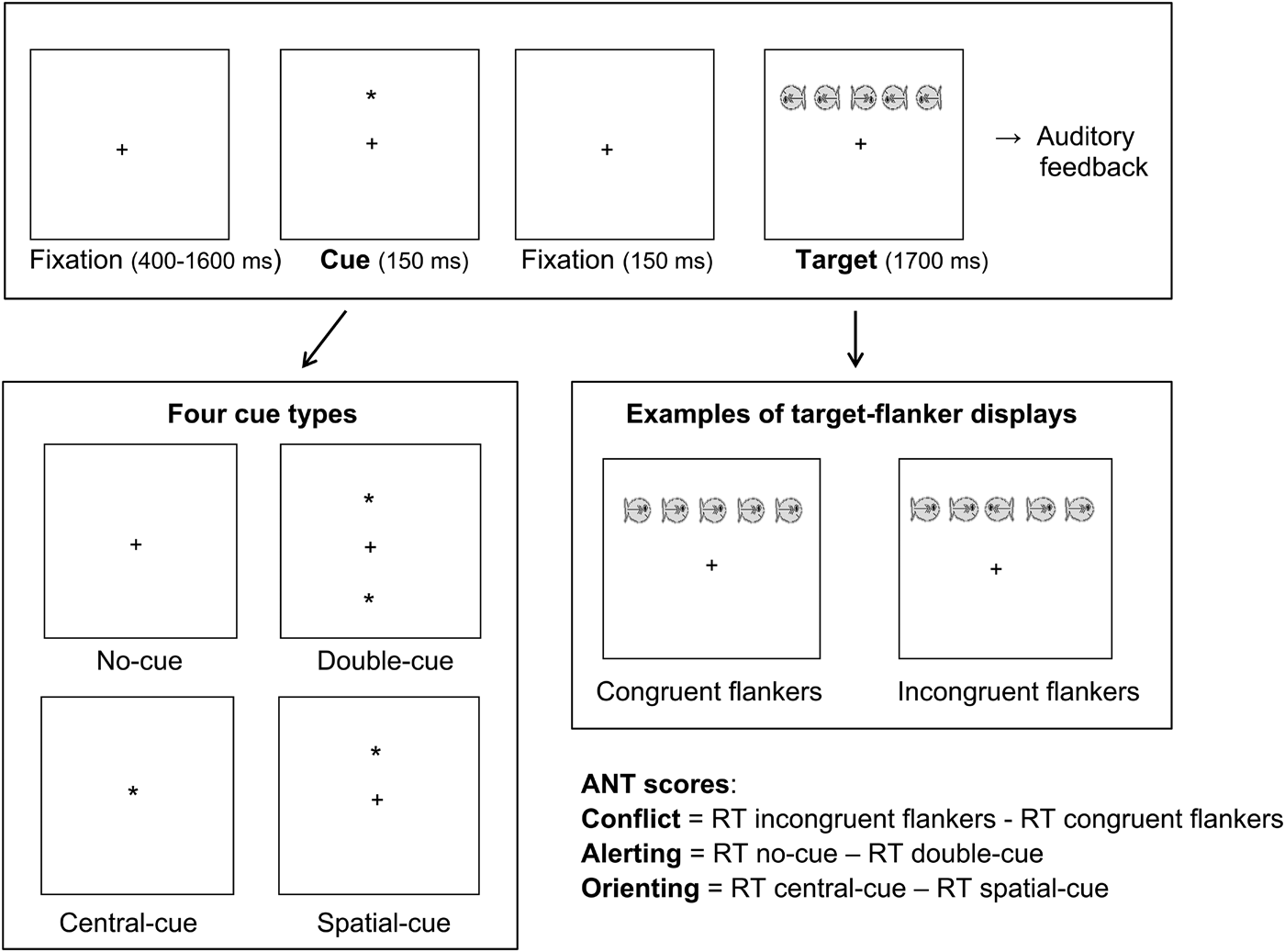
The version used here was designed to assess executive attention, alerting and orienting in children (for task details, see Rueda et al. Reference Rueda, Fan, McCandliss, Halparin, Gruber, Lercari and Posner2004) (https:// www.sacklerinstitute.org/cornell/assays_and_tools/). Participants indicate whether a central target (drawing of a fish) points right or left; and the target appears under differing warning cue and flanker conditions (Fig. 1). Each trial starts with a central fixation cross (randomly varying 400–1600 ms). Next, one of four types of warning cue appears (150 ms): (i) ‘no-cue’: only the fixation-cross appears; (ii) ‘central-cue’: an asterisk replaces the central fixation cross; (iii) ‘double-cue’: two asterisks appear, one above and one below the fixation cross; (iv) ‘spatial-cue’: one asterisk appears, either above or below the fixation cross, indicating where the target will appear. Next, the central fixation cross appears alone again (450 ms).
Illustration of main stimulus events on an experimental trial from the child version of the Attention Network Task (ANT) (upper panel). On each trial, participants press one of two keys to indicate the direction in which the central target fish is pointing. Spatial cues and target-flanker arrays (fish stimuli) are equally likely to appear above or below the fixation cross. The task is presented in color (yellow fish, turquoise background). RT, Reaction time. The figure has been adapted from Rueda et al. (Reference Rueda, Fan, McCandliss, Halparin, Gruber, Lercari and Posner2004) (Fig. 1; not drawn to scale).

The target array then appears above or below the central fixation cross (1700 ms) and is either a row of five fish (two flanker fish each side of the central target fish) or the central fish alone. On ‘congruent’ trials, the flanker and central fish point in the same direction; on ‘incongruent’ trials, the flanker fish point in the opposite direction to the central fish; and on ‘no-flanker’ trials the central fish appears alone. Participants are instructed to press one of two keys to indicate as quickly and accurately as possible the direction of the central fish. Feedback is given on each trial: a ‘whoohoo’ sound on correct trials, and a single tone on incorrect trials. There were 24 practice and 96 experimental trials (Rueda et al. Reference Rueda, Fan, McCandliss, Halparin, Gruber, Lercari and Posner2004, experiment 2), with an equal number of trials per condition, appearing in a fully random order.
Preparation of ANT data
Three attention network scores are indexed by differences in median correct reaction times (RTs) between the following trial types: conflict = RT incongruent – RT congruent flankers; alerting = RT no cue – RT double cue; orienting = RT central cue – RT spatial cue. Higher conflict scores reflect poorer distracter inhibition (poorer executive attention). The alerting score reflects a beneficial effect on RT of the cue indicating temporal imminence of the target; and orienting indicates a benefit of the cue indicating target location. ANT scores were not calculated if RTs were missing from >40% of trials (n = 19, 2% of sample), as in Rueda et al. (Reference Rueda, Fan, McCandliss, Halparin, Gruber, Lercari and Posner2004). Five children (0.2% of sample) were excluded due to extreme outlying ANT scores shown on box-and-whisker plots. The error rate was log-transformed before analyses to reduce skewness. RT variability was indexed by the s.d. of correct RTs.
Statistical analysis
Hypotheses were tested using analyses of variance (ANOVAs) of ANT conflict scores with custom hypothesis tests in general linear model procedures. Effect sizes relating to hypotheses were indexed by Cohen's d (standardized difference between group means in s.d. units, with 0.2, 0.5 and 0.8 reflecting small, medium and large effects, respectively; Cohen, Reference Cohen1988). Analysis of covariance (ANCOVA) examined (i) whether similar results were obtained when controlling potential confounds (i.e. age, gender, IQ, overall error rate, overall mean correct RT, and RT variability), and (ii) whether executive attention deficits in specific disorder groups were independent of other symptoms of psychopathology. Planned analyses of diagnostic subgroups compared the two anxiety subgroups (specific phobia versus other anxiety disorders), and two ADHD subgroups (ADHD versus ADHD + ODD/CD), and significant differences were followed by comparisons with other groups. To compare groups on other variables, χ2 and ANOVA were used. The level of α was 0.05, two-tailed, throughout.
Results
Anxiety, ADHD and no-disorder groups
Demographic and symptom measures
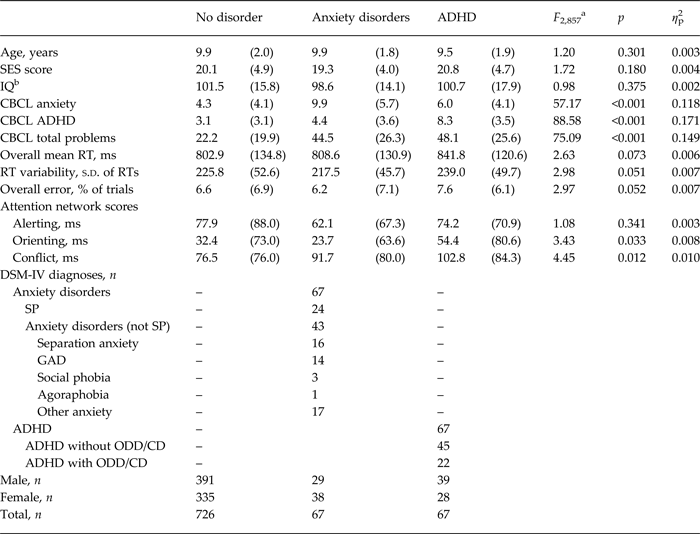
For means and ANOVA results, see Table 1. The three groups did not differ significantly in age, gender [χ2 = 3.44, degrees of freedom (df) = 2, p = 0.18], socio-economic status score or IQ. Groups differed significantly as expected in CBCL anxiety (anxiety disorders > ADHD > no disorder) and ADHD scores (ADHD > anxiety disorders > no disorder). The anxiety and ADHD groups had similar CBCL total scores (p > 0.2), which were significantly higher than those of disorder-free children (p's < 01).
Characteristics and ANT scores of children with no disorder, anxiety disorders and ADHD

Data are given as mean (s.d.) or as number of participants.
ANT, Attention Network Task; ADHD, attention-deficit/hyperactivity disorder; SES, socio-economic class score; IQ, intelligence quotient; CBCL, Child Behavior Checklist; RT, reaction time; s.d., standard deviation; DSM-IV, Diagnostic and Statistical Manual of Mental Disorders, 4th edition; SP, specific phobia; GAD, generalized anxiety disorder; ODD/CD, oppositional defiant disorder and conduct disorder.
a F values indicate overall main effect of group (three levels: no disorder, anxiety disorders, ADHD) on each dependent variable.
b IQ scores were available for 799 children (93% of sample), degrees of freedom = 2, 796.
Overall errors and RTs
The ADHD group had significantly more variable RTs and more errors than the no-disorder and anxiety disorders groups; and slower RTs than the no-disorder group (all p's < 0.05) (see Table 1). Anxiety and no-disorder groups did not significantly differ in errors, overall RT or RT variability (p's > 0.2).
Executive attention
Hypothesis-driven tests showed that the anxiety disorder group as a whole did not differ significantly from the no-disorder group in conflict scores (F 1,857 = 2.38, p = 0.123, η p 2 = 0.003, d = 0.20) (hypothesis 1 was not confirmed). However, conflict scores were significantly higher in the ADHD than no-disorder group (F 1,857 = 7.15, p = 0.008, η p 2 = 0.008, d = 0.35), which supports hypothesis 2 (see Table 1 for means). The latter result remained significant when potential confounds were controlled (age, gender, IQ, overall errors, mean RT, RT variability) (F 1,790 = 4.21, p = 0.041, η p 2 = 0.005).
Alerting and orienting
The groups did not differ significantly in alerting (Table 1), but differed in orienting scores (F 2,857 = 3.43, p = 0.033, η p 2 = 0.008). Children with ADHD had higher orienting scores than the anxiety and no-disorder groups (p's < 0.05), with no significant difference between the anxiety and no-disorder groups (p > 0.3). The difference in orienting scores between the ADHD and other groups remained significant after controlling potential confounds (as above) (F 2,790 = 3.26, p = 0.039, η p 2 = 0.008).
Diagnostic subgroups
Demographic and symptom measures
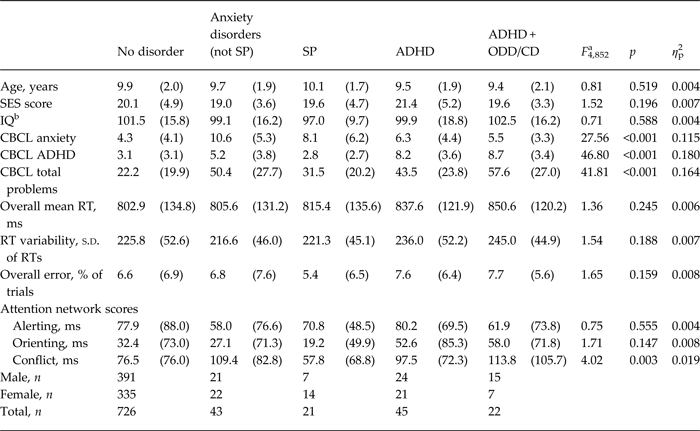
For means and ANOVA results, see Table 2. Comparison of the four diagnostic subgroups (anxiety disorders excluding specific phobia; specific phobia; non-co-morbid ADHD; ADHD + ODD/CD) and the no-disorder group showed no significant difference in gender ratio (χ2 = 5.75, df = 4, p = 0.22), age, socio-economic status or IQ. Children with anxiety disorders (excluding specific phobia) had significantly higher CBCL anxiety, ADHD and total scores than those with specific phobia (p's < 0.05). The ADHD subgroups did not differ significantly from each other in anxiety or ADHD scores (p's > 0.4), although total scores were higher in ADHD + ODD/CD than ADHD alone (p < 0.05). Disorder-free children had significantly lower symptom scores than each disorder subgroup (p's < 0.05), except for similar ADHD scores to specific phobics (p > 0.6).
Sample characteristics and ANT scores as a function of diagnostic subgroups

Data are given as mean (s.d.) or as number of participants.
ANT, Attention Network Task; SP, specific phobia; ADHD, attention-deficit/hyperactivity disorder; ODD/CD, oppositional defiant disorder and conduct disorder; SES, socio-economic class score; IQ, intelligence quotient; CBCL, Child Behavior Checklist; RT, reaction time; s.d., standard deviation.
a F values indicate overall main effect of group (five levels: no disorder, anxiety disorders excluding SP; SP; non-co-morbid ADHD; ADHD + ODD/CD) on each dependent variable.
b IQ scores were available for 796 children (93% of sample), degrees of freedom = 4, 791.
Overall errors and RTs
These did not significantly differ across the five groups, which may reflect reduced sensitivity of analyses using a larger number of smaller groups (Table 2).
Executive attention
Custom hypothesis tests (addressing hypothesis 3) showed that after excluding specific phobia, children with anxiety disorders did have significantly higher conflict scores compared with no-disorder (F 1,852 = 7.41, p = 0.007, η p 2 = 0.009, d = 0.43) and specific phobia (F 1,852 = 6.35, p = 0.012, η p 2 = 0.007, d = 0.68) groups (Fig. 2 A, left). These group differences remained significant when potential confounds (age, gender, IQ, overall errors, mean RT, RT variability) were controlled (F 1,785 = 6.49, p = 0.011, η p 2 = 0.008; F 1,785 = 4.62, p = 0.032, η p 2 = 0.006, respectively). There were no significant group differences in conflict scores between specific phobia versus no disorder; non-co-morbid ADHD versus ADHD + ODD/CD; or anxiety disorders (excluding specific phobia) versus ADHD (all p's > 0.2).
(A) Executive attention dysfunction reflected by Attention Network Task (ANT) conflict score (ms). (B) General psychopathology reflected by Child Behavior Checklist (CBCL) total problems score. (C) Anxiety symptom severity reflected by CBCL anxiety score. Left panels: each score is shown as a function of the four diagnostic subgroups: anxiety disorders (excluding specific phobia); specific phobia; non-co-morbid attention-deficit/hyperactivity disorder (ADHD); and ADHD with co-morbid oppositional defiant disorder and conduct disorder (ODD/CD); and the no-disorder group. Right panels: each score is shown as a function of low-, mid-range and high-anxiety groups in disorder-free children. Values are means, with standard errors are represented by vertical bars. a,b,c,d Mean values sharing the same letters do not differ significantly from each other (p < 0.05). x,y,z Mean values sharing the same letters do not differ significantly from each other (p < 0.05). Contrasts were planned to minimize the number of tests and address hypotheses as described earlier. The ADHD subgroups (ADHD and ADHD + ODD/CD) did not significantly differ in ANT conflict or CBCL anxiety scores, so were combined into an overall ADHD group in contrasts with other groups on these measures. The ADHD subgroups differed significantly in CBCL total scores, so each was compared with other subgroups on this measure. For disorder-free children, the planned contrast of conflict scores compared high- and low-anxious groups to test hypothesis 4 (Fig. 2A, right).

Alerting and orienting
The five groups did not differ significantly in alerting or orienting (Table 2).
Disorder-free children: high versus low anxiety
Demographic and symptom measures
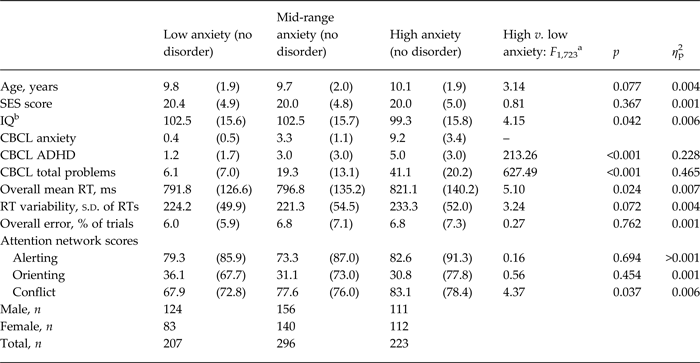
For means and ANOVA results comparing high- and low-anxious disorder-free children, see Table 3. These groups did not differ significantly in socio-economic status, but differed in gender (50% v. 40% female, respectively, χ2 = 4.44, df = 1, p = 0.04). High-anxious children also tended to be older and have significantly lower IQ scores than low-anxious children (Table 3). High-anxious children not only had higher CBCL anxiety scores (due to selection criteria), but also significantly higher general psychopathology and ADHD scores than low-anxious children.
Sample characteristics and ANT scores in disorder-free children as a function of anxiety group

Data are given as mean (s.d.) or as number of participants.
ANT, Attention Network Task; SES, socio-economic class score; IQ, intelligence quotient; CBCL, Child Behavior Checklist; ADHD, attention-deficit/hyperactivity disorder; RT, reaction time; s.d., standard deviation.
a F value was not calculated for CBCL anxiety, because the selection criteria resulted in no overlap in scores between groups. Data from all participants were used in total variance estimation. F values relate to the comparison of high- versus low-anxiety groups for each dependent variable.
b IQ scores were available for 673 children (93% of disorder-free children), degrees of freedom = 1, 670.
Overall errors and RTs
Responses were significantly slower and tended to be more variable in the high- than low-anxious group (Table 3), but not when CBCL ADHD scores were controlled (F's < 1). Accuracy was similar across groups.
Executive attention
As predicted (hypothesis 4), high-anxious children had higher conflict scores than low-anxious children (F 1,723 = 4.37, p = 0.037, η p 2 = 0.006, d = 0.20) (Fig. 2 A, right). This group difference remained significant when potential confounds (age, gender, IQ, overall error, mean RT, RT variability) were controlled (F 1,664 = 6.57, p = 0.011, η p 2 = 0.010).
Alerting and orienting
The groups did not differ significantly in alerting or orienting (Table 3).
Supplementary analyses of ANT conflict scores
Controlling effects of co-morbid psychopathology symptoms
ANCOVA of conflict scores from the four diagnostic subgroups and no-disorder group showed that the significant group differences, reported earlier, were independent of co-morbid psychopathology symptoms. Specifically, the difference between the anxiety disorders (excluding specific phobia) and no-disorder groups remained significant when CBCL ADHD and total problems scores were used as covariates, as well as potential confounds described earlier (F 1,783 = 5.64, p = 0.018, η p 2 = 0.007). Also, the difference between the combined ADHD and no-disorder groups was significant when CBCL anxiety and total problems scores were covariates (F 1,783 = 6.85, p = 0.009, η p 2 = 0.009).
A separate ANCOVA of conflict scores from disorder-free children confirmed the significant difference between the high- versus low-anxiety groups when CBCL ADHD and total problems scores were controlled in addition to potential confounds (F 1,662 = 6.83, p = 0.009, η p 2 = 0.010) (anxiety items were excluded from the total problems score because the independent variable of anxiety group is based on these items).
Executive attention in non-co-morbid anxiety disorders, other than specific phobia
With the exception of specific phobia, hypotheses had not been formulated for other individual non-co-morbid anxiety diagnoses (e.g. separation anxiety, GAD) because these samples were small, and differences between these disorders were not expected. Mean conflict score was 133 (s.d. = 104) ms for non-co-morbid separation anxiety (n = 10), 129 (s.d. = 85) ms for non-co-morbid GAD (n = 11) and 92 (s.d. = 74) ms for other anxiety disorders (n = 13). ANOVA of conflict scores comparing these groups with no-disorder children (mean = 77 ms, s.d. = 76, n = 726) showed a significant overall group difference (F 3,756 = 3.58, p = 0.014, η p 2 = 0.014). Relative to no-disorder children, conflict scores were higher in those with separation anxiety (d = 0.74, p = 0.020) and GAD (d = 0.69, p = 0.025) (results were similar with potential confounds as covariates).
Effects of potential confounds
ANCOVA of conflict scores with age, gender, IQ, overall errors, mean RT, and RT variability as covariates showed significant effects of two covariates, which were independent of the significant group effect (anxiety disorders, ADHD, no disorder) reported earlier: i.e. higher conflict scores were also associated with younger age (F 1,790 = 14.32, p < 0.01, η p 2 = 0.018) and greater RT variability (F 1,790 = 6.89, p = 0.009, η p 2 = 0.009). Similar effects of age and RT variability were found in ANCOVAs comparing the diagnostic subgroups, and low- versus high-anxiety disorder-free subgroups.
Discussion
Results summary
Anxiety disorders
Overall, children with anxiety disorders did not differ significantly from disorder-free children in ANT conflict scores assessing executive attention (hypothesis 1 was not supported). However, there was heterogeneity among anxiety disorders. As predicted (hypothesis 3), children with anxiety disorders, excluding specific phobias, did have higher conflict scores compared not only with disorder-free children, but also with children with specific phobias, who showed no deficit in executive attention. There was no evidence of anxiety-related deficits in alerting or orienting.
ADHD
Children with ADHD had higher conflict scores than disorder-free children (supporting hypothesis 2). There was no significant difference in conflict scores between non-co-morbid ADHD and co-morbid ADHD + ODD/CD, or between the anxiety disorders (excluding specific phobia) and ADHD groups. That is, anxiety disorders (excluding specific phobia) and ADHD were each associated with impaired executive attention. The ADHD group also had higher orienting scores, less accurate responses and more variable RTs than the anxiety disorders and no-disorder groups.
Non-clinical anxiety
Disorder-free children with high anxiety showed poorer executive attention than those with low anxiety (hypothesis 4 was supported). There were no anxiety-related deficits in alerting or orienting.
Contribution of findings to previous research
Anxiety-related deficits in executive attention
As noted earlier, past studies using the ANT investigated executive attention in adults with clinical and non-clinical anxiety. The present study not only extends this work, but also reveals notable similarities between children and adults. First, the finding of impaired executive attention in anxiety disorders (excluding specific phobia), relative to disorder-free individuals, resembles results from a small sample of adults with anxiety disorders (12 patients, most having GAD or agoraphobia; none with pure specific phobia; Pacheco-Unguetti et al. Reference Pacheco-Unguetti, Acosta, Marqués and Lupiáñez2011). The present study shows this effect in a larger medication-free sample of children. Second, the finding of heterogeneity in executive attention among anxiety disorders (i.e. between specific phobias versus other anxiety disorders) is similar to that observed in adults on other executive attention tasks (Airaksinen et al. Reference Airaksinen, Larsson and Forsell2005). Third, the present finding of impaired executive attention in high- versus low-anxious disorder-free children complements results from non-clinical high- versus low-anxious adults (Pacheco-Unguetti et al. Reference Pacheco-Unguetti, Acosta, Callejas and Lupiáñez2010). Together, these results indicate that children and adults share a similar pattern of anxiety-related deficits in executive attention.
Moreover, the present results extend previous research by providing further evidence of anxiety-specific deficits in executive attention. Anxiety-related group differences in conflict scores remained significant in supplementary analyses that took account of the effects of other psychopathology and potential confounds (including age and IQ). Specifically, differences in conflict scores between: (i) anxiety disorders (excluding specific phobia) versus no-disorder groups; and (ii) high- versus low-anxious groups of disorder-free children were independent of co-morbid ADHD symptoms or general psychopathology scores. Hence, anxiety appears to be the primary variable underlying these group differences in executive attention functioning.
ADHD-related deficits in executive attention
Children with ADHD had higher conflict scores than disorder-free children. This is consistent with two previous ANT studies of ADHD (Konrad et al. Reference Konrad, Neufang, Hanisch, Fink and Herpertz-Dahlmann2006; Johnson et al. Reference Johnson, Robertson, Barry, Mulligan, Daibhis, Daly, Watchorn, Gill and Bellgrove2008), although this effect has not always been found, perhaps because RTs tend to be highly variable in ADHD, which may increase noise in the ANT data (Booth et al. Reference Booth, Carlson and Tucker2007; Adólfsdóttir et al. Reference Adólfsdóttir, Sørensen and Lundervold2008; Kratz et al. Reference Kratz, Studer, Malcherek, Erbe, Moll and Heinrich2011). Furthermore, in the present study, the difference between the ADHD and no-disorder groups in conflict scores remained significant when effects of anxiety symptoms and general psychopathology were controlled. Thus, impairment in executive attention function in ADHD was not accounted for by co-morbid psychopathology.
The ADHD group differed from both anxiety disorders and no-disorder groups on other ANT measures. The ADHD group had higher orienting scores, which may indicate that they benefited more from the spatial warning cue (indicating where the target will appear), possibly due to lower intrinsic efficiency of the orienting network (Brunyé et al. Reference Brunyé, Mahoney, Lieberman and Taylor2010). This finding was not predicted; it has not been found in previous ANT studies (Adólfsdóttir et al. Reference Adólfsdóttir, Sørensen and Lundervold2008; Johnson et al. Reference Johnson, Robertson, Barry, Mulligan, Daibhis, Daly, Watchorn, Gill and Bellgrove2008), and the reason for these mixed orienting results across studies is unclear.
The ADHD group showed additional deficits which have been proposed to be robust markers of cognitive dysfunction in ADHD (Adólfsdóttir et al. Reference Adólfsdóttir, Sørensen and Lundervold2008): i.e. less accurate responses and more variable RTs, compared with both anxiety and no-disorder groups. These results suggest an elevated level of basic cognitive dysfunction in ADHD that is not shared by children with anxiety disorders (for further evidence of basic information processing deficits in ADHD, see Salum et al. Reference Salum, Sergeant, Sonuga-Barke, Vandekerckhove, Gadelha, Pan, Moriyama, Graeff-Martins, de Alvarenga, do Rosario, Manfro, Polanczyk and Rohde2014a , Reference Salum, Sonuga-Barke, Sergeant, Vandekerckhove, Gadelha, Moriyama, Graeff-Martins, Manfro, Polanczyk and Rohde b ).
Are executive attention deficits disorder-specific?
In the present study, the pattern of conflict scores appears to more closely resemble the pattern of general psychopathology (reflected by CBCL total problems score) than anxiety symptoms (Fig. 2A, B and C ), respectively. For example, the specific phobia group had the lowest levels of general psychopathology and conflict scores of the four diagnostic subgroups, while the anxiety disorders (excluding specific phobia) and ADHD groups had the highest levels of both general psychopathology and conflict scores. Closer similarity between the patterns of conflict scores and general psychopathology, rather than anxiety, would not be explained by cognitive models such as attention control theory, which focus on the effect of non-clinical anxiety on executive attention function, with anxiety viewed as a continuous dimension (Eysenck et al. Reference Eysenck, Derakshan, Santos and Calvo2007).
Thus, the pattern of results in Fig. 2 raises the question of whether executive function deficits are primarily a function of general psychopathology, rather than specific disorders. Recent models of the structure of psychiatric disorders highlight the role of general psychopathology (‘p’) as a common higher-order factor underlying both internalizing and externalizing disorders, including anxiety and ADHD (Lahey et al. Reference Lahey, Applegate, Hakes, Zald, Hariri and Rathouz2012; Caspi et al. Reference Caspi, Houts, Belsky, Goldman-Mellor, Harrington, Israel, Meier, Ramrakha, Shalev, Poulton and Moffitt2013). The factor p is described as being conceptually similar to the g factor of general intelligence, in that it is a higher-order factor that accounts for much variation in lower-order factors. Factor p underlies psychopathology severity across disorders, such that individuals with a high p have more persistent and co-morbid problems, greater life impairments as children and adults, and greater emotional dysregulation and executive deficits (Caspi et al. Reference Caspi, Houts, Belsky, Goldman-Mellor, Harrington, Israel, Meier, Ramrakha, Shalev, Poulton and Moffitt2013). This view would explain why it may be difficult to identify disorder-specific markers (e.g. in cognitive function, or neuroimaging indices), but it does not rule out their existence. An association between executive attention dysfunction and general psychopathology would seem compatible not only with a p-factor model, but also with the view, from developmental and personality research, that executive attention plays a key role in supporting effective regulation of thoughts, behavior and emotion; i.e. self-regulation, which is compromised across a wide range of psychopathologies (Posner & Rothbart, Reference Posner and Rothbart2000, Reference Posner and Rothbart2007; Muris & Ollendick, Reference Muris and Ollendick2005; Rueda et al. Reference Rueda, Posner and Rothbart2005; Hofmann et al. Reference Hofmann, Schmeichel and Baddeley2012).
In relation to the p-factor model, the present results suggest the following conclusions. First, the presence of any psychiatric disorder is not sufficient in itself to account for impaired executive attention, given that such impairment was not found in specific phobias. Second, while the pattern of executive attention function across the different disorder groups appears to parallel that of general psychopathology (Fig. 2), the latter does not seem sufficient to account for the results given that supplementary analyses indicated anxiety-specific and ADHD-specific deficits in executive attention; i.e. associations were found between impaired executive attention and diagnoses of anxiety disorders (not specific phobia) and ADHD after controlling the effect of general psychopathology symptoms. Third, the difference in executive attention between specific phobias and other anxiety disorders may relate to differences in specific symptom profiles (rather than general psychopathology), such as severity of cognitive versus behavioral symptoms of anxiety (e.g. worry versus behavioral avoidance). Thus, it would seem useful to investigate further the extent to which executive attention deficits relate to different classes of anxiety symptoms in anxiety disorders. Finally, neuroimaging research may help clarify other issues, such as whether common neural mechanisms underlie executive attention dysfunction associated with non-clinical anxiety, anxiety disorders (other than specific phobia) and ADHD.
Strengths and limitations
A strength of the study is the use of a large community sample of medication-free children. However, a limitation was the small number of children with specific non-co-morbid anxiety disorders, such as GAD and separation anxiety, so examination of these disorders was curtailed. Another strength is the use of a theoretically grounded task, specifically designed to assess function of the executive attention network, indexed by distracter interference (Fan et al. Reference Fan, McCandliss, Sommer, Raz and Posner2002; Posner & Rothbart, Reference Posner and Rothbart2007; Posner & Fan, Reference Posner, Fan and Pomerantz2008). However, a limitation of the ANT is that it does not assess cognitive flexibility, reflected by task switching, which is another aspect of executive attention that may be impaired by high anxiety (Eysenck et al. Reference Eysenck, Derakshan, Santos and Calvo2007). Resistance to distraction is also distinct from other cognitive functions related to child psychopathology such as motor response inhibition and attention bias to threat. The children studied here were a subsample of those participating in separate investigations of ADHD-related impairment in response inhibition (using Go/No-Go and Conflict Control tasks; Salum et al. Reference Salum, Sergeant, Sonuga-Barke, Vandekerckhove, Gadelha, Pan, Moriyama, Graeff-Martins, de Alvarenga, do Rosario, Manfro, Polanczyk and Rohde2014a , Reference Salum, Sonuga-Barke, Sergeant, Vandekerckhove, Gadelha, Moriyama, Graeff-Martins, Manfro, Polanczyk and Rohde b ) and anxiety-related threat attention bias (visual probe task; Salum et al. Reference Salum, Mogg, Bradley, Gadelha, Pan, Tamanaha, Moriyama, Graeff-Martins, Jarros, Polanczyk, do Rosario, Leibenluft, Rohde, Manfro and Pine2013). There was some evidence suggesting ADHD-related impairment in response inhibition, but this was explained by basic information-processing deficits; and no response inhibition deficits were associated with other psychopathology including anxiety and depressive disorders. Threat attention bias was associated with high internalizing symptoms in disorder-free children and distress disorders (GAD, depressive disorders), but not externalizing disorders (ADHD, ODD/CD; Salum et al. Reference Salum, Mogg, Bradley, Gadelha, Pan, Tamanaha, Moriyama, Graeff-Martins, Jarros, Polanczyk, do Rosario, Leibenluft, Rohde, Manfro and Pine2013). Given that resistance to distraction, motor response inhibition and threat attention bias are separable constructs (Nigg, Reference Nigg2000; Bunge et al. Reference Bunge, Dudukovic, Thomason, Vaidya and Gabrieli2002; Brydges et al. Reference Brydges, Anderson, Reid and Fox2013; Diamond, Reference Diamond2013), their specific contributions to child psychopathology warrant further clarification.
Effect sizes for hypothesis-related significant group differences in conflict scores were in the moderate-to-low range: d was 0.43 for anxiety disorders (excluding specific phobia); 0.35 for ADHD (each versus no-disorder); and 0.20 for high versus low anxiety in disorder-free children. Previous research suggests large effects of adult anxiety on conflict scores (d = ~1.0, Pacheco-Unguetti et al. Reference Pacheco-Unguetti, Acosta, Callejas and Lupiáñez2010, Reference Pacheco-Unguetti, Acosta, Marqués and Lupiáñez2011); and null-to-large effects of ADHD (e.g. d = ~0.1, 0.4 and 1.0 in Adólfsdóttir et al. Reference Adólfsdóttir, Sørensen and Lundervold2008, Johnson et al. Reference Johnson, Robertson, Barry, Mulligan, Daibhis, Daly, Watchorn, Gill and Bellgrove2008, and Konrad et al. Reference Konrad, Neufang, Hanisch, Fink and Herpertz-Dahlmann2006, respectively). Methodological variables may contribute to variation in effect sizes, e.g. larger effects may be found with adult participants (whose RT data may be less ‘noisy’ than children's), homogeneous samples and strictly controlled experimental testing conditions (e.g. laboratory versus school settings).
Conclusion
This study contributes to previous research by demonstrating that executive attention is impaired in children with anxiety disorders (excluding specific phobias), as well as in children with ADHD, relative to disorder-free children. Furthermore, executive attention was less efficient in disorder-free children who have high, relative to low, levels of anxiety symptoms. Such findings have potential clinical and educational implications, as poor executive attention is linked not only with psychopathology, such as anxiety and ADHD, but also with lower educational attainment (St Clair-Thompson & Gathercole, Reference St Clair-Thompson and Gathercole2006). If executive attention promotes self-regulation, as discussed earlier, cognitive and behavioral interventions that improve children's executive attention (Diamond & Lee, Reference Diamond and Lee2011) may help reduce non-clinical and clinical manifestations of psychopathology, and increase educational success (Posner & Rothbart, Reference Posner and Rothbart2005; Diamond, Reference Diamond2012).
Acknowledgements
This work is supported by the National Institute of Developmental Psychiatry for Children and Adolescents, a science and technology institute funded by the Conselho Nacional de Desenvolvimento Científico e Tecnológico (CNPq; National Council for Scientific and Technological Development; grant number 573974/2008-0) and the Fundação de Amparo à Pesquisa do Estado de São Paulo (FAPESP; Research Support Foundation of the State of São Paulo; grant number 2008/57896-8). G.A.S. is in receipt of a CAPES/FAPERGS post-doctoral scholarship. G.G.M. and L.A.R. are in receipt of a senior research CNPq scholarship. We thank the children and families for their participation, which made this research possible; the other members of the high-risk cohort research team; the collaborators for the neuropsychological evaluation; Robert Goodman for his research support regarding the DAWBA instrument procedures; and Bacy Fleitlich-Bilyk for her clinical supervision.
Declaration of Interest
G.A.S., P.A., G.G.M., D.S.P., K.M. and B.P.B. have no potential conflicts of interest relating to this work. A.G. and P.P. receive continuing medical education support from Astra Zeneca, Eli-Lilly and Janssen-Cilag. L.A.R. has been a member of the speakers’ bureau/advisory board and/or acted as a consultant for Eli-Lilly, Janssen-Cilag, Novartis and Shire in the last 3 years. He receives authorship royalties from Oxford Press and ArtMed. He has also received travel awards from Shire for his participation in the 2014 American Psychological Association meeting. The ADHD and Juvenile Bipolar Disorder Outpatient Programs chaired by him received unrestricted educational and research support from the following pharmaceutical companies in the last 3 years: Eli-Lilly, Janssen-Cilag, Novartis and Shire.