1 Introduction
Let G be a finite group,
${\text {Irr}}(G)$
 the set of all complex irreducible characters of G, and
${\text {cd}}(G) = \{\chi (1) \mid \chi \in {\text {Irr}}(G)\}$
 the set of degrees of all complex irreducible characters of G. In 2000, Huppert [Reference Huppert7] made the following conjecture.
Conjecture 1.1. Let S be a finite simple group and G a finite group. Then,
${{\text {cd}}(G) = {\text {cd}}(S)}$
 if and only if
$G= S\times A$
 , where A is an abelian group.
This conjecture has been verified for sporadic simple groups, alternating groups and several families of simple groups of Lie type, as documented in [Reference Bessenrodt, Tong-Viet and Zhang1, Reference Huppert7, Reference Huppert8, Reference Nguyen, Tong-Viet and Wakefield13, Reference Tong-Viet15–Reference Wakefield19]. In 2012, Chen and Xu investigated the characterisation of finite simple groups using more limited character degree information. Specifically, they successfully characterised the simple
$K_3$
 -groups solely by their group orders and either one or both of their largest and second-largest irreducible character degrees, as reported in [Reference Xu, Chen and Yan22]. Subsequently, this line of research has been further pursued (see [Reference Jiang and Shao9, Reference Yan23]).
For
$\chi \in {\text {Irr}}(G)$
 , Qian [Reference Qian, Wang and Wei14] defined the codegree of
$\chi $
 , denoted by
$\chi ^c(1)$
 , as
$\chi ^c(1) = {|G : \ker \chi |}/{\chi (1)}$
 , and conducted extensive research on the relationship between character codegrees and the structure of finite groups. Let
$\mathrm {{cod}}(G)$
 denote the set of codegrees of all irreducible complex characters of G. Based on this definition, Qian proposed the following conjecture [Reference Khukhro and Mazurov10, Problem 20.79]).
Conjecture 1.2. Let S be a finite simple group and let G be a finite group. Then,
$\mathrm {{cod}}(G) = \mathrm {{cod}}(S)$
 if and only if
$G \cong S$
 .
This conjecture has been verified for sporadic simple groups, alternating groups and certain simple groups of Lie type. Of particular note are recent advances, specifically the work of Hung and Moretó, who investigated Qian’s conjecture through a more general framework rather than relying on case-by-case verification for individual simple groups [Reference Hung and Moretó5, Reference Hung and Moretó6]. They established the following elegant result.
Theorem 1.3 [Reference Hung and Moretó5].
Let S and H be finite simple groups such that
$\mathrm {{cod}}(S) \subseteq \mathrm {{cod}}(H)$
 . Then,
$S \cong H$
 .
Moreover, in [Reference Hung and Moretó6], Hung and Moretó proposed and investigated the following more general conjecture. They confirmed the validity of this conjecture for alternating groups, sporadic simple groups and simple groups of the following Lie types:
$^2B_2$
 ,
$^2G_2$
 ,
$^2F_4$
 ,
$G_2$
 ,
$^3D_4$
 ,
$F_4$
 ,
$^2E_6$
 ,
$A_{\leq 3}$
 ,
$^2A_{\leq 6}$
 ,
$C_2$
 ,
$C_3$
 and
$B_3$
 .
Conjecture 1.4. Let H be a nonabelian simple group and G a nontrivial finite group. Then,
$\mathrm {{cod}}(G) \subseteq \mathrm {{cod}}(H)$
 if and only if
$G \cong H$
 .
Our motivation stems from investigating whether finite simple groups can be characterised using more refined character codegree information. Specifically, we aim to determine whether a simple group can be uniquely identified by its order and the minimum nontrivial irreducible character codegree. This problem is of significant theoretical interest, as supported by several established results. Let
$m^c(G)$
 denote the minimum nontrivial irreducible character codegree of a finite group G, and
$b(G)$
 denote the maximum degree among its irreducible characters. The invariant
$m^c(G)$
 was first introduced and studied in [Reference Hung and Moretó5], where it is denoted by
$f(G)$
 . For every finite simple group G, we have
$m^c(G) = |G| / b(G)$
 . A number of researchers, including Xu, Jiang, Yan and Chen [Reference Jiang and Shao9, 22, 23], have studied the interplay between the order of a simple group, the maximum degree of its irreducible characters and its structural properties. Their work has shown that certain simple groups can be uniquely determined by their order and the maximum irreducible character degree, although in some cases, additional data—such as the second or third largest character degrees—are required. However, there are notable examples of nonisomorphic groups that share both the same order and the same maximum irreducible character degree. For instance, the Mathieu group
$M_{22}$
 and the direct product
$T \times M_{11}$
 possess identical orders and equal largest irreducible character degrees, where T is a Frobenius group with an elementary abelian kernel of order
$2^3$
 and a cyclic complement of order 7. Similarly, the alternating group
$A_6$
 shares both its order and its largest irreducible character degree with the groups
$S_3 \times A_5$
 and
$Z_3 \rtimes S_5$
 . These examples highlight that while there exists an inverse relationship between
$b(G)$
 and
$m^c(G)$
 in simple groups, the question of whether a simple group can be uniquely characterised by its order and
$m^c(G)$
 remains both meaningful and challenging.
In this paper, we establish that all sporadic simple groups, all alternating groups and the projective special linear groups
$L_2(p)$
 for primes
$p \geq 5$
 are uniquely determined by their group orders and the minimum nontrivial irreducible character codegrees.
2 Characterisation of
$L_2(p)$


Lemma 2.1 [Reference Hung and Moretó5, Lemma 2.1(5)].
If G is abelian, then
$\mathrm {{cod}}(G)=\pi _e(G)$
 , where
$\pi _e(G)$
 is the set of orders of the elements of G.
Lemma 2.2. Let G be a finite group. If
$m^c(G)>\max (\pi (G))$
 , then
$ G=G{'}$
 and, thus, G is nonsolvable.
The following lemma is a direct corollary of the preceding lemma.
Lemma 2.3 [Reference Hung and Moretó5, Proposition 7.1].
Let H be a simple group of Lie type. If
$n = 7$
 or
$n \geq 9$
 and the order of the alternating group
$\mathrm {A}_n$
 divides
$|H|$
 , then
$m^c(H)> m^c(\mathrm {A}_n)$
 .
Lemma 2.4 [Reference Hung and Moretó5, Lemma 6.1].
Let H be a simple group of Lie type defined over a field of characteristic p. Then, the following statements hold:
-
(1) $|H|_p<|H|_{p'}/p-1$
; -
(2) $|H|_{p'} < |H|_p^2$
, thus,
$m^c(H) < |H|_p^2$
; -
(3) if H is not of type $A_1$
, then every prime divisor of
$|H|_{p'}$
is less than
$\sqrt {|H|_{p'}}$
.


Lemma 2.5 [Reference Cossey, Halasi, Maroti and Nguyen4, Theorem 12].
Let S be a simple group. Then,
$\sqrt [3]{|S|} < b(S)$
 .
Lemma 2.6 [Reference Kimmerle11, Theorem 5.1].
Let S and T be two nonisomorphic finite simple groups of the same order. Then, S and T are either
$L_3(4)$
 and
$A_8$
 or
$B_n(q)$
 and
$C_n(q)$
 , where
$n\geq 3$
 and q is an odd prime power.
Theorem 2.7. Let G be a group and let
$H = L_2(p)$
 , where
$p \geq 5$
 is a prime. Then,
$G \cong H$
 if and only if
$|G| = |H|$
 and
$m^c(G) = m^c(H)$
 .
Proof. It suffices to prove the sufficiency. We have
$|L_2(p)| = p(p-1)(p+1)/2$
 and
$\mathrm {cd}(H) = \{1, p, p-1, p+1, (p + \varepsilon )/2\}$
 , where
$\varepsilon = (-1)^{(p-1)/2}$
 and
$p \geq 5$
 is a prime. Thus,
$|G| = p(p-1)(p+1)/2$
 and
$m^c(G) = m^c(L_2(p)) = p(p-1)/2$
 .
Note that p is the largest prime divisor of
$|G|$
 . Since
$p < p(p-1)/2 = m^c(G)$
 , it follows from Lemma 2.2 that
$G = G'$
 and, hence, G is nonsolvable. Therefore, G has a maximal normal subgroup M such that
$G/M \cong S$
 and
$m^c(G) \leq m^c(S)$
 , where S is a nonabelian simple group. The proof proceeds in three steps.
Step 1. We prove that S is not a sporadic group. Suppose, to the contrary, that S is a sporadic group.
Assume
$p \mid |S|$
 . Note that
$|S| \mid |G| = \frac{1}{2}p(p-1)(p+1)$
 and p is the largest prime divisor of
$|S|$
 . Thus, for any prime
$r \mid |S|$
 with
$r < p$
 , we have
$r \mid (p-1)(p+1)$
 . However, by Table 1, for every sporadic group except
$M_{11}$
 and
$M_{12}$
 , there exists a prime r such that
$r \nmid (p-1)(p+1)$
 . If
$S = M_{11}$
 (
$|M_{11}| = 2^4 \cdot 3^2 \cdot 5 \cdot 11$
 ) or
$M_{12}$
 (
$|M_{12}| = 2^6 \cdot 3^3 \cdot 5 \cdot 11$
 ), then
$p = 11$
 , so
$|G| = 2^2 \cdot 3 \cdot 5 \cdot 11$
 . Hence,
$|G| < |S|$
 , which is a contradiction.
Sporadic groups except
$M_{11}$
 and
$M_{12}$
 .

Table 1 Long description
The table is organized into two identical sets of three columns: Group, p, and r.
Left side entries:
* J sub 1: p = 19, r = 11
* J sub 2: p = 7, r = 5
* J sub 3: p = 19, r = 17
* M c L: p = 11, r = 7
* R u: p = 29, r = 13
* O'N: p = 31, r = 19
* C o sub 2: p = 23, r = 7
* H N: p = 19, r = 11
* T h: p = 31, r = 19
* C o sub 1: p = 23, r = 13
* F i super prime sub 24: p = 29, r = 23
* M: p = 71, r = 59
Right side entries:
* M sub 22: p = 11, r = 7
* H S: p = 11, r = 7
* M sub 24: p = 23, r = 7
* H e: p = 17, r = 7
* S u z: p = 13, r = 11
* C o sub 3: p = 23, r = 7
* F i sub 22: p = 13, r = 11
* L y: p = 67, r = 37
* F i sub 23: p = 23, r = 17
* J sub 4: p = 43, r = 37
* B: p = 47, r = 31
* M sub 23: p = 23, r = 7
Now, assume
$p \nmid |S|$
 . In this case,
$|S| \mid \tfrac 12(p-1)(p+1)$
 . Then,
$p \geq \sqrt {2|S| + 1}> \sqrt {2|S|}$
 and, thus,
$m^c(G) = \tfrac 12p(p-1)> |S| - \sqrt {2|S|}$
 . By Lemma 2.5,
$\sqrt [3]{|S|} < b(S)$
 . Since
${|S|}/{b(S)}$
 is a codegree, it follows that
$m^c(S) \leq {|S|}/{b(S)} \leq |S|^{2/3}$
 . Consider the function
${f(x) = x - \sqrt {2x} - x^{2/3}}$
 for
$x> 2^6$
 . This function is strictly increasing and satisfies
$f(2^6)> 0$
 , so
$f(|S|)> 0$
 for all sporadic groups S. That is,
$|S| - \sqrt {2|S|} - |S|^{2/3}> 0$
 , which implies
$m^c(G)> |S| - \sqrt {2|S|} > |S|^{2/3} \geq m^c(S)$
 , again being a contradiction.
Therefore, S is not a sporadic group.
Step 2. When S is an alternating group, we prove that
$S = A_5$
 and
$G = S$
 .
Assume
$S = A_n$
 with
$n = 7$
 or
$n \geq 9$
 . Since
$|S| \mid |L_2(p)|$
 , it follows from Lemma 2.3 that
$m^c(S) < m^c(L_2(p))$
 . Therefore,
$m^c(G) \leq m^c(S) < m^c(L_2(p))$
 , which is a contradiction.
When
$S = A_5$
 , we have
$m^c(S) = 12$
 . Since
$m^c(G) = \tfrac 12p(p-1) \leq m^c(S)$
 , it follows that
$p = 5$
 and
$|G| = 2^2 \cdot 3 \cdot 5$
 . Comparing orders immediately yields
$G = S = A_5$
 .
When
$S = A_6$
 , we have
$m^c(S) = 36$
 . Since
$m^c(G) = \tfrac 12p(p-1) \leq m^c(S)$
 , we conclude that
$p = 5$
 or
$p = 7$
 . Hence,
$|G| = 2^2 \cdot 3 \cdot 5$
 or
$2^3 \cdot 3 \cdot 7$
 , both of which are less than
$|S|$
 , which is a contradiction.
When
$S = A_8$
 , we have
$m^c(S) = 2^5 \cdot 3^2$
 . Since
$m^c(G) = \tfrac 12p(p-1) \leq m^c(S)$
 , the possible values of p are
$5, 7, 11, 13, 17, 19$
 or
$23$
 . Checking each case individually, we find that
$|S| \nmid |G|$
 , again being a contradiction.
Therefore,
$G = S = A_5$
 when S is an alternating group.
Step 3. When S is a simple group of Lie type, we prove that
$S \cong L_2(p)$
 and
$G = S$
 .
Assume that S is a simple group of Lie type defined over a field of characteristic r. We divide the proof into two cases:
$r = p$
 and
$r \neq p$
 .
Case 1. Assume
$r = p$
 . Then,
$|S| = p |S|_{p'}$
 and
$|S|_{p'} \mid |G|_{p'} = \tfrac 12(p+1)(p-1)$
 . If
$|S|_{p'} < \tfrac 12(p+1)(p-1)$
 , then
$|S|_{p'} \leq \tfrac 14(p+1)(p-1)$
 . However, since
$m^c(G) = \tfrac 12p(p-1) \leq m^c(S) \leq \mathrm {{cod}}(\mathrm {St}) = |S|_{p'} \leq \tfrac 14(p+1)(p-1)$
 , where St denotes the Steinberg character, this leads to a contradiction. Therefore,
$|S|_{p'} = \tfrac 12(p+1)(p-1)$
 . It follows that
$|S| = |G| = |L_2(p)|$
 . By Lemma 2.6, we conclude that
$S \cong L_2(p)$
 and, hence,
$G = L_2(p)$
 .
Case 2. Assume
$r \neq p$
 . By [Reference Michler12, Reference Willems21], considering the degree of the Steinberg character
$\mathrm {St}(1)_r$
 of S, we have
$\mathrm {St}(1)_r = |S|_r$
 and
$\mathrm {{cod}}(\mathrm {St})_r = |S|_{r'}$
 . Thus,
$m^c(G) \leq m^c(S) \leq |S|_{r'}$
 . We proceed with the proof by distinguishing whether S is of type
$A_1$
 or not.
Case 2.1. Assume S is not of type
$A_1$
 . Since
$|S| {\kern-1pt}\mid{\kern-1pt} \tfrac 12p(p{\kern-1pt}-{\kern-1pt}1)(p{\kern-1pt}+{\kern-1pt}1)$
 and
$(p-1, p+1) = 2$
 , it follows that
$|S|_r \mid p-1$
 or
$|S|_r \mid p+1$
 .
First, assume
$|S|_r \mid p-1$
 . If
$|S|_r < p-1$
 , then
$|S|_r \leq \tfrac 12(p-1)$
 . By Lemma 2.4,

which implies that
$-1 \leq p \leq 3$
 , a contradiction. Therefore,
$|S|_r = p-1$
 . It follows that
$|S|_{r'} \mid \tfrac 12p(p+1)$
 .
If
$|S|_{r'} = \tfrac 12p(p+1)$
 , then
$|S| = |L_2(p)|$
 and, by Lemma 2.6,
$S \cong L_2(p)$
 , which is of type
$A_1$
 , contrary to the assumption for this case. If
$|S|_{r'} < \tfrac 12p(p+1)$
 , then
${|S|_{r'} \leq \tfrac 14p(p+1)}$
 . Since
$\tfrac 12p(p-1) = m^c(G) \leq |S|_{r'}$
 , we deduce
$ \tfrac 12p(p-1) \leq \tfrac 14p(p+1) $
 and, hence,
$0 \leq p \leq 3$
 , again a contradiction.
Second, assume
$|S|_r \mid p+1$
 . If
$|S|_r < p+1$
 , then
$|S|_r \leq \tfrac 12(p+1)$
 . By Lemma 2.4,

which implies
$2 - \sqrt {5} \leq p \leq 2 + \sqrt {5}$
 , a contradiction. Therefore,
${|S|_r = p+1}$
 . It follows that
${|S|_{r'} \mid \tfrac 12p(p-1)}$
 . Since
$\tfrac 12p(p-1) = m^c(G) \leq |S|_{r'}$
 , we deduce
$|S|_{r'} = \tfrac 12p(p-1)$
 . Hence,
$|S| = |L_2(p)|$
 . By Lemma 2.6,
$S \cong L_2(p)$
 , which is of type
$A_1$
 , again contrary to the assumption in this case.
Case 2.2. Assume S is of type
$A_1$
 . Let
$S = L_2(r^n)$
 . If
$r \neq 2$
 , then we have
${m^c(S) = \tfrac 12r^n(r^n - 1)}$
 . Since
$m^c(G) \leq m^c(S)$
 , it follows that
$p \leq r^n$
 . Hence,
$|S| \geq |L_2(p)|$
 and, therefore,
$|S| = |L_2(p)|$
 and
$G = S = L_2(p)$
 .
If
$r = 2$
 , then
$|S| = 2^n(2^n - 1)(2^n + 1)$
 and
$m^c(S) = 2^n(2^n - 1)$
 . Clearly,
$2^n \mid p-1$
 or
$2^n \mid p+1$
 .
When
$2^n \mid p-1$
 , we claim that
$2^n = p-1$
 . Otherwise,
$2^n \leq \tfrac 12(p-1)$
 and

which is a contradiction. Thus,
$2^n = p-1$
 . Since
$|S| \mid \tfrac 12p(p-1)(p+1)$
 , it follows that
$|S|_{2'} \mid \tfrac 12p(p+1)$
 . We claim that
$|S|_{2'} = \tfrac 12p(p+1)$
 . Otherwise,
$|S|_{2'} \leq \tfrac 14p(p+1)$
 and

which implies
$0 \leq p \leq 3$
 , a contradiction. Therefore,
$|S|_{2'} = \tfrac 12p(p+1)$
 . Together with
$2^n = p-1$
 , we obtain
$|G| = |S| = |L_2(p)|$
 , which contradicts Lemma 2.6.
When
$2^n \mid p+1$
 , we claim that
$2^n = p+1$
 . Otherwise,
$2^n \leq \tfrac 12(p+1)$
 and

which is a contradiction. Since
$2^n = p+1$
 ,

again a contradiction.
Therefore,
$G = S = L_2(p)$
 when S is a simple group of Lie type.
3 Characterisation of the alternating group
In this section, we demonstrate that the group order and the minimum nontrivial codegree are sufficient to characterise the alternating groups. We begin by recalling several properties of the alternating groups.
Lemma 3.1 [Reference Buekenhout2, Theorem 3.7].
Suppose that
$\tfrac 12n! = p_1^{\alpha _1} p_2^{\alpha _2} \cdots p_s^{\alpha _s}$
 , where
$n \geq 5$
 and
$p_1, p_2, \ldots , p_s$
 are distinct primes such that
$p_1^{\alpha _1}> p_i^{\alpha _i}$
 for
$i = 2, \ldots , s$
 . Then:
-
(1) $p_1 = 2$
for
$n \neq 5, 6, 7, 9$
; -
(2) $p_1 = 3$
for
$n = 6, 7, 9$
; -
(3) $p_1 = 5$
for
$n = 5$
.


Lemma 3.2.
-
(1) Let $S = A_n$
with
$n \geq 5$
. Then,
$m^c(S)> \sqrt {n!}/2$
. -
(2) Let $m<n$
be positive integers. Then,
$m^c(A_m)<m^c(A_n)$
. -
(3) Let S be a sporadic simple group such that $|S| \mid |A_n|$
. Then,
$m^c(S) < m^c(A_n)$
.


Proof. The lemma follows straightforwardly from [Reference Hung and Moretó5, Lemma 5.4(1), Proposition 8.1 and the second paragraph of the proof of Proposition 8.2].
Lemma 3.3. Let S be a simple group of Lie type such that
$|S| \mid |A_{39}|$
 . Then, S is either a group contained in the list in [Reference Conway, Curtis, Wilson, Norton and Parker3], or one of
$L_2(11^3)$
 ,
$L_2(13^2)$
 and
$L_2(17^2)$
 .
Proof. Assume
$S \cong A_n(q)$
 . Since
$q^{n(n+1)/2}\ \|\ |S| \mid |A_{39}| = 2^{34} \cdot 3^{18} \cdot 5^8 \cdot 7^5 \cdot 11^3 \cdot 13^3 \cdot 17^2 \cdot 19^2 \cdot 23 \cdot 29 \cdot 31 \cdot 37$
 , we have
$\tfrac 12n(n+1) \leq 34$
 , so
$n \leq 7$
 . Therefore, if S is not a group listed in [Reference Conway, Curtis, Wilson, Norton and Parker3], then S must be one of the following simple groups of Lie type:
$A_1(q)$
 with
$q> 125$
 ,
$A_2(q)$
 with
$q> 31$
 ,
$A_3(q)$
 with
$q> 11$
 ,
$A_4(q)$
 with
$q> 11$
 ,
$A_5(q)$
 with
$q> 5$
 ,
$A_6(q)$
 with
$q> 3$
 or
$A_7(q)$
 with
$q> 2$
 .
If
$S = A_1(q)$
 with
$q> 125$
 , given that
$|S|$
 divides
$|A_{39}|$
 , it follows that q must be one of
$2^t$
 for
$7 \leq t \leq 34$
 ,
$3^t$
 for
$5 \leq t \leq 18$
 ,
$5^t$
 for
$4 \leq t \leq 8$
 ,
$7^t$
 for
$3 \leq t \leq 5$
 ,
$11^3$
 ,
$13^t$
 for
$2 \leq t \leq 3$
 ,
$17^2$
 or
$19^2$
 .
For these values of q, checking the orders of
$S = A_1(q)$
 such that
$|S| \mid |A_{39}|$
 , we find that S must be one of the following:
$A_1(11^3)$
 (with order
$2^2 \cdot 3^2 \cdot 5 \cdot 7 \cdot 11^3 \cdot 19 \cdot 37$
 ),
$A_1(13^2)$
 (with order
$2^3 \cdot 3 \cdot 5 \cdot 7 \cdot 13^2 \cdot 17$
 ) or
$A_1(17^2)$
 (with order
$2^5 \cdot 3^2 \cdot 5 \cdot 17^2 \cdot 29$
 ).
If
$S = A_2(q)$
 with
$q> 31$
 , then
$q^3$
 divides one of
$2^{34}$
 ,
$3^{18}$
 ,
$5^8$
 ,
$7^5$
 ,
$11^3$
 or
$13^3$
 . Hence, q must be one of
$2^t$
 for
$5 \leq t \leq 11$
 or
$3^t$
 for
$4 \leq t \leq 6$
 . By computing the orders of
$S = A_2(q)$
 for these cases, we conclude that
$|S| \nmid |A_{39}|$
 , which is a contradiction.
Using the same approach, we obtain contradictions for
$S = A_3(q)$
 with
$q> 11$
 ,
$A_4(q)$
 with
$q> 11$
 ,
$A_5(q)$
 with
$q> 5$
 ,
$A_6(q)$
 with
$q> 3$
 and
$A_7(q)$
 with
$q> 2$
 .
Now, assume
$S \cong {}^2A_n(q)$
 . From
$q^{n(n+1)/2}\ \|\ |S| \mid |A_{39}|$
 and the fact that the largest exponent of a prime power dividing
$|A_{39}|$
 is 34, it follows that
$n \leq 7$
 . Therefore, if S is not listed in [Reference Conway, Curtis, Wilson, Norton and Parker3], then S must be one of
${}^2A_2(q)$
 with
$q> 32$
 ,
${}^2A_3(q)$
 with
$q> 11$
 ,
${}^2A_4(q)$
 with
$q> 11$
 ,
${}^2A_5(q)$
 with
$q> 5$
 or
${}^2A_6(q)$
 with
$q> 3$
 .
If
$S = {}^2A_2(q)$
 with
$q> 32$
 , then
$q^3$
 divides one of
$2^{34}$
 ,
$3^{18}$
 ,
$5^8$
 ,
$7^5$
 ,
$11^3$
 or
$13^3$
 . Thus, q is either
$2^t$
 for
$6 \leq t \leq 11$
 or
$3^t$
 for
$4 \leq t \leq 6$
 . Computing the orders of
$S = {}^2A_2(q)$
 for these values yields
$|S| \nmid |A_{39}|$
 , which is a contradiction.
For
$S = {}^2A_3(q)$
 with
$q> 11$
 ,
${}^2A_4(q)$
 with
$q> 11$
 ,
${}^2A_5(q)$
 with
$q> 5$
 or
${}^2A_6(q)$
 with
$q> 3$
 , the same method leads to a contradiction.
Finally, suppose S is any other simple group of Lie type not yet considered. By the same argument as above, all such S satisfying
$|S| \mid |A_{39}|$
 are contained in the list of [Reference Conway, Curtis, Wilson, Norton and Parker3].
Since
$\vert A_8\vert =\vert L_3(4)\vert =2^6\cdot 3^2\cdot 5\cdot 7$
 and
$70=b(A_8)>b(L_3(4))=64$
 , it follows that
$m^c(A_8)=2^5\cdot 3^2<m^c(L_3(4))=3^2\cdot 5\cdot 7 $
 . Further, we have the following lemma.
Lemma 3.4. Let S be a simple group of Lie type. If
$S\neq L_3(4)$
 and
$\vert S\vert \mid \vert A_n\vert $
 , then
$m^c(S)<m^c(A_n)$
 ,
$n\geq 5$
 . If
$S=L_3(4)$
 , then
$m^c(S)<m^c(A_n)$
 ,
$ n\geq 9$
 .
Proof. Assume S is defined over a field of characteristic p. By Lemma 2.4,
$m^c(S) < |S|_p^2 \leq |A_n|_p^2$
 . When
$n> 10$
 , we have
$m^c(S) < |A_n|_2^2 \leq 2^{2n-2}$
 by Lemma 3.1. By Lemma 3.2,
$m^c(A_n) \geq \sqrt {n!}/2$
 . Therefore, the result holds if
$\tfrac 12\sqrt {n!} \geq 2^{2n-2}$
 . This inequality is verified using MATLAB and holds for all
$n \geq 40$
 . It remains to consider the case
${5 \leq n \leq 39}$
 .
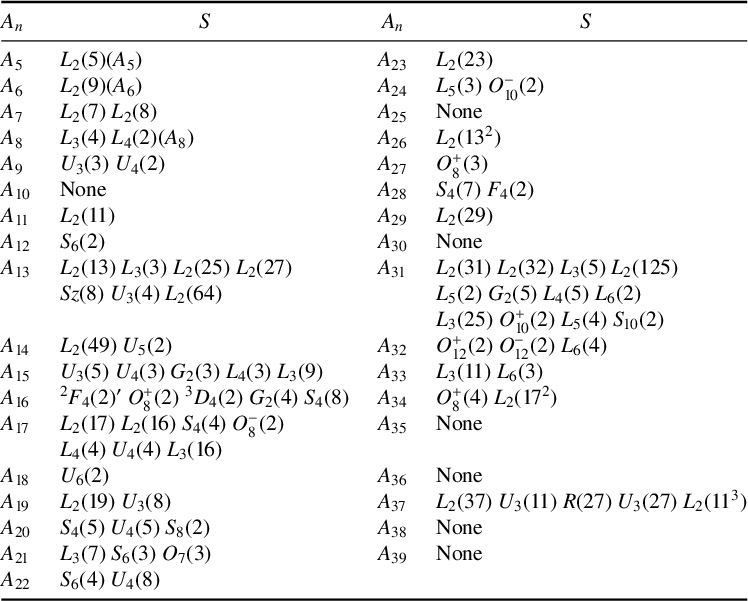
Through direct computation, we obtain Table 2, which lists all simple groups of Lie type whose orders divide
$|A_n|$
 , but do not divide
$|A_{n-1}|$
 for
$5 \leq n \leq 39$
 . Upon inspection, for each simple group of Lie type
$S \neq L_3(4)$
 such that
$|S| \mid |A_n|$
 and
$|S| \nmid |A_{n-1}|$
 , we find that
$m^c(S) < m^c(A_n)$
 . Thus, the conclusion follows from Lemma 3.2. For
$S = L_3(4)$
 , [Reference Conway, Curtis, Wilson, Norton and Parker3] shows that
$3^2 \cdot 5 \cdot 7 = m^c(S) < m^c(A_9) = 2^3 \cdot 3 \cdot 5 \cdot 7$
 . In conclusion, by Lemma 3.2,
$m^c(S) < m^c(A_n)$
 for all
$n \geq 9$
 .
Simple groups of Lie type S satisfying
$\vert S\vert \mid \vert A_n\vert $
 , but
$\vert S\vert \nmid \vert A_{n-1}\vert $
 .

Table 2 Long description
The table is organized into four columns, effectively presenting two sets of A sub n and S pairings side-by-side.
Row 1: A sub 5 corresponds to L sub 2 (5) (A sub 5); A sub 23 corresponds to L sub 2 (23).
Row 2: A sub 6 corresponds to L sub 2 (9) (A sub 6); A sub 24 corresponds to L sub 5 (3) O super minus sub 10 (2).
Row 3: A sub 7 corresponds to L sub 2 (7) L sub 2 (8); A sub 25 has no corresponding S value.
Row 4: A sub 8 corresponds to L sub 3 (4) L sub 4 (2) (A sub 8); A sub 26 corresponds to L sub 2 (13 super 2).
Row 5: A sub 9 corresponds to U sub 3 (3) U sub 4 (2); A sub 27 corresponds to O super plus sub 8 (3).
Row 6: A sub 10 has no corresponding S value; A sub 28 corresponds to S sub 4 (7) F sub 4 (2).
Row 7: A sub 11 corresponds to L sub 2 (11); A sub 29 corresponds to L sub 2 (29).
Row 8: A sub 12 corresponds to S sub 4 (2); A sub 30 has no corresponding S value.
Row 9: A sub 13 corresponds to L sub 2 (13) L sub 3 (3) L sub 2 (25) L sub 2 (27); A sub 31 corresponds to L sub 2 (31) L sub 2 (32) L sub 3 (5) L sub 2 (125).
Row 10: Additional S values for A sub 13 include Sz (8) U sub 3 (4) L sub 2 (64); Additional S values for A sub 31 include L sub 5 (2) G sub 2 (5) L sub 4 (5) L sub 6 (2).
Row 11: Further S values for A sub 31 include L sub 3 (25) O super plus sub 10 (2) L sub 5 (4) S sub 10 (2).
Row 12: A sub 14 corresponds to L sub 2 (49) U sub 5 (2); A sub 32 corresponds to O super plus sub 12 (2) O super minus sub 12 (2) L sub 6 (4).
Row 13: A sub 15 corresponds to U sub 3 (5) U sub 4 (3) G sub 2 (3) L sub 4 (3) L sub 3 (9); A sub 33 corresponds to L sub 3 (11) L sub 6 (3).
Row 14: A sub 16 corresponds to super 2 F sub 4 (2) prime O super plus sub 8 (2) super 3 D sub 4 (2) G sub 2 (4) S sub 4 (8); A sub 34 corresponds to O super plus sub 8 (4) L sub 2 (17 super 2).
Row 15: A sub 17 corresponds to L sub 2 (17) L sub 2 (16) S sub 4 (4) O super minus sub 8 (2); A sub 35 has no corresponding S value.
Row 16: Additional S values for A sub 17 include L sub 4 (4) U sub 4 (4) L sub 3 (16).
Row 17: A sub 18 corresponds to U sub 6 (2); A sub 36 has no corresponding S value.
Row 18: A sub 19 corresponds to L sub 2 (19) U sub 3 (8); A sub 37 corresponds to L sub 2 (37) U sub 3 (11) R (27) U sub 3 (27) L sub 2 (11 super 3).
Row 19: A sub 20 corresponds to S sub 4 (5) U sub 4 (5) S sub 8 (2); A sub 38 has no corresponding S value.
Row 20: A sub 21 corresponds to L sub 3 (7) S sub 6 (3) O sub 7 (3); A sub 39 has no corresponding S value.
Row 21: A sub 22 corresponds to S sub 6 (4) U sub 4 (8).
Theorem 3.5. Let G be a finite group and let
$H = A_n$
 with
$n \geq 5$
 . Then,
$G \cong H$
 if and only if
$|G| = |H|$
 and
$m^c(G) = m^c(H)$
 .
Proof. It suffices to prove the sufficiency.
We first show that G is simple. Assume, for a contradiction, that G is not simple and let M be a maximal normal subgroup of G. Then,
$M \neq 1$
 and
$G/M \cong S$
 , where S is a simple group. If S is nonabelian, it follows from
$|S| \mid |A_n|$
 and
$|S| < |A_n|$
 that
$m^c(S) < m^c(A_n)$
 by Lemmas 3.2 and 3.4. Since
$m^c(G) \leq m^c(S)$
 , we obtain
${m^c(G) < m^c(A_n)}$
 , which is a contradiction. If S is abelian, then
$m^c(S)$
 is prime and

again a contradiction. Therefore, G must be simple.
Since
$|G| = |H|$
 and G is simple, it follows from Lemma 2.6 that either
$G \cong H$
 or
$G = L_3(4)$
 and
$H = A_8$
 . If
$G = L_3(4)$
 and
$H = A_8$
 , then

which is a contradiction. Hence,
$G \cong H = A_n$
 and the theorem follows.
4 Characterisation of a sporadic simple group
Lemma 4.1 [Reference Wang, Lv, Yan and Chen20, Lemma 2.14].
Let S be a sporadic simple group and T a nonabelian simple group such that
$|T| \mid |S|$
 .
-
(1) If $S = M$
, then T is either a group contained in the list in [Reference Conway, Curtis, Wilson, Norton and Parker3], or one of
$A_n$
for
$26 \leq n \leq 32$
,
$L_2(2^{10})$
or
$L_2(13^2)$
, where M denotes the Monster group. -
(2) If $S \neq M$
, then T is a group contained in the list in [Reference Conway, Curtis, Wilson, Norton and Parker3].


Lemma 4.2. Let S be a sporadic simple group and let p be the largest prime divisor of
$|S|$
 . Then,
$p < m^c(S)$
 .
Proof. Let
$b = b(S)$
 be the largest irreducible character degree of S. Note that
$b^2 < |S|$
 , so
$b < |S|/b = m^c(S)$
 . Moreover, by [Reference Conway, Curtis, Wilson, Norton and Parker3],
$p < b(S)$
 for the largest prime divisor p of
$|S|$
 . Therefore,
$p < m^c(S)$
 and the lemma follows.
Theorem 4.3. Let G be a finite group and let H be a sporadic simple group. Then,
$G \cong H$
 if and only if
$|G| = |H|$
 and
$m^c(G) = m^c(H)$
 .
Proof. It is sufficient to prove the sufficiency. First, it follows from Lemmas 4.2 and 2.2 that
$G = G'$
 and G is nonsolvable. We claim that G is simple. Suppose, for contradiction, that G is not simple. Then, there exists a maximal nontrivial normal subgroup M of G such that
$G/M = S$
 , where S is a nonabelian simple group. In the subsequent arguments, we shall repeatedly apply the fact that
$|S|$
 divides
$|H|$
 and that
$|S| < |H|$
 .
Case 1. Assume that H is a Mathieu group. By Lemma 4.1 and [Reference Conway, Curtis, Wilson, Norton and Parker3], if
$H = M_{11}$
 , then S is one of
$A_5$
 ,
$A_6$
 or
$L_2(11)$
 . If
$H = M_{12}$
 , then S is one of

If
$H = M_{22}$
 , then S is one of

If
$H = M_{23}$
 , since
$|M_{12}|$
 divides
$|M_{23}|$
 , S is either one of the groups listed in (4.1), or one of
$M_{22}$
 or
$L_2(23)$
 . If
$H = M_{24}$
 , since
$|M_{22}|$
 divides
$|M_{24}|$
 , S is either one of the groups listed in (4.2), or one of
$M_{22}$
 ,
$L_2(23)$
 or
$M_{23}$
 .
According to [Reference Conway, Curtis, Wilson, Norton and Parker3], we always have
$m^c(S) < m^c(H)$
 . Since
$m^c(G) \leq m^c(S)$
 , it follows that
$m^c(G) < m^c(H)$
 , which leads to a contradiction.
Case 2. Assume that H is a Janko group. By Lemma 4.1 and [Reference Conway, Curtis, Wilson, Norton and Parker3], if
$H = J_1$
 , then S is one of
$A_5$
 ,
$L_2(7)$
 or
$L_2(11)$
 . If
$H = J_2$
 , then S is one of

If
$H = J_3$
 , then S is one of

If
$H = J_4$
 , then S is one of

According to [Reference Conway, Curtis, Wilson, Norton and Parker3], we always have
$m^c(S) < m^c(H)$
 . Since
$m^c(G) \leq m^c(S)$
 , it follows that
$m^c(G) < m^c(H)$
 , which leads to a contradiction.
Case 3. Assume that H is one of the following sporadic simple groups:
$HS$
 ,
$M^cL$
 ,
$\textit {Suz}$
 ,
$Ly$
 ,
$He$
 ,
$Ru$
 ,
$\textit {O'N}$
 ,
$\textit {Th}$
 or
$\textit {HN}$
 . By Lemma 4.1 and [Reference Conway, Curtis, Wilson, Norton and Parker3], if
$H = HS$
 , then S is one of

If
$H = M^cL$
 , then S is one of

If
$H = \textit {Suz}$
 , since
$|M_{12}|$
 ,
$|M_{22}|$
 and
$|J_2|$
 divide
$| \textit {Suz}|$
 , then S is either one of the groups listed in (4.1), (4.2) and (4.3), or one of

If
$H = Ly$
 , since
$|M^cL|$
 divides
$|Ly|$
 , then S is either one of the groups listed in (4.5), or one of

If
$H = He$
 , since
$|J_2|$
 divides
$|He|$
 , then S is either one of the groups listed in (4.3), or one of

If
$H = Ru$
 , since
$|J_2|$
 divides
$|Ru|$
 , then S is either one of the groups listed in (4.3), or one of

If
$H = \textit {O'N}$
 , since
$|M_{22}|$
 divides
$|\textit {O'N}|$
 , then S is either one of the groups listed in (4.2), or one of

If
$H = \textit {Th}$
 , since
$|J_2|$
 divides
$|\textit {Th}|$
 , then S is either one of the groups listed in (4.3), or one of

If
$H = HN$
 , since
$|M^cL|$
 and
$|HS|$
 divide
$|HN|$
 , then S is either one of the groups listed in (4.1), (4.2), (4.3), (4.4) and (4.5), or one of

According to [Reference Conway, Curtis, Wilson, Norton and Parker3], we always have
$m^c(S) < m^c(H)$
 . Since
$m^c(G) \leq m^c(S)$
 , it follows that
$m^c(G) < m^c(H)$
 , which leads to a contradiction.
Case 4. Assume that H is a Conway group. By Lemma 4.1 and [Reference Conway, Curtis, Wilson, Norton and Parker3], if
$H = Co_3$
 , since
$|M^cL|$
 ,
$|M_{24}|$
 and
$|HS|$
 divide
$|Co_3|$
 , then S is either one of the groups listed in (4.2), (4.3), (4.4) and (4.5), or one of

If
$H = Co_2$
 , since
$|M^cL|$
 ,
$|M_{24}|$
 and
$|HS|$
 divide
$|Co_2|$
 , then S is either one of the groups listed in (4.2), (4.3), (4.4), (4.5) and (4.12), or one of

If
$H = Co_1$
 , since
$|Co_3|$
 ,
$|\textit {Suz}|$
 and
$|Co_2|$
 divide
$|Co_1|$
 , then S is either one of the groups listed in (4.1), (4.2), (4.3), (4.4), (4.5), (4.6), (4.12) and (4.13), or one of

According to [Reference Conway, Curtis, Wilson, Norton and Parker3], we always have
$m^c(S) < m^c(H)$
 . Since
$m^c(G) \leq m^c(S)$
 , it follows that
$m^c(G) < m^c(H)$
 , which leads to a contradiction.
Case 5. Assume that H is one of the sporadic simple groups
$Fi_{22}$
 ,
$Fi_{23}$
 or
$Fi^{\prime }_{24}$
 . By Lemma 4.1 and [Reference Conway, Curtis, Wilson, Norton and Parker3], if
$H = Fi_{22}$
 , since
$|\textit {Suz}|$
 ,
$|M_{22}|$
 and
$|J_2|$
 divide
$|Fi_{22}|$
 , then S is either one of the groups listed in (4.1), (4.2), (4.3) and (4.6), or one of

If
$H = Fi_{23}$
 , since
$|M_{24}|$
 ,
$|Fi_{22}|$
 and
$|J_2|$
 divide
$|Fi_{23}|$
 , then S is either one of the groups listed in (4.1), (4.2), (4.3), (4.6) and (4.15), or one of

If
$H = Fi^{\prime }_{24}$
 , since
$|Fi_{23}|$
 and
$|He|$
 divide
$|Fi^{\prime }_{24}|$
 , then S is either one of the groups listed in (4.1), (4.2), (4.3), (4.6), (4.7), (4.15) and (4.16), or one of

According to [Reference Conway, Curtis, Wilson, Norton and Parker3], we always have
$m^c(S) < m^c(H)$
 . Since
$m^c(G) \leq m^c(S)$
 , it follows that
$m^c(G) < m^c(H)$
 , which leads to a contradiction.
Case 6. Assume that H is either the Monster group M or the Baby Monster group B. By Lemma 4.1 and [Reference Conway, Curtis, Wilson, Norton and Parker3], if
$H = B$
 , since
$|M^cL|$
 ,
$|M_{24}|$
 ,
$|Fi_{23}|$
 and
$|Co_1|$
 divide
$|B|$
 , then S is either one of the groups listed in (4.1), (4.2), (4.3), (4.4), (4.5), (4.6), (4.10), (4.11), (4.12), (4.13), (4.14), (4.15) and (4.16), or one of

If
$H = M$
 , since
$|B|$
 ,
$|Fi^{\prime }_{24}|$
 ,
$|\textit {O'N}|$
 and
$|Ru|$
 divide
$|M|$
 , then S is either one of the groups listed in (4.1), (4.2), (4.3), (4.4), (4.5), (4.6), (4.7), (4.8), (4.10), (4.11), (4.12), (4.13), (4.14), (4.15), (4.16) and (4.17), or one of

According to [Reference Conway, Curtis, Wilson, Norton and Parker3], we always have
$m^c(S) < m^c(H)$
 . Since
$m^c(G) \leq m^c(S)$
 , it follows that
$m^c(G) < m^c(H)$
 , which leads to a contradiction.
In summary, G must be simple. By Lemma 2.6, it follows that
$G \cong H$
 and, hence, the theorem holds.
By the proof of Theorem 4.3, we obtain the following corollary.
Corollary 4.4. Let G be a group and H a sporadic simple group. If
$|G|$
 divides
$|H|$
 and
$|G| < |H|$
 , then
$m^c(G) < m^c(H)$
 .
Acknowledgement
We thank the reviewers for their careful reading of this paper and many helpful suggestions.