1 Introduction
The Semantic Web is an extension of the current web in which the web information can be given well-defined semantic meaning, and thus enabling better cooperation between computers and people. From this point of view, we should find some methods that can describe the semantic meaning of the web. Fortunately, ‘ontology’ can do this. The core of the Semantic Web is ‘ontology’, which is a formal and explicit specification of a shared conceptualization and can enable semantic interoperability. With ontologies, it is possible to formally represent the knowledge of an application domain in terms of a set of vocabulary, the fundamental concepts in the domain, and relations between them. Over the past few years, several ontology definition languages for the Semantic Web have emerged, including RDF(S), OIL, DAML, DAML + OIL, and OWL (Berners-Lee et al., Reference Berners-Lee, Hendler and Lassila2001). Among them, OWL is the newly released standard recommended by W3C. As the Semantic Web expects, OWL has the reasoning nature because Description Logics (DLs; Baader et al., Reference Baader, Calvanese and McGuinness2003) are essentially the theoretical counterpart of OWL and play a crucial role in this context. DLs, which provide a logical reconstruction of object-centric and frame-based knowledge representation languages, are the subset of first-order logic that can provide sound and decidable reasoning support (Baader et al., Reference Baader, Calvanese and McGuinness2003).
It is clear that DLs play a key role in the Semantic Web. As with the traditional crisp logic, any sentence in OWL, being asserted facts, or reasoning results, must be either true or false and nothing in between. However, most real-world domains contain uncertain knowledge and incomplete or imprecise information that is true only to a certain degree. Ontologies defined by these languages (e.g., OIL and OWL) thus cannot quantify the degree of the overlap or inclusion between two concepts, and also cannot support reasoning in which only partial information about a concept or individual in the domain can be obtained. Uncertainty becomes more prevalent when more than one ontology is involved, where it is often the case that a concept defined in an ontology can only find partial matches to one or more concepts in another ontology. To overcome the difficulty, existing ontology languages and traditional DLs need to be extended to be able to capture uncertain knowledge about the concepts, properties, and instances in the domain and to support reasoning with imprecise information. Along this direction, researchers in the past have attempted to apply different formalisms, such as fuzzy logic, rough set theory, Bayesian probability, and ad hoc heuristics, into ontology and DLs (Zadeh, Reference Zadeh1965; Dubois & Prade, Reference Dubois and Prade2001; Hajek, Reference Hajek2006; Sanchez, Reference Sanchez2006; Jiang et al., Reference Jiang, Tang, Wang and Tang2009a).
In particular, the representation of fuzzy information has been addressed several decades ago by Zadeh (Reference Zadeh1965), and fuzzy set theory has been identified as a successful technique for modeling the imprecise and uncertain data in many application areas (Klir & Yuan, Reference Klir and Yuan1995), such as the database and the Semantic Web. Currently, there have been lots of fuzzy extensions of DLs with Zadeh's fuzzy logic theory papers published, but one only finds few comprehensive review papers of them. Only Lukasiewicz and Straccia (Reference Lukasiewicz and Straccia2008) and Straccia (Reference Straccia2008) give an overview on several extensions of DLs with the probabilistic logic, possibilistic logic, and fuzzy logic. Regarding the fuzzy logic part, the authors pay more attention to the fuzzy DL f-SHOIN(D), and then give a simple overview on other existing fuzzy DLs. Moreover, Bobillo (Reference Bobillo2008) surveys some contributions to the field of fuzzy ontologies (including the proposed definitions, some pointers to the most relevant applications, etc.), introduces his work fuzzy DL f-SROIQ(D), and also gives an overview on other fuzzy DLs. However, the works (Bobillo, Reference Bobillo2008; Lukasiewicz & Straccia, Reference Lukasiewicz and Straccia2008; Straccia, Reference Straccia2008) have not given the detailed classifications of fuzzy DLs with fuzzy logic, and also the comparisons of different fuzzy DLs, the reasoning of fuzzy DLs, the querying of fuzzy DLs, and the detailed applications of fuzzy DLs were missed. On this basis, to investigate these issues and more importantly serve as identifying the direction of fuzzy DLs for the Semantic Web study, this paper aims at providing a comprehensive literature overview of fuzzy DLs for the Semantic Web. In our work, we will introduce fuzzy DLs from the origin, development (from weaker to stronger in expressive power), some special techniques, and so on. Moreover, the other important issues on fuzzy DLs, such as reasoning, querying, and applications, will also be discussed in detail. Also, we will make a comparison and analysis. Note that, however, it does not mean that this paper covers all publications in the research area and give complete descriptions.
In this paper, we review existing proposals to extend DLs and Semantic Web languages with the capability to handle imprecise and uncertain information. There are many ways of representing and dealing with imprecision and uncertainty. In particular, there are lots of existing Semantic Web languages and DLs dealing with imprecision and uncertainty that are based on fuzzy set theory. Therefore, in this paper, we restrict our attention to approaches based on fuzzy set theory for representing imprecise and uncertain information. We will not cover recent proposals for probabilistic extensions of DLs, and we will also not discuss non-monotonic and non-standard logics for representing uncertainty. In more detail, this paper will review a number of proposals for extending logical languages with fuzzy logic in the following aspects:
1. Approaches that extend DLs with fuzzy logic theory, which play as the theoretical counterpart of the Semantic Web languages.
2. Approaches that directly relate to fuzzy DLs, such as reasoning, querying, and applications of fuzzy DLs. Also, we make some comparisons and analyses.
In the first category, we cover fuzzy extensions of DLs, which are commonly accepted as being the formal basis of web ontology language (OWL). Even though most approaches only cover logics that are much weaker than OWL, the methods proposed can directly be applied to the corresponding subset of OWL without changes because DLs play as the theory counterpart of OWL. In particular, we will survey existing fuzzy DLs from the origin, development (from weaker to stronger in expressive power), some special techniques, and will simply discuss the following issues of a fuzzy DL:
• Expressiveness of the fuzzy DL;
• The syntax, semantics, and knowledge base (KB) of the fuzzy DL;
• Reasoning algorithms for the fuzzy DL;
• The decidability and complexity of the reasoning algorithms.
Indeed, the balance of expressive power and the computability of the fuzzy extension of DLs is a hot topic of the research. Generally speaking, the more expressive the DL, the higher computational complexity of it, so we should consider the balance of the two factors in a real application. At last, in the second category, we also review a number of proposals that directly relate to fuzzy DLs:
• Reasoning on fuzzy DLs, especially different reasoning techniques and fuzzy DL reasoners;
• Querying over fuzzy DLs;
• The applications of fuzzy DLs, including the fuzzy extensions of Semantic Web languages, the fuzzy Description Logic Programs (DLPs), some particular applications, etc. Also, we make some comparisons and analyses in our whole review.
The paper is structured as follows. In Section 2, we give some background information on DLs and related formalisms that are the basis for the logical languages used in the different approaches discussed later in the paper. We also provide a brief introduction to fuzzy set theory on which the fuzzy DLs are based. In the main parts of this paper (Sections 3–6), we survey the different approaches for extending DLs to represent the imprecise and uncertain information according to their expressive powers in Section 3; Section 4 investigates issues about reasoning and querying of fuzzy DLs, where we survey the reasoning techniques for fuzzy DLs, the existing reasoners and comparations of their expressive and reasoning powers, and the querying problems of fuzzy DLs; in Section 5, we discuss the applications of fuzzy DLs in detail, including the fuzzy extensions of Semantic Web languages, fuzzy DLPs, and some particular applications; finally, in Section 6, we conclude with a critical review of the state of the art and an analysis of directions for future research.
2 Description Logics and fuzzy sets theory
In this section, we first present some background information on DLs and related formalisms that are the basis for the logical languages used in the different approaches discussed in the later sections. Then, we provide a brief introduction to fuzzy sets theory on which the fuzzy DLs are based.
2.1 Description Logics
In the last decade, a substantial amount of work has been carried out in the context of DLs. DLs are a logical reconstruction of the so-called frame-based knowledge representation languages, with the aim of providing a simple well-established Tarski-style declarative semantics to capture the meaning of the most popular features of structured representation of knowledge. Nowadays, DLs have gained even more popularity due to their applications in the context of the Semantic Web (Baader et al., Reference Baader, Calvanese and McGuinness2003).
Generally, the recent researches on DLs can be divided into three categories:
• Introducing the theoretical foundations of DLs, addressing some of the most recent developments in theoretical research in the area;
• Focusing on the implementation of knowledge representation systems based on DLs, describing the basic functionality of a DL system, surveying the most influential knowledge representation systems based on DLs, and addressing specialized implementation techniques;
• Addressing the use of DLs and of DL-based systems in the design of several applications of practical interest.
In the following statements, we mainly focus on the first category, especially the theoretical formalism of a DL, with respect to the balance between its expressive power and its computational complexity. Indeed, the tradeoff between the expressiveness of a DL language and its complexity of reasoning shows that a careful selection of language constructs is needed and that the reasoning services provided by the DL system are deeply influenced by the set of constructs. On this basis, we can characterize three different approaches to the implementation of reasoning services. The first can be referred to as limited + complete systems, which are designed by restricting the set of constructs in such a way that subsumption would be computed efficiently, possibly in polynomial time. The second approach can be denoted as expressive + incomplete systems, since the idea is to provide both an expressive language and efficient reasoning. The drawback is, however, that reasoning algorithms turn out to be incomplete in these systems. After some of the sources of incompleteness are discovered, often by identifying the constructs—or, more precisely, combinations of constructs—that would require an exponential algorithm to preserve the completeness of reasoning, the systems with complete reasoning algorithms are designed. Systems of this sort are therefore characterized as expressive + complete, they provide a test bed for the implementation of reasoning techniques developed in the theoretical investigations, and they play an important role in stimulating comparison and benchmarking with other systems.
In the following, we survey the languages of DLs according to their expressive power with the beginning of AL (i.e., attributive language; Baader et al., Reference Baader, Calvanese and McGuinness2003). The language AL has been introduced as a minimal language that is of practical interest, and the different DL languages are distinguished by the constructors they provide. In the sequel, we shall discuss various languages from the family of AL-languages. The other expressive languages from the extensions of this family are also introduced.
2.1.1 The basic Description Logic attributive language
Elementary descriptions are atomic concepts and atomic roles (also called concept names and role names), and complex descriptions can be built from them inductively with concept constructors and role constructors. In abstract notation, we use the letters A and B for atomic concepts, the letter R for atomic roles, and the letters C and D for concept descriptions.
Concept descriptions in AL are formed according to the following syntax rule:
C, D →  ${\rm{\tf="AgfaRSSB" T}}$ | (universal concept)
⊥ | (bottom concept)
A | (atomic concept)
C ∩ D | (intersection)
∀R.C | (value restriction)
∃R.⊥ (limited existential quantification)
In AL, negation can only be applied to atomic concepts, and only the top concept is allowed in the scope of an existential quantification over a role. In order to define a formal semantics of AL-concepts, we consider an interpretations I that consist of a non-empty set ΔI (the domain of the interpretation) and an interpretation function •I, which assigns to every atomic concept A, a set A I ⊆ ΔI, and to every atomic role R, a binary relation R I ⊆ ΔI × ΔI. The interpretation function is extended to concept descriptions by the following inductive definitions:
 $$\displaylines{ & {{{\rm{\tf="AgfaRSSB" T}}}^I} \, = \,{{{\rm{\rDelta }}}^I} \cr & {{ \bot }^I} \, = \,\varnothing \cr & {{(\neg A)}^I} \, = \,{{{\rm{\rDelta }}}^I} \backslash {{A}^I} \cr & {{(C \cap D)}^I} \, = \,{{C}^I} \cap {{D}^I} \cr & {{(\forall R.C)}^I} \, = \,\{ a \in {{{\rm{\rDelta }}}^I} |\forall b.(a,b) \in {{R}^I} \, \rightarrow \,b \in {{C}^I} \} \cr & {{(\exists R. \bot )}^I} \, = \,\{ a \in {{{\rm{\rDelta }}}^I} |\exists b.{}(a,b) \in {{R}^I} \} \cr}$$
The above constructors can be used to build DL KBs for representing the knowledge of an application domain (the ‘world’) by first defining the relevant concepts of the domain (i.e., its terminology), and then using these concepts to specify properties of objects and individuals occurring in the domain (i.e., the world description; Baader et al., Reference Baader, Calvanese and McGuinness2003). Generally speaking, a DL KB comprises two components, the TBox and the ABox. The TBox introduces the terminology, that is, the vocabulary of an application domain, while the ABox contains assertions about named individuals in terms of this vocabulary.
In brief, a TBox T is a finite set of terminology axioms of the form C ⊆ D or C = D. An interpretation I satisfies C ⊆ D if C I ⊆ D I, and similarly for C = D. An interpretation I is a model of TBox T iff I satisfies all axioms in T. An ABox A is a finite set of assertions of the form C(d) or R(d 1, d 2). By the first kind, called concept assertions, one states that d belongs to (the interpretation) C, and by the second kind, called role assertions, one states that d 2 is a filler of the role R for d 1. An interpretation I is a model of ABox A iff I satisfies all assertions in A. Furthermore, an interpretation I satisfies a DL knowledge base KB if it satisfies all axioms and assertions in KB.
2.1.2 The family of attributive languages
We obtain more expressive languages if we add further constructors to AL. The following introduce several important constructors, which are often added to AL.
The union of concepts (indicated by the letter U) is written as C ∪ D, and interpreted as
 $$ {{(C \cup D)}^I} = {{C}^I} \cup {{D}^I} $$
Full existential quantification (indicated by the letter E) is written as ∃R.C, and interpreted as
 $$ {{(\exists R.C)}^I} = \{ a \in {{{\rm{\rDelta }}}^I} |\exists b.(a,b) \in {{R}^I} \wedge b \in {{C}^I} \} $$
Note that ∃R.C differs from ∃R.⊥ in that arbitrary concepts are allowed to occur in the scope of the existential quantifier.
Number restrictions (indicated by the letter N) are written as ⩾nR (at-least restriction) and as ⩽nR (at-most restriction), where n ranges over the non-negative integers. They are interpreted as
 $${{({\geqslant}nR)}^I} = \{ a \in {{{\rm{\rDelta }}}^I} |\# \{ b|(a,b) \in {{R}^I} \} {\geqslant}n\} $$
and
 $${{({\leqslant}nR)}^I} = \{ a \in {{\rDelta }^I} |\# \{ b|(a,b) \in {{R}^I} \} {\leqslant}n\} $$
respectively, where ‘#{}’ denotes the cardinality of a set. From a semantic view point, the coding of numbers in number restrictions is immaterial. However, for the complexity analysis of inferences it can matter whether a number n is represented in binary (or decimal) notation or by a string of length n, since binary (decimal) notation allows for a more compact representation.
The negation of arbitrary concepts (indicated by the letter C, for ‘complement’) is written as ¬C, and interpreted as
 $${{(\neg C)}^I} = {{{\rm{\Delta }}}^I} \backslash {{C}^I} $$
Extending AL by any subset of the above constructors yields a particular AL-language. We name each AL-language by a string of the form:
 $$AL[U][E][N][C]$$
where a letter in the name stands for the presence of the corresponding constructor. For instance, ALEN is the extension of AL by full existential quantification and number restrictions. Moreover, since the union (U) and full existential quantification (E) can be expressed using negation (C), the letters UE in language names will be replaced by the letter C. For instance, we shall write ALC instead of ALUE and ALCN instead of ALUEN.
2.1.3 The more expressive Description Logics
There are several possibilities for extending AL in order to obtain a more expressive DL. The three most prominent are adding additional concept constructors, adding role constructors, and formulating restrictions on role interpretations. For these extensions, we introduce a naming scheme. Basically, each extension is assigned a letter or symbol:
• For concept constructors, the letters/symbols are written after the starting AL;
• For role constructors, we write the letters/symbols as superscripts;
• For restrictions on the interpretation of roles as subscripts.
• As an example, a DL called ALCQIR +, extends AL with the concept constructors negation (C) and qualified number restrictions (Q), the role constructor inverse (I), and the restriction that some roles are transitive(R +).
Below, we start with the third case, since we need to refer to restrictions on roles when defining certain concept constructors.
Restrictions on role interpretations: These restrictions enforce the interpretations of roles to satisfy certain properties, such as functionality and transitivity. We consider these two prominent examples in more detail. Others would be symmetry or connections between different roles.
• Functional roles: Here one considers a subset NF of the set of role names NR, whose elements are called features. An interpretation must map features f to functional binary relations f I ⊆ ΔI × ΔI. AL extended with features is denoted by ALf.
• Transitive roles: Here one considers a subset NR + of NR. Role names R ∈ NR + are called transitive roles. An interpretation must map transitive roles R ∈ NR + to transitive binary relations R I ⊆ ΔI × ΔI. AL extended with transitive roles is denoted by ALR +.
All the DLs mentioned until now contain the concept constructors such as intersection (C ∩ D) and value restriction (∀R.C) as a common core. DLs that allow for intersection of concepts and existential quantification (but not value restriction) are collected in the EL-family. The only constructors available in EL are intersection of concepts (C ∩ D) and existential quantification (∃R.⊥). Extensions of EL are again obtained by adding appropriate letters/symbols. Moreover, in order to avoid very long names for expressive DLs, the abbreviation S was introduced for ALCR +, that is, DL that extends ALC by transitive roles. Prominent members of the S-family are SIN (which extends ALCR + with number restrictions and inverse roles), SHIF (which extends ALCR + with role hierarchies, inverse roles, and number restrictions of the form ⩽1R), and SHIQ (which extends ALCR + with role hierarchies, inverse roles, and qualified number restrictions). Actually, DLs SIN, SHIF, and SHIQ are somewhat less expressive than indicated by their name since the use of roles in number restrictions is restricted: roles that have a transitive sub-role must not occur in number restrictions.
2.1.4 Description Logics with data type representation
A drawback that all DLs introduced until now share is that all the knowledge must be represented on the abstract logical level. In many applications, one would like to be able to refer to concrete domains and predefined predicates on these domains when defining concepts, such as one wants to define the concept ‘Minor’ using the axiom Minor = Person ∩ ∃age.⩽18. To solve the problem, Baader and Hanschke (Reference Baader and Hanschke1991a) integrated concrete domains into concept languages, and the definition of concrete domain was given and a tableau-based algorithm for deciding consistency of ALC(D)-ABoxes for admissible D was introduced. The algorithm has an additional rule that treats existential predicate restrictions according to their semantics. The main new feature is that, in addition to the usual ‘abstract’ clashes, there may be concrete ones, that is, one must test whether the given combination of concrete predicate assertions is non-contradictory. This is the reason why we must require that the satisfiability problem for D is decidable. As described by Baader and Hanschke (Reference Baader and Hanschke1991b), the algorithm is not in PSpace. Using techniques similar to the ones employed for ALC it can be shown, however, that the algorithm can be modified such that it needs only polynomial space (Lutz, Reference Lutz1999), provided that the satisfiability procedure for D is in PSpace. In the presence of acyclic TBoxes, reasoning in ALC(D) may become NExpTime-hard even for rather simple concrete domains with a polynomial satisfiability problem (Lutz, Reference Lutz2001).
The more expressive DLs SHN(D) − (Haarslev & Möller, Reference Haarslev and Möller2001) and SHOQ(D) (Horrocks & Sattler, Reference Horrocks and Sattler2001), which can represent data information, are proposed. Although SHN(D) − and SHOQ(D) are rather expressive, they also have a very serious limitation on data types, that is, they do not support customized data types. It has been pointed out that many potential users will not adopt them unless the limitation is overcome. Pan and Horrocks release a series of papers about data types to solve the problem (Pan & Horrocks, Reference Pan and Horrocks2006; Pan, Reference Pan2007). In the two papers, they summarize the limitations of OWL data typing and propose the data type approach. For example, SHIQ(G) and SHOQ(G) DLs presented by Pan (Reference Pan2007) and Pan and Horrocks (Reference Pan and Horrocks2006) can support user-defined data type and user-defined data type predicates.
2.2 Fuzzy set theory
In order to satisfy the need for modeling fuzzy information, the following several kinds of imperfect information have been extensively introduced into real-world applications (Klir & Yuan, Reference Klir and Yuan1995; Smets, Reference Smets1997; Bosc et al., Reference Bosc, Kraft and Petry2005; Ma & Yan, Reference Ma and Yan2008):
• Inconsistency is a kind of semantic conflict, meaning the same aspect of the real world is irreconcilably represented more than once in a database or in several different databases. For example, the age of George is stored as 34 and 37 simultaneously.
• Imprecision is relevant to the content of an attribute value and means that a choice must be made from a given range (interval or set) of values without knowing which one to choose. For example, the age of Michael is a set {18, 19, 20, 21}.
• Vagueness is like imprecision but which is generally represented with linguistic terms. For example, the age of John is a linguistic value ‘old’.
• Uncertainty is related to the degree of truth of its attribute value, meaning that we can apportion some, but not all, of our belief to a given value or group of values. For example, the possibility that the age of Chris is 35 right now should be 0.98. The random uncertainty, described using probability theory, is not considered in the paper.
• Ambiguity means that some elements of the model lack complete semantics, leading to several possible interpretations.
Generally, several different kinds of imperfection can coexist with respect to the same piece of information. For example, the age of John is a set {18, 19, 20} and their possibilities are 0.70, 0.95, and 0.98, respectively. Imprecision, vagueness, and uncertainty are three types of imperfect information (Smets, Reference Smets1997; Ma & Yan, Reference Ma and Yan2008). Imprecision are essential properties of the information itself, whereas uncertainty is a property of the relation between the information and our knowledge about the world.
Currently, several approaches, such as probability, rough set, and fuzzy set theories, have been developed to handle uncertainty. There are some similarities and differences among these approaches. In brief, fuzzy logic and probabilistic logic are mathematically similar, and both have truth values ranging between 0 and 1, but conceptually distinct (Chen et al., Reference Chen, Nikolaidis, Cudney, Rosca and Haftka1999). The distinction between fuzzy set and probability theory has to do with the difference between the notions of probability and a degree of membership (Sanjaa & Tsoozol, Reference Sanjaa and Tsoozol2007). Probability statements are about the likelihoods of outcomes: an event either occurs or does not, and you can choose on it. It interprets with ‘degree of belief’ in Bayesian theorem. In fuzziness, the concept ‘degree of truth’ is used, which one cannot choose and cannot say clearly whether an event occurs or not. That is, fuzzy logic and probability refer to different kinds of uncertainty, fuzziness is a type of deterministic uncertainty, and it measures the degree to which an event occurs, not whether it occurs. Probability arouses from the question whether or not an event occurs. Also, two theories of fuzzy sets and rough sets model different types of uncertainty (Yao, Reference Yao1998). The theory of fuzzy sets is centered upon fuzzy information granulation, whereas rough set theory is focused on crisp information granulation. The rough set theory takes into consideration the indiscernibility between objects. The indiscernibility is typically characterized by an equivalence relation. Rough sets are the results of approximating crisp sets using equivalence classes. The fuzzy set theory deals with the ill-definition of the boundary of a class through a continuous generalization of set characteristic functions. The indiscernibility between objects is not used in fuzzy set theory. A fuzzy set may be viewed as a class with unsharp boundaries, whereas a rough set is a crisp set, which is coarsely described.
In particular, in the real-world applications, fuzzy set theory has been extensively introduced into database and information systems to deal with imprecision and uncertainty (Bosc et al., Reference Bosc, Kraft and Petry2005; Ma & Yan, Reference Ma and Yan2008). Also, in the Semantic Web, the fuzzy set theory has been considered as the main theory basis for fuzzy extensions to DLs to represent imprecise and uncertain information. Therefore, in this paper we will concentrate on DLs with fuzzy set theory. Here, we only give some basic knowledge of fuzzy set theory.
Fuzzy data is originally described as fuzzy set (Zadeh, Reference Zadeh1965). A fuzzy set, say {0.6/18, 0.7/19, 0.8/20, 0.9/21} for the age of Michael, is more informative because it contains information imprecision (the age may be 18, 19, 20, or 21 and we do not know which one is true) and uncertainty (the degrees of truth of all possible age values are respectively 0.6, 0.7, 0.8, and 0.9) simultaneously.
Let U be a universe of discourse. A fuzzy value on U is characterized by a fuzzy set F in U. A membership function
 $${{\mu }_F}:U \rightarrow [0,1]$$
is defined for the fuzzy set F, where μF(u), for each u ∈ U, denotes the degree of membership of u in the fuzzy set F. For example, μF(u) = 0.75 means that u is ‘likely’ to be an element of F by a degree of 0.75. For ease of representation, a fuzzy set F over universe U is organized into a set of ordered pairs:
 $$ F = \{ {{\mu }_F}({{u}_1})/{{u}_1},{{\mu }_F}({{u}_2})/{{u}_2}, \ldots, {{\mu }_F}({{u}_{\rm{n}}})/{{u}_{\rm{n}}}\} . $$
When U is an infinite set, then the fuzzy set F can be represented by
 $$F = {\int\!\!\!}_{u\: \in \:U} {{{\mu }_F}(u)/} u$$
When the membership function μF(u) above is explained to be a measure of the possibility that a variable X has the value u in this approach, where X takes values in U, a fuzzy value is described by a possibility distribution  $\pi $X (Zadeh, Reference Zadeh1978):
 $$ {{\pi }_X} = \{ {{\pi }_X}({{u}_1})/{{u}_1},\,{{\pi }_X}({{u}_2})/{{u}_2}, \ldots, {{\pi }_X}({{u}_n})/{{u}_n}\} . $$
Here,  $\pi $X(ui), ui∈U, denotes the possibility that ui is true. A fuzzy set is a representation of a concept while possibility distribution relates with the possibility of occurring a value within a distribution. Let
 $\pi $X and F be the possibility distribution representation and the fuzzy set representation for a fuzzy value, respectively. It is clear that
 $\pi $X = F is true. Therefore, a fuzzy value on U can be characterized by a fuzzy set or a possibility distribution in U. Moreover, according to Zadeh, the membership function has to satisfy three well-known restrictions: for all u ∈ U and for all fuzzy sets F, F′ with respect to U:
 $$ \matrix { {{\mu }_{F \cap F}}(u) = \min \,\{ {{\mu }_F}(u),\,{{\mu }_F}(u) \cr\ {{\mu }_{F \cup F}}(u) = \max \,\{ {{\mu }_F}(u),\,{{\mu }_F}(u)\} \cr\ {{\mu }_{\overline{F} }}(u) = 1\,{\rm{ - }}\,{{\mu }_F}(u),\,{\rm{where}}\,\bar{F}\,{\rm{is}}\,{\rm{complement}}\,{\rm{of}}\,F\,{\rm{in}}\,U \end{} $$
For more concepts and operations about fuzzy sets and possibility distribution theory, one can refer to Zadeh (Reference Zadeh1965, Reference Zadeh1978).
3 Fuzzy extensions of Description Logics
Much work has been carried out toward combining fuzzy logic and DLs during the last decade. The following statements introduce almost all the fuzzy extensions to DLs (i.e., fuzzy DLs) from weaker to stronger in expressive power, including the family of FALC languages, the more expressive fuzzy DLs, and the tractable fuzzy DLs.
3.1 The family of FALC languages
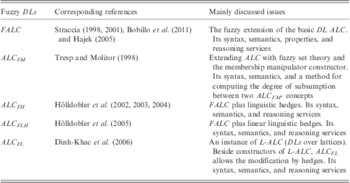
The initial idea combining fuzzy logic and DLs was presented by Yen (Reference Yen1991), where a construct called membership manipulators was introduced, and a structural subsumption algorithm was also provided in order to perform reasoning. A later approach was presented by Tresp and Molitor (Reference Tresp and Molitor1998), and the authors also developed a tableaux calculus for the proposed fuzzy DL called ALCFM (ALC extended with fuzzy set theory and the membership manipulator constructor). More importantly, the fuzzy extension of the basic DL ALC, that is, FALC, was presented by Straccia (Reference Straccia1998), where the concept constructor membership manipulator was also included in the extended language. Furthermore, the complete tableau-based reasoning algorithm for FALC was provided by Straccia (Reference Straccia2001). In particular, although both algorithms by Straccia (Reference Straccia2001) and Tresp and Molitor (Reference Tresp and Molitor1998) are extensions of the usual tableau-based algorithm for ALC, they differ considerably. For example, the algorithm by Tresp and Molitor (Reference Tresp and Molitor1998) introduced numerical variables for the degrees, and produced a linear optimization problem, which must be solved in place of the usual clash test. In contrast, Straccia (Reference Straccia2001) dealt with the membership degrees within his tableau-based algorithm. In addition, other fuzzy extensions of ALC were considered by Hölldobler et al. (Reference Hölldobler, Khang and Störr2002, Reference Hölldobler, Störr and Tran2003), Liu and Chen (Reference Liu and Chen2006), etc.
In general, the family of fuzzy ALC languages can be summarized in Table 1.
The family of FALC languages

DLs = Description Logics.
In the following, we introduce the family of FALC languages, including FALC, ALCFM, ALCFH, ALCFLH, and ALCFL in detail.
3.1.1 The fuzzy Description Logic FALC
The FALC (Straccia, Reference Straccia1998, Reference Straccia2001) is considered as the basic fuzzy DL, thus we introduce its syntax, semantics, KB, and reasoning problems in detail.
Definition 1 (syntax). Let NI, NC, and NR be three disjoint sets: NI is a set of individual names, NC is a set of fuzzy concept names, and NR is a set of fuzzy role names. FALC-concepts are defined as follows (where A ∈ NC, R ∈ NR):
 $$C,D \rightarrow \bot |{\rm{\tf="Arial" T}}|A|\neg C|C \cap D|C \cup D|\exists R.C|\forall R.C$$
Definition 2 (semantics). The semantics of FALC is defined by a fuzzy interpretation FI = 〈ΔFI, •FI〉 where ΔFIis a non-empty set and •FIis a function which maps every d ∈ NI to an element d FI ∈ ΔFI , maps every A ∈ NC into a function A FI: ΔFI → [0, 1], and maps every R ∈ NR into a function R FI: ΔFI × ΔFI → [0, 1]. Furthermore, for any FALC-concepts C and D, R ∈ NR, and d, d′ ∈ ΔFI , we have:
 $$\displaylines{ & {{{\rm{\tf="Arial" T}}}^{FI}} (d) = 1 \cr & {{ \bot }^{FI}} (d) = 0 \cr & {{(\neg C)}^{FI}} (d) = 1\, - \,{{C}^{FI}} (d) \cr & {{(C \cap D)}^{FI}} (d) = \min \{ {{C}^{FI}} (d),{}{{D}^{FI}} (d)\} \cr & {{(C \cup D)}^{FI}} (d) = \max \{ {{C}^{FI}} (d),{}{{D}^{FI}} (d)\} \cr & {{(\forall R.C)}^{FI}} (d) = {{\inf }_{d^{\prime} \in {{{\rm{\rDelta }}}^{FI}} }}\{ \max \{ 1\, - \,{{R}^{FI}} (d,d^{\prime}),{{C}^{FI}} (d^{\prime})\} \} \cr & {{(\exists R.C)}^{FI}} (d) = {{\sup }_{d^{\prime} \in {{{\rm{\rDelta }}}^{FI}} }}\{ \min \{ {{R}^{FI}} (d,d^{\prime}),{{C}^{FI}} (d^{\prime})\} \} \cr}$$
With the introduction of fuzzy sets into the classical ALC, the form of the KB is changed accordingly:
Definition 3 (knowledge base). An FALC knowledge base K is composed of a TBox T and an ABox A:
• A TBox T is a finite set of terminology axioms of the form C ⊆ D or C = D. An interpretation FI satisfies C ⊆ D iff for any d ∈ ΔFI , C FI(d) ⩽ D FI(d), and similarly for C = D. FI is a model of TBox T iff FI satisfies all axioms in T.
• An ABox A is a finite set of assertions of the form〈α ∞ n〉. Here∞ ∈ {>, ⩾, <, ⩽}, n ∈ [0, 1], α is either of the form d: C or (d 1, d 2): R. Especially, in order to give a uniform format of the ABox, we define: when n = 1, the form〈α ⩾ 1〉 is equivalent to〈α = 1〉. Concretely speaking,〈d: C ⩾ 1〉 means that d is determinately an individual of C; 〈(d 1, d 2): R ⩾ 1〉 means that (d 1, d 2) determinately has the relationship R. An interpretation FI satisfies〈d: C ∞ n〉 iff C FI(d FI) ∞ n and satisfies 〈(d 1, d 2): R ∞ n〉 iff R FI(d 1FI, d 2FI) ∞ n. FI is a model of ABox A iff FI satisfies all assertions in A.
• A fuzzy interpretation FI satisfies a knowledge base K if it satisfies all axioms and assertions in K.
Now, we introduce the reasoning problems of FALC, including satisfiability, subsumption, consistency, entailment, and so on.
Definition 4 (reasoning problems). An FALC knowledge base K is satisfiable iff there exists a fuzzy interpretation FI, which satisfies all axioms and assertions in K. An FALC-concept C is satisfiable w.r.t. a Tbox T iff there exists some model FI of T for which there is some d ∈ ΔFIsuch that C FI(d) = n, and n ∈ (0, 1]. Let C and D be two FALC-concepts, we say that C is subsumed by D w.r.t. T if for every model FI of T it holds that, ∀d ∈ ΔFI , C FI(d) ⩽ D FI(d). An FALC Abox A is consistent w.r.t. T if there is a model FI of T, which is also a model of A. Furthermore, given an axiom or assertion ψ, an FALC knowledge base K entails ψ, written K |= ψ, iff all models of K also satisfy ψ. Moreover, given an FALC knowledge base K and a fuzzy assertion α, the greatest lower bound of α w.r.t. K is glb(K, α) = sup{n : K |= α ⩾ n}, where supØ = 0.
The problem of concept satisfiability can be reduced to the problem of ABox consistency, and the problems of subsumption and entailment can be reduced to the problem of KB satisfiability (Straccia, Reference Straccia2001; Stoilos et al., Reference Stoilos, Stamou, Pan, Tzouvaras and Horrocks2007). Furthermore, in the presence of only simple TBoxes (A Tbox T is called simple if it neither includes cyclic nor General Concept Inclusions (GCIs), that is, axioms are the form A ⊆ C or A ≡ C, where A is a concept name that is never defined by itself either directly or indirectly, and A appears at most once at the left hand side.) (Baader et al., Reference Baader, Calvanese and McGuinness2003; Stoilos et al., Reference Stoilos, Stamou, Pan, Tzouvaras and Horrocks2007), all the problems above can be reduced to ABox consistency w.r.t. an empty TBox. The reasoning algorithm and its decidability for FALC have been introduced in detail (Straccia, Reference Straccia2001; Bobillo et al., Reference Bobillo, Bou and Straccia2011). Moreover, Hajek (Reference Hajek2005) studied the problems of satisfiability, validity, and subsumption of FALC-concepts. Haarslev et al. (Reference Haarslev, Pai and Shiri2006) introduced a generic framework, which allows representing several existing extensions of DLs with uncertainty in a uniformed manner, and used FALC as an example to illustrate how it can represent uncertainty and reasoning services in the frameworks considered.
3.1.2 The fuzzy Description Logic ALCFM
In Tresp and Molitor (Reference Tresp and Molitor1998), an extension of ALC to many-valued logics called ALCFM was proposed, where the construct called membership manipulators (Yen, Reference Yen1991) also appeared, which are applied to concepts. Examples of manipulators could be ‘mostly’, ‘more or less’, or ‘very’. For example, if Tall is a concept (standing for the fuzzy set of all tall persons), then VeryTall, which is obtained by applying the manipulator Very to the concept Tall, is a new concept (standing for the fuzzy set of all very tall persons). Intuitively, the manipulators modify the membership degree functions of the concepts. In our example, the membership function for VeryTall should have its largest values at larger heights than the membership function for Tall. Formally, the semantics of manipulators is defined by a function that maps membership degree functions to membership degree functions (Tresp & Molitor, Reference Tresp and Molitor1998).
Now, let us consider what kind of inference problems are of interest in this context (i.e., Yen, Reference Yen1991; Tresp & Molitor, Reference Tresp and Molitor1998). Yen (Reference Yen1991) considered crisp subsumption of fuzzy concepts, that is, given two concepts C, D defined in the fuzzy DL, the author was interested in the question whether C FI(d) ⩽ D FI(d) for all fuzzy interpretations FI and d ∈ ΔFI. Thus, the subsumption relationship itself is not fuzzified. To this end, the author described a structural subsumption algorithm for a rather small fuzzy DL, which is almost identical to the subsumption algorithm for the corresponding classical DL. In contrast, Tresp and Molitor (Reference Tresp and Molitor1998) were interested in determining fuzzy subsumption between fuzzy concepts, that is, given concepts C, D, they want to know to which degree C is a subset of D. The complete reasoning algorithms can be found by Tresp and Molitor (Reference Tresp and Molitor1998) and Yen (Reference Yen1991), respectively.
3.1.3 The fuzzy Description Logics with hedges
The fuzzy extensions of ALC language were also considered in other approaches (Hölldobler et al., Reference Hölldobler, Khang and Störr2002, Reference Hölldobler, Störr and Tran2003, Reference Hölldobler, Störr and Khang2004, Reference Hölldobler, Nga and Khang2005), where a concept constructor hedges (an algebraic approach to structures of sets of linguistic domains of linguistic truth variables (Cat Ho & Wechler, Reference Cat Ho and Wechler1990)) were included in the extended languages. The fuzzy DLs ALCFH (Hölldobler et al., Reference Hölldobler, Khang and Störr2002, Reference Hölldobler, Störr and Tran2003, Reference Hölldobler, Störr and Khang2004) and ALCFLH (Hölldobler et al., Reference Hölldobler, Nga and Khang2005) were presented, respectively, where primitive concepts were modified by means of hedges. ALCFH and ALCFLH are strictly more expressive than FALC defined by Straccia (Reference Straccia1998). Moreover, the authors showed that a linearly ordered set of hedges primitive concepts can be modified to any desired degree by prefixing them with appropriate chains of hedges. The authors also defined the decision procedures for the unsatisfiability problems in ALCFH and ALCFLH, and discussed truth bounds, expressivity as well as complexity issues.
In addition, in Dinh-Khac et al. (Reference Dinh-Khac, Hölldobler and Tran2006), a fuzzy linguistic DL called ALCFL was proposed, which is an instance of L-ALC (DLs over lattices (Straccia, Reference Straccia2006d)). Beside constructors of L-ALC, ALCFL allows the modification by hedges. Furthermore, the ambiguity of the hedge application in ALCFH and ALCFLH is solved in ALCFL. In all these approaches, above tableaux decision procedures were presented for performing reasoning services.
In summary, the fuzzy extension to ALC can be used as a basis both for extending existing DL-based systems and for further research. In the latter case, there are several open points. For instance, it is not clear yet how to reason both in the case of fuzzy specialization of the general form C ⊆ D and in the case that cycles are allowed in a fuzzy KB. Another interesting topic for further research concerns the semantics of fuzzy connectives. While for a huge number of proposals given in the literature their impact from a semantics point of view is well understood, the question how they impact from a computational complexity and algorithms point of view remains still open. For example, Meghini et al. (Reference Meghini, Sebastiani and Straccia1997) proposed a preliminary fuzzy DL, which lacks reasoning algorithm, as a modeling tool for multimedia document retrieval.
3.2 The more expressive fuzzy Description Logics
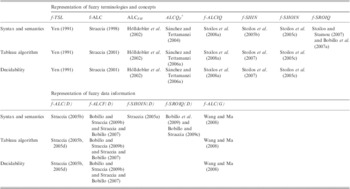
In the following statements, we survey several more expressive fuzzy DLs according to the concept constructors or role restrictions that have been constrained on them, such as extending fuzzy DLs with number restrictions, inverse/transitive roles, fuzzy data type, fuzzy cut sets, and so on (see Table 2 in Section 3.2.4).
Some existing fuzzy DLs from weaker to stronger in expressive power

DLs = Description Logics.
3.2.1 Fuzzy Description Logics with number restrictions
The number restrictions include the unqualified number restrictions N and qualified number restrictions Q. Currently, there have been several approaches for extending fuzzy ALC with number restrictions. In Li et al. (Reference Li, Xu, Lu, Kang and Wang2005c), a fuzzy DL called f-ALCN was presented, and the authors provided reasoning for f-ALCN by using the idea of the reduction in order to annotate the concepts and roles of the crisp DL ALCN. Moreover, in Lu et al. (Reference Lu, Xu, Li, Kang and Wang2005), an extended fuzzy ALCN and designed tableau algorithms for that were given. In addition, in Zhao et al. (Reference Zhao, Boley and Du2009), a fuzzy DL named fuzzy ALCHIN and an algorithm for consistency checking of KBs in the proposed language were proposed.
Approach toward more expressive DL was presented by Sánchez and Tettamanzi (Reference Sánchez and Tettamanzi2004), where the DL is called ALCQF +. It includes fuzzy quantifiers, which allows for the definition of fuzzy quantifiers of the absolute and relative kind by means of piecewise linear functions on N and Q ∩ [0, 1], respectively, is a new novel idea for fuzzy DLs. Furthermore, in Sánchez and Tettamanzi (Reference Sánchez and Tettamanzi2006), the same authors introduced the reasoning procedures for ALCQF +, where in order to reason about instances, the semantics of quantified expressions are defined based on recently developed measures of the cardinality of fuzzy sets. Moreover, a procedure was described to calculate the fuzzy satisfiability of a fuzzy assertion, which is a very important reasoning task. Besides, the procedure also considers several different cases and provides direct solutions for the most frequent types of fuzzy assertions. In addition, Sánchez and Tettamanzi (Reference Sánchez and Tettamanzi2006) defined independence of fuzzy assertions and obtained some results that speed up the calculation of fuzzy satisfiability in some (the most common) cases. More recently, Stoilos et al. (Reference Stoilos, Stamou and Kollias2008a) investigated on the problem of reasoning with qualified cardinality restrictions in fuzzy DLs, extending previous results on simple number restrictions, and thus presented a tableaux algorithm for the fuzzy DL f-ALCIQ. The other efforts for extending fuzzy DLs with number restrictions (such as fKD-SHIN and fuzzy SHOIQ) can be found in Section 3.2.3.
The extensions with fuzzy quantifiers greatly increase the expressive power of DLs, but make reasoning hard. As a solution, Dragoni and Tettamanzi (Reference Dragoni and Tettamanzi2007) propose to use non-exact evolutionary algorithms to solve concept satisfiability. In fact, not just the reasoning, the semantics of qualified number restrictions is still open to discussion, as pointed by Bobillo and Straccia (Reference Bobillo and Straccia2008a), where a new semantics is also introduced.
3.2.2 The more expressive fuzzy Description Logics with inverse roles/transitive roles/nominals
The fuzzy DL FALC and its some extensions above can effectively express fuzzy knowledge, but they provide limited representation and reasoning ability. For example, they only contain some simple operators, such as conjunction, intersection, negation, value restriction, and existential quantification, which cannot represent and reason on more complex fuzzy knowledge (e.g., the inverse of roles and the transitive roles). Therefore, some scholars have carried out researches on more expressive fuzzy DLs, such as fKD-SI (Stoilos et al., Reference Stoilos, Stamou and Tzouvaras2005a), fKD-SHIN (Stoilos et al., Reference Stoilos, Stamou and Tzouvaras2005b), f-SHOIN (Stoilos et al., Reference Stoilos, Stamou and Tzouvaras2005c), f-SHOIQ (Stoilos et al., Reference Stoilos, Stamou and Pan2006a), and f-SROIQ (Stoilos & Stamou, Reference Stoilos and Stamou2007) as follows.
In order to represent and reason on more complex fuzzy knowledge, two very expressive fuzzy DLs fKD-SI and fKD-SHIN were presented. Stoilos et al. (Reference Stoilos, Stamou and Tzouvaras2005a) proposed the fuzzy DL fKD-SI by extending the DL language SI with fuzzy set theory. The combination of transitive and inverse roles can capture knowledge about part-whole relationships and aggregated objects. Both these properties fit well into the framework of knowledge-based multimedia processing where both part-whole relationships, as well as, imprecise and vague knowledge appear in applications like multimedia information retrieval and processing. In more detail, Stoilos and Stamou (Reference Stoilos and Stamou2009) investigated the reasoning problems for fuzzy SI (f-SI) under arbitrary continuous fuzzy operators, and proved decidability of the fuzzy DLs, such as fL-SI, fP-SI. Furthermore, Stoilos et al. (Reference Stoilos, Stamou and Tzouvaras2005b) provided an extension of the above fKD-SI to an even more expressive fuzzy DL, namely fKD-SHIN, which is also the extension of fuzzy ALC with transitive role axioms (S), inverse roles (I), role hierarchies (H), and number restrictions (N). More importantly, Stoilos et al. (Reference Stoilos, Stamou, Pan, Tzouvaras and Horrocks2007) showed the semantics as well as sound, complete and terminating reasoning algorithms for both of the extended languages fKD-SI and fKD-SHIN, where the authors also investigated the applicability of blocking strategies, like dynamic blocking and pair-wise blocking. Moreover, in Gu et al. (Reference Gu, Lv, Gao and Shi2007), a fuzzy DL called ef-SHIN was introduced to support reasoning of fuzzy ontology.
In particular, the RBox will be added into the fKD-SHIN KB, that is, an fKD-SHIN KB consists of a TBox, an ABox, and an RBox, where the TBox and ABox have been introduced in Section 3.1.1. An fKD-SHIN RBox is a finite set of fuzzy transitive role axioms of the form Trans(R) and fuzzy role inclusion axioms of the form R ⊆ S, where R, S are fKD-SHIN-roles. A fuzzy interpretation FI satisfies Trans(R) if ∀x, z ∈ ΔFI, R FI(x, z) ⩾ supy ∈ΔFI {min(R FI(x, y), R FI(y, z))}, while it satisfies R ⊆ S if ∀x, z ∈ ΔFI, R FI(x, z) ⩽ S FI(x, z). A fuzzy interpretation FI satisfies an fKD-SHIN RBox iff it satisfies all fuzzy axioms in the RBox; in this case, we say that FI is a model of this RBox.
Moreover, a fuzzy extension of the corresponding DL of the ontology description language OWL DL, called f-SHOIN(D), was developed by Straccia (Reference Straccia2005a, Reference Straccia2006a), while no reasoning algorithms were given. Furthermore, in order to provide reasoning for fuzzy OWL web ontology language, in Stoilos et al. (Reference Stoilos, Stamou and Tzouvaras2005c, Reference Stoilos, Stamou and Pan2010), the authors considered the DL f-SHOIN by discarding data types D constructor. The authors gave the syntax, semantics, and a tableau procedure for f-SHOIN, and also presented a reduction technique from fuzzy OWL to f-SHOIN to provide reasoning support for fuzzy OWL ontologies. In addition, Bobillo et al. (Reference Bobillo, Delgado and Gómez-Romero2006) presented a sound fuzzy extension of SHOIN including fuzzy nominals and fuzzy GCIs, and also presented a reasoning preserving procedure to reduce an f-SHOIN KB into a crisp one.
In addition, in Stoilos et al. (Reference Stoilos, Stamou and Pan2006a), the syntax and semantics of fuzzy SHOIQ were presented and the properties of the semantics of transitivity, qualified cardinality restrictions, and reasoning capabilities were investigated. Furthermore, Stoilos and Stamou (Reference Stoilos and Stamou2007) extended the current state-of-the-art on fuzzy extensions to Semantic Web languages by presenting the syntax and semantics of the fuzzy SROIQ as well as the abstract, XML syntax, and semantics of a fuzzy extension to OWL 1.1. Moreover, the authors also provided reasoning support for a fuzzy version of fuzzy SROIQ by extending well-known reduction techniques of fuzzy DLs to classical DLs for the additional axioms and constructors of fuzzy SROIQ.
3.2.3 Fuzzy Description Logics with fuzzy data type
In order that fuzzy DLs can represent and reason on the concrete knowledge in the real-world applications, several fuzzy DLs with fuzzy concrete domains (D) and fuzzy data type group (G) have been proposed as follows.
The Semantic Web is expected to process knowledge information and data information in an intelligent and automatic way. But recent research has shown that the OWL ontology language is very limited in representing fuzzy data information. To this end, Straccia (Reference Straccia2005b, Reference Straccia2005c, Reference Straccia2005d) proposed a fuzzy DL called fuzzy ALC(D) (ALC extended with concrete domains), where the representation of concept membership functions and fuzzy modifiers are allowed, together with an inference procedure based on a mixture of a tableaux and bounded mixed integer programming. A reasoning algorithm for fuzzy ALCF(D) with GCIs and explicit membership functions was proposed by Bobillo and Straccia (Reference Bobillo and Straccia2009b, Reference Bobillo and Straccia2009d), Bobillo and Straccia (Reference Bobillo and Straccia2007), and Straccia and Bobillo (Reference Straccia and Bobillo2007).
The more expressive DL, which can support fuzzy concrete domains was shown by Straccia (Reference Straccia2005a), where the language is the fuzzy extension of SHOIN(D), which is the corresponding DL of the ontology description language OWL DL. It shows that the representation and reasoning capabilities of fuzzy SHOIN(D) go clearly beyond classical SHOIN(D). The following interesting features are considered in fuzzy SHOIN(D): (i) concrete domains are fuzzy sets; (ii) fuzzy modifiers are allowed; and (iii) entailment and subsumption relationships may hold to some degree in the unit interval [0, 1]. A fuzzy concrete domain D is a pair 〈ΔD, φD〉, where ΔD is an interpretation domain and φD is the set of fuzzy domain predicates d with a predefined arity n and an interpretation d D: ΔD n → [0, 1]. Furthermore, a fuzzy interpretation FI with respect to a fuzzy concrete domain D is a pair FI = (ΔFI, FI) consisting of a non-empty set ΔFI (called the domain), disjoint from ΔD, and of a fuzzy interpretation function FI that assigns each concrete individual to an element in ΔD; assigns each abstract individual to an element in ΔFI; assigns each abstract concept C to a function C FI: ΔFI → [0, 1]; assigns each abstract role R to a function R FI: ΔFI × ΔFI → [0, 1]; assigns each data type role T to a function T FI: ΔFI × ΔD → [0, 1]; assigns each n-ary predicate p to the fuzzy relation p D: ΔD n → [0, 1], which means the relationship of data types v 1,…,vn satisfies predicate p in a degree in [0, 1]. The detail reviews about fuzzy SHOIN(D) can be found in Lukasiewicz and Straccia (Reference Lukasiewicz and Straccia2008) and Straccia (Reference Straccia2005a).
Moreover, in Bobillo et al. (Reference Bobillo, Delgado and Gómez-Romero2009), Bobillo and Straccia (Reference Bobillo and Straccia2009c), and Bobillo (Reference Bobillo2008), the authors proposed the fuzzy extension of OWL 2 language, that is, fuzzy SROIQ(D), and also presented a reasoning preserving procedure to obtain a crisp representation for the fuzzy SROIQ(D). Based on the presentation of fuzzy DLs with fuzzy concrete domain, the fuzzy data information in the Semantic Web can be represented.
Furthermore, in order to support fuzzy customized data type information, a new kind of fuzzy DL called F-ALC(G) was proposed by Wang and Ma (Reference Wang and Ma2008), which can not only support the representation and reasoning of fuzzy concept knowledge, but also support fuzzy data information with customized fuzzy data types and customized fuzzy data type predicates.
3.2.4 The other fuzzy Description Logics with cut sets/fuzzy rough sets/fuzzy truth values
In the real-world applications, one wants to express using ∀R 0.9.C 0.6 the set of individuals that are related with degree 0.9 using role R with some individual that belongs to concept C with degree at least 0.6, that is, the fuzzy DLs allow for the cut sets of fuzzy concepts/roles.
To this end, by introducing the cut sets of fuzzy concepts and fuzzy roles as atomic concepts and atomic roles, and inheriting the concept and role constructors from DLs, Lu et al. (Reference Lu, Xu, Li and Kang2006) and Li et al. (Reference Li, Xu, Lu, Kang and Wang2005a) proposed a family of the so-called extended fuzzy DLs (EFDLs), which use α-cuts as atomic concept and roles. The definitions of syntax, semantics, reasoning tasks, and reasoning properties are given for EFDLs. In particular, EFDLs and FALC (Straccia, Reference Straccia1998) are fuzzy DLs with same concept constructors and different fuzzily methods, and the former supports more powerful presentation of fuzzy concepts. Furthermore, Lu et al. (Reference Lu, Li, Zhou and Kang2008a) presented sound and complete tableau algorithms for EFDLs, and proved the complexity is PSPACE-complete. Subsequently, based on the cut sets, several works also proposed different extension of DLs and reasoning algorithms for fuzzy ALCH (Kang et al., Reference Kang, Lu, Xu, Li and He2005; Li et al., Reference Li, Lu, Xu, Kang and Jiang2005b), fuzzy ALCN (Li et al., Reference Li, Xu, Lu, Kang and Wang2005c).
Furthermore, in order that the fuzzy DLs can support the expression of comparisons between fuzzy membership degrees, for example, it is a familiar description that ‘John is taller than Tom’, which can be seemed as a comparison between two fuzzy membership degrees, it is necessary to extend fuzzy DLs with the ability of expressing comparison expressions. Toward this goal, in Lu et al. (Reference Lu, Kang, Zhang, Li and Zhou2008b), the authors EFDLs with the fuzzy comparison cuts, and the extended language was called FCDLs. Also, the syntax, semantics, and reasoning algorithms for FCDLs were provided in detail.
Moreover, Bobillo and Straccia (Reference Bobillo and Straccia2009a) and Jiang et al. (Reference Jiang, Tang, Wang and Tang2009a, Reference Jiang, Wang, Deng and Tang2009b, Reference Jiang, Wang, Tang and Xiao2009c) provided a simple solution to join fuzzy DLs and rough DLs, and studied how to combine fuzzy DLs with fuzzy rough sets, that is, fuzzy rough DLs. In particular, Bobillo and Straccia (Reference Bobillo and Straccia2009a) presented a very expressive fuzzy rough extension of the DL SROIQ(D), the logic behind the language OWL 2. In addition, Bobillo and Straccia (Reference Bobillo and Straccia2009e) allowed fuzzy DL sentences to be qualified with fuzzy truth values, and, thus, allow expressions such as ‘Tina is young is very true’ and ‘Tina is young is almost true’. The syntax, semantics, and reasoning algorithms for the extended languages were provided.
According to the statements above, some important existing fuzzy DLs can be summarized in Table 2. Notice that, however, it does not mean that Table 2 covers all publications in the research area and gives complete descriptions.
3.3 The tractable fuzzy Description Logics
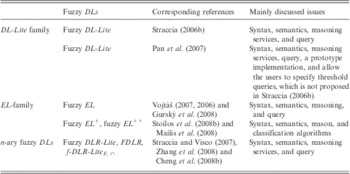
In the area of DLs, another family of DLs cannot be ignored, that is, the tractable DLs, which are rich enough to capture significant ontology languages but keeping low complexity of reasoning. Some existing tractable fuzzy DLs can be summarized in Table 3.
The tractable fuzzy D Ls

DLs = Description Logics.
The first kind of tractable DLs is DL-Lite family, which has the low complexity of reasoning, has received much attention in recent years. The detailed introduction about the DL-Lite family can be found in Calvanese et al. (Reference Calvanese, De Giacomo and Lembo2007). In order that the DLs of the DL-Lite family can handle the imprecise and uncertain information, fuzzy extensions to these DLs have started to receive attention. A fuzzy extension of DL-Lite called fuzzy DL-Lite was proposed by Straccia (Reference Straccia2006b), where the syntax and semantics of fuzzy DL-Lite were defined, and the author also showed how to compute efficiently the top-k answers of a complex query over a huge set of instances in fuzzy DL-Lite. Furthermore, based on Straccia (Reference Straccia2006b), Pan et al. (Reference Pan, Stamou, Stoilos and Thomas2007) proposed two new expressive query languages accompanied with query answering algorithms over fuzzy DL-Lite, and also developed a prototype implementation for querying fuzzy DL-Lite ontologies.
Moreover, as mentioned in Section 2.1, DLs that allow for intersection of concepts and existential quantification (but not value restriction) are collected in the EL-family, which can also be considered as the tractable DLs. Some fuzzy extensions to the EL-family languages are presented; Vojtáš (Reference Vojtáš2006, Reference Vojtáš2007) presented a fuzzy extension of EL called fuzzy EL, and also reduced fuzzy EL to crisp EL for providing reasoning for the fuzzy EL. Gurský et al. (Reference Gurský, Horváth, Jirásek, Novotný, Pribolová, Vaneková and Vojtáš2008) also presented the model-theoretic semantics for fuzzy EL, which is the motivation of creating a model for fuzzy RDF. Furthermore, the fuzzy extensions of EL + and EL ++ were investigated by Stoilos et al. (Reference Stoilos, Stamou and Pan2008b) and Mailis et al. (Reference Mailis, Stoilos, Simou and Stamou2008), respectively. In Mailis et al. (Reference Mailis, Stoilos, Simou and Stamou2008), the authors provided the syntax and semantics together with a reasoning algorithm for the fuzzy concept subsumption problem of fuzzy EL ++.
In addition, in order to model relationships among more than two objects in some real world situations, various extensions of DLs with relations of arbitrary arity (such as DLR, DLRifd, and so on) have been proposed by Calvanese et al. (Reference Calvanese, De Giacomo and Lenzerini1997, Reference Calvanese, De Giacomo and Lenzerini1998, Reference Calvanese, De Giacomo and Lenzerini1999). On this basis, a fuzzy extension of DL DLR-Lite called f-DLR-Lite was introduced by Straccia and Visco (Reference Straccia and Visco2007), where an ontology-mediated multimedia information retrieval system based on f-DLR-Lite was developed. A fuzzy extension of DLR called FDLR was proposed by Zhang et al. (Reference Zhang, Ma and Yan2008) for representing and reasoning on fuzzy ER models, while reasoning algorithms for FDLR was missed. Moreover, a fuzzy DL called f-DLR-LiteF , ∩ was proposed by Cheng et al. (Reference Cheng, Ma, Yan and Wang2008b), where the fuzzy DL allows for the presence of n-ary relations and the occurrence of concept conjunction on the left land of inclusion axioms.
4 Reasoning and querying of fuzzy Description Logics
Reasoning and querying are the most important research lines in the area of DLs. The knowledge representation systems based on DLs provide their users with various reasoning capabilities and querying services. The former can deduce implicit knowledge from the explicitly represented knowledge, such as computing subsumption and checking satisfiability; and the latter can access and query the KBs, such as instance retrieval, realization, instantiation, and conjunctive query answering. In fact, both of them are not independent as mentioned by Calvanese et al. (Reference Calvanese, De Giacomo and Lembo2007). In the following, we will introduce the reasoning and querying of fuzzy DLs, respectively.
4.1 Reasoning on fuzzy Description Logics
One of the most important advantages of DLs is their reasoning ability. Therefore, for a fuzzy DL, how to give its reasoning algorithm and implement its corresponding reasoner have become the important tasks for researchers. The following will introduce the existing fuzzy DL reasoning techniques and fuzzy DL reasoners in detail.
4.1.1 Reasoning techniques for fuzzy Description Logics
So far, kinds of reasoning techniques for different fuzzy DLs have been proposed. Moreover, the reasoning complexity of some fuzzy DLs was investigated by Bonatti and Tettamanzi (Reference Bonatti and Tettamanzi2005) and the optimization techniques for fuzzy DLs were discussed by Simou et al. (Reference Simou, Mailis, Stoilos and Stamou2010). In general, the reasoning techniques can be summarized in three categories: tableau-based reasoning technique, reasoning technique for GCIs, and reduction to crisp DLs.
Besides, Keller and Heymans (Reference Keller and Heymans2008) introduced a new class of inference procedures into fuzzy DLs reasoning, that is, the fixpoint-based decision procedure for deciding knowledge-based satisfiability in the fuzzy DL FALC.
4.1.1.1 The tableau-based reasoning technique
Most of the existing reasoning algorithms for fuzzy DLs (e.g., Straccia, Reference Straccia2001, Reference Straccia2005b; Li et al., Reference Li, Xu, Lu, Kang and Wang2005c, Reference Li, Xu, Lu and Kang2006a; Sánchez & Tettamanzi, Reference Sánchez and Tettamanzi2006; Stoilos et al., Reference Stoilos, Stamou and Kollias2008a, Reference Stoilos, Stamou and Tzouvaras2005a, Reference Stoilos, Stamou, Pan, Tzouvaras and Horrocks2007; Wang & Ma, Reference Wang and Ma2008) are tableau-based algorithms as mentioned in Section 3, which have turned out to be very useful comparing with the early structural subsumption algorithms (Baader et al., Reference Baader, Calvanese and McGuinness2003). Here, we will not introduce the detailed procedures of tableau-based algorithms, please refer to Baader et al. (Reference Baader, Calvanese and McGuinness2003), Straccia (Reference Straccia2001), Stoilos et al. (Reference Stoilos, Stamou, Pan, Tzouvaras and Horrocks2007), etc.
Moreover, most of the tableau-based algorithms are given with respect to the simple Tbox (Stoilos et al., Reference Stoilos, Stamou, Pan, Tzouvaras and Horrocks2007). A Tbox T is called simple if it neither includes cyclic nor GCIs, that is, axioms are the form A ⊆ C or A ≡ C, where A is a concept name that is never defined by itself either directly or indirectly, and A appears at most once at the left hand side. Reasoning on fuzzy DLs with a simple Tbox can be transformed into reasoning on fuzzy DLs with an empty Tbox by a transformation called unfolding, or expansion (Nebel, Reference Nebel1990): Concept inclusion introductions A ⊆ C can be replaced by concept equivalence introductions A ≡ A′ ∩ C, where A′ is a new concept name, which stands for the qualities that distinguish the elements of A from the other elements of C. Subsequently, if C is a complex concept expression, which is defined in terms of concept names, defined in the Tbox, we replace their definitions in C. The detailed introduction about the expansion technique can be found in the works of Baader et al. (Reference Baader, Calvanese and McGuinness2003), Straccia (Reference Straccia2001), and Stoilos et al. (Reference Stoilos, Stamou, Pan, Tzouvaras and Horrocks2007).
4.1.1.2 The reasoning technique for General Concept Inclusions in fuzzy Description Logics
The GCIs (i.e., the Tbox in a fuzzy DL KB is a set of GCI axioms of the form C ⊆ D, where C and D are arbitrary concepts) are an important feature of DLs, for example, GCIs are necessary to represent domain and range constraints. The procedures to deal with GCIs, in the context of fuzzy DLs, have been recently developed. Some discussions about how to reason on f-ALCH with GCIs and how to provide a tableau for FALC with GCIs were given by Straccia (Reference Straccia2004a) and Stoilos et al. (Reference Stoilos, Straccia and Stamou2006b), respectively. In particular, Stoilos et al. (Reference Stoilos, Straccia and Stamou2006b) pointed out that a major theoretical and computational limitation so far is the inability to deal with GCIs, and the authors also addressed this issue and developed a calculus for fuzzy DLs with GCIs. Moreover, the other approaches for reasoning with respect to simple and acyclic Tboxes were considered, for example, Li et al. (Reference Li, Xu, Lu and Kang2006a) extended the fuzzy tableau of f-SHI (Stoilos et al., Reference Stoilos, Stamou and Tzouvaras2005b) with an additional rule to handle with general and cyclic Tboxes in the language f-SHI. Interestingly, the technique used by Stoilos et al. (Reference Stoilos, Straccia and Stamou2006b) is different from that presented by Li et al. (Reference Li, Xu, Lu and Kang2006a).
4.1.1.3 The reasoning technique of reducing to crisp Description Logics
To reason on fuzzy DLs, several approaches for reducing fuzzy DLs to classical DLs have been developed, so that reasoning on a fuzzy DL KB can be performed by using existing DL systems.
The first effort in this direction was presented by Straccia (Reference Straccia2004a), where the authors presented a technique for reasoning on an f-ALCH KB by reduced f-ALCH to crisp ALCH. Li et al. (Reference Li, Xu, Lu, Kang and Wang2005c, Reference Li, Xu, Lu and Kang2006b) also provided reasoning for fuzzy DLs f-ALCN and f-ALCQ using the idea of the reduction. Moreover, Bobillo et al. (Reference Bobillo, Delgado and Gómez-Romero2006) proposed a technique to be able to reduce an f-SHOIN KB to a crisp SHOIN KB. Vojtáš (Reference Vojtáš2007) also used the idea of the reduction to reduce fuzzy EL to crisp EL in order to provide reasoning for fuzzy EL. In addition, Bobillo et al. (Reference Bobillo, Delgado and Gómez-Romero2007a) and Stoilos and Stamou (Reference Stoilos and Stamou2007) provided reasoning support for fuzzy SROIQ by extending well-known reduction techniques of fuzzy DLs to classical DLs. Overall, by reducing fuzzy DLs to crisp DLs, reasoning in a fuzzy DL KB can be performed by using existing and optimized DL systems.
4.1.2 Fuzzy Description Logic reasoners
DLs serve as the theoretical counterpart of the Semantic Web and provide reasoning supports for it, and the DL reasoners are the basic supporting bodies for the Semantic Web coming into use. Therefore, in order to implement the automatic reasoning of fuzzy DLs, kinds of reasoners based on different fuzzy DLs have been put forward as will be introduced in the following.
In recent years, a series of reasoners, such as FaCT, RACER, and Pellet (Baader et al., Reference Baader, Calvanese and McGuinness2003), have been developed based on the classic DLs. These reasoners are very efficient and soundness for ontology reasoning. Pellet, for example, is an OWL-DL reasoner with good performance, extensive middleware, and a number of unique features. Also there are some other reasoners such as Jess, Jena, KOAN2, Cerebra, cwm, Euler, surnia, SWI, E-wallet, MSPASS (OWL Implementations, 2001), which are based on classic DLs and toward OWL. Most of classical reasoners mentioned above have been updated for several versions and have good reliability, robustness, and running efficiency. Some versions of them have been commercialized.
However, these classical reasoners cannot support the representation and reasoning of fuzzy ontologies and fuzzy DLs. With the extensive and in-depth application of intelligent systems, the processing of fuzzy, and uncertain information in the real world is becoming an essential part of intelligent systems (Straccia, Reference Straccia2001; Stoilos et al., Reference Stoilos, Stamou, Pan, Tzouvaras and Horrocks2006c, Reference Stoilos, Simous, Stamou and Kollias2007; Cimianoet et al., Reference Cimiano, Haase, Ji, Mailis, Stamou, Stoilos, Tran and Tzouvaras2008; Lukasiewicz & Straccia, Reference Lukasiewicz and Straccia2008). It is imperative to develop fuzzy reasoners, which can process fuzzy ontologies and fuzzy DLs.
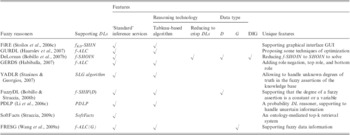
Table 4 lists the existing fuzzy reasoners that can support the processing of fuzzy and uncertain information. In Table 4, PDLP (Li et al., Reference Li, Liu, Tao, Zhang, Zhou and Yu2006c) is a reasoner based on the probability DL for dealing with uncertain information, while the rest are used to deal with fuzzy information based on fuzzy DLs.
The comparisons of the current fuzzy and probabilistic DL reasoners

DLs = Description Logics.
In summary, for the implementation of fuzzy reasoners, there are two strategies: one is to translate the fuzzy DL into the classic DL and then call the classic DL reasoner for reasoning, for example, DeLorean in Table 4 and the reasoning technology mentioned by Straccia (Reference Straccia2004a). Another strategy is to directly implement fuzzy reasoners based on the tableau algorithm of the corresponding fuzzy DL, for example, the reasoners in Table 4 except for DeLorean and SoftFacts. The latter strategy has the advantage that the optimized technology can be adopted according to the specific fuzzy DL, and their efficiency in the implementation can be enhanced.
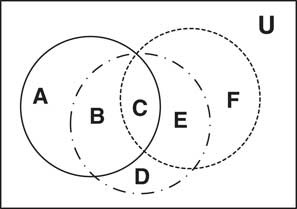
Through comparison of the reasoners in Table 4, it can be found that these reasoners can support the particular fuzzy DL. The existing reasoners in Table 4 can support the representation and reasoning of fuzzy concept knowledge, fuzzy concrete domain, or fuzzy customized data type and predicates. The relationships of the reasoning capacity among parts of these fuzzy reasoners are shown in Figure 1. In Figure 1, U means human knowledge. The dotted circle, solid circle, and dotted and solid circles in Figure 1 denote FRESG reasoner and two fuzzy reasoners 1 and 2, respectively.
The relationships among existing fuzzy Description Logic reasoners

In Figure 1, C stands for f-ALC that all fuzzy reasoners can support; E stands for the DLs that support fuzzy concrete domain D, such as FuzzyDL in Table 4; F stands for the DLs that support fuzzy customized data type and fuzzy customized data type predicates G, such as FRESG in Table 4; B stands for the remaining part with the same reasoning abilities of reasoner 1 and reasoner 2 in addition to f-ALC; A and D stands for the unique part of reasoner 1 and 2 in reasoning capacity, respectively.
4.2 Querying over fuzzy Description Logics
With the emergence of a good number of large-scale domain ontologies or KBs, it is of particular importance to provide users with querying services. Therefore, querying over DLs from DL-Lite family to more expressive DLs, such as SHOQ and SHIQ, are extensively investigated (Cheng et al., Reference Cheng, Ma, Zhang and Wang2009b).
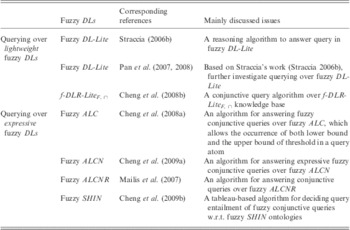
In the real world, however, there exists a great deal of uncertainty and imprecision. Thus, how to query over fuzzy DLs has started to receive much attention. A major problem fuzzy DLs have to face with is that, unlike classical DLs, where an answer to a query is a set of tuples ranked according to the degree they satisfy the query. This poses a new challenge in case the researchers have to deal with a huge amount of instances. The research on querying over fuzzy DLs can be summarized in Table 5.
Querying over fuzzy DLs

DLs = Description Logics.
To query over fuzzy DLs, some work focusing on lightweight fuzzy DL languages has been done. Straccia (Reference Straccia2006b) first presented a fuzzy DL called fuzzy DL-Lite by extending DL-Lite with fuzzy set theory, and investigated how to compute efficiently the top-k answers of a complex query (i.e., conjunctive queries) over a huge set of instances in fuzzy DL-Lite. However, conjunctive query answering in fuzzy DL-Lite is quite similar to query answering in crisp DL-Lite. Furthermore, following Straccia's work (Straccia, Reference Straccia2006b), Pan et al. (Reference Pan, Stamou, Stoilos and Thomas2007, Reference Pan, Stamou, Stoilos, Taylor and Thomas2008) proposed two new expressive query languages accompanied with query answering algorithms over fuzzy DL-Lite, where the authors allowed the users to specify threshold queries, which are not presented by Straccia (Reference Straccia2006b), and also presented a prototype implementation for querying fuzzy DL-Lite ontologies. In Cheng et al. (Reference Cheng, Ma, Yan and Wang2008b), a conjunctive query algorithm over f-DLR-LiteF , ∩KB was proposed, and the authors showed that the query answering algorithm over the extended DL is still FOL reducible and shows polynomial data complexity.
Moreover, querying in other expressive fuzzy DLs has been carried out to provide users with expressive querying services. Mailis et al. (Reference Mailis, Stoilos and Stamou2007) described fuzzy CARIN, a knowledge representation language combining fuzzy DLs with Horn rules, and also proposed a fuzzy version of existential entailment algorithm for answering conjunctive queries in fuzzy ALCNR. However, it allows only positive role atoms in a query, while the negative atoms are not touched on. On this basis, Cheng et al. (Reference Cheng, Ma, Zhang and Wang2008a, Reference Cheng, Ma, Zhang and Wang2009a) presented the algorithms for answering expressive and fuzzy conjunctive queries, allowing in a query both positive atoms and negative atoms, over the relative expressive fuzzy DLs, namely f-ALC and f-ALCN. More recently, Cheng et al. (Reference Cheng, Ma, Zhang and Wang2009b) developed a tableau-based algorithm for deciding query entailment over f-SHIN KBs, where the query also allowed the occurrence of both lower bound and the upper bound of threshold in a query atom, and the authors proved that the algorithm for query entailment is co3NExpTime in the size of the KB and the query.
5 Applications
Like the classical DLs (Baader et al., Reference Baader, Calvanese and McGuinness2003), the fuzzy DLs have also been extensively applied to many application domains. In general, the applications about fuzzy DLs can be summarized in two categories: integrating fuzzy DLs and other techniques (such as ontology language OWL and fuzzy Logic Programs (fuzzy LPs)) to well represent and reason on fuzzy information (i.e., 1 and 2); applying fuzzy DLs to some particular domains such as information retrieval and image analysis (i.e., 3). In detail, the applications about fuzzy DLs including:
1. One of the most important applications of fuzzy DLs is the fuzzy extensions of the Semantic Web languages. Since DLs are the logical foundation of the Semantic Web and play a crucial role in the Semantic Web, recently there have been quite a few works on DL-based fuzzy ontology languages such as fuzzy OWL (Stoilos et al., Reference Stoilos, Stamou and Tzouvaras2005c) and fuzzy SWRL (Pan et al., Reference Pan, Stoilos, Stamou, Tzouvaras and Horrocks2006a).
2. To satisfy the requirement of the layered architecture of the Semantic Web (i.e., integrating the Rules and the Ontology layer), currently several researches have been concentrated on combining fuzzy DLs and fuzzy LPs, that is, fuzzy DLPs.
3. The fuzzy DLs have also been applied to some particular application domains such as information retrieval, medicine, and image analysis.
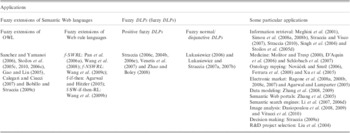
The applications of fuzzy DLs can be summarized in Table 6.
The applications of fuzzy DLs

DLs = Description Logics; DLP = Description Logic Program.
5.1 Fuzzy extensions of the Semantic Web languages
As mentioned in Section 1, DLs and ontologies play a key role in the Semantic Web, especially DLs that are the logic foundation of the Semantic Web. In order to deal with the fuzzy information, there have been kinds of fuzzy DLs as introduced in the previous sections. However, the Semantic Web languages such as OWL cannot represent the imprecise and uncertain information. Therefore, recently there have been quite a few works on DL-based fuzzy ontology languages as shown in Table 6, which have been proposed as formalisms capable of capturing and reasoning about imprecise and vague knowledge.
Extensions of OWL: Several works have been carried out toward combining fuzzy logic and the Semantic Web ontology. In order that the Web ontology languages can capture, represent, and reason on imprecise information directly, based on the fuzzy DL f-SHOIN, the OWL web ontology language was extended with the fuzzy set theory in Stoilos et al. (Reference Stoilos, Stamou and Tzouvaras2005c, Reference Stoilos, Stamou and Pan2010), which is called f-OWL. The authors provided the syntax and semantics of f-OWL, as well as a reduction technique from f-OWL to f-SHOIN for providing reasoning support for f-OWL ontologies. Moreover, based on a fuzzy extension to OWL called Fuzzy OWL, Stoilos et al. (Reference Stoilos, Simous, Stamou and Kollias2006c) developed a reasoning platform, Fuzzy Reasoning Engine (FiRE), which lets Fuzzy OWL capture and reason about imprecise and uncertain knowledge.
In addition, Gao and Liu (Reference Gao and Liu2005) investigated how to extend OWL by fuzzy DL, and the authors extended existing OWL language by encoding fuzzy constructors, axioms and constraints, and mapped semantics of these new vocabularies to fuzzy DLs. Moreover, the authors also provided the translation rules from OWL to fuzzy OWL. More recently, based on the fuzzy DL f-SROIQ(D), Bobillo and Straccia (Reference Bobillo and Straccia2009c) investigated the fuzzy extension of OWL 2, and proposed an OWL ontology to represent some important features of fuzzy OWL 2 statements.
In more detail, the connections among fuzzy ontology, fuzzy DLs, and fuzzy OWL were introduced by Calegari and Ciucci (Reference Calegari and Ciucci2007). Overall, extending OWL with fuzzy set theory can directly represent fuzzy ontology and resolve some fuzzy entailment tasks by constraint propagation calculus of fuzzy DLs.
Extensions of Web rule languages: As an important representation of knowledge, rules become a main design issue of the Semantic Web. Some Semantic Web rule languages, such as SWRL (Horrocks et al., Reference Horrocks, Patel-Schneider, Boley, Tabet, Grosof and Dean2004), which is a Horn clause rules extension to OWL that overcomes many limitations of OWL, come into being. However, in the Semantic Web, there is much imprecise and uncertain knowledge, which cannot be represented by these rule languages. To this end, based on OWL DL, that is, the DL SHOIN(D), Pan et al. (Reference Pan, Stoilos, Stamou, Tzouvaras and Horrocks2006a) first advocated a fuzzy SWRL extension based on fuzzy sets, called f-SWRL, where the general form of fuzzy rules, the syntax, and the semantics were investigated. And some examples of fuzzy rules were provided to illustrate the features of f-SWRL. Based on Pan et al. (Reference Pan, Stoilos, Stamou, Tzouvaras and Horrocks2006a), another fuzzy extension of SWRL was proposed by Wang et al. (Reference Wang, Ma, Yan and Meng2008).
Subsequently, other fuzzy extensions of rule languages are presented. Wang et al. (Reference Wang, Ma, Xu and Cheng2009c) proposed a fuzzy rule language, called f-NSWRL, which makes up for the insufficiency of f-SWRL in the respect of representing non-monotonicity. Agarwal and Hitzler (Reference Agarwal and Hitzler2005) showed how fuzzy membership functions and fuzzy IF-THEN rules can be modeled by means of an appropriate DL and how this can be employed for query answering. Moreover, by combining if-then rules with fuzzy OWL DL (i.e., the DL f-SHOIN(D)) in the framework of fuzzy sets, a Semantic Web rule language, called f-SW-if-then-RL, was presented by Wang et al. (Reference Wang, Ma, Yan and Cheng2009b), which employs fuzzy if-then rules to represent and reason on imprecise and uncertain knowledge abundant in the context of the Semantic Web. In addition, to provide features for representing rule-based languages capable of handling uncertainty and imprecision, a general extension of RuleML (Rule Markup Language) was introduced by Technical group charter, FuzzyRuleML.
5.2 Fuzzy extensions of Description Logic Programs
In the Semantic Web, both aspects of structured and rule-based representation of knowledge are becoming of interest, thus integrating the Rules and the Ontology layer has become a key requirement for the layered architecture of the Semantic Web. Toward this goal, DLPs come into being (Levy & Rousset, Reference Levy and Rousset1998; Grosof et al., Reference Grosof, Horrocks, Volz and Decker2003; Eiter et al., Reference Eiter, Lukasiewicz, Schindlauer and Tompits2004; Pan et al., Reference Pan, Franconi, Tessaris, Stamou, Tzouvaras, Serafini, Horrocks and Glimm2004). DLPs combine DLs and Logic Programs (LPs), where DLs capture the meaning of the most popular features of structured representation of knowledge, while LPs are powerful rule-based representation languages.
However, DLPs cannot represent imprecise knowledge. Therefore, currently several researches have been concentrated on extending DLPs to fuzzy DLPs in order to represent uncertain, vague, or imprecise knowledge. In general, the fuzzy DLPs can be classified into the positive fuzzy DLPs, fuzzy normal DLPs, and fuzzy disjunctive DLPs.
Straccia (Reference Straccia2006c, Reference Straccia2004b) first combines DLs, LPs, and the management of uncertainty into a uniform framework. The author extends the DL called L-ALC (DLs over lattices) with rules and defines its syntax, semantics, and reasoning problems, where the management of uncertainty is based on so-called annotation terms. However, the approach presented by Straccia (Reference Straccia2006c, Reference Straccia2004b) requires that the so-called annotation terms (see Kifer & Subrahmanian, Reference Kifer and Subrahmanian1992) are grounded, which makes the approach hardly feasible in practice. Furthermore, Straccia (Reference Straccia2006e) integrates the management of imprecision into a highly expressive family of representation languages, called positive fuzzy Description Logic Programs (positive fuzzy DLPs), which are a combination of fuzzy DLs with fuzzy LPs, where the author considers fuzzy ALC(D) as the DL component. Also, the syntax, semantics, and reasoning of fuzzy DLPs are defined.
Moreover, significant research efforts focusing on fuzzy DLPs are carried out by Lukasiewicz. Differently from the work on positive fuzzy DLPs by Straccia, Lukasiewicz (Reference Lukasiewicz2006) first presents an approach to fuzzy DLPs with default negation in rule bodies, called fuzzy normal DLPs, where the author presents an approach to fuzzy DLPs by integrating fuzzy DLs (e.g., f-SHIF(D) and f-SHOIN(D)) with non-monotonic LPs under the answer set semantics. Along this line of research, Lukasiewicz and Straccia (Reference Lukasiewicz and Straccia2007a) present a novel approach to tightly integrated fuzzy DLPs, called fuzzy disjunctive DLPs, which are a tight integration of fuzzy disjunctive programs under the answer set semantics with fuzzy generalizations of SHIF(D) and SHOIN(D), and also the syntax, semantics, and reasoning of fuzzy DLPs are defined. Furthermore, Lukasiewicz and Straccia (Reference Lukasiewicz and Straccia2007b) give a polynomial reduction for certain fuzzy DLPs to tightly integrated disjunctive DLPs. In addition, Lukasiewicz (Reference Lukasiewicz2005a, Reference Lukasiewicz2005b) and Lukasiewicz and Straccia (Reference Lukasiewicz and Straccia2009) also present probabilistic fuzzy DLPs for the Semantic Web, which allow for handling both probabilistic uncertainty and fuzzy vagueness in a uniform framework.
In addition, Zhao and Boley (Reference Zhao and Boley2008) present a fuzzy extension to DLPs, called fhDLP, which not only combines DL with LP, as in DLP, but also supports uncertainty representation. Venetis et al. (Reference Venetis, Stoilos, Stamou and Kollias2007) also extends DLPs to fuzzy DLPs by providing the mappings between fuzzy DLs (e.g., f-SHOIN) and fuzzy def-Horn rules (the fragment of Horn rules), in order to provide a complete framework for representing fuzziness in the Semantic Web.
5.3 Some particular applications of fuzzy Description Logics
Based on the high expressive power and effective reasoning service, the fuzzy DLs and existing fuzzy DL reasoners have also been applied to some particular application domains as shown in Table 6.
As mentioned by Lukasiewicz and Straccia (Reference Lukasiewicz and Straccia2008), fuzzy DLs were first proposed for logic-based information retrieval (Meghini et al., Reference Meghini, Sebastiani and Straccia2001). Meghini et al. (Reference Meghini, Sebastiani and Straccia2001) dealt with retrieval and showed how the degree of relevance of a document to a query may be seen in terms of the fuzzy DL that underlies both the representation and query languages. In Straccia and Visco (Reference Straccia and Visco2007), an ontology-mediated multimedia information retrieval system was presented based on the fuzzy DL f-DLR-Lite, which can handle hundreds of thousands of images. Simou et al. (Reference Simou, Athanasiadis and Kollias2008a) proposed a methodology for semantic indexing and retrieval of images based on the fuzzy DL f-SHIN. The idea has also been adopted by Stoilos et al. (Reference Stoilos, Stamou, Tzouvaras, Pan and Horrock2005d), Singh et al. (Reference Singh, Dey and Abulaish2004), and Simou et al. (Reference Simou, Athanasiadis, Stoilos and Kollias2008b) for information representation and retrieval.
Moreover, fuzzy DLs have also been applied to medicine as introduced by Molitor and Tresp (Reference Molitor and Tresp2000), where the authors investigated how to extend DLs to vague knowledge in medicine. D'Aquin et al. (Reference D'Aquin, Lieber and Napoli2006) provided a use case in the medical domain, where fuzzy concrete domains are used to identify tumor regions in X-ray images. Schlobach et al. (Reference Schlobach, Klein and Peelen2007) proposed a DL called Rough Description Logic (RDL) by extending traditional DLs based on rough-set semantics, and showed that Rough DL-based reasoning can be done in a realistic use case and that modeling vague knowledge helps to answer important questions in the design of clinical trials.
In addition, some researchers pointed out fuzzy DLs would contribute to ontology mapping (Xu et al., Reference Xu, Kang, Lu, Li and Jiang2005; Nováček & Smrž, Reference Nováček and Smrž2006; Ferrara et al., Reference Ferrara, Lorusso, Stamou, Stoilos, Tzouvaras and Venetis2008). Ferrara et al. (Reference Ferrara, Lorusso, Stamou, Stoilos, Tzouvaras and Venetis2008) discussed the application of the fuzzy DLs theories to the problem of ontology mapping validation as a different way of handling mapping uncertainty with respect to probabilistic approaches. In Xu et al. (Reference Xu, Kang, Lu, Li and Jiang2005), the fuzzy DLs were used to resolve the mapping problem of fuzzy concepts between fuzzy ontologies.
Also, some researchers have shown that fuzzy DLs are very useful in other applications. For example, Zhang et al. (Reference Zhang, Ma and Yan2008, Reference Zhang, Ma, Cheng and Meng2009) studied fuzzy data modeling with fuzzy DLs, where they established the relationships between fuzzy data models (e.g., fuzzy ER/UML model) and fuzzy DL KBs in order to realize the automatic reasoning of data models. Ragone et al. (Reference Ragone, Straccia, Bobillo, Di Noia, Di Sciascio and Donini2007, Reference Ragone, Straccia, Bobillo, Di Noia, Di Sciascio and Donini2008a, Reference Ragone, Straccia, Bobillo, Di Noia and Di Sciascio2008b, Reference Ragone, Straccia, Noia, Sciascio and Donini2008c) proposed a novel fuzzy DL-based approach to automate matchmaking in e-marketplaces, and in Agarwal and Lamparter (Reference Agarwal and Lamparter2005), fuzzy DLs have also been used to improve searching and comparing products in electronic markets. Li et al. (Reference Li, Sun, Lu, Wen and Li2006d, Reference Li, Wen, Lu, Sun and Wang2007) proposed an improved semantic search model through integrating inference and information retrieval, where a type-2 fuzzy DL was described and employed in the semantic search engines. In Dasiopoulou et al. (Reference Dasiopoulou, Kompatsiaris and Strintzis2008, Reference Dasiopoulou, Kompatsiaris and Strintzis2009), a fuzzy DL-based reasoning framework was proposed for the extraction of enhanced image descriptions based on an initial set of graded annotations, generated through generic image analysis techniques, and Vitucci et al. (Reference Vitucci, Arrigoni Neri and Gini2010) built an image analysis system, which includes two modules, the vision module, and the semantic module implemented with the fuzzy reasoner FiRE (Stoilos et al., Reference Stoilos, Simous, Stamou and Kollias2006c). Besides, fuzzy DLs have also been applied to other areas such as Semantic Web portals (Zhang et al., Reference Zhang, Yu, Zhou, Lin and Yang2005), context representation (Bobillo et al., Reference Bobillo, Delgado and Gómez-Romero2008), decision making (Straccia, Reference Straccia2009a), and R&D project selection (Liu et al., Reference Liu, Tian and Ma2004).
6 Discussions and conclusions
Based on the introduction in the previous sections, it is shown that lots of fuzzy DLs and related techniques and applications have been investigated in order to handle fuzzy information in real-world applications. In the last, we provide a brief summarization to well gain a general understanding of the field. In order for DLs to represent and reason on fuzzy information, Yen (Reference Yen1991) first combined fuzzy logic and DLs. From then on, the incorporation of imprecise and uncertain information in DLs has increasingly received attention. In particular, after a fuzzy extension of the basic DL ALC, that is, FALC, was proposed by Straccia (Reference Straccia1998), kinds of fuzzy DLs extending FALC were developed, such as the extensions of FALC with hedges (Hölldobler et al., Reference Hölldobler, Störr and Tran2003, Reference Hölldobler, Störr and Khang2004, Reference Hölldobler, Nga and Khang2005), number restrictions N (Lu et al., Reference Lu, Xu, Li, Kang and Wang2005; Li et al., Reference Li, Xu, Lu, Kang and Wang2005c; Zhao et al., Reference Zhao, Boley and Du2009), and qualified cardinality restrictions Q (Sánchez & Tettamanzi, Reference Sánchez and Tettamanzi2004; Stoilos et al., Reference Stoilos, Stamou and Kollias2008a). Furthermore, Stoilos et al. (Reference Stoilos, Stamou and Tzouvaras2005b) provided an extension of the FALC with transitive role axioms (S), inverse roles (I), role hierarchies (H), and number restrictions (N), and proposed a fuzzy DL named f-SHIN, which has a high expressive power and decidable reasoning procedure. More recently, a family of fuzzy DLs called tractable fuzzy DLs such as fuzzy DL-Lite (Straccia, Reference Straccia2006b) and fuzzy EL (Vojtáš, Reference Vojtáš2007, Reference Vojtáš2006) were proposed, which are rich enough to capture significant ontology languages but keeping low complexity of reasoning. Moreover, for representing fuzzy data type information, some fuzzy DLs with fuzzy concrete domains D and fuzzy data type group G were presented, such as fuzzy ALC(D) (Straccia, Reference Straccia2005b, Reference Straccia2005c, Reference Straccia2005d), fuzzy ALCF(D) (Bobillo & Straccia, Reference Bobillo and Straccia2007, Reference Bobillo and Straccia2009d), fuzzy SHOIN(D) (Straccia, Reference Straccia2005a, Reference Straccia2006a), fuzzy SROIQ(D) (Bobillo, Reference Bobillo2008; Bobillo et al., Reference Bobillo, Delgado and Gómez-Romero2009; Bobillo & Straccia, Reference Bobillo and Straccia2009c), and fuzzy ALC(G) (Wang & Ma, Reference Wang and Ma2008). In addition, with the occurrence of many fuzzy DLs, kinds of reasoning and querying techniques for different fuzzy DLs (e.g., tableau-based reasoning technique (Straccia, Reference Straccia2001; Stoilos et al., Reference Stoilos, Stamou, Pan, Tzouvaras and Horrocks2007), reasoning technique for GCIs (Straccia, Reference Straccia2004a; Stoilos et al., Reference Stoilos, Straccia and Stamou2006b), reasoning technique of reducing to crisp DLs (Straccia, Reference Straccia2004a; Li et al., Reference Li, Xu, Lu, Kang and Wang2005c; Bobillo, Reference Bobillo2008), and querying over fuzzy DLs in Table 5) and fuzzy DL reasoners in Table 4 have been developed. Also, fuzzy DLs have been extensively applied to many application domains as shown in Table 6. The detailed introduction about fuzzy DLs can be found from Sections 3–5 in this paper, and for most recent research issues about fuzzy logic and more generally soft computing, in the DLs, ontologies, and the Semantic Web, one can refer to Ma (Reference Ma2006), Sanchez (Reference Sanchez2006b) and Shadbolt et al. (Reference Shadbolt, Hall and Berners-Lee2006).
In this paper, we focus our attention on the recent research achievements on fuzzy extension approaches of DLs based on fuzzy set theory, and we provide a comprehensive literature overview of them, which can contribute to investigating the fuzzy DLs and more importantly serving as identifying the direction of fuzzy DLs study. We survey the existing fuzzy DLs from the origin, development (from weaker to stronger in expressive power), some special techniques, and so on. The important issues on fuzzy DLs, such as reasoning, querying, and applications, are discussed in detail. Also, we make a comparison and analysis in our whole review.
After reviewing most of the proposals of fuzzy extensions, it has been widely approved that fuzzy DLs could play a key role in the Semantic Web by serving as a mathematical framework for fuzzy knowledge representation and reasoning in applications. However, still the full potential of fuzzy DLs has not been exhaustively explored, we found that fuzzy DLs have been studied relatively enough regarding the theoretical side, but it is a paradox in the balance between the expressive power of the DL formalism and its computational complexity. Therefore, how to handle the balance and the development of tools and systems that would provide a flexible and efficient way to build and manage fuzzy knowledge will be a hot research topic. Besides, the researches on fuzzy extensions of DLs are still in a developing stage and the following issues may be important in order for fuzzy DL technologies to be more widely adoptable in the Semantic Web and other application domains:
• The more expressive fuzzy DLs may be needed to satisfy the requirement of applications, for example, extending the DLs SHIQ(G) and SHOQ(G) presented by Pan (Reference Pan2007)and Pan and Horrocks (Reference Pan and Horrocks2006)toward supporting the fuzzy user-defined data type and fuzzy user-defined data type predicate; extending fuzzy DLs toward supporting fuzzy spatial relations as shown by Straccia (Reference Straccia2009b); extending fuzzy DLs by introducing Bayesian rules (Zhang et al., Reference Zhang, Wu and Hu2007). In all cases, the underlying principle is to remain as close as possible to classical logic for preserving computational efficiency as much as possible (Dubois et al., Reference Dubois, Mengin and Prade2006).
• The balance between expressivity and computation complexity of fuzzy DLs. As mentioned by Brachman and Levesque (Reference Brachman and Levesque1984), using expressive DLs to model complex knowledge definitely brings about higher complexity, while reducing reasoning complexity will lead to the limitation of expressive power. After prompting a reasoning algorithm to an expressive DL language, although the decidability of the algorithm is investigated, the computational complexity is still an open problem. Furthermore, the optimal technologies can be investigated, which can reduce the computational complexity of the algorithm.
• The implementation of more expressive fuzzy DL reasoners. As shown in this paper, fuzzy DLs have been investigated relatively enough regarding the theoretical side. Another important side is the development of tools and systems that would provide a flexible and efficient way to build and manage fuzzy knowledge. Although there have been several fuzzy DL reasoners as introduced in Section 4.1.2, most of them cannot support fuzzy data information, DIG standard interface, and so on. Therefore, to satisfy the need of applications, some more expressive fuzzy DL reasoners should be implemented and applied to the real world, and also the performance of them should be improved.
• The query over more expressive fuzzy DLs and the complexity analysis for them. Currently, most of researches on querying over fuzzy DLs focus on lightweight fuzzy ontology languages. Therefore, querying over even more expressive fuzzy DLs should be carried out, for example, fuzzy DLs additionally extended with nominals and data type groups, and so on. Moreover, there exist a few fuzzy query engines that can be applied in real world applications, only CARIN system (Mailis et al., Reference Mailis, Stoilos and Stamou2007) and ONTOSEARCH2 (Pan et al., Reference Pan, Stamou, Stoilos and Thomas2006b, Reference Pan, Thomas and Sleeman2007), which is a query engine for both DL-Lite and fuzzy DL-Lite. Thus, more fuzzy query engines should be exploited.
• The application problems of fuzzy DLs will become the important research lines in DLs. As introduced in this paper, currently, there have been a lot of fuzzy extensions of DLs, while few applications of them, thus how to apply them to the real world application domains will attract increasing attention, for example, fuzzy DLs for data mining, database modeling, fuzzy controlling, and so on.
• The fuzzy DLPs will be an interesting topic for future research. This is extremely important as the representation of vague and imprecise information in the Semantic Web, and gains more and more attention by the research community. Although there have been several researches on fuzzy DLPs, integrating more expressive fuzzy DLs into fuzzy DLPs is needed. Moreover, few researches focus on reasoning on fuzzy DLPs, thus investigating about reasoning algorithms for fuzzy DLPs and analyzing the computational complexity may attract much attention. In addition, the implementation for fuzzy DLPs will be desired to apply in practice.
• To overcome the identified shortcomings of OWL, such as expressivity issues and deficiencies in the definition of OWL species, OWL 2, an extension to and revision of OWL that is currently being developed within the W3C OWL Working Group (Cuenca Grauet et al., Reference Cuenca Grau, Horrocks, Motik, Parsia, Patel-Schneider and Sattler2008). Following the current trend of research, in order to deal with the imprecise and uncertain information, fuzzy extensions to OWL 2 will attract much attention.
Acknowledgments
The authors wish to thank the anonymous referees for their valuable comments and suggestions. The work is supported by the National Natural Science Foundation of China (60873010, 61073139) and the Fundamental Research Funds for the Central Universities (N090504005 and N090604012), and in part by the Program for New Century Excellent Talents in University (NCET-05-0288).