



1 Introduction
In this paper, we investigate the irregular multifractal spectrum of Birkhoff averages arising from the Gauss map and continued fractions.
The Gauss map
$G\colon [0,1) \to [0,1)$
 is defined by

This map is intimately connected with the continued fraction expansion of real numbers. Let
$\lfloor \cdot \rfloor $
 denote the floor function and
$G^n$
 the nth iterate of G. For any
$x\in [0,1)$
 , define
$a_{1}(x):= \lfloor {1}/{x}\rfloor $
 and
$a_{n+1}(x):= a_{1}(G^{n}(x))$
 for
$n\geq 1$
 such that
$G^n(x)>0$
 . Then, x admits the continued fraction expansion

where the positive integers
$a_n(x)$
 are referred to as the partial quotients of x. The Gauss map acts as the shift on partial quotients, namely
$G([a_1, a_2, a_3, \ldots ]) = [a_2, a_3, a_4, \ldots ]$
 . For a detailed treatment of the Gauss map and continued fractions, we refer the reader to [Reference Einsiedler and Ward6, Reference Kesseböhmer, Munday and Stratmann24].
Let
$\psi \colon [0,1) \to \mathbb {R}$
 be a potential. For any
$x\in [0,1)$
 and
$n \geq 1$
 , we define the nth Birkhoff sum as

Let

and

Note that it is possible for
$\alpha _{\inf }$
 and
$\alpha _{\sup }$
 to be minus infinity and infinity, respectively. In this paper, the notation
$[\alpha _{\inf },\alpha _{\sup }]$
 denotes a subset of the real line. If
$\alpha _{\inf } = -\infty $
 , the interval is understood to be open on the left; similarly, if
$\alpha _{\sup } = \infty $
 , the interval is open on the right. For any
$\unicode{x3bb} \in [\alpha _{\inf },\alpha _{\sup }]$
 , let

and

and define
$E(\unicode{x3bb} ) := E_{\sup }(\unicode{x3bb} ) \cap E_{\inf }(\unicode{x3bb} )$
 . Denote by
$\dim _{\mathrm {H}}$
 the Hausdorff dimension (see [Reference Falconer7] for the definition). We are interested in the upper and lower Birkhoff spectra

and their connections to the classical Birkhoff spectrum

As a canonical example of a uniformly expanding map with countably many branches, the Gauss map has attracted considerable attention in multifractal analysis since the 1990s. The methods developed in its study have been systematically extended to the broader class of countable Markov interval maps. In a seminal work from 1990, Mayer [Reference Mayer29] investigated the thermodynamic formalism of the Gauss map and showed that its topological pressure exhibits a logarithmic singularity at
$1/2$
 . This type of phase transition stands in sharp contrast to the situation for hyperbolic systems with finitely many branches, and plays a crucial role in determining the behavior of the Birkhoff spectra given in (2) and (3). In particular, it gives rise to a series of new and delicate phenomena in multifractal analysis (see, e.g., [Reference Fan, Liao and Ma10, Reference Fan, Liao, Wang and Wu11, Reference Hanus, Mauldin and Urbański19, Reference Kesseböhmer and Stratmann25, Reference Mauldin and Urbański28, Reference Pollicott and Weiss32, Reference Sarig35]), which distinguish the Gauss map from finite-branch dynamical systems, and reveal the rich geometric complexity of the Gauss map and continued fractions.
Specializing to the geometric potential
$\psi (x)=\log |G'(x)|$
 , the set
$E(\unicode{x3bb} )$
 reduces to the level set of the Lyapunov exponent of the Gauss map:

The associated Birkhoff spectrum is referred to as the Lyapunov spectrum. The study of the Lyapunov spectrum for the Gauss map was initiated by Pollicott and Weiss [Reference Pollicott and Weiss32, Proposition 4], and was later developed in detail by Kesseböhmer and Stratmann [Reference Kesseböhmer and Stratmann25, Theorem 1.3], as well as independently by Fan et al [Reference Fan, Liao, Wang and Wu11, Theorem 1.3]. Let
${\unicode{x3bb} _{0}:=2\log (({1+\sqrt {5}})/{2})}$
 and
$\gamma _{0}:={\pi ^{2}}/{6\log 2}$
 . It was proved that the Lyapunov spectrum

has an unbounded domain
$[\unicode{x3bb} _0, \infty )$
 , and is real-analytic on
$(\unicode{x3bb} _0, \infty )$
 , strictly increasing on
$[\unicode{x3bb} _0, \gamma _0]$
 and strictly decreasing on
$[\gamma _0, \infty )$
 . In particular, L attains its unique maximum value
$1$
 at
$\gamma _0$
 and has an inflection point at some point greater than
$\gamma _0$
 .
Denote by
$J_{\sup }(\unicode{x3bb} )$
 and
$J_{\inf }(\unicode{x3bb} )$
 the sets obtained from
$J(\unicode{x3bb} )$
 by replacing the limit with the limsup and liminf, respectively. The resulting Birkhoff spectra are referred to as the upper and lower Lyapunov spectra. The general framework developed in the present paper, when applied to the Lyapunov exponents, leads to a comprehensive multifractal characterization of the upper and lower Lyapunov spectra.
Theorem 1. (Upper and lower Lyapunov spectra)
The following statements hold.
-
(i) For any $\unicode{x3bb} \in [\unicode{x3bb} _0, \infty )$
 , $$ \begin{align*} \dim_{\mathrm{H}}J(\unicode{x3bb}) =\dim_{\mathrm{H}}J_{\inf}(\unicode{x3bb}) = \dim_{\mathrm{H}}J_{\sup}(\unicode{x3bb})= L(\unicode{x3bb}). \end{align*} $$
-
(ii) For any $\unicode{x3bb} ,\xi \in [\unicode{x3bb} _0, \infty )$
with
$\unicode{x3bb} \leq \xi $
, $$ \begin{align*} \dim_{\mathrm{H}} (J_{\inf}(\unicode{x3bb}) \cap J_{\sup}(\xi)) = \min\{L(\unicode{x3bb}),\, L(\xi)\}. \end{align*} $$



The upper and lower Lyapunov spectra serve as key tools for understanding the multifractal nature of the Lochs index associated with comparisons between the continued fraction and decimal expansions of real numbers.
For any
$x\in [0,1)$
 and
$n \geq 1$
 , we define the Lochs index
$k_n(x)$
 as the maximum number of partial quotients in the continued fraction expansion of x that can be determined by the first n decimal digits of x. It was first proved by Lochs [Reference Lochs27] that for Lebesgue-almost every
$x\in [0,1)$
 ,

Later, Wu [Reference Wu37, Theorem 1.3] established the asymptotic behavior of
$k_n(x)$
 in terms of the upper and lower Lyapunov exponents. Specifically, for each irrational
$x\in [0,1)$
 ,

where
$\ell _{\sup }(x)$
 and
$\ell _{\inf }(x)$
 denote the upper and lower Lyapunov exponents of x, respectively. Combining this result with Theorem 1, we obtain a complete multifractal analysis of the Lochs index.
For any
$\unicode{x3bb} \in [\unicode{x3bb} _0, \infty )$
 , define

and

and let
$K(\unicode{x3bb} ):= K_{\inf }(\unicode{x3bb} )\cap K_{\sup }(\unicode{x3bb} )$
 . The Hausdorff dimensions of these level sets and their intersections are determined as follows, which provides a refinement of [Reference Wu37, Corollary 2.5]. See [Reference Barreira and Iommi1, Theorem 11] for related results.
Theorem 2. The following statements hold.
-
(i) For any $\unicode{x3bb} \in [\unicode{x3bb} _0, \infty )$
, $$ \begin{align*} \dim_{\mathrm{H}}K(\unicode{x3bb}) =\dim_{\mathrm{H}}K_{\inf}(\unicode{x3bb}) = \dim_{\mathrm{H}}K_{\sup}(\unicode{x3bb}) =L(\unicode{x3bb}). \end{align*} $$
-
(ii) For any $\unicode{x3bb} ,\xi \in [\unicode{x3bb} _0, \infty )$
with
$\unicode{x3bb} \geq \xi $
, $$ \begin{align*} \dim_{\mathrm{H}} (K_{\inf}(\unicode{x3bb}) \cap K_{\sup}(\xi)) = \min\{L(\unicode{x3bb}),\, L(\xi)\}. \end{align*} $$


Iommi and Jordan [Reference Iommi and Jordan20] further developed this line of research by studying the Birkhoff spectrum for a wider class of potentials beyond the geometric potential. In the particular case of the potential
$\psi (x) = \lfloor 1/x\rfloor $
 , the Birkhoff sum
$S_n\psi (x)$
 in (1) becomes the arithmetic sum of the partial quotients of x, and the set
$E(\unicode{x3bb} )$
 reduces to the level set of the arithmetic mean of partial quotients:

Iommi and Jordan [Reference Iommi and Jordan20, Proposition 6.7] proved that the corresponding Birkhoff spectrum, called the arithmetic-mean spectrum,

is defined on the unbounded interval
$[1, \infty )$
 . Moreover, S is real-analytic, strictly increasing, and strictly concave on
$(1,\infty )$
 , with
$S(1) =0$
 and
$\lim _{\unicode{x3bb} \to \infty }S(\unicode{x3bb} ) =1$
 .
Let
$A_{\inf }(\unicode{x3bb} )$
 and
$A_{\sup }(\unicode{x3bb} )$
 denote the sets obtained from
$A(\unicode{x3bb} )$
 by replacing the limit with the liminf and limsup, respectively. The general framework established in this paper provides a complete characterization of the Hausdorff dimension of these sets.
Theorem 3. (Upper and lower arithmetic-mean spectra)
The following statements hold.
-
(i) For any $\unicode{x3bb} \in [1, \infty )$
, $$ \begin{align*} \dim_{\mathrm{H}}A(\unicode{x3bb}) =\dim_{\mathrm{H}}A_{\inf}(\unicode{x3bb}) = \dim_{\mathrm{H}}A_{\sup}(\unicode{x3bb})= S(\unicode{x3bb}). \end{align*} $$
-
(ii) For any $\unicode{x3bb} ,\xi \in [1, \infty )$
with
$\unicode{x3bb} \leq \xi $
, $$ \begin{align*} \dim_{\mathrm{H}} (A_{\inf}(\unicode{x3bb}) \cap A_{\sup}(\xi)) = S(\unicode{x3bb}). \end{align*} $$





We remark that Theorem 3(i) is analogous to the classical results of Besicovitch [Reference Besicovitch4] and Eggleston [Reference Eggleston5, Theorem 14] concerning the multifractal analysis of the arithmetic mean of digits in the dyadic expansion of real numbers, but the corresponding spectrum exhibits a different behavior.
Our investigation is motivated by the following two aspects. First, Feng et al [Reference Feng, Lau and Wu15] obtained the upper and lower Birkhoff spectra for conformal repellers on smooth Riemannian manifolds under continuous potentials. (See also earlier work of Fan et al [Reference Fan, Feng and Wu8] in the setting of subshifts of finite type.) More precisely, Feng et al [Reference Feng, Lau and Wu15, Theorem 1.1 and Propositions 6.3–6.4] proved that for every repeller J of an expanding
$C^{1+\delta }$
 conformal topologically mixing map and for every continuous potential
$\psi \colon J\to \mathbb {R}$
 , the following properties hold.
-
(1) For any $\unicode{x3bb} \in [\unicode{x3bb} _{\min },\unicode{x3bb} _{\max }]$
, (4) $$ \begin{align} \dim_{\mathrm{H}}E(\unicode{x3bb})=\dim_{\mathrm{H}}E_{\inf}(\unicode{x3bb})=\dim_{\mathrm{H}}E_{\sup}(\unicode{x3bb}). \end{align} $$
-
(2) For any $\unicode{x3bb} ,\xi \in [\unicode{x3bb} _{\min },\unicode{x3bb} _{\max }]$
with
$\unicode{x3bb} \leq \xi $
, (5) $$ \begin{align} \dim_{H}(E_{\inf}(\unicode{x3bb})\cap E_{\sup}(\xi))=\min\{\dim_{\mathrm{H}}E(\unicode{x3bb}),\,\dim_{\mathrm{H}}E(\xi)\}. \end{align} $$





Second, Gelfert et al studied the upper and lower Lyapunov spectra for several non-uniformly expanding systems beyond
$C^{1+\delta }$
 conformal expanding maps, including parabolic systems [Reference Gelfert and Rams18], rational maps [Reference Gelfert, Przytycki and Rams16], and multimodal maps [Reference Gelfert, Przytycki and Rams17]. Due to the presence of parabolic fixed points and critical points, the geometric potential is less regular, and they showed that only certain inequalities corresponding to (5) can be obtained for the upper and lower Lyapunov spectra, e.g., [Reference Gelfert, Przytycki and Rams16, Theorem 2] and [Reference Gelfert, Przytycki and Rams17, Theorems 1 and 2]. They further remark [Reference Gelfert, Przytycki and Rams17, p. 1450] that ‘the question of whether these equalities for geometric potentials hold in these non-uniformly expanding settings remains open.’ All these results naturally raise the question of whether (4) and (5) can be proved or disproved for the Gauss map under mildly regular potentials.
2 Statement of the main results
For any
$x\in [0,1)$
 and
$n \geq 1$
 , let
$I_n(x)$
 denote the cylinder of order n that contains x. Let
$\psi \colon [0,1) \to \mathbb {R}$
 be a potential. We define the nth variation of
$\psi $
 by

Many conditions have been introduced in the literature via variations to describe different types of regularity or decay properties of potentials. For example, we have the following examples.
-
• Sarig [Reference Sarig34, p. 1567] defined a potential $\psi $
to be locally Hölder continuous if there exist constants
$A>0$
and
$0<r<1$
such that
$\mathrm {Var}_n(\psi ) \leq Ar^n$
for all
$n \geq 1$
. -
• Iommi and Jordan [Reference Iommi and Jordan20, p. 2562] defined a potential $\psi $
to have summable variation if
$\sum ^\infty _{n=1} \mathrm {Var}_n(\psi ) <\infty $
. -
• Seuret and Wang [Reference Seuret and Wang36, Definition 2.3] introduced the notion of the tempered distortion property for potentials $\psi $
satisfying
$\mathrm {Var}_{1}(\psi )<\infty $
and
$\mathrm {Var}_n(\psi ) \to 0$
as
$n \to \infty $
. (Fan et al [Reference Fan, Jordan, Liao and Rams9, Definition 2.1] refer to the tempered distortion property as the property that the potential has variations uniformly converging to zero.)










Throughout this paper, a potential
$\psi \colon [0,1)\to \mathbb {R}$
 is said to satisfy the weakly tempered distortion property if

The weakly tempered distortion property plays a crucial role in our argument. It guarantees that the Birkhoff averages have uniformly small oscillations on sufficiently long cylinders, which allows us to pass from symbolic constructions to dimensional estimates. This condition is considerably weaker than summable variation or local Hölder continuity and, therefore, permits a broader class of potentials. In particular, both potentials
${\psi (x)=\log |G'(x)|}$
 and
$\psi (x)=\lfloor 1/x\rfloor $
 considered in §1 are locally Hölder continuous, and thus satisfy the weakly tempered distortion property.
Our main theorems in this paper are stated as follows.
Theorem A. Let
$\psi \colon [0,1)\to \mathbb {R}$
 be a potential satisfying the weakly tempered distortion property. Then, for any
$\unicode{x3bb} \in [\alpha _{\inf },\alpha _{\sup }]$
 ,

Theorem A qualitatively demonstrates that the classical, lower, and upper Birkhoff spectra coincide. Denote their common value in (7) by
$b_\psi (\unicode{x3bb} )$
 . We remark that the value of the classical Birkhoff spectrum has been extensively studied; see, e.g., [Reference Fan, Jordan, Liao and Rams9, Reference Fan, Liao, Wang and Wu11, Reference Iommi and Jordan20–Reference Kesseböhmer, Munday and Stratmann23, Reference Kesseböhmer and Stratmann25, Reference Pollicott and Weiss32, Reference Rush33] and references therein. As a result, the properties of the function
$b_\psi (\unicode{x3bb} )$
 are now relatively well understood. Specifically, Iommi and Jordan [Reference Iommi and Jordan20] introduced the following classes of potentials:

and

Let
$\mathcal {T}$
 denote the class of potentials satisfying the tempered distortion property and
$\mathcal {W}$
 the class of potentials satisfying the weakly tempered distortion property. Then,

Let
$\mathcal {M}_G$
 denote the set of all G-invariant probability measures on
$[0,1)$
 . For each
${\mu \in \mathcal {M}_{G}}$
 , we write
$h(\mu )$
 for the measure-theoretic entropy of
$\mu $
 and
$\unicode{x3bb} (\mu ) := \int \log |G'|\,d\mu $
 for the Lyapunov exponent of
$\mu $
 . Combining Theorem A with [Reference Iommi and Jordan20, Theorems 1.3 and 1.4] and [Reference Fan, Jordan, Liao and Rams9, Theorem 1.1], we have the following hierarchical structure of
$b_{\psi }(\unicode{x3bb} )$
 . To be more precise, we have the following.
-
(1) (Theorem A) If $\psi \in \mathcal {W}$
, then
$b_{\psi }(\unicode{x3bb} )$
is well defined on
$[\alpha _{\inf },\alpha _{\sup }]$
. -
(2) [Reference Fan, Jordan, Liao and Rams9, Theorem 1.1] If $\psi \in \mathcal {T}$
, then for any
$\unicode{x3bb} \in [\alpha _{\inf },\alpha _{\sup }]$
, (8) $$ \begin{align} b_{\psi}(\unicode{x3bb})=\lim_{\varepsilon \to 0}\sup\bigg\{\frac{h(\mu)}{\unicode{x3bb}(\mu)}\colon \mu\in\mathcal{M}_G,\, \bigg|\int\!\psi d\mu -\unicode{x3bb}\bigg|< \varepsilon,\, \unicode{x3bb}(\mu) <\infty \bigg\}. \end{align} $$
-
(3) [Reference Iommi and Jordan20, Theorem 1.3] If $\psi \in \mathcal {R}$
, then for any
$\unicode{x3bb} \in [\alpha _{\inf },\alpha _{\sup }]$
, (9) $$ \begin{align} b_{\psi}(\unicode{x3bb})=\sup\bigg\{\frac{h(\mu)}{\unicode{x3bb}(\mu)}\colon \mu\in\mathcal{M}_G,\, \int\!\psi d\mu=\unicode{x3bb},\, \unicode{x3bb}(\mu) <\infty \bigg\}. \end{align} $$
-
(4) [Reference Iommi and Jordan20, Theorem 1.4] If $\psi \in \bar {\mathcal {R}}$
, then the conditional variational principle (9) remains valid. Moreover, depending on the limiting behavior of
$\psi (x)/(-2\log x)$
as
$x\to 0$
, one further obtains additional regularity properties of
$b_{\psi }(\unicode{x3bb} )$
.


As shown in [Reference Fan, Liao and Ma10], the right-hand sides of (8) and (9) do not necessarily coincide. We also point out that, when considering the fast Birkhoff spectra, the analogous identities among the classical, lower, and upper spectra no longer hold. This discrepancy was first observed by Fan et al [Reference Fan, Liao, Wang and Wu11, Reference Fan, Liao, Wang and Wu12], and Liao and Rams [Reference Liao and Rams26] in their study of the Khintchine spectrum for the Gauss map. In a recent work, the present authors and Wang [Reference Fang, Moreira, Wang and Zhang13] further extended these findings to the setting of countable Markov interval maps.
Theorem B. Let
$\psi \colon [0,1)\to \mathbb {R}$
 be a potential satisfying the weakly tempered distortion property. Then, for any
$\unicode{x3bb} , \xi \in [\alpha _{\inf },\alpha _{\sup }]$
 with
$\unicode{x3bb} \leq \xi $
 ,

Theorem B establishes a precise relationship between the upper and lower Birkhoff level sets for the Gauss map by showing that the Hausdorff dimension of their intersection equals the smaller of the two individual dimensions. This result extends the identity established by Feng et al [Reference Feng, Lau and Wu15, Proposition 6.4] and Gelfert and Rams [Reference Gelfert and Rams18, Theorem 1] from finite-branch systems to the infinite-branch context of the Gauss map. Moreover, the intersections of the upper and lower Birkhoff level sets considered here yield a finer multifractal decomposition of
$[0,1)$
 . In the classical setting, the multifractal decomposition of
$[0,1)$
 induced by the Birkhoff level sets takes the form

where
$E^\prime $
 is the irregular set defined by

However, this decomposition provides little information about the internal structure of
$E^\prime $
 , for which essentially no multifractal information is captured. Although in many dynamical systems the irregular set is known to have full topological entropy and full Hausdorff dimension (see, e.g., [Reference Barreira, Li and Valls2, Reference Barreira and Schmeling3, Reference Fan, Feng and Wu8, Reference Feng, Lau and Wu15, Reference Iommi and Jordan20, Reference Olsen31]), its finer geometric and dimensional properties remain largely mysterious. Considering the intersections
$E_{\inf }(\unicode{x3bb} ) \cap E_{\sup }(\xi )$
 , we obtain the following refined multifractal decomposition of (11):

In this new decomposition, when
$\unicode{x3bb} =\xi $
 , the intersections reduce to the classical Birkhoff level set
$E(\unicode{x3bb} )$
 , while for
$\unicode{x3bb} <\xi $
 , they provide a finer stratification of the irregular set
$E^\prime $
 , capturing how points with different upper and lower Birkhoff averages contribute to its structure. Theorem B quantifies the Hausdorff dimensions of these intersections, thereby giving a refined multifractal description of the irregular set.
The rest of this paper is organized as follows. In §3, we establish a key lemma and use it to prove Theorems A and B. Section 4 is devoted to a detailed proof of the key lemma.
3 Key Lemma and proofs of Theorems A and B
Let
$\unicode{x3bb} ,\xi \in [\alpha _{\inf }, \alpha _{\sup }]$
 with
$\unicode{x3bb} \leq \xi $
 be fixed. For convenience, denote

For any
$\alpha \in \mathbb {N}^n$
 , we denote by
$I_n(\alpha )$
 the cylinder of order n associated with
$\alpha $
 . That is, if
$\alpha = (a_1,\ldots ,a_n) \in \mathbb {N}^n$
 , then

For any
$n,r \in \mathbb N$
 and
$a,b \in \mathbb Q$
 with
$a<b$
 , let

and

Since
$|I_n(\alpha )|\le 2^{-n}$
 for all
$n \geq 1$
 , we have
$r \geq n$
 whenever
$Z_{n,r}(a,b)\ne \emptyset $
 .
Key Lemma. Let
$\unicode{x3bb} ,\xi \in [\alpha _{\inf }, \alpha _{\sup }]$
 with
$\unicode{x3bb} \leq \xi $
 . Suppose that there exists
$s>0$
 such that for any
$a,b \in \mathbb Q$
 with
$a<\unicode{x3bb} <b$
 , for any
$c, d \in \mathbb {Q}$
 with
$c<\xi <d$
 , and for any
$n_0 \geq 1$
 , there exist integers
$n \geq n_0$
 ,
$\tilde {n} \geq n_0$
 ,
$r\ge n$
 , and
$\tilde r\ge \tilde n$
 such that

Then,

In particular, when
$\unicode{x3bb} =\xi $
 , the Key Lemma reduces to the case of a single level set
$E(\unicode{x3bb} )$
 . In other words, if there exists
$s>0$
 such that for any
$a,b \in \mathbb Q$
 with
$a<\unicode{x3bb} <b$
 and for any
$n_0 \geq 1$
 , there exist integers
$n \geq n_0$
 and
$r\ge n$
 such that

then
$\dim _{\mathrm {H}}E(\unicode{x3bb} ) \geq s$
 .
The proof of the Key Lemma follows a Cantor-type construction combined with Falconer’s dimension estimate and occupies the whole of §4. In the rest of this section, we first proceed with the proofs of Theorems A and B, assuming the Key Lemma.
3.1 Proof of Theorem A assuming the Key Lemma
Proof. Fix
$\unicode{x3bb} \in [\alpha _{\inf }, \alpha _{\sup }]$
 . For simplicity, we denote by
$\tau ,\tau _{\inf }$
 and
$\tau _{\sup }$
 the Hausdorff dimension of the sets
$E(\unicode{x3bb} ), E_{\inf }(\unicode{x3bb} )$
 , and
$E_{\sup }(\unicode{x3bb} )$
 , respectively. Then,

Hence, it suffices to prove that
$\tau _{\inf } \leq \tau $
 and
$\tau _{\sup } \leq \tau $
 . We prove only the first inequality, as the second follows analogously.
We first claim that for any
$\varepsilon>0$
 , there exist
$\widetilde {a},\widetilde {b} \in \mathbb Q$
 with
$\widetilde {a}<\unicode{x3bb} <\widetilde {b}$
 and
$N \in \mathbb N$
 such that for all
$n \geq N$
 and all
$r\ge n$
 ,

In fact, if the claim is false, then there exists
$\varepsilon _{0}>0$
 such that for any
$a,b\in \mathbb {Q}$
 with
${a<\unicode{x3bb} <b}$
 and any integer
$n_{0}\geq 1$
 , there exist integers
$n\geq n_{0}$
 and
$r\ge n$
 satisfying

Applying the Key Lemma with
$\unicode{x3bb} = \xi $
 , we obtain
$\dim _{\mathrm {H}} E(\unicode{x3bb} ) \ge \tau + \varepsilon _0$
 , which contradicts the definition of
$\tau $
 .
We now show that

The equality in (14) follows directly from the definitions of
$Z_n(\widetilde {a},\widetilde {b})$
 and
$Z_{n,r}(\widetilde {a},\widetilde {b})$
 . To prove the inclusion, take
$a^\prime , b^\prime \in \mathbb {R}$
 such that
$\widetilde {a}<a^\prime <\unicode{x3bb} <b^\prime <\widetilde {b}$
 , and define

Since the potential
$\psi $
 satisfies the weakly tempered distortion property given in (6), there exists
$N_0\in \mathbb {N}$
 with
$N_0 \geq N$
 such that for all
$n \geq N_0$
 ,

For any
$x\in E_{\inf }(\unicode{x3bb} )$
 , we have

Hence, for any
$j \in \mathbb {N}$
 , there exists
$N_j\in \mathbb {N}$
 with
$N_j \geq N_0$
 such that

For any
$j \in \mathbb {N}$
 , let
$\alpha _j := a_1(x)a_2(x)\cdots a_{N_j}(x)$
 . Then,
$x\in I_{N_j}(\alpha _j)$
 . We next prove that
$\alpha _j \in Z_{N_j}(\widetilde {a},\widetilde {b})$
 for all
$j \in \mathbb {N}$
 . Fix
$j \in \mathbb {N}$
 . For any
$y\in I_{N_j}(\alpha _j)$
 , it follows from (15) that

Combining this with (16), we derive that

and

Thus,

which implies that
$\alpha _j \in Z_{N_j}(\widetilde {a},\widetilde {b})$
 . Therefore, the inclusion in (14) holds.
Since
$|I_n(\alpha )| \leq 2^{-(r-1)}$
 for all
$\alpha \in Z_{n,r}(\widetilde {a},\widetilde {b})$
 , for any
$K \geq N$
 , we deduce from (13) that

By (14), we conclude that

Hence,
$\dim _{\mathrm {H}} E_{\inf }(\unicode{x3bb} ) \le \tau + 2\varepsilon $
 ; that is,
$\tau _{\inf } \le \tau + 2\varepsilon $
 . Letting
$\varepsilon \to 0$
 , we obtain
$\tau _{\inf } \leq \tau $
 . This completes the proof of Theorem A.
3.2 Proof of Theorem B assuming the Key Lemma
The proof of Theorem B proceeds similarly to that of Theorem A.
Proof. Let
$\unicode{x3bb} ,\xi \in [\alpha _{\inf }, \alpha _{\sup }]$
 with
$\unicode{x3bb} \leq \xi $
 be fixed. Define

Since
$E(\unicode{x3bb} ,\xi ) \subset E_{\inf }(\unicode{x3bb} )$
 and
$E(\unicode{x3bb} ,\xi ) \subset E_{\sup }(\xi )$
 , it follows from Theorem A that

which implies that

Hence, it remains to prove that

By the Key Lemma, we derive that for any
$\varepsilon>0$
 , there exist
$a_0,b_0 \in \mathbb Q$
 with
${a_0<\unicode{x3bb} <b_0}$
 ,
$c_0,d_0 \in \mathbb {Q}$
 with
$c_0<\xi <d_0$
 , and
$\widetilde {N}\in \mathbb N$
 such that, for all
$n \geq \widetilde {N}$
 and all
$r\ge n$
 ,

or for all
$\tilde n \geq \widetilde {N}$
 and all
$\tilde r\ge \tilde n$
 ,

Moreover, we claim that

and

The justification of the inclusions in (20) and (21) is analogous to that of (14), and is therefore omitted.
We are now in a position to prove inequality (17). If (18) holds, then, by the inclusion in (20), we obtain

This implies that
$\dim _{\mathrm {H}} E_{\inf }(\unicode{x3bb} ) \leq \rho +2\varepsilon $
 . By Theorem A, it follows that

Letting
$\varepsilon \to 0$
 , we have
$\dim _{\mathrm {H}} E(\unicode{x3bb} ) \leq \rho $
 . Similarly, if (19) holds, then, by the inclusion in (21), we conclude that
$\dim _{\mathrm {H}} E(\xi ) \leq \rho $
 . Therefore, inequality (17) follows. We complete the proof.
4 Proof of the Key Lemma
In this section, we present the proof of the Key Lemma, following an approach previously developed by the present authors in [Reference Fang, Moreira and Zhang14]. Since our goal is to establish a lower bound for
$\dim _{\mathrm {H}} E(\unicode{x3bb} ,\xi )$
 , we will do this by applying Falconer’s formula (see [Reference Falconer7, Example 4.6]).
Lemma 4. (Falconer’s formula)
Let
$[0,1]=: \mathrm {E}_0 \supset \mathrm {E}_1 \supset \mathrm {E}_2 \supset \cdots $
 be a decreasing sequence of sets, where each
$\mathrm {E}_n$
 is a union of finitely many disjoint closed intervals (called nth level basic intervals), and the maximum length of the nth level basic intervals tends to zero as
$n \to \infty $
 . Define

Assume that each
$(n-1)$
 th level basic interval contains at least
$m_n\, n$
 th level basic intervals, which are separated by gaps of length at least
$\varepsilon _n$
 . If
$m_n \geq 2$
 and
$0 < \varepsilon _{n+1} < \varepsilon _n$
 for all sufficiently large n, then

To apply Lemma 4, we proceed in the following four steps. Let
$\unicode{x3bb} ,\xi \in [\alpha _{\inf }, \alpha _{\sup }]$
 with
$\unicode{x3bb} \leq \xi $
 be fixed.
4.1 Step I: Construction of the sequence
$\{\mathrm {E}_n\}_{n \geq 1}$

In the rest of this paper, when the order of a cylinder set is clear from the context or does not need to be emphasized, we omit the corresponding subscript. This convention is adopted mainly for typographical clarity, as the expressions appearing in these subscripts can be rather long.
Define
$a_1=\lceil \unicode{x3bb} \rceil -1, b_1=\lfloor \unicode{x3bb} \rfloor +1$
 ,
$c_2 = (\lceil 2\xi \rceil -1)/2$
 ,
$d_2= (\lfloor 2\xi \rfloor +1)/2$
 and, for any
$k>1$
 ,

and

Then,
$a_{2k-1}, b_{2k-1},c_{2k},d_{2k} \in \mathbb Q$
 and

and

By the condition of the Key Lemma, there exist strictly increasing sequences
$\{n_k\}_{k\geq 1}$
 and
$\{r_k\}_{k\geq 1}$
 of positive integers with
$r_k \geq n_k$
 such that, for all
$k \in \mathbb {N}$
 ,

For notational convenience, let

Under this notation, the inequalities in (24) can be rewritten as

The cardinality of
$Z_{n_k, r_k}(\widetilde {a}_k,\widetilde {b}_k)$
 is estimated as follows: since
$|I_{n_k}(\alpha )|<(1/{2^{r_k-1}})$
 for all
$\alpha \in Z_{n_k, r_k}(\widetilde {a}_k,\widetilde {b}_k)$
 , by (25), we have

and therefore,

Let
$0<\varepsilon <s$
 be fixed. It follows that, for any sufficiently large k,

Hence, there exists
$0<C \leq 1$
 such that

For simplicity, let
$X_k:= Z_{n_k,r_k}(\widetilde {a}_k,\widetilde {b}_k)$
 .
Let

Notice that, since
$\mathrm {Var}_1(\psi )<\infty $
 , we derive that
$\psi $
 is bounded on the interval
$I(w)$
 for any finite sequence w of positive integers.
Choose a sequence
$\{u_k\}_{k\geq 0}$
 of integers such that
$u_0=0$
 and

We proceed to construct the sequence
$\{\mathrm {E}_n\}_{n\geq 1}$
 of subsets of
$[0,1]$
 . For this purpose, we first introduce some notation.
For any
$k\in \mathbb N$
 and
$n \in \mathbb {N}$
 with
$\sum ^{k-1}_{i=0}u_i <n \leq \sum ^{k}_{i=0}u_i$
 , define

The length of a word in
$\mathcal {A}^{*(n)}_k$
 is
$(n-\sum ^{k-1}_{i=0}u_i)n_k$
 . In particular, when
$n = \sum ^{k}_{i=0}u_i$
 , we write
$\mathcal {A}^{*(n)}_k$
 as
$\mathcal {A}_k$
 :

Define

The length of a word in
$\mathcal {W}^{*(n)}_k$
 is
$\sum ^{k-1}_{j=1}u_jn_j + (n-\sum ^{k-1}_{i=0}u_i)n_k$
 . When
$n = \sum ^{k}_{i=0}u_i$
 , we write
$\mathcal {W}^{*(n)}_k$
 as
$\mathcal {W}_k$
 :

Let
$v_k$
 denote the maximum component among all vectors in
$X_k$
 for each
$k \in \mathbb {N}$
 . The sequence
$\{\mathrm {E}_n\}_{n\geq 1}$
 of sets is defined as follows.
-
(I-i) When $\sum _{i=0}^{k-1}u_i < n < \sum _{i=0}^{k}u_i$
for some
$k\in \mathbb {N}$
, for any
$w_1\cdots w_{k-1}w^{*(n)}_k \in \mathcal {W}^{*(n)}_k$
, we define the nth level basic interval as $$ \begin{align*} J(w_1\cdots w_{k-1}w^{*(n)}_k):=\bigcup^{v_k}_{j=1} \mathrm{cl}(I(w_1\cdots w_{k-1}w^{*(n)}_kj)), \end{align*} $$where $\mathrm {cl}(A)$
denotes the closure of the set A. We then set $$ \begin{align*} \mathrm{E}_n:= \bigcup_{w_1\cdots w_{k-1}w^{*(n)}_k \in \mathcal{W}^{*(n)}_k} J(w_1\cdots w_{k-1}w^{*(n)}_k). \end{align*} $$
-
(I-ii) When $n= \sum ^k_{i=0}u_i$
for some
$k\in \mathbb {N}$
, for any
$w_1\cdots w_{k-1}w_k \in \mathcal {W}_k$
, we define the nth level basic interval as $$ \begin{align*} J(w_1\cdots w_{k-1}w_k):=\bigcup^{v_{k+1}}_{j=1} \mathrm{cl}(I(w_1\cdots w_{k-1}w_kj)). \end{align*} $$We then set
$$ \begin{align*} \mathrm{E}_n:= \bigcup_{w_1\cdots w_{k-1}w_k \in \mathcal{W}_k} J(w_1\cdots w_{k-1}w_k). \end{align*} $$


With this construction, the sequence
$\{\mathrm {E}_n\}_{n\geq 1}$
 is now fully defined.
4.2 Step II: Inclusion of the limit set of
$\{\mathrm {E}_n\}_{n\geq 1}$
in
$E(\unicode{x3bb} ,\xi )$


Since
$\mathrm {E}_{n+1} \subseteq \mathrm {E}_n$
 for all
$n \in \mathbb {N}$
 , we define
$\mathrm {E}_0 := [0,1]$
 and the limit set

We will prove that

For any
$x\in \mathrm {E}$
 , the word consisting of the partial quotients of the continued fraction expansion of x is

For any
$k \in \mathbb {N}$
 and
$0 \leq \ell \leq u_k-1$
 , we have

which, together with (12), implies that

Thus,

For any
$N\in \mathbb {N}$
 , there exist
$k \in \mathbb N$
 ,
$0\leq \ell _k <u_k$
 , and
$0 \leq t_k <n_k$
 such that

Let us write

By (30), (31), and the definition of
$M_k$
 in (27), we derive that

and

By (28), we have

which implies that

Hence,

and

Since
$\liminf _{k\to \infty }\widetilde {a}_k = \unicode{x3bb} $
 and
$\limsup _{k\to \infty }\widetilde {b}_k = \xi $
 , it follows that

and

By the definition of
$u_{k-1}$
 defined in (28), we have
${M_k}/{u_{k-1}}<(1/k)$
 for all
$k\in \mathbb {N}$
 . Therefore, we conclude that

Next, we show that

For the lower limit, let
$N_k:= \sum ^{2k-1}_{j=1} u_jn_j$
 for all
$k \in \mathbb {N}$
 . Since
$u_{2k-1}>\sum ^{2k-2}_{j=1} u_jn_j$
 , we have

which implies that
$\lim _{k\to \infty }({N_k}/{u_{2k-1}n_{2k-1}})=1$
 . Hence,

By (31), we obtain

which implies that

Note that
$u_{2k-1}n_{2k-1}>n_{2k-1}\sum ^{2k-2}_{j=1} u_jn_j$
 for all
$k\in \mathbb {N}$
 , while
$\widetilde {b}_{2k-1} \to \unicode{x3bb} $
 and
$\widetilde {b}_{2k} \to \xi $
 as
$k\to \infty $
 . It follows that
$\{\widetilde {b}_{2k-1}\}_{k\geq 1}$
 and
$\{\widetilde {b}_{2k}\}_{k\geq 1}$
 are bounded. Therefore,

and consequently,

Hence,

For the upper limit, let
$\widetilde {N}_k:= \sum ^{2k}_{j=1} u_jn_j$
 for all
$k \in \mathbb {N}$
 . Since
$\sum ^{2k-1}_{j=1} u_jn_j<u_{2k}$
 , it follows that
$\lim _{k\to \infty }({\widetilde {N}_k}/{u_{2k}n_{2k}})=1$
 . Therefore,

From (31), we deduce that

and thus,

Since, as before,
$\lim _{k\to \infty }({\sum ^{2k-1}_{j=1} u_jn_j\widetilde {a}_j}/{u_{2k}n_{2k}})=0$
 , we deduce that

where the last inequality follows from
$\widetilde {a}_{2k} \to \xi $
 as
$k\to \infty $
 . Hence,

Therefore, (32) holds. That is,
$\mathrm {E}$
 is a subset of
$E(\unicode{x3bb} ,\xi )$
 .
By (29), we obtain

To calculate the lower bound of
$\dim _{\mathrm {H}}\mathrm {E}$
 , by Lemma 4, it remains to estimate the values of
$m_n$
 and
$\varepsilon _n$
 .
4.3 Step III: Estimation of
$m_n$
and
$\varepsilon _n$
in Lemma 4


We first recall the meanings of
$m_n$
 and
$\varepsilon _n$
 in Lemma 4:
$m_n$
 are chosen such that every
$(n-1)$
 th level basic interval contains at least
$m_n\, n$
 th level basic intervals, and
$\varepsilon _n$
 is chosen such that the gaps between these nth level basic intervals have lengths at least
$\varepsilon _n$
 .
The estimates of the values of
$m_n$
 and
$\varepsilon _n$
 are as follows.
-
(II-i) When $\sum ^{k-1}_{i=0}u_i < n< \sum ^k_{i=0}u_i$
for some
$k\in \mathbb {N}$
, equivalently, $$ \begin{align*} \sum^{k-1}_{i=0}u_i \leq n-1 < \sum^k_{i=0}u_i -1, \end{align*} $$the $(n-1)$
th level basic interval is of the form
$J(w)$
for some
$w \in \mathcal {W}^{*(n-1)}_k$
, and it contains the nth level basic intervals: $$ \begin{align*} J(ww^\prime):=\bigcup^{v_k}_{j=1} \mathrm{cl}(I(ww^\prime j)) \end{align*} $$for all $w^\prime \in X_k$
. Hence, we may take
$m_n= \sharp X_k$
. In this case, the minimum length of the gaps between these nth level basic intervals is at least (33) $$ \begin{align} \widetilde{\varepsilon}_n :=\min\{|I(w(v_k+1))|\colon w \in \mathcal{W}^{*(n)}_k\}. \end{align} $$
-
(II-ii) When $n=\sum ^k_{i=0}u_i$
for some
$k \in \mathbb {N}$
, equivalently, $$ \begin{align*} n-1= \sum^k_{i=0}u_i -1, \end{align*} $$the $(n-1)$
th level basic interval is of the form
$J(w)$
for some
$w \in \mathcal {W}^{*(n-1)}_k$
, and it contains the nth level basic intervals: $$ \begin{align*} J(ww^\prime):=\bigcup^{v_{k+1}}_{j=1} \mathrm{cl}(I(ww^\prime j)) \end{align*} $$for all $w^\prime \in X_k$
. Hence, we may take
$m_n= \sharp X_k$
. In this case, the minimum length of the gaps between these nth level basic intervals is at least (34) $$ \begin{align} \widetilde{\varepsilon}_n:= \min\{|I(w(v_{k+1}+1))|\colon w \in \mathcal{W}_k\}. \end{align} $$


Therefore, for any
$k\in \mathbb {N}$
 and
$n \in \mathbb {N}$
 with
$\sum ^{k-1}_{i=0}u_i < n \leq \sum ^k_{i=0}u_i$
 , by (26), we have

For
$\varepsilon _n$
 , we may take

for all
$n \in \mathbb {N}$
 with
$\sum ^{k-1}_{i=0}u_i < n <\sum ^k_{i=0}u_i$
 , and take

for all
$n=\sum ^k_{i=0}u_i$
 . Since
$r_{k+1}> r_k$
 , it follows that the sequence
$\{\varepsilon _n\}_{n\geq 1}$
 is strictly decreasing. In fact, when
$\sum ^{k-1}_{i=0}u_i <n < \sum ^{k}_{i=0}u_i -1$
 , by (36), we obtain

Since
$|I(u)| \geq 2|I(w)|$
 for any
$u \in \mathcal {W}^{*(n)}_k$
 and
$w \in \mathcal {W}^{*(n+1)}_k$
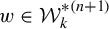 , it follows that
$\varepsilon _n> \varepsilon _{n+1}$
 . When
$n= \sum ^{k}_{i=0}u_i -1$
 , we deduce from (36) and (37) that

Since
$r_{k+1}>r_k$
 , we have
$\varepsilon _n> \varepsilon _{n+1}$
 . When
$n= \sum ^{k}_{i=0}u_i$
 , from (36) and (37), we derive that

and hence,
$\varepsilon _{n}>\varepsilon _{n+1}$
 .
We next show that

To this end, we will make use of the following fact: for any two finite words u and v,

see [Reference Moreira30, Lemma A.2] for details. We also note that
$v^2_k < 2^{r_k}$
 for all
$k\geq 1$
 . In fact, since
$v_k$
 is the maximum component among all vectors in
$X_k$
 , there exists
$\omega ^\prime \in X_k$
 having
$v_k$
 as one of its components. In this case, by the definition of
$X_k$
 , we have

which implies that
$v^2_k < 2^{r_k}$
 . When
$\sum ^{k-1}_{i=0}u_i < n < \sum ^k_{i=0}u_i$
 , for any
$ w \in \mathcal {W}^{*(n)}_k$
 , by (38), we derive that

which, together with (33), implies that

When
$n=\sum ^k_{i=0}u_i$
 , for any
$w \in \mathcal {W}_k$
 , it follows from (38) that

which, together with (34), implies that

4.4 Step IV: Computation of the lower limit in Lemma 4
We are ready to calculate the lower limit

Concerning the numerator in (39), for any
$\sum ^{k-1}_{i=0}u_i < n \leq \sum ^k_{i=0}u_i$
 , it follows from (35) that

Define

Then,

Turning to the denominator in (39), for any
$w_j= w^{(1)}_j w^{(2)}_j\cdots w^{(u_j)}_j \in \mathcal {A}_j$
 , by (38), we have

When
$\sum ^{k-1}_{i=0}u_i < n < \sum ^k_{i=0}u_i$
 , for any
$w=w_1w_2\cdots w_{k-1}w^{*(n)}_k \in \mathcal {W}^{*(n)}_k$
 , from (38), we derive that

Note that

Combining this with (42) and (43), we conclude that

which, together with (36), implies that

When
$n=\sum ^k_{i=0}u_i$
 , for any
$w=w_1w_2\cdots w_{k-1}w_k \in \mathcal {W}_k$
 , we deduce from (38) and (42) that

which, together with (37), implies that

We are now in a position to estimate the lower limit in (39). When
$\sum ^{k-1}_{i=0}u_i < n < \sum ^k_{i=0}u_i$
 , by (28) and the definition of
$U_n$
 in (40), we see that

Combining this with (41) and (44), we derive that

where the last inequality comes from
$0<C\leq 1$
 . When
$n=\sum ^k_{i=0}u_i$
 , it follows from (28) and (40) that

Combining this with (41) and (45), we conclude that

Since
$\{r_k\}_{k\geq 1}$
 is strictly increasing and
$r_k \to \infty $
 as
$k\to \infty $
 , we obtain

It follows from the definition of
$U_n$
 in (40) that

By (46) and (47), we derive that

which, together with (29) and Lemma 4, implies that

Letting
$\varepsilon \to 0$
 , we have

Combining the above four steps, we complete the proof of the Key Lemma.
Acknowledgments
The authors would like to thank the anonymous referee for valuable comments and suggestions, which have helped to improve the quality of this manuscript. The authors would also like to thank Prof. Min Wu and Prof. Lingmin Liao for helpful discussions.
Funding
L.F. was partially supported by the Natural Science Foundation of Jiangsu Province (No. BK20231452) andthe Stability Support Program for Basic Research (Grant No. WZJC202601001). C.G.M. was partiallysupported by CNPq and FAPERJ. Y.Z. was partially supported by the National Natural Science Foundation(Nos. 12671216 and 12271432) and the USTC–AUST Mathematics Basic Discipline Research Center.



