






No CrossRef data available.
Article contents
Thinking through prior bodies: autonomic uncertainty and interoceptive self-inference
Published online by Cambridge University Press: 28 May 2020
Abstract
The Bayesian brain hypothesis, as formalized by the free-energy principle, is ascendant in cognitive science. But, how does the Bayesian brain obtain prior beliefs? Veissière and colleagues argue that sociocultural interaction is one important source. We offer a complementary model in which “interoceptive self-inference” guides the estimation of expected uncertainty both in ourselves and in our social conspecifics.
Information
- Type
- Open Peer Commentary
- Information
- Copyright
- Copyright © The Author(s), 2020. Published by Cambridge University Press
References
Ainley, V., Apps, M. A. J., Fotopoulou, A. & Tsakiris, M. (2016) “Bodily precision”: A predictive coding account of individual differences in interoceptive accuracy. Philosophical Transactions of the Royal Society B: Biological Sciences 371(1708):20160003. https://doi.org/10.1098/rstb.2016.0003.CrossRefGoogle ScholarPubMed
Allen, M. & Friston, K. J. (2018) From cognitivism to autopoiesis: Towards a computational framework for the embodied mind. Synthese 195(6):2459–82. https://doi.org/10.1007/s11229-016-1288-5.CrossRefGoogle ScholarPubMed
Allen, M., Levy, A., Parr, T. & Friston, K. J. (2019) In the body's eye: The computational anatomy of interoceptive inference. BioRxiv 603928. https://doi.org/10.1101/603928.CrossRefGoogle Scholar
Allen, M. & Tsakiris, M. (2019) The body as first prior: Interoceptive predictive processing and the primacy. In The interoceptive mind: From homeostasis to awareness, 1st Edition, pp. 27–45. Oxford University Press.Google Scholar
Apps, M. A. & Tsakiris, M. (2014) The free-energy self: A predictive coding account of self-recognition. Neuroscience & Biobehavioral Reviews 41:85–97.CrossRefGoogle ScholarPubMed
Barrett, L. F. & Simmons, W. K. (2015) Interoceptive predictions in the brain. Nature Reviews Neuroscience 16(7):419–29. https://doi.org/10.1038/nrn3950.CrossRefGoogle Scholar
Bruineberg, J., Kiverstein, J. & Rietveld, E. (2018a) The anticipating brain is not a scientist: The free-energy principle from an ecological-enactive perspective. Synthese 195(6):2417–44. https://doi.org/10.1007/s11229-016-1239-1.CrossRefGoogle Scholar
Bruineberg, J., Rietveld, E., Parr, T., van Maanen, L. & Friston, K. J. (2018b) Free-energy minimization in joint agent-environment systems: A niche construction perspective. Journal of Theoretical Biology 455:161–78. https://doi.org/10.1016/j.jtbi.2018.07.002.CrossRefGoogle Scholar
Chanes, L. & Barrett, L. F. (2016) Redefining the role of limbic areas in cortical processing. Trends in Cognitive Sciences 20(2):96–106. https://doi.org/10.1016/j.tics.2015.11.005.CrossRefGoogle ScholarPubMed
Friston, K. J. & Frith, C. D. (2015a) A duet for one. Consciousness and Cognition 36:390–405. https://doi.org/10.1016/j.concog.2014.12.003.CrossRefGoogle Scholar
Friston, K. J. & Frith, C. D. (2015b) Active inference, communication and hermeneutics. Cortex 68:129–43. https://doi.org/10.1016/j.cortex.2015.03.025.CrossRefGoogle Scholar
Gallagher, S. & Allen, M. (2018) Active inference, enactivism and the hermeneutics of social cognition. Synthese 195(6):2627–48. https://doi.org/10.1007/s11229-016-1269-8.CrossRefGoogle ScholarPubMed
Lawson, R. P., Mathys, C. & Rees, G. (2017) Adults with autism overestimate the volatility of the sensory environment. Nature Neuroscience 20(9):1293–99. https://doi.org/10.1038/nn.4615.CrossRefGoogle ScholarPubMed
Limanowski, J. & Blankenburg, F. (2013) Minimal self-models and the free energy principle. Frontiers in Human Neuroscience 7:547. https://doi.org/10.3389/fnhum.2013.00547.CrossRefGoogle ScholarPubMed
Parr, T. & Friston, K. J. (2017a) Uncertainty, epistemics and active inference. Journal of the Royal Society Interface 14(136):20170376. https://doi.org/10.1098/rsif.2017.0376.CrossRefGoogle Scholar
Petzschner, F. H., Weber, L. A. E., Gard, T. & Stephan, K. E. (2017) Computational psychosomatics and computational psychiatry: Toward a joint framework for differential diagnosis. Biological Psychiatry 82(6):421–30. https://doi.org/10.1016/j.biopsych.2017.05.012.CrossRefGoogle Scholar
Powers, A. R., Mathys, C. & Corlett, P. R. (2017) Pavlovian conditioning-induced hallucinations result from overweighting of perceptual priors. Science 357(6351):596–600. https://doi.org/10.1126/science.aan3458.CrossRefGoogle ScholarPubMed
Pulcu, E. & Browning, M. (2019) The misestimation of uncertainty in affective disorders. Trends in Cognitive Sciences. https://doi.org/10.1016/j.tics.2019.07.007.CrossRefGoogle Scholar
Ramstead, M. J. D., Kirchhoff, M. D., Constant, A. & Friston, K. J. (2019b) Multiscale integration: Beyond internalism and externalism. Synthese 1–30. https://doi.org/10.1007/s11229-019-02115-x.Google Scholar
Ramstead, M. J. D., Kirchhoff, M. D. & Friston, K. J. (2019c) A tale of two densities: Active inference is enactive inference. Adaptive Behavior 36(03):181–204, 1059712319862774. https://doi.org/10.1177/1059712319862774.CrossRefGoogle Scholar
Seth, A. K. (2013) Interoceptive inference, emotion, and the embodied self. Trends in Cognitive Sciences 17(11):565–73. https://doi.org/10.1016/j.tics.2013.09.007.CrossRefGoogle ScholarPubMed
Seth, A. K. & Tsakiris, M. (2018) Being a beast machine: The somatic basis of selfhood. Trends in Cognitive Sciences 22(11):969–81. https://doi.org/10.1016/j.tics.2018.08.008.CrossRefGoogle ScholarPubMed
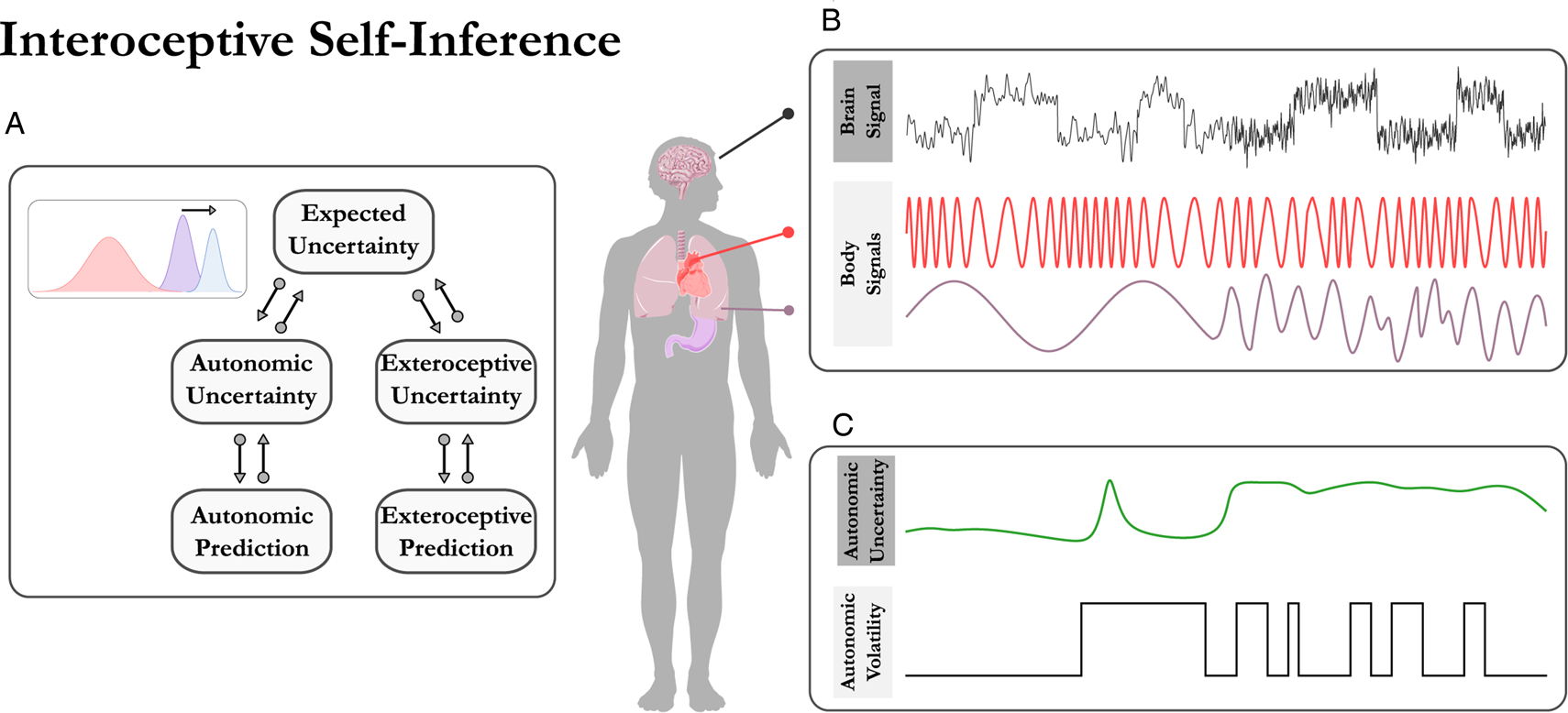
Figure 1. Interoceptive self-inference model. (A) Hierarchical precision-weighted inferences integrate confidence signals from the internal and external environment into an overall estimate of expected uncertainty. (B) For example, slow-respiratory oscillations stabilize cardiac cycles, resulting in low-autonomic uncertainty. In contrast, a volatile breath pattern increases baseline neural uncertainty, as illustrated in a simulated brain response to a steady state exteroceptive input. (C) These fluctuations can be modeled, for example by a dynamic reinforcement-learning approach in which the volatility of interoceptive state transitions inflates the estimate of autonomic uncertainty. Through inversion of the self-inference model to conspecifics, agents can predict the confidence of others’ beliefs.
Target article
Thinking through other minds: A variational approach to cognition and culture
 Samuel P. L. Veissière
[Opens in a new window]Samuel P. L. Veissière
, Axel Constant
[Opens in a new window]Axel Constant
, Maxwell J. D. Ramstead
[Opens in a new window]Maxwell J. D. Ramstead
, Karl J. Friston
[Opens in a new window]Karl J. Friston
and Laurence J. Kirmayer
[Opens in a new window]Laurence J. Kirmayer
Related commentaries (29)
Enculturation without TTOM and Bayesianism without FEP: Another Bayesian theory of culture is needed
Integrating models of cognition and culture will require a bit more math
Thinking through prior bodies: autonomic uncertainty and interoceptive self-inference
Author response
TTOM in action: Refining the variational approach to cognition and culture
Samuel P. L. Veissière
[Opens in a new window]Samuel P. L. Veissière
, Axel Constant
[Opens in a new window]Axel Constant
, Maxwell J. D. Ramstead
[Opens in a new window]Maxwell J. D. Ramstead
, Karl J. Friston
[Opens in a new window]Karl J. Friston
and Laurence J. Kirmayer
[Opens in a new window]Laurence J. Kirmayer
In their impressive synthesis, Veissière and colleagues argue that enactive social interaction is a prime ground for generating higher-order prior beliefs (both implicit and explicit). We share this enthusiasm for social–cultural patterning of priors, and also their comprehensive embrasure of the enactive and embodied turn within the larger predictive processing movement (Allen & Friston Reference Allen and Friston2018; Barrett & Simmons Reference Barrett and Simmons2015; Gallagher & Allen Reference Gallagher and Allen2018; Ramstead et al. Reference Ramstead, Kirchhoff, Constant and Friston2019b; Reference Ramstead, Kirchhoff and Friston2019c; Seth Reference Seth2013). As they elegantly argue, ontogenetic development provides a wealth of knowledge about how to behave in a given context. It follows that this “duet for one” of mutual prediction not only constrains how we engage with others, but also our own self-inference (Friston & Frith Reference Friston and Frith2015a; Reference Friston and Frith2015b). As such the proposal that much of our “repertoire of prior beliefs” emerges from socio-cultural interaction and enactive, embodied engagement is both feasible and exciting.
However, we disagree that “information from and about other people's expectations constitutes the primary domain” from which prior beliefs about “statistical regularities” (i.e., expected precision) arise. Although socio-cultural sources certainly contribute, we highlight the predominance of more than 1 million years of phylogenetic evolution in shaping our “prior bodies” as the key constitutive factor molding how we predict ourselves and other agents (Allen & Tsakiris Reference Allen and Tsakiris2019). In advance of any ontogenetic development, one is born with homeostatic and morphological features which shape the expected statistics of one's life, and these, in turn, provide a rich generative model which can be inverted to understand a wide range of human social behaviors.
Developing this view, we recently proposed a computational model of interoceptive self-inference (Allen et al. Reference Allen, Levy, Parr and Friston2019). Our model argues that the visceral body provides a fundamental constraint on belief precision, and that interoception serves to sample these rhythms so as to better estimate expected uncertainty. This model formalizes other more conceptual accounts of interoceptive inference in the domain of emotion (Barrett & Simmons Reference Barrett and Simmons2015; Chanes & Barrett Reference Chanes and Barrett2016; Seth Reference Seth2013; Seth & Tsakiris Reference Seth and Tsakiris2018), selfhood (Ainley et al. Reference Ainley, Apps, Fotopoulou and Tsakiris2016; Apps & Tsakiris Reference Apps and Tsakiris2014; Limanowski & Blankenburg Reference Limanowski and Blankenburg2013), and metacognition (Petzschner et al. Reference Petzschner, Weber, Gard and Stephan2017). Our model generalizes beyond these to argue that the primary homeostatic rhythms of the body fundamentally constrain prior beliefs about the precision, or confidence, of both interoceptive and exteroceptive belief updates. This to say, visceral rhythms embed primary control dynamics, or hyper-priors, on the agent's landscape of precision. This, in turn, dictates the confidence I assign to any shift in my posterior beliefs and provides a useful starting point for estimating self-precision in others.
To illustrate the core of our model (summarized in Fig. 1), consider the following example of sensory attenuation in the retina. In the eye, the pulsation of blood across the optic disk at each heartbeat distorts the retinal surface, briefly occluding ascending sensory information. In a hierarchical brain, this predictable fluctuation of precision is a crucial learning signal, which can be sampled via interoception to improve estimates of expected uncertainty (Parr & Friston Reference Parr and Friston2017a; Pulcu & Browning Reference Pulcu and Browning2019). Expected uncertainty, in turn, provides an invaluable control signal dictating how much I should update my beliefs in the face of new information; Bayesian decision theory tells us that when confronted with a volatile environment (or a volatile colleague), one should more rapidly update their beliefs in response to prediction error.
Interoceptive self-inference model. (A) Hierarchical precision-weighted inferences integrate confidence signals from the internal and external environment into an overall estimate of expected uncertainty. (B) For example, slow-respiratory oscillations stabilize cardiac cycles, resulting in low-autonomic uncertainty. In contrast, a volatile breath pattern increases baseline neural uncertainty, as illustrated in a simulated brain response to a steady state exteroceptive input. (C) These fluctuations can be modeled, for example by a dynamic reinforcement-learning approach in which the volatility of interoceptive state transitions inflates the estimate of autonomic uncertainty. Through inversion of the self-inference model to conspecifics, agents can predict the confidence of others’ beliefs.
Through simulation, we show that this simple coupling of sensory precision to the rhythm of homeostasis enforces a primary interaction between the body and our perception of the world. In our model, lesioning afferent viscerosensory information caused a cascade of interoceptive prediction error which elicit psychosomatic hallucinations, blunted belief updating, and attenuated physiological reactions. These domain-general alterations in precision ultimately cause agents to update their higher-order beliefs, resulting in top-down metacognitive biases (i.e., mis-estimation of expected uncertainty) that characterize many psychiatric and psycho-social illnesses (Lawson et al. Reference Lawson, Mathys and Rees2017; Powers et al. Reference Powers, Mathys and Corlett2017). In contrast, maladaptive prior beliefs about self-uncertainty can elicit misperception or hyper-arousal in the interoceptive domain. This equips the model with a deeply circular, enactive causation; my expectation of confidence in the world constrains my visceral inference and regulation, and the statistics of visceral rhythms constrain my exteroceptive percepts and beliefs.
Here perhaps is where there is the most potential for crosstalk between the model of Veissière and colleagues and interoceptive-self inference. Our model suggests that agents are imbued at birth with a repertoire of “embodied priors” or statistical regularities dictated by their morphological forms, which act as hyper-parameters on meta-cognition and learning (Allen & Tsakiris Reference Allen and Tsakiris2019). In particular, these priors influence the confidence or precision dictating the perceptual and emotional salience we assign to various interoceptive and exteroceptive outcomes. The notion of variational niche construction developed by Veissière and others can be cast as building ontogenetic refinement in addition to these fundamental constraints (Bruineberg et al. Reference Bruineberg, Kiverstein and Rietveld2018a; Reference Bruineberg, Rietveld, Parr, van Maanen and Friston2018b). That is to say, in thinking through other minds we demarcate novel boundaries of salience, refining the embodied set-points that define a landscape of precision for agents. We maintain, however, the hegemony of the phylogenetic body in setting these starting points; ultimately, the strongest possible source one can sample from concerning the volatility of others is found within oneself.
Acknowledgments
MA is supported by a Lundbeckfonden Fellowship (R272-2017-4345), and the AIAS-COFUND II fellowship program that is supported by the Marie Skłodowska-Curie actions under the European Union's Horizon 2020 (Grant agreement no. 754513), and the Aarhus University Research Foundation.