





No CrossRef data available.
Article contents
The multicultural mind as an epistemological test and extension for the thinking through other minds approach
Published online by Cambridge University Press: 28 May 2020
Abstract
The multicultural experience (i.e., multicultural individuals and cross-cultural experiences) offers the intriguing possibility for (i) an empirical examination of how free-energy principles explain dynamic cultural behaviors and pragmatic cultural phenomena and (ii) a challenging but decisive test of thinking through other minds (TTOM) predictions. We highlight that TTOM needs to treat individuals as active cultural agents instead of passive learners.
Information
- Type
- Open Peer Commentary
- Information
- Copyright
- Copyright © The Author(s), 2020. Published by Cambridge University Press
References
Benet-Martínez, V., Leu, J., Lee, F. & Morris, M. W. (2002) Negotiating biculturalism: Cultural frame switching in biculturals with oppositional versus compatible cultural identities. Journal of Cross-Cultural Psychology 33(5):492–516.CrossRefGoogle Scholar
Briley, D. A., Morris, M. W. & Simonson, I. (2005) Cultural chameleons: Biculturals, conformity motives, and decision making. Journal of Consumer Psychology 15(4):351–62.CrossRefGoogle Scholar
Cheng, C. Y., Lee, F. & Benet-Martínez, V. (2006) Assimilation and contrast effects in cultural frame switching: Bicultural identity integration and valence of cultural cues. Journal of Cross-Cultural Psychology 37(6):742–60.CrossRefGoogle Scholar
Cheon, B. K. & Hong, Y. (2019) Aversive responses towards culture fusion is moderated by the source of foreign cultural inflows. PLoS One (under review ).Google Scholar
Christopoulos, G. I. & Tobler, P. N. (2016) Culture as a response to uncertainty: Foundations of computational cultural. In The Oxford handbook of cultural neuroscience, eds. Chiao, J. Y., Li, S.-C., Seligman, R. & Turner, R., pp. 81–104. Oxford University Press.Google Scholar
Dayan, P. & Daw, N. D. (2008) Decision theory, reinforcement learning, and the brain. Cognitive, Affective, & Behavioral Neuroscience 8(4):429–53.Google Scholar
Friedman, N. P., Miyake, A., Corley, R. P., Young, S. E., DeFries, J. C. & Hewitt, J. K. (2006) Not all executive functions are related to intelligence. Psychological Science 17:172–179.CrossRefGoogle ScholarPubMed
Hong, Y., Morris, M. W., Chiu, C. & Benet-Martinez, V. (2000) Multicultural minds: A dynamic constructivist approach to culture and cognition. American Psychologist 55:709–720.CrossRefGoogle ScholarPubMed
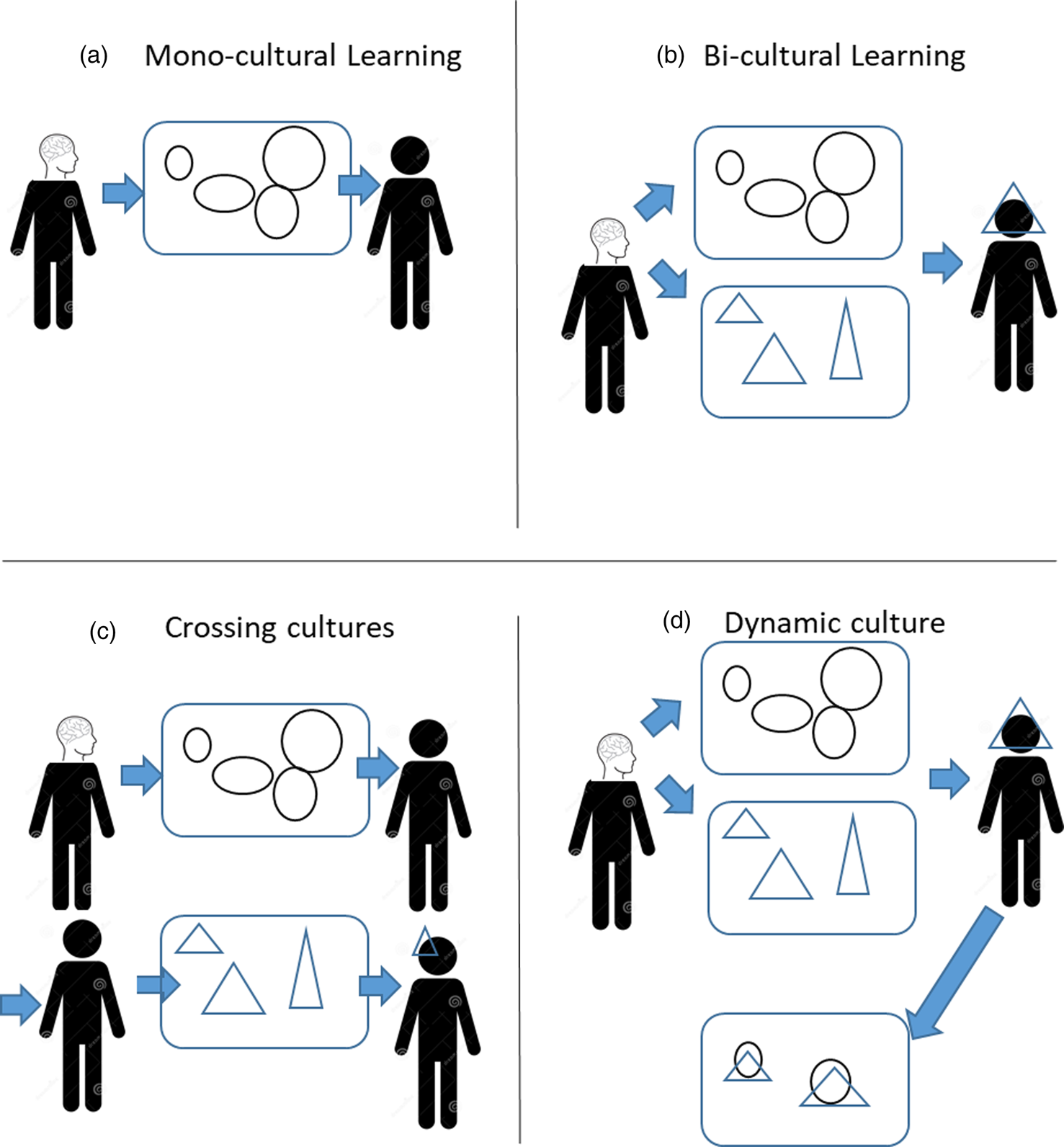
Figure 1. Four types of cultural learning. (a) Monocultural: learning one culture (“circle” culture). (b) Bicultural: concurrently learning two cultures (“circle” and “triangle” cultures). (c) Crossing cultures bicultural: learning a host culture followed by learning a new culture. (d) Dynamic culture: an individual re-constructs a new culture.
Target article
Thinking through other minds: A variational approach to cognition and culture
 Samuel P. L. Veissière
[Opens in a new window]Samuel P. L. Veissière
, Axel Constant
[Opens in a new window]Axel Constant
, Maxwell J. D. Ramstead
[Opens in a new window]Maxwell J. D. Ramstead
, Karl J. Friston
[Opens in a new window]Karl J. Friston
and Laurence J. Kirmayer
[Opens in a new window]Laurence J. Kirmayer
Related commentaries (29)
Enculturation without TTOM and Bayesianism without FEP: Another Bayesian theory of culture is needed
Integrating models of cognition and culture will require a bit more math
Thinking through prior bodies: autonomic uncertainty and interoceptive self-inference
Author response
TTOM in action: Refining the variational approach to cognition and culture
Samuel P. L. Veissière
[Opens in a new window]Samuel P. L. Veissière
, Axel Constant
[Opens in a new window]Axel Constant
, Maxwell J. D. Ramstead
[Opens in a new window]Maxwell J. D. Ramstead
, Karl J. Friston
[Opens in a new window]Karl J. Friston
and Laurence J. Kirmayer
[Opens in a new window]Laurence J. Kirmayer
 You have
Access
…I was constantly referring my new world to the old for comparison, and the old to the new for elucidation…It is painful to be conscious of two worlds.
— Mary Antin, Russian Jew immigrant to USA (p. 3) (Antin Reference Antin1912)
Thinking through other minds (TTOM) offers an excellent, multi-level account aiming at explaining how individuals learn a specific culture – typically, the culture that the individual is exposed to during childhood. This framework remains to be tested and improved against a wider range of cultural phenomena.
Culture is not monolithic – in fact, individuals could acquire knowledge of multiple cultures and carry multiple cultural identities. Many cultural phenomena are essentially dynamic and involve drastic changes, including within the individual (Fig. 1). A typical example is the bicultural individual, that is, individuals who have been substantially exposed to two cultures (either concurrently during early childhood or sequentially with secondary enculturation happening later in life). Second, dynamic cultural phenomena could emerge when political or other events accentuate or suppress or even create a new cultural identity.
Four types of cultural learning. (a) Monocultural: learning one culture (“circle” culture). (b) Bicultural: concurrently learning two cultures (“circle” and “triangle” cultures). (c) Crossing cultures bicultural: learning a host culture followed by learning a new culture. (d) Dynamic culture: an individual re-constructs a new culture.
We explain these phenomena, elaborate their importance for testing TTOM, and discuss tools for its empirical assessment.
The bicultural phenomenon
The bicultural individual “knows” that the very same behavior could have different causes, interpretations, and consequences depending on the culture (context) it is manifested. This critical ability to navigate different cultural frames is termed cultural frame switching (Briley et al. Reference Briley, Morris and Simonson2005; Hong et al. Reference Hong, Morris, Chiu and Benet-Martinez2000) and has been adequately demonstrated – yet, the exact computational accounts are hypothesized at best.
Using free-energy principles (FEP) terminology, the bicultural mind not only has many generative models, but, also, the ability to effortlessly switch between them. Antithetical cultural identities might disrupt cultural switching (Benet-Martínez et al. Reference Benet-Martínez, Leu, Lee and Morris2002) and understanding the underlying processes could be a critical test for the FEP framework. Moreover, adopting different generative models entails different pragmatic affordances and, eventually, different decision computations. Crucially, even short-lived cultural cues, such as the linguistic environment or visual stimuli, could alter attitudes, behavior, and choices of biculturals (Cheng et al. Reference Cheng, Lee and Benet-Martínez2006). This mechanism can be harnessed to experimentally “induce” cultural frames (Hong et al. Reference Hong, Morris, Chiu and Benet-Martinez2000).
Crossing cultures
This is a type of bicultural individuals whose native culture has been well established, with enculturation processes associated with the secondary (“host”) culture ensuing. Typical examples include immigrants, “expatriates,” students at a foreign country, and even sojourners. Thus, the exposure and immersion to a new culture might depend on the intergroup relationships between the immigrant groups and the host society, which will in turn evoke learning, unlearning, and relearning of the new and native culture (Christopoulos & Tobler Reference Christopoulos, Tobler, Chiao, Li, Seligman and Turner2016). Bicultural identity processes (Benet-Martínez et al. Reference Benet-Martínez, Leu, Lee and Morris2002) mentioned are also applicable. Understanding these individuals within the TTOM framework is particularly interesting, as the whole process of enculturation is observable and reportable and TTOM predictions can be tested – including neurobiological responses.
For the TTOM framework, the individual-crossing cultures needs to exercise active inference to learn and understand the new environment. Given that uncertainty substantially increases in a new culture, attentional salience would be intensified. Thus, understanding attentional selection processes and the role of the native culture priors are critical questions: An individual who substantially relies on the priors and expectations of her native culture might face substantial enculturation difficulties; on the other hand, rebuilding a new generative model could be an unnecessarily slow process. It would be interesting if FEP could generate hypothetical models that demonstrate how secondary enculturation happens, fails, or succeed. Finally, the TTOM framework emphasizes that social learning is based on leveraging trusted others – yet, the thorny problem for individuals crossing cultures is to identify these trusted others. Thus, locating the deontic cues in a new culture is a central process of secondary enculturation.
Individuals as active cultural agents
There is a third phenomenon where political or other events accentuate cultural aspects and could even create relatively new cultural identities – even within the very same cultural space. For instance, the recent social movement in Hong Kong following the proposal of the extradition bill has amplified the differentiation between the Hong Kong and Mainland Chinese cultures (cf. Cheon & Hong Reference Cheon and Hong2019). In another historical example, the expulsion of Singapore from the Malaysia led to the emergence of an independent nation. Since then, Singapore developed her own cultural identity, building on cultural affordances from distinct cultural heritages (Malay, Chinese, Indian, and other mixed cultures – e.g., Peranakan).
Such phenomena are also of particular interest, as the cultural agent has to not only learn, unlearn, and relearn, but, essentially, to actively “construct” a new culture. This is a challenge for the TTOM which (probably) treats the individual as a passive agent; however, individuals assess, interpret, shape, and further develop culture as active culture agents.
Cognitive flexibility, model-free, and model-based learning
All examples described above would need to elicit neurocognitive functions that go beyond pure learning. The obvious candidate here is cognitive flexibility (CF) – the capacity to adapt to change and problem solve in new situations (Friedman et al. Reference Friedman, Miyake, Corley, Young, DeFries and Hewitt2006). Neurocomputational models of CF overall, and of learning, unlearning, and relearning specifically, have been specified (Dayan & Daw Reference Dayan and Daw2008, among others) and the FEP computational approaches can accommodate them. Thus, we would welcome FEP computational models building on CF neurocomputational processes to interpret dynamic cultural phenomena. The models can be empirically tested, extending familiar neurocognitive assessments (probabilistic reversal learning, etc.).
Beyond intra- and cross-cultural studies, dynamic multicultural phenomena can offer significant insights into how culture is shaped. The TTOM approach proposed by Veissière et al. could explain the way cultural agents adapt to a new culture. Our proposal of examining the multicultural mind will not only be a strong epistemological test for the TTOM theory, but will help addressing complex and pragmatic cultural phenomena.