





No CrossRef data available.
The power of the weak: When altruism is the equilibrium
Published online by Cambridge University Press: 08 May 2023
Abstract
A rational economic analysis complements Grossmann's fearful ape hypothesis. Two examples of mixed-motive games with strong inter-dependence (i.e., weak chirping nestling, boxed pigs) demonstrate that signaling weakness is a dominant strategy. Weakness elicits cooperative, caring response, comprising the equilibrium of the game. In extensive form, a reliable reputation of weakness elicits caring as a sequential equilibrium.
Information
- Type
- Open Peer Commentary
- Information
- Copyright
- Copyright © The Author(s), 2023. Published by Cambridge University Press
References
Baldwin, B. A., & Meese, G. B. (1979). Social behaviour in pigs studied by means of operant conditioning. Animal Behaviour, 27, 947–957. https://doi.org/10.1016/0003-3472(79)90033-2CrossRefGoogle Scholar
Camerer, C., & Weigelt, K. (1988). Experimental tests of a sequential equilibrium reputation model. Econometrica, 56(1), 1–36. https://www.jstor.org/stable/1911840CrossRefGoogle Scholar
Camerer, C. F., & Fehr, E. (2006). When does “economic man” dominate social behavior? Science (New York, N.Y.), 311(5757), 47–52. doi: 10.1126/science.1110600CrossRefGoogle Scholar
Henrich, J., Boyd, R., Bowles, S., Camerer, C., Fehr, E., Gintis, H., … Tracer, D. (2005). “Economic man” in cross-cultural perspective: Behavioral experiments in 15 small-scale societies. Behavioral and Brain Sciences, 28(6), 795–815. https://doi.org/10.1017/S0140525X05000142CrossRefGoogle ScholarPubMed
Kreps, D. M., & Wilson, R. (1982). Sequential equilibria. Econometrica, 50(4), 863–894. https://doi.org/10.2307/1912767CrossRefGoogle Scholar
Levitt, S. D., & List, J. A. (2007). What do laboratory experiments measuring social preferences reveal about the real world? Journal of Economic Perspectives, 21(2), 153–174. doi: 10.1257/jep.21.2.153CrossRefGoogle Scholar
Smith, V. L. (2003). Constructivist and ecological rationality in economics. American Economic Review, 93(3), 465–508. doi: 10.1257/000282803322156954CrossRefGoogle Scholar
Zahavi, A. (1987). The theory of signal selection and some of its implications. In Delfino, V. P. (ed.), International symposium of biological evolution (pp. 305–327). Adriatica Editrice.Google Scholar
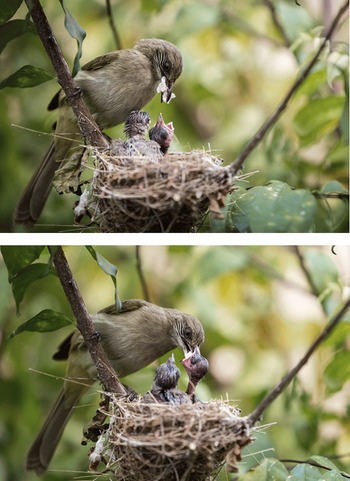
Figure 1. Feeding the weak first.
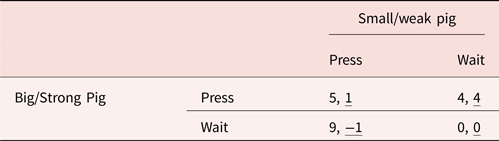
Table 1. Outcomes in the Boxed Pigs game
Target article
Related commentaries (28)
Beyond the fearful ape hypothesis: Humans are also supplicating and appeasing apes
Conceptualization, context, and comparison are key to understanding the evolution of fear
Fearful apes, happy apes: Is fearfulness associated with uniquely human cooperation?
Fearfulness: An important addition to the starter kit for distinctively human minds
Hominin life history, pathological complexity, and the evolution of anxiety
More than fear: Contributions of biobehavioral synchrony and infants' reactivity to cooperative care
Social learning and the adaptiveness of expressing and perceiving fearfulness
 You have
Access
Grossmann offers the fearful ape hypothesis: “… in the context of the strong interdependence … heightened fearfulness was adaptive… facilitate care-based responding … increasing cooperation with mothers and others” (target article, sect. 1 [Introduction], para. 2). Grossmann presents behavioral level and neuro-chemical brain responses to signals of fear. Phylogenetic research and ontogenetic research support the notion of heightened sensitivity to fear signals and the association to caring or cooperative responses.
This commentary offers a complementing game-theory rationale that supports Grossmann's fearful ape hypothesis. We present two famous examples of mixed-motive games with strong interdependence between asymmetric players. In both examples, a strong player's caring response for a weak player is economically rational, establishing the equilibrium of the game.
Example 1: The weak chirping nestling
This example is discussed in the Selfish Gene (Dawkins, Reference Dawkins1976, Reference Dawkins1989, Ch. 8). Referring to siblings' competition over parental investment, Dawkins first notes that being strong is an advantage. But what about the weak? Considering a bird feeding its nestlings, Dawkins notes that the weakest nestling sometimes chirps the loudest to get more than its fair share of food (see Fig. 1). Zahavi (Reference Zahavi and Delfino1987) speculated that because loud chirps could attract predators to the nest, the mother's best response is to care for the loud chirper first to make it quiet and protect the nest. In terms of economic rationality, chirping loud is a dominant strategy for the weakest nestling, and feeding the weak nestling first is the stable solution of the game. According to Nash equilibrium, no player (i.e., the bird, weakest nestling, other nestlings) can gain more by unilaterally changing their behavior.
Feeding the weak first.
Example 2: The boxed pigs
A second example refers to “the Boxed Pigs” game (Baldwin & Meese, Reference Baldwin and Meese1979). A big (strong) pig and a small (weak) pig are put in a box. Pressing a lever on one end of the box dispenses food at the other end of the box. Each pig has to choose between “wait” or “press.” The food equals 10 utility units. Pressing the lever (and running to the other end of the box) costs two utility units (−2 for Press choice). If the weak pig presses the lever and the strong pig waits, the strong pig gets to the food first and consumes nine units, leaving only one unit for the weak pig. If the strong pig presses the lever and the weak pig waits, it gets to the food first and consumes four units of the food. If both press the lever and arrive at the same time, the strong pig will consume seven units and the weak pig will consume three units of the food. Recall that whoever presses the lever loses two utility units. Table 1 summarizes the outcomes for each pig in the four choice combinations of the game. In the lower-right cell both pigs wait and get nothing. In the upper-left cell both pigs press, arrive together to the food, and both pay the cost of pressing. In the lower-left cell the strong pig gains at the expense of the weak pig (selfish outcome). In the upper-right cell the small pig gains at the expense of the strong pig (caring outcome).
Outcomes in the Boxed Pigs game
Note. Underlined values indicate food units for the small/weak pig.
Note that regardless of the choice of the strong pig, the weak pig is always better off waiting (than pressing). Thus, “wait” is the dominant strategy for the weak pig. The strong pig does not have a dominant strategy, but given that the small pig waits, the strong pig must press the lever or it will end up with nothing. The stable solution of the game is the caring outcome. The small pig gets all the four units of food it can consume, and the strong pig is left with just four units (i.e., 10 units, minus the “press” cost of two, minus four units consumed by the weak pig). This is a Nash equilibrium and neither the small nor the big pig can gain more by unilaterally changing their behavior.
Consistent with Grossmann's proposal, both examples demonstrate “the power of the weak” in eliciting a caring response. An economical rational analysis indicates that weakness can be a dominant strategy, leading to an equilibrium, where a strong player “cares” for a weak player (the bird feeds the weakest nestling first, the strong pig “sacrifices” its needs to provide for the weak pig).
We need to bridge the gap between these one-shot games and Grossmann's perspective of evolutionary based, brain-wired caring response to fear signals. We thus consider the above examples in extensive form where they are repeated over and over. Will the bird continue to feed the weak nestling? Will the strong pig keep pressing the lever?
In extensive form games, we consider sequential equilibrium and the effect of reputation. Reputation of a player is built through the history of their choices in former interactions (i.e., sub-games). Reliable reputations raise expectations for the player's future choices and guide the behavior of other players. If the equilibrium of the sub-game becomes the stable solution of the long, repeating game, it presents sequential equilibrium (e.g., Camerer & Weigelt, Reference Camerer and Weigelt1988; Kreps & Wilson, Reference Kreps and Wilson1982). If the weak nestling establishes a reliable reputation of chirping, the bird will repeatedly feed it first. If the small pig consistently waits in each (or most) sub-games, the big pig will continue to provide the food. Beyond the above examples, economists consistently document prosocial altruistic behavior in a range of one-shot and repeated games (e.g., Camerer & Fehr, Reference Camerer and Fehr2006; Henrich et al., Reference Henrich, Boyd, Bowles, Camerer, Fehr, Gintis and Tracer2005; Levitt & List, Reference Levitt and List2007; Smith, Reference Smith2003). Complementing Grossmann's review, a rational economic analysis of strong asymmetric interdependence supports the notion that signaling fear and weakness can effectively elicit a cooperative, caring response.
Acknowledgments
We thank Professor Avishai Henik for his support and inspiration.
Financial support
This research received no specific grant from any funding agency, commercial, or not-for-profit sectors.
Competing interest
None.