

Introduction
In Diod. 18.9, the author recounts the measures taken by the Athenians to prepare for their rebellion against the Macedonians after the death of Alexander. Leosthenes was sent to Taenarum to recruit mercenaries who had fled from Asia, and to prepare for the war.Footnote 1 Diod. 18.9.2 contains two principal ideas: firstly, that the Athenians communicated secretly with Leosthenes to hire the mercenaries and act as if he were operating independently; secondly, that because Antipater considered Leosthenes to be inept, the Athenians would have more time to prepare for war. The main passage under discussion follows (18.9.3):
διὸ καὶ Λεωσθένης μετὰ πολλῆς ἡσυχίας μισθωσάμενος τοὺς προειρημένους παραδόξως ἑτοίμην ἔσχε πρὸς τὰς πράξεις ἀξιόλογον δύναμιν· ἐστρατευμένοι γὰρ κατὰ τὴν Ἀσίαν πολὺν χρόνον καὶ πολλῶν καὶ μεγάλων ἀγώνων μετεσχηκότες ἀθληταὶ τῶν κατὰ πόλεμον ἔργων γεγένηντο.
In this sentence many translators (see below) have chosen to translate the phrase μετὰ πολλῆς ἡσυχίας as ‘very quietly’ or ‘secretly’, but, as we will see, this translation is inappropriate and mistaken. The Athenians clearly wanted Antipater to be aware that it was indeed Leosthenes preparing for war; hence, the idea of secrecy and Leosthenes’ actions should not be linked by διὸ καί. The notion of secrecy would contradict the aims of the Athenians, and this construction is inappropriate.
The supposedly secretive nature of Leosthenes’ role in procuring mercenaries for the Lamian War remains consistently overstated. Killed in a skirmish below Lamia in the early stages of the war, Leosthenes was eulogised by Hyperides in a fashion befitting the greatest of Greek heroes. And, although he was remembered as a heroic but tragic figure, his reputation may ultimately owe more to the quality of his funeral oration than to his own achievements.Footnote 2 The influence of this literary fame continues and can still be seen in modern historical perspectives.Footnote 3
This altered perspective can be found in translations of Diod. 18.9.3 where he discusses Leosthenes’ role in recruiting mercenaries for the Lamian War. As it is increasingly the case that modern readers access Diodorus – the most extensive surviving source for the period – through translations, such perceptions are in danger of obscuring textual reality.Footnote 4 Translation of ancient source material both reflects and forms the basis of historical perception. An examination of the translation of 18.9.3 – in particular the phrase μετὰ πολλῆς ἡσυχίας – into the major languages of classical scholarship will demonstrate that translations, and consequently perceptions of Leosthenes’ involvement in the Lamian War, are not supported by Diodorus’ pattern of linguistic choice.
Furthermore, beyond simply pointing to the perils of reading ancient sources in translation, it is this kind of linguistic and thematic consistency between books, to which different sources are attributed, that suggests a unity that Diodorus’ work has often been accused of lacking.
Diodorus 18.9.3 in translation
Consider five frequently cited translations of Diodorus’ passage describing Leosthenes’ preparations for war. We may begin by considering the Greek text and several translations concerning the first half of the passage, and we shall address the latter half below:Footnote 5
διὸ καὶ Λεωσθένης μετὰ πολλῆς ἡσυχίας μισθωσάμενος τοὺς προειρημένους παραδόξως ἑτοίμην ἔσχε πρὸς τὰς πράξεις ἀξιόλογον δύναμιν. (Diod. 18.9.3)
-
1. Leostene adunque in gran silenzio reclutò i soldati indicatigli; e contro quanto si sarebbe mai aspettato, egli ebbe all'uopo truppa non volgare … (Compagnoni (Reference Compagnoni1822))
-
2. Milites ergo iam indicatos in magno silentio conduxit Leosthenes, ac praeter opinionem copias non vulgares ad rem gerendam promptas habuit. (Dindorf (Reference Dindorf1826))
-
3. Accordingly Leosthenes had very quietly hired the troops mentioned above and, contrary to general belief, had secured a considerable number of men ready for action. (Geer (Reference Geer1947))
-
4. C'est pourquoi Léosthène, qui avait engagé ces gens en grand silence, disposa à l’étonnement général d'une armée considérable prête à entrer en action. (Goukowsky (Reference Goukowsky1978))
-
5. So warb denn Leosthenes in aller Ruhe die schon oben erwähnten Mannschaften an und bekam damit zur allgemeinen Streitmacht von beachtlicher Stärke in die Hand. (Veh and Wirth (Reference Veh and Wirth2005))
Translating πολλὴ ἡσυχία as ‘gran silenzio’, ‘magno silentio’, ‘very quietly’, ‘grand silence’ or ‘aller Ruhe’ may seem reasonable, since ‘silence’ is often an appropriate translation for ἡσυχία in classical literature. However, in this context these translations create the unavoidable impression that Leosthenes carried out his recruitment in secret, especially since μετὰ πολλῆς ἡσυχίας μισθωσάμενος clearly does not mean in a literal way that the mercenaries were hired in a whispered voice, or with hand signals. And this implication of secrecy is inconsistent with Diodorus’ use of the noun ἡσυχία and cognate forms throughout his surviving work.Footnote 6 Diodorus employed these words to convey the ideas of ‘silence’, ‘peace’ or, more often, the condition or state resulting from inaction (see below). Had Diodorus wanted to communicate a sense of secrecy, he would most likely have used the adverb λάθρᾳ or an appropriate synonym.Footnote 7
When silence is not meant absolutely, then Diodorus’ use of ἡσυχία carries the sense of limiting the intensity of the action. The translator must choose a word to suit the Greek context, while being cautious in case the word in the recipient language introduces misleading implications of its own. This is the nature of the problem we are dealing with, and it has implications beyond the merely pedantic, as the interpretation significantly influences the perception of Leosthenes’ role in the critical preparations in the lead-up to the Lamian War. Indeed, it is likely that the prevailing historical opinion about Leosthenes (given his reputation from sources such as Hyperides) influenced the translators mentioned above into giving the impression that he gathered a force with deliberate secrecy.
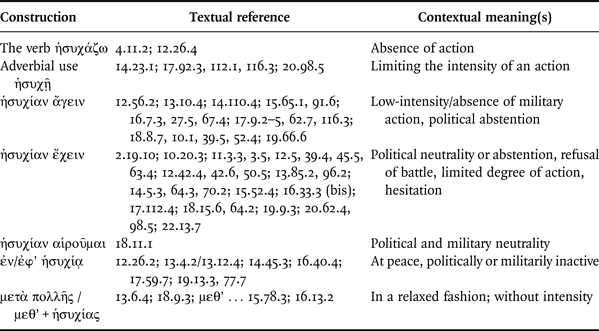
I argue instead that μετὰ πολλῆς ἡσυχίας μισθωσάμενος explains that the mercenaries were recruited in a leisurely manner, without great urgency. The sentence is not praise for Leosthenes’ discretion but condemnation of his lack of vigour. The survey of the full scope of Diodorus’ usage in Table 1 below, which shows instances of the verb ἡσυχάζω, ἡσυχῇ and ἡσυχία, will confirm this thesis. Diodorus used ἡσυχία to express the absence, or diminished quantity or quality, of an activity in contrast to its expected level of intensity. He employed these forms as terms of limitation. Thus, at 18.9.3 he does not mean the description of Leosthenes’ actions leading up to the war to be considered secret.
Diodorus’ usage of ἡσυχία and related words.

Diodorus 18.8–19: ἡσυχία and the Lamian War
During his narrative of the Lamian War Diodorus uses ἡσυχία on five occasions: 18.8.7, 9.3, 10.1, 11.1, 15.6. We have examined 18.9.3, and when we look at the other four examples, which shed further light on Diodorus’ meaning as it applies specifically to events involving Leosthenes, we can confirm that Diodorus implies no sense of secrecy.
-
1. 18.8.7
The Athenians fear to take military action while Alexander is alive. They neither act directly, nor raise any objection to the king's provocative Exile's Decree. Thus, ἡσυχίαν ἦγον here describes their being completely docile and passive. The Athenians ‘remained quiet’ in the sense that they waited, inactive, watching for (ἐπιτηροῦντες) an opportunity presumably to be presented by Fate.
-
2. 18.10.1
The Athenian Assembly was fractured between the men of property (τῶν κτηματικῶν) and the demagogues (τῶν δημοκόπων). The former supported the policy of appeasement and τὴν ἡσυχίαν ἄγειν, while the latter took a hawkish position: παρακαλούντων ἐρρωμένως ἔχεσθαι τοῦ πολέμου, ‘urging them to cleave resolutely to war’; this is contrasted with the former, whose policy of τὴν ἡσυχίαν ἄγειν therefore implies a pacific and cautious course.
-
3. 18.11.1
The Lamian War divided Greece. Those Greeks who were well disposed towards the Macedonians (πρὸς Μακεδόνας ἀπέκλινον) refused to participate: τὴν ἡσυχίαν εἵλοντο. This is the only use of αἱρέω with ἡσυχία in Diodorus, and the force of this verb (‘choose, prefer’) is intensified as it is in response to the actions of the Athenian ambassadors inciting them to war at 18.10.5 (τῇ συνήθει τῶν λόγων δεινότητι παρορμώντων πρὸς τὸν πόλεμον). In this case ἡσυχία is the political middle ground between pro-Macedonian sentiment and an active Athenian alliance. These Greeks are acting neither furtively nor quietly: they assertively and openly ‘prefer’ their neutrality.
-
4. 18.15.6
Antipater has deliberately opted for a temporary pause in military action: οὗτος δὲ κρίνας ἐπὶ τοῦ παρόντος ἡσυχίαν ἔχειν. It is clear that the ‘silence’ of ἡσυχία refers strictly to the cessation of hostilities, while his actions are still well known to Antiphilus and the Greeks. He is not acting in secret. The expression denotes the absence, or diminished nature, of activity in contrast to its normal intensity.
Thus Diodorus’ use of the term in relation to Leosthenes’ activity before the Lamian War in the recruiting of mercenaries was meant not to indicate the idea of secrecy, but to criticise Leosthenes’ lack of vigour. When Diodorus wanted to clarify that an action was carried out secretly, as the various translators were inclined to believe he did in 18.9.3, he often used λάθρᾳ, a term occurring in the narrative with the same frequency as ἡσυχία. Diodorus had the vocabulary available to distinguish the clandestine from the dilatory. This ability is demonstrated by the following example at 18.64.2 where Diodorus’ language clearly distinguishes between inactivity and furtive behaviour:
… μετὰ δὲ ταῦτα τῶν Ἀθηναίων ἐπί τινας ἡμέρας ἡσυχίαν ἐχόντων ἔλαθε νυκτὸς κατ’ ὀλίγους στρατιώτας εἰσαγαγὼν εἰς τὴν Μουνυχίαν …
… afterwards the Athenians remained inactive for several days while he [Nicanor] covertly landed small parties of soldiers into Munychia by night …
The Athenians were inactive (ἡσυχίαν ἐχόντων) while Nicanor moved his men in secret (ἔλαθε … εἰσαγαγών). It is clear by the context what Diodorus means by ἡσυχία here.
As a result, the translator and reader must be cautious when interpreting ἡσυχία and not confuse it with the English association of ‘quiet’ with ‘in secret’. Diodorus distinguished between the two ideas, and the translator must maintain that division throughout the Bibliothēkē. In the case of 18.9.3, the persistent inclination to assign an element of secrecy or guile to the mercenary action is the result of a conflation of circumstances: the translators and commentators have confused the secrecy of the negotiations between Athens and Leosthenes with the negotiations between Leosthenes and the mercenaries. These are discrete events: the former secret, but the latter deliberately public. This misunderstanding ignores one of the principal aims of Athenian strategy: to distract Antipater with Leosthenes’ very prominent role in the preparations for war. Leosthenes was to be the highly visible public face of the Athenian revolt, concealing only the transactions he was having with Athens, not those with the mercenaries.
μετὰ πολλῆς ἡσυχίας
A more detailed examination of the unusual construction μετὰ πολλῆς ἡσυχίας will demonstrate that the current view of Leosthenes’ contribution to the Lamian War is, to a very large extent, the product of the misinterpretation, and the perpetuation of this misinterpretation in translation, of this critical phrase. Although ἡσυχία is a commonly used noun, the complete phrase μετὰ πολλῆς ἡσυχίας is, as we would expect, comparatively unusual, appearing only once elsewhere in the Bibliothēkē. We do find μεθ’ ἡσυχίας on two occasions in Diodorus (15.78.3; 16.13.2), where, in each case, the preposition and noun temper the strength of a governing verb to emphasise a degree of difference from intensive action of the verb. At 18.9.3, the addition of πολύς serves even to enhance that function. Both the complete phrase's appearance in books of the Bibliothēkē which are accepted to be drawn from different sources (see below on 13.6.4), and its infrequency, suggest that it is a phrase Diodorus himself wrote.
Before the Common Era, this phrase is to be found in only one other Greek writer, Polybius (32.13.3), who writes of an episode involving Gaius Fannius and a group of legates negotiating with Dalmatians in the second century BC:
… εἰ μὴ συνείξαντες τῷ καιρῷ μετὰ πολλῆς ἡσυχίας ἐποιήσαντο τὴν ἀπόλυσιν.
… unless they had not acquiesced to the situation and made their departure with little commotion.
And, in Diodorus’ surviving work, the complete phrase μετὰ πολλῆς ἡσυχίας is to be found only once elsewhere, at 13.6.4–5:
οἱ μὲν οὖν Συρακόσιοι κατὰ τὴν τεταγμένην νύκτα ἦγον τὸ στρατόπεδον ἐπὶ τὴν Κατάνην, οἱ δὲ Ἀθηναῖοι παραπλεύσαντες εἰς τὸν μέγαν λιμένα τῶν Συρακοσίων μετὰ πολλῆς ἡσυχίας τοῦ τε Ὀλυμπίου κύριοι κατέστησαν καὶ πάντα τὸν περικείμενον τόπον καταλαβόμενοι παρεμβολὴν ἐποιήσαντο.
And so it came about that on the pre-determined night the Syracusans led their army to Catane, but the Athenians, sailing around into the Great Harbour of the Syracusans, made themselves masters of the Olympiaeum with great ease and, capturing the entire area about it, they constructed a camp.
Here the Athenians have employed a Catanian double-agent to misdirect the Syracusan army so that they can attack (13.6.1–4). Again, the phrase μετὰ πολλῆς ἡσυχίας has been misunderstood in similar ways.Footnote 8 Some scholars attach it mainly to παραπλεύσαντες, but even so the point is unlikely to be that the Athenians sailed the 50 km from Catane to Syracuse silently. There was no need for this during the voyage, nor when they arrived, since they knew the Syracusan army had left in the opposite direction. The Athenian arrival was relaxed and leisurely, in contrast to the usual naval attack with paean.Footnote 9 Even though the Athenian mission takes place at night, the point is not to conceal their arrival at Syracuse but to conceal their absence from Catane from the Syracusan army. Nor is the fact that the mission is next called an ἀπάτη (‘deception’, 13.6.5) good reason to interpret μετὰ πολλῆς ἡσυχίας in a way that connotes stealth, since the use of ἀπάτη is fully justified already by the Athenians’ use of a double-agent to misinform the Syracusans.Footnote 10
In any case, a more plausible role for the prepositional phrase μετὰ πολλῆς ἡσυχίας is not to modify παραπλεύσαντες but to modify the main verbs which follow, κατέστησαν and ἐποιήσαντο.Footnote 11 In this sentence παραπλεύσαντες acts with the force of an adjective modifying οἱ Ἀθηναῖοι and already attracts one modifying prepositional phrase, εἰς τὸν μέγαν λιμένα. As prepositions have functionally evolved from adverbs, compositionally their original function was to act as modifiers of verbs, and the second prepositional phrase (μετὰ πολλῆς ἡσυχίας) is more suited to modifying the verbs which follow than the preceding participle.Footnote 12
A revised translation of 18.9.3
It is, then, with these examples in mind that a revised translation – and ultimately a revised understanding – of the original passage (Diod. 18.9.3) becomes necessary, a translation which is more consistent with Diodorus’ established patterns of meaning:
διὸ καὶ Λεωσθένης μετὰ πολλῆς ἡσυχίας μισθωσάμενος τοὺς προειρημένους παραδόξως ἑτοίμην ἔσχε πρὸς τὰς πράξεις ἀξιόλογον δύναμιν· ἐστρατευμένοι γὰρ κατὰ τὴν Ἀσίαν πολὺν χρόνον καὶ πολλῶν καὶ μεγάλων ἀγώνων μετεσχηκότες ἀθληταὶ τῶν κατὰ πόλεμον ἔργων ἐγεγένηντο.
Accordingly, Leosthenes went about enlisting the men mentioned previously as mercenaries without great urgency and, surprisingly, had a noteworthy force ready for action; for these men, having soldiered throughout Asia for a considerable time and having participated in many major battles, had become masters of the art of war.Footnote 13
Our new interpretation of μετὰ πολλῆς ἡσυχίας allows us also to make sense of διὸ καί (‘accordingly’), which, as noted above, is illogical on the other interpretation. The conjunctions ought to link this sentence smoothly as a consequence or corollary of the preceding sentence, i.e. the revelation that Leosthenes’ reputation was generally poor.Footnote 14 The translations given earlier in this article acknowledge this (‘adunque’ in Compagnoni; ergo in Dindorf; ‘c'est pourquoi’ in Goukowsky; ‘accordingly’ in Geer; and ‘so … den’ in Veh). Yet Leosthenes’ discretion and achievement in building a considerable force do not follow from Antipater's contempt for him, discussed in 18.9.2 – quite the reverse. Our revised translation maintains the internal consistency of the passage by connecting Antipater's scorn directly to Leosthenes’ nonchalance.
Similarly, the treatment of παραδόξως is problematic in translations. It must be noted that what is ἀξιόλογον (literally, ‘worthy of mention’) is the force of mercenaries, and not necessarily a vast number of men. Emphasising size over quality is a corruption of meaning that is forced upon the translator who tries to maintain the original incorrect assumption that Leosthenes gathered men discreetly, the paradox thus being that he acquired a large number of men.Footnote 15 Now we can return to the previously examined translations and their understanding of the latter half of Diodorus’ passage – as, in doing so, we will see that the paradox between size and quietness is avoided:
ἐστρατευμένοι γὰρ κατὰ τὴν Ἀσίαν πολὺν χρόνον καὶ πολλῶν καὶ μεγάλων ἀγώνων μετεσχηκότες ἀθληταὶ τῶν κατὰ πόλεμον ἔργων γεγένηντο.
-
1. … poichè trattavasi d'uomini i quali lungo tempo aveano militato in Asia, erano stati in molte e grandi battaglie, ed erano nel mestiere delle armi esercitatissimi. (Compagnoni (Reference Compagnoni1822))
-
2. Quia enim longo per Asiam tempore militaverant, et in multis magnisque certaminibus suas habuerant partes, bellatores exercitati evaserant. (Dindorf (Reference Dindorf1826))
-
3. … for these men, who had campaigned throughout Asia for a long time and had taken part in many great conflicts, had become war's athletes. (Geer (Reference Geer1947))
-
4. Au cours de longues campagnes en Asie, ces soldats s’étaient en effet entraînés aux travaux de la guerre en prenant part à beaucoup de grandes batailles. (Goukowsky (Reference Goukowsky1978))
-
5. Durch langjährige Feldzüge in Asien und Teilnahme an vielen bedeutenden Schlachten waren ja die Männer zu Meistern im Kriegshandwerk geworden. (Veh and Wirth (Reference Veh and Wirth2005))
These become consistent with our revised translation, as they are without the contradictory suggestion that a sizeable force was gathered despite Leosthenes’ supposed secrecy, putting emphasis where it is due – on the quality of the men gathered. In turn, the paradox is, properly, that the force was noteworthy despite Leosthenes’ casual approach to recruitment.
Importantly, this reinterpretation challenges the view of modern scholarship, which offers a virtual consensus of opinion on the question of Leosthenes’ capabilities as both soldier and statesman.Footnote 16 Under his supposedly dynamic personal leadership, an army and alliances were formed that very nearly defeated Antipater, and only his death at the siege of Lamia destroyed the dream of Athenian freedom. But, upon closer examination, Diodorus cannot be read critically without calling into question the image of Leosthenes as a competent στρατηγός.Footnote 17 Leosthenes’ renown as a successful general is not corroborated by the account of his role in the preparations for the Lamian War.Footnote 18
Conclusion
A thorough examination of Diodorus’ use of ἡσυχία demonstrates that he employed it clearly and consistently. The term denotes the absence, or diminished nature, of activity in contrast to its normal intensity. Diodorus’ use of this term in relation to Leosthenes’ activity before the Lamian War in the recruiting of the mercenaries was not meant to indicate the idea of secrecy, but to describe Leosthenes’ lack of vigour negatively: he was at best phlegmatic. This observation also provides an insight into our perceptions of Leosthenes, and a useful and significant step in re-examining this critical transitional period in Greek history. On a dispassionate reading of Diodorus, divorced as much as possible from the adherent traditional mythology, this view of Leosthenes opens the door to a comprehensive re-examination of the Lamian War.