



1 Introduction
Let
$(M, g_{_M})$
 be a Riemannian manifold and let D denote the Levi-Civita connection of
$(M, g_{_M})$
 . For a smooth vector field X on M, the divergence of X denoted as
$\text {div}(X)$
 is defined as
$trace(DX)$
 . For a smooth function
$f : M \rightarrow \mathbb {R}$
 , the gradient of f at a point
$p \in M$
 denoted as
$(\nabla f)(p)$
 is defined by
$\langle \nabla f (p), v \rangle _{g_{_M}} = df (p)(v)$
 for all
$v \in T_pM$
 . Here,
$T_pM$
 is the tangent space to M at the point p. The Laplace–Beltrami operator
$\Delta $
 is defined by
$\Delta f = \text {div}(\nabla f )$
 . The Riemannian manifolds, we consider in this article, are going to be space forms, that is, the complete simply connected Riemannian manifolds with constant sectional curvature. It is well known that they are one of the following spaces: (i) the Euclidean space
$\mathbb {E}^n$
 , (ii) the unit sphere
$S^n = \{(x_1, x_2, \ldots ,x_{n+1}) \in \mathbb {R}^{n+1} \, | \, \sum _{i=1}^{n+1} x_i^2 = 1\}$
 with induced Riemannian metric
$\langle \cdot , \cdot \rangle $
 from the Euclidean space
$\mathbb {R}^{n+1}$
 , and (iii) the hyperbolic space
${\mathbb {H}^n := \{(x_1, x_2, \ldots ,x_{n+1}) \in \mathbb {R}^{n+1} \,| \, \sum _{i=1}^n x_i^2 - x_{n+1}^2 = -1 ~\mbox { and }~ x_{n+1}> 0\}}$
 with the Riemannian metric induced from the bilinear form
$(x, y) := \sum _{i=1}^n x_i\, y_i - x_{n+1}\, y_{n+1}$
 . Here,
$ x = (x_1, x_2,\ldots ,x_{n+1}), y = (y_1, y_2,\ldots ,y_{n+1}) \in \mathbb {R}^{n+1}$
 . For details about the standard geometric terminologies used in this article, the reader may refer to [Reference do Carmo13].
Finding sharp bounds for Steklov–Dirichlet eigenvalues among a constrained family of doubly connected domains is an interesting problem which has caught attention of many authors [Reference Hong, Lim and Seo21, Reference Michetti25] owing to its physical significance. In this article, we consider a mixed Steklov–Dirichlet eigenvalue problem on domains with a spherical hole. Let
$\Omega _{out}$
 denote a bounded domain in the Riemannian manifold
$ M, $
 with smooth boundary denoted by
$\partial \Omega _{\mathrm{out}} $
 . Let
$B_{r} \subset M $
 be a ball of radius
${r}$
 such that
$\overline {B_{r}} \subset \Omega _{\mathrm{out}} $
 . Consider the following Steklov–Dirichlet eigenvalue problem on
$\Omega := \Omega _{\mathrm{out}} \setminus \overline {B_{r}}:$


It is known (cf. [Reference Agranovich1]) that the boundary value problem (1.1) has a discrete spectrum
$0 < \sigma _1 \leq \sigma _2 \leq \sigma _3 \leq \cdots \nearrow \infty $
 , counted with multiplicity. For each
$1 \leq k < \infty $
 , the k-th eigenvalue of (1.1), i.e.,
$\sigma _{k}$
 , admits the following variational characterization:

where
${\mathcal {H}_{k,0}(\Omega )}$
 is the collection of all the k-dimensional subspaces of the Sobolev space
$\tilde {H}_{0}^1 (\Omega ):=\{ u \in H^1(\Omega ) : u=0 \,\,\text {on} \,\, \partial B_{r}\}$
 . The expression
$\displaystyle R(u):=\frac {\int _{\Omega } \| \nabla u \|^2\, dv}{ \int _{\partial \Omega _{\mathrm{out}}} u^2 \,ds}$
 is called a Rayleigh quotient. If v is an eigenfunction corresponding to a Steklov Dirichlet eigenvalue
$\sigma $
 , then
$\displaystyle \sigma = R(v)= \frac { \int _{\Omega } \| \nabla v \|^2 \,dv}{\int _{\partial \Omega _{\mathrm{out}}} v^2 \,ds}$
 .
Various bounds for the first Steklov–Dirichlet eigenvalue relating the geometry of the underlying domains have been obtained for bounded domains in
$\mathbb {R}^{2}$
 . Using the theory of conformal mapping, Hersch and Payne [Reference Hersch and Payne19] obtained sharp upper bounds for the first Steklov–Dirichlet eigenvalue on planar doubly connected bounded domains. In [Reference Dittmar and Solynin12], using circular symmetrization and a distortion theorem for conformal mappings of an annulus, lower bounds for the first Steklov–Dirichlet eigenvalue were derived for doubly connected planar domains. For bounded domains in
$\mathbb {R}^{n}$
 , Banuelos et al. [Reference Bañuelos, Kulczycki, Polterovich and Siudeja6] obtained some classical inequalities comparing eigenvalues of the mixed Steklov–Dirichlet problem and mixed Steklov–Neumann problem.
Many isoperimetric bounds and monotonicity results for the first Steklov–Dirichlet eigenvalue have been derived for various domains in
$\mathbb {R}^{n}$
 [Reference Gavitone and Piscitelli16, Reference Hong, Lim and Seo20]. For instance, in [Reference Verma and Santhanam30], it was proved that, if
$n \geq 3$
 and
$\Omega _{\mathrm{out}}$
 is a ball of fixed radius, the first Steklov–Dirichlet eigenvalue
$\sigma _{1}(\Omega )$
 is maximum when
$ \Omega _{\mathrm{out}}$
 and
$B_{r}$
 are concentric. This result was later proved for planar annular domains and for domains contained in two-point homogeneous spaces [Reference Ftouhi14, Reference Seo27]. Generalizing this, Paoli et al. [Reference Paoli, Piscitelli and Sannipoli26] proved that concentric annular domain locally minimizes first Steklov–Dirichlet eigenvalue when
$\Omega _{\mathrm{out}}$
 varies over nearly spherical sets of fixed volume. Further, if
$\Omega _{\mathrm{out}}$
 is an open, bounded, and convex set contained in a suitable ball, Gavitone et al. [Reference Gavitone, Paoli, Piscitelli and Sannipoli15] proved that, under a volume constraint,
$\sigma _{1}(\Omega )$
 is maximum for concentric annular domain. In particular, they proved the following result.
Theorem 1.1 [Reference Gavitone, Paoli, Piscitelli and Sannipoli15, Theorem 1.1]
Fix
$n \geq 2$
 . Let
$\Omega _{\mathrm{out}}$
 be an open bounded convex set in
$\mathbb {R}^{n}$
 . Let
$B_r$
 be a ball in
$\mathbb {R}^{n}$
 of radius r such that
$\overline {B_r} \subset \Omega _{\mathrm{out}}\subset B_{\bar {r}}$
 , where
$B_{\bar {r}} $
 is the ball in
$\mathbb {R}^{n}$
 , centered at the origin, with radius
$\bar {r}$
 defined in terms of r and n, as

Then,
$\sigma _1 (\Omega _{\mathrm{out}}\backslash \overline {B_r} ) \leq \sigma _1 (B_{R,r})$
 , where
$B_{R,r}$
 is the concentric annular domain with inner radius r and outer radius R such that Vol
$(\Omega _{\mathrm{out}}\backslash \overline {B_r})$
 = Vol
$(B_{R,r})$
 .
In [Reference Gavitone, Paoli, Piscitelli and Sannipoli15], the authors have also obtained sharp lower and upper bounds for
$\sigma _{1}(\Omega )$
 in terms of the minimal and maximal distances between the center of
$\Omega _{\mathrm{out}}$
 and its boundary
$\partial \Omega _{\mathrm{out}}$
 . Similar results have been proved for Steklov eigenvalues on star-shaped domains contained in unit hemisphere [Reference Verma29].
In this article, we generalize the above-mentioned results in three directions:
(1) First eigenvalue on star-shaped domains in non-Euclidean space forms: The aim is to find sharp lower and upper bounds for the first Steklov–Dirichlet eigenvalue of doubly connected star-shaped domains in non-Euclidean space forms (Theorem 2.1). These bounds are proved using a similar approach to that used in [Reference Gavitone, Paoli, Piscitelli and Sannipoli15], with appropriate changes due to the difference in the geometries of the non-Euclidean space forms.
(2) Higher eigenvalues on symmetric Euclidean domains (Isoperimetric Inequality): The aim is to find optimal shapes for the higher Steklov–Dirichlet eigenvalues (Theorem 5.1) under a volume constraint and with certain symmetry assumptions on Euclidean domains. To prove this result, we plug suitable test functions into the variational characterization of the eigenvalue and in order to use this characterization, we develop a substantial list of auxiliary results concerning the behavior of a few relevant functions appearing therein. In Remark 5.2, we justify by giving suitable examples that the symmetry assumption in the statement of Theorem 5.1 is crucial.
(3) First eigenvalue on star-shaped Euclidean domains (Isoperimetric Inequality): We further remark that Theorem 1.1 of [Reference Gavitone, Paoli, Piscitelli and Sannipoli15] can easily be extended from convex Euclidean domains to star-shaped Euclidean domains (Theorem 2.2).
We bring to the readers’ notice that the eigenvalue optimization problems considered in [Reference Aithal and Chorwadwala2, Reference Chorwadwala and Ghosh7–Reference Chorwadwala and Vemuri11, Reference Harrell, Kröger and Kurata17, Reference Hersch18, Reference Kesavan22] are for the first Dirichlet eigenvalue of the Laplacian, the p-Laplacian, (
$1< p<\infty $
 ), and are of certain general linear elliptic operators. In [Reference Kiwan and El Soufi23], the authors deal with the second Dirichlet eigenvalue of the Laplacian. In these problems, the authors considered the Dirichlet eigenvalue problem on doubly connected domains of the form
$B \setminus P$
 under a volume constraint, where B is a disk, while P is either a smaller disk or a domain having a dihedral symmetry with some monotonicity assumption on its boundary. In each of these articles, it was proved that the concentric configuration, among the admissible family of domains, maximizes the first Dirichlet eigenvalue of the operator under consideration.
We further mention here similar problems considered for the Neumann Eigenvalues (cf. [Reference Anoop, Bobkov and Drábek3–Reference Anoop and Verma5, Reference Verma and Santhanam30]).
This article is organized as follows: In Section 2, we discuss the geometry of star-shaped domains in non-Euclidean space forms. We then derive sharp bounds for the first Steklov–Dirichlet eigenvalue on doubly connected star-shaped domains with a spherical hole (Theorem 2.1). We also state a generalization of Theorem 1.1 from convex domains to star-shaped domains (Theorem 2.2). This theorem can be proved following the ideas in [Reference Gavitone, Paoli, Piscitelli and Sannipoli15]. In Section 3, we study the behavior of Steklov–Dirichlet eigenvalues and their corresponding eigenfunctions in annular domains. Certain integral inequalities on domains with given symmetry assumptions are proved in Section 4. In Section 5, we obtain isoperimetric bounds for higher eigenvalues (Theorem 5.1). The “order 4 symmetry assumption” on the domains in the statement of Theorem 5.1 is crucial. We illustrate this fact by providing example of a domain without any symmetry for which the theorem does not hold true. We also provide examples of symmetric domains having other symmetries but not having the symmetry of order 4 for which the theorem fails. These examples are explained in Remark 5.2.
We will be using the following notations in the rest of the article. For
$s \in M$
 and
${r> 0}$
 ,
$B_{r}(s)$
 would denote the open geodesic ball in the Riemannian manifold
$(M,g)$
 with center s and radius
${r}$
 . When there is no confusion about the center s, we can denote
$B_r(s)$
 by
$B_r$
 . For
$M=S^n$
 , we take
$r \in (0, \frac {\pi }{2}]$
 . By
$B_{R,r}$
 we would mean the concentric annular domain in M with inner radius r and outer radius R. By
$\tilde {\Omega }_{out}$
 , we mean a star-shaped domain in a space form, centered at a point p in its interior. For us,
$\tilde {\Omega } := \tilde {\Omega }_{\mathrm{out}} \setminus \overline {B_{r_1}(p)}$
 when
$\overline {B_{r_1}(p)} \subset \tilde {\Omega }_{\mathrm{out}}$
 for
$r_1>0$
 . For
$M=\mathbb {E}^n$
 , without loss of generality,
$B_r$
 would mean
$B_r(\underline {0})$
 , the Euclidean ball with radius r centered at the origin. Let
$0<R_1<R_2$
 . Consider
$B_{R_2} \setminus \overline {B_{R_1}}$
 , the concentric annular domain in
$\mathbb {R}^{n}$
 centered at the origin with inner radius
$R_1$
 and outer radius
$R_2$
 . We set
$\Omega _0:= B_{R_2} \setminus \overline {B_{R_1}}$
 . For us,
$\Omega _{\mathrm{out}}$
 would mean a bounded domain in
$\mathbb {R}^n$
 having a symmetry of order
$4$
 with respect to the origin. For us,
$\Omega := \Omega _{\mathrm{out}} \setminus \overline {B_{R_1}}$
 when
$\overline {B_{R_1}} \subset \Omega _{\mathrm{out}}$
 .
2 Sharp bounds for the first Steklov–Dirichlet eigenvalue on star-shaped domains
In this section, we consider the Steklov–Dirichlet problem on star-shaped domains in space forms. Let
$M= \mathbb {R}^{n}, S^{n}$
 , or
$\mathbb {H}^{n}$
 with Riemannian metric
$g_{_M} = dr^{2} + \sin _{M}^{2}r \; dg_{S^{n-1}},$
 where
$dg_{{S}^{n-1}}$
 is the standard metric on the
$(n-1)$
 -dimensional unit sphere
${S}^{n-1}$
 , and

We wish to mention here that
$\sin _{M}r$
 is an increasing function of r.
Let
$\tilde {\Omega }_{\mathrm{out}} \subset M$
 be a bounded domain having smooth boundary
$\partial \tilde {\Omega }_{\mathrm{out}}$
 . We further assume that
$\tilde {\Omega }_{\mathrm{out}}$
 is a star-shaped domain with respect to a point p in its interior. Then, for every unit vector
$u \in T_{p}M$
 , there exists a unique point
$q \in \partial \tilde {\Omega }_{\mathrm{out}}$
 such that
$q = \exp _{p}(r_u u)$
 for some real number
$r_u> 0$
 . Here,
$T_{p}M$
 is the tangent space of the manifold M at the point
$p \in M$
 ; and
$\exp _{p}$
 is the exponential map defined from
$T_{p}M$
 to M. Let
$\|{u}\| := \sqrt { \left \langle u, u \right \rangle _{g_{_M}}}$
 , and let

Then,
$\tilde {\Omega }_{\mathrm{out}}$
 and
$\partial \tilde {\Omega }_{\mathrm{out}}$
 can be represented as

Note that
$r_u$
 is the distance from p to
$\partial \tilde {\Omega }_{\mathrm{out}}$
 in the direction
$u \in U_{p}M$
 . Define

Let
$\partial _r$
 denote the radial vector field emanating from p. For
$q \in \partial \tilde {\Omega }_{\mathrm{out}}$
 , let
$\nu (q)$
 denote the unit outward normal to
$ \partial \tilde {\Omega }_{\mathrm{out}}$
 at q; and
$\theta (q)$
 be the angle between
$\partial _r(q)$
 and
$\nu (q)$
 . Since
$\partial \tilde {\Omega }_{\mathrm{out}}$
 is a level set of the function
$\xi (r,u)=r-r_u$
 , we get
${\nu (q) = \frac {\nabla \xi }{\|\nabla \xi \|}.}$
 Let
$\overline {\nabla }r_u$
 represent the component of
${\nabla }r_u$
 tangential to
${S}^{n-1}$
 . Then, in normal coordinates, the radial component of gradient of
$\xi $
 satisfies

For any point
$q \in \partial \tilde {\Omega }_{\mathrm{out}}$
 , define

Since
$\tilde {\Omega }_{\mathrm{out}}$
 is a star-shaped bounded domain,
$\cos (\theta (q))> 0$
 and therefore
$\theta (q) < \frac {\pi }{2}$
 for all
$q \in \partial \tilde {\Omega }_{\mathrm{out}}$
 . By the compactness assumption of
$\partial \tilde {\Omega }_{\mathrm{out}}$
 , there exists
$\alpha $
 such that
$0 \leq \theta _u =\theta (q) \leq \alpha < \frac {\pi }{2}$
 for all
$q \in \partial \tilde {\Omega }_{\mathrm{out}}$
 . Let
$a = \tan ^{2} \alpha $
 . Thus, for all
$q \in \partial \tilde {\Omega }_{\mathrm{out}}$
 ,

For
$s \in M$
 and
$r> 0$
 , let
$B_{r}(s)$
 denote the open geodesic ball in M with center s and radius
${r}$
 . When there is no confusion about the center s, we can denote
$B_r(s)$
 by
$B_r$
 . For
$M=S^n$
 , we take
$r \in (0, \frac {\pi }{2} ]$
 . Clearly, for any
$s \in S^n$
 ,
$B_{\frac {\pi }{2}}(s)$
 is nothing but the open hemisphere of
$S^n$
 centered at s. Consider the following problem on
$ \tilde {\Omega }_{\mathrm{out}} \backslash \overline {B_{r_1}}$
 :

Theorem 2.1 Let
$M= \mathbb {R}^{n}, S^{n}$
 , or
$\mathbb {H}^{n}$
 . Let
$p \in M$
 ,
$r_1>0$
 , and
$\tilde {\Omega }_{\mathrm{out}}\subset M$
 be a star-shaped domain with respect to p such that
$\overline {B_{r_1}(p)} \subset \tilde {\Omega }_{\mathrm{out}}$
 . If
$M= S^{n}$
 , we further assume that
$\tilde {\Omega }_{\mathrm{out}} \subset B_{\frac {\pi }{2}}(p)$
 . Then, we have the following bounds for
$\sigma _1 (\tilde {\Omega }_{\mathrm{out}} \backslash \overline {B_{r_1}})$
 in terms of
$a, R_{\mathrm{max}}, R_{\mathrm{min}}$
 ,
$\sigma _1 ( B_{R_{\mathrm{min}}} \backslash \overline {B_{r_1}})$
 , and
$\sigma _1 ( B_{R_{\mathrm{max}}} \backslash \overline {B_{r_1}})$
 :

where
$B_{R_{\mathrm{max}}}$
 and
$B_{R_{\mathrm{min}}}$
 are balls centered at p with radii
$R_{\mathrm{max}}$
 and
$R_{\mathrm{min}}$
 , respectively.
Proof Note that for any
$s \in M$
 ,
$\sin _M^{\,n-1}(r)$
 is the volume density of the geodesic sphere
${S}(s, r)$
 in M, and
$du$
 is the spherical volume density on the unit sphere
$U_sM$
 . It is well known (see [Reference Marsden, Tromba and Weinstein24, p. 385]) that the surface measure
$dS$
 and volume measure
$dV$
 on M are given by

Let f be a positive eigenfunction of (2.1) corresponding to
$\sigma _1 (\tilde {\Omega }_{\mathrm{out}} \backslash \overline {B_{r_1}})$
 . Then, substituting
$\|\nabla f\|^2 = \left (\frac {\partial f}{\partial r} \right )^2 + \frac {1}{\sin _{M}^{2}r }\|\overline {\nabla } f\|^2,\quad dV= \sin_M^{\,n-1}(r)\,dr\, du,$
 and using
${r_u\geq R_{\min },}$
 we obtain

Now, since
$dS = \sec (\theta _u) \, \sin_M^{\,n-1}(r)\,du,\, \sec (\theta _u) \leq \sec (\alpha )$
 , and
$r_u\leq R_{\max }$
 , we have

Thus, using the restriction of f on the set
$B_{R_{\mathrm{min}}} \backslash \overline {B_{r_1}}$
 as a test function in the variational characterization (1.2) of
$\sigma _1 \left (B_{R_{\mathrm{min}}} \backslash \overline {B_{r_1}}\right )$
 , we can write

Therefore,

Similar to the previous calculation, we now take h to be a positive eigenfunction corresponding to
$\sigma _1 (B_{R_{\mathrm{max}} }\backslash \overline {B_{r_1}})$
 . Then, using
$dV = \sin _{M}^{n-1}(r) \, dr\, du$
 and
$r_u \leq R_{\mathrm{max}}$
 , we get

Now, using
$dS= \sec (\theta _u)\, \sin _{M}^{n-1}\left (r_{u}\right ) \, du$
 ,
$\sec (\theta _u) \geq 1,$
 and
$R_{\mathrm{min}} \leq r_u$
 , we get

Using the variational characterization (1.2) of
$\sigma _1 (\tilde {\Omega }_{out} \backslash \overline {B_{r_1}})$
 once again, we get

Since h is an eigenfunction corresponding to
$\sigma _1 (B_{R_{\mathrm{max}} }\backslash \overline {B_{r_1}})$
 , we conclude that

The following theorem extends Theorem 1.1 of [Reference Gavitone, Paoli, Piscitelli and Sannipoli15] from bounded convex domains to bounded star-shaped domains of
$\mathbb {R}^{n}, n \geq 2$
 . The proof follows using exactly the same arguments as in [Reference Gavitone, Paoli, Piscitelli and Sannipoli15].
For
$n \geq 2$
 and
$R_1>0$
 , define
$\overline {R_1}$
 in terms of
$R_1$
 and n, as

Let
$B_{R}$
 be a ball in
$\mathbb {R}^{n}$
 of radius
$R>0$
 centered at the origin.
Theorem 2.2 Fix
$n \geq 2$
 . Let
$\tilde {\Omega }_{out}$
 be a bounded domain in
$\mathbb {R}^{n}$
 which is star shaped with respect to the origin. For any
$R_1>0$
 for which
$\overline {B_{R_1}} \subset \tilde {\Omega }_{\mathrm{out}} \subset B_{\overline {R_1}} $
 , we get

where
$R_2>0$
 is such that
$\overline {B_{R_1}} \subset B_{R_2}$
 and Vol
$(\tilde {\Omega }_{\mathrm{out}})$
 = Vol
$(B_{R_2})$
 .
3 The Steklov–Dirichlet problem on concentric annular domains
In this section, we study some properties of the mixed Steklov–Dirichlet eigenvalues and their corresponding eigenfunctions on concentric annular domains in
$\mathbb {R}^{n}$
 . We first use separation of variables method in order to compute the eigenfunctions, where we need the following proposition which describes the eigenvalues and the eigenfunctions of
$\Delta _{S^{n-1}}$
 , Laplace operator on
$n-1$
 -dimensional unit sphere [Reference Shubin28, Sections 22.3 and 22.4].
Proposition 3.1 The set of all eigenvalues of
$\Delta _{S^{n-1}}$
 is
$\{l\,(l+n-2) : l \in \mathbb {N} \cup \{0\}\}$
 . The eigenfunctions corresponding to each eigenvalue
$l(l+n-2)$
 are the spherical harmonics of degree l and thus, the multiplicity of the eigenvalue
$l(l+n-2)$
 equals the dimension of
$\mathcal {H}_{l}$
 , the space of harmonic homogeneous polynomials of degree
$l$
 on
$\mathbb {R}^{n}$
 .
Let
$\Omega _0 = B_{R_2} \backslash \overline {B_{R_1}}$
 , where
$B_{R_1}$
 and
$B_{R_2}$
 are concentric balls in
$\mathbb {R}^{n}$
 of radius
$R_1$
 and
$R_2$
 , respectively,
$0 < R_1 < R_2$
 . Without loss of generality, we assume that both balls
$B_{R_1}$
 and
$B_{R_2}$
 are centered at the origin. Now, we find eigenvalues and corresponding eigenfunctions of the following Steklov–Dirichlet eigenvalue problem on domain
$\Omega _0$
 and study some of their properties:

Let
$u(r,\omega )=f(r)g(\omega )$
 be a smooth function, where f is a radial function defined on
$[R_1, R_2]$
 and g is an eigenfunction of
$\Delta _{S^{n-1}}$
 corresponding to the eigenvalue
$l(l+n-2)$
 . Now,

If u is a solution of (3.1), then f satisfies the following ordinary differential equation and boundary constraints:

The eigenfunctions of (3.2) are given below:

These eigenfunctions correspond to the following eigenvalues:

and

Here,
$\sigma _{(i)}(\Omega _0)$
 ,
$i \in \mathbb {N} \cup \{0\}$
 denote the
$(i+1)$
 -th Steklov–Dirichlet eigenvalue of
$\Omega _0$
 counted without multiplicity.
Remark 3.2 For
$2 \leq i \leq n+1$
 ,
$\sigma _i(\Omega _0) = \sigma _2(\Omega _0) = \sigma _{(1)}(\Omega _0)$
 . That is,
$\sigma _{(1)}(\Omega _0)$
 has multiplicity n and the corresponding eigenfunctions are
$\displaystyle f_{1}(r)\, \dfrac {x_i}{r}, i = 1, 2, \ldots n$
 . Further, by substituting the value of
$f_1$
 from (3.3) in the variational characterization of
$\sigma _2(\Omega _0)$
 , we get

Using the definition of
$ f_1(r),$
 we get

Then,

And

Hence,

Lemma 3.3 For
$f_1:[R_1,\infty ) \rightarrow \mathbb {R} $
 , the eigenfunction given in (3.3), define two real-valued functions F and G on
$[R_1,\infty )$
 as follows:

Then, both F and G are nonnegative functions. The function F is a decreasing function of r while G is an increasing function of r.
Proof We have
$f_1(r)= r - \dfrac {R_1^n}{r^{n-1}}$
 . Therefore,
$f_1'(r)= 1 + (n-1)\left (\dfrac {R_1}{r}\right )^n.$
 Substituting these in the definition of F and
$G,$
 we get

Consequently, for all
$r \in (R_1,\infty )$
 ,
$F'(r) = -2\, n\, (n-1)\, \dfrac {R_1^{2n}}{r^{2n+1}} < 0$
 , while
$G'(r) = (n+1) + 2\,(n-1)\,\dfrac {R_1^n}{r^n}+(2n-1)\,(n-1)\,\dfrac {R_1^{2n}}{r^{2n}}> 0$
 . Hence, proved.
4 Integral inequalities related to the Steklov–Dirichlet eigenfunctions on annular domains
Let
$E_1, E_2, \ldots , E_n$
 be the standard orthonormal basis of
$\mathbb {R}^{n}$
 and
$(x_1, x_2, \ldots , x_n)$
 be the standard normal coordinate system on
$\mathbb {R}^{n}$
 . For
$s\in \mathbb {N}$
 and
$i,j\in \left \{1,2,\ldots , n\right \}$
 , let
$\displaystyle R_{i,j}^{\frac {2 \pi }{s}}$
 denote the rotation, in the anti-clockwise direction, around the origin by an angle
$\dfrac {2 \pi }{s}$
 in the coordinate plane
$(x_{i}, x_{j})$
 .
Definition 4.1 A domain
$W \subset \mathbb {R}^{n}$
 is said to have a symmetry of order s with respect to the origin if
$R_{i,j}^{\frac {2 \pi }{s}}(W) = W \text { for all } \, i,j \in \left \{1,2,\ldots , n\right \}.$

Definition 4.2 A domain
$W \subset \mathbb {R}^{n}$
 is said to be centrally symmetric with respect to the origin if
$-x \in W$
 whenever
$x \in W$
 .
The following proposition is useful in choosing the test functions to be substituted in the variational characterization of the Steklov–Dirichlet eigenvalues on a domain with a symmetry of order
$4$
 .
Proposition 4.1 Let
$g : (0, \infty ) \rightarrow \mathbb {R}$
 be a smooth function, and
$W \subset \mathbb {R}^n$
 be a bounded domain with smooth boundary.
-
(1) If W has a symmetry of order $2$
 , then for each
$i=1,2,\ldots n$
, we have (4.1) $$ \begin{align} (a) \int_{x \in W} g(\|x\|) \, x_i\, dV = 0, \quad (b) \int_{x \in \partial W} g(\|x\|)\, x_i\, dS = 0. \end{align} $$
-
(2) If W has symmetry of order $4$
, then for each
$i, j=1,2,\dots n$
,
$i\neq j$
, we have (4.2) $$ \begin{align} (a) \int_{ x \in W} g(\|x\|)\, x_i\, x_j \, dV = 0, \quad (b) \int_{x \in \partial W} g(\|x\|) \, x_i \, x_j \,dS = 0. \end{align} $$


Proof
-
(1)
-
(a) The domain W has a symmetry of order $2$
. Therefore, the transformation
$x=R_{i,j}^{\frac {2\pi }{2}}(y) = -y$
for
$j \neq i$
would give us $$ \begin{align*}\int_{x \in W} g(\|x\|)\, x_i\, dV = - \int_{y \in W} g(\|y\|) \,y_i\, dV .\end{align*} $$Thus, $\displaystyle \int _{x \in W} g(\|x\|)\, x_i\, dV = 0,$
for
$i=1,2,\ldots n$
.
-
(b) Now, since $\partial W$
is also symmetric of order
$2$
, the proof of part (b) follows by the same arguments used in part (a).
-
-
(2)
-
(a) If the domain W has symmetry of order $4$
then the transformation
$\displaystyle x=R_{i,j}^{\frac {2\pi }{4}}(y)$
would yield us $$ \begin{align*}\displaystyle \int_{x \in W} g(\|x\|) \, x_i \, x_j \, dV = -\displaystyle \int_{y\in W} g(\|y\|)\, y_i \, y_j \, dV.\end{align*} $$Thus, $\displaystyle \int _W g(\|x\|)\, x_i \, x_j \, dV = 0$
.
-
(b) The proof of this part is similar to that of part (a).
-


Now, for the eigenfunction
$f_1$
 given in (3.3), we get

Consequently, we get


We recall that
$\Omega _{0}= B_{R_2} \backslash \overline {B_{R_1}}$
 is the concentric annular domain, and that
$f_1$
 is the radial eigenfunction corresponding to the Steklov–Dirichlet eigenvalue
$\sigma _1(\Omega _0)$
 given in (3.3). Now, from equalities (4.3) and (4.4) and Proposition 4.1, we get the following result.
Corollary 4.2 For the domain
$\Omega :=\Omega _{\mathrm{out}} \backslash \overline {B_{R_1}}$
 , where
$\Omega _{out}$
 is a smooth domain which has a symmetry of order
$4$
 with respect to the origin and is such that Vol
$(\Omega _{\mathrm{out}})$
 = Vol
$(B_{R_2})$
 , we get the following integral equalities for each
$i,j=1,2,\dots n$
 ,
$i\neq j$
 ,
-
(1) $\displaystyle \int _{x \in \partial \Omega } f_1(\|x\|) \frac {f_1(\|x\|)}{\|x\|}x_i\, dS = 0,$
-
(2) $\displaystyle \int _{x \in \partial \Omega } \frac {f_1(\|x\|)}{\|x\|}x_i \frac {f_1(\|x\|)}{\|x\|}x_j \,dS=0$
, -
(3) $\displaystyle \int _{ x \in \Omega } \left < \nabla f_1(\|x\|), \nabla \left (\frac {f_1(\|x\|)}{\|x\|}x_i \right )\right> \,dV=0,$
-
(4) $\displaystyle \int _{x \in \Omega } \left < \nabla \left (\frac {f_1(\|x\|)}{\|x\|} x_i \right ) , \nabla \left (\frac {f_1(\|x\|)}{\|x\|}x_j \right )\right>\, dV=0$
.


Proof Please note that any domain having a symmetry of order
$4$
 also has a symmetry of order
$2$
 . Equalities (4.1) and (4.4) imply (1) and (3). Similarly, using equalities (4.2) and (4.3), we get the integral equalities (2) and (4).
Remark 4.3 It is easy to see that Vol
$(\Omega )$
 =Vol
$(\Omega _0)$
 .
Lemma 4.4 Let W be a bounded smooth domain in
$\mathbb {R}^n$
 having a symmetry of order
$4$
 . Let
$g: (0, \infty ) \rightarrow \mathbb {R}$
 be a positive continuous radial function. Then, there exists a constant
$A> 0$
 , independent of i, such that

Proof Clearly,
$\int _{x \in W} g(\|x\|) \, x_i^2\, dV>0$
 for each
$i = 1,2 \dots n$
 . Now, for a fixed
$i\neq 1$
 , if we take the transformation
$\displaystyle x=R_{1,i}^{\frac {2\pi }{4}}(y)$
 , we obtain
$\displaystyle \int _{x \in W} g(\|x\|)\, x_i^2\, dV= \int _{y \in W} g(\|y\|)\, y_1^2\,dV$
 . That is, the value of the integral is independent of the choice of i. This value is the constant
$A>0$
 as desired. Hence, proved.
Lemma 4.5 The following inequality holds for
$F:[R_1, \infty )\rightarrow \mathbb {R}$
 defined in Lemma 3.3:

Proof The domain
$\Omega = \Omega _{\mathrm{out}}\backslash \overline {B_{R_1}}$
 is a disjoint union of the domains
$\left ( \Omega \cap \Omega _0 \right )$
 and
$\Omega \backslash \left ( \Omega \cap \Omega _0 \right )$
 . Therefore,

Since F is a decreasing function of r (cf. Lemma 3.3), we have


Therefore,

Since Vol
$(\Omega )$
 = Vol
$(\Omega _0)$
 (cf. Remark 4.3), we have Vol
$(\Omega _0 \backslash (\Omega \cap \Omega _0))$
 = Vol
$(\Omega \backslash (\Omega \cap \Omega _0))$
 . As a consequence, we get the desired inequality.
Let
$\partial \Omega _{\mathrm{out}}$
 and
$\partial {B_{R_{2}}}$
 denote the boundaries of
$\Omega _{\mathrm{out}}$
 and
${B_{R_{2}}},$
 respectively. For each
$u \in S^{n-1}$
 , define
$R_u = \sup \left \{ r \, | \, r \, u \in \partial \Omega _{\mathrm{out}} \right \}$
 . Since
$\overline {B_{R_1}} \subset \Omega _{\mathrm{out}}$
 and
$\Omega _{out}$
 is a smooth bounded domain in
$\mathbb {R}^n$
 containing
$\overline {B_{R_1}}$
 , we can say that, for each
$u \in S^{n-1}$
 , there exists at least one real number
$r> R_1$
 such that
$ r \, u \in \partial \Omega _{\mathrm{out}}$
 . Thus,
$R_1 < R_u < \infty $
 and
$R_u u \in \partial \Omega _{\mathrm{out}}$
 for each
$u \in S^{n-1}$
 . Therefore, the set
$ C= \{ R_u \, u \, | \; u \in S^{n-1} \} $
 is a subset of
$\partial \Omega _{\mathrm{out}}$
 . Let
$C_{in} := \{ r \, u \, | \; 0 \leq r < R_u, \ u \in S^{n-1} \}$
 . Then,
$C_{\mathrm{in}}$
 is a domain in
$\mathbb {R}^{n}$
 such that
$\Omega _{\mathrm{out}} \subset C_{\mathrm{in}}$
 . These sets will be used in the proof of the following lemma.
Lemma 4.6 The following inequality holds for the radial eigenfunction
$f_1$
 (given in (3.3)) corresponding to the Steklov–Dirichlet eigenvalue
$\sigma _1(\Omega _0)$
 :

Proof Since
$C \subset \partial \Omega _{\mathrm{out}}$
 , we get
$ \displaystyle \int _{x \in \partial \Omega _{\mathrm{out}} } f_1^2(\|x\|)\, dS \geq \int _{x \in C} f_1^2(\|x\|) \, dS $
 .
Note that if x is an element of set
$ C= \{ R_u u \, | \; u \in S^{n-1} \} $
 , then
$\|x\|=R_u$
 and surface measure on C is
$dS = \sec (\theta _u)\,{R_u}^{n-1}\,du \geq {R_u}^{n-1}\, du$
 . Thus, we get the following inequality:

Recall that, for the Steklov–Dirichlet eigenfunction
$f_1$
 on
$\Omega _0$
 ,
$f_1(R_1) = 0$
 . Therefore, we can write

We recall here that
$C_{in} = \{ r \, u \, | \; 0 \leq r < R_u, \ u \in S^{n-1} \}$
 is a domain in
$\mathbb {R}^{n}$
 containing
$\Omega _{\mathrm{out}}$
 . Therefore, in the spherical coordinates
$C_{in} \backslash \overline {B_{R_1}} =\{r \, u \, | \, R_1 < r < R_u, \, u \in S^{n-1}\}$
 . And hence, we can rewrite the above integral as follows:

where
$G(r) = 2 f_1(r) \, f^{\prime }_1(r) + \frac {(n-1)}{r} \, f_1^2(r) $
 is as defined in Lemma 3.3. From all of the above integral equalities and inequalities, we get

Clearly,

Now, since G is an increasing function of r (cf. Lemma 3.3), we get

Therefore, we get

Since Vol
$(\Omega _0 \backslash (\Omega \cap \Omega _0))$
 = Vol
$(\Omega \backslash (\Omega \cap \Omega _0))$
 , the last two terms of the previous inequality add up to zero. As a result, we have

Here, we have once again used the fact that
$f_1(R_1)=0$
 . We have thus proved that
$ \displaystyle \int _{x \in \partial \Omega _{out} } f_1^2(\|x\|) \, dS \geq \int _{x \in \partial B_{R_2}} f_1^2(\|x\|) \, dS $
 .
5 Bounds for higher eigenvalues
Let
$W_1$
 and
$W_2$
 be smooth bounded domains in
$\mathbb {R}^n$
 such that
$\overline {W_2}\subset W_1$
 . Let
$\Gamma _1, \Gamma _2$
 denote the boundaries of
$W_1, W_2$
 respectively. Let
$W:=W_1 \setminus \overline {W_2}$
 . We consider the following Steklov–Dirichlet eigenvalue problem on W:

Let
$\sigma _{k} (W)$
 denote the k-th Steklov–Dirichlet eigenvalue of (5.1) on W. We recall here that
$B_{R}$
 denotes a ball of radius R centered at the origin. We now state our main theorem which provides the isoperimetric bounds for higher Steklov Dirichlet eigenvalues.
Theorem 5.1 Fix
$0<R_1< R_2$
 . Let
$\Omega _{out}$
 be a bounded smooth domain in
$\mathbb {R}^n$
 having a symmetry of order
$4$
 with respect to the origin such that
$\overline {B_{R_1}} \subset \Omega _{\mathrm{out}}$
 and Vol
$(\Omega _{\mathrm{out}})$
 = Vol
$(B_{R_2})$
 . Then, for
$2 \leq k \leq n+1$
 ,

Proof We recall here the notations used in the previous section, viz.,
$\Omega = \Omega _{\mathrm{out}}\backslash \overline {B_{R_1}}$
 ,
$\Omega _0= B_{R_2} \backslash \overline {B_{R_1}}$
 . From the hypothesis of the theorem, it follows that Vol
$(\Omega ) = $
 Vol
$(\Omega _0)$
 .
Since
$\sigma _i(\Omega _0) = \sigma _2(\Omega _0) \, \forall \; i \in \{2, 3, \ldots , n+1\}$
 , it is enough to prove that
$\sigma _{n+1}(\Omega ) \leq \sigma _{n+1}(\Omega _0) = \sigma _2(\Omega _0)$
 . In order to prove this inequality, we will find a suitable test function to be plugged in the variational characterization (1.2) of
$\sigma _{n+1}(\Omega )$
 .
Consider the following
$(n+1)$
 -dimensional subspace of
$\tilde {H}_ 0^1(\Omega )$
 :

where
$f_1$
 is the Steklov–Dirichlet eigenfunction corresponding to
$\sigma _1(\Omega _0)$
 . That is,
$f_1$
 is a solution of (3.2) and its expression is given in (3.3) for
$l=1$
 . Now, for any
$u \in E \backslash \{0\}$
 , there exist
$c_0, c_1, \dots c_n \in \mathbb {R},$
 not simultaneously equal to zero, such that

Then, using Corollary 4.2, we get

Now, by using Lemma 4.4 and equation (4.3), it follows that there exist constants
$A_1, A_2> 0$
 such that for all
$ i = 1,2, \ldots , n$
 ,

Therefore,

and

As a consequence, for all
$i \in \{1, 2, \ldots , n\}$
 , we have


Now,

Then, from the inequality (5.6), we get

Next, using the expression for
$\sigma _2(\Omega _0)$
 from (3.4), and using Lemmas 4.5 and 4.6, we get

Therefore, from the variational characterization (1.2) and inequalities (5.7) and (5.8), we conclude that

This completes the proof of Theorem 5.1.
Remark 5.2 We now illustrate that the “symmetry of order
$4$
 ” assumption in the statement of Theorem 5.1 cannot be dropped. In Figure 1, we give examples of three doubly connected planar domains,
$\Omega _1$
 ,
$\Omega _2$
 , and
$\Omega _3$
 (say), having the same area and such that they do not enjoy a symmetry of order
$4$
 . We will show that Theorem 5.1 does not hold true for these domains. These three domains are of the form
$\Omega _i=\Omega ^i_{\mathrm{out}} \setminus \overline {B_0}$
 , where
$B_0$
 is the common inner circular hole for each
$\Omega _i$
 (
$1\leq i \leq 3$
 ).
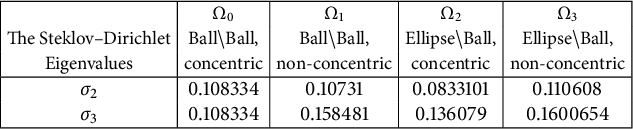
Comparison of
$\sigma _2(\Omega _i),\sigma _3(\Omega _i) (1 \leq i \leq 3)$
 with
$\sigma _2(\Omega _0)= \sigma _3(\Omega _0)$
 .

Figure 1 Long description
The figure consists of four panels labeled A, B, C, and D.
* Panel A, titled The Concentric Annulus Omega sub 0, shows a large gray circle with a radius of 10 cm centered at P(0,0). A smaller white circular hole with a radius of 2 cm is perfectly centered at P(0,0). In the top-left corner, sigma sub 2 equals 0.108334 and sigma sub 3 equals 0.108334.
* Panel B, titled Omega sub 1 having one axis of symmetry, shows a large gray circle with a radius of 10 cm centered at P(0,0). A white circular hole with a radius of 2 cm is shifted to the upper right, centered at Q(3,5). In the top-left corner, sigma sub 2 equals 0.10731 and sigma sub 3 equals 0.158481.
* Panel C, titled Omega sub 2 having symmetry of order 2, shows a gray ellipse with a vertical semi-axis of 11.765 cm and a horizontal semi-axis of 8.5 cm centered at P(0,0). A white circular hole with a radius of 2 cm is centered at P(0,0). In the top-left corner, sigma sub 2 equals 0.0833101 and sigma sub 3 equals 0.136079.
* Panel D, titled Omega sub 3 without any symmetry, shows a gray ellipse with a vertical semi-axis of 11.765 cm and a horizontal semi-axis of 8.5 cm centered at P(0,0). A white circular hole with a radius of 2 cm is shifted to the upper right, centered at Q(3,5). In the top-left corner, sigma sub 2 equals 0.110608 and sigma sub 3 equals 0.1600654.
Comparison of
$\sigma _2(\Omega _0)=\sigma _3(\Omega _0) $
 with
$\sigma _2(\Omega _i), \sigma _3(\Omega _i), \; i=1,2,3$
 .

Table 1 Long description
The table consists of five columns and three main data rows.
Column headers from left to right are:
- Column 1: The Steklov-Dirichlet Eigenvalues.
- Column 2: Omega sub 0, described as Ball set minus Ball, concentric.
- Column 3: Omega sub 1, described as Ball set minus Ball, non-concentric.
- Column 4: Omega sub 2, described as Ellipse set minus Ball, concentric.
- Column 5: Omega sub 3, described as Ellipse set minus Ball, non-concentric.
Data rows:
- Row 1 (sigma sub 2): Omega sub 0 is 0.108334; Omega sub 1 is 0.10731; Omega sub 2 is 0.0833101; Omega sub 3 is 0.110608.
- Row 2 (sigma sub 3): Omega sub 0 is 0.108334; Omega sub 1 is 0.158481; Omega sub 2 is 0.136079; Omega sub 3 is 0.1600654.
The domain
$\Omega _1$
 has only one axis of symmetry while the domain
$\Omega _2$
 has a symmetry of order 2. The domain
$\Omega _3$
 has no symmetry at all.
Using FreeFem++, we found that
$\sigma _3(\Omega _1)$
 and
$\sigma _3(\Omega _2)$
 are higher than
$\sigma _2(\Omega _0)$
 , where
$\Omega _0$
 is the concentric annulus having the same area as that of
$\Omega _i$
 (
$1\leq i \leq 2$
 ), and having the same circular hole
$B_0$
 . This shows that Theorem 5.1 may not hold for
$\sigma _{n+1}$
 even for domains with some symmetry if they do not have a symmetry of order
$4$
 .
The domain
$\Omega _3$
 is an example of a domain which has no symmetry at all, and for which both
$\sigma _2(\Omega _3)$
 and
$\sigma _3(\Omega _3)$
 are higher than
$\sigma _2(\Omega _0)$
 . This example shows that Theorem 5.1 does not hold for
$\sigma _2$
 as well (in addition to
$\sigma _3)$
 if we drop the order
$4$
 symmetry assumption.
The values of these Steklov–Dirichlet eigenvalues for
$\Omega _i$
 ,
$0 \leq i \leq 3$
 , are also listed in Table 1.
Acknowledgements
The authors thank Dr. Ravi Prakash, Universidad de Concepción, for his guidance in working with FreeFem++. The authors would also like to thank the anonymous reviewer for their valuable comments and suggestions.