In the target article, McCullough et al. offer the intriguing hypothesis that mechanisms for revenge in humans have evolved to deter harms and that forgiveness mechanisms evolved to compensate for the possibility or consequences of revenge in order to preserve valuable relationships. They refer to four possible responses to interrelational harm: acceptance, forgiveness, avoidance, or revenge. Such responses, however, are contingent on the victim perceiving the harm, yet such awareness is not always apparent or adaptive. Extrapolating from Betrayal Trauma Theory (Freyd Reference Freyd1996), we suggest a different way to structure these concepts (see Fig. 1), where their “avoidance” and “acceptance” are included in our withdrawal and unawareness, respectively. True acceptance requires awareness; however, in many cases (we argue in most cases), what looks like acceptance to an outside observer is actually motivated unawareness.
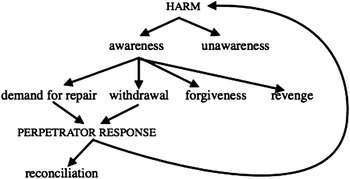
Figure 1.Responses to interrelational harm.
If a victim is aware of the harm, he or she then has the choice to demand repair, withdraw from the relationship, forgive the perpetrator, or enact revenge (Fig. 1). After a demand for repair or withdrawal, the victim's next options depend on the perpetrator's response. If the response is a good one, reconciliation might occur, whereas if the response is negative, it constitutes a new harm and the suite of behavioral options re-starts.
Importantly, the option of awareness depends upon the victim's degree of empowerment in the interpersonal relationship in which the harm occurred. As the target article notes, a victim's response depends heavily on his/her relationship with the perpetrator. For example, McCullogh et al. predict that relationships with expected future value are more likely to be forgiving. However, categories of interpersonal relationships involve more than just their perceived future value.
Dependence is a particularly important dimension of relationships. Being dependent on others for material and emotional support has profound implications for adaptive responses to harm. Betrayal Trauma Theory (Freyd Reference Freyd1996; DePrince et al. Reference DePrince, Brown, Cheit, Freyd, Gold, Pezdek, Quina and Belli2012) posits that when a victim is significantly dependent on the perpetrator, it may be adaptive to remain unaware of the harm the perpetrator imposed. A dependent victim is essentially required to maintain the relationship with his or her aggressor. Most of the options shown in Figure 1 that follow awareness may be detrimental to the relationship on which the victim depends and therefore are not adaptive.
Betrayal blindness is theorized to be a basic response among humans. Empirical research suggests that betrayal blindness is both common and psychologically important for the victim (DePrince et al. Reference DePrince, Brown, Cheit, Freyd, Gold, Pezdek, Quina and Belli2012; Freyd et al. Reference Freyd, DePrince and Gleaves2007). It is likely that betrayal blindness has played an important role in human evolution: For humans to survive into adulthood, they had to live through periods of significant dependence (such as childhood). Dependence continues in various forms (e.g., due to illness or resource asymmetries) throughout the lifespan. Furthermore, although there is variation in severity, harm in interpersonal relationships is ubiquitous. Thus, every individual who reproduced successfully maintained important interpersonal relationships with people who had more power than them and sometimes caused harm. Selection pressure may have created evolutionarily ancient human victims who had the ability to remain unaware of interrelational harm.
Why would a person remain unaware rather than acknowledge and either ignore (pretend not to see) or “accept” a betrayal? We propose that such pretending is often not adaptive because of the resources necessary for maintenance and the risks associated with failure. If the victim is very young (infant or toddler), he or she may not have the cognitive capacity to pretend and thus be required to remain unaware in order to preserve the relationship. Even in adulthood, most humans may find it difficult to be effective pretenders. For example, in trying to feign happiness with a perpetrator, a victim may have trouble smiling in a seemingly authentic way (i.e., Duchenne smiling; see Ekman & O'Sullivan Reference Ekman and O'Sullivan2006). There is great risk to being a poor pretender: losing a necessary (or apparently necessary) relationship. Even when effective pretending is possible, it may be very costly to cognitive capacity by consuming attention resources that would then not be available for other tasks. It is hard to see how such a risky and resource-demanding process (feigning unawareness/acceptance) could be adaptive.
McCullogh et al.'s description of behavioral options (sect. 4.4) fails to give significant attention to the variation in awareness that distinguishes the possible responses. For instance, the authors' concept of “acceptance” may actually be better understood as unawareness (betrayal blindness). In other words, a victim may appear to “accept” a harm by remaining unaware of it. In contrast, both revenge and forgiveness constitute explicit actions in response to interrelational harm that necessitate explicit thought and understanding about that harm and the interpersonal relationship between the victim and the aggressor.
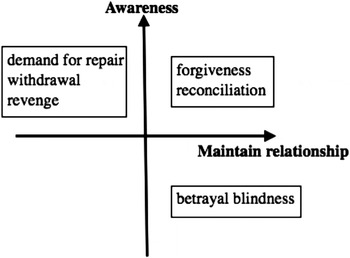
We can understand different behavioral responses to harm by organizing them on two orthogonal axes: (1) degree of awareness, and (2) whether the victim wants to maintain the relationship (Fig. 2). For example, a victim may forgive an aggressor when he or she wants to maintain the relationship and is highly aware, whereas a victim may remain blind to the betrayal when he or she wants to maintain the relationship with the aggressor and thus is unaware of the harm. In this model, forgiveness may be most common when the victim holds significant power in the relationship. Betrayal blindness is predicted to be frequent when the perpetrator holds significant power. A question awaiting future research is how tightly connected harm awareness is with empowerment.
Figure 2.Proposed dimensions of responses to interrelational harm.
Another interesting research question concerns the evolution of the awareness necessary for various behavioral responses to harm. Forgiveness and revenge seem behaviorally similar to other responses (e.g., reconciliation and counter-aggression) but psychologically different because of the difference in cognitive awareness. Do nonhuman animals exhibit the responses of revenge and forgiveness? Such comparative research might help us further understand the evolution of the different possible responses to interrelational harm.





 You have
Access
In the target article, McCullough et al. offer the intriguing hypothesis that mechanisms for revenge in humans have evolved to deter harms and that forgiveness mechanisms evolved to compensate for the possibility or consequences of revenge in order to preserve valuable relationships. They refer to four possible responses to interrelational harm: acceptance, forgiveness, avoidance, or revenge. Such responses, however, are contingent on the victim perceiving the harm, yet such awareness is not always apparent or adaptive. Extrapolating from Betrayal Trauma Theory (Freyd Reference Freyd1996), we suggest a different way to structure these concepts (see Fig. 1), where their “avoidance” and “acceptance” are included in our withdrawal and unawareness, respectively. True acceptance requires awareness; however, in many cases (we argue in most cases), what looks like acceptance to an outside observer is actually motivated unawareness.
Responses to interrelational harm.
If a victim is aware of the harm, he or she then has the choice to demand repair, withdraw from the relationship, forgive the perpetrator, or enact revenge (Fig. 1). After a demand for repair or withdrawal, the victim's next options depend on the perpetrator's response. If the response is a good one, reconciliation might occur, whereas if the response is negative, it constitutes a new harm and the suite of behavioral options re-starts.
Importantly, the option of awareness depends upon the victim's degree of empowerment in the interpersonal relationship in which the harm occurred. As the target article notes, a victim's response depends heavily on his/her relationship with the perpetrator. For example, McCullogh et al. predict that relationships with expected future value are more likely to be forgiving. However, categories of interpersonal relationships involve more than just their perceived future value.
Dependence is a particularly important dimension of relationships. Being dependent on others for material and emotional support has profound implications for adaptive responses to harm. Betrayal Trauma Theory (Freyd Reference Freyd1996; DePrince et al. Reference DePrince, Brown, Cheit, Freyd, Gold, Pezdek, Quina and Belli2012) posits that when a victim is significantly dependent on the perpetrator, it may be adaptive to remain unaware of the harm the perpetrator imposed. A dependent victim is essentially required to maintain the relationship with his or her aggressor. Most of the options shown in Figure 1 that follow awareness may be detrimental to the relationship on which the victim depends and therefore are not adaptive.
Betrayal blindness is theorized to be a basic response among humans. Empirical research suggests that betrayal blindness is both common and psychologically important for the victim (DePrince et al. Reference DePrince, Brown, Cheit, Freyd, Gold, Pezdek, Quina and Belli2012; Freyd et al. Reference Freyd, DePrince and Gleaves2007). It is likely that betrayal blindness has played an important role in human evolution: For humans to survive into adulthood, they had to live through periods of significant dependence (such as childhood). Dependence continues in various forms (e.g., due to illness or resource asymmetries) throughout the lifespan. Furthermore, although there is variation in severity, harm in interpersonal relationships is ubiquitous. Thus, every individual who reproduced successfully maintained important interpersonal relationships with people who had more power than them and sometimes caused harm. Selection pressure may have created evolutionarily ancient human victims who had the ability to remain unaware of interrelational harm.
Why would a person remain unaware rather than acknowledge and either ignore (pretend not to see) or “accept” a betrayal? We propose that such pretending is often not adaptive because of the resources necessary for maintenance and the risks associated with failure. If the victim is very young (infant or toddler), he or she may not have the cognitive capacity to pretend and thus be required to remain unaware in order to preserve the relationship. Even in adulthood, most humans may find it difficult to be effective pretenders. For example, in trying to feign happiness with a perpetrator, a victim may have trouble smiling in a seemingly authentic way (i.e., Duchenne smiling; see Ekman & O'Sullivan Reference Ekman and O'Sullivan2006). There is great risk to being a poor pretender: losing a necessary (or apparently necessary) relationship. Even when effective pretending is possible, it may be very costly to cognitive capacity by consuming attention resources that would then not be available for other tasks. It is hard to see how such a risky and resource-demanding process (feigning unawareness/acceptance) could be adaptive.
McCullogh et al.'s description of behavioral options (sect. 4.4) fails to give significant attention to the variation in awareness that distinguishes the possible responses. For instance, the authors' concept of “acceptance” may actually be better understood as unawareness (betrayal blindness). In other words, a victim may appear to “accept” a harm by remaining unaware of it. In contrast, both revenge and forgiveness constitute explicit actions in response to interrelational harm that necessitate explicit thought and understanding about that harm and the interpersonal relationship between the victim and the aggressor.
We can understand different behavioral responses to harm by organizing them on two orthogonal axes: (1) degree of awareness, and (2) whether the victim wants to maintain the relationship (Fig. 2). For example, a victim may forgive an aggressor when he or she wants to maintain the relationship and is highly aware, whereas a victim may remain blind to the betrayal when he or she wants to maintain the relationship with the aggressor and thus is unaware of the harm. In this model, forgiveness may be most common when the victim holds significant power in the relationship. Betrayal blindness is predicted to be frequent when the perpetrator holds significant power. A question awaiting future research is how tightly connected harm awareness is with empowerment.
Proposed dimensions of responses to interrelational harm.
Another interesting research question concerns the evolution of the awareness necessary for various behavioral responses to harm. Forgiveness and revenge seem behaviorally similar to other responses (e.g., reconciliation and counter-aggression) but psychologically different because of the difference in cognitive awareness. Do nonhuman animals exhibit the responses of revenge and forgiveness? Such comparative research might help us further understand the evolution of the different possible responses to interrelational harm.
ACKNOWLEDGMENTS
We thank Katie Hinde and Steve Pinker for their helpful feedback on a prior draft of this commentary.