Two factors play a key role in criminal conviction in the common law tradition: a harmful consequence (actus reus) and the intent to harm (mens rea). Intentions at the time of action influence moral judgment and the subsequent punishment (Young et al. Reference Young, Bechara, Tranel, Damasio, Hauser and Damasio2010). Individuals who harm others accidentally and unknowingly receive less punishment than those who harm others intentionally. McCullough et al. propose that revenge functions to deter future harms by increasing others' “welfare tradeoff ratios” (WTRs) toward victims. This theory implies that revenge should exist only when harms are intentional because only intentional harms can reveal others' WTRs. On the other hand, unintentional harms are not informative about the harm doer's true WTR and thus should not invite revenge. However, punishment of innocent people is not uncommon in real life situations. Take envy, for example; disliking others' wealth leads people to pay to destroy the envied person's money, even though the envied person is not responsible for the inequality. In laboratory studies, evidence suggests that revenge exists even when harms are unintentional.
Our recent functional magnetic resonance imaging (fMRI) study investigated the behavioral and neural responses to different types of fairness (Yu et al., submitted). In our experiment (see Fig. 1), two participants (strangers) jointly completed a matching task and then they received the outcomes. If their choices were matched, they both received some monetary rewards. Otherwise, they both lost money. However, the exact amounts of money each player could win or lose in each trial were determined by a computer program. Participants received advantageous (more than their partner), disadvantageous (less than their partner), or equal payoffs. Then, they were given the opportunity to alter their partner's payoff at their personal costs. It is a one way punishment, that is, their partners did not have such opportunity to punish. Every fifty pence increase or decrease in the partner's payoff cost participants ten pence.
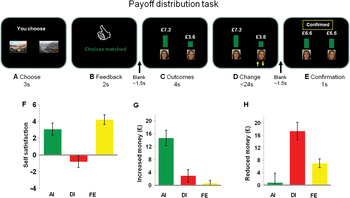
Figure 1.Experimental task design and behavioral results. (A) In the payoffs distribution task, participants were required to choose one image. (B) After the Choose stage, participants were informed whether their choices were matched or not, and hence, both win or both lose. (C) The outcome for the participants and the outcome for their partners were presented. (D) After the Outcome stage, participants could alter the partner's payoff at their personal costs. (E) Participants pressed a third key when they finished changing. The final payoffs for both players were depicted. (F) The self-reported satisfaction toward outcomes across win and loss trails in advantageous inequality condition (AI), disadvantageous inequality condition (DI), and fair equal condition (FE). (G) The increased money (total money spent to increase other's payoffs) in each condition. (H) Reduced money (total money spent to decrease other's payoffs) in each condition.
We found that individuals have strong preferences for fairness in both disadvantageous and advantageous inequality conditions, such that they alter others' payoff toward an equal distribution at a personal financial cost. At the neural level, individuals who spent more money to increase others' payoff had stronger activity in the putamen (the reward region) when they encountered advantageous inequality (Mobbs et al. Reference Mobbs, Yu, Meyer, Passamonti, Seymour, Calder, Schweizer, Frith and Dalgleish2009). Conversely, those who spent more money to reduce others' payoff had stronger activity in the amygdala (the anger region) in response to disadvantageous inequality, suggesting that negative emotions evoke revenge (Scott et al. Reference Scott, Young, Calder, Hellawell, Aggleton and Johnson1997). Revenge may reduce the immediate psychological harms (e.g., envy and anger) by bringing others down. Our study suggests that accidental harms are enough to elicit immediate negative emotions which may evoke the desire for revenge.
Why do people punish those who are not responsible for the inequality?
One possibility is that when an individual is treated unfairly, the induced negative emotion is quite intense. Like physical pain, which makes people punch objects, and frustration, which provokes displaced aggression, the social pain resulting from inequality drives people to revenge. The psychological urge to reduce immediate pain is ignored in the target article. From an evolutionary perspective, the sense of unfairness is vital for an individual's survival in social situations and thus revenge may have evolved as an instinctive reaction to unfair treatment. Furthermore, outcomes are easy to evaluate but intentions are difficult to know. Negative outcomes may be enough to elicit revenge motives in the initial stage. Whether to take revenge or to forgive is modulated by attribution of intentions in the latter stage. Previous research shows that forgiveness requires the effort to restrain vengeful impulses (DeWall et al. Reference DeWall, Baumeister, Stillman and Gailliot2007; Reference DeWall, Pond and Bushman2010), suggesting that revenge is an emotional “hot” system and forgiveness is a rational “cool” process.
Revenge may ultimately hurt the seeker as much as the victim (Dreber et al. Reference Dreber, Rand, Fudenberg and Nowak2008). Like a proverb states, “Before you embark on a journey of revenge, dig two graves.” In our study, punishment reduces both players' payoffs and participants know that. Even when revenge seekers know such consequences, for example, for individuals who commit crime of passion, they still choose to do so. I argue that revenge is not always future-oriented and may have evolved for other reasons, such as the fairness instinct. It is possible that revenge serves to restore the fairness social norm when individual self-interest has been violated by others. It functions mainly to reduce current emotional harms rather than to deter future harms. This explains why in many situations people seek revenge even when it escalates conflicts rather than moderates them, leading to destructive outcomes for everybody involved.





Two factors play a key role in criminal conviction in the common law tradition: a harmful consequence (actus reus) and the intent to harm (mens rea). Intentions at the time of action influence moral judgment and the subsequent punishment (Young et al. Reference Young, Bechara, Tranel, Damasio, Hauser and Damasio2010). Individuals who harm others accidentally and unknowingly receive less punishment than those who harm others intentionally. McCullough et al. propose that revenge functions to deter future harms by increasing others' “welfare tradeoff ratios” (WTRs) toward victims. This theory implies that revenge should exist only when harms are intentional because only intentional harms can reveal others' WTRs. On the other hand, unintentional harms are not informative about the harm doer's true WTR and thus should not invite revenge. However, punishment of innocent people is not uncommon in real life situations. Take envy, for example; disliking others' wealth leads people to pay to destroy the envied person's money, even though the envied person is not responsible for the inequality. In laboratory studies, evidence suggests that revenge exists even when harms are unintentional.
Our recent functional magnetic resonance imaging (fMRI) study investigated the behavioral and neural responses to different types of fairness (Yu et al., submitted). In our experiment (see Fig. 1), two participants (strangers) jointly completed a matching task and then they received the outcomes. If their choices were matched, they both received some monetary rewards. Otherwise, they both lost money. However, the exact amounts of money each player could win or lose in each trial were determined by a computer program. Participants received advantageous (more than their partner), disadvantageous (less than their partner), or equal payoffs. Then, they were given the opportunity to alter their partner's payoff at their personal costs. It is a one way punishment, that is, their partners did not have such opportunity to punish. Every fifty pence increase or decrease in the partner's payoff cost participants ten pence.
Experimental task design and behavioral results. (A) In the payoffs distribution task, participants were required to choose one image. (B) After the Choose stage, participants were informed whether their choices were matched or not, and hence, both win or both lose. (C) The outcome for the participants and the outcome for their partners were presented. (D) After the Outcome stage, participants could alter the partner's payoff at their personal costs. (E) Participants pressed a third key when they finished changing. The final payoffs for both players were depicted. (F) The self-reported satisfaction toward outcomes across win and loss trails in advantageous inequality condition (AI), disadvantageous inequality condition (DI), and fair equal condition (FE). (G) The increased money (total money spent to increase other's payoffs) in each condition. (H) Reduced money (total money spent to decrease other's payoffs) in each condition.
We found that individuals have strong preferences for fairness in both disadvantageous and advantageous inequality conditions, such that they alter others' payoff toward an equal distribution at a personal financial cost. At the neural level, individuals who spent more money to increase others' payoff had stronger activity in the putamen (the reward region) when they encountered advantageous inequality (Mobbs et al. Reference Mobbs, Yu, Meyer, Passamonti, Seymour, Calder, Schweizer, Frith and Dalgleish2009). Conversely, those who spent more money to reduce others' payoff had stronger activity in the amygdala (the anger region) in response to disadvantageous inequality, suggesting that negative emotions evoke revenge (Scott et al. Reference Scott, Young, Calder, Hellawell, Aggleton and Johnson1997). Revenge may reduce the immediate psychological harms (e.g., envy and anger) by bringing others down. Our study suggests that accidental harms are enough to elicit immediate negative emotions which may evoke the desire for revenge.
Why do people punish those who are not responsible for the inequality?
One possibility is that when an individual is treated unfairly, the induced negative emotion is quite intense. Like physical pain, which makes people punch objects, and frustration, which provokes displaced aggression, the social pain resulting from inequality drives people to revenge. The psychological urge to reduce immediate pain is ignored in the target article. From an evolutionary perspective, the sense of unfairness is vital for an individual's survival in social situations and thus revenge may have evolved as an instinctive reaction to unfair treatment. Furthermore, outcomes are easy to evaluate but intentions are difficult to know. Negative outcomes may be enough to elicit revenge motives in the initial stage. Whether to take revenge or to forgive is modulated by attribution of intentions in the latter stage. Previous research shows that forgiveness requires the effort to restrain vengeful impulses (DeWall et al. Reference DeWall, Baumeister, Stillman and Gailliot2007; Reference DeWall, Pond and Bushman2010), suggesting that revenge is an emotional “hot” system and forgiveness is a rational “cool” process.
Revenge may ultimately hurt the seeker as much as the victim (Dreber et al. Reference Dreber, Rand, Fudenberg and Nowak2008). Like a proverb states, “Before you embark on a journey of revenge, dig two graves.” In our study, punishment reduces both players' payoffs and participants know that. Even when revenge seekers know such consequences, for example, for individuals who commit crime of passion, they still choose to do so. I argue that revenge is not always future-oriented and may have evolved for other reasons, such as the fairness instinct. It is possible that revenge serves to restore the fairness social norm when individual self-interest has been violated by others. It functions mainly to reduce current emotional harms rather than to deter future harms. This explains why in many situations people seek revenge even when it escalates conflicts rather than moderates them, leading to destructive outcomes for everybody involved.