


1. Introduction
Selected effect (SE) functions are, roughly, the ways a trait type has contributed to its bearers’ fitness in evolutionary history. Furthermore, they are often thought to be a trait’s “proper function”: a standard for normal instantiations of the trait type, and thus what a trait is supposed or expected to perform (Wright Reference Wright1973; Millikan Reference Millikan1984; Neander Reference Neander1991; Griffiths Reference Griffiths1993; Garson Reference Garson2017). Recent literature has raised a challenge to the SE theories of proper functions (SE theories): The normative implication of a function depends on its ability to explain why traits exist, yet SE functions, as currently defined, cannot provide such explanations in cases where the selective environment is heterogeneous (Christie et al. Reference Christie, Brusse, Bourrat, Takacs and Griffiths2022a; Davini Reference Davini2025).
This article proposes an amendment to the SE theories to alleviate this challenge: restricting proper functions to effectively fixed traits—traits that have effectively reached fixation and maintained a close-to-one frequency in a population. Specifically, not all SE functions are proper functions; rather, a trait in a population has a proper function only if it is at or close to fixation. This restriction is consistent with the general theoretical goal of proper functions and can better support the teleological and normative implications they are expected to have in many applications.Footnote 1
The article is structured as follows. Section 2 discusses the challenge concerning SE functions’ explanatory power; after examining some responses from SE theorists, I argue that a revision of the concept is necessary for addressing the challenge. Section 3 introduces the restricted account of proper functions that I propose and briefly discusses how it interacts with other existing challenges to SE theories. It then discusses three of its theoretical advantages: preserving the theoretical goals of proper functions, identifying purpose-conferring fitness contributions, and grounding a threshold for binary attributions. Section 4 addresses special cases that may pose difficulties for the restricted account, including exaptation, polymorphism, and fixed traits with no recent fitness contributions. Section 5 offers concluding remarks.
2. Why not all selected effect functions are proper functions
2.1. From selected effect functions to proper functions
This section motivates my proposed revision by showing that proper functions should be attributed more restrictively than SE functions. To start, SE functions and proper functions are not conceptually equivalent. The general idea of SE functions is that they are ways trait types have contributed to their bearers’ fitness (i.e., raising the probability of survival and reproduction) in evolutionary history. For example, pumping blood is an SE function of the heart because this is how hearts have contributed to their bearers’ fitness in the past. On the other hand, the general idea of proper functions is that they are what traits are normally supposed to do. Pumping blood is also a proper function of the heart, but for a different reason: Any normal heart should be able to pump blood. Proper functions are expected to distinguish function from accidental causal contribution (Walsh and Ariew Reference Walsh and Ariew1996) and normal variations from dysfunctions (Griffiths and Matthewson Reference Griffiths and Matthewson2016; Matthewson and Griffiths Reference Matthewson and Griffiths2017). They are also used as the standard of normality by some accounts in philosophy of mind (Millikan Reference Millikan1984; Papineau Reference Papineau1987; Neander Reference Neander2017b), epistemology (Plantinga Reference Plantinga1993, and philosophy of medicine (Wakefield Reference Wakefield1992).
Traditionally, SE theories define proper functions simply as SE functions (Millikan Reference Millikan1989; Neander Reference Neander1991; Griffiths Reference Griffiths1993; Godfrey-Smith Reference Godfrey-Smith1994). However, as Neander points out, the concept of proper function itself does not presuppose that they are SE functions (Reference Neander2017a, 1153).Footnote 2 Three conceptual moves are necessary to bridge the trait’s historical fitness contribution with the expectation of its normal activity. The first is explanation: SE functions are often thought to explain why a trait exists in the current population because they are how the trait was selected. For example, the heart’s ability to pump blood explains why vertebrates have hearts: This ability is the reason why hearts were selected. The second move is from this explanatory power to the idea that SE functions are teleological: The goal and purpose of a trait is to perform its SE function, because it is the reason the trait exists. The SE function of hearts—pumping blood—becomes the goal and purpose of hearts. This is because hearts were selected for performing this function and persist because they perform it. In the third move, the idea of purpose further supports a normative claim: Because the SE function is what the trait is for, it is what is normally expected from the trait. A trait that fails to perform its SE function would be malfunctioning. We finally reached the other end of the bridge: the normatively loaded idea of proper function.
This article will scrutinize the explanation–teleology move. For an SE function to become a proper function, it must be able to explain why the trait exists. However, this explanatory power faces challenges. The next subsection will discuss a recent challenge to SE functions’ ability to explain the existence of traits.
2.2. Explanation challenge
Critics argue that SE functions can only explain why a trait exists in a population when the selective environment is uniform and unchanging (Christie et al. Reference Christie, Brusse, Bourrat, Takacs and Griffiths2022a, Reference Christie, Brusse, Bourrat, Takacs and Griffiths2022b; Okasha Reference Okasha2022; Davini Reference Davini2025). However, there are many cases where the selective pressures on certain traits are constantly changing. For example, in frequency-dependent selection scenarios like those modeled in evolutionary game theory, the selective pressure favors different strategies when the proportion of strategies in the population changes. In such cases, the SE function of the trait cannot satisfactorily explain the frequency of the trait. To see why, consider the classic Hawk–Dove game (Christie et al. Reference Christie, Brusse, Bourrat, Takacs and Griffiths2022a; Davini Reference Davini2025). The Hawkish trait is the tendency to compete aggressively for resources, whereas the Dovish trait is the tendency to retreat when facing conflicts and not compete for resources. When both traits are present in the population, the payoffs are roughly as follows: When Hawk meets Dove, Hawk takes all resources at no cost. When Dove meets Dove, they peacefully divide resources, yielding moderate payoffs. When Hawk meets Hawk, they must divide resources while also having costs from aggressive competition, yielding the worst outcome. When the frequency of Hawk increases, the chance for a Hawk to encounter another Hawk increases accordingly, and the outcome of being a Hawk gets worse. But when the frequency of Dove increases, the chance for a Hawk to meet a Dove increases, improving the outcome of being a Hawk. This dynamic results in an equilibrium: Both Hawk and Dove persist in the population.
Presumably, the SE function of the Hawkish trait is to compete and seize resources, and the function of the Dovish trait is to avoid conflict and save energy. To explain why Hawks are selected, one needs to cite not only the trait’s function of competing and seizing resources but also the fact that there is a sufficient proportion of Doves in the population, because otherwise being competitive would hurt a Hawk’s fitness when encountering other Hawks. The same goes for the Doves: They are selected not only because the trait helps them avoid conflict and save energy but also because there are not too many Hawks in the population; otherwise, avoiding conflict would hurt a Dove’s fitness when encountering Hawks, because Doves would rarely obtain resources. So in the Hawk–Dove scenario, the trait’s SE functions cannot explain the trait’s selective consequence.
This general logic applies to any selection process where the environment changes frequently, for instance, the natural selection on peppered moth pigmentation. When there are more pale-colored trees, lighter moths have a selective advantage through camouflage, whereas darker moths are selected against; when dark-colored trees increase, the selective advantages of colors are reversed. When human activities rapidly shift the selective environment, the fitness contributions of different pigmentation types change accordingly and do not suffice to explain frequency changes.
There have been extensive debates about whether this critique is a real threat to SE theories. Many SE theorists argue that SE theories were never intended to provide the kind of explanation critics demand (Kingsbury Reference Kingsbury2022; Garson Reference Garson2022b). There are roughly three ways of defending SE theories against the explanation challenge. The first is to argue that the explanation does not need to be a full explanation, or that the cause does not have to be sufficient but only necessary. Rumana (Reference Rumana2022) has pushed back on this defense, arguing that there seems to be no convincing justification for singling out SE functions from other necessary causes of selective consequences. The second is that the fitness contributions identified by SE functions need not be constant throughout the whole evolutionary history. Rather, SE theories only need to focus on the time period when traits actually made fitness contributions. The third concerns what exactly SE functions are supposed to explain. The latter two responses ultimately depend on the same question: What kind of fitness contribution is required for an SE function to qualify as a proper function? I will address this question in the next subsection.
2.3. What fitness contribution should proper functions make?
What kind of fitness contribution is required for an SE function to qualify as a proper function? This question has two interrelated dimensions: the temporal scope of fitness contributions (how sustained must they be?) and the explanandum of fitness contributions (what evolutionary outcome must they explain?). Because teleology is one necessary step in the theoretical link between SE function and proper function, the answers to both are determined by what can ground teleological claims.
Let’s deal with the explanandum question first. The explanation required for a proper function should enable us to say, “This trait is there for performing the function.” Mere causal explanation is insufficient: That something caused an object to exist doesn’t mean it is the object’s purpose. Erosion caused a valley to exist, but it makes no sense to say the valley’s purpose is erosion. What is needed is a purpose-conferring causal history. When a craftsperson makes a knife, their intention for the knife to cut causes the knife to exist. This intention-driven causal history grounds the claim that one of the causes of the knife’s existence is its purpose. This parallel with artifacts is what inspires SE theorists in the first place.
Drawing on this parallel, a trait’s function should cite a purpose-conferring causal history in order to become the trait’s purpose. Natural selection lacks intentions, but it has a relevantly similar structure: Ancestral trait tokens caused descendant tokens to exist precisely because those ancestors possessed fitness-enhancing features. Because descendants inherit these features from ancestors, the selective feedback loop provides a nonintentional but teleologically structured explanation (Dresow and Love Reference Dresow and Love2023). We can thus say that the descendant trait is there because the ancestral trait contributed to fitness, which grounds the teleological claim. Whether this analogy ultimately succeeds is debatable, but establishing the purpose-conferring causal history is necessary for SE theories to ground teleological claims about proper function.
Because proper functions are typically assigned to trait tokens, they should be able to provide a purpose-conferring causal history of the existence of a specific trait token. Crucially, this requires more than merely citing a cause of a token’s existence. It requires a continuous fitness-contributing feedback loop. The question is: How extended must this loop be? What a proper function needs to explain depends on what threshold a fitness-contributing feedback loop must meet to be purpose-conferring. Some SE theorists have argued that proper function needs only to explain the existence of the specific ancestral lineage of trait tokens (Millikan Reference Millikan2022, 364; Kingsbury Reference Kingsbury2022, 370),Footnote 3 rather than explaining the nonzero frequency of the trait in the population, as required by critics (Christie et al. Reference Christie, Brusse, Bourrat, Takacs and Griffiths2022a).
But the normative power of proper function is significantly weakened if it only explains the existence of a specific lineage of traits. The problem is that a single episode of fitness contribution can establish an entire lineage, yet it cannot confer purpose or normative standards. Consider this example: Suppose an ancestral individual A in a lineage possessed a neutral trait like baldness, which happened to be sexually attractive to a particular mate. This one-off selective advantage causally contributed to reproductive success, and thus to the existence of all bald descendants in that lineage. The trait of baldness caused the existence of a lineage of bald tokens, but this single fitness-contributing event is insufficient to ground purpose. Sexual attraction cannot be the purpose of A’s baldness, because the trait existed before the selection for sexual attraction. As for A’s offspring, although the one-off sexual selection explains A’s offspring being bald, it is absurd to say any of A’s offspring (even its direct child) is bald for sexual attraction, if the selection is truly one-off. It also doesn’t mean that any offspring individual would be malfunctioning if its baldness cannot attract mates. The point is that grounding purpose requires more than explaining the existence of an ancestral lineage: Establishing a lineage requires only a single fitness-contributing event, but grounding purpose requires sustained, recurring fitness contributions. If SE functions aim to track genuine purposes rather than accidental causes, it is problematic to require them only to explain the existence of a single lineage, because this explanation is not sufficient to ground purpose for offspring trait tokens.
An SE theorist might argue that a purpose-conferring explanation indeed needs to explain the existence of a set of trait tokens within a population across lineages, independently evolving similar traits under the same selective pressure, but this is different from explaining the specific frequency of the trait. Avoiding conflict might not explain why the Doveish trait has the observed equilibrium frequency, but it can explain why it persists at a stable, nonzero frequency in the population. Counterfactually, if the Doveish trait did not have the effect of avoiding conflict, it would be eliminated from the population as a result of the inability to compete for resources. The problem with this defense, however, is that there seems to be no principled way to distinguish between one-off cases like baldness and more sustained cases like the Doveish trait. The temporal extension and strength of selection for a function come in degrees. One extreme is one-off selection that establishes a single lineage, which cannot confer purpose; as selection becomes more extensive and stronger, at some point we might want to say that it is sufficient to ground purpose. But where to draw the line? SE theory provides no principled basis for choosing one threshold over another, leaving the distinction between purpose-grounding and non-purpose-grounding selection vague.
The restricted account proposes a threshold while admitting the existence of such a continuum. SE-function-level teleology and normativity remain gradual: The intuition that a trait “serves a purpose” strengthens as selection becomes more sustained, and the restricted account does not deny these middle-ground intuitions wholesale. Instead, the restricted account draws a principled line at the strong end of the continuum: Proper function, as a subset of SE function, is restricted to traits whose selection history is strong enough to ground a higher level of normativity. I will clarify the two levels of normativity in the following subsection.
2.4. Two levels of normativity
A possible reaction to the explanation challenge is eliminativism: abandoning the concepts of SE function and proper function altogether, or rejecting selected effect theory as the right way to characterize proper function. This section will discuss two levels of normativity associated with biological functions that are best captured by separating SE function and proper function rather than eliminating them.
In theories of naturalized normativity, there seem to be two levels of normativity associated with functions. One is the evaluative standard for individual tokens at the character-state level, and the other is the evaluative standard for individual tokens as well as types of variations at the character level. The relationship between character and character state is illustrated by Brigandt (Reference Brigandt2007):
A character is a part of an organism, such as a type of morphological structure, that can be present in several individuals and species. A character state is a property or set of properties that a character in a particular individual has. One character may be in different states in different individuals. For example, an eye is a character with the character states blue, green, brown, etc. (711)
Normativity has different strengths on the two levels. At the character-state level, some character states are selected as a result of certain fitness contributions, and such contributions are expected from any token possessing the character state. For example, the heterozygous sickle cell trait is selected for malaria resistance (Allison Reference Allison1954; Sober Reference Sober1984). By definition, malaria resistance is the SE function of the heterozygous sickle cell trait, and it sets a standard for the trait tokens. A heterozygous sickle cell trait token can fail to confer malaria resistance, and we can call this failure a malfunction for the specific character state in some sense. This character-state normativity also establishes what counts as a normal variation: The heterozygous sickle cell trait is one of the normal variations in red blood cell shape. But the SE function only sets the normative standard at the level of character state. The fact that the heterozygous sickle cell trait was selected for does not mean that any other character state is abnormal or a malfunction: The homozygous discocyte trait is also normal. In contrast, the homozygous sickle cell trait (also called sickle cell anemia) is a malfunction in a stronger sense, not because a particular individual fails to perform some causal effect that the homozygous sickle cell trait historically has, but because this character state fails to meet the functional standard at the character level. The character state itself is a malfunction for the character, and any individual with the homozygous sickle cell trait would be malfunctioning. Such a standard calls for a more restricted concept of function, one with sufficient explanatory power to ground character-level normativity.
The different levels of normativity correspond with different levels of explanation. Malaria resistance is an important factor in explaining the existence of heterozygous sickle cell traits in the current population. This explanatory role is sufficient to make malaria resistance an SE function of the heterozygous sickle cell trait. However, the heterozygous sickle cell trait persists only at a relatively low frequency in the population because the homozygous genotype leads to severe anemia. The selective advantage of malaria resistance, the cost of the homozygous genotype, and the genetic mechanism binding the two phenotypes jointly determine the trait’s equilibrium frequency. Even though selection in this case is intuitively strong, there is no principled measure to distinguish this from cases where selection is weaker, and thus there is no principled basis for granting character-level normativity here. The purpose attribution of the trait is limited to the relatively weak, character-state level. This aligns with the fact that malaria resistance does not ground the strong normative standard on the character level. Heterozygous sickle cell is just one normal variation of red blood cell morphology; having it is normal, but not having it is not abnormal. A person with the heterozygous sickle cell trait who lacks resistance to malaria can be seen as malfunctioning, but only in the sense of a deviation from the standard for one character state. It differs from a deviation from the standard for a character, such as a heart unable to pump blood.
Different applications of SE theories require different levels of normativity. Defining malfunction as a necessary condition for disease is often argued to rely on strong, character-level normativity.Footnote 4 On the other hand, justifying a condition as “serving a purpose” and thus not itself a dysfunction only requires normativity at the character-state level (Garson Reference Garson2022a).Footnote 5 Separating proper function from SE function captures this difference in levels of normativity. SE function, like any historical fitness contribution, can ground that the function bearer is a normal variation. It partially explains why the trait exists and grounds its purpose to some extent. The stronger the selection, the more plausible the attribution of teleology and normativity. The SE function captures the relatively weak, gradual normativity associated with functions. Proper function, on the other hand, grants the evolutionary purpose and normal standard for the whole character, and as I will argue in the next section, there is a clear, principled threshold for its attribution: fixation.
3. The restricted account and its theoretical advantages
3.1. The restricted account
In the previous section, I argued that the teleological and normative implications of proper function, in their strong sense at the character level, require a fitness contribution that is sufficiently strong and sustained. Traditional SE theories provide no principled threshold for this requirement, often fail to offer purpose-conferring explanations of the trait in heterogeneous environments, and do not support the strong normative standard at the character level.
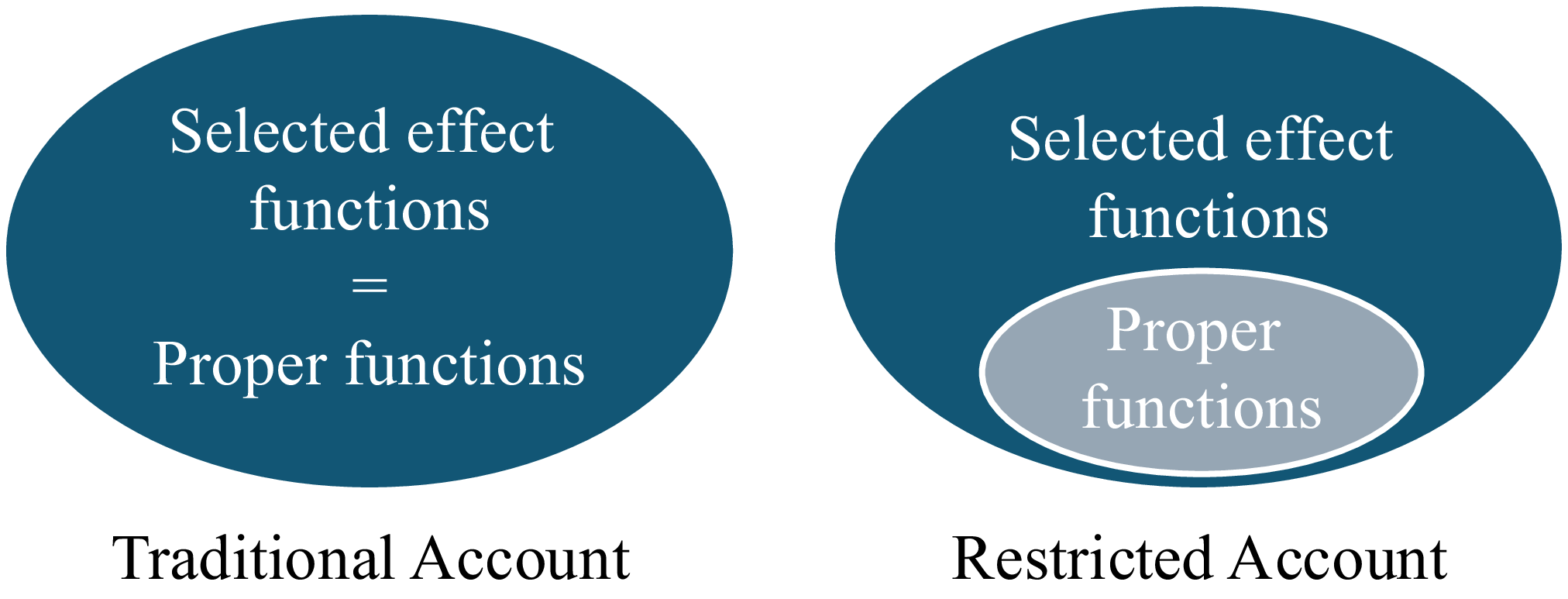
The solution I propose is to restrict the scope of proper functions. SE functions, as a concept directly derived from evolutionary history, do not always have the explanatory power and teleological implication of proper functions. Proper functions, on the other hand, need not be attributed to every trait that has been selected by natural selection. The difficulties discussed above are resolved when the two concepts are separated, and their connection is restricted. In what follows, I will propose a promising way to make such a restriction: to understand proper functions as SE functions that have led to effective fixation. Figure 1 contrasts the traditional account and the restricted account using Venn diagrams.Footnote 6
Conceptual relations between SE functions and proper functions.

The restricted account attributes proper functions only to traits that have effectively reached fixation and remain at near-fixation frequencies. Fixation means effectively every individual in the population has the trait, and population here refers to a local group of the same species that can interbreed. Both concepts are commonly adopted in population genetics.Footnote 7 Reaching fixation is a clear threshold for selective strength and duration. It marks that the selection for the trait is sufficiently persistent and strong to eliminate all other variations, despite the complexity of fluctuating environments or genetic mechanisms.
Aside from the explanation challenge, which will be addressed in subsection 3.3, there have been roughly three additional lines of critique against SE theories in the literature. The first is that grounding functions in selection history renders them causally epiphenomenal: They concern past causal contributions and say nothing about a trait’s current role in the system (Bickhard Reference Bickhard, Brown and Smith2003; Mossio et al. Reference Mossio, Saborido and Moreno2009). The second is that SE theories misclassify functions in various cases, denying attribution where intuition demands it or assigning it where it does not belong (García-Valdecasas and Deacon Reference García-Valdecasas and Deacon2024; Rama Reference Rama2026). The third is that SE theories are overly selection-centric, neglecting developmental processes and inherency in the formation of biological traits (Newman Reference Newman2023; Rama Reference Rama2026).
A full engagement with all three critiques is beyond the scope of this article. Nonetheless, some brief clarifications may help locate the present project within the broader debate. First, the concept of function is heterogeneous, and what counts as an adequate theory of function depends on what one wants the concept to do. This article pursues a specific aim: to identify a biologically grounded criterion for normative standards for trait tokens. Different normative projects may call for different functional concepts; some may require capturing a trait’s current contribution to the system, whereas others may not. The restricted account offers a principled way to ground one concept of normativity. Whether it is the appropriate tool for any given normative project is a question this article leaves open. Second, because the concept of function is heterogeneous and context-relevant, any specific functional attribution is also relative to the theoretical aim. The restricted account developed here justifies and clarifies the attributions warranted by the present normative project, and a different functional attribution would not be a counterexample if it serves to identify functions relative to a different project. Third, the biological examples discussed throughout the article show that the internal aspects of organisms—developmental processes, inherency, and co-option of existing mechanisms—are encapsulated within the selective consequences of organism–environment interactions. The restricted account aims to be more attentive to the complexity of trait formation and evolution than traditional SE theories.
So far, restricting proper functions to effectively fixed traits in the population seems promising. In the following subsections, I argue that this restriction can preserve the theoretical goal of having a concept of proper function while mitigating, if not entirely avoiding, the explanatory challenge to proper functions.
3.2. Preserving the theoretical goal of proper function
The major theoretical goal of the concept of proper function, in general, is to ground normative claims, which includes several specific aspects. The first is to establish a normative expectation of function, in contrast to mere factual description: If a trait token fails to perform a function, it is dysfunctional rather than simply lacking the function, which further enables a distinction between function and accidental causal contribution (Walsh and Ariew Reference Walsh and Ariew1996; Garson Reference Garson2016; Allen and Neal Reference Allen, Neal and Zalta2020; Artiga Reference Artiga2021). The second is to distinguish normal variation from dysfunctional variation (Griffiths and Matthewson Reference Griffiths and Matthewson2016). Lastly, proper function is expected to naturalize normative judgments in various contexts, including mental representation (Schulte and Neander Reference Schulte, Neander and Edward2022), disease or disorder (Murphy Reference Murphy, Edward and Nodelman2023), and knowledge (Boyce Reference Boyce2016).
SE functions already establish the normative expectation in a gradual way; the restricted account preserves this gradual attribution while offering an additional threshold to single out the most canonical cases. Consider the classic examples of proper functions: The proper function of vertebrate hearts is to pump blood, the proper function of human eyes is trichromatic vision, and so forth. They are not attributing proper functions to traits that merely persist in the population but to traits that are fixed in the population. In other words, the most plausible cases for proper functions are about traits that (almost) every individual in the population has. Furthermore, the standards for accurate mental representation, warrant of belief, and health are usually based on fixed features of the species in question.
As already discussed in subsection 2.4, the restricted account also helps identify dysfunctional variation: Failing to perform a proper function should be considered a dysfunction on the character level, and this is plausible only if proper functions are restricted to fixed traits. The heart has the proper function of pumping blood because (except for extremely rare cases) every vertebrate has a heart, and pumping blood is the reason why the heart is present in almost every vertebrate. A vertebrate without a heart, or with a heart unable to pump blood, would be considered dysfunctional. By keeping the general concept of SE function and restricting proper function to a subset of it, the account also preserves the room for weak normativity on the character-state level: A trait with SE functions can be seen as a normal variation, where neither possessing it nor lacking it is abnormal.
3.3. Identifying purpose-conferring fitness contributions
When proper function is restricted to SE functions of fixed traits, the explanation challenge is substantially alleviated. Fixation provides a principled standard for the fitness contribution required for proper functions, in terms of both temporal scope and evolutionary outcome.
As discussed in the previous section, to ground the purpose of a trait, its function needs to account for a continuous fitness contribution to the trait bearer. The problem for SE functions in general is that in many cases, they do not seem to provide a purpose-conferring causal story sufficient for character-level normativity. Either other mechanisms are essential to explaining the trait’s existence (such as frequency-dependent dynamics or genetic transmission independent of selection), or the fitness contribution is too sporadic or contingent to ground purpose (as in cases of episodic selection). The restricted account excludes these problematic cases, denying proper-function attribution to traits that never reached fixation. For example, in the Hawk–Dove scenario, because neither trait reaches fixation, neither has a proper function. Because each strategy’s fitness fluctuates with the proportion of each strategy in the population, the selective environment changes too frequently for the SE function to make a sufficiently sustained causal contribution, so it does not ground any character-level normativity of the trait. In the bald lineage scenario, the trait also does not reach fixation in the population, so it does not have a proper function either. Even though it explains the existence of some trait tokens (a lineage), it is too weak to ground a proper function.
By contrast, for an SE function of a fixed trait, two conditions are met in evolutionary history. First, the trait made a fitness contribution, causing it to be selected to some extent; second, the trait reached fixation. Together, these conditions indicate that there was a selection on the trait that was persistent and strong enough to cause fixation. How exactly the fixation was reached depends on many factors, such as population size, the strength of selection, the stability of the environment, and maybe also genetic and developmental mechanisms internal to the organism, but fixation provides a consistent standard for the extent of selection across diverse contexts. Fixation means that every individual possesses the trait because their ancestors’ possession of it contributed to fitness. Each trait token’s existence can be explained by the fact that ancestral tokens possessed and performed the function, contributing to fitness in a sustained manner.
Because of the scope of the article, I will not discuss the specific structure required for a purpose-conferring causal history, or whether it can ever be established by natural selection. However, fitness contribution causing fixation seems to be a more defensible threshold than any other level of fitness contribution, especially because it aligns with paradigmatic proper-function attributions, which mainly involve fixed traits.
3.4. Grounding threshold for binary attributions
One crucial benefit of the restricted account is that it draws a clear, biologically principled threshold. In addition to grounding a sufficient level of fitness contribution to provide purpose-conferring explanation, this threshold also has an additional benefit: It can better ground binary attribution whenever needed. There are at least two aspects of functions that require such binary attribution: first, the attribution of character-level purposes—whether a function is the purpose of the character; second, the itemization of continuous traits, such as identifying proper functions for different values of adult body height.
The purpose-attribution aspect follows from the purpose-conferring explanation discussed earlier and responds to a challenge raised by Matthewson (Reference Matthewson2020): Whereas natural selection comes in degrees, the attribution of proper functions—along with their teleological and normative implications—is typically binary. This mismatch needs explanation if proper functions are grounded in natural selection. One solution is to adopt a graded understanding of proper functions, but this seems to undermine their teleological and normative force. The alternative is to set a threshold for selection strength that aligns with binary attribution, but finding a non-arbitrary threshold is difficult.
Being fixed in the current population provides such a threshold. Matthewson identifies three ways selection varies in degrees: (1) different selection pressures on different traits, (2) changing selective forces over time, and (3) varying population suitability for selection. Although these make selection strength difficult to quantify, fixation offers an objective, binary outcome measure.
For the first case, even when traits face different selection pressures, fixation can warrant proper-function attribution uniformly. For instance, although selection on cellular ion channels may seem “stronger” than on nasal hair, both have reached fixation in humans, indicating that both underwent sufficient selection to ground their respective proper functions. The intuition of different selection strength largely stems from the epistemic readiness of certain traits’ functions. However, as long as the fixation is due to selection (rather than drift or genetic hitchhiking), the evolutionary outcome serves as evidence for selective strength. The second case is similar to the examples discussed in subsection 3.3. When selective forces change over time, if the trait never reaches fixation, then it does not have a proper function; if the trait reaches fixation nonetheless, then the change of selective force does not affect the attribution of proper function. As for the third case, populations may vary in suitability for selection, but for any trait, fixation provides a binary answer for the selective outcome.
The ultimate point is that although selective forces can vary in different ways and are often difficult to quantify, the outcome of selection—whether a trait reaches fixation or not—provides a good measure of the strength of selection. There is a natural distinction between fixed traits and traits that merely persist in the current population, which can support the binary verdict of proper functions.
For continuous traits, attributing proper functions requires first individuating discrete trait types from the continuum. To say that a certain height range has the function of reaching higher leaves, we must first identify which range constitutes the functionally relevant trait. Fixation provides a reasonable way to draw this boundary. For a continuous trait, when nearly all the population falls within a certain range, this range can be itemized as a distinct trait type, such as “normal height,” “normal weight,” and so on. Values outside this range are categorized as below or above normal. If possessing values within the normal range contributed to fitness in evolutionary history, then this range can be individualized as a trait with a proper function. By contrast, extreme values that occur only rarely in the population do not have proper functions because they are not fixed (and also might not have SE functions if they do not confer fitness advantages).
4. Addressing special cases
So far, I have presented reasons to prefer the restricted definition of SE proper functions. In this section, I will discuss some special cases that might be thought to pose difficulties to the restricted account and explain away those potential difficulties.
4.1. Exaptation
Exaptation is the phenomenon in which a trait takes on a function different from the one it was originally selected for. A classic example is feathers, which initially evolved for insulation or mating displays and were later co-opted for flight (Benton et al. Reference Benton, Dhouailly, Jiang and McNamara2019). Another example is the gene that encodes both crystallins in the eyes and small heat shock proteins (shsp) in non-lens tissues. The gene can be considered to have undergone exaptation because it was initially selected for a stress-protective and/or stabilizing function in non-lens tissues and later acquired a refractive function in the lens (Piatigorsky Reference Piatigorsky2007, 66–71). Now the gene has two functions: first, stress protection and/or stabilization; second, enabling refraction.
Exaptation could pose a potential difficulty for the restricted account: If the old function is the reason the trait got fixed, then it is the trait’s only proper function. Because the new function was gained after fixation, it does not seem to fit the restricted definition of a proper function. But the exapted traits are usually expected to perform both functions: The feather is expected to help with flight as well as keeping warm, and the crystallin gene is expected to enable refraction in the lens as well as protect against stress. In other words, both functions before and after exaptation should be proper functions. This requires a clarification of the understanding of traits in the current context.
Because the restricted account uses fixation as the threshold for selection strength, the trait individuation appropriate to this project must identify the properties necessary and sufficient for the causal contribution to fixation. This means a more fine-grained way of individuating traits than in ordinary usage. Even for one organ, different properties of it reached fixation at different times as a result of different selective processes. For example, a contractile muscular structure that generates pressure was fixed in chordates because it circulates body fluids, long before a four-chamber heart was fixed in birds and mammals because it separates systemic and pulmonary circulation. The function of the heart in general is to pump blood, whereas the function of the four-chamber structure of the heart is to support a fully separated dual circulation.
This is, in a sense, individuating traits based on their functions, which might raise concerns about circularity. However, it is worth noticing that this approach has a specific aim: to identify traits that are genuine bearers of proper functions. It is not a general definition of a trait, nor is it a way to individualize traits that can be generalized to other biological inquiries. For another epistemic aim, for instance, finding out the phylogenetic history of a trait, defining a trait by its function would be deeply problematic (Love Reference Love2007). But the project of proper function is motivated mainly by a philosophical aim: to ground normativity from some biological facts. So it is not surprising that the definition it adopts departs from what is commonly used in biology.
This nonstandard definition of a trait is justified by the epistemic goal of establishing normativity. What proper-function judgments ultimately aim to identify is the set of properties that are normatively expected to have certain causal efficacy, which is determined by what previous tokens of the same kind were selected for. So bearers of proper functions should be singled out by the causal efficacy selected in the past, namely, by their SE functions. Thus, identifying the function and identifying the trait are two sides of the same epistemic process: finding out what was strongly favored by selection and assigning the normative expectation justified by such selection to it. It does not matter whether these property clusters can legitimately be called a trait or not. The term trait is only a shortcut for referring to the bearer of a function and can be readily replaced by another term for those concerned about individualizing traits by their functions.
With this in mind, a trait before and after exaptation should be considered two different traits for proper-function identification. Feathers in general reached fixation because of their insulation or display function, but flight feathers reached fixation because of their flight function. The latter refers to a specific feather structure and is a distinct trait from other feather structures or feathers in general. Similarly, the gene encoding shsp, the expression of the gene as crystallin protein in the lens, and the regulatory mechanism enabling differential expression of the gene should be seen as three distinct traits with different proper functions: stress protection/stabilization, refraction, and tissue-specific protein production, respectively. By individuating traits based on the properties that contributed to their fixation, the restricted account can accommodate exaptation: What appears to be one trait gaining a new function is actually the fixation of a distinct trait with its own proper function.
4.2. Polymorphism
Another possible challenge to the restricted account is that we seem to attribute proper functions to a trait that belongs to only one morph, even though that morph is not fixed in the population (Garson Reference Garson2022b). For example, the ovary and the uterus obviously have proper functions, but they are not fixed in the population because males do not have them. In this case, different morphs share the same genetic structure, but their expression can differ as a result of genetic, developmental, or environmental cues. Thus, the trait can be described as a conditional: “if female, then has ovaries and uterus,” which is fixed in the population. This conditionalization is justified by genetic and developmental mechanisms because the underlying genes are present in both sexes but expressed only in females. In mammals, every embryo carries genes for ovarian and uterine developmental pathways; only the activation of the SRY gene on the Y chromosome redirects development toward testes. This kind of solution applies to any case in which polymorphisms share the same underlying genetic basis, whereas regulatory mechanisms or environmental factors determine their differential expression. Another example is caste differentiation in social insects: In honeybees, queens and workers share the same genome, but only queens develop a fully functional reproductive system. The queen’s reproductive system has the proper function of reproduction, even though the majority of individuals in the population lack this trait. This is because whether an individual develops as a queen or a worker is determined not by genetic differences but by environmental and developmental factors, especially the type of nutrition received during the larval stage. The trait, therefore, should be understood conditionally as “if an individual develops as a queen, it has such a reproductive system.”
The same applies to traits specific to particular developmental stages. Tadpoles have tails, and adult frogs have legs. Neither tails nor legs are fixed in the population, but they clearly have proper functions (Neander Reference Neander2017a). Here again, the traits should be conditionalized on developmental stage, given their consistent genetic basis. “Having a tail in the larval stage” is determined by genes fixed in the population, present in all individuals regardless of their current developmental stage. Similarly, “tail resorption during metamorphosis” and “adult having legs” are both fixed traits. Conditionalizing traits on their genetic basis and judging fixation by the frequency of that basis rather than the frequency of the morph itself is justified by the way natural selection operates: It ultimately acts on what is inherited across generations, which, in cases of genetic inheritance, is the genotype. If a genotype is fixed in the population and gives rise to different phenotypes across developmental stages, sexes, or caste roles, then each phenotype should be regarded as a fixed, conditionalized trait with its own proper function, even if the unconditionalized phenotype itself is not fixed in the population.
A different type of polymorphism occurs when different alleles determine different morphs. For example, the males of Paracerceis sculpta have three morphs: alpha-males with the largest body size, making them competitive in occupying mating habitats; beta-males with intermediate body size, allowing them to resemble females; and gamma-males with the smallest body size, allowing them to resemble immature individuals. Both beta-males and gamma-males enter the mating habitat by deceiving alpha-males (Shuster, Reference Shuster1987). One might want to say that each morph’s specific morphology has a proper function: It is supposed to have certain causal effects in mating behavior, it can fail to perform these effects while the function still exists, and there is something abnormal when such failure occurs. However, none of the three morphologies is fixed in the population, and because they are determined by different genes, the conditionalization solution does not apply. If a proper function needs to be attributed to each of the three morphs, this would be a counterexample to the restricted account.
However, the intuitive judgment that an alpha-male is malfunctioning when their appearance fails to confer occupational competitiveness does not necessarily require attributing a specific proper function to the alpha morph. Instead, we can say the proper function of the trimorphic appearance is to enter the mating habitat and grant access to reproductively receptive females. Each of the morphs fulfills the function in a different way. If a male P. sculpta’s bodily appearance fails to help it accomplish mating, there is something wrong with its appearance, no matter which specific morph it belongs to. Thus, the restricted account can accommodate such polymorphisms by attributing proper functions at a higher level: to the polymorphic system itself rather than to individual morphs.
This might sound like a cheap move, for the same logic can apply to any set of character states that contribute to fitness in the same abstract way. Dovish and Hawkish traits can be said to share the same proper function: maximizing resource gain while minimizing conflict costs. And because a trait is individualized by its SE function, “taking one of the Hawk–Dove strategies” is a fixed trait, and thus it has a proper function. The peppered moth’s different body colors can also share the function of camouflage, so multiple camouflage-conferring colors can be treated as a single trait. If this trait is fixed, it likewise has a proper function.
The possibility of different character states sharing one abstract proper function is indeed an implication of the account, but it is not as cheap as one might think. Proper functions are normative expectations at the character level. For a character (a type of morphological structure), there can be multiple normal variations. If each normal variation is selected for different reasons, then each has its own SE function. Sometimes, all normal variations also share a more abstract SE function, meaning that those variations together can be individualized as a “disjunctive” trait. If this disjunctive trait sharing one abstract SE function is fixed due to such a function, then its SE function is also its proper function, setting a normative standard for the character, including all its character states. The abstract function picks out some nontrivial features of the trait as a character, namely, that all its existing states contribute to fitness in a unified way. Not all polymorphic traits have this feature. For example, male guppies (Poecilia reticulata) exhibit color polymorphism. Brighter colors are selected for by sexual selection, whereas darker colors are selected for predator avoidance (Endler Reference Endler1980, Reference Endler1983). Because bright and dull color morphs contribute to fitness in two distinct ways, there is no shared abstract SE function that unifies all color morphs. The color polymorphism in male guppies therefore does not constitute a single disjunctive trait with a shared proper function.
4.3. Fixed traits with no recent fitness contribution
Another possible counterexample is traits like the appendix: They are effectively fixed in the current human population, but it is debatable whether they have proper functions (or any function at all). However, historically, the appendix contributed to the fitness of our ancestors by helping digest cellulose-rich plant material. Thus, we might want to attribute an SE function to it. If digesting plants is an SE function of the appendix but not a proper function, this case would pose a problem for the current account because the appendix is a fixed trait. It does seem plausible that the appendix lacks a proper function of digesting plants: It is highly questionable whether there is anything wrong with a human who does not have an appendix, for the same reason why lacking wisdom teeth is not a malfunction.
This is no more problematic for the restricted account than for the original account; both face the same challenge. Challenges can also be posed to the SE normativity of vestigial traits: Malfunction is not possible even at the character-state level; a human appendix that cannot digest cellulose seems just fine. SE theories have already proposed a solution to this problem: to distinguish recent history from ancient history. SE functions refer only to historical contributions that are recent enough to still sustain the trait’s current prevalence (Griffiths Reference Griffiths1993; Godfrey-Smith Reference Godfrey-Smith1994). Although the appendix contributed to fitness through plant digestion in the distant past, cellulose digestion is not currently an SE function because it no longer contributes to fitness in this way. Because proper functions must first be SE functions, plant digestion cannot be a proper function of the appendix even if the trait is fixed. Whether the recent history successfully solves the problem is contested, but if it is defensible that vestigial traits like the appendix lack SE functions, they cannot have proper functions either. This is a case where the restricted account is no better or worse than the traditional SE accounts. So even if the restricted account cannot be defended in these cases, it still has considerable advantages over the traditional account, as discussed earlier.
The point that a proper function must first be an SE function addresses another possible concern about prevalent or pandemic dysfunction, where all individuals in a population have a pathological condition. Similar cases are traits that are fixed completely as a result of random drift or genetic hitchhiking. Such a trait lacks proper function, even if it is fixed, because it did not contribute to fitness and has no SE functions in the first place. Fixation is a necessary but nonsufficient condition for proper function. The restricted account allows fixed traits to have no functions.
5. Concluding remarks
I have proposed a restricted account of SE proper functions: Proper functions are SE functions of effectively fixed traits, or more precisely, SE functions that have led to the trait’s fixation. Although SE functions in general should be defined liberally as any historical fitness contribution of the trait, the concept of proper function needs to be more restricted in order to ground its teleological and normative verdicts about a morphological character. This is because the normativity associated with proper function depends on its capacity to support robust purpose attributions, which in turn requires a sufficiently strong evolutionary outcome and sustained temporal scope of fitness contribution.
I have argued that restricting proper functions to fixed traits substantially strengthens the explanatory power of SE theories and better supports their teleological implications. Fixation provides a principled, non-arbitrary threshold that addresses a central challenge for SE accounts while preserving the theoretical role that proper functions are meant to play. This restricted concept thus offers a more secure foundation for naturalized accounts of function and normativity.
This restriction involves a trade-off: It strengthens the explanatory, teleological, and normative grounding of proper functions at the cost of narrowing their scope. Some may see this as giving up too much. However, the account preserves weak normativity at the character-state level: Traits with SE functions remain classifiable as normal variations. What the restriction gives up is only the stronger claim that every SE function can ground character-level normative judgments. The restriction is also well motivated because it limits proper functions to cases where evolutionary history can plausibly support robust teleological grounding, denying them where such grounding is insufficient. The result is a more defensible SE theory that acknowledges the limits of what evolutionary history can support. Although this trade-off may not appeal to every theoretical project, the restricted account offers a principled way to preserve at least part of the normative role that proper functions are meant to play.
Acknowledgments
I would like to thank the following people for helpful feedback on previous drafts of this article: André Ariew, Weixin Cai, Ge Fang, Alan Love, Yichen Luo, Hannah Rubin, Anqi Wang, Shimin Zhao, members of the Love Lab, members of the Phil & Sci Icosikaipentagon Reading Group, and the audience of the University of Missouri Philosophy Graduate Colloquia. I would also like to thank the two anonymous referees for their comments.
Funding Statement
None to declare.
Declarations
None to declare.

 Open access

