Madole & Harden (M&H) provide an insightful analysis showing that different types of causes can play different roles in helping us understand the aetiology of complex traits. They make a point often underappreciated – namely, that average treatment effects (ATEs), such as those obtained from randomised controlled trials (RCTs), have some of the same limitations as those often attributed to heritability estimates and single-nucleotide polymorphism associations. Similarly, heritability estimates have often been charged with being only local parameters – when such a charge is rarely made against RCTs. Further, the charge of locality gives the false impression that a less local causal relationship – one that could be observed under a broader range of conditions – is always more useful than a local one. I show here that this conclusion does not follow; in some cases, which I illustrate with a theoretical example, local causal knowledge can be more useful for explanation and intervention than more generalisable knowledge.
Since Lewontin (Reference Lewontin1974), it is commonly accepted that heritability estimates originating from an analysis of variance suffer from the problem of locality: one estimate obtained in one population, even if unbiased, cannot and should not be extrapolated to other populations. This position, particularly its extreme form, is questionable (see Sesardic, Reference Sesardic2005, pp. 75–80); however, generally, locality is considered a detrimental feature for establishing causal relationships. Being able to generalise a result is an important aspect of science, and locality stands in its way.
The problem of locality ties in with the analysis of causation provided by Woodward (Reference Woodward2010) in the context of biological science (see also Bourrat [Reference Bourrat2020, Reference Bourrat2021], for discussions in the specific context of heritability). Intervening on a variable (X) permits establishing whether X is a cause of another variable (Y) but not comparing it to different causes. To that effect, several dimensions of causal relationships have been proposed in the literature, among which is stability. Some causal relationships are less stable than others – that is, they break down more easily when the background (i.e., the variables of the system that are not X or Y) changes. Thus, locality and stability are inversely related. The more a cause is local – the less it would generalise beyond the population where it was established – the less stable it is.
An ATE measures whether X makes a difference on Y, while all other variables in the background are randomised. As such, if a difference in Y is observed, one can be confident that the relationship tested is as stable as there is variation in the background. More importantly, however, it tells us nothing about whether this relationship holds under any of the randomised backgrounds, only that X makes, on average, a difference on Y (often with a certain magnitude). Conversely, if no causal relationship exists between X and Y, on average, in the range of backgrounds tested, this does not tell us whether it would also be the case in any of the specific backgrounds.
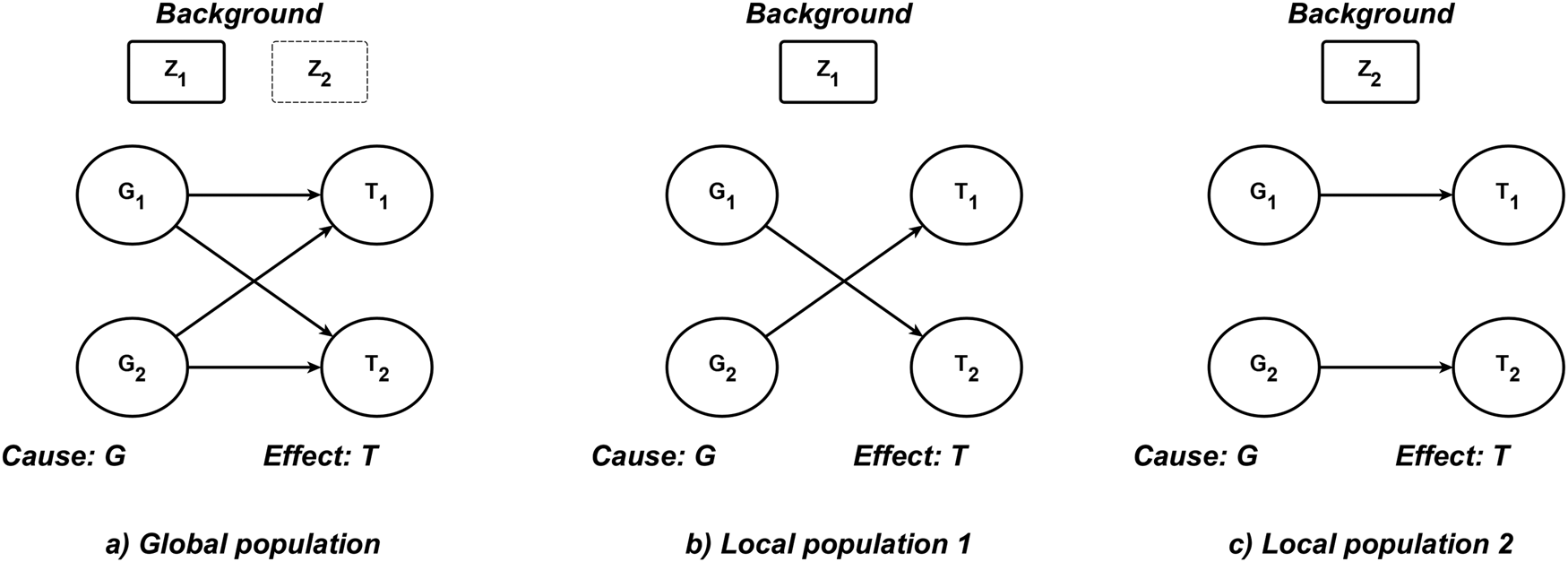
To make the point slightly more concrete (see Fig. 1), suppose a global population of individuals with two possible genotypes (G 1 and G 2) in equal proportions. Each genotype is associated with either two phenotypes with the same probability, T 1 and T 2 (e.g., two levels of anxiety, “low” for T 1 and “high” for T 2), depending on the background with two randomised states in equal proportions, Z 1 and Z 2, that could represent the environment. Intervening on G in the global population would lead to the conclusion that the genotype is not a cause of T. However, suppose that (unknown to the experimenter) in a local population “1” (part of G) containing the same proportion of the two genotypes but where only the background Z 1 exists, intervening on G would lead to a deterministic change in T (with G 1 → T 2 and G 2 → T 1). Further, in another local population “2” (also part of G), identical to the first except that only Z 2 exists, the opposite deterministic causal relationship would be established (with G 1 → T 1 and G 2 → T 2). In each local population, the conclusion would be that an individual's genotype causes the trait, but that a different genotype causes a different trait's value in the two populations.
Figure 1.Causal relationship between G and T in three populations. (a) In a global population with two randomised backgrounds (Z1 and Z 2), G does not appear to be causing T: intervening on G, on average, does not affect the probability of expressing one of the two values of T. (b) In the local population “1,” with a constant background Z 1, intervening on G leads to a change in T, and it is established that this relationship is G 1 → T 2 and G 2 → T 1. (c) In the local population “2,” with a constant background Z 2, the same is observed as in the local population “1,” except that the relationship is reversed so that G 1 → T 1 and G 2 → T 2.
This last conclusion would be more adequate than the conclusion reached in the global population that G does not cause anxiety. This is so because intervening on the background of some individuals in the population experiencing the “wrong” environment could affect their phenotype and have the benefit of reducing their anxiety.
A similar demonstration using more complex variables than binary variables – although more tedious – could be devised to show that a small global average effect can be the result of two (or more) large effects established in more local backgrounds but going in different directions.
The lesson from this simple case is that local or unstable causal relationships can have more value than more stable ones when the causal relationship is characterised by averages. This flies in the face of the commonly accepted view that more is better when it comes to causal stability and uncovers a well-known trade-off in the philosophy of modelling literature between generality and precision (Levins, Reference Levins1966). The point sketched here speaks directly to M&H's urge not to dismiss shallow causes once integrated into a more thorough causal analysis.






 You have
Access
Madole & Harden (M&H) provide an insightful analysis showing that different types of causes can play different roles in helping us understand the aetiology of complex traits. They make a point often underappreciated – namely, that average treatment effects (ATEs), such as those obtained from randomised controlled trials (RCTs), have some of the same limitations as those often attributed to heritability estimates and single-nucleotide polymorphism associations. Similarly, heritability estimates have often been charged with being only local parameters – when such a charge is rarely made against RCTs. Further, the charge of locality gives the false impression that a less local causal relationship – one that could be observed under a broader range of conditions – is always more useful than a local one. I show here that this conclusion does not follow; in some cases, which I illustrate with a theoretical example, local causal knowledge can be more useful for explanation and intervention than more generalisable knowledge.
Since Lewontin (Reference Lewontin1974), it is commonly accepted that heritability estimates originating from an analysis of variance suffer from the problem of locality: one estimate obtained in one population, even if unbiased, cannot and should not be extrapolated to other populations. This position, particularly its extreme form, is questionable (see Sesardic, Reference Sesardic2005, pp. 75–80); however, generally, locality is considered a detrimental feature for establishing causal relationships. Being able to generalise a result is an important aspect of science, and locality stands in its way.
The problem of locality ties in with the analysis of causation provided by Woodward (Reference Woodward2010) in the context of biological science (see also Bourrat [Reference Bourrat2020, Reference Bourrat2021], for discussions in the specific context of heritability). Intervening on a variable (X) permits establishing whether X is a cause of another variable (Y) but not comparing it to different causes. To that effect, several dimensions of causal relationships have been proposed in the literature, among which is stability. Some causal relationships are less stable than others – that is, they break down more easily when the background (i.e., the variables of the system that are not X or Y) changes. Thus, locality and stability are inversely related. The more a cause is local – the less it would generalise beyond the population where it was established – the less stable it is.
An ATE measures whether X makes a difference on Y, while all other variables in the background are randomised. As such, if a difference in Y is observed, one can be confident that the relationship tested is as stable as there is variation in the background. More importantly, however, it tells us nothing about whether this relationship holds under any of the randomised backgrounds, only that X makes, on average, a difference on Y (often with a certain magnitude). Conversely, if no causal relationship exists between X and Y, on average, in the range of backgrounds tested, this does not tell us whether it would also be the case in any of the specific backgrounds.
To make the point slightly more concrete (see Fig. 1), suppose a global population of individuals with two possible genotypes (G 1 and G 2) in equal proportions. Each genotype is associated with either two phenotypes with the same probability, T 1 and T 2 (e.g., two levels of anxiety, “low” for T 1 and “high” for T 2), depending on the background with two randomised states in equal proportions, Z 1 and Z 2, that could represent the environment. Intervening on G in the global population would lead to the conclusion that the genotype is not a cause of T. However, suppose that (unknown to the experimenter) in a local population “1” (part of G) containing the same proportion of the two genotypes but where only the background Z 1 exists, intervening on G would lead to a deterministic change in T (with G 1 → T 2 and G 2 → T 1). Further, in another local population “2” (also part of G), identical to the first except that only Z 2 exists, the opposite deterministic causal relationship would be established (with G 1 → T 1 and G 2 → T 2). In each local population, the conclusion would be that an individual's genotype causes the trait, but that a different genotype causes a different trait's value in the two populations.
Causal relationship between G and T in three populations. (a) In a global population with two randomised backgrounds (Z1 and Z 2), G does not appear to be causing T: intervening on G, on average, does not affect the probability of expressing one of the two values of T. (b) In the local population “1,” with a constant background Z 1, intervening on G leads to a change in T, and it is established that this relationship is G 1 → T 2 and G 2 → T 1. (c) In the local population “2,” with a constant background Z 2, the same is observed as in the local population “1,” except that the relationship is reversed so that G 1 → T 1 and G 2 → T 2.
This last conclusion would be more adequate than the conclusion reached in the global population that G does not cause anxiety. This is so because intervening on the background of some individuals in the population experiencing the “wrong” environment could affect their phenotype and have the benefit of reducing their anxiety.
A similar demonstration using more complex variables than binary variables – although more tedious – could be devised to show that a small global average effect can be the result of two (or more) large effects established in more local backgrounds but going in different directions.
The lesson from this simple case is that local or unstable causal relationships can have more value than more stable ones when the causal relationship is characterised by averages. This flies in the face of the commonly accepted view that more is better when it comes to causal stability and uncovers a well-known trade-off in the philosophy of modelling literature between generality and precision (Levins, Reference Levins1966). The point sketched here speaks directly to M&H's urge not to dismiss shallow causes once integrated into a more thorough causal analysis.
Acknowledgment
I thank James Madole and Paige Harden for discussions on this topic.
Financial support
This work was supported by an Australian Research Council Discovery Early Career Research Award (Grant ID: DE210100303).
Competing interest
None.