


INTRODUCTION
Due to assimiliationist policies and socioeconomic pressures, many Native American languages have been receding in favor of English (Grenoble & Whaley Reference Grenoble and Whaley1998; Hinton & Hale Reference Hinton and Hale2001; Austin Reference Austin2008). Community programs and language-vitality research initiatives are taking valuable steps to revitalize these languages and restore heritage language identities. We applaud that important work. At the same time, this article points out that revitalization is not the whole story of language and Native ethnic identity. Across modern Native America and First Nations Canada, many speakers are using a set of shared English features to perform and construct Native sociolinguistic identity. In their study of Lumbee English, Wolfram & Dannenberg (Reference Wolfram and Dannenberg1999:180–81) ask the following:
How does a group struggling to maintain its cultural distinctiveness create and maintain symbolic linguistic identity when it has lost its ancestral language roots? Can a dialect of the replacement language develop to fill the emblematic void of a lost ancestral language?
Studies of Lumbee and other individual tribes have demonstrated that English features can in fact be used to produce and reproduce Native identity, even in the absence of a viable heritage language (Leap Reference Leap and Fitzgerald1974; Wolfram & Dannenberg Reference Wolfram and Dannenberg1999). Lumbee, for example, has not been spoken for about five generations, yet the tribe maintains a distinct ethnic and linguistic identity through English (Wolfram & Dannenberg Reference Wolfram and Dannenberg1999).
We take this notion to the next logical stage: Using a broader range of tribes than prior research, we suggest that English construction of Native ethnic identity is occurring at a greater geographic and social range than previously assumed. It is becoming translocal (Blommaert Reference Blommaert2005:69). Specifically, we hypothesize that many communities across modern Native America and Canada are constructing a shared sense of ethnic identity through a set of linguistic features, particularly prosodic features of pitch and timing. Moreover, these features are best interpreted as performances (Bauman Reference Bauman2000) in heteroglossic, moment-by-moment discourse contexts (Coupland Reference Coupland2007:106–8; Jaffe, Koven, Perrino, & Vigouroux Reference Jaffe, Michèle, Perrino and Vigouroux2015). Following Eckert (Reference Eckert2005), Coupland (Reference Coupland2007), Mendoza-Denton (Reference Mendoza-Denton, Chambers, Trudgill and Schilling-Estes2002), and others, we focus on ‘what people meaningfully achieve through linguistic variation’ (Coupland Reference Coupland2007:5) and how these meanings are emerging in the English features of these Native communities. In a practice-based approach, ‘identities emerge in practice, through the combined effects of structure and agency’ (Bucholtz Reference Bucholtz1999:209; see also Goffman Reference Goffman1959; Ricoeur Reference Ricoeur, Reagan and Stewart1978:116; Giddens Reference Giddens1979:24, Reference Giddens1991; Fairclough Reference Fairclough2001:14).
Our study explores these issues through acoustic sociophonetics, discourse analysis, and analysis of ethnographic interviews. The results suggest that many Native people are creatively and resiliently building a modern Native ethnic identity using English as the most widely accessible linguistic resource. This finding is solidly supported by emic ‘cultural insider’ perspectives as well. The first two co-authors of this article are enrolled members of Native American and Canadian First Nations communities, and they conducted fieldwork and participated closely in all aspects of research design and interpretation. In this way, our study draws on ‘the local knowledge that motivates and explains the behavior of a particular group’ (Johnstone Reference Johnstone and Fought2004:76), while also connecting with contemporary sociolinguistics.
Our results suggest that many NativeFootnote 1 people are using these shared prosodic features to construct their identity in contrast to the Other (Fought Reference Fought2006:12–13; Llamas Reference Llamas2007), that is, non-Native people. This English construction of Native identity occurs regardless of whether a given speaker has knowledge of a heritage language. Such a large-scale, English-based ethnolinguistic identity has parallels in other minority communities, for example, African American English (Wolfram & Thomas Reference Wolfram, Dannenberg, Knick and Oxendine2002). In fact, given the binarity of the Native-versus-non-Native social construct in modern North American thinking, it would be surprising if some shared linguistic features had not arisen across Native communities. After all, language both reflects and constructs society (Giddens Reference Giddens1979:24, Reference Giddens1991; Bucholtz Reference Bucholtz1999:209; Coupland Reference Coupland, Eckert and Rickford2001:198–99; Fairclough Reference Fairclough2001:14). Moreover, the basic notion of large-scale Native ethnic identity will not come as a surprise to anyone who has experienced the powwow circuit or other modern cross-tribal events, where Nativeness—not a specific tribe or region—is often the primary locus of affinity. At the same time, we recognize that Native identity is complex, multi-layered, and experienced in various ways by different individuals and communities. For example, Native communities in the eastern U.S. encountered Europeans sooner than some of the locations studied here, and so they may have different sociolinguistic perspectives than people in the present study.
Prior work has examined ‘American Indian English’, ‘Native American English’, or ‘First Nations English’ in various parts of North America (e.g. Leap Reference Leap1977a,Reference Leapb, Reference Leap1993; Wolfram & Dannenberg Reference Wolfram and Dannenberg1999; Dannenberg Reference Dannenberg1999, Reference Dannenberg2002; Hazen Reference Hazen2000; Schilling-Estes Reference Schilling-Estes2004; Fought Reference Fought2006; Coggshall Reference Coggshall2008; Bowie, Dannenberg, & Kubitskey Reference Bowie, Dannenberg and Kubitskey2013; Kwatchka Reference Kwatchka and Hopkins2013). Acoustic sociophonetic research has been especially rare for these English varieties, and few studies have carefully examined the possibility of shared Native features across the continent. Our study helps fill these gaps by investigating the English spoken in three deliberately diverse locations: North/South Dakota, Northwest Territories (Canada), and Dartmouth College (New Hampshire), which enrolls Native students from a diverse range of backgrounds. By investigating speakers from these diverse tribal and regional backgrounds, we test the hypothesis that a shared Native ethnic identity is being constructed through a particular set of distinctive prosodic features.
Previous findings hint at this possibility. In one of the few prior studies on this topic that uses acoustic sociophonetic methods, Coggshall (Reference Coggshall2008) finds that both Eastern Cherokee English and Lumbee English speakers share similar timing patterns, and she suggests that such features should be examined from a wider sample of tribes. Native people themselves also report a sense of shared dialect features among speakers across the continent. For example, a Native student at Dartmouth explained that her use of Native American English features depends on the identity of her conversational partners: “I think it has to do with your familiarity and whether or not they also speak the same way—‘cause there's sort of a Pan-Indian dialect that exists, that people who aren't Native might not understand”. As a Native American website says, ‘The rez [reservation] accent knows no borders’.Footnote 2 Such comments match our own observations in powwows and other inter-tribal gatherings where a shared sense of Native ethnic community is constructed, though not necessarily labeled as ‘Pan-Indian’. The term Pan-Indian apparently originated with Brant (Reference Brant1950). By the 1960s, anthropologists viewed Pan-Indianism as ‘an ever growing social phenomenon’ (Thomas Reference Thomas1965:75). The term continues to appear in more recent work (e.g. Clark Reference Clark2012; Brandt & Smith Reference Brandt and Smith2013), although Hertzberg (Reference Hertzberg1971:291) suggests that the term is ‘seldom used by Pan-Indians, except by a few anthropologists and other intellectuals’. Even so, the underlying notion is strongly held in contemporary Native America (Shoemaker Reference Shoemaker1988; Nagel Reference Nagel1996), even if it is expressed in other ways, such as the commonly used terms Native and Indian Country. For example, we recall a New England powwow announcer who often talked about Indian Country to the audience, characterizing Indian Country as a sense of shared experience and identity, not a particular region. Thomas (Reference Thomas1965:75) states that ‘One can legitimately define Pan-Indianism as the expression of a new identity and the institutions and symbols which are both an expression of that new identity and a fostering of it’. A half-century later, we can confirm that Thomas was right: this ethnic identity is alive and well, and it is being constructed and expressed by institutions and symbols, including the set of distinctive English features discussed in this article.
In past research on Native American English, researchers have rightly pointed out the presence of variability in English dialect features across different tribes and locations. This is certainly true, but such an emphasis draws attention away from the possibility of unity at a larger scale. African American dialects, which have received a far greater amount of research attention (Schneider Reference Schneider1996, cited in Wolfram & Schilling-Estes Reference Wolfram, Dannenberg, Knick, Oxendine and Schilling-Estes2006:211), show considerable unity across the continent in certain linguistic features, along with diversity in regional and social variation (Mufwene, Rickford, Bailey, & Baugh Reference Mufwene, Rickford, Bailey and Baugh1998; Rickford Reference Rickford1999; Lanehart Reference Lanehart2001; Green Reference Green2002). Similar observations have been noted for US Latina/o English speakers (Fought Reference Fought2003, Reference Fought2006:70–88). The possibility of complex multidimensional communities constructing shared linguistic identities has been demonstrated in London as well (Cheshire, Kerswill, Fox, & Torgersen Reference Cheshire, Kerswill, Fox and Torgersen2011; Sharma Reference Sharma2011; Torgerson & Szakay Reference Torgersen and Szakay2012). It is reasonable to hypothesize that a shared sense of linguistic community may also be found in modern Native America and First Nations Canada.
In Leap's (Reference Leap1993) discussion of Native American English, he puts the emphasis on variability:
It goes without saying that Indian English grammars differ in their own right, site by site and (in some cases) speaker by speaker. Just as there is no single nonstandard English, so there is no single Indian English code… In part, such diversity reflects the unique properties of each community's ancestral language and cultural traditions… (Reference Leap1993:143)
From the viewpoint of language description or documentation, it is clear that a great deal of variability exists, just as Leap suggests. No single structural grammar could encompass such a diverse set of tribes and locations where Native people speak English. The influence of regional English dialects on vowels, for example, is just one of many factors in regional variability. From a sociolinguistic viewpoint, however, we should be careful not to overlook the possibility of unity in a limited, shared set of features, and the important role that such features may play in constructing contemporary Native identity. Rowicka (Reference Rowicka2005) raises the possibility that ‘a shared AIE [American Indian English] substratum is developing, based on non-standard English features rather than on specific ancestral language transfer features. Leap's Reference Leap1993 assertion that no general AIE variety is on the rise may be worth reexamination’ (301). Following Rowicka, our study explores Native American English from this broader perspective.
PRIOR WORK
Leap (Reference Leap1993) provides a comprehensive examination of Native American English features from various tribes, including grammatical features and phonological features as well as history and educational issues. Most other work focuses on individual regions or tribes, such as Liebe-Harkort's (Reference Liebe-Harkort1983) study of Apache English, Flanigan (Reference Flanigan1987) on Lakota English, Alford (Reference Alford1974) on Cheyenne English, and Leap's (Reference Leap1977a, Reference Leapb) work on Isletan English and other southwestern varieties, as well as research by Leechman & Hall (Reference Leechman and Hall1955), Malancon & Malancon (Reference Malancon and Jo Malancon1977), Bartelt, Penfield-Jasper, & Hoffer (Reference Bartelt, Susan and Hoffer1982), Wolfram (Reference Wolfram1984), and others. Pragmatic and anthropological linguistic issues have also been examined, including Basso's (Reference Basso1970) study of silence in Apache and other scholarship in the ethnography of communication, for example, Philips (Reference Philips1974) and Scollon & Wong-Scollon (Reference Scollon, Wong-Scollon and Carbaugh1990).
More recently, Meek (Reference Meek2006) discusses how the popular media culture portrays Native American English. A number of researchers have recently studied grammatical features of Lumbee English (Dannenberg & Wolfram Reference Dannenberg and Wolfram1998; Dannenberg Reference Dannenberg1999, Reference Dannenberg2002; Wolfram, Dannenberg, Knick, & Oxendine Reference Wolfram, Dannenberg, Knick, Oxendine, Schilling-Estes and Thomas2002; Schilling-Estes Reference Schilling-Estes2004). Anderson (Reference Anderson1999) researches /ai/ and /oi/ in Cherokee English, and Hazen (Reference Hazen2000) examines variants of be among the Haliwa-Saponi of North Carolina. Bowie, Dannenberg, & Kubitskey (Reference Bowie, Dannenberg and Kubitskey2013) investigate Alaska. Rowicka (Reference Rowicka2005) investigates voiceless stops in Quinault, Canada, while Ball & Bernhardt (Reference Ball and Bernhardt2008) sketch some English features of Canadian First Nations people for reference by speech pathologists. The recent study most relevant to the sociophonetic aspects of our project is Coggshall's (Reference Coggshall2008) work on Eastern Cherokee and Lumbee. As explained above, Coggshall raises the possibility that syllable timing might be found across a wider range of Native speakers, although that study is based on data from only two tribes located in North Carolina.
Considering this review of prior literature on Native American English, we observe five significant gaps. First, the amount of literature is limited in comparison to other English varieties, and quantitative or acoustic studies are rare. Second, a good amount of prior fieldwork is becoming outdated (such as Alford Reference Alford1974, Leap Reference Leap1977a,Reference Leapb, etc.) due to rapid social and linguistic changes in many Native communities. Third, prior work has largely focused on grammatical features, rather than phonetic or phonological features. Pitch is especially understudied, despite early suggestions about the possible importance of prosody (Penfield Reference Penfield1977; Leap Reference Leap1993). Leap notes several possible prosodic features, including a ‘singsong voice’ (Reference Leap1993:52), and Penfield discusses a level intonation pattern in questions (Reference Penfield1977:34–35). Fourth, as outlined above, prior work has typically centered around a particular tribe, rather than drawing larger generalizations from a wider range of tribes. Leap (Reference Leap1993) considers some possible continent-wide phenomena, but the book does not focus on acoustic analysis, and it represents the state of Native American society over two decades ago. Finally, the fifth gap in the prior literature is that most researchers have not been members of the Native American community themselves. We believe that the Native/non-Native collaborative approach of the present study provides a balance of emic and etic perspectives. The two Native co-authors have lifelong experience as active members of Native communities: Lakhota (Standing Rock Sioux Reservation) and Sahtu Dene (Northwest Territories, Canada). These co-authors gained further experience with diverse tribes during four years as undergraduates at Dartmouth College, where they held leadership positions in Native student organizations and actively participated in a Native American affinity house. After college, they have continued their engagement with their own Native communities in North/South Dakota and northern Canada.
Distinctive features
It is important to emphasize that we are not suggesting that Native people all speak English the same way. Each region has its own regional English dialect features, and many Native communities have additional features of their own. Moreover, individuals make their own identity and discourse choices. We do find, however, that many Native people share certain prosodic features in certain contexts, especially in joking or other casual settings. And even for those who never speak this way, there is still a shared knowledge of these features across many different Native communities. There are well-known stereotypical examplesFootnote 3 in movies like Smoke signals, which is popular in Native American communities. In addition, Native American and First Nations comedians, such as Don Burnstick, and powwow announcers, such as Tony Bobtail Bear, frequently draw upon such features. Native people report that such speaking styles can cross tribal and regional boundaries, even though there are many tribal and regional differences in other respects. Many also report that they change speaking styles depending on the situation and the people present (Native versus non-Native).
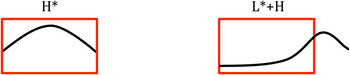
Considering the ‘singsong’ quality noted by Leap (Reference Leap1993), we observe that the following pitch and rhythm effects may be involved as speakers use English to index a distinctive Native identity. First, we find a pitch contour in certain words such that the stressed syllable is low and the following syllable is high (L*+H). Figure 1 contrasts this pattern with H*, where the pitch is highest on the stressed syllable. In the figure, the rectangle represents the stressed syllable, and the dark line is the pitch track (Pierrehumbert Reference Pierrehumbert1980; Cruttenden Reference Cruttenden1997:67; Arvaniti & Garding Reference Arvaniti, Garding, Cole and Hualde2008; Ladd Reference Ladd2008).
Two stress patterns (adapted from Arvaniti & Garding (Reference Arvaniti, Garding, Cole and Hualde2008), citing Pierrehumbert Reference Pierrehumbert1980).

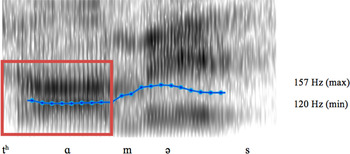
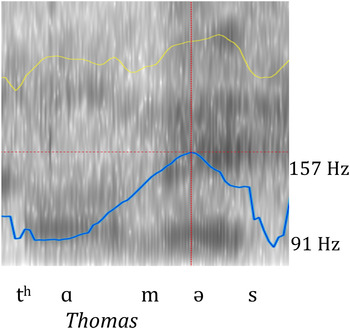
Figure 2 provides a Praat screenshot (Boersma & Weenink Reference Boersma and Weenink2014) of the L*+H pattern from our data. In such syllables, the stressed syllable is marked by this distinctive pitch contour, so we refer to this pattern as the ‘contour pitch-accent’ feature. Note that the stressed syllable [thɑ-] is lower in pitch than the following syllable [-məs], and there is a contoured transition between L and H. We believe that the present study represents the first time that this distinctive pitch feature has been acoustically and phonologically explained in research on Native American English or Canadian First Nations English.
L*+H contour pitch-accent pronunciation of the word Thomas.

We have also observed that the end of intonation units (clause-final or turn-final positions) sometimes have a high-rising, mid, or high-falling contour, rather than the more standard falling declination of many other dialects (Clark & Yallop Reference Clark and Yallop1995:337; Ladefoged Reference Ladefoged2006:116–17). In addition, lengthening often occurs in these positions.
We observe syllable timing as a distinctive feature as well, but since Coggshall (Reference Coggshall2008) has already conducted a study of syllable timing, we focus on contour pitch-accent and the intonation-unit-final features noted above. To our knowledge, these features of Native American English have never been acoustically analyzed—certainly not across multiple tribal locations. We decided to invest our resources into these features, rather than syllable timing, but we look forward to future research that may build on Coggshall's syllable-timing work.
Are these Native American English features enregistered in the sense of Agha (Reference Agha2003, Reference Agha2006)? ‘A register emerges when a number of indexical relationships begin to be seen as related; a particular linguistic form (or non-linguistic sign) is enregistered when it becomes included in a register’ (Johnstone Reference Johnstone2011:660; see also Johnstone, Andrus, & Danielson Reference Johnstone, Jennifer and Danielson2006). The set of Native American prosodic features described in this article appear frequently in Native American comedy performances, powwow announcers’ performances, and popular movies, as well as daily discourse and playful banter. The catchphrase Hey Thomas became popular following the movie Smoke signals, and it continues to carry meaning for many young modern Native people. Like Johnstone's vowel observations of downtown [da:nta:n] in Pittsburgh, we suggest that the prosody in Hey Thomas is part of an enregistered set of interrelated indexicals. Johnstone's local field observations led her to view Pittsburghese as a register, and we believe it is reasonable to suggest that these Native prosodic features are enregistered as well, albeit on a wider, extra-local scale. But unlike the segmental (diphthong) target in Pittsburghese downtown, the phrase Hey Thomas targets prosodic features, not segmental features. In fact, we suspect that the key set of phonological indexicals in this hypothesized continent-wide Native enregisterment may be entirely prosodic rather than segmental.
We recognize that a range of other linguistic features could be relevant as well, such as lexical items, syntax, or segmental variation, especially in particular geographic regions, as discussed in Leap (Reference Leap1993:44–50) and elsewhere. Segmental features are subject to wide variation across the continent under the influence of regional English dialects. Lexical features vary widely as well, including highly localized borrowings from Native languages. Since our study emphasizes cross-continental features, we have chosen to focus on the most likely variables to share widespread Native indexicality, and the results and ethnographic observations have consistently pointed in the direction of prosody. For cases like Pittsburgh, a set of locally distinctive segmental and lexical features became enregistered as indexing local identity (Johnstone et al. Reference Johnstone, Jennifer and Danielson2006). Native America crosses a vastly wider territory, encompassing multiple cultures, regions, and language substrates, along with many different localized English vowel systems and other regional phonology. Prosodic features may be especially suited to transcend the bounds of regional English in this way.
As for morphosyntax, we find evidence of nonstandard forms, but they overlap with those found in many other nonstandard varieties of English. We do not find especially distinctive Native morphosyntactic features, nor do we find evidence that a distinctive subset or frequency of such features has become enregistered, unlike the case of African American English or Lumbee English (Wolfram & Schilling-Estes Reference Wolfram, Dannenberg, Knick, Oxendine and Schilling-Estes2006:217). While grammatical features play an important role in local Lumbee identity (Dannenberg & Wolfram Reference Dannenberg and Wolfram1998), we do not find these distinctive patterns on a wider scale. As Wolfram & Schilling-Estes (Reference Wolfram, Dannenberg, Knick, Oxendine and Schilling-Estes2006:46–53) point out, many nonstandard grammatical features are not due to contact or accommodation, but rather represent natural (internal) language changes toward transparency, simplicity, analogical leveling, and so on. Therefore, it is not surprising to find features like negative concord, different tense marking, and so on, in Native American English as well as African American English and unrelated nonstandard dialects in North AmericaFootnote 4 and in other nonstandard dialects of English around the world (e.g. Preston Reference Preston2015).
Examples from our study include different tense and agreement patterns (I gots some, I gots that), negative concord (I don't have nothin), preterite-had, copula absence, resumptive pronouns, do-absence (How you say hello in Slavey?), and forms like I seen that; I seen her yesterday; Somebody else gonna catch it. We also find structures like My mom and them went to…. Speakers are also observed using double comparatives (e.g. more better). We believe that Native prosodic features are more geographically consistent and more likely to index large-scale Native constructs, and so we focus on prosody in this article. Moreover, speakers who never use nonstandard grammatical features still use prosodic features to index Native identity.
METHODS
We designed the fieldwork to involve a wide range of tribes and locations. Fieldwork was conducted in three sites: (i) the Standing Rock Reservation in North and South Dakota, home to the Lakhota/Dakhota people; (ii) the town of Tulita in the Canadian Northwest Territories, home to Slavey Dene people; and (iii) on the Dartmouth College campus in Hanover, New Hampshire, with students from diverse tribal backgrounds. Dartmouth enrolls more Native students than all of the other Ivy League schools combined (about 180–200 self-identifying Native students), which provides a uniquely diverse set of tribes in one location. Dartmouth's original founding charter in 1769 included a focus on Native Americans. In 1970 the school began renewing this heritage and recruiting Native students from diverse tribal backgrounds across the continent.
Interviews
A total of approximately seventy-five Native people are represented in our recordings. The students recorded at Dartmouth were all young adults. For Standing Rock Reservation and Tulita, Canada, the participants included three generations: young adults, middle-aged people, and elders. Participants were drawn from diverse walks of life, including a range of occupations across the local communities, as well as academics (students at Dartmouth, and students and teachers at the tribal college, Sitting Bull). The Standing Rock and Tulita recordings were in rural communities, while the Dartmouth students came from both urban and rural backgrounds. The present study uses a broad sample of Native society as a step toward understanding how prosodic features index Native ethnic identity, and future studies can examine possible influences of social factors like urbanity/rurality in more detail.
The interviews were recorded with Edirol R-05 digital recorders (44.1 KHz, 16-bit). All interviews were held in ‘Native-friendly’ environments: the Dartmouth Native American House (a campus affinity house), Standing Rock's tribal community college (Sitting Bull), as well as homes and other venues (Northwest Territories). In all cases, the interviewer and the interviewees were Native, thus helping to build a Native cultural environment. Interviews consisted of two types: one-on-one interviews (twenty-four recordings) and casual group gatherings (fourteen recorded events involving three to eight people in each case). The one-on-one sessions involved a ‘toy game’ activity adapted from McDonough & Lachler (Reference McDonough and Lachler2012) designed to elicit naturalistic speech. In the toy game, the interviewer and the participant have identical sets of small toys (animals, trees, etc.). The two people are separated by a small poster board that blocks the line of vision. The goal of the game is to arrange both sets of toys in an identical pattern without looking past the poster board to the other person's side, for example, ‘Where is the horse?’, ‘The horse is next to the tree’. At the end, the poster board is removed, and both people can see how closely their toy sets match. The one-on-one interviews also included questions relating to Native American issues and questions about personal identity and ethnicity.
The second type of interview consisted of group settings where a small group of people chatted casually. One particularly effective group event was a ‘frybread party’ (Allard, Atcitty, Cooper, & Seawright Reference Allard, Atcitty, Cooper and Seawright2014), where seven students gathered at the Dartmouth Native American House to make frybread and chat. This group represented diverse tribal affiliations, including Cherokee, Oto-Missouri, Iowa, Navajo, Tuscarora, Acoma Pueblo, Lakhota, Hochunk, Creek, and Potowatomi.Footnote 5 The speakers also represented geographically far-flung regions: Arizona, New York, Oklahoma, South Dakota, and Michigan. In Native communities, group activities like this tend to garner more support, while individual interviews can be more difficult. For example, one-on-one parent/teacher conferences are often dispreferred in Native communities, whereas large-group parent involvement activities are welcomed.
RESULTS
The toy game activity and other one-on-one interview activities yielded few of the distinctive prosodic features that we had expected from our prior informal observations. Even though the one-on-one interviews were Native-only settings, most interviewees simply used Standard English. The only speakers who used Native prosodic features were a few people who we have observed using these features in any environment: Native and non-Native, casual and formal. One speaker (male college student, Navajo) produced these features throughout the recordings, but other speakers produced them only in specific discourse moments (see discussion of excerpt (1) below). For most speakers, the individual interview style did not elicit the types of distinctively Native features that we had observed in daily life prior to the study. Although the interview environment was meant to be casual, the inherent formality of a one-on-one interview apparently caused most interviewees to avoid distinctively Native features. This finding has implications for the social meaning of the prosodic features found in this study, discussed below.
By contrast, the casual ‘frybread party’ and the other group settings generated a great deal of distinctively ‘Native-sounding’ features. This result is understandable since many Native students have reported that they tend to use these features in casual settings, especially when joking or teasing friends, rather than in formal settings like classroom interactions. Even so, we had expected that a Native-only personal interview environment would create sufficient affiliation to draw out Native prosodic features. It turns out, however, that these features primarily appear in casual settings. They are best viewed in terms of their situated social meaning in the particular discourse moments of natural interactions (cf. Silverstein Reference Silverstein2003).
Further insights emerged from individual speakers’ responses to our interview questions. One Navajo student said, “I feel like I have to like talk more better to non-Natives because they have expectations about us… Back home, I tend to make more grammatical mistakes, and I don't care how I talk back home. But here, like, I feel like I have to, like, up my game and speak formally”. A Lakhota student said, “in an academic setting, like, I speak differently than I would in a casual setting… so I think my rez comes out. My rez [reservation] accent comes out in casual settings”. Another student said that she has noticed shifts in her English every time she returns to Dartmouth from her pueblo community in New Mexico.
Initial impressionistic analysis of a group setting
The Dartmouth ‘frybread party’ recordings consisted of seven speakers talking casually together for a total of forty-four minutes, amounting to 772 intonation units. Results were coded using the discourse-analytic notion of intonation unit in Chafe (Reference Chafe1994:53–70). In our conversational recordings, intonation units can be single turns, but speakers can also produce multiple intonation units (typically clauses) within a single turn. As an initial exploratory stage of the data analysis, we invited a Native student to listen to the recordings and mark a Praat TextGrid (Boersma & Weenink Reference Boersma and Weenink2014) whenever she perceived a feature as ‘Native-sounding’. We used this method to produce an initial exploratory sketch of the types of features that may be indexing Native identity. Of course, a more extensive sample of listeners would be required if the primary goal of our study were perceptual in nature. But for our purposes in this production-based study, this initial exploratory sketch served as a practical way to focus our acoustic analysis. Among the features tagged as ‘Native-sounding’ in the initial analysis, we noted that 185 were prosodic features: twenty-two contoured pitch-accented items, eight high-falling syllables in intonation-unit-final position, thirty-nine low tonic syllables, forty-eight instances of high-rise terminal, and fifty-five lengthened syllables in utterance-final position. Examining these results statistically, we found that intonation-unit-final features (high-falling terminal, high-rise terminal, lengthened terminal) were the most common at p < 0.0002 (Newmark, Walker, Allard, Atcitty, Cooper, & Seawright Reference Newmark, Walker, Allard, Atcitty, Cooper and Seawright2014). The prevalence of these effects suggests that intonation-unit-final position may be important in the prosodic construction of Native ethnic identity, that is, clause-final and turn-final positions.
Discourse context
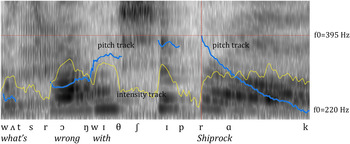
Our two Native co-authors and other Native research colleagues were participants in group recordings. The discourse analyses in this article are based on their interpretations and perspectives as participant-observers. First of all, we observe that the prosodic features discussed in this article occurred primarily in the following contexts: joking, teasing, storytelling, ironic imitations, expressing offense, and expressing solidarity. In other words, speakers were more likely to produce these features in playful moments or when trying to make a particularly important point. Excerpt (1) provides an example of the use of Native-sounding features in discourse context. The key word in this selection is the underlined token of Shiprock, which is a town in New Mexico. The underlined token of Shiprock was produced with a high-falling, lengthened terminal (see Figure 3). Notice the contrast in length between the terminal syllable and the rest of the utterance, as well as the high-falling contour. A playful/humorous key (Hymes Reference Hymes1974) is apparent throughout this excerpt, especially as the participants tease Speaker A for her attitude about Shiprock. Speaker F, for example, directly imitates Speaker A and generates laughter. Note also that the town of Shiprock is portrayed by several of the speakers as a stereotypically Navajo place. The conversations are transcribed at the basic word level; angle brackets < > indicate paralinguistic features; square brackets [ ] indicate editorial (authors’) comments.
-
(1) A: Hey, where are you from?
B: She's from [speaks in Navajo]
C: Huh?
A: Where are you from?
C: [names a location in New Mexico]
D: What about you?
E: [names a location in Arizona] [It's] literally the heart of the Navajo Nation
C: Lies… lies!
B: Okay, actually that's
E: Girl, you live on a checkerboard
B: That's [speaks in Navajo]
<laughter>
A: I was born in Shiprock
B: Huh?
F: That pretty Nav-[ajo]
That's pretty–
Yeah <laughs>
…
D: Shiprock?
B: … My mom and them went to Farmingham today
A: What's wrong with Shiprock ? [see Figure 3]
G: I love Shiprock
D: I just drove by — through Shiprock one time
A: Shiprock's my — Shiprock's my main — I don't know, I love Shiprock
F: <laughs> [I'm] trying not to cuss. <laughs>
F: [imitates Speaker A]: Shiprock's my — Shiprock's my main —
<laughter all around>
E: Shiprock is my heart
A: Yeah
B: Oh, it's your heart
F: Mm, oh
D: So what's you guys’ tribal affiliation? …
Figure 3.Spectrogram and pitch track from the underlined token of Shiprock in excerpt (1). Pitch (f0) is represented by the darker pitch track (blue in online version) in the figure. Intensity is represented by the lighter line (yellow online) (range in the figure: highest = 73 dB, lowest = 58 dB).


This excerpt also includes a small amount of codeswitching (Navajo) by one participant, even though not all participants understood it. Codeswitching was infrequent in our data. When it occurred, Navajo was the main language used in this way, most likely because Navajo is a comparatively large language community and has considerably higher language vitality. For Lakhota/Dakhota, Slavey Dene, and other language communities in our data set, a speaker may (rarely) be heard using a single word of the heritage language, but little more. This reflects the challenge that current generations are facing in revitalizing Native languages. Even for Navajo, it is common for younger and middle-aged people not to be fluent in the heritage language.Footnote 6 In fact, this is one of the reasons why we believe that the prosodic features in this study are so meaningful to the Native community: while immersion programs are making progress in language revitalization, younger and middle-aged speakers still typically use English for most interactions in everyday life. Codeswitching is a well-known tool for performing ethnic identity in bilingual communities, for example, Spanish-English codeswitching is used this way in the US (Fought Reference Fought2006; Mendoza-Denton Reference Mendoza-Denton2008), but this tool is much less accessible for younger Native Americans.
Acoustic analysis
Our analyses of the recordings, combined with our experiences as participant-observers in the community, suggest that the following specific prosodic features are indexing Native identity in casual group settings: (i) contoured pitch-accent, (ii) high-falling, mid, or high-rising syllable in intonation-unit-final position, (iii) lengthened intonation-unit-final syllables, and (iv) syllable timing. Building on Coggshall's (Reference Coggshall2008) observations about syllable timing in North Carolina and Leap's (Reference Leap1993) earlier discussion of ‘singsong’ features, we believe that our list represents the prosodic features commonly used to index contemporary Native American ethnic identity. Naturally, some of these features, such as high-rise terminals, are found across diverse dialects of English (Wolfram & Schilling-Estes Reference Wolfram, Dannenberg, Knick, Oxendine and Schilling-Estes2006:172, 199). The individual linguistic features need not all be unique for a particular group to create a distinctive style or ethnic identity. What we are suggesting is that Native Americans are using a particular collection of features in a particular way to construct a Native ethnic identity (Fought Reference Fought2006:ch. 2).
Among these features, we selected the following three pitch features for detailed acoustic analysis: contour pitch-accent, high-falling terminal syllables, and mid-terminal syllables. As noted above, Coggshall (Reference Coggshall2008) has already explored syllable timing, so we put our acoustic focus on three pitch features that are unexplored and that we perceive as ‘Native-sounding’ to a high degree. A full perceptual study goes beyond the goals of the present study, but we hope that future research will build on our work. Likewise, future research on duration may be valuable, as we sometimes observe lengthening in tandem with the pitch features analyzed in this study, such as mid-terminals that are lengthened. The role of amplitude may be significant as well. The appendix provides further Praat examples of our pitch features of interest in the context of amplitude and duration.
Pitch normalization
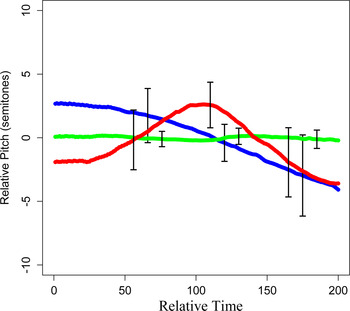
In order to compare different speakers, the pitch tracks are first normalized according to duration and pitch. Duration is normalized in terms of 200 ‘relative time points’ (Stanford Reference Stanford2008, Reference Stanford2015), which makes it possible to compare tokens at any point, regardless of different speech rates. As for normalizing pitch, the mean f0 for each token was used as a reference; in the plots below (Figures 4–7), the zero line represents the mean f0 for each token. This makes it possible to compare speakers with different mean f0 as well as tokens with different mean f0. It is also important to convert the data to a logarithmic scale because f0 is nonlinear in Hz. Even after mean f0 differences are normalized, speakers still have different ranges. Speakers with high-pitched voices typically have wider pitch ranges than lower-pitched speakers (Yaeger-Dror & Fagyal Reference Yaeger-Dror, Fagyal, Di Paolo and Yaeger-Dror2011:124). A semitoneFootnote 7 scale is a common way to handle this issue (Ross, Edmondson, & Seibert Reference Ross, Edmondson and Seibert1986; Hart, Collier, & Cohen Reference Hart, Collier and Cohen1990:23–24, 188; Xu Reference Xu1999; Nolan Reference Nolan, Solé, Recasens and Romero2003; Astruc Reference Astruc, Jones and Knight2013:130–31), following the auditory properties of pitch. A semitone is a musical half-step, and so an octave is twelve semitones. Note that this methodology allows range to be analyzed as a sociolinguistic variable. Without a logarithmic conversion like semitones, range effects cannot be analyzed as a sociolinguistic variable because higher-pitched speakers inherently have wider f0 ranges. In other words, with a semitone scale, different speakers’ pitches can be directly compared, despite differences in sex, age, or an individual's preferred mean pitch, and so on. This makes it possible to make inter- and intra-speaker comparisons of not only simple pitch but also pitch contour. Pitch range can also be studied as a variable, much like vowel formants are gradient variables that can be socially meaningful. Podesva (Reference Podesva2007), for example, shows how an individual speaker can change pitch range—not simply pitch—to index ‘expressiveness’, and so on. But a conversion to semitones additionally makes it possible to overlay multiple speakers’ pitch tracks, as we discuss below.
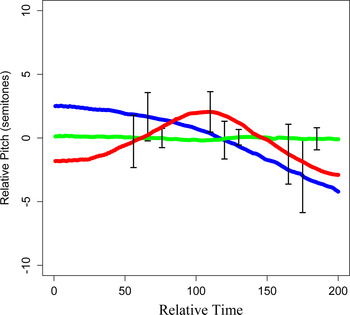
Pitch results for all locations. 192 total tokens represented: bell-shaped line = pitch-accent contour (sixty-nine tokens), falling line = high-falling terminal (fifty-one tokens), level line = mid-terminal (seventy-two tokens). Locations represented: Tulita (twenty-seven tokens), Standing Rock (122 tokens), and Dartmouth (forty-three tokens).

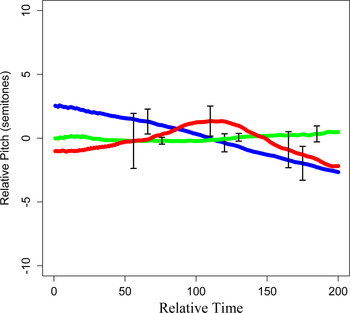
Standing Rock results (122 tokens): bell-shaped line = pitch-accent contour (thirty-eight tokens), falling line = high-falling terminal (thirty-eight tokens), level line = mid-terminal (forty-six tokens).

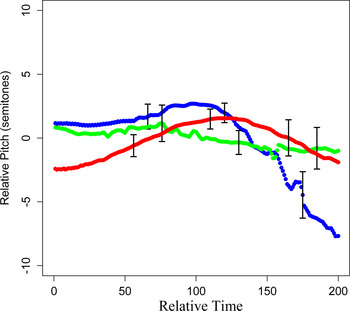
Results from the Dartmouth frybread recording (forty-three tokens): bell-shaped line = pitch-accent contour (sixteen tokens), falling line = high-falling terminal (eight tokens), level line = mid-terminal (nineteen tokens).

Results from the Tulita recordings (twenty-seven tokens): bell-shaped line = pitch-accent contour (fifteen tokens), sharper falling line = high-falling terminal (five tokens), level line = mid-terminal (seven tokens).

Plotting the results
We find consistent pitch patterns across all three field sites. First, Figure 4 shows all three locations together: contour pitch-accent (bell-shaped line), high-falling terminal, and mid-terminal. Each line represents the mean of all tokens for that feature, normalized according to the procedures described above. Error bars represent the standard deviation at the given point in relative time.
Among these three features, we are especially intrigued by the contour pitch-accent. We note that the peak occurs at approximately the midpoint of the prosodic word, and it is roughly symmetrical. We also note that it covers an average range of about half an octave (one octave = twelve semitones). This strikingly clear pitch-accent pattern is arguably part of the sociolinguistic competence (Ervin-Tripp Reference Ervin-Tripp and Ervin-Tripp1973; Kerswill & Williams Reference Kerswill and Williams2000) of many speakers in Native America and First Nations Canada.
When we divide the data into each field site, we find compelling evidence that these pitch patterns are shared across diverse regions in North America. Figure 5 shows the results for Standing Rock; Figure 6 shows the Dartmouth ‘frybread recordings’; and Figure 7 shows Tulita, Northwest Territories. In these three plots, we observe that the features have the same overall characteristics. In particular, note that the pitch-accent contour is always roughly symmetrical, it has a peak near the midpoint, and its range is approximately half an octave (slightly smaller in the Dartmouth recording).
DISCUSSION
Possible historical origins
In light of the results, it is natural to wonder about the origins of these shared features. Possible origins of Native American English features include (i) inter-tribal contact in the off-reservation boarding schools which began in the late nineteenth century (Leap Reference Leap1993:157–69), (ii) an early trade pidgin (Leechman & Hall Reference Leechman and Hall1955), (iii) reservations as social settings for the development of shared English features (Craig Reference Craig1991), and (iv) Native languages as substrates (Leap Reference Leap1993). Regardless of the relative strengths of these historical hypotheses, it is clear that distinctive English features have emerged in many Native communities. For example, it may or may not be the case that phonologies of certain Native languages have had a substratal influence on wider Native American English phonology. But either way, our study suggests that current generations of L1 English speakers of Native heritage may be constructing an ethnic identity through a shared set of Native American English features, and these shared features go beyond any speaker's particular tribe or personal fluency in any Native heritage language. After all, Chicano English is acquired as L1 by many children and then used to index an ethnic identity across a wide region using English, regardless of whether a child can speak Spanish (Fought Reference Fought2006:70–88).
The off-reservation boarding school system and other cross-tribal interactions have had an undeniably strong influence on Native languages and on the role of English in modern Native life. In the late nineteenth and early twentieth century, many Native American and Canadian First Nations children were taken away from their families and placed in boarding schools. Native children from different locations have therefore interacted in English since at least the late 1800s. Leap (Reference Leap1993:157–69), Malancon & Malancon (Reference Malancon and Jo Malancon1977), and Coggshall (Reference Coggshall2008) have all suggested the possibility that Native American English may have some of its origins in these boarding school interactions. In such an environment, it is understandable that the children would construct distinctive English features and share them across communities. Children were forced to learn English and punished for speaking their Native languages, often through beatings or other threats. In recent years, there has been a growing awareness in the US and Canada of the harmful effects that the boarding school era had on Native languages, cultures, and communities. As Hornberger & McKay (Reference Hornberger and McKay2010:409) explain, ‘The historical oppression that Native Americans have endured through institutions like boarding schools led to the loss of tribal languages and to the emergence of distinctive linguistic features of Native American English’. More recently, there has also been a considerable amount of interaction through urban relocation and intermarriage across tribes, especially in the era following the Indian Relocation Act of 1956.
In addition, many Native languages are tonal, which naturally suggests that one or more tonal languages could have been the source for some of the pitch related features in English described here. At the same time, we note that high rising terminals and other distinctive pitch-related features can appear in nontonal languages, including many varieties of English, for example, New Zealand English (Guy, Horvath, Vonwiller, Daisley, & Rogers Reference Guy, Horvath, Vonwiller, Daisley and Rogers1986), so this remains an open historical question. Prosodic influences on majority languages have been observed elsewhere as well; Cruttenden (Reference Cruttenden1997:151–52) notes the influence of Mayan prosody on Spanish dialects, and Colazo-Simon (Reference Colazo-Simon2007) also finds Mayan influence on the phonetics of Yucatecan Mexico Spanish. Moreover, speakers in our study use these prosodic features regardless of whether their heritage languages are tonal or not (e.g. Navajo vs. Lakhota/Dakhota). Therefore, a simple connection probably cannot be drawn from any particular Native tonal language to the Native American English pitch patterns observed here. There are 566 federally recognized US tribes and 617 Canadian First Nations communities,Footnote 8 and so it would be a daunting task to link their complex histories and linguistic substrates to these prosodic features of modern Native American English.
Orders of indexicality
While such historical questions are valuable to consider, we would like to focus our analysis on the modern, synchronic scope of these shared prosodic features. After all, Native people often express their desire for others to recognize and respect their living cultures in the present, rather than focusing solely on the past. In modern Native society, the English features discussed in this study are found across vast cultural and geographic distances, and there is an increasing degree of intertribal contact and an increasing Native presence on social media. At the same time, Native communities are facing serious challenges to their local heritage languages and cultures. What do these English prosodic features mean to modern Native people, and why exactly are they using these features?
First, recall (in the Introduction) that we are not claiming that all Native people speak English in the same way, nor that they necessarily share dialect features at the segmental, lexical, or morphosyntactic levels. Rather, we are reporting on a set of prosodic features that we believe many Native people recognize as indexes of Native ethnic identity in English. We find that some speakers use these features very frequently (almost every clause); others use these features only occasionally; others never use these features. How can this situation be understood in sociolinguistic terms? Naturally, one factor is that some individual speakers simply identify more with their Native heritage than others. Likewise, some speakers may choose to use linguistic means to index their ethnic identity more than other speakers. Native ethnic identity is, of course, expressed to different degrees in different families and communities across the continent. Some Native readers of this study could be members of communities that do not use these features at all. We also recognize that a strong Native identity can be constructed in many ways, both cultural and linguistic, and certainly not just via the features studied here.
Nonetheless, in studying these prosodic features we find a pattern of sociolinguistic tendencies—both in our recordings and in our personal experiences—that we believe is worthy of consideration. Our study suggests that certain prosodic features have become enregistered, recognized by the community, and available for making social meaning, even if not all speakers choose to use them. Silverstein's notion of orders of indexicality (Reference Silverstein2003) provides insights in this regard. A small minority of speakers in our study used Native-sounding features frequently and unselfconsciously, such as Speaker B in the ‘frybread recording’ (excerpt (1) above) and a few similar speakers in the Standing Rock and Tulita recordings. In Silverstein's (Reference Silverstein2003) terminology, this represents a first order indexical being constantly used to reflect and construct a particular Native American identity in daily life, with little linguistic self-consciousness or agentivity. Just as first order indexicals can mark a person's regional heritage, so too they can mark ethnic heritage. In fact, Native participants in our study have sometimes suggested that these features remind them of an uncle or other family member or ‘typical’ Native person back home on the reservation, that is, a certain persona (Coupland Reference Coupland, Eckert and Rickford2001; Reyes Reference Reyes2002).
But we also find that some speakers use these features in a much more agentive manner. As discussed in the Methods section, we originally planned to elicit these features by asking people to talk about their lives and Native issues, especially in affinity environments like Dartmouth's Native American house or the predominantly Native communities on Standing Rock Reservation and in Tulita, Canada. But in these one-on-one settings, we found that most interviewees used standard English features, even though they were discussing Native issues with a Native interviewer in a Native setting. By contrast, distinctively Native features appeared frequently in the casual group settings (in all three locations), especially in a ‘playful’ and warm interactive environment. In these settings, most speakers still did not use these features all the time; they just occasionally produced these features to express themselves at some key moment in the discourse, such as getting another person's attention, or being playful, teasing, or ironic, and so on.
In one instance (excerpt (2)), the participants decided to take turns sharing brief stories they had written about their lives. Going around the circle, the next person to speak was ‘John’ (pseudonym). John was reticent at first, and so two other participants (Speakers 1 and 2) playfully nudged him to speak: “What'd you write about…”, “Tell us…!”. Both of these phrases were clearly marked with the distinctive contour pitch-accent feature and a lengthened, mid-pitch terminal. Interestingly, Speaker 1's use of these prosodic features follows immediately after Speaker 2's use of the same features, even overlapping slightly. The segmental content of the two phrases is not the same (write about vs. tell us), but the contour pitch-accent and the lengthened mid-pitch terminal are very similar. In this way, Speaker 1 and Speaker 2 are playfully co-constructing the same distinctively Native prosodic pattern, and thereby multiplying their persuasive effect on John.
-
(2) 1: John…
John: Huh?
<laughter>
2: What'd you write about …
1: Tell us …
John: I told you all last week
2: Oh my God, John! <laughs>
1: It was not last week. Quit telling lies
<laughter>
John: <laughs> Okay, I told you two weeks ago
In Silverstein's model, such behavior can be viewed in the framework of a second order indexical, as the speakers are agentively and creatively choosing to use these features in a specific moment of discourse to accomplish social work. Together, the two speakers are drawing upon shared communal knowledge, that is, the first order indexical that many Native people recognize as an index of a certain kind of Native persona. They are using that shared knowledge of the first order indexical and turning it into a way to achieve a particular social purpose at a particular moment (second order indexical). When this occurs, it is effective both as a discourse move as well as generating a shared sense of ethnic belonging, humor, and social work (in this case, convincing John to tell his story).
Performance and heteroglossia
These Native linguistic performances also support Bauman's notion of performance, where ‘the act of expression is put on display, objectified, marked out to a degree from its discursive surrounding and opened up to interpretive scrutiny and evaluation by an audience’ (Reference Bauman2000:1, quoted in Jaffe et al. Reference Jaffe, Michèle, Perrino and Vigouroux2015:135; cf. Coupland Reference Coupland2007). In our data, the performances can be quite short—sometimes as little as one or two words heteroglossically surrounded by standard English, the ‘monoglot standard’ (Silverstein Reference Silverstein, Brenneis and Macauley1996, quoted in Jaffe et al. Reference Jaffe, Michèle, Perrino and Vigouroux2015:137). Yet the audience immediately recognizes the distinctively Native index, and the utterance accomplishes its (second order indexical) social work. The momentary use of such a prosodic feature is effective as performance because the audience shares Native cultural knowledge of these features. They share sociolinguistic competence and ‘the situated and creative exercise of competence’ (Bauman & Sherzer Reference Bauman and Sherzer1989:7; Bauman Reference Bauman2011:713; see also Enfield & Sidnell Reference Enfield, Sidnell, Dor, Knight and Lewis2014; Hill Reference Hill1995). In excerpt (1) above, Speaker A's use of “Shiprock…” with high-falling contour fits this model. In excerpt (2), the contour pitch-accent on Speaker 2's “write about…” and Speaker 1's “tell us…” both show this type of performance. In another group recording, a speaker asks, “Who's gonna make popcorn? I'm hungry”. When she doesn't get a positive response, she playfully adds, “Why can't you? You're just sitting there…”. The latter phrase ends in a lengthened mid-pitch terminal, which is another example of a momentary, situated performance of one of the distinctive features discussed in this article.
In this respect, the prosodic features identified in this study have an ‘enduring social positioning’ (Jaffe et al. Reference Jaffe, Michèle, Perrino and Vigouroux2015:137) in Native society such that the other participants instantly perceive them as distinctively Native. Because of this shared knowledge, speakers can agentively perform dynamic and multidimensional expressions of Native identity.
Similarly, Johnstone (Reference Johnstone2011:676) explains how such multidimensional expressions are experienced: ‘not all instances of dialect stylization are meant to project just one set of meanings, and not all audience members share the same interpretive repertoire’. A Dartmouth Native student with an expanded or supralocal identity (Hazen Reference Hazen2000; Meyerhoff Reference Meyerhoff, Holmes and Meyerhoff2003:320–21) might produce or perceive a contour pitch-accent as ironic, while the same feature might simply index ‘local’ to a speaker on the reservation. When a Native person makes use of these features, there are multiple choices for audience interpretation (Johnstone Reference Johnstone2011:658; Alim & Reyes Reference Alim and Reyes2011) and multiple stances (Jaffe Reference Jaffe and Jaffe2009; Bucholtz Reference Bucholtz and Jaffe2009; Kiesling Reference Kiesling and Jaffe2009). As Bakhtin (Reference Bakhtin, Bakhtin, Holquist, Emerson and Holquist1981) explains, language ‘carries with it the “taste” of all its users in previous contexts’ (quoted in Bell & Gibson Reference Bell and Gibson2011:560). Therefore, a person who uses these prosodic features is contributing this ‘taste’ to the collective experience of the community. Other speakers then appropriate this linguistic flavor at particular moments in their own discourses, including second order indexicals and ‘constructed dialogues’ in the sense of Tannen (Reference Tannen2009), even if they may distance themselves from such a persona or lifestyle. Recall the negative or ironic attitudes toward traditional rural Native towns expressed by college students in excerpt (1). The community produces and reproduces these multidimensional sociolinguistic experiences of shared Nativeness.
Unifying some of the prosodic features?
In our acoustic sociophonetic approach, we divided the prosodic features into phonetic categories for analysis, such as contoured pitch-accent, and so on. For a future study that takes a step further into the phonology, it may be useful to try analyzing some of these features as phonologically unified. Perhaps the contoured pitch-accent (e.g. on Thomas) represents the word-level prosodic realization of a single underlying prosodic frame that can be applied to prosodic units of different sizes: syllable, word, intonational phrase, and so on. Perhaps when it is applied to a unit larger than a syllable or word, the tendency for a slight lengthening on H becomes more evident, so that it is realized as clause-final lengthening. This hypothesis could be tested in future work. The present study has focused on acoustic phonetics correlates of pitch, but a future phonological analysis might explore the underlying phonology.
CONCLUSION: THE PROSODIC CONSTRUCTION OF NATIVE ETHNIC IDENTITY
This study suggests that many Native American and Canadian First Nations people are linguistically constructing a shared indigenous ethnic identity through a set of English prosodic features. Many regions and tribes have their own distinctive English features, including lexical, morphosyntactic, and segmental features, which may be related to local English dialects or local Native substrates. But we suggest that there is also a set of prosodic features that have become enregistered across a much wider geographic range: contour pitch-accent, high-falling, high-rising and mid terminals, lengthened intonation-unit-final syllables, and syllable timing. These features can be modeled in Silverstein's (Reference Silverstein2003) framework of first and second order indexicality, as speakers initiate performances (Bauman & Sherzer Reference Bauman and Sherzer1989:7; Bauman Reference Bauman2011:713) at particular discourse moments to index a heteroglossic Native identity creatively—and often playfully or ironically. We draw this conclusion from acoustic sociophonetics, discourse analysis, ethnographic interviews, and our personal experiences as participant-observers in three diverse locations: Standing Rock Reservation (Lakhota/Dakhota), Tulita, Canada (Slavey), and the Dartmouth campus (diverse tribes).
Native American and Canadian First Nations communities are diverse, complex, and ever-changing, and we recognize that our findings will not apply to some individuals or communities. Ethnic identity is expressed and experienced in different ways by different people, including a wide range of semiotic choices. Even so, our study suggests that many modern Native people share sociolinguistic experiences of these English prosodic features, and many speakers use them to construct multidimensional Native identities. For those speakers who choose to construct identity in this way, these prosodic features can cross wide geographic and social distances, tapping into a shared sense of Native ethnicity. In the future we hope to examine other regions, especially the east coast, which may be different due to its earlier contact with Europeans. It would also be valuable to consider more ethnographic and historical perspectives to determine why and how these features arose and are continuing to spread. Naturally, since many Native languages are tonal, it is plausible that distinctive pitch patterns developed from one or more substrates. Like other researchers, we suspect that the off-reservation boarding school system played a significant role as well in the development of English in these communities. But regardless of the diachronic origin, what our study shows is that many modern Native people are synchronically using these shared prosodic features across a very wide range of locations and communities.
These features of Native American English and Canadian First Nations English function as a form of resilience and resistance. While the boarding school system was originally meant to completely eradicate Native ways of living and speaking (Bear Reference Bear2008), it actually resulted in creative new ways of adapting English to Native speaking patterns and constructing ethnic identity. In other words, Native people have found a way to construct and perform their ethnic identity through a ‘foreign’ language, English. Among diverse tribes and across vast distances in North America, Native people are using English in a resilient and distinctive way, countering the assimilationist efforts of the past, and creatively building their own modern Native American future.
APPENDIX: ADDITIONAL ACOUSTIC EXAMPLES
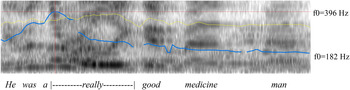
First of all, we provide a ‘neutral’ sample that does not have ‘Native-sounding’ features. Figure A1 is a Native speaker from our recordings producing typical Standard English prosody.Footnote 9 Notice that the tonic syllable lands on really, followed by a classic declination pattern in the latter part of the sentence (cf. Ladefoged Reference Ladefoged2006:116–17; Ladd Reference Ladd2008:98, Pierrehumbert Reference Pierrehumbert1980).
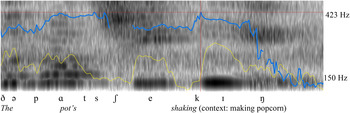
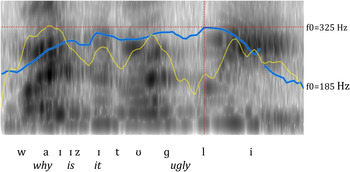
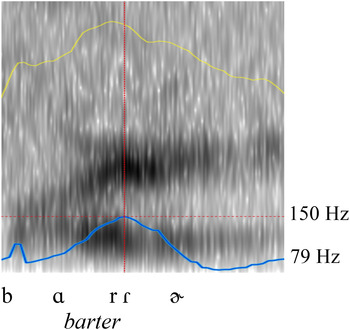
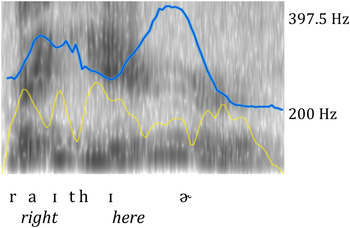
Figure A2 shows an example of the contoured pitch-accent L*+H ‘Thomas’ feature. The word shaking is L*+H: the first syllable sha- is L* while the second syllable -king is H. The utterance ends with a lengthened, creaky velar nasal. Figure A3 shows similar prosodyFootnote 10 : the word ugly has the ‘Thomas’ pitch pattern, along with a mid-terminal and lengthening. Figures A4–A6 provide further examples. Another example is the word Shiprock discussed earlier in Figure 3 of the Discourse context section, which has a high-falling, lengthened terminal.
Example of a Standard English pitch pattern. The lower line shows the pitch track, and the upper line shows intensity.

Pitch-accent contour on the word shaking. In this plot, pitch is represented by the upper line, and intensity is the lower line (intensity range in the figure: highest = 74 dB, lowest = 50 dB).

Pitch-accent contour on the word ugly. Pitch is represented by the upper line, and intensity is the lower line (intensity range in the figure: highest = 80 dB, lowest = 61 dB).

L*+H pitch-accent contour on the word barter, including some lengthening on the second syllable. Pitch is represented by the lower line, and intensity is the upper line (intensity range in the figure: highest = 80 dB, lowest = 59 dB).

L*+H pitch-accent contour on the word Thomas. Pitch is represented by the lower line, and intensity is the upper line (intensity range in the figure: highest = 76 dB, lowest = 64 dB).

L*+H pitch-accent contour on the word here. Pitch is represented by the upper line, and intensity with the lower line (intensity range in the figure: highest = 71 dB, lowest = 50 dB).