






No CrossRef data available.
Article contents
The distinction between long-term knowledge and short-term control processes is valid and useful
Published online by Cambridge University Press: 18 July 2023
Abstract
The binary distinction De Neys questions has been put forward many times since the beginnings of psychology, in slightly different forms and under different names. It has proved enormously useful and has received detailed empirical support and careful modeling. At heart the distinction is that between knowledge in long-term memory and control processes in short-term memory.
Information
- Type
- Open Peer Commentary
- Information
- Copyright
- Copyright © The Author(s), 2023. Published by Cambridge University Press
References
Atkinson, R. C., & Shiffrin, R. M. (1968). Human memory: A proposed system and its control processes. In Spence, K. W. & Spence, J. T. (Eds.), The psychology of learning and motivation: Advances in research and theory (Vol. 2, pp. 89–195). Academic Press.Google Scholar
Bryan, W. L., & Harter, N. (1899). Studies on the telegraphic language: The acquisition of a hierarchy of habits. Psychological Review, 6(4), 345–375.CrossRefGoogle Scholar
Chein, J., & Schneider, W. (2012). The brain's learning and control architecture. Current Directions in Psychological Science, 21(2), 78–84.CrossRefGoogle Scholar
Evans, K. K., Birdwell, R. L., & Wolfe, J. M. (2013). If you don't find It often, you often don't find It: Why some cancers are missed in breast cancer screening. PLoS ONE, 8(5), e64366.CrossRefGoogle ScholarPubMed
Fisk, A. D., Rogers, W. A., Cooper, B. P., & Gilbert, D. K. (1997). Automatic category search and its transfer: Aging, type of search, and level of learning. Journal of Gerontology: Psychological Sciences, 52B, 91–102.CrossRefGoogle Scholar
Hasher, L., & Zacks, R. T. (1979). Automatic and effortful processes in memory. Journal of Experimental Psychology: General, 108(3), 356–388.CrossRefGoogle Scholar
Huijbregts, S. C. J., De Sonneville, L. M. J., Van Spronsen, F. J., Berends, I. E., Licht, R., Verkerk, P. H., & Sergeant, J. A. (2003). Motor function under lower and higher controlled processing demands in early and continuously treated phenylketonuria. Neuropsychology, 17(3), 369–379.CrossRefGoogle ScholarPubMed
LaBerge, D., & Samuels, S. J. (1974). Toward a theory of automatic information processing in reading. Cognitive Psychology, 6, 293–323. https://doi.org/10.1016/0010-0285(74)90015-2CrossRefGoogle Scholar
Logan, G. D. (1988). Toward an instance theory of automatization. Psychological Review, 95(4), 492–527.CrossRefGoogle Scholar
Mesulam, M.-M. (2000). Attentional networks, confusional states, and neglect syndromes. In Mesulam, M.-M. (Ed.), Principles of behavioral and cognitive neurology (2nd ed., pp. 174–256). Oxford University Press.CrossRefGoogle Scholar
Samuels, S. J., & Flor, R. F. (1997). The importance of automaticity for developing expertise in reading. Reading and Writing Quarterly, 13, 107–121.CrossRefGoogle Scholar
Schneider, W., & Chein, J. M. (2003). Controlled & automatic processing: From mechanisms to biology. Cognitive Science, 27, 525–559.CrossRefGoogle Scholar
Schneider, W., & Shiffrin, R. M. (1977). Controlled and automatic human information processing: I. Detection, search, and attention. Psychological Review, 84, 1–66.CrossRefGoogle Scholar
Shiffrin, R. M. (1988). Attention. In Atkinson, R. C., Herrnstein, R. J., Lindzey, G., & Luce, R. D. (Eds.), Stevens’ handbook of experimental psychology: Perception and motivation; learning and cognition (pp. 739–811). Wiley.Google Scholar
Shiffrin, R. M., & Schneider, W. (1977). Controlled and automatic human information processing: II. Perceptual learning, automatic attending, and a general theory. Psychological Review, 84, 127–190.CrossRefGoogle Scholar
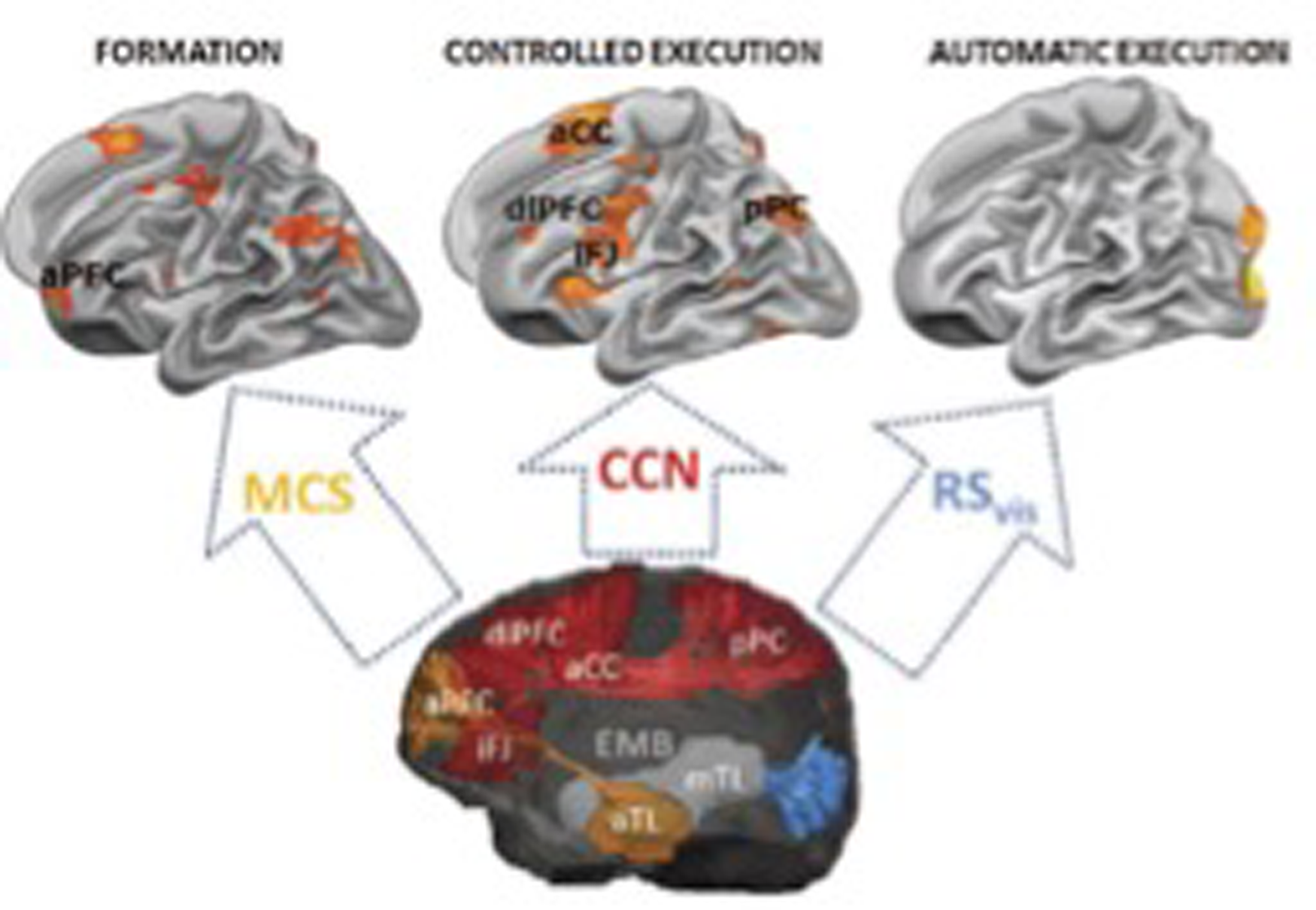
Figure 1. How learning in the form of development of automaticity alters activity in neural networks, seen in Figure 2 of Chein and Schneider (2012). Functional MRI reveals changes in brain activation as learning proceeds in a simple visual-discrimination task. Initial performance is associated with increased activity in the anterior prefrontal cortex (aPFC), of the metacognitive system (MCS). After the first few trials, activity declines in the aPFC and increases in the interconnected regions of the cognitive control network (CCN) – the dorsolateral prefrontal cortex (dlPFC), the anterior cingulate cortex (aCC), the posterior parietal cortex (pPC), and the inferior frontal junction (iFJ) – to support controlled execution of the task. After considerable practice, automatic processes develop and activity declines generally.
Target article
Related commentaries (34)
A good architecture for fast and slow thinking, but exclusivity is exclusively in the past
Advancing theorizing about fast-and-slow thinking: The interplay between fast and slow processing
Deliberative control is more than just reactive: Insights from sequential sampling models
Explaining normative–deliberative gaps is essential to dual-process theorizing
Fast and slow language processing: A window into dual-process models of cognition
Hoist by its own petard: The ironic and fatal flaws of dual-process theory
How research on persuasion can inform dual-process models of judgment
Illusory intuitions: Challenging the claim of non-exclusivity
The distinction between long-term knowledge and short-term control processes is valid and useful
De Neys makes a case for the lack of support and specificity of the binary conceptual distinction between fast and slow thinking. It is certainly the case that any binary distinction applied to the complexities of human cognition (including perception, memory, and decision making) could not possibly be more than a crude approximation to reality. Yet the binary distinction he questions has been put forward many times since the beginnings of psychology, in slightly different forms and under different names. It has proved enormously useful; its constant resurrection testifies to its utility; in some of its forms it has received detailed empirical support and careful modeling. One can focus on any one of these binary instantiations and find much to criticize, but there is a fundamental basis for human cognition that is being captured and a look at the history of these concepts shows many similarities and a great deal of support.
The conceptual distinction is closely related to those between automatic and controlled processing, between short-term memory (including working memory) and long-term memory, between automatic and attentive processing, between working memory and semantic memory, between the use of rules versus expertise, between the use of algorithms versus memory, between beginners versus experts in motor tasks, games, and sports, between fast and slow thinking, between intuitive versus deliberate thinking and decision making, and more along these lines.
One of the first empirical presentations of the ideas was published by Bryan and Harter in Psychological Review in Reference Bryan and Harter1899. They examined the development of automaticity in the receiving of telegraphy, arguing for stages in which a kind of chunking in memory took place, so that perception of the dots and dashes being sent would occur at larger and larger scales, starting for example with letters, and later with words and then phrases or sentences. That led to a number of additional explorations in the 20 years following. The basic idea was that performance at first goes step by step, dot by dot, dash by dash, letter by letter, but as learning proceeds the incoming dots and dashes are perceived in larger and larger groups, and long-term memory and knowledge can thereby greatly improve speed of receiving telegraphy. Seventy-five years later, LaBerge and Samuels (Reference LaBerge and Samuels1974) applied these ideas to the development of automaticity in reading.
Related distinctions proved critically important in theorizing how memory operates, as exemplified in the chapter by Atkinson and Shiffrin titled “Human memory: A proposed system and its control processes” (Reference Atkinson, Shiffrin, Spence and Spence1968). A key distinction was between a relatively permanent long-term memory containing knowledge and a short-term memory, also called working memory, in which control processes controlled the operations of cognition, including access to long-term memory and knowledge.
The distinction between learned behavior stored in long-term memory and control processes in short-term memory received what surely is it most thorough and complete empirical exploration by Schneider and Shiffrin (Reference Schneider and Shiffrin1977) and Shiffrin and Schneider (Reference Shiffrin and Schneider1977) in the form of a contrast between automatic and controlled processing (later termed a distinction between automatic and attentive processing; Shiffrin, Reference Shiffrin, Atkinson, Herrnstein, Lindzey and Luce1988). They used visual and memory search to show how step-by-step controlled processing is used initially for both forms of search, and used throughout for both forms of search when training was inconsistent (termed varied mapping), but gradually became automatized in various ways as consistent training (termed consistent mapping) would cause learning to take place; for example, a target may come to call attention to itself automatically.
Another thorough and careful empirical and theoretical investigation of these ideas was carried out by Gordon Logan and colleagues, for example as laid out by Logan in Psychological Review in Reference Logan1988. In various articles about that time Logan and colleagues investigated the automatization of multi-step processes like counting dots or verifying alphabet arithmetic equations, showing that with consistent practice, the multi-step algorithm is replaced by rapid retrieval of previously encountered solutions. Slow thinking is replaced by automatic retrieval from long-term memory.
The above two examples take the form of a distinction between active use of attention and automatic processing. In these examples, as in all other binary divisions of cognition, the boundary between the two forms of processing is imprecise. For example, in the absence of automatic processing and learned attention to targets, visual objects tend to be examined one at a time; processing time rises as the number of objects increases because on average the searched-for target is found halfway through the sequence of comparisons. As consistent training proceeds, a target comes to draw attention to itself, so that the target is found in the first step, rather than at a random point in the sequence of comparisons. However that automatic attention process may be slower than a single comparison carried out by a controlled process; when only one object is presented a controlled comparison can be faster than automatic attention attraction. We note that Vim De Neys faults dual-processing approaches because of lack of evidence of “exclusivity.” In much of the automaticity literature the view is both processes operate in parallel and interact.
There is a growing literature of biological separation of automatic and controlled processing. Strokes that damage structures such as the right parietal cortex can severely compromise control processes, but spare automatic processing, as seen in neglect (Mesulam, Reference Mesulam and Mesulam2000). Schneider and Chein (Reference Schneider and Chein2003) review much of this literature. Chein and Schneider (Reference Chein and Schneider2012) highlight the way that learning alters the activity of neural networks as automatic processing develops – see Figure 1.
How learning in the form of development of automaticity alters activity in neural networks, seen in Figure 2 of Chein and Schneider (Reference Chein and Schneider2012). Functional MRI reveals changes in brain activation as learning proceeds in a simple visual-discrimination task. Initial performance is associated with increased activity in the anterior prefrontal cortex (aPFC), of the metacognitive system (MCS). After the first few trials, activity declines in the aPFC and increases in the interconnected regions of the cognitive control network (CCN) – the dorsolateral prefrontal cortex (dlPFC), the anterior cingulate cortex (aCC), the posterior parietal cortex (pPC), and the inferior frontal junction (iFJ) – to support controlled execution of the task. After considerable practice, automatic processes develop and activity declines generally.
The distinctions we have been discussing have also played an important role in applications in society. To take just a few examples they have driven research and practice in reading education in children (LaBerge & Samuels, Reference LaBerge and Samuels1974; Samuels & Flor, Reference Samuels and Flor1997), in medical decision making (Evans, Birdwell, & Wolfe, Reference Evans, Birdwell and Wolfe2013), in aging (Fisk, Rogers, Cooper, & Gilbert, Reference Fisk, Rogers, Cooper and Gilbert1997; Hasher & Zacks, Reference Hasher and Zacks1979), and in clinical science (Huijbregts et al., Reference Huijbregts, De Sonneville, Van Spronsen, Berends, Licht, Verkerk and Sergeant2003).
It would take a book rather than this commentary to trace all these closely related binary distinctions, because they have appeared and been used throughout the history of psychological research, albeit under various names. Research on them demonstrates great utility in classifying human cognition in these ways, as demonstrated by a great deal of careful empirical research, theorizing, and quantitative modeling in certain of these domains. Notwithstanding the admitted imprecision of these binary conceptual divisions of cognition, and the differences between them, we believe there is a fundamental importance and utility to the distinction between control processes carried out in short-term working memory, and automatic learned processes stored in long-term memory as knowledge. The message conveyed by De Neys to this extent misses the “big picture” and is misleading.
Financial support
This research received no specific grant from any funding agency, commercial, or not-for-profit sectors.
Competing interest
None.