



1 Introduction
Given a topological space X,
 $\mathcal B$
its Borel sigma-algebra, and
 $\mu $
a probability measure on X, it is well known that for any sub-sigma algebra
 $\mathcal E\subset \mathcal B$
,
 $\mu $
may be disintegrated over the partition induced by
 $\mathcal E$
in the sense that we may find a system of probability measures
 $\{\mu _x\}_{x\in X}$
such that
 $\mu _{x}(\bigcap _{x\in E, E\in \mathcal E}E ) =1$
,
 $x\mapsto \mu _x$
is Borel measurable, and
 $\mu (B) = \int \mu _x(B)\,d\mu $
for any
 $B\in \mathcal B$
. This system is referred to as being the disintegration of
 $\mu $
along
 $\mathcal E$
. This fact was later extended to the more general context of Lebesgue spaces, where V. Rokhlin (see [Reference Rohlin19]) proved that
 $\mu $
may be disintegrated over any measurable partition, that is, over any partition that is countably generated by elements of the
 $\sigma $
-algebra of the Lebesgue space in consideration.
The mentioned theorem of Rokhlin is extensively used in dynamical systems and was further extended to more general contexts (see for example [Reference Possobon and Rodrigues16, Reference Simmons21]). In general, given a certain dynamics, in many contexts, this dynamics admits certain invariant partitions which are dynamically defined and the study of the disintegration of the invariant measures along these partitions usually yields important properties of the dynamics. In some cases, these partitions are naturally given by invariant foliations of the dynamics.
In smooth ergodic theory for example, Anosov and partially hyperbolic diffeomorphisms admit a pair of invariant foliations called stable and unstable foliations, which we will denote here by
 $\mathcal F^s$
and
 $\mathcal F^u$
. In these contexts, measure disintegration techniques have been an essential tool to obtain ergodicity and rigidity of some properties such as regular conjugacy between certain
 $C^1$
-close Anosov maps.
In his seminal work, Anosov [Reference Anosov1] proved that the disintegration of the volume measure along the unstable (respectively stable) foliation of a volume preserving Anosov diffeomorphism is absolutely continuous with respect to the leaf measure. This result was generalized to the stable and unstable foliation of partially hyperbolic diffeomorphisms (see [Reference Barreira and Pesin3] for example). This is clearly not the general case for an arbitrary foliation, an example for which absolute continuity does not occur was given by Katok [Reference Milnor12] and there are now several examples of other natures in the literature. More specifically, Katok’s example shows a foliation by analytic curves of
 $(0,1)\times \mathbb R / \mathbb Z$
such that there exists a full Lebesgue measure set which intersects each leaf in exactly one point. In this case, we say that the conditional measures along the leaves are atomic or that the foliation is atomic with respect to the reference measure, which in the example of Katok is the standard two-dimensional Lebesgue measure.
Atomicity and absolute continuity are two extremes among the possibilities that one could expect when studying the conditional measures along a foliation. The first one is equivalent to saying that the conditional measures are atomic measures and the last one implies that the conditional measures are absolutely continuous with respect to the Riemannian measure of the leaf, a property which is usually called leafwise absolute continuity or Lebesgue disintegration of measure. Although these are two extreme behaviors among, a priori, many possibilities for the disintegration of a measure, recent results have indicated that this dichotomy is more frequent than one would at first expect. In [Reference Ruelle and Wilkinson20], Ruelle and Wilkinson proved that for certain skew product type of partially hyperbolic dynamics, if the fiberwise Lyapunov exponent is negative, then the disintegration of the preserved measure along the fibers is atomic. Later, Homburg [Reference Homburg9] proved that for some examples treated in [Reference Ruelle and Wilkinson20], one can actually prove that the disintegration is composed by only one atom per leaf. Avila et al [Reference Avila, Viana and Wilkinson2] proved that for
 $C^1$
-volume preserving perturbations of the time-
 $1$
map of geodesic flows on negatively curved surfaces, the disintegration of the volume measure along the center foliation is either atomic or absolutely continuous and that in the latter case, the perturbation should be itself the time-
 $1$
map of an Anosov flow. Although inside the class of derived from Anosov diffeomorphisms non-Lebesgue and non-atomic disintegration was given in [Reference Varão23], Ponce et al [Reference Ponce, Tahzibi and Varão15] exhibited an open class of volume preserving diffeomorphisms which have (mono) atomic disintegration along the center foliation and, recently, Tahzibi and Zhang [Reference Tahzibi and Zhang22] proved that non-hyperbolic measures of derived from Anosov diffeomorphisms on
 $\mathbb T^3$
also must have atomic disintegration along the center foliation, answering a question from [Reference Ponce and Tahzibi14].
In this paper, our main goal is to better understand the disintegration of an invariant measure along an invariant foliation for the dynamics without requiring hyperbolicity or partial hyperbolicity for f, but assuming that the invariant foliation has some type of metric rigidity with respect to f. In other words, we aim to investigate what are the possible characterizations of the conditional measures obtained when we disintegrate
 $\mu $
over a foliation
 $\mathcal F$
, assuming that the behavior of f along
 $\mathcal F$
is very far from being hyperbolic.
1.1 Statement of results
Before stating our main result, we recall that a topological space X is called a Cantor space if it is homeomorphic to the standard ternary Cantor set. If X is a Cantor space with the topology induced by a certain space
 $N\supset X$
, we will also say that X is a Cantor set or a Cantor subset of N.
It is well known that a non-empty metric space X is a Cantor space if, and only if, it is perfect, compact, and totally disconnected. We will say that a topological space X is a
 $\sigma $
-Cantor space if there is a sequence of nested Cantor spaces
 $K_1\subset K_2 \subset \cdots $
such that
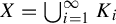 $X = \bigcup _{i=1}^{\infty } K_i$
. Analogously, for
 $X\subset N$
, we will say that X is a
 $\sigma $
-Cantor set or
 $\sigma $
-Cantor subset of N if it is a
 $\sigma $
-Cantor space with the topology induced from N.
In particular, observe that in the case where
 $X\subset \mathbb R$
, X is a
 $\sigma $
-Cantor subset if and only if it is perfect and with empty interior, since the only connected sets in
 $\mathbb R$
are intervals.
Given a homeomorphism
 $f:M \to M$
over a compact Riemannian manifold M and
 $\mathcal F$
a f-invariant one-dimensional continuous foliation of M whose leaves are
 $C^1$
immersed submanifolds of M, an
 $\mathcal F$
-arc length system is a continuous system of functions
 $\{l_x\}_{x\in M}$
, where each
 $l_x$
is a function defined on the equivalence classes of simple arcs of
 $\mathcal F(x)$
associating to each class a non-negative real number in a ‘metric like fashion’, that is, it vanishes only on degenerate arcs and is additive. Furthermore, this system is f-invariant in the sense that
 $l_x \circ f = l_{f(x)}$
. The formal definition is presented in Definition 3.1.
The following is our first main result.
Theorem A. Let
 $f:M\to M$
be a homeomorphism over a compact Riemannian manifold,
 $\mathcal F$
be an f-invariant one-dimensional continuous foliation of M by
 $C^1$
-leaves, and
 $\{l_x\}$
an
 $\mathcal {F}$
-arc length system. If f is ergodic with respect to an f-invariant probability measure
 $\mu $
, then one of the following holds:
-
(a) the disintegration of
 $\mu $
along
$\mathcal F$
is atomic;
-
(b) for almost every
$x\in M$
, the conditional measure on
$\mathcal F(x)$
is equivalent to the measure
$\unicode{x3bb} _{x}$
defined on simple arcs of
$\mathcal F(x)$
by -
(c) for almost every
$x\in M$
, the conditional measure on
$\mathcal F(x)$
is supported in a
$\sigma $
-Cantor subset of
$\mathcal F(x)$
. Equivalently, in the leaf topology, this set is perfect and with empty interior.


The existence of invariant systems of metrics was obtained in [Reference Bonatti and Zhang5] for the context of transitive partially hyperbolic diffeomorphisms with topological neutral center, meaning that f and
 $f^{-1}$
have Lyapunov stable center direction (see [Reference Rodriguez Hertz, Rodriguez Hertz and Ures17, §7.3.1]), i.e. given any
 $\varepsilon>0$
, there exists
 $\delta>0$
for which, given any
 $C^1$
path
 $\gamma $
tangent to the center direction, one has
 $$ \begin{align*}\operatorname{length}(\gamma) <\delta \Rightarrow \operatorname{length}(f^n(\gamma)) <\varepsilon \quad \text{ for all } n\in \mathbb Z. \end{align*} $$
For these diffeomorphisms, the center direction integrates to a continuous foliation
 $\mathcal F^c$
of M [Reference Rodriguez Hertz, Rodriguez Hertz and Ures18, Corollary
 $7.6$
]. In this context, we are able to improve the previous result.
Theorem B. Let
 $f:M \to M$
be a transitive
 $C^1$
partially hyperbolic diffeomorphism with one-dimensional topological neutral center direction over a compact Riemannian manifold. If f is ergodic with respect to an f-invariant probability measure
 $\mu $
with full support, then one of the following holds:
-
(a) the disintegration of
$\mu $
along
$\mathcal F^c$
is atomic; -
(b) for almost every
$x\in M$
, the conditional measure on
$\mathcal F^c(x)$
is equivalent to the measure
$\unicode{x3bb} _{x}$
defined on simple arcs of
$\mathcal F^c(x)$
by


1.2 Organization of the paper
In §2, we give some preliminaries on measure theory and disintegration of measures along a foliation. In §3, we introduce the definition of an
 $\mathcal {F}$
-arc length system with respect to the dynamics in
 $(M,\mathcal {A},\mu )$
and the construction of the measures induced by this system. In §4, we prove several technical lemmas concerning the continuity/measurability of certain functions such as the evaluation of conditional measures on certain balls inside the leaves of
 $\mathcal F$
. Finally, in §§5 and 6, we prove Theorems A and B, respectively.
2 Basics on conditional measures
Throughout the paper,
 $(M,\mathcal {A},\mu )$
will be a probability space, where M is a compact Riemannian manifold, with dimension at least two,
 $\mu $
is a non-atomic Borel measure, and
 $\mathcal {A}$
is a completion of the Borel
 $\sigma $
-algebra
 $\mathcal {B}$
of M with respect to the measure
 $\mu $
. (We note that for simplicity, we are using a slight abuse of notation by also denoting the extension of the measure
 $\mu $
on
 $\mathcal A$
as
 $\mu $
.) In other words,
 $(M,\mathcal {A},\mu )$
is measurably isomorphic to
 $([0,1], \mathcal A_{[0,1]}, \text {Leb}_{[0,1]})$
, where
 $\text {Leb}_{[0,1]}$
is the standard Lebesgue measure on
 $[0,1]$
and
 $\mathcal A_{[0,1]}$
is the
 $\sigma $
-algebra of Lebesgue measurable sets of
 $[0,1]$
. In particular, whenever we state that a certain subset of M is measurable without mentioning the
 $\sigma $
-algebra, it is implicitly understood that it is
 $\mathcal A$
-measurable. We will denote by
 $\mu (\cdot |U)$
the restriction of
 $\mu $
to a subset
 $U\subset M$
, that is, it denotes the measure given by
 $\mu (\cdot |U)=\mu (U)^{-1} \cdot \mu (B\cap U)$
.
Given a sub-
 $\sigma $
-algebra
 $\mathcal {E}\subset \mathcal {B}$
generated by a countable family
 $\{E_n\}_{n\in \mathbb N}$
, the atom of x is the set given by
 $$ \begin{align*}[x]:=\bigcap_{E\in \mathcal E: \; x\in E} E.\end{align*} $$
Since
 $\{E_n\}_{n\in \mathbb N}$
generates
 $\mathcal E$
, we may also write
 $$ \begin{align*}[x]=\bigcap_{x\in E_n} E_n.\end{align*} $$
Consequently,
 $[x]$
is a Borel set for every
 $x\in M$
and
 $\{[x] : x\in M\}$
is a partition of M.
Given
 $\mathcal {E}\subset \mathcal {B}$
a countably generated sub-
 $\sigma $
-algebra, a family of measures
 $\{\mu _x\}_{x\in M}$
is called a system of conditional measures of
 $\mu $
associated to
 $\mathcal {E}$
if:
-
(i) the function
$x\mapsto \mu _x(B)$
is
$\mathcal E$
-measurable in the sense that for every
$B\in \mathcal {B}$
,
${x\to \mu _x(B)}$
is
$\mathcal {E}$
-measurable; -
(ii) for
$\mu $
almost every
$x\in X$
,
$\mu _x([x])=1$
; -
(iii)
$\mu (B)=\int _{y\in B} \mu _y(B)\,d\mu (y)$
.








As it is well known, every Borel measure
 $\mu $
admits a system of conditional measures with respect to any countably generated sub-
 $\sigma $
algebra
 $\mathcal E \subset \mathcal B$
and such a system is essentially unique, see for example [Reference Einsiedler and Ward8, Theorem 5.14].
In our context, it is usually convenient to consider systems of conditional measures along certain partitions by
 $C^1$
immersed submanifolds, as we detail in the following.
We say that
 $\mathcal {F}$
is a continuous foliation of dimension m by
 $C^1$
-leaves if
 $\mathcal F = \{ \mathcal F(x)\}_{x \in M}$
is a partition of M into
 $C^1$
immersed submanifolds of dimension m, such that for every
 $x\in M$
, there exist open sets
 $U\subset M, \, V\subset \mathbb {R}^m, \, W\subset \mathbb {R}^{n-m}$
and a homeomorphism
 ${\varphi :U\to V\times W}$
, called a local chart, such that for every
 $c\in W$
, the set
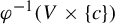 $\varphi ^{-1}(V\times \{c\})$
, which is called a plaque of
 $\mathcal {F}$
, is a connected component of
 $L\cap U$
for a certain
 $L\in \mathcal {F}$
. Given a foliation
 $\mathcal {F}$
of M, we denote by
 $\mathcal {F}(x)$
the element of
 $\mathcal {F}$
that contains x and call such elements the leaves of
 $\mathcal {F}$
. Whenever U is a foliated chart, we denote by
 $\mathcal F|U$
the continuous foliation of U given by plaques of
 $\mathcal F$
restricted to U.
Given a one-dimensional continuous foliation
 $\mathcal F$
of M, consider a local chart of
 $\mathcal F$
,
 $$ \begin{align*}\varphi: U \to (0,1)\times B^{n-1}_1(0),\end{align*} $$
we also call U a foliated box.
Let
 $\{\widetilde {E}_{q,k}\}$
be a countable collection of sets defined by
 $$ \begin{align*} \widetilde{E}_{q,k}=(0,1)\times B(q,1/k)\subset\mathbb{R}\times \mathbb{R}^{n-1}, \quad q\in B^{n-1}_1(0)\cap\mathbb{Q}^{n-1}, \, k\in\mathbb{N}. \end{align*} $$
Let
 $E_{q,k}=\varphi ^{-1}(\widetilde {E}_{q,k})$
and
 $\mathcal {E}\subset \mathcal {B}$
be the sub-
 $\sigma $
-algebra generated by the family of Borelian sets
 $E_{q,k}$
. Notice that for every
 $y\in M$
, the atom,
 $[y]$
is the connected component of
 $\mathcal {F}(y)\cap U$
that contains y, in this case, we also call the system of conditional measures of
 $\mu $
associated to
 $\mathcal E$
,
 $\{\mu ^U_y\}_{y\in U}$
, the disintegration of
 $\mu $
along
 $\mathcal {F}$
restricted to U. We say that the disintegration of
 $\mu $
along
 $\mathcal F$
is atomic if for any local chart U, for almost every
 $y\in U$
, there exists
 $a(y)$
in the plaque
 $\mathcal F|U(y)$
with
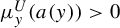 $\mu ^U_y(a(y))>0$
.
As we may observe, the disintegration of
 $\mu $
along
 $\mathcal F$
is always done inside a local chart. However, the following well-known result states that if two local charts intersect, the disintegration of both local charts are equal except by a multiplicative constant when restricted to the intersection.
Proposition 2.1. (See for example [Reference Einsiedler and Lindenstrauss7, Proposition 5.17])
If
 $U_1$
and
 $U_2$
are domains of two local charts
 $\varphi _{1}$
and
 $\varphi _{2}$
of
 $\mathcal F$
, then for almost every x, the conditional measures
 $\mu _x^{U_1}$
and
 $\mu _x^{U_2}$
coincide up to a multiplicative constant on
 $U_1 \cap U_2$
.
The above proposition provides a tool to extend a conditional measure (which is locally defined) to a measure on the full leaf that, when normalized on foliated charts, restores the disintegration. That is, assume x is a point that belongs to two different foliated charts
 $U_1$
and
 $U_2$
, and let
 $L_1$
and
 $L_2$
be the respective plaques that contain the point x. Since by the above proposition
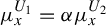 $\mu _x^{U_1}=\alpha \mu _x^{U_2}$
at the intersection of both charts, we can extend
 $\mu _x^{U_1}$
to
 $L_1 \cup L_2$
in such a way that on
 $L_2$
, the extension of
 $\mu _x^{U_1}$
is
 $\alpha \mu _x^{U_2}$
. This process can be done inductively so that
 $\mu _x^{U_1}$
is extended to the whole leaf
 $\mathcal F(x)$
. Therefore,
 $\mathcal F(x)$
have many measures that are constructed in such a way but using different plaques to start from, and there is no canonical way to choose one of them, but this is not a problem as we work with a class of measures instead.
As observed in [Reference Avila, Viana and Wilkinson2], the property such as in Proposition 2.1 allows us to define a family of classes of measures
 $\{x \in M: \Omega _x\}$
such that:
-
•
$\omega _x (M\setminus \mathcal F(x))=0$
for any representative
$\omega _x$
of
$\Omega _x$
; -
• any two representatives of
$\Omega _x$
are equal modulo multiplication by a constant; -
• for any local chart U of M and
$\{\mu ^U_x\}_{x\in U}$
, a disintegration of
$\mu (\cdot |U)$
along
$\mathcal F|U$
, for almost every point
$x\in U$
, where
$$ \begin{align*}\mu^U_x = \omega_x(\cdot | \mathcal F|U(x)),\end{align*} $$
$\omega _x$
denotes a representative of
$\Omega _x$
.



The family
 $\{\Omega _x\}_{x\in M}$
will be called a disintegration of
 $\mu $
along
 $\mathcal F$
. Notice that considering such a family
 $\{\Omega _x\}_{x\in M}$
an atom in a certain leaf
 $\mathcal F(x)$
is now a well-defined concept independent of the local chart since it is a point
 $a\in \mathcal F(x)$
for which
 $\Omega _x(\{a\})>0$
. Hence, in the context of an ergodic system, since the set of atoms is invariant, it has zero or full measure, which implies that, in the latter case, almost every measure of the family will be a sum of Dirac measures.
3 Invariant arc-length and invariant metric systems
Given
 $f:M\to M$
and a foliation
 $\mathcal F$
of M, we say that f preserves
 $\mathcal F$
, or that
 $\mathcal F$
is f-invariant if for
 $x\in M$
,
 $$ \begin{align*} \mathcal F(f(x)) = f(\mathcal F(x)). \end{align*} $$
From now on,
 $\mathcal {F}$
will denote a continuous and f-invariant one-dimensional foliation.
By a simple arc
 $\gamma $
on a leaf
 $\mathcal F(x)$
, we mean a
 $C^1$
curve
 $\gamma :[0,1]\to \mathcal F(x)$
for which
 $\gamma (t) \ne \gamma (s)$
for all
 $t\ne s$
with
 $(t,s)\notin \{(0,1), \; (1,0)\}$
. In the space of simple arcs, we define an equivalence relation by saying that
 $\gamma \sim \sigma $
if
 $\sigma $
is a reparameterization of
 $\gamma $
. We say that a sequence of simple arcs
 $\gamma _n$
converges to
 $\gamma $
(in the
 $C^0$
-topology) if
 $\gamma _n$
converges pointwise to
 $\gamma $
. By convention, by a degenerate arc, we mean a point.
The following definition is inspired by the concept of center metric given in [Reference Bonatti and Zhang5].
Definition 3.1. We will call
 $\{l_x\}$
an
 $\mathcal {F}$
-arc length system if for
 $x\in M$
,
 $l_x$
is defined on the simple arcs on
 $\mathcal {F}(x)$
and
 $l_x$
satisfies the following properties:
-
(1) strictly positive on the non-degenerate arcs and vanishing on degenerate arcs;
-
(2)
$l_x(\gamma )=l_x(\sigma )$
if
$\gamma \sim \sigma $
; -
(3) let
$\gamma :[0,1]\to \mathcal {F}(x)$
be a simple arc and
$a\in (0,1)$
, then
$$ \begin{align*} l_x(\gamma[0,a])+l_x(\gamma[a,1])=l_x(\gamma[0,1]); \end{align*} $$
-
(4) let
$\gamma :[0,1]\to \mathcal {F}(x)$
be a simple arc, then
$$ \begin{align*}l_x(\gamma[0,1])=l_{f(x)}(f(\gamma[0,1]));\end{align*} $$
-
(5) given a sequence of simple arcs
$\gamma _n :[0,1]\to \mathcal F(x_n)$
, converging to a simple arc
$\gamma :[0,1] \to \mathcal F(x)$
,
$$ \begin{align*}l_{x_n}(\gamma_n) \rightarrow l_x(\gamma) \quad \text{as} \; n\rightarrow +\infty.\end{align*} $$










In general, it is easy to give examples of systems preserving some continuous foliation of dimension one
 $\mathcal F$
and admitting some
 $\mathcal F$
-arc length system.
Examples 3.2. (a) Let
 $M=\mathbb T^d$
,
 $d\geq 2$
, and
 $L:\mathbb R^d \to \mathbb R^d$
be a linear map given by a matrix with integer entries and for which
 $1$
is an eigenvalue. Let v be an eigenvector associated to
 $1$
and take
 $E = \mathbb R\cdot v$
. The linear map L induces a linear function
 ${f_L:\mathbb T^d \to \mathbb T^d}$
and E induces a foliation
 $\mathcal F$
of
 $\mathbb T^d$
which is one-dimensional and
 $f_L$
-invariant. Clearly,
 $f_L$
is an isometry along
 $\mathcal F$
. In particular, the family of standard arc-lengths on the leaves of
 $\mathcal F$
constitute an
 $\mathcal F$
-arc length system. For this case, we obtain that any ergodic measure invariant by
 $f_L$
must have either atomic conditionals, conditionals supported on
 $\sigma $
-Cantor subsets of the leaves, or they must be equivalent to the Lebesgue measure on the leaves.
Question. Does there exists an ergodic measure
 $\mu $
preserved by some
 $f_L$
whose conditional measures are supported on a
 $\sigma $
-Cantor subset of the leaves?
(b) Let
 $\varphi :\mathbb R \times M \to M$
be any
 $C^1$
flow. The foliation
 $\mathcal F$
given by the orbits of
 $\varphi $
is a
 $\varphi _t$
-invariant
 $C^1$
-foliation of M for any fixed
 $t\in \mathbb R$
. There is a natural
 $\mathcal F$
-arc length system, in this case, given by
 $$ \begin{align*}l_x(\gamma) := |l| \quad \text{with } \varphi(l,\gamma(0))=\gamma(1).\end{align*} $$
Assume that almost every
 $x\in M$
is not a periodic point of
 $\varphi $
. Given any
 $\varphi _t$
-ergodic invariant measure
 $\mu $
, it follows from [Reference Lindenstrauss11, Example 7.4] that the disintegration of
 $\mu $
along
 $\mathcal F$
is either Lebesgue or atomic.
(c) Some skew-products also provide interesting examples. For example, take
 $f: \mathbb T^d \times S^1 \to \mathbb T^d \times S^1$
given by
 $$ \begin{align*}f(x,y)=(g(x), R_{\alpha}(y)),\end{align*} $$
where
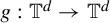 $g:\mathbb T^d \to \mathbb T^d$
is any homeomorphism and
 $R_{\alpha }:S^1 \to S^1$
denotes a rotation of angle
 $\alpha $
. In this case, the foliation
 $\mathcal F$
whose leaves are
 $\{x\}\times S^1$
,
 $x\in \mathbb T^d$
, is f-invariant and by taking
 $l_x$
on
 $\{x\}\times S^1$
to be given by the usual arc length on
 $S^1$
, we conclude that
 $\{l_x\}$
is an
 $\mathcal F$
-arc length system. In this example, it is easy to determine the measurable properties of
 $\mathcal F$
in the sense that, given a Borel g-invariant measure
 $\nu $
, the measure
 $\nu \times \unicode{x3bb} _{S^1}$
is f-invariant and a direct application of the Fubbini theorem shows that the disintegration of
 $\mu $
along
 $\mathcal F$
has the Lebesgue measures
 $\unicode{x3bb} _{S^1}$
as its conditional measures. (Here, we denote by
 $\unicode{x3bb} _{S^1}$
the standard Lebesgue measure on
 $S^1$
.)
(d) Another more interesting case is provided by recent results of Bonatti and Zhang [Reference Bonatti and Zhang5]. A
 $C^1$
diffeomorphism
 $f:M\to M$
, on a compact Riemannian manifold M, is said to be partially hyperbolic if there is a non-trivial splitting
 $$ \begin{align*}TM=E^s\oplus E^c\oplus E^u\end{align*} $$
such that
 $$ \begin{align*} Df(x)E^{\tau}(x)=E^{\tau}(f(x)), \quad \tau\in \{s,c,u\} \end{align*} $$
and a Riemannian metric for which there are continuous positive functions
 $\mu ,\hat {\mu },\nu ,\hat {\nu }, \gamma , \hat {\gamma }$
with
 $$ \begin{align*} \nu(p),\hat{\nu}(p) <1 \quad \text{and} \quad \mu(p)<\nu(p)<\gamma(p)<\hat{\gamma}(p)^{-1}<\hat{\nu}(p)^{-1}<\hat{\mu}(p)^{-1}, \end{align*} $$
such that for any vector
 $v\in T_pM$
,
 $$ \begin{align*} \mu(p)\|v\|<\|Df(p)\cdot v\| < \nu(p)\|v\| \quad \text{if} \; v\in E^s(p),\end{align*} $$
 $$ \begin{align*} \gamma(p)\|v\| < \|Df(p)\cdot v\| < \hat{\gamma}(p)^{-1}\|v\| \quad \text{if} \; v\in E^c(p),\end{align*} $$
 $$ \begin{align*} \hat{\nu}(p)^{-1}\|v\|< \|Df(p)\cdot v\|<\hat{\mu}(p)^{-1}\|v\| \quad \text{if} \; v\in E^u(p).\end{align*} $$
We say that f has topological neutral center if, for any
 $\varepsilon>0$
, there exists
 $\delta>0$
for which, given any smooth curve
 $\gamma :[0,1]\to M$
with
 $\gamma '(t) \in E^c(\gamma (t))$
,
 $0\leq t \leq 1$
, if
 ${\text {length}(\gamma ) <\delta }$
, then
 $\text {length}(f^n(\gamma ))<\varepsilon $
for all
 $n\in \mathbb Z$
. For partially hyperbolic diffeomorphisms with neutral center, the center distribution
 $E^c$
integrates to an f-invariant foliation
 $\mathcal F^c$
(see [Reference Rodriguez Hertz, Rodriguez Hertz and Ures18, Corollary 7.6]) called center foliation of f. In [Reference Bonatti and Zhang5], the authors proved that if
 ${f:M \to M}$
is a
 $C^1$
partially hyperbolic diffeomorphism with neutral center direction, then f admits a continuous
 $\mathcal F$
-arc length system. To understand the measurable properties of the center foliation preserved by such maps was one of the motivations of this work. As a consequence of our results, the disintegration of any f-invariant ergodic probability measure of such maps falls in three possible cases. When the conditional measures have full support, the second author proves in [Reference Ponce13] the occurrence of an invariance principle. Further, if the measure is smooth, full support of the conditional measures imply the Bernoulli property for f. If, moreover, f is locally accessible, then
 $\mathcal F^c$
is as regular as the map f itself.
Definition 3.3. Given
 $y, z, w\in \mathcal {F}(x)$
, we say that y is between z and w if there exists a simple arc
 $\gamma :[0,1]\to \mathcal {F}(x)$
such that
 $\gamma (0)=z$
,
 $\gamma (1)=w$
,
 $\gamma (t)=y$
for some
 $t\in (0,1)$
, and
 $$ \begin{align*}l_{x}(\gamma)=\min\{l_{x}(\alpha) \, : \, \alpha:[0,1]\to \mathcal{F}(x), \, \alpha(0)=z, \, \alpha(1)=w \}.\end{align*} $$
Definition 3.4. Let
 $\{l_x\}$
be an
 $\mathcal {F}$
-arc length system. For
 $x\in M$
, we define a metric
 $d_x$
on
 $\mathcal {F}(x)$
by
 $$ \begin{align*} d_x(y,z):=\min \{l_{x}(\gamma) \, : \, \gamma:[0,1]\to \mathcal{F}(x) \text{ is simple with } \gamma(0)=y, \, \gamma(1)=z\}. \end{align*} $$
We call the family
 $\{d_x\}_x$
the
 $\mathcal {F}$
-metric system associated to the
 $\mathcal F$
-arc length system
 $\{l_x\}_x$
.
Remark 3.5. By the definition of
 $d_x$
, it is evident that
 $d_x$
is an additive metric. Specifically, for any
 $y, z, w \in \mathcal {F}(x)$
such that y lies between z and w, the following holds:
 $$ \begin{align*} d_x(z, w) = d_x(z, y) + d_x(y, w). \end{align*} $$
Moreover, the family
 $\{d_x\}$
is invariant under f, in the sense that
 $$ \begin{align*} d_{f(x)}(f(z), f(y)) = d_x(z, y). \end{align*} $$
It is not true that
 $\{d_x\}_{x\in M}$
is continuous in the sense that we may have sequences
 ${x_n \rightarrow x}$
,
 $y_n \rightarrow y$
, with
 $y_n \in \mathcal F(x_n)$
,
 $y\in \mathcal F(x)$
, but
 $d_{x_n}(x_n,y_n) \nrightarrow d_{x}(x,y)$
. Indeed, this happens, for example, for compact foliations where the leaves do not have uniformly bounded length. It is true, however, that this family of metrics is continuous when restricted to plaques inside local charts. We make this property more precise as follows.
Definition 3.6. Consider
 $\mathcal F$
a continuous foliation of M. A function
 $F:\bigcup _{x\in M} \mathcal F(x) \times \mathcal F(x) \to [0,\infty )$
will be called plaque-continuous if given any
 $p\in M$
, there exists a local chart
 $p\in U$
of
 $\mathcal F$
such that for any sequences
 $x_n \rightarrow x$
,
 $y_n \rightarrow y$
with
 $y_n \in \mathcal F|U(x_n)$
,
 $x\in U$
and
 $y \in \mathcal F|U(x)$
, we have
 $$ \begin{align*}\lim_{n\rightarrow \infty} F(x_n,y_n) = F(x,y).\end{align*} $$
Any such local chart U will be called a continuity-domain of F.
Definition 3.7. We say that a family of metrics
 $\{d_x: x\in M\}$
, where each
 $d_x$
is defined on
 $\mathcal F(x)$
, is plaque-continuous if
 $F:\bigcup _{x\in M} \mathcal F(x) \times \mathcal F(x) \to [0,\infty )$
, defined by
 $$ \begin{align*}F(x,y):=d_x(x,y),\end{align*} $$
is plaque continuous. In this case, if U is a continuity-domain of F, we will also say that U is a continuity-domain of
 $\{d_x\}$
.
Proposition 3.8. The metric system given in Definition 3.4 is plaque-continuous.
Proof. Let
 $\varphi :U \to (0,1)\times V \subset \mathbb R^n$
be a local chart of
 $\mathcal F$
, where
 $\varphi ^{-1}((0,1) \times \{c\})$
,
 $c\in V$
, are the plaques of
 $\mathcal F$
in U. For any
 $p\in U$
, consider
 ${\xi : W\subset U \to (0,1)\times K\subset \mathbb R^n}$
another local chart centered in p such that for any
 $$ \begin{align*}z\in W \Rightarrow l_z(\mathcal F|U(z) )> 3\cdot l_z(\mathcal F|W(z)).\end{align*} $$
This can be done by the continuity of
 $\{l_x\}$
. In particular, for any
 $x\in W, y\in \mathcal F|W(x) = \xi ^{-1}((0,1),c')$
, the simple curve
 $\gamma (t) = \xi ^{-1}((1-t)\xi (x)+t\xi (y), c' )$
minimizes the
 $l_x$
-length connecting x and y, that is,
 $d_x(x,y) = l_x(\gamma )$
.
Therefore, consider
 $x\in W, y\in \mathcal F|W(x) = \xi ^{-1}((0,1),c')$
and sequences
 $x_n \in W, y_n \in \mathcal F|W(x_n) = \xi ^{-1}((0,1),c_n)$
with
 $x_n \rightarrow x$
and
 $y_n \rightarrow y$
. Let
 $\gamma $
be defined as in the previous paragraph and
 $\gamma _n(t):=\xi ^{-1}((1-t)\xi (x_n)+t\xi (y_n), c_n )$
. By the convergence of the sequences, we have
 $\gamma _n \rightarrow \gamma $
. However, by the previous discussion on the choice of the local chart W,
 $$ \begin{align*}d_{x_n}(x_n,y_n) = l_{x_n}(\gamma_n) \quad \text{and} \quad d_x(x,y) = l_x(\gamma).\end{align*} $$
We then conclude by the continuity of
 $\{l_x\}$
that
 $\lim _{n\rightarrow \infty } d_{x_n}(x_n,y_n) =\lim _{n\rightarrow \infty } l_{x_n}(\gamma _n)= l_x(\gamma ) = d_x(x,y)$
.
Therefore,
 $\{d_x\}$
is plaque-continuous as we wanted to show.
Lemma 3.9. Given any local open transversal T to
 $\mathcal F$
, for any r small enough, the set
 $$ \begin{align*}S:=\bigcup_{x\in T}B_{d_x}(x,r)\end{align*} $$
is open.
Proof. Assume that T is a local transversal associated to a local chart
 $(U,\varphi )$
. Let
 $r>0$
be small enough that we have
 $B_{d_x}(x,r)\subset U$
for every
 $x\in T$
. In particular,
 $U\setminus \overline {T}$
has two open connected components
 $U_1$
and
 $U_2$
with
 $\overline {U_1}\cap \overline {U_2} = \overline {T}$
.
Since U is a local chart, we may consider an orientation on the
 $\mathcal F|U$
-plaques. Assume that S is not open. Then, there exists
 $y\in S$
and a sequence
 $y_k \notin S$
, with
 $y_k\rightarrow y$
.
Consider
 $x\in T$
such that
 $y\in B_{d_x}(x,r)$
and denote by
 $\varphi $
the flow on the
 $\mathcal F|U$
-plaques induced by the orientation fixed before and such that
 $$ \begin{align*}d_p(\varphi_t(p), p)=|t|,\end{align*} $$
whenever
 $\varphi _t(p)$
is defined. Let
 $t_0$
be such that
 $x=\varphi _{t_0}(y)$
. As
 $y\in B_{d_x}(x,r)$
, there exists
 $\delta>0$
for which
 $$ \begin{align*}\varphi_t(y)\in S, \quad t\in [t_0-\delta, t_0+\delta].\end{align*} $$
Now, by the plaque continuity and the fact that
 $y_k\rightarrow y$
,
 $$ \begin{align*}\varphi_{t_0-\delta}(y_k)\rightarrow \varphi_{t_0-\delta}(y), \quad \varphi_{t_0+\delta}(y_k)\rightarrow \varphi_{t_0+\delta}(y).\end{align*} $$
Observe that
 $\varphi _{t_0-\delta }(y)$
and
 $\varphi _{t_0+\delta }(y)$
belong to different connected components, thus, for k large enough, the same happens for
 $\varphi _{t_0-\delta }(y_k)$
and
 $\varphi _{t_0+\delta }(y_k)$
. Since
 $\gamma _k:=\{\varphi _{t}(y_k): \quad t\in [t_0-\delta , t_0+\delta ]\}$
is an arc with points in the interior and in the exterior of
 $U_1$
, it must intersect its boundary, namely T. This implies that
 $y_k\in S$
for large k, yielding a contradiction.
That is, S is open as we wanted to show.
Proposition 3.10. Given a finite open cover
 $\mathcal U$
of M by local charts of
 $\mathcal F$
, there exists
 $\mathfrak r>0$
such that for all
 $x\in M$
, there is
 $U\in \mathcal U$
with
 $$ \begin{align*}B_{d_x}(x,\mathfrak r) \subset U.\end{align*} $$
Proof. For each
 $x\in M$
, take any
 $U_x\in \mathcal U$
with
 $x\in U_x$
. There exists
 $r_x>0$
for which
 $B_{d_x}(x,r_x) \subset U_x$
. By plaque continuity of
 $\{d_x\}$
, there exists a neighborhood
 $x\in V_x \subset U_x$
for which
 $$ \begin{align*}y\in V_x \Rightarrow B_{d_y}(y,r_x) \subset U_x.\end{align*} $$
Since M is compact, we may cover M with a finite number of neighborhoods
 $V_{x_i}$
,
 $1\leq i \leq l$
. Take
 $\mathfrak r = \min \{r_{x_i}: 1\leq i \leq l \}$
.
In the following, we will prove a technical result which will be used in the proof of the main theorem. Namely, we prove that the continuous translation of a measurable set along the foliation
 $\mathcal F$
is also a measurable set.
Lemma 3.11. There exists
 $t_0>0$
such that for every
 $0\leq t\leq t_0$
and every Borel subset
 $A\subset M$
, the set
 $$ \begin{align} \Phi_t(A):=\{x\in M : d_x(x,A)<t\} \end{align} $$
is a measurable set.
Proof. Let
 $\mathcal U$
be a finite cover of M by local charts that are continuity-domains of
 $\{d_x\}$
. Consider
 $\mathfrak r$
the number given by Proposition 3.10. In particular, the family
 $\{U_{\mathfrak r/2} : U\in \mathcal U\}$
, defined by
 $$ \begin{align*}U_{\mathfrak r/2} = \{x\in U : d_x(x,\partial U)\geq \mathfrak r/2\},\end{align*} $$
is still a cover of M. Let
 $A\subset M$
be a Borel subset. Observe that
 $$ \begin{align*}\Phi_{t}(A\cap U_{\mathfrak r/2}) \subset U, \quad U\in \mathcal U, \, t<\mathfrak r/2.\end{align*} $$
We will prove that for
 $U\in \mathcal U$
, the subset
 $\Phi _t(A \cap U_{\mathfrak r/2})$
is measurable.
Let
 $\varphi _U:U\to B_1^{n-1}(0)\times (0,1)$
be a local chart of
 $\mathcal F$
and, inside U, consider the orientation in the plaques
 $\mathcal {F}(x)$
induced by the orientation in the line segments of the form
 $\{\overline {x}\}\times (0,1)\subset \mathbb R^{n-1}\times \mathbb R$
. This orientation induces, at each plaque, an order relation which we will denote by
 $\prec $
(the plaque being implicit in the context).
Now, for
 $s\in [-t,t]$
, with
 $0\leq t< \mathfrak r/2$
fixed, we define
 $\phi _s^U:U_{\mathfrak r/2}\to U$
by:
-
• for
$s>0$
,
$\phi ^U_s(x)$
is the only point of the plaque
$\mathcal {F}|U(x)$
such that
$d_x(x,\phi _s^U(x))=s$
and
$x\prec \phi _s^U(x)$
; -
• for
$s\kern1.4pt{<}\kern1.4pt0$
,
$\phi _{s}^U(x)$
is the unique point of the plaque
$\mathcal {F}|U(x)$
such that
${d_x(x,\phi _s^U(x))\kern1.4pt{=}\kern1.4pt{-}\kern1.4pt s}$
and
$\phi _s^U(x)\prec x$
.







Observe that
 $\phi ^U_s$
is continuous for every
 $|s|<t$
since U is a continuity-domain of
 $\{d_x\}$
and, consequently, it is a homeomorphism. Thus,
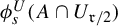 $\phi _s^U(A\cap U_{\mathfrak r/2})$
is a measurable subset of M for every
 $s\in [-t,t]$
.
Now, for each
 $1\leq i \leq n$
, take
 $$ \begin{align*} \Phi_t^U(A):=\bigcup_{\substack{q\in\mathbb{Q} \\ q<t}}\phi_q^U(A\cap U_{\mathfrak r/2}), \quad 0\leq t <\mathfrak r/2. \end{align*} $$
Notice that
 $\Phi _t^U(A)$
is a measurable set, since each set in the countable union is measurable as we have proved before. Consequently,
 $$ \begin{align*} \Phi_t(A)=\bigcup_{U\in \mathcal U}\Phi_t^U(A) \end{align*} $$
is a measurable set, as we wanted to show.
Definition 3.12. Let
 $\{l_x\}$
be an
 $\mathcal {F}$
-arc length system. Then, we have a well-defined homeomorphism
 $$ \begin{align*}h_x: \mathcal F(x) \to F,\end{align*} $$
where
 $F=\mathbb R$
or
 $F=S^1$
,
 $h_x(x)=0$
(here, we are using the identification
 $S^1=[0,1]/\sim $
where
 $0\sim 1$
; thus, the point
 $0$
stands for the equivalence class of
 $0$
in
 $S^1$
), and such that, for any simple arc
 $\gamma :[0,1]\to \mathcal F(x)$
,
 $$ \begin{align*}l_x(\gamma[0,1]) = \unicode{x3bb}(h_x(\gamma[0,1])),\end{align*} $$
where
 $\unicode{x3bb} $
denotes the Lebesgue measure on F. In particular,
 $\unicode{x3bb} (h_x(\gamma [0,1]))$
is the size of the interval
 $h_x(\gamma [0,1])$
. We now define the measure
 $\unicode{x3bb} _x$
on
 $\mathcal F(x)$
given by

Note that if
 $\gamma [0,1]$
is a simple arc in
 $\mathcal F(x)$
, then

Consequently, the measure
 $\unicode{x3bb} _{x}$
is a doubling measure. (Recall that given a metric space
 $(X,d)$
, a measure
 $\nu $
on X is said to be a doubling measure if there exists a constant
 $\Omega>0$
such that for any
 $x\in X$
and any
 $r>0$
, we have
 $$ \begin{align*}\nu(B(x,2r)) \leq \Omega \cdot \nu(B(x,r)).)\end{align*} $$
4 Properties of non-atomic disintegrations over a continuous one-dimensional foliation
The proof of the main result of this paper follows from understanding the topological structure of
 $\text {supp} \; \mu _x^U$
for a disintegration
 $\{\mu ^U_x\}_{x\in U}$
of
 $\mu (\cdot |U)$
of
 $\mu $
on a local chart U. To this end, we first need to understand the behavior, in terms of measure theory, of the map
 $$ \begin{align*}(x,r) \mapsto \mu^U_x(B_{d_x}(x,r)),\end{align*} $$
defined for a certain subset of
 $U\times \mathbb R$
. This is the goal of this section.
For the rest of the paper, we assume the following:
-
•
$\mathcal F$
is an f-invariant one-dimensional continuous foliation; -
•
$\mathcal U$
is a finite cover of M by local charts U of
$\mathcal F$
such that
$\overline {U}$
is still inside a local chart of
$\mathcal F$
; -
• each
$U\in \mathcal U$
is a continuity-domain of
$\{d_x\}$
; -
• for each
$U\in \mathcal U$
,
$\{\mu ^U_x\}$
is a disintegration of
$\mu (\cdot |U)$
along the plaques
$\mathcal F|U$
; -
• the disintegration of
$\mu $
along
$\mathcal F$
is not atomic, in particular, for each
$U\in \mathcal U$
, there exists a subset
$\mathcal A_U \subset U$
with
$\mu (\mathcal A_U)=0$
and for which
$$ \begin{align*}x\notin \mathcal A_U \Rightarrow \mu^U_x \; \text{is not atomic};\end{align*} $$
-
•
$\mathfrak r>0$
is any constant given by Proposition 3.10; -
•
$\{\Omega _x\}_{x\in M}$
is a disintegration of
$\mu $
along
$\mathcal F$
and we denote
$\omega _x$
any representative of
$\Omega _x$
,
$x\in M$
.


We also fix the following notation: for any subset
 $X\subset M$
, we denote by
 $\mathcal B_X$
the Borel
 $\sigma $
-algebra of X given by the topology induced by that of M. It is important to observe that, by definition, for any
 $U\in \mathcal U$
, the set
 $\mathcal A_U$
is
 $\mathcal F|U$
-saturated in U.
Lemma 4.1. For each
 $0<r<\mathfrak r$
,
 $U\in \mathcal U$
,
 $J\subset M$
Borel, and
 $x\in U \setminus \mathcal A_U$
, the map
 $$ \begin{align*}y \mapsto \mu^U_x(J\cap B_{d_x}(y,r))\end{align*} $$
is continuous when restricted to the subset
 $F_{r} \subset \mathcal F|U(x)$
given by
 $$ \begin{align*}F_r(x) =\{y \in \mathcal F|U(x) : \; B_{d_x}(y,r) \subset U\}. \end{align*} $$
In particular, for each
 $0<r<\mathfrak r$
,
 $U\in \mathcal U$
, and
 $x\in U \setminus \mathcal A_U$
, the map
 $$ \begin{align*}y \mapsto \mu^U_x(B_{d_x}(y,r))\end{align*} $$
is continuous when restricted to
 $F_{r} \subset \mathcal F|U(x)$
.
Proof. Take
 $x\in U$
,
 $U\in \mathcal U$
, and
 $J\subset M$
as in the statement. Let
 $y_n \rightarrow y$
,
 $y_n, y \in F_r(x)$
. We want to show that for
 $r>0$
,
 $$ \begin{align*}\lim_{n\rightarrow \infty} \mu^U_x(J\cap B_{d_{x}}(y_n,r)) = \mu^U_x(J\cap B_{d_x}(y,r)). \end{align*} $$
Given any
 $k\in \mathbb N$
, since
 $\mu ^U_x$
is not atomic, we have that
 $$ \begin{align*} \mu^U_x(\partial B_{ d_x}(y,r)) & = 0 \quad \text{and} \quad \mu^U_x(\partial B_{d_x}(y_n,r)) =0\quad \text{ for all } n \in \mathbb N, \end{align*} $$
where
 $\partial B_{d_x}$
denotes the boundary of the set inside the leaf
 $\mathcal F(x)$
. Now, let
 ${B_n:= (J\cap B_{d_x}(y_n,r)) \Delta (J\cap B_{d_x}(y,r))}$
, where
 $Y\Delta Z$
denotes the symmetric difference of the sets Y and Z. From standard measure theory,
 $$ \begin{align*} \limsup_{n\rightarrow \infty} \mu^U_x(B_n) \leq \mu^U_x \Big(\limsup_{n \rightarrow \infty} B_n \Big).\end{align*} $$
Thus,
 $$ \begin{align*} \limsup_{n\rightarrow \infty} \mu^U_x(B_n) & \leq \mu^U_x \bigg( \bigcap_{m=1}^{\infty} \bigcup_{n\geq m} B_n \bigg).\end{align*} $$
We know that
 $z\in \bigcap _{m=1}^{\infty } \bigcup _{n\geq m} B_n $
if, and only if, there exists
 $n_1<n_2<n_3< \cdots $
such that
 $z \in B_{n_1}\cap B_{n_2} \cap \cdots $
. Therefore, for each i, either:
-
•
$z \in (J\cap B_{d_x}(y_{n_i},r)) \setminus (J\cap B_{d_x}(y,r)) \Rightarrow z \in J, z\in B_{d_x}(y_{n_i},r)$
and
$z\notin B_{d_x}(y,r)$
; or -
•
$z \in (J\cap B_{d_x}(y,r)) \setminus (J\cap B_{d_x}(y_{n_i},r)) \Rightarrow z \in J, z\in B_{d_x}(y,r)$
and
$z\notin B_{d_x}(y_{n_i},r)$
.




Observe that z cannot fall in the second case infinitely often since
 $\bigcap _i (B_{d_x}(y,r)\setminus B_{d_x}(y_{n_i},r)) = \emptyset $
. Therefore, passing to a subsequence if necessary,
 $$ \begin{align*} z \in J, z\in B_{d_x}(y_{n_i},r)\quad \text{and} \quad z\notin B_{d_x}(y,r),\end{align*} $$
which implies, by taking
 $i \rightarrow \infty $
, that
 $z\in J\cap \partial B_{d_x}(y,r) \subset \partial B_{d_x}(y,r)$
. Consequently,
 $$ \begin{align*}\limsup_{n\rightarrow \infty} \mu^U_x(B_n) \leq \mu^U_x(\partial B_{d_x}(y,r)) = 0.\end{align*} $$
Therefore,
 $$ \begin{align*}\lim_{n\rightarrow \infty} \mu^U_x (J\cap B_{d_x}(y,r) \setminus J\cap B_{d_x}(y_n,r)) = \lim_{n\rightarrow \infty} \mu^U_x (J\cap B_{d_x}(y_n,r) \setminus J\cap B_{d_x}(y,r))= 0\end{align*} $$
and, consequently,
 $$ \begin{align*} \lim_{n\rightarrow \infty} \mu^U_x (J\cap B_{d_x}(y_n,r)) = & \lim_{n\rightarrow \infty}(\mu^U_x(J\cap B_{d_x}(y_n,r)\setminus J\cap B_{d_x}(y,r)) + \mu^U_x (J\cap B_{d_x}(y,r)) \\ & - \mu^U_x(J\cap B_{d_x}(y,r) \setminus J\cap B_{d_x}(y_n,r)) = \mu^U_x (J \cap B_{d_x}(y,r)), \end{align*} $$
as we wanted to show. The second claim is a consequence of the first by taking
 $J=M$
.
Proposition 4.2. Let
 $U\in \mathcal U$
and
 $0<r<\mathfrak r$
. Consider
 $(V,\varphi )$
a local chart inside U such that
 $$ \begin{align*}x\in V \Rightarrow B_{d_x}(x,r) \subset U,\end{align*} $$
and
 $J\subset M$
a Borel subset of M. Then, restricted to
 $V\setminus \mathcal A_U$
, the map
 $$ \begin{align*}x\mapsto \mu^U_x(J\cap B_{d_x}(x,r))\end{align*} $$
is
 $\mathcal B_{V\setminus \mathcal A_U}$
-measurable and, consequently,
 $\mathcal B_{U\setminus \mathcal A_U}$
-measurable as
 $V\subset U$
. In particular, the map
 $$ \begin{align*}x \in V\setminus \mathcal A_U\mapsto \mu^U_x(B_{d_x}(x,r))\end{align*} $$
is
 $\mathcal B_{U\setminus \mathcal A_U}$
-measurable.
Proof. If x and y belong to the same
 $\mathcal F$
-plaque in U, then
 $\mu ^U_x=\mu ^U_y$
. We already know that for all Borel subset
 $W\subset M$
,
 $$ \begin{align*}x\in V \mapsto \mu^U_x(W \cap U)\end{align*} $$
is Borel measurable.
Consider the local chart be given by the homeomorphism
 $\varphi :V \to (0,1)\times G$
, where
 $G\subset \mathbb R^{n-1}$
is an open subset. Setting
 $g_r:V \to [0,\infty )$
as
 $$ \begin{align*}g_r(x) = \mu^U_x(J\cap B_{d_x}(x,r)),\end{align*} $$
we have
 $$ \begin{align*}g_r \circ \varphi^{-1}(x_1,x_2) = \mu^U_{\varphi^{-1}(x_1,x_2)}(J\cap B_{d_{\varphi^{-1}(x_1,x_2)}}(\varphi^{-1}(x_1,x_2),r)).\end{align*} $$
Let us prove that this function is continuous in
 $x_1$
and Borel measurable in
 $x_2$
.
By Lemma 4.1, restricted to
 $V\setminus \mathcal A_U$
, we already have the continuity of
 $g_r\circ \varphi ^{-1}$
the first coordinate, since the second coordinate being fixed means we are evaluating the function on a single plaque where the conditional measure is non-atomic. Now, fix the first coordinate
 $x_1$
and consider the transversal
 $T=\{x_1\} \times B_1^{n-1}(0)$
. By Lemma 3.9, the set
 $$ \begin{align*}S:=\bigcup_{x\in \varphi^{-1}(T)}B_{d_x}(x,r)\end{align*} $$
is an open subset of M and, consequently,
 $S\cap J =\bigcup _{x\in \varphi ^{-1}(T)}J\cap B_{d_x}(x,r) $
is Borel. Thus,
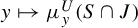 $y \mapsto \mu ^U_y(S\cap J)$
is a Borel measurable function in V, which implies that
 $g_r\circ \varphi ^{-1}(x_1, \cdot )$
is
 $\mathcal B_T$
-measurable. In particular, its restriction to
 $T\cap \varphi (V\setminus \mathcal A_U) = T\setminus \varphi (\mathcal A_U)$
is a
 $\mathcal B_{T\setminus \varphi (\mathcal A_U)}$
-measurable map. However, observe that for
 $x\in T$
,
 $$ \begin{align*}\mu^U_x(S\cap J) = \mu^U_x(J\cap B_{d_x}(x,r)).\end{align*} $$
Therefore, for
 $x_1$
fixed, the map
 $x_2 \in G \setminus \pi _2(\varphi (\mathcal A_U)) \mapsto \mu ^U_{\varphi ^{-1}(x_1,x_2)}(J\cap B_{d_{\varphi ^{-1}(x_1,x_2)}} (\varphi ^{-1}(x_1,x_2),r))$
is
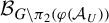 $\mathcal B_{G \setminus \pi _2(\varphi (\mathcal A_U))}$
-measurable, where
 $\pi _2:(0,1)\times G \mapsto G$
is the projection onto the second coordinate.
Consequently,
 $g_r\circ \varphi ^{-1}$
restricted to
 $((0,1)\times G)\setminus \varphi (\mathcal A_U)$
is a jointly measurable function with respect to the product
 $\sigma $
-algebra
 $\mathcal B_{(0,1)} \times \mathcal B_{G \setminus \pi _2(\varphi (\mathcal A_U))}$
(see for example [Reference Charalambos and Kim6, Lemma 4.51]). As
 $\varphi $
is a homeomorphism, we conclude that
 $g_r$
is
 $\mathcal B_{V\setminus \mathcal A_U}$
-measurable, as we wanted to show.
In the following lemma, we prove that the subset of M, consisting of all points
 $x\in M$
for which there is a ball in
 $\mathcal {F}(x)$
with null
 $\mu ^U_x$
measure, is a relatively Borel set.
Lemma 4.3. For each
 $U\in \mathcal U$
, the set
 $$ \begin{align*}\mathcal Z_U = \bigcup_{x\in U\setminus \mathcal A_U} \mathcal F|U(x) \setminus \text{supp} \; \mu^U_x\end{align*} $$
is a
 $\mathcal B_{U\setminus \mathcal A_U}$
-measurable set, meaning
 $\mathcal {Z}_U=V\cap (U\smallsetminus \mathcal {A}_U)$
for some open set V.
Proof. First, let us give a better formulation for the definition of
 $\mathcal Z_U$
. Observe that
 $$ \begin{align*} \mathcal Z_U =\{x \in U \setminus \mathcal A_U : \mu^U_x(I)=0 \; \text{for some open ball} \; x\in I\subset \mathcal F(x)\}. \end{align*} $$
Consider
 $\{q_1,q_2,\ldots \}$
an enumeration of
 $\mathbb Q \cap [0,1]$
and let
 $\mathcal U$
be the given finite family of local charts covering M. For each
 $U \in \mathcal U$
and
 $i\in \mathbb N$
, define
 $\phi _i^{U}:U_i\setminus \mathcal A_U\to \mathbb {R}$
by
 $$ \begin{align*} \phi_i^{U}(x)=\mu^U_{x}(B_{d_x}(x,q_i)), \end{align*} $$
where
 $U_i=\{x\in U:B_{d_x}(x,q_i) \subset U\} $
. Observe that we may cover
 $U_i$
with a countable number of local charts
 $V_i^j\subset U_i$
,
 $j\in \mathbb N$
and, by Proposition 4.2,
 $\phi _i^{U} | V_i^j$
is
 $\mathcal B_{V_i^j\setminus \mathcal A_U}$
-measurable for every j. In particular,
 $\phi _i^U$
is
 $\mathcal B_{U_i\setminus \mathcal A_U}$
-measurable for every i. Therefore, we have that
 $\mathcal {Z}_i^{U}:=(\phi _i^{U})^{-1}(\{0\})\subset M$
is a
 $\mathcal B_{U_i\setminus \mathcal A_U}$
-measurable subset, in particular, a
 $\mathcal B_{U\setminus \mathcal A_U}$
-measurable subset. It is not difficult to see that
 $$ \begin{align} \mathcal{Z}_U=\bigcup_{i=1}^\infty \mathcal{Z}_i^{U}. \end{align} $$
Therefore,
 $\mathcal {Z}_U$
is a
 $\mathcal B_{U\setminus \mathcal A_U}$
-measurable subset as we wanted to show. Moreover,
 $\mu (\mathcal {Z}_U)=0$
.
Consider
 $\mathcal P$
the set given by
 $$ \begin{align*} \mathcal P = \{x: \text{there exists } U,V \in \mathcal U, \; x\in U\cap V, \; \mu^U_x (\cdot | U\cap V) \nsim \mu^V_x (\cdot | U\cap V)\}, \end{align*} $$
that is,
 $\mathcal P$
is the set of points x for which there exists two local charts U and V in
 $\mathcal U$
, both containing x, where the respective conditional measures at the plaque of x,
 $\mu ^U_x$
and
 $\mu ^V_x$
, are not equivalent on the intersection
 $\mathcal F|U(x) \cap \mathcal F|V(x)$
. In particular, this set has zero measure by Proposition 2.1. Set
 $\widetilde {M}:=M\setminus (\bigcup _{U\in \mathcal U} (\mathcal Z_U \cup \mathcal A_U) \cup \mathcal P)$
. Let
 $$ \begin{align} M_0:= \bigcap_{n\in \mathbb Z}f^n(\widetilde{M}).\end{align} $$
As
 $\mu (\widetilde {M})=1$
, we have
 $\mu (M_0)=1$
. For each
 $x\in M_0$
, we will denote by
 $\mu _x$
the measure on
 $B_{d_x}(x,\mathfrak r)$
given by the conditional measure
 $\mu ^U_x$
for some
 $U\in \mathcal U$
with
 $x\in U$
, normalized to give weight exactly one to
 $B_{d_x}(x,\mathfrak r)$
, that is, for a measurable
 $F\subset \mathcal F|U(x)$
,
 $$ \begin{align}\mu_x(F) = \mu^U_x(F | B_{d_x}(x,\mathfrak r)).\end{align} $$
Given any
 $y\in B_{d_x}(x,\mathfrak r)\cap M_0$
, the measures
 $\mu _y$
and
 $\mu _x$
are proportional to each other at the intersection
 $B_{d_x}(x,\mathfrak r) \cap B_{d_y}(y,\mathfrak r)$
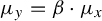
by Proposition 2.1, that is, there exists a constant
 $\beta $
for which
 $\mu _y = \beta \cdot \mu _x$
is restricted to
 $B_{d_x}(x,\mathfrak r) \cap B_{d_y}(y,\mathfrak r)$
.
In particular, evaluating both sides at
 $B_{d_x}(x,\mathfrak r) \cap B_{d_x}(y,\mathfrak r)$
,
 $$ \begin{align*} \beta \cdot \mu_x(B_{d_x}(x,\mathfrak r) \cap B_{d_x}(y,\mathfrak r)) = \mu_y(B_{d_x}(x,\mathfrak r) \cap B_{d_x}(y,\mathfrak r)) \end{align*} $$
 $$ \begin{align*} \Rightarrow \beta=\frac{\mu_y(B_{d_x}(x,\mathfrak r) \cap B_{d_x}(y,\mathfrak r))}{\mu_x(B_{d_x}(x,\mathfrak r) \cap B_{d_x}(y,\mathfrak r))}. \end{align*} $$
Corollary 4.4. For each
 $0<r<\mathfrak r$
,
 $x\in M_0$
, and
 $J\subset M$
Borel, the map
 $$ \begin{align*} y \in B_{d_x}(x,\mathfrak r)\cap M_0 \mapsto \mu_y(J \cap B_{d_x}(y,r)) \end{align*} $$
is continuous.
Proof. For a certain
 $0<r<\mathfrak r$
fixed, take any
 $x \in M_0$
. Let
 $y\in B_{d_x}(x,\mathfrak r) \cap M_0$
and
 $U \in \mathcal U$
with
 $B_{d_x}(y,\mathfrak r) \subset U$
, take
 $y_n \in B_{d_x}(x,\mathfrak r)\cap M_0$
with
 $y_n \rightarrow y$
as
 $n\rightarrow \infty $
and
 ${B_{d_x}(y_n,\mathfrak r) \subset U}$
.
By definition,
 $$ \begin{align*}\mu_y = \mu_y^U(\cdot |B_{d_x}(y,\mathfrak r)), \; \mu_{y_n} = \mu_{y_n}^U(\cdot |B_{d_x}(y_n,\mathfrak r)). \end{align*} $$
Therefore, for
 $n\in \mathbb N$
such that
 $B_{d_x}(y,r)\subset B_{d_x}(y_n,\mathfrak r)$
and
 $B_{d_x}(y_n,r)\subset B_{d_x}(y,\mathfrak r)$
,
 $$ \begin{align} \mu_{y_n}(J\cap B_{d_x}(y_n,r)) = \frac{\mu_{y_n}^U(J\cap B_{d_x}(y_n,r))}{\mu_{y_n}^U(B_{d_x}(y_n,\mathfrak r))} = \frac{\mu_y^U(J\cap B_{d_x}(y_n,r))}{\mu_{y}^U(B_{d_x}(y_n,\mathfrak r))}. \end{align} $$
By Lemma 4.1, we have
 $\mu _y^U(J\cap B_{d_x}(y_n,r))\rightarrow \mu _y^U(J\cap B_{d_x}(y,r))$
and
 $\mu _{y}^U( B_{d_x}(y_n,\mathfrak r)) \rightarrow \mu _{y}^U(B_{d_x}(y,\mathfrak r))$
as
 $n\rightarrow \infty $
. Therefore,
 $\mu _{y_n}(J\cap B_{d_x}(y_n,r))\rightarrow \mu _{y}(J\cap B_{d_x}(y,r))$
as we wanted to show.
Corollary 4.5. For each
 $x\in M_0$
and
 $J\subset M$
Borel, the map
 $$ \begin{align*}r \in [0,\mathfrak r] \mapsto \mu_x(J\cap B_{d_x}(x,r))\end{align*} $$
is continuous. Furthermore, the map
 $$ \begin{align} (x,r) \in M_0 \times [0,\mathfrak r] \mapsto \mu_x(J\cap B_{d_x}(x,r))\end{align} $$
is jointly measurable. In particular,
 $$ \begin{align}(x,r) \in M_0 \times [0,\mathfrak r] \mapsto \mu_x(B_{d_x}(x,r))\end{align} $$
is jointly measurable.
Proof. Let
 $x\in M_0$
. First, let us prove that
 $r \in [0,\mathfrak r] \mapsto \mu _x(J\cap B_{d_x}(x,r))$
is a continuous function. Let
 $0=r<\mathfrak r$
and
 $r_n \in [0,\mathfrak r] \searrow r$
(if
 $r=\mathfrak r$
, the argument is analogous). Hence,
 $$ \begin{align*}\mu_{x}(J\cap B_{d_x}(x,r_n)) = \mu_x(J\cap B_{d_x}(x,r)) + \mu_x(J\cap B_{d_x}(x,r_n)\setminus J\cap B_{d_x}(x,r)).\end{align*} $$
As
 $\mu _x$
is non-atomic,
 $$ \begin{align*}\lim_{n\rightarrow \infty}\mu_x(B_{d_x}(x,r_n)\setminus B_{d_x}(x,r)) =0.\end{align*} $$
Then,
 $$ \begin{align*}\mu_x(J\cap B_{d_x}(x,r_n)\setminus J\cap B_{d_x}(x,r)) =\mu_x(J \cap ( B_{d_x}(x,r_n)\setminus B_{d_x}(x,r))) \rightarrow 0,\end{align*} $$
showing the first part of the statement.
Let us show the second part of the statement. For each
 $x\in M_0$
, let
 $x\in V_x$
be a local chart with
 $$ \begin{align*}y\in V_x \Rightarrow B_{d_y}(y,\mathfrak r) \subset U_x \quad \text{for some} \; U_x \in \mathcal U.\end{align*} $$
As M is compact, we may cover M with a finite number of such local charts, say
 $V_1,V_2, \ldots , V_l$
and call
 $U_1, U_2, \ldots , U_l$
the associated local charts in
 $\mathcal U$
. For any j, consider
 $$ \begin{align*}y\in V_j \mapsto \mu_y(J\cap B_{d_y}(y,r)).\end{align*} $$
Observe that
 $$ \begin{align*}\mu_y(J\cap B_{d_y}(y,r)) =\frac{\mu^{U_j}_y(J\cap B_{d_y}(y,r))}{\mu^{U_j}_y(B_{d_y}(y,\mathfrak r))}. \end{align*} $$
Therefore, by Proposition 4.2,
 $y\in V_j \cap M_0 \mapsto \mu _y(J\cap B_{d_y}(y,r))$
is a
 $\mathcal B_{U_j\setminus \mathcal A_{U_j}}$
-measurable map. As j is arbitrary,
 $y\in M_0 \mapsto \mu _y(J\cap B_{d_x}(y,r))$
is a
 $\mathcal B_{U\cap M_0}$
-measurable map.
Thus, the map given by (6) is jointly measurable as it is continuous in the first coordinate and
 $\mathcal B_{M_0}$
-measurable in the second. The second conclusion follows from taking
 $J=M$
.
5 Proof Theorem A
First of all, we can assume that
 $(M,\mu )$
is an atom-less probability space and that the disintegration of
 $\mu $
along
 $\mathcal F$
is not atomic, otherwise, there would be nothing to do. We also consider the same objects fixed in the beginning of §4.
Now, we define the distortion of the disintegration measure of
 $\mu $
relative to the metric system in each leaf
 $\mathcal {F}(x)$
by the following definition.
Definition 5.1. Let
 $(M,\mu )$
be a probability space and
 $\mathcal F$
be a continuous one-dimensional foliation of M. Let
 $\{\mu _x\}$
be the system of conditional measures along
 $\mathcal F$
given by (4) for
 ${x\in M_0}$
(see Lemma 4.3 and recall that
 $\mu (M_0)=1$
), and let
 $d=\{d_x\}$
be the
 $\mathcal F$
-metric system induced by the arc-length system
 $\{l_x\}$
as in Definition 3.4. We define the
 $\mu $
-distortion of the
 $\mathcal {F}$
-metric system by
 $$ \begin{align*} \Delta(x)= \begin{cases} \limsup_{\varepsilon \rightarrow 0}\dfrac{\mu_x(B_{d_x}(x,\varepsilon))}{2\varepsilon} := \lim_{n\rightarrow \infty}\bigg(\!\sup_{\varepsilon \leq 1/n} \dfrac{\mu_x(B_{d_x}(x,\varepsilon))}{2\varepsilon}\bigg) & \!\text{if } x\in M_0,\\ 0 & \!\text{if } x\notin M_0. \end{cases} \end{align*} $$
Recall that
 $B_{d_x}(x,\varepsilon )$
is the ball inside
 $\mathcal F(x)$
, centered in the point x and with radius
 $\varepsilon $
with respect to the metric
 $d_x$
.
Lemma 5.2. The map
 $x \in M\mapsto \Delta (x)$
is measurable.
Proof. Clearly, it is sufficient to check the measurability of
 $\Delta (x)$
in
 $M_0$
. By Corollary 4.5, for any fixed
 $x\in M_0$
, the function
 $w(x,\cdot ):(0,\mathfrak r) \rightarrow \mathbb (0,\infty )$
is continuous. Thus, for n small enough,
 $$ \begin{align*} \sup_{\varepsilon \leq 1/n} \frac{\mu_x(B_{d_x}(x,\varepsilon))}{2\varepsilon} = \sup_{r\in \mathbb Q \cap (0,1/n] } \frac{\mu_x(B_{d_x}(x,r))}{2r} \quad \text{ for all } x\in M_0. \end{align*} $$
For each
 $n\in \mathbb N$
, the map
 $L_n:M_0 \to \mathbb R$
,
 $x\in M_0 \mapsto \sup _{r\in \mathbb Q \cap (0,1/n] } {(\mu _x(B_{d_x}(x,r)))}/{2r}$
is measurable, as it is defined by the supremum over a countable number of measurable maps. Consequently, since
 $\Delta (x)= \lim _{n\rightarrow \infty } L_n(x)$
for all
 $x\in M_0$
, we conclude that
 $\Delta (x)$
is measurable as we wanted.
Observe that, a priori,
 $\Delta (x)$
is a measurable function, but it is not immediately true that
 $\Delta (x)<\infty $
for
 $\mu $
-almost every x. Also note that
 $$ \begin{align*}f_{*}\mu_x = \mu_{f(x)} \quad\text{and}\quad f(B_{d_x}(x,\varepsilon)) = B_{d_{f(x)}}(f(x),\varepsilon),\end{align*} $$
since
 $$ \begin{align*}d_{f(x)}(f(x),f(y))=d_x(x,y),\end{align*} $$
we conclude that
 $\Delta (x)$
is an f-invariant map. By ergodicity of f, it follows that
 $\Delta (x)$
is constant almost everywhere, let us call that constant by
 $\Delta $
, that is, for almost every x,
 $$ \begin{align} \Delta(x) = \Delta. \end{align} $$
Let
 $\widehat {M}\subset M_0$
be a Borel f-invariant full measure set of points x for which (8) occurs.
5.1 Technical lemmas for the case
$\Delta = \infty $

Lemma 5.3. If
 $\Delta =\infty $
, there exists a sequence
 $\varepsilon _k\rightarrow 0$
, as
 $k\rightarrow +\infty $
, and a full measure subset
 $R^{\infty } \subset \widehat {M}$
such that:
-
(i)
$R^{\infty }$
is f-invariant; -
(ii) for all
$x \in R^{\infty }$
, (9)
$$ \begin{align} \frac{\mu_x(B_{d_x}(x,\varepsilon_k))}{2\varepsilon_{k}} \geq k .\end{align} $$


Proof. Let
 $k\in \mathbb N^{*}$
arbitrary. Since
 $\Delta (x) = \Delta $
for every
 $x \in \widehat {M}$
, define
 $$ \begin{align*}\varepsilon_k(x):= \sup \bigg\{\varepsilon \leq 1: \frac{ \mu_x(B_{d_x}(x,\varepsilon))}{ 2\varepsilon} \geq k \bigg\}, \quad x\in \widetilde{M}.\end{align*} $$
Claim 1. The function
 $\varepsilon _k(x)$
is measurable for all
 $k \in \mathbb N$
.
Proof. Define
 $$ \begin{align*} w(x,\varepsilon) = \frac{ \mu_x(B_{d_x}(x,\varepsilon))}{2\varepsilon}. \end{align*} $$
By Corollary 4.5, for any
 $x\in M_0$
, the function
 $w(x,\cdot ):(0,\mathfrak r) \rightarrow \mathbb (0,\infty )$
is continuous and, for
 $0<\varepsilon <\mathfrak r$
fixed, the function
 $w(\cdot , \varepsilon ):M_0 \rightarrow \mathbb (0,\infty )$
is a measurable function by Proposition 4.2. Given any
 $k\in \mathbb N$
,
 $\beta>0$
, the continuity of
 $w(x,\cdot )$
implies that
 $$ \begin{align*} \varepsilon_k^{-1}((0,\beta)) = & \; \{x: \varepsilon_{k}(x) \in (0,\beta)\} \\ = & \bigcap_{\beta\leq r \leq 1} w(\cdot, r)^{-1}([0, k)) \\ = & \bigcap_{\beta\leq r \leq 1, r\in \mathbb Q} w(\cdot, r)^{-1}([0, k)). \end{align*} $$
Therefore,
 $\varepsilon _k^{-1}((0,\beta ))$
is measurable, as it is a countable intersection of measurable subsets of
 $M_0$
, and consequently,
 $\varepsilon _k$
is a measurable function for every k.
Note that
 $\varepsilon _k(x)$
is f-invariant. Thus, by ergodicity, for every
 $k\in \mathbb {N}$
, the function
 $\varepsilon _k$
is constant almost everywhere, let
 $R^{\infty }_k$
be a full measure set such that
 $\varepsilon _k(x)$
is constant equal to
 $\varepsilon _k$
. It is easy to see that the sequence
 $\varepsilon _k$
goes to
 $0$
as k goes to infinity. Take
 $\widetilde {R}^{\infty }:= \bigcap _{k=1}^{+\infty } R^{\infty }_k$
. Since each
 $R^{\infty }_k$
has full measure,
 $\widetilde {R}^{\infty }$
has full measure and clearly satisfies what we want for the sequence
 $\{\varepsilon _k\}_{k}$
. Finally, take
 $R^{\infty }=\bigcap _{i\in \mathbb {Z}} f^{i}(\widetilde {R}^{\infty })$
. The set
 $R^{\infty }$
is f-invariant, has full measure and satisfies items (i) and (ii).
We now set, for each
 $U\in \mathcal U$
,
 $x\in U\setminus (\mathcal Z_U \cup \mathcal A_U)$
,
 $$ \begin{align*} & \Pi^{\infty}_{x,U}\\ &\quad:= \bigg\{y \in \mathcal F|U(x) \setminus \mathcal Z_U : \; \frac{1}{2\varepsilon_k}\cdot \frac{ \mu^U_y(B_{d_x}(y,\varepsilon_k))}{\mu^U_y(B_{d_x}(y,\mathfrak r)) } \geq k \text{ for all } k \; \text{with} \; B_{d_x}(y,\varepsilon_k) \subset U \bigg\} \end{align*} $$
and
 $$ \begin{align*}\Pi^{\infty}_U := \bigcup_{x\in U\setminus (\mathcal Z_U \cup \mathcal A_U)} \Pi^{\infty}_{x,U}.\end{align*} $$
Observe that if
 $x\in R^{\infty }$
, then
 $x\in \Pi ^{\infty }_{x,U}$
; therefore,
 $R^{\infty }\cap U \subset \Pi ^{\infty }_U$
. In particular,
 ${U\setminus \Pi ^{\infty }_U \subset U\setminus R^{\infty }}$
. Since
 $\mu (R^{\infty })=1$
, then
 $\Pi ^{\infty }_U$
is measurable. Also, we can clearly assume that
 $\varepsilon _k$
is strictly decreasing and
 $\varepsilon _1<\mathfrak r$
.
Lemma 5.4. For every
 $x \in R^{\infty } \cap U$
, consider
 $\delta =\delta (x)>0$
for which
 $$ \begin{align*}B_{d_x}[x,2\cdot \delta+\mathfrak r]\subset U.\end{align*} $$
The set
 $\Pi ^{\infty }_{x,U } \cap B_{d_x}[x,\delta ]$
is a closed subset on the plaque
 $\mathcal F|U(x)$
.
Proof. Let
 $y_n \rightarrow y$
,
 $y_n \in \Pi ^{\infty }_{x,U}\cap B_{d_x}[x,\delta ]$
,
 $y\in \mathcal F|U(x)$
. In particular,
 $B_{d_x}(y_n,\mathfrak r) \subset B_{d_x}(x,\delta +\mathfrak r) \subset U$
and by taking the limit over n, we also have
 $B_{d_x}(y,\mathfrak r) \subset B_{d_x}(x,\delta +\mathfrak r) \subset U$
. Furthermore, it is clear that
 $y\in B_{d_x}[x,\delta ]$
since this is a closed set. By Lemma 4.1, for each
 $k\in \mathbb N$
, the map
 $$ \begin{align*}y \in B_{d_x}[x,\delta] \subset F_{\varepsilon_k}(x) \mapsto \mu^U_y(B_{d_x}(y,\varepsilon_k))\end{align*} $$
is continuous and the same holds for
 $$ \begin{align*}y \in B_{d_x}[x,\delta] \subset F_{\mathfrak r}(x) \mapsto \mu^U_y(B_{d_x}(y,\mathfrak r)).\end{align*} $$
Thus,
 $$ \begin{align*}\lim_{n\rightarrow \infty} \frac{\mu^U_{y_n}(B_{d_x}(y_n,\varepsilon_k))}{\mu^U_{y_n}(B_{d_x}(y_n,\mathfrak r))} = \frac{\mu^U_{y}(B_{d_x}(y,\varepsilon_k))}{\mu^U_{y}(B_{d_x}(y,\mathfrak r))}, \quad k\geq 1,\end{align*} $$
which implies that for all
 $k\geq 1$
,
 $$ \begin{align*} \frac{\mu^U_y(B_{d_x}(y,\varepsilon_k))}{2\varepsilon_k \cdot \mu^U_y(B_{d_x}(y,\mathfrak r))} = \lim_{n\rightarrow \infty} \frac{\mu^U_{y_n}(B_{d_x}(y_n,\varepsilon_k))}{2\varepsilon_k \cdot \mu^U_{y_n}(B_{d_x}(y_n,\mathfrak r))} \geq k, \end{align*} $$
that is,
 $y\in \Pi ^{\infty }_{x,U}$
as we wanted.
Now, we consider the following sets:
 $$ \begin{align*}D^{\infty}_U := \mathcal F|U(\Pi^{\infty}_U) \setminus (\mathcal F|U)(\mathcal{Z_U}).\end{align*} $$
We claim that
 $D^{\infty }_U$
is an
 $\mathcal A$
-measurable subset. In fact, consider the natural projection
 $\pi :U\to U/\mathcal {F}$
, as U is an open subset of a manifold (in particular, it is a Polish space), we have that
 $U/\mathcal {F}$
is a Polish space with the quotient topology. By Lemma 4.3,
 ${\mathcal {Z}_U = V \cap (U\setminus \mathcal A_U)}$
for some Borel set V. Since
 $U\setminus \mathcal A_U$
is
 $\mathcal F|U$
-saturated,
 $$ \begin{align*}\mathcal{F}|(\mathcal{Z}_U)= \pi^{-1}(\pi(V))\cap (U\setminus \mathcal A_U).\end{align*} $$
Note that
 $\pi (V)$
is a Souslin set by [Reference Bogachev4, Corollary 1.10.9]. (A subset of a Polish space Y is called a Souslin set, or an analytical set, if it is the image of a Polish space X by a continuous map from X to Y.) Consequently,
 $ \pi ^{-1}(\pi (V)) $
is measurable in the
 $\sigma $
-algebra
 $\mathcal {A}$
, which we recall is the completion of the Borel sigma algebra
 $\mathcal B$
, implying that
 $\mathcal {F}|(\mathcal {Z}_U)$
is
 $\mathcal A$
-measurable.
Since
 $R^{\infty }\cap U\subset \mathcal {F}|U(\Pi ^{\infty }_U)$
and
 $\mu (R^{\infty })=1$
, we have that
 $\mathcal {F}|U(\Pi ^{\infty }_U)$
is an
 $\mathcal A$
-measurable subset of U, this implies that
 $D^\infty _U=\mathcal F|U(\Pi ^{\infty }_U) \setminus \mathcal F|U(\mathcal {Z}_U)$
is an
 $\mathcal A$
-measurable set as we wanted to show.
Since
 $D^\infty _U$
is an
 $\mathcal A$
-measurable set, by ergodicity of f, the f-invariant set
 $$ \begin{align*} D^{\infty}:=\bigcup_{n\in \mathbb Z, U\in \mathcal U}f^n \Big(\bigcup D^{\infty}_U\Big) \end{align*} $$
must satisfy either
 $\mu (D^{\infty })=0$
or
 $\mu (D^{\infty })=1$
.
5.2 Technical lemmas for the case
$\Delta < \infty $

Lemma 5.5. If
 $\Delta <\infty $
, there exists a sequence
 $\varepsilon _k\rightarrow 0$
, as
 $k\rightarrow +\infty $
, and a full measure subset
 $R \subset \widehat {M}$
such that:
-
(i) R is f-invariant;
-
(ii) for every
$x \in R$
, then (10)
$$ \begin{align} \bigg| \frac{ \mu_x(B_{d_x}(x,\varepsilon_k))}{2\varepsilon_{k}} - \Delta \bigg| \leq \frac{1}{k}.\end{align} $$


Proof. The proof is similar to the proof of Lemma 5.3. Let
 $k\in \mathbb N^{*}$
be arbitrary. Since
 $\Delta (x) = \Delta $
, for every
 $x \in \widehat {M}$
,
 $$ \begin{align*} \varepsilon_k(x):= \sup \bigg\{\varepsilon \leq \frac{1}{k}: \bigg| \frac{ \mu_x(B_{d_x}(x,\varepsilon))}{2\varepsilon} - \Delta \bigg| \leq \frac{1}{k} \bigg\}. \end{align*} $$
Observe that for
 $x\in \widehat {M}$
, such
 $\varepsilon _k(x)$
exists by the definition of
 $\Delta $
,
 $\varepsilon _l(x) \rightarrow 0$
as
 $l\rightarrow \infty $
and
 $$ \begin{align*} \lim_{l\rightarrow \infty}\bigg|\frac{ \mu_x(B_{d_x}(x,\varepsilon_l(x)))}{2\varepsilon_l(x)} - \Delta \bigg|=0. \end{align*} $$
Claim 2. The function
 $\varepsilon _k(x)$
is measurable for all
 $k \in \mathbb N$
.
Proof. Define
 $$ \begin{align*}w(x,\varepsilon) = \frac{ \mu_x(B_{d_x}(x,\varepsilon))}{ 2\varepsilon}. \end{align*} $$
As observed in the proof of Lemma 5.3,
 $r\mapsto w(x,r)$
is continuous and
 $x\mapsto w(x, r)$
is measurable. Given any
 $k\in \mathbb N$
,
 $k>0$
, by the definition of
 $\varepsilon _k$
, for all
 $\beta> 1/k$
, we have
 $\varepsilon _k^{-1}((0,\beta )) = \widehat {M}$
. Also, the continuity of
 $w(x,\cdot )$
implies that for every
 $\beta \leq 1/k$
,
 $$ \begin{align*} \varepsilon_k^{-1}((0,\beta)) = &\; \{x: \varepsilon_{k}(x) \in (0,\beta)\} \\ = & \bigcap_{\beta\leq r \leq 1/k} w(\cdot, r)^{-1}\Big(\Big[\Delta+\frac{1}{k}, \infty\Big)\Big) \cup w(\cdot, r)^{-1}\Big(\Big[0, \Delta-\frac{1}{k} \Big)\Big) \\ = & \bigcap_{\beta\leq r \leq 1/k, r\in \mathbb Q} w(\cdot, r)^{-1}\Big(\Big[\Delta+\frac{1}{k}, \infty \Big)\Big) \cup w(\cdot, r)^{-1}\Big(\Big[0, \Delta-\frac{1}{k} \Big)\Big). \end{align*} $$
Therefore,
 $\varepsilon _k^{-1}((0,\beta ))$
is measurable, as it is a countable intersection of measurable sets, and consequently,
 $\varepsilon _k$
is a measurable function for every k.
As
 $\varepsilon _k(x)$
is f-invariant, by ergodicity, we may take the full measure set
 $R_k$
, where
 $\varepsilon _k(x)$
is constant equal to
 $\varepsilon _k$
. The sequence
 $\varepsilon _k$
goes to
 $0$
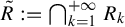
as k goes to infinity, so we set
 ${\tilde {R}:= \bigcap _{k=1}^{+\infty } R_k}$
. Since each
 $R_k$
has full measure,
 $\tilde {R}$
has full measure and clearly satisfies what we want for the sequence
 $\{\varepsilon _k\}_{k}$
. The set
 $R=\bigcap _{i\in \mathbb {Z}}f^{i}(\widetilde {R})$
is f-invariant, has full measure, and satisfies items (i) and (ii) as we wanted.
Similar to the definitions made in §5.1, we set
 $$ \begin{align*} \Pi_U := \bigcup_{x\in U\setminus (\mathcal Z_U \cup \mathcal A_U)} \Pi_{x,U}, \end{align*} $$
where
 $$ \begin{align*} \Pi_{x,U}:= &\; \bigg\{y \in \mathcal F|U(x) \setminus \mathcal Z_U : \; \bigg|\frac{1}{2\varepsilon_k}\cdot \frac{ \mu^U_y(B_{d_x}(y,\varepsilon_k))}{\mu^U_y(B_{d_x}(y,\mathfrak r)) } - \Delta \bigg| \leq \frac{1}{k}\\ & \quad \text{ for all } k \; \text{with} \; B_{d_x}(y,\mathfrak r) \subset U \bigg\}. \end{align*} $$
Lemma 5.6. For every
 $x \in R \cap U$
, consider
 $\delta (x)>0$
for which
 $$ \begin{align*}B_{d_x}[x,2\cdot \delta+\mathfrak r]\subset U.\end{align*} $$
The set
 $\Pi _{x,U} \cap B_{d_x}[x,\delta ]$
is a closed subset on the plaque
 $\mathcal F|U(x)$
.
Proof. Identical to the proof of Lemma 5.4.
Similar to the definition made in §5.1, we consider the set
 $$ \begin{align*}D_U := \mathcal F|U(\Pi_U) \setminus (\mathcal F|U)(\mathcal{Z_U})\end{align*} $$
and
 $$ \begin{align*}D:=\bigcup_{n\in \mathbb Z, U\in \mathcal U}f^n\Big(\bigcup D_U\Big).\end{align*} $$
Similarly,
 $D_U$
is
 $\mathcal A$
-measurable for all
 $U\in \mathcal U$
and again by ergodicity, we have
 $\mu (D)=0$
or
 $\mu (D)=1$
.
After proving the auxiliary lemmas for
 $\Delta ^\infty $
(respectively
 $\Delta $
) and obtaining the sets D (respectively
 $D^\infty $
), we divide the next part of the proof into four cases.
5.3 Case 1:
$\Delta <\infty $
and
$\mu (D)=0$


In this case, we will show that the support of
 $\mu _x$
is a Cantor subset for almost every
 $x\in M$
.
As fixed in the beginning, consider
 $\{\omega _x\}_x$
the disintegration of
 $\mu $
along
 $\mathcal F$
and consider
 $\mathcal G$
a full measure
 $\mathcal F$
-saturated set of points, where
 $$ \begin{align*}f^j_*\Omega_x = \Omega_{f^j(x)} \quad \text{ for all } j\in \mathbb Z.\end{align*} $$
Let
 $\mathcal G^U:=\{x\in U\setminus D: \mu ^U_x = \omega _x(\cdot | \mathcal F|U(x))\}\cap \{x: \mu ^U_x \; \text {is non-atomic}\}$
.
Consider:
-
•
$\Phi ^U_{1/n}(\mathcal Z_U):=\{x\in U: d_x(x,\mathcal Z_U) <1/n\};$
-
•
$\mathcal E_n = \bigcup _j \mathcal G\cap f^j(\Phi _{1/n}^U(\mathcal Z_U) \cap \mathcal G^U)$
.


As
 $\mathcal Z_U = \chi _U \cap (U\setminus \mathcal A_U)$
,
 $$ \begin{align*}\Phi^U_{1/n}(\mathcal Z_U) = \{x \in M: d_x(x,\mathcal Z_U) < 1/n\} \cap (U\setminus \mathcal A_U), \end{align*} $$
which is measurable for
 $n \geq \hat {n}$
, for some
 $\hat {n}\in \mathbb N$
not depending on U, by Lemma 3.11 since
 $\chi _U$
is a Borel subset of U. Therefore, the set of the second item is an f-invariant measurable subset of M; thus, it either has full or null measure.
Now, again we separate two cases.
Case 1.1. Assume that for all
 $n\geq \hat {n}$
,
 $\mu (\mathcal E_n)=1$
. Then,
 $$ \begin{align*} \mathcal E_n^U=\mathcal G^U \cap \bigg(\bigcup_j \mathcal G\cap f^j(\Phi_{1/n}^U(\mathcal Z_U) \cap \mathcal G^U)\bigg) \end{align*} $$
has full measure in U for every
 $n\geq \hat {n}$
. For
 $z\in \mathcal E^U = \bigcap _{n\geq \hat {n}} \mathcal E^U_n$
, let
 $n_0>0$
such that for
 $n\geq n_0 \geq \hat {n}$
, we have
 $B_{d_x}(z,1/n_0)\subset U$
. For
 $n\geq n_0$
, let j with
 $$ \begin{align*}f^{-j}(z) \in \Phi^{U}_{1/n}(\mathcal Z_U)\cap \mathcal G^{U},\end{align*} $$
and
 $p \in \mathcal Z_U$
with
 $d_x(p,f^{-j}(z))<1/n$
. Then,
 $d_x(f^j(p),z)<1/n$
, which implies
 $f^j(p)\in U$
, and if
 $\mu ^U_p(B_{d_x}(p,\delta ))=0$
, for
 $\delta $
small, then since
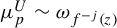 $\mu ^U_p \sim \omega _{f^{-j}(z)}$
(because
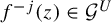 $f^{-j}(z) \in \mathcal G^U$
) and
 $z\in \mathcal G$
, it follows that
 $\omega _z(f^{-j}(I_p))=\omega _{f^j(z)}(I_p) = 0$
and
 $z\in \mathcal G^u$
; thus,
 $\mu ^U_z(f^{-j}(I_p))=0$
. Therefore,
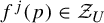 $f^j(p)\in \mathcal Z_U$
and
 $z\in \Phi _{1/n}(\mathcal Z_U)$
. That is, the set
 $\mathcal Z_U \cap \mathcal F|U(z)$
is dense in
 $\mathcal F|U(z)$
for almost every
 $z\in \mathcal E^U$
.
Claim 3. For
 $x\in \mathcal E^U$
,
 $\mathcal {C}_x:=\mathcal {F}|U(x)\setminus \mathcal {Z}_U$
is a Cantor subset in
 $\mathcal {F}|U(x)$
.
Proof. To prove that
 $\mathcal {C}_x$
is a Cantor set, we will show that this set is a nowhere dense and perfect set. Therefore, as it is bounded (
 $\mathcal C_x \subset \mathcal F|U(x)$
), we can conclude that it is a compact, nowhere dense perfect set, that is, a Cantor set. Since
 $\mathcal {Z}_U \cap \mathcal F|U(x)$
is a dense and open set in
 $\mathcal {F}|U(x)$
, we have that
 $\mathcal {C}_x$
is a nowhere dense and closed set. Now, let us see that
 $\mathcal {C}_x$
has no isolated points. Let
 $y\in \mathcal {C}_x$
. Suppose that there exist
 $r>0$
with
 $B_{d_x}(y,r)\subset U$
and
 $B_{d_x}(y,r)\cap \mathcal {C}_x=\{y\}$
. Since
 $y\in \mathcal {C}_x$
,
 $$ \begin{align*}0<\mu^U_x(B_{d_x}(y,r))=\mu^U_x(B_{d_x}(y,r)\setminus \mathcal C_x ) + \mu^U_x(\{y\}) = \mu^U_x(\{y\});\end{align*} $$
thus,
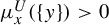 $\mu ^U_x(\{y\})>0$
, which is a contradiction since
 $x\notin \mathcal A_U$
.
Therefore,
 $\mathcal C_x$
is indeed a Cantor subset.
Thus, for almost every
 $x\in M$
and any local chart U, the conditional measure
 $\mu ^U_x$
is supported in the Cantor set
 $\mathcal {C}_x$
. In particular, the measure
 $\omega _x$
on
 $\mathcal F(x)$
is supported on a
 $\sigma $
-Cantor subset of the leaf. We remark that for the Claim, we did not use the fact that
 $\Delta =\infty $
; thus, the same argument will work when
 $\Delta <\infty $
.
Case 1.2. If, however, there exists
 $N_0\in \mathbb {N}$
with
 $N_0\geq \hat {n}$
such that
 $\mu (\mathcal E_{N_0})=0$
, then
 $\mu (\mathcal E^U_{N_0})=0$
and, moreover,
 $\mu (\mathcal E^U_N)=0$
for any
 $N \geq N_0$
. Since
 $$ \begin{align*}\mathcal G^U \cap \mathcal G \cap \varphi_{1/N}(\mathcal Z_U) \subset \mathcal E^U_{N_0},\end{align*} $$
we have
 $$ \begin{align*} \mu(\Phi^U_{1/N}(\mathcal Z_U)) = \mu(\mathcal G^U \cap \mathcal G \cap \Phi_{1/N}(\mathcal Z_U))\leq \mu(\mathcal E_n^U)=0 \quad \text{ for all } N\geq N_0. \end{align*} $$
In particular, for almost every
 $x\in U$
,
 $$ \begin{align} \mu^U_x(\Phi^U_{1/N}(\mathcal{Z}_U\cap \mathcal F|U(x)))=0. \end{align} $$
As
 $\Phi ^U_{1/N}(\mathcal {Z}_U\cap \mathcal F|U(x))$
is an open subset of
 $\mathcal F|U(x)$
, by (11), for almost every
 $x\in U$
,
 $$ \begin{align*} \Phi^U_{1/N}(\mathcal{Z}_U\cap \mathcal F|U(x))\subset (\mathcal{Z}_U\cap \mathcal F|U(x)). \end{align*} $$
However, clearly the other continence holds; thus,
 $\mathcal {Z}_U\cap \mathcal F|U(x) = \Phi ^U_{1/N}(\mathcal {Z}_U\cap \mathcal F|U(x))$
and this implies
 $\mathcal {Z}_U\cap \mathcal F|U(x) = \mathcal F|U(x)$
. As this happens for almost every
 $x\in U$
, we fall in a contradiction with the fact that
 $\mu (\mathcal Z_U \cap U)=0$
. Therefore, this case does not happen.
5.4 Case 2:
$\Delta =\infty $
and
$\mu (D^{\infty })=0$


In particular, for every
 $U\in \mathcal U$
, we must have
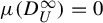 $\mu (D^{\infty }_U)=0$
, which implies
 $\mu (\mathcal F|U(\mathcal Z_U))=\mu (U)$
.
In this case, we will proceed very similarly to the previous case. For
 $U\in \mathcal U$
, consider the sets
 $\mathcal E_n$
and
 $\mathcal E_n^U$
defined in Case 1.
Again, if
 $\mu (\mathcal E_n)=1$
for every
 $n\in \mathbb Z$
, then there exists a full measure subset of U, namely
 $\mathcal E^U$
, such that
 $z\in \mathcal E^U$
implies
 $\mathcal Z_U \cap \mathcal F|U(z)$
is dense in
 $\mathcal F|U(z)$
. Hence, as shown by the Claim in Case 1, it follows that the support of
 $\mu ^U_x$
is a Cantor subset of the plaque
 $\mathcal F|U(x)$
for almost every
 $x\in U$
.
Otherwise, if
 $\mu (\mathcal E_{N_0})=0$
for some
 $N_0\in \mathbb N$
, then as in Case 1, we conclude that
 $\mathcal {Z}_U\cap \mathcal F|U(x) = \mathcal F|U(x)$
, which contradicts the fact that
 $\mu (\mathcal Z_U \cap U)=0$
; thus, this case does not occur.
5.5 Case 3:
$\Delta = \infty $
and
$\mu (D^{\infty })=1$


Let us prove that this case cannot occur. Since
 $\mu (D^{\infty })=1$
, there exists
 $U\in \mathcal U$
with
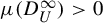 $\mu (D^{\infty }_U)>0$
. Since
 $\mu (\mathcal F|U(\Pi ^{\infty }_U))=\mu (U)$
, for almost every point
 $\bar {x}\in D^{\infty }_U$
,
 $$ \begin{align} \mu^U_{\bar{x}}(\Pi^{\infty}_U\cap \mathcal F|U(\bar{x}))=1.\end{align} $$
Take any such typical
 $\bar {x}$
and consider
 $x\in \mathcal F|U(\bar {x}) \cap \Pi ^{\infty }_U$
, in particular,
 ${B_{d_x}(x,\mathfrak r)\subset U}$
. Also,
 $\Pi ^{\infty }_{x,U}\cap B_{d_x}[x,\delta ]$
is closed in
 $\mathcal F|U(x)$
for some
 $\delta>0$
small if there exists
 $z\in B_{d_x}[x,\delta ] \setminus \Pi ^{\infty }_{x,U}\cap B_{d_x}[x,\delta ]$
, then for some
 $\delta _2>0$
, we have
 $B_{d_x}(z,\delta _2) \subset B_{d_x}[x,\delta ] \setminus \Pi ^{\infty }_{x,U}\cap B_{d_x}[x,\delta ]$
and
 $\mu ^U_x(B_{d_x}(z,\delta _2))=0$
by (12). However, this cannot happen since this would imply
 $z\in \mathcal Z_U $
and, consequently,
 $\mathcal F|U(\mathcal Z_U) \cap D^{\infty }_U \ne \emptyset $
, falling in a contradiction with the definition of
 $D^{\infty }_U$
. Therefore,
 $$ \begin{align*}\Pi^{\infty}_{x,U}\cap B_{d_x}[x,\delta]= B_{d_x}[x,\delta].\end{align*} $$
Consider
 $0<r_0<\delta $
small enough so that
 $B_{d_x}(x,\mathfrak r+2\cdot r_0)\subset U$
. By hypothesis, for k with
 $\varepsilon _k<r_0$
, by Remark 3.5, we can take
 $\lfloor r_0/\varepsilon _k\rfloor $
disjoint balls of radius
 $\varepsilon _k$
inside
 $B_{d_x}(x,r_0)$
, say with center
 $a_1,a_2,\ldots ,a_{\lfloor r_0/\varepsilon _k\rfloor }$
. Then,
 $$ \begin{align*} \begin{aligned} & \sum_{i=1}^{\lfloor r_0/\varepsilon_k\rfloor}\mu^U_{x}(B_{d_x}(a_i,\varepsilon_k)) \leq \mu^U_x(B_{d_x}(x,r_0))\\ &\quad \Rightarrow \sum_{i=1}^{\lfloor r_0/\varepsilon_k\rfloor}\frac{\mu^U_{x}(B_{d_x} (a_i,\varepsilon_k))}{\mu^U_x(B_{d_x}(x,\mathfrak r))} \leq \frac{\mu^U_x(B_{d_x}(x,r_0))}{\mu^U_x(B_{d_x}(x,\mathfrak r))}\\ &\quad \Rightarrow \sum_{i=1}^{\lfloor r_0/\varepsilon_k\rfloor}\frac{\mu^U_x(B_{d_x}(a_i,\mathfrak r))}{\mu^U_x(B_{d_x}(x,\mathfrak r))}\cdot \frac{\mu^U_{x}(B_{d_x}(a_i,\varepsilon_k))} {\mu^U_x(B_{d_x}(a_i,\mathfrak r))} \leq \frac{\mu^U_x(B_{d_x}(x,r_0))}{\mu^U_x(B_{d_x}(x,\mathfrak r))}. \end{aligned} \end{align*} $$
By Lemma 4.1,
 $$ \begin{align*} w \in B_{d_x}[x,r_0] \subset F_{\mathfrak r} \mapsto \mu^U_x(B_{d_x}(w,\mathfrak r)) \end{align*} $$
is continuous; hence, there exists
 $\eta>0$
such that
 $$ \begin{align*} \frac{\mu^U_x(B_{d_x}(w,\mathfrak r))}{\mu^U_x(B_{d_x}(x,\mathfrak r))} \geq \eta \end{align*} $$
for every
 $w\in B_{d_x}[x,r_0]$
. Therefore, since
 $a_i \in B_{d_x}[x,\delta ]$
for all i,
 $$ \begin{align*} \eta \cdot (2\varepsilon_k\cdot k ) \cdot \lfloor \frac{r_0}{\varepsilon_k}\rfloor & <\eta \cdot \sum_{i=1}^{\lfloor r_0/\varepsilon_k\rfloor} \frac{\mu^U_{x}(B_{d_x}(a_i,\varepsilon_k))}{\mu^U_x(B_{d_x}(a_i,\mathfrak r))} \\ & \leq \sum_{i=1}^{\lfloor r_0/\varepsilon_k\rfloor}\frac{\mu^U_x(B_{d_x}(a_i,\mathfrak r))}{\mu^U_x(B_{d_x}(x,\mathfrak r))}\cdot \frac{\mu^U_{x}(B_{d_x}(a_i,\varepsilon_k))}{\mu^U_x(B_{d_x}(a_i,\mathfrak r))} \\ & \leq \frac{\mu^U_x(B_{d_x}(x,r_0))}{\mu^U_x(B_{d_x}(x,\mathfrak r))}. \end{align*} $$
Taking
 $k\rightarrow \infty $
, the left side goes to infinity from where we conclude that
 $\mu ^U_x(B_{d_x}(x,r_0)) =\infty $
, falling in a contradiction. Thus, this case does not occur.
5.6 Case 4:
$\Delta < \infty $
and
$\mu (D)=1$


We will prove that if this case occurs, then for almost every
 $x\in U$
,
 $U\in \mathcal U$
, the conditional measure in
 $\mathcal {F}|U(x)$
is equivalent to the measure
 $\unicode{x3bb} _x$
given in Definition 3.12.
Lemma 5.7. The constant
 $\Delta $
is bounded away from zero and

for
 $\mu $
-almost every
 $x\in M$
.
Proof. Let
 $y\in D$
. Then, for some
 $n_0\in \mathbb Z$
and
 $U\in \mathcal U$
, we have
 $f^{n_0}(y) \in D_U$
. Call
 ${x=f^{n_0}(y)}$
. As
 $x\in \mathcal F|U( \Pi _U)\setminus \mathcal F|U(\mathcal Z_U)$
, we have
 $\mu ^U_x(\mathcal F|U( \Pi _U) \cap \mathcal F|U(x))=1$
. Therefore, we conclude (by the same argument used in Case 3—§5.5) that
 $$ \begin{align*} \Pi_{x,U}\cap B_{d_x}[x,\delta] = B_{d_x}[x,\delta] \end{align*} $$
for some
 $\delta $
small. Consequently,
 $\Pi _U \cap \mathcal F|U(x) \supset \{y \in \mathcal F|U(x): d_{x}(y, \partial \mathcal F|U(x))\geq \mathfrak r\}$
.
For any given
 $k \in \mathbb N^{*}$
,
 $U\in \mathcal U$
, and
 $x \in \Pi _U$
,
 $$ \begin{align} \bigg| \frac{\mu^U_x(B_{d_x}(x,\varepsilon_k))}{2\varepsilon_{k} \cdot \mu^U_x(B_{d_x}(x,\mathfrak r))} - \Delta \bigg| \leq \frac{1}{k}. \end{align} $$
Given
 $\varepsilon> 0$
, take
 $k_0 \in \mathbb N$
such that
 $k_{0}^{-1} < \varepsilon $
. Again, since
 $\{d_x\}$
is an
 $\mathcal {F}$
-metric system, given a constant
 $r>0$
, we need at most
 $s(k)=\lfloor r/\varepsilon _{k}\rfloor +1$
points, say
 $a_1,a_2,\ldots ,a_{s(k)}$
, to cover the ball
 $B_{d_x}(x,r)$
with balls of radius
 $\varepsilon _k$
. Let
 $\alpha _i := ({\mu ^U_x(B_{d_x}(a_i,\mathfrak r))}/{\mu ^U_x(B_{d_x}(x,\mathfrak r))})$
. Again, by continuity (see Lemma 4.1), there exists
 $\beta>0$
such that
 $\alpha _i \leq \beta $
for all i. Therefore,
 $$ \begin{align*} \frac{\mu^U_x(B_{d_x}(x,r))}{\mu^U_x(B_{d_x}(x,\mathfrak r))}\leq & \sum_{i=1}^{s(k)} \frac{\mu^U_{x}(B_{d_x}(a_i,\varepsilon_k))}{\mu^U_x(B_{d_x}(x,\mathfrak r))} = \sum_{i=1}^{s(k)} \alpha_i \cdot \frac{\mu^U_{x}(B_{d_x}(a_i,\varepsilon_k))}{\mu^U_x(B_{d_x}(a_i,\mathfrak r))} \\ \leq & \;\beta \cdot \sum_{i=1}^{s(k)} \frac{\mu^U_{x}(B_{d_x}(a_i,\varepsilon_k))}{\mu^U_x(B_{d_x}(a_i,\mathfrak r))} \leq \beta \sum_{i=1}^{s(k)} \frac{2\varepsilon_k}{k} + \Delta2\varepsilon_k \\ = & \;\beta \cdot s(k)\frac{2\varepsilon_k}{k} + \beta\cdot s(k)2\varepsilon_k \cdot \Delta. \end{align*} $$
Since
 $\lim s(k)\varepsilon _k=r$
, we have that
 $\beta \cdot s(k)({\varepsilon _k}/{k})$
goes to zero as
 $k\rightarrow \infty $
, so
 $$ \begin{align*}\frac{\mu^U_x(B_{d_x}(x,r))}{\mu^U_x(B_{d_x}(x,\mathfrak r))} \leq 2\Delta \cdot \beta \cdot r. \end{align*} $$
Therefore,
 $\mu ^U_x\ll \unicode{x3bb} _x$
when restricted to
 $\{y \in \mathcal F|U(x): d_{x}(y, \partial \mathcal F|U(x))\geq \mathfrak r\}$
and
 ${\Delta>0}$
. As
 $\mathfrak r$
can be taken to be arbitrarily small in the beginning, it follows that
 $\mu ^U_x \ll \unicode{x3bb} _x$
as we wanted to show.
Next, we are able to conclude that
 $\mu ^U_x$
is equivalent to the measure
 $\unicode{x3bb} _x$
.
Lemma 5.8. For
 $\mu $
-almost every (a.e.)
 $x\in M$
,

Proof. By Lemma 5.7, we know that
 $\mu ^U_x \ll \unicode{x3bb} _x$
. Since
 $\unicode{x3bb} _x$
is a doubling measure, we have that the Radon–Nikodyn derivative
 $d\mu ^U_x/d\unicode{x3bb} _x$
exists and is given at
 $\unicode{x3bb} _x$
-a.e. point
 $y\in \{y \in \mathcal F|U(x): d_{x}(y, \partial \mathcal F|U(x))\geq \mathfrak r\}$
by

In particular, by taking the limit along the subsequence
 $\varepsilon _k$
,
 $k\rightarrow \infty $
, we conclude that

which implies

where
 $\beta (y)=\mu ^U_x(B_{d_x}(y,\mathfrak r))$
. Since
 $\beta $
is a continuous function, given any compact
 $I\subset \{y \in \mathcal F|U(x): d_{x}(y, \partial \mathcal F|U(x))\geq \mathfrak r\}$
,

Then,

In particular, if
 $\mu ^U_x(E)=0$
, then, for any compact subset
 $I\subset \{y \in \mathcal F|U(x): d_{x}(y, \partial \mathcal F|U(x))\geq \mathfrak r\}$
, we have
 $\unicode{x3bb} _x(E\cap I)=0$
. Since
 $\mathcal F(x)$
may be written as a countable union of increasing compact subsets, we conclude that
 $\unicode{x3bb} _x(E \cap \{y \in \mathcal F|U(x): d_{x}(y, \partial \mathcal F|U(x))\geq \mathfrak r\})=0$
. Again, since
 $\mathfrak r$
may be taken to be arbitrarily small, we conclude that
 $\unicode{x3bb} _x(E)=0$
; thus,
 $\unicode{x3bb} _x\ll \mu ^U_{x}$
as we wanted to show.
6 Proof of Theorem B
The proof of Theorem B employs arguments inspired by those used in [Reference Katok and Kalinin10], with several technical differences related to the fact that the balls inside the leaves here are generated by the plaque-continuous metric system
 $\{d_x\}_{x \in M}$
.
Additionally, instead of affine maps, we define functions on
 $\mathcal {F}^c(x)$
, as described in [Reference Bonatti and Zhang5], referred to as the limit center map.
Consider the set
 $\mathcal N=\{x\in M \, : \, \alpha (x)=\omega (x)=M\}$
. Since f is transitive and
 $\mu $
has full support,
 $\mathcal N$
is a full measure residual subset. The following definition is due to Bonatti and Zhang [Reference Bonatti and Zhang5].
Definition 6.1. We say that a map
 $F:\mathcal F^c(x)\to \mathcal F^c(x)$
is a limit center map if there exists a sequence
 $\{n_i\}\subset \mathbb {Z}$
with
 $|n_i|\to \infty $
such that
 $\{f^{n_i}\}$
pointwise converges to F.
For each
 $x\in \mathcal N$
, we consider
 $$ \begin{align*} \mathscr{L}(\mathcal F^c(x))&:=\{F: \mathcal F^c(x) \to \mathcal F^c(x): F \text{ is a limit center map}\}\quad \text{ and }\\ \mathscr{L}^+(\mathcal F^c(x))&:=\{F\in \mathscr{L}(\mathcal F^c(x)) : F \text{ preserves the orientation of } \mathcal F^c(x)\}. \end{align*} $$
Remark 6.2. (See [Reference Bonatti and Zhang5, Proposition 4.7] For every
 $x\in \mathcal N$
, we have the following.
-
• If
$L = \mathcal F^c(x)$
is not compact, then there is a homeomorphism
$\psi _L: L\to \mathbb {R}$
such that where
$$ \begin{align*} \mathscr L^+(L)=\{\psi_L^{-1}\circ T_t\circ \psi_L, \, t\in \mathbb{R}\}, \end{align*} $$
$T_t$
is the translation
$T_t:\mathbb {R}\to \mathbb {R}, \, s\mapsto s+t$
.
-
• If
$L=\mathcal F^c(x)$
is compact, then there is a homeomorphism
$\psi _L:L\to S^1$
such that where
$$ \begin{align*} \mathscr L^+(L)=\{\psi_L^{-1}\circ R_t\circ \psi_L, \, t\in S^1=\mathbb{R}/\mathbb{Z}\}, \end{align*} $$
$R_t$
is the rotation
$R_t:S^1\to S^1, \, s\mapsto s+t(\mathrm {mod}\ \mathbb {Z})$
.
-
•
$\mathscr {L}^+(\mathcal F^c(x))$
is a group whose action on
$\mathcal F^c(x)$
is transitive. -
•
$\mathscr {L}(\mathcal F^c(x))$
either coincides with
$\mathscr {L}^+(\mathcal F^c(x))$
or is the group generated by
$\mathscr {L}^+(\mathcal F^c(x))$
and
$-\textrm {Id}|{\mathcal F^c(x)}$
. -
• If
$F:\mathcal F^c(x)\to \mathcal F^c(x)$
is a limit center map having a fixed point
$x\in \mathcal F^c(x)$
, if F is orientation preserving, then F is the identity map of
$\mathcal {F}^c(x)$
. This is, the action on
$\mathcal F^c(x)$
given by the group
$\mathscr L^+(\mathcal F^c(x))$
is free.






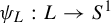



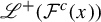


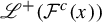
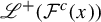




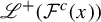
Before we proceed, recall that the atlas
 $\mathcal U$
of
 $\mathcal F = \mathcal F^c$
was taken to have specific properties detailed in the beginning of §4. Furthermore, in what follows, we assume that the disintegration of
 $\mu $
along
 $\mathcal F^c$
is not atomic, otherwise, we already fall in one of the possibilities claimed by the statement.
For each point
 $x\in M$
, consider
 $U_x \in \mathcal U$
and
 $V_x \subset U_x$
the closure of a neighborhood of x such that for every
 $y\in V_x$
, we have
 $B_{d_y}(y,\mathfrak r)\subset U$
.
Lemma 6.3. For
 $\mu $
-a.e.
 $x\in M$
and
 $\mu ^{U_x}_x$
-a.e.
 $y\in V_x\cap \mathcal F^c|U_x(x)$
, there is a limit center map
 $F \in \mathscr {L}^+(\mathcal F^c(x))$
such that
 $F(x)=y$
and
 $F_*\mu _x=\mu _y$
.
Proof. Recall that for every
 $x\in M_0$
(see (3)), the measure
 $\mu _x$
is defined on
 $B_{d_x}(x,\mathfrak r)$
by
 $$ \begin{align*}\mu_x(J) = \mu_x^U(J | B_{d_x}(x,\mathfrak r)) = \frac{\mu_x^U(J \cap B_{d_x}(x,\mathfrak r))}{\mu_x^U(B_{d_x}(x,\mathfrak r)) }, \quad J\subset B_{d_x}(x,\mathfrak r).\end{align*} $$
Abusing notation, we may define
 $x\in M_0 \mapsto \mu _x(J)$
for any Borel set
 $J\subset M$
by taking
 $\mu _x(J) := \mu _x(J\cap B_{d_x}(x,\mathfrak r))$
. By Corollary 4.5, the map
 $x \in M_0 \mapsto \mu _x$
is measurable in the sense that for any Borel subset
 $J \subset M$
, the map
 $x \in M_0 \mapsto \mu _x(J\cap B_{d_x}(x,\mathfrak r))$
is measurable.
Using Lusin’s theorem, we may take
 $\{K_i\}$
an increasing sequence of compact subsets of
 $M_0$
for which the map
 $x\mapsto \mu _x$
is continuous when restricted to each
 $K_i$
. Once again, we emphasize that, in this case, it means that for any Borel subset
 $J\subset M$
, the map
 $x \in K_i \mapsto \mu _x(J\cap B_{d_x}(x,\mathfrak r))$
is continuous. As
 $\mu $
is ergodic, for
 $\mu $
-a.e. point
 $x\in K_i$
, the orbit of x is dense in a full measurable subset of
 $K_i$
. Let
 $P_i=\mathcal N\cap K_i$
.
Let
 $x\in P_i$
and
 $y\in V_x \cap \mathcal {F}^c|U_x(x)\cap P_i$
. From Remark 6.2, we know that there exists
 $F\in \mathscr {L}^+(\mathcal {F}^c(x))$
such that
 $F(x)=y$
, and since F is a limit center map, there exists a sequence
 ${n_k}\subset \mathbb {Z}$
with
 $|n_k|\to \infty $
so that the sequence
 $f^{n_k}|_{\mathcal {F}^c(x)}$
converges pointwise to F.
By the continuity of
 $x \in P_i \mapsto \mu _x$
and since
 $y\in P_i$
,
 $$ \begin{align*} F_*\mu_x=\lim_{k\to \infty}f^{n_k}_*\mu_x=\lim_{k\to \infty}\mu_{f^{n_k}(x)}=\mu_{F(x)}=\mu_y. \end{align*} $$
By taking the limit set of
 $K_i$
, we conclude that for every point
 $x\in P$
, where
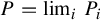 $P=\lim _i P_i$
, and
 $y\in V_x\cap \mathcal {F}^c|U_x(x)\cap P$
, there exists
 $F\in \mathscr {L}^+(\mathcal {F}^c(x))$
such that
 $F(x)=y$
and
 $F_*\mu _x=\mu _y$
as we wanted.
Let P be the full measure subset of points for which the previous lemma holds. For
 $x \in P$
, define
 $$ \begin{align*} & G^{U_x}_x {\kern-1pt}={\kern-1pt} \{y {\kern-1pt}\in{\kern-1pt} V_x {\kern-1pt}\cap{\kern-1pt} \mathcal F^c|U_x(x): \text{there exists } \; F \in \mathcal L^+(\mathcal F^c(x)) \text{ with } F(x) {\kern-1pt}={\kern-1pt} y \text{ and } F_*\mu_x = \mu_y \}. \end{align*} $$
By Lemma 6.3, we know that
 $[V_x \cap \mathcal F^c|U_x(x)] \setminus G_x^{U_x}$
has zero
 $\mu _x^{U_x}$
-measure.
Lemma 6.4. For
 $x\in P$
, the set
 $G^{U_x}_x$
is closed in
 $\mathcal F^c|U_x(x)$
.
Proof. Assume that
 $\mathcal F^c(x)$
is not compact. The argument is identical for the other case.
We know that
 $\mathcal L^+(\mathcal F^c(x))$
is a closed group as it is isomorphic to either group of translations (see Remark 6.2). Furthermore, for any
 $J\subset M$
Borel, the map
 $y \in B_{d_x}(x,\mathfrak r)\cap M_0 \mapsto \mu _y(J\cap B_{d_x}(y,\mathfrak r))$
is continuous by Corollary 4.4.
Let
 $y_n \in G^{U_x}_x$
with
 $y_n \to y \in V_x \cap \mathcal F^c|U(x)$
and consider
 $F_n \in \mathcal L^+(\mathcal F^c(x))$
be given by Lemma 6.3 satisfying
 $F_n(x) = y_n$
.
Observe that the sequence
 $\{F_n\}_n$
converges pointwise to a map
 $F\in \mathcal L^+(\mathcal F^c(x))$
with
 $F(x)=y$
. Indeed, by Remark 6.2, there are real numbers
 $t_n$
for which
 $$ \begin{align*}\psi_L^{-1}\circ T_{t_n}\circ \psi_L = F_n, \quad n\geq 1,\end{align*} $$
where
 $L=\mathcal F^c(x)$
. In particular,
 $$ \begin{align*}T_{t_n}(\psi_L(x)) = \psi_L(y_n).\end{align*} $$
Since
 $\psi _L(y_n)$
converges to
 $\psi _L(y)$
, because
 $\psi _L$
is a homeomorphism, it follows that
 $|\psi _L(x) -\psi _L(y_n)| \rightarrow |\psi _L(x) -\psi _L(y)|$
. Since
 $T_{t_n}$
are translations, we have
 $t_n = |\psi _L(x) -\psi _L(y_n)| \rightarrow |\psi _L(x) -\psi _L(y)|$
. Consequently, the sequence of translations
 $\{T_{t_n}\}$
converges to the translation
 $T_t:\mathbb R\to \mathbb R$
with
 $t = |\psi _L(x) -\psi _L(y)|$
. In particular,
 $F_n$
converges to
 $F:= \psi _L^{-1}\circ T_t\circ \psi _L$
.
Finally, by the continuity mentioned previously,
 $$ \begin{align*}F_*\mu_x = \lim_{n\rightarrow \infty}(F_n)_*\mu_x = \lim_{n\rightarrow \infty} \mu_{y_n} = \mu_y.\end{align*} $$
Thus,
 $y \in G^{U_x}_x$
, showing that
 $G^{U_x}_x$
is closed in
 $\mathcal F^c|U_x(s)$
as we wanted.
Lemma 6.5. For
 $\mu $
-a.e.
 $x\in P$
, the support of
 $\mu ^{U_x}_x$
cannot be a Cantor subset of
 $\mathcal F^c|U(x)$
.
Proof. Assume that for some
 $x\in P$
, the support of
 $\mu ^{U_x}_x$
is a Cantor subset of
 $\mathcal F^c|U(x)$
. As
 $V_x$
is compact, the intersection
 $V_x \cap \text {supp}(\mu ^{U_x}_x)$
is also a Cantor subset and is the support of the restriction
 $\mu ^{U_x}_x(\cdot | V_x \cap \mathcal F^c|U(x))$
.
As we have seen, for
 $\mu $
-a.e.
 $x\in P$
, the set
 $G^{U_x}_x$
is a full measure subset of
 $ V_x \cap \mathcal F^c|U(x))$
and is closed by Lemma 6.4; therefore, it must contain the support
 $V_x \cap \text {supp}(\mu ^{U_x}_x)$
which is a Cantor subset. Consider an ordering of
 $\mathcal F^c|U(x)$
and consider
 $a = \text {inf} (V_x \cap \text {supp}(\mu ^{U_x}_x))$
,
 $b=\text {sup} (V_x \cap \text {supp}(\mu ^{U_x}_x)),$
and
 $\gamma $
the center arc connecting a and b inside
 $\mathcal F^c|U(x)$
.
Let
 $\zeta : \gamma \to [0,1]$
given by
 $\zeta (a)=0$
,
 $\zeta (b) =1$
, be increasing and linear with respect to
 $d_x$
, that is,
 $\zeta (y) = d_x(a,y)/d_x(a,b)$
. The set
 $\zeta (\gamma ) \subset [0,1]$
is a Cantor subset, in particular, there exists a strictly increasing homeomorphism
 $H_0 : \zeta (\gamma ) \to \mathcal C_3$
with
 $H_0(0)=0$
,
 $H_0(1)=1$
, where
 $\mathcal C_3$
here denotes the standard ternary Cantor set in
 $[0,1]$
. Now, let us extend
 $H_0$
to a map of
 $[0,1]$
.
First, we fix some notation. Consider
 $I^0 = [0,1]$
,
 $I^1_1=(1/3,2/3)=(a^1_1,b^1_1)$
, and
 $I^m_k = (a^m_k,b^m_k)$
, with
 $1\leq k \leq 2^{m-1}$
the open intervals removed at the mth stage of the construction of the ternary Cantor set with
 $a^m_k < b^m_k < a^m_{k+1}$
for any
 $m\geq 2$
and
 $1\leq k \leq 2^{m-1}-1$
. Therefore,
 $$ \begin{align*} \mathcal C_3 = I_0 \setminus \bigg(\bigcup_{m=1}^{\infty} \bigcup_{k=1}^{2^{m-1}} I^m_k\bigg). \end{align*} $$
Let also
 $J^m_k := (H_0^{-1}(a^m_k), H_0^{-1}(b^m_k)) \subset [0,1]$
. Then,
 $\zeta (\gamma ) = I_0 \setminus ( \bigcup _{m=1}^{\infty } \bigcup _{k=1}^{2^{m-1}} J^m_k)$
. Consider
 $H:[0,1] \to [0,1]$
defined by:
-
• the restriction of H to each
$J^m_k$
is the linear map given by
$$ \begin{align*} H|J^m_k(y) = \bigg(1-\frac{y-H_0^{-1}(a^m_k)}{H_0^{-1}(b^m_k)-H_0^{-1}(a^m_k)}\bigg)\cdot a^m_k+ \frac{y-H_0^{-1}(a^m_k)}{H_0^{-1}(b^m_k)-H_0^{-1}(a^m_k)}\cdot b^m_k; \end{align*} $$
-
• the restriction of H to
$\zeta (\gamma )$
is
$H_0$
, that is,
$H|\zeta (\gamma ) = H_0$
.



Observe that H is continuous and strictly increasing; thus, it is a strictly increasing bijection and, consequently, a homeomorphism.
Consider now the homeomorphism
 $\widetilde {H} := H\circ \zeta : \gamma \to [0,1]$
and denote by
 $E_3$
the set of all points in
 $\mathcal C_3$
that are extremes of the removed intervals, that is,
 $E_3 = \{a^m_k, \; b^m_k : m\in \mathbb Z, \; 1\leq k \leq 2^{m-1} \}$
, or equivalently,
 $$ \begin{align*} E_3 = \bigg\{\frac{k}{3^m}, \frac{k+1}{3^m} : \; m \geq 1, \; 0< k <3^m,\; k \text{ not divisible by } 3 \bigg\}. \end{align*} $$
Now, consider
 $y\in \text {supp}(\mu ^{U_x}_x(\cdot | V_x))$
such that
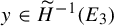 $y \in \widetilde {H}^{-1}(E_3)$
, that is, y is the preimage of an extreme of some open interval removed from the ternary Cantor set. Therefore, taking the pre-image by
 $\widetilde {H}$
of an open interval of
 $[0,1]\setminus \mathcal C_3$
having
 $\widetilde {H}(y)$
as one of its extremes, we obtain an open arc
 $\gamma _y \subset \mathcal F^c|U(x)$
with extreme in y and contained in the complement of
 $V_x \cap \text {supp}(\mu ^{U_x}_x)$
. In particular,
 $\gamma _y$
has zero
 $\mu _y$
-measure and y as one of its extremes. As
 $y\in G^{U_x}_x$
, there exists F such that
 $F(x)=y$
and
 $F_*\mu _x = \mu _y$
; therefore,
 $F^{-1}(\gamma _y)$
is an open arc with zero
 $\mu _x$
-measure and extreme in x, that is,
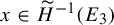 $x \in \widetilde {H}^{-1}(E_3)$
. Analogously, for any other
 $z\in G_x^{U_x}$
, there exists
 $F_{x,z} \in \mathcal L^+(\mathcal F^c(x))$
with
 $F_{x,z}(x) = z$
and
 $(F_{x,z})_*\mu _x = \mu _z$
, which, by the same reasoning, implies that
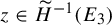 $z \in \widetilde {H}^{-1}(E_3)$
. Therefore,
 $G_x^{U_x} = \widetilde {H}^{-1}(E_3)$
, which is absurd since
 $E_3 \ne \mathcal C_3$
.
As
 $\mu (P)=1$
, then the previous lemma concludes that for
 $\mu $
-a.e.
 $x\in M$
, the conditional measure
 $\mu _x^{U_x}$
cannot be supported on a Cantor subset of the plaque, which concludes the proof of Theorem B.
Acknowledgements
We are grateful to Federico Rodriguez Hertz (Penn State University) for directing the second author, while on a visit to Penn State University, to an argument of Katok and Kalinin [Reference Katok and Kalinin10], which ultimately led to the proof of Theorem B. We also thank Prof. Ali Tahzibi for reading and providing suggestions on earlier versions of this paper. Finally, we would like to thank the referees for their careful reading and insightful comments, which greatly improved the clarity and presentation of the proofs. G.P. has received research support from FAPESP, grants # 2018/25624-0 and # 2022/07762-2, and a partial grant from project 88887.310561/2018-00 - CAPES-PRINT. R.V. also received research support from FAPESP (grants # 2016/22475-9, # 18/13481-0, # 17/06463-3, and # 24/15612-6) and Conselho Nacional de Desenvolvimento Científico e Tecnológico (CNPq) (grants 313947/2020-1 and 314978/2023-2). M.E. received a PhD fellowship from CAPES, Finance code 001. This study was also partially supported by the Coordenação de Aperfeiçoamento de Pessoal de Nível Superior - Brasil (CAPES) and CNPq, Finance Code 001.



