


Introduction
Epidemiological surveys internationally have repeatedly found a substantial proportion of people using mental health services in a specified period of time not to meet criteria for a diagnosis of a mental disorder during that period (Katz et al. Reference Katz, Kessler, Frank, Leaf and Lin1997; Alonso et al. Reference Alonso, Angermeyer, Bernert, Bruffaerts, Brugha, Bryson, de Girolamo, Graaf, Demyttenaere, Gasquet, Haro, Katz, Kessler, Kovess, Lepine, Ormel, Polidori, Russo, Vilagut, Almansa, Arbabzadeh-Bouchez, Autonell, Bernal, Buist-Bouwman, Codony, Domingo-Salvany, Ferrer, Joo, Martinez-Alonso, Matschinger, Mazzi, Morgan, Morosini, Palacin, Romera, Taub and Vollebergh2004; Kessler et al. Reference Kessler, Demler, Frank, Olfson, Pincus, Walters, Wang, Wells and Zaslavsky2005; Burgess et al. Reference Burgess, Pirkis, Slade, Johnston, Meadows and Gunn2009). These findings have been interpreted to imply that considerable overuse of services exists (e.g., Demyttenaere et al. Reference Demyttenaere, Bruffaerts, Posada-Villa, Gasquet, Kovess, Lepine, Angermeyer, Bernert, de Girolamo, Morosini, Polidori, Kikkawa, Kawakami, Ono, Takeshima, Uda, Karam, Fayyad, Karam, Mneimneh, Medina-Mora, Borges, Lara, de Graaf, Ormel, Gureje, Shen, Huang, Zhang, Alonso, Haro, Vilagut, Bromet, Gluzman, Webb, Kessler, Merikangas, Anthony, Von Korff, Wang, Brugha, Aguilar-Gaxiola, Lee, Heeringa, Pennell, Zaslavsky, Ustun and Chatterji2004) by ‘the worried well’ (Doessel et al. Reference Doessel, Williams and Whiteford2010), and as evidence to support redistribution of resources from people without an apparent diagnosed need to people with more severe conditions (Druss et al. Reference Druss, Wang, Sampson, Olfson, Pincus, Wells and Kessler2007). The term ‘met un-need’ has been used to define ‘treated non-prevalence’ or psychiatric treatment for individuals with no recognised disorders (Rosen, Reference Rosen, Thornicroft and Tansella1999; Andrews, Reference Andrews, Andrews and Henderson2000; Jorm, Reference Jorm2006).
Mental health services use during the past year by people without concurrent diagnosis was examined in the USA by Druss et al. (Reference Druss, Wang, Sampson, Olfson, Pincus, Wells and Kessler2007) using data from the National Comorbidity Survey Replication (NCS-R). These authors pointed out that if overuse of services is taken to imply use in the absence of need, then investigation of this problem requires a careful consideration of what is meant by ‘need’. ‘Need’ is a complex concept encompassing multiple constructs in addition to diagnosis, such as symptoms, disease burden, treatment effectiveness and consumer perceptions (Culyer & Wagstaff, Reference Culyer and Wagstaff1993; Regier, Reference Regier2003; Aoun et al. Reference Aoun, Pennebaker and Wood2004). Druss et al. (Reference Druss, Wang, Sampson, Olfson, Pincus, Wells and Kessler2007) found a dose–response relationship between the number of indicators of potential need (including 12-month or lifetime disorders and subthreshold symptoms) and service use. They concluded that low-need patients do not contribute importantly to formal mental health expenditure or divert significant professional resources away from patients with diagnosable disorders. Druss et al. highlighted the importance of maintenance and prevention treatment for people with subthreshold symptoms who may not meet diagnostic criteria for current disorders (Druss et al. Reference Druss, Wang, Sampson, Olfson, Pincus, Wells and Kessler2007).
Andrews (Reference Andrews, Andrews and Henderson2000) considers that epidemiological surveys typically overestimate ‘met un-need’ ‘for some may not currently meet criteria simply because of the good treatment they are now receiving’ (p. 12). He considers both ‘met need’ and ‘unmet need’ also typically to be over-estimated since some who meet diagnostic criteria for a disorder will not be significantly disabled or distressed so as to seek treatment, while many who see professionals will not be correctly diagnosed or will not receive appropriate treatment. Andrews (Reference Andrews, Andrews and Henderson2000) also characterises the decision to seek treatment as complex, driven by factors such as ease of access, severity, disability, and the perception that treatment will be effective. Andrews (Reference Andrews, Andrews and Henderson2000) also cautions that perceived need may be infinite, whether it is ‘the need of our patients for cure, relief and comfort, [or] of their therapists to provide these services’ (p. 12).
In Australia, these kinds of questions can be explored through analyses of the most recent National Survey of Mental Health and Wellbeing (NSMHW) 2007 (Australian Bureau of Statistics, 2009). One paper based on this survey has examined patterns of use including this area of treated non-prevalence (Harris et al. Reference Harris, Diminic, Burgess, Carstensen, Stewart, Pirkis and Whiteford2014) with findings convergent with earlier analyses of the Confidentialised Unit Record File (CURF) identifying 5% of the population received mental health care (MHC) in the past year without a 12-month mental disorder diagnosis(Burgess et al. Reference Burgess, Pirkis, Slade, Johnston, Meadows and Gunn2009). Inevitably the conduct of such work involves a series of value-based assumptions around what might constitute an identification of need for treatment.
The analytic work reported here, while conducted contemporaneously with this other work (Harris et al. Reference Harris, Diminic, Burgess, Carstensen, Stewart, Pirkis and Whiteford2014) was independent and took different decision pathways. There is no central coordination of work with the multiple CURFs released to researchers – while this can lead to duplication of effort it also permits corroboration and validation of findings through analyses that may take different routes to address similar questions. This previously unpublished work is now reported for this invited article. It could be important to assess whether work reported so far including this study from the NSMHW data set (Harris et al. Reference Harris, Diminic, Burgess, Carstensen, Stewart, Pirkis and Whiteford2014) is robust to analyses where different assumptions are used in selection and construction of key variables and categories. Writing this in 2017 we also can bring into the contextual frame significant national policy advances (National Mental Health Commission, 2014; Australian Government Department of Health, 2015) and in our understanding of regional variation in needs for MHC and mental health services provided in Australia (Meadows et al. Reference Meadows, Enticott, Inder, Russell and Gurr2015; Enticott et al. Reference Enticott, Meadows, Shawyer, Inder and Patten2016).
Despite significant improvements in service provision in Australia between 1997 and 2007 (Meadows & Bobevski, Reference Meadows and Bobevski2011), a large proportion of service users still perceive their needs for MHC as being unmet for interventions other than medication, from 20% for counselling to 70% for social intervention (Jorm, Reference Jorm2011; Meadows & Bobevski, Reference Meadows and Bobevski2011). While mental health services may be reasonably well aligned with need in the population overall (Druss et al. Reference Druss, Wang, Sampson, Olfson, Pincus, Wells and Kessler2007; Harris et al. Reference Harris, Diminic, Burgess, Carstensen, Stewart, Pirkis and Whiteford2014) and we started with this investigative proposition, any substantial subpopulation that could be characterised as having ‘met un-need’ would indicate there was opportunity for corrective diversion of limited resources towards people with demonstrable unmet need. Key recent policy documents in Australia identify disparities in urban–rural MHC delivery (National Mental Health Commission, 2014; Australian Government Department of Health, 2015) while more recent information from activity data and surveys would also bring greater attention to inequalities within urban areas (Meadows et al. Reference Meadows, Enticott, Inder, Russell and Gurr2015; Enticott et al. Reference Enticott, Meadows, Shawyer, Inder and Patten2016). The suggested policy directions include increased attention to stepped-care models, including diversion for people with lower severity problems to online resources; these then implicitly assume there is some reasonable scope for redirection of existing resources without compromise to desirable quality standards.
Aims
The present study used data from the Australian NSMHWB 2007 to examine whether people without a diagnosis of a mental disorder who used mental health services had other need-indicators explaining their service use. The study further examined whether the rate and frequency of service use was related to level of need. It was expected that most service users in Australia without a 12-month diagnosis would have other indicators of need, and that higher rate and frequency of service use would be related to higher levels of need.
Methods
Sample
The NSMHWB 2007 was conducted by the Australian Bureau of Statistics on a staged clustered probability sample of the Australian population. The survey included 8841 people aged 16–85 years from all states and territories, with a 60% response rate. A follow up of non-responders led to subsequent adjustment of survey weights to reduce response bias (Australian Bureau of Statistics, 2009). The survey and data-weighting has been described in detail elsewhere (Australian Bureau of Statistics, 2009; Slade et al. Reference Slade, Johnston, Oakley-Browne, Andrews and Whiteford2009).
Measures
Diagnostic assessment of mental disorders
Diagnostic assessment for a range of mental disorders (e.g., generalised anxiety disorder, major and minor depressive episodes and disorders recurrent brief depression, substance dependence) was made by trained lay interviewers with the Composite International Diagnostic Interview (CIDI) Version 3.0 (Kessler & Üstun, Reference Kessler and Üstun2004). The CIDI 3.0 contains a series of diagnostic screening questions for each disorder. If respondents answer positively to screening items for any disorders the full diagnostic interview is administered for those disorders.
Assessment of psychotic symptoms
Presence of psychotic symptoms was assessed with four screening stem questions (Australian Bureau of Statistics, 2009) asking respondents whether they ever felt their thoughts were being directly interfered with or controlled by another person; that people were too interested in them; or they had special powers that most people lack. Branch questions explored 12-month recency and whether a doctor had ever told them that they may have schizophrenia.
Measures of psychological distress and disability
Psychological distress over the last 30 days was measured with the Kessler 10 (K-10) scale (Andrews & Slade, Reference Andrews and Slade2001; Kessler et al. Reference Kessler, Andrews, Colpe, Hiripi, Mroczek, Normand, Walters and Zaslavsky2002). The recommended cut-offs for levels of distress were used: low (10–15); moderate (16–21); and high to very high (22–50). Disability in the last 30 days was measured with the 12-item version of the World Health Organisation Disability Assessment Schedule II (WHODAS) (Buist-Bouwman et al. Reference Buist-Bouwman, Ormel, De Graaf, Vilagut, Alonso, Van Sonderen and Vollebergh2008). Respondents who scored more than zero on the WHODAS were defined as having at least some disability.
Measures of service use
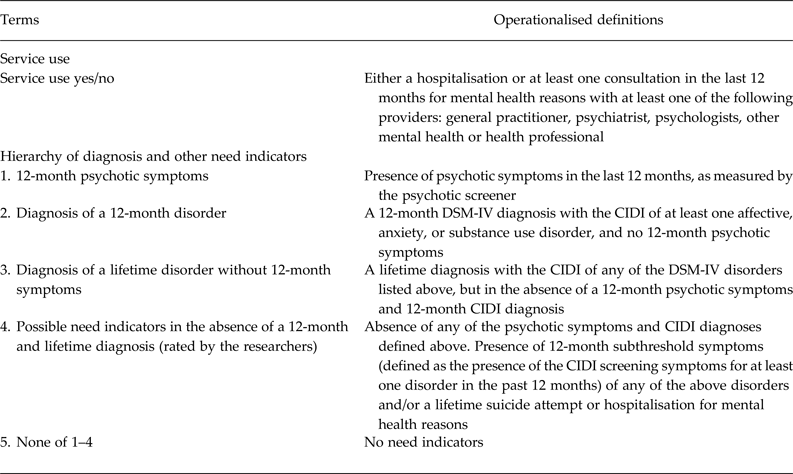
Participants were asked whether they had consulted a range of providers (e.g., general practitioners (GPs), psychiatrists, psychologists) in the past year for mental health reasons and about the number of consultations that they had with each provider in the past year. CURF data items on numbers of consultations with specific providers represented limited categorisations not directly comparable across providers. Questions about hospitalisation for mental health problems in the past year were also included. The definition of service use for this work is given in Table 1.
Operationalised definitions of need, diagnosis, and service use

Creation of need categories
The CIDI diagnoses and several indicators of possible need for mental health treatment were used to divide the sample into five mutually exclusive and hierarchical need categories (Table 1) where 1 is highest-rank and 5 lowest-rank. For each case the highest rank applicable is scored as the data item. These categorisations are similar to those used by Druss et al. (Reference Druss, Wang, Sampson, Olfson, Pincus, Wells and Kessler2007), but adapted to suit the data from the NSMHWB 2007 with different judgements being made regarding group assignment from those in other Australian work (Harris et al. Reference Harris, Diminic, Burgess, Carstensen, Stewart, Pirkis and Whiteford2014).
Although the psychosis screener used in the survey has not been formally validated, we conducted exploratory analyses which showed that the group identified by this instrument as having 12-month psychotic symptoms was characterised by higher disability, more intensive service use, and more hospitalisations compared to all the other groups. So we examined this group as a separate category and placed it at the top of the need hierarchy (Table 1).
Analysis
To investigate the pattern of service use by people in each of the five need categories, percentages with 95% confidence intervals were calculated. To investigate whether people with less evident need had lower rates and frequencies of service use, percentage differences between the five need categories were tested with two-proportions z-tests at the alpha < 0.05 level of significance.
Logistic regressions were carried out to further explore predictors of any MHC, whether provided in primary-care or other care sectors in people with only lifetime disorders, and in people with no 12-month or lifetime disorders. Mental health service use was entered as the dependent variable for both analyses. For the group with lifetime disorders, the number of DSM-IV lifetime disorders, the presence of lifetime Bipolar Disorder, recency of symptoms, lifetime hospitalisation or suicide attempt, and scores on the K-10 and the WHODAS were entered as the independent variables. Lifetime Bipolar Disorder was separated from other disorders because it is usually long-term with a high risk of relapse and a high rate of suicidal mortality (Treuer & Tohen, Reference Treuer and Tohen2010). For the group without disorders, the presence of 12-month subthreshold symptoms and/or lifetime suicide or hospitalisation, score on the K-10, and scores on the WHODAS were entered as the independent variables. Based on the results of the logistic regressions service users were divided into low, medium, and high levels of need. Two-proportions z-tests were used to test whether people with lower levels of need had lower rates of service use at the alpha < 0.05 level of significance. Data was analysed using Stata 9.0 Intercooled (StataCorp LP, Reference StataCorp2007). All data was weighted, using survey weights provided by the Australian Bureau of Statistics. The jackknife replication method for variance estimation (Australian Bureau of Statistics, 2009) was used in all analyses.
Results
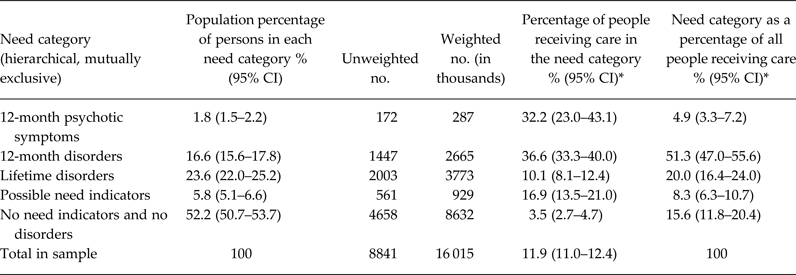
Table 2 indicates that of the five need categories, the highest proportion of people receiving any MHC (including primary and secondary care contexts) were those with psychosis indicators (32.2%) and those with diagnosed mental disorders in the last 12 months (36.6%). People with possible need indicators (16.9%) or lifetime disorders (10.1%) were significantly less likely to receive any care. By contrast, only 3.5% of people with no need indicators and no disorders used received any MHC, significantly less than any of the other groups. People with 12-month disorders constituted about half (51.3%) of all people receiving any MHC, followed by people with lifetime disorders (20.0%), people with no need indicators and no disorders (15.6%), people with possible need indicators (8.3) and finally people with 12-month psychotic symptoms (4.9%).
Service use in the last 12 months by need category

* Includes people accessing care in primary and/or secondary care settings.
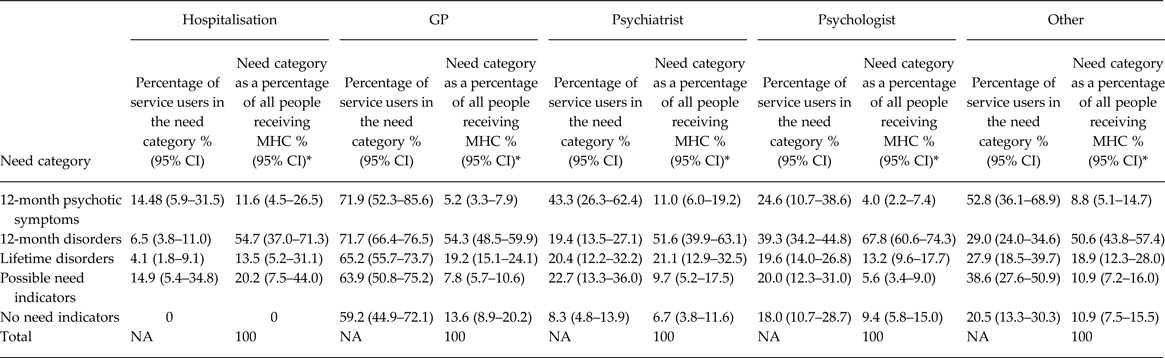
The pattern of consultations with different mental health providers among people receiving any MHC is presented in Table 3. Only 8.3% of people with no disorders and no need indicators received MHC from psychiatrists, significantly less than the other groups (19.4–43.3%). People with 12-month disorders were significantly more likely to report consultations with psychologists (39.3%) compared with any of the other categories (18–24.7%).
Hospitalisations and mental health consultations with different providers by need category

* Includes people accessing care in primary and/or secondary care settings.
NA, not applicable.
Two-proportions z-tests revealed that people with no disorders (both with and without possible need indicators) were significantly more likely to have only single consultations (31.8 and 33.0% respectively) compared with people with 12-month disorders (17.8%). People with no disorders and no possible need indicators were also significantly more likely to have less than six consultations (86%), compared with 27.0–59.8% for the other groups. When differences in consultation frequencies were tested between the five need categories for each provider group (GPs, psychiatrists and psychologists), people with no disorders tended to report significantly fewer mental health consultations for each provider group than people with 12-month or lifetime disorders.
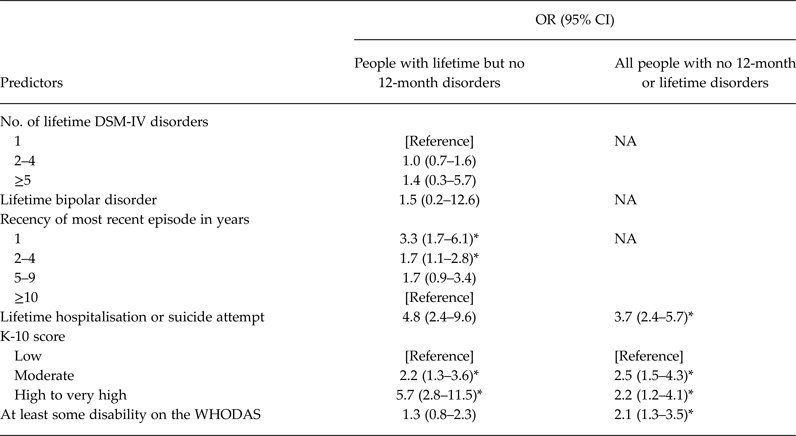
The results of the logistic regressions assessing the distribution of service use among people with lifetime disorders and people with no 12-month or lifetime disorders are presented in Table 4. For people with lifetime disorders, significant predictors of service use were more recent occurrence of a disorder, a lifetime hospitalisation or suicide attempt, and higher scores on the K-10. For the group with no 12-month or lifetime disorders, significant predictors of service use were the presence of 12-month subthreshold symptoms, lifetime hospitalisation or suicide attempt, higher K-10 scores and at least some disability on the WHODAS.
Two logistic regressions to predict service use for two groups of people without 12-month disorders

* Significant at p < 0.05.
NA, not applicable.
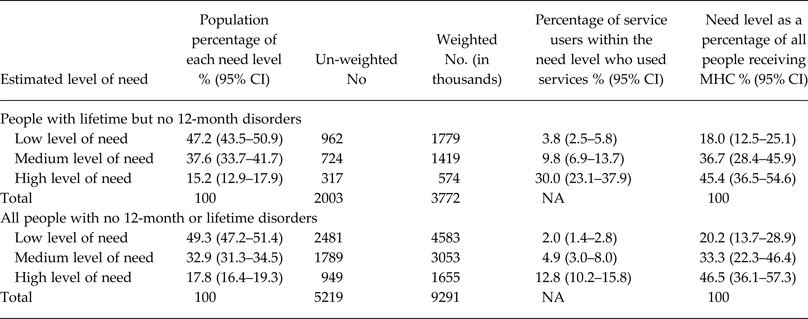
Table 5 shows that when people with only lifetime disorders or no 12-month or lifetime disorders were classified into low, medium or high levels of need, patterns of service use were related to level of need in a monotonic form in respect of both service use rates and proportion of service users.
Service use among people with no 12-month disorders by level of need

NA, not applicable.
Discussion
Key findings
In this Australian survey, while 43% of all people receiving MHC from any service sector were people without CIDI diagnosed 12-month mental disorders, most of these people (84%) had either lifetime disorders or other indicators for MHC. People without a diagnosis and without any apparent need indicators had the lowest rate of any MHC (4%); as typically low-frequency users they overall had substantially less resource use than other groups.
Comparison with other Australian work
Assumptions made here differed from those in previous work (Harris et al. Reference Harris, Diminic, Burgess, Carstensen, Stewart, Pirkis and Whiteford2014). Firstly we included persons aged 16–85 in analyses and secondly we made use of the psychosis screener to define one need category. People positive for this screen had high service-use so it seems likely that the screener is in fact capturing substantial numbers of people with psychotic or other relatively severe problems. Findings regarding this group, important clinically and for service planning, often are in effect ignored in work from these surveys describing service use (Burgess et al. Reference Burgess, Pirkis, Slade, Johnston, Meadows and Gunn2009; Harris et al. Reference Harris, Diminic, Burgess, Carstensen, Stewart, Pirkis and Whiteford2014). In relation to high-prevalence disorder symptoms captured through the CIDI, our threshold was set somewhat higher, requiring matching positive responses to all screening questions in a disorder set, rather than any of these, so setting inclusion criteria closer to diagnostic thresholds. We also included lifetime history of suicide attempt as a need indicator and made use of the WHODAS. In considering then whether the key conclusions of the earlier examination are robust to the application of a different set of underlying assumptions, we would note that overall our estimate of the proportion of services users with no indicator was slightly higher than in the 2014 published study (15.6 cf. 13.6%) but with overlapping confidence intervals.
Maintenance MHC of lifetime disorders
Service users with a history of psychiatric disorders, but no current symptoms may receive effective maintenance treatment to remain well with much of this work happening in primary-care (Geddes et al. Reference Geddes, Carney, Davies, Furukawa, Kupfer, Frank and Goodwin2003, Reference Geddes, Burgess, Hawton, Jamison and Goodwin2004; Pilling et al. Reference Pilling, Anderson, Goldberg, Meader and Taylor2009). Here, 10% of people with lifetime disorders but no current symptoms used services in the past year, making up the second largest group of service users after people with 12-month disorders, but with a somewhat lower number of consultations. In this group, service use was significantly predicted by the recency of symptoms, lifetime hospitalisation or suicide attempt, and higher levels of psychological distress in the last 30 days. A progressive relationship found between the proportions of people with lifetime disorders receiving treatment and their estimated level of need (low, medium or high), suggests an underlying rationality in resource distribution.
Treatment of subthreshold cases
People with possible need indicators (or subthreshold symptoms) had a lower overall rate of mental health related service use (17%) compared with the people with 12-month disorders (37%), as well as a lower overall number of consultations. Significant predictors of treatment for people without diagnosed disorders were lifetime hospitalisation or suicide attempt, elevated levels of psychological distress and high levels of disability.
While Narrow et al. (Reference Narrow, Rae, Robins and Regier2002) calculated reduced prevalence estimates of mental disorders in the US, based on the argument that treatment should be focused on severe diagnosed disorders (Regier et al. Reference Regier, Kaelber, Rae, Farmer, Knauper, Kessler and Norquist1998), others have suggested that a more nuanced approach is needed to effectively differentiate between diagnosed prevalence and the need for treatment (e.g., Wakefield, Reference Wakefield2001; Mechanic, Reference Mechanic2003; Kessler et al. Reference Kessler, Demler, Frank, Olfson, Pincus, Walters, Wang, Wells and Zaslavsky2005; Harris et al. Reference Harris, Diminic, Burgess, Carstensen, Stewart, Pirkis and Whiteford2014). Subthreshold symptoms have been associated with increased disability days and lowered quality of life (Rai et al. Reference Rai, Skapinakis, Wiles and Araya2010), more severe outcomes 12 months later (Kessler et al. Reference Kessler, Merikangas, Berglund, Eaton, Koretz and Walters2003), and new-onset functional disability and days lost from work at an 18-months follow-up (Goldney et al. Reference Goldney, Fisher, Dal Grande and Taylor2004). Thus, treatment of some ‘mild’ cases particularly in context of implicit or explicit application of primary-care based stepped-care models might prevent a substantial proportion of future severe cases and reduce future service use costs (Kessler et al. Reference Kessler, Merikangas, Berglund, Eaton, Koretz and Walters2003).
‘Met un-need’ or ‘the worried well’
People with no need indicators, an appreciable proportion of total service users, had the lowest rate of service use and those users had the smallest average number of mental health consultations. Thirty-three per cent had only one consultation, perhaps without a finding of diagnosis or need for follow-up. This group also had a much lower rate of consulting psychiatrists compared with other groups, constituting 7% of all people in the Australian population who consulted a psychiatrist. High psychological distress and disability scores were predictive of service use among this group. Findings from the previous Australian NSMHWB in 1997 (Korten & Henderson, Reference Korten and Henderson2000) similarly indicated that sub-syndromal levels of distress identified by continuous disability scales may be common and associated with significant impairment of functioning, independent of the presence of a CIDI diagnosis.
The results of the present study are suggestive of less specialist mental health treatment for mental disorders for this group and more primary-care, including seeking counselling, perhaps for dealing with life stressors. Service use in terms of volume and intensity is low for the group without apparent needs, it is likely to be associated with relatively low cost so resources that could be freed from this group and reassigned to any other needy group is likely to be very small. A small proportion of such false positive rates of treatment are considered necessary for many medical interventions, and similarly may be an acceptable, and even a desirable, outcome in mental health treatment (Druss et al. Reference Druss, Wang, Sampson, Olfson, Pincus, Wells and Kessler2007).
Limitations
Misclassification issues arise for all of the instrumentation and generally will act to reduce the strength of associations detected. Mental disorders such as eating disorders and personality disorders were not here surveyed. While the psychosis screener was not a fully valid measure of psychotic disorders, it was associated with the highest level of disability and service use among categories used here. Service use data was by self-report and potentially less reliable than observational data. Instruments time scales varied and it is not possible to match timing of symptoms with service-use. Service-use patterns in Australia might have changed since 2007 due to expansion of the government's Better Access initiative which has increased access to MHC (Harrison et al. Reference Harrison, Britt and Charles2012) although not equitably so (Meadows et al. Reference Meadows, Enticott, Inder, Russell and Gurr2015).
In Australia we know that rates of mental health problems vary substantially with socioeconomic status of area of residence and that private sector activity varies in a way quite startlingly at odds with the distribution of such need. Considering quintiles of disadvantage/advantage spectrum, very high levels of psychological distress are around three times higher in most disadvantaged quintiles while rates of government subsidised private sector use for critical items of service are around three times higher in the most advantaged areas (Meadows et al. Reference Meadows, Enticott, Inder, Russell and Gurr2015; Enticott et al. Reference Enticott, Meadows, Shawyer, Inder and Patten2016). So there could be local variation in this observed situation that the NSMHW was unable to identify.
This survey-based work could usefully be complemented with in-depth investigation of administrative databases. Unfortunately in Australia these sources are not readily accessible for detailed analysis and previous published work in this area has involved data sets accessed through Freedom of Information legislation (Meadows et al. Reference Meadows, Enticott, Inder, Russell and Gurr2015). In some other countries, for instance Canada, administrative data sets are more readily accessible permitting in-depth longitudinal studies (see for instance Cailhol et al. Reference Cailhol, Pelletier, Rochette, Laporte, David, Villeneuve, Paris and Lesage2017). The public interest in Australia would be better served if data were more openly available following the Canadian example.
Key policy considerations
Stepped care models, as indicated by existing policy (National Mental Health Commission, 2014; Australian Government Department of Health, 2015), rest on the assumption that some diversion of people currently using face-to-face primary-care to web-based resources or telephone-based support can be achieved without significant loss of quality of care. We suggest these results indicate that these models will need sophisticated design and implementation if they are not going to result in diversion of resources away from people with significant needs for care.
Primary-care has potential through life-long engagement to play a critical role in brokering processes whereby people step-up and down as indicated; promoting continuity of primary care including primary MHC should be an important governmental priority.
Stepped care models that commence from face-to-face contact with a GP are working with a person who has physically sought care, although these already have substantial barriers experienced when the stigmatising option of specialist referral may be introduced. It will be important, as stepped care models are rolled out broadly, to ensure that the care interfaces between web and telephone based supports and face-to-face contact when this is needed, are in alignment with sound clinical standards and concern for equity of access and safety. Based on existing inequity in use of specialist MHC in Australia, and without any systemic change to the funding models that permit this, there is a risk that affluent areas may continue to have higher volumes of face-to-face contact service provision, while in poorer areas, people with equivalent problems will be offered web-based or telephone intervention. This may or may not be of equivalent effectiveness for them and evaluation of this will be important if Australian MHC is to move towards rather than away from equitable provision.
Conclusions
Most people without evidence of a 12-month diagnosis using mental health services have other indicators of need for care. While there is a shortfall of care provision for many of those people for whom care is needed, there does not appear to be large pool of people consuming care so as to hinder access of individuals who are more needy. In many cases the pattern would be compatible with desirable practices of continued follow up, often in primary-care, of people with significant and well established vulnerabilities. Any future NSMHW might usefully be constructed with design parameters including ability to estimate disorder rates in specific population subgroups such as those living in more socioeconomically deprived areas. ‘Met un-need’ may be occurring in specific geographic areas but for the purpose of development of stepped-care models as mandated by government, this cannot be generally assumed.
Acknowledgements
The NSMHW 2007 was funded by the Commonwealth Government and conducted by the Australian Bureau of Statistics. We express appreciation to all participants. Ms Kimberly Buck provided technical editorial input to an earlier draft.
Financial support
This research received no specific grant from any funding agency, commercial or not-for-profit sectors.
Conflicts of interest
None.
Ethical standards
The work was carried out on the Confidentialised Unit Record File derived from the survey as conducted by the Australian Bureau of Statistics and within the terms of the agreement for CURF access between Monash University and the Bureau. No additional data was collected. The authors assert that all procedures contributing to this work comply with the ethical standards of the relevant national and institutional committees on human experimentation and with the Helsinki Declaration of 1975, as revised in 2008.
Availability of data and materials
The CURF is available by application to the Australian Bureau of Statistics – the authors can be contacted regarding details of analytic process.
Authors’ contributions
IB contributed to design, analysis, and writing. AR contributed to concepts and writing. GM contributed to conception, design, and writing.



Target article
Mental health service use and need for care of Australians without diagnoses of mental disorders: findings from a large epidemiological survey
Related commentaries (2)
Populational and individual perspective on needs
‘Unmet need’ and ‘met un-need’ in mental health services: artefacts of a categorical view of mental health problems