


6.1 Language Input, Intake, and Exposure in Monolingual and Bilingual Children
In this chapter, we explore the relationship between language input and cognitive control, particularly in children with reduced language input. Reduced input in one particular language may occur because of a lack of environmental input or exposure to multiple languages. Even though the literature on the relationship between language input and children’s cognitive-linguistic development is flourishing, there is no agreement among scholars about the most critical components of this relationship, particularly in bilingual children. Recent debates on language input reveal contradictory views about the nature of language learning and the mechanisms that enable children to process information from the environment (Carroll, Reference Carroll2017).
Usage-based theoretical models emphasize the importance of both quantity and quality of language input on children’s development. Recent findings suggest that in their early years, bilingual toddlers’ language skills are highly influenced by the amount of language input, while during the preschool years, the quality of input becomes more relevant (Anderson et al., Reference Anderson, Graham, Prime, Jenkins and Madigan2021; Surrain et al., Reference Surrain, Rowe and Luk2021). Attuned dyadic behaviors, including the parent’s supportive guidance and the child’s active engagement were linked to children’s expressive and receptive language skills, as well as to their verbal reasoning skills (Jokihaka et al., Reference Jokihaka, Laasonen, Lahti-Nuuttila, Smolander, Kunnari, Arkkila and Heinonen2022). Other studies measured quality by the diversity and complexity of the linguistic features in the parents’ speech (Anderson et al., Reference Anderson, Graham, Prime, Jenkins and Madigan2021). Moreover, in a study on Russian gender acquisition in a Turkish-Russian bilingual child, findings revealed that despite a reduced amount of input, the acquisition of form-related gender was achieved at a high level, indicating the critical role of quality over quantity in language input (Antonova Ünlü & Wei, Reference Antonova Ünlü and Wei2018).
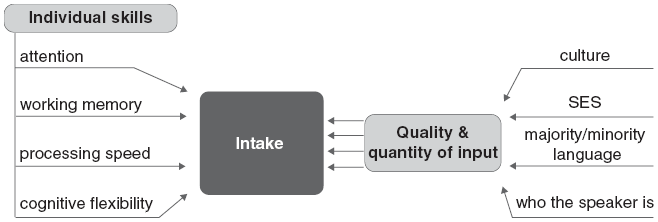
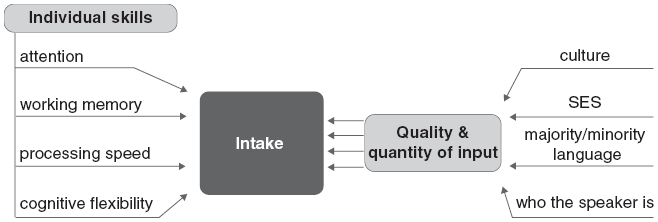
It is important to note, however, that the effect of language input on children’s language skills cannot be understood without studying the child’s intake from that input (Badger, Reference Badger2018). It is the intake that signals the amount of information that the listener derives from the language environment (Wong, Reference Wong2001). This process, however, depends on a number of factors (see Figure 6.1). There has been a debate over the years about the specific functions that are needed for a child to derive relevant information from the input. An earlier view, the “Noticing hypothesis,” suggested that it is the person’s awareness that is needed for input to become intake. Thus, the difference between input and intake was associated with consciousness (Schmidt, Reference Schmidt1993, Reference Schmidt and Robinson2001). More recent studies suggest the contribution of multiple components to intake, including the child’s perceptual skills, attention, and language knowledge (Rowe, Reference Rowe2015). Further, intake will also depend on the nature of the input, such as the frequency of certain linguistic elements in a given language and the discriminability of the items (Wijnen, Reference Wijnen, Beers, van de Bogaerde, Bol, de Jong and Rooijmans2000).
Individual and global components influencing language intake
As children mature, there is an expansion in their language knowledge and an increase in the number of opportunities to practice their language skills that lead to variations in intake (De Houwer, Reference De Houwer2017). Children with more advanced intake produce higher-level output, which, in turn, leads to improved input. For example, mothers talked more and used more diverse and complex language with their older children than with the younger ones (De Houwer, Reference De Houwer, Grüter and Paradis2014). These child-to-parent effects were also evidenced in a large-scale twin study (Dale et al., Reference Dale, Tosto, Hayiou-Thomas and Plomin2015), as well as in research with children who exhibited a language delay. Although parents of children with a language delay provided as much input as the parents of typically developing children, the quality of their input showed differences. Parents of children with language delays adjusted their conversational style to what they perceived as the child’s language abilities and took fewer conversational turns than the parents of typically developing children (Vigil et al., Reference Vigil, Hodges and Klee2005).
In addition to quantity and quality, a further aspect of language input is the length of exposure. Although the terms “input” and “exposure” are often used interchangeably in the literature, in certain disciplines, these two terms are used with slightly different meanings. For example, in the bilingualism literature, the terms “quality” and “quantity” typically refer to the current input, while the term “exposure” is used when the child receives particular language experiences over time. As children age, they participate in different communicative acts across linguistic environments, and receive different quantity and quality of language input from the other speakers. Given the variability of all of these factors, there is a need for integrating the different language input elements when examining children’s language experiences. This task, however, is further complicated by the large variety of methods used across studies. Many scholars used surveys to assess parental language input, such as the Multilingual Infant Language Questionnaire (Liu & Krager, Reference Liu and Kager2017); the Parents of Bilingual Children Questionnaire (Tuller, Reference Tuller, Armon-Lotem, de Jong and Meir2015); and the Maternal Mental State Input Inventory (Peterson & Slaughter, Reference Peterson and Slaughter2003), among others.
To provide a more integrated view of parental input, Ågren and colleagues (Reference Ågren, Granfeldt and Thomas2014) developed a language profile measure with French-Swedish bilingual children by using a combination of input components. The input variables for French included the parents’ language proficiency, proportion of French spoken at home, number of weeks per year spent in French-speaking countries, contact with other native speakers of French, access to French TV and computer games, and reading habits in the target language. Each component was graded on a 3-point scale. This method allowed the authors to analyze input from both qualitative and quantitative perspectives, as well as to develop an index to distinguish among groups of children (e.g., children with bilingual native language and early successive bilingual children).
The currently used, most objective measure of input is the LENA “talk pedometer” system. It includes a small device that children carry with them all day long to record the speech they hear and that which they produce. At the end of the day, the audio files are sent to a cloud-based processing system that uses algorithms that are trained to differentiate the adult input from the child’s output and from other noises, such as TV (www.lena.org). A meta-analysis of studies using LENA technology (Wang et al., Reference Wang, Hartman, Aziz, Arora, Shi and Tunison2017) revealed that the system can be used efficiently in families speaking various languages (e.g., English, French, Korean). An important finding across studies was that the number of conversational turns between the parent and the child is at least as predictive of the child’s language development as is the number of words spoken by the adult. This result highlights the significance of the child’s active participation in communicative acts with the parents. The more engaged the child, the more involved and responsive the parent. The outcomes across studies also revealed that parents of children with communication disorders greatly benefited from parent-focused intervention in association with the use of the system. Professional guidance and parental-group support resulted in decreased parental stress; increased well-being and communication competence; and more efficient strategy use (Moseley Harris, Reference Moseley Harris2021; Rutherford et al., Reference Rutherford, Singh-Roy, Rush, McCartney, O’Hare and Forsyth2019).
Taken together, the relationship between input and intake is dynamic in nature, and shows individual variations in speakers. Input should always be considered with regard to intake and vice versa. The more we understand about children’s cognitive functions and learning mechanisms, the better we comprehend their interactions with the quality of language input. A deeper understanding of these effects may contribute to more efficient communication between caregivers and their children.
A major challenge for child language development theorists, however, is to explain children’s productions of structures for which there is no environmental input (Lieven, Reference Lieven2014; Tomasello, Reference Tomasello2003). These questions are often explained with productivity and abstraction. Behavioral and neurophysiological methods have been applied to examine the cues that children use as they process particular structures, including the preferential looking paradigm, electrophysiological measures, and eye-tracking studies (e.g., Stone & Bosworth, Reference Stone and Bosworth2019; Waldman DeLuca et al., Reference Waldman DeLuca, Schwartz, Marton, Houston, Ying, Steinman and Drakopoulou2023). Detailed error analysis data may provide another useful source to answer these questions. Children’s errors may reflect their level of abstraction and their creative use of language. It is important to note, however, that even after careful consideration of all the influential linguistic factors, including the language environment, there are individual differences that indicate the role of domain-general cognitive contributors in the relationship between language input and development.
6.2 The Relationship between Language Input and Cognitive Control
Both the quantity and quality of language input interact with a number of cognitive control functions. One of the most widely studied components is working memory. Studies on language processing and working memory provide multiple conceptual frameworks to explain the relationship between language input and processing capacity. Although many scholars approached the relationship between working memory and language by studying the working memory skills of children with different language abilities (typically developing monolingual children, children with language impairment, etc.), it is important to note that the relationship between language and working memory is bidirectional. Relevant to our topic are the connectivist-based efficiency accounts with the suggestion that processing capacity is related to both the linguistic features of the language input (experience) and individual characteristics (architecture) of the speaker (MacDonald & Christiansen, Reference MacDonald and Christiansen2002). Working memory performance is affected by the linguistic complexity of the input (word frequency, morphological and syntactic complexity, etc.), as well as by the child’s language skills (Mainela-Arnold & Evans, Reference Mainela-Arnold and Evans2005; Marton et al., Reference Marton, Schwartz, Farkas and Katsnelson2006). This interaction between architecture and experience is reflected in individual differences within groups.
There is consensus in the literature that during language development, children need to process complex language inputs that require a strong and efficient information processing system to store and evaluate the incoming information (Gathercole & Baddeley, Reference Gathercole and Baddeley1993). Processing verbal input in working memory is critical in order to develop long-term representations of words and linguistic structures. It allows the learner to analyze and to determine the structural properties of the language input. Its capacity is determined by the amount of information that can be kept active in the face of interference. Verbal working memory has been linked to vocabulary acquisition in both first and second language learners (Gathercole, Reference Gathercole2006; Martin & Ellis, Reference Martin and Ellis2012); to language comprehension (Just & Carpenter, Reference Just and Carpenter1992); syntactic processing (King & Just, Reference King and Just1991); and to reading comprehension (Daneman & Carpenter, Reference Daneman and Carpenter1980; Gathercole & Baddeley, Reference Gathercole and Baddeley1993; McVay & Kane, Reference McVay and Kane2012b).
Working memory is also viewed as a system that operates in strong interaction with attentional control (Meier & Kane, Reference Meier, Kane and Egner2017). Outcomes from structural modeling have revealed that the relationship between working memory capacity and higher-level cognition is mediated by attentional control, including the discriminating selection of specific processes for engagement (Unsworth et al., Reference Unsworth, Fukuda, Awh and Vogel2014). Studies describing the relationship between working memory and attentional control have shown that individuals with high working memory spans exhibit better abilities in attention control; they are able to maintain information more efficiently and retrieve it more quickly than others with lower working memory spans (Unsworth & Engle, Reference Unsworth and Engle2006). Thus, children with better attention and working memory skills process language input more efficiently and resist interference with greater success.
Cross-language interference has been studied extensively in the bilingualism and second language acquisition literatures (Hsin et al., Reference Hsin, Legendre and Omaki2013; Kaushanskaya & Marian, Reference Kaushanskaya and Marian2007; Prior et al., Reference Prior, Degani, Awawdy, Yassin and Korem2017). However, only a few studies looked at the relationship between language input and interference control for irrelevant lexical items; for competing sentence interpretations (e.g., in sentences with syntactic ambiguity); or for simultaneously active languages. Ye and Zhou (Reference Ye and Zhou2009) examined the different brain areas that were activated in response to potent but irrelevant items compared to competing stimuli. While the ventral lateral prefrontal cortex, particularly the Broca’s area, controlled interference from irrelevant information, the parietal cortex signaled the lateral prefrontal cortex when there was a conflict between competing representations in response to multiple inputs. These are important findings because conflict resolution and interference control are often discussed in the behavioral literature as similar or interchangeable processes. The neurophysiological outcomes reveal a difference between these processes, and they show how interference control relies on a dual-network system, which supports distinct adaptive control and more stable functions (e.g., to ensure set-maintenance; Dosenbach et al., Reference Dosenbach, Fair, Miezin, Cohen, Wenger, Dosenbach and Petersen2007). These findings have significant implications for children processing multiple language inputs.
6.3 Delayed or Reduced Language Input and Cognitive Control
6.3.1 Cognitive Control in Children from Families with Low Socioeconomic Status
Socioeconomic status (SES) has been linked to children’s cognitive, language, and academic performance, as well as to their brain functions (Farah et al., Reference Farah, Shera, Savage, Betancourt, Giannetta, Brodsky, Malmud and Hurt2006; Merz et al., Reference Merz, Wiltshire and Noble2019; Sheridan et al., Reference Sheridan, Peverill, Finn and McLaughlin2017). In a large-scale study examining brain structures associated with disparities in parental education and family income, the regions of language development, cognitive control, and memory were identified as the most critical areas in the brain (Noble et al., Reference Noble, Houston, Brito, Bartsch, Kan, Kuperman, Akshoomoff, Amaral, Bloss, Libiger, Schork, Murray, Casey, Chang, Ernst, Frazier, Gruen, Kennedy, Van Zijl and Sowell2015). Similar findings were reported by Farah and colleagues (Reference Farah, Shera, Savage, Betancourt, Giannetta, Brodsky, Malmud and Hurt2006), who assessed seven different neurocognitive systems by administering multiple cognitive control (i.e., inhibition, resistance to interference, and monitoring), language ability (i.e., phonological awareness, vocabulary, and syntactic knowledge), and nonexecutive tasks. SES did not affect all cognitive skills across the board, but did impact children’s language skills, cognitive control, and memory functions. It did not influence the outcomes on reward processing or visual cognition, such as face perception and shape detection. Thus, when studying different cognitive functions, researchers need to be aware that SES may highly influence the outcomes on cognitive control and various memory functions.
Children in families with low SES typically receive decreased quantity and quality of language input compared to children from mid- and high-SES families (Schwab & Lew-Williams, Reference Schwab and Lew‐Williams2016). Even though low- and mid-SES mothers showed the same number of social goals in play situations with their infants, they differed in their language goals. Mid-SES mothers incorporated more language goals into their play activities than low-SES parents. The lexical and grammatical diversity of the input, as well as the mean length of utterances of the mothers predicted their children’s language development, including their vocabulary knowledge, as well as their grammatical skills (Hart & Risley, Reference Hart and Risley1995; Hoff, Reference Hoff2003). Upper- and middle-class parents spoke more, used more word types, and attended more to their children’s initiatives than lower-SES parents, who tended to direct their children’s behavior more often. In addition to differences in language outcomes between children from low- and high-SES families, cognitive functions were also affected by mothers’ verbal input (Chang et al., Reference Chang, Park and Kim2009). However, mothers who participated in parental intervention increased the language and cognitive stimulation of their children, which, in turn, had a positive effect on the children’s development.
Mothers’ verbal input was a strong predictor of cognitive development, independent of maternal sensitivity in a large sample of eight–twelve-month-old infants (Page et al., Reference Page, Wilhelm, Gamble and Card2010). While maternal sensitivity showed no link to cognitive development, it did influence children’s social-emotional outcomes. In contrast, verbal input had a great impact on children’s cognitive performance, and it was measured by parents’ verbal statements such as those that encouraged the infant, described the task, or provided supportive feedback to motivate the infants to achieve their goals. Furthermore, the effect of parental language stimulation on cognitive development grows with an increase in children’s age. Cognitive flexibility was observed in a longitudinal study (at ages 6, 9, and 12 months) in low- and high-SES families who differed in their language input. Cognitive flexibility was measured with the perseverative reaching task. The groups differed across all three sessions, demonstrating that the delays observed in low-SES children compared to their high-SES peers persists over time without intervention (Clearfield & Niman, Reference Clearfield and Niman2012).
In addition to the behavioral differences related to SES and parents’ verbal stimulation, there are observable variations in brain structures across these groups. Low SES has been linked to reduced gray matter and decreased integrity of white matter tracts in both language and cognitive control regions of the brain, such as the left perysilvian area and the prefrontal cortex (Merz et al., Reference Merz, Wiltshire and Noble2019). In a working memory study using the N-back and count span tasks, children from higher income families exhibited both greater working memory capacity and greater functional brain responsiveness with increased working memory demands compared to children from low-income families (Finn et al., Reference Finn, Minas, Leonard, Mackey, Salvatore, Goetz, West, Gabrieli and Gabrieli2017). There were significant differences in brain activation in the prefrontal cortex and in the parietal regions between the groups, even when performance differences were matched across working memory loads and children were matched for nonverbal IQ. A similar pattern was observed in adolescents with a delayed match-to-sample working memory task. With an increase in working memory demands, participants’ performance showed a linear relationship with parental SES; adolescents’ working memory performance improved with an increase in parental education level.
The relationship between SES, language input, and working memory was further evidenced by neuro-imaging data. Children from families with low SES exhibited less efficient neural recruitment in the superior parietal cortex and in the prefrontal cortex on working memory trials with higher cognitive demands (Sheridan et al., Reference Sheridan, Peverill, Finn and McLaughlin2017). It is important to note that none of these participants had experienced physical or sexual abuse or any other form of violence. However, the parents provided reduced language input and cognitive stimulation to their children, and the children had fewer books and learning opportunities. The study by Sheridan and colleagues clearly showed that parental language and cognitive stimulation play an important role even in older children’s cognitive performance, and the lack of complex language input has a long-lasting effect into the adolescent years. These findings also raise concerns about these children’s schooling and the expected compensatory effects of education. The gap in working memory performance between adolescents from low- and high-SES families (ages 13–20 years) was still present following eight–twelve years of education.
Taken together, parental education and income are closely linked to the quantity and quality of the language input that children are exposed to in families with disparities in socioeconomic status. Children from low SES families perform more poorly than their more affluent peers on various language, cognitive control, and memory tasks. The gap in cognitive and language performance between children from low- and mid-high-SES families persists through adolescence. These cognitive and language weaknesses have a negative effect on children’s academic achievements, including literacy skills and performance in mathematics. Such behavioral patterns are also associated with specific functions and structures of the brain. Differences in brain structures that were linked to SES status were particularly prominent in areas of language processing and cognitive control.
6.3.2 Interaction between Language Input and Cognitive Control in Children with Developmental Language Disorder (DLD)
The literature on the relationship between language input and language development in typically developing children highlights the relevance of both the quantity and quality of language input and underscores how these properties affect children’s cognitive-linguistic behavior. Considering the dynamic nature of this relationship, there is evidence that parents may adjust the quality and quantity of their language input based on their children’s age and communicative abilities. This was evidenced in families with children experiencing language delays (Vigil et al., Reference Vigil, Hodges and Klee2005). Parents of typically developing children responded more often to their children and used more elaborated language than did the parents of children with language delay, even though the number of utterances and the number of words in their utterances were similar in the two groups of parents. In contrast, parents of children with language delay produced more initiations than the parents of typically developing children, which resulted in more frequent topic changes in the former group. Thus, parents of typically developing children responded more to what their children were saying and stayed on topic longer following their children’s lead compared to the parents of children with language delay, who switched topics more often to engage their children in the conversation. This was probably done because the children with language delay used fewer utterances than their typically developing peers.
In children with DLD, a discrepancy has also been found between parental input and children’s intake as a result of these children’s limitations in processing capacity, especially in working memory (Laloi et al., Reference Laloi, de Jong and Baker2017; Leonard et al., Reference Leonard, Weismer, Miller, Francis, Tomblin and Kail2007) and sustained attention (Boerma et al., Reference Boerma, Leseman, Wijnen and Blom2017). Thus, even when the parents provided rich and linguistically diverse language input, children with DLD were able to process only parts of that information because of their weaknesses in processing capacity. From the perspective of emergentism, the working memory limitation or the reduced processing speed in children with DLD could lead to difficulties in mapping certain aspects of the language input, such as the statistical properties of low-frequency information (Evans, Reference Evans2001). A number of studies on the learning mechanisms of language development emphasized the importance of statistical learning (Hsu & Bishop, Reference Hsu and Bishop2010). In the case of typical development, as children receive more language input, they detect regularities that facilitate the development of specific linguistic structures. In children with DLD, however, the working memory limitations may result in a negative impact on statistical learning. In order to detect regularities in the language input, children need to store and process a number of elements to memorize a sufficient amount of information for specific cognitive-linguistic patterns to emerge. Children with DLD need more language input compared to their typically developing peers to develop these patterns. Thus, the working memory limitations and the associated weaknesses in statistical learning necessitate increased language input for children with DLD to develop specific cognitive-linguistic structures.
The relationship between children’s working memory performance and parental language input was further evidenced in a study with two subgroups of children with DLD and their typically developing peers (Kalnak et al., Reference Kalnak, Peyrard-Janvid, Forssberg and Sahlén2014). One subgroup of children with DLD had parents who themselves demonstrated spoken and/or written language problems, whereas the other subgroup of children with DLD had parents with good language skills. Children in the DLD subgroup with parents who demonstrated weaknesses in language processing, received less diverse language input than children in the other two groups. Children’s nonword repetition performance, which is a measure of working memory and a marker of DLD, differed across groups. Nonword repetition in the subgroup of children with parents with poor language skills was not only one standard deviation below the scores of their typically developing peers but was also significantly lower than that of the other children with DLD, who had parents who exhibited good language skills and provided their children with rich language input. These findings demonstrate how in families with language impairment – language difficulties in both parents and children – the social interactions are negatively affected by the limitations in language production in both parties. In these families, both parents and children adjust their communicative behaviors to some lower standards in response to each other’s language production. In addition to the parents’ less diverse language input, their lower level of education and genetic transmission might also contribute to the children’s poor nonword repetition performance.
While most studies have focused on the interaction between language input and processing capacity by examining performance on working memory and attention tasks in children with DLD, Farrant and colleagues (Reference Farrant, Maybery and Fletcher2012) studied the relationship among language input, theory of mind, and cognitive flexibility. The authors tested the hypothesis that children’s acquisition of sentential complements would mediate the relationship between language input and children’s understanding of explicit false belief. The amount of maternal language input for children with DLD and their typically developing peers did not differ in this study. The results showed a strong relationship between maternal language input and children’s theory of mind and cognitive flexibility development. Traditional correlation analyses showed that the language input was clearly associated with both cognitive flexibility and theory of mind. However, outcomes from structural equation modeling revealed that theory of mind development was mediated by memory for false complements and cognitive flexibility. Memory for false complements facilitated the development of explicit false belief understanding, as well as cognitive flexibility. Children with DLD exhibited significantly poorer memory for false complements, weaker cognitive flexibility, and lower explicit false belief than typically developing children. Weaknesses in memory and cognitive flexibility contributed to their delayed theory of mind development.
Based on the findings on slower information processing in children with DLD compared to their typically developing peers, Montgomery (Reference Montgomery2005) examined the effect of input rate (i.e., normal, slow, and fast speaking rates) on children’s performance in a word recognition task measured by reaction time. He found that children with DLD exhibited slower reaction times than their typically developing peers when the sentences were presented at normal or fast rates, but they processed information faster when the presentation rate was slow. The two groups showed opposite patterns, and their performance was associated with their attentional capacity. Children with DLD needed more time to allocate their attentional resources to process the sentences, whereas increased time had a negative effect on typically developing children’s language processing performance. These children processed information less efficiently when the input rate was slowed down.
In addition to input rate, the frequency of input and its spacing were also examined in children with DLD (Riches et al., Reference Riches, Tomasello and Conti-Ramsden2005). These children benefited from more frequent inputs in a verb learning study, particularly when the words were widely spaced. The same manipulations did not have a positive effect on typically developing children’s performance. Spacing had a larger impact than frequency on children’s performance in the DLD group, a pattern that suggests that the repetition of information is insufficient if it is not widely distributed in the language input.
Taken together, there are consistent findings in the literature indicating that children with DLD do not benefit as much from parental language input as typically developing children do. There is a complex interaction between language input and these children’s processing capacity limitations, including weaknesses in working memory and attentional capacity. On the one hand, these cognitive problems limit the intake from the language input in children with DLD; on the other hand, limited intake leads to further difficulties in language processing and cognitive flexibility. The outcomes of these studies, however, also revealed that children with DLD may benefit from the language input if it is presented more slowly, more frequently, and with a wider distribution of items compared to typical parental language input.
6.3.3 Multiple Language Input: Interaction between Language Input and Cognitive Control in Bilingual Children
The amount of language input in bilingual children can be presented as the quantity of the overall language input or as the quantity of input in each language separately. Even in balanced bilingual children, the quantity of input per language is never the same, and may change over time because it is highly associated with the language context (e.g., home language vs. school language). The amount of time that children spend in one language environment over the other frequently shifts with age and results in changes in the amount of language input. For example, as children get older, they tend to spend more time in school and among their peers than at home with family.
Early studies in the bilingualism literature emphasized the disadvantages of bilingualism and argued that dual-language input leads to confusion and poor performance (for a review, see Hakuta, Reference Hakuta1986). This view is no longer accepted among scholars, but the number of studies that have examined the bilingual child’s entire linguistic repertoire is still small and often limited to children’s vocabulary development (Bedore et al., Reference Bedore, Peña, García and Cortez2005; Monsrud et al., Reference Monsrud, Rydland, Geva, Thurmann-Moe and Halaas Lyster2019). Although there has been a positive shift over the years in opinions and attitudes towards the effect of dual-language input on children’s language development, many studies still compare bilingual children’s performance in one language to that of their monolingual peers (Bialystok et al., Reference Bialystok, Luk, Peets and Sujin2010; Vagh et al., Reference Vagh, Pan and Mancilla‐Martinez2009). This approach puts bilingual children at a disadvantage because, unlike monolingual children, bilingual children cannot use their entire language knowledge when tested in one language only. For example, bilingual children’s vocabulary is distributed across their languages, so when their lexical knowledge is tested in just a single language, they are limited in using their resources. In addition to the language context, a number of other variables affect children’s quantity of input, among which the languages spoken by the parents are particularly important. Children’s input at home will depend on whether both parents are bilingual, whether they use different languages with the child, and whether they are minority language speakers.
The length of children’s exposure to each of their languages is frequently associated with the age of acquisition of that particular language (for more details, see Chapter 4, “The Effect of Age on First Language Acquisition, Second Language Learning, and Cognitive Control Development”). There is evidence that the development of certain linguistic structures may be more closely associated with age of acquisition than the amount of language input. For example, in Turkish-English sequential bilingual children, vocabulary was affected by both age of acquisition and language input, whereas tense morphology was only influenced by age of acquisition (Chondrogianni & Marinis, Reference Chondrogianni and Marinis2011). These results were in line with findings suggesting that measures of language input are good predictors of phonology and vocabulary, but they do not predict grammatical development, particularly the acquisition of syntax (Armon-Lotem & Meir, Reference Armon-Lotem, Meir, De Houwer and Ortega2019). Thordardottir (Reference Thordardottir2011) provided an even more nuanced analysis, which clarified how the relationship between the amount of language input and receptive vocabulary differs from that of expressive vocabulary. Although both types of vocabulary showed a strong correlation with the amount of language input, when bilingual children’s vocabulary performance was compared to that of monolingual children, bilingual children needed a larger amount of input to meet the expressive vocabulary norms than the receptive ones. The amount of input was also related to children’s speed of language processing, and these two variables positively affected vocabulary knowledge (Hurtado et al., Reference Hurtado, Grüter, Marchman and Fernald2014).
Young children, who are exposed to multiple languages, need to develop a complex cognitive control system allowing them to extract patterns from each language and to switch between the languages. Taking in multiple language inputs requires different adaptation processes. For example, infants developing two languages simultaneously need to allocate attentional resources from one language to the other. In most cases, the language input differs between the two languages, causing infants to establish a stronger and a weaker language. In order to develop the weaker language, children need to allocate more attentional resources to that language (Kovács, Reference Kovács2015). The frequent switches between the two languages on a daily basis may contribute to further adaptation in the cognitive system. In a series of eye-tracking studies, infants who received input in two languages demonstrated more cognitive flexibility than monolingual children by suppressing their previous responses more efficiently and updating their predictions according to changes in task requirements (Kovács & Mehler, Reference Kovács and Mehler2009).
Another type of attention skill that contributes significantly to children’s language development is joint attention. Joint attention provides the child with substantial nonlinguistic scaffolding during parent–child interactions, which are periods when the child is highly attentive and motivated to learn by using social cues (Tomasello & Farrar, Reference Tomasello and Farrar1986). Early joint attention experiences are related to children’s later language abilities. Therefore, the quality of input that the child receives during these interactions with the parent is critical. Parents’ input typically involves two different joint attention strategies, (1) following the child’s attentional focus and commenting on the objects and events that the child is engaged with, or (2) redirecting the child’s attention, shifting attentional focus to a new object or event.
Moreover, there are different cultural-linguistic elements that impact joint attention activities in bilingual families. Several studies have shown that when a minority language is spoken at home, then parents tend to use more redirecting strategies to ensure that they engage the child in those interactions, whereas they are more willing to follow their child’s lead when the majority language is used (Vigil et al., Reference Vigil, Tyler and Ross2006). Further, parents who speak the child’s weaker language typically speak more, using more repetition and more directives than parents who speak the child’s stronger language (Pearson & Amaral, Reference Pearson, Amaral, Grüter and Paradis2014).
Fathers and mothers also differ in how much child-centered input they provide. Mothers tend to use more child-centered language, while fathers use more directives. In bilingual families, where one parent speaks one language and the other parent speaks another language, these qualitative differences in language input may lead to differences in the child’s development of the two languages. In association with variations in language input, Yow and Markman (Reference Yow and Markman2011) found heightened aptitude toward joint attention in bilingual children compared to their monolingual peers, which was reflected by more efficient use of referential cues. Bilingual children were better at predicting the speakers’ intent from their use of nonverbal referential gestures. Even when their monolingual and bilingual parents provided the same amount of parental input, bilingual children exhibited more vigilant behavior in monitoring and assessing the communicative cues. These outcomes indicate a bidirectional relationship between dual-language input and joint attention. Bilingual children tend to be more vigilant in joint-attention activities than monolingual children, and the parents of bilingual children seem to use different communicative strategies when speaking the stronger versus the weaker language. The interactions among these factors appear to have a facilitative effect on bilingual children’s language development.
Even though there are not many studies linking variations in language input to differences in overall cognitive control, there are findings suggesting that dual-language input is associated with children’s cognitive flexibility, and this relationship may be moderated by children’s language skills. Children with strong language skills showed better cognitive flexibility with an increase in dual-language input (Crespo et al., Reference Crespo, Gross and Kaushanskaya2019). This pattern was not observed in children with lower language scores. Cognitive flexibility was measured with the Dimensional Change Card Sort task (Zelazo, Reference Zelazo2006), which required sorting binary cards based on specific rules. Children sorted the cards, first according to color and then by shape. As discussed in Chapter 2, “Cognitive Control,” the two most common measures in this task are switching cost and mixing cost. While the switching cost reflects the time difference between stay and switch trials, the mixing cost is calculated by comparing participants’ responses to stay trials – in which no switching is involved – between a single block and a mixed block. Single blocks include stay trials only, whereas mixed blocks include both stay and switch trials. Thus, the mixing cost indicates how the different contexts affect participants’ responses to stay trials. The increase in dual-language input had a positive effect on the mixing costs (i.e., increased language input was associated with smaller mixing cost). The same relationship was not observed with the switching cost. Thus, children who had more language input were less affected by the global context of the task. Language input showed a strong relationship with global sustained attention and overall monitoring skills (mixing cost), but it did not show a positive relationship with children’s local response inhibition (switching cost). These findings suggest a bidirectional relationship between language and cognitive control development, and provide support to previous research suggesting that mixing and switching costs rely on different neural mechanisms and reflect different sustained and transient control processes. While sustained attention and monitoring in mixed designs are supported by the activation of the right anterior prefrontal cortex, the maintenance of task-set information is related to the lateral prefrontal cortex, and task-set reconfiguration and updating following a switch reflects the activation of the superior parietal cortex (Braver et al., Reference Braver, Reynolds and Donaldson2003).
A further question is whether language input could have a similar effect on cognitive control if bilingualism is acquired through a second language immersion program. Eight-year-old monolingual and bilingual children were compared on a number of cognitive control tasks. The bilingual children had three years of bilingual immersion education experience. Children in this latter group were significantly faster than their monolingual peers on most cognitive control tasks, including alerting, auditory selective attention, divided attention, and mental flexibility, but the groups did not differ on inhibition (Nicolay & Poncelet, Reference Nicolay and Poncelet2013). The findings on inhibition are consistent with other studies (e.g., Kautto et al., Reference Kautto, Jansson-Verkasalo and Mainela-Arnold2021; Laloi et al., Reference Laloi, de Jong and Baker2017). Response inhibition develops relatively early during childhood, and inhibition tasks typically do not distinguish between monolingual and bilingual children or children with typical and atypical language development.
The effect of school-based language input was also studied by He and colleagues (Reference He, Yussof, Vijayakumar, Gabrielle, O’Brien and Ong2020) from the perspective of code-switching. Bilingual children’s cognitive flexibility was enhanced by their teachers’ frequent code-switching practices, particularly with intra-sentential switches. Compared to inter-sentential code-switching, intra-sentential switches are more difficult to predict and therefore are more demanding on the control system. The children needed to monitor the language input, separate the codes according to the different languages, and switch between them continuously. The findings suggest that children who are exposed to frequent intra-sentential switches in the language input exhibit better cognitive flexibility, even in nonverbal tasks, than children who are not exposed to frequent intra-sentential code-switching.
Overall, despite some inconsistencies in the bilingualism literature, the findings across studies suggest that children who are exposed to multiple languages learn to monitor the different language sources and variations within the linguistic environment early on. They exhibit enhanced vigilance and cognitive flexibility in both verbal and nonverbal domains. Furthermore, dual-language input seems to affect certain cognitive control functions to a greater extent than others, and these differences are linked to distinct neural mechanisms in the brain.
6.4 Conclusions
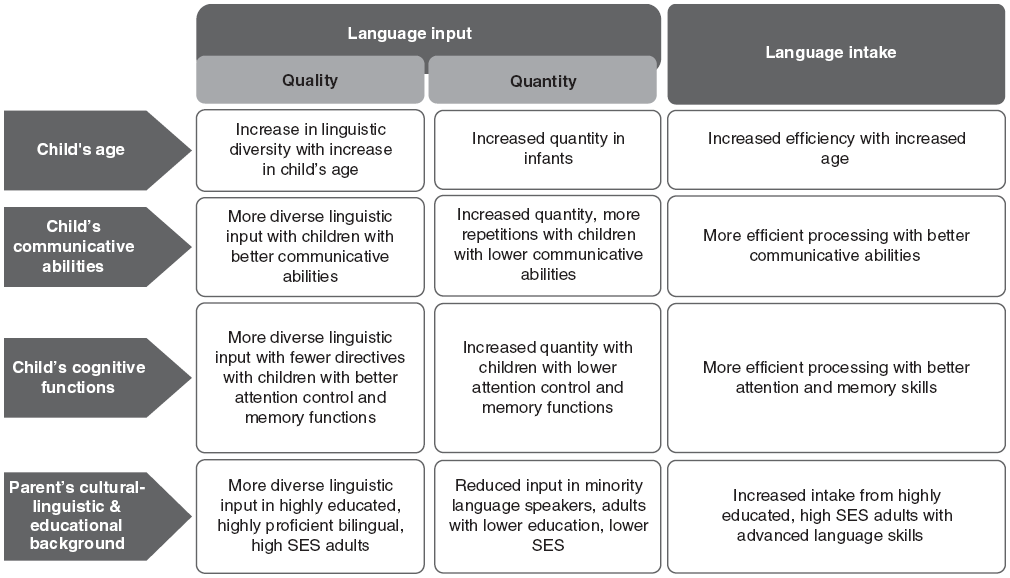
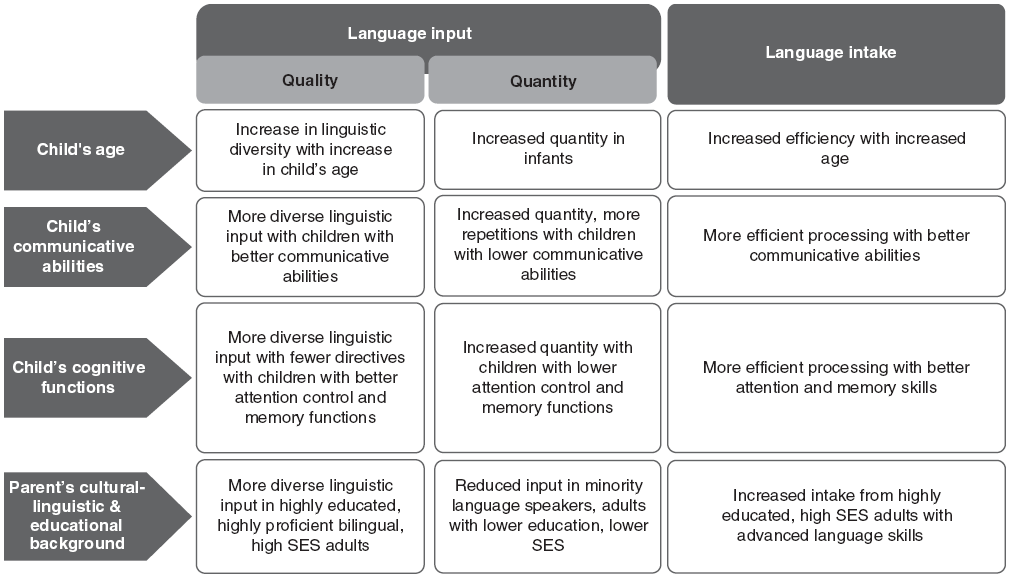
The quality and quantity of language input across populations show multiple interactions with both cognitive and language development in children. The interactions among parental input, language environment, and the child’s age, as well as communicative abilities, are bidirectional, resulting in complex patterns. Communicative abilities are also associated with children’s cognitive control skills. Therefore, cognitive control abilities may show either a positive or a negative correlation with children’s intake, depending on the child’s individual skills. The interactions among language input, parental background, the child’s individual skills, and language intake are summarized in Figure 6.2.
Interactions between input and intake

 Open access