

Saturday 3 March (London)
In the evening talked with LoweFootnote 80 as to the Reform Bill.Footnote 81 He spoke of the Whigs as a party with bitterness and of the Govt. with the determination of destroying them if possible somehow. “If your party” he said “are only true the Govt. have not a chance”. Anyhow he and some who act with him on his side of the House are decided to vote against the 2nd. reading.Footnote 82 He asked me to give him any information I could during the next few days.
I talked also a good deal with Delane,Footnote 83 who is only one degree less hostile to the Government. The burden of his conversation was “The crash must soon come, but are you on the other side ready. Have you made your arrangements to succeed?” He was all in favour of being free of Lord Derby as a leader.
Sunday 4 March
When at the Carlton this afternoon BathFootnote 84 came up to me and imparted his apprehension that Disraeli intended to support the Government bill, alleging that Major EdwardsFootnote 85 had a conversation with D. and that he (D.) had left on him the impression that he could not object to a £15 franchise in the counties and a £6 rating in the boroughs, I said I thought this was very unlikely. Bath however was in a great state of excitement and told me that he “held extreme, very extreme, opinions on religious matters and all that”, but that he was ready to waive everything rather than allow the Government bill to pass.
He then asked me whether a meeting of Conservative Peers and Commoners could not be convened. I suggested that Lord Derby and Disraeli were the natural persons to organise such a meeting.
He said the D. of RichmondFootnote 86 might in default of the leaders be a person on whom “the party could rally” though he did not much like him personally. I said I did not think the D. of R [would] do anything in opposition to Lord Derby. He then said they must fall back on the D. of RutlandFootnote 87 to which I merely said he would find that impossible. He then declared that “if the worst came to the worst the Conservatives must go over to the Whigs, – much as he individually hated them – and make common cause against the Radicals.”
I advised him finally to see Lord Derby and press him to call a meeting, for this can do no harm. Further, it will irritate Lord D. into resigning and provoke the crisis which should now come, or Lord D. will consent and discussion will do good.
Tuesday 6 March
Baillie-CochraneFootnote 88 came to me tell me Walpole had told him that if the Government reform bill should be – what is now currently reputed – £20 in Counties and £6 rating in boroughs and the abstraction of one seat from 25 constituencies he could not oppose it.Footnote 89 If this is so and Walpole carries his intention into acts it is most serious. Henley would probably go with him and some 15 or 20 on our side. This will effectually paralyse Lowe, Elcho,Footnote 90 and some 40 or 50 on the Liberal side whose accession to us depends upon our remaining united.
The extreme Radicals on their part will accept anything as an instalment and the H. of Lords is not now strong enough to stand out against a considerable majority of the Commons. The Conservative Party will again be split up, the Liberals will carry almost all the constituencies. I have written strongly to Sir W Heathcote pointing out the danger and urging him to use his influence with Walpole and to DenisonFootnote 91 in the same sense with regard to Henley.
I somehow suspect both Disraeli and Lord Derby. They are both I imagine hampered by the supposed consequences of their Reform bill of 1859. Anyhow the state of things is very critical.Footnote 92
Friday 9 March (London)
I have been for some days anxious as to the Reform bill or rather as to the course which the leaders of the Party are likely to take. Yesterday Lord Derby summoned a House of Commons meeting, talked chiefly about the Oaths billFootnote 93 but also urged the policy of non-committal to anything on the 1st reading of the Reform bill. The meeting generally assented, but later in the day a private meeting was held in the H. of C. at which Disraeli, Northcote,Footnote 94 Cranborne, Sir W. Heathcote and Walpole agreed to speak in support of the Liberals who will attack the bill on Monday. This is as it should be.
Last night Lowe dined with us and after dinner I went with him into the whole question. Our conversation was a full and confidential one.Footnote 95
He enumerated to me the names of a good many of the Liberals who are prepared to support him against the bill, amongst them the two GrosvenorsFootnote 96 whose adhesion is of the utmost consequence. He had not actually counted noses but relies upon not much less than 40 votes.
He wishes for two nights debate which with the Government so weak in debating strength will he thinks knock the bill to pieces, but his object is to get support in the way of speaking from our side.
Anyhow he and his friends are resolved to vote against the bill whether they get help or not from us. If indeed they were deserted by us “it would be a spectacle” to the whole of the country to see this band of 30 or 40 men fighting it out to the last: and he added that in such a case if they would not stop the bill against a combination of the two great parties in the State they could at least do the Conservatives a mortal mischief by stepping forward to maintain the position which they ought to defend.
The great principle on which they are prepared to stand is no lowering of the £10 franchise in boroughs. They will accept no compromise on this head.
He expressed a good deal of distrust of Disraeli, some little distrust of Northcote whom he called “dolose”,Footnote 97 but said he could get on very well with Hardy.
We afterwards diverged into more general politics and discussed though with some reserve the possibilities of a combination of moderate Liberals and Conservatives. He described himself as “a Whig except in respect of family considerations”: agreed with me when I said that we seemed to be passing into a new era in the political and parliamentary Government of the Country and admitted that the principal difficulties which a fusionist Government would have to deal with would be Church questions, though he did not think them insurmountable.
This morning I had a talk with Cranborne on some points raised by Lowe and have helped I hope to make matters safe for Monday night.
Saturday 10 March (London)
Our usual Saturday dinner.
Delane amongst others dined here. His opinion as to the state of Ireland is bad, as bad as can be. The whole people are in his view (excepting of course the Orange party) entirely disaffected and incapable of being reconciled by any moderate change of government etc.
The only remedy which he could suggest and he owned it was an utterly revolutionary one would be to stop absenteeism by giving the alternative of a compulsory sale. It would be desperate but nothing short of this would produce any effect. However, it may be doubted in such a case whether the cure would not be worse than the original evil. Last autumn Irish landlords of the best kind and class told him that they could not count on the support of one single tenant.
In the evening I had some talk with Northcote as to the present state of things. He admitted the enormous difficulties of forming a government out of the present materials at our disposal. He began by admitting that Disraeli could not become the nominal leader and that Lord Derby was little likely to be in earnest. He went on to say that the Party would not follow Stanley, and that General PeelFootnote 98 had distinctly declared that he would neither take the lead nor serve under Stanley as leader. He said – and in fact gave me such strong reasons for what he said that I think he must be correct – that Disraeli had made real and repeated offers of ceding his claims wholly or partially and had told Lord D. in the autumn (which I knew of at the time) that the old combinations were impossible: but that Lord D. would not give up the existing arrangements. We were interrupted in our conversation but the upshot of Northcote's opinion is that when the crash comes as it shortly will in all likelihood Lord D. will give Disraeli carte blanche to form the H. of C. Government, that D. will offer Lowe and HorsmanFootnote 99 places if they can bring over some 25 men and that Lord D. will try to obtain the cooperation of “Lord Westminster, Duke of Cleveland, Lord Lansdowne”Footnote 100 and possibly some few other Whigs.
Thursday 15 March (London)
I had a talk with Northcote as to the Reform bill. He is anxious and fears much that the Whigs will end after much grumbling by supporting the Government and that Lowe's and Horsman's party will when it comes to voting turn out much smaller than they anticipated.
Lord Derby's conduct is incomprehensible. He summoned the Party in the H. of C. to meet him the other day and talked to them about the Oaths bill. He then dismissed them with a promise that when the Government scheme was out he should hope to see them again. The bill comes out and Lord Derby summons the Party on Thursday 12 April at 12 o'clock on the very day when it is to be read the 2nd time. It is in part an insult to the Party, and they so felt it: for such was the expression of opinion that TaylorFootnote 101 went to Lord D. and in consequence a second circular appears today convening them for tomorrow!!
The result of my conversation with Northcote was a visit to me this afternoon by Disraeli, who discussed everything with great frankness. His hopes are founded in securing the adhesion of some of the great Whig Peers. It is a case he says for the intervention of Peers and the support of Lord Westminster or the Duke of Cleveland will determine many in the H. of C. “But it is,” he added, “vain to expect or even to ask anything from Lord Derby. He would probably receive these great personages if they would come to him in St. James’ SquareFootnote 102 and offer him their allegiance but he will not take a single step towards them. He knows nothing of the management of men.”
After discussing various plans of action at length I undertook to try to deal myself with some of the persons in question. I intend to communicate personally with them and to put aside all party considerations treating it as a question which is so important as to be above all party.
I have this evening done something towards this. I sought out LichfieldFootnote 103 in the House and walked home with him. He is very much discomposed at the idea of Reform such as this and quite entered into my views. I urged on him the importance of securing the cooperation of some of the Whig Peers to put pressure on the Government to withdraw their bill. He promised to consider it well and to see as many as he could on the subject tomorrow evening.
Tuesday 20 March (London)
We have had a very anxious week of it with regard to Reform matters but this evening I think we really begin to see the light. GrosvenorFootnote 104 has given notice in the H. of C. of a resolution declining to discuss the Government Bill and the notice has been received I hear with loud cheers from both sides.Footnote 105 I have been in constant communication throughout the whole of this time with Lowe and Elcho endeavouring as far as it lay with me to facilitate matters. Both are thoroughly in earnest, but I cannot help thinking that Lowe is either a little jealous of Elcho or a little fretful with him on account of Elcho's greater nobility of character. It is however impossible not to like Elcho much the best. He is so thoroughly a gentleman and if he does ever make a mistake it is made in all honour and good faith.
Meanwhile I have persuaded Lord ShaftesburyFootnote 106 to move for a return of the male occupiers in boroughs at a gross estimated rental of from 10 to 7 who belong to the working class. This will give Lord S. the opportunity of declaring himself against the indiscriminate introduction of the lower element and will tell with great force on all the shop-keeping and Dissenting interest.Footnote 107 There is to be a debate upon his motion, not going into the merits of the bill: but I hope that a few well-chosen sentences from him will produce a great effect.
Wednesday 21 March (London)
Lord Shaftesbury gave up his motion. In part he was frightened at it and the possible consequences of it. In part he was worried with his Chancery law suit and so after putting his notice upon the papers he abandoned it. Lowe was of course very sarcastic upon this.
Sunday 25 March (London)
In the afternoon I took a long walk with Northcote round Kensington Gardens. We discussed past, present and future in politics. Northcote expressed his firm resolution not to form part of a government which would not deal fairly with Church questions and said he was perfectly ready to take up his seat with Henley, Sir W. Heathcote and others on the back benches and to give a Conservative government every help but not to be party to any movement against the Church.Footnote 108
In the afternoon later Elcho called and I talked much with him, inter alia, on the recent violent articles in the Telegraph which he tells me are written by Frank Lawley,Footnote 109 who is just as intimate with Gladstone as he ever was.
Wednesday [sic] 17 AprilFootnote 110 (London)
All through the last week or rather four days our prospects in the House of Commons have been growing brighter. The Government are moving heaven and earth to detach men but Grosvenor whom I met today is sanguine.
BeaumontFootnote 111 met me, talked much of the rascality of many of the liberals who though hating the bill are yet afraid to vote against it, assented to all that I said with regard to the necessity of a combination government and then informed me that he suspected that Gladstone intended on the night of the division to attempt a coup de theâtre by announcing that if the House would agree to the 2nd reading of the Reform billFootnote 112 the Government would undertake not to proceed further with it till they had brought the Redistribution of Seats bill through a 2nd reading also and then proceed with both bills pari passu. It is so shabby a trick that it is likely. He wished me to communicate it to Lord Derby which I undertook to do.
He further told me that H. Herbert of KerryFootnote 113 who is the O'Donoghue'sFootnote 114 mouthpiece in the matter told him that the Irish members would vote against the bill if the Conservatives would promise to give them an Enquiry into the Irish Church, but that the Irish members the villains – thought that they were the masters of the political situation, and were prepared to use their advantage.
Monday 23 April (London)
Stanley breakfasted with me and we afterwards walked round Kensington Gardens. As we were returning – I had previously made up my mind to speak to him on the subject of possible change – I told what Lowe had said to me, how determined he was not to serve under Disraeli, how doubtful even whether he could serve with him, and that on the whole he seemed to me to be the one person possible who as much from position and character as from ability was able to centre in himself the different parties and interests. He expressed grave doubts as to his being able, even physically, to undertake the leadership of the House, to which I replied that he was in that position that a statement would often be accepted from him where an argument would be required from others. I then said that in proposing to him what of itself amounted to a dispossessing of Lord Derby of position he would of course acquit me of any disloyalty to him but that looking to all the [circumstances] and the critical character of the time I believed that what I suggested was the only course. He replied that his father and he quite understood each other on these points. I told him that I had told Northcote of my conversation with Lowe for him to communicate it to Disraeli.
He said to me something which implied that he thought himself unpopular with the Party, to which I answered that whatever might have been the feeling some time since I saw on every side in the Party signs of very great good sense and moderation and that several of the younger men had on several occasions of late expressed themselves quite ready to accept such an arrangement as his leadership because it offered an escape from the present great difficulties.Footnote 115
Saturday 28 April (London)
The report today at the Carlton (which looks much like a hive of bees upset and ready to swarm) is that the Government are already out.Footnote 116 The report is founded on a statement to this effect said to be made by Childers to Sir E. Tennent.Footnote 117 It is said Sir G. Grey has gone down to the Queen to the Isle of Wight but one does not see what Sir G.G. can have to do with the matter in the present stage.Footnote 118
There are three contingencies at least which are now possible:
1. A pure Conservative Government with Lord D. and Disraeli, undertaking to deal with Reform and leaning on the Lowe, Grosvenor and Horsman party, probably referring the question to a Commission and so gaining time and strength and reserving the chance of a dissolution.
2. A combination Government of Stanley and the Conservatives with a Whig adhesion might perhaps be made to extend somewhat beyond the Lowe – Horsman party.
3. A Combination Government of Whigs including and indeed starting from some members of the present Cabinet and of the Conservatives with either Disraeli or Stanley as leader in the H. of C., and Lord Derby waiving his leadership in the Lords: and either taking a seat without office in the Cabinet or standing aloof and giving a general support.
It is anyhow a critical state of things and I almost think that it would be better that the present Government should go on, get deeper into difficulties and make the split between themselves and the secessionist Whigs irremediable.
Friday 4 May
I have had great trouble and anxiety for the last four or five days in an attempt to bring about a conference between Grosvenor, Lowe, Horsman and Elcho and some of our friends.Footnote 119 There have been great difficulties on all sides – the Adullamites, as they are now commonly called, fearing that the report of any meeting should get abroad and lead to misrepresentation: but on the other hand fearing that Pakington,Footnote 120 Peel, and several more of our friends might also hear of it and take offence at the idea of what might seem to be a hole and corner meeting. Twice the scheme seemed on the point of succeeding: twice it broke down and ultimately it failed through the apprehension on Grosvenor's part that it might be known. I have had repeated conferences with Disraeli who has been perfectly frank and open, holding back nothing as far as I can see and being very sound as I think in his views of what is to be done.
The state of things is this. The Government feel themselves to be in a difficulty and BouverieFootnote 121 under the guise of a neutral bystander is organizing with WhitbreadFootnote 122 and some others a sham opposition to the Government in order to affront away from the Grosvenor and Lowe party any waverers and ultimately to lead them back home to this government. And his mode of accomplishing this is by throwing out proposals of a compromise which of course the Government would accept in Committee; that compromise evidently being the substitution of £20 for £14 in the Counties and £8 for £7 in the boroughs, together with some boundary revision and the gift of some borough seats to the Counties in order to bribe the County members with them. This is a very dangerous game for us, because there are a good many people on our side who in their timidity and ignorance are so anxious to settle the question, as is now the cry, that they do not see that this is no settlement that it would only lead to further charges and that it is the policy of the Whigs and the ruin of the Conservative Party.Footnote 123
Henley, Walpole, Cairns,Footnote 124 Pakington, Adderley,Footnote 125 G. HardyFootnote 126 and some others seem to be bitten with the delusion. Of these however Walpole we have almost I think succeeded in convincing. Disraeli gave him a home thrust by pointing out that Bouverie who is looking to the Speakership – on which Walpole has always had a longing eye, was the author of this scheme – and all the others, if only they can be prevented from committing themselves, can with the exception of Henley I think be managed. They will go with their Party.
Stanley was the author in the bill of 1859 of the retention of the £10 borough franchise: he has always had a strong feeling in favour of adhering to this but the weak point in his character – his timidity comes out and as the difficulty of holding his own increases he begins to waver. Disraeli, however, is pressing him: and I have done my best in the same sense. Fortunately too the Lowe and Grosvenor Party have taken up most distinctly the policy of no compromise and postponement for this Session at all events.
Meanwhile, the Secessionists are in great difficulties. The four leaders are firm enough and they say that they can count upon some eight or ten more, but that for the remainder no dependence can be placed on them. The Government is tampering with them and with the large majority it appears to be simply a question of the amount of the bribe. That most miserable and despicable creature Beaumont – for really there is nothing else in plain truth to be said of him – is wavering and more than half prepared to go and this after all the fine speeches about honour and good faith which he made me ten days since!
Altogether it is a very critical state of things. We have much in our favour and against us the strong will of one man who seems to have all the cleverness, the violence, and the obstinate cunning of a madman – It is Gladstone alone who forces the Government and his party on.
Thursday 10 May (London)
Great shakiness in some of our own party on the subject of a supposed compromise with regard to Reform. They are disposed to substitute in Committee an £8 for a £7 and a £20 for a £14 franchise. This would be absolute.
After much discussion of the subject with various people feeling very anxious as to the course which has to be taken in the H. of C., I wrote a rather long letter to Lord DerbyFootnote 127 and subsequently had back from him a reply agreeing so far with me that he said that the Government scheme if passed even though with modifications “would be the extinction of the Conservative Party for the next 20 years.” Lord Russell is said to have formed pretty nearly the same opinion of his bill, for Lowe declares that he told someone that his bill “would prevent a Conservative Government coming into office for the next 20 years.”
It is a very critical time in every point of view, but I hardly think that whatever the issue the Whigs as a Party are likely to enjoy 20 years of bearable supremacy.
Friday 11 May (London)
The great panic, a money crisis in the City, the most fraudulent and bankrupt firm of all – the Government – which most deserved to fail seems likely to go on.Footnote 128
A meeting of Conservative H. of C. M.P.s. Much discussion but ultimately a good understanding and very tolerable unanimity. I hope it will last.Footnote 129
Monday 21 May (London)
I called on Lord Derby in order to state the proposed scheme of a Conservative first class daily Paper under the editorship of Russell, The Times correspondent and present editor of the Army and Navy Gazette,Footnote 130 and to endeavour to obtain from him an expression of general goodwill.
I told him that Russell proposed to raise the necessary funds by shares of £10 or £20 throughout the Country, that W.H. SmithFootnote 131 approves the scheme and will cordially go along with it, that CubittFootnote 132 and EdwardsFootnote 133 have promised large subscriptions, that Delane is friendly wishing for a first class Conservative paper to stand between him and the penny Press and has offered to give him his accounts and every other information which can be useful, that the sub-editor of the Saturday Review is to be had, the best sub-editor in London, and that all that Russell needs is £2000 per an. for the next two or three years till the paper pays. He wishes to go thoroughly along with the Conservative Party but he will not pledge himself to a slavish allegiance on every point.
Lord Derby's answer was a string of objections.
First, he was not sure that it was desirable to have any paper which was or professed itself an organ of the Party.
Next, how would Russell go on Church questions? Would he be in favour of perpetual concession and sacrifice as soon as a pinch came?
Next, would not this injuriously affect the Standard?
Finally before answering he would wish to talk the matter over with Disraeli.
To this of course I could offer no objection though I am afraid that it will lead to some intervention on the part of the Rose, BaxterFootnote 134 and especially Spofforth Footnote 135 firm who will view this only in the light of opposition to the Standard; and will do everything to thwart it accordingly.
Saturday 9 June
Gladstone seems to be going out of his mind. Northcote has just told me that Gladstone's last passion is for Mrs Thistlethwayte.Footnote 136 He goes to dinner with her, meets her frequently, seems engrossed with her: and she in return in her preachments to her congregation exhorts them to put up in their prayers on behalf of Mr Gladstone's reform bill.
His manner in the H. of C. even is very extraordinary. When Stanley on Thursday night stated the object of his motion of postponement, Gladstone gave a half shriek and threw himself back on his seat as if he had been shot.
Mrs Gladstone the other day in her very simple manner said to someone that it was “a great pity that dear William returned home so angry as he often does.”
Monday 17 September (Buxton)
I have had several anxious days and even weeks with regard to Canada and the threatened Fenian invasion.Footnote 137 Lord Monck's letters have been unsatisfactory.Footnote 138 At first denying and discrediting all ideas of danger – then a hasty telegram calling for reinforcements – then explaining the news of his requisition by a despatch in which he reiterates his own belief that there is no danger and yet gives way to the expression of alarm on all sides of him – a series of inconsistencies.
His information is very scanty – not nearly as much as I can glean from occasional Canadian papers. Meanwhile in the midst of all this he talks of returning to England to confer on the subject of Confederation, and it is only after repeated letters of mine in which I point out the impossibility of his leaving, and when matters seem coming to a head as regards Fenianism that he writes to say that he must give up coming home – and writes as if we have been urging him to come!Footnote 139
Two days since (the 15th), I received a telegram stating that the Canadian delegates cannot arrive till the close of the Navigation on the same account. I wrote to Elliott desiring him to fix a day for the North Britain and the Nova Scotian delegates, and that I would come up to London to meet them.
So ends my second attempt to drink the water.
Monday 8 October (London)
Discussed Reform question with Bagehot.Footnote 140 He admits possibility of postponing question for a year or so but says it must be settled. He believes trimming of franchise in small boroughs would give them up to Conservatives, certainly in Devon and Cornwall.
Saturday 27 October (Highclere)
Walked with Disraeli in morning.Footnote 141 He then began on Reform. He said Cranborne was much against any bill: and had promised but not sent a paper of objections. He wishes to hold our hand till later when we shall see what is public feeling on many points, meanwhile consider it. He seems to be most in favour of resolutions and perhaps a Commission appointed by Parliament founded on the resolution. I stated some objections. He admitted them: but is obviously in an undecided state of mind, sometimes inclines to one side sometimes to another.
He suggested as a detail to omit all mention of reform in Queen's Speech, to lead the opposition to believe that they would move an amendment on Address and then just before moving Address to let the Secretary to the treasury announce that on a certain day the question of Reform would be considered. I objected to this as laying us open and as a dodge from which nothing could be gained and he seemed to assent to this view. He spoke of the difficulties of government and said he had never been in a majority.
Sunday 28 October (Highclere)
Walked to the lake with Disraeli [. . .]. He admired everything, the sun shining brightly and the trees flaming with autumn colours, and talked agreeably on all subjects inter alia Copernicus and Pythagoras and ancient astronomy.
I gave him Mansel's letterFootnote 142 to see on Reform. He was so struck that he asked to show it to Lord Derby and said if the Deanery of Norwich was still vacant he would do his best to get it for him.
Monday 29 October (Highclere)
Spoke to Disraeli before he left as to Sir W. Heathcote and a peerage in consequence of something which D. had said to EvelynFootnote 143 the evening before.
Disraeli said Lord Derby was not inclined to give the peerage, that there was not money enough, and that many creations had been made.
I told him Sir W.H.'s health was doubtful that he might be obliged to resign the seat and that I should not advise him to sacrifice or risk his health.
Our Party all went.
Wednesday 31 October (London)
Our first Cabinet since end of Session. Mainly employed in discussion of reform.
The first question was whether reform should be ignored or dealt with and every one, however reluctantly, admitted it was necessary to attempt it.
On the whole the general feeling was in favour of resolutions a Commission and a bill. Lord Derby read a letter from Genl. Grey to himFootnote 144 an honourable and creditable one in which Grey stated the Queen's wish to have the question settled and her readiness to communicate with any political persons and to facilitate a concurrence if possible. He also read a memorandum drawn up by Lord GreyFootnote 145 advocating
1. a concurrence of parties for this object.
2. a concurrence proposed and made openly and to avoid all risk of it being thought an aristocratic cabal.
3. providing by resolutions.
4. a Committee of the Privy Council.
His resolutions were abstract but yet much to the point. He wrote apparently in a very friendly spirit.
Evelyn entertained Lowe at luncheon. He was very vehement on Reform and said that if we attempted he would oppose us to the utmost of his powers with at least ten of the Adullamite party. He declared we were judicially blinded as the aristocratic party in the French Revolution etc.
Thursday 1 November (London)
I had a talk with Northcote on Reform this morning. We are generally well agreed. If we bring forward any scheme it should be a well-considered and a bold one.
Thursday 8 November (London)
Cabinet on Reform
At first the discussion showed only great differences of opinion. Afterwards Lord Derby and Disraeli ground through a series of resolutions which no one much liked but to which the resistance was so fragmentary and uncombined that they were finally adopted.Footnote 146 Cranborne proposed two preliminary resolutions directed totidem verbis against the principle of numerical class ascendancy. John MannersFootnote 147 produced a series of general resolutions which were in part adopted. Pakington raised the question of a separation of votes in large towns into 2 classes according to some money qualification: but it found no favour [. . .]. I raised the question of a preliminary commission to consider the whole question but was over-ruled on alleged impossibility of getting a fair commission. I also urged household suffrage accompanied by Conservative restrictions and safeguards, but was again overruled. Peel proposed adding ¼ to existing electors in every boro’, but this was objected to.
I am not satisfied at the general result.
Friday 9 November (London)
Lord Mayor's dinner. I sat between Mr Disraeli and Stanley! The latter drank like a fish. He must have consumed more than 2 bottles of sherry alone.
Ld Derby's speech was excellent and the reception given to him was warm and cordial. The most popular minister could not have been greeted more warmly.
Monday 12 November (London)
Met Solicitor-GeneralFootnote 148 at C.O. to consider case of Fenian convicts.Footnote 149
Afterwards went to Lord Derby and settled to telegraph to Lord Monck to spare their lives but not announce commutation of sentences.
Tuesday 13 November (London)
Received deputation from Aborigines SocietyFootnote 150 at C.O. Adderley present, but I contrived to prevent him saying anything.
Cabinet 3.30
Several matters discussed.
1. I raised question as to Fenian convicts under sentence of death in Canada. Agreed to explain commutation, viz., 20 years, in a despatch, and probably want Lord Monck's explanatory despatch.
2. Stanley mentioned his answer to Seward'sFootnote 151 letter to BruceFootnote 152 claiming amnesty for these convicts.
3. NaasFootnote 153 apprehends much agitation in Ireland for next month. Three fresh ships are to cruise on Irish coast in case of any attempt at a landing [. . .].
Went afterwards with Disraeli to his room and discussed reorganisation of C.O.Footnote 154 He assents to the addition of a legal adviser but opposed M. BernardFootnote 155 – a fair compromise.
Thursday 15 November
Cabinet
I brought forward my proposal for exchange of territory with French and Dutch on West coast of Africa. Cabinet agreed leaving me to settle details with Stanley.
Some discussion as to proposed meeting by Trades Unions on 3 December. Sir R. MayneFootnote 156 called in.
Friday 16 November (London)
Cabinet
Lord Derby read a letter from the Queen complaining that she had not had enough information as to Fenian convicts under sentence of death in Canada or general proceedings of Cabinet. I received a similar letter with special reference to Canadian affairs through Genl. GreyFootnote 157 which I answered that evening by special messenger.Footnote 158
Northcote brought forward his railway plans.
Some further discussion as to Reform meeting on 3rd December. Sir R. Mayne attended and reported his interview with the deputation, who represent the numbers likely to attend at 200 to 300,000 men.Footnote 159
Walpole is fast losing his head. He seems to grow feverishly nervous at the prospect of any row and his police are either ineffective or neglect to keep him informed. If there is a breeze we shall probably see a repetition of the mismanagement of last summer.
Tuesday 20 November
Cabinet
I mentioned arrival of delegates and it was understood that the sentences of Fenian convicts should be commuted to 20 years.
I showed Ld Derby my draft despatch on this subject to which he assented. Sent it on to Stanley.Footnote 160
Tuesday 27 November (London)
Went to the Duke of CambridgeFootnote 161 and discussed question of succession to vacant Governorships. Told him that I should always be glad that military officers should succeed in the large free Colonies but that in many if not most of others it would only be just to Colonial Service to reserve places for them.
Dined with Phillimore and discussed the whole position personal and general with regard to the Alabama claims. I cannot say I feel satisfied either way.Footnote 162
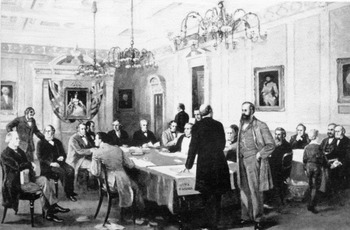
‘The Fathers of the Confederation’, London, December 1866. Carnarvon is standing on the left with Lord Monck, right. The seated figures are the delegates from Canada, Nova Scotia, and New Brunswick.

Cranborne opposed the reference of Alabama claims to arbitration very strongly, on ground that late Government had laid down denial so decidedly, that Lord Derby had in opposition denounced arbitration, that the questions were not such as any country ought to surrender to arbitration. He argued that we should conciliate no party and only lower the country by such a course.
Some general discussion followed and I said that I agreed with Stanley, because when as foreign minister he could not guarantee peace and it had become a grave matter but that personally I found on reference to Hansard that I had in opposition used language very strongly against arbitration and I endeavoured to let the Cabinet understand that I should have to consider my own position.
Finally decided not to offer special points for arbitration but to suggest arbitration generally and to have Seward to say on what points he wished to arbitrate.
Thursday 29 November (London)
Cabinet
Revised the draft on Alabama claims. Stanley inserted a few words which much modified the character of it. It was understood, on my asking, that it commits us to nothing beyond a general disposition to accept arbitration without specifying any particular points [. . .].
After Cabinet talked to Cranborne about the Alabama claims and our despatch. He thought that I was not sufficiently committed by my speech in 1864Footnote 163 to make it necessary for me to resign. He was prepared to resign if the original draft had been agreed upon.
Monday 3 December (London)
The Reform meeting and Procession. They did not start from the Parade in front of the Horse Guards till 12.40. When once off they moved quickly.
Met Walpole at the Carlton – he seemed delighted with the mob, the rainy day and himself, but was in a nervous state.
Tuesday 11 December (Highclere)
Discussed various points in Confederation scheme with delegates.Footnote 164 They are much in favour of a nominated not elective Legislative Council. They will I think give up right of pardoning now proposed to be given to Lieutenant-Governors, and they expressed themselves anxious to make provincial Legislatures and Governments as municipal in character as possible.
Tuesday 18 December (Highclere)
Went up to town by first train.
Received Howe,Footnote 165 Annand,Footnote 166 and Macdonald,Footnote 167 anti-confederates at the C.O.
Howe managed his case with great skill and temper and impressed me much. He went away I think in good humour. If only the question is referred to the people of N. Scotia, not the Parliament, he is satisfied. It is an awkward question.
Thursday 20 December (Highclere)
Canadian delegates arrived 19 December. Macdonald went. He said that the conferences of the delegates would probably be over by Saturday. I told him that the two main difficulties which I foresaw were
1. the guarantee question – to which he said that they only wanted what Cardwell had promised.Footnote 168
2. the position of the N. Scotian legislature. He said that any dissolution on this question would give a majority against Confederation and would postpone it for years. He said that Howe had so influenced the public mind on the subject that even he probably could not now restrain them.
Sunday 23 December (London)
Discussed various questions with Stanley [. . .]. He does not believe that we shall come to any agreement amongst ourselves or be able to do much in the House. He used to me many of Lowe's arguments against Reform derived from and through Lady Salisbury.Footnote 169 He was curiously indisposed to it. The only thing he said on which he was decided, was that if beaten we ought not to dissolve.
Tuesday 25 December (Highclere)
Discussed with Lowe [. . .]. On reform he strongly urges delay and caution. He would be very favourable to a franchise founded on £100, or even £50 income tax. It is an advantage to make income tax permanent for if it were abolished we should have a property tax immediately.
Confederation. He objected to guarantees but says truly that we are committed by the acts of our predecessors and may fairly say so. As to Confederation itself [. . .] his main objection is one to the whole scheme because it may increase rather than diminish the connection of North America with us.
He urges me strongly to represent to Lord Derby Adderley's incapacity and anyhow to wash my hands of all responsibility. Adderley, he said, is almost certainly to involve us in difficulties and probably serious ones. I am afraid he is right.
Wednesday 26 December (Highclere)
The Lowes, Bakers and Lady D. NevillFootnote 170 went.
Lowe feels very bitterly the treatment which he has had from the Whigs. He said to me that there was nothing that he could not have had and that had not been offered short of the Governor-General of India out of England: but that the Cabinet was reserved exclusively for men of particular connection and family. Had he been a radical he might indeed have had it but for a man of moderate views the cabinet was closed. But if ever difficulties arose in Parliament, a hard committee to be carried through, then no one could do it as he could and the entire work was put upon him. I observed that whatever our faults as Party this exclusiveness was not one, to which he cordially assented. There is certainly no love lost on his side.