




No CrossRef data available.
Article contents
Motor planning in primates
Published online by Cambridge University Press: 15 June 2012
Abstract
Vaesen asks whether goal maintenance and planning ahead are critical for innovative tool use. We suggest that these aptitudes may have an evolutionary foundation in motor planning abilities that span all primate species. Anticipatory effects evidenced in the reaching behaviors of lemurs, tamarins, and rhesus monkeys similarly bear on the evolutionary origins of foresight as it pertains to tool use.
Information
- Type
- Open Peer Commentary
- Information
- Copyright
- Copyright © Cambridge University Press 2012
References
Chapman, K. M., Weiss, D. J. & Rosenbaum, D. A. (2010) Evolutionary roots of motor planning: The end-state comfort effect in lemurs (Lemur catta, Eulemur mongoz, Eulemur coronatus, Eulemur collaris, Hapalemur griseus, and Varecia rubra). Journal of Comparative Psychology
124:229–32.CrossRefGoogle Scholar
Johnson-Frey, S. H. (2004) The neural bases of complex tool use in humans. Trends in Cognitive Sciences
8:71–78.CrossRefGoogle ScholarPubMed
Nelson, E. L., Berthier, N. E., Metevier, C. M. & Novak, M. A. (2010) Evidence for motor planning in monkeys: Rhesus macaques select efficient grips when transporting spoons. Developmental Science
14:822–31.CrossRefGoogle Scholar
Rosenbaum, D. A., Cohen, R. G., Meulenbroek, R. G. & Vaughan, J. (2006) Plans for grasping objects. In: Motor control and learning over the lifespan, ed. Latash, M. & Lestienne, F., pp. 9–25. Springer.CrossRefGoogle Scholar
Rosenbaum, D. A., Marchak, F., Barnes, H. J., Vaughan, J., Slotta, J. & Jorgensen, M. (1990) Constraints for action selection: Overhand versus underhand grips. In: Attention and performance XIII: Motor representation and control, ed. Jeannerod, M., pp. 321–42. Erlbaum.Google Scholar
Weiss, D. J. & Wark, J. (2009) Hysteresis effects in a motor task in cotton-top tamarins (Saguinus oedipus). Journal of Experimental Psychology: Animal Behavior Processes
35:427–33.Google Scholar
Weiss, D. J., Wark, J. D. & Rosenbaum, D. A. (2007) Monkey see, monkey plan, monkey do: The end-state comfort effect in cotton-top tamarins (Saguinus oedipus). Psychological Science
18(12):1063–68.CrossRefGoogle ScholarPubMed
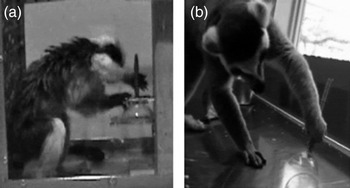
Figure 1. In (a), a cotton-top tamarin (Saguinus oedipus) grasps the stem of a cup (a plastic champagne glass with its base removed) to pull it from an apparatus and extract a marshamallow stuck in the cup's bottom. The tamarin uses a thumb-down grasp that permits a subsequent thumb-up grasp once the cup is pulled out and inverted (not shown). In (b), a ring-tailed lemur (Lemur catta) uses a thumb-down grasp to turn over a free-standing plastic champagne glass with a raisin affixed to the bottom of the bowl. Sources: (a) Weiss et al. 2007 (Courtesy of Sage Publications), (b) Chapman et al. 2010 (Courtesy of The American Psychological Association).
In discussing the impact of executive control on cumulative culture, Vaesen asks whether goal maintenance and planning are crucial for innovative acts – in particular, for innovative acts involving tool use. In this connection, we point to our work on goal maintenance and planning in two groups of nonhuman primates – cotton-top tamarin monkeys (Weiss & Wark Reference Weiss and Wark2009; Weiss et al. Reference Weiss, Wark and Rosenbaum2007) and lemurs (Chapman et al. Reference Chapman, Weiss and Rosenbaum2010). The work we describe, as well as other research by us and others on anticipatory effects in reaching and grasping by humans (for reviews, see Rosenbaum Reference Rosenbaum2010; Rosenbaum et al. Reference Rosenbaum, Cohen, Meulenbroek, Vaughan, Latash and Lestienne2006), may be unknown to Vaesen. Our aim in this commentary is to draw attention to this research, hoping that doing so will provide more tools with which Vaesen can evaluate and develop his hypothesis.
We have demonstrated that cotton-top tamarin monkeys (Fig. 1a) and lemurs (Fig. 1b) show a surprising level of goal maintenance and planning in a behavioral context. Our investigations reveal that these species spontaneously alter their object grasps depending on what they plan to do with the objects.
In (a), a cotton-top tamarin (Saguinus oedipus) grasps the stem of a cup (a plastic champagne glass with its base removed) to pull it from an apparatus and extract a marshamallow stuck in the cup's bottom. The tamarin uses a thumb-down grasp that permits a subsequent thumb-up grasp once the cup is pulled out and inverted (not shown). In (b), a ring-tailed lemur (Lemur catta) uses a thumb-down grasp to turn over a free-standing plastic champagne glass with a raisin affixed to the bottom of the bowl. Sources: (a) Weiss et al. Reference Weiss, Wark and Rosenbaum2007 (Courtesy of Sage Publications), (b) Chapman et al. Reference Chapman, Weiss and Rosenbaum2010 (Courtesy of The American Psychological Association).
In these studies, the object to be moved was a cup with a piece of food stuck inside its bowl. The cup was positioned in a way that required manipulation of the cup to get the food out. The animals were allowed to interact with the cups as they pleased. Therefore, they could freely choose a canonical thumb-up initial posture followed by a non-canonical thumb-down posture, or they could freely choose a non-canonical thumb-down initial posture followed by a canonical thumb-up posture. These animals, like humans (Rosenbaum et al. Reference Rosenbaum, Marchak, Barnes, Vaughan, Slotta, Jorgensen and Jeannerod1990), chose the latter course of action. They adopted the non-canonical initial posture when grasping the cups to be inverted, thereby permitting the more canonical posture at the end of the cup rotation. The final thumb-up posture permitted greater control during the food extraction phase.
The pictures shown in Figure 1 are not rare instances of behavior, culled from video frames to finally find the poses we wanted. The pictures in Figure 1 illustrate behaviors that were reliably elicited whenever the cup needed to be turned to permit food extraction. When the cup did not need to be turned, the animals adopted canonical thumb-up postures right from the start. The statistics from the carefully controlled studies we did to test the hypothesis that the animals plan ahead supported this claim. On this basis, we concluded that the evolutionary foundation of human motor planning abilities as they relate to tool use are likely shared across all primate species. The latter inference is further supported by similar research with Old World monkeys (Nelson et al. Reference Nelson, Berthier, Metevier and Novak2010).
Vaesen is interested in behaviors that take longer to complete than the ones we have described here, so he could say we are focusing on too narrow a slice of behavior. Still, it has been argued that short-span motor abilities provide a scaffold for the evolution of planning and goal maintenance over longer durations. One proposal is that the cognitive capacities underlying anticipatory motor planning in reaching and grasping provide a sufficient condition for the development of tool use (Johnson-Frey Reference Johnson-Frey2004). We believe, contrary to Johnson-Frey, that such cognitive capacities provide a necessary but not sufficient condition for tool use. Our reason for this alternative view is that tamarins and lemurs do not use tools in the wild or in captivity, at least as far as we know, yet they show the anticipatory motor planning abilities needed to turn cups in ways that afford maximal control during food extraction. The underlying cognitive abilities indexed by our tasks require an appreciation of means-end relationships as well as an ability to inhibit the deployment of canonical postures in the service of better later postures. Our appreciation of these facts leaves us skeptical of Vaesen's claim that humans possess unique abilities for inhibition and foresight.
A last thought: In his discussion of foresight in the context of prospective planning of action sequences (sect. 12.2), Vaesen differentiates between novel solutions and action routines. We question whether that distinction properly distinguishes humans from non-human animals. The nonhuman primates in our studies found novel solutions for the food extraction problems they faced. They had minimal experience with cups, yet they spontaneously adopted non-canonical grasps when presented with inverted cups, even in first trials. If foresight requires novel solutions to problems, as Vaesen asserts, then the behaviors we have described provide evidence for prospective planning and foresight in non–tool-using animals.