The institutions of global governance have changed dramatically in recent years. In the decades after 1945, dozens of specialized agencies, programs, and commissions were created within the UN system. Other functional intergovernmental organizations (IGOs), notably the World Trade Organization (WTO), appeared and gained influence, and European institutions expanded dramatically. Multilateral treaties also multiplied; environmental agreements, for example, grew by nearly 150 percent during the 1990s.Footnote 1 In the early years of this century, however, growth in the number of IGOs has slowed markedly. Although existing IGOs continue to expand their activities, the formation of new organizations has decreased by about 20 percent.Footnote 2 Adoption of new environmental treaties has slowed even more sharply.Footnote 3
New organizational forms, in contrast, have emerged and expanded rapidly. States have created informal institutionsFootnote 4 and plurilateral “clubs,”Footnote 5 such as the G20 and other “G-groups.” In response to increasing institutional fragmentation, states have also established meta-institutions to coordinate other entities, such as the High Level Political Forum for sustainable developmentFootnote 6 and the G20 for financial regulation.Footnote 7 IGOs have created their own “emanations.”Footnote 8 National regulatory agencies have established influential transgovernmental institutionsFootnote 9 such as the Basel Committee on Banking Supervision.Footnote 10 Subnational governments have also established transnational networks such as the C40 Cities Climate Leadership Group. Transnational public-private partnerships (PPPs) have expanded and gained official recognition, as at the 2002 World Summit on Sustainable Development.Footnote 11
Perhaps most striking, private transnational regulatory organizations (PTROs) have proliferated. PTROs are established and governed by actors from civil society, business, and other sectors.Footnote 12 They engage directly in transnational governance, adopting standards of conduct for business and other targets on regulatory issues from worker rights to climate change; promoting, monitoring, and enforcing those standards; and conducting related administrative activities.Footnote 13 PTROs operate through markets, not through interstate negotiations or hierarchy;Footnote 14 they adopt voluntary standards and rely on incentives such as consumer demand, reputational benefits, avoidance of mandatory regulation, and reduced transactions costs to induce participation and compliance.Footnote 15 Before the 1990s, such organizations barely existed.Footnote 16 Today, they are numerous, well established, and expanding in numbers.Footnote 17 These changes are especially notable in climate change governance, on which we focus our empirical analysis.
This dramatic shift in the institutional landscape is highly significant for global governance. Because PTROs are controlled by private actors rather than states, they make decisions and exert influence through different processes than do IGOs. They make different claims to legitimacy, provide different avenues for political participation, and are accountable to different constituencies. They complement IGO norms and programs, multiplying their governance impact. For these and other reasons discussed more fully in the conclusion, a world of global governance in which key decisions are made by private-sector and civil society actors operating through PTROs is very different from one dominated by states acting through IGOs.
What accounts for this shift in the composition of global governance institutions? Why do some types of organizations—such as PTROs—rapidly increase in number, becoming a major, ongoing presence in global governance? And why do other organizational forms—such as IGOs—experience slowing growth, even as incumbent organizations take on new responsibilities? In short, what explains the different patterns of growth these organizational forms have experienced? Current theories of international governance provide valuable insights and focus usefully on variations in the characteristics of organizational actors. However, they overlook the other crucial causal variable: the structure of the institutional environments that influence organizational behavior.
To remedy the lack of attention to the institutional environment in contemporary theory, this article draws on work in the sociology of organizations—known as “organizational ecology”—that has demonstrated the importance of institutional landscapes for organizational behavior. Deriving from pioneering work by Hannan and colleagues in the 1980s and 1990s,Footnote 18 organizational ecology studies aggregate changes in the types and numbers of organizations. It considers both the structural influence of organizational environments and the specific actor characteristics that mediate that influence. Organizational ecology has not been systematically applied to global governance, even though it speaks directly to the issue of organizational change and diversity. It is highly relevant to understanding the viability not only of PTROs, but also of other innovative governance institutions.
Why Organizational Ecology?
A number of theories of global governance can provide partial explanations for the divergent growth patterns of IGOs and PTROs but these explanations are incomplete because they overemphasize agency at the expense of structure.
Functionalist theory would argue that negative externalities generated by diverse global activities create interests among actors and organizations in correcting them through cooperation. Whether cooperation led to the creation of new IGOs or PTROs, or to the expansion of existing organizations, would depend on the alignment of actor and organizational interests, weighted by power. From a functionalist standpoint, both the expansion in the number of democratic states over the past thirty years and advances in communications technology could have generated new interests and capabilities, generating viable transnational organizations.Footnote 19 But functionalist theory—which has focused on interstate cooperationFootnote 20 —would find it difficult to explain the differential increase in the number of PTROs compared with IGOs.
Theories of self-regulation view the emergence of voluntary standards, especially self-regulatory standards, as a means of capturing private benefits, especially by business or other (potential) targets. These benefits may include preempting public regulation, gaining access to markets, and enhancing firm reputation.Footnote 21 Many climate PTROs, however, are based in nongovernmental organizations (NGOs) or are multistakeholder initiatives in which these economic incentives are absent or diluted. Nonetheless, these theories warn us that target firms may still seek to capture PTRO norms and procedures.Footnote 22
Organizational theories focus on the interests of organizations themselves.Footnote 23 All organizations seek to survive and so must act to satisfy their minimum resource needs.Footnote 24 In addition, organizations typically seek to expand their authority and resources. But these theories do not explain our puzzle, which is not why existing organizations expand, but why many organizations of a new type are able to survive.
Principal-agent theory would predict that established IGOs will delegate certain functions to other organizations that can perform them more efficiently. The agents might be newly created IGOs, PTROs, or other institutions. In this view, we should observe, as we do, new entities tied by authority and accountability relationships to older ones. Also consistent with this argument are orchestration—in which IGOs support and guide the activities of organizations with “on-the-ground” knowledge or other capabilities IGOs lackFootnote 25 —and the creation of emanations, “second-order IGOs created through actions of other IGOs.”Footnote 26 However, delegation is costly, requiring high levels of agreement among principals and careful oversight of agents. Many recent PTROs were not created as agents of any principal, but reflect what Green calls “entrepreneurial private authority.”Footnote 27 So although principal-agent theory helps to account for the creation of some PTROs, it does not explain their vast expansion or viability.
All of these theories are incomplete because they fail to pay systematic attention to the organizational environment within which both IGOs and PTROs operate. Organizational ecology, in contrast, is primarily a structural theory. In answering the question “Why are there so many (or so few) kinds of organizations?”Footnote 28 it focuses on the institutional environment in which organizations operate, especially the density of that environment and the resources it can provide. Organizational ecology does not deny the roles of functions, agency relationships, organizational goals, or private benefits, but highlights the constraints and opportunities that institutional environments create.
Organizational ecology also pays attention to organizational characteristics, but it emphasizes those intrinsic organizational features that shape institutional environments and determine how particular organizations respond to them. These include the cost of creating organizations, flexibility, and stability or fragility.
Organizational Diversity in Climate Governance
Our analysis begins from a simple empirical observation: the number of PTROs has grown dramatically in the past two decades, while the number of IGOs has remained relatively static. Here we establish this empirical premise in the climate change issue-area.
Patterns of Growth
Among IGOs, the United Nations Framework Convention on Climate Change (UNFCCC) (adopted 1992)Footnote 29 is the focal institution, together with its offshoot the Kyoto Protocol (KP) (1997).Footnote 30 Since 1992, the UNFCCC has become a complex organization, with both shared and separate organs for the convention and KP and multiple subsidiary bodies. These include a Conference and Meeting of the Parties; permanent subsidiary bodies; issue-specific committees; boards governing programs such as the Clean Development Mechanism (CDM); and a Secretariat.Footnote 31 In all, more than twenty bodies are related to the UNFCCC or KP. All but one of these are internal organs of the conventions—not independent IGOs. Only the Global Environment Facility (GEF), the main financial mechanism of the UNFCCC, is a separate IGO, established in 1991 (before the convention). The Intergovernmental Panel on Climate Change (IPCC) (formed in 1988) is also an independent body.
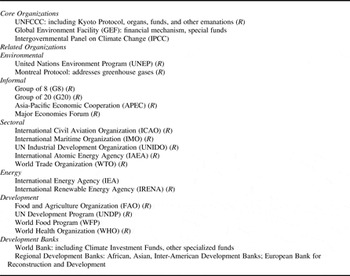
Additional IGOs are (or may become) involved in climate policy. Michonski and LeviFootnote 32 identify twenty-two multilateral organizations that are relevant to climate policy but for which climate is not the primary focus (Table 1); as with the UNFCCC/KP organs, not all are regulatory bodies. These include broad environmental organizations such as the United Nations Environment Program (UNEP), multilateral and regional development banks, and sectoral bodies including the International Energy Agency and WTO. The World Bank, in addition to general lending, administers several specialized funds to support CDM projects and develop carbon markets. Keohane and Victor identify a similar range of institutions in the climate change regime complex.Footnote 33 Michonski and Levi note that “efforts to create new institutions … can take a long time (and often fail),” emphasizing that “a wealth of climate-related institutional capacity already exists” in these IGOs.Footnote 34
IGOs in the climate change regime complex

Note: Regulatory organizations denoted with (R).
In sum, given the breadth of activities undertaken within the climate regime, there are relatively few IGOs. Not all of these organizations, moreover, engage in rulemaking, and most are “old” IGOs that steered their activities toward climate change as the issue became salient. Many, including the World Bank, Food and Agriculture Organization, and International Civil Aviation Organization, date back to the founding of the United Nations. Even the GEF and IPCC predate the UNFCCC. The only recent climate-related IGOs are the International Renewable Energy Agency (2009) and the Major Emitters Forum (2007).
Most of the more recent bodies in the climate change regime complex are emanations. For example, the UNFCCC established the Adaptation Fund (AF) in 2001; it approved the Green Climate Fund (GCF) in 2010, but that is still not operational. These examples reflect a general trend in global governance: IGOs are increasingly creating emanations or “progeny.”Footnote 35 A 1996 study estimated that more than two-thirds of international organizations could be described as “emanations.”Footnote 36 A more recent study estimates that proportion as close to 80 percent.Footnote 37
By contrast, the number of climate-related PTROs is substantially larger, and they are much younger organizations. It is challenging to make a definitive count of this population: there is a “dearth of systematic records on transnational governance initiatives for climate change,” so that “the entire population is unknown.”Footnote 38 However, triangulating across recent studies suggests that there are more than three times as many PTROs as rule-making IGOs in this domain, probably even more.
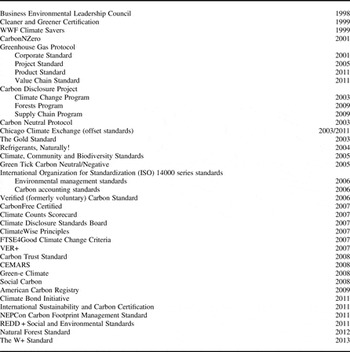
Bulkeley and colleagues identify sixty transnational institutions that explicitly address climate change.Footnote 39 Some involve subnational governments or IGOs; many engage in activities other than regulation. But 75 percent “have some sort of target, monitoring or rule-setting function,” and “over 64 percent of all rule-setting initiatives” are private.Footnote 40 Abbott modifies that database to analyze nearly seventy organizations. Approximately one-third are regulatory; thirteen of those are pure PTROs (nearly as many more are public-private collaborations).Footnote 41 Hale and Roger examine seventy-five transnational climate governance initiatives. Roughly half are private.Footnote 42 Green identifies thirty organizations focused on carbon measurement and accounting.Footnote 43 Applying conservative definitions of “private” and “regulatory” to these data, we identify at least thirty-one organizations, some with multiple standards, that qualify as climate-focused PTROs (Table 2).
Climate change-focused PTROs and year established

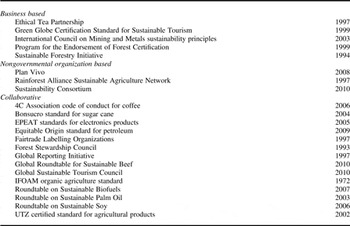
PTROs are also much more recent creations than the IGOs identified earlier. Some 90 percent of all climate-focused initiatives were founded after the signing of the KP in 1997;Footnote 44 almost all climate PTROs were formed since 2000. Just as with IGOs, one must also consider PTROs that address climate issues as part of broader mandates. Based on our ongoing research, at least twenty-two organizations fall within this category (Table 3).Footnote 45 These organizations are diversified: they pursue broad environmental and social goals but also explicitly address climate mitigation and/or adaptation. They have followed a similar temporal trajectory: with three exceptions,Footnote 46 all were formed since 1997, and most since 2000.
Diversified PTROs with climate standards and year established

In sum, there is clear evidence that climate PTROs are multiplying rapidly, much more quickly than climate IGOs. They already outnumber climate IGOs by at least a factor of three. Given that most have emerged within fifteen years, this is a remarkable rate of growth. The empirics only reinforce our question: What explains the rapid growth in PTROs and the relative stability of IGOs?
The Role of PTROs in Climate Governance
A skeptic might question whether the growing number of private transnational regulatory organizations is consequential if these organizations remain at the margins of climate governance. In fact, however, in addition to their broader political significance,Footnote 47 they are an increasingly important component of climate governance. PTROs within the “transnational regime complex for climate change”Footnote 48 regulate large swaths of the global economy. They write and implement influential (albeit voluntary) rules both in core areas of climate governance—such as the measurement of carbon emissionsFootnote 49 and qualification of CDM projectsFootnote 50 —and in related areas including green buildings,Footnote 51 environmentally responsible investment,Footnote 52 and environmental disclosure.Footnote 53
PTROs are increasingly recognized as essential components of the international climate change regime. States created the Ad Hoc Working Group on the Durban Platform (ADP) in 2010 for two purposes: to develop a legal instrument to succeed the KP in 2020, and to pursue mitigation in the interim. The latter effort, Workstream 2, is charged with “enhancing mitigation ambition to identify and explore options for a range of actions … to ensur[e] the highest possible mitigation efforts by all Parties.”Footnote 54
Among other efforts, Workstream 2 is focusing on potential contributions by subnational and private actors. The December 2014 decision of the UNFCCC Conference of the Parties in Lima explicitly recognized the need to identify subnational policy options for mitigation, and to involve private actors in that process.Footnote 55 The Peruvian government, with UNFCCC support, launched the “Nazca Portal” at Lima to highlight private and subnational initiatives.Footnote 56 A recent technical paper by the UNFCCC Secretariat proposes a formal process to “analyze and identify development-focused mitigation opportunities and good practices, under a ‘policy menu.’”Footnote 57 This process will include PTRO standards.
Domestic carbon regulations also show the significance of PTROs. Numerous PTROs address carbon offsetting. States are increasingly incorporating these private regulations into their domestic policies on emissions trading and voluntary reductions. Roughly 30 percent of all states with carbon-pricing instruments now recognize PTRO standards in domestic regulations, blurring the lines between private and public governance.Footnote 58
Organizational Ecology: Concepts and Theory
Our analysis revolves around three key concepts: (1) organizations, (2) populations and niches, and (3) organizational density. Institutions are sets of interconnected rules and practices that prescribe behavior.Footnote 59 They have varying degrees of agency. Some have no ability to act independently; bilateral investment treaties are an example. Organizations are institutions capable of exercising agency.Footnote 60 UNEP and the World Bank are intergovernmental organizations. The Greenhouse Gas Protocol and Forest Stewardship Council are private organizations.Footnote 61
The major units of analysis in organizational ecology are not individual organizations but populations of organizations with particular forms. Populations are “sets of organizations engaged in similar activities and with similar patterns of resource utilization.”Footnote 62 Organizations within a population share common features such as goals, technologies, and forms of authority.Footnote 63 A population defined around such features usually forms a recognizable class, such as trade unions, hospitals, or fast-food restaurants.Footnote 64 Indeed, recent organizational ecology scholarship suggests that the perceptions of relevant audiences define and constitute populations.Footnote 65 Within a population, individual organizations may vary in size, resources, and other features; for example, some may be generalists, others specialists. “Segregating factors,” such as social networks that reinforce separate identities, keep populations distinct; “blending processes,” such as restructurings that recombine organizational features, bring them together.Footnote 66
In ecological terms, a fundamental feature of a population is its members' dependence on a common set of resources. Because of this common dependency, organizations within a population respond similarly to changes in their environment. A population can thus be seen as occupying an ecological niche defined by its required resource set: “the fundamental niche of an organizational form consists of the social, economic, and political conditions that can sustain the functioning of organizations that embody the form.”Footnote 67 If two organizational forms require different resources, they occupy different niches.Footnote 68
Among PTROs, for example, organizations that regulate and certify emissions reduction credits for sale in the voluntary carbon market constitute a population. These organizations require similar social, material, and political resources, including rule-making authority recognized by market participants, legitimacy within relevant stakeholder communities, members, funding (from members, contributors, fees, foundations, or other sources), access to essential actors, and administrative resources. Within the population, however, individual organizations may have larger or smaller budgets, more or less stringent standards, and other variations. PTROs that set standards for city renewable-energy programs would constitute a different population than those PTROs that participate in the carbon market, distinguishable on each of these features, and perceived as distinct by relevant audiences. When an organization modifies its operations so that it requires a different mix of resources—for example, when a climate PTRO targets adaptation rather than mitigation—it shifts to a different niche and population. Populations that affect one another's resources form an ecological community, which co-evolves within their shared environment.
Finally, organizational density is a central feature in organizational ecology because organizations must compete more vigorously for resources in a dense population than in a sparse one. In natural ecologies, the density of a species is understood as “the number of individuals divided by the area occupied.”Footnote 69 Classic works of organizational ecology reflect a similar numerical understanding: Hannan and Carroll define density as “the number of organizations within a specified population, defined in terms of specified spatial and temporal boundaries.”Footnote 70
These definitions do not fit world politics well. Considering the numerator of the density ratio, governance organizations often take on new activities that increase their demand for resources and the intensity of their competition, without changing their numbers. For example, the UN now engages in peacebuilding as well as peacekeeping; the UNFCCC addresses adaptation, finance, and technology transfer as well as mitigation; and the World Bank builds carbon markets as well as funding economic development. Considering the denominator, surface area would be a poor proxy for social, political, and economic resources because such resources are not fixed. Both exogenous events and organizational actions can increase (or decrease) available resources. Indeed, organizations may elicit new resources by expanding their activities: as states and nonstate actors come to accept UN peacebuilding, for example, they provide additional authority, legitimacy, and material resources.Footnote 71
We therefore adopt a different understanding of density. The numerator represents the extent and complexity of governance activities within a population of organizations; numbers are relevant but not determinative. The denominator represents the resources available for that population. Both factors are subject to change. To be sure, this mutability presents significant measurement challenges. In principle, however, one can observe the density of a population, compare its density over time, and compare it with other populations.
Like Waltz's structural theory, organizational ecology focuses on configurations at the systemic level, not on the internal politics of actors or the relationship of internal politics to world politics. But for Waltz, structures are defined by the distribution of capabilities among the major actors in world politics—states. The key variable distinguishing different systems of world politics is the distribution of power among states—unipolar, bipolar, or multipolar.Footnote 72 In organizational ecology, by contrast, the relevant structures are populations of actors, not the actors themselves, and the key variable is the organizational density of a given population. States constitute populations, as do intergovernmental, transnational, and other types of organizations.
These two theoretical approaches are complementary rather than in conflict: both are structural because they focus on configurations at the systemic level, but they emphasize different configurations. Both can be distinguished from theories that focus on the internal characteristics of actors or that examine relationships between internal and interstate politics—the “second image” or “second image reversed.”Footnote 73
Theory: Organizational Growth and Change
Organizational ecology theory is concerned with the institutional factors that affect the “vital rates” of organizations within a population—especially their rates of “birth” (founding or entry) and “death” (dissolution or exit). For an organizational form to be ecologically viable, its vital rates must be at least in balance. For it to expand, its vital rates must be positive. Organizational ecology identifies two processes that explain the ongoing success or failure of organizational forms; both are based on the structural variable of density. They are legitimation and competition.
First, an emerging organizational form must be seen as legitimate in the environments where its members operate. Individual organizations pursue varied legitimation strategies. In an ecological perspective, however, the mere fact that the number of organizations in a population is increasing makes that form more widely acceptable to key audiencesFootnote 74 under the logic of appropriateness.Footnote 75 Early in the life of the organizational form, then, there is a positive relationship between institutional density and growth rates through the mechanism of legitimation. But this process is subject to diminishing returns: eventually, additional organizations will not further enhance the legitimacy of the form.
Second, competition strongly affects the vital rates of organizations. In the early years of an organizational form, density is low relative to carrying capacity: the numbers of organizations and the scope of their activities are small. As a result, competition for resources is limited. The number of organizations can grow rapidly; indeed, its growth rate may increase for some time. As more organizations occupy a niche and expand their activities, however, resource constraints begin to bind. The ecological process of selection begins to operate: organizations find it more difficult to gain members, financing, and other essential resources. Past the inflection point, there is a negative relationship between density and growth rates through the mechanism of competition.
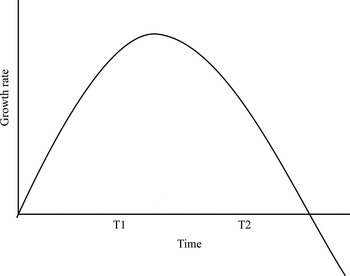
Based on these two factors, scholars studying organizational ecology observe broad regularities in organizational life cycles, across diverse organizational forms. New forms initially grow rapidly, with little resource competition and increasing legitimacy; eventually, however, competition causes growth to level off and decline, perhaps even turning negative as organizations exit.Footnote 76 Figure 1 depicts this common pattern.
Organizational growth rates over time

Intrinsic organizational features influence how particular types of organizations shape and respond to their institutional environments. Some organizational forms require substantial investments of resources, personnel, and time to establish; they have high entry costs. Organizations of this type may ultimately grow large and are often stable and persistent. However, resource limitations imply that relatively few can be created. As a result, the intrinsic growth rate of the form is limited. Because of their long “gestation periods,” such organizations may be unable to respond rapidly to new opportunities and challenges.
Other organizational forms, in contrast, can be established with relatively small investments; they have low entry costs. Organizations of this type often have simpler structures and operate at smaller scales than those of the first type. Individual organizations may therefore remain smaller and less stable, but many can be created within a given period; their intrinsic growth rates are high. In addition, their short gestation periods allow them to respond nimbly to new opportunities or other environmental changes.
Organizations of these two types pursue classic, contrasting ecological strategies.Footnote 77 The slow-but-stable type reproduces at a low rate, producing relatively few new units, but with heavy investment in each. As a result, most units survive. Their stability enables them to weather difficult resource conditions; their behavior is also predictable, a quality valued by many organizational principals. The rapid-but-fragile type, in contrast, reproduces at a higher rate, producing many more new units, but with less investment in each. As a result, the survival chances of individual units are relatively small. In favorable conditions, however, this form can expand rapidly.
Organizational Ecology and Institutional Growth: Three Conjectures
We can now apply insights from organizational ecology to help explain the viability and rapid growth of private transnational regulatory organizations, relative to the slowing growth of IGOs. We develop three conjectures with observable implications for the behavior and growth of IGOs and PTROs.
Intrinsic Features
We begin by contrasting the intrinsic features of IGOs and PTROs. Multilateral IGOs generally belong to the slow-but-stable organizational type. IGOs operate largely as agents of their member states, which are reluctant to delegate extensive authority.Footnote 78 The formation of IGOs thus requires costly political negotiations over difficult design issues, such as organizational mandates and authorities, voting procedures, oversight mechanisms, and financial support, and then requires ratification by diverse states following domestic approval procedures.Footnote 79 There is also a limited pool of potential member states; if “IGO fatigue” sets in among them, it will be difficult for new organizations to be created. Finally, domestic budget constraints make state provision of material support to IGOs relatively inelastic in response to new demands. These features limit the ability of IGOs to respond to opportunities or challenges, as populations, by expanding the number of purpose-built organizations.
PTROs, in contrast, resemble the rapid-but-fragile type of organization. PTROs are entrepreneurial;Footnote 80 a few entrepreneurs can establish a PTRO within a short time, at limited expense and with little if any external oversight. PTRO founders, moreover, come from a deep pool of civil society, business, and technical actors—far larger than the pool of potential member states. Most PTROs can also begin operations with a few members. As populations, then, PTROs can respond rapidly to new opportunities and challenges through the formation of new organizations. Yet PTROs are relatively fragile, suggesting that over time they will experience higher “death rates” than IGOs.Footnote 81
This discussion gives rise to our first conjecture:
C1
Private transnational regulatory organizations will have lower entry costs than intergovernmental organizations.
Observable implications of this conjecture include the following: (1) PTROs will experience higher birth rates than IGOs; and (2) as populations, PTROs will respond more rapidly to changes in the environment through organizational formation than will IGOs.
Institutional Density and Niche-finding
The institutional environment in which IGOs operate is much denser than that of PTROs. In addition, distinct features of these organizational forms help shape their environments and determine their responses to environmental constraints.
For IGOs, a dense institutional environment is largely a product of the organizational life cycle depicted in Figure 1. Over time, IGOs have moved far along the growth rate curve, to around the point labeled T2; their numbers and the complexity of their activities have greatly increased. Much of this expansion has been matched by increases in social, political, and material resources, but constraints on state support mean that resources have not fully kept pace. In this world of high institutional density, resource competition is intense, affecting state decisions to create new organizations and organizational decisions to initiate new activities.
IGO strategies intensify these conditions of competition. IGOs have strong incentives to build out the breadth and complexity of their activities to the boundaries of their assigned domains: doing so allows IGOs to demonstrate to principals that they are fulfilling their mandates. These mandates are often broad and sweeping: the General Assembly resolution establishing UNEP, for example, mandated it to promote international cooperation and appropriate policies “in the field of environment.”Footnote 82 IGOs also have strong incentives to interpret their mandates broadly, expanding the accepted scope of their domains, even if they impinge on others.Footnote 83 Doing so allows IGOs to satisfy organizational incentives to prosper and expand, and to elicit additional political, social, and material resources.
In general, IGOs have limited organizational flexibility because of strong state oversight and multiple veto points. Combined with the difficulty of forming new IGOs, this makes the creation of emanations the best, if not the only, way for IGOs to respond to opportunities and challenges. IGO officials largely drive the growth in emanations, advocating for additional “progeny” and taking the lead on their design.Footnote 84 States often support this strategy to avoid the costs of establishing new organizations,Footnote 85 although the resources they provide may not keep pace with demand. As a result, however, IGOs must contend with increasingly dense complexes of organizations and rules, pursuing costly competition in congested organizational spaces.Footnote 86
PTROs, in contrast, are still at an early stage in their organizational life cycle. In Figure 1, we would place PTROs at point T1: their growth rates have increased rapidly and are still increasing in many issue areas. PTROs thus operate in a world of modest institutional density, both in numbers and in the scope and complexity of their activities, relative to their potential resource base. This favorable organizational environment limits resource competition among PTROs and provides numerous niches in which they can gain footholds and thrive.
PTRO strategies reinforce the effects of low institutional density. As rapid-but-fragile organizations, PTROs have strong incentives to avoid intense competition. Competition absorbs scarce resources and may lead to costly discord and conflict, even to organizational “death.” To avoid competition, PTROs may cooperate by reciprocally adjusting their activities, for example, by shifting to less competitive areas or actively collaborating.Footnote 87 Alternatively, and at lower cost, they may adapt unilaterally, shifting their activities to a niche in which resources are more abundant or institutional density lower.Footnote 88
PTROs are highly flexible, which enhances their ability to locate and occupy favorable niches. Their authority is primarily established through acceptance of their standards, not through delegation from principals. As a result, they are less constrained by principal oversight; their principals are in any case entrepreneurial. In addition, PTROs frequently have less costly decision procedures and more flexible mandates than IGOs. This suggests that at any point on the growth rate curve PTROs will be better able to occupy favorable niches.
This discussion gives rise to our second conjecture:
C2
Intergovernmental organizations will expand their activities to fill their domains, while more flexible private transnational regulatory organizations will strategically seek favorable niches.
Observable implications of this conjecture include the following: (1) the number of issues the average IGO deals with will grow more rapidly than the number dealt with by the average PTRO; and (2) IGOs will expand into adjacent domains, crowding against other IGOs, while PTROs will operate in narrower niches that limit competition.
Legitimation
Legitimacy is an especially important organizational resource for PTROs: they are a more novel form than IGOs, and they depend on voluntary adoption of their standards. In organizational ecology, an increase in the numbers of an organizational form, with its associated practices, will gradually lead to widespread acceptance of the form by relevant audiences. PTROs do not rely solely on that phenomenon, however, but actively pursue strategies of legitimation.Footnote 89 Multistakeholder organizations such as the Forest Stewardship Council adopt representative, participatory structures. Organizations within the ISEAL Alliance follow consultative standard-setting procedures. Even industry schemes seek legitimacy in collective action. All seek output legitimacy through concrete results.
PTROs are also able to pursue an additional legitimation strategy: engaging in activities that complement the policies of IGOs and other legitimate public institutions.Footnote 90 Many follow norms and procedures approved by states. For example, the vast majority of private carbon-offset organizations recognize CDM rules.Footnote 91 ISEAL Alliance organizations follow standard-setting and certification procedures approved by the WTO and the International Organization for Standardization (ISO).Footnote 92 In other cases, PTROs engage in activities that parallel IGO rules and programs; private carbon-offset standards, for example, structure the voluntary carbon market in parallel with official market systems. Such relationships, both consistent with the niche-finding strategy, can enhance the legitimacy of PTROs within stakeholder communities and the public, strengthening their authority.
The flexibility of PTROs enhances their ability to locate and form complementary relationships, as with other types of niches. In addition, IGOs increasingly seek to engage PTROs through the strategy of orchestration to help IGOs achieve their own goals.Footnote 93 IGO orchestration enhances the legitimacy, authority, and competitive position of collaborating PTROs, which provide IGOs with access to private targets, information, and other capabilities.
As a result of such strategies, reinforced by growth in numbers, the authority of PTROs has increased rapidly, with public and private actors alike adhering to, endorsing and ratifying their rules.Footnote 94 For example, the last two global summits on sustainable development emphasized the need for PTROs, along with other voluntary commitments, to address the challenging problems in this area. The “sociological legitimacy” of PTROs appears increasingly established.Footnote 95
This discussion gives rise to our third conjecture:
C3
Private transnational regulatory organizations will strategically forge complementary relationships with intergovernmental organizations, enabling them to gain legitimacy and other resources.
Observable implications of this conjecture include the following: new domains of IGO activity will be associated with rapid increases in the numbers and activities of PTROs in those domains, provided that PTROs have access to them.Footnote 96
Taken together, these conjectures suggest an organizational ecology explanation for the phenomenon of differential growth rates as between PTROs and IGOs. C1 implies that the birth rates of PTROs will be much higher than those of IGOs. C2 suggests that the survival rates of PTROs will also be relatively high because their institutional density is low, minimizing competition among them. C3 claims that when IGOs expand into new areas of activity, PTROs will not be far behind. Together, these conjectures lead us to expect that the aggregate growth rate of PTROs in contemporary world politics will exceed that of IGOs.
Organizational Ecology in Climate Governance
We probe the plausibility of our analysis by examining the global governance of climate change—a politically salient area involving numerous IGOs and private transnational regulatory organizations. Organizations of both types adopt and implement rules and standards and engage in related administrative activities.
We present evidence from climate governance that supports the three conjectures introduced earlier. For both IGOs and PTROs, the organizational and environmental factors highlighted in the conjectures (entry costs and birth rates; density; flexibility, and niche strategies) are cumulative. For IGOs, all of these factors work in a negative direction, constraining growth rates. For PTROs, in contrast, they all work in a positive direction, enhancing growth rates and viability.
First Conjecture: Entry Costs and Growth Rates
Our first conjecture was that PTROs have lower entry costs than intergovernmental organizations, which means that they should experience higher birth rates than IGOs and that populations of PTROs should respond more rapidly than populations of IGOs to changes in the environment through organizational formation. The arduous processes to establish financial mechanisms under the UNFCCC and KP provide ample evidence that intrinsically high entry costs constrain the creation of new IGOs.
The Adaptation Fund (AF) grew out of the Kyoto Protocol (KP), which required that a share of proceeds from CDM projects be used to fund adaptation activities in vulnerable developing countries.Footnote 97 In 2001, the KP parties voted to create a fund for adaptation and directed 2 percent of CDM proceeds to it. In 2007, with the KP already in force, the parties established its governance structure, agreeing on a complex system of representation with guaranteed seats for the UN regions, least-developed countries, small island developing states, and UNFCCC Annex I states, along with a temporary secretariat and trustee. In 2008, the parties established the Adaptation Fund Board and adopted rules and procedures, revised in 2009. The AF approved its first project in 2010; as of March 2015 it had approved only $265 million in grants and disbursed only $95 million.Footnote 98
An equally fraught process has characterized establishment of the Green Climate Fund (GCF), intended to become the main financial instrument of the UNFCCC.Footnote 99 The GCF was proposed at the 2009 Copenhagen Conference of the Parties (COP) to the UNFCCC and included in the Copenhagen Accord. The 2010 Cancun COP formalized the commitment to establish the GCF and established a Transitional Committee to design it. The committee recommended some basic design elements, including a board with multiple guaranteed seats like those on the Adaptation Fund Board; the 2011 Durban Conference of Parties adopted these recommendations.
However, northern and southern states were sharply divided over many aspects of the GCF design, and the governance structure approved at Durban was incomplete. Among the important unresolved issues were the GCF's relationship to the UNFCCC, mechanisms for capitalizing the fund, the fund's “business model” and operating modalities, and the board's voting rules.Footnote 100 From 2012 to 2014, the board made a series of decisions necessary to the initial mobilization of resources. Although states have pledged some contributions, no disbursements have yet been made.
Many climate PTROs provide striking support for the other aspect of this conjecture, that PTROs will have lower entry costs and higher birth rates. For example, in 2010 environmental NGOs (including the Natural Resources Defense Council [NRDC]) and socially responsible investor groups (including the CERES Investor Network on Climate Risk and California State Teachers Retirement System) established the nonprofit Climate Bond Initiative (CBI).Footnote 101 CBI was created to develop standards for private-sector “climate bonds,” following the example of successful public bonds dedicated to supporting environmental projects. In 2011—only a year later—CBI launched a prototype Climate Bond Standard focused on bonds backed by wind energy assets. This rapid entry is not unique: organizations such as CarbonFix and the Natural Forest Standard followed similar schedules. CarbonFix also illustrates the fragility of PTROs; it merged with a larger organization, the Gold Standard, in 2013.
The flexible governance of PTROs allows them to operate efficient, though still legitimate, design processes for standards and procedures. Entrepreneurs (such as NRDC and CERES), familiar with governance needs and niche opportunities, typically initiate these processes. The UN Environmental Program (UNEP) and other IGOs sometimes provide support, as UNEP did for the Global Reporting Initiative (GRI) and Principles for Responsible Investment. Entrepreneurs convene expert technical advisory groups, organize stakeholder consultations, and provide opportunities for public comment, typically online. These processes, and the resulting institutional designs, increasingly rely on learning from existing organizations.
Second Conjecture: Institutional Density and Niche-finding
Our second conjecture was that IGOs will expand their activities to fill their domains, while PTROs will strategically seek favorable niches. This means that the IGOs should deal with more issues than PTROs, on average, and that IGOs should expand into adjacent domains, while PTROs operate in narrower niches.
The tendency of IGOs to expand their activities to the borders of their domains and beyond is illustrated by the widely noted phenomenon of “mission creep.” Kahler argues that as issue areas are redefined (for example, from environment to sustainable development) and new issues emerge, IGOs consistently expand their activities to encompass the new frontiers, even to the point of institutional overload.Footnote 102 Gutner agrees, arguing that this strategy, combined with the breadth and complexity of IGO mandates, undermines performance;Footnote 103 Einhorn argues that mission creep impairs accountability.Footnote 104
A second illustration is the phenomenon of “bandwagoning,” in which IGOs and treaty bodies link themselves to the discourse and policies of salient regimes such as climate.Footnote 105 This expansionary strategy frequently “colonizes” portions of neighboring domains, both to gain resources and to ensure that an organization is fully occupying its own domain. For example, the Secretariat of the UN Convention to Combat Desertification (UNCCD) has “committed disproportionate attention to climate change to capitalize on the financial resources the climate regime has garnered.”Footnote 106
Like the UNCCD example, the Rio Conventions provide evidence of institutional expansion and crowding. These conventions, all signed in 1992, include the UNFCCC, UNCCD, and Convention on Biological Diversity. Like many environmental agreements, they have significant substantive overlap. Land conversion is a common catalyst for climate change, biodiversity loss, and desertification; some sources of biodiversity are significant sources of greenhouse gases when destroyed. Accordingly, policy measures under one convention necessarily affect others, sometimes negatively. For example, the CDM accepts credits generated by monoculture plantations—a clear threat to biodiversity. Conversely, properly designed forestry projects can both combat climate change and preserve biodiversity.Footnote 107 A similar level of institutional density can be observed in renewable energy (hydro, wind, and solar) and other fields.
The Rio Conventions have recognized the existence of rule overlaps and the costs they create, but each has incentives to maintain these overlaps to elicit additional resources. In 2001, the three Secretariats created a “Joint Liaison Group” (JLG) to share information and coordinate efforts yet there has been virtually no progress toward alleviating overlap; more than a decade later, the JLG is still focused on shallow forms of cooperation. Indeed, the Executive Secretary of UNFCCC recently argued that the JLG should not undertake concrete implementation activities or deal with international rules,Footnote 108 but should merely support the parties' activities at the national level. In short, the conventions are pursuing superficial cooperation that allows for continued expansion and the increased resources expansion may elicit.
In contrast, PTROs frequently follow narrower niche strategies. Consider the Verified Carbon Standard (VCS), which recently launched a new standard for REDD—reduced emissions from forest degradation and deforestation. Although the UN and private organizations have undertaken numerous REDD activities, all have been project-based. There is an emerging consensus, however, that REDD activities are ideally undertaken across a jurisdiction, rather than as discrete, geographically delimited projects. “Jurisdictional REDD” reduces the likelihood of “leakage”—simply pushing deforestation from the project area to other locations. Recognizing the lack of appropriate rules, VCS designed its standard to help states and subnational actors implement jurisdictional REDD. Its entry strategy was explicitly to select a low-density domain.Footnote 109
The Greenhouse Gas Protocol (GHGP) was created by two NGOs: the World Resources Institute and World Business Council on Sustainable Development, the latter business-based.Footnote 110 The organization's standards are measurement tools that allow organizations to account for their carbon emissions. Its standards apply to companies, carbon-offset projects, and products.
The GHGP first published its corporate standard in 2001. At that point, the KP had just been signed but had not yet entered into force. There was a smattering of national and private experiments with carbon markets, such as the UK Emissions Trading Scheme and Chicago Climate Exchange, but in general the organizational landscape was sparse, with few private initiatives and virtually none at the corporate level. UNEP was working on a corporate-level measurement tool but its program had a slightly different audience and never gained traction.Footnote 111 Thus, the GHGP entered an institutional environment where it could establish itself without significant competition. Moreover, by filling a recognized governance gap that UNEP had been unable to fill, it gained some benefits of complementarity. These conditions allowed it to gain political resources, avoid discord, and establish itself as a credible and legitimate standard-setting organization.
Since then the GHGP has enjoyed significant success. It is currently the most widely used corporate-level accounting standard. It is also the basis for several other carbon accounting frameworks, including that of the International Organization for Standardization (ISO-14064, Part 1). In 2013, 81 percent of Global 500 companies reported emissions using standards based on GHGP.Footnote 112 In short, the GHGP has become the leading standard for corporate-level emissions accounting and reporting. Its staying power and high adoption rate demonstrate the success of its niche strategy.
The Climate Bond Initiative (CBI), discussed earlier, complements private carbon-offset standards by providing financing for offset projects. By focusing its standards on financial instruments, the CBI entered its own low-density niche; there is virtually no overlap or competition with offset standards. The recently created Natural Forest Standard,Footnote 113 in contrast, entered a domain crowded with private sustainable forestry schemes. Yet it was still able to limit competition by carving out its own narrow niche: it focuses only on projects that are designed for “REDD+,” are relatively large, involve natural forests, and do not involve commercial forestry.
The Green-e Climate Certified Carbon Offset program also shaped its mission to avoid competition with private offset organizations.Footnote 114 The Green-e standard addresses retail sellers of voluntary offsets. It requires that the projects underlying retail offsets be certified by organizations such as the Gold Standard and VCS; it complements those standards by verifying that credits sold are retired from inventories and by regulating consumer advertising and disclosures. These cases illustrate the “conscious parallelism” that niche-finding produces.Footnote 115 They also reflect the ability of flexible, entrepreneurial organizations to adopt widely varying strategies within a particular issue area, enabling PTROs to enter sparsely populated niches in ways not available to IGOs.
Third Conjecture: Legitimacy and Complementarity
Our third conjecture was that PTROs will gain legitimacy and other resources by forming relationships with IGOs. This means that new domains of IGO activity should be associated with the increased presence of PTROs in those domains, provided that PTROs have access to them.
Carbon offset programs support C3. The Clean Development Mechanism (CDM) is the largest of three market-based mechanisms created by the KP. It allows developed nations to purchase carbon offsets produced from projects in the developing world to help achieve their emissions-reductions commitments. The CDM thus creates a “compliance market” for offsets: the purchase of KP-monitored carbon credits helps developed countries meet their binding reduction requirements.
After the CDM was in place, PTROs began creating their own carbon-offset rules. Many are more stringent than CDM rules; in addition, many expand on the CDM through a “climate-plus” logic. The projects they certify produce emissions reductions but must also provide additional benefits, such as biodiversity preservation, local economic development, or long-term sustainability.Footnote 116 Private offset rules and the voluntary private market they support thus complement public rules in terms of meeting—and exceeding—CDM goals. But PTRO standards have different targets. Whereas states use CDM to comply with their KP targets, most buyers of private offsets are business firms that use them to enhance their reputations or prepare for future regulation.Footnote 117
Not only do PTROs intend to complement the CDM; they are in fact substantively complementary. A network analysis of public and private offset standards shows that, overwhelmingly, private standards choose to link to CDM rules: roughly 80 percent of all private transnational carbon offset standards recognize those rules.Footnote 118 Given the uncertain future of the KP and carbon markets, PTROs are “hedging their bets” by ensuring maximal compatibility with other standards—including the dominant public standard, CDM. This strategy of compatibility increases the likelihood that a given private standard will continue to be usable in a future regulatory regime and maximizes organizational autonomy because standards need not compete directly with the CDM (though they do compete with each other). It enables PTROs to maintain relevance—and thus survive—into the future.
Complementary PTRO standards also arise in climate finance. In the mid-1980s, the World Bank and European Investment Bank issued “Green Bonds” and “Climate Awareness Bonds,” respectively. Those bonds included financial terms equivalent to commercial bonds and were (highly) rated on the same bases; however, proceeds were “ring-fenced” for use exclusively in environmental projects. As we discussed, in 2010 environmental NGOs and socially responsible investors created the CBI. CBI's standards for private-sector “climate bonds” complement public bonds and other forms of climate finance. CBI and voluntary offsets both involve the construction of new niches not previously identified as part of a governance domain.
In some areas, IGOs encourage PTROs to provide complementary standards through the strategy of orchestration. In 1997, UNEP—having long attempted to persuade businesses to report on their environmental impacts as a complement to treaty-based national reporting mechanisms—collaborated with the environmental NGO CERES to found and promote the GRI. UNEP engaged in notable efforts to build the authority and legitimacy of GRI, including arranging its launch at the General Assembly, endorsing it and recruiting governments to host its headquarters. GRI is now an independent, multistakeholder institution, but a UNEP official sits on its board. Its standards for environmental reporting, which address carbon emissions and energy consumption among other behaviors, have become the global standard.
Finally, IGOs also afford nonregulatory private organizations opportunities to provide complementary services rather than standards. The 2002 World Summit on Sustainable Development (WSSD) encouraged public-private and private-private partnerships to develop activities that would further implementation of global norms, including the Rio Declaration and WSSD outcome. Nearly 350 of these so-called Type II partnerships were registered. The 2012 United Nations Conference on Sustainable Development (Rio+20) similarly encouraged private “voluntary commitments” focused on implementation.
Conclusion: Implications for Governance
The composition of global governance institutions has shifted dramatically in recent years. Intergovernmental organizations (IGOs), the dominant form since at least the end of World War II, remain numerous and influential, but their growth rates have slowed. Other organizational forms—from informal intergovernmental institutions to transgovernmental networks and private transnational regulatory organizations (PTROs)—have appeared and expanded rapidly.
This institutional revolution has potentially important consequences for a wide range of outcomes, in climate governance and beyond. PTROs are controlled by private actors, not by states; this difference has broad implications. The activities of PTROs respond primarily to private actors' priorities, which may differ from the priorities of governments. PTRO standards directly address private targets, primarily businesses; they bypass governmentsFootnote 119 and may provide a rationale for governments to avoid politically costly regulation. Business frequently participates in PTRO governance. It may promote weak rules, engage in efforts to reinforce oligopoly and monopoly, and attempt to preempt public regulation. Short of this, it may promote market-oriented measures that generate private benefits, furthering the neoliberal cast of environmental policy.Footnote 120 PTROs are accountable primarily to their members and those that voluntarily support them, not to society as a whole.
PTROs also promise important governance benefits. They frequently reinforce public governance with complementary standards and mechanisms. They can act when divergent interests block intergovernmental agreement. The rapid formation of numerous PTROs occupying diverse niches provides a wealth of natural experiments from which governments and IGOs can learn. PTROs provide new opportunities for civil society, business, workers, technical experts, and other private actors to participate in international governance, although these tend to bypass government control and traditional notions of democracy.
Organizational ecology suggests further political implications. PTROs can multiply rapidly in response to new opportunities. However, if PTROs are “fragile” as well as “rapid,” they may be less resilient than established organizational forms in the face of shocks. Changes in public attention or attitudes, or in the priorities of foundations or other funding bodies, may be enough to produce widespread failure. PTRO responses to shocks are difficult to forecast, however, because the organizational form is so young; comparative analysis of the life cycles of other forms should shed valuable light on future prospects. Similarly, PTROs can flexibly occupy niches where competition is limited. Yet this may lead to greater institutional fragmentation, reducing impacts, and requiring investments in coordination. Niche-finding flexibility may also render PTROs less predictable than incumbent forms—they may suddenly shift to new areas of operation.
Actor-centric theories of politics shed substantial light on how organizational agency, strategies, and power—subject to constraints—shape the behavior of governance organizations. But these theories provide little insight into how populations of organizations become viable (or fail), behave, and evolve. Although regime complex theory and related approaches have begun to explore the impact of interorganizational interactions on behavior, they have yet to provide a full understanding of the impacts of organizational structures in resource-constrained environments.Footnote 121
We introduce organizational ecology theory, not previously applied to international relations, to help fill these analytical gaps. Organizational ecology focuses on populations: it explicitly addresses the abundance and diversity of organizational populations, their viability, and their life cycles of growth and decline. Organizational ecology emphasizes the process of selection through which some new forms succeed, while others fail and exit. Selection is driven, in this framework, by the nature of the institutional environment—especially the conditions of resource competition—and by interactions among organizations in conditions of greater or lesser resource scarcity.
Actor-centered and ecological approaches are complementary. Organizational ecology enhances our understanding of the constraints and opportunities presented by environmental and population-level variables. Actor-centric theories supply the micro-foundations for understanding organizational responses to those constraints and opportunities. Even here, however, organizational ecology makes important contributions, highlighting actor characteristics important in structuring and mediating the influence of organizational environments.
We have chosen a “most-likely case”Footnote 122 to demonstrate the applicability of organizational ecology theory: the issue-area of climate change, where much new PTRO activity is taking place. When one seeks to demonstrate the existence of a new phenomenon, selecting a most likely case is appropriate; but this choice implies that one cannot generalize to the entire domain. We can only claim to have shown, therefore, that organizational ecology, with its focus on populations and institutional density, helps to explain macro-level patterns of organizational change in institutionally dynamic domains such as climate policy. Whether it is equally relevant to other issue-areas remains to be established by further research. As a structural theory, however, organizational ecology should be highly transferable across issue-areas. Although the specific institutional forms and patterns of growth in other domains may vary, fundamental concepts such as organizational density, resource competition, and legitimation are likely to retain their explanatory power.
Similarly, because we have focused on two sharply divergent organizational forms, it is tempting to suggest that other forms—such as informal and transgovernmental institutions—fall between those extremes. Transgovernmental networks, for example, have lower entry costs and greater flexibility than IGOs; their mandates are more fluid, and states exercise less formalized oversight. Although we do not consider such institutions in this study, organizational ecology opens an important comparative research agenda: exploring the evolution of diverse organizational forms and the interactions among them.
Our analysis suggests likely future trajectories for the two forms we have considered, especially for PTROs. If these organizations continue to thrive, we would expect their environment to change in line with the growth rate curve in Figure 1. Over time, as their numbers and the complexity of their activities increase, competition should intensify, while the number of low-density niches should decline. PTROs may therefore modify their strategies. They may increasingly invest in defending their “turf;” they may seek to fully occupy their domains and refuse to cede any portion of them.
To be sure, flexible PTROs have niche-finding advantages at any point on the growth rate curve. However, recent organizational ecology scholarship suggests that the flexibility of organizational forms declines with age.Footnote 123 PTROs may thus become more highly bureaucratized and inert over time. Eventually, they could even become organizational “dinosaurs,” trapped in a form adapted to the institutional environment of the early twenty-first century. Other forms may then prove better adapted to current conditions.
In all these settings, though, analysts will still find it valuable to think, as organizational ecology does, in terms of populations. They will still find structural features such as institutional density, niches, resource availability, and conditions of competition important. They will also look to the intrinsic characteristics of organizational forms that shape environments and influence their impact on individual organizations, including entry costs, birth and death rates, and flexibility. Organizational ecology does not answer, certainly not definitively, all questions of future organizational design and behavior; it must be complemented by the micro-foundations provided by agent-centered theories. Where this is done, however, organizational ecology is a valuable addition to the international relations toolbox.