The Frente Sandinista de Liberación Nacional (Sandinista National Liberation Front, FSLN), Frente Farabundo Martí para la Liberación Nacional (Farabundo Martí National Liberation Front, FMLN), and Unidad Revolucionaria Nacional Guatemalteca (Guatemalan National Revolutionary Unit, URNG) were coalitions of political-military organisations that overcame ideological and strategic differences to confront repressive, authoritarian regimes. However, internal differences led to the fracturing of each organisation and the creation of splinter parties following negotiated settlements to the civil wars in El Salvador and Guatemala and electoral defeat in Nicaragua. The coalitions fractured as the new parties had to define political platforms relevant for the post-Cold War period and select leaders capable of winning through elections what they had previously fought for in battle.
A number of recent studies have begun to explore the transitions of these armed groups to political parties. After having been voted out of office in 1990 in Nicaragua, centralisation of resources around Daniel Ortega allowed the FSLN to successfully adapt to changing conditions and win the 2006 and 2011 presidential elections.Footnote 1 Several have sought to explain the FMLN's transition from the region's most powerful armed group to successful political party by focusing on its wartime popular support which, for a variety of reasons, translated into post-war success beginning with the 1994 elections of the century.Footnote 2 In Guatemala, there is no shortage of explanations for the URNG's failure as a political party, including problems of internal democracy, outdated ideology, wider systemic issues such as security and the strength of party identification and other organisational and institutional factors.Footnote 3 , Footnote 4 There have also been a number of works that utilised a comparative approach to the performance of each of these groups as political parties. However, only Allison and Martín on the FMLN, Sáenz de Tejada on the FMLN and URNG, and Cottam et al. on the FSLN make internal divisions central to their analyses.Footnote 5
While there has been limited research on the divisions within the original political-military organisations, there has been less scholarship on the new parties that formed from the divisions. The Movimiento de Renovación Sandinista (Sandinista Renovation Movement, Renovate-MRS) and Movimiento por el Rescate del Sandinismo (Movement to Rescue Sandinismo, Rescue-MRS) emerged from the FSLN. The Partido Demócrata (Democratic Party, PD), Movimiento Renovador (Renovating Movement, MR), and Frente Democrático Revolucionario (Revolutionary Democratic Front Party, FDR) were each formed by historic leaders of the FMLN. Finally in Guatemala, the Alianza Nueva Nación (New Nation Alliance, ANN) was taken over by former members of the URNG. While resignations and expulsions initially hurt the historic parties, the FSLN and FMLN subsequently emerged strong enough to win the presidency of their respective countries. The splinter parties, on the other hand, have disappeared or are on the verge of disappearing.
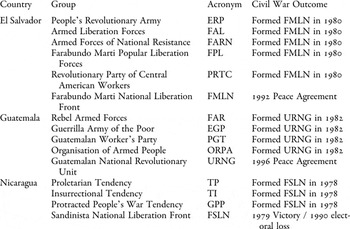
Central American Armed Opposition Groups

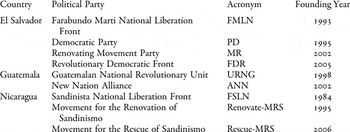
Political Parties with Roots as Armed Opposition Groups

In this article, two primary questions are investigated. First, why did the armed coalitions fracture in the post-war period? Second, what explains why those groups that splintered from the FSLN, FMLN and URNG fared so poorly as political parties? There is no single factor that explains the failures of the splinter parties. The splinter parties failed to amass political support because of their limited financial resources, alliances with non-revolutionary centrist and centre-right parties, and the tendency for voters to overlook internal debates even as the historic parties underwent significant ideological and personnel changes during the region's transition to democracy. In the remainder of the article, the histories of the FSLN, FMLN and URNG are described, focusing particularly upon internal differences within each group during the war and the post-war. Explanations are then given of what led to the exit of each splinter group and their failed efforts to construct political alternatives.
Struggling to Define Sandinismo
Outraged at poor political, social and economic conditions under the United States-backed repressive Somoza regime in Nicaragua and inspired by the Cuban revolution, Carlos Fonseca, Silvio Mayorga and Tomás Borge established the Frente de Liberación Nacional (National Liberation Front).Footnote 6 Two years later, Fonseca convinced the other leaders to rename the organisation the Frente Sandinista de Liberación Nacional (Sandinista National Liberation Front, FSLN) after nationalist and anti-yanqui Augusto César Sandino.Footnote 7 The FSLN performed relatively poorly for the next 15 years, suffering a series of military defeats before officially dividing into three competing factions in late 1975: Tendencia Proletaria (Proletarian Tendency, TP), Tendencia Insurreccional (Insurrectional Tendency, TI; also known as Terceristas or Third Way), and Guerra Popular Prolongada (Protracted People's War Tendency, GPP). Each ‘tendency’ differed in its belief as to how best to achieve revolutionary success and, to a certain extent, how society should be constructed following Somoza's overthrow. The TP subordinated military strategy to political strategy, ‘was more class conscious, cautious with regard to strategy, and primarily a clandestine, urban group’ led by Jaime Wheelock, Luis Carrión and Roberto Huembes.Footnote 8 It believed that it was more important to develop the proletariat than the peasantry.Footnote 9 Brothers Daniel and Humberto Ortega's TI sought to form political alliances with other non-revolutionary, non-socialist organisations through a mixed urban-rural strategy. The TP and TI both recruited young students from traditional families studying at the Jesuit-run Central American University in the 1960s and 1970s.Footnote 10 Finally, Fonseca and Oscar Turcios headed the rural-dominated GPP which sought to organise the peasantry through Maoist guerrilla strategy. Its rural emphasis meant that young Sandinistas from traditional families were underrepresented in the organisation compared to the other groups.
The formal reunification of the Sandinista tendencies occurred in March 1979. Each group came to the realisation that long-term revolutionary success ‘could not be assured on the basis of support from a single social class or simply by means of tactical alliances and military adventurism.’Footnote 11 Shared Sandinista identity, the ability of each tendency to maintain its command structures, the equal distribution of power within the FSLN, a ‘task oriented’ approach to interacting with one another, and their emphasis on the ‘final objective’ of overthrowing the Somoza regime factored in as well.Footnote 12 The GPP and TP did not want to be left behind following the TI's success in 1977–78.Footnote 13 Finally, Cuba pressured the tendencies to work closer together in return for assistance.Footnote 14 The reunited FSLN organised a broad domestic coalition of students, labour, peasants, and economic elites and an international coalition of guerrillas and governments in overthrowing Anastasio Somoza Debayle in July 1979.
The unity that had been established in the late 1970s continued into the revolutionary years. Martí i Puig argues that there was little change in the FSLN's organisational structure during the 1980s because each of the nine leaders of the party's directorate (three representatives from each faction) had veto power over decisions made by the National Directorate.Footnote 15 The directorate was designed to function as a ‘collegial body’ because ‘the three factions did not trust each other sufficiently to appoint a single leader’.Footnote 16 Pérez, on the other hand, argues that unity was necessary ‘for political survival’ and that ‘[T]hose Sandinistas who harboured different conceptions of revolutionary politics realised the necessity to overlook differences and remain united in the context of the greater contra threat.’Footnote 17 The party was publicly united but remained divided behind closed doors between ‘ideologues’ and ‘pragmatists’.Footnote 18 The divisions did not ‘duplicate the factional splits of the 1970s’ but instead were related to ‘the role of the private sector, support for revolutions in neighbouring countries, and relations with the United States and the Soviet Union’.Footnote 19
In 1984, an FSLN presidential and vice-presidential ticket of Daniel Ortega and Sergio Ramírez won with 63 per cent of the vote. The FSLN won nearly two-thirds of the national vote and National Assembly's seats. Even if they were not entirely democratic, these elections were freer and fairer than those occurring at the same time in Guatemala and El Salvador and reflected popular support for the Sandinistas, but by no means total support. Following five more years of war against the United States-backed contras, the 1990 elections ended the revolution when Violeta Barrios de Chamorro defeated Ortega 55 to 41 per cent. The FSLN only managed to retain 39 seats in the expanded 92-seat assembly. Poor economic conditions, an unpopular military draft, criticism from the Catholic Church, the prevalent belief that if the Sandinistas lost, the United States would cease contra support, and the opposition's coalescence around a single presidential candidate factored into their loss.
Sandinista divisions then deepened as they had to confront their political rejection and determine how to recapture political momentum. Two ‘currents’ formed within the FSLN over such issues as Ortega's continued leadership, opposition tactics used by Sandinista organisations, and the party's organisational structure and programme.Footnote 20 The Izquierda Democrática (Democratic Left, ID) supported Ortega's continued leadership and the maintenance of an anti-imperialistic stance towards the United States; they also understood the collapse of the USSR and their electoral loss as temporary setbacks for socialist revolution.Footnote 21 The Por un Sandinismo de las Mayorías (For a Sandinismo of the Majorities) was more critical of Ortega's leadership style, promoted a more social-democratic outlook, and desired better relations with the United States and other sectors of Nicaraguan society. Many of the FSLN's revolutionary leaders, including Ramírez, Dora María Téllez, Henry Ruiz Hernández, Mirna Cunningham and Luis Carrión, led this second current. They argued that ‘the FSLN had to become a traditional political party within a democratic electoral system’.Footnote 22 Initially, they attempted to reform the FSLN from within, but with little success.
The fact that the social-democratic current was a minority in the party but reflected the position held by a majority of the FSLN congressional bench exacerbated internal divisions. Ramírez and Sandinista congressional deputies introduced constitutional reforms that prohibited close family members of the president from later serving as president and presidential re-election. At the time, an article in El Nuevo Diario claimed that the prolonged popular war tendency was attempting to force tercerista Ortega from the party's leadership.Footnote 23 Ramírez's removal from the Sandinista National Directorate and as leader of their congressional deputies was the final straw. ‘For a Sandinismo of the Majorities’ formally broke from the FSLN in early 1995 and formed the Movimiento de Renovación Sandinista (Movement for the Renovation of Sandinismo, Renovate-MRS) in May. Ramírez, Carrión, Téllez, Cunningham, Fernando Cardenal, Ernesto Cardenal, Julio Marenco, Gioconda Belli, and Carlos Tünnermann Bernheim abandoned the FSLN within months of each other.
The newly formed Renovate-MRS maintained high expectations heading into the 1996 elections. The Renovate-MRS hoped to tap into disillusionment among many rank-and-file Sandinistas in order to establish the new party as a viable alternative to the FSLN.Footnote 24 According to Smith, the Renovate-MRS differed from the FSLN in its unequivocal rejection of violence as a political instrument, preference to search for alliances in society, including with the Chamorro government, deeper concern with internal party democracy, and emphasis on returning to power rather than developing the party's base.Footnote 25
But while the Renovate-MRS ‘did attract many of the best brains in the FSLN and its continued attacks on the “extremism” of the FSLN would create problems for that party's attempt to move towards the centre as the elections approached’, it fared quite poorly in October 1996. It captured only one deputy and Ramírez, its presidential candidate, received a disappointing share of the vote.Footnote 26
The ID had initially convinced the FSLN to support Mariano Fiallos, the former rector of the National Autonomous University of Nicaragua (UNAN), as its presidential candidate.Footnote 27 However, Fiallos had second thoughts about his candidacy and Ortega took advantage to propel himself as candidate. Ortega softened his image and that of his party, dressing in white instead of fatigues and toning down his anti-US rhetoric. However, he still lost to the former mayor of Managua and Liberal Alliance candidate, Arnoldo Alemán Lacayo, 51 to 38 per cent. The FSLN won 35 legislative seats with 37 per cent of the vote.
The ID grew increasingly frustrated with Ortega's direction of the party, especially his dealings with the Sandinista Business Bloc led by Herty Lewites in 1998.Footnote 28 However, they did not resign from the FSLN. According to veteran Sandinista militant Vilma Núñez de Escorcia, ‘All the internal groups publicly criticising the way the party is being run – the Left of the FSLN, the Sandinista Initiative, Sandinistas for Dignity, the Sandinista Forum and many others-unanimously agree that the struggle to rescue the FSLN, transform it and turn it once again into an instrument of popular struggle must take place within.’Footnote 29 At the same time, however, Ortega and his supporters increased control over the party's decision-making institutions.Footnote 30
In January 2000, Alemán and Ortega completed a pact to divide power between their two parties, provide a legal defence for the two leaders against prosecution for wrongdoing, and enact a series of electoral ‘reforms’ that would hinder new and existing smaller political parties. Political parties would be required to ‘retain committees at the national level and in each of Nicaragua's 14 departments and 151 municipalities, and to present citizen signatures totalling 3 per cent of the most recent electoral roll. Parties that formed alliances would each have to meet the 3 per cent, and parties failing to obtain 4 per cent of the vote at election time would lose their registration’.Footnote 31 Some characterised Law 331 as ‘the most restrictive election law in Latin America’.Footnote 32 Several Sandinistas who rejected the alliance with Alemán, including four FSLN deputies, were expelled from the party.Footnote 33 According to Baltodano, ‘the Democratic Left warned of the pact's disastrous political-ideological consequences. Early on we charged that it was intensifying the FSLN's slide down the slippery slope of politicking, election mania and a logic of power based on divvying up public posts and personal businesses.’Footnote 34
After losing its legal status in 2000, the Renovate-MRS recovered it in August 2001 once it agreed to support Ortega in November's presidential elections.Footnote 35 Ramírez, however, criticised the Ortega alliance. Even with Renovate-MRS support, Ortega lost his third consecutive run at the presidency to Enrique Bolaños Geyer, Alemán's handpicked successor as the candidate for the Partido Liberal Constitucionalista (Constitutional Liberal Party, PLC), 56 to 42 per cent. The FSLN won 43 out of 92 seats with 42 per cent of the vote. In a surprising twist, Bolaños would pursue fraud and money laundering charges against Alemán during which time Ortega ‘reversed the balance of forces in a pact in which the FSLN was originally the junior partner’.Footnote 36
In preparing for the 2006 presidential election, a new current, the Movimiento por el Rescate del Sandinismo (Movement for the Rescue of Sandinismo, Rescue-MRS), supported former Managua mayor Lewites against Ortega in internal elections. At this point, the ID supported an internal debate to decide on the party's candidate even though they did not agree with Lewites’ centrist positions.Footnote 37 However, Lewites and his supporters were expelled for challenging Ortega. They were joined in the Rescue-MRS by the ID's Henry Ruiz and Mónica Baltodano.
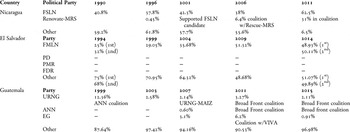
Political Party Performance in Presidential Elections (1990–2015)

Source: Author's elaboration of electoral results from national electoral tribunals in Guatemala, Nicaragua and El Salvador.
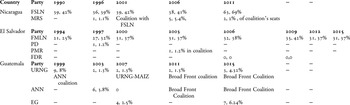
Political Party Performance in Legislative Elections (1990–2015)
(Seats won, % of seats)

Source: Author's elaboration of electoral results from national electoral tribunals in Guatemala, Nicaragua and El Salvador.
The social-democratic Renovate-MRS and socialist revolutionary Rescue-MRS allied to support Lewites in the presidential election but he died before the general elections. Along with the Partido Social Cristiano Nicaragüense (Nicaraguan Social Christian Party, PSC), the Partido Socialista Nicaragüense (Nicaraguan Socialist Party, PSN), the Partido Verde Ecologista de Nicaragua (Nicaraguan Green Party, PVEN), and the Partido Acción Ciudadana (Party for Citizen Action, PAC), the Alianza Movimiento Renovador Sandinista (Sandinista Renovation Movement Alliance), also known as the Alianza Herty 2006 (Herty 2006 Alliance), supported Chamorro's son-in-law Edmundo Jarquín, former ambassador to Spain and Mexico during the revolution. The Alliance did well in the capital but only captured 6 per cent nationally, finishing in fourth place. It won five seats with 9 per cent of the vote. The opportunity to build on its political performance was short-lived, however, as two deputies defected to the FSLN shortly after the new congress convened. In June 2008, the Supreme Electoral Council revoked the MRS’ legal status as a political party ‘because of unsatisfactory completion of all requirements for political parties as defined under the electoral law’.Footnote 38 The MRS protested against the Council's ruling, arguing that its decision was purely political and not based on law.
The FSLN continued to consolidate around Ortega, entering into alliances with several businessmen who had been excluded from Alemán and Bolaños’ Liberal governments. The alliances with various business representatives helped Ortega to a first-round victory in 2006 with a mere 38 per cent of the vote. Although most observers believed that the constitution should have prohibited Ortega from running for re-election, the Sandinista-packed Constitutional Court ruled in 2009 that preventing Ortega from serving a third term and a second consecutively, would violate his human rights. Ortega and the FSLN of the Alianza Unida, Nicaragua Triunfa (United Nicaragua Triumphs Alliance) coalition defeated Fabio Gadea Mantilla of the Unidad Nicaragüense por la Esperanza (Nicaraguan Unity for Hope, UNE), a coalition comprised of his Partido Liberal Independiente (Independent Liberal Party, PLI), the Renovate-MRS, and other parties.Footnote 39 Jarquín of the Renovate-MRS ran as Gadea's vice-presidential candidate. In legislative elections, the Renovate-MRS won two seats, occupied by Víctor Hugo Tinoco and Enrique Sáenz, as part of the same alliance.
Renovate-MRS made some important contributions in the mid-1990s when it helped to pass constitutional reforms and laws to strengthen the police and the army. However, its electoral and political relevance today is minimal. The Renovate-MRS and the Rescue-MRS continue to challenge Ortega and the FSLN, mostly recently through their opposition to the proposed canal concession to a Hong Kong-based entity, but they demonstrate no signs that they will be able to develop into an effective political force.
The Fall of the ERP and RN
In the early 1970s, a small number of armed groups emerged to challenge an alliance between the armed forces and oligarchy that had governed El Salvador since the 1930s. They had concluded that the Partido Comunista Salvadoreño's (Communist Party of El Salvador, PCS) insistence on transforming the country through the electoral process was futile. In 1970, former PCS General Secretary Cayetano Carpio and others formed the Fuerzas Populares de Liberación Farabundo Martí (Popular Forces of Liberation – Farabundo Martí, FPL) in order to pursue a prolonged popular war based on the Chinese experience. The Ejército Revolucionario del Pueblo (People's Revolutionary Army, ERP), formally established two years later, sought to provoke a mass insurrection of the Salvadorean people. After renowned poet and guerrilla Roque Dalton was executed on the ERP high command's orders, several Dalton supporters resigned from the organisation and subsequently formed the Fuerzas Armadas de Resistencia Nacional (Armed Forces of National Resistance, FARN or RN) in 1975. While the RN dedicated more attention to political work than did the ERP, it also sought to provoke mass insurrection through the intensification of urban warfare. Established in 1976, the Partido Revolucionario de Trabajadores Centroamericanos (Revolutionary Party of Central American Workers, PRTC) sought to establish links with like-minded individuals throughout the region. The fifth political-military organisation, the Fuerzas Armadas de Liberación (Armed Forces of Liberation, FAL), was officially created by the PCS five months after the failed reformist coup of October 1979. Of the five groups, the PCS maintained the strongest links to the Soviet Union as it faithfully followed the Soviet-backed strategy of participation in the political system and the prosecution of a bourgeois revolution as the first step towards socialism.
These political-military organisations established the Dirección Revolucionaria Unificada (Unified Revolutionary Directorate, DRU) at a May 1980 meeting in Havana. The ERP had remained isolated from the other groups since Dalton's execution but Cuban pressure convinced the other organisations to include them in the DRU. The FPL, PCS, ERP and RN formed the FMLN in October; the PRTC was included in December. At the time, the five political-military organisations agreed that electoral politics and continued capitalist development could not bring about the socialism that they sought and that they instead needed to pursue their revolutionary objectives through force of arms.Footnote 40 There remained important differences, however, over whether the FMLN should pursue a prolonged popular war or a mass-based insurrection strategy, how much attention should be given to political work, the national reality, and the appropriateness of alliances.Footnote 41 Unity was maintained in many ways because each organisation retained its own statutes and organic structure, leaders and financing.Footnote 42 Carpio's suicide in April 1983 and the subsequent passage of FPL leadership into the hands of a younger and more pragmatic generation of militants further improved organisational unity.Footnote 43
Negotiations would last throughout the final 18 months of the conflict before the FMLN and Alfredo Cristiani signed the Chapultepec Accords in January 1992. While there were some differences amongst the political-military organisations as to the pace and content of negotiations, the primacy of armed revolution had kept the FMLN sufficiently unified. Post-war challenges threatened this unity, however, when the new political party had to select candidates, draft a political platform, establish electoral alliances, and decide what it meant to be part of a system it had previously fought to overthrow. It was clear that there was a sharp divide between the ERP and RN on one side and the FAL, FPL and PRTC on the other.
The FMLN attained legal status as a political party in 1993 with a new structure designed to guarantee that no single organisation could dominate the others through control of its management bodies. Party leaders hoped that this would accommodate a diversity of leadership, organisational cultures and ideological nuances among the five organisations. However, like the FSLN, the new structures that prioritised majority decision-making over the more consensus-based decision-making that had characterised each party during the war quickly led to conflict. In 1993, the ERP, now renamed the Expresión Renovadora del Pueblo (Renewed Expression of the People), formally abandoned Marxism-Leninism and proclaimed its commitment to social democracy. Joaquín Villalobos (ERP) argued that global and national changes called for a renovated left, one that should consider alliances with non-revolutionary political actors, even including the Alianza Republicana Nacionalista (Nationalist Republican Alliance, ARENA). The ERP-RN believed that the peace accords had opened political space to transform the country and that they should take the opportunity to resolve the problems of the people.Footnote 44 Dagoberto Gutiérrez (PCS) and the other organisations believed that the FMLN should continue the war as a permanent opposition party; ‘following the peace accords, they [Handal and the FPL] began to immediately attack (ethically and morally) all those who wanted to modernise the FMLN’.Footnote 45
In preparing for the 1994 presidential elections, the ERP-RN argued that the FMLN should support a centre-right reformist candidate while the FPL, PCS and PRTC preferred Rubén Zamora of the Frente Democrático Revolucionario (Democratic Revolutionary Front, FDR). Zamora was chosen to represent the FMLN but ARENA's Armando Calderón Sol defeated him in a runoff. Some blamed less than complete ERP-RN support for the FMLN's loss even though greater ERP-RN support was unlikely to have made any difference. In the legislative elections, the FMLN captured 21 per cent of the vote and 25 per cent of the seats, replacing the Partido Demócrata Cristiano (Christian Democratic Party, PDC) as the country's second-largest political party. However, the divisions that had become apparent during the selection of the party's candidate would lead to the FMLN's first major break one year later.
When congress convened in May, ERP-RN deputies supported ARENA's controversial budget and its nominee for assembly president in return for two Board of Director positions. The ERP-RN deputies then sought to redefine the FMLN as a social-democratic party and to dissolve the five groups.Footnote 46 The FMLN leadership rejected their proposals and suspended those deputies who had voted with ARENA. Fourteen mayors and seven ERP-RN deputies resigned in December and, along with the Movimiento Nacional Revolucionario (National Revolutionary Movement, MNR), established the Partido Demócrata (Democratic Party, PD) in March 1995.
The PD sought to occupy the political centre between ARENA and the FMLN, space that previously had been occupied by José Napoleón Duarte's PDC. However, many centrist voters and those sympathetic to the FMLN were not convinced. It is possible that the PD was seen as too far to the right given its temporary alliance with ARENA.Footnote 47 The PD captured less than 1 per cent of the vote and one seat in the 1997 election after having retained seven deputies in the previous legislature. The only department where the PD performed well was Morazán, an ERP-RN wartime stronghold, where it received 7 per cent of the vote. As a result of its poor electoral showing, the Supreme Electoral Tribunal cancelled the PD. The FMLN, on the other hand, recaptured the seven seats that it had lost with the ERP-RN's exit and added another six to win a combined 27 congressional seats.
Martínez argues that the PD performed so poorly for four reasons.Footnote 48 At the time, the political system had a tradition of marcas electorales whereby people vote for the party's flag and that it was hard to change their mind.Footnote 49 In 1994, the ERP/RN tried to make the FMLN initials disappear so that no group could keep them; they argued that would have given the PD a better chance at winning and ‘prevented what's happened since with the Partido Comunista abusing the marca’. Second, like most new political parties, particularly on the Left, the PD suffered from a lack of financial resources. Third, it presented a ‘simplistic discussion of alternatives and programmes’ that was not adequately discussed in the country. Finally, there existed a ‘deficit of political culture in the population as seen in debates amongst the politicians and simplistic discussions amongst the population in general’. In essence, debates boiled down to the Left and the Right with citizens given a choice between FMLN and ARENA visions. Some criticised the ERP-RN for acting too rashly and not giving the new political party sufficient time to adjust to the new political scene after two decades of war.
The FMLN's internal divisions continued following the PD's failure. Like the ERP-RN leaders before them, Facundo Guardado (FPL) and Raúl Mijango (ERP) wanted the FMLN to negotiate alliances with non-ARENA aligned business sectors and adopt principles resembling European social democracy. This ‘renovating’ trend included former leaders and mid-level cadres of the PRTC, the RN and the FPL. Schafik Handal (PCS) and Salvador Sánchez Cerén (FPL) advocated for the ‘orthodox’ or ‘revolutionary socialist’ trend which sought to retain the FMLN's identity as a revolutionary socialist party identified with Marxism-Leninism. The debate over the future of the party played out publicly during the controversial selection of the party's 1999 presidential ticket. Without resolving the party's future, Guardado and Nidia Díaz (PRTC) were selected to represent the FMLN. ARENA's Francisco Flores defeated Guardado in the first round, 52 to 29 per cent. Zamora, who had been the FMLN's candidate in 1994, finished third with 8 per cent on the ticket of the Centro Democrático Unido (United Democratic Centre, CDU).
Following the 2000 legislative and municipal elections, it looked as if the party was moving in the direction of greater unity but that would not last for long. Although the renovating and revolutionary socialist groups appeared to have roughly equal representation in terms of party members, the latter was in control of the organisation's leadership positions. In 2001, Guardado and Francisco Jovel's (PRTC) renovating group boycotted the special May convention, instead organising a separate one to choose their candidates for internal party elections.Footnote 50 Guardado was expelled in October and Jovel and five other renovators a few months later after they broke party discipline on the 2002 General Budget vote.Footnote 51 Similar to the criticism that had been levelled at the ERP-RN, FMLN Deputy Héctor Cordóva claimed that these leaders lacked the patience needed to resolve the problems within the party.Footnote 52
Guardado and Jovel established a new social-democratic party, the Movimiento Renovador (Renovating Movement, MR), in April 2002. More so than the PD which tried to present itself as a centrist alternative, the MR characterised itself as the ‘democratic left, social-democratic and heir to the traditions of the popular organisations of the last thirty years’. They thought that it was dangerous to move too far from the FMLN. However, like the PD, it still failed to draw much support from the left or centre. In addition to aligning with the Partido Demócrata Social (Social Democratic Party, PSD), the MR aligned with the PDC which probably did not help convince voters that they were a sincere social-democratic alternative. The MR attained less than 2 per cent of the 2003 vote and, like the PD before them, lost its legal standing after failing to surpass the 3 per cent threshold required by law. The FMLN, on the other hand, won 31 seats with 34 per cent of the vote after having again survived the loss of another important group of historic militants.
In 2003 and 2004, Santa Tecla mayor Oscar Ortíz (FPL) led a reformist effort similar to that of the renovators and ERP/RN with the intention of promoting the internal democratisation of the party and strengthening external alliances. After initially considering journalist Mauricio Funes, they supported Ortíz in the FMLN primary elections for the 2004 presidential elections.Footnote 53 Ortíz won the support of several young mayors and deputies. However, Handal defeated Ortíz to secure the nomination. Other small groupings distanced themselves from the orthodox wing at this time as well. At the end of 2003, ex-commander and former congressman Mauricio González (FPL) led the veteranos, a group of old guard FMLN with support within the party but very few political positions. Roberto Hernández (FPL) and Carlos Rivas Zamora represented the capitalinos and were concentrated in the area around greater San Salvador. The fabistas, led by Fabio Castillo (PRTC) and Hugo Martínez (FPL), were considered intellectuals and valued the free expression of ideas within the party. Gerson Martínez (FPL) led the terceristas but following Handal's 2004 nomination, they moved closer to the orthodox faction.
Another reformist at times aligned with the FMLN, Héctor Silva, ran as the presidential candidate of the CDU-PDC. Silva had been a popular two-term mayor of San Salvador on a ticket supported by the FMLN and other Left leaning parties. However, his relationship with the FMLN soured as he claimed that it was run by ‘communists’.Footnote 54 In March 2004, Handal captured 36 per cent of the vote in losing to ARENA's Elías Antonio Saca who finished with 57 per cent. Silva finished a distant third with less than 4 per cent of the vote.
The FMLN increased its presidential vote share but the first-round defeat was still a bitter pill to swallow. The orthodox wing had believed that the FMLN was so strong following the 2003 national election and Rivas Zamora's victory in the race for San Salvador mayor following Silva's two terms that its presidential candidate did not matter. While failing to reform the FMLN, Ortíz remained in the party. He might have learnt that there was little hope of advancing his agenda and political ambitions outside the FMLN. However, other reformists left the FMLN once the revolutionary socialists strengthened their control over the organisation in the November 2004 party elections.
The Frente Democrático Revolucionario (Revolutionary Democratic Front, FDR) formed in June 2005 shortly after approximately 350 militants resigned from the FMLN, including Ileana Rogel (FPL), Julio Martínez, Celina de Monterrosa and Rene Canjura (FPL).Footnote 55 Similar to the experience of the PD, the FDR managed to hold on to its seven deputies for the remainder of the legislative period and its success would be short-lived. Like the MR in 2003, the FDR also sought to represent the revolutionary left in 2006. Like the MR with the PDC, however, the FDR alliance with the Cambio Democrático (Democratic Change, CD) party was not helpful; the FDR failed to capture a single legislative seat. The FDR suffered the same fate as the PD and MR while the FMLN was now the largest congressional bloc with 32 seats after having captured 40 per cent of the vote.
Three years later in January 2009, the FDR again failed to capture a single assembly seat and won only one municipality in an alliance with the CD. Since it failed to win a seat or capture 50,000 votes, the FDR lost its legal registration as a political party. The FMLN, on the other hand, won 35 legislative seats. In March's presidential election, the FMLN allied with the Friends of Mauricio in support of Mauricio Funes to defeat ARENA's Rodrigo Ávila 51 to 49 per cent. The FMLN had arrived at the presidency for the first time following 15 years of electoral competition and surviving the defections of the PD, MR and FDR. The PDC had nominated Rivas Zamora but withdrew his nomination prior to the vote.
Fifteen years after advocating war in the Legislative Assembly, the Tendencia Revolucionaria's (Revolutionary Tendency) Gutiérrez called for the FMLN to resign from the Funes administration. He then created the Movimiento Nuevo País (New Country Movement, MNP) in order to pressure the FMLN from a more participatory left position.Footnote 56 The MNP, however, was unable to garner the 50,000 signatures needed to request registration as a political party in 2013.Footnote 57 The MNP then engaged in talks with former ERP commander Jorge Meléndez (ERP) and his PSD concerning an electoral alliance for 2014. Gutiérrez claims that he sought the establishment of a political movement, not a political party.Footnote 58
In preparing for the 2014 presidential elections, many FMLN supporters in El Salvador and the United States lobbied unsuccessfully to have the party select the more moderate and highly popular Ortíz as its candidate. Instead, the FMLN selected Sánchez Cerén, the party's last remaining commander. There was some speculation that Ortíz would run independently; however, Ortíz agreed to be Sánchez Cerén's running mate. The two narrowly won a March 2014 runoff by just over 6,000 votes.
Today's FMLN does not represent the coalition of forces that fought the Salvadorean government and oligarchy and the United States in the 1970s and 1980s. Instead, it is dominated at the highest levels by former PCS and one faction of the FPL.Footnote 59 The FMLN benefited from a large network of rural and urban supporters and its management and control of territory during the war and the government's repression against civilians.Footnote 60 , Footnote 61 The growing percentage of the population that identified with the left and a moderation of the party's platform and candidate helped propel the FMLN from opposition to government in 2009.Footnote 62 After failing with the PD, MR and FDR, numerous ERP, RN and PRTC members work in today's FMLN government and party but few in influential leadership positions. Even though the guerrillas often professed more loyalty to their political-military organisations than to the larger FMLN project, voters have remained loyal to the FMLN.
ARENA, on the other hand, used its financial resources, vast network of patron-client relationships, and incumbency advantages to hold the presidency for 20 years.Footnote 63 However, Tony Saca's rightist Gran Alianza por la Unidad Nacional (Grand National Alliance, GANA) challenged ARENA on the right. This frequent FMLN ally has already been more successful than any other FMLN or ARENA splinter party, winning 11 per cent of the 2014 presidential vote and 11 legislative seats in 2015. GANA's success is largely due to Saca's name recognition, healthy financial coffers, the cancellations of the PDC and the Partido de Conciliación Nacional (National Conciliation Party, PCN), its swing vote in the legislature, and electoral rules that favour the country's third largest party. None of these benefits was available to the PD, MR or FDR.
Guatemala's fragmented Left
Similar to the FSLN and FMLN, Guatemalan guerrillas established the URNG umbrella group after years of independent struggle. Following Jacobo Arbenz's overthrow, the communist Partido Guatemalteco de Trabajo (Guatemalan Labour Party, PGT) was made illegal. Most members were arrested or fled into exile but some PGT regrouped in order to work with mass-based organisations. A few years later, however, the PGT, various student groups and the Movimiento Revolucionario 13 Noviembre (November 13th Revolutionary Movement, MR-13) formed the Fuerzas Armadas Rebeldes (Rebel Armed Forces, FAR). The MR-13 had been formed by Guatemalan soldiers critical of government corruption and complicity in allowing the United States to train and launch an invasion of Cuba from their soil. The FAR, PGT and MR-13 would maintain a rocky relationship throughout the 1960s as individuals and groups left the organisation only to reincorporate months or years later. The loss of key military leaders, poor weapons, an inability to win over the indigenous population, and US military training nearly destroyed all guerrillas by the end of the decade. The MR-13 would disappear, the FAR would establish a base in the northern Petén department, and the PGT would refocus on non-violent organising.
After fleeing to Mexico, other FAR and MR-13 survivors established two new organisations committed to avoiding the errors that had befallen their earlier comrades. The Organización del Pueblo en Armas (Organisation of the People in Arms, ORPA) cultivated relationships with indigenous groups, urban labour movements, and progressive middle-class intellectuals and professionals.Footnote 64 Like ORPA, the Ejército Guerrillero de los Pobres (Guerrilla Army of the Poor, EGP) successfully built a social base amongst the indigenous groups in the Western Highlands on its way to becoming the country's most formidable guerrilla group.
The FAR, ORPA, EGP, and PGT formed the URNG in February 1982. While the belief in the need for armed struggle was important in bringing the left together, international pressure was more important.Footnote 65 Cuba and Nicaragua offered assistance to the four insurgent groups on the condition that they work together.Footnote 66 International supporters, particularly Spanish and Italian, also encouraged unification as they were frustrated that they were expected to assist each group individually.Footnote 67 Finally, the successful example of the FMLN was also important.Footnote 68
Like the FMLN and FSLN, the URNG's unification glossed over differences in terms of membership, preferred strategies and tactics, and analyses of the country's socio-economic and political conditions. For example, the PGT was more focused on non-violent organising and contributed very little militarily. ORPA disagreed with the FAR's strategy for mass insurrection because doing so would make civilians vulnerable to military retaliation; they would be responsible for their deaths, not the army.Footnote 69 ORPA never declared itself Marxist-Leninist. The FAR also felt that ORPA had unfairly characterised them as racists because of their class-based rather than indigenous-based analysis.Footnote 70 The EGP and FAR also disagreed over the value of forging alliances with political parties and centre-right political forces.Footnote 71 Rarely did the four political-military organisations engage in joint offensive activities. The organisations were even divided in the refugee camps in Mexico.Footnote 72 If anything, there was unity at the command and international levels.
Overwhelming state repression between 1981 and 1983 and a political opening beginning in 1984 convinced many guerrillas that revolutionary success was unlikely. Mario Payeras (EGP) believed that there was no room for debate within the revolutionary movement over how best to respond to the repression or whether the political opening with the return to electoral politics provided an opportunity for the URNG to reintegrate into civilian life.Footnote 73 In 1984, as many as 35–40 percent of the EGP, including Payeras, abandoned the URNG.Footnote 74
While the URNG entered into dialogue with officials from Vinicio Cerezo's PDC government in 1984, more serious negotiations did not begin until several years later. The URNG believed that it was important to achieve a more comprehensive peace agreement than had been achieved in neighbouring El Salvador.Footnote 75 However, the URNG lost key supporters during this decade of peace negotiations. Roughly six months before the December 1996 Firm and Lasting Agreement, Miguel Ángel Sandoval (EGP) quit the Diplomatic Political Commission and the party over opposition to last-minute changes to the Socio-economic Agreement. Others left the organisation because they disagreed with the URNG's acceptance of a weakened Truth Commission that held almost no one accountable for crimes committed during the conflict. The URNG entered the post-war period politically weaker and more divided than the FMLN and FSLN.
The URNG became a legal political party in December 1998 but not without controversy. The FAR believed that they should merge with the Frente Democrático Nueva Guatemala (Guatemalan New Democratic Front, FDNG) rather than create its own political party; the ORPA and EGP strongly disagreed.Footnote 76 The FDNG was a political party comprised of several organisations sympathetic to the URNG that had done relatively well in the 1995 elections. It also had a more urban base which would have complemented the URNG's rural roots. The URNG was also hampered by the absence of effective leadership. Before his death in 1998, many Guatemalans believed that EGP commander Rolando Morán was the individual most capable of keeping the revolutionary left united and, at the same time, bridging the gap with the non-revolutionary left.Footnote 77 Rodrigo Asturias, son of Nobel Laureate Miguel Ángel Asturias, would have been next in charge; however, his ORPA was implicated in a kidnapping scandal during the latter stages of the peace process which side-lined him through the 1999 elections. Even though the botched high-profile kidnapping was carried out without the other groups’ knowledge, the ‘disloyal act’Footnote 78 ‘discredited’ the entire URNG, not just ORPA.Footnote 79
In 1999, the URNG allied with the Desarrollo Integral Auténtico (Authentic Integral Development, DIA) party and the Unidad de Izquierda Democrática (Democratic Leftist Union, UNID) to form the Alianza Nueva Nación (New Nation Alliance, ANN). The ANN with Álvaro Colom as its candidate attained 12 per cent of the presidential vote and nine out of 113 congressional seats. Ramírez's death and ORPA's poorly timed failed kidnapping undermined support for the new political party. While the URNG/ANN probably would not have finished stronger than third, there is good reason to believe that its electoral support suffered because of its inability to maintain an alliance with the FDNG.
Monsanto (FAR) of the third largest political-military organisation became Secretary General following Morán's (EGP) death and Asturias’ (ORPA) scandal. Unfortunately, the EGP's control of the national committee made the party extremely difficult to govern.Footnote 80 During the 2000 Fiscal Pact debate, the EGP wanted to raise taxes and make it more difficult for businessmen to operate as usual; they felt Monsanto gave too much away during negotiations.Footnote 81 Asturias (ORPA) then defeated Monsanto (FAR) in an internal election for Secretary General in August 2001. Monsanto and the more radical revolutionary current resigned the following May arguing that the URNG had spent too much time trying to co-govern with the Partido de Avanzada Nacional (National Advancement Party, PAN) and the Frente Republicano Guatemalteco (Guatemalan Republican Front, FRG) rather than opposing them.Footnote 82 Monsanto's decision was also influenced by his desire to open the party to alliances with non-revolutionary but anti-oligarchic groups on the Right and to represent the party in the 2003 presidential election.Footnote 83 Approximately 45 per cent of the organisation resigned alongside Monsanto, many of whom followed him into the ANN political party, not to be confused with the 1999 electoral alliance.Footnote 84 This ANN was formed in June 2003 by Alfonso Bauer and César Montes’ UNID, Nineth Montenegro's Frente Democrático Solidaridad (Democratic Solidarity Front (FDS), and Monsanto's fellow URNG dissidents. Unlike the FSLN and the FMLN, the URNG's more radical militants left the party and in much greater numbers. These divisions led to disillusionment among former combatants and confusion among potential voters.Footnote 85
Due to its late formation as a political party, the ANN did not present a presidential candidate in 2003. However, they actually performed better than the URNG in congressional elections securing six seats with 5 per cent of the vote. The ANN's ‘strong’ electoral showing owed a great deal to Montenegro's popularity; it won five of its six seats in the department of Guatemala. The ANN was positioned to lead the party-based Left with an alliance between former guerrilla commander Monsanto and social leader Montenegro. However, the ANN's success would be short-lived as deputies Montenegro, Alfredo de León and Jeannette Pérez resigned shortly after the new congress convened. They claim that they left because of the absence of dialogue and democracy in decision-making while Monsanto claims that they left because of personal conflicts. UNID then withdrew arguing that it had no interest in remaining in a party controlled by Monsanto. According to Monsanto, his FAR supporters did most of the heavy lifting in forming the new party and for that reason they made up its majority; controlling the party was not their plan.Footnote 86 The ANN was further weakened in September 2006 when several members of its youth wing renounced their positions claiming that the party had not distinguished itself – the ANN was just as ‘authoritarian and clientelistic’ as the other political parties.Footnote 87 The ANN had to recreate itself once again. While only for one contest, the ANN performed stronger than any other splinter group.
The URNG's electoral support declined sharply and after finishing third in the 1999 presidential (in coalition) and legislative elections, fell to sixth place for the presidency and tied for seventh in the legislature in 2003. Asturias and indigenous leader Pablo Ceto (EGP) garnered less than 3 per cent of the vote and the party won only two out of 158 congressional seats. The URNG tried to improve its political fortunes by allying with several leftist social movements and renaming itself URNG-MAIZ in November 2006. Many Movimiento Amplio de Izquierda (Broad Movement of the Left, MAIZ) were formerly affiliated with the guerrillas but had distanced themselves from the URNG over the years.Footnote 88 However, they were not a very large group that added significantly to the URNG's support.
In the September 2007 elections, former guerrillas represented the ANN, URNG-MAIZ, Encuentro por Guatemala (Gathering for Guatemala, EG) and, to a lesser extent, Unidad Nacional de la Esperanza (National Unity of Hope, UNE).Footnote 89 The URNG-MAIZ, ANN and EG had engaged in talks that would have brought about some level of cooperation for the elections, but, in the end, each supported its own candidates. Monsanto and businessman Mariano Portillo represented the ANN. The URNG proposed Sandoval and social leader Walda Barrios (whose husband was a member of ORPA). Nobel Laureate Rigoberta Menchú (long associated with the EGP) and a former president of Guatemala's chamber of commerce, industry, agriculture, and finance (CACIF) represented the EG; other leftists in the EG included Montenegro (associated with ORPA) and Montes (MR-13 and EGP). While the URNG's vote share declined to 2 per cent, the ANN fared even worse with approximately 1 per cent of the presidential and legislative votes. Given that it did not surpass 5 per cent of the vote or win a single congressional seat outright, the party was dissolved in July 2008. While neither the URNG nor the ANN did well, the results were somewhat surprising given that Monsanto was a much more public face of the guerrillas, having been a commander for over two decades, than Sandoval ever was. The elections were won by UNE's Álvaro Colom, the candidate who the URNG and ANN had promoted in 1999.
What remained of the URNG, Monsanto's ANN (now the Alternativa Nueva Nación), and Menchú's WINAQ, united behind the Frente Amplio de Izquierda (Broad Front of the Left) in 2011.Footnote 90 After preliminary conversations, the Movimiento Nacional Revolucionario (National Revolutionary Movement, MNR) headed by Aníbal García, a clandestine member of the URNG as a university student, remained outside the alliance.Footnote 91 The Broad Front, which promoted Menchú as its presidential candidate, finished a disappointing, but not unexpected, sixth place with over 3 per cent of the national vote. Amilcar de Jesús Pop Ac of WINAQ and Carlos Enrique Mejía Paz (PGT/ORPA) of URNG won seats in the congress with approximately the same per cent of the national vote. After two years of legal challenges, a seat from Huehuetenango was eventually awarded to the URNG's Walter Félix López (PGT). After forming the Broad Front a few months prior to the election, the leadership had no illusions that they were going to do very well as the alliance was very fragile.Footnote 92 In 2015, the Broad Front captured a disappointing 2 per cent of the presidential vote but an improved 4 per cent of the congressional vote. However, that performance only translated into three congressional seats.
Conclusion
The FSLN, FMLN and URNG were each coalitions of political-military organisations that united to confront common enemies during the Cold War. Each group glossed over differences in terms of membership, preferred strategies and tactics, and analyses of the social conditions in their countries. The pressures towards unification were strongly influenced by external actors, namely Cuba, which offered assistance to each group as long as they merged, while the FMLN and URNG also sought to emulate the FSLN's success.
Sandinista unity remained strong throughout the 1980s as they fought a war against the United States-backed contras. Disagreements existed but they mostly played out behind closed doors. The demands of war and possibility of victory contributed to FMLN unity. In Guatemala, however, the degree of cohesion in the URNG was never as strong as it was in the FSLN and FMLN. The divisions within the EGP and the PGT as well as among the organisations were much greater than experienced in neighbouring countries. Others, however, say such claims were exaggerated as part of the military's counterinsurgency strategy.Footnote 93
During the Guatemalan and Salvadorean peace processes, divisions within the rebel coalitions became more apparent, such as when the ORPA and ERP engaged in activities unbeknown to the overall leadership and adopted political rhetoric more closely related to social democracy rather than the socialism espoused by the URNG and FMLN. Their actions did not result in the fracturing of either organisation, but they did demonstrate their fragility. Most FMLN leaders and combatants believed that the FMLN was capable of military victory or, at worst, forcing important concessions in return for a negotiated settlement. Therefore, they saw little benefit to leaving the organisation even if they disagreed with specific elements of the peace negotiations. The FMLN's first high-profile organisational break did not occur until after the first post-war election.
The URNG was a different story. A large contingent exited the war following the government's scorched-earth policy of the early 1980s. During the 1990s, the URNG made a conscious decision to pursue a more comprehensive agreement than they believed had been achieved in El Salvador.Footnote 94 However, the URNG lost supporters and ties with sympathetic social movements during the approximately ten years of negotiations. Given the failure on the part of the government to implement a number of the reforms and voters to pass May 1999 constitutional reforms, there is a strong case to be made that the URNG's efforts backfired. While they did achieve more on paper in terms of social, economic and political reforms than did the FMLN, they neglected what it would take to transform themselves into a viable political party. Its weakened performance as a political party then made it difficult to pressure the state to follow through on its commitments.
In each country, the initial post-war divisions were between those who wanted to take their parties in more social-democratic directions versus those who wanted to maintain stronger socialist identities. Even though the Renovate-MRS could count on some of the revolution's historic leaders, Sandinista voters were not inclined to support the new social-democratic political party. The Renovate-MRS lost its legal status twice and is now part of an anti-Sandinista coalition spanning the liberal-conservative political spectrum. Like the Renovate-MRS in Nicaragua, the PD and the MR in El Salvador also wanted to take their parties in more social-democratic directions. The Renovate-MRS and PD believed that the end of the Cold War brought about fundamental changes in their respective societies and that their countries needed political stability which led them to look more favourably upon alliances, including those with Chamorro and ARENA. In post-war Guatemala, however, the situation was reversed. The ORPA-dominated URNG sought more social democracy and envisioned working with the government to implement the provisions of the peace accords. The more radical socialist current led by the FAR's Monsanto lost the battle for party control to ORPA and the EGP and then resigned to establish the ANN.
Who stayed and who left was largely determined by which group controlled the party's organisational structures. Decision-making during each country's civil war had been focused more on resolving differences through consensus. However, post-war decision-making emphasised majoritarian rules which left those of the MRS, PD and ANN in what they thought were permanent minority positions. According to Martínez Peñate, the FMLN's treatment of the PD and MR was an example of the ‘ideological intolerance’ within the party where the PCS required everyone to think like them.Footnote 95 Instead, they pursued their own political projects which ultimately failed.
The FSLN schisms were resolved with the expulsion of all those who tried to challenge Ortega's leadership.Footnote 96 As a result, Ortega's virtual monopoly on power inside the FSLN left the party deinstitutionalised but, at the same time, more flexible and better able to adapt to a challenging electoral environment. Ten years after the Renovate-MRS’ appearance, the Rescue-MRS emerged to re-establish the historic FSLN which had been co-opted by Danielismo. The Rescue-MRS has had a brief electoral history but, like the Renovate-MRS, it has experienced little success. In the case of El Salvador, dissidents were expelled from or ‘voluntarily’ left the FMLN which also helped the party to adapt to a challenging electoral environment.Footnote 97 However, a key difference was that the party consolidated around the visions of the revolutionary socialist camp (the PCS and one fraction of the FPL) rather than an individual figure as in Nicaragua. In Guatemala as well, there was a strong element of individuals wanting to run the party and be its presidential candidate that led to the URNG's fracturing.Footnote 98 In addition, the FAR leadership was interested in more expansive alliances than the EGP, ORPA and PGT.
Why did the electoral alternatives fail? It is difficult to argue that the splinter parties were inhibited by overly aggressive electoral rules except perhaps in Nicaragua. While the rules could have been more permissive, each party competed in legislative elections determined via proportional representation. In El Salvador, parties must win 3 per cent of the presidential vote to persist. In Guatemala, political parties need to win a seat from a department list or to have surpassed 4 or 5 per cent (since 2004) of the national vote to win a seat from the national list. Law 331 in Nicaragua requires parties to maintain organisational structures throughout the entire country and present candidates for 80 per cent of the posts in every election. However, the Renovate-MRS claims that it was cancelled for political reasons rather than having failed to surpass the standards as set out by the electoral rules. The ANN, PD, MR and FDR were all cancelled after failing to surpass minimal electoral thresholds.
The splinter parties generally possessed few financial resources which severely limited the campaigning that they could pursue.Footnote 99 Martínez speculated that the ERP-RN might have had a greater opportunity to succeed had they formed their own party following the peace accords.Footnote 100 There were more resources in 1993 when the international community provided funds to support reinsertion programmes, resolve social and economic problems, and establish new political parties than in 1997. In Guatemala, the ANN and URNG have had some of the more sophisticated party platforms and organisational structure but they have not had the money to compete.Footnote 101 While the ANN still did not have a great sum of money, its 2003 alliance with Montenegro gave them a financial advantage over the URNG.Footnote 102 That alliance, however, broke down immediately after the election.
What seems to have been more of a problem was their inability to convince historic supporters of the FSLN, FMLN and URNG that they were legitimate heirs to those parties’ revolutionary traditions. While militants often professed their loyalty to their political-military organisation (i.e. TP, ERP, FAR) and not to the larger organisation (FSLN, FMLN, URNG), voters were more inclined to support the united political-military project. ‘He was never my comandante’, one former FPL soldier admitted regarding revered FMLN and PCS leader Schafik Handal.Footnote 103 It is not clear, however, that voters paid much attention to or understood the internal party battles. The FMLN and FSLN's decisions not to retire their brands have allowed the two parties to retain their historic supporters even as their platforms have changed quite significantly and historic leaders have abandoned the parties. The identities and solidarity tiesFootnote 104 that the two coalitions forged during the 1970s and 1980s and the two-party-systems that have developed in the post-war periods (Sandinista/anti-Sandinista and FMLN/ARENA) have allowed the FSLN and FMLN leadership to make decisions that have alienated former leaders but not necessarily hurt their electoral performance. For this same reason, the splinter parties have failed.Footnote 105
The new political parties, especially the Renovate-MRS and PD, were likely hurt by the alliances that they made with more reformist, sometimes even reactionary, parties. The polarisation that existed between the Left and Right in El Salvador and Nicaragua made challenging the creation of social-democratic alternatives. In Guatemala, the ANN criticised the URNG for its closeness to the FRG in trying to implement aspects of the peace accords rather than to truly act as an opposition party. It is possible that this perceived closeness to the FRG had some negative impact on the URNG and positive impact on the ANN in 2003. However, the ANN's alliance with former Guatemalan military officers was also questioned by those who might have been sympathetic to another alternative on the Left.Footnote 106
Today, the orthodox wing of the FMLN controls the presidency and maintains the second-largest share of congressional seats while the PD, MR and FDR have disappeared. The FSLN controls the presidency and congress while the Renovate-MRS and Rescue-MRS continue to oppose Ortega and his allies. A number of those who had broken away from the FSLN and the FMLN eventually found their way back to the parties as there was little hope that other political vehicles of the Left or the Centre would provide them similar opportunities. It appears, however, that there might be another effort to redefine the FMLN as a more social-democratic party in late 2015.Footnote 107 In Guatemala, neither the URNG nor ANN is a relevant political actor and their equally poor performance as part of the Broad Front in September 2015's election has done little to change that.
Even though confidence in existing political parties has been low and polls indicate electorates yearning for new political alternatives, the MRS-Renovate and MRS-Rescue in Nicaragua, the PD, MR and FDR in El Salvador and the ANN in Guatemala have failed to establish themselves as viable political alternatives to the FSLN, FMLN and URNG. Limited financial resources, alliances with non-revolutionary centrist and centre-right parties, and voters’ tendencies to overlook internal ideological and personnel debates within the original political parties, especially the FSLN and FMLN, have hindered their efforts at party building. As a result, former militants in El Salvador and Nicaragua have few alternatives other than to work from within the FMLN and FSLN or to leave party politics behind. In Guatemala, those most sympathetic to the ANN and URNG have abandoned electoral politics altogether and instead work through civil society to produce the changes that Guatemala so needs.