

Introduction
In the past, the concept of ‘well-being at work’ primarily focused on physical health and safety risks. However, more recently, there has been increasing recognition of the importance of psychosocial factors. This aligns with the World Health Organization’s (WHO) definition of health as ‘a state of well-being’. This shift in focus has led to the examination of psychosocial risk factors that can impact both psychological and physical health. Consequently, adverse social behaviours in the workplace, including bullying, are now being acknowledged as significant psychosocial risk factors, affecting individual health and well-being. The study of this phenomenon and its impact on individuals has emerged as a prominent issue in research literature over the last decade.
Bullying usually implies an actual or perceived power imbalance between the parties involved (Brodsky Reference Brodsky1976). Hence, its study in the organisational framework is especially relevant, since power in organisations is usually distributed unequally between the different hierarchical levels (Saunders et al Reference Saunders, Huynh and Goodman-Delahunty2007; Lopez et al Reference Lopez, Hodson and Roscigno2009). In fact, numerous studies confirm the existence of bullying, discrimination, and other abusive behaviours in this framework (Paoli and Merllié Reference Paoli and Merllié2001; Sacht et al Reference Schat, Frone, Kelloway, Kelloway, Barling and Hurrell2006), especially bullying exerted by managers on workers (Beale and Hoel Reference Beale and Hoel2011; Zapf et al Reference Zapf, Escartin, Einarsen, Hoel, Vartia, Einarsen, Hoel, Zapf and Cooper2011; Fevre et al Reference Fevre, Lewis, Robinson and Jones2012, Tepper Reference Tepper2000).
Definitions of workplace bullying have varied over time, depending on the research perspective (Bartlett and Bartlett Reference Bartlett and Bartlett2011; Hershcovis Reference Hershcovis2011) and the conception of violence that is contextually and temporally sensitive (De Haan Reference De Haan, Body-Gendrot and Spierenberg2009). According to Einarsen (Reference Einarsen1999), workplace bullying occurs when someone at work is systematically subjected to aggressive behaviour from one or more colleagues or superiors over a period of time, where the target finds it difficult to defend himself or herself, or to escape the situation. Bullying can take the form of direct actions such as verbal abuse, accusations, and public humiliation, but can also be subtle and disguised in the form of gossip, rumour spreading and social exclusion. In any case, it is predominantly psychological mistreatment (Einarsen et al Reference Einarsen, Hoel, Zapf, Cooper, Einarsen, Hoel, Zapf and Cooper2003).
Among the consequences of workplace bullying are those that affect individuals, such as stress reactions, substance abuse, sleep problems, and mental and general health problems (Fevre et al Reference Fevre, Lewis, Robinson and Jones2012; Yoo and Lee Reference Yoo and Lee2018; Steele et al Reference Steele, Rodgers and Fogarty2020; Hauge et al Reference Hauge, Skogstad and Einarsen2010; and Wood et al Reference Wood, Niven and Braeken2016), or, more broadly, on individual well-being (Hershcovis and Barling Reference Hershcovis and Barling2010; Tepper Reference Tepper2000). All the above factors also affect individual performance at work. In fact, the literature demonstrates the impact of bullying on worker’s effective commitment (Steele et al Reference Steele, Rodgers and Fogarty2020), absenteeism rates (Johns Reference Johns, Cooper and Barling2008; Kivimäki et al Reference Kivimaki, Elovainio and Vahtera2000; Franche et al Reference Franche, Murray, Ibrahim, Smith, Carnide, Cote, Gibson and Koehoorn2011; Clausen et al Reference Clausen, Hogh, Borg and Ortega2012; and Wood et al Reference Wood, Niven and Braeken2016), rotation, and productivity (Einarsen et al Reference Einarsen, Hoel, Zapf and Cooper2011; and Devonish Reference Devonish2014). In this sense, our study focusses on the impact of bullying on mental health, specifically on self-reported levels of anxiety.
Part of the literature analysing bullying uses the observation of individual acts, the actors involved (targets and perpetrators), and the consequences, as an analytical framework. This approach defines a conceptualisation of bullying as an individualised phenomenon (Berlingieri Reference Berlingieri2015) and acts of bullying as ‘individuals’ intentional acts’ (Menjivar Reference Menjívar2011). Consequently, the probability of suffering bullying at work would depend on a series of personal and job stressors that constitute explanatory variables (Leyman Reference Leymann1996; Zapf Reference Zapf1999; and Hoel and Salin Reference Hoel, Salin, Einarsen, Hoel and Cooper2003). The consideration of workers as members of a group, with its own dynamics outside the company, would have less explanatory relevance. Bullying at work would be explained separately from gender dynamics, sexual orientation, race, class, or any other social group in society, concealing its interrelated nature (Hearn and Parkin Reference Hearn and Parkin2001).
Vulnerability to bullying, however, does not affect all groups equally and its impact on the organisation is not exclusively determined by internal factors. A greater incidence is observed among groups with less formal or social power in society, such as ethnic minorities (Shields and Wheatley Price Reference Shields and Wheatley Price2002; Wright and Pollert Reference Wright and Pollert2007; D’Cruz Reference D’Cruz2012; and D’Cruz and Rayner Reference D’Cruz and Rayner2012), or women (Benach et al Reference Benach, Julià, Bolíbar, Amable, Vives, Burke and Cooper2018). The power imbalance of these groups in organisations is often due to structural conditions that affect society as a whole, defining the relationships among groups and generating tensions between them. The relationships established at the organisational level could, in fact, reflect these structural factors (Bannerji Reference Bannerji1995). The analysis of bullying should not be carried out, therefore, exclusively at a micro level (micro influences), but should be expanded with a meso and macro perspective, as proposed by Bronfenbrenner (Reference Bronfenbrenner1997), D´Cruz et al (Reference D’Cruz, Mulder, Noronha, Beerepoot and Magala2019) and Einarsen (Reference Einarsen2000).
As far as women are concerned, the social factors which establish hierarchical relationships that subordinate women to men are often reproduced in the labour market. As a result, women frequently occupy positions with less formal power (temporary, casual, fixed-term, and non-unionised), which may result in greater workplace vulnerability (Fredman Reference Fredman2003; Messing et al Reference Messing, Punnett, Bond, Alexanderson, Pyle, Zahm, Wegman, Stock and de Grosbois2003) and may provoke a higher prevalence of psychological distress (Ansoleaga et al Reference Ansoleaga, Ahumada and González-Santa Cruz2019). The explanation of bullying as a completely gender-neutral phenomenon would be insufficient, as it separates men and women from the organisation and from society as a whole (Hearn and Parkin Reference Hearn and Parkin2001).
On the other hand, the increasingly globalised and competitive labour market is causing many companies to undertake processes of restructuring, flexibility, and downsizing, where workers are frequently considered a cost to be reduced (Hoel and Salin Reference Hoel, Salin, Einarsen, Hoel and Cooper2003). This framework is especially conducive to bullying as it leads to greater worker vulnerability. In fact, authors, such as Beale and Hoel (Reference Beale and Hoel2011), consider that the phenomenon of bullying should be interpreted as an ‘endemic feature of the capitalist employment relationship’. The organisational practices defined in this context could be considered depersonalised bullying since they are not targeted at specific individuals, but affect all workers in the organisation (Liefooghe and Mackenzie 2001 and Reference Liefooghe, Mackenzie, Einarsen, Hoel, Zapf and Cooper2003; and D’Cruz and Noronha 2009).
The consequences of this economic environment are especially intense for those workers balancing work with family life, who are the most vulnerable and most likely to suffer bullying (Díaz et al Reference Díaz, Mauro, Ansoleaga and Toro2017; Milner et al Reference Milner, King, LaMontagne, Bentley and Kavanagh2018). The probability of experiencing bullying could be higher for women as they have traditionally been responsible for housework and care for children and dependents.
This is the theoretical framework in which we define our work. Our study initially analyses the effect of bullying on self-rated anxiety (SRA) considering all European (19) workers individually. Subsequently, we adopt a meso and macro perspective. On the one hand, we disaggregate the group of workers by gender, to observe whether frequency of bullying and SRA impact differs as a group. On the other hand, we study whether the SRA impact of bullying at work differs among European (19) countries depending on national levels of economic gender inequality. Through this procedure, it should be possible to identify whether the frequency and impact of bullying on women’s SRA is higher in the group of countries where inequality is greater (or vice versa). With greater equality, the meso and macro influences should prevail to a lesser extent, at least in relation to gender.
In order to capture economic gender inequality, we use the Global Gender Gap index (GGGI), introduced by the World Economic Forum in 2006. The GGGI captures the magnitude and scope of gender-based disparities and tracks their progress. The index is decomposed according to four different criteria: participation and opportunity (economic), educational attainment, health and survival, and political empowerment. In our case, since we are studying bullying at work, we exclusively consider the economic criteria. Furthermore, it is in this criterion where wider differences are found in the group of countries considered. In fact, differences in the GGGI among European (19) countries are exclusively justified by the economic and political criteria as the differences found in educational and health criteria are too small, as observed by Perugini and Vladisavljević (Reference Perugini and Vladisavljević2019). To the best of our knowledge, there are no studies using the GGGI to create groups of countries that explain the differences in the impact of bullying on women’s SRA.
Our hypotheses are the following:
-
i) We anticipate discovering a negative impact of bullying on SRA (the estimated coefficient will be positive).
-
ii) We do not, however, have a prior hypothesis about the frequency of bullying (from a descriptive point of view) and differential impact of this variable on SRA by gender. On the one hand, we would expect a higher frequency of bullying among women, caused by imbalance of power and the greater vulnerability of this group compared to men (Benach et al (Reference Benach, Julià, Bolíbar, Amable, Vives, Burke and Cooper2018)). At the same time, several studies consider that women could be more health-conscious and open to admitting vulnerability and seeking help than men (Hibbard and Pope Reference Hibbard and Pope1983; Benyamini et al Reference Benyamini, Leventhal and Leventhal2000; Courtenay Reference Courtenay2000; Idler Reference Idler2003). If these considerations were both true, women would feasibly report bullying more frequently. On the other hand, if we consider a hypothesis of adaptive expectations, individuals could internalise, and even legitimise, the situation of inferiority they are suffering and would be less able to recognise it (Bourgois Reference Bourgois, N and P2004). If this were the case, women would identify and report bullying to a lesser extent than men.
-
iii) We consider that in environments with lower gender egalitarianism, it is highly feasible that the frequency and impact of bullying on SRA would be greater for women than for men due to their increased vulnerability. However, we could find the same problem mentioned in our second hypothesis. Despite the greater vulnerability of women, recognition of bullying in these more unequal and discriminatory environments would feasibly be lower, especially for those groups most discriminated against, as they would have partially internalised the problem.
Theoretical framework: bullying and gender
Bullying, as a form of interpersonal violence, has been the focus of extensive research in recent decades. Power dynamics play a crucial role in bullying, making any employee susceptible to being targeted, regardless of gender, race, sexual orientation, age, or other social categories. However, this does not negate the significance of these categories in the bullying process. Indeed, numerous studies indicate that certain groups, such as gender and sexual minorities, ethnic or religious minorities, and individuals with physical or psychological disabilities, are more vulnerable to being bullied (Cortina et al Reference Cortina, Kabat-Farr, Leskinen, Huerta and Magley2013; Fevre et al Reference Fevre, Robinson, Lewis and Jones2013; Fox and Stallworth Reference Fox and Stallworth2005; Hoel et al Reference Hoel, Lewis and Einarsdóttir2014; Salin and Hoel Reference Salin and Hoel2013).
Gender refers to socially constructed roles, behaviours, activities, and attributes that a given society deems appropriate for men and women (WHO 2016). Traditionally, gender norms have prescribed specific roles and behaviours to men and women, creating a fertile ground for the abuse of power. Gender stereotypes further fuel the establishment of social hierarchies, where certain behaviours are deemed more acceptable based on an individual’s gender. These hierarchies frequently manifest in the workplace, potentially resulting in gender wage disparities and a dearth of equitable representation in leadership roles, contributing to power inequality and exacerbating the risk of bullying (Miner and Eischeid Reference Miner and Eischeid2012).
Additionally, gender stereotypes and social expectations directly impact bullying behaviour in the workplace, regardless of the worker’s position within the organisation chart. Cultural norms dictating how men and women should act can create tensions in the work environment. Stereotypes also affect the perception of certain behaviours, which would be evaluated differently based on the worker’s gender.
However, the literature is not conclusive regarding the prevalence of bullying by gender. In fact, studies such as those by Arbetsmiljöverket (2014) for Sweden, Einarsen and Hetland (Reference Einarsen and Hetland2016) for Norway, Ortega et al (Reference Ortega, Hogh, Pejtersen and Olsen2009) for Denmark, Notelaers et al (Reference Notelaers, Vermunt, Baillien, Einarsen and De Witte2011) for Belgium, Giorgi, Leon-Perez, and Arenas (Reference Giorgi, Leon-Perez and Arenas2015) for Italy do not find significant differences by gender. On the other hand, studies by Kauppinen et al (Reference Kauppinen, Mattila-Holappa, Perkiö-Mäkelä, Saalo, Toikkanen, Tuomivaara and Virtanen2013) for Finland, O’Connell et al (Reference O’Connell, Calvert and Watson2007) for Ireland, Baguena et al (Reference Baguena, Belena, Toldos and Martinez2011) for Spain, Meschkutat et al (Reference Meschkutat, Stackelbeck and Langenhoff2002) for Germany, Galanaki and Papalexandris (Reference Galanaki and Papalexandris2013) for Greece, and Niedhammer et al Reference Niedhammer, David and Degioanni2007) for France show a higher prevalence for women. It seems, therefore, that the social and cultural values of each country could affect not only the prevalence of bullying but also gender differences themselves (Nielsen et al Reference Nielsen, Matthiesen and Einarsen2010).
Bullying not only can differ in its frequency but also in the psychological and emotional impact of gender. Some studies indicate that women may experience greater emotional stress in bullying situations, while men may face specific challenges related to the perception of their masculinity. Mundjberg Eriksen et al (Reference Mundjberg Eriksen, Hogh and Hansen2016) note that exposure to bullying has negative health effects on both sexes, but only women who have experienced bullying suffer long-term effects. Attell et al (Reference Attell, Kummerow Brown and Treiber2016) point out that women experience more stress in response to bullying, while men report higher anxiety. Additionally, the professional impact could vary, affecting advancement opportunities and job retention unevenly.
Some of the differences in reporting bullying and its impact could be due to gender differences in labelling (Salin and Hoel Reference Salin and Hoel2013). In this sense, the work of Cortina et al (Reference Cortina, Magley and Lim2002) suggests that individuals with less power may feel more intimidated and stressed by negative behaviours. In the workplace, since women have traditionally held lower hierarchical positions, they may feel less capable of defending themselves and, therefore, feeling more exposed (Anderson and Berhal Reference Anderson and Berdahl2002). It could also be the case that men, consciously or unconsciously, find it difficult to admit being bullied, as it could threaten their self-esteem (Eagly et al Reference Eagly, Wood, Diekman, Eckes and Trautner1987). In this regard, the study by Zapf et al (Reference Zapf, Escartin, Einarsen, Hoel, Vartia, Einarsen, Hoel, Zapf and Cooper2011), based on a meta-analysis, suggests that women may be over-represented in studies related to the prevalence of bullying.
Gender, in any case, seems to be a factor to consider in explaining the frequency, intensity, and impact of workplace bullying (Nielsen et al Reference Nielsen, Matthiesen and Einarsen2010). Indeed, the literature does not seem conclusive regarding gender differences in the prevalence of bullying and its impact [see Salin (Reference Salin, D’Cruz, Noronha, Caponecchia, Escartín, Salin and Tuckey2018) for an overview of empirical articles that explore the relationship between bullying and gender]. It appears that a determining factor could be the environment in which the worker is included, although it is not clear what characteristics of that environment lead to a higher prevalence by gender and a differential impact. It is precisely in this field where our study focuses.
Data analysis
The results presented in this article are based on the European Working Conditions Survey (EWCS) prepared in 2021 and published in 2023. This cross-sectional survey has been organised every 5 years since 1990 by the European Foundation for the Improvement of Living and Working Conditions. This survey interviewed nearly 70,000 workers in 36 countries. Its findings provide detailed information on a broad range of issues, including exposure to physical and psychosocial risks, work organisation, work-life balance, and health and well-being.Footnote 1 Random probability sampling was used to generate nationally representative samples of each country.
In our estimates, and for reasons of homogeneity, we have considered the 19 countries corresponding to the Economic and Monetary Union of the European Union. The total number of observations is 39127 after having eliminated people over 70 years old, unemployed individuals, and all the observations without response in our dependent variable.
The results from the EWCS-2021 have been validated with those from the EWCS-2015 (EWCS 2016) to observe their stability over time. We do not expect the phenomenon of bullying (prevalence and intensity) to remain stable per se, but we aim to identify whether the variables affecting bullying remain consistent over time. It is important to note that they are not strictly comparable as it is not a panel but independent samples. Moreover, in the EWCS (2021), the interviewing mode has been modified, and currently, it is conducted by telephone, based on the same questionnaire. An unclustered, unstratified sampling design was used. This method is commonly known as random digit dialling, which is equivalent to a simple random sample. To ensure that the results of the EWCS 2021 could be considered representative of workers in the European countries covered, weighting was carried out on the data. We measure our dependent variable, SRA, through the question: Last 12 months any health problems – Anxiety? (The answers were ‘yes’ or ‘no’).
One of the issues with this type of question is that it cannot capture properly the intensity and the persistence of anxiety. On the other hand, the wording of the questionnaire is quite clear. There exist, in fact, other types of questions that allow the capture of discomfort and stress but these have not been identified, first, as a health problem and, second, do not include explicitly the term anxiety. Moreover, considering the prevalence of the problem, it seems that we are indeed considering a phenomenon of a certain intensity.
BULLYING is our main independent variable. Different concepts have been used in literature to describe this phenomenon such as ‘mobbing’ (Leymann Reference Leymann1996; Zapf et al Reference Zapf, Knorz and Kulla1996), ‘emotional abuse’ (Keashly Reference Keashly1998), ‘harassment’ (Björkqvist et al Reference Björkqvist, Österman and Hjelt-Back1994; Brodsky Reference Brodsky1976), ‘mistreatment’ (Spratlen Reference Spratlen1995), ‘victimisation’ (Einarsen and Raknes,Reference Einarsen and Raknes1997), or the term itself ‘bullying’ (Einarsen and Skogstad Reference Einarsen and Skogstad1996; Rayner Reference Rayner1997; Vartia Reference Vartia1996).
When capturing bullying, the literature considers two possibilities. In some cases, behavioural checklists can be used, where respondents are asked if they have been subjected to any negative acts; the other possibility is self-labelling (Salin and Hoel Reference Salin and Hoel2013). The former could be considered more objective as it does not include elements such as the target’s sense-making and interpretation of the behaviour. However, this issue is not so straightforward either, as it would require the definition of each of the abusive behaviours to be the same for all individuals. It might be interesting, perhaps, to have an external observer identifying such behaviours. However, such information is not available.
In the EWCS (2021), there are several questions referring to negative behaviours in the workplace, specifically support from managers and colleagues (especially when the respondent answers ‘never’), boss respect, verbal abuse, and unwanted sexual attention. We have tried to be as specific as possible and we have chosen a question that includes the term ‘bullying’ in its wording. In our case, we use the following question from the survey to define the concept: subjected to any of the following bullying/harassment at work in the past 12 months?
As we made with our dependent variable, it may be worth asking whether this question captures the persistence and intensity of bullying. Regarding persistence, it is one of the few questions, along with the corresponding one on anxiety, that includes the terms ‘in the last 12 month’. On the other hand, as we will observe later when contrasting our results with those of the EWCS (2015), the impact of bullying seems to be stable over time, although given the characteristics of the survey, it cannot be known if it is the same worker who suffers the consequences of bullying.
As for intensity, other negative behaviours, such as the lack of support from colleagues and managers and verbal abuse, are much more frequent, so it seems that workers identify bullying as distinct from these other behaviours.
We adjust for a selection of socioeconomic and demographic variables, mainly gender (male as the reference category), age and educational level, and other variables related to the family environment: (a) the household size; (b) whether the individual is involved in housework and cooking (HOUSEWORK), (c) in caring for elderly or disabled relatives (CAREOLD) or for children or grandchildren (CARECHILD); and (d) the facility of reconciling personal and work life (CONCILIATE).
Regarding the variables associated with work, we have included the occupations, working hours, if the worker is self-employed (SELF), has a temporary contract (TEMP), works part-time (PART), or is employed in the public sector (PUBLIC) and working conditions that could affect health: (a) if the worker is exposed at work to chemical products (CHEMICAL), or to materials which can be infectious (INFECTIOUS); and (b) if the job involves carrying or moving heavy loads (CARRY), or encountering emotionally disturbing (DISTURB) or risky (RISK) situations.
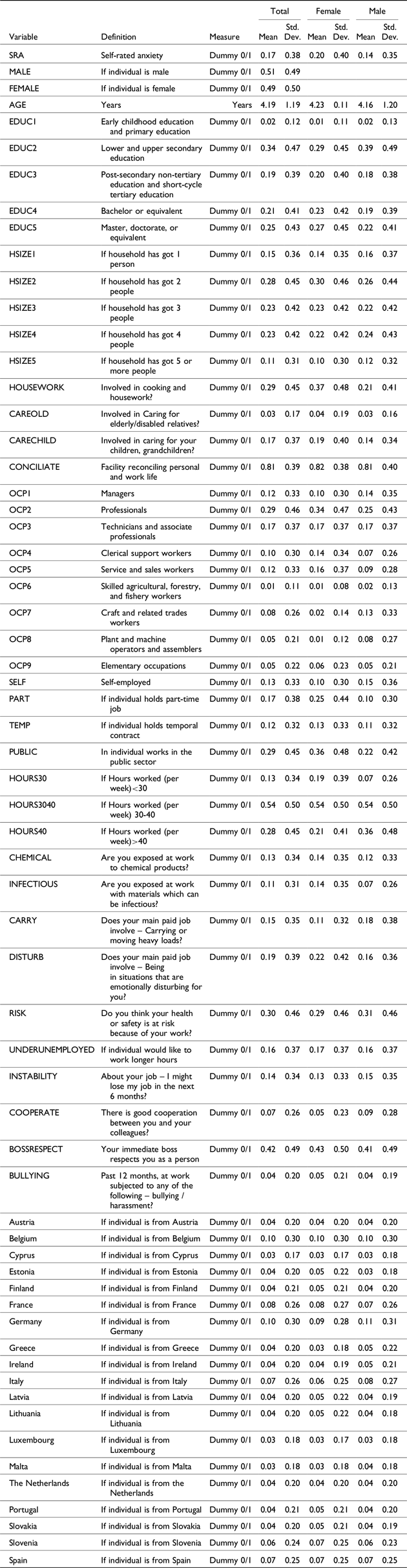
Two dummy variables have been created to capture labour market precarity (See Benach et al (Reference Benach, Vives, Amable, Vanroelen, Tarafa and Muntaner2014 and Reference Benach, Vives, Tarafa, Delclos and Muntaner2016) and Vancea and Utzet (Reference Vancea and Utzet2017) to study the effect of precarious employment as a social determinant of health): (a) if the individual has the possibility of losing his or her job in the next few months (INSTABILITY); and (b) if he/she would like to work longer hours (UNDEREMPLOYED). Finally, two variables have been considered to capture the workplace environment: (a) if there is positive cooperation between the worker and his/her colleagues (COOPERATION) and (b) if the worker’s immediate superior respects him/her as a person (BOSSRESPECT). Appendix 1 shows the set of variables used, their definition, how they are measured, and their average and standard deviation.
Finally, the economic GGGI includes the following economic criteria variables: (a) Ratio: female labour force participation over male value; (b) Wage equality between women and men for similar work (converted to female-over-male ratio); (c) Ratio: estimated female earned income over male value; (d) Ratio: female legislators, senior officials, and managers over male value; and (e) Ratio: female professional and technical workers over male value. It ranges from 0 (highest inequality) to 1 (total gender equality). See Appendix 2.
Results
Table 1 shows SRA by gender, the GGGI, and the frequency of bullying. As can be observed: (a) differences in SRA are remarkable among European (19) countries; (b) differences in SRA by gender are also considerably different (better in the case of men in all the cases); (c) the differences in the frequency of bullying are also noteworthy by country and gender. Thus, in countries like Luxembourg and France, 7.23% and 6.84% of workers have experienced bullying, respectively, while in Italy, this barely reaches 1.29%. Regarding the frequency by gender, prevalence seems to be higher among women than among men (4.78%, compared to 3.56%), in line with our initial hypotheses. However, this pattern cannot be extended to all countries, since the frequency of bullying is higher among men in 5 of the 19 countries (Cyprus, Germany, Greece, Malta, and Portugal).
Bullying, self-rated anxiety (SRA), and Economic Gender Gap index (EGGI)

It is noteworthy, also, that while the country frequencies in the EWCS (2015) and the EWCS (2021) differ (bearing in mind that this is not a panel, and there has been a modification of the interviewing methodology), these major characteristics regarding prevalence and gender differences remain consistent over time. In fact, the correlation coefficients between the frequency of anxiety and bullying across both surveys reach 0.8 and 0.7, respectively. It seems, therefore, that there are certain structural elements that make both phenomena stable over time.
In Table 2, estimates have been made including SRA as the dependent variable. The sample has been disaggregated by gender. The estimates have been made using the odds ratios method. Results can be interpreted as comparative advantage or, directly, as odds ratio.
Estimation results on self-reported anxiety (SRA)

As can be observed, the variable female increases the probability of reporting higher SRA by 25% compared to that of men. There does not appear to be a clear relationship between age, educational attainment, and SRA. Living alone increases the chances of experiencing anxiety, given that the rest of the coefficients are less than one. Workers with larger families (households with more than 4 members) are those with a lower probability of suffering from anxiety. Caring for the elderly and children increases the probability of reporting anxiety. It is also noteworthy the high coefficient of HOUSEWORK that shows the existence of the strong impact of performing household tasks on the probability of suffering from anxiety. Lately, facilities for reconciling family and personal life have also had a positive impact on SRA, as pointed out by Harryson et al (Reference Harryson, Novo and Hammarström2010).
In comparison to that of managers, all occupations considered reduce the probability of reported anxiety. Intuitively, managers do assume a higher level of responsibility and consequently, they have greater possibilities for experiencing anxiety. Being self-employed also increases the probability of reporting anxiety. The possibility of losing a job (INSTABILITY) increases the chances of suffering anxiety in line with the results highlighted by Cottini and Lucifora (Reference Cottini and Lucifora2013).
Regarding our main variable under study, BULLYING, a significant impact on SRA is observed, in accordance with our hypothesis, and as observed by Hauge, Skogstad and Einarsen (Reference Hauge, Skogstad and Einarsen2010), Fevre et al (Reference Fevre, Lewis, Robinson and Jones2012), Wood, Niven and Braeken (Reference Wood, Niven and Braeken2016), Yoo and Lee (Reference Yoo and Lee2018), and Steele, Rodgers and Fogarty (Reference Steele, Rodgers and Fogarty2020). Those who are bullied are 2.31 times more likely to report anxiety. Additionally, if there is good cooperation between the worker and his/her colleagues, the probability of suffering anxiety is reduced (0.82 times). Likewise, the BOSSRESPECT variable reduces the probability of suffering anxiety (0.84 times).
All these results are consistent with those obtained in the EWCS (2015), which validates our findings (estimates under request). In fact, the coefficient associated with bullying was practically the same (2.38).
By gender, caring for the elderly generates greater anxiety among women, while caring for children has greater impact among men. The variable CONCILIATE has a greater impact on men’s SRA than on women’s. Apparently, the facility to balance family and work has a greater impact on men, in contrast to the idea introduced by Milner et al (Reference Milner, King, LaMontagne, Bentley and Kavanagh2018). It must be borne in mind, in any case, that most of these questions collect individual perceptions and they could also have a differential pattern by gender. It could be a case of women internalising the need to reconcile work and family life to a greater extent and finding this easier.
Regarding the variable BULLYING, impact on women’s SRA is greater than that of men (2.54 compared to 1.99), which allows us to test our second hypothesis. Similarly, in the EWCS (2015), the coefficient for this variable was higher for women (2.49) than for men (2.29). However, in the EWCS (2021), these differences are more pronounced.
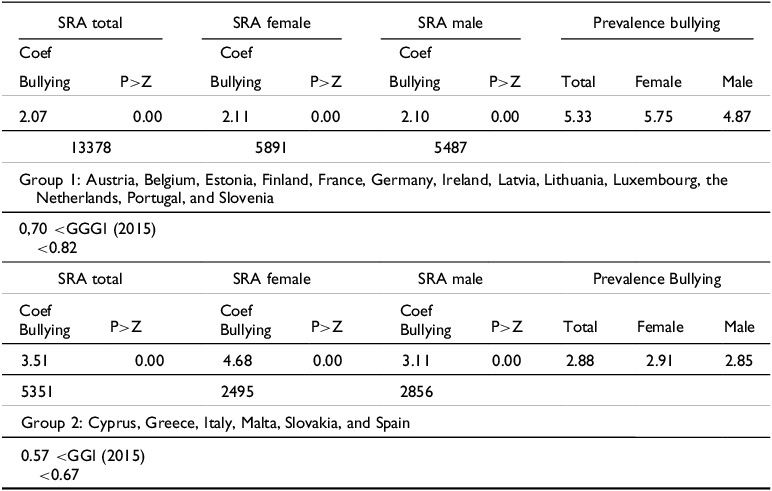
Below, to test the third part of our hypothesis, the sample has been divided according to the economic GGGI to identify whether the impact of bullying on women’s SRA is higher in countries with higher gender inequality. The countries have been separated into two groups: those with less economic inequality by gender (Group 1: Belgium, Estonia, France, Germany, Ireland, Latvia, Lithuania, the Netherlands, Portugal, and Slovenia), and those with higher inequality (Group 2: Austria, Cyprus, Greece, Italy, Luxemburg, Malta, Slovakia, and Spain) in the European (19) framework. Table 3 shows the impact of the variable BULLYING on SRA by gender. The frequency of bullying in each group is also included. The complete results can be observed in Appendix 3.
Estimation results on self-reported anxiety (SRA) by Global Gender Gap index (GGGI)

The variable BULLYING increases the possibility of reporting anxiety by 2.24 in Group 1 and 2.64 in Group 2. The results by gender allow us to test the third hypothesis. The differences by gender are more noticeable in environments with greater inequality. In Group 1, the differences between men and women are small (2.37 and 2.01, respectively), while in Group 2, experiencing bullying multiplies by 2.04 the chances of men suffering anxiety and by 3.63 for women. In the EWCS (2015), the impact of bullying on men’s SRA was also higher in Group 2 than in Group 1. It is feasible that greater gender equality would be accompanied by the achievement of other rights that would reduce the impact of bullying for both men and women. In the EWCS (2021), but the coefficient is not statistically significant.
The relationship between the frequency of bullying, the impact of bullying, and the GGGI is also noteworthy. Interestingly, the frequency of bullying is higher in Group 1 (4.76%) than in Group 2 (2.74%). It should be borne in mind that our variable collects the self-rated bullying and it is feasible, as we pointed out in the introduction, that awareness of the problem will be greater in Group 1 than in Group 2. In fact, the Eurofound (2015) established a classification of countries according to bullying based on two criteria: (a) if violence and harassment were considered to be a major issue; and (b) the awareness of the problem. Within the countries we have characterised as belonging to Group 1, Belgium, Finland, Ireland, and the Netherlands were classified as countries where violence and harassment were increasingly considered a relevant policy issue and the awareness of violence and harassment was steadily increasing. In these countries, there would be established and relatively systematic policies in place to prevent and address violence and harassment. In most of these countries, according to the Eurofound, there are higher proportions of workers reporting violence and harassment than the EU average. France and Germany, also included in Group 1, were classified as countries where violence and harassment are increasingly considered a relevant policy issue and awareness of violence and harassment is steadily increasing.
On the opposite side, Cyprus, Greece, Italy, Malta, and Spain, all included in Group 2, are defined as countries where violence and harassment are not considered to be a major issue and awareness of it is low or increasing. These countries would be characterised by low levels of reporting of violence and harassment by workers and, in general, the policies developed by social partners and governments are not developed. Additionally, Slovakia, also from Group 2, was classified as a country where the awareness of violence and harassment is low and the policies and procedures are developing or do not yet exist. In this country, the general level of awareness will be low, indicating that it is in the early stages of developing policies to address the issue.
Lately, in this report, Austria is considered an outlier. The country has a comparatively high share of workers reporting violence and harassment. There are some work-related policies, but none are systematic. Violence and harassment are not explicitly included in the legislation, but some agreements exist at the sectoral level.
Although there is no complete correspondence between both classifications since each one shows a different grouping of European countries (Lithuania, Estonia and Slovenia are countries with relatively greater gender equality, nevertheless the Eurofound qualifies them as countries where awareness of violence and harassment is low and the policies and procedures are developing or do not yet exist, while Luxembourg is characterised in the same way as France and Germany). It does seem that the awareness of the problem is much higher in Group 1. Consequently, it is feasible that this awareness reduces tolerance of the problem and increases the reported levels of bullying (Giorgi Reference Giorgi2008). To reduce the frequency of bullying and its impact on SRA, it is important that the problem is previously identified.
In Appendix 4, the estimates corresponding to the EWCS (2015) are presented. Once again, our results are not strictly comparable due to the mentioned methodological change and the fact that some countries have considerably modified their classification according to the GGGI. However, the broad conclusions are similar. The difference in the impact of bullying on anxiety is higher in countries corresponding to Group 1 than in Group 2, and the reported bullying is higher in the former group. Once again, the consistency between the results of both estimations validates our findings.
Conclusions and discussion
This study analyses the impact of bullying at work on SRA in nineteen European countries. The article tries to verify whether there is a differential impact of bullying at work on SRA by gender and country. Specifically, it observes whether the frequency and impact of bullying on women’s SRA is higher in those environments with greater economic and political gender inequality. The article, thus, proposes a grouping of countries based on the World Economic Forum GGGI according to the economic criteria.
The descriptive analysis displays remarkable differences in SRA among the different European (19) countries. The gender response pattern is also considerably different (men’s SRA is lower than women’s in all countries). The differences in the frequency of bullying are also remarkable. The results regarding the frequency of bullying by gender show that overall the prevalence of the problem is higher among women than among men. However, this is not always the case, so it is necessary to delve into the causes that justify this lower prevalence among women in some countries.
The estimates reveal the importance of bullying on SRA. Those who experience bullying are 2.31 times more likely to report anxiety. By gender, the impact is observed to be greater for women than for men (the probability of suffering anxiety is multiplied by 2.54 for women and by 1,99 for men), in line with Mundjberg Eriksen et al (Reference Mundjberg Eriksen, Hogh and Hansen2016) but contrary to the findings of Attell et al (Reference Attell, Kummerow Brown and Treiber2016).
The results corresponding to the EWCS (2015) are very similar, both in the magnitude of the coefficient and in the gender difference, demonstrating the stability and validity of our results.
There are several possible explanations for the gender differences. On the one hand, and considering the limitations in the definition of our main variable, fundamentally its amplitude and generality, it is feasible that the type of bullying suffered by women was more intense and with greater impact than that suffered by men. On the other hand, self-recognition of the anxiety problem could be higher among women than among men, as suggested by Hibbard and Pope (Reference Hibbard and Pope1983), Benyamini, Leventhal, and Leventhal (Reference Benyamini, Leventhal and Leventhal2000), Courtenay (Reference Courtenay2000), and Idler (Reference Idler2003), and the impact of bullying is, therefore, higher.
The results show that bullying increases the probability of reporting anxiety, and differences by gender are notable in the group of countries where women’s economic participation and opportunities, according to the GGGI, are lower. In fact, in the group of countries with greater relative equality, the differences in the impact of bullying on SRA by gender are smaller. It is remarkable, in any case, that the frequency of bullying is higher in the group of countries where conditions for women are more equal. It should be considered that our variable includes reported bullying and awareness of the problem will feasibly be greater in this group. In fact, the Eurofound (2015) considers Cyprus, Greece, Malta, Italy, and Spain as countries where violence and harassment are not considered to be a major issue and awareness of the problem is low (or increasing). The last country included in this group, Slovakia, is defined as a country where awareness of violence and harassment is low and the policies and procedures are developing or do not yet exist.
The restrained efforts by governments and the absence of social dialogue on this matter would be manifested in the low percentage of companies implementing procedures to address violence and harassment. Violence and harassment would be treated as a private matter and the lack of emphasis on addressing it in the workplace might pose challenges.
If we consider the existing literature, our work would reinforce the idea of Anderson and Berhal (Reference Anderson and Berdahl2002), who consider that women may feel less capable of defending themselves and, therefore, feel more exposed. However, the fact that the frequency of bullying reported by women increases in seemingly more egalitarian environments seems to contradict this argument. In fact, the impact on anxiety is smaller in egalitarian environments, which might suggest that the intensity of bullying is smaller.
Our study underscores the necessity of conducting a nuanced analysis of bullying based on gender. Interventions and strategies aimed at addressing bullying must be sensitive to gender dynamics, and prevention programmes should incorporate considerations of gender stereotypes and promote equality. Additionally, it highlights the importance of considering the broader macro environment in which workers are situated, beyond just their immediate surroundings such as family and organisation. There appear to be structural factors at the national level that could exacerbate the prevalence and impact of this phenomenon.
From a policy perspective, increasing economic participation and opportunities for women will significantly reduce the impact of bullying on this demographic. Conversely, the lack of awareness regarding these abusive behaviours likely results in a deficiency of specific legislation, thus amplifying the impact on vulnerable workers, particularly those in precarious situations. Efforts to raise awareness of the issue should be encouraged to accurately gauge its scope and mitigate its repercussions.
In any case, and in accordance with Bronfenbrenner’s (Reference Bronfenbrenner1997) approach, the analysis of workplace bullying requires not just the micro perspective, which includes personal characteristics and job stressors, but a meso and macro perspective. In our case, existing gender inequalities in the country, regardless of the specific organisation analyzed, should be considered. In a hypothetically more egalitarian environment, the exclusive consideration of the individual actors and actions could be less problematic. The greater the gender inequality in the country, the greater the unwillingness in organisations to deal with abusive practices against women and, therefore, the greater the impact on SRA.
Finally, and regarding the limitations of the analysis, the survey does not allow for studying individual fixed effects as it is not a panel, and therefore we cannot study the evolution of individuals as economic and social conditions change. At the same time, part of the richness of our analysis comes from the subjective perception of individuals when defining the existence of bullying. However, as we have pointed out, awareness of the problem is not the same in all countries and the identification of this phenomenon is complicated.
Likewise, and considering the country coefficients, we are aware that other groupings could be made in Europe (19), apart from the GGGI, especially those of cultural and social nature, that could enrich the analysis and justify the differences in the impact of bullying on women’s SRA.
For future research, it would be interesting to capture the phenomenon of bullying through a list of bullying behaviours given that the questions included in the EWCS (2021) do not allow for an objective analysis of this phenomenon. Additionally, the establishment of a data panel could be useful to observe how certain political and social changes in the country (e.g. changes in legislation) modify the frequency of bullying and its impact on individuals. Lately, gender refers to socially constructed roles, behaviours, activities, and attributes that a given society considers appropriate for men and women. It will be interesting, therefore, to observe how, as these values evolve over time, the impact and frequency of bullying by gender also change.
Appendices
Appendix 1. Descriptive statistics
Appendix 2. Descriptive statistics (mean)

Appendix 3. Estimation results on self-reported anxiety (SRA) by Global Gender Gap index (GGGI) (complete results)

Appendix 4. Estimation results on self-reported anxiety (SRA) by Global Gender Gap index (GGGI). EWCS (2015)