Ackermann et al. provide a remarkable neural model of human vocalizations linking affective and motor brain systems underlying vocal communication. Recent neuroimaging studies on human affective vocalizations provide additional insights on this close link between the affective and motor component. Although human communication is mostly non-affective, the case of affective expressions provides an ideal paradigm to test the validity of the affective-motor model of human communication proposed by Ackermann et al.
Recent neuroimaging studies have specified the neural mechanisms underlying affective vocalizations (Aziz-Zadeh et al. Reference Aziz-Zadeh, Sheng and Gheytanchi2010; Laukka et al. Reference Laukka, Åhs, Furmark and Fredrikson2011; Wattendorf et al. Reference Wattendorf, Westermann, Fiedler, Kaza, Lotze and Celio2013). These studies confirm the central role of the basal ganglia (BG) in vocalizations (Laukka et al. Reference Laukka, Åhs, Furmark and Fredrikson2011; Pichon & Kell Reference Pichon and Kell2013), as proposed by Ackermann et al., and show the close connection between the ventromedial and dorsolateral striatum during emotional speech (Pichon & Kell Reference Pichon and Kell2013). They also support the notion of a close connection of the BG to the cortico-subcortical vocalization network (Laukka et al. Reference Laukka, Åhs, Furmark and Fredrikson2011; Pichon & Kell Reference Pichon and Kell2013) as well as to the limbic system, which adds the emotional component of speech (Laukka et al. Reference Laukka, Åhs, Furmark and Fredrikson2011; Péron et al. Reference Péron, Frühholz, Verin and Grandjean2013; Wattendorf et al. Reference Wattendorf, Westermann, Fiedler, Kaza, Lotze and Celio2013).
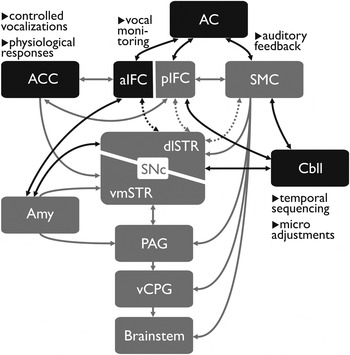
Although these studies support several of the main assumptions by Ackermann et al., they, first, also provide conflicting evidence for the suggested roles of some brain regions, and, second, suggest additional areas to be included in the neural network of vocalizations. Concerning the first point, Ackermann et al. propose, for example, that the anterior cingulate cortex (ACC) has no central role for prosodic vocal modulations, and that the inferior frontal cortex (IFC) is only involved in speech output behavior. Recent studies, however, indicate that the ACC plays a central role in the regulation of vocal behavior (Wattendorf et al. Reference Wattendorf, Westermann, Fiedler, Kaza, Lotze and Celio2013), probably supporting the interaction between cognitive, physiological, and emotional-motivational states (Laukka et al. Reference Laukka, Åhs, Furmark and Fredrikson2011) and serving as an auditory–motor interface between the perception and production of vocalizations (Aziz-Zadeh et al. Reference Aziz-Zadeh, Sheng and Gheytanchi2010); see our Figure 1. Furthermore, the portion of the inferior frontal cortex (IFC) that lies rostral to the premotor cortex and Broca's area seems also to be involved in processing vocalizations, especially in the recognition and the generation of emotional intonated speech (Aziz-Zadeh et al. Reference Aziz-Zadeh, Sheng and Gheytanchi2010; Frühholz & Grandjean Reference Frühholz and Grandjean2013). Similar to the ACC, the IFC might thus act as an auditory–motor interface linking the perception and the production of emotional speech. This interface seems critical, because auditory–motor feedback loops are important for online adjustments of vocal behavior based on the forward and backward mapping of performance predictions (Rauschecker & Scott Reference Rauschecker and Scott2009). This is closely related to the second point.
Figure 1.
Suggested extension (black regions and arrows) of Ackermann et al.'s original model (gray regions) beyond the affective (i.e., amygdala) and motor systems. Based on the paradigm of affective vocalizations and emotional speech, we suggest adding the AC and anterior IFC (aIFC), which serve auditory–motor feedback processing and vocal monitoring; the CbII, which serves online micro and macro adjustments of vocal motor output; and the ACC, which appears to be directly involved in controlling vocal output and physiological responses.
Recent neuroimaging evidence also points to two brain structures active during human vocalizations, which are not yet (explicitly) included in the model. As mentioned above, vocalizations strongly depend on auditory feedback for online adjustments and corrections. Accordingly, studies consistently report activity in low- and high-level regions of the auditory cortex (AC) (Aziz-Zadeh et al. Reference Aziz-Zadeh, Sheng and Gheytanchi2010; Pichon & Kell Reference Pichon and Kell2013), and in the cerebellum (Laukka et al. Reference Laukka, Åhs, Furmark and Fredrikson2011; Pichon & Kell Reference Pichon and Kell2013; Wattendorf et al. Reference Wattendorf, Westermann, Fiedler, Kaza, Lotze and Celio2013). While the AC together with the IFC is thought to serve auditory feedback processing and vocal monitoring, the cerebellum mainly supports online macro- (Pichon & Kell Reference Pichon and Kell2013) and micro-adjustments (Wattendorf et al. Reference Wattendorf, Westermann, Fiedler, Kaza, Lotze and Celio2013) of vocal motor behavior.
Concerning the AC feedback-related activity, the online validation of the vocal performance seems critical for vocal expressions. Affective vocalizations for successful social communication depend on a proper vocal production, especially in terms of temporo-dynamic features (Patel et al. Reference Patel, Scherer, Bjorkner and Sundberg2011). The temporal slow prosodic modulations of emotional speech, in particular, seem to rely on feedback processing in the AC (Aziz-Zadeh et al. Reference Aziz-Zadeh, Sheng and Gheytanchi2010; Pichon & Kell Reference Pichon and Kell2013). A major part of the slow prosodic modulations is determined by temporal variations of the fundamental frequency, which mainly contribute to the perception of pitch variations. This perceived temporal pitch variations of one's own vocalizations considerably activates the AC, and, surprisingly, also the cerebellum (Pichon & Kell Reference Pichon and Kell2013).
Although the cerebellum was a core element in a former model proposed by Ackermann (Reference Ackermann2008), in the present article Ackermann et al. note that it is not relevant here. However, given the above-mentioned evidence that the cerebellum is related to slow temporal modulations in affective speech (Pichon & Kell Reference Pichon and Kell2013), and given the general observation that non-speech (primate-general) and speech-based affective vocalizations (human-specific) considerably activate the cerebellum (Laukka et al. Reference Laukka, Åhs, Furmark and Fredrikson2011; Wattendorf et al. Reference Wattendorf, Westermann, Fiedler, Kaza, Lotze and Celio2013), we propose that the cerebellum should be an integral part of a neural model of vocal communication. It seems that for emotional vocalizations, the cerebellum supports the online micro adjustment of ongoing motor responses (Wattendorf et al. Reference Wattendorf, Westermann, Fiedler, Kaza, Lotze and Celio2013) and provides a macro temporal event structure (Kotz & Schwartze Reference Kotz and Schwartze2010) for the temporal dynamics embedded in emotional speech. Both are important ingredients for valid affective vocalizations in terms of vocal motor responses (Patel et al. Reference Patel, Scherer, Bjorkner and Sundberg2011).
Overall, from the perspective of affective vocalizations and emotional speech, neuroimaging evidence supports the neural model of Ackermann et al., but also suggests that the model might be extended to include auditory–motor feedback loops and online adjustment of vocal behavior (Fig. 1). The paradigm of human affective vocalizations thus might be a valid example for a cross-validation of the model proposed by Ackermann et al., because affective vocalizations are an essential ingredient of human communication.





Ackermann et al. provide a remarkable neural model of human vocalizations linking affective and motor brain systems underlying vocal communication. Recent neuroimaging studies on human affective vocalizations provide additional insights on this close link between the affective and motor component. Although human communication is mostly non-affective, the case of affective expressions provides an ideal paradigm to test the validity of the affective-motor model of human communication proposed by Ackermann et al.
Recent neuroimaging studies have specified the neural mechanisms underlying affective vocalizations (Aziz-Zadeh et al. Reference Aziz-Zadeh, Sheng and Gheytanchi2010; Laukka et al. Reference Laukka, Åhs, Furmark and Fredrikson2011; Wattendorf et al. Reference Wattendorf, Westermann, Fiedler, Kaza, Lotze and Celio2013). These studies confirm the central role of the basal ganglia (BG) in vocalizations (Laukka et al. Reference Laukka, Åhs, Furmark and Fredrikson2011; Pichon & Kell Reference Pichon and Kell2013), as proposed by Ackermann et al., and show the close connection between the ventromedial and dorsolateral striatum during emotional speech (Pichon & Kell Reference Pichon and Kell2013). They also support the notion of a close connection of the BG to the cortico-subcortical vocalization network (Laukka et al. Reference Laukka, Åhs, Furmark and Fredrikson2011; Pichon & Kell Reference Pichon and Kell2013) as well as to the limbic system, which adds the emotional component of speech (Laukka et al. Reference Laukka, Åhs, Furmark and Fredrikson2011; Péron et al. Reference Péron, Frühholz, Verin and Grandjean2013; Wattendorf et al. Reference Wattendorf, Westermann, Fiedler, Kaza, Lotze and Celio2013).
Although these studies support several of the main assumptions by Ackermann et al., they, first, also provide conflicting evidence for the suggested roles of some brain regions, and, second, suggest additional areas to be included in the neural network of vocalizations. Concerning the first point, Ackermann et al. propose, for example, that the anterior cingulate cortex (ACC) has no central role for prosodic vocal modulations, and that the inferior frontal cortex (IFC) is only involved in speech output behavior. Recent studies, however, indicate that the ACC plays a central role in the regulation of vocal behavior (Wattendorf et al. Reference Wattendorf, Westermann, Fiedler, Kaza, Lotze and Celio2013), probably supporting the interaction between cognitive, physiological, and emotional-motivational states (Laukka et al. Reference Laukka, Åhs, Furmark and Fredrikson2011) and serving as an auditory–motor interface between the perception and production of vocalizations (Aziz-Zadeh et al. Reference Aziz-Zadeh, Sheng and Gheytanchi2010); see our Figure 1. Furthermore, the portion of the inferior frontal cortex (IFC) that lies rostral to the premotor cortex and Broca's area seems also to be involved in processing vocalizations, especially in the recognition and the generation of emotional intonated speech (Aziz-Zadeh et al. Reference Aziz-Zadeh, Sheng and Gheytanchi2010; Frühholz & Grandjean Reference Frühholz and Grandjean2013). Similar to the ACC, the IFC might thus act as an auditory–motor interface linking the perception and the production of emotional speech. This interface seems critical, because auditory–motor feedback loops are important for online adjustments of vocal behavior based on the forward and backward mapping of performance predictions (Rauschecker & Scott Reference Rauschecker and Scott2009). This is closely related to the second point.
Suggested extension (black regions and arrows) of Ackermann et al.'s original model (gray regions) beyond the affective (i.e., amygdala) and motor systems. Based on the paradigm of affective vocalizations and emotional speech, we suggest adding the AC and anterior IFC (aIFC), which serve auditory–motor feedback processing and vocal monitoring; the CbII, which serves online micro and macro adjustments of vocal motor output; and the ACC, which appears to be directly involved in controlling vocal output and physiological responses.
Recent neuroimaging evidence also points to two brain structures active during human vocalizations, which are not yet (explicitly) included in the model. As mentioned above, vocalizations strongly depend on auditory feedback for online adjustments and corrections. Accordingly, studies consistently report activity in low- and high-level regions of the auditory cortex (AC) (Aziz-Zadeh et al. Reference Aziz-Zadeh, Sheng and Gheytanchi2010; Pichon & Kell Reference Pichon and Kell2013), and in the cerebellum (Laukka et al. Reference Laukka, Åhs, Furmark and Fredrikson2011; Pichon & Kell Reference Pichon and Kell2013; Wattendorf et al. Reference Wattendorf, Westermann, Fiedler, Kaza, Lotze and Celio2013). While the AC together with the IFC is thought to serve auditory feedback processing and vocal monitoring, the cerebellum mainly supports online macro- (Pichon & Kell Reference Pichon and Kell2013) and micro-adjustments (Wattendorf et al. Reference Wattendorf, Westermann, Fiedler, Kaza, Lotze and Celio2013) of vocal motor behavior.
Concerning the AC feedback-related activity, the online validation of the vocal performance seems critical for vocal expressions. Affective vocalizations for successful social communication depend on a proper vocal production, especially in terms of temporo-dynamic features (Patel et al. Reference Patel, Scherer, Bjorkner and Sundberg2011). The temporal slow prosodic modulations of emotional speech, in particular, seem to rely on feedback processing in the AC (Aziz-Zadeh et al. Reference Aziz-Zadeh, Sheng and Gheytanchi2010; Pichon & Kell Reference Pichon and Kell2013). A major part of the slow prosodic modulations is determined by temporal variations of the fundamental frequency, which mainly contribute to the perception of pitch variations. This perceived temporal pitch variations of one's own vocalizations considerably activates the AC, and, surprisingly, also the cerebellum (Pichon & Kell Reference Pichon and Kell2013).
Although the cerebellum was a core element in a former model proposed by Ackermann (Reference Ackermann2008), in the present article Ackermann et al. note that it is not relevant here. However, given the above-mentioned evidence that the cerebellum is related to slow temporal modulations in affective speech (Pichon & Kell Reference Pichon and Kell2013), and given the general observation that non-speech (primate-general) and speech-based affective vocalizations (human-specific) considerably activate the cerebellum (Laukka et al. Reference Laukka, Åhs, Furmark and Fredrikson2011; Wattendorf et al. Reference Wattendorf, Westermann, Fiedler, Kaza, Lotze and Celio2013), we propose that the cerebellum should be an integral part of a neural model of vocal communication. It seems that for emotional vocalizations, the cerebellum supports the online micro adjustment of ongoing motor responses (Wattendorf et al. Reference Wattendorf, Westermann, Fiedler, Kaza, Lotze and Celio2013) and provides a macro temporal event structure (Kotz & Schwartze Reference Kotz and Schwartze2010) for the temporal dynamics embedded in emotional speech. Both are important ingredients for valid affective vocalizations in terms of vocal motor responses (Patel et al. Reference Patel, Scherer, Bjorkner and Sundberg2011).
Overall, from the perspective of affective vocalizations and emotional speech, neuroimaging evidence supports the neural model of Ackermann et al., but also suggests that the model might be extended to include auditory–motor feedback loops and online adjustment of vocal behavior (Fig. 1). The paradigm of human affective vocalizations thus might be a valid example for a cross-validation of the model proposed by Ackermann et al., because affective vocalizations are an essential ingredient of human communication.
ACKNOWLEDGMENTS
Sascha Frühholz and Didier Grandjean were supported by grants from the Swiss National Science Foundation (105314_146559/1 and 105314_124572/1) and the NCCR in Affective Sciences (51NF40-104897).