




No CrossRef data available.
Article contents
Modification of spectral features by nonhuman primates
Published online by Cambridge University Press: 17 December 2014
Abstract
Ackermann et al. discuss the lack of evidence for vocal control in nonhuman primates. We suggest that nonhuman primates may be capable of achieving greater vocal control than previously supposed. In support of this assertion, we discuss new evidence that nonhuman primates are capable of modifying spectral features in their vocalizations.
Information
- Type
- Open Peer Commentary
- Information
- Copyright
- Copyright © Cambridge University Press 2014
References
Brumm, H., Voss, K., Köllmer, I. & Todt, D. (2004) Acoustic communication in noise: Regulation of call characteristics in a New World monkey. Journal of Experimental Biology
207(3):443–48.Google Scholar
Cleveland, J. & Snowdon, C. T. (1982) The complex vocal repertoire of the adult cotton-top tamarin (Saguinus oedipus oedipus). Zeitschrift für Tierpsychologie
58(3):231–70.Google Scholar
Egan, J. P. & Hake, H. W. (1950) On the masking pattern of a simple auditory stimulus. Journal of the Acoustical Society of America
22:622–30.Google Scholar
Egnor, S. E. R. & Hauser, M. D. (2006) Noise-induced vocal modulation in cotton-top tamarins (Saguinus oedipus). American Journal of Primatology
68(12):1183–90.Google Scholar
Egnor, S. E. R., Iguina, C. G. & Hauser, M. D. (2006) Perturbation of auditory feedback causes systematic perturbation in vocal structure in adult cotton-top tamarins. Journal of Experimental Biology
209(18):3652–63.Google Scholar
Egnor, S. E. R., Wickelgren, J. G. & Hauser, M. D. (2007) Tracking silence: Adjusting vocal production to avoid acoustic interference. Journal of Comparative Physiology A: Neuroethology, Sensory, Neural, and Behavioral Physiology
193(4):477–83.Google Scholar
Eliades, S. J. & Wang, X. (2012) Neural correlates of the Lombard effect in primate auditory cortex. The Journal of Neuroscience
32(31):10737–48.Google Scholar
Garnier, M., Henrich, N. & Dubois, D. (2010) Influence of sound immersion and communicative interaction on the Lombard effect. Journal of Speech, Language, and Hearing Research
53:588–608.Google Scholar
Hage, S. R., Jiang, T., Berquist, S. W., Feng, J. & Metzner, W. (2013) Ambient noise induces independent shifts in call frequency and amplitude within the Lombard effect in echolocating bats. Proceedings of the National Academy of Sciences USA
110(10):4063–68.Google Scholar
Hotchkin, C. F. (2012) Vocal noise compensation in nonhuman mammals: Modification types and usage patterns. Ph.D. thesis, Department of Ecology, The Pennsylvania State University.Google Scholar
Hotchkin, C. F. & Parks, S. (2013) The Lombard effect and other noise-induced vocal modifications: Insight from mammalian communication systems. Biological Reviews
88(4):809–24.Google Scholar
Hotchkin, C. F., Parks, S. E. & Weiss, D. J. (2013) Vocal modifications in primates: Effects of noise and behavioral context on vocalization structure. In: Proceedings of Meetings on Acoustics, Vol. 19, No. 1, Article 010061. Acoustical Society of America.Google Scholar
Janik, V. & Slater, P. J. B. (1997) Vocal learning in mammals. In: Advances in the Study of Behavior, vol. 26, ed. Slater, P. J. B., Rosenblatt, J. S., Snowdon, C. T., & Milinski, M., pp. 59–99. Academic Press.Google Scholar
Lombard, E. (1911) Le signe de l'elevation de la voix [The sign of the elevation of the voice]. Annales des Maladies de l'Oreille et du Larynx
37:101–19.Google Scholar
Lu, Y. & Cooke, M. (2009) The contribution of changes in F0 and spectral tilt to increased intelligibility of speech produced in noise. Speech Communication
51(12):1253–62.Google Scholar
Nachtigall, P., Supin, A. Y., Pawloski, J. & Au, W. W. L. (2004) Temporary threshold shifts after noise exposure in the bottlenose dolphin (Tursiops truncatus) measured using evoked auditory potentials. Marine Mammal Science
20:673–87.Google Scholar
Owren, M. J., Amoss, R. T. & Rendall, D. (2011) Two organizing principles of vocal production: Implications for nonhuman and human primates. American Journal of Primatology
73(6):530–44.Google Scholar
Parks, S. E., Johnson, M., Nowacek, D. P. & Tyack, P. L. (2011) Individual right whales call louder in increased environmental noise. Biology Letters
7:33–35.CrossRefGoogle ScholarPubMed
Pick, H. L. Jr., Siegel, G. M., Fox, P. W., Garber, S. R. & Kearney, J. K. (1989) Inhibiting the Lombard effect. Journal of the Acoustical Society of America
85:94.Google Scholar
Sinnott, J. M., Stebbins, W. C. & Moody, D. B. (1975) Regulation of voice amplitude by the monkey. Journal of the Acoustical Society of America
58:412–14.Google Scholar
Weiss, D. J. & Hauser, M. D. (2002) Perception of harmonics in the combination long call of cotton-top tamarins (Saguinus oedipus). Animal Behaviour
64:415–26.Google Scholar
Weiss, D. J., Garibaldi, B. T. & Hauser, M. D. (2001) The production and perception of long calls by cotton-top tamarins (Saguinus oedipus): Acoustic analyses and playback experiments. Journal of Comparative Psychology
15(3):258–71.Google Scholar
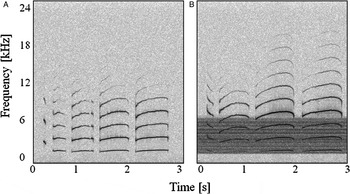
Figure 1. Representative CLCs produced during (a) control and (b) treatment trials demonstrating changes to spectral tilt. All whistles from (a) have strong fundamental frequencies and maximum energy in the 2nd harmonic, while in (b) the first whistle has a very faint fundamental frequency at approximately 2 kHz, and peak frequencies for all whistles occur in the 4th harmonics. Reduced energy in the fundamental frequency is also apparent in the second and third whistles. Spectrogram parameters: 1024 point Hamming window, 75% overlap, 11.7 Hz frequency resolution.
In discussing the modulation of acoustic call structure, Ackermann et al. question the extent to which nonhuman primates exert operant control over the spectro-temporal features of their calls. This concern echoes a long-standing notion that nonhuman primates are capable of controlling acoustic parameters that can be modulated by changes in exhalation, such as loudness and duration, but lack control over spectral features that may require more nuanced control over the vocal apparatus (Janik & Slater Reference Janik, Slater, Slater, Rosenblatt, Snowdon and Milinski1997).
In this connection, we would like to briefly review our work on noise-induced vocal modifications in nonhuman primates. When vocalizing in noisy environments, humans and several other species (e.g., whales, bats, etc.; Hage et al. Reference Hage, Jiang, Berquist, Feng and Metzner2013; Parks et al. Reference Parks, Johnson, Nowacek and Tyack2011; see review in Hotchkin & Parks Reference Hotchkin and Parks2013) involuntarily raise the amplitude of their vocalizations (i.e., the Lombard effect; Lombard Reference Lombard1911; Pick et al. Reference Pick, Siegel, Fox, Garber and Kearney1989). Associated changes in vocalization duration have also been documented in humans and nonhumans (e.g., Garnier et al. Reference Garnier, Henrich and Dubois2010). Some species also modify spectral features by shifting energy to higher harmonics (reviewed in Hotchkin & Parks Reference Hotchkin and Parks2013). However, consistent with Ackermann et al.'s concerns, previous studies with nonhuman primates have suggested that they may be restricted to manipulating the amplitude and temporal aspects of their calls in response to noise in the transmission environment (Egnor & Hauser Reference Egnor and Hauser2006; Sinnott et al. Reference Sinnott, Stebbins and Moody1975). To the best of our knowledge, no nonhuman primate has previously demonstrated the ability to modify spectral features of their calls in response to noise.
We have recently discovered this ability in cotton-top tamarins (Saguinus oedipus), a small arboreal New World species known to have an extensive vocal repertoire (Cleveland & Snowdon Reference Cleveland and Snowdon1982). A previous study with this species found that they modify the amplitude and duration of their calls in response to noise (Egnor & Hauser Reference Egnor and Hauser2006), and, using a different method, we have determined they are also capable of modifying spectral components of their calls. Our findings suggest the possibility for greater vocal control in nonhuman primates than previously supposed (e.g., Janik & Slater Reference Janik, Slater, Slater, Rosenblatt, Snowdon and Milinski1997).
Unlike prior studies with nonhuman primates (Brumm et al. Reference Brumm, Voss, Köllmer and Todt2004; Egnor & Hauser Reference Egnor and Hauser2006; Sinnott et al. Reference Sinnott, Stebbins and Moody1975), our study used playbacks of both broad- and narrow-band white noise at a range of amplitudes to investigate vocal control of two call types, chirps and combination long calls (CLCs; Hotchkin Reference Hotchkin2012; Hotchkin et al. Reference Hotchkin, Parks and Weiss2013). We measured a variety of acoustic parameters including spectral tilt (a relative measure of the distribution of energy between the high- and low-frequency components of the call), which is an acoustic parameter that has been studied almost exclusively in human responses to noise (e.g., Lu & Cooke Reference Lu and Cooke2009). We found that individuals modified the structure of both call types in response to changes in noise amplitude and bandwidth. In CLCs, whose frequencies were overlapped by the noise, peak fundamental frequency and spectral tilt changed in response to increased noise amplitude and bandwidth (see our Fig. 1). While the noise stimuli did not overlap with the chirp frequencies, this call type also showed changes to frequency content during noise. Noise with frequency components at or slightly below vocalization frequency may result in masking, due to a phenomenon known as the upward spread of masking which has been observed in both humans and nonhuman mammals (Egan & Hake Reference Egan and Hake1950; Nachtigall et al. Reference Nachtigall, Supin, Pawloski and Au2004). Increases in chirp frequency may provide release from masking by low-frequency noise, thereby improving the detectability even when noise frequencies do not overlap the vocalization. In chirps, the peak and maximum components of the fundamental frequency increased as a result of noise level, with no changes to spectral tilt. Other vocal modifications observed included the Lombard effect (i.e., an increase in amplitude) and longer chirp duration.
Representative CLCs produced during (a) control and (b) treatment trials demonstrating changes to spectral tilt. All whistles from (a) have strong fundamental frequencies and maximum energy in the 2nd harmonic, while in (b) the first whistle has a very faint fundamental frequency at approximately 2 kHz, and peak frequencies for all whistles occur in the 4th harmonics. Reduced energy in the fundamental frequency is also apparent in the second and third whistles. Spectrogram parameters: 1024 point Hamming window, 75% overlap, 11.7 Hz frequency resolution.
The focus of the authors is primarily on volitional control and modification of vocalizations in nonhuman primates, and they could therefore dismiss this finding because responses to noise are thought to reflect involuntary processes, as noted above. In fact, we do not argue that the flexibility exhibited in the Lombard effect and conditioning studies necessarily set the stage for the evolution of vocal flexibility as it is manifest in humans (as noted by Owren et al. Reference Owren, Amoss and Rendall2011). However, in order to refine the dual stage hypothesis, it is important to fully describe the range of flexible features available in nonhuman primate vocal communication. Research with cotton-top tamarins alone has demonstrated they are capable of producing long-term changes to the acoustic structure of their calls (i.e., vocal convergence; see Weiss et al. Reference Weiss, Garibaldi and Hauser2001); perceiving changes to the spectral features of the harmonics in their CLCs (Weiss & Hauser Reference Weiss and Hauser2002); modifying the timing of their calls (Egnor et al. Reference Egnor, Wickelgren and Hauser2007); and also altering the loudness, duration, and spectral components of their calls when transmitting signals in noisy environments (Egnor & Hauser Reference Egnor and Hauser2006; Egnor et al. Reference Egnor, Iguina and Hauser2006; Hotchkin Reference Hotchkin2012). Further, it has been suggested that multiple levels of vocal control may be active during Lombard vocalizations and could involve a complex array of neural structures extending beyond brainstem reflexes (Eliades & Wang Reference Eliades and Wang2012). Thus, the main implication of our findings for the target article is to indicate that nonhuman primates may possess greater vocal control than has previously been supposed. Developing a more complete understanding of the ways in which nonhuman primates are capable of manipulating their vocalizations, and the supporting neural networks, may ultimately help Ackermann et al. further refine their theory.