1 Introduction
Weakly compact cardinals were introduced by Erdős and Tarski in the 1960s. There are many equivalent ways to define these cardinals, and this variety testifies to its significance: via model theory of infinitary languages, compactness of topological spaces, basis problems for linear orders, tree properties, Ramsey theory, elementary embeddings, indescribable cardinals, and more.
Motivated by a characterization of weak compactness in terms of C-sequences due to Todorčević [Reference Todorčević15, Theorem 1.8], Lambie-Hanson and Rinot [Reference Lambie-Hanson and Rinot9, Definition 1.6] introduced a new cardinal characteristic, the C-sequence number, to measure the compactness of a regular uncountable cardinal
 $\kappa $
, where the best case
 $\chi (\kappa )=0$
amounts to saying that
 $\kappa $
is weakly compact (see Definition 2.18 below). Once the C-sequence number of
 $\kappa $
is bigger than
 $1$
(i.e.,
 $\chi (\kappa )>1$
), the method of walks on ordinals becomes active and enables the construction of interesting incompact objects. To mention two such applications at the level of a strongly inaccessible cardinal
 $\kappa $
, if
 $\chi (\kappa )>1$
, then the
 $\kappa $
-chain condition is not infinitely productive (see [Reference Lambie-Hanson and Rinot8, Lemma 3.3] and [Reference Lambie-Hanson and Rinot9, Lemma 5.8]), and there is a
 $\kappa $
-Aronszajn tree with no ascent path of width less than
 $\chi (\kappa )$
(see [Reference Inamdar and Rinot5, Lemma 7.9]).Footnote
1
The strong assertion
 $\chi (\kappa )=1$
indeed implies that
 $\kappa $
shares features of weakly compact cardinals such as satisfying a diagonal form of simultaneous reflection of stationary subsets of
 $\kappa $
[Reference Lambie-Hanson and Rinot9, Lemma 2.12], and as being weakly compact in Gödel’s constructible universe [Reference Todorčević15, Theorem 1.10].
In the other direction, very little is known about the compatibility of
 $\chi (\kappa )=1$
with incompact postulates. Not only because walks on ordinals is unavailable in this context, but because Kunen’s proof [Reference Kunen7, Section 3] is currently the only known method to construct models for
 $\chi (\kappa )=1$
. We defer the discussion on Kunen’s method to Section 1.1, and now turn to describe and motivate the kind of incompactness we would like to show compatible with
 $\chi (\kappa )=1$
.
The axiom
 $\clubsuit _{\operatorname {\mathrm {AD}}}$
was introduced by Rinot and Shalev in [Reference Rinot and Shalev12] as a guessing principle useful in solving problems in set-theoretic topology. Roughly speaking,
 $\clubsuit _{\operatorname {\mathrm {AD}}}$
holds over a set of ordinals S iff there is a ladder system over S consisting of pairwise almost-disjoint sets (in a sense sufficient to imply that the set S is not subtle), and this system has a guessing feature akin to Ostaszewski’s principle
 $\clubsuit $
[Reference Ostaszewski11]. By [Reference Rinot and Shalev12, Theorem 2.30],
 $\clubsuit _{\operatorname {\mathrm {AD}}}$
fails over every club of a weakly compact cardinal. By [Reference Rinot and Shalev12, Theorem 2.23], if there exists a
 $\kappa $
-Souslin tree T whose set of vanishing levels
 $V(T)$
is stationary (see Definition 2.5 below), then
 $\clubsuit _{\operatorname {\mathrm {AD}}}$
holds over
 $V(T)\cap C$
for some club
 $C\subseteq \kappa $
.
As
 $\clubsuit _{\operatorname {\mathrm {AD}}}$
holding over a club in
 $\kappa $
implies that
 $\kappa $
is neither subtle nor weakly compact, this raises the question of the degree of compactness that is compatible with it. The best known result in this vein is [Reference Rinot, Yadai and You13, Theorem E] asserting that assuming the consistency of a weakly compact cardinal, it is consistent that for some strongly inaccessible cardinal
 $\kappa $
satisfying
 $\chi (\kappa ) = \omega $
,
 $\clubsuit _{\operatorname {\mathrm {AD}}}$
holds over a club in
 $\kappa $
, furthermore, there is a
 $\kappa $
-Souslin tree T such that
 $V(T) = \operatorname {\mathrm {acc}}(\kappa )$
.Footnote
2
Whether this result may be improved to
 $\chi (\kappa )<\omega $
remained an evasive open problem. Here, this remaining case is resolved.
Main Theorem. Suppose that
 $\kappa $
is a weakly compact cardinal. Then there exists a forcing extension in which
 $\kappa $
is strongly inaccessible,
 $\chi (\kappa )=1$
and there exists a
 $\kappa $
-Souslin tree T such that
 $V(T)=\operatorname {\mathrm {acc}}(\kappa )$
.
To crystallize two concise compactness principles that our model manages to separate, consider the following two threading-type postulates:
-
(I) For every C-sequence
 $\langle C_\beta \mid \beta <\kappa \rangle $
, there exists a cofinal
$\Delta \subseteq \kappa $
such that, for every
$\alpha <\kappa $
, there exists a
$\beta <\kappa $
with
$\Delta \cap \alpha \subseteq \operatorname {\mathrm {nacc}}(C_\beta )$
.Footnote
3
-
(II) For every C-sequence
$\langle C_\beta \mid \beta <\kappa \rangle $
, there exists a cofinal
$\Delta \subseteq \kappa $
such that, for every
$\alpha <\kappa $
, there exists a
$\beta <\kappa $
with
$\Delta \cap \alpha \subseteq C_\beta $
.


By Todorčević’s theorem [Reference Todorčević15, Theorem 1.8], if
 $\kappa $
is weakly compact, then (I) holds. The postulate (II) is equivalent to asserting that
 $\chi (\kappa )\le 1$
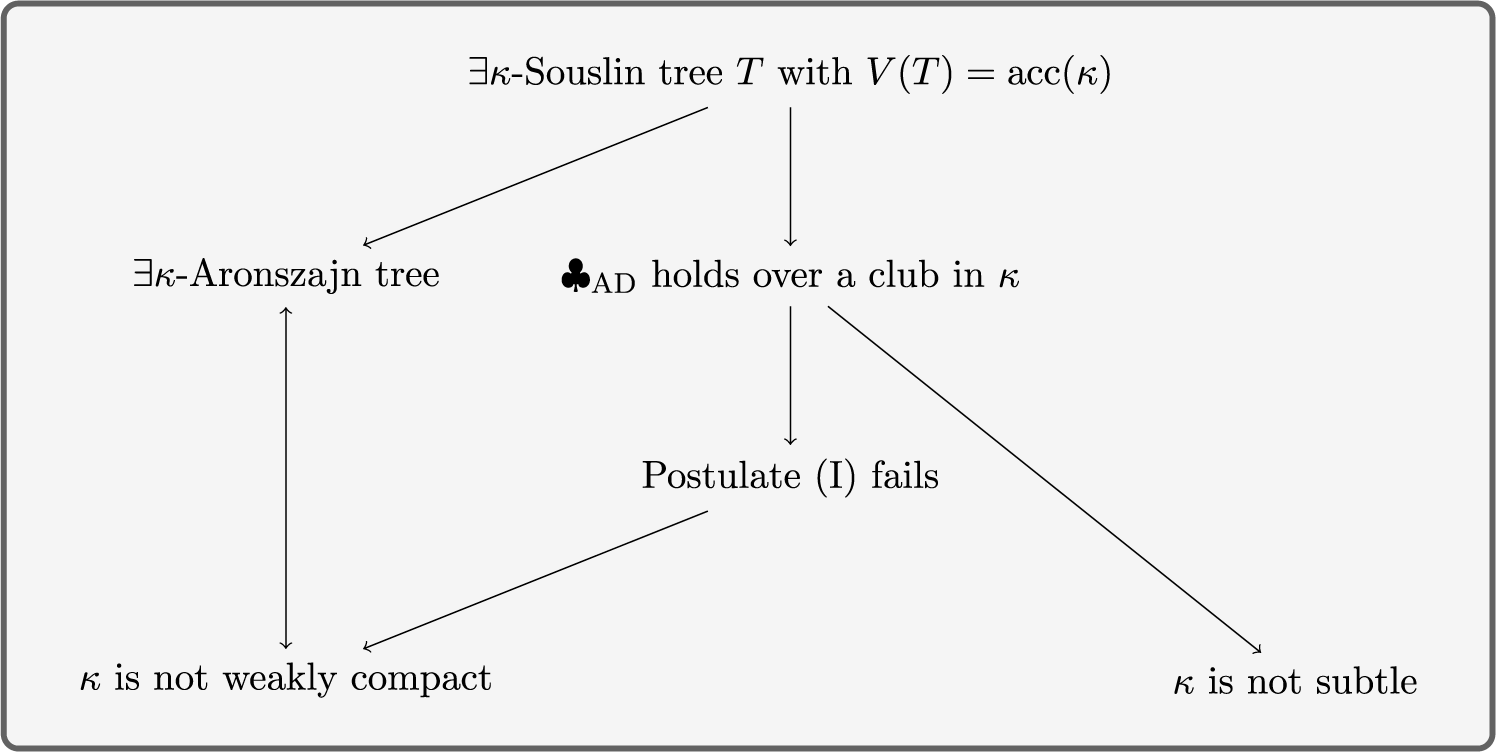
. Our model demonstrates that (II) is strictly weaker than (I) (see Figure 1).
Diagram of implications at the level of a strongly inaccessible cardinal
 $\kappa $
.

1.1 About the proof
The standard way to argue that
 $\chi (\kappa )=1$
holds in a given model is to prove that
 $\kappa $
is not weakly compact, but can become one via some
 $\kappa $
-cc notion of forcing. The prototype example is Kunen’s model [Reference Kunen7, Section 3] in which there is a
 $\kappa $
-Souslin tree T such that forcing with it makes
 $\kappa $
a measurable cardinal (in particular, weakly compact and subtle). Modifying Kunen’s proof to make the generic
 $\kappa $
-Souslin tree T satisfy that
 $V(T)$
covers a club in
 $\kappa $
brings up two obstructions. First, as explained earlier, the existence of such a T implies that
 $\kappa $
is not subtle, so that it cannot become measurable in some
 $\kappa $
-cc forcing extension. The second is that in any extension in which
 $\kappa $
becomes weakly compact, our tree would have to admit at least
 $\kappa ^+$
-many cofinal branches (see Proposition 2.7). So if, as in Kunen’s case, T is slimFootnote
4
and the resurrection of weak compactness is obtained by forcing with T, then such a T must have been a so-called almost-Kurepa
 $\kappa $
-Souslin tree.
While we do not know it is impossible to prove the Main Theorem using Kunen’s original approach, we ended up taking a different path. Instead of resurrection of weak compactness in a single forcing extension, our approach is to produce a model admitting a family of generic elementary embeddings each living in its own
 $\kappa $
-cc forcing extension, as follows. We will start with
 $\kappa $
a weakly compact cardinal, carry out some preparatory forcing below
 $\kappa $
, and then force to add a uniformly homogeneous
 $\kappa $
-Souslin subtree T of
 ${}^{<\kappa }\kappa $
such that
 $V(T)$
is a club in
 $\kappa $
and such that T admits an
 $\mathcal F$
-ascent path for an educated choice of a filter
 $\mathcal F$
over
 $\omega $
. Our plan is to argue that
 $\chi (\kappa )=1$
holds in the final model by showing that for every C-sequence
 $\vec C$
over
 $\kappa $
, a nontrivial elementary embedding
 $j:M\rightarrow N$
between two
 $\kappa $
-models with
 $\operatorname {\mathrm {crit}}(j)=\kappa $
and
 $\vec C\in M$
exists in some further
 $\kappa $
-cc forcing extension. In the inevitable case that our tree T belongs to M, it would admit a branch
 $b:\kappa \rightarrow \kappa $
, as witnessed by any element of the
 $\kappa ^{\text {th}}$
-level of
 $j(T)$
. Meanwhile, since
 $V(T)$
covers a club,
 $\kappa \in j(V(T))=V(j(T))$
, and hence the tree
 $j(T)$
would have a vanishing
 $\kappa $
-branch
 $b':\kappa \rightarrow \kappa $
. As b is non-vanishing and
 $b'$
is vanishing, the fact that T is uniformly homogeneous implies that b and
 $b'$
must disagree cofinally often. By iterating such an argument, we infer that the tree must have at least
 $\omega $
-many cofinal branches that disagree with each other cofinally often. Thus, we shall need a notion of forcing that introduces such cofinal branches in a
 $\kappa $
-cc fashion. This is exactly where the definition of a mutually exclusive
 $\mathcal F$
-ascent path arises. To connect on a previous remark, instead of adding
 $\kappa ^+$
-many branches, in our approach only countably many (mutually exclusive ones) are added.
1.2 Organization of this article
In Section 2, we provide some necessary background on trees, ascent paths, and C-sequences. We motivate the new notion of a mutually exclusive
 $\mathcal {F}$
-ascent path by showing that variations of Kunen’s forcing that do not make use of this kind of ascent path are not well behaved.
In Section 3, we present our main notions of forcing. Large cardinals play no role in this section, and the results are applicable as low as at
 $\aleph _2$
.
In Section 4, we prove the main theorem by iterating the posets of Section 3 below and at a weakly compact cardinal.
2 Preliminaries
2.1 Trees and vanishing levels
For simplicity, instead of working with abstract trees, we opt to work with the following more concrete implementation. A streamlined tree is a subset
 $T\subseteq {}^{<\kappa }H_\kappa $
for some cardinal
 $\kappa $
that is downward-closed, i.e., for every
 $t\in T$
,
 $\{ t\restriction \alpha \mid \alpha <\kappa \}\subseteq T$
. The height of a node
 $x\in T$
is
 $\operatorname {\mathrm {dom}}(x)$
. The height of T, denoted
 $\operatorname {\mathrm {ht}}(T)$
, is the least ordinal
 $\beta $
such that
 $T_\beta :=\{x\in T\mid \operatorname {\mathrm {dom}}(x)=\beta \}$
is empty. Note that for every ordinal
 $\beta $
,
 $T\restriction \beta :=\{x\in T\mid \operatorname {\mathrm {dom}}(x)<\beta \}$
is as well a streamlined tree. A streamlined tree T is said to be normal iff for every
 $x\in T$
and every
 $\alpha <\operatorname {\mathrm {ht}}(T)$
, there exists some
 $y\in T_\alpha $
with either
 $x\subseteq y$
or
 $y\subseteq x$
. A streamlined
 $\kappa $
-tree [Reference Brodsky and Rinot2, Definition 2.3] is a downward-closed subset T of
 ${}^{<\kappa }H_\kappa $
satisfying that
 $0<|T_\alpha |<\kappa $
for every
 $\alpha <\kappa $
.Footnote
5
A streamlined
 $\kappa $
-Souslin tree is a streamlined
 $\kappa $
-tree having no
 $\kappa $
-branches and no
 $\kappa $
-sized antichains with respect to the ordering
 $\subsetneq $
.
Convention 2.1. Hereafter, by a tree, we mean a streamlined tree.
Definition 2.2. For all
 $s,t\in {}^{<\kappa }H_\kappa $
, let
 $$ \begin{align*}\Delta(s,t):=\min(\{\operatorname{\mathrm{dom}}(s),\operatorname{\mathrm{dom}}(t)\}\cup\{\delta\in\operatorname{\mathrm{dom}}(s)\cap\operatorname{\mathrm{dom}}(t)\mid s(\delta)\neq t(\delta)\}).\end{align*} $$
In addition, we define
 $(s*t):\operatorname {\mathrm {dom}}(t)\rightarrow H_\kappa $
via:
 $$ \begin{align*}(s*t)(\varepsilon):=\begin{cases}s(\varepsilon),&\text{if }\varepsilon\in\operatorname{\mathrm{dom}}(s);\\ t(\varepsilon),&\text{otherwise.}\end{cases}\end{align*} $$
Definition 2.3. A
 $\kappa $
-tree T is uniformly homogeneous iff for all
 $s, t\in T$
,
 $s*t$
is in T.
Definition 2.4. Suppose that T is a tree. An
 $\alpha $
-branch is a subset
 $B\subseteq T$
linearly ordered by
 $\subsetneq $
and satisfying that
 $\{ \operatorname {\mathrm {dom}}(x)\mid x\in B\}=\alpha $
. For
 $\alpha \in \operatorname {\mathrm {acc}}(\kappa )$
, an
 $\alpha $
-branch B is vanishing iff
 $\bigcup B\notin T$
.
Definition 2.5 (The levels of vanishing branches, [Reference Rinot and Shalev12, Definition 2.18])
For a
 $\kappa $
-tree T,
 $ V(T)$
stands for the set of all
 $\alpha \in \operatorname {\mathrm {acc}}(\kappa )$
such that for every node
 $x\in T$
of height less than
 $\alpha $
there exists a vanishing
 $\alpha $
-branch containing x.
In the context of uniformly homogeneous trees, the preceding admits a simpler characterization (see [Reference Rinot, Yadai and You13, Propositions 2.6 and 2.19]).
Fact 2.6. For a uniformly homogeneous
 $\kappa $
-tree T,
 $V(T)$
coincides with the set of all
 $\alpha \in \operatorname {\mathrm {acc}}(\kappa )$
for which there exists a vanishing
 $\alpha $
-branch.
Proposition 2.7. Suppose that
 $\kappa $
is a weakly compact cardinal, and T is a
 $\kappa $
-tree such that
 $V(T)$
covers a club in
 $\kappa $
. Then T has at least
 $\kappa ^+$
-many cofinal branches.
Proof. Towards a contradiction, suppose that the set of cofinal branches of T may be enumerated (possibly with repetitions) as
 $\langle b_\alpha \mid \alpha < \kappa \rangle $
. It follows that we may take a
 $\kappa $
-model M containing T and each of the
 $b_\alpha $
’s. Using the weak compactness of
 $\kappa $
, fix an elementary embedding
 $j:M\rightarrow N$
with critical point
 $\kappa $
, where N is as well a
 $\kappa $
-model. By elementarity,
 $\kappa \in j(V(T))$
, so let b be a vanishing
 $\kappa $
-branch of
 $j(T)$
. Since the restriction of
 $j(T)$
to all levels below
 $\kappa $
coincides with T, it follows that b is a cofinal branch of T, so that
 $b = b_\alpha $
for some
 $\alpha <\kappa $
. By elementarity,
 $j(b_\alpha )$
is a cofinal branch of
 $j(T)$
having
 $b_\alpha $
as an initial segment, contradicting the fact
 $b_\alpha =b$
is a vanishing
 $\kappa $
-branch of
 $j(T)$
.
2.2 Ascent paths
The notions of forcing in Section 3 below will make use of the upcoming Definitions 2.8, 2.14, and 2.15. To motivate them, we shall inspect here two earlier attempts to define these notions of forcing, demonstrating the problem with these attempts.
Let
 $\theta <\kappa $
be a pair of infinite regular cardinals. We start by recalling the vanilla definition of an ascent path.
Definition 2.8. Suppose that T is a tree, and
 $\theta $
is some cardinal. For all
 $f,g \in {}^{\theta }T$
, denote
 $$ \begin{align*}\circledcirc(f,g):=\{ \tau<\theta \mid f(\tau) \subseteq g(\tau)\text{ or }f(\tau) \supseteq g(\tau)\}.\end{align*} $$
Definition 2.9 (Laver)
Suppose that T is a tree of some height
 $\gamma $
. A sequence
 $\vec f=\langle f_\alpha \mid \alpha < \gamma \rangle $
is a
 $\theta $
-ascent path through T iff the following two hold:
-
• for every
$\alpha < \gamma $
,
$f_\alpha :\theta \rightarrow T_\alpha $
is a function; -
• for all
$\alpha < \beta < \gamma $
,
$\circledcirc (f_{\alpha },f_{\beta })$
is co-bounded in
$\theta $
.


Remark 2.10. We often write
 $\vec f(\alpha )$
for the
 $\alpha ^{\text {th}}$
-element of
 $\vec f$
, namely,
 $f_\alpha $
.
A natural notion of forcing for adding a
 $\kappa $
-Souslin tree with a
 $\theta $
-ascent path may be found in the proof of [Reference Gitik4, Theorem 3.1]. It reads as follows.
Definition 2.11.
 $\mathbb S^\kappa _{\theta }$
is defined to be the notion of forcing consisting of all pairs
 $\langle T,\vec {f} \rangle $
for which the following two hold:
-
(1)
$T \subseteq {^{<\kappa }}2$
is a normal uniformly homogeneous tree of a successor height all of whose levels have size less than
$\kappa $
; -
(2)
$\vec {f}$
is a
$\theta $
-ascent path through T.


The order on
 $\mathbb S^\kappa _{\theta }$
is defined by taking end-extension on both coordinates.
Work in
 $V[G]$
for G an
 $\mathbb S^\kappa _{\theta }$
-generic filter over V. It is the case that
 $T(G):=\bigcup \{T\mid \langle T,\vec {f}\rangle \in G\}$
is a uniformly homogeneous
 $\kappa $
-Souslin tree, and
 $\vec {f^G}:=\bigcup \{\vec {f}\mid \langle T,\vec {f}\rangle \in G\}$
is a
 $\theta $
-ascent path through
 $T(G)$
. Next, consider the following further forcing.
Definition 2.12.
 $\mathbb A^\kappa _{\theta }$
has underlying set
 $\kappa $
, and ordering
 $$ \begin{align*}\beta\leq_{\mathbb A^\kappa_{\theta}}\alpha \text{ iff }(\alpha\le\beta\ \&\ \circledcirc(\vec{f^G}(\alpha),\vec{f^G}(\beta))=\theta).\end{align*} $$
Proposition 2.13.
 $\mathbb A^\kappa _{\theta }$
does not satisfy the
 $\kappa $
-chain condition.
Proof. Let us say that
 $\beta <\kappa $
is bad iff
 $\beta =\alpha +1$
is a successor ordinal and
 $\Delta (\vec {f^G}(\beta )(0),\vec {f^G}(\beta )(1))=\alpha $
.
Claim 2.13.1. There are cofinally many bad
 $\beta <\kappa $
.
Proof. Back in V, given a condition
 $\langle T,\vec {f}\rangle $
in
 $\mathbb S^\kappa _\theta $
, fix
 $\alpha $
such that
 $\operatorname {\mathrm {ht}}(T)=\alpha +1$
. Let
 $T':=T\cup \{ t{}^\smallfrown \langle 0\rangle ,t{}^\smallfrown \langle 1\rangle \mid t\in T_\alpha \}$
, and define
 $\vec f':\alpha +2\rightarrow {}^\theta {T'}$
via
 $$ \begin{align*}\vec f'(\beta)(\tau):=\begin{cases} \vec f(\beta)(\tau),&\text{if }\beta\le\alpha;\\ \vec f(\alpha)(\tau){}^\smallfrown\langle0\rangle,&\text{if }\beta=\alpha+1\ \&\ \tau\neq1;\\ \vec f(\alpha)(0){}^\smallfrown\langle1\rangle,&\text{otherwise}. \end{cases}\end{align*} $$
Then
 $\langle T',\vec f'\rangle $
extends
 $\langle T,\vec f\rangle $
and it forces that
 $\operatorname {\mathrm {dom}}(\vec f')$
is bad.
As the collection of all bad
 $\beta <\kappa $
is an antichain in
 $\mathbb A^\kappa _\theta $
, the latter fails to satisfy the
 $\kappa $
-cc.
To mitigate the problem arising from the preceding proposition, and in view of the goal of securing a good chain condition, we introduce the next two definitions.
Definition 2.14. Two elements
 $s,t\in {}^{<\kappa }H_\kappa $
are mutually exclusive iff
 $s(\varepsilon )\neq t(\varepsilon )$
for every
 $\varepsilon \in \operatorname {\mathrm {dom}}(s)\cap \operatorname {\mathrm {dom}}(t)$
.
Definition 2.15. Suppose that T is a tree of some height
 $\gamma $
, and
 $\mathcal F$
is a filter over
 $\theta $
. A sequence
 $\vec f=\langle f_\alpha \mid \alpha < \gamma \rangle $
is a mutually exclusive
 $\mathcal {F}$
-ascent path through T iff the following three hold:
-
• for every
$\alpha < \gamma $
,
$f_\alpha :\theta \rightarrow T_\alpha $
is a function; -
• for all
$\alpha < \beta < \gamma $
,
$\circledcirc (f_{\alpha },f_{\beta })\in \mathcal {F}$
; -
• for every nonzero
$\alpha <\gamma $
,
$\langle f_\alpha (\tau )\mid \tau <\theta \rangle $
consists of mutually exclusive nodes.


Fix some uniform filter
 $\mathcal F$
over
 $\theta $
, and revise Definition 2.11, as follows.
Definition 2.16.
 $\mathbb S^\kappa _{\mathcal F}$
is defined to be the notion of forcing consisting of all pairs
 $\langle T,\vec {f} \rangle $
for which the following two hold:
-
(1)
$T \subseteq {^{<\kappa }}\kappa $
is a normal uniformly homogeneous tree of a successor height all of whose levels have size less than
$\kappa $
; -
(2)
$\vec {f}$
is a mutually exclusive
$\mathcal F$
-ascent path through T.


The order on
 $\mathbb S^\kappa _{\mathcal F}$
is defined by taking end-extension on both coordinates.
Work in
 $V[G]$
for G an
 $\mathbb S^\kappa _{\mathcal F}$
-generic filter over V. Define
 $\mathbb A^\kappa _{\mathcal F}$
to have underlying set
 $\kappa $
, and ordering
 $$ \begin{align*}\beta\leq_{\mathbb A^\kappa_{\mathcal F}}\alpha \text{ iff }(\alpha\le\beta\ \&\ \circledcirc(\vec{f^G}(\alpha),\vec{f^G}(\beta))\in\mathcal F).\end{align*} $$
This time—for an educated choice of a filter
 $\mathcal F$
—the corresponding notion of forcing
 $\mathbb A^\kappa _{\mathcal F}$
does satisfy the
 $\kappa $
-chain condition. In particular, the tree generated by the ascent path is a
 $\kappa $
-Souslin tree. Curiously, the whole tree
 $T(G)$
is not Souslin. Indeed, during a talk given by the second author at the Chinese Academy of Sciences, Yinhe Peng pointed out the following.
Proposition 2.17 (Peng)
Let G be an
 $\mathbb S^\kappa _{\mathcal F}$
-generic filter. Then
 $T(G)$
has an antichain of size
 $\kappa $
.
Proof. By a density argument, there are cofinally many
 $\alpha <\kappa $
, for which there is a node
 $t_\alpha :\alpha +\theta \rightarrow \kappa $
such that for every
 $\varepsilon <\alpha +\theta $
,
 $$ \begin{align*}t_\alpha(\varepsilon)=\begin{cases} \vec f^G_\alpha(0)(\varepsilon),&\text{if }\varepsilon<\alpha;\\ \vec f^G_{\alpha+\theta}(\tau)(\alpha+\tau),&\text{if }\varepsilon=\alpha+\tau. \end{cases}\end{align*} $$
Now, if
 $\alpha <\alpha +\theta \le \beta $
and
 $t_\alpha $
is extended by
 $t_\beta $
, then there are cofinally many
 $\tau <\theta $
such that
 $f_{\alpha +\theta }(\tau )\subseteq f_\beta (\tau )$
. In particular, we may find a nonzero
 $\tau $
such that
 $f_{\alpha +\theta }(\tau )(\alpha +\tau )=f_\beta (\tau )(\alpha +\tau )$
. Since
 $t_\alpha \subseteq t_\beta $
, we have
 $$ \begin{align*}f_\beta(\tau)(\alpha+\tau)=f_{\alpha+\theta}(\tau)(\alpha+\tau)=t_\alpha(\alpha+\tau)=t_\beta(\alpha+\tau)=f_{\beta}(0)(\alpha+\tau),\end{align*} $$
contradicting the fact that
 $f_\beta (\tau )$
and
 $f_\beta (0)$
are mutually exclusive.
In Section 3, we shall present a pair
 $(\mathbb S^\kappa _{\mathbf X},\mathbb A^\kappa _{\mathbf X})$
of notions of forcing that overcome the problems detected in the two earlier attempts
 $(\mathbb S^\kappa _{\theta },\mathbb A^\kappa _{\theta })$
and
 $(\mathbb S^\kappa _{\mathcal F}, \mathbb A^\kappa _{\mathcal F})$
considered here. Specifically,
 $\mathbb S^\kappa _{\mathbf X}$
will be a
 ${<}\kappa $
-strategically closed forcing that adds a uniformly homogeneous
 $\kappa $
-Souslin tree with a mutually exclusive
 $\mathcal {F}$
-ascent path and whose set of vanishing levels is a club in
 $\kappa $
. As well,
 $\mathbb S^\kappa _{\mathbf X}*\dot {\mathbb A}^\kappa _{\mathbf X}$
will be a
 ${<}\kappa $
-strategically closed forcing, and
 ${\mathbb A}^\kappa _{\mathbf X}$
will satisfy the
 $\kappa $
-chain condition.
2.3 C-sequences
A C-sequence over a regular uncountable cardinal
 $\kappa $
is a sequence
 $\vec C=\langle C_\beta \mid \beta <\kappa \rangle $
such that for every
 $\beta <\kappa $
,
 $C_\beta $
is a closed subset of
 $\beta $
with
 $\sup (C_\beta )=\sup (\beta )$
.
Definition 2.18 (The C-sequence number of
$\kappa $
, [Reference Lambie-Hanson and Rinot9])

If
 $\kappa $
is weakly compact, then let
 $\chi (\kappa ):=0$
. Otherwise, let
 $\chi (\kappa )$
denote the least cardinal
 $\chi \le \kappa $
such that, for every C-sequence
 $\langle C_\beta \mid \beta <\kappa \rangle $
, there exist
 $\Delta \in [\kappa ]^\kappa $
and
 $b:\kappa \rightarrow [\kappa ]^{\chi }$
with
 $\Delta \cap \alpha \subseteq \bigcup _{\beta \in b(\alpha )}C_\beta $
for every
 $\alpha <\kappa $
.
Remark 2.19. The special case of
 $\chi (\kappa )\le 1$
is better known as “all C-sequences over
 $\kappa $
are trivial” [Reference Todorcevic16, Definition 6.3.1].
To motivate one ingredient of the proof of the main result in Section 4, we present here an abstract approach to producing models satisfying
 $\chi (\kappa )=1$
. It may be phrased as a suspended form of the tree property, as follows.
Proposition 2.20. Suppose that
 $\kappa $
is a strongly inaccessible cardinal, and for every
 $\kappa $
-tree T, there is a
 $\kappa $
-cc forcing extension in which T has a
 $\kappa $
-branch. Then
 $\chi (\kappa )\le 1$
.
Proof. Let
 $\vec C=\langle C_\beta \mid \beta <\kappa \rangle $
be a C-sequence over
 $\kappa $
. Let T be the corresponding tree
 $T(\rho _0^{\vec C})$
from the theory of walks on ordinals. Since
 $\kappa $
is strongly inaccessible, T is narrow, i.e., it is a
 $\kappa $
-tree. Let
 $V'$
be some
 $\kappa $
-cc forcing extension of the universe in which T admits a
 $\kappa $
-branch. By the proof of the forward implication of [Reference Todorcevic16, Theorem 6.3.5], there must exists a club
 $C\subseteq \kappa $
such that, for every
 $\alpha <\kappa $
, there is a
 $\beta \ge \alpha $
with
 $C\cap \alpha =C_\beta \cap \alpha $
. Since
 $V'$
is a
 $\kappa $
-cc forcing extension of V, we may find a subclub
 $D\subseteq C$
residing in V. It follows that for every
 $\alpha <\kappa $
, there is a
 $\beta \ge \kappa $
with
 $D\cap \alpha \subseteq C_\beta $
.
Remark 2.21. An analogous statement holds for
 $\chi (\kappa )=0$
. Indeed, by [Reference Unger17, Lemma 2.2], if
 $\kappa $
is a strongly inaccessible cardinal and for every
 $\kappa $
-tree T there is a forcing extension by a poset whose square has the
 $\kappa $
-cc in which T has a
 $\kappa $
-branch, then
 $\chi (\kappa )=0$
.
3 An ascent path variant of Kunen’s construction
Throughout this section,
 $\theta ,\kappa $
stand for infinite regular cardinals and we assume that
 $\lambda ^\theta <\kappa $
for all
 $\lambda <\kappa $
. In particular,
 $\theta ^+<\kappa $
. We also fix a sequence
 $\mathbf X=\langle X_\xi \mid \xi <\zeta \rangle $
satisfying the following requirements:
-
•
$\langle X_\xi \mid \xi <\zeta \rangle $
is a
$\subseteq $
-decreasing sequence of nonempty subsets of
$\theta $
; -
•
$|\theta \setminus X_0|=\theta $
; -
•
$\bigcap _{\xi <\zeta }X_\xi =\emptyset $
.


We denote by
 $\mathcal F$
the filter generated by the elements of
 $\mathbf X$
, i.e.,
 $\mathcal F=\{ Y\subseteq \theta \mid \exists \xi <\zeta \,(X_\xi \subseteq Y)\}$
. Note that
 $\mathcal F$
is proper and nonprincipal. Also, let
 $\mathcal {I}$
denote the dual ideal of
 $\mathcal {F}$
.
Definition 3.1. Define an equivalence relation
 $=^*$
on
 ${}^{<\kappa }H_\kappa $
by letting
 $s=^*t$
iff
 $\operatorname {\mathrm {dom}}(s)=\operatorname {\mathrm {dom}}(t)$
and there exists an
 $\alpha <\operatorname {\mathrm {dom}}(s)$
such that
 $s(\beta ) = t(\beta )$
whenever
 $\alpha \leq \beta <\operatorname {\mathrm {dom}}(s)$
.
We are now ready to present the notions of forcing we will be using.
Definition 3.2.
 $\mathbb S^\kappa _{\mathbf X}$
is defined to be the notion of forcing consisting of all pairs
 $\langle T,\vec {f} \rangle $
that satisfy the following list of requirements:
-
(1)
$T \subseteq {^{<\kappa }}\kappa $
is a normal uniformly homogeneous tree of a successor height, say
$\eta +1$
, all of whose levels have size less than
$\kappa $
; -
(2)
$\vec {f}$
is a mutually exclusive
$\mathcal {F}$
-ascent path through T; -
(3)
$V(T)$
is a closed set, and if
$\eta \in \operatorname {\mathrm {acc}}(\kappa )$
, then
$\eta \in V(T)$
; -
(4) for every nonzero
$\alpha \le \eta $
, for every
$t \in T_\alpha $
, the set
$\{\tau <\theta \mid t \text { and }\vec f(\alpha )(\tau )\\ \text {are mutually exclusive}\}$
is in
$\mathcal {F}$
.Footnote
6


The order on
 $\mathbb S^\kappa _{\mathbf X}$
is defined by taking end-extension on both coordinates.
Notation 3.3. For
 $\langle T,\vec {f} \rangle \in \mathbb S^\kappa _{\mathbf X}$
:
-
•
$\eta _T$
denotes the unique ordinal to satisfy
$\operatorname {\mathrm {ht}}(T)=\eta _T+1$
; -
•
$\nu _T$
denotes the cardinality of the quotient .


 .
Remark 3.4. If
 $\eta _T=\alpha +1$
is a successor ordinal, then
 $\nu _T=|\{t(\alpha )\mid t\in T_{\eta _T}\}|$
.
Lemma 3.5 (One-step
$\beta $
-extension)

Let
 $\langle T,\vec {f} \rangle \in \mathbb S^\kappa _{\mathbf X}$
,
 $\beta \le \eta _T$
, and
 $\nu <\kappa $
. Then there is a
 $\langle T',\vec {f'}\rangle \le \langle T,\vec {f}\rangle $
with
 $\eta _{T'}=\eta _T+1$
and
 $\nu _{T'}\ge \nu $
such that:
-
•
$\circledcirc (\vec {f}(\beta ),\vec {f}(\eta _T))\subseteq \circledcirc (\vec {f}(\eta _T),\vec {f'}(\eta _{T'}))$
, and -
•
$\circledcirc (\vec {f}(\beta ),\vec {f'}(\eta _{T'}))=\theta $
.


Proof. Set
 $T':=T\cup \{ t{}^\smallfrown \langle \iota \rangle \mid t\in T_{\eta _T},~\iota <|\nu \cup \theta |\}$
, and then define
 $\vec {f'}:\eta _{T'}+1\rightarrow {}^\theta ({}^{<\kappa }\kappa )$
by letting for all
 $\alpha \le \eta _{T'}$
and
 $\tau <\theta $
,
 $$ \begin{align*}\vec{f'}(\alpha)(\tau):=\begin{cases} \vec{f}(\alpha)(\tau),&\text{if }\alpha\le\eta_{T};\\ (\vec{f}(\beta)(\tau)*\vec{f}(\eta_T)(\tau)){}^\smallfrown\langle \tau\rangle,&\text{otherwise}. \end{cases}\end{align*} $$
It is clear that
 $\langle T',\vec {f'}\rangle $
is an element of
 $\mathbb S^\kappa _{\mathbf X}$
as sought.
The next lemma identifies a feature of decreasing sequences of conditions sufficient to ensure the existence of a lower bound.
Lemma 3.6. Suppose
 $\Gamma $
is a cofinal subset of some
 $\gamma \in \operatorname {\mathrm {acc}}(\kappa )$
,
 $\delta \in (\gamma ,\kappa )$
, and we are given a sequence
 $\langle (T^\beta ,\vec {f^\beta }, \vec {z}^\beta ) \mid \beta \in \Gamma \rangle $
such that:
-
•
$\langle \langle T^\beta ,\vec {f^\beta }\rangle \mid \beta \in \Gamma \rangle $
is a decreasing sequence of conditions in
$\mathbb S^\kappa _{\mathbf X}$
; -
• for every
$\beta \in \Gamma $
,
$\vec {z}^\beta :(\beta ,\delta )\rightarrow T^\beta $
, where
$\beta <i<\delta $
implies:-
–
$\vec {z}^\beta (i)$
belongs to the top level of
$T^\beta $
; -
–
$\vec {z}^\beta (i)\not =^*\vec {z}^\beta (i')$
for every
$i'\in (\beta ,\delta )\setminus \{i\}$
; -
–
$\vec {z}^\beta (i)\not =^*\vec {f}^\beta (\eta _{T^\beta })(0)$
; -
–
$\vec {z}^\beta (i)$
and
$\vec {f}^\beta (\eta _{T^\beta })(\tau )$
are mutually exclusive whenever
$0<\tau <\theta $
.Footnote
7
-
-
• for all
$\alpha ,\beta \in \Gamma $
:-
–
$\circledcirc (\vec {f^\alpha }(\eta _{T^\alpha }),\vec {f^\beta }(\eta _{T^\beta }))=\theta $
; -
–
$\vec z^\alpha (i) \subseteq \vec z^\beta (i)$
provided
$\alpha <\beta <i<\delta $
.
-


Then there are a condition
 $\langle T^\gamma ,\vec {f^\gamma } \rangle $
in
 $\mathbb S^\kappa _{\mathbf X}$
and
 $\vec {z^\gamma }:(\gamma ,\delta )\rightarrow T^\gamma $
such that:
-
•
$\eta _{T^\gamma }=\sup _{\beta \in \Gamma }\eta _{T^\beta }$
; -
•
$\vec {z^\gamma }(i)=\bigcup _{\beta \in \Gamma }\vec {z^\beta }(i)$
whenever
$\gamma <i<\delta $
; -
• for every
$\beta \in \Gamma $
,
$\langle T^\gamma ,\vec {f^\gamma }\rangle \le \langle T^\beta ,\vec {f^\beta }\rangle $
and
$\circledcirc (\vec {f^\beta }(\eta _{T^\beta }),\vec {f^\gamma }(\eta _{T^\gamma }))=\theta $
; -
• a function
$y:\eta _{T^\gamma }\rightarrow \kappa $
is in
$T^\gamma $
iff one of the following holds:-
– there are
$x\in \bigcup _{\beta \in \Gamma }T^\beta $
and
$\tau <\theta $
such that
$y=x*\vec {f^\gamma }(\eta _{T^\gamma })(\tau )$
, or -
– there are
$x\in \bigcup _{\beta \in \Gamma }T^\beta $
and
$i\in (\gamma ,\delta )$
such that
$y=x*\vec z^\gamma (i)$
.
-


Proof. Set
 $\eta :=\sup _{\beta \in \Gamma }\eta _{T^\beta }$
and
 $\vec {f}:=\bigcup _{\beta \in \Gamma }\vec {f}^{\beta }$
. Define
 $\vec {f^\gamma }:\eta +1\rightarrow {}^\theta ({}^{<\kappa }\kappa )$
by letting for all
 $\alpha \le \eta $
and
 $\tau <\theta $
,
 $$ \begin{align*}\vec{f^\gamma}(\alpha)(\tau):=\begin{cases} \vec{f}(\alpha)(\tau),&\text{if }\alpha<\eta;\\ \bigcup_{\beta\in\Gamma}\vec{f}(\eta_{T^\beta})(\tau),&\text{if }\alpha=\eta. \end{cases}\end{align*} $$
Define
 $\vec {z^\gamma }:(\gamma ,\delta )\rightarrow T^\gamma $
via
 $$ \begin{align*}\vec{z^\gamma}(i):=\bigcup_{\beta\in\Gamma}\vec{z^\beta}(i).\end{align*} $$
Finally, consider
 $T:=\bigcup _{\beta \in \Gamma }T^\beta $
, and then let
 $$ \begin{align*}T^\gamma:=T \cup \bigcup \{ x*\vec{f^\gamma}(\eta)(\tau), x*\vec{z^\gamma}(i)\mid x \in T, \tau<\theta, \gamma<i<\delta \}.\end{align*} $$
To see that
 $\langle T^\gamma ,\vec {f}^{\gamma }\rangle $
is as sought note that
 $$ \begin{align*}y:=\bigcup_{\beta\in\Gamma}\vec{z^\beta}(\gamma)\end{align*} $$
determines a vanishing
 $\eta $
-branch of
 $T^\gamma $
and hence
 $\eta \in V^-(T)=V(T)$
. Also, for every
 $i \in (\gamma ,\delta )$
,
 $\vec {z^\gamma }(i)$
and
 $\vec {f}^\gamma (\eta )(\tau )$
are mutually exclusive for every nonzero
 $\tau <\theta $
. So, for every
 $t\in (T^\gamma )_\eta $
, an intersection of two filter sets demonstrates that
 $\{\tau <\theta \mid t \text { and }\vec f^\gamma (\eta )(\tau )\text { are mutually exclusive}\}$
is in
 $\mathcal {F}$
.
Lemma 3.7.
 $\mathbb S^\kappa _{\mathbf X}$
is
 ${<}\kappa $
-strategically closed.
Remark 3.8. By [Reference Ishiu and Yoshinobu6], for a successor cardinal
 $\kappa =\lambda ^+$
, if
 $\square _\lambda $
holds, then every
 $(\lambda +1)$
-strategically closed forcing is
 $\kappa $
-strategically closed. So, in this case,
 $\mathbb S^\kappa _{\mathbf X}$
is moreover
 $\kappa $
-strategically closed. On the other hand, if
 $\kappa $
is subtle, then
 $\mathbb S^\kappa _{\mathbf X}$
is not
 $\kappa $
-strategically closed; this is because a
 $\kappa $
-strategically closed forcing preserves the subtleness of
 $\kappa $
, whereas the existence of a
 $\kappa $
-tree T for which
 $V(T)$
covers a club implies that
 $\kappa $
is non-subtle [Reference Rinot, Yadai and You13, Corollary 2.22].
Given an
 $\mathbb S^\kappa _{\mathbf X}$
-generic filter G, we let
 $T(G):=\bigcup \{T\mid \langle T,\vec {f}\rangle \in G\}$
, and
 $\vec {f^G}:=\bigcup \{\vec {f}\mid \langle T,\vec {f}\rangle \in G\}$
.
Definition 3.9. Suppose G is an
 $\mathbb S^\kappa _{\mathbf X}$
-generic filter over V. In
 $V[G]$
, for every
 $\xi <\zeta $
, define the forcing notion
 $\mathbb A^\kappa _{\mathbf X,\xi }$
associated with G to have underlying set
 $\kappa $
, and ordering
 $$ \begin{align*}\beta\leq_{\mathbb A^\kappa_{\mathbf X,\xi}}\alpha \text{ iff }(\alpha\le\beta\ \&\ X_\xi\subseteq \circledcirc(\vec{f^G}(\alpha),\vec{f^G}(\beta))).\end{align*} $$
Let
 $\mathbb A^\kappa _{\mathbf X}$
be the lottery sum of these
 $\mathbb A^\kappa _{\mathbf X,\xi }$
’s over all
 $\xi <\zeta $
.
Lemma 3.10.
 $\mathbb S^\kappa _{\mathbf X}* \mathbb {\dot {A}}^\kappa _{\mathbf X}$
has a dense subset that is
 ${<}\kappa $
-strategically closed.
Proof. Let
 $\xi <\zeta $
, and we shall prove that
 $\mathbb S^\kappa _{\mathbf X}* \mathbb {\dot {A}}^\kappa _{\mathbf X,\xi }$
has a dense subset that is
 ${<}\kappa $
-strategically closed.
Let D be the collection of all pairs
 $(p,\dot q)$
in
 $\mathbb S^\kappa _{\mathbf X}*\dot {\mathbb A}^\kappa _{\mathbf X,\xi }$
such that if
 $p=\langle T,\vec {f} \rangle $
, then
 $\dot q=\check {\eta _T}$
. By Lemma 3.5, D is dense in
 $\mathbb S^\kappa _{\mathbf X}*\dot {\mathbb A}^\kappa _{\mathbf X,\xi }$
. For simplicity, we shall identify D with the collection of all triples
 $(T,\vec {f},\eta )$
such that
 $\langle T,\vec {f}\rangle \in \mathbb S^\kappa _{\mathbf X}$
and
 $\eta =\eta _T$
, where a triple
 $(T',\vec {f'} ,\eta ')$
extends
 $( T,\vec {f} ,\eta )$
iff all of the following hold:
-
•
$T'\cap {}^{\le \eta }\kappa =T$
, -
•
$\vec {f'}\restriction (\eta +1)=\vec f$
, and -
•
$X_\xi \subseteq \circledcirc (\vec f(\eta ),\vec {f'}(\eta '))$
.


To prove that D is
 ${<}\kappa $
-strategically closed, let
 $\mu <\kappa $
be arbitrary, and we shall describe a winning strategy for
 ${\mathbf {II}}$
in the game
 $\Game _\mu (D)$
. Playing the game will yield a decreasing sequence of conditions in D,
 $\langle (T^{\beta },\vec {f}^{\beta },\eta _{\beta })\mid \beta <\mu \rangle $
, along with an auxiliary sequence
 $\langle \vec {z}^{\beta }\mid \beta <\mu \text { nonzero even ordinal}\rangle $
.
We start by letting
 $(T^0,\vec {f^0},\eta _0)$
be the maximal element of D, that is,
 $T^0:=\{\emptyset \}$
,
 $\vec {f^0}:1\rightarrow {}^\theta \{\emptyset \},$
and
 $\eta _0:=0$
. Next, suppose that
 $\gamma <\mu $
is a nonzero even ordinal and we have already obtained a decreasing sequence of conditions
 $\langle (T^{\beta },\vec {f}^{\beta },\eta _{\beta })\mid \beta <\gamma \rangle $
in D, and a sequence
 $\langle \vec {z}^{\beta }\mid \beta <\gamma \text { nonzero even ordinal}\rangle $
in such a way that all of the following hold:
-
(i) for all
$\alpha <\beta <\gamma $
,
$X_\xi \subseteq \circledcirc (\vec f^{\alpha }(\eta _\alpha ), \vec f^{\beta }(\eta _\beta ))$
; -
(ii) for every nonzero even
$\beta <\gamma $
,
$\vec {z}^\beta :(\beta ,\mu )\rightarrow T^\beta $
, where
$\beta <i<\mu $
implies:-
•
$\vec {z}^\beta (i)$
belongs to the top level of
$T^\beta $
; -
•
$\vec {z}^\beta (i)\not =^*\vec {z}^\beta (i')$
for every
$i'\in (\beta ,\mu )\setminus \{i\}$
; -
•
$\vec {z}^\beta (i)\not =^*\vec {f}^\beta (\eta _\beta )(0)$
; -
•
$\vec {z}^\beta (i)$
and
$\vec {f}^\beta (\eta _\beta )(\tau )$
are mutually exclusive for every nonzero
$\tau <\theta $
;
-
-
(iii) for every pair
$\alpha <\beta $
of even ordinals below
$\gamma $
:-
•
$\circledcirc (\vec f^{\alpha }(\eta _\alpha ), \vec f^{\beta }(\eta _\beta ))=\theta $
; -
•
$\vec z^\alpha (i) \subseteq \vec z^\beta (i)$
provided
$0<\alpha <\beta <i<\mu $
.
-


Our description of the
 $\gamma ^{\text {th}}$
-move is divided into three cases, as follows.
 ${\blacktriangleright }$
If
 $\gamma =2$
, then using Lemma 3.5, fix a one-step
 $\eta _1$
-extension
 $\langle T^2,\vec {f}^2\rangle $
of
 $\langle T^1,\vec f^1\rangle $
such that
 $\nu _{T^2}\ge \max \{\mu ,\theta ^+\}$
. Letting
 $\eta _2:=\eta _{T^2}$
, it is clear that
 $(T^2,\vec f^2,\eta _2)$
belongs to D and extends
 $(T^1,\vec f^1,\eta _1)$
. Now, as
 $\nu _{T^2}\ge \max \{\mu ,\theta ^+\}$
, we may fix a map
 $\vec {z^2}:(2,\mu )\rightarrow T^2$
, where
 $2<i<\mu $
implies:
-
•
$\vec {z^2}(i)$
belongs to the top level of
$T^2$
; -
•
$\vec {z^2}(i)\not =^*\vec {z^2}(i')$
for every
$i'\in (2,\mu )\setminus \{i\}$
; -
•
$\vec {z^2}(i)\not =^*\vec {f}^2(\eta _{2})(0)$
; -
•
$\vec {z^2}(i)$
and
$\vec {f}^2(\eta _{2})(\tau )$
are mutually exclusive for every nonzero
$\tau <\theta $
.


Indeed, as
 $\eta _2=\eta _1+1$
, this can be achieved by ensuring that
 $\langle \vec {z^2}(i)(\eta _1)\mid 2<i<\mu \rangle {}^\smallfrown \langle \vec {f^2}(\tau )(\eta _1)\mid \tau <\theta \rangle $
be an injective sequence, whereas
 $\langle \vec {z^2}(i)\restriction \eta _1\mid 2<i<\mu \rangle $
be a constant sequence whose sole element is
 $\vec {f^2}(\eta _2)(0)\restriction \eta _1$
.
 ${\blacktriangleright }$
If
 $\gamma $
is a successor ordinal, say,
 $\gamma =\alpha +2$
, then using Lemma 3.5, fix a one-step
 $\eta _\alpha $
-extension
 $\langle T^\gamma ,\vec {f}^\gamma \rangle $
of
 $\langle T^{\alpha +1},\vec f^{\alpha +1}\rangle $
such that
 $\nu _{T^\gamma }\ge \max \{\mu ,\theta ^+\}$
. Letting
 $\eta _\gamma :=\eta _{T^\gamma }$
, it is clear that
 $(T^\gamma ,\vec f^\gamma ,\eta _\gamma )$
belongs to D, and
 $$ \begin{align*}X_\xi\subseteq \circledcirc(\vec f^{\alpha}(\eta_{\alpha}),\vec{f}^{\alpha+1}(\eta_{\alpha+1}))\subseteq \circledcirc(\vec f^{\alpha+1}(\eta_{\alpha+1}),\vec{f}^\gamma(\eta_\gamma)).\end{align*} $$
Next, we fix a map
 $\vec {z}^\gamma :(\gamma ,\mu )\rightarrow T^\gamma $
, where
 $\gamma <i<\mu $
implies:
-
•
$\vec {z}^\gamma (i)$
belongs to the top level of
$T^\gamma $
; -
•
$\vec {z}^\gamma (i)\not =^*\vec {z}^\gamma (i')$
for every
$i'\in (\gamma ,\mu )\setminus \{i\}$
; -
•
$\vec z^\alpha (i)\subseteq \vec {z}^\gamma (i)$
and
$\vec {z}^\gamma (i)\not =^*\vec {f}^\gamma (\eta _\gamma )(0)$
; -
•
$\vec {z}^\gamma (i)$
and
$\vec {f}^\gamma (\eta _\gamma )(\tau )$
are mutually exclusive for every nonzero
$\tau <\theta $
.


This is possible because the combination of
 $\nu _{T^\gamma }\ge \max \{\mu ,\theta ^+\}$
with
 $\eta _\gamma =\eta _{\alpha +1}+1$
and
 $\circledcirc (\vec f^{\alpha }(\eta _\alpha ), \vec f^{\gamma }(\eta _\gamma ))=\theta $
enables us to ensure that
 $\langle \vec {z^\gamma }(i)(\eta _{\alpha +1})\mid \gamma <i<\mu \rangle {}^\smallfrown \langle \vec {f^\gamma }(\tau )(\eta _{\alpha +1})\mid \tau <\theta \rangle $
be an injective sequence, and
 $\langle \vec {z^\gamma }(i)\restriction \eta _{\alpha +1}\mid \gamma <i<\mu \rangle $
be equal to
 $\langle \vec z^\alpha (i)*(\vec {f^\gamma }(\eta _\gamma )(0)\restriction \eta _{\alpha +1})\mid \gamma <i<\mu \rangle $
.
 ${\blacktriangleright }$
If
 $\gamma $
is a limit ordinal, then obtain
 $\langle T^\gamma , \vec {f}^\gamma \rangle $
and
 $\vec z^\gamma $
by appealing to Lemma 3.6 with the sequence
 $\langle (T^\beta ,\vec {f^\beta }, \vec {z}^\beta ) \mid \beta <\gamma \text { nonzero even ordinal}\rangle $
. Then let
 $\eta _\gamma :=\eta _{T^\gamma }$
.
In all cases,
 $( T^{\gamma },\vec {f}^{\gamma },\eta _\gamma )$
belongs to D and requirements (i)–(iii) are satisfied for
 $\gamma $
by the induction and the construction of
 $( T^{\gamma },\vec {f}^{\gamma },\eta _\gamma )$
. This completes the description of our winning strategy for
 ${\mathbf {II}}$
.
Lemma 3.11. For every
 $\xi <\zeta $
,
 $\mathbb S^\kappa _{\mathbf X} \Vdash \mathbb {\dot {A}}^\kappa _{\mathbf X,\xi }$
has the
 $\kappa $
-cc.
In particular,
 $\mathbb S^\kappa _{\mathbf X}\Vdash \mathbb {\dot {A}}^\kappa _{\mathbf X}$
has the
 $\kappa $
-cc.
Proof. The “in particular” part follows from the fact that
 $\zeta <\theta ^+<\kappa $
. Now, fix a
 $\xi <\zeta $
, and let
 $\dot {A}$
be an
 $\mathbb S^\kappa _{\mathbf X}$
-name for a maximal antichain in
 $\mathbb {\dot {A}}^\kappa _{\mathbf X,\xi }$
. We shall need the following key claim concerning the poset
 $\mathbb S^\kappa _{\mathbf X}$
.
Claim 3.11.1. Let
 $\langle T,\vec {f}\rangle \in \mathbb S^\kappa _{\mathbf X}$
. Then there exists
 $\langle T',\vec {f'}\rangle \le \langle T,\vec {f}\rangle $
with
 $\circledcirc (\vec {f}(\eta _T),\vec {f'}(\eta _{T'}))=\theta $
such that for every triple
 $(\vec {x},Y,\pi )$
satisfying the following two conditions:
-
(A)
$\vec {x}=\langle x_\tau \mid \tau <\theta \rangle $
consists of mutually exclusive nodes of
$T_{\eta _T}$
; -
(B)
$Y \in \mathcal I$
and
$\pi :Y\rightarrow Y$
is an injection such that:-
•
$x_\tau =\vec f(\eta _T)(\tau )$
for every
$\tau \in \theta \setminus Y$
; -
•
$x_\tau =^*\vec f(\eta _T)(\pi (\tau ))$
for every
$\tau \in Y$
.
-


there exists an
 $\alpha <\eta _{T'}$
such that:
-
•
$\langle T',\vec {f'}\rangle \Vdash _{\mathbb S^\kappa _{\mathbf X}}\alpha \in \dot A$
; -
•
$X_\xi \setminus Y\subseteq \circledcirc (\vec {f'}(\alpha ),\vec {f'}(\eta _{T'}))$
; -
•
$\vec {f'}(\alpha )(\tau ) \subseteq x_\tau *\vec {f'}(\eta _{T'})(\pi (\tau ))$
for every
$\tau \in X_\xi \cap Y$
.


Proof. By our assumptions,
 $\mu :=\max \{|T_{\eta _{T}}|,\theta \}^\theta $
is smaller than
 $\kappa $
. Fix a bijection h from the set of all even ordinals in
 $\mu $
to the set of all triples
 $(\vec {x},Y,\pi )$
satisfying (A) and (B). We shall construct a sequence
 $\langle (T^{j},\vec {f}^{j},\vec {z}^j)\mid j<\mu \rangle $
in such a way that all of the following hold:
-
(i)
$\langle T^{0},\vec {f^0}\rangle =\langle T,\vec f\rangle $
; -
(ii) for all
$i<j<\mu $
,
$\langle T^{j},\vec {f}^{j}\rangle \le \langle T^i,\vec {f}^i\rangle ,$
and
$X_\xi \subseteq \circledcirc (\vec f^{i}(\eta _{T^i}), \vec f^{j}(\eta _{T^j}))$
; -
(iii) for every pair
$i<j$
of even ordinals below
$\mu $
,
$\circledcirc (\vec f^{i}(\eta _{T^i}), \vec f^{j}(\eta _{T^j}))=\theta $
; -
(iv) for every nonzero even
$j<\mu $
,
$\vec {z}^j:(j,\mu ]\rightarrow T^j$
, where
$j<\iota <\mu $
implies:-
•
$\vec {z}^j(\iota )$
belongs to the top level of
$T^j$
; -
•
$\vec {z}^j(\iota )\not =^*\vec {z}^j(\iota ')$
for every
$\iota '\in (j,\mu ]\setminus \{\iota \}$
; -
•
$\vec {z}^j(\iota )\not =^*\vec {f}^j(\eta _{T^j})(0)$
; -
•
$\vec {z}^j(\iota )$
and
$\vec {f}^j(\eta _{T^j})(\tau )$
are mutually exclusive for every nonzero
$\tau <\theta $
; -
•
$\vec z^i(\iota ) \subseteq \vec z^j(\iota )$
for every nonzero even
$i<j$
and every
$\iota \in (j,\mu ]$
.
-
-
(v) for every even
$i<\mu $
, letting
$(\langle x_\tau \mid \tau <\theta \rangle ,Y,\pi ):=h(i)$
, there exists an
$\alpha \le \eta _{T^{i+1}}$
such that:-
(a)
$\langle T^{i+1},\vec {f}^{i+1}\rangle \Vdash _{\mathbb S^\kappa _{\mathbf X}}\alpha \in \dot A$
; -
(b)
$X_\xi \setminus Y\subseteq \circledcirc (\vec {f}^{i+1}(\alpha ),\vec {f}^{i+1}(\eta _{T^{i+1}}))$
; -
(c)
$\vec {f}^{i+1}(\alpha )(\tau )\subseteq x_\tau *\vec {f}^{i+1}(\eta _{T^{i+1}})(\pi (\tau ))$
for every
$\tau \in X_\xi \cap Y$
.
-


We start by setting
 $(T^{0},\vec f^0,\vec z^0):=(T,\vec f,\emptyset )$
. Next, suppose that
 $j\in (0,\mu ]$
is such that
 $\langle (T^{i},\vec {f}^{i},\vec {z}^i)\mid i<j \rangle $
has already been defined.
Case 1:
 $j=i+1$
for an even ordinal i: Let
 $(\langle x_\tau \mid \tau <\theta \rangle ,Y,\pi ):=h(i)$
. By (B),
 $\langle \vec f(\eta _T)(\tau )\mid \tau \in \theta \setminus Y\rangle {}^\smallfrown \langle x_\tau \mid \tau \in Y\rangle $
coincides with
 $\langle x_\tau \mid \tau <\theta \rangle $
. So, by (A), it consists of mutually exclusive nodes. By Clauses (i) and (ii),
 $\circledcirc (\vec {f}(\eta _{T}),\vec {f^i}(\eta _{T^i}))=\theta $
. So, since
 $Y\in \mathcal I$
, we can take a one-step extension
 $\langle S,\vec g\rangle $
of
 $\langle T^{i}, \vec {f}^{i} \rangle $
such that:
-
•
$\theta \setminus Y\subseteq \circledcirc (\vec {f}^{i}(\eta _{T^i}),\vec g(\eta _S))$
, and -
• for every
$\tau \in Y$
,
$x_\tau *\vec {f}^{i}(\eta _{T^i})(\pi (\tau ))\subseteq \vec g(\eta _S)(\tau )$
.


Recalling Definition 3.9, and as A is a maximal antichain, we may find a condition
 $\langle S', \vec {g'}\rangle \le \langle S,\vec g\rangle $
such that, for some
 $\alpha \le \eta _{S'}$
,
-
•
$\langle S',\vec {g'}\rangle \Vdash _{\mathbb S^\kappa _{\mathbf X}}\alpha \in \dot A$
, and -
•
$X_\xi \subseteq \circledcirc (\vec {g}(\eta _S),\vec {g'}(\alpha ))$
.


Fix an injection
 $\psi :\theta \setminus ((X_\xi \setminus Y)\cup (X_\xi \cap \operatorname {\mathrm {Im}}(\pi )))\rightarrow \theta \setminus X_\xi $
.Footnote
8
Denote
 $\alpha ':=\max \{\eta _S,\alpha \}$
. Pick a one-step extension
 $\langle T^j,\vec {f^j}\rangle $
of
 $\langle S',\vec {g'}\rangle $
such that, for every
 $\tau <\theta $
,
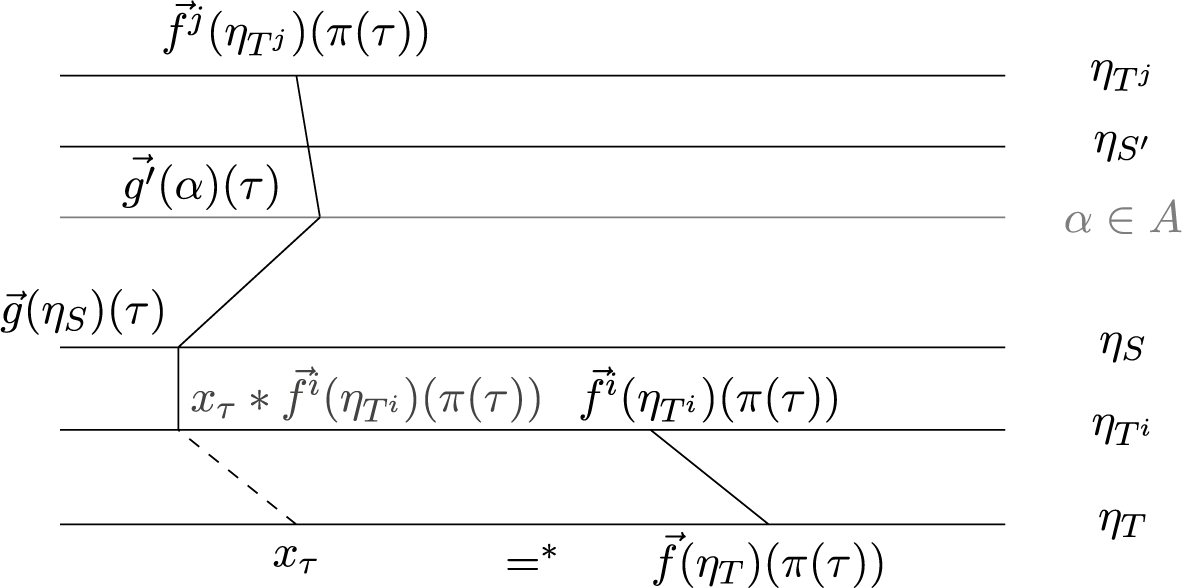
 $$ \begin{align*}\vec{f}^{j}(\eta_{T^j})(\tau)=\begin{cases} (\vec{g'}(\alpha')(\tau)*\vec{g'}(\eta_{S'})(\tau)){}^\smallfrown\langle \tau\rangle,&\text{if }\tau\in X_\xi\setminus Y;\\ (\vec{g'}(\alpha')(\pi^{-1}(\tau))*\vec{g'}(\eta_{S'})(\tau)){}^{\smallfrown\langle\pi^{-1}}(\tau)\rangle,&\text{if }\tau\in X_\xi\cap \operatorname{\mathrm{Im}}(\pi);\\ (\vec{g'}(\alpha')(\psi(\tau))*\vec{g'}(\eta_{S'})(\tau)){}^\smallfrown\langle\psi(\tau)\rangle,&\text{otherwise}. \end{cases}\end{align*} $$
This ensures that the following two hold (Figure 2):
-
•
$X_\xi \setminus Y\subseteq \circledcirc (\vec {g'}(\alpha ),\vec {f}^{j}(\eta _{T^j}))$
; -
•
$\vec {g'}(\alpha )(\tau )\subseteq x_\tau *\vec {f}^{j}(\eta _{T^j})(\pi (\tau ))=\vec {f}^{j}(\eta _{T^j})(\pi (\tau ))$
for every
$\tau \in X_\xi \cap Y$
.


Case:
 $\tau \in X_\xi \cap Y$
.

Case 2:
 $j=2$
: Using Lemma 3.5, fix a one-step extension
 $\langle T^2,\vec {f}^2\rangle $
of
 $\langle T^1,\vec f^1\rangle $
such that
 $\nu _{T^2}\ge \mu $
. In particular, we may fix a map
 $\vec {z^2}:(2,\mu ]\rightarrow T^2$
, where
 $2<\iota <\mu $
implies:
-
•
$\vec {z^2}(\iota )$
belongs to the top level of
$T^2$
; -
•
$\vec {z^2}(\iota )\not =^*\vec {z^2}(\iota ')$
for every
$\iota '\in (2,\mu ]\setminus \{\iota \}$
; -
•
$\vec {z^2}(\iota )\not =^*\vec {f}^2(\eta _{T^2})(0)$
; -
•
$\vec {z^2}(\iota )$
and
$\vec {f}^2(\eta _{T^2})(\tau )$
are mutually exclusive for every nonzero
$\tau <\theta $
.


Case 3:
 $j=i+2$
for an even ordinal i: Using Lemma 3.5, let
 $\langle T^j,\vec {f^j}\rangle $
be a one-step
 $\eta _{T^i}$
-extension of
 $\langle T^{i+1},\vec {f^{i+1}}\rangle $
with
 $\nu _{T^j}\ge \mu $
. As
 $\circledcirc (\vec f^{i}(\eta _{T^i}), \vec f^{j}(\eta _{T^j}))=\theta $
, we may then fix a map
 $\vec {z}^j:(j,\mu ]\rightarrow T^j$
, where
 $j<\iota <\mu $
implies:
-
•
$\vec {z}^j(\iota )$
belongs to the top level of
$T^j$
; -
•
$\vec {z}^j(\iota )\not =^*\vec {z}^j(\iota ')$
for every
$\iota '\in (j,\mu ]\setminus \{\iota \}$
; -
•
$\vec z^i(\iota )\subseteq \vec {z}^j(\iota )$
and
$\vec {z}^j(\iota )\not =^*\vec {f}^j(\eta _{T^j})(\tau )$
; -
•
$\vec {z}^j(\iota )$
and
$\vec {f}^j(\eta _{T^j})(\tau )$
are mutually exclusive for every nonzero
$\tau <\theta $
.


Case 4:
 $j\in \operatorname {\mathrm {acc}}(\mu +1)$
: Obtain
 $(T^j,\vec {f^j},\vec z^j)$
by appealing to Lemma 3.6 with the sequence
 $\langle (T^i,\vec {f^i}, \vec {z}^i) \mid i<j\text { nonzero even ordinal}\rangle $
, using
 $\delta :=\mu +1$
.
Once we are done with the recursion, it is clear that
 $\langle T',\vec {f'}\rangle :=\langle T^\mu ,\vec {f^\mu }\rangle $
is as sought.
Let
 $\langle T,\vec {f}\rangle $
be an arbitrary condition in
 $\mathbb S^\kappa _{\mathbf X}$
, and we shall find an extension of it forcing that A is bounded in
 $\kappa $
. To this end, we shall construct a sequence
 $\langle (T^{j},\vec {f}^{j},\vec {z}^j)\mid j<\theta ^+ \rangle $
in such a way that all of the following hold:
-
(i)
$\langle T^{0},\vec {f^0}\rangle \le \langle T,\vec f\rangle $
; -
(ii) for all
$i<j<\theta ^+$
,
$(T^{j},\vec {f}^{j}\rangle \le (T^i,\vec {f}^i\rangle $
and
$\circledcirc (\vec f^{i}(\eta _{T^i}), \vec f^{j}(\eta _{T^j}))=\theta $
; -
(iii) for every
$j<\theta ^+$
,
$\vec {z}^j:(j,\theta ^+]\rightarrow T^j$
, where
$j<\iota <\theta ^+$
implies:-
•
$\vec {z}^j(\iota )$
belongs to the top level of
$T^j$
; -
•
$\vec {z}^j(\iota )\not =^*\vec {z}^j(\iota ')$
for every
$\iota '\in (j,\theta ^+]\setminus \{\iota \}$
; -
•
$\vec {z}^j(\iota )\not =^*\vec {f}^j(\eta _{T^j})(0)$
; -
•
$\vec {z}^j(\iota )$
and
$\vec {f}^j(\eta _{T^j})(\tau )$
are mutually exclusive for every nonzero
$\tau <\theta $
; -
•
$\vec z^i(\iota ) \subseteq \vec z^j(\iota )$
for every
$i<j$
and every
$\iota \in (j,\theta ^+]$
.
-


We start by appealing to Lemma 3.5 to find a condition
 $\langle T^0,\vec {f}^0\rangle \le \langle T,\vec f\rangle $
with
 $\nu _{T^0}\ge \theta ^+$
. Then, fix a map
 $\vec {z}^0:(0,\theta ^+]\rightarrow T^0$
, where
 $0<\iota <\theta ^+$
implies:
-
•
$\vec {z}^0(\iota )$
belongs to the top level of
$T^0$
; -
•
$\vec {z}^0(\iota )\not =^*\vec {z}^0(\iota ')$
for every
$\iota '\in (0,\theta ^+]\setminus \{\iota \}$
; -
•
$\vec {z}^0(\iota )\not =^*\vec {f}^0(\eta _0)(0)$
; -
•
$\vec {z}^0(\iota )$
and
$\vec {f}^0(\eta _0)(\tau )$
are mutually exclusive for every nonzero
$\tau <\theta $
.


Next, for every
 $i<\theta ^+$
such that
 $(T^i,\vec {f}^i,\vec {z}^i)$
has already been determined, obtain
 $\langle T^{i+1},\vec f^{i+1}\rangle $
by appealing to Claim 3.11.1 with
 $\langle T^i,\vec {f}^i\rangle $
. By possibly replacing
 $\langle T^{i+1},\vec {f}^{i+1}\rangle $
with a one-step
 $\eta _{T^{i+1}}$
-extension of it (using Lemma 3.5), we may also assume that
 $\eta _{T^{i+1}}$
is a successor ordinal and
 $\nu _{T^{i+1}}\ge \theta ^+$
. Consequently, we may construct
 $\vec z^{i+1}$
satisfying requirement (iii) for
 $j:=i+1$
. At a limit stage i, we obviously use Lemma 3.6 with
 $\gamma :=i$
and
 $\delta :=\theta ^++1$
. Hereon, for notational simplicity, denote
 $\eta _{T^i}$
by
 $\eta _i$
.
We claim that
 $\langle T^{\theta ^+},\vec {f}^{\theta ^+}\rangle $
forces that A is bounded in
 $\kappa $
, and in fact
 $A\subseteq \eta _{\theta ^+}$
. Suppose not, and pick a condition
 $\langle S,\vec {g}\rangle \le \langle T^{\theta ^+},\vec {f}^{\theta ^+}\rangle $
that forces some
 $\beta \geq \eta _{\theta ^+}$
to be in A. Without loss of generality,
 $\beta \le \eta _S$
.
Consider
 $Y:=\theta \setminus \circledcirc (\vec {g}(\beta ),\vec {f}^{\theta ^+}(\eta _{\theta ^+}))$
which is an element of
 $\mathcal I$
. Recalling that we have invoked Lemma 3.6 with
 $\delta :=\theta ^++1$
, every element of
 $T_{\eta _{\theta ^+}}$
is equal modulo bounded to
 $\vec {f}^{\theta ^+}(\eta _{\theta ^+})(\tau )$
for some
 $\tau <\theta $
. Consequently, we may fix a map
 $\pi :Y\rightarrow \theta $
such that
 $\vec {g}(\beta )(\tau )\restriction \eta _{\theta ^+}=^*\vec {f}^{\theta ^+}(\eta _{\theta ^+})(\pi (\tau ))$
for every
 $\tau \in Y$
. As the elements of
 $\vec g(\beta )$
are mutually exclusive, it follows that
 $\pi $
is an injection from Y to Y. To summarize, we have found a
 $Y\in \mathcal I$
and an injection
 $\pi :Y\rightarrow Y$
such that the following two hold:
-
(1)
$\vec {g}(\beta )(\tau )\restriction \eta _{\theta ^+}=~\vec {f}^{\theta ^+}(\eta _{\theta ^+})(\tau )$
for every
$\tau \in \theta \setminus Y$
; -
(2)
$\vec {g}(\beta )(\tau )\restriction \eta _{\theta ^+}=^*\vec {f}^{\theta ^+}(\eta _{\theta ^+})(\pi (\tau ))$
for every
$\tau \in Y$
.


Next, as
 $\operatorname {\mathrm {dom}}(\vec {g}(\beta ))=\theta $
, we may find a large enough
 $i<\theta ^+$
such that:
-
(3)
$\vec {g}(\beta )(\tau )\restriction \eta _{\theta ^+}=(\vec {g}(\beta )(\tau )\restriction \eta _i)*\vec {f}^{\theta ^+}(\eta _{\theta ^+})(\pi (\tau ))$
for every
$\tau \in Y$
.


In particular:
-
(4)
$\vec {g}(\beta )(\tau )\restriction \eta _{i+1}=~\vec {f}^{i+1}(\eta _{i+1})(\tau )$
for every
$\tau \in \theta \setminus Y$
, and -
(5)
$\vec {g}(\beta )(\tau )\restriction \eta _{i+1}=^*\vec {f}^{i+1}(\eta _{i+1})(\pi (\tau ))$
for every
$\tau \in Y$
.


Consider
 $\vec {x}:=\langle \vec {g}(\beta )(\tau ) \restriction \eta _{i+1} \mid \tau <\theta \rangle $
. Then the triple
 $(\vec x,Y,\pi )$
satisfies requirements (A) and (B) with respect to
 $\langle T^{i+1},\vec {f}^{i+1}\rangle $
. Therefore, there exists an
 $\alpha <\eta _{i+2}$
such that:
-
(6)
$\langle T^{i+2},\vec {f}^{i+2}\rangle \Vdash _{\mathbb S^\kappa _{\mathbf X}}\alpha \in \dot A$
; -
(7)
$X_\xi \setminus Y\subseteq \circledcirc (\vec {f}^{i+2}(\alpha ),\vec {f}^{i+2}(\eta _{i+2}))$
; -
(8)
$\vec {f}^{i+2}(\alpha )(\tau ) \subseteq x_\tau *\vec {f}^{i+2}(\eta _{i+2})(\pi (\tau ))$
for every
$\tau \in X_\xi \cap Y$
.



By Clauses (1) and (7), for every
 $\tau \in X_\xi \setminus Y$
,
 $$ \begin{align*}\vec{f}^{i+2}(\alpha)(\tau)\subseteq \vec{f}^{i+2}(\eta_{i+2})(\tau)\subseteq \vec{f}^{\theta^+}(\eta_{\theta^+})(\tau)\subseteq \vec{g}(\beta)(\tau).\end{align*} $$
By Clauses (3) and (8), for every
 $\tau \in X_\xi \cap Y$
, we have
 $$ \begin{align*}\begin{aligned} \vec{f}^{i+2}(\alpha)(\tau)&\subseteq x_\tau*\vec{f}^{i+2}(\eta_{i+2})(\pi(\tau))\\ &= (\vec{g}(\beta)(\tau)\restriction \eta_{i+1})*\vec{f}^{i+2}(\eta_{i+2})(\pi(\tau))\\ &\subseteq(\vec{g}(\beta)(\tau)\restriction \eta_{i+1})*\vec{f}^{\theta^+}(\eta_{\theta^+})(\pi(\tau))\\ &=\vec{g}(\beta)(\tau)\restriction \eta_{\theta^+}\subseteq \vec g(\beta)(\tau). \end{aligned}\end{align*} $$
As
 $\vec {f^{i+2}}\subseteq \vec {f}^{\theta ^+}\subseteq \vec g$
, we infer that
 $\langle S,\vec {g} \rangle $
forces that
 $\beta \in A$
is a proper extension of
 $\alpha \in A$
, contradicting the fact that A is an antichain.
Corollary 3.12. For every
 $\mathbb S^\kappa _{\mathbf X}$
-generic filter G:
-
(1)
$T(G)$
is a uniformly homogeneous
$\kappa $
-Souslin tree; -
(2)
$V(T(G))$
is a club in
$\kappa $
; -
(3)
$\vec {f}^G$
is a mutually exclusive
$\mathcal {F}$
-ascent path through
$T(G)$
; -
(4)
$T(G)$
coincides with the tree generated by its ascent path. Furthermore, for every
$t\in T(G)$
and every
$\xi <\zeta $
, there are
$\alpha <\kappa $
and
$\tau \in X_\xi $
such that
$t\subseteq \vec {f^G}(\alpha )(\tau )$
.


Proof. (1)
 $T(G)$
is a uniformly homogeneous
 $\kappa $
-tree thanks to Lemmas 3.5 and 3.7. Towards a contradiction, suppose that
 $T(G)$
admits a
 $\kappa $
-sized antichain. It then follows from the upcoming Clause (4) that there exists an injective sequence
 $\langle (\alpha _\gamma ,\tau _\gamma )\mid \gamma <\kappa \rangle $
of elements of
 $\kappa \times X_0$
such that
 $\{ \vec {f^G}(\alpha _\gamma )(\tau _\gamma )\mid \gamma <\kappa \}$
is an antichain in
 $T(G)$
. Find a
 $\tau \in X_0$
for which
 $\Gamma :=\{\gamma <\kappa \mid \tau _\gamma =\tau \}$
has size
 $\kappa $
. Then
 $\{\alpha _\gamma \mid \gamma \in \Gamma \}$
is a
 $\kappa $
-sized antichain in
 $\mathbb A^\kappa _{\mathbf X,0}$
, contradicting Lemma 3.11.
(2) By Definition 3.2(3), it suffices to prove that for every
 $\varepsilon <\kappa $
, there exists a
 $\langle T,\vec f\rangle \in G$
such that
 $\eta _T\in \operatorname {\mathrm {acc}}(\kappa \setminus \varepsilon )$
. Now, this follows from Lemma 3.6, as demonstrated by the proof of Lemma 3.10.
(3) By Definition 3.2(2).
(4) By a density argument, using Definition 3.2(4).
4 On the verge of weak compactness
For the purpose of this section, we fix an
 $\mathbf X=\langle X_n\mid n<\omega \rangle $
satisfying the following requirements:
-
•
$\mathbf X$
is a
$\subseteq $
-decreasing sequence of nonempty subsets of
$\omega $
; -
•
$|\omega \setminus X_0|=|X_0\setminus X_1|=\omega $
; -
•
$\bigcap _{n<\omega }X_n=\emptyset $
.


As in the previous section, we denote by
 $\mathcal F$
the filter generated by
 $\mathbf X$
, and we derive the corresponding notions of forcing of Definitions 3.2 and 3.9. The next result is the main theorem of the article.
Theorem 4.1. Suppose that
 $\kappa $
is a weakly compact cardinal. In some forcing extension,
 $\kappa $
is a strongly inaccessible cardinal satisfying
 $\chi (\kappa )=1$
, and there exists a
 $\kappa $
-Souslin tree T such that
 $V(T)=\operatorname {\mathrm {acc}}(\kappa )$
.
Proof. For an ordinal
 $\tau $
, let
 $\mathbb P_\tau $
be the Easton-support iteration of length
 $\tau $
which forces with
 $\mathbb S^\eta _{\mathbf X}*\mathbb A^\eta _{\mathbf X}$
at every strongly inaccessible cardinal
 $\eta <\tau $
. As usual, at
 $\eta <\tau $
that is not strongly inaccessible, we use trivial forcing.
Let
 $G_\kappa $
be
 $\mathbb P_\kappa $
-generic over V. Let g be
 $\mathbb S^\kappa _{\mathbf X}$
-generic over
 $V[G_\kappa ]$
and let h be
 $\mathbb A^\kappa _{\mathbf X, 0}$
-generic over
 $V[G_\kappa ][g]$
. Note that
 $G_{\kappa +1}:=G_\kappa *g*h$
is
 $\mathbb P_{\kappa +1}$
-generic over V.
By Corollary 3.12, in
 $V[G_\kappa ][g]$
,
 $T(g)$
is a uniformly homogeneous
 $\kappa $
-Souslin tree admitting an
 $\mathcal F$
-ascent path
 $\vec f^g$
, and
 $V(T(g))$
covers a club in
 $\kappa $
. By [Reference Rinot, Yadai and You13, Lemma 2.15], then,
 $$ \begin{align*}V[G_\kappa][g]\models\text{"there exists a }\kappa\text{-Souslin tree }T\text{ such that }V(T)=\operatorname{\mathrm{acc}}(\kappa)."\end{align*} $$
It thus remains to prove that
 $\chi (\kappa )\le 1$
holds in
 $V[G_\kappa ][g]$
. To this end, let
 $\vec {C}=\langle C_\beta \mid \beta <\kappa \rangle $
be an arbitrary C-sequence in
 $V[G_\kappa ][g]$
.
Work in V. Let
 $\dot {C}$
be a
 $\mathbb P_\kappa *\dot {\mathbb S}^\kappa _{\mathbf X}$
-name for
 $\vec {C}$
. Take a
 $\kappa $
-model M containing
 $\mathbb P_\kappa *\dot {\mathbb S}^\kappa _{\mathbf X}*\dot {\mathbb A}^{\kappa }_{\mathbf X}$
and
 $\dot {C}$
. As
 $\kappa $
is weakly compact, we may now pick a
 $\kappa $
-model N and a nontrivial elementary embedding
 $j_0:M \rightarrow N$
with critical point
 $\kappa $
. Hereafter, work in
 $V[G_{\kappa +1}]$
.
Claim 4.1.1.
 $j_0$
may be lifted to an elementary embedding
 $$ \begin{align*}j_1:M[G_\kappa]\rightarrow N[G_{\kappa+1}*G_{tail}].\end{align*} $$
Proof. By [Reference Cummings3, Proposition 7.13 and Remark 7.14],
 $\mathbb P_\kappa $
has the
 $\kappa $
-cc. In addition, by Lemma 3.10, in
 $V[G_\kappa ]$
,
 $\mathbb S^\kappa _{\mathbf X}*\mathbb A^\kappa _{\mathbf X}$
has a dense set that is
 ${<}\kappa $
-strategically closed. So, from
 ${}^{<\kappa }N \subseteq N$
, we infer that
 ${}^{<\kappa }N[G_{\kappa +1}] \subseteq N[G_{\kappa +1}]$
. Since we use nontrivial forcing only at strongly inaccessibles, Lemma 3.10 implies that the quotient forcing
 $j_0(\mathbb P_\kappa )/ G_{\kappa +1}$
is
 $\kappa $
-strategically closed in
 $N[G_{\kappa +1}]$
. But
 ${}^{<\kappa }N[G_{\kappa +1}] \subseteq N[G_{\kappa +1}]$
, and hence
 $j_0(\mathbb P_\kappa )/ G_{\kappa +1}$
is
 $\kappa $
-strategically closed. As N has no more than
 $\kappa $
many
 $\mathbb P_{\kappa +1}$
-names, the model
 $N[G_{\kappa +1}]$
has no more than
 $\kappa $
many dense sets of
 $j_0(\mathbb P_\kappa )/ G_{\kappa +1}$
. It thus follows that a
 $j_0(\mathbb P_\kappa )/ G_{\kappa +1}$
-generic over
 $N[G_{\kappa +1}]$
may be recursively constructed, say
 $G_{tail}$
, so that
 $N[G_{\kappa +1}][G_{tail}]$
is a
 $j_0(\mathbb P_\kappa )$
-generic extension of N. As
 $j_0$
is the identity map over
 $\mathbb P_\kappa $
, Silver’s criterion holds vacuously, so we may lift
 $j_0$
to a
 $j_1:M[G_\kappa ]\rightarrow N[G_{\kappa +1}*G_{tail}]$
, as sought.
Claim 4.1.2.
 $j_1$
may be lifted to an elementary embedding
 $$ \begin{align*}j_2:M[G_\kappa*g]\rightarrow N[G_{\kappa+1}*G_{tail}*g_{tail}].\end{align*} $$
Proof. For every
 $n\in X_0$
, define
 $b_n:\kappa \rightarrow \kappa $
via:
 $$ \begin{align*}b_n:=\bigcup\{\vec f^g(\alpha)(n)\mid \alpha\in h\}.\end{align*} $$
As h is
 $\mathbb A^\kappa _{\mathbf X, 0}$
-generic over
 $V[G_\kappa ][g]$
, each such
 $b_n$
is a cofinal branch through
 $T(g)$
. Furthermore, the elements of
 $\langle b_n\mid n\in X_0\rangle $
are mutually exclusive. Take
 $n_0 \in X_0\setminus X_1$
and then let
 $$ \begin{align*}T:=T(g)\cup\{ x*b_n\mid x\in T(g), n\in X_0\ \&\ n \neq n_0\}.\end{align*} $$
Then T is a uniformly homogeneous tree for which
 $b_{n_0}$
is a vanishing
 $\kappa $
-branch. Thus,
 $V(T)=V(T(g))\cup \{\kappa \}$
. Next, we extend the ascent path
 $\vec {f}^g$
by setting
 $\vec {f}:=\vec {f}^g\cup \{ (\kappa ,\langle b_{\pi (n)}\mid n<\omega \rangle )\}$
, where
 $\pi :\omega \rightarrow X_0 \setminus \{n_0\}$
is some bijection such that
 $\pi \restriction X_1$
is the identity function.
Altogether,
 $\langle T, \vec {f} \rangle $
is a legitimate condition of
 $\mathbb S^{j_1(\kappa )}_{\mathbf X}$
as computed in
 $N[G_{\kappa +1}]$
, in particular, it is an element of the last iterand of
 $j_1(\mathbb P_\kappa *\dot {\mathbb S}^\kappa _{\mathbf X})/ G_{\kappa +1}*G_{tail}$
. In addition,
 $\langle T, \vec {f} \rangle $
extends every condition lying in
 $j_1[g]$
.
Since
 ${}^{<\kappa }N[G_{\kappa +1}] \subseteq N[G_{\kappa +1}]$
and
 $G_{tail}$
is a generic for a
 $\kappa $
-strategically closed forcing,
 ${}^{<\kappa }N[G_{\kappa +1}*G_{tail}] \subseteq N[G_{\kappa +1}*G_{tail}]$
. By Lemma 3.10,
 $\mathbb S^{j_1(\kappa )}_{\mathbf X}$
is
 ${<}j_1(\kappa )$
-strategically closed in
 $N[G_{\kappa +1}*G_{tail}]$
. But
 ${}^{<\kappa }N[G_{\kappa +1}*G_{tail}] \subseteq N[G_{\kappa +1}*G_{tail}]$
, and hence
 $\mathbb S^{j_1(\kappa )}_{\mathbf X}$
is
 $\kappa $
-strategically closed. As N has no more than
 $\kappa $
many
 $j_1(\mathbb P_{\kappa })$
-names, the model
 $N[G_{\kappa +1}*G_{tail}]$
has no more than
 $\kappa $
many dense sets of
 $j_1(\mathbb P_\kappa *\dot {\mathbb S}^\kappa _{\mathbf X})/ G_{\kappa +1}*G_{tail}$
. It thus follows that a
 $j_1(\mathbb P_\kappa *\dot {\mathbb S}^\kappa _{\mathbf X})/ G_{\kappa +1}*G_{tail}$
-generic over
 $N[G_{\kappa +1}*G_{tail}]$
may be recursively constructed, say
 $g_{tail}$
, so that
 $N[G_{\kappa +1}*G_{tail}][g_{tail}]$
is a
 $j_1(\mathbb P_\kappa *\dot {\mathbb S}^\kappa _{\mathbf X})$
-generic extension of N and
 $\langle T,\vec f\rangle \in g_{tail}$
. By Silver’s criterion, we may now lift
 $j_1$
to a
 $j_2:M[G_\kappa ][g]\rightarrow N[G_{\kappa +1}*G_{tail}][g_{tail}]$
, as sought.
Let
 $j_2:M[G_\kappa ][g]\rightarrow N[G_{\kappa +1}*G_{tail}*g_{tail}]$
be given by the preceding claim. Clearly,
 $\vec C$
is in
 $M[G_\kappa ][g]$
, so that
 $j_2(\vec C)$
is a C-sequence over
 $j_2(\kappa )$
. Let
 $C_\kappa $
denote
 $j_2(\vec {C})(\kappa )$
.
Claim 4.1.3. For every
 $\alpha <\kappa $
, there exists
 $\beta \ge \alpha $
such that
 $C_\kappa \cap \alpha =C_\beta \cap \alpha $
.
Proof. Suppose not, and let
 $\alpha <\kappa $
be a counterexample. Denote
 $A:=C_\kappa \cap \alpha $
, and define a map
 $\varphi :\kappa \setminus \alpha \rightarrow \alpha $
via:
 $$ \begin{align*}\varphi(\beta):=\min\{\varepsilon<\alpha\mid A\cap\varepsilon\neq C_\beta\cap\varepsilon\}.\end{align*} $$
By elementarity,
 $j_2(A)\cap j_2(\varphi )(\kappa )\neq C_\kappa \cap j_2(\varphi )(\kappa )$
. However,
 $j_2(A)=A=C_\kappa \cap \alpha \subseteq \alpha>j_2(\varphi )(\kappa )$
. This is a contradiction.
Recall that
 $C_\kappa $
is a club in
 $\kappa $
lying in
 $V[G_\kappa ][g][h]$
. As h is
 $\mathbb A^\kappa _{\mathbf X}$
-generic over
 $V[G_\kappa ][g]$
, and as
 $\mathbb A^\kappa _{\mathbf X}$
satisfies the
 $\kappa $
-cc, it follows that there exists a club
 $D \subseteq C_\kappa $
with
 $D\in V[G][g]$
. Evidently, for every
 $\alpha <\kappa $
, there exists a
 $\beta \ge \alpha $
such that
 $D \cap \alpha \subseteq C_\beta \cap \alpha $
.
Remark 4.2. Since
 $\mathbb {A}^\kappa _{\mathbf X,\xi }$
only adds
 $\kappa $
-many cofinal branches to
 $T(g)$
, it follows from Proposition 2.7 that it does not resurrect the weak compactness of
 $\kappa $
in
 $V[G_\kappa ][g]$
.
Corollary 4.3. Assuming the consistency of a weakly compact cardinal, it is consistent that for some inaccessible cardinal
 $\kappa $
, (II) holds, but (I) fails:
-
(I) For every C-sequence
$\langle C_\beta \mid \beta <\kappa \rangle $
, there exists a cofinal
$\Delta \subseteq \kappa $
such that, for every
$\alpha <\kappa $
, there exists a
$\beta <\kappa $
with
$\Delta \cap \alpha \subseteq \operatorname {\mathrm {nacc}}(C_\beta )$
. -
(II) For every C-sequence
$\langle C_\beta \mid \beta <\kappa \rangle $
, there exists a cofinal
$\Delta \subseteq \kappa $
such that, for every
$\alpha <\kappa $
, there exists a
$\beta <\kappa $
with
$\Delta \cap \alpha \subseteq C_\beta $
.


Proof. Work in the model of Theorem 4.1. We have
 $\chi (\kappa )=1$
which implies that
 $\chi (\kappa )\le 1$
, i.e., Clause (II) holds. In addition, there exists a
 $\kappa $
-Souslin tree T such that
 $V(T)=\operatorname {\mathrm {acc}}(\kappa )$
. An inspection of the proof of [Reference Rinot and Shalev12, Theorem 2.23] makes it clear that there exists a club
 $D\subseteq \kappa $
such that for every partition
 $\mathcal S$
of D into stationary sets,
 $\clubsuit _{\operatorname {\mathrm {AD}}}(\mathcal S,\omega ,{<}\omega )$
holds. In particular,
 $\clubsuit _{\operatorname {\mathrm {AD}}}(\{D\},1,1)$
holds. An inspection of the proof of [Reference Rinot and Shalev12, Theorem 2.30] then yields that Clause (I) must fail.
Question 4.4. Is Postulate (I) strictly weaker than weak compactness?
4.1 Concluding remarks
It is not hard to check that the final model
 $V[G_\kappa ][g]$
in the proof of Theorem 4.1 is an intersection model in the sense of [Reference Rinot, You and Yuan14]. In particular, an adaptation of the proof of [Reference Rinot, You and Yuan14, Corollary 4.7] to generic elementary embeddings yields that in this model, every
 $\kappa $
-Aronszajn tree contains an
 $\omega $
-ascent path. In addition, this is the first example of a model obtained as the decreasing intersection of countably many models in which
 $\chi (\kappa )<\omega $
. Furthermore, by strengthening the initial large cardinal hypotheses, this yields the following two corollaries.
Corollary 4.5. Suppose that
 $\kappa $
is a measurable cardinal. Then there is a forcing extension in which
 $\kappa $
carries a
 $\kappa $
-saturated ideal and an indecomposable ultrafilter, yet
 $\kappa $
is not subtle.
The reader is referred to [Reference Kunen7, Section 3] for a construction of the
 $\kappa $
-saturated ideal over
 $\kappa $
, to [Reference Rinot, You and Yuan14, Corollary 3.10] for a construction of the indecomposable ultrafilter over
 $\kappa $
, and to [Reference Rinot, Yadai and You13, Corollary 2.22] for the verification that
 $\kappa $
is not subtle.
Corollary 4.6. Suppose that
 $\theta <\kappa $
is a pair of cardinals such that
 $\theta $
is measurable and
 $\kappa $
is supercompact. Then there is a cardinal-preserving forcing extension in which
 $\kappa $
is the least
 $\theta $
-strongly compact cardinal and
 $\chi (\kappa )=1$
.
The verification that
 $\kappa $
is the least
 $\theta $
-strongly compact cardinal is essentially the same as that of [Reference Rinot, You and Yuan14, Corollary 3.8].
Acknowledgments
The results of this article were presented by the second author in an invited talk at the Chinese Annual Conference on Mathematical Logic, July 2023, and in a seminar talk at the Institute of Mathematics, Chinese Academy of Sciences, November 2023. We thank Jing Zhang for encouraging us to include Corollary 4.5 and for informing us that this finding answers a question of him. We thank the referee for a thoughtful report. The opening paragraph of our introduction is now taken from their report.
Funding
The first and second authors were supported by the Israel Science Foundation (Grant Agreement No. 203/22).