Whereas the end of the twentieth century witnessed a proliferation of democratization studies, the beginning of the twenty-first century saw renewed scholarly interest in authoritarianism. Within this literature, an important body of research focused on the role of political parties in sustaining authoritarian rule. Beginning with Barbara Geddes' finding that single-party regimes are more stable than military regimes or personalistic dictatorships, scholars pointed to a range of ways in which ruling parties enhance authoritarian durability.Footnote 1
Yet as Benjamin Smith observed, party-based authoritarian regimes vary widely in terms of their durability.Footnote 2 Whereas some ruling parties provide a foundation for decades of regime stability, others collapse quickly in the face of challenges. This variation was strikingly manifest in the late 1980s and early 1990s, when economic crisis and the end of the Cold War challenged single-party regimes across the world. Where ruling parties possessed cohesive mass organizations, as in Cuba, Malaysia, Mozambique, and Vietnam, regimes often survived these challenges; where ruling parties lacked such organizations, as in Madagascar, Malawi, Senegal, and Zambia, economic crises or opposition challenges triggered elite defection and, in many cases, regime collapse. Thus it appears that the key to durable authoritarianism is not the existence of ruling parties per se, but rather the character of those parties.
We seek to explain variation in the durability of party-based authoritarian regimes. Regime durability, or the capacity to survive crises, is distinct from stability, or duration in power.Footnote 3 Even weak regimes may survive for years if they are not seriously challenged. Thus we focus on ruling parties' capacity to survive crises—such as economic failure or opposition challenges—that threaten their control of the state. Such crises provide a kind of “stress test” that allow us to better evaluate regime durability.
Recent scholarship on authoritarianism suggests that ruling parties enhance elite cohesion—and consequently, regime durability—by providing institutionalized channels for elites to advance their careers and access the spoils of power.Footnote 4 These arguments conform to a broader scholarly tendency to focus on the material incentives underlying authoritarian rule.Footnote 5 Thus dictators are said to retain power by offering supporters more “rents … than they can expect under a different regime,”Footnote 6 and they are expected to lose power when they are “no longer able to provide sufficient resources to sustain political support.”Footnote 7
Although distribution of the spoils of office—or what we broadly refer to as “patronage” —is an important source of elite cohesion, it is not necessarily the most effective one. Patronage may ensure elite cooperation during normal times, but it often fails to do so during crises. When a patronage-based party's hold on power is threatened by economic crisis, domestic opposition, or external pressure, regimes often suffer defection and, in many cases, collapse. For example, the end of the Cold War saw the demise of numerous Leninist regimes led by highly institutionalized parties. Those that survived were almost invariably based on more than patronage. Indeed, the only Communist regimes that persisted after the collapse of the Soviet Union—China, Cuba, Laos, North Korea, and Vietnam—were led by veterans of violent revolutionary struggle.Footnote 8
Building on earlier scholarship linking authoritarian stability to ruling party and regime origins,Footnote 9 we argue that the identities, norms, and organizational structures forged during periods of sustained, violent, and ideologically-driven conflict are a critical source of cohesion—and durability—in party-based authoritarian regimes. Although origins in violent struggle hardly eliminate intra-party conflict, they raise the cost of defection and provide leaders with additional (non-material) resources that can be critical to maintaining unity and discipline, even when a crisis threatens the party's hold on power. Hence, where ruling parties combine mechanisms of patronage distribution with the strong identities, solidarity ties, and discipline generated by violent origins, regimes should be most durable.
We highlight this argument via an analysis of four competitive authoritarian regimes in post-Cold War Africa: Kenya, Mozambique, Zambia, and Zimbabwe.Footnote 10 In each of these cases, an established single- or dominant-party regime faced heightened international pressure, economic crisis, and a strong opposition challenge after 1990. Yet whereas ruling parties in Kenya and Zambia were organized almost exclusively around patronage, those in Mozambique and Zimbabwe were liberation parties that came to power via violent struggle. This difference is critical to explaining diverging post-Cold War regime outcomes: whereas ruling parties in Zambia and Kenya imploded and eventually lost power in these face of crises, those in Mozambique and Zimbabwe remained intact, and their regimes survived.
These case analyses do not constitute a definitive test of our theory. Rather, they highlight the theory's causal mechanisms and demonstrate some initial plausibility to the claim that authoritarian regimes rooted in violent struggle respond differently to crises than do otherwise similar regimes. As the conclusion shows, however, there is evidence that our claims are generalizable.
Parties, Patronage, and Authoritarian Durability
Political parties have long been viewed as pillars of authoritarian rule.Footnote 11 Parties enhance regime stability in a variety of ways. For one, they mobilize support, which is critical to both deterring challenges and defeating them when they arise.Footnote 12 Party organizations provide an infrastructure for delivering votes, buying support via clientelism, and when necessary, stealing votes. In some cases, parties play a coercive role, mobilizing local cells or “youth wings” to monitor and intimidate opponents.Footnote 13 According to Geddes, they may even deter coups.Footnote 14
Perhaps most importantly, ruling parties foster elite cohesion, which is widely viewed as essential to authoritarian stability.Footnote 15 Elite cohesion may be defined as rulers' ability to maintain the loyalty and cooperation of allies within the regime. Where cohesion is high, ministers, allied legislators, and local officials routinely support and cooperate with the government. Internal rebellion and defection are rare, and when they occur, they attract few followers. Where cohesion is low, incumbents routinely confront insubordination, rebellion, or defection, which often contributes to authoritarian breakdown.
Ruling parties are said to enhance regime stability because they encourage elite cooperation over defection.Footnote 16 By providing institutional mechanisms to regulate access to the spoils of public office,Footnote 17 and by lengthening actors' time horizons through the provision of future opportunities for career advancement, ruling parties “create incentives for long-term loyalty.”Footnote 18 As long as the party is expected to remain in power, losers in short-term factional struggles will remain loyal in the expectation that they will gain access to power in future rounds. Ruling parties thus generate “collective security,” or a “sense among power holders that their immediate and long-term interests are best served by remaining within the party organization.”Footnote 19 The result is “long-term cohesion … and the maintenance of political stability.”Footnote 20 According to Geddes, even weak parties created by dictators create “vested interests” in regime survival through patronage distribution.Footnote 21 Where governing parties are absent, regime elites see fewer opportunities for career advancement from within and are thus more likely to seek power from outside the regime.
Yet institutionalized access to the spoils of public office is ultimately a weak source of cohesion.Footnote 22 Ruling parties that are organized strictly around patronage and career advancement may discourage defection during normal times, as long as their hold on power is perceived as secure. However, such parties are vulnerable to crises—such as a withdrawal of external support, economic crises that seriously erode public support and limit patronage resources, large-scale protest, or serious electoral challenges—that threaten their hold on power. When such crises cast doubt upon incumbents' ability to deliver the goods, patronage-based parties are prone to defection.Footnote 23 Indeed, if a crisis convinces ruling party elites that continued loyalty threatens their future access to power and patronage, it may trigger a band-wagoning effect in which politicians defect en masse to the opposition. As one Zambian politician put it, “only a stupid fly … follows a dead body to the grave.”Footnote 24 Thus, patronage-based cohesion may be a source of authoritarian stability in the absence of a serious challenge, but ruling parties that are organized around patronage are vulnerable to any crisis that undermines elite confidence in their ability to retain power or deliver the goods.
Non-Material Sources of Cohesion: The Role of Violent Struggle
Ruling party cohesion is highest where regularized elite access to the spoils of power is complemented by other, non-material, sources of cohesion,Footnote 25 particularly the norms, identities, and organizational structures generated during periods of violent conflict. As Huntington observed, durable party-based authoritarianism is often a “product of struggle and violence.”Footnote 26 Such struggles most frequently take the form of armed revolutionary or national liberation movements,Footnote 27 although as Slater shows, they may also take the form of successful counter-insurgency.Footnote 28
We argue that ruling parties will be most cohesive where they have gained power as a result of a sustained, violent, and ideationally driven struggle.Footnote 29 Ideationally driven struggles, or what Jeremy Weinstein calls “activist rebellions,” should be distinguished from “opportunistic rebellions” (e.g., Liberia and Sierra Leone in the 1990s), in which activists are recruited primarily via the distribution of selective material benefits.Footnote 30
Origins in violent, ideationally-driven conflict enhance regime cohesion in several ways. First, violent conflict creates enduring partisan identities.Footnote 31 Recent research suggests that that enduring partisan identities are often “fired in a kiln of violence,”Footnote 32 particularly when violence is prolonged and involves mass mobilization.Footnote 33 Strong rank-and-file attachments provide parties with relatively stable support bases, which enhances their electoral performance and—by increasing the value of the party label—discourages elite defection.
Second, violent conflict hardens partisan boundaries. As Adrienne LeBas argues, intense polarization sharpens “us-them” distinctions, strengthening within-group ties and fostering perceptions of a “linked fate” among cadres.Footnote 34 Where cadres have participated in prolonged and violent struggle, they are more likely to view party membership in “moral” terms, and to frame choices about cooperation or defection in terms of loyalty rather than material calculus.Footnote 35 As African National Congress (ANC) leader Thabo Mbeki put it, “leaving the ANC [would be] like leaving one's mother and father.”Footnote 36 The polarization generated by violent conflict tends to persist long after the initial seizure of power,Footnote 37 effectively “trapping” potential defectors within the ruling party.Footnote 38 When the opposition can be credibly linked to a historic enemy, and when abandoning the ruling party is viewed as disloyalty and even treason, the cost of defection will be high.Footnote 39 In such a context, ruling party defectors generally fail to mobilize broad support. For example, in Mexico in 1940 and 1952, Nicaragua in the early 1980s, Zimbabwe in 1989 and 2008, and South Africa in 2008, high-profile defectors failed to coax many leaders or activists out of ruling liberation parties.
Third, violent struggle forces parties to create militarized structures and establish military-style internal discipline—characteristics that tend to persist after they gain power. Thus, Frelimo's “military ethos” and discipline persisted into the 2000s,Footnote 40 and more than two decades after the end of Zimbabwe's liberation war, John Makumbe observed that ZANU cadres had “still not taken off their uniforms.”Footnote 41 Such militarization yields greater cohesion than that found in other parties. For example, the Sandinistas' striking internal discipline during the 1980s was attributed to a “political-military structure” forged during the guerrilla war.Footnote 42
Fourth, successful liberation struggles tend to produce a generation of leaders (or in some cases, individual leaders) with extraordinary legitimacy and unquestioned authority, which they can use to unify the party and impose discipline during crises. In China, for example, the generation of the Long March appears to have been critical in forging unified response to the 1989 pro-democracy protests.Footnote 43 A group of party “elders” drawn from the revolutionary period acted as a cohesive and self-confident “final court of appeals.”Footnote 44 The elders possessed the authority to impose unity on the party and provided the Communist leadership with the cohesion and self-confidence needed to risk the high intensity repression of June 1989. As we shall see, liberation leaders (antigos combatentes) similarly helped to ensure ruling party cohesion in Mozambique, and ex-ZANU combatants repeatedly closed ranks behind Robert Mugabe during periods of crisis in Zimbabwe.
Finally, violent origins enhance ruling parties' capacity to repress. Parties that come to power via violent struggle usually reconstruct the state's coercive apparatus, purging it of its personnel and filling the ranks with partisan cadres.Footnote 45 Thus, the security forces are either re-built from scratch or radically transformed via the infusion of ex-guerrillas. The result is a party-state in which the army, police, and other security agencies are commanded by cadres from the liberation struggle and infused with the ruling party's ideology. In revolutionary Nicaragua, for example, all top military officials were ex-guerrilla commanders who were active in the ruling Sandinista National Liberation Front (FSLN).Footnote 46 These officials were “possessed by a genuine sense of mission that transcended the strictly military. They were defenders … of a revolutionary political project.”Footnote 47 Likewise, all of Zimbabwe's security forces, including the army, police, and intelligence agencies, were led by veterans of the liberation struggle.Footnote 48 Such partisan penetration creates a more disciplined coercive apparatus. Security forces run by veterans from the liberation struggle are less prone to coups or insubordination.
A history of armed struggle also yields a generation of leaders and cadres with experience with—and the stomach for—violence. A ruling elite that has experienced violent conflict is more likely to remain united behind coercive measures and, crucially, security officials that are drawn from that elite are more likely to carry out orders to repress. In addition, liberation struggles create a pool of rank-and-file ex-combatants who may be mobilized by the ruling party to intimidate, threaten, and attack regime opposition. In Zimbabwe, for example, ZANU-PF mobilized thousands of war veterans to repress opposition.Footnote 49 Likewise, Sandinista activists—most of whom were active in the guerrilla struggle—were mobilized for militias, neighborhood-level surveillance, and thug work.Footnote 50
The effects of violent origins on ruling party cohesion and regime durability are not permanent. Rather, they degrade over time, particularly after veterans of the liberation struggle die or cease to dominate the ruling party. Succeeding generations often lack the legitimacy to impose unity in crisis, as well as experience with (and stomach for) repression.Footnote 51 The erosion of revolutionary cohesion was evident in the Soviet Union, where, in the absence of a founding generation equivalent to the Chinese elders or Frelimo's antigos combatentes, governments were unable to impose unity when the system began to disintegrate.Footnote 52
The argument that legacies of violent struggle are an important source of authoritarian cohesion converges with those of other scholars—such as Huntington and Smith—who identify early periods of conflict as critical to explaining regime durability. However, we posit a different causal mechanism. Smith argues that strong opposition challenges—along with fiscal scarcity—during a regime's foundational period create incentives for ruling party elites to build robust organizations and broad coalitions, which later serve as the bases for stable authoritarianism.Footnote 53 Huntington, who argued—as we do—that revolutionary regimes are more durable,Footnote 54 similarly highlights parties' capacity to “mobilize and organize the masses.”Footnote 55 Although strong party organizations strengthen authoritarian regimes, they are insufficient to ensure regime durability. During crises, mass organizations that lack non-material sources of cohesion may divide or crumble from within. For example, mass Communist Party organizations did little to prevent regime collapse in Eastern Europe in 1989, and as we shall see, ruling parties in Kenya and Zambia were defeated not because they lacked extensive organizations but because those organizations were decimated by defection (and ultimately turned against incumbents). Thus, the mechanism that links early conflict to regime durability is ruling party cohesion.
In sum, ruling parties that emerged out of sustained, ideationally-driven, violent struggle are particularly well-equipped to survive regime-threatening crises. Such parties possess not only the organizational strength highlighted by Smith but also the cohesion necessary to withstand serious challenges. Violent struggle often gives rise to enduring partisan identities, rigid inter-party boundaries, militarized party structures, founding leaderships with a capacity to override factional conflict, and extensive ruling party penetration of the coercive apparatus. Ruling parties that consolidate power in the absence of revolutionary struggle tend to be organized primarily around patronage, which, though an effective source of cohesion during normal times, is often insufficient to prevent defection during crises.
Before turning to the case analyses, two caveats merit note. First, we do not claim that patronage is unimportant as a source of cohesion. All successful ruling parties rely on the distribution of access to the spoils of public office. What distinguishes revolutionary or liberation parties is the combination of material and non-material sources of cohesion. Second, cohesion rooted in violent conflict does not guarantee regime stability. Although elite defection is a major cause of authoritarian breakdown, it is hardly the only one. In Nicaragua, for example, the highly cohesive Sandinista regime fell in 1990—despite virtually no elite defection—due to a combination of external pressure and economic crisis.Footnote 56 Compared to other party-based authoritarian regimes, however, we expect those rooted in violent struggle to be particularly resilient in the face of crisis.
Party Origins, Elite Cohesion, and Authoritarian Durability: Four Cases from Post-Cold War Africa
In the following sections, we illustrate our argument though a comparative analysis of four party-based authoritarian regimes in post-Cold War Africa: Kenya and Zambia, where patronage-based ruling parties suffered defection and eventual defeat in the face of economic or succession crises; and Mozambique and Zimbabwe, where ruling parties and regimes survived despite similar (or worse) crises.
Kenya, Mozambique, Zambia, and Zimbabwe may be treated as “most similar” cases of post-Cold War authoritarianism. All four were poor and predominantly rural African countries with stable single- or dominant-party regimes controlled by the political movement that led the country to independence: the Kenya African National Union (KANU) in Kenya, the Front for the Liberation of Mozambique (Frelimo) in Mozambique, the United National Independence Party (UNIP) in Zambia, and the Zimbabwe African National Union-Patriotic Front (ZANU-PF).Footnote 57 All four ruling parties had stable national organizations and extensive patronage networks,Footnote 58 and in 1990, all of them had been in power for at least a decade. Moreover, all four regimes were competitive authoritarian in the early 1990s.Footnote 59 Whereas Zimbabwe had maintained multiparty rule since 1980, Kenya, Mozambique, and Zambia adopted multiparty institutions between 1990 and 1992.Footnote 60
Regimes in Kenya, Mozambique, Zambia, and Zimbabwe all faced severe crises in the post-Cold War era.Footnote 61 For one, the end of the Cold War brought intense international democratizing pressure. The collapse of the Soviet Union, the emergence of the West as the world's dominant power, and unprecedented Western democracy promotion reduced autocratic room for maneuver in much of the developing world. Indeed, external pressure forced governments in Kenya, Mozambique, and Zambia to end single party rule (and discouraged the Mugabe government from establishing it) between 1990 and 1992.Footnote 62 Second, all four governments faced serious electoral challenges, in that ruling parties either lost elections (Zambia in 1991, Kenya in 2002) or faced a real possibility of defeat (Kenya in 1992 and 1997, Mozambique in 1994 and 1999, Zimbabwe in 2002 and 2008). Finally, all four countries faced serious economic crises at some point during the late 1980s and 1990s. Although they varied in severity, each of these crises eroded ruling party support and limited patronage resources, thereby threatening incumbent power.
Notwithstanding these similarities, however, regime outcomes varied. In Zambia and Kenya, ruling parties suffered large-scale defection in the face of post-Cold War crises, which resulted in their defeat and removal from power; in Mozambique and Zimbabwe, by contrast, Frelimo and ZANU suffered few defections and remained in power through 2012.
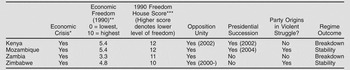
Existing theories cannot easily account for this variation (refer to table 1). Take economic crisis. Economic downturns undermine public support and erode patronage resources, which should encourage elite defection.Footnote 63 Yet whereas economic crisis undermined regime stability in Zambia (and to some degree, in Kenya), it failed to do so in Mozambique and Zimbabwe. Indeed, levels of economic crisis do not correlate with regime outcomes in our cases. Whereas Kenya experienced massive elite defection and authoritarian breakdown in a context of relatively mild crisis, Zimbabwe, which suffered the most severe crisis, did not.Footnote 64
Explaining post-Cold War regime outcomes in Kenya, Mozambique, Zambia, and Zimbabwe

* Crisis is defined as a year in which per capita GDP contracts by three percent or more or the annual inflation rate surpasses 500 percent. In Kenya and Zambia, only years in which autocratic incumbent remained in power are counted (Source: World Bank World Development Indicators (http://www.worldbank.org)).
** Taken from Fraser Institute Level of Economic Freedom. See http://www.freetheworld.com/cgi-bin/freetheworld/getinfo.cgi. Score for Mozambique is from 2003 (no score is given for prior years).
*** Scores combine Freedom House's civil and political rights scores, which each range from 1 to 7.
A second alternative argument focuses on economic statism. Scholars such as Steven Fish and Kenneth Greene argue that extensive state control of the economy enhances authoritarian durability.Footnote 65 Greater government capacity to affect people's livelihood facilitates the punishment of defectors and co-optation of potential opponents. In liberalized economies, by contrast, governments possess fewer resources with which to co-opt elites or prevent their defection. Yet statism also fails to explain our regime outcomes. Table 1 shows the four countries' scores in the Fraser Institute's Level of Economic Freedom index for 1990.Footnote 66 All four countries maintained mixed economies, but Zambia—a case of regime breakdown—was clearly the most statist. Although statism might explain regime stability in post-2000 Zimbabwe, Mozambique underwent considerable economic liberalization in the 1980s and 1990s—and the regime nevertheless remained stable.
Third, Howard and Roessler suggest that two factors increase the likelihood of incumbent defeat in competitive authoritarian elections: opposition unity and executive succession (usually triggered by the president's death or retirement).Footnote 67 Neither factor appears to explain variation among our cases. Unified opposition existed in Mozambique through the mid 2000s and in Zimbabwe for most of the 2000s—and yet ruling parties survived. And although President Moi's retirement clearly contributed to KANU's collapse in 2002, Frelimo survived a similar succession challenge in 2004.
Another potential explanation focuses on variation in regime openness. It has been argued, for example, that more open regimes are more prone to breakdown.Footnote 68 Yet as Table 1 shows, our cases received similar Freedom House scores in 1990. In fact, Zimbabwe was scored as most open, whereas Kenya was scored—together with Mozambique—as least free.
The regimes also vary in age: in 1990, KANU and UNIP had been in power more than a decade longer than either Frelimo or ZANU-PF. Might older regimes have been more vulnerable to breakdown? Both existing theory and available evidence suggest that, if anything, newer regimes are more likely to suffer defection and collapse.Footnote 69 Diverse scholars—ranging from Huntington to Bueno de Mesquita et al.—have posited a positive relationship between regime age and durability.Footnote 70 Likewise, Bienen and van de Walle's empirical analysis of regime turnover in Africa finds that “the risk of losing power is a decreasing function of time [in power].”Footnote 71 Moreover, as we show below, low cohesion in KANU and UNIP was not a product of age; indeed, both parties had histories of elite defection that dated back to the 1960s.
Finally, it might be argued that a violent heritage in general, and not violent party origins specifically, contributes to authoritarian durability. Although it is often difficult to disentangle the two, available evidence suggests that where violent origins do not give rise to a strong ruling party (e.g., post-1947 Pakistan), regimes are less stable. An instructive case is Kenya, which had a violent anti-colonial experience (the Mau Mau rebellion) but was governed after independence by a party (KANU) whose origins lay outside that violence. As we shall see, KANU's limited cohesion undermined regime stability in the post-Cold War era.
We contend that diverging post-Cold War regime outcomes in Kenya, Mozambique, Zambia, and Zimbabwe can be traced to distinct party origins. In Kenya and Zambia, ruling parties gained power without significant violent struggle, and consequently, they consolidated into patronage-based machines that proved vulnerable to crisis in the post-Cold War period. By contrast, Frelimo and ZANU came to power only after years of armed struggle, which gave rise to cohesive party structures that served as the foundation for more robust regimes.
Zimbabwe
Zimbabwe is a striking case of regime stability in the face of unified opposition and profound economic crisis. The government of Robert Mugabe not only remained intact in the face of a strong opposition challenge but was able to mobilize large-scale violence to thwart it. This outcome, we argue, was rooted in the regime's origins in violent liberation struggle, which gave rise to a cohesive ruling party with strong ties to the coercive apparatus.
Party origins and ascent to power. The ZANU government was forged out of an armed liberation movement. Created in 1963, ZANU launched an insurgency against white rule—via its armed wing, ZANLA—in 1966, triggering a civil war that cost 30,000 lives.Footnote 72 ZANU/ZANLA was an ideological guerrilla movement aimed at overthrowing white rule and radically redistributing land.Footnote 73 In power after 1980, the party was marked by several legacies of the guerrilla struggle. For one, the ZANU leadership was dominated by ex-liberation fighters, many of whom had spent years together in the bush or in prison.Footnote 74 As late as 2000, the ZANU politburo was “dominated by Mugabe's lieutenants from the liberation struggle of the 1970s.”Footnote 75 Party cohesion was reinforced by Mugabe himself. Although he was never fully trusted by ZANLA military commanders,Footnote 76 Mugabe's liberation hero status provided him with a special legitimacy. On most matters during the post-independence period, his word “was virtually law” within ZANU.Footnote 77 Finally, a culture of “military commandism” remained “deeply ingrained in ZANU-PF practice and political structures.”Footnote 78 Thus, although ZANU was “riddled with factions,”Footnote 79 it suffered “virtually no defections” during its first decade in power.Footnote 80
ZANU's roots in the liberation war also enhanced its coercive capacity. For one, the ruling party maintained a firm grip over the state's coercive apparatus. ZANU and the security forces were linked by “an umbilical cord, formed during the anti-colonial war.”Footnote 81 The Zimbabwe National Army (ZNA) “evolved out of a national struggle … in which the distinction between politicians and soldiers … was blurred.”Footnote 82 Tens of thousands of guerrillas were absorbed into the armed forces in the early 1980s.Footnote 83 Although the ZNA initially integrated Rhodesian and rival ZIPRA guerrillas, a purge in the early 1980s gave ZANU “undisputed mastery” over the army.Footnote 84 Led by ex-ZANLA commanders who shared the “bush life” in the 1970sFootnote 85 the ZNA became a “highly partisan” army.Footnote 86 Indeed, all of Zimbabwe's main internal security agencies—including the army, police, and the Central Intelligence Organization—were led by “war hardened” ex-combatants with close ties to ZANU,Footnote 87 and who were “vested in the party remaining in power.”Footnote 88 These ex-combatants' capacity for violence was unquestioned.Footnote 89 As Ibbo Mandaza observed, militarism, which was “so deeply ingrained … during the armed struggle, continues to pervade … the Zimbabwean state,” and the “capacity and potential for violence” remains a “central pillar of the state itself.”Footnote 90 Finally, ZANU maintained strong ties to rank-and-file war veterans.Footnote 91 War veterans' organizations were an “indispensable weapon in the hands of ZANU-PF.”Footnote 92 They “played a significant role in mobilizing support for the ruling party, often through coercive means.”Footnote 93 As we shall see, such mobilization was critical to ZANU's repression of emerging opposition in the early 2000s.Footnote 94
Crisis and regime response. ZANU faced little opposition during the initial post-Cold War period, as its repression–and later absorption—of the rival Zimbabwe African People's Union in the early 1980s resulted in nearly two decades of de facto single-party rule.Footnote 95 However, challenges emerged in the late 1990s as economic stagnation and an unpopular war in the Congo generated public discontent and rising protest.Footnote 96 The Zimbabwe Congress of Trade Unions (ZCTU) spearheaded a wave of protest in 1997 and 1998.Footnote 97 In 1999, the ZCTU joined with church and civic groups to create the Movement for Democratic Change (MDC), thereby creating the kind of cohesive opposition party that scholars have linked to successful transitions.Footnote 98 Indeed, the MDC quickly emerged as a “formidable electoral threat.”Footnote 99 The government's electoral vulnerability was made manifest by the surprising defeat of its proposed constitutional reform in a 2000 referendum. The defeat “shook ZANU-PF to the core.”Footnote 100 With the 2000 parliamentary and 2002 presidential elections looming, the ruling party faced a “real possibility of losing power.”Footnote 101
Unlike KANU and UNIP, however, ZANU suffered few defections in the face of rising opposition.Footnote 102 Rather, party and security officials closed ranks around Mugabe,Footnote 103 which facilitated a strategy of polarization and repression. The mobilization of war veterans was central to this strategy.Footnote 104 In early 2000, the government launched a radical land reform, which was accompanied by a wave of violent land invasions that were led by war veterans and coordinated with state officials.Footnote 105 The land invasions became a “frontal assault” on the MDC, as war veterans broke up opposition rallies, attacked MDC supporters, and “cordoned off large areas of the rural constituency from opposition politicians.”Footnote 106 During the 2000 parliamentary campaign, war veterans and ZANU “youth brigades” engaged in large-scale violence and intimidation, closing off large parts of the countryside to the MDC.Footnote 107 The repression helped ZANU narrowly win the 2000 parliamentary election.
The effectiveness of ZANU's repressive strategy was rooted, in part, in its guerrilla origins. For one, ZANU explicitly framed the land invasions in terms of the liberation struggle, labeling the campaign the “Third Chimurenga” (the liberation war was known as the Second Chimurenga), linking the MDC to British colonialism and white Rhodesians, and attacking MDC supporters as “sellouts” and “traitors.”Footnote 108 The hardening of partisan boundaries effectively “trapped” potential ZANU defectors within the party.Footnote 109 Thus, whereas in Zambia the MMD benefited from a “cascade” of UNIP defections in 1991, there were virtually no defections from ZANU to the MDC in 2000.Footnote 110 In addition, the army relied heavily on the mobilization of ex-combatants, whose loyalty was unquestioned.Footnote 111 As one war veteran put it, “This country was won through the loss of blood and not elections…. We are married to this country and Mugabe. We are going to support Mugabe until we bury him.”Footnote 112
Mugabe faced another challenge in the 2002 presidential election. In a context of international isolation and a deteriorating economy, public support for the government eroded. Indeed, surveys showed MDC candidate Morgan Tsvangirai with a large lead.Footnote 113 Nevertheless, ZANU and the security forces again “rallied round Mugabe,”Footnote 114 which allowed him to steal the election through violence and rigging. During the 2002 campaign, paramilitary forces broke up opposition rallies and abducted and tortured hundreds of MDC supporters.Footnote 115 On election eve, the government reduced the number of polling places in MDC strongholds, preventing hundreds of thousands of people from voting.Footnote 116 Mugabe's victory was rejected by Western powers, deepening the regime's international isolation, but ZANU and the security forces remained intact. Post-election protest plans fizzled in the face of repression.Footnote 117 In 2003, the MDC launched a “final push” against Mugabe, in which it engaged in unprecedented mass action and called on members of the security forces to defect; no such defections occurred, however, and the protests were met with a “frightening intensification of state repression.”Footnote 118
After 2002, Zimbabwe suffered an unprecedented economic collapse. GDP declined by more than 40 percent, and the country descended into one of the worst hyperinflationary spirals—inflation reached 231 million percent in 2008—in history.Footnote 119 In this context, support for ZANU evaporated, even in its rural strongholds.Footnote 120 Economic crisis, strong international pressure, and a cohesive opposition generated ample theoretical reason to expect regime collapse. Nevertheless, both ZANU and the coercive apparatus remained intact.Footnote 121 Security officials—most of them ex-liberation fighters—ascended to the top echelons of the government,Footnote 122 and repression intensified. In 2005, Operation “Drive out Rubbish” displaced hundreds of thousands of people from the homes in the MDC's urban strongholds.Footnote 123
Notwithstanding his advancing age and eroding support, Mugabe stood for re-election in 2008. Yet with the exception of ex-Finance Minister Simba Makoni, who left the party to launch an independent presidential bid, there were “no major defections.”Footnote 124 Makoni, who was vilified as a “sell-out,” failed to attract rank-and-file ZANU support and won only eight percent of the vote.Footnote 125 Tsvangirai appeared to win the 2008 election in the first round, but massive falsification of the results forced a runoff.Footnote 126 The security forces again closed ranks behind Mugabe, launching a wave of violence that forced the MDC to withdraw from the race.Footnote 127 Although ZANU and the MDC eventually formed a “unity government” in which Tsvangirai became Prime Minister, ZANU retained control of the presidency and the coercive apparatus through 2012.
It has been argued that ZANU and security officials were united primarily by patronage, and specifically, by access to ill-gotten wealth in Congo and other illicit activities.Footnote 128 Likewise, regime leaders' implication in violence may have reinforced elite cohesion by raising the cost of losing power.Footnote 129 Yet there is little reason to think that complicity in violence and other illicit activities is sufficient to prevent elite defection. In the absence of non-material ties, regime elites implicated in violence and other criminal activity may seek to protect themselves in the face of regime crises by abandoning the sinking ship and negotiating a deal with the opposition. This occurred, for example, in Serbia in 2000. Despite (and perhaps because of) their extensive involvement in violence and corruption under Slobodan Milosevic, leaders of the notorious Red Berets militia struck a deal with the Serbian opposition on the eve of the 2000 “Bulldozer revolution,” and their defection helped ensure Milosevic's fall.Footnote 130 Likewise, implication in corruption or violence failed to secure elite cohesion in the Philippines in the 1980s, Indonesia in the 1990s, and Ukraine in the 2000s. Finally, as we will show, powerful Kenyan regime elites defected in 2002 despite being implicated in violence and corruption.
Due to Mugabe's advanced age and poor health, ZANU's future was uncertain in 2012. Nevertheless, Zimbabwe is a striking case of regime durability. Despite more than a decade of international isolation, one of the world's deepest economic crises, and a strong and cohesive opposition, the ZANU government avoided the kind of elite defection seen in Zambia and especially Kenya, where the opposition was weaker and the economic crisis less severe. As Africa Confidential observed in late 2002, “In 22 years of independence, no more than a handful of [ZANU] politicians have defected.”Footnote 131
Mozambique
Mozambique is another case of regime durability rooted in a history of a violent anti-colonial struggle and civil war. Frelimo's legacy of violent struggle limited elite defection, which enabled it to survive internationally-supervised elections in 1994, a close (and possibly stolen) election in 1999, and a presidential succession in 2004.
Party origins and ascent to power. Like Zimbabwe, single-party rule in Mozambique was rooted in armed struggle. Created in 1962, Frelimo led a violent insurgency against Portuguese rule from 1964 until 1974. During the 1960s, Frelimo evolved into a Marxist guerrilla movement whose cadres were “renowned in Africa for the strength of their ideology [and] the rigor of their training.”Footnote 132 Although the insurgency failed to defeat the Portuguese militarily, Frelimo's armed operations contributed to the “war weariness” that helped inspire Portugal's 1974 military coup and subsequent retreat from colonial rule.Footnote 133 Frelimo experienced another round of violent conflict after independence, as an insurgency led by the Rhodesian/South African-backed Mozambican National Resistance (Renamo) plunged Mozambique into a 17-year civil war that caused an estimated one million deaths.Footnote 134
As in Zimbabwe, origins in violent struggle enhanced ruling party cohesion. Like ZANU, Frelimo was “profoundly influenced by the experience of the independence struggle.”Footnote 135 The liberation war transformed Frelimo from a “loosely organized nationalist front” into a disciplined vanguard party.Footnote 136 Decades of violent conflict gave rise to a strong “military ethos”Footnote 137 and a “leadership deeply committed to the idea of unity.”Footnote 138 This culture of discipline persisted even after Frelimo abandoned its Marxist ideology in the 1980s.Footnote 139 The civil war against Renamo further hardened partisan boundaries, trapping potential defectors within the ruling party. Renamo, which became the main opposition party after the 1992–94 transition, had been aided by Rhodesia and (white) South Africa during the civil war and was thus viewed by Frelimo supporters as having betrayed the cause of African liberation. For ruling party politicians, then, the prospect of being labeled a traitor raised the cost of defection.
Another important legacy of the liberation struggle was the predominance of ex-guerrilla fighters (antigos combatentes) in the Frelimo leadership. For years, Frelimo's “most dedicated militants [sprang] from those directly involved in the armed struggle.”Footnote 140 In 1989, nine of ten politburo members were veterans of the liberation struggle,Footnote 141 and through 1995, all party general secretaries were antigos combatentes. Footnote 142 Viewed as “guarantors of superior ethics,” the antigos combatentes were “accorded unquestioned leadership and privileges,” and they remained influential in the party leadership into the 2000s.Footnote 143 Finally, the security forces—created by Frelimo at independence—were closely linked to the ruling party.Footnote 144 Although the army was restructured after the 1992 peace accords, the police, which served as the regime's main internal security force, maintained “a strong esprit de corps” and a “sense of solidarity rooted in a history of political struggle.Footnote 145
Crisis and regime response. The end of the Cold War posed a severe threat to Frelimo. Most Soviet-backed regimes in sub-Saharan Africa collapsed in the initial post-Cold War period.Footnote 146 Mozambique had been among the region's most Soviet-dependent states, and the withdrawal of Soviet assistance—in the midst of a civil war—contributed to a severe economic crisis in the 1980s.Footnote 147 Desperate for aid, Mozambique turned to the West.Footnote 148 Under “immense pressure” from the international community,Footnote 149 the Frelimo government adopted a multiparty constitution and entered peace negotiations with Renamo. The 1992 Rome Accords legalized Renamo and called for internationally-supervised elections, which were held in 1994.
The 1992–94 transition posed a major challenge to Frelimo. The economy, which had recovered in the late 1980s, suffered a drought-induced downturn in the early 1990s,Footnote 150 and Renamo, which was effectively a unified opposition, posed a serious electoral threat.Footnote 151 Unlike Kenya and Zambia, however, the transition to multiparty rule and competitive elections did not trigger significant ruling party defections. In the 1994 election, President Joaquim Chissano defeated Renamo leader Alonso Dhlakama by a margin of 53 percent to 34 percent. Although Frelimo won only a narrow legislative majority, the party's iron-clad discipline—reinforced by the predominance of the “historic generation”—allowed it to retain control of parliament.Footnote 152 Thus, unlike Benin, Madagascar, or Zambia, where weak ruling parties cost presidents control of the legislature, Frelimo's internal discipline meant that “parliament's oversight function on government [was] almost nonexistent.”Footnote 153
The 1999 election—which again pitted Chissano against Dhlakama—posed another challenge to the regime. The race was close, which may have led Frelimo to steal the election.Footnote 154 After Chissano was declared the winner, Renamo rejected the results and launched a boycott of parliament, and in November 2000, opposition street demonstrations were violently repressed. The Frelimo-dominated police carried out orders to repress in a disciplined manner.Footnote 155
Frelimo reconsolidated power in the 2000s, despite two significant challenges. First, by 2000, the government had undertaken a sweeping economic liberalization program, including large-scale deregulation and privatization.Footnote 156 These reforms “severely weakened the ability of the state to exercise strategic guidance over the economy,”Footnote 157 which should have limited Frelimo's ability to pre-empt or co-opt opposition.Footnote 158 Second, in 2001, President Chissano—abiding by term limits—announced that he would not seek re-election in 2004. Yet unlike Kenya, where presidential succession threw KANU into crisis, Frelimo's succession was remarkably smooth. The Central Committee selected Armando Guebuza, a member of the “historic generation,” as Frelimo's presidential candidate, and the party quickly rallied behind Guebuza.Footnote 159 Thanks in part to a growing economy, Frelimo won the 2004 elections easily. In 2009, Guebuza was re-elected in a landslide, leading Africa Confidential to observe that “Frelimo's grip over the country is now total.”Footnote 160
In sum, Frelimo survived the transition to multiparty rule despite a unified opposition, economic liberalization, and a presidential succession. Two decades after the collapse of the Soviet Union, Frelimo had regained its dominant party status. This resilience was rooted in strikingly high levels of elite cohesion, which can be traced back to Frelimo's origins as an armed liberation movement.
Zambia
Zambia is a case of a patronage-based ruling party that collapsed in the face of economic crisis and a strong opposition challenge. The United National Independence Party (UNIP), which ruled Zambia since independence, was a patronage-based machine without roots in violent struggle. Led by founding President Kenneth Kaunda, the Zambian regime was relatively stable during the Cold War period. However, massive defection to the opposition crippled the ruling party and contributed to Kaunda's overwhelming defeat in the 1991 election.
Party origins and the ascent to power. Although UNIP led Zambia to independence, it was not born of violent struggle. UNIP was founded in the late 1950s when Kaunda and other African leaders left the moderate African National Congress to build a stronger party with a more hard-line anti-colonial strategy.Footnote 161 UNIP grew rapidly, and by 1960, it was the dominant African party in Northern Rhodesia (later Zambia).Footnote 162
UNIP's ascent to power was relatively easy. Zambian independence was achieved “without serious economic or political dislocation.”Footnote 163 The de-colonization process was negotiated and, with minor exceptions, non-violent.Footnote 164 Given the British government's openness to independence after 1959, Kaunda had no need to turn to violent struggle. Instead, he focused on negotiating independence and mobilizing support for UNIP in the British-run 1962 and 1964 elections.
UNIP thus won power in 1964 without having developed the ideologically-committed cadre or internal solidarity that characterized ZANU and Frelimo. Rather, the ruling party was a “coalition of factional interests.”Footnote 165 Lacking alternative sources of cohesion, Kaunda relied heavily on patronage to sustain a “maximum coalition” that encompassed “as wide a range of ethnic, regional, and ideological groups as possible.”Footnote 166 Intra-party cohesion was low from the outset. Indeed, UNIP suffered a series of internal rebellions and “overt schisms” in the 1960s and 1970s.Footnote 167 In 1967, for example, distributional conflicts among ethno-regional leaders triggered an internal rebellion that “almost shattered UNIP,”Footnote 168 and in 1971 the party split when UNIP stalwart Simon Kapwepe left to form the United Progressive Party (UPP). Now “on the verge of becoming a minority party,”Footnote 169 UNIP imposed single-party rule.
UNIP's ties to the coercive apparatus were weaker than in Zimbabwe or Mozambique. Having ascended to power peacefully, UNIP did not seek to radically restructure the post-colonial state. The Zambian Defense Force (ZDF) was neither created nor commanded by liberation veterans, but rather was initially led by British officers before undergoing a slow “Zambianization” beginning in the late 1960s.Footnote 170 Thus, in contrast to Mozambique and Zimbabwe, where the security forces remained under the command of liberation veterans with deep roots in the ruling party, UNIP only weakly penetrated Zambia's security forces. Indeed, “ethnic balancing” weighed more heavily than partisan ties in the distribution of top military appointments.Footnote 171 UNIP's control over the security forces was precarious. The Kaunda government confronted six coup attempts between 1964 and 1990, including uprisings in 1980, 1987, and 1988.Footnote 172
Crisis and regime response. Like many other African governments, the Kaunda administration fell into crisis in the 1980s amid a steep economic decline. GDP contracted by nearly 20 percent between 1981 and 1986, reducing living standards to 1967 levels.Footnote 173 Bankrupt, the government grew increasingly dependent on international financial institutions, and in 1990, IMF-backed austerity measures triggered urban riots.Footnote 174 Although the economy remained highly statist (in 1990, Zambia ranked 109th out of 113 countries on the Fraser Institute's Economic Freedom Index), Kaunda quickly lost the ability to contain opposition. With weak ties to the military and no history of violent struggle, the government “lacked the will for, or the means of, repression,”Footnote 175 and as a result, protest quickly evolved into a large-scale democracy movement. In July 1990, civil society groups, led by the Zambian Central Trade Union (ZCTU), formed the Movement for Multiparty Democracy (MMD).Footnote 176 The emergence of a viable (and unified) opposition triggered a “bandwagon effect,”Footnote 177 as a “cascade” of government officials and national and local party leaders jumped to the MMD.Footnote 178 Although Western democratizing pressure was more limited than in Kenya, Mozambique, or post-2000 Zimbabwe, the government's inability to contain internal dissent or repress protest left it little choice but to call multiparty elections for 1991.Footnote 179
Unlike Zimbabwe, Mozambique, and even Kenya, the Kaunda government did not survive the transition to multiparty rule. Amid a fiscal crisis, UNIP's patronage machine “ran out of fuel,”Footnote 180 and in the absence of the kind of polarization that “trapped” ruling party politicians in Zimbabwe and Mozambique, the cost of elite defection was minimal.Footnote 181 Thus, ruling party branches suffered a “mass exodus of officials” prior to the 1991 election, leading to the “disintegration of UNIP party structures.”Footnote 182 These defections strengthened the opposition, as numerous UNIP politicians brought their resources, experience, and constituencies to the MMD.Footnote 183 Consequently, although the playing field remained skewed in UNIP's favour, MMD candidate Frederick Chiluba overwhelmingly defeated Kaunda in the 1991 election.
In sum, Zambia is a striking case of how quickly and thoroughly patronage-based ruling parties may unravel in a context of crisis. When UNIP's ability to deliver patronage eroded and a viable opposition emerged, politicians defected from the once-dominant party in droves, bringing a quick end to two decades of single party rule. Thus, even though the Zambian regime faced weaker external democratizing pressure than did regimes in Kenya, Mozambique, and Zimbabwe, it was the first to collapse.
Kenya
Kenya is another case of an established patronage-based party that suffered large-scale defection and eventual defeat in the post-Cold War period. Although President Daniel arap Moi managed to narrowly win re-election in 1992 and 1997, the succession crisis triggered by his retirement brought a wave of defections that contributed directly to KANU's defeat in 2002.
Party origins and ascent to power. KANU, which ruled Kenya from independence, was not founded in violent struggle. The anti-colonial Mau Mau rebellion was defeated by 1956, seven years before independence, and de-colonization consequently took place “on the terms of the British.”Footnote 184 Although many Mau Mau veterans joined KANU during its formative phase,Footnote 185 the party leadership remained solidly in the hands of moderates, such as Jomo Kenyatta, who were not active in the rebellion.Footnote 186 Kenyan independence was thus negotiated by moderate and conservative politicians, and the 1963 transition was an elite-led process that involved little violence or mass mobilization.Footnote 187 Indeed, ex-British loyalists quickly gained ascendance in the colonial state,Footnote 188 whereas Mau Mau veterans “played relatively little part in Kenyan politics” after 1963.Footnote 189
Notwithstanding Kenya's violent anti-colonial past, then, neither KANU nor the post-colonial regime was born of violence. KANU, which was created in 1960, represented a coalition of diverse ethnic and ideological groups.Footnote 190 Kenyatta quickly sidelined former Mau Mau activistsFootnote 191—a tendency that was reinforced by the 1964 merger with the conservative Kenya African Democratic Union (KADU). Rather than an ideologically-driven liberation movement, then, KANU was a “loose conglomeration of local notables,”Footnote 192 which relied on “patronage—and patronage alone—to hold together a fractious coalition.”Footnote 193 Like UNIP, KANU suffered several early defections and schisms, most notably the 1966 departure of a group of MPs to form the Kenya People's Union.Footnote 194 Moi, who succeeded Kenyatta as president in 1978, centralized and strengthened KANU's party structures.Footnote 195 Nevertheless, the party remained a “fragile”—and thoroughly patronage-based—coalition in the 1980s and 1990s.Footnote 196
Kenya's security forces were not forged of violent struggle. Unlike ZANU and Frelimo, KANU did not radically restructure the coercive apparatus it inherited from colonial rule. The army was initially led by British officials and underwent only a “slow and gradual Africanization.”Footnote 197 Ethnic ties, rather than guerrilla roots, were the primary criterion for distributing top military posts.Footnote 198 Although civilian control was solid compared to many African regimes,Footnote 199 ruling party penetration of the armed forces was considerably weaker than in Zimbabwe and Mozambique. Indeed, KANU governments faced coup attempts in 1964 and 1982 and coup plots in 1971 and 1978.Footnote 200
Crisis and regime response. Kenya's single-party regime fell into crisis at the end of the Cold War.Footnote 201 Moi, who had been a staunch US ally during the Cold War, became a target of Western conditionality.Footnote 202 At the same time, the government faced substantial domestic opposition. In 1990, amid growing calls for multi-partyism from church and civic groups, ex-KANU barons Charles Rubia and Kenneth Matiba joined opposition leader Oginga Odinga to launch the Forum for the Restoration of Democracy (FORD).Footnote 203 The government's crackdown on the emerging democracy movement triggered Western sanctions: in November 1991, donors suspended $350 million in assistance.Footnote 204 Isolated and facing a deteriorating economy, Moi legalized opposition and called multi-party elections for 1992.Footnote 205 The transition to multi-partyism generated a crisis within KANU. Due to Moi's unpopularity and FORD's emergence as a viable opposition, “all predictions were that [KANU] would lose” multiparty elections.Footnote 206 The prospect of defeat triggered a “massive political re-alignment,” as ruling-party politicians began to defect en masse to the opposition.Footnote 207 It was KANU's “darkest hour. No one knew who was loyal or who was about to defect.”Footnote 208
Although a combination of repression, electoral manipulation, and opposition division allowed Moi to narrowly win re-election in 1992 and 1997,Footnote 209 KANU weakened over the course of the 1990s. Patronage resources dried up in a context of slow growth and persistent donor pressure, which fed growing internal dissent and eventually “broke the KANU coalition apart.”Footnote 210 In this context, Moi's announcement that he would not seek re-election in 2002 triggered a succession crisis. Moi's retirement “dissipated his patronage-bound support” and threw KANU into disarray, as party barons jockeyed to succeed him.Footnote 211 Moreover, Moi's choice of Uhuru Kenyatta, the inexperienced son of Jomo Kenyatta, as his successor “irreparably split” KANU.Footnote 212 Barons such as Vice President George Saitoti, General Secretary Raila Odinga, ex-General Secretary Joseph Kamotho, ex-Foreign Minister Kalonzo Musyoka, and Local Government Minister William Ole Ntimama, who have been described as “arguably the most valuable KANU leaders,”Footnote 213 abandoned the party. They joined other opposition forces in the National Alliance Rainbow Coalition (NARC), which backed the presidential candidacy of Mwai Kibaki. The NARC's emergence as a viable—and united—opposition triggered a bandwagoning effect. KANU politicians, sensing that the “political tide had turned,”Footnote 214 began to “defect to the new party in droves.”Footnote 215 By late 2002, at least half of the 1990s-era KANU elite had joined the NARC.Footnote 216 Several leading defectors had been implicated in violence and other criminal activities in the 1990s.Footnote 217 Rather than remain wedded to the regime, however, they “sought out the most likely victor, in order to maintain their positions of influence.”Footnote 218
The wave of defections decimated KANU. The departure of Odinga and other ethno-regional barons cost the ruling party several key ethnic electorates—including the Luo, Luhya, and Kamba—“in one fell swoop.”Footnote 219 Ruling-party defections also strengthened the opposition by allowing the NARC to “borrow” KANU's organizational structures.Footnote 220 Ex-KANU barons delivered vast financial and organizational resources to the opposition.Footnote 221 And crucially, several of them controlled militias responsible for “ethnic violence” in opposition strongholds in the 1990s, which meant that, unlike Zimbabwe, the ruling party lost much of its coercive capacity.Footnote 222 Kibaki won the election in a landslide, putting an end to nearly four decades of KANU rule.
In sum, KANU's patronage-based machine proved relatively robust during normal times, but it lacked the cohesion to survive a succession crisis. Although Kenya's economic crisis was considerably milder than those in Zambia and Zimbabwe,Footnote 223 and although external pressure was less intense than in Mozambique in the early 1990s or Zimbabwe after 2000, the succession crisis triggered by Moi's retirement triggered a devastating wave of ruling party defections. These defections were “probably the single most important” factor behind the 2002 transition.Footnote 224
Conclusion
We have sought to explain variation in the durability of party-based authoritarian regimes. Whereas the recent literature focuses primarily on parties' capacity to regulate access to power and patronage, we argue that patronage is neither the only nor the most effective source of party cohesion. Although institutionalized patronage may generate cohesion during normal times, pure patronage-based parties are vulnerable to crises generated by economic downturns or strong opposition challenges. By contrast, ruling parties that combine patronage with non-material sources of cohesion, particularly a shared history of violent struggle, tend to be more disciplined, less prone to defection, and more capable of repression in the face of crisis.
Although this article is best viewed as a hypothesis-generating exercise, an initial look at the comparative evidence suggests that our theory may be generalizable. In post-Cold War Africa, for example, nearly all of the party-based authoritarian regimes that emerged out of violent, ideologically-driven conflict (e.g., Angola, Eritrea, Ethiopia, Uganda) survived through 2011. Likewise, origins in violent struggle appear to explain why some communist regimes survived the collapse of communism. Virtually all communist regimes maintained the kind of institutionalized ruling-party structures that are said to foster authoritarian stability. However, most regimes in Eastern Europe did not emerge out of a prolonged violent struggle.Footnote 225 All of these regimes collapsed. By contrast, the communist regimes that survived 1989—China, Cuba, Laos, North Korea, Vietnam—were all led by parties grounded in armed struggle. Regime cohesion and survival was particularly striking in Cuba and North Korea, where externally-dependent states confronted severe economic crises in the wake of the Soviet collapse, and in China, which faced large-scale opposition protest in 1989.Footnote 226 In each of these cases, a cohesive party with extensive interlocking ties to the coercive apparatus provided governments with effective tools for confronting these challenges.
More generally, of the 41 regimes that Geddes classifies as single party, and which existed in 1989,Footnote 227 12 were rooted in prolonged, violent, and ideationally driven struggle.Footnote 228 Nine of these regimes remained in power as of 2012.Footnote 229 Of the three regimes that were no longer in power, two collapsed for reasons other than elite defection (state failure in Albania, heavy external pressure in Nicaragua) and a third, South Yemen, ceased to exist after Yemeni unification in 1990. By contrast, of the 29 single-party regimes that existed in 1989 and were not rooted in prolonged violent struggle, only eight survived through mid-2012.Footnote 230 Obviously, a simple bivariate correlation does not demonstrate causality. However, these data, together with evidence from case studies, suggest that origins in violent struggle plausibly contributed to authoritarian durability after the Cold War.
We conclude with four points. First, regime durability, or the capacity to survive crises, should be distinguished from duration in power.Footnote 231 Like the Dodo, which survived for thousands of years on a protected island but quickly became extinct when confronted by predators, regimes may survive for many years in a favorable environment (i.e., one characterized by a growing economy or strong external support), but quickly collapse when faced with a serious challenge. Studies that focus on regime longevity miss this critical dimension. Although crises are difficult to measure and compare, they allow us to distinguish regimes that survive due to abundant resources (e.g., Botswana) or strong external support (e.g., Jordan, communist Bulgaria) from those with the robustness to survive crises (e.g., Cuba, Zimbabwe).
Second, contra most rational choice analyses of authoritarian party formation,Footnote 232 our analysis suggests that the most durable party institutions are rarely the product of leadership choice. Cohesive party structures are almost always exogenous to regimes; they are frequently rooted in war, liberation struggles, and other polarizing conflicts. Autocrats do not choose such parties; they either come to power with them or they inherit them. Moreover, rulers who come to power without cohesive mass parties cannot build them from scratch. Rather, they must generally choose between a patronage-based organization (e.g., Putin, Shevardnadze in Georgia) and no ruling party at all (Yeltsin, Lukashenka in Belarus).
Third, revolutionary cohesion has a “best-before” date. The effects of violent origins diminish over time, particularly with the disappearance of the generation that participated directly in the armed struggle. Once this founding generation passes from the scene, revolutionary or liberation parties tend to evolve into more standard, machine-like organizations in which the spoils of office are the primary source of elite cohesion (e.g., the Mexican PRI). When that transition occurs, ruling parties must find alternative bases for stability. One of these is obviously economic growth (e.g., China and Vietnam). Another is institutionalized mechanisms of leadership succession. Here an important difference emerges between the Mozambican and Zimbabwean cases: whereas Frelimo took steps toward institutionalizing succession in the 2000s, ZANU did not—and the party's looming succession poses a clear threat to regime stability.
Finally, our analysis highlighted the importance of non-material sources of regime stability. Recent scholarship has focused on the role of material incentives in sustaining authoritarian rule. Thus, authoritarian durability is said to be rooted in autocrats' differential capacity to distribute resources and career opportunities in a manner that rewards loyalty.Footnote 233 Although the distribution of material resources is a critical component of authoritarian durability, it is hardly the only one, and in times of crisis, it may not be the most important one. Broadening analyses of authoritarianism to incorporate alternative bases of regime stability—of which a legacy of violence is one—constitutes an important area for future research.Footnote 234