Introduction
Background
The term ‘Telecare’ is confusing, with multiple definitions in existence. In the current paper, Telecare refers to technology which remotely, passively and automatically monitors changes in an individual's condition and/or lifestyle, in order to manage risks associated with independent living (Bower et al. Reference Bower, Cartwright, Hirani, Barlow, Hendy, Knapp, Henderson, Rogers, Sanders, Bardsley, Steventon, Fitzpatrick, Doll and Newman2011). This is distinguished from ‘Telehealth’, which involves a health-care professional providing remote health-care using a digital network (Royal College of Nursing 2012). Our working definition of Telecare includes first-generation (e.g. pendant alarms) and second-generation Telecare (e.g. extreme temperature sensors, flood detectors, etc.), with the former relying on the user to trigger an alert and the latter being able to detect specific alert conditions automatically (Brownsell, Blackburn and Hawley Reference Brownsell, Blackburn and Hawley2008). The emergence of more sophisticated ‘third-generation’ Telecare, which provides additional capabilities such as lifestyle monitoring and social support (e.g. Global Positioning System tracking), has generated interest among Telecare manufacturers and researchers, but is not widely used (Turner and McGee-Lennon Reference Turner and McGee-Lennon2013). Therefore, the current paper focuses predominantly on first- and second-generation Telecare systems, which are more widely available.
In the United Kingdom (UK), Telecare is normally provided through Local Authorities (LAs) or associated agencies, and is rarely accessed privately (Yeandle Reference Yeandle2014a). An individual may be referred to their local Telecare service by a family member, a health or social care professional, or (rarely) present as a self-referral (Yeandle Reference Yeandle2014a). Referrals are typically initiated in response to a ‘crisis’ event or change in circumstances, e.g. after a period of hospitalisation, significant deterioration of health and/or increased frailty, or through bereavement (Fry Reference Fry2014; Hamblin Reference Hamblin2014; Koivunen Reference Koivunen2014). After referral, the individual is assessed by the Telecare provider to determine whether the Telecare service would benefit them, and which specific Telecare devices would be most appropriate to meet their needs (Telecare Services Association 2010). The range of devices available will be restricted to those offered by the LA or agency involved (Koivunen Reference Koivunen2014). The selected devices will then be installed in the individual's home, and the installing technician will explain to the individual how the devices operate, how to test them, and what to do if an emergency situation arises and they need help (Buckle Reference Buckle2014; Koivunen Reference Koivunen2014). Although there are regional variations in how the devices are monitored, this is typically carried out by a 24-hour control centre, which is responsible for communicating with the individual (if possible) and deciding on an appropriate response to the situation (e.g. calling the emergency services or a family member, or cancelling the alert if it is a false alarm) (López and Domènech Reference López and Domènech2009). Many LAs/agencies charge, or expect users to contribute towards, a fee to maintain and provide Telecare equipment, the monitoring response and, in some cases, a response service (e.g. if family are unavailable or if the emergency services are not required) (Koivunen Reference Koivunen2014; Social Care Institute for Excellence 2013). Periodic reassessment should take place to ensure that the Telecare service is still relevant and appropriate for the individual over time and as their circumstances change. In the UK context, however, there is significant regional variation in how often or how consistently this takes place (AKTIVE Consortium 2013; Buckle Reference Buckle2014; Fry Reference Fry2014).
Telecare, in at least its most basic pendant alarm form, is currently being used by approximately 1.5 million people in the UK (Steventon et al. Reference Steventon, Bardsley, Billings, Dixon, Doll, Beynon, Hirani, Cartwright, Rixon, Knapp, Henderson, Rogers, Hendy, Fitzpatrick and Newman2013). The service is purported to bring many benefits to older adults, including reduced hospitalisations and admissions to care homes, and increased independence, safety and quality of life (AKTIVE Consortium 2013; Barrett, Thorpe and Goodwin Reference Barrett, Thorpe and Goodwin2015; Department of Health 2012). However, the evidence-base for Telecare is currently mixed and consists largely of small-scale pilot studies (Turner and McGee-Lennon Reference Turner and McGee-Lennon2013). In 2007, Barlow et al. (Reference Barlow, Singh, Bayer and Curry2007) conducted a systematic review of benefits of home Telecare for older people and people with long-term conditions. They found only two relevant large observational studies, and no Randomised Controlled Trials (RCTs), despite widespread use of Telecare. The individual and service outcomes from the two observational studies were, however, largely positive, and included helping people with dementia to stay at home, reduced hospital admissions and cost savings. More recently, the Whole Systems Demonstrator (WSD) project team reported the results of a large RCT of Telecare, the only RCT of Telecare to date which has been identified by the authors. The WSD consisted of 2,600 participants with social care needs who were randomised to receive either Telecare (first and second generation) or usual care (first generation) (Steventon et al. Reference Steventon, Bardsley, Billings, Dixon, Doll, Beynon, Hirani, Cartwright, Rixon, Knapp, Henderson, Rogers, Hendy, Fitzpatrick and Newman2013). Although it was found that the service was associated with improved psychological outcomes such as health-related quality of life (Hirani et al. Reference Hirani, Beynon, Cartwright, Rixon, Doll, Henderson, Bardsley, Steventon, Knapp, Rogers, Bower, Sanders, Fitzpatrick, Hendy and Newman2014), there was no difference between the intervention and control groups on health and social care resource utilisation (Steventon et al. Reference Steventon, Bardsley, Billings, Dixon, Doll, Beynon, Hirani, Cartwright, Rixon, Knapp, Henderson, Rogers, Hendy, Fitzpatrick and Newman2013), and the Telecare service was deemed not to be cost-effective (Henderson et al. Reference Henderson, Knapp, Fernandez, Beecham, Hirani, Beynon, Cartwright, Rixon, Doll, Bower, Steventon, Rogers, Fitzpatrick, Barlow, Bardsley and Newman2014). However, an organisational analysis of the clinical and management teams involved in delivering the intervention revealed major implementation barriers which arose due to stringent requirements to adhere to the rigorous RCT methodology, and a tendency to focus on healthcare-related (rather than social care-related) outcomes (Hendy et al. Reference Hendy, Chrysanthaki, Barlow, Knapp, Rogers, Sanders, Bower, Bowen, Fitzpatrick, Bardsley and Newman2012). In addition, outcomes were not assessed longer term, when care system complexities and barriers can mean it is a long time before a service change can be implemented and any effects can be seen (Barlow et al. Reference Barlow, Bayer, Castleton and Curry2005; Barrett, Thorpe and Goodwin Reference Barrett, Thorpe and Goodwin2015).
Despite uncertainties about the effectiveness of Telecare and the conditions for its optimal use, increasing use of Telecare is a key UK government strategy to maintain older people in the community for as long as possible (Barrett, Thorpe and Goodwin Reference Barrett, Thorpe and Goodwin2015; Department of Health 2012). Based on the current and projected size of older populations in the UK and the current number of Telecare users, it is likely that many people who could potentially benefit from Telecare do not currently use it (Barrett, Thorpe and Goodwin Reference Barrett, Thorpe and Goodwin2015; Turner and McGee-Lennon Reference Turner and McGee-Lennon2013), or if they do then it is often used inappropriately (at least from the perspective of Telecare service providers) (Greenhalgh et al. Reference Greenhalgh, Wherton, Sugarhood, Hinder, Procter and Stones2013; Mort, Roberts and Callén Reference Mort, Roberts and Callén2013). For example, the pendant alarm may not be worn at all times (López and Domènech Reference López and Domènech2009), or Telecare users may delay calling for help because they do not wish to inconvenience others (Bentley et al. Reference Bentley, Powell, Orrell and Mountain2014; López and Domènech Reference López and Domènech2009).
There is an abundance of research investigating perceived barriers and facilitators to Telecare use among users of Telecare, e.g. Clark and McGee-Lennon (Reference Clark and McGee-Lennon2011), but little or no research investigating why potential beneficiaries of Telecare decide not to use it when it may be appropriate to their circumstances. Sanders et al. (Reference Sanders, Rogers, Bowen, Bower, Hirani, Cartwright, Fitzpatrick, Knapp, Barlow, Hendy, Chrysanthaki, Bardsley and Newman2012) explored reasons why people declined to participate in the WSD RCT of Telecare. They concluded that perceived requirements for technical competence in using the equipment, stigma and perceived threat to identity and independence, and expectation of disrupted health and social care services, were the main contributors to individuals declining to participate in the WSD trial. In this situation, however, it is possible that factors relating to the RCT methodology itself (e.g. randomisation) may have discouraged participation, rather than the technology itself (Sanders et al. Reference Sanders, Rogers, Bowen, Bower, Hirani, Cartwright, Fitzpatrick, Knapp, Barlow, Hendy, Chrysanthaki, Bardsley and Newman2012).
It is important to explore how Telecare is perceived among non-users of the service. It is also important to understand the reasons why people may or may not choose to use Telecare, and to understand the considerations which influence the timing of that decision. By doing this, the potential benefits of using Telecare could be communicated to this population, whilst protecting their autonomy in making an informed decision about whether or not to use Telecare. We therefore conducted a qualitative study to investigate the perceived barriers and facilitators to Telecare use among current non-users of Telecare, outside the context of an RCT. The authors had not identified any existing research which had attempted to explore the perspectives of non-users of Telecare; yet it is vital to understand what may influence them to accept or decline Telecare, and when, as it is this group which may become future users of the service.
Study context
In April 2012 discussions were held between the research team and an LA in the North of England about an observed decline in Telecare referral rates which had taken place in their region over the previous year. It was agreed that it would be valuable to explore the reasons for this. At the time of the study, the LA in question provided both first- and second-generation Telecare, via a contracted Telecare agency, throughout the region. There was a baseline weekly cost for the pendant alarm and monitoring service (approximately £4.80), and additional second-generation items of Telecare, e.g. flood detector, extreme temperature sensor, etc., were subject to an additional weekly charge (approximately 50p to £1.50). At the time of the study, the most ‘vulnerable’ users, i.e. those with a categorisation of having ‘critical need’ according to the standard UK Telecare eligibility framework (Department of Health 2010), received the service free of charge through local charitable funding. Individuals from the region being discharged from hospital were offered a six-week free trial of the service.
The original aims of the study were as follows:
1. Primary aim: To examine the reasons why people choose not to adopt Telecare when it may be an appropriate intervention in their circumstances.
2. Secondary aim: To explore people's perceptions of the most effective messages and modes for service providers to communicate successfully the benefits of Telecare to users and potential users.
Methods
Study design
Individual semi-structured qualitative interviews were conducted to enable participants to provide their views on Telecare and to allow in-depth exploration of contextual and personal knowledge and experiences. Ethical approval was obtained from the University of Sheffield's School of Health and Related Research Ethics Committee (Reference 0589/KW), and governance approval was obtained from the relevant LA and National Health Service (NHS) region.
Recruitment
Recruitment involved identification of an opportunistic sample of adults who did not use Telecare. Participants fell under one of two categories: ‘Known Refuser’, i.e. people who had been referred to Telecare services but decided not to use it; and ‘Unknown to Service’, i.e. people who had never been referred to Telecare services but who could be argued to benefit from it, e.g. if they self-identified as potentially being relevant for Telecare due to their age, health status and/or living circumstances. In its advertising materials, the relevant LA states that the service is suitable for anyone over the age of 18, but suggests that people may feel they need Telecare, for example, due to their living circumstances (e.g. living alone) or due to a disability and/or health condition. All participants were aged 18 years or over, with an expected majority aged 65 years or over. The research team aimed to recruit up to 20–30 participants in total, or until data saturation was reached.
A range of strategies were used to identify and approach participants. ‘Known Refusers’ were sent a letter by the local Telecare agency, inviting them to take part in the study. We also tried to reach this group through local NHS staff who visited older people, asking them to hand out an Information Sheet about the project if they were aware of the individual having declined referral to Telecare. The ‘Unknowns to Service’ were recruited via advertisements in local newspapers and via third-sector organisations. The research team also visited local community groups to discuss the research with them, thereby inviting further potential participants. Potential participants contacted the research team via post, email or telephone to express an interest in the study. Eligibility was discussed during an initial telephone conversation with potential participants to determine their age, health status and living circumstances, in order to confirm whether Telecare was potentially of relevance to them. However, concrete inclusion and exclusion criteria were not used due to an anticipated wide variety in participants’ circumstances. If a potential participant was interested in taking part then an interview was arranged at a time and place convenient to them. Participants were given the option to be interviewed in their own home, over the telephone or in a public location, for their convenience and to maximise recruitment. An Information Sheet was sent out one week prior to the interview date. Written informed consent was obtained for face-to-face interviews, and recorded verbal consent for telephone interviews, immediately prior to beginning the interview. If the research team were unsure about a potential participant's ability to provide informed consent then this was tested by the researcher through administration of the Six-Item Cognitive Impairment Test (6CIT; Katzman et al. Reference Katzman, Brown, Fuld, Peck, Schechter and Schimmel1983) prior to taking informed consent. Potential participants were excluded from the study if they achieved a score of ten or above. Although ideally we would have wished to explore the views of people with conditions such as dementia, on this occasion this group was excluded due to practical and resource limitations. However, by the end of the recruitment period no potential participants had been excluded on the basis of cognitive ability. Interviews were conducted by two researchers of similar demographics (white British females, young adults). Interviews were either audio recorded and transcribed verbatim, or detailed notes were taken by the researcher if the participant did not give permission for audio recording.
All participants were offered a £10 monetary incentive for taking part.
Procedure and materials
The interview topic guide and associated materials were developed in conjunction with the LA and Telecare agency, after consulting relevant evidence. These materials were then checked by members of an NHS Trust-convened lay-person panel. Minor working changes were made as a result. The topic guide was developed in a way that it could be delivered in a flexible manner depending on the flow of conversation.
Initial questions covered brief demographic information and previous Telecare experience (or lack of). After determining prior experience with, and knowledge of, Telecare, participants were presented with the following definition of Telecare: ‘the use of technology to help people remain safe and independent in their own home’, in accordance with the definition of the participating LA. This definition is presented to potential users of Telecare in the LA's information leaflets and advertising materials. Following this, a series of four case studies was shown to the participant which illustrated how different Telecare technologies could be used with different sectors of the population and people with a range of needs, as reported by Percival and Hanson (Reference Percival and Hanson2006). This was because we had anticipated a low awareness of Telecare amongst participants and wished to ensure a common understanding before discussing barriers and facilitators to using Telecare. In addition, participants were asked: where they would go if they wanted more information about Telecare; what types of people or situations Telecare may (or may not be) suitable for; whether they felt Telecare would be suitable/unsuitable for them and why/why not; what key considerations could be involved in their own, or another person's, decision not to use Telecare; and what their opinion of Telecare was and in what circumstances (if any) they thought Telecare would be a good idea for themselves or another. Additionally, ‘Known Refusers’ were asked why they refused Telecare, what information they had received and the key considerations that had contributed towards their decision to refuse Telecare.
It was made clear to participants at the beginning of the interview that the members of the research team were not associated with any Telecare companies and that they could be completely honest about their views without fear of coercion towards Telecare acceptance.
Data analysis
Framework analysis (Ritchie and Spencer Reference Ritchie, Spencer, Bryman and Burgess1994) was used to enable analysis with reference to the original topics in the interview guide, and to allow the identification of any new considerations or issues. Two researchers (CB and LP) independently familiarised themselves with the data. A thematic framework for analysis was then agreed based upon topics in the interview guide and new emerging themes. The researchers initially coded the same two interviews, and any discrepancies in coding were identified and resolved between them. The data were then divided between the two researchers and systematically coded (indexed) and mapped against the thematic framework to achieve an overall interpretation of the findings (Ritchie and Spencer Reference Ritchie, Spencer, Bryman and Burgess1994). The software program NVivo 9 was used for data analysis.
Results
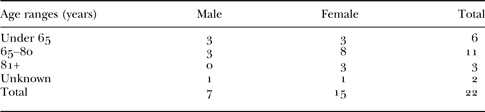
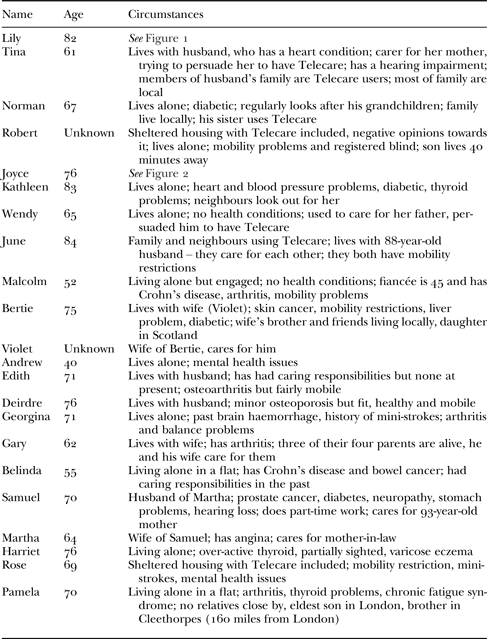
Twenty-two qualitative interviews were conducted in 2013. All but one of the participants were categorised as ‘Unknowns to Service’, with the remaining participant categorised as a ‘Known Refuser’. No potential participants were excluded through not being able to provide informed consent. Two participants were living in accommodation in which a basic Telecare package (pull cords) was included in the rent, but were included in the study because of strong negative opinions towards its use. Some participants had current or past experience of Telecare through friends or relatives using it, and several participants were trying, or had tried, to persuade close relations to use Telecare. Some participants had considered using Telecare themselves in the past, although many had never considered it as an option for themselves. Interviews were between 17 and 95 minutes long. Twenty interviews were audio recorded and transcribed verbatim. One participant did not wish to be recorded and the recorder failed at the beginning of another interview. Detailed notes were taken for these two interviews. Participants’ age ranges and gender are summarised in Table 1, and participants’ individual circumstances, and prior knowledge and experiences of Telecare, are summarised in Table 2. Participants have been given pseudonyms to preserve anonymity.
Gender and age ranges of participants

Summary of participants’ individual circumstances

Source: Adapted from Bentley et al. (Reference Bentley, Powell, Orrell and Mountain2014).
Overall, the results highlighted a number of barriers which negatively influenced participants’ opinions regarding Telecare use. These included issues such as stigma, design, alternative options, awareness and cost, which have been previously discussed in Bentley et al. (Reference Bentley, Powell, Orrell and Mountain2014). The current paper focuses in detail on other considerations which are pertinent to the outcome and timing of Telecare adoption: peace of mind, support networks, changing circumstances, and communication around Telecare. The Results section ends with a consideration of participants’ decision-making processes.
Peace of mind
Telecare was viewed positively by almost all participants when discussed in relation to its potential to help (other) people in certain situations. Benefits such as increased safety, confidence and peace of mind were recognised for older people, people with disabilities or illnesses, people who were living alone, and people who were prone to falling:
[Speaking hypothetically] This has saved me going into a home or this saved me from lying you know on the floor for five days you know, without anybody coming to see me. (Pamela)
Telecare was viewed by some participants as a way to help people live independently in their own homes, as a preferred option to sheltered housing or residential care. Participants’ independence was vitally important to them:
The ability to remain independent and particularly the ability to stay in your own home as long as possible because I think that is what most people, well certainly most people of my age and older want is to stay in their own homes just as absolutely as long as they can without having to have a lot of dependence on other people. (Deirdre)
It should be noted, however, that the phrase ‘maintaining independence’ was included in the initial definition given to participants. Of particular interest was the often simultaneous and contradictory view of Telecare as a symbol of reduced independence, yet also being described as a way to maintain independence, a perception which may be linked to stigma around Telecare and it being viewed as the next step in a downhill ageing process:
My daughter-in-law says if you get one of them the next stop is the nursing home. But I do think that you are relinquishing a certain amount of independence, well as far as I am concerned I would be relinquishing a certain amount of independence, and I am quite happy with the way things are. (Rose)
The benefits of Telecare were usually discussed in relation to other people rather than to the participants personally, with Telecare being seen as unsuitable for themselves:
It gives them confidence, that to me is what having this kind of thing is … yes and if I needed them I would be more confident with them in you see. (Samuel)
For some people that must be really, really reassuring. (Rose)
This was particularly interesting as many participants fulfilled some of the criteria for Telecare use which they themselves identified during the interview. When this was highlighted, participants often provided a counter-reason for not needing Telecare, e.g. they were disabled but they were not living alone. Again this is indicative of the stigma associated with Telecare use and its relationship to increased dependence and vulnerability, not a state which most participants related to themselves.
Some participants did discuss potential benefits which Telecare could offer for them personally, e.g. Lily would feel more confident exploring her garden. Wendy had known someone who was young and fit who had fallen and injured herself and struggled to raise the alarm, making the point that anyone could be vulnerable and might need help. Only two participants (Joyce and Pamela) described a situation in which they themselves had fallen: Joyce was fortunately able to get up by herself, and Pamela had fallen in a public location and received help. One participant (Tina) described how her mother continued to decline Telecare even after a fall in which she was fortunate to have received help straight away, with Tina's frustration with her mother's decision showing through in her account. Another participant (Rose) reported that her mother had experienced a fall in her kitchen and was not found until the following day. Sadly, Rose's mother passed away in hospital four days later. Rose's mother had previously refused Telecare, and Rose wondered if the delay had contributed to her death.
Although many participants had a preference for alternative options to Telecare (e.g. alarm button alternatives which contact relatives), it was stated by a minority that Telecare has certain advantages over alternatives, including the ability to receive help more quickly and less need for reliance on family members:
I'm not in I'm talking to you and she could be laid on the floor couldn't she. So whilst she sees it's a better idea, and I can agree with her financially, she can't get her head around the fact that we are not sat at the side of the phone all day. We are still fairly active. (Tina)
Support network
Some participants considered that they did not need to have Telecare in their home due to their strong support network:
I have still got my husband alive and living with me. I have still got regular contact . . . if I lived on my own possibly, but because I don't live on my own it's not an issue. (Tina)
However, it was interesting to note that the presence or absence of a strong support network could influence a person's decision to accept or refuse Telecare in either direction. For example, some participants described situations in which their family members had tried to persuade them to use Telecare (e.g. Lily), or they themselves had tried to persuade loved ones to use the service (e.g. Tina and Wendy), despite the individual in question having a good support network around them. Even where a support network is strong, family members cannot be with the individual at all times or might not always be available to help, thus family members may feel more secure and less anxious in carrying out their own day-to-day activities if their relative has Telecare in place:
Even if they have got a carer, that carer has to go out sometime and go into other rooms at other times so yes I do think they are useful. (Violet)
Knowing that the person who is an invalid or who is their mother or father have got this facility and they would be aware that they would let them know if there was anything wrong. (June)
If they're happy about it and it gives you a little bit of respite from worrying about them then it, it's all to the good. (Pamela)
Lily, and some of the participants’ cared-for relatives, had declined Telecare despite attempts from family members to persuade them otherwise, and despite some offers from family members to pay for the service themselves. Family members were usually more positive about using Telecare for their loved one than the loved one themselves. For example, for Tina's mother, when the cost barrier was removed by Tina's offer to pay for the service, other barriers became apparent, e.g. stigma associated with Telecare use and concerns about privacy. Tina felt frustrated by this, particularly as she felt her mother relied too strongly on her and her brother being able to help, even though they were willing to help if they could:
As soon as they said do you want us, she would say no go away my daughter will do it, didn't ask daughter but! (Tina)
However, some participants stated that they would consider using Telecare if it was suggested to them by family members:
I mean I do trust my children. I would listen to them if they suggested it. (Joyce)
If I felt that I needed the help, or if somebody else told me I did which I think is equally important as you get older is if someone tells you, you do you just listen. (Deirdre)
The decision to accept or decline Telecare was also positively or negatively influenced by past experiences and anecdotes from friends and relatives, e.g. Robert not being responded to quickly after experiencing a fall in sheltered housing.
Tied in with participants’ desire to remain independent was, in some cases, their concern about becoming a ‘burden’ to their family members (e.g. not wanting to cause worry or inconvenience to others); a concern which may lead to Telecare use for the peace of mind of their relatives:
Whether you have got family locally you don't want to be a burden to them, and if you have got family far away you certainly don't want to be a burden on them and being worried. (Deirdre)
The proximity of people's support network could also influence decisions regarding Telecare adoption. For example, some participants considered that someone might not feel they needed Telecare if they had family support nearby:
And again it's easier because we all live in [name of place]. Now if your son or daughter or family members don't live local then that's a completely different issue altogether and one I can't answer because my family lives local to my mum. (Tina)
Changing circumstances
Almost all participants stated that if their circumstances changed in the future then they were more likely to consider accepting Telecare. When asked which changes in circumstances would make them re-consider, topics raised included getting older, more vulnerable, more disabled and if a family member suggested it. However, Lily saw accepting Telecare as accepting that her quality of life would end. It appeared that the decision to accept Telecare would be taken as a decision of necessity in response to a change in circumstances, rather than installing it in a pre-emptive fashion. Telecare was in some cases perceived as an intervention to be avoided unless absolutely necessary, possibly due to its challenges to independence:
I would definitely reconsider if I had a stroke, that would be a big thing. Probably if I had had a fall and not being able to get up, I mean now it's not easy for me to get up from the floor … so if I fell in such a position that I couldn't get back up or I struggled to get back up or something, I don't know. (Joyce)
Maybe as I get older and I am less confident then possibly I will re-think but at the moment I have just said no thank you, you know. Thank you for offering but I really, really don't consider that I need it at the moment, but it is nice to be aware of these things so if things change you know it is there. (Rose)
In the future yes, not at the moment. I mean I hope I never have to do it but you don't know do you … who is to say how old you are going to be anyway, who is to say how fit you are going to be for the rest of your life. (Harriet)
It was frequently stated or implied that the individual involved should be able to retain their independence in their decision to use (or not use) Telecare, identifying for themselves when they felt it was needed, and not feeling pressurised into it by anybody else:
I think it is something that I have got in my mind for future use as and when I assess that the risk is at that level . . . I think I am aware of my own body and would take action, I mean I have done in the past. (Joyce)
Communication
Regarding previous awareness of Telecare, two participants had experience of living in sheltered accommodation for which a basic Telecare package was included. Although it was not always clear to what extent the remaining participants had considered using Telecare in the past, a minority had given Telecare use serious consideration, and two were considering accepting the service in the near future. Around half of the remaining participants had definitely not considered using Telecare for themselves, although in some cases they had relatives who were using the service, and/or they were trying to persuade a loved one to use Telecare.
There was some awareness among participants of the council being involved in the provision of Telecare, and of Telecare being a means to obtain help in certain situations. There was, however, a general low awareness among the participants of the range of Telecare devices available, the range of situations in which it can be used, or the existence of less stigmatising options for wearing the alarm, all of which were felt to add to the benefits of Telecare:
Not a lot, and only about the bit where you press and that you can contact. I had a friend that I used to go walking with and she had one and that's as much as I know about them. I certainly didn't know there were any other devices. (Kathleen)
Most participants did not know the meaning of the term ‘Telecare’ before participating in the project. Even in cases where participants had prior knowledge or experience of Telecare, usually through relatives who had used the service, they did not associate the word with pendant alarms or other devices. This demonstrated a disconnection between terms of reference of Telecare service users and providers. Wendy did not like the reference to ‘care’ in Telecare. She felt it enhanced the stigma that Telecare is for older, more vulnerable people and detracted from its purpose of encouraging independence. Wendy also felt the word ‘alarm’ inferred that there is likely to be an emergency situation, which could potentially affect people's decision to have a ‘pendant alarm’:
. . . so maybe it is a bad name altogether then. (Wendy)
It was noted by some participants that they did not recall seeing Telecare advertised anywhere:
So how do you communicate to people, I mean I would imagine one possible way is advertise on the telly, but who is going to pay for that? (Samuel)
I have to say that in the years I've been retired I haven't seen a lot of adverts about Telecare. (Pamela)
With regard to potential messages which could be used to promote Telecare, many participants found it difficult to speculate on what sort of messages would allow people to make informed choices about accepting or declining Telecare, particularly messages which would appeal to them personally. Some stated that advertising could emphasise the existence of alternative and less stigmatising options to wearing the pendant alarm, or could highlight the range of devices available. The majority of participants stated that they would like Telecare advertising to be positively framed and focused on the benefits of the products, not the risks if a person decided not to have it.
Positive messages are more powerful . . . I would be wanting to focus on the benefits so if you have this you will be able to x, y, z . . . the technology, the iPhones and things they are not sold on the risks of you not having it are they? They are sold to you on the benefits, if you have this you will be able to take photos of your friends and e-mail them to your other friends. (Wendy)
You have to get the message across to people to say that this can actually save your life, this is to help you, we are not doing it for any other purpose it's just to help you live a life. (Bertie)
However, a minority expressed a preference for negative framing due to its perceived impact, even though many found this more coercive:
It might have you know more effect to see somebody lying, lying on a step with blood oozing from their forehead you know this could happen to you if you haven't got a pendant … but I wonder whether frightening people into something is . . . the best way. (Pamela)
Participants tended to agree, however, that any advertising message needed to be both memorable and appealing.
Some of the most frequently mentioned strategies for increasing awareness of Telecare included through the internet (though not everyone has it), through health and social care professionals, through ageing-related charities and community groups, through newspapers, libraries and general practitioner surgeries, and through fairs and stalls at larger relevant community events:
I don't know where my mum got that leaflet from yesterday, I think she said my sister-in-law brought it her, but then my sister-in-law works for NHS so she does beds for elderly people so that's her job, so she would find access to those literature fairly easy but I am not quite sure that other people would. (Tina)
You have to have it somewhere where people can see it all the time . . . in everywhere they look they can see something about it you know what I mean, telephone box or anywhere as long as it's stuck up. (Norman)
Word of mouth was viewed as the strongest method for spreading awareness of Telecare, which is supported by the fact that most participants with some understanding of Telecare had gained this through friends/relatives having the service. However, it was also noted that advertisements for Telecare may not be noticed by an individual if they do not feel the service is relevant for them, therefore any communications should first persuade potential users that it is relevant to them:
We have kept stuff but I would imagine most people don't until they need it and then oh I wish I would have kept that now, where do I get it from . . . people just generally aren't interested unless it impacts on their life. (Samuel)
Emphasis was placed on the importance of making Telecare advertising more appealing, especially as most people have to pay for it. Wendy felt that advertising and design aimed at older people was generally drab and reinforced the older person stereotype, thus detracting from the genuine benefits some products could offer for people:
You have leaflets that clearly are aimed at people that need help with various things . . . they might be very useful but they are not appealing, the paper is poor quality, the illustrations are not zippy . . . and you immediately feel depressed . . . I am looking with the raised toilet seats and stuff, there is nothing wrong with raised toilet seats they are really useful but it's, they are not pictured in any kind of appealing way. (Wendy)
Telecare is like any other paid-for service, in that it should be appealing and desirable to the target audience, rather than viewed as a last resort:
I mean if you live in more exclusive flats you have the commissioner, whatever you call them, sat downstairs on security. So that in a way is a bit like what we are saying isn't it? . . . but they don't call it secure accommodation they call it chic or whatever, but it's the same principal, you are paying for a service. (Tina)
Two of the participants were aware of advancements in technology generally, e.g. Wendy suggesting that smartphones might be able to carry out many Telecare functions, and also advancements specifically within Telecare (e.g. third-generation environmental monitoring):
There's all sorts of clever things going on . . . being able to have access through Skype . . . which seem to me excellent ideas in terms of people not feeling afraid and isolated and being able to make contact, but also mechanisms for the support services to be aware if somebody hasn't got out of their bed for three days or you know. (Pamela)
Decision process
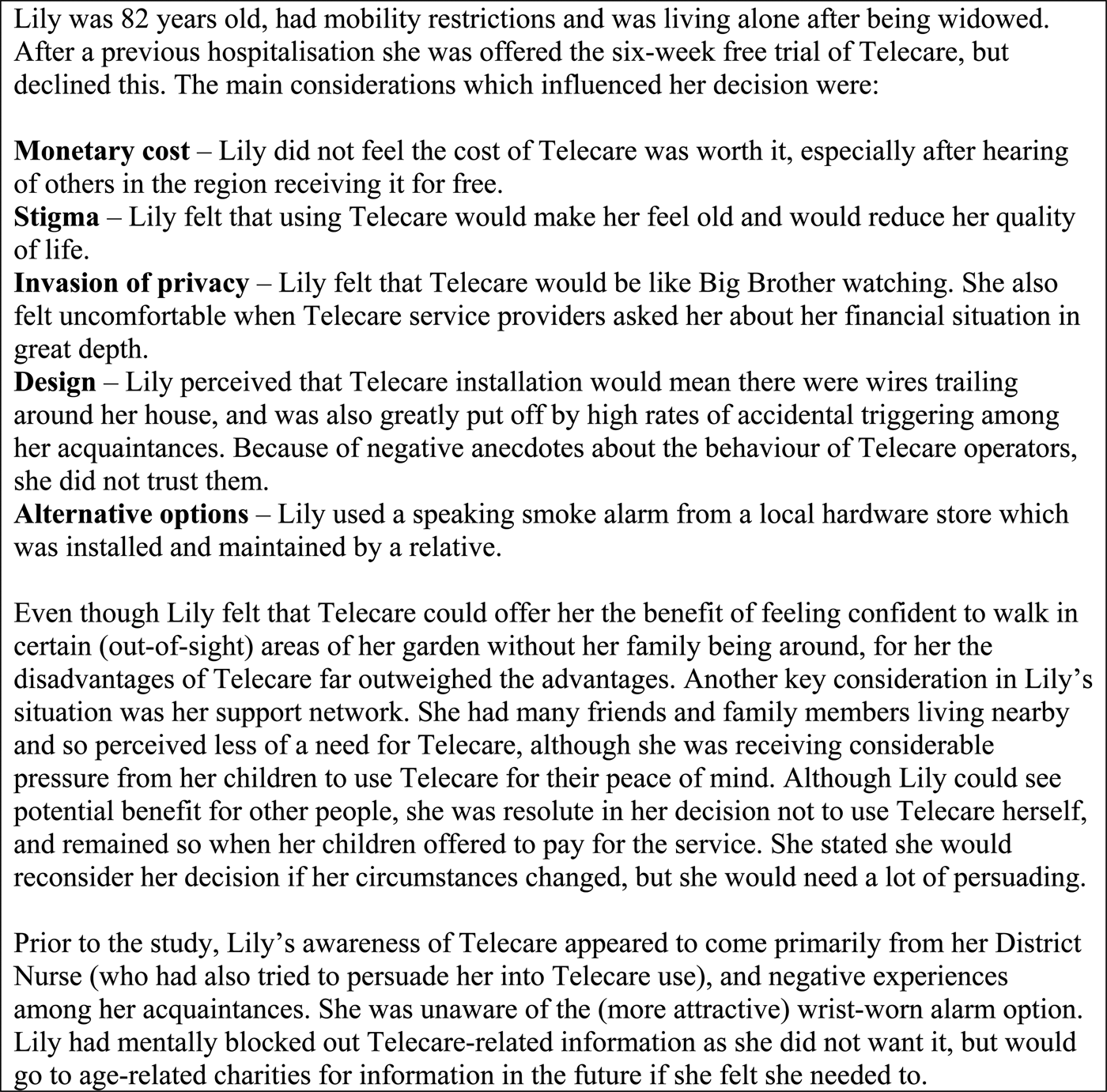
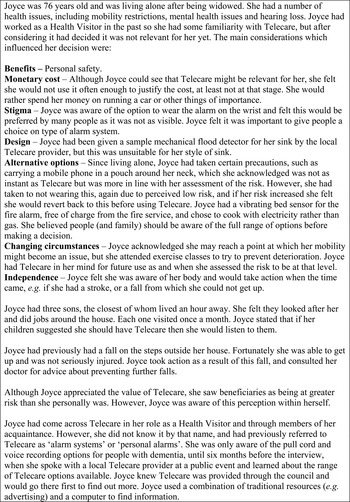
Participants’ demographics, circumstances and factors which influenced their decisions and opinions varied widely, and are explored in detail for two participants in Figures 1 and 2. These two participants were chosen because they had differing opinions of Telecare, and both had decided not to use it. Lily had an extremely negative opinion of Telecare, seeing it as expensive, stigmatising and unsuitable for her needs. In Joyce's case she perceived more benefits to Telecare use, but decided to reserve it for future use if her health deteriorated. Both Lily and Joyce utilised their strong support network and both used alternatives to Telecare to maintain independence. See Figures 1 and 2 for a detailed consideration of each example decision process. All participants appeared to weigh up the perceived costs (including, but not limited to, monetary cost) versus perceived benefits (e.g. peace of mind) of accepting Telecare when exploring their opinions and decisions.
Lily's story: Lily was a ‘Known Refuser’, against Telecare.

Joyce's story: Joyce was an ‘Unknown to Service’ and had considered Telecare.

Discussion
This qualitative study investigating barriers to Telecare use among current non-users has provided detailed insight into the decision-making process which occurs prior to accepting or declining Telecare. In many cases participants had little previous awareness of what Telecare entailed and/or had never considered it as an option for themselves. All participants, including those who had, or had not, previously considered Telecare, identified a number of key considerations which significantly influenced their decision-making process. Although the identified barriers are similar to those identified in other studies with Telecare users (e.g. Hamblin Reference Hamblin2014), this is the first study we are aware of which has explored Telecare barriers from the perspective of individuals who were not using the service but could potentially benefit from it. We use these findings to suggest that the timing of the decision to use (or not use) Telecare may be crucial in determining how much (if any) benefit people may receive from the service, and that a decision to use Telecare may be delayed, or not considered, because of barriers to its use.
Significant barriers to Telecare use were concerns about personal monetary cost, negative stigma around the appearance and marketing of Telecare, and the reduced independence which participants associated with the equipment. Design and suitability of the service and/or technology also had a significant influence on individuals’ decision-making process. Issues relating to Telecare design and its inherent stigmatising properties, as well as personal monetary cost, are explored in detail in a previous publication (Bentley et al. Reference Bentley, Powell, Orrell and Mountain2014). The strength and opinion of a person's support network (including family, friends, professionals, etc.) can influence the decision in either direction, e.g. an individual may be more likely to adopt Telecare if they feel that it will bring peace of mind to the relatives who care for them.
The perceived reassurance and peace of mind provided by the service, and the safety of knowing that they would not be alone if an emergency situation arose, were arguments in favour of Telecare use. However, it is worth noting that these benefits were frequently discussed by participants as being relevant for ‘vulnerable others’, rather than in relation to themselves. This is important because individuals may decide whether Telecare is useful for them or not based on its association with old age and dependence, rather than on any potential benefits the service may (or may not) offer for them personally. This raises the question of whether ‘vulnerability’ is to be judged by the physical and/or mental state of the individual, or whether it is reliant on the individual's perception of their physical/mental state (Aceros, Pols and Domenech Reference Aceros, Pols and Domenech2015). It has also been reported that certain social care models may in themselves promote dependency through their focus on avoiding risks rather than promoting independence (Aceros, Pols and Domenech Reference Aceros, Pols and Domenech2015; Bowes and McColgan Reference Bowes and McColgan2013). As the majority of participants in the present study did not see themselves as being vulnerable, the adoption of Telecare was perceived as not being applicable to them.
With regard to the timing of the decision to use or not use Telecare, most participants stated they would consider this as an option in the future if their circumstances changed, e.g. due to increased frailty or ill health. However only a minority of participants seemed to consider this option as a pre-emptive strategy, and in most cases was viewed as a scenario to be avoided unless absolutely necessary. The monetary cost of the service may add to this perception. Some individuals may be unwilling/unable to pay for something for which they cannot immediately see the benefits, especially if they are in receipt of a limited income, e.g. basic state pension. Therefore, they may choose to prioritise other essentials and activities, rather than paying for a service ‘just in case’ something happens. A decision to use Telecare earlier may be made if family members try to persuade the individual to use it, either by highlighting a deterioration which the individual has not noticed, or for the peace of mind of the family member and the desire not to be perceived as a ‘burden’.
Adequate and appropriate knowledge of Telecare is also vitally important. Many participants had little awareness of how Telecare worked, the range of devices available or the range of situations in which it can be used, yet a decision about whether or not to adopt Telecare may be made on this limited or misunderstood information. This lack of knowledge and awareness is compounded by a general confusion around the term ‘Telecare’ and the different types of devices and services to which it can refer (Pols Reference Pols2012). Most participants’ existing knowledge of Telecare was gained through (positive and negative) experiences of people they knew who had used Telecare. General experiences with technology may also impact the decision-making process, e.g. one participant who was thinking of buying a smartphone viewed Telecare as drab and outmoded by comparison. However, it is essential that, to be able to make this decision in an informed way, a person needs awareness and knowledge of the different Telecare options and of locally available service options.
Findings from a recent study of Telecare use by older people found that participants often experienced feelings of safety and peace of mind, and a greater ability to carry out valued activities and live independently, through having Telecare at home (Fry Reference Fry2014; Yeandle Reference Yeandle2014a). However, significant barriers to post-installation acceptance and use of Telecare were also identified, including stigma and loss of identity (Hamblin Reference Hamblin2014), low awareness of how to use the device/service (Hamblin Reference Hamblin2014; Koivunen Reference Koivunen2014), and issues relating to design and suitability (Yeandle Reference Yeandle2014b). These findings are supported by the results of our study. In addition, an individual's support network can be strongly influential both in the initial decision to install Telecare and in subsequent acceptance and use. For example, Telecare may be installed as a way to diffuse tensions arising from an individual's wish to remain independent and autonomous, and a relative's fears for their safety (Yeandle Reference Yeandle2014a). Many of these barriers and facilitators are corroborated by a multitude of other studies (Aceros, Pols and Domenech Reference Aceros, Pols and Domenech2015; Clark and McGee-Lennon Reference Clark and McGee-Lennon2011; Greenhalgh et al. Reference Greenhalgh, Wherton, Sugarhood, Hinder, Procter and Stones2013; Mort, Roberts and Callén Reference Mort, Roberts and Callén2013; Sanders et al. Reference Sanders, Rogers, Bowen, Bower, Hirani, Cartwright, Fitzpatrick, Knapp, Barlow, Hendy, Chrysanthaki, Bardsley and Newman2012; Turner and McGee-Lennon Reference Turner and McGee-Lennon2013).
In the present study, most participants stated that they would rethink their decision regarding installation and use of Telecare if their circumstances changed in the future. Several participants stated or implied that autonomy in their decision of whether, when and how to use Telecare was of great importance to them. However, the reality is that, during a time of crisis, the decision to use or not use Telecare may be taken away from the individual, for example by well-meaning members of their support network (Hamblin Reference Hamblin2014). Research has shown that the likelihood of post-installation acceptance of Telecare is greatly increased when the individual involved has made the initial decision to use Telecare themselves and it has been installed as a preventative, rather than a reactive, strategy to help them remain independent in their own home for as long as possible (Hamblin Reference Hamblin2014). If people feel that their choice and control are removed in the decision to install Telecare then they may be more likely to ‘re-assert’ their independence by adapting the equipment or choosing their circumstances of use, for example by choosing to wear the pendant alarm only in specific situations (Aceros, Pols and Domenech Reference Aceros, Pols and Domenech2015; López and Domènech Reference López and Domènech2009; Yeandle Reference Yeandle2014b). In addition, if Telecare is installed in response to a crisis event an individual's awareness or memory of what the service is, how to use the equipment, etc., can be affected (Koivunen Reference Koivunen2014). Bearing in mind the findings of the present study, i.e. the importance of autonomy in the decision to use (or not use) Telecare, it is concerning that other research highlights how commonly that choice is removed from individuals.
Traditionally, Telecare has been used as a reactionary strategy, both in its installation and operation. The service does have the potential to be used preventatively, e.g. preventing harm caused by a delayed response to a fall, although viewpoints differ as to whether the service is inherently a crisis management strategy (Ganyo, Dunn and Hope Reference Ganyo, Dunn and Hope2011; Hanson et al. Reference Hanson, Percival, Aldred, Brownsell and Hawley2007; Milligan, Roberts and Mort Reference Milligan, Roberts and Mort2011; Percival and Hanson Reference Percival and Hanson2006). With the emergence of third-generation Telecare, there is even greater scope for the service to be used as a preventative strategy to reduce morbidity associated with later age, rather than just to react to emergency situations or sudden changes in circumstance (Barlow, Bayer and Curry Reference Barlow, Bayer and Curry2006; Stowe and Harding Reference Stowe and Harding2010). However, third-generation Telecare is not yet widely available in the developed world (Turner and McGee-Lennon Reference Turner and McGee-Lennon2013). In order for an individual to potentially gain preventative benefit from Telecare use, their acceptance of the technology is imperative. It is also important that they adopt it early enough to maintain autonomy over the decision to begin using it, and to have time to adjust to using the technology. Introduction of these devices in dementia is particularly time-critical (AKTIVE Consortium 2013; Hamblin Reference Hamblin2014). However, the requirements for an individual to adopt Telecare early enough to experience any benefit, and for that individual to autonomously make that decision, seem to oppose each other when discussing an intervention which is strongly associated with older age and vulnerability. Because of this association, Telecare is viewed as being highly undesirable unless used as a last resort. Therefore, it may be adopted too late to gain any benefit, and/or the individual may be coerced into using it in response to a perceived increase in their vulnerability.
Issues relating to the perceived trade-off between independence/autonomy and safety, in relation to Telecare use, are discussed in detail in several publications (Aceros, Pols and Domenech Reference Aceros, Pols and Domenech2015; Bentley et al. Reference Bentley, Powell, Orrell and Mountain2014; López and Domènech Reference López and Domènech2009). If the design of Telecare devices and services was more suitable and less stigmatising, then this perceived trade-off may be reduced or eradicated. In other words, people may not feel they are necessarily giving up some of their independence or freedom in exchange for greater safety, just as the purchaser of a smartphone would not be giving up their independence in doing so, yet could be argued to be increasing their safety if they injured themselves out of range of help (whether young or old). Many of the participants in the current study used alternatives to Telecare which did not require a trade-off between safety and independence. Older people have the same criteria as other age groups regarding what is attractive to them in terms of technology, including ease of use and ability to perceive the benefit of using it (Bentley et al. Reference Bentley, Powell, Orrell and Mountain2014). This raises the question of how we encourage earlier adoption of Telecare with all of the existing barriers to its use, and leads us to consider whether, ethically, we should even encourage this. Based on our findings, it can be argued that individuals could be persuaded to use Telecare by members of their support network. Taking this approach, however, may undermine individuals’ autonomy and independence. In addition, various researchers (Aceros, Pols and Domenech Reference Aceros, Pols and Domenech2015; Barrett, Thorpe and Goodwin Reference Barrett, Thorpe and Goodwin2015; Mort, Roberts and Callén Reference Mort, Roberts and Callén2013) have warned of the dangers of coercively forcing Telecare on to people due to government ‘push’ and rhetoric around the ‘ageing population’. Telecare use should be the individual's choice, and a decision not to use Telecare should be respected.
Recommendations
The authors conclude that one key to the dilemma, both in terms of encouraging Telecare uptake and respecting individuals’ autonomy, appears to lie in raising awareness of Telecare among the general population, and also among health and social care professionals who provide, and refer individuals to, the service. The vast majority of the UK population (91%) do not know what Telecare is (Telehealth Forum 2012: 3–5). When participants found out about the wide range of devices available, including the wrist-worn alarm button, and the fact that Telecare is not just used for ‘old people’, participants tended to look on Telecare more favourably. If awareness was raised, and stigma-related preconceptions were reduced (e.g. removing words such as ‘vulnerable’ from advertising materials), this might encourage a consumer model of Telecare and drive changes in design, which fundamentally has not changed for decades and which currently treats older people as passive users of technology (Bentley et al. Reference Bentley, Powell, Orrell and Mountain2014; Peine, Rollwagen and Neven Reference Peine, Rollwagen and Neven2014). Telecare technology needs to be made more desirable and less stigmatising, in the way that tablets and smartphones constantly change to be desirable to, and meet the needs of younger, and increasingly older, generations (Bentley et al. Reference Bentley, Powell, Orrell and Mountain2014). With the advent of smartphones, etc., people may expect more sophisticated Telecare solutions in the future, particularly if they will be expected to pay for them (Bentley et al. Reference Bentley, Powell, Orrell and Mountain2014). Perhaps moving forward, Telecare providers need to explore the potential of smartphones and mobile applications (apps) to carry out some of the functions of Telecare.
UK Telehealthcare (formerly The London Telecare Association) is attempting to raise awareness of Telecare in London through a poster campaign at bus stops, and is aiming to encourage these activities in the rest of the UK, although the authors are not aware of any evaluations of this scheme at present. Generally raising awareness of Telecare could ensure that people are properly informed about the service before deciding whether or not to use it. This would reduce the likelihood of a decision being made based on misinformation or limited awareness of options, whilst preserving the individual's independence and autonomy in making that (fully informed) decision. We also need to accept that alternative options, such as carrying a mobile phone at all times, may remain more appealing than Telecare for many individuals. In the future, Telecare providers should embrace this potential for dual functionality of technology (that people already use and accept) rather than trying to persuade them that they need a separate (stigmatising) pendant alarm.
One of the most significant barriers to raising awareness of Telecare is the monetary cost of doing so. Within the LA associated with this study, there was almost no budget for advertising and promotional materials due to increased financial pressures faced across social care. Local and national commitment and investment to this course would be required. This problem is not helped by the mixed evidence-base behind the intervention. The authors of the present paper, along with others (Barrett, Thorpe and Goodwin Reference Barrett, Thorpe and Goodwin2015; Turner and McGee-Lennon Reference Turner and McGee-Lennon2013), advocate greater emphasis on the value of pragmatic evaluation of Telecare rather than the perceived need to apply the traditional medical view of ‘gold standard’ evidence to a complex social care intervention (as was done in the WSD RCT).
Strengths and weaknesses
A key strength of this study is that it is the first, of which the authors are aware, to have explored barriers and facilitators of Telecare use among individuals who are not users of Telecare but for whom the service may be deemed to be relevant. A weakness of the study is that participants were self-selected and thus may have had more of an interest in technology, or differed in other important ways, from the general population of potential Telecare users. However, this is a common and usually unavoidable pitfall of research. Unfortunately, we were only able to recruit one ‘Known Refuser’ through LA communications, a group which was harder to reach than the larger pool of ‘Unknowns to Service’ within the wider community. Further valuable insights may have been gained if more ‘Known Refusers’ had decided to take part in the research, or if more of them could have been reached through other LAs if project resources had allowed. However, the one ‘Known Refuser’ did provide useful insights as to why they deemed Telecare to be unsuitable for themselves.
Conclusions
The adoption of Telecare by non-users of the service is hindered by barriers such as stigma and lack of communication. Despite being offset, to a limited extent, by the benefits of peace of mind and potential reassurance for family members, Telecare is often not used until it is deemed absolutely necessary, by which time it may be too late to realise fully any potential benefits of having the service. Telecare is not a panacea solution. A balance needs to be achieved between encouraging individuals to consider Telecare early enough for any potential preventative benefits to be realised, and respecting individuals’ independence and autonomy in making that decision. One way to achieve this may be through raising awareness of Telecare in the general population, including the range of options available and how they could be of benefit. If potential ‘consumers’ of Telecare begin demanding more innovative and flexible Telecare provision, this may encourage designers and providers to respond to this demand and invest more in, for example, widespread implementation of third (and later) generations of Telecare. Although the findings are from an English context, they may be of importance for other countries and potentially other social care systems.
Acknowledgements
The research team and CLAHRC South Yorkshire would like to acknowledge the significant contributions of partner organisations and particularly those of the participants of this study.