Introduction
Almost 6 years ago, and drawing on a number of different sources, the final report of the Review of Higher Education Access and Outcomes for Aboriginal and Torres Strait Islander people (the Review; Behrendt et al., Reference Behrendt, Larkin, Griew and Kelly2012) documented substantial differences between IndigenousFootnote 1 and non-Indigenous domestic students' university degree pathways, rates of retention and completion. For example, the Review highlighted that there was ‘a one in three dropout rate from university [for Indigenous students] compared to one in five for all domestic students' (p. 7). Since the Review was released, there is evidence of steady increases in Indigenous student participation in the higher education sector; however, the most recent national statistics still show a disparity between Indigenous and non-Indigenous student participation. For instance, in 2016, Indigenous persons constituted 2.8% of the population, but only 1.2% of higher education enrolments (ABS, 2016; Department of Education and Training [DET], 2016), and retention rates are still below those of all domestic students (71.2% for Indigenous students versus 79.9% for non-Indigenous students) (based on 2014 outcomes; Universities Australia, 2017). The Universities Australia report further notes that just under half (47.3%) of the 2006 cohort of Indigenous Bachelor students had completed their degrees by 2014 (i.e. within 8 years of commencement), whereas nearly three quarters (73.9%) of non-Indigenous students from the same cohort had completed within this time frame (see also Edwards and McMillan, Reference Edwards and McMillan2015). These statistics clearly suggest that higher education providers have some way to go towards achieving the ‘parity to population' targets set by the Review (Behrendt et al., Reference Behrendt, Larkin, Griew and Kelly2012) and, more recently, in the Universities Australia Indigenous Strategy 2017–2020 (Universities Australia, 2017). This study describes the efforts of one university to realise this goal.
A whole-of-university approach
Until relatively recently, scholars and policy-makers alike have tended to view Indigenous Education Units as being responsible for Indigenous student outcomes (Nakata, Reference Nakata2013). Landmark reviews of Indigenous higher education, such as the Review, have however increasingly called for a ‘whole of university’ approach, underscored by the sharing of efforts to support Indigenous students across university units. For example, it was recommended that ‘faculties and mainstream support services have primary responsibility for supporting Aboriginal and Torres Strait Islander students, backed up by Indigenous Education Units' (Recommendation 10, p. 52; emphasis added). Likewise, the Universities Australia Indigenous Strategy 2017–2020 suggests that ‘embedding Indigenous issues within core [university] policies’ (Universities Australia, 2017, p. 28) will address disproportionally low participation and success rates among Indigenous students. Notably, these calls for a whole-of-university approach focus attention on the need for cultural change across institutions, with Indigenous Education Units providing ‘value-added, specialised support over and above what should already be provided by faculties’ (Behrendt et al., Reference Behrendt, Larkin, Griew and Kelly2012, p. 50) and broader guidance on all matters Indigenous across the university; including curriculum, teaching, research and governance.
A subsequent question arising from calls for a whole-of-university approach is who is responsible for the leadership, implementation and evaluation of universities’ Indigenous student success strategies? Some of the changes that have resulted from efforts to implement the Review's recommendations have proven to be both divisive and contentious, with some Indigenous Education Units subject to review and restructuring. Further, some institutions' interpretation of a whole-of-university approach has led to the ‘mainstreaming’ of staff and services, and Indigenous Education Units closing down completely (Asmar and Page, Reference Asmar and Page2017). Thus, key questions about the role that Indigenous Education Units have to play in supporting academic progression remain largely unanswered, with increased pressure on those that remain to demonstrate that they can offer a return on investment in relation to improving student retention and completion rates (e.g. Frawley et al., Reference Frawley, Smith and Larkin2015; Smith Pollard, Robertson & Trinidad, Reference Smith, Pollard, Robertson and Trinidad2017a).
Despite ongoing calls for a whole-of-university approach in supporting Indigenous student success, there are a few examples in the published literature of how such an approach has been applied. One exception is Rigney (Reference Rigney, Frawley, Larkin and Smith2017), who describes how a whole-of-university approach at the University of Adelaide has taken the form of university management driving changes in sectors beyond student support. Activities to indigenise the university have included establishing an Indigenous Education and Engagement Committee within the management level of the university, staff being trained in cultural awareness and faculty members being supported to indigenise the curriculum. Notably, although not directly aimed at student support, these activities paralleled favourable increases in Indigenous student enrolments at the university. Though helpful in understanding how a whole-of-university approach can be applied, the activities described by Rigney (Reference Rigney, Frawley, Larkin and Smith2017) were driven by staff across the whole university, rather than the Indigenous Education Unit. Thus, there is a gap in knowledge as to how Indigenous Education Units might go about leading and applying a whole-of-university approach. To our knowledge, there is yet to be an examination of how an Indigenous Education Unit has adopted the whole-of-university approach, with the specific aim of increasing Indigenous student success. In this context, the aim of this paper is to present a case study of how one Indigenous Education Unit, the Kulbardi Aboriginal Centre, has lead and implemented a whole-of-university approach to Indigenous student success. In doing so, this study offers an example of how efforts to build the evidence base of ‘what works’ in the Indigenous higher education space (Smith et al., Reference Smith, Pollard, Robertson and Trinidad2017a; Smith, Trinidad, & Larkin, Reference Smith, Trinidad, Larkin, Frawley, Larkin and Smith2017b) might proceed.
Case study: Kulbardi
An exploratory case study methodology was identified as well suited to developing the type of descriptive insight that could inform practice, policy and future research projects (see Zanial, Reference Zainal2007). Whilst delimited in context-specific ways, Merriam (Reference Merriam1988) argues that the case study approach ‘offers a means of investigating complex social units consisting of multiple variables of potential importance in understanding the phenomenon’ (p. 41). Case study approaches are also open to different theoretical paradigms and types of data (VanWynsberghe and Khan, Reference VanWynsberghe and Khan2007). With this in mind, the methodology is consistent and intent of this study which examines a suite of activities that make up a whole-of-institution approach to Indigenous student success.
Our methodological steps began with mapping the actions of the Centre to support student success. Specifically, we examined the activities outlined by the Centre's Student Success Strategy, which was developed in 2013 and implemented from 2014 to 2016. We then requested Indigenous onshore student outcome data from the university's Office of Strategy, Quality and Analytics (OSQA) for the 3-year period before implementation of the strategy (i.e. 2011–2013), the three years during implementation (2014–2016) and 1-year post-implementation (2017). Although OSQA routinely reports on student outcomes for all enrolled students, these data are not typically broken down to allow outcomes to be compared across enabling, undergraduate and post-graduate courses. This is problematic because the workload, academic skill-level of students, level of academic support and expectations of students, fundamentally differ between these courses. A third and final step in our methodology was, therefore, to request course-level student outcome data. The university provided approval for the use of student data in this study.
Overview
As is the case in many other units, Kulbardi's model has developed organically over time, with changes occurring in neither a linear nor consistent manner. It is, therefore, useful to start by providing an overview of the history of the unit. First established as the Indigenous Education Unit in 1988, the unit formally became the Kulbardi Aboriginal Centre in 1996. The Centre's motto ‘wings to fly' (Kulbardi is a Noongar word for magpie) encapsulates the aim of supporting students to develop the tools (i.e. the wings) that they need for independent learning and to engage in the broader community. The Centre sits on Noongar country in a public university in Perth, Western Australia and provides services to 200–300 Indigenous students at any one time. The majority of students enrol from non-traditional pathways (e.g. non-ATAR entry) and there is a high proportion of students from low socioeconomic status backgrounds.
Centre staff include a Head of Centre, one full-time Student Success Officer, one full-time Student Support/Indigenous Tutorial Assistance Scheme (ITAS) Co-ordinator, two full-time academics, a part-time teaching academic, a part-time post-doctoral research fellow, an Administrative Coordinator, two Communications and Engagement Officers and several casual tutors. Facilities include a study space where students can access computing facilities, study rooms, a kitchen and an outdoor area. The Centre offers three major academic support programmes: K-Track, a university enabling programme, which has recently received an Australia Award for University Teaching; Ngoolark, an enabling programme for undergraduate students; and the Indigenous Student Success Program (formally ITAS), which is a federally funded tuition support programme that provides Indigenous university students free access to tutors (see Wilks et al., Reference Wilks, Fleeton and Wilson2017). Notably, not all Indigenous students enrolled in the host university attend the Centre and some access alternate academic and support programmes. For example, Indigenous students can access an Indigenous pre-entry course run by the School of Veterinary and Life Sciences or a mainstream pre-entry enabling course.
Recent history
Although the aims of the Centre have remained mostly unchanged from conception to present (i.e. the Centre provides a physical space for Indigenous students to access academic, social, emotional and cultural support), the mechanisms for achieving these aims have changed considerably since the Centre's inception. In 2011, an external review raised substantial concerns about the Centre's capacity to support Indigenous students through their educational journeys. At the same time, the host university was struggling to achieve national standards, with Moreton-Robinson et al. (Reference Moreton-Robinson, Walter, Singh and Kimber2011) ranking the university as the ‘worst performing institution in the country' (based on its performance in three areas: Indigenous participation in university governance structures; student access and attainment rates and staff employment). Although this assessment proved to be a catalyst for change, the subsequent recommendations focused primarily on re-establishing an inclusive and supportive professional and learning environment and did not speak to what the ‘core business' of Kulbardi should be. Thus, in 2013, with new leadership (and structural changes occurring both within and external to the Centre), Kulbardi was asked to reconsider its purpose within the institution and re-focus efforts on supporting Indigenous students.
Importantly, and at odds with reports of Indigenous Education Units taking a step back from leading Indigenous success strategies under a whole-of-university approach (Asmar and Page, Reference Asmar and Page2017), Centre staff were the innovators and drivers of the strategy described here. The rationale for the Centre leading the new student success strategy was in some ways pragmatic, and in some ways strategic. At a practical level, and as evidenced by the external review, the host university had a lack of maturity and a poor track record around Indigenous student support. Thus, it did not make sense to task the wider university with the development of a new Indigenous student success strategy. Second, there was a lack of existing infrastructure within the broader university to develop and implement Indigenous student support activities. In contrast, the Centre's core business had always been student support, and so the existing capacities of staff in this area could be leveraged to implement the new student success strategy. Strategically, Centre staff saw the opportunity to drive the universities' new approach to Indigenous student success as key to the Centre's sustainability. Importantly, the leadership of the Centre in driving a whole-of-university approach to student success was received positively by the wider university, and viewed as the Centre leading a mainstream response to Indigenous student support.
Conceptualisation of the strategy
A starting point for refocusing Kulbardi's strategic direction was to look towards the academic literature on supporting Indigenous student success. Drawing on Nakata's (Reference Nakata2013) advice that Indigenous staff within universities should take greater ownership over the support and success of their student cohorts, the strategic intention was to focus on student success (rather than enrolments) and how student data might be utilised to inform practice. The resulting approach drew on a relatively large body of published research that documents factors that affect the performance of Indigenous students in tertiary education (e.g. Nakata et al., Reference Nakata, Nakata and Chin2008; Pechenkina and Anderson Reference Pechenkina and Anderson2011; Rigney, Reference Rigney, Nola, Gina and Hannah2011). It was apparent that Indigenous student success is not solely dependent on student-level factors, but also affected by structural-level factors across the university. For instance, academic issues, including those related to academic content and skills, teacher attitudes, the curriculum and teaching and learning practices, have been identified as a recurring barrier to success for many Indigenous students (e.g. Morgan, Reference Morgan2001; Ellender et al., Reference Ellender, Drysdale, Chesters, Faulkner, Kelly and Turnbull2008; Whatman et al., Reference Whatman, McLaughlin, Willstead, Tyhuis and Besston2008; Devlin, Reference Devlin2009). There is also evidence from the broader literature that indicates that students will be more likely to thrive, persist and complete their degrees in environments that provide clear and consistent information about institutional and curricular expectations and requirements (e.g. Engstrom and Tinto, Reference Engstrom and Tinto2008). Non-university factors including financial circumstances, housing and family, peer and community support are also regarded as crucial to academic persistence (e.g. Guillory and Wolverton, Reference Guillory and Wolverton2008; Pechenkina and Anderson, Reference Pechenkina and Anderson2011). A direct consequence of recognising that the responsibility for student success does not lie solely with the student is that support programmes will work best if they are targeted at multiple systems across the university. Specifically, Nakata (Reference Nakata2013) has suggested that Indigenous Education Units should work across three levels of intervention when developing a student success strategy: (1) university management and governance; (2) teaching and pedagogy and (3) student support. Hence, the new strategy was based on the understanding that interactions at multiple levels of the university would be necessary.
Measuring success
The first stage in developing the strategy was to define Indigenous student success. Definitions of student success within Indigenous higher education have been mixed, and some have argued that widely adopted measures do not adequately capture what success means to Indigenous students (Herbert, Reference Herbert2003; Pidgeon, Reference Pidgeon2008). For example, total university enrolments have been the yardstick for measuring student success, with more enrolments used as a proxy for student outcomes (e.g. Asmar et al., Reference Asmar, Page and Radloff2015; Smith et al., Reference Smith, Pollard, Robertson and Trinidad2017a, Reference Smith, Trinidad, Larkin, Frawley, Larkin and Smith2017b). Yet, increases in Indigenous student enrolments do not correspond directly to graduation rates, and thus do not accurately represent academic achievement (see Pechenkina et al., Reference Pechenkina, Kowal and Paradies2011; Nakata, Reference Nakata2013). Furthermore, although Indigenous student participation in enabling programmes is fundamental to improving undergraduate entrance rates, the completion of these courses is also not considered to be a reliable indicator of success (Behrendt et al., Reference Behrendt, Larkin, Griew and Kelly2012) and there are discrepancies in reports of how many undergraduate Indigenous students have actually accessed these programmes (DET data suggest that only 9.4% of Indigenous students between 2009 and 2013 had completed an enabling course; Pitman et al. (Reference Pitman, Harvey, McKay, Devlin, Trinidad, Brett, Frawley, Larkin and Smith2017), whereas the Review suggested that over 50% of Indigenous students had accessed undergraduate degrees through enabling or special entry programmes). Thus, other ways to measure student success that reflected students' ongoing participation and progression through their undergraduate degrees were sought.
Indigenous and non-Indigenous staff at the Centre discussed the pros and cons of utilising student enrolments and enabling course pass rates as the sole indicators of student success, and decided that these metrics did not reflect the reasons students were saying they attended university (i.e. informal discussions with students indicated that they wanted to pass their units and receive their degrees). Based on these discussions, two types of success outcomes were identified: academic retention rates; and unit pass rates. Academic retention rates represent the percent of domestic students who remain enrolled in the university from one academic year to the next. They offer a more nuanced measure of university progress than overall enrolments because staying in the university from year-to-year represents a commitment to, and likely progression, through an enabling course or a degree. The Centre set a ‘proximity to parity’ target for academic retention. That is, the goal was to match (or better) the retention rates for non-Indigenous domestic students by 2017, based on baseline data showing that, in the 3 years before the implementation of the strategy (2010–2013), the average retention rate for Indigenous students was 12% below that of non-Indigenous students (Indigenous = 71.5%; non-Indigenous = 80.9%). Unit success rates were calculated using the method described by Pitman et al. (Reference Pitman, Harvey, McKay, Devlin, Trinidad, Brett, Frawley, Larkin and Smith2017) where success is expressed as the proportion of units in which students receive a ‘pass’ (or above) grade, divided by the total number of units attempted. The Centre set a target that 70% of all units undertaken by Indigenous students would result in a ‘pass’ (or above) grade by 2017. The average pass rate for 3 years before the implementation of the strategy was 62%. Hence, reaching the target of 70% would mean increasing the pass rate by just over 11%. The use of these success metrics, rather than total enrolment numbers, is increasingly recognised as relevant to Indigenous higher education studies (see Wilks and Wilson, Reference Wilks and Wilson2015) and has the advantage of drawing on data that are routinely collected by universities as part of their standard reporting requirements. Further, an additional deciding factor in the Centre utilising these success outcomes was that both metrics map onto national reporting requirements for Indigenous Education Units, and on which federal funding for Centres is directly tied. Thus, it was important that the Centre aim to achieve improvements in the student outcomes which it is funded to achieve.
It is important to note here that in implementing the new Success Strategy, Centre staff anticipated an initial decrease in retention of Indigenous students. Consistent with the Centre's revised definitions of student success the strategy saw staff make an explicit shift from focusing on retention to focusing on pass rates. As a result, difficult conversations had to be had with students who were retained year on year but whom achieved little or no academic progress. As part of their outreach work, the Student Success team (discussed below) had in-depth conversations with students who were not at good standing within the university. Many students who were identified in this process had gained entry to the University through 3–5 week short courses that were mapped to specific disciplines. These programmes, no longer in existence, were discontinued due to the poor academic progress of students when transitioning into undergraduate studies. Put simply, these programmes were inadequate in preparing these students to undertake university studies. Students were asked to consider the financial implications of their continuing studies and reflect on the likeliness of their success at university. Students who opted out were supported to take up employment or alternative educational pathways.
Approach
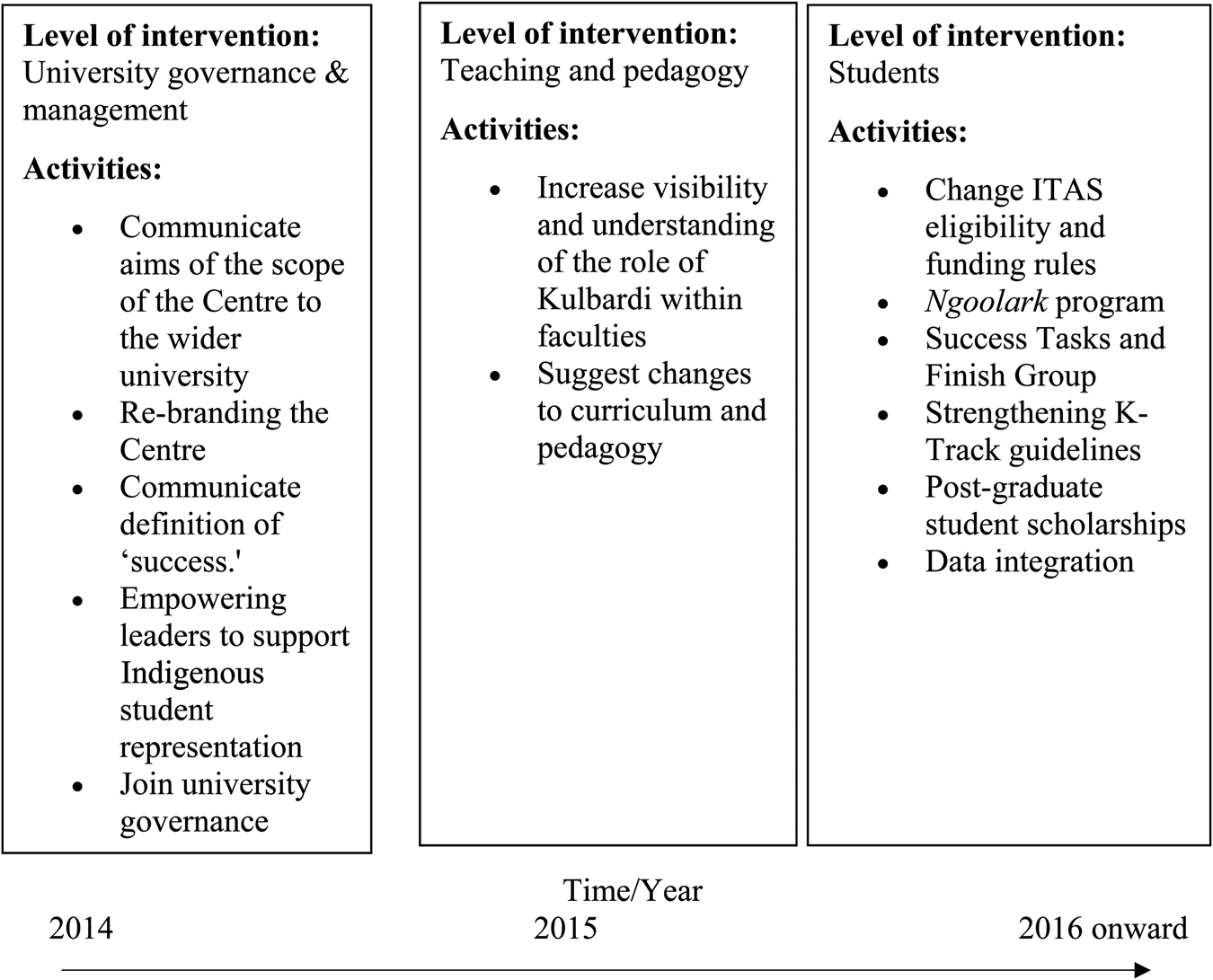
Figure 1 outlines the actions taken by Kulbardi across three levels of intervention. As illustrated in figure 1, the strategy employed a phased approach, where Centre staff focused first on university management and governance, followed by faculty and teaching, and then direct student support.
Implementation plan for Kulbardi‘s Student Success Strategy.

The approach involved the following components:
University management and governance
In 2014, the Head of Centre booked meetings with key university management staff and other stakeholders to communicate the aims and the scope of Kulbardi. The Student Success Strategy (figure 1) was presented and examples of activities provided for each stage. These meetings served to ‘re-brand’ the Centre as a place that was focused on student success and to commit the University to supporting efforts to achieve the expected level of performance (i.e. parity in retention figures, 70% pass rate). Senior academics and managers were asked to provide their ideas about how each part of the university could enable student success and to share the responsibility of providing a supportive learning environment for Indigenous students. A salient outcome of the intervention at the management and governance level was that Kulbardi staff became embedded in university governance structures (e.g. the Head of Centre joined the Academic Council). Through this, embedding representation increased at the highest levels of the university.
Teaching and pedagogy
In 2015, Centre staff focussed on working with the various schools in the University. The aim here was for Kulbardi to gain visibility with each of the schools so that academic staff would refer Indigenous students to the Centre for support. Increased visibility of the work the Centre did was achieved by Centre staff holding meetings with faculty members including school Deans, academic chairs and first year student support co-coordinators. In turn, faculty members began to reach out to the Centre, asking for support on developing culturally appropriate curriculum, seeking cultural competency training or emailing the Student Success Officer directly about how best they could support a specific student. Centre staff viewed this reciprocated communication between faculty and the Centre as evidence of strong collaboration between the Centre and the host university. Building such relationships and knowledge created new opportunities for Kulbardi to provide appropriate resources and support in the development of curriculum and pedagogy. For example, the importance of explicit and rigorous expectations for success combined with culturally-responsive and connected curriculum was emphasised (see Bodkin-Andrews and Carlson, Reference Bodkin-Andrews and Carlson2014).
In a context in which Indigenous education is ‘everybody's business’, another important purpose of engaging with the schools was to model how engagement with broader university systems might occur. Building relationships between faculty staff and students was considered necessary for the academic development and support of Indigenous students who attended the Centre. The establishment of support networks, comprised of an assemblage of academic and professional staff across the entirety of an institution and its functions, have been identified as important to student agency and persistence (Maldonado et al., Reference Maldonado, Rhoads and Buenavista2005; Pechenkina, and Anderson, Reference Pechenkina and Anderson2011). Such networks establish the ‘relational’ groundwork (Carter et al., Reference Carter, Hollinsworth, Raciti and Gilbey2018, p. 255) for cultural ‘border crossing’ and learning that provides students with important insights into hidden sources of knowledge and power (Giroux, Reference Giroux1992, p. 22). This approach is also consistent with Nakata's (Reference Nakata2013) observation that the formation of collegial relationships between Indigenous students (and staff) and non-Indigenous university staff is a critical step of closing the gap between Indigenous and non-Indigenous ways of thinking.
Within the Student Success Strategy, these relationships between faculty staff and students were established early in students' journeys. For example, in the K-Track enabling course, students work alongside academics in Psychology and Exercise Science, Health Professions, and Veterinary and Life Sciences through educative experiences embedded in their coursework that extend beyond ad hoc guest lectures. For instance, in K-Track's iHealth unit, non-Indigenous Psychology and Exercise Science academics and postgraduate students work collaboratively to develop and implement individual health and wellbeing plans for students. This has not only fostered a sense of connectedness with the academy for Kulbardi students, but it has had a significant impact on non-Indigenous perceptions of Aboriginal and Torres Strait Islander people within the University community. Another practical example of this is when students attending the Centre enquire about course selection: in this circumstance Centre staff support the student to book an appointment with the student advisor in their faculty, rather than enquiring on their behalf.
Student support
Across 2016–2017, Kulbardi staff further narrowed their focus on direct student–staff interactions. The focus on direct student support only occurred after staff had spent time engaging with university management and governance and with individual schools. The rationale here was that encouraging students to join with broader university systems would not be successful if the systems were not ready to support and receive students.
Several activities occurred at this level of intervention. Firstly, a change in eligibility rules for ITAS allowed for a more equitable distribution of tuition hours such that any Indigenous student (regardless of current academic performance) became eligible for tuition (Department of Prime Minister and Cabinet, 2014). Such funding changes meant that those students who were succeeding but still wished to improve their performance, as well as those who were struggling academically, could access tutors. Consequently, ITAS tutors began to perform a greater variety of tasks; ranging from teaching study skills, to the support of students' academic thought (e.g. helping students develop strong conceptual arguments, critical analysis of texts). Importantly, as part of the ITAS tutors' reporting responsibilities, they were required to indicate their observations of their student's individual academic performance. Where a student was deemed to be at-risk, support interventions were put in place by Kulbardi staff (see description of the student success working group, below).
The second student-focused initiative was the development and implementation of the Ngoolark unit (first implemented in semester 1, 2017). Ngoolark is as an enabling unit that facilitates undergraduate students' use of the Centre and wider university support services. Ngoolark is limited to humanities students.Footnote 2 Although open to all undergraduate students, the unit targets those students who have failed two or more units in the previous semester (and so are at risk of failing the next semester). A critical component of encouraging students to participate in Ngoolark is that the unit carries full course load. Thus, students remain enrolled in a full-time course load, and as a result, are still eligible for total ABSTUDY funding. The Ngoolark unit runs for a semester during which students meet weekly with an ITAS tutor (to work on assignments from their course-specific units) and with the Student Success Coordinator who provides academic coaching (e.g. helping the student to develop goals for the week, time management strategies). All Ngoolark assessments are formative, and directly related to the content that the student is learning in their degree.
Third at the direct student support level of intervention, Centre staff made changes to the entry conditions for its pre-university enabling programme, K-Track. Before the implementation of the Student Success Strategy, Kulbardi admitted students into enabling programmes without any assessment of the prospective students' academic preparedness or university readiness. This ‘open door' approach was one that was supported by the Centre's previous management and rewarded by the former federal Indigenous funding regime. Yet, while this ‘open-door' approach led to high Indigenous enrolment figures, it also led to high-attrition rates and low numbers of completions in the enabling programme. The practice of enrolling students who are not ready to begin a university-enabling programme also presents complex pedagogical and curriculum challenges, because the resulting student cohort has wide-ranging academic needs. Therefore, the academic team within Kulbardi developed a combined skills assessment and university readiness survey that better identified the needs of prospective Indigenous enabling students. Importantly, there were no previous instruments for assessing university readiness among Indigenous students within the literature to draw this assessment from. Therefore, the assessment was developed in consultation with academics in the University's non-Indigenous enabling programme. While benchmarking was not undertaken, the diagnostic assessment and survey has been reviewed and refined over time with particular attention paid to the relation between outcomes/findings from the diagnostic and survey and the subsequent student performance within and beyond the enabling programme.Footnote 3 Based on the results of these assessments, students were only granted entry into the enabling programme if they could demonstrate appropriate levels of academic preparedness and self-reflection about their ability to undertake university studies. Observations from Centre staff support that students' performance on the combined skills assessment and university readiness survey is a strong predictor of student success within the enabling programme. Notably, although staff were planning to make changes to K-track entry requirements in the final year of implementation of the Student Success Strategy, the changes took place 1 year earlier (i.e. 2015). This pre-emptive change in entry requirements was catalysed by changes in federal government funding which saw Indigenous Education Units allocated funding on student enrolment rates as well as pass rates. Thus, there was a shift in the economic context of the Centre which allowed for a greater focus on selecting enabling students who were most likely to complete the course.
A fourth student-focused strategy was the establishment of the Student Success Working Group (formed in 2017 after discussions in 2016). The Working Group, comprised of the Head of Centre, Student Support/ITAS Coordinator, academic staff and the Student Success Officer, met fortnightly to discuss students at the Centre who might benefit from additional support. Students were not included in the Working Group to maintain individual student confidentiality. The Student Success Coordinator subsequently established contact with ‘at-risk' students and offered them individual support (e.g. enrolment in the Ngoolark unit). Students were flagged as ‘at-risk’ if they: (a) were disengaged from their course of study (ascertained by checking whether the student has logged onto the university's learning management system to access course material and checked university email); (b) not attending the Centre and/or classes and (c) have psychological and/or physical limitations to studying and no current equity/disabilities/medical support plan.Footnote 4 (d) had not submitted course assignments or submitted late; or (e) were studying in a psychosocial context (e.g. living away from home) that requires additional support. The bulk of information on student engagement was gathered using the university's client management system that provides real-time detailed information relating to students' interactions with a broad range of functions within the institution. This system could identify, for example, if a student did not submit an assessment, had not attended a tutorial and also document all communications or support the student received from various areas of the university.
Students who were deemed ‘at risk' by the Working Group were offered tailored interventions. Both student support and academic staff collaboratively developed these interventions. Although a significant body of research focused on increasing retention and success of Indigenous, equity and broader student cohorts informed these support activities (e.g. , Ellender et al., Reference Ellender, Drysdale, Chesters, Faulkner, Kelly and Turnbull2008; Engstrom and Tinto, Reference Engstrom and Tinto2008; Guillory, and Wolverton, Reference Guillory and Wolverton2008; Devlin, Reference Devlin2009) best practice relating to supporting Indigenous students remains contentious. Indeed, while the Behrendt review (Behrendt et al., Reference Behrendt, Larkin, Griew and Kelly2012) provided some case studies and recommendations, no clarity in the literature exists regarding what constitutes best practice in supporting Indigenous students through university. Therefore, interventions were developed and tailored to each individual student's need and relied on context-specific factors. For example, one student may have benefited most from being linked in with financial support, whereas another student may have required remedial study skills. This broad spectrum of interventions included referral to specialist services, referral to academic support, financial support, support in finding accommodation or broader external advocacy agencies were common. Further, the identification of individual student needs was supported by one-to-one conversations between Student Success Officers and the student. What support staff found from these conversations then fed back into the Student Success Working Group on how best to support the student in the future. This type of process ended in staff having a comprehensive picture of student needs from a range of perspectives. Importantly, throughout each step, students were empowered to reflect on their own strengths in seeking to overcome their identified obstacles.
A secondary and broader aim of the Working Group was to develop a culture of success within Kulbardi. To achieve this shift in culture, the Working Group members reviewed the Centres' website; ensuring content was communicating a narrative of Indigenous student success. As an example, Centre staff uploaded student success profiles onto the website. Students were also encouraged to write their weekly ‘victories' on a student success wall, and staff awarded prizes for academic achievement. Moreover, as a result of meeting regularly to discuss at-risk students, the Working Group was able to identify risk factors for student disengagement and implement centre-wide strategies to address these. These included: holding an Indigenous student orientation day during O-week (the first of which occurred during semester 1, 2018); encouraging commencing students to ‘buddy-up’ with Indigenous undergraduate students, the employment of a student wellbeing officer. Several other recommendations which are yet to be enacted by Kulbardi staff are the provision of practical and contextualised cultural awareness training for all staff to ensure best practice; provision of mental health ‘fun days’ to improve student awareness of mental health and university health services, and to investigate the feasibility of Indigenous student campus housing. Kulbardi is also designing a proposed new purpose-built Centre that meets the now increased student demands on Indigenous student support services.
A fifth, and final, student support strategy focused on Indigenous post-graduate students. Based on findings from the Centre's annual Indigenous Student Experience Survey, it became apparent that students faced substantial financial barriers to taking up postgraduate studies, particularly research degrees. In response, and in partnership with the School of Graduate Studies, Kulbardi established four annual research scholarships for Indigenous students enrolled in higher degrees (i.e. at the masters or doctoral level). Kulbardi also created a postgraduate research support role to mentor and guide students through to candidature and beyond. Academic staff at the Centre are also permitted to co-supervise and deliver independent study contracts where appropriate. These additions to Centre practice resulted in an encouraging increase in Indigenous students undertaking higher degree research—from six students in 2014 to 12 students in 2018. Increasing the amount of Indigenous students who graduate with post-graduate degrees is a key part of the Centre's wider strategy to develop a future Indigenous academic workforce. The awarding of Indigenous academic fellowships, where PhD students are employed as fixed-term academic staff members to extend their learning and teaching experiences alongside their research studies, also supports this endeavour.
Outcomes
Retention rates
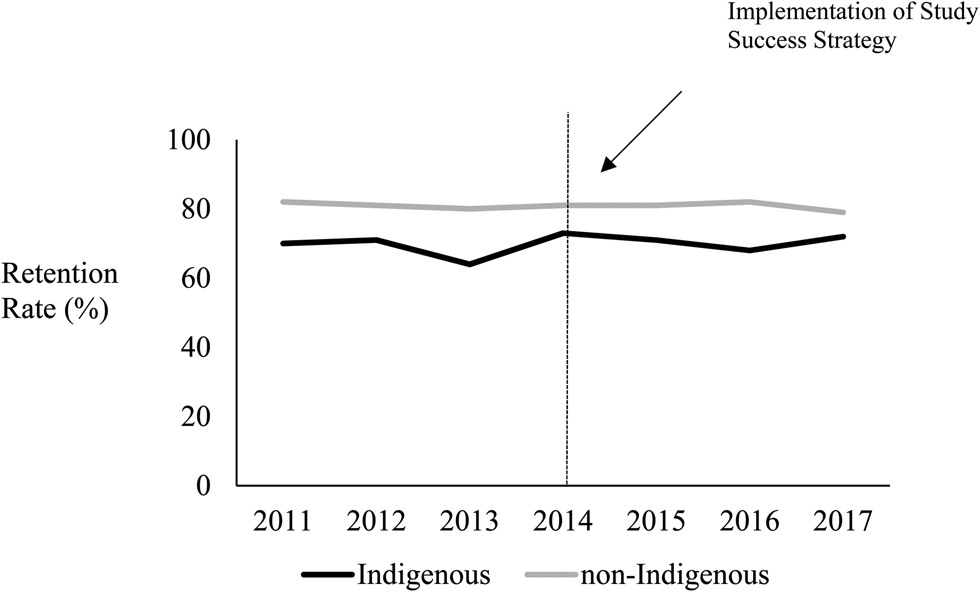
As noted above, a key component of the Kulbardi approach has been to measure success directly regarding student outcomes (i.e. retention rates, unit pass rates). Figure 2 compares Indigenous and non-Indigenous student retention rates from 2011 to 2017.
Indigenous and non-Indigenous student retention rates, 2011–2017. Note: Indigenous student N = 193–283. Non-Indigenous student N = 13,109–14,065.

Figure 2 depicts how, from 2011 to 2017, there has been an upward trend towards Indigenous students moving closer to parity with non-Indigenous student retention rates. Notably, there was a sharp increase in parity in 2014, which was the first year of implementation of the Student Success Strategy. However, it is important to note that retention rates recorded in 2014 likely reflect students' experiences of the university in the 2013 (i.e. the previous academic year). Although speculative, this uptick in parity may be because discussions about a new strategic direction for the Kulbardi began in 2013, and thus Indigenous students may have anticipated positive changes at the Centre and remained at university. Figure 2 also shows that the closest point to parity with non-Indigenous students occurred in 2017, which was 1-year post the full implementation of the Student Success Strategy. However, it should also be noted that this uptick occurred in the context of a slight downward trend in non-Indigenous student retention, which could explain part of the narrowing gap between Indigenous and non-Indigenous students. Figure 2 also demonstrates a slight reduction (3% decrease) in Indigenous student retention rates between 2015 and 2016. This drop in retention may be due the Centres' shift from focusing on retention to focusing on academic progression, and the resultant difficult conversations with some students around deciding whether university was the best option for them.
Pass rates
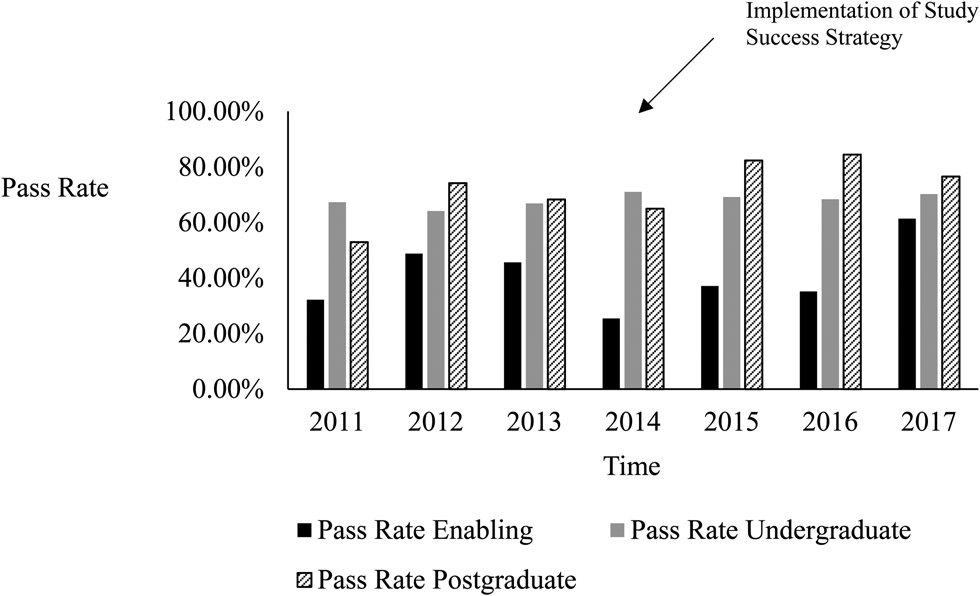
Figure 3 shows the unit pass rates between 2011 and 2017, broken down by enabling, undergraduate and post-graduate units. As figure 3 demonstrates, across this time-period, there was a trend towards increasing pass rates for Indigenous students. In examining differences across enabling, undergraduate and post-graduate cohorts, post-graduate pass rates reached and continued to remain around 70% from 2012 onwards. Similarly, undergraduate pass rates fluctuated around 70% from 2012 onwards and reached 81% by 2015. However, the largest increase in pass rates occurred among the enabling student cohort. For these students, the largest increase in the pass rate was between 2016 and 2017, 1 year post-implementation of the Student Success Strategy.
Unit pass rate for Indigenous enabling, undergraduate and post-graduate students, pre- and post-implementation of the Student Success Strategy. Indigenous student N = 193–283. Non-Indigenous student N = 13,109–14,065.

Discussion
This paper presents a case study of one Indigenous Education Units'—the Kulbardi Aboriginal Centre—implementation of a whole-of-university approach to Indigenous student success. Specifically, we have described how, capitalising upon the outcomes of an external review and renewed institutional commitment to Indigenous education, Kulbardi led a concerted effort to strategically operationalise, implement and evaluate a whole-of-institutional approach to supporting student success. In doing so, a model of student success was developed that spans multiple levels of the university (i.e. management and governance, teaching and pedagogy and direct student support), with initial evaluation based on university data concerning: (1) parity of Indigenous student retention rates with non-Indigenous students and (2) unit pass rates. Overall, these data suggest that, despite an upward trend towards parity in Indigenous and non-Indigenous retention rates from pre-post implementation, the implementation of Kulbardi's student success strategy did not co-occur with any substantial improvement in parity, but rather tracked in-line with this upward trend towards parity. In contrast, unit pass rates for Indigenous students increased from pre-post implementation, and showed that the Centre had been successful in reaching its target of a 70% pass rate by 2017. More broadly, this case study begins to address an identified need in the literature for a more comprehensive discussion about ‘what works' in Indigenous higher education (see Smith et al., Reference Smith, Pollard, Robertson and Trinidad2017a, Reference Smith, Trinidad, Larkin, Frawley, Larkin and Smith2017b, Reference Smith, Pollard, Robertson and Shalley2018). In what follows, we discuss the need for evaluation of efforts to implement a whole-of-university approach to Indigenous student success that are driven by Indigenous Education Units and also discuss nuanced approaches to data collection when evaluating the activities of Indigenous Education Units.
Evaluating the practice of Indigenous education units
Nakata (Reference Nakata2013) has argued that staff at Indigenous Education Units must engage in critical, self-reflective practice if they are to improve success outcomes in their student cohorts. In line with this recommendation, the staff at Kulbardi underwent a detailed and systematic approach to critical-self-reflection, which resulted in the development and implementation of the Student Success Strategy presented here. Based on recommendations from previous reviews in the field of Indigenous higher education and a small, but informative, body of previous empirical evidence, the Centre adopted a whole-of-university approach, which saw intervention occur across multiple levels of the university. To our knowledge, this is the first published study to detail the steps that an Indigenous Education Unit has taken in the operationalisation and implementation of this type of multiple layered approach, and presents a model which can be considered and further developed by other Indigenous Education Units across Australia.
Importantly, this case study illustrates how a whole-of-university approach can be driven and implemented by an Indigenous Education Centre. Although some institutional responses to a whole-of-university approach have seen the restructure, mainstreaming and even closure of Indigenous Education Units (Asmar and Page, Reference Asmar and Page2017), Kulbardi interpreted a whole-of-university approach as the Centre leading mainstream responses to Indigenous student support. As a result of the work performed in engaging university management and increasing Indigenous representation at the governance level of the university, which run parallel with promising gains in student success, Kulbardi is now seen within the university as a sector leader in student support. Thus this case study provides an illustration of how a whole-of-university approach to student support can be housed within an Indigenous Education Unit, and provides an alternate model of student support to that of strategies which are owned by mainstream university services (e.g. non-Indigenous student support, university governance).
The examination of student pass rates demonstrated that the Centre reached its target of an overall 70% pass rate for units undertaken by Indigenous students, following the implementation of the strategy. Specifically, the introduction of the Ngoolark unit in 2017, which supports undergraduate students to access academic support systems, co-occurred with undergraduate pass rates reaching over 70% for the first time. Likewise, increases in post-graduate pass rates tracked in-line with the Centre creating a postgraduate research support position and ensuring financial support for postgraduate students. Furthermore, although the pass rates for enabling units did not reach the 70% target in the period examined, they did show a sharp upward trend post-implementation of the success strategy, suggesting that the Centre is on the way towards achieving this. Overall, these findings offer some support for the adoption of a whole-of-university approach in terms of increasing Indigenous student pass rates.
Limitations of student outcome data
Despite the improvement in unit pass rates, our examination of student retention rates provided less robust support for the Centre's Student Success Strategy. That is, although Indigenous retention rates continued to move closer to parity (with non-Indigenous rates) during the implementation period, an upward trend was already present pre-implementation. Thus, it is difficult to disentangle whether the new activities of the Centre contributed to tangible increases in student parity, or whether this was a natural extension of an already increasing trend. That said, academic retention rates may not be the most accurate and nuanced indicator of student success because they only reflect Indigenous students remaining at university, regardless of course progression. That is, retention rates do not show whether a student is progressing through their degree, and hence, moving towards completion. Moreover, this metric does not measure the extent to which students are failing and re-taking the same unit, or switching between degrees and remaining in first-year units. These students are recorded as ‘retained’, despite (arguably) stalling in their academic progression. Likewise, retention rates are measured from one academic year to the next and thus do not capture so-called ‘boomerang’ students (i.e. those who leave university for extended periods of time but then return to complete their degree). In addition, local retention rates do not reflect the progression of those students who have transferred to other universities.
In fact, although the student outcome data that we chose to examine here is highly accessible and practical, in many ways this case study serves to highlight the limitations of this data. Firstly, data were aggregated to the level of ‘Aboriginal and Torres Strait Islander’ student, meaning that tracking individual student retention and pass rates was not possible. It would be useful to track an individual student's academic trajectory, as the activities of Indigenous Centres are unlikely to be equally beneficial to all Indigenous students. These individual differences need to be considered if evaluations of Indigenous Education Units are to be taken seriously. Further, this level of data may help to identify subgroups of students who can benefit from alternative programmes and activities. A related limitation of the current study is the absence of qualitative data assessing university staff members' and students' perceptions of the efficacy of the Student Success Strategy. Such data would provide insight into how students and staff members viewed the changes that the Centre was making during the implementation of the strategy, and would likely provide further insight into implementation practices. Thus, scholars wishing to conduct evaluation of strategies to support Indigenous student success would benefit from including a qualitative data collection component.
Secondly, despite working closely with the host universities OSQA to assess unit pass rates based on course type (e.g. enabling, undergraduate or post-graduate), we were unable to drill down further into other student characteristics which may affect success (see Gore et al., Reference Gore, Holmes, Smith, Fray, McElduff, Weaver and Wallington2017). Most pertinent to the current study, we were not able to compare retention rates and unit pass rates for the enabling cohort based on whether students were enrolled in a centre-run enabling programme (i.e. the K-track programme) or other university-run enabling programmes. Likewise, we could not compare these success outcomes based on whether Indigenous students enrolled at the university actively attended the Centre. This type of comparison is worth conducting, but requires the integration of the student outcome data routinely collected by OSQA and the individual student data held by the Centre.
At the same time, however, Fogarty et al. (Reference Fogarty, Bulloch, McDonnell and Davis2018a) have pointed to the complicity of ‘deficit metrics’ in perpetuating the notion and visibility of a ‘problem’ in Indigenous education (p. ix). In this context, rather than privilege institutional indicators of success (which reinscribe the hegemony of mainstream ideals and performance measures), there is also preference for more holistic, strength-based conceptualisations of success that encompass personal, cultural and contextual considerations (Biddle et al., Reference Biddle, Gray and Schwab2017; Fogarty et al., Reference Fogarty, Lovell, Langenberg and Heron2018b; see also Herbert, Reference Herbert2003). As a result, there have been increasing calls for evaluation to be ‘decolonised’ (Johnston-Goodstar, Reference Johnston-Goodstar2012, p. 113) so that the process is grounded in Indigenous knowledge, protocols and agendas (Smith et al., Reference Smith, Pollard, Robertson and Trinidad2017a). What this means is that Indigenous people must be active participants in all aspects and stages of evaluation to ensure that the process is aligned with their values and agendas rather than simply to satisfy government or funding requirements (Johnston-Goodstar, Reference Johnston-Goodstar2012). In response to the legacy of ‘racialised’ data collection and its complicity with deficit constructions of Indigenous people, Walter (Reference Walter, Kukutai and Taylor2016) argues for the assertion of Indigenous data sovereignty (p. 84). For Walter, Indigenous data sovereignty encompasses ‘the right to determine the means of collection, access, analysis, interpretation, management, dissemination and reuse of data pertaining to the Indigenous peoples from whom they have been derived, or to whom they relate. Indigenous data sovereignty rejects the discourse and practices of Indigenous data business-as-usual and instead centres Indigenous collective rights in relation to data about our peoples, territories, lifeways and natural resources’ (p. 261).
Despite such important contributions to ‘disrupting’ the status quo (Walter, Reference Walter, Kukutai and Taylor2016, p. 90), efforts to develop ‘alternative’ Indigenous evaluation frameworks and processes, remain emergent in the context of Australian higher education (Smith et al., Reference Smith, Pollard, Robertson and Trinidad2017a, p. 25). In the absence of any drive by government or higher education providers to implement change, the danger is that the many different whole-of-university initiatives underway to support Indigenous education in the sector will continue to be evaluated using default processes and benchmarks, which fraught by biases and incomplete data, have had the combined effect of reducing Indigenous people to a perceived problem (Fogarty et al., Reference Fogarty, Bulloch, McDonnell and Davis2018a). In short, Indigenous student success may not always conform to such simple outcome indicators, such as those used in this study. Indeed, it is also, of course, the case that the goals and priorities of Indigenous students may not always conform to the objectives and desired outcomes of the Australian government and higher education providers. Indigenous students are not a homogeneous category and care should be taken to ensure that data collection methods and conceptualisations of university success reflect this heterogeneity.
Conclusion
This case study presents descriptive data on the success of the Kulbardi Aboriginal Centre's whole-of-university approach, in the form of Indigenous student parity rates and unit pass rates in. Indeed, a whole-of-university approach to Indigenous student success is relatively new and little evidence has accumulated on the outcomes of interventions in this space. Moving beyond descriptions of the diversity of activity that is currently underway to support Indigenous student success (Asmar and Page, Reference Asmar and Page2017), this paper presents a case study that reports efforts to develop an approach to systematic evaluation of student outcomes. Evaluation activities within this realm can contribute qualitatively and quantitatively to the decision-making of Indigenous staff, students and other higher education partners, including Indigenous community members, who share a commitment to the sustained improvement of Indigenous education and student success. Indeed, there is scope to support and evaluate the plethora of current activities centred on supporting Indigenous students at university (Smith et al., Reference Smith, Pollard, Robertson and Shalley2018). By adopting a systematic approach to the evaluation of such activities, which is informed by Indigenous standpoints and principles, practitioners and policy makers will gain knowledge on ‘what works’ in Indigenous higher education.
Bep Uink is a Research Fellow at the Kulbardi Aboriginal Centre, Murdoch University. Her research spans investigations into barriers and enablers of Indigenous students' success in higher education, gendered barriers to education and young peoples' social-emotional wellbeing.
Braden Hill is the Director of Aboriginal Education, Equity, and Inclusion at Murdoch University, and former Head of Centre at Kulbardi Aboriginal Centre. His research focuses on transformational learning at the cultural interface in Indigenous higher education students and intersectionality among Indigenous Australians.
Andrew Day originally trained as a forensic and clinical psychologist and is a Fellow of the Australian Psychological Society. His current research interests relate to Aboriginal and Torres Strait Islander higher education, forensic and clinical psychology and the criminal justice system.
Gregory Martin is the Director of the Teaching, Technologies and Innovation Support Unit (TTISU) in the Faculty of Arts and Social Sciences at the University of Technology Sydney. His research is inter-disciplinary and explores issues of pedagogy, curriculum, innovation and justice within, between and across multiple scales and education sectors.