


1. Introduction
Making sense of teleological explanations is one of the perennial problems of philosophy and has earned its place as a major topic of debate in the philosophy of biology. Biological practice is suffused with concepts that have connotations of purpose, such as function, error, mistake, preference, choice, health, and so on. To some, these concepts are shorthands which can be replaced without loss. Others claim that the persistence of this language is no accident. Biological phenomena really are distinctly purposive and warrant teleological explanation.
Teleology has at least two different meanings which are frequently conflated. It is sometimes used to denote a phenomenon to be explained—which I call “purposiveness”—and other times to indicate a mode of explanation—which I call “teleology” (Walsh Reference Walsh and Ruse2008; Dresow & Love Reference Dresow and Love2023; Gambarotto & Mossio Reference Gambarotto and Mossio2022; Bich Reference Bich2024). The phenomenon which has garnered the most philosophical attention is the adaptedness or functionality of biological traits. But as many have argued, functional traits are one of a number of phenomena that appear to compel teleological explanation, including the distinctive organization of biological systems and goal-directed behavior (Levesley Reference Levesley2025; see also Wright Reference Wright1973; Nagel Reference Nagel1979). While there are differing views on whether these phenomena are distinct or merely aspects of the same thing, it is widely assumed that teleological explanations are univocal and therefore apply equally to these purposive phenomena and any others there might be. I put aside the question concerning the variety of purposive phenomena, and focus on challenging the monist assumption about teleological explanation.
As has long been recognized, the most distinctive feature of teleological explanation is that it explains a phenomenon by a consequence it brings about, where that consequence is identified as the goal. However, to explain an event in virtue of a consequence appears to be an appeal to backward causation, whereby a future state or consequence is causing things to happen in the present. There have been many attempts to dissolve or resolve the backward causation problem, though two kinds of strategies can be distinguished. The first, eliminativist strategy is to deny that consequences can explain, meaning that teleology is either not a legitimate kind of explanation or can be translated, without loss, into a form of explanation in which consequences play no explanatory role. The second, naturalist strategy is to show that the consequence-based features of a teleological explanation are no impediment to its legitimacy as a form of explanation. In this view, the citing of a consequence as an explanans is a necessary—though not necessarily sufficient—condition for an explanation to count as teleological. A putatively teleological explanation which fails to cite a consequence yields “a disemboweled teleological notion shorn even of its original outline”, i.e., an explanation stripped of its distinctive teleological character (Wright Reference Wright1976, 3). This paper is concerned solely with the second strategy.Footnote 1
To date, the naturalist strategy has been pursued in two ways. A standard approach has focused on showing how teleological explanations can be a form of causal explanation in which consequences play an explanatory role, without invoking the problem of backward causation. This requires that consequences be causes which occurred in the past or are occurring in the present. It is widely assumed that this ‘causal-consequence’ interpretation is just what teleology means (e.g., Garson Reference Garson2019, 27). A second builds on the increasing acceptance of non-causal explanations in philosophy and science, and argues that teleology is a form of non-causal explanation. From this standpoint, the problem of backward causation is avoided because the explanation is non-causal.
I show how the causal and non-causal approaches lead to different conceptions of teleological explanation. Specifically, I argue that each conception has strengths and weaknesses which flow from their status as causal and non-causal explanations respectively. I then argue against the implicit consensus regarding the univocality of teleology as a causal-consequence explanation. Causal and non-causal conceptions of teleology explain different aspects of the same purposive phenomena, and are therefore not only compatible but mutually supportive. As such, I argue that the implicitly monist stance taken by defenders of teleology is not just mistaken, but to the detriment of our understanding of purposive phenomena. We ought to be pluralists about teleological explanation.
In the next section, I briefly review Larry Wright’s account of teleological explanation as a prominent attempt at making sense of teleology as a legitimate form of consequence explanation. In section 3, I contrast traditional backward-looking interpretations of teleology with an organizational account which provides an alternative presentist interpretation. In section 4, I examine an alternative interpretation of teleology as a non-causal mode explanation, which explains by a genuine appeal to future states. In section 5, I compare the causal and non-causal renderings of these explanations and argue that they have different explanatory virtues that are entirely compatible.
2. Backward Causation and the Dilemma of Teleological Explanation
Attempts to offer a naturalistic account of teleological explanation have long faced a dilemma. On the one hand, for teleology to be genuinely explanatory it must meet the standards of scientific explanations, and since the 1970s these have largely been deemed to be causal. But if teleology is to be of a distinct kind, then it must also differ sufficiently from such causal explanations. These two desiderata—that teleology be both explanatory and distinctive—appear to be in conflict. If teleology is entirely sui generis, then it risks not being explanatory in any recognizable way; but if it is no different than an ordinary causal explanation, then it risks losing its distinctive character. This reflects a broader dilemma about explanatory pluralism itself (Pincock Reference Pincock, Reutlinger and Saatsi2018, 42).
One of the most well-known and clearly articulated resolutions to this problem was offered by Larry Wright in the late 1960s and early 70s (see also: Ayala Reference Ayala1970; Ruse Reference Ruse1971; Wimsatt Reference Wimsatt1972). In a challenge to accounts of teleology based on the deductive-nomological model of explanation (Hempel and Oppenheim Reference Hempel and Oppenheim1948), he proposed a more liberal form of explanation which he dubbed the etiological model (see also Canfield Reference Canfield1964; Godfrey-Smith Reference Godfrey-Smith1993). As he explains, the term was chosen to highlight what causal and teleological explanations have in common; i.e., to show how both might be deemed explanatory by the same standards (Wright Reference Wright1972). Such explanations cite “etiologies”—which appear to have originally meant something like ‘difference maker’ for Wright—that bring about or make more likely the explanandum (ibid). These can be either antecedent conditions (in the case of regular causal explanations) or consequences (in the case of teleological explanations). As Wright says: “When we say that teleological etiologies are consequence-etiologies we are saying that the consequences of goal-directed behavior are involved in its etiology: it [the behavior] occurs because it has certain consequences.” (ibid, 217; emphasis added).
Wright’s notion of etiology frames a resolution to the dilemma because it shows how teleology can be both explanatory and distinctive without being entirely “sui generis” (Wright Reference Wright1972, 205). This distinctiveness also makes teleology irreducible: “Teleological expressions are not ‘translatable into’ or ‘saying the same thing as’ some causal expression [which does not cite consequences]. The two do not ‘have the same cognitive content’, and they differ in more than mere ‘emphasis’.” (Wright Reference Wright1968, 223; emphasis added; cf. Nagel Reference Nagel1961, 422). In this way, Wright’s strategy—and the “etiological accounts” that have been inspired by it—differs from those which attempt to translate teleology into a form of explanation where consequences play no explanatory role, as is the case with “dispositional” accounts of function explanation. While some dispositional accounts use the language of means and ends (e.g., Adams Reference Adams1979), this is just a re-labeling of cause and effect given that the effect or consequence doesn’t explain. In this sense, ‘etiological’ and ‘dispositional’ correspond to causal accounts of teleology that attempt to preserve its consequence-explanatory character from those that do not (Saborido Reference Saborido, Galavotti, Dieks, Gonzalez, Hartmann, Uebel and Weber2014; Gambarotto Reference Gambarotto2023, section 3).
Whether Wright’s account is successful in navigating the horns of the dilemma largely depends on the meaning of ‘etiology’ and its relationship to the notion of cause. On one hand, Wright used the notion of cause to contrast with that of teleology (Reference Wright1972, 217; see also 205, fn. 3). Here, the difference is just whether those etiologies are antecedent conditions or consequences. At the same time, Wright himself claims that the “because” of a teleological explanation “is to be taken in its ordinary, conversational, causal-explanatory sense.” (Wright Reference Wright1973, 157). For this reason, many have chosen to dispense with the notion of etiology as it seems to needlessly multiply technical terms; etiological explanations are just causal explanations in a broad sense (Salmon Reference Salmon1998, 7; Garson Reference Garson2016, 5; Reference Garson2019, 14). According to Salmon, “they do not go into the small details of the causal processes and interactions involved” (Salmon Reference Salmon1998, 75). In other words, they are not necessarily mechanistic explanations which appeal to descriptions that elucidate the relation between cause and effect by citing interacting parts and their activities.Footnote 2
If these interpretations are correct, then Wright is effectively characterizing teleology (qua consequence explanation) as a special subtype of causal explanation. Call this the ‘causal-consequence’ interpretation of teleology. But if it is to work, then the explanans must simultaneously feature both as a cause (in order to be explanatory in a causal sense) and as a consequence (for the explanation to be teleological), which violates the temporal priority of the explanans as a defining feature of causal explanations (i.e., invokes backward causation). How can a consequence be said to causally explain anything? The next section reviews two different attempts at resolving this problem.
3. Teleology as a Causal-Consequence Explanation
3.1. Selected effects accounts
The classic resolution to the problem of backward causation is to show how an entity’s existence is explained by what it—or members of its kind—did in the past. This conception of teleological explanation is at the heart of the ‘selected effects’ (SE) accounts of function (Millikan Reference Millikan1984; Neander Reference Neander1991; Griffiths Reference Griffiths1993; Godfrey-Smith Reference Godfrey-Smith1993). These theories explain the existence of a biological trait by appealing to a reproduction and selection process which occurred in the past. To rehearse a hackneyed example, hearts can be said to exist in virtue of the fitness-enhancing activities of other hearts in the evolutionary past. Those past effects or consequences causally explain why hearts exist in the present.
By appealing to past consequences, these explanations contain a crucial normative element which distinguishes proper function from malfunction and side-effects. SE theories deem a trait to be malfunctioning if it does not do whatever it is that explains its current existence. Because these causal-consequences are interpreted as goals, an entity ought to do whatever it is that causes its existence. In this regard, appealing to causes of existence or persistence provides these accounts with a great advantage over those that reduce teleological explanations to causal explanations that do not cite consequences, because the latter usually fail to account for normativity.
One of the latest incarnations of this theory is the ‘generalized selected effects theory’ (Garson Reference Garson2019). The GSE aims to break free of one of the restrictions of traditional SE theory, namely that it only applies to entities that undergo reproduction or copying. The GSE moves beyond this by arguing that an entity’s function is an activity that caused its differential reproduction or retention in a population in the past (Garson Reference Garson2024, 955; see also: Reference Garson2019; Fagerberg and Garson Reference Fagerberg and Garson2024). Within a population of entities containing variation, some entities may be more likely to be retained due to their differences. As a result, the existence of phenomena as diverse as synaptic connections and behaviors learned by trial and error can be explained teleologically (Garson Reference Garson2019; see also Walsh Reference Walsh, Ariew, Cummins and Perlman2002). This makes the GSE theory a highly general account of teleological explanation for a wide range of purposive phenomena whose existence is explained by a consequence-oriented selection process.Footnote 3
Since the 1970s, there has been a recurring complaint about this resolution to the problem of backward causation, namely, that it is expressed in a “tenseless” fashion (Skinner Reference Skinner1965, 52; Wright Reference Wright1976, 9). To say that a trait exists ‘because of what it does’ is to imply that its current activity has explanatory relevance, which is not the case. In fact, only the past activities of the trait can explain why it currently exists (Cohen Reference Cohen1982, 40; Neander Reference Neander1991, 463). This requirement flows from the fact that the putatively teleological explanation is causal; so the goal (qua cause) must have already occurred in order to explain (Godfrey-Smith Reference Godfrey-Smith1994, 355). Justin Garson concludes that “the selected effects theory solves the problem of backward causation by a sort of temporal smudging, but that’s not cheating” (2019, 28). Not all are convinced of the innocence of this move, however, and consider it a fundamental problem with the causal-consequence interpretation of teleology: “According to a truly etiological interpretation, there is actually no teleology in functional explanations, because no reference to future states is made in explaining the existence of a certain trait” (Schlosser Reference Schlosser1998, 310, emphasis added; see also: Cartwright Reference Cartwright, Donagan, Perovich, Wedin, Robert and Marx1986, 201; Walsh Reference Walsh2014, 204-205). I will return to this issue in section 5. For the time being, I take this debate to raise important questions about the limits to the explanatory scope of causal-consequence interpretations of teleology. Can they be anything but backward-looking? In the next section, I evaluate a recent attempt to offer an account of teleology which answers this question in the positive.
3.2. Organizational theories
In contrast to the aforementioned selected effects accounts, organizational theories are focused on explaining biological organization as one of the defining characteristics of living beings. Organisms, in this view, are organized in such a way as to maintain themselves over time. Proponents claim that the continued existence of a particular organism is an intrinsically purposive phenomenon, and is key to making sense of the functionality of traits and goal-directed behavior.Footnote 4 Biological organization requires a teleological explanation because the activity of the organism contributes to its own existence over time, and it therefore can be said to exist because of what it does. This continued existence is also thought to set normative standards: an organized system ought to do whatever it is that keeps it in existence (Mossio and Bich Reference Mossio and Bich2017, 1105). There are two claims here that require some disentangling: the first is a claim about how a system may be organized so as to persist over time; the other is a claim about why this activity needs to be explained in virtue of a consequence it brings about.
A recent and well-developed account of biological organization claims to follow a long tradition which characterizes it in terms of a closed network of mutually supporting entities (Mossio and Bich Reference Mossio and Bich2017; see also Gambarotto & Nahas Reference Gambarotto and Nahas2022). This account, called the Autonomy Theory (AT), refines this basic idea by distinguishing two interrelated types of causes relevant for making sense of biological organization: processes and constraints (Montévil & Mossio Reference Montévil and Mossio2015).Footnote 5 Processes are changes, essentially the thermodynamic flow of matter and energy in “the alteration, consumption, production and/or constitution of relevant entities.” (ibid, 182). Constraints, in turn, are entities which enable or alter these processes by limiting their degrees of freedom without being altered at the timescale of the process. To illustrate, a pipe acts as a constraint on the flow of water, and is not changed over the time scale of that process. It thereby enables the water to travel in ways that would be highly unlikely or impossible without it. An illustrative example from the life sciences is that of an enzyme, which makes a difference to a process (a chemical reaction) by lowering the activation energy required for its occurrence and thereby speeding it up drastically.Footnote 6
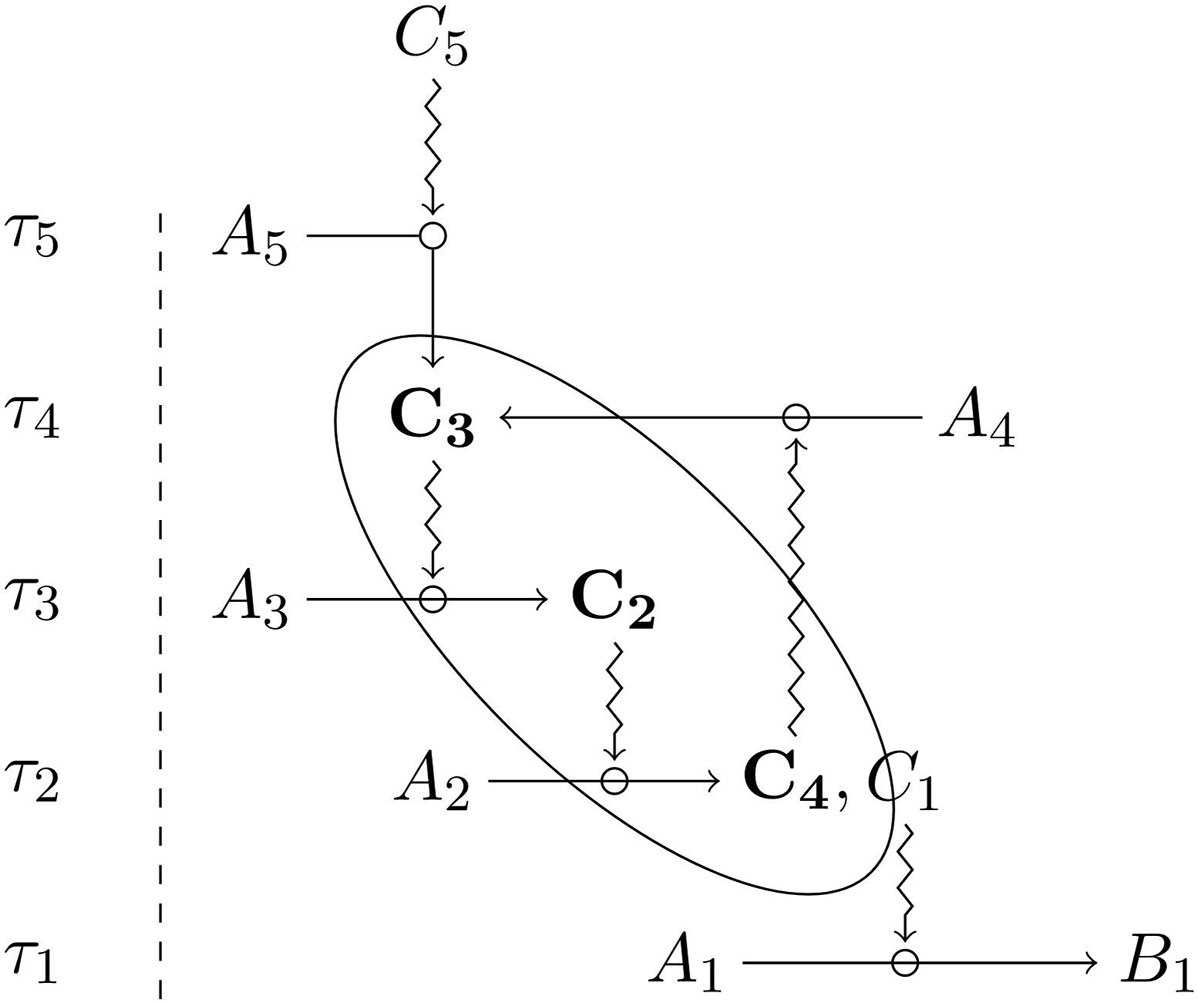
According to the AT, biological organization maintains itself over time because it is constituted by a circular or “closed” network of interdependent constraints. A constraint is generative whenever it acts, at a given timescale, on a process which in turn generates or maintains another constraint. Reciprocally, a constraint is dependent when its existence depends on the activity of another constraint. As such, each constraint subject to closure will be both dependent on and generative of at least one other constraint in the set (though any given system realizing closure will also depend on and produce external constraints not subject to closure). To give a simplified example, one can imagine a closed system composed of three constraints, each enabling a process (A4, A3, and A2) at corresponding time intervals (Fig 1).
(reproduced from Montévil and Mossio, Reference Montévil and Mossio2015).

Figure 1. Long description
A diagram of closure of constraints. The diagram represents five constraints, labeled C1, C2, C3, C4, and C5, and the processes they enable, labeled A1, A2, A3, A4, and A5. Each process occurs at a characteristic timescale, labeled T1, T2, T3, T4, and T5. Constraints are products of processes enabled by other constraints. Only the constraints C3, C2, and C4 are subject to closure, because they are mutually enabling and dependent on one another
This formal, idealized model is intended to represent the way in which a system as a whole may be capable of producing and maintaining itself in far-from-equilibrium conditions in the face of constant degradation. The diagram represents the way in which each constraint is conserved—and therefore identifiable as a constraint—over a particular time interval at which it enables a process. C3, for instance, is conserved over the timescale τ3, during which it enables process A3 which generates C2. Given that closure depends on processes which take time and do not occur simultaneously, closure unfolds over multiple timescales (τ2-τ4). This means that a description of a constraint-closed system can only be given over a sufficiently long temporal interval, over which all the relevant constraints and dependencies can be described (Montévil and Mossio Reference Montévil and Mossio2015, 187). But to represent the system as closed requires representing these various constraints and processes as if they all occur simultaneously, even if they do not in reality. In other words, a representation of closure requires abstraction from time: “[T]he whole network of dependencies should be considered as one ‘block’ extended over multiple time scales. Accordingly, closure consists of an interdependent relational network of dependencies, extracted from the dynamics of the system in physical time.” (Montévil and Mossio Reference Montévil and Mossio2015, 187; see also: Moreno & Mossio Reference Moreno and Mossio2015, 24; 79; Mossio and Saborido Reference Mossio and Saborido2016, section 3).
This way in which timescales figure in the account offers some new possibilities for conceptualizing teleological explanations. On the surface, the authors’ claim is that a trait’s existence can be explained in virtue of its contribution to the persistence of the system it is part of. My heart exists in part thanks to its contribution to keeping me alive; its continued persistence is explained as a consequence of its activity (Mossio and Bich Reference Mossio and Bich2017, 1090). Taken in isolation, such a tenseless statement is misleading given that, at any given moment, a heart only exists due to things it did in the past. This is because it takes time for its effects to ‘loop back’ and contribute to its own persistence at a later time. But in the context of the theory, the representation of a heart as a constraint subject to closure legitimates a literal interpretation of the tenseless statement, ‘it exists because of what it does’. This is due to the way in which closure must be represented as an extended ‘block’ of time. To say a heart is cause and effect of itself requires locating it in a constraint-closed system, and by locating the heart in such an abstract network of interdependencies, it is represented in its roles as cause and as consequence simultaneously. For this reason, some defenders characterize the theory as atemporal (Mossio and Saborido Reference Mossio and Saborido2016), though I would suggest that it is better thought of as presentist, where the time required for an effect to become a cause is taken as a single interval in time.
In a recent article, Leonardo Bich emphasizes that this minimal account of closure is too simple to explain most biologically relevant cases of purposiveness. It “does not account for the possibility of different ways to pursue and realise goals based on different alternative ways to realise self-maintenance. Yet this is what most biological phenomena are about.” (Bich Reference Bich2024, 6). Basic closure, in this view, is necessary but insufficient for capturing goal-directed behavior. Bich’s proposal is to emphasize the importance of regulatory control as a ubiquitous feature of organisms (Bich et al. Reference Bich, Mossio, Ruiz-Mirazo and Moreno2016). Regulation, in this view, is made possible by a special type of constraint, decoupled from the productive activities that constitute closure, whose function is to modulate and coordinate the activities of other constraints. This idea has proved fruitful for applying the framework to modeling glycemia regulation (Bich et al. Reference Bich, Mossio and Soto2020) and the nervous system (Bechtel and Bich Reference Bechtel and Bich2023). To name but one example, regulatory constraints characterize the function of the lac operon system which activates the synthesis of enzymes required for the metabolism of lactose, but only if lactose is present in the environment and glucose (the preferred sugar) is absent. The lac operon is therefore a mechanism which plays the role of a regulatory constraint by inducing the system to switch between available alternatives (digest glucose or digest lactose) based on metabolic needs and environmental conditions.
While regulatory constraints expand the explanatory scope of the account, it is not clear whether this entails a revision to the AT’s account of teleological explanation. Considered as a constraint, the lac operon enables a particular regulatory process at a given timescale. This timescale may be too short for the effect of the regulatory constraint to play any explanatory role for its activity. But at a longer timescale, this effect propagates through the constraint-closed organization and eventually ‘loops back’ to maintain the constraint that first enabled it. We will be able to ‘see’ this if we treat that interval as a time block, and under this description, the causes and effects of the regulatory constraint will coincide. Again, there is a reliance on the circularity made possible by the constraint closure of the organization because the consequence must play an explanatory role as a cause, otherwise the explanation isn’t teleological. Though the process takes time in reality, to explain the regulatory constraint as cause and effect of itself requires a description of the constraint-closed system it is a part of. The resultant explanation not only successfully navigates the dilemma—it is both distinctive in its appeal to consequences, and explanatory in a causal sense—but also shows how such a causal interpretation of teleology need not be solely backward-looking, and may be presentist too.
4. Teleology as a Non-Causal Explanation
Thus far, I’ve shown how the assumption that teleology, qua consequence explanation, must be a species of causal explanation has imposed particular restrictions on the way teleology is construed, most notably in the way it necessitates that the goal be a cause operating in the past or over an extended present. This is not necessarily a problem for these accounts, though for reasons that will become clear in the next section, it limits the scope of what teleology can explain. In this section I will argue that there is another way to navigate the dilemma by construing teleological explanations non-causally. This will set up section 5, in which I will compare and contrast the different explanatory uses of causal and non-causal interpretations, to argue that they are distinct yet compatible and we therefore ought to be pluralists about teleology.
4.1. Non-causal explanations
In recent years, a number of scholars have argued that the pervasiveness of non-causal explanations in the sciences challenges the dominant position that scientific explanations must be causal (Salmon Reference Salmon1998; Machamer et al. Reference Machamer, Darden and Craver2000; Woodward Reference Woodward2005; Bechtel Abrahamsen Reference Bechtel and Abrahamsen2005; Strevens Reference Strevens2011; Andersen Reference Andersen2014; Potochnik Reference Potochnik2017). Non-causal explanations are those where an explanatory model is “decoupled from the different possible kinds of causal mechanisms”, such that the explanans does not represent any causal processes or mechanism (Bokulich Reference Bokulich, Reutlinger and Saatsi2018, 149). These explanations explain by revealing a pattern of counterfactual dependence between a phenomenon and non-causal features of the system. To cite a well-known example, Euler explained why it is impossible to walk a path through the city of Königsberg while crossing every one of its seven bridges only once by appealing to the topological arrangement of the bridges. To do so, he represented the bridges with a highly idealized topological graph, and on this basis could mathematically prove the impossibility. This explanation is distinctively non-causal for a few reasons, including: i) the fact that it shows the phenomenon to be more strongly inevitable than a causal explanation would, and ii) the fact that it shows something to be impossible, rather than merely not realized (Lange Reference Lange2017; Ross Reference Ross2025). This example illustrates how non-causal explanations depend on idealizations that abstract away from causal details, precisely because it is non-causal features of the system—in this case, the topology—that explain (Batterman and Rice Reference Batterman and Rice2014; Lange Reference Lange2017; Huneman Reference Huneman2018; Reutlinger and Saatsi Reference Reutlinger and Saatsi2018; Rice Reference Rice2015; Reference Rice2021).
A well-known example from biology is equilibrium explanation. Sober (Reference Sober1983) argues that R. A. Fisher’s explanation of the 1:1 sex ratio in many species is a non-causal equilibrium explanation: wherever sex ratios diverge from 1:1, and mating is random, there will be a fitness advantage to producing a preponderance of the minority sex, which in turn will move the sex ratio closer to 1:1. What renders such an explanation non-causal is the irrelevance of the initial conditions and actual trajectories to the explanation: “whatever the actual initial sex ratio had been, the selection pressures that would have resulted would have moved the population to its equilibrium state. Where causal explanation shows how the event to be explained was in fact produced, equilibrium explanation shows how the event would have occurred regardless of which of a variety of causal scenarios actually transpired.” (Sober Reference Sober1983, 202). In other words, the final state is explained in a way that is agnostic toward the causal trajectories of the system, but rather appeals to a set of possible causal trajectories and initial conditions which all converge on the same point. The lack of information about initial conditions and actual causal trajectories provides crucial modal information that would be lost by including these details; and the absence of such details shifts our focus to what is relevant for explaining the system’s equilibrium state (Rice Reference Rice2015, 596–598).
I follow Rice (Reference Rice2021, ch. 4) and others in thinking that revealing a pattern of counterfactual dependence is a common feature of successful explanations, and that this counterfactual dependence need not be causal (cf. Woodward Reference Woodward2005). The impossibility of crossing Königsberg as described above counterfactually depends on the topological structure of the bridges, even though the bridges do not cause this impossibility. The same is true of the equilibrium explanation, where the equilibrium point counterfactually depends on the constraints and trade-offs at play, without citing the particular causal trajectory that brings about the equilibrium. It is therefore entirely possible to provide a non-causal explanation which reveals a pattern of counterfactual dependence between explanandum and explanans. Such non-causal explanations come in various forms in biology, including statistical, computational, network, minimal model, and optimality explanations (Lange Reference Lange2017; Reutlinger and Saatsi Reference Reutlinger and Saatsi2018, 4; Reutlinger Reference Reutlinger2017, 4).
If one holds that only causes can be explanatory, then non-causal explanations are either not explanations at all, or the explanation does in fact track causal patterns in some highly general way (Potochnik Reference Potochnik2017). Rice argues that equilibrium explanations are veritably non-causal because they abstract away “from all the actual causes of the phenomenon—regardless of their level of detail.” (2021, 50). Importantly, however, this does not mean that “no causal information can be gleaned from the model. What makes the explanation non-causal is that the features of the system that do the real explanatory work—in this case the structural trade-offs between various control and design variables—are not causes of the explanandum.” (ibid, 59). Moreover, though it is the non-causal counterfactual relationships that are doing the explanatory work, it is also the case that non-causal explanations are “made true” by causal facts (ibid, 100). That any given population in fact approaches a 1:1 sex ratio is true because of the actual causes which led the population down that path. And while this means that one could explain such a convergence by citing those causal facts, in many cases it would be a worse explanation (Sober Reference Sober1983, 207; see also Jackson and Pettit Reference Jackson and Pettit1992). But importantly, even in a context where such an explanation would be deemed superior (given the explanatory interest of the scientist), such a causal rendering need not compete with the non-causal explanation, given that each provides different counterfactual information about the situation (Andersen Reference Andersen2018; Ross 2025). For this reason, many defenders of non-causal explanation do not merely hold a pluralist view about modes of explanation, but a pluralist stance about the variety of non-competing (though sometimes incommensurable) ways in which the same phenomenon can be explained (Bokulich Reference Bokulich, Reutlinger and Saatsi2018).
4.2. Teleology as a non-causal consequence explanation
The increasing acceptance of non-causal explanations provides an opportunity for revisiting basic questions about teleological explanation. Notably, a non-causal interpretation provides an alternative way out of the dilemma of teleology and a new solution to the problem of backward causation, because the consequences cited in a teleological explanation are not causes but non-causal facts which a purposive phenomenon counterfactually depends on.
Before venturing any further, it is worth dispelling an immediate worry one might have about a non-causal rendering of teleology. This has to do with the fact that a consequence is an essentially temporal concept: it is what is produced by a process, and therefore occurs after the process. However, a lack of temporality is often cited as a mark of non-causal explanations, which may raise the suspicion that a non-causal explanation cannot possibly be a consequence explanation. Consider how Pincock describes the bridges of Königsberg case: “it seems clear that our representation of the bridges is not a causal representation for the simple reason that it does not represent change over time” (Pincock Reference Pincock2012, 53). This is evidence that “citing a temporal ordering of events is likewise not necessary to explain”, because counterfactual dependence has no temporal requirement (Rice and Rohwer Reference Rice and Rohwer2021, 1034).
However, this doesn’t mean that time does not feature in any non-causal explanation. Fisher’s 1:1 ratio is a case in point. While the fact that the 1:1 ratio is an equilibrium point can be represented synchronically by a graph which plots fitness against the frequency of males and females, we understand the explanation to be about a temporal process. As Sober puts it, the equilibrium explanation presents a disjunction of possible scenarios at an earlier time, each of which would have led to the ratio of 1:1 at a later time (Sober Reference Sober1983, 204-205). The explanation is agnostic about which of these causal scenarios actually transpired, and as such abstracts from the actual causes, but not from time.
What is interesting about non-causal explanations is that while they may, in certain cases, cite explananda and explanantia which have a temporal ordering, there is no requirement (as there is for causal explanations) that this ordering flow in a particular direction (i.e., that the explanans will occur before the explanandum). In some cases, such as the teleological explanation discussed below, there is a temporal ordering—though it is one in which the explanans follows the explanandum. This suggests that a non-causal rendering of teleological explanation may be a potent solution to the problem of backward causation.
An example of a non-causal teleological explanation comes from the Ecological Account (EA) of agency (Walsh Reference Walsh2015; Fulda Reference Fulda2017; Reference Fulda2025).Footnote 7 Here, the purposive phenomenon to be teleologically explained is goal-directed behavior. Consider, for instance, the behavior of a reef squid (Sepioteuthis sepioidea) named Joey, squirting ink in the presence of a predator. A causal explanation of this phenomenon might cite how the effect counterfactually depends on a set of neurophysiological causes, without which it would not occur. This can be shown by intervening on those causes under controlled conditions (Woodward Reference Woodward2005). A non-causal teleological explanation involves a different kind of counterfactual dependence relation, called hypothetical necessity, which operates between means and goals. Goals hypothetically necessitate their means insofar as the means is required or sufficient for bringing about the goal (Walsh Reference Walsh2012, 178; cf. Taylor Reference Taylor1964; Wright Reference Wright1972). To say that a set of actions or means counterfactually depends on a consequence—the future goal-state they bring about—is to say that a difference in the goal of a behavior would, all else being equal, lead to a difference in the means pursued for that goal in a systematic way. At the same time, a change in the conditions under which the goal is being pursued would lead to a modification of the means being pursued. To borrow a term from Jason Winning, agents in these explanations are treated as “open-ended” controllers of their behaviors who flexibly select actions because they are appropriately conducive to the goal, and who will modify them in the event that it becomes appropriate to do so in changing circumstances (Winning Reference Winning2025). So a teleological explanation of the squid’s behavior will state that the squid inked in order to escape the predator. Here a consequence of the behavior—escaping the predator—explains why an event occurs, not by causing it but by showing how the behavior was hypothetically necessary as a means to bring about the goal.
Such a teleological explanation of Joey’s behavior highlights the numerous actions that he could have taken but didn’t. Key here is the understanding that agents like Joey have a range of possible actions in their repertoire, and that context-sensitive cues provide affordances for particular courses of action. Observations under wild and experimental conditions have shown that Caribbean reef squid have several types of defenses against predators, including jetting behaviors and the ability to change color, shape, and texture, which can be used to threaten, startle, frighten, or bluff predators (Wood et al. Reference Wood, Maynard, Lawlor, Sawyer, Simmons, Pennoyer and Derby2010). Moreover, it appears that inking, for example, is not only used for confusing and blinding predators but also as a conspecific alarm cue (Wood et al. Reference Wood, Pennoyer and Derby2008). In light of this, we want to know why Joey chose one course of action over another precisely because his behavioral repertoire is large and sensitive to environmental cues, and therefore allows for a wide variety of possible responses to any given situation. The presence of conspecifics may explain why Joey secreted ink to escape a predator in one instance, but changed his color and shape in another. Joey’s behavioral repertoire and environmental affordances establish the relevant contrast class the explanation draws on, and the explanation does so in a way that is completely agnostic about the way these behaviors are causally-mechanically realized.
That Joey took one course of action among an array of possible actions opens up his behavior to normative assessment. To explain one course of action as being conducive to a goal is also to say that it was appropriate in some way. The notion of appropriateness carries with it the normative implications that one expects to find in a teleological explanation: the actions were selected by the agent in virtue of the fact that they were appropriate for achieving a goal, given the agent’s circumstances and possibilities of action these afforded. By extension, it is entirely appropriate to speak—as biologists routinely do—of a squid’s action being a mistake, error, or failure (Oderberg et al. Reference Oderberg, Hill, Austin, Bojak, Gibbins and Cinotti2023).
The resultant account of teleological explanation resolves the problem of backward causation because the consequence or goal state explains without causing. Moreover, this resolves the dilemma of teleology because the resultant explanation is distinctive while meeting the same criteria for scientific adequacy as other non-causal explanations.
Before moving to a comparison of the EA’s account of teleology with the ones discussed in section 3, it is worth being clear about the relationship between this conception of teleology and standard causal explanations more generally. To say that teleology is non-causal is not to say that it must somehow compete with causal explanations. To claim that a behavior can be explained in a non-causal teleological way does not mean that it is the only way of explaining a given phenomenon, nor even that it is the best explanation in all instances. As with equilibrium explanations, a non-causal teleological explanation by no means replaces a causal explanation that appeals to the physical mechanisms which caused the reef squid to squirt ink upon receiving the stimulus that it did. The satisfactoriness of these explanations hinges on the explanatory interests of the investigator (Rice Reference Rice2021, 182).
Moreover, like any other non-causal explanation, teleological explanations which consist in non-causal counterfactual dependencies are made true by causal relationships; but it is the counterfactuals between goals and means that are doing the explanatory work, not the additional fact that they are grounded in causal relationships (ibid, 100). The teleological explanation would tell us something different than the causal explanation, in the same way that a causal explanation of a species’ convergence to a 1:1 sex ratio tells us something different than the equilibrium explanation of the same phenomenon. As Wright recognized, “teleological expressions are not ‘translatable into’ or ‘saying the same thing as’ some causal expression. The two do not ‘have the same cognitive content’, and they differ in more than mere ‘emphasis’ (Wright Reference Wright1968, 223). But the idea that teleological explanations are irreducible to causal-mechanical explanations because they differ in explanatory content is all too often taken to mean that these modes of explanation are in conflict or that teleology is dispensable. This is an unfortunate mistake (see: Walsh Reference Walsh2012; Reference Walsh and Huneman2013; cf. DiFrisco and Gawne Reference DiFrisco and Gawne2024).
5. The Case for Teleological Pluralism
At the outset of this paper, I distinguished between teleology as a form of explanation and purposiveness as an empirical phenomenon to be explained. I’ve put aside the question of whether purposive phenomena like functional traits and goal-directed behavior are different or aspects of the same phenomenon, and focused on the distinctiveness of teleology insofar as it explains via consequences and makes normative claims about the realization of those consequences. The citing of consequences as an explanans leads to the problem of backward causation, which has been resolved in causal (GSE and AT) and non-causal ways (EA). Are these accounts compatible or in conflict? I’ll answer this question in two steps, first comparing the two causal accounts and then contrasting those with the non-causal one.
As discussed in section 3, the GSE explains why a given phenomenon exists by citing the past effects which caused its differential persistence in a population. The AT explains why a given phenomenon exists by showing how, in virtue of being part of a constraint-closed system, it causally contributes to its own persistence. These are two variants of the same causal-consequence approach to resolving the dilemma of teleology. The differences lie in the causal context within which they locate the relevant causes: populations in the former case, and constraint-closed systems in the latter. These contexts may in some cases overlap, but in others be quite spatiotemporally distinct. As such it is entirely possible that both give appropriate explanations for the existence or persistence of an entity in those respective contexts. It can be both true that hearts persist in a population of S. sepioidea due to natural selection and that Joey’s three hearts persist due to their contribution to his organization. It can also be both true that some synapses exist because of a process of neural selection, and that these synapses also maintain the organization of the nervous system, and the organism as a whole in turn. Given that the same entity may have a number of past and present effects which causally contribute to its existence, its existence at any time could well be overdetermined.
That being said, the compatibility between the GSE and the AT is a weak form of teleological pluralism insofar as the explanations are of the same type, i.e., they are both causal (Pincock Reference Pincock, Reutlinger and Saatsi2018). A more robust pluralism about teleology would require that there be different types of explanations (causal and non-causal) which are recognizably teleological, and the EA gives us good reason to think this. For the sake of simplicity, I’ll focus on the way the AT and EA might jointly contribute to our understanding of goal-directed behavior, while also mentioning places where the GSE may have an explanatory advantage over the AT.
Consider again the example of Joey, the Caribbean reef squid, escaping from a predator by secreting ink. The AT conceptualizes this behavior as a highly sophisticated example of how complex organisms maintain their autonomy in adverse conditions. As discussed in section 3.2, this process warrants teleological explanation insofar as the causally responsible parts are constraints which exist in virtue of a consequence they bring about, namely, the maintenance of themselves and the system they are part of. More specifically, a teleological explanation in this case would require identifying the causes of Joey’s secretion of ink at the level of particular sets of regulatory constraints whose activity is cause and effect of itself over an extended block of time. This explanation tells us how the behavior is actually generated in this particular case. In contrast, the EA black-boxes these causal-mechanical details and explains why a phenomenon occurred by showing how a future goal state hypothetically necessitated a set of means given a set of environmental affordances. These are genuinely different types of explanations, but they are also both recognizably teleological. This is a genuine challenge to the assumption that teleology is univocal, and we should welcome it. These explanations are compatible and irreducible insofar as they are based on different ways of conceptualizing and representing one and the same “explanandum phenomenon” (sensu Bokulich Reference Bokulich, Reutlinger and Saatsi2018).Footnote 8 To make my case, I’ll highlight a few differences in what these explanations tell us.
The first difference has to do with the distinct counterfactuals which are involved in each explanation. For the AT to generate a teleological explanation of Joey’s behavior requires modeling it in terms of closure of constraints. And while closure is usually presented in abstract and simple terms, in practice applying it as a model requires integrating a wealth of empirical data regarding the particular mechanisms which play the roles of regulatory constraints (Bich and Bechtel Reference Bich and Bechtel2022b). These regulatory constraints make sophisticated behavior possible by showing how the activities of the system are coordinated and controlled across levels of organization, and operate in such a way as to maintain the autonomy of the system. Here the persistence of Joey over a block of time is explained by showing how it is caused by—and counterfactually dependent on—the regulatory constraints that modulate his behavior. For the AT to make this a convincing explanation, it needs to be a fairly causally-mechanically detailed story (ibid; Bich et al. 2020). This reveals one of the great strengths of the account: it can integrate existing knowledge about the mechanisms underlying complex behavior into any particular teleological explanation of behavior (Bich and Bechtel Reference Bich and Bechtel2021; Reference Bich and Bechtel2022a; Reference Bich2024).
The EA, in contrast, abstracts away from all of these causal-mechanistic details (despite recognizing that it evidently was caused, perhaps just in the way the AT describes). This abstraction and idealization is a general strength of non-causal explanations which, by extension, is shared by the EA’s account of teleology. Not citing causal-mechanical facts pertaining to the internal organization of the system does two things. First, it shifts our attention toward external, relational features of the organism and its environment, most notably the features of the environment which show up as affordances for Joey the squid. These affordances play a distinctive explanatory role regarding why Joey took one course of action rather than another.Footnote 9 Second, much like equilibrium explanations, it shifts attention away from the actual causal reasons why a particular outcome occurred precisely as it did, to show how the goal state would have occurred across a wide variety of possible scenarios. To say that Joey acted in order to escape is to say that he did whatever was hypothetically necessary (and within his power) to achieve this end; and that had the situation been slightly different, he might have taken a different course of action. This is different from saying that Joey acted this way because of the action of control mechanisms whose effects maintain the organization they are part of. To invoke the neural, physiological, and organizational causal details of this situation is to invoke a different (and equally interesting) contrast class and set of counterfactual information concerning the regulatory mechanisms controlling different neural and physiological pathways that might generate the behavior in question. But it also risks losing sight of the bigger (i.e., more coarse-grained) picture of environmental affordances and possible courses of action. This is because the content of the non-causal explanation lies at the level of goals and the possibilities which are afforded to an agent in a given context. This does not make either of the explanations wrong, but substantially different and irreducible to one another. It seems like we need both.
Those are the respective strengths of the accounts. But they also have some distinctive limitations that flow from their choice to define goals in causal terms. The causal rendition identifies goals with causes of existence by definition, and under the GSE, these effects would be past effects which caused the existence of an entity in the present. But in being a presentist account, the AT further restricts its definition of goals to be causes of self-maintenance or persistence within a given time interval. In treating goals as genuine future states, the non-causal approach does not specify what kinds of states these goals might be; they may even directly undermine the existence of the agent pursuing them (as in semelparous reproduction). This has significant implications for the normative aspect of teleological explanation. Consider the case of goal-failure: if goals are causes, then they must occur in order to explain, since the phenomenon counterfactually depends on them. This poses a problem for explaining why Joey initiates an action without succeeding. This failed action can be explained mechanistically, but it cannot be explained teleologically (as a causal-consequence explanation), if the self-maintaining consequence—which would explain why it occurred—did not in fact occur. And here a backward-looking account like the GSE may have an advantage, since the consequences it appeals to have already happened in the past. But if goals are genuinely unrealized future states toward which an agent is acting, then they don’t need to occur in order to explain. From the EA’s perspective, inking is goal-directed and the right thing to do even if it ultimately fails to bring about the goal which necessitated the behavior.
There are at least two possible reasons to resist the pluralism I am suggesting here. The first is to reject pluralism altogether as an explanatory stance. This view has had many defenders in the past, but it seems to be increasingly difficult to square with the numerous examples of non-causal explanations which have been documented. One may have further reasons for thinking that teleology in particular must be univocal. But in that case, what it means to ‘naturalize’ teleological explanation is not just to show that it meets standards of scientific practice—which is what I am doing here—and the project is in fact altogether different (Nahas and Sachs Reference Nahas and Sachs2023).
A second is to state that one of these must be “true” teleology while the other is not. One way to make this case is to argue that there are criteria beyond normative content and explaining with consequences which I have omitted here. This is entirely possible, though I am unsure what such criteria would be. An alternative way to make this case is to say that some of these explanations don’t really have normative content or don’t really cite consequences as the explanans. In other words, some of these explanations are pseudo-teleological or only half-heartedly so. Both of these worries can be more precisely formulated in this way: the fact that the explanans is a consequence and the fact that it has normative implications must play a non-accidental role in its explanatoriness (i.e., both must feature within what Mark Bedau calls the ‘scope’ of the explanans; 1992, 789).
Regarding the concern about normativity: though I’ve largely followed the assumption that consequence explanations get their normative features for free, this will need to be put to further scrutiny in future work. For instance, causal accounts package normativity by tying it to causes of existence, but this connection seems to require further articulation (Corti Reference Corti2023). Putting this aside for the time being, the worry that some of these explanations are not really consequence explanations echoes Schlosser’s complaint cited earlier: “According to a truly etiological interpretation, there is actually no teleology in functional explanations, because no reference to future states is made in explaining the existence of a certain trait” (Reference Schlosser1998, 310; see also Bigelow and Pargetter Reference Bigelow and Pargetter1987, 189). So, one might think, if consequences explain only as causes occurring in the past or present, then their being consequences is incidental to the explanation. But this doesn’t seem right. Consider that we’ve learned something distinctive about a trait when we show that the effects of past members of its type played a causal role in its existence, or that its own effects contribute to its persistence. As Wesley Salmon put it: “It is not just that it has had such consequences in the past; in addition, the fact that it had such consequences is causally responsible for its coming into being in the present instance.” (Reference Schlosser1998, 75; emphasis added). The same is true of constraints whose existence is explained by what they do. I think causal-consequence explanations have earned the label ‘teleology’, and that they are genuinely different from those explanations which purport to be teleological but do not, in fact, explain in virtue of a consequence. The same is true for the non-causal approach to teleology discussed above.
The upshot of the foregoing analysis is a pluralism about teleological explanation. If this is right, then teleology is not a mode of explanation but a family of explanations which share some common features and cross-cut the causal/non-causal divide. There are likely more members of this family which I have not had space to highlight here (e.g., Wouters Reference Wouters2007). Philosophers have been mistaken in their monistic assumptions about teleological explanation.
6. Conclusion
I began by outlining the dilemma of teleological explanation: either it fails to be distinctive, or it fails to be explanatory. If teleology must be causal to be explanatory, then the problem of backward causation is an inevitable result of any attempt to make sense of its most distinctive feature. Inspired in large part by Wright’s seminal work, selected effect and organizational theories saw that the dilemma could be resolved within a causal framework. Unfortunately, the alternative non-causal resolution has received comparatively little attention. These different interpretations of teleology explain different aspects of the same purposive phenomenon and have different explanatory virtues and limitations which flow from their status as causal and non-causal explanations respectively. As such, our understanding of the phenomenon is increased by preserving these different types of teleological explanation.
Acknowledgements
My sincere thanks to Denis Walsh, Matteo Mossio, Andrea Gambarotto, and two anonymous reviewers for their thoughtful feedback on previous drafts of this manuscript.
Funding Statement
This work was supported by the Agence Nationale De La Recherche, grant number ANR-23-CE54-0017.
Declarations
None to declare.

 Open access

