

Introduction
Designing public policies to successfully address issues of gender equality at a national and international level requires a comprehensive understanding of its multifaceted nature. Since the adoption of the Treaty of Lisbon in 2009, the European Union (EU) has formally recognised gender equality as one of its foundational principles, reinforcing its commitment to ensuring equal rights and opportunities across all Member States. In the subsequent years, the scope of the EU’s legal framework on gender equality has broadened noticeably – not only through the increasing number of policy documents but also by integrating emerging themes, including work–life balance, care, pay transparency, and intersectionality. To track developments and policy dynamics, the EU has introduced specific targets for Member States to meet within a set timeframe.
Building on these policy developments, this article aims to examine the evolution of the EU legal framework on gender equality in the following policy areas: care, leadership, and employment. Footnote 1 We selected a purposefully diverse group of six EU Member States: France, Italy, the Netherlands, Poland, Romania, and Sweden to analyse their performance in the selected policy areas. To justify our country selection, we refer to cultural norms and welfare regime typologies. These differences are reflected in their performance across the three areas. To ensure that the legal-policy review aligns with the study’s focus on employment, leadership, and care, EU instruments and initiatives are mapped across these domains. Building on this mapping, the research is structured around the following research tasks:
-
1. Identifying relevant hard-law instruments (EU treaties, directives) and soft-law mechanisms (open method of coordination [OMC]: Footnote 2 targets, resolutions, guidance).
-
2. Analysing the extent of gender gaps in employment, leadership, and care.
-
3. Assessing progress towards agreed targets based on statistical data from the countries under review.
This study contributes an integrated comparative perspective by linking developments in EU-level instruments with measurable outcomes in six Member States, thereby illustrating how legal frameworks and national contexts jointly shape progress in employment, leadership, and care. The research process is organised into three distinct phases (see Figure 1). First, the relevant EU documents on gender equality policies in the areas of employment, leadership, and care were collected. The relevant time period commences at the implementation of the Treaty of Lisbon, whereas the endpoint is determined by the availability of statistical data. The selection of six countries – France, Italy, the Netherlands, Poland, Romania, and Sweden – is used to visualise statistics on EU targets and cultural norms. This selection is informed by Esping-Andersen’s typology of welfare regimes and is explained in greater detail in the Methodology section.
Research design and methodological framework.
Source: Own work.

Literature review
This literature review adopts a deliberately broad scope to examine the dynamics of gender disparities in employment, leadership, and care, as well as the capacity of institutional measures to mitigate these inequalities. Although the article focuses on the EU gender equality policies, the review also draws on selected international scholarship to situate EU developments within wider debates on labour market participation, leadership representation, care responsibilities, and institutional change. The purpose of including evidence from different institutional and cultural settings is not to equate the EU with non-European national contexts, particularly those in Africa or the Middle East, but to identify broader mechanisms through which gender disparities emerge, persist, and respond to policy intervention. This distinction is important because the EU operates through a specific supranational legal and institutional framework, whereas national contexts outside Europe often reflect different regulatory traditions, welfare arrangements, and socio-cultural conditions.
Empirical research shows a wide range of gender disparities across both developed and developing economies. Although these gaps have narrowed over time, considerable inequalities remain. Evidence suggests that women’s empowerment and overall economic development are closely linked, but sustained policies are needed to support progress (Duflo Reference Duflo2012). Globalisation and European integration have reshaped gender roles, with more women entering the labour market. However, traditional norms continue to influence opportunities, creating a complex environment in which women balance economic autonomy with persistent societal expectations (Rubery Reference Rubery2015). Clear differences in pay and employment remain, particularly in high-income countries (Olivetti and Petrongolo Reference Olivetti and Petrongolo2016). Women’s labour force participation follows a dynamic pattern associated with changes in fertility trends, economic transformations, education, and social norms (Choudhry and Elhorst Reference Choudhry and Elhorst2018; Goldin Reference Goldin1995; Mammen and Paxson Reference Mammen and Paxson2000). Critically, the effectiveness of regulatory frameworks in narrowing gender gaps cannot be assessed in isolation from broader macroeconomic and institutional conditions. Rubery (Reference Rubery2015) demonstrates that austerity policies in Europe disrupted and potentially reversed progress towards gender equality by cutting public sector employment conditions and care services, affecting women disproportionately. This work highlights the ways in which gains in gender equality are vulnerable to fiscal retrenchment. Similarly, the persistence of the gender pay gap despite decades of equal pay legislation illustrates the challenge of constantly shifting benchmarks and inadequate enforcement (Rubery and Grimshaw Reference Rubery and Grimshaw2015).
Beyond structural inequalities in employment, research also highlights persistent gaps in leadership representation. Leadership roles remain male-dominated in many institutional and organisational settings, although the causes, scale, and policy responses vary across contexts. Women continue to face barriers to career advancement, including reduced access to networks, sponsorship opportunities and informal channels of influence, which limits visibility and professional growth (Callander et al Reference Callander, Johnson and Grandis2025; Gilani et al Reference Gilani, Hashim, Tlemsani, Tantry and Whitehead2025; Mendelberg and Karpowitz Reference Mendelberg and Karpowitz2016). These barriers are deeply rooted and can perpetuate disparities even when progressive policies exist (Ghalebeigi et al Reference Ghalebeigi, Gekara and Madani2023; Um Reference Um2023). Although progress has been made, particularly in increasing the share of women on corporate boards, women remain under-represented in senior decision-making positions. Some research suggests that greater female representation may contribute to a stronger organisational reputation, improved corporate responsibility, and better financial performance (Bernardi and Threadgill Reference Bernardi and Threadgill2010; Dobbin and Jung Reference Dobbin and Jung2011; Landry et al Reference Landry, Bernardi and Bosco2016; Larkin et al Reference Larkin, Bernardi and Bosco2012). Nonetheless, structural constraints and limited access to informal support networks remain substantial barriers to women’s advancement (Callander et al Reference Callander, Johnson and Grandis2025).
The COVID-19 pandemic significantly intensified gender inequalities in care responsibilities. Lockdowns, school closures, and teleworking arrangements increased the burden on women, who often assume a larger share of childcare and household tasks (Xue and McMunn Reference Xue and McMunn2021). This additional workload heightened stress and work–family conflict, affecting women disproportionately, and these pressures were not experienced equally across societies. This underscores the need for mental health support and policies that address the gendered impact of caregiving (Harrop Reference Harrop2021). Research shows that societal norms around gender egalitarianism can moderate how caregiving responsibilities are shared, with more egalitarian societies showing greater male contributions and slightly reduced conflict for women (Bainbridge et al Reference Bainbridge, Palm and Fong2021).
A further strand of scholarship examines why regulation may fail to deliver substantive gender equality despite formal legal commitments. Fredman (Reference Fredman2016) argues that formal equality provisions – such as non-discrimination clauses – are inherently limited because they do not address the structural disadvantages that generate unequal outcomes. Achieving substantive equality requires proactive measures that redress disadvantage, counter stereotyping, enhance voice and participation, and promote structural transformation. From a complementary institutional perspective, Mackay et al (Reference Mackay, Kenny and Chappell2010) demonstrate that gendered norms embedded in both formal rules and informal institutional practices can resist or neutralise progressive regulation. This feminist institutionalist insight helps explain why EU directives, once transposed, may produce divergent outcomes across Member States; domestic institutional legacies and informal conventions mediate the effects of supranational legal instruments, sometimes reinforcing rather than dismantling existing gender hierarchies.
The EU’s legal framework for gender equality seeks to balance employment, equal opportunities, and social protection. However, resources and attention remain more strongly concentrated on equality and employment than on social inclusion, indicating ongoing imbalances within the EU’s approach (Akarcesme et al Reference Akarcesme, Aranguiz, Lemmens and Cantillon2024). This reveals persistent challenges in achieving a holistic balance across the EU’s gender equality policy pillars.
Methodology
Figure 1 illustrates the research design underpinning the analysis of gender equality policies in the EU over the period 2009–2025. The study adopts a comparative focus on six EU Member States – France, Italy, the Netherlands, Poland, Romania, and Sweden. These countries were selected for their heterogeneous cultural contexts and divergent welfare regime characteristics, as guided by Esping-Andersen’s typology (Reference Esping-Andersen1989), as well as their differing trajectories in advancing gender equality. Country selection is informed by institutional diversity and variation in cultural dimensions, drawing on Hofstede’s (Reference Hofstede1991) cultural dimensions (power distance, individualism, masculinity – or, in some applications including this article, motivation towards achievement and success – uncertainty avoidance, long-term orientation, and indulgence), as quantitatively presented by The Culture Factor Group’s 6-D Model of National Culture (nd).
The analysis is structured around three core pillars: employment, leadership, and care. A mixed-methods design is employed, combining qualitative and quantitative approaches in an integrated framework. Qualitatively, the study conducts desk research, including a review of EU treaties, directives, policy documents, institutional publications, and Member State reports. These documents were examined using a concise content-analysis approach, in which key themes and policy developments related to employment, leadership, and care were identified and categorised. Given the manageable size of the document corpus, this analysis was conducted manually without the use of dedicated qualitative software. Quantitatively, the study draws on established indicators capturing labour market participation, leadership representation, and care responsibilities. Data sources include Eurobarometer, the European Institute for Gender Equality (EIGE), Eurostat, the 6-D Model of National Culture, and the World Values Survey (WVS). Quantitative indicators were selected based on availability, longitudinal consistency, and relevance to EU gender equality targets.
A central component of research design is the integration of qualitative and quantitative evidence. Findings from the document analysis inform the interpretation of statistical patterns, and quantitative results help to distinguish between types of regulations (soft-law vs hard-law) of EU policy instruments across Member States. This integrative approach enables a more comprehensive presentation of how legal frameworks, cultural contexts, and measurable outcomes interact over time.
Research sample of countries
Esping-Andersen’s welfare regimes (Reference Esping-Andersen1989) provide a critical framework for analysing social policies’ impact on gender equality. These regimes – liberal, conservative (corporate), and social-democratic – offer different approaches to social welfare, influencing gender roles and equality. Welfare regimes shape the distribution of benefits, the design of childcare and leave policies, activation and labour market incentives, and service provision. As a result, they bear directly on gender equality in employment (labour supply and pay gaps), leadership (talent pipelines and board representation), and care (childcare coverage). Institutional contexts and cultural norms play a crucial role in shaping gender norms and roles and related outcomes. Following this, we justify our selection of the research sample by referring to Esping-Andersen’s typology. In this framework, France represents the conservative (corporate) model, as does Italy, although the latter is often distinguished geographically as part of the Southern European welfare regime. The Netherlands and Sweden exemplify the social democratic model, whereas Poland and Romania are classified within a post-communist (hybrid Central and Eastern European) model, reflecting legacies of fragmented social protection, fiscal constraints, and transitional institutional capacities.
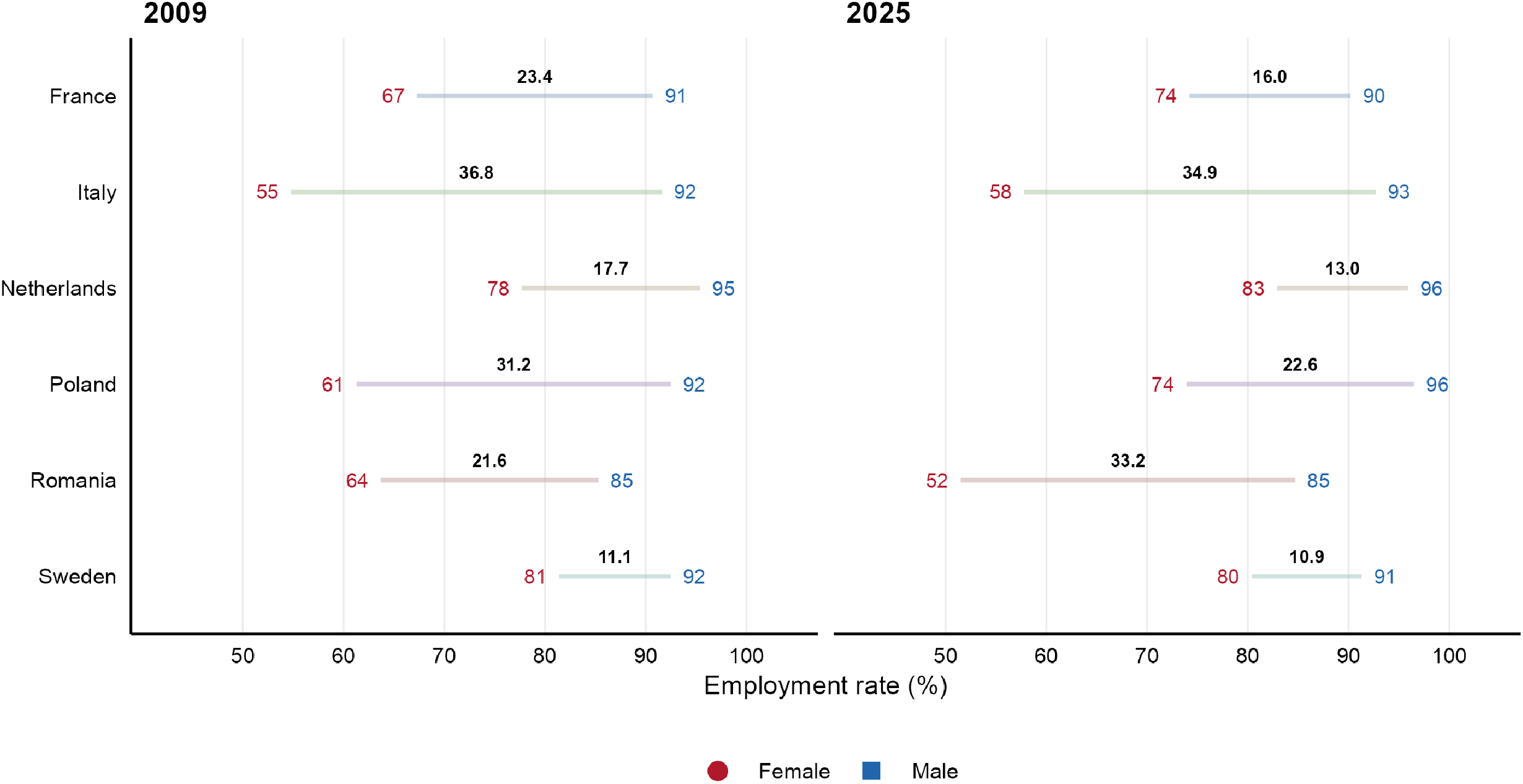
To operationalise regime and cultural variation, an analysis of attitudes towards gender norms and roles and family values in the six selected countries reveals varying attitudes towards gender equality and traditional norms (see Figure 2). Empirically, this is reflected in the employment rate gap among adults aged 25–49 with a child under 6, which varies substantially across the selected countries, as shown in Figure 3 (Eurostat 2026d). This life-stage typically coincides with the most intensive period of career development and heightened care needs, prompting trade-offs in labour supply and career progression. These cross-country differences signal how policy design (childcare, activation) and prevailing norms interact to shape labour supply, leadership pipelines and caregiving patterns. By examining this variation across the selected spectrum of countries, it is possible to shed light on how the European legal framework has, on the one hand, addressed policies narrowing gender gaps, and highlighted the uneven pace of progress across Member States, on the other hand. The interaction between EU gender equality legal rules and national regime features helps explain differences in outcomes across employment, leadership, and care gaps.
Cultural norms in selected group of countries.
Note: F = female, M = male. Gender gaps are expressed in percentage points (p.p.).
Source: Own elaboration based on: European Commission (2024); Haerpfer et al (Reference Haerpfer, Inglehart, Moreno, Welzel, Kizilova, Diez-Medrano, Lagos, Norris, Ponarin and Puranen2024).

Employment rates and gender gap among adults aged 25–49 with a child under the age of six.
Note: Gap = Male – Female (p.p.). Bold values above segments denote the gap.
Source: Own elaboration based on Eurostat (2026b).

The study uses data from WVS Wave 7: 2017–2022 (Haerpfer et al Reference Haerpfer, Inglehart, Moreno, Welzel, Kizilova, Diez-Medrano, Lagos, Norris, Ponarin and Puranen2024) and The Culture Factor Group’s 6-D Model of National Culture (nd) based on Hofstede’s cultural dimensions (Reference Hofstede1991) to examine these variations by analysing values, beliefs, and norms of the selected countries in a comparative cross-national perspective. Figure 2 shows that family is identified as the most important life value by both men and women. Conversely, pronounced differences emerge in attitudes to gender norms and roles, where societal expectations often place women in primary caregiving and men in primary breadwinning roles. Data on WVS supports the Esping-Andersen’s welfare-regime classification, as well as egalitarian, traditional, and family-oriented profiles. Sweden displays patterns aligned with egalitarian norms (low traditional gaps, strong male acceptance of caregiving). Italy shows the strongest traditional gender attitudes, particularly regarding women’s domestic roles. Poland and Romania present a mixed post-communist profile – relatively traditional on some indicators but with notable progressive pockets, such as attitudes in Poland on male benefits from equality. France and the Netherlands occupy intermediate positions, although with distinct patterns reflecting their respective conservative-corporatist and social-democratic institutional contexts. These attitudinal differences provide the cultural backdrop against which the employment, leadership, and care gaps documented in the subsequent figures should be interpreted – countries with larger attitudinal gender gaps tend to exhibit wider structural gaps in labour market outcomes.
The evolution of the EU legal framework
The following section provides a comprehensive overview of the main EU legal acts and policy instruments (including soft and hard law) that define and shape the EU’s strategy in respect to gender gaps in employment, leadership, and care.
One of the fundamental areas of activity within the EU’s legal framework is the promotion of gender equality. This principle is firmly embedded in key treaties and strategic documents, constituting an essential component of both the EU legal order and its social policy. In this context, particular emphasis is placed on the systematic reduction of gender gaps – disparities between women and men in areas such as employment, remuneration, Footnote 3 and participation in social and political life. Footnote 4
The Treaty of Lisbon (European Union 2016b) reinforces the EU’s commitment to gender equality. Article 2 of the Treaty on EU identifies gender equality as one of the EU’s core values. Meanwhile, Article 8 of the Treaty on the Functioning of the European Union (TFEU) establishes a horizontal principle requiring the elimination of inequalities and the promotion of equality between women and men across all EU activities. These principles form the normative basis for what is known as gender mainstreaming. In operational terms, gender mainstreaming functions both as a legal obligation (treaty-based) and as a governance strategy (policy-based), linking high-level treaty commitments to concrete instruments in employment, leadership, and care. It requires Member States to actively integrate the objective of gender equality while drafting and implementing laws, policies, and administrative practices. This dual nature – normative and procedural – explains why gender mainstreaming is embedded in EU treaty law when operationalised through a mix of soft-law instruments (e.g. OMC) and hard-law directives (e.g. on equal treatment, working time, and leave). In practice, soft-law tools (coordination, target-setting, benchmarking, guidance) primarily rely on voluntary compliance and reputational incentives, whereas hard-law instruments require transposition and can be enforced through judicial and administrative mechanisms. The coexistence of these approaches reflects the EU’s commitment to mainstreaming gender concerns across all policy domains, while acknowledging the challenges of enforcement and variation in national contexts (Walby Reference Walby2004, Reference Walby2020).
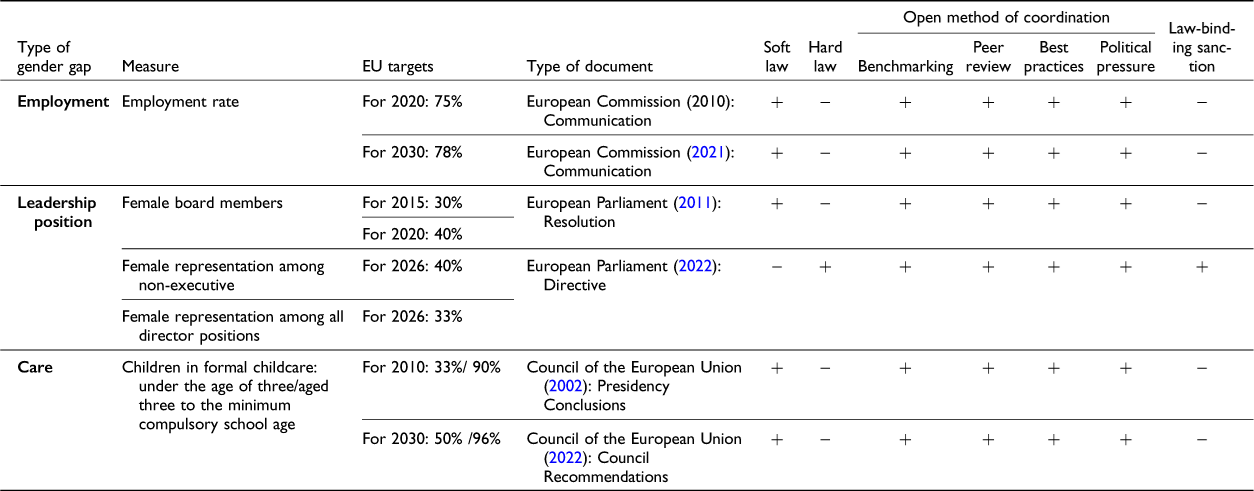
The scope and enforceability of EU gender equality instruments are shaped by the type of competence the Union exercises in each policy domain. In the area of social policy – which encompasses working conditions, equal treatment, and work–life balance – the EU holds a shared competence with Member States (Articles 4(2)(b) and 153 TFEU). This enables it to adopt directives that set minimum standards while leaving national authorities’ discretion over transposition and implementation. Employment policy, by contrast, falls under the EU’s coordinating competence (Article 5(2) TFEU); the EU issues guidelines and recommendations, but Member States retain primary responsibility for designing and implementing labour market policies. Care-related measures, insofar as they touch upon education and childcare infrastructure, engage the EU’s supporting competence (Article 6 TFEU), where the EU may only supplement – not replace – national action. This competence architecture explains why leadership targets have been advanced through a binding directive (Directive (EU) 2022/2381), whereas employment and childcare objectives rely predominantly on soft-law instruments, such as Council Recommendations and Communications, coordinated through the OMC. The differentiated enforcement capacity across these domains – discussed in greater detail in Table 1 – reflects these constitutional constraints.
European Union competences in closing gender gaps in employment, leadership positions and care

Table 1. Long description
The table compares EU gender equality instruments across different policy domains, focusing on employment, leadership positions, and care. It has three main sections: Employment, Leadership position, and Care. Each section lists specific measures, EU targets, types of documents, and methods of coordination. The table has 12 rows and 7 columns. Column headers are Type of gender gap, Measure, EU targets, Type of document, Soft law, Hard law, and Law-binding sanction. Row labels include Employment rate, Female board members, Female representation among non-executive, Female representation among all director positions, and Children in formal childcare. The table details specific targets, documents, and coordination methods for each measure, indicating the varying degrees of enforceability and competence across different policy domains.
Note: The legal documents have been arranged chronologically within each thematic area to facilitate tracking the evolution of regulations and instruments over time.
Source: Own elaboration based on: (Council of the European Union (2002, 2022); European Commission (2010, 2021); European Parliament (2011, 2022).
The importance of combating gender-based inequalities is also strongly emphasised in the Charter of Fundamental Rights of the European Union (European Union 2016a), particularly in Chapter III, ‘Equality’. Article 21 prohibits all forms of discrimination, including those based on sex, sexual orientation, and social origin. Article 23 obliges the EU to ensure equality between women and men in all areas, including employment, work, and pay, while allowing for the adoption of positive action measures to support under-represented groups.
Gender gaps are also explicitly addressed in the European Pact for Gender Equality 2011–2020 (Council of the European Union 2011). The document calls on Member States to undertake efforts to reduce employment disparities between women and men by promoting female employment across all age groups and combating discrimination. The Pact also stresses the need to eliminate gender stereotypes in education and working life and to implement policies ensuring equal pay for work of equal value. Furthermore, it advocates for increased representation of women in political and economic leadership, which is essential for addressing the gender leadership gap. Additionally, the Pact encourages the introduction of work–life balance measures, including access to quality childcare and care services for dependents. The Strategic Engagement for Gender Equality 2016–2019 (European Commission 2016) placed narrowing the gender employment gap at the centre of its priorities. Another key objective was to promote a more equitable distribution of unpaid care work between genders. It also sought to enact legislation on leave entitlements and flexible working arrangements to facilitate a better work–life balance.
Table 1 provides a structured overview of the principal EU targets and instruments related to employment, leadership, and care and indicates their placement on the soft-law to hard-law spectrum. It illustrates the interplay between soft and hard-law mechanisms, highlighting the differentiated enforcement capacity across policy areas. The regulatory architecture underpinning these objectives reveals significant variation across domains. Employment and care-related targets rely predominantly on soft-law instruments (e.g. European Commission Communications, Council Recommendations), complemented by the OMC tools such as benchmarking, peer review, and best practice exchange. These instruments lack direct sanctions, which limits enforceability and places emphasis on voluntary compliance and reputational incentives. In contrast, leadership-related objectives exhibit a hybrid approach, combining soft-law resolution with hard-law directive. This calibration towards binding obligations in leadership reflects persistent structural barriers to women’s advancement and the corresponding need for stronger legal intervention where voluntary progress has been slow (e.g. corporate board representation). The review presented in Table 1 constitutes the implementation of the first research task formulated in this article. It provides the foundation to continue the analysis and address the two remaining tasks: assessing the extent of gender gaps and examining progress towards agreed targets based on country-level data.
Gender gaps
Employment
At the strategic level, the EU recognises the reduction of gender inequality as a foundation for social cohesion and economic growth. The Europe 2020 Strategy (European Commission 2010) underscores the importance of inclusive growth and highlights that effective gender equality policies contribute to higher female labour force participation. This, in turn, helps reduce the gender employment gap – a priority further reinforced by the European Pillar of Social Rights Action Plan (European Commission 2021), which sets ambitious targets to address women’s disadvantaged positions in the labour market (including the pay gap, pension gap, glass ceiling, minimum income, and unemployment benefits) and in the broader socio-economic context. These domains include healthcare, education, training and lifelong learning, social protection, childcare, and work–life balance. Such priorities illustrate the EU’s growing emphasis on linking gender equality with sustainable labour market performance.
An examination of gender-disaggregated employment rates across selected EU Member States (Sweden, Romania, Poland, the Netherlands, Italy, and France) reveals differing trajectories in progress towards both EU-wide and nationally defined employment targets. In 2020, the EU benchmark for employment stood at 75% (European Commission 2010), subsequently raised to 78% in 2030 (European Commission 2021).
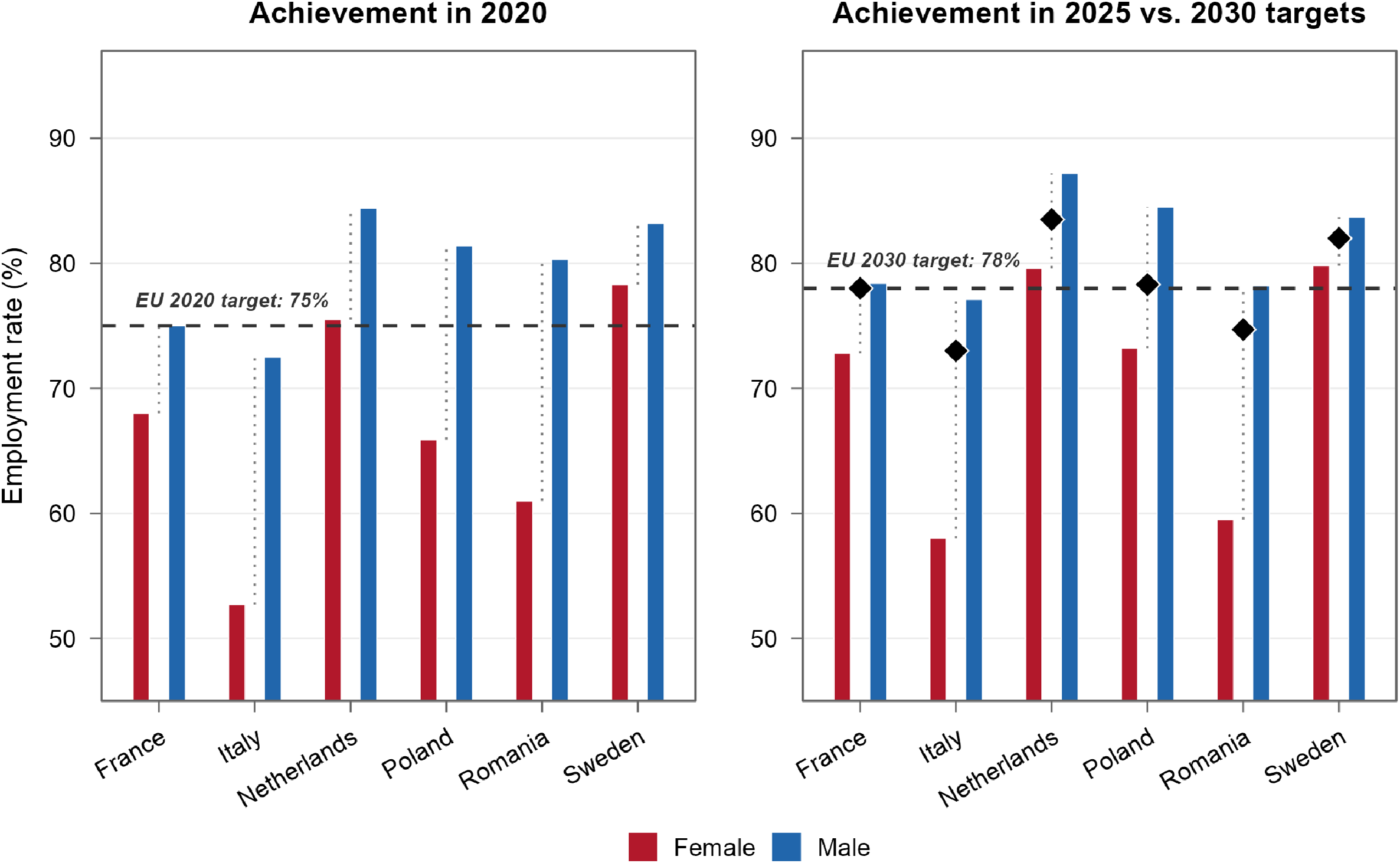
In 2020, only Sweden and the Netherlands met or exceeded the 75% target, with Italy recording the lowest rate (55%), resulting in a pronounced gender employment gap (see Figure 4). These labour market outcomes illustrate how Member States vary in meeting the objectives set out in the evolving EU legal and strategic framework.
Employment rates vs EU targets.
Note: Dashed line = EU-wide employment target. Diamond = national 2030 target (aggregate). Dotted line = gender gap per country. Age group: 20–64.
Source: Own elaboration based on: European Commission (2010, 2021; Eurostat (2026b).

Figure 4. Long description
Panel A: A bar graph titled ‘Achievement in 2020’ compares the employment rates of females and males in six countries: France, Italy, Netherlands, Poland, Romania, and Sweden. The horizontal axis lists the countries, and the vertical axis measures the employment rate in per cent. The graph includes two sets of bars for each country: red bars representing female employment rates and blue bars representing male employment rates. The EU 2020 target of 75 per cent is marked with a dashed horizontal line. France shows female employment around 65 per cent and male employment around 75 per cent. Italy shows female employment around 50 per cent and male employment around 75 per cent. The Netherlands shows female employment around 75 per cent and male employment around 85 per cent. Poland shows female employment around 65 per cent and male employment around 75 per cent. Romania shows female employment around 60 per cent and male employment around 70 per cent. Sweden shows female employment around 75 per cent and male employment around 85 per cent. Panel B: A bar graph titled ‘Achievement in 2025 vs. 2030 targets’ compares the projected employment rates of females and males in the same countries against the EU 2030 target of 78 per cent. The horizontal axis lists the countries, and the vertical axis measures the employment rate in per cent. The graph includes two sets of bars for each country: red bars representing female employment rates and blue bars representing male employment rates. The EU 2030 target of 78 per cent is marked with a dashed horizontal line. Black diamonds indicate the projected employment rates for 2025. France shows female employment around 70 per cent and male employment around 80 per cent, with projections reaching the EU target. Italy shows female employment around 60 per cent and male employment around 75 per cent, with projections reaching the EU target. The Netherlands shows female employment around 80 per cent and male employment around 85 per cent, with projections exceeding the EU target. Poland shows female employment around 70 per cent and male employment around 80 per cent, with projections reaching the EU target. Romania shows female employment around 65 per cent and male employment around 75 per cent, with projections reaching the EU target. Sweden shows female employment around 80 per cent and male employment around 85 per cent, with projections exceeding the EU target.
By 2024, all six countries demonstrated improvements in employment rates; however, despite this progress, gender disparities persisted. Sweden reported the highest overall levels (women: 82%, men: 84%), and the Netherlands approached gender parity (women: 77%, men: 83%), reducing the gender employment gap to 6 p.p. (percentage points). Romania, Poland, and France experienced moderate increases in female employment. However, they continued to fall short of the 75% benchmark initially set for 2020. In these countries, the gender employment gap remained evident, particularly in Romania. Italy, despite the increase in female employment, continued to exhibit the widest gender employment gap (see Figure 4).
Looking ahead to the 2030 employment targets, Sweden (women: 82%, men: 84%) has already surpassed both the EU-wide goal (78%) and its national target (82.6%). The Netherlands (women: 77%, men: 83%) is approaching its national target (83.3%) and maintains a relatively balanced gender distribution in employment. Poland and France have made measurable progress but remain below their respective national targets (78.7% and 77%). Romania and Italy face the most significant challenges in meeting their national objectives, both in terms of overall employment levels and gender equality.
Leadership positions
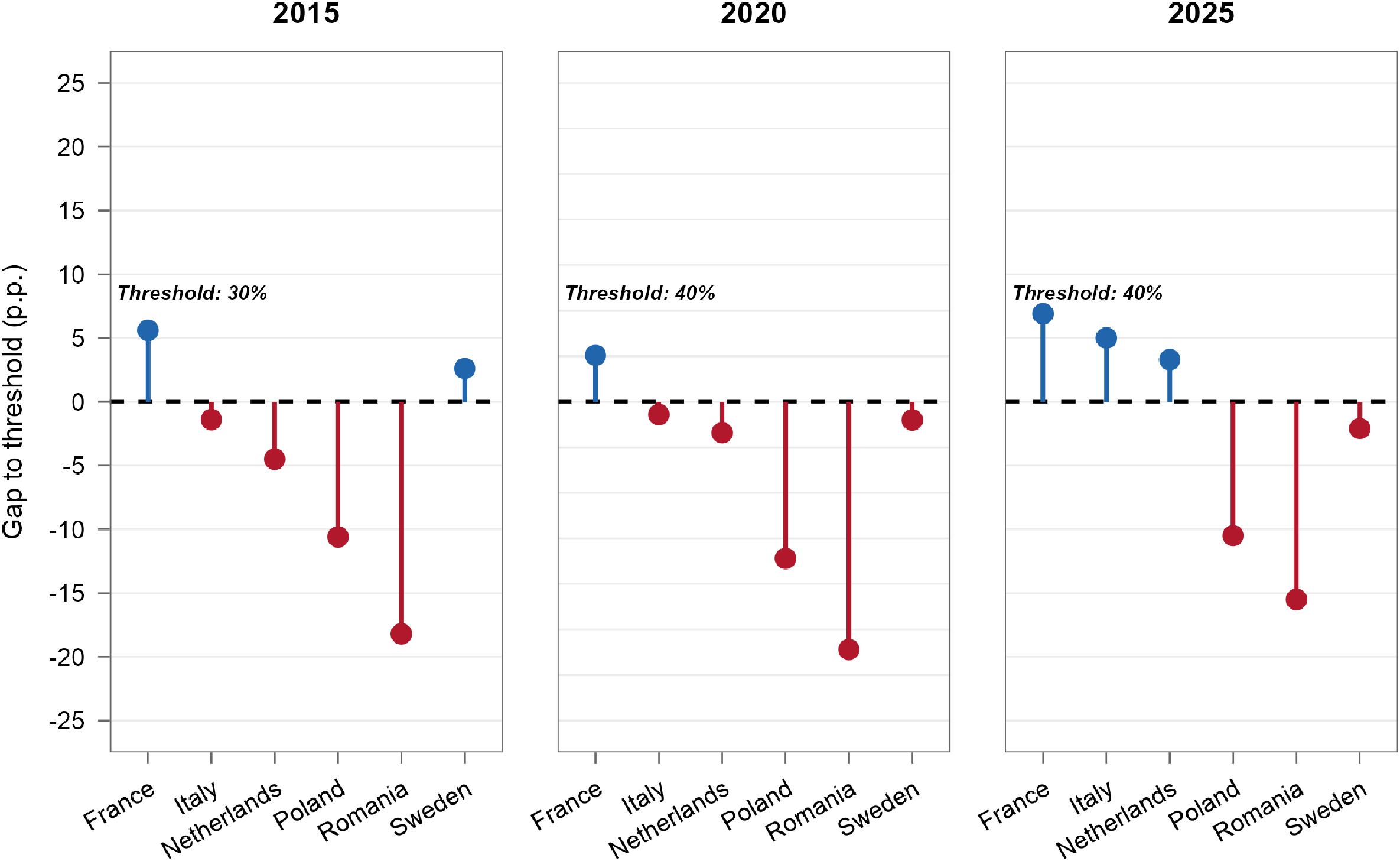
Already in 2011, the European Parliament underscored the importance of gender mainstreaming within decision-making structures in its Resolution on Women and Business Leadership (European Parliament 2011). The resolution called on companies to achieve a critical mass of women on management boards – 30% by 2015 and 40% by 2020. This objective was later reinforced through binding legislation with the adoption of Directive (EU) 2022/23813 (European Parliament 2022), which requires listed companies, by 30 June 2026, to ensure that members of the under-represented sex hold at least 40% of non-executive board positions or 33% of all directorships (executive and non-executive combined). In this context, ‘critical mass’ refers to the minimum threshold of representation considered necessary to influence decision-making processes.
To assess how Member States have progressed towards these objectives, a comparative analysis of six countries was conducted. This analysis of six EU Member States reveals significant disparities in progress towards gender balance in corporate leadership (see Figure 5). By 2015, only France (35.6%) and Sweden (32.6%) had surpassed the 30% threshold, meeting the initial benchmark. Italy narrowly missed the target, whereas the Netherlands, Poland and Romania fell short by 4.5, 10.1, and 19.9 p.p., respectively.
Female board members vs EU targets.
Note: Progress on targets set by the European Parliament resolution of 6 July 2011 on women and business leadership European Parliament (2011) – status in 2015, 2020, and 2025.
Source: Own work based on European Parliament (2011); European Institute for Gender Equality (2026).

By 2020, France was the only country to exceed the 40% target, reaching 45.1%. Sweden, Italy, and the Netherlands closely approached the benchmark. In contrast, Poland and Romania continued to lag significantly behind, with gaps of 17.2 and 27.2 p.p. Data from 2025 confirm an upward trend in most countries. France (46.9%), Italy (44.4%), and the Netherlands (43.8%) not only met the 40% target but also exceeded it. Sweden, despite a slight decline compared with 2020, maintained a high level of female representation at 37.4%. Poland and Romania demonstrated substantial improvement; however, they remain around 15 p.p. below the target, respectively (see Figure 5).
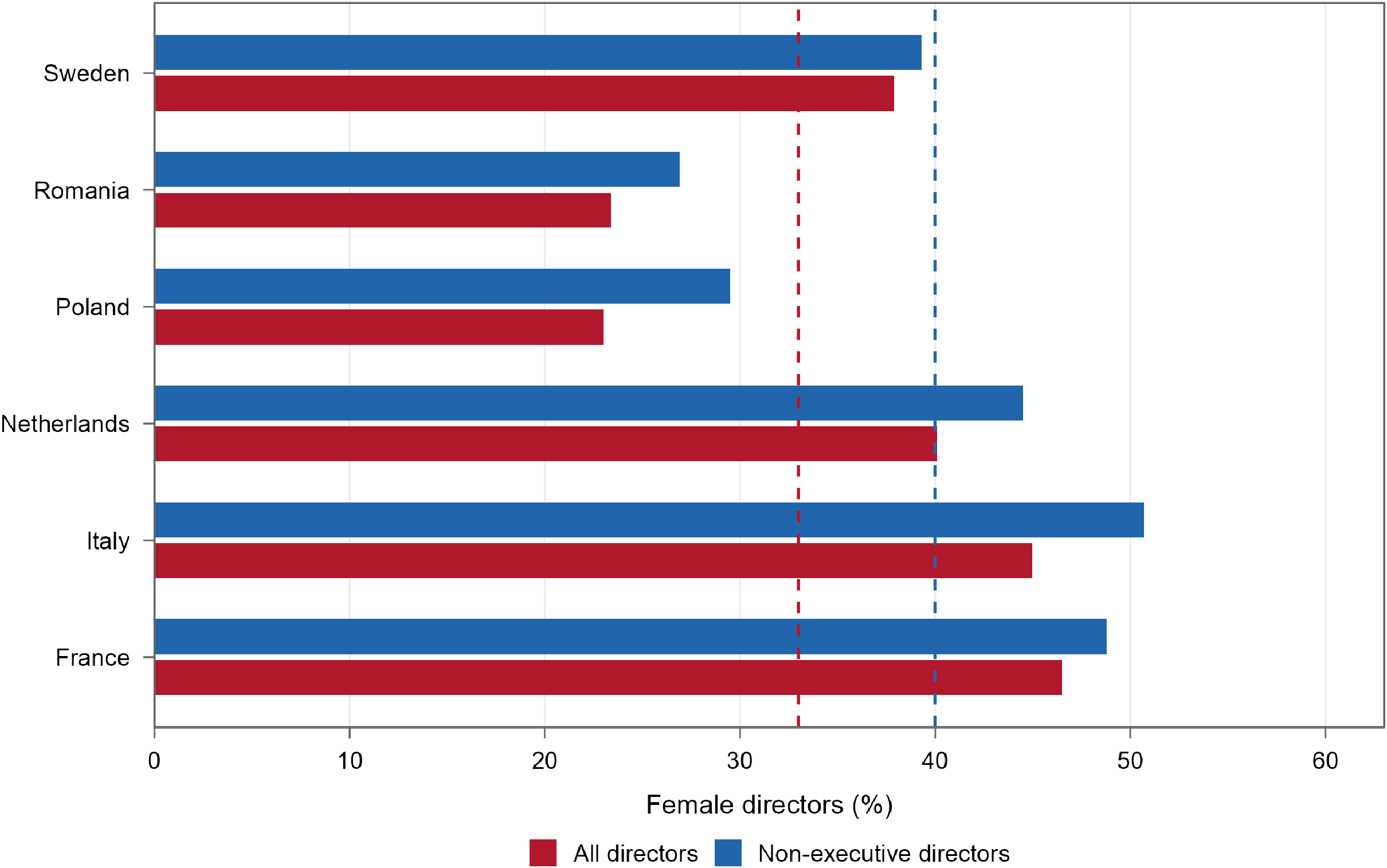
Building on this performance analysis, the next step is to assess compliance with the requirements introduced under Directive (EU) 2022/2381. In parallel, the implementation of Directive (EU) 2022/2381 (Women on Board Directive) (European Parliament 2022) reveals that France, Italy, the Netherlands, and Sweden have already achieved gender balance among senior management. Conversely, Poland and Romania remain below the required thresholds and fall behind European countries (see Figure 6).
Female representation among non-executive and all director positions vs EU targets.
Note: Progress on the implementation of Directive (EU) 2022/2381 of the European Parliament and of the Council of 23 November 2022 on improving the gender balance among directors of listed companies and related measures European Parliament (2022) – status as of 2025. Red dashed line = EU Target: 33%, blue dashed line = EU target 40%.
Source: Own work based on Eurostat (2026c).

Care
The Barcelona targets, adopted in 2002 with a 2010 deadline, established EU-wide benchmarks for formal childcare coverage – 33% for children under the age of three and 90% for those aged three to the minimum compulsory school age (Council of the European Union 2002). These objectives were later reinforced and expanded by the European Care Strategy (Council of the European Union 2022), which introduced more ambitious targets to be achieved by 2030: 50% and 96%, respectively. The revised goals aim to reduce the care gap and enhance access to early childhood education and care. They also promote better access to affordable, high-quality childcare. Central to this strategy is removing disincentives for women to enter and remain in the labour market by structurally improving care services and supporting a more equitable division of caregiving roles. Strengthening the care sector is therefore directly linked to gender equality, both in employment and in broader social participation. This policy evolution provides the framework for evaluating how Member States progress towards childcare coverage objectives.
Turning to Member State outcomes, in 2015, only Sweden exceeded the 33% threshold for children under three. Other countries remained substantially below the target: Italy, the Netherlands, Poland, and Romania. For children aged three and above, none of the countries reached the 90% benchmark. The highest participation rates were observed in Italy (78.7%), Sweden (79.2%), and France (71.8%). Meanwhile, Poland (49.9%), the Netherlands (43.7%), and Romania (6.3%) showed significant care gaps, with Romania falling short by over 80 p.p. (care gap defined as the difference between coverage and the EU benchmark) (see Figure 7). These figures indicate persistent structural disparities in access to childcare services across Member States.
Children in formal childcare under the age of three vs EU targets.
Note: Dashed line = EU target (Barcelona 2002: 33%; revised 2022: 50%).
Source: Own elaboration based on: Eurostat (2026a).

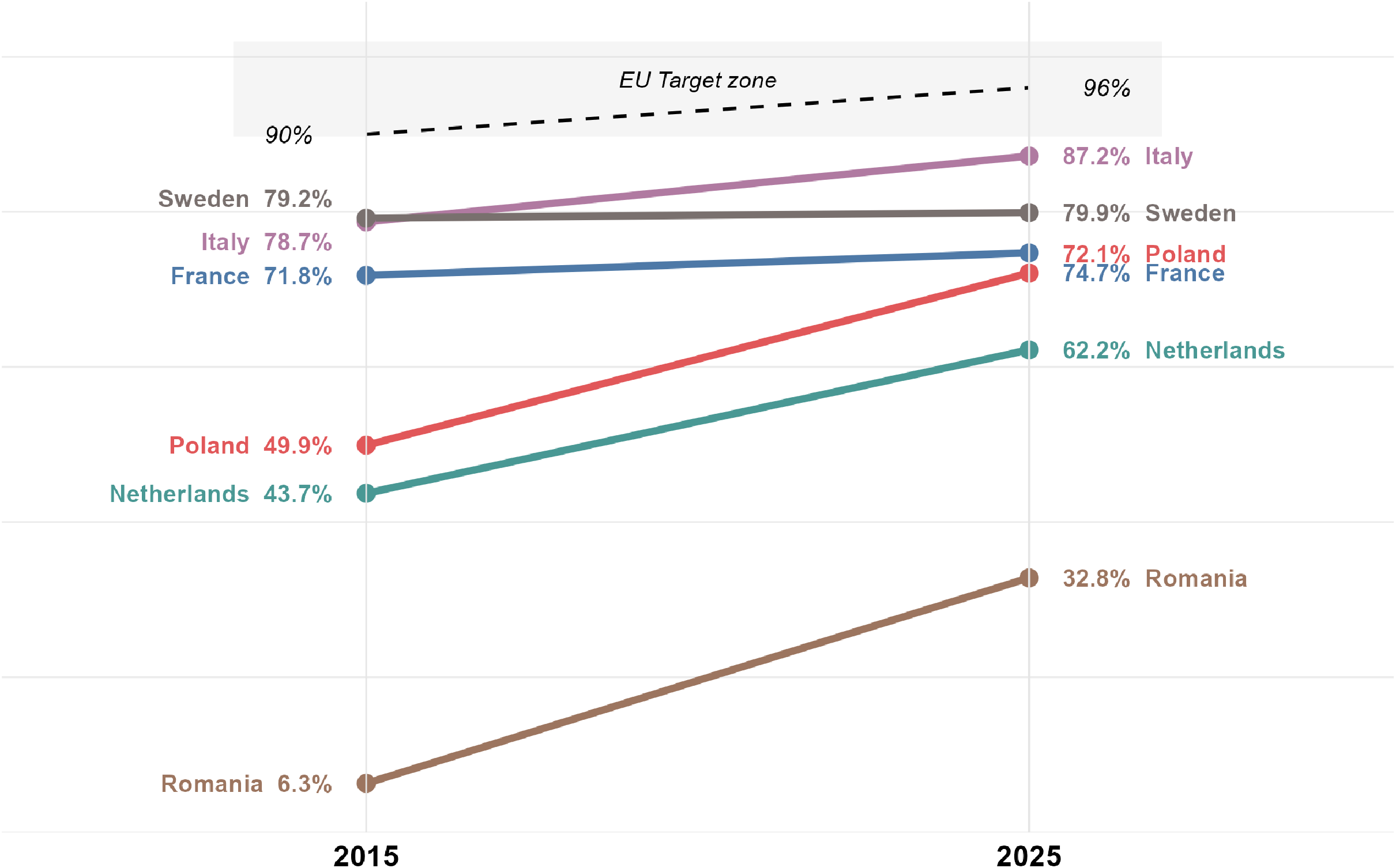
Compared with the 2015 outcomes, by 2025 France and Sweden exceeded the revised target for the younger age group. For children aged three and above, none of the countries met the 96% benchmark. Italy and Sweden showed the smallest gaps relative to the target. France, the Netherlands, Poland, and Romania remained significantly below the target (see Figure 8). Taken together, these outcomes highlight uneven progress towards EU childcare objectives and underscore the policy imperative to close care gaps as part of broader gender equality strategies in the future.
Children in formal childcare aged three to the minimum compulsory school age vs EU targets.
Note: Dashed line = EU target (Barcelona 2002: 90%; revised 2022: 96%).
Source: Own elaboration based on: European Commission (2022); Eurostat (2026a).

Figure 8. Long description
A line graph showing the percentage of children in formal childcare aged three to the minimum compulsory school age from 2015 to 2025 for several countries. The horizontal axis represents the years 2015 and 2025, while the vertical axis represents the percentage of children in formal childcare, ranging from 0 per cent to 100 per cent. The graph includes a dashed line indicating the E U target zone at 96 per cent. The countries included are Italy, Sweden, Poland, France, Netherlands, and Romania. Each country is represented by a different colored line. Italy’s percentage increases from 78.7 per cent in 2015 to 87.2 per cent in 2025. Sweden’s percentage increases slightly from 79.2 per cent in 2015 to 79.9 per cent in 2025. Poland’s per centage increases significantly from 49.9 per cent in 2015 to 72.1 per cent in 2025. France’s percentage increases from 71.8 per cent in 2015 to 74.7 per cent in 2025. The Netherlands’ percentage increases from 43.7 per cent in 2015 to 62.2 per cent in 2025. Romania’s percentage increases from 6.3 per cent in 2015 to 32.8 per cent in 2025.
Conclusion
This review demonstrates that EU legal frameworks have established important minimum standards for addressing gender disparities in employment, leadership, and care. However, implementation remains uneven across Member States, embedded in conservative (corporate): France and Italy; social democratic: the Netherlands and Sweden; and in post-communist contexts: Poland and Romania. Most of the EU documents are soft law, and therefore non-binding, primarily providing good practices and policy tools. Consequently, achieving substantive gender equality requires stronger enforcement, the removal of institutional barriers and coherent implementation across diverse national contexts.
Within the current policy architecture, the contemporary EU legal framework for promoting gender equality is firmly anchored in the Roadmap for Women’s Rights (European Commission 2025), which identifies gender equality as the cornerstone of the EU’s post-2025 policy architecture. Principle 3 prioritises eliminating gender pay and pension gaps; Principle 4 advances equal sharing of care responsibilities and universal access to high-quality early childhood education and care; Principle 5 commits to equal employment opportunities and fair working conditions, including addressing occupational segregation and under-representation in leadership.
Synthetising the evidence, the employment and care gaps are closely interrelated and can be interpreted through the lens of the double-burden hypothesis (Bratberg et al Reference Bratberg, Dahl and Risa2002), which underscores the disproportionate strain on women who combine paid employment with unpaid caregiving. This dynamic is frequently manifested as work–family conflict, whereby structural barriers – such as inadequate workplace policies, limited access to flexible arrangements, and insufficient social support – constrain women’s capacity to reconcile these roles (Bayrakçı et al Reference Bayrakçı, Uzunbacak, Erhan, Eryılmaz and Akçakanat2026; Müller et al Reference Müller, Neumann and Wrohlich2018). The pressures are further intensified by the motherhood penalty (Budig et al Reference Budig, Misra and Boeckmann2012; Goldin et al Reference Goldin, Kerr and Olivetti2024; Halrynjo and Mangset Reference Halrynjo and Mangset2025), reflected in lower earnings, slower career progression, and higher incidence of part-time or informal employment among mothers. Societal norms and gendered expectations further entrench disparities in job quality and advancement. Notably, evidence that anti-discrimination legislation can attenuate the motherhood penalty (Zajíčková et al Reference Zajíčková, Zajíček and Rašticová2021) indicates the potential of well-designed legal interventions to improve labour-market equity. These mechanisms underscore the importance of enforcement and supportive measures in EU policy design.
Leadership dynamics reinforce these patterns. The gender gap in leadership remains particularly salient given the persistence of the glass ceiling (Totleben and Domagała Reference Totleben and Domagała2024), which continues to hinder women’s access to top-level roles. Insights from critical mass theory (Lefley and Janecek Reference Lefley and Janecek2025; Torchia et al Reference Torchia, Calabrò and Huse2011) indicate that women’s ability to exert substantive influence increases only after surpassing a threshold of representation (≈33%). This can trigger significant changes in group dynamics that improve decision quality and inclusivity, particularly for under-represented women. For example, the presence of women on boards can reduce gender pay disparity among non-executive directors, indicating that a critical mass is necessary for significant impact (Tarkovska et al Reference Tarkovska, Gabaldon and Ratiu2023).
Taking a cross-domain view, and in line with the diversity spillover hypothesis (Sever Reference Sever2025; Tyrowicz and Drążkowski Reference Tyrowicz and Drążkowski2024), the establishment of measurable targets in employment, leadership, and care is strategically important – progress in one area can catalyse gains in others, thereby reinforcing the EU’s broader equality agenda. For example, gender quotas on corporate boards have been associated with positive Environmental, Social and Governance (ESG) spillovers, implying that increased female representation can enhance corporate responsibility (Schoonjans Reference Schoonjans2024). Overall, the evidence supports a dual strategy: binding standards with robust enforcement, complemented by supportive socio-economic instruments.
Although the EU’s legal architecture has established important minimum standards, the uneven progress documented in this review points to several regulatory limitations that warrant explicit attention. First, the predominance of soft-law instruments in employment and care – Communications, Council Recommendations, and OMC tools – means that compliance depends largely on voluntary action and reputational incentives rather than legally enforceable obligations. This stands in contrast to the leadership domain, where binding legislation with financial sanctions has been associated with more visible progress, particularly in France, Italy, and the Netherlands. The differential pace of convergence across domains suggests that the enforceability of instruments is a significant determinant of outcomes, and that soft-law coordination alone may be insufficient to overcome entrenched structural barriers.
Second, formal legal commitments to equality do not automatically translate into substantive change. As Fredman (Reference Fredman2016) argues, formal equality provisions – such as non-discrimination clauses and target-setting – are inherently limited because they do not address the underlying structural drawbacks that generate unequal outcomes. Achieving equality requires proactive measures that redress disadvantage, counter stereotyping, and promote structural transformation – dimensions that remain unevenly developed across the EU’s gender equality architecture.
Third, feminist institutionalist scholarship (Mackay et al Reference Mackay, Kenny and Chappell2010) highlights that gendered norms embedded in both formal rules and informal institutional practices can resist or neutralise progressive regulation. This insight helps explain why the same EU directives, once transposed, produce markedly different outcomes across Member States; domestic institutional legacies – including welfare regime configurations, labour market structures, and prevailing cultural norms – mediate the effects of supranational legal instruments, sometimes reinforcing rather than dismantling existing gender hierarchies. The persistent gaps observed in Poland and Romania, compared with the more advanced positions of France and Sweden, illustrate this dynamic.
Finally, the vulnerability of gender equality gains to macro-economic conditions must be acknowledged. Rubery (Reference Rubery2015) demonstrates that austerity policies disrupted progress towards gender equality by cutting public sector employment and care services disproportionately affecting women. This underscores the need for EU gender equality policy to be embedded within a broader macroeconomic framework that safeguards social investment, particularly in care infrastructure, against fiscal retrenchment.
Several limitations of this study must be acknowledged. First, the scope was restricted to three areas of policy interventions: employment, leadership, and care. This focus reflects their interconnected nature, whereby disparities in each domain mutually reinforce one another. Second, the selected domains align with the European Commission’s strategic priorities as outlined in the Gender Equality Strategy 2020–2025 and reflect areas with substantial hard- and soft-law legislative development. This focus enables a clear assessment of EU’s primary intervention mechanisms. Third, the study does not track the transposition of EU directives into national legislation or the implementation of specific programmes and resource allocation at the Member State level; consequently, it cannot establish causal linkages between EU-level instruments and observed national outcomes. Fourth, the reliance on aggregate indicators does not capture within-country variation, such as regional disparities or sectoral differences. Finally, while the six selected countries represent diverse welfare regimes and cultural contexts, they do not encompass the full range of EU Member State configurations, which limits the generalisability of the findings.
This study also highlights the need for future-oriented research. First, comparative and longitudinal impact assessment of EU policies – particularly legally binding directives – is needed to track implementation and outcomes over time and to identify spillover effects across policy domains. Such assessments should examine how directives have been transposed into national legislation, the extent to which Member States have implemented accompanying programmes and action plans, and whether adequate financial resources have been allocated to support compliance. Second, further research should examine how EU gender equality frameworks affect women with intersecting identities, such as race, ethnicity, migration status, disability, and socio-economic background. Such analyses would help clarify whether current policies address the experiences of marginalised groups or inadvertently reinforce other forms of inequality. Finally, comparative research on non-EU models could help identify innovative policy instruments and enforcement mechanisms that may inform future EU legislative reforms. This would allow for an assessment of the transferability of successful interventions to the EU’s supranational governance structure and its Member State contexts.
Declaration of generative AI and AI-assisted technologies in the writing process
In the late stages of this work, ChatGPT by OpenAI and Microsoft 365 Copilot were used to improve the readability and language. Claude Opus 4.6/Sonnet 4.6 and Positron Assistant were used to support data analysis and visualisation in R programming language. After using these tools, the author(s) reviewed and edited the content as needed and take(s) full responsibility for the content.
Funding statement
This study has been financed by the National Science Centre in Poland within OPUS-25, the project: REWORK – Can Remote Working Make Labor Market More Inclusive?, under grant number 2023/49/B/HS4/01647.
Wiktoria Domagała, Ph.D., is an Assistant Professor in the Institute of Economics, Department of Macroeconomics and Development Studies at Poznań University of Economics and Business. Her research interests focus on the contemporary labour market, with particular emphasis on gender disparities, occupational segregation, women’s entrepreneurship, and the representation of women on corporate boards. Her scholarly output includes numerous articles, the monograph titled Occupational Segregation by Gender in OECD Countries, and the coordination of a research project on gender inequality in highly developed economies, funded by Poland’s National Science Centre.
Julia Jastrząbek, Ph.D., is an Assistant Professor at the Institute of Economics, Department of Macroeconomics and Development Studies at Poznań University of Economics and Business. Her research interests include the socioeconomic aspects of sport mega-events, public policy, industrial policy and the contemporary labour market. Supported by a Miniatura 7 grant from the National Science Centre, Poland, she spent three months as a visiting researcher at the University of Lausanne (February–May 2024).




 Open access

