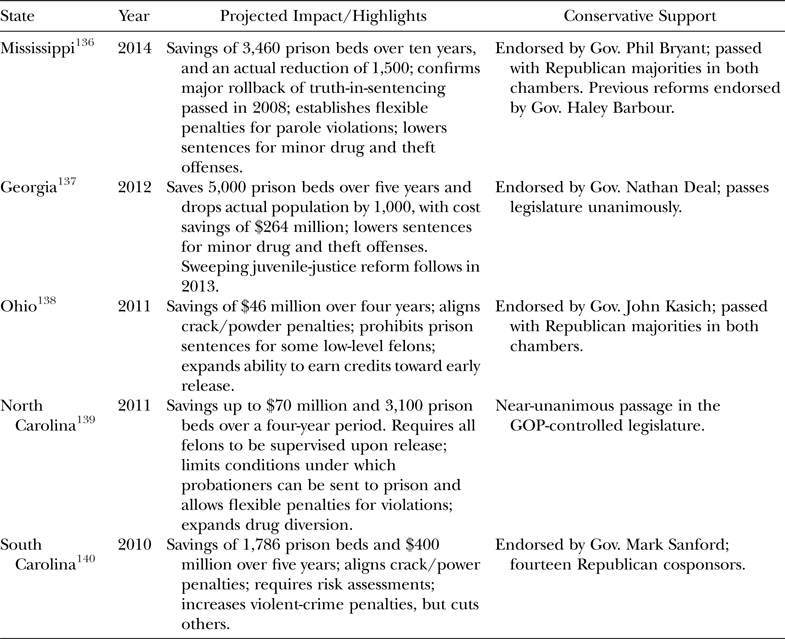
In the second half of the twentieth century, conservatives launched a revolution in American criminal justice that saw incarceration rates quintuple and made crime a central partisan battleground. But in the twenty-first century, the Right is rethinking the carceral state. National figures from Newt Gingrich to Jeb Bush to Rand Paul are aggressively critiquing the U.S. prison system as oversized, inefficient, and unjust. At least six Republican-controlled southern states have passed reforms aimed at curbing or reversing prison growth.Footnote 1 With broad bipartisan support, Congress has passed legislation that was unthinkable just ten or twenty years ago: for example, bills to help released prisoners adjust to society; to attack the scourge of prison rape; and to reduce the disparity between sentences for crack and powder cocaine offenses. These reforms are modest, but they represent a profound shift in the American agenda, from carceral expansion to carceral retrenchment. The fact that this agenda shift is happening with full support from the movement that long saw harsher punishment as its proud legacy raises profound questions about how we understand policy feedback—the process by which a policy creates the conditions for its own expansion or retrenchment.
There was no exogenous shock that generated this change, no sudden electoral victory by long-time dissidents or a mass mobilization of the disadvantaged that threatened social stability. While evidence about the harmful effects of mass incarceration has certainly accumulated over the last fifteen years, it is hardly new. What has changed profoundly is that people in power are attending to information they previously ignored. The case of sentencing reform thus suggests that scholars need to pay much closer attention to the fact that policy effects become policy feedback only through a process of construction. Focusing on the oft-neglected phenomenon of policy-undermining feedback, we will show that it requires resourceful entrepreneurs and favorable conditions for deleterious policy effects to be identified, for changes to such policies to be framed so as to be politically acceptable, and for the reform agenda to be diffused through policy-making channels. With apologies to Alexander Wendt: Policy feedback is what states make of it.Footnote 2
Policy feedback, we argue, occurs on a continuum of construction: It is easier for policy makers to recognize and interpret some policy effects than others. To explain how feedback is constructed, we propose a model that links the work of the UCLA school on political parties to the psychological literature on political cognition. First, we argue that elites with control of the party's “brand” will only acknowledge deleterious policy effects if doing so does not threaten core commitments held by members of their coalition. Second, even where this necessary condition is met, cognitive and cultural barriers may prevent the adoption of new views. One of the key ways that policy makers cope with the cognitive constraints on their information-processing is by using norms of cultural appropriateness, in which the central question is not, “What is true?” but “What do people like us believe?” Patterns of information processing can change when actors who have special credibility within the party or movement engage in a process of “identity vouching,” leveraging their relationships and reputations to convince others to attend to previously ignored information.Footnote 3 The impact of such cultural dynamics will vary from issue to issue, but we should expect that they will grow in importance as partisan polarization increases the overlap between party and political movements or philosophies.
We then apply this framework to our case. We demonstrate that “tough on crime” positions became culturally embedded in the conservative movement and the Republican Party, discouraging attention to signals of policy failure. We critique the argument that the reforms now under way were an automatic response to changing economic and budgetary conditions. Instead, we argue that these policy changes are the result of more specifically political phenomena. We argue that two structural changes—the declining electoral salience of crime and the increasingly antigovernment and antiunion spirit of the Republican Party—created an opportunity for the construction of undermining feedback through identity vouching, in which movement contrarians persuaded copartisans that prison reform is more conservative than the party's previous positions. These changes in conservative position-taking are not the only forces that are reshaping the politics of criminal justice—increasing mobilization on the Left and in the civil rights community matter a great deal, too. But without the shift that has occurred on the Right, the potential coalitions for reform would be much more limited, and the range of states in which reform was viable would be narrower.
The pioneers of the study of policy agendas associated the punctuations that accompanied major policy change with a process of “alarmed discovery”—a sudden moment in which something that was always there came to be widely recognized as a major problem.Footnote 4 Alarmed discovery implies that there was both a process through which the phenomenon was previously obscured, and a process through which it was revealed. We suggest a mechanism for this process: partisan information processing. Parties render some kinds of information identity-inappropriate, which explains absence of discovery. But changes in structural conditions and strategic action by partisan advocates can reformulate identity, making such information suddenly available to policy makers, whose alarmed discovery can drive rapid policy change. We suggest that in a highly polarized polity, this mechanism will be increasingly common.
How a political system processes evidence of policy failure is one of the most important measures of its quality of governance. It is impossible for any policy process to anticipate all possible negative consequences of public policies, but an ability to recognize and respond to problems when they emerge is a reasonable measure against which to judge political regimes. And if we wish to improve our own political system, a good place to start is by understanding the pathways through which previously taboo information manages to break through the daunting obstacles of party politics and biased information processing.
I. THE CONTINUUM OF UNDERMINING FEEDBACK
Scholars in policy studies and American political development have long recognized that policy “makes politics” through its impact on market expectations, the interest-group environment, and individuals’ political attitudes and behaviors as well as its direct fiscal, economic, and social effects.Footnote 5 This basic insight has come to be associated with the concept of “policy feedback,” but the accumulation of studies on the phenomenon has led to some conceptual confusion about what actually qualifies as “feedback.”Footnote 6 A related problem is that the literature tends to speak of “positive” or “negative” feedback, but is unclear whether these terms refer to the stability of a policy or the growth of a policy. Recent work by R. Kent Weaver and Alan Jacobs provides the clearest conceptual framework for understanding feedback, and one that fits the study of public policy better than earlier work that took its cue from theories that originated in the natural sciences. Weaver defines feedback as “consequences of policy that tend to (influence) the political, fiscal or social sustainability of a particular set of policies.”Footnote 7 And in a paper with Jacobs, instead of using the terms “positive” and “negative” feedback, he refers to “reinforcing” or “undermining” feedback.Footnote 8 This terminology makes clear that the reference is to policy expansion or contraction, rather than to the stability of an overall system.
What even this substantial conceptual improvement leaves unanswered is the question of when, how, and why policy makers attend to and internalize such information about political, fiscal, or social sustainability, and when they allow this information to alter their policy positions and priorities.Footnote 9 Most scholars in the feedback tradition have assumed that information about policy effects is recognized by the political system and focused their inquiry on what happens next. This assumption is in tension with the agenda-setting literature, which emphasizes that policy-making institutions have difficulty sifting signals from the environment, and that the interpretation of information about problems and policy is highly sensitive to framing and construction.Footnote 10 As we understand it, feedback, as distinct from mere “effects,” only occurs when cues are interpreted—that is, assigned valence and intensity—by relevant policy makers.Footnote 11 We would thus modify the Weaver construction by defining feedback as “consequences of policy that are broadly recognized and that are believed to either undermine or reinforce the political, fiscal or social viability or sustainability of a particular set of policies.”
As Weaver and Jacobs point out, the feedback literature also tends to stress processes by which status quo policies are reinforced or expanded, what is understood in the historical-institutionalist literature as positive feedback. The literature on the carceral state, which has become a central focus of American political development scholars in recent years, exemplifies many of the characteristic features of an emphasis on positive feedback.Footnote 12 We argue, on the contrary, that undermining policy feedback is a central, and generally ignored, feature of American politics.
If it is true that, as Paul Pierson has argued, “the political world is unusually prone to positive feedback,” then we should expect warnings that a policy is failing—and the implication that significant corrective action is required—to struggle for a hearing.Footnote 13 Recognizing policy failure should, consequently, require an even more explicit process of social construction than would be required of policy success. Our purpose in this paper is thus to identify when the troubling consequences of policy are likely to be recognized at the systemic level. In Kingdonian terms, how does negative information become accepted as undermining feedback, and thus understood as a “problem” for the governmental agenda?Footnote 14
Our claim that feedback is constructed does not imply that all meaning is up for grabs all the time. Of course, there is broad and consistent agreement on many scenarios that are considered “problems.” For example, Weaver is correct that cues about the performance of pension regimes—his object of study—are likely to draw political attention. However, this is because that information has been “preconstructed” with clear and identifiable meanings. “Preconstructed feedback” is an indicator of policy consequences whose valence and significance are widely accepted, even treated as obvious or natural. At the far end of preconstruction, these agreements can be institutionalized with the creation of monitoring agencies or automatic triggers to “fix” a policy when an indicator goes awry. Put differently, preconstruction is the process of wiring what McCubbins and Schwartz famously called political “fire alarms.”Footnote 15
Formal institutionalization is not required for a signal to be widely recognized as authoritative. Stock markets are widely understood to send critical signals about the economy and the confidence of business in government policy. The recognition afforded to certain experts can make their opinions a widely recognized signal. One example from the 1970s is economists’ argument that a whole slew of regulations were inefficient; a modern-day example is the consistent warning by engineers that American infrastructure is crumbling.Footnote 16 But in other policy areas, it is not even clear what the leading signs of success or failure are or what available information means. Are low crime rates and high incarceration rates a sign that sentencing policy is effective? Or a sign that sentencing policy is on a perverse course? Drawing attention to indicators that are not preconstructed is challenging because it requires that meaning must be fabricated on the fly, rather than assumed. What's more, policy feedback, as well as its preconstruction, can occur in at least three dimensions—political, fiscal, and social sustainability.Footnote 17 A policy may, for example, have preconstructed undermining feedback fiscally and socially but ambiguous feedback politically.Footnote 18 Judging which type of feedback predominates overall requires an assessment of the forces operating in all three streams.
It might be objected that accumulated undermining feedback can “blow up” and burst onto the agenda in spectacular fashion without much political strategizing. Such “policy explosions” are indeed distinct from other unconstructed forms of undermining feedback in that they can draw a significant amount of attention and problem consensus quickly. But, short of spectacular acts of violence or accidents that veer into “policy disaster” terrain—items on the order of the Challenger disaster or the meltdown at Fukushima—it is not obvious why some issues “explode” while others do not.
In sum, undermining feedback occurs when a critical mass of policy makers come to recognize a particular signal about policy effects as indicating a “problem” with the policy's fiscal, social, or political sustainability that requires change. Signal recognition is easier where particular policy indicators have pre-constructed and institutionalized meanings than in cases where their meanings are ambiguous or disputed.
II. CULTURAL COGNITION AND UNDERMINING FEEDBACK
The party system is one of the strongest forces structuring the processing of information in American politics, and one largely ignored by the agenda-setting literature. Following the “UCLA school” associated with John Zaller and his co-authors, we conceive of the American parties as essentially alliances of “strong policy demanders” who pool their demands through membership in a “team” and cooperate to gain control of the state through elections.Footnote 19 In most cases, team membership requires issue deference, a kind of cognitive logroll in which allies with a less intense commitment to an issue come to conceive of their own interests in the terms set by a more intensely committed partner. For example, party members are expected to look to sources of analysis certified by the lead coalition member on an issue and are expected to treat with suspicion or dismissal other sources of analysis. The latter mechanism has grown more powerful amid partisan polarization, when coalition members themselves think of their parties less as alliances of convenience and more as ideologically coherent armies. The result is that a relatively narrow set of organizations preconstruct how information on policy effects should be processed.
As David Karol has argued, given that party coalition members exchange their resources for support of their key policy objectives, change in “coalitionally anchored” party positions is almost impossible without a realignment in the coalitional basis of the parties. However, parties also take positions on “groupless” issues, where no coalition member has a fundamental interest.Footnote 20 Parties adopt such “opportunistic” positions out of electoral calculation or out of a sense that a particular position is consonant with an ideology common to all coalition members. Feedback on these policies is not controlled by a single dominant coalition member and is thus more vulnerable to change. That is not to say that opportunistic policies have no anchoring whatsoever, far from it. Such policies can come to define who “we” are (and who “they” are as well), and may be highly emotionally charged. They can thus become rooted in partisans’ conception of themselves, and in the party brand among the electorate.
This line of scholarship, however, does not provide a clear model of how change occurs on groupless issues. To understand how elites change their processing of information on opportunistic policies—and thus shift the feedback from reinforcing to undermining—we need to integrate insights from the agenda-setting literature about policy makers’ cognition and biases. As Frank Baumgartner and Bryan Jones have argued, the major challenge facing all policy makers is filtering the barrage of information clamoring for their attention. Emotion and bias are key elements of the process by which policy makers choose which signals to attend to and how to interpret them.Footnote 21 Moreover, once information is considered, it encounters a status quo bias among policy makers who have a “sense of ownership” in the prevailing policy and find it difficult to let it go. Emotional attachment to particular types of solutions may lead to mischaracterization of the problem based on incorrect analogies to other problems that were addressed with the favored solution.Footnote 22 Studies of such confirmation bias abound in psychology and are frequently invoked in the international relations literature.Footnote 23
However, these accounts still do not provide a systematic explanation for how emotion and bias steer information processing in politics. Such an account can be found in Dan M. Kahan and Donald Braman's theory of “cultural cognition.”Footnote 24 The authors propose that cultural orientations explain much of the variation in how individuals assess factual information about controversial political issues. Individuals who are culturally inclined to view an action or behavior as inappropriate—drug use or gun ownership, for example—are also much more likely to view it as dangerous. This skewed assessment of the risks deriving from different activities leads individuals to selectively filter information about the costs and benefits of policies influencing those activities, turning for guidance to authority figures with whom they share an identity and cultural orientation. Likewise, individuals will tend to discount information perceived to come from an opposing camp, while treating information from allies as “objective.”
The key to penetrating the cognitive barriers thrown up by cultural commitments is not to produce more “evidence” that supports the scientific validity of one position or another, Kahan and Braman argue. Before individuals can process information, they need to believe it does not represent a threat to identity, that the information is the kind of thing that people like them believe. Kahan and Braman call the process through which such new information is rendered culturally appropriate “debiasing.”Footnote 25 Debiasing is most likely to be successful when new views are carried by those with “high esteem within their cultural or ideological group.”Footnote 26 As a result of their status, people of high esteem can address the contradictions that inevitably crop up in any movement of distinctive factions held together by an attachment to broad principles. These “identity vouchers” can argue that they are simply applying those foundational principles in novel combinations, or to issues that had previously been overlooked. “People of high esteem” can also include people so honored because they hold a professional position that, in the view of a particular culture, makes their opinions on a particular subject seem highly credible. The most obvious example is an army general advising on a military strategy. Such people are rendered all the more credible when they appear to be making an argument that violates their self-interest.Footnote 27
While Kahan and Braman focus on mass attitudes, they describe these risk assessments as being driven by the same types of social-psychology mechanisms identified in the literature on policy makers’ biases. Because cultural divisions persist across demographic categories such as educational attainment, policy makers’ elite status does not make them immune to the dynamic. In fact, policy makers face a greater barrage of information than the average citizen, have reputational incentives not to confess error, and, at least in this era of American politics, have stronger, more deeply reinforced ideological attachments than the average citizen.Footnote 28 Legislators in particular may rely more on the trust heuristic than average citizens. They must decide on so many issues that they operate by taking “cues” from peers perceived to be in their camp.Footnote 29
We push the cultural cognition literature forward by arguing that debiasing must often be undertaken at the elite level before it can reach the general public, and we assert that it is a quintessentially entrepreneurial process: rational, opportunistic, resource-intensive, and strategic. The process is rational because movement contrarians must carefully target policy makers they view as most amenable to position change on grounds of both ideology and self-interest, and they must identify institutional venues favorable to their cause. It is opportunistic because persuading fellow movement adherents to switch positions may depend on linking the position to a shift in conditions or events, allowing the entrepreneur to obscure that a shift in position has actually occurred. In the absence of strategic opportunism, such brief moments for rethinking legacy positions may be lost, or their full potential not exploited. The process is resource-intensive because identifying such policy makers, packaging information in ways that appeal to them, and reframing political interest requires activists, time, credibility, and access. Finally, it is strategic because attempts at debiasing information for people of a given cultural orientation will meet with resistance from other actors attached to the same orientation. In other words, people who generally perceive themselves to be allies will find themselves fighting over the meaning of their shared values when a process of debiasing is initiated. The last two points are mutually reinforcing. Debiasing can unleash dormant frictions within a movement. Such conflicts can create highly uncertain conditions in which creativity can determine winners. In such an environment, relevant resources are not only material, but also intangible: They include motivation, salient knowledge, and learning skills.Footnote 30
Debiasing is a process that occurs primarily within a single ideological movement seen to “own” a particular policy legacy.Footnote 31 This implies two major obstacles to debiasing. First, policies viewed as creating a positive identity may become deeply embedded in culture. The linkage between policy commitment and cultural commitment can be forged or tightened significantly by the contingencies—often electoral—of prior political battles. When a policy is widely perceived to be successful (both in policy and electoral terms) in its early years, the movement may find it difficult to attend to pathologies arising from the policy's generation of unintended consequences or failure to adjust to a changed context. Therefore, we argue that the group perception that a policy is “working” in political terms (for example, by serving as an effective electoral weapon) must abate before debiasing can take on significant force.
One of the chief barriers to debiasing is reputational. Movements, like individuals, do not like to admit that they were wrong, a phenomenon that can cause them to ignore even powerful signals of policy error.Footnote 32 Thus, debiasing undermining feedback about movement-“owned” policies requires a rhetorical framework in which members see a credible “out” from admitting fault—in which they can say “we were right then when we had position X, and we are right now that we have position Y.” Arguments that “the character of the problem has changed” or “the policy has so diminished the problem that it is no longer necessary” are forms of this kind of rhetorical move.
A policy's reputation or policy image can be reinforced or undermined through the mechanism of motivated cognition. On the way “up,” a positive policy image will cause actors to ignore negative information and pay excessive attention to positive information. That then generates an even stronger policy image, thereby leading to even more biased cognition—a cognitively virtuous cycle. But the same thing operates in the other direction—once a reputation has been damaged, it can kick off a vicious cycle, in which evidence of positive functioning is ignored and even ambivalent signals are paid greater attention to. The art of policy entrepreneurship in this area, therefore, is to “tip” the cognitive process from virtuous to vicious, from reinforcement to stigma. Again, this process occurs largely prior to the rational assessment of evidence—it determines what evidence actors attend to, what evidence they seek to collect, and how they process it.
Identity vouching operates, in a sequential process, with two distinct audiences. The process begins with a very small core group of movement leaders that has decided that their group's position needs to change, often for deeply held moral reasons. They then seek to change the positions of the larger group of highly visible, ideologically unassailable movement leaders. This process typically occurs in a very low-profile, often behind-the-scenes manner, in which the key currency of change is relationships. The movement leaders within the core group have typically been through numerous battles together and have developed strong ties between each other. The segment of that elite cadre that seeks to change their group's positions leverages these relationships to convert the remaining trustees of the movement's “brand.” Once the elite cadre has been substantially converted, they can then communicate the change of position to the larger group of movement adherents—including legislators and the general public—relying on their reputation for ideological purity. They will typically communicate to the broader movement public reasons for a switch in position that are rooted in their deeper cultural commitments. At the end of this sequence, movement activists and affiliated politicians will be open to information about undermining feedback they had previously feared as a threat to identity.
In the case study that follows, we conceive of “tough-on-crime” policies passed beginning in the early 1980s at the state and federal levels as an initiating change that created amplifying effects over the following thirty years. As we explain in Section III, these amplifying effects included politicians’ perceptions that tough-on-crime positions were crucial for electoral success, and the rise of organized interests with a stake in prison growth, such as guard unions and private companies. Prison growth was also in a mutually reinforcing relationship with other trends, making it difficult in some cases to isolate what are strictly feedback effects. Most notably, mass incarceration coincided with changes in race relations that required racial hostility to be appealed to indirectly. For our purposes, however, the crucial point is that a series of additional effects clearly attributable to prison growth—the raw material for feedback—was either ignored or interpreted as evidence that more incarceration was needed, generating neutral-to-positive feedback. These included the fiscal impact of mass incarceration, the deterioration of prison conditions brought on by factors such as overcrowding and incarceration of the mentally ill, the wildly disproportionate racial impact of incarceration, and the persistence of high recidivism rates.
We turn now to our case, which is broken into four sections. In Section III, we argue that a commitment to mass incarceration became embedded in conservative ideology, leading conservatives to dismiss problem signals as a threat to identity. In Section IV, we describe the structural changes that formed necessary but not sufficient conditions for this threat perception to change. In Section V, we describe the strategic, resource-intensive process by which reformers used longstanding relationships, and ultimately public reputations, to debias problem signals. In Section VI, we explore the process of debiasing as it moved from a small, core group of reformers to a national movement. Finally, in Section VII, we show that these efforts have succeeded in broadly changing the attitudes of conservative policy makers.
III. MASS INCARCERATION AND CONSERVATIVE IDENTITY
Conservatives supported the construction of the carceral state, despite the fact that there was no major Republican coalition member acting as an anchor on the issue. In fact, being “tough on crime” was such a deep part of conservative identity that—up until the 2000s—conservatives ignored a range of evidence that the scale of incarceration in the United States had become pathological.Footnote 33 The enormous fiscal cost of incarceration, high levels of recidivism, and the disproportionate impact on African Americans have been clear for decades, but these factors were typically either ignored, dismissed, or treated as inappropriate for conservatives to consider until recently. In this section we lay out how these negative consequences of mass incarceration were long neglected by conservatives, but are now gaining traction within the movement. We then explain how conservatives rooted the crime issue into their political identity in a way that for many years prevented negative information from becoming undermining feedback.
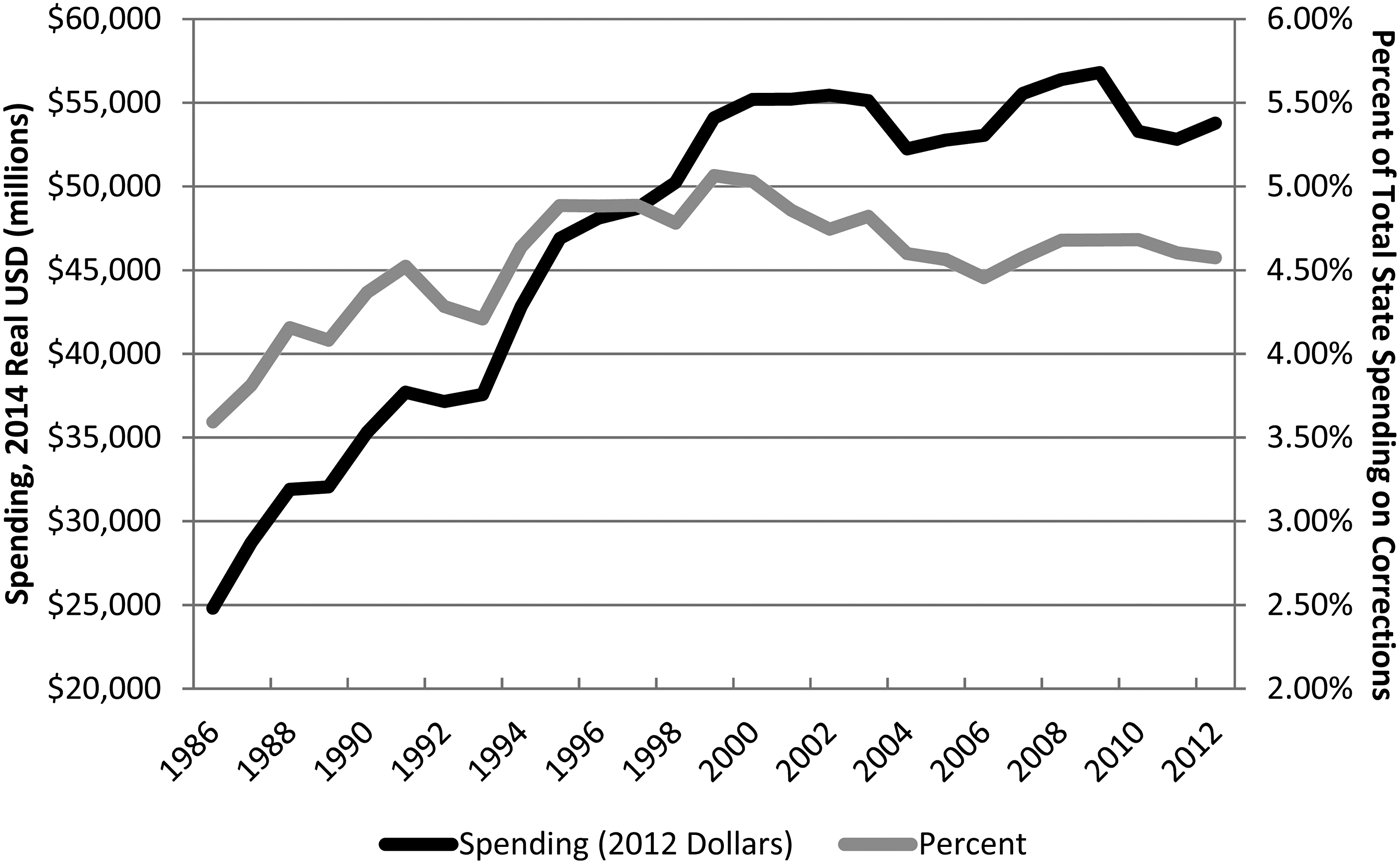
Cost: Between 1977 and 2003, state and local spending on corrections grew twice as much as health-care and education spending and 50 percent more than welfare spending.Footnote 34 Skeptics argued throughout the 1980s that these costs were unsustainable, but were stymied by the argument that, like national defense, there was no price too high to pay for public safety.Footnote 35 Things are different today: Cost is now one of the primary justifications conservatives invoke for prison reform. This reversal cannot easily be explained by the economic fundamentals of the issue, however. As Figure 1 shows, the growth of prison costs over the last decade has not been more dramatic than in previous eras—including periods of economic stress, such as the early 1990s. In other words, soaring prison costs are nothing new, and neither are complaints about them. Something else has changed to give this indicator new weight.
State Spending on Corrections, 1986–2012. The data are from the National Association of State Budget Officers, 2013.

Recidivism: High recidivism rates are now being seized upon as evidence of prison's inefficacy—but these data are not new either. In 1989, the Bureau of Justice Statistics published a study of 16,000 inmates in eleven states. Within three years of their release, almost two-thirds had been rearrested for a serious offense. The results appeared in the nation's leading newspapers—albeit as briefs—but were mentioned just once in the Congressional Record.Footnote 36 Some states followed up with recidivism studies of their own. Proposals to increase funding for programs to battle the problem, or even to tie Corrections Departments’ funding to performance on this front, were also floated on occasion.Footnote 37 But the nation's chief crime-control policy through the 1990s continued to be the construction of more prisons.Footnote 38 Today, conservatives frequently invoke high recidivism rates as evidence that the money Americans are spending on prisons is being wasted.Footnote 39 A 2011 report reprised accounts of the grim state of recidivism at a level of detail that had not previously been available—but the new data did not suggest that the problem had gotten worse than it had been twenty years before.Footnote 40
Racial disparity: The racial skew in American incarceration rates has been well documented and thoroughly debated since at least the turn of the century.Footnote 41 Evidence that the war on drugs was worsening the situation accumulated during the 1980s and 1990s and was underscored by a handful of high-profile reports.Footnote 42 As John DiIulio, a student of James Q. Wilson and longtime advocate of tougher sentencing, wrote in 1989, “Nobody denies that as America's corrections population has skyrocketed, the non-white proportion has reached historic highs.”Footnote 43 The Wall Street Journal observed in 1989, “Incarceration no doubt also means jailing a disproportionate number of minority youth,” but concluded grimly that “fighting drugs isn't a dainty job.”Footnote 44
While critics bemoaned the impact of rising incarceration on minorities, sentencing hawks argued that tougher laws (and the high rates of minority incarceration that they generated) actually benefited minorities by addressing the violence plaguing their communities.Footnote 45 In the political sphere, at least among conservatives, the growing incarceration of minorities was arguably regarded as an asset rather than a signal of policy pathology. The carceral-state literature has persuasively shown that tough-on-crime politics were racial politics. Politicians who vowed to lock up criminals were largely catering to white voters and cuing stereotypes of African Americans. A politician operating in this mode would not be likely to view data showing that tough sentencing was falling most heavily on blacks as a problem.
Today, most conservative prison reformers do not go out of their way to highlight racial disparities, but neither do they appear complacent about the issue, and they are paying increasing attention. The leading conservative reform group, Right on Crime, has done publicity work together with the NAACP. Kentucky Senator Rand Paul has gone so far as to compare mass incarceration to Jim Crow, and some conservative commentators have argued that taking up prison reform could help the party in its quest to make inroads with minorities.Footnote 46 More recently, a senior aide to the libertarian mega-funders Charles and David Koch has observed that American criminal justice “definitely appears to have a racial angle, intended or not” and, more strikingly, “We have more of America now in prison than they ever did (in South Africa) in apartheid … Let that swirl around in your head for a while.”Footnote 47
To explain these changes in the interpretation of policy signals, it is necessary to understand the group dynamics that held the previous understanding in place. Starting in the 1960s, law and order became a central pillar of conservative identity, a mark of what it meant to be a conservative. Segregationist Southern politicians planted this flag when they denounced civil rights activists as common criminals. The conflation was extended by Barry Goldwater and Richard Nixon in their 1964 and 1968 presidential campaigns, gaining force as the country was wracked by riots, campus disruptions, and rising urban violence. Later iterations of tough-on-crime discourse were more subtle, but fed into a racially tinged mythology that saw American society as divided between “moochers”—people who relied on government assistance and refused the responsibilities of citizenship—and “earners,” whose hard work was consistently undermined by the dependent, disordered, and depraved. Street criminals and “welfare queens” epitomized the moocher category, along with the politicians, student protesters, judges, and “effete” liberal intellectuals who defended them.Footnote 48
Meanwhile, police and, in some cases, prison guards, were valorized as defending the nation's upstanding earners.Footnote 49 Suggestions of “going soft” on criminals thus became linked with a visceral notion of threat, one that suggested not only vulnerability to violence, but also acquiescence to the erosion of traditional norms (such as deference to authority, particularly in the case of campus disruptions at places like Cornell, Berkeley, and Harvard).Footnote 50 So effective was this imagery that nonpunitive attitudes toward punishment soon became linked with a second threat of which politicians were acutely aware: the danger of losing reelection. This concern ultimately led the Democratic Party to converge on the “tough-on-crime” position, although there were genuine crime warriors in both parties.Footnote 51
The identity-affirming quality of law-and-order discourse explains the paradox that massive prison expansion—perhaps the most impressive state-building project in postwar America—was sponsored by the movement associated with retrenchment of the state in most other areas.Footnote 52 Many conservatives simply did not view police officers and prison guards as part of the “bureaucracy”: They were different than other government employees, the vanguard of the silent majority against threats to social order.Footnote 53 In fact, prison guards, especially in California, were viewed as legitimate members of the conservative coalition.Footnote 54 Consequently, the public choice logic that conservatives typically applied to government—that it was inherently expansionary, secretive, and parasitic—was not applied to the apparatus of criminal justice.Footnote 55 In this exemption from suspicion, the law-enforcement apparatus was analogous to the military. As Reagan Attorney General William French put it: “The Justice Department is not a domestic agency. It is the internal arm of the national defense.”Footnote 56 George H.W. Bush's drug czar, William Bennett, acknowledged in 1989 that a drug-war plan reliant on more incarceration would be expensive, but noted, “the maintenance of civil society demands that this money be spent.”Footnote 57 Jeffrey Piccola, a Republican senator in the Pennsylvania Legislature, explained in 1997 that the public viewed prison spending much as it did defense spending during the Cold War. “In both cases, the public feels the expenditures are necessary for the sake of their safety,” he said.Footnote 58
To be sure, there were dissident voices within the conservative movement as early as the 1980s and 1990s. The most prominent among them were drug-war critics in libertarian circles, especially at the Cato Institute and Reason magazine, who decried both the tactics and the prohibitionist logic of the antinarcotics crusade. However, the broader movement dismissed these voices as the complaints of a handful of eccentrics. While libertarians were (and continue to be) part of the conservative coalition, most conservatives treated their criticisms of drug and crime policy as a peculiarity for which they were given a special dispensation due to their usefulness on economic issues. But this peculiarity also meant that conservatives felt comfortable ignoring what they had to say.Footnote 59
A small number of conservatives grew publicly worried with the nation's punitive turn in the late 1990s. In 1999, political scientist John DiIulio, who had backed “get tough” policies in a Wall Street Journal op-ed only five years earlier, was back in the pages of the Journal declaring that “2 Million Prisoners are Enough.”Footnote 60 DiIulio argued that incarceration had worked, but “the value of imprisonment is a portrait in the law of rapidly diminishing returns.” He recommended a five-step program of reforms, including the repeal of mandatory minimum sentences for drug offenses and a turn toward rehabilitation and the overhaul and scale-up of probation and parole. “Zero prison growth is possible,” DiIulio concluded.Footnote 61 Likewise, former Attorney General Edwin Meese III, an architect of Ronald Reagan's drug-war policies, called for reviewing mandatory-minimum sentences for low-level drug offenders in a 1999 interview.Footnote 62 By 2002, at least eight states had revised such sentences, amid a slew of cost-cutting efforts that followed the 2001 recession. But for the most part, the reductions of this era remained marginal and only weakly associated with calls for systemic reform. Texas, for example, slashed its corrections budget “in every category other than prisons.”Footnote 63
Well into the 2000s, then, ever-expanding incarceration was deeply rooted ideologically and culturally among conservative politicians and thinkers, was a key element of Republican (and Democratic) electoral strategy, and had generated a strong supportive coalition. The deeply embedded character of the regime of mass incarceration led politicians to ignore signals that the policy was becoming pathological. Even when that evidence came from individuals with solid hardline credentials, such as DiIulio, it was widely ignored. Turning the tide would require two further ingredients: 1) changes in the political environment that made being tough on crime a less obvious winner for Republican office seekers and 2) a concerted effort to convert individual credibility into systematic criticism. We describe the shifting fundamentals of crime and punishment in the last fifteen years in the next section before explaining how conservative activists capitalized on these changes.
IV. DECLINING SALIENCE AND NEW PRIORITIES
The dominant interpretation of rising conservative interest in sentencing reform is that it was driven by state fiscal crises, which implies an automatic response to problem signals of the kind we would expect from preconstructed feedback.Footnote 64 There is certainly much to support this hypothesis. The aftermath of the 2001 recession coincided with an initial round of reform, and the deeper downturn after 2008 has coincided with a more sweeping round of changes.Footnote 65 In every state that has passed sentencing reforms, saving money has been invoked as a major rhetorical justification. The pressure prisons are putting on state budgets also helps to explain why, in many states, business leaders have become cheerleaders for the cause of reform.Footnote 66
The economic account is seriously incomplete, however. Fiscal crisis is hardly a sufficient condition for the reforms now under way, and it may not even be necessary. As noted above, this is not the first time rising prison costs have coincided with economic downturns. To the contrary, Marie Gottschalk points out that both history and theory suggest economic downturns can be associated with significant growth of the correctional apparatus.Footnote 67 Further undermining the fiscal account, the Pew Center on the States argues that state prison growth began to slow already in 2007, before the onset of recession, and primarily as a result of policy changes.Footnote 68 As a symbolic matter, too, practitioners date the turning point for reforms to 2007. That was the year that Texas—one of the nation's top jailers per capita—passed a sweeping sentencing reform package. While legislators faced an outsized long-term appropriations forecast from the state's prison system, Texas was having a strong budget year in 2007 that allowed the legislature to hike overall spending by 10 percent over the previous year.Footnote 69
Budget stringency has certainly helped reformers make their case to fellow conservatives and has created an opening for starting conversations with Republican officeholders. But there are other, more powerful forces that help explain why conservatives have been so willing to consider “bad news” about mass incarceration, while just a few years ago they were not. The real question, then, is not how budget pressures overwhelmed the carceral state, but how the carceral state was reframed to be evaluated in terms of cost and efficacy. How did conservatives come to believe the same package of austerity and accountability they applied to other government services also makes sense with prisons?
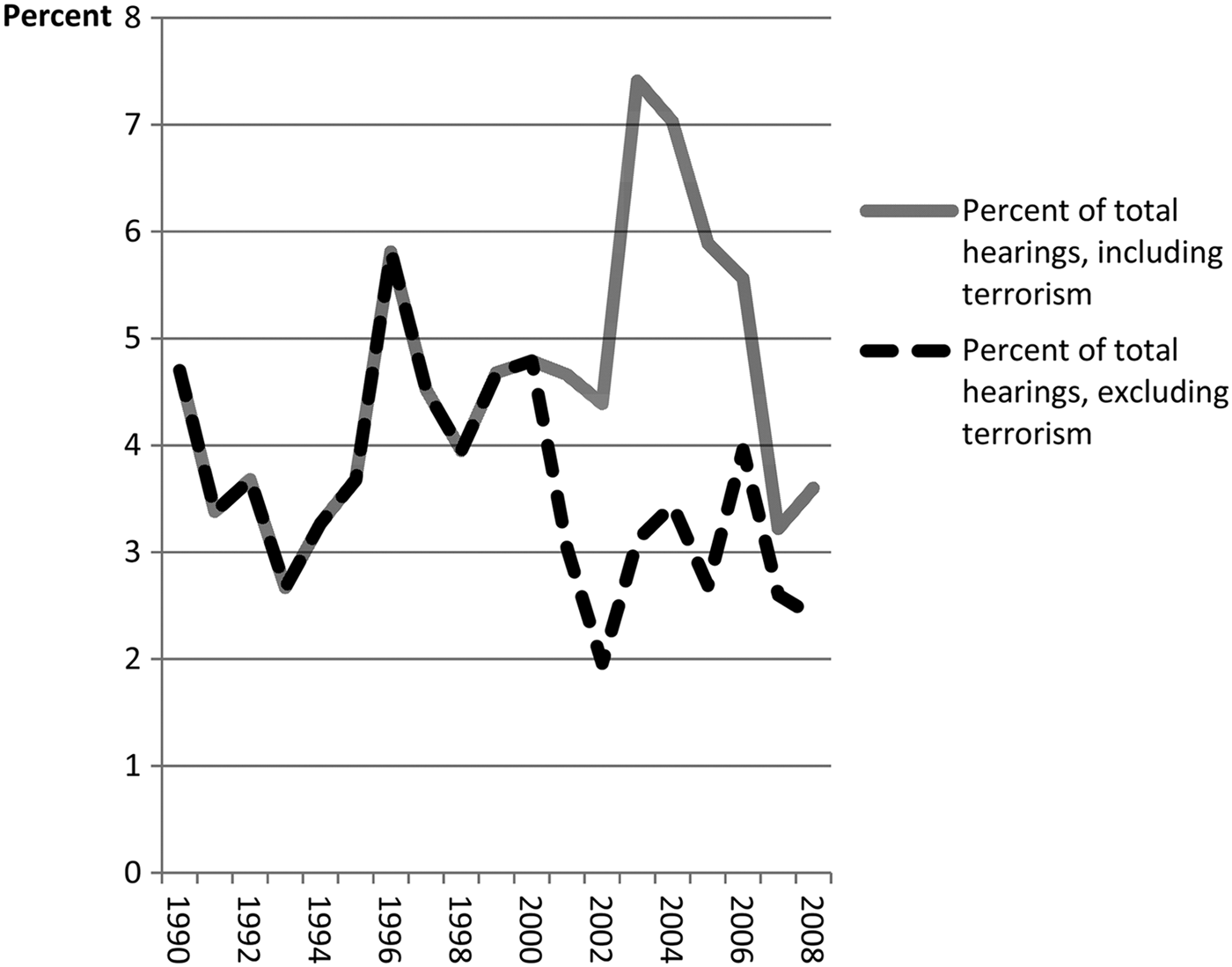
First, rates of violent crime began to decline steeply in the mid-1990s. As a signal of whether mass incarceration was “working” as a policy, crime rates can cut both ways—they have been used to argue that expanding prisons was the right strategy, that the scale of expansion went far beyond what was necessary, and positions in between. But the political effect was unambiguous—crime slid from the top to the bottom of the political agenda. The crime fall appears to have begun registering with the mass public by the latter years of the 1990s, as smaller proportions of Americans began identifying crime-related problems as the nation's most pressing issue in Gallup surveys. As Figure 2 shows, crime-related issues have now all but disappeared from the public's consciousness. As the public stopped caring so much about crime, politicians lost attention as well. Data from the Policy Agendas Project show that, across the political system, attention to crime dropped sharply after the mid-1990s. Figure 3 shows that congressional hearings, for example, peaked in 1996 and plummeted by 2002, when terrorism is excluded. With crime far from the public's attention, changing minds on criminal justice did not require convincing politicians to give up an issue that was earning dividends at the ballot box.
Violent Crime and “Most Important Problem” Responses, 1984–2012. Source: National Association of State Budget Officers. Source: Sourcebook of Criminal Justice Statistics Online, Table 2.1.2012, “Attitudes toward the Most Important Problem Facing the Country” (Albany, NY: Hindelang Criminal Justice Research Center, University at Albany, 2012), http://www.albany.edu/sourcebook/pdf/t212012.pdf; Sourcebook of Criminal Justice Statistics Online, Table 3.106.2012, “Estimated Number and Rate (per 100,000 Inhabitants) of Offenses Known to Police” (Albany, NY: Hindelang Criminal Justice Research Center, University at Albany, 2012), http://www.albany.edu/sourcebook/pdf/t31062012.pdf.

Percent of Congressional Hearings on Crime, with and without Terrorism. Source: Policy Agendas Project, “Congressional Hearings Dataset” (University of Texas at Austin, n.d.), http://www.policyagendas.org/page/datasets-codebooks#congressional_hearings. Access date is July 20, 2012.

Crime also lost some of its electoral appeal for Republicans because Democrats moved aggressively to convince the public that there were no meaningful differences between the parties. David Holian shows that Clinton adopted a “Yes, but” reply to the GOP, accepting key premises of the Republican platform but adding the new angle of prevention through expanded policing and gun control. Clinton talked more about both of these dimensions of crime than most of his Republican predecessors. The effects were impressive: In 1996, more voters said they trusted Clinton to handle crime than Bob Dole, his Republican rival.Footnote 70 The highly visible “tough-on-crime” campaign by the president and many other Democrats may have convinced Republicans that their advantage on the issue had diminished and was no longer worth pursuing. In spatial terms, Clinton pulled the Democrats toward the Republican position sufficiently to erase the distance between the two parties in the voters’ minds—ironically, Republicans lost an issue by being so successful at altering their rivals’ position. With little perceived difference in the parties’ positions, there was not much political benefit for members of Congress to raise the issue—and less reason for Republicans to dig in their heels to protect a position that was no longer delivering the electoral goods.
Third, this decline in attention to crime appears to have been reinforced by the intrusion of a new domestic-security issue: terrorism. After the attacks of September 11, 2001, counter-terrorism dominated public discussion of law enforcement. As Figure 3 also shows, terrorism accounted for the vast majority of hearings coded in the “crime” category of the Policy Agendas Project in the 2001–2005 period. Politicians who at another time might have been inclined to focus on more pedestrian cops-and-robbers issues were now forced to address the new threat, limiting their capacity to take up the traditional law-and-order cause. Republicans interested in attacking Democrats in the electorate's “fear space” could abandon street crime knowing that they had an equally potent alternative available.
The result of these changes was to slow the self-replicating dynamics in which initial success with “tough-on-crime” politics encouraged more politicians to pile on. As early as 2001, the combination of these political changes with recessionary budget pressure began to show effects, as numerous states launched modest experiments to slow the growth of their prison systems.
However, a fourth change provided a crucial impetus for the reframing of crime in terms of efficiency and cost: generational replacement in the conservative movement. The 2000s saw the rise of a new cohort of conservative politicians more devoted than ever to antistatism and fiscal austerity. This change has registered in Republicans’ increasing willingness to extend a public-choice-type critique of government to previously sacrosanct policies like Social Security, Medicare, surveillance—and crime.Footnote 71 Generational change is important in a second sense as well. Newer politicians did not spend their formative political years in the “tough-on-crime” era. They are unlikely to have experienced as vividly as their older peers the fear of being labeled “soft,” or the opportunities of being “tough,” and thus are less likely to have hard-wired those categories into their substantive beliefs or reelection strategies. In fact, most have probably thought very little about crime at all. As one Congressional aide working on the issue put it recently, “The main response from Republicans is … ‘This is all new to me.’”Footnote 72 Looking at the issue with fresh—and increasingly antistatist—eyes, many young Republicans are having a hard time understanding why it was ever the conservative position on criminal justice to spend increasing sums of money on unaccountable prison bureaucracies. This explains the peculiar stance of innocence struck by many Republicans arguing for major reforms in policies that their party largely created in the first place—many of the newer politicians (like Senators Rand Paul and Mike Lee) think of themselves as not really implicated in decisions made by copartisans twenty or thirty years earlier.
As a result of these changes, the electoral self-interest that helped anchor tough-on-crime position taking has become substantially attenuated. At the same time, the longstanding belief that law enforcement was immune from critique came into tension with a rising tide of libertarianism. While neither of these forces, on their own, would have been sufficient to drive the changes in conservative position taking over the last few years, they were necessary in order to provide the raw materials for entrepreneurial agents to work with.
V. THE SEEDS OF IDENTITY VOUCHING
These shifting fundamentals provided the raw material for a change in position. But they were insufficient on their own to debias information that conservatives previously had found threatening, a step that would require the formation of a committed reform cadre within the movement with the power to deploy individual and organizational reputations on behalf of the cause. Building such a cadre required dissident conservatives to leverage long-standing personal relationships with other movement leaders. These relationships gave reformers an opportunity to persuade skeptical colleagues, to mobilize those who were sympathetic but uncommitted, and to create a sense of group identity and momentum.
The key player in the conservative reevaluation of criminal justice was Prison Fellowship, an evangelical prison ministry founded by Charles Colson in 1976.Footnote 73 Colson, a former Nixon deputy, served seven months in prison for Watergate-related crimes.Footnote 74 Shortly before his incarceration, Colson experienced what he described as a religious transformation, and he spent the rest of his life working with prison inmates. Over the years, Colson's unstinting outreach to prisoners and his personal redemption story made him an evangelical superstar, celebrated as “one of the most influential evangelical leaders of the last half-century” and “one of the great modern-day lions of the faith.”Footnote 75 As Colson's home base, Prison Fellowship possessed an unimpeachable reputation among religious conservatives—it would be almost unthinkable to imagine someone accusing the organization of being insufficiently orthodox.
Prison Fellowship was not the only organization with conservative ties espousing criminal-justice reform. Families Against Mandatory Minimums (FAMM), founded by an alumna of the Cato Institute, contributed to passing limited sentencing reforms as early as 1994 and remained an important incubator of ideas thereafter. The Cato Institute itself has, since its founding in 1977, been a home for scholars and analysts critical of drug prohibition, “police militarization,” and, more recently, “over-criminalization,” a focus also of the widely read libertarian Reason magazine. Finally, the Heritage Foundation has been criticizing the expansion of federal criminal law as an intrusion on states’ rights and legitimate economic activity since the mid-1990s. Heritage's judicial dean, former Reagan attorney general Edwin Meese III, has also spoken out against mandatory minimums.Footnote 76
Still, Prison Fellowship has been the most important force in the conservative conversation about criminal-justice reform. While FAMM, Heritage, and Cato target particular ills of the criminal-justice system, especially at the federal level, Prison Fellowship's agenda has been far broader, encompassing sentencing, prison conditions, reentry, and the cultivation of empathy for prisoners and their families. Through a combination of high-level access, an incremental agenda-setting strategy, and careful calibration of its message, the organization succeeded in using Colson's ironclad reputation to build strong ties with other streams of the movement. As a result, Prison Fellowship—in particular its policy chief, Pat Nolan—created a coordinating capacity for prison-reform efforts that did not previously exist.
Prison Fellowship's first contribution to policy change came as a spinoff of its core work of providing religious counseling to inmates. It mobilized thousands of rank-and-file evangelicals into prison ministry, exposing them directly to inmates and their stories. As Tony Perkins, president of the evangelical Family Research Council, put it: “As more and more churches are involved in prison ministries, they begin the process of re-humanizing the criminal.”Footnote 77 As Colson became a household name among evangelicals, he also spread this message of redemption through other channels. For example, Colson had a strong influence on Tim Dunn, a Texas oilman who became an early funder of sentencing-reform efforts. Asked what prompted his interest in the issue, Dunn said, “It was mostly the information I got from Colson. I read their materials and listened to their [Prison Fellowship's] restorative-justice principles and the stories that they had and I thought, ‘You know, that's really right.’”Footnote 78 Another important Texan, George W. Bush, also was influenced by Colson's work: He helped Prison Fellowship set up a program in which it ran an entire prison wing on religious principles and frequently touted it as a model “faith-based initiative” during his 2000 presidential run.Footnote 79
The task of leveraging the sympathy Prison Fellowship had generated into political change fell to Pat Nolan, a former Republican leader in the California State Assembly and a veteran of Young Americans for Freedom with a strong network in the conservative movement. In California, he had earned a reputation as a tough-on-crime legislator, cosponsoring a successful “Victims’ Bill of Rights” ballot measure while pushing to expand the prison system and restrict parole.Footnote 80 But Nolan's outlook changed when he was sentenced to thirty-three months in federal prison after accepting a plea deal on what he maintains were flawed charges stemming from an overzealous FBI corruption sting. While in prison, Nolan was connected with Colson, and he agreed to take the advocacy job at Prison Fellowship upon his release. “I'd seen so much injustice while I was inside that I felt I really wanted to address that,” Nolan said. “My eyes had been opened.”Footnote 81
Over the next fifteen years, Nolan laid the groundwork for a shift in conservative attitudes by promoting a legislative agenda that framed prison issues in terms designed to appeal to conservatives, especially evangelicals. Nolan recruited high-ranking conservative friends to lobby for this agenda and brainstorm strategy. As these friends reached out to their own contacts, the reform cadre grew. Nolan's legislative success and expanding, increasingly committed network created a sense that, within the conservative movement, the crime issue was no longer owned by law-and-order traditionalists operating in the mode of “captured crime politics” in which propunishment interests dominated.Footnote 82 Instead, evangelicals teamed up with civil libertarians and fiscal conservatives to claim the issue, defining the chief problem as inhumane government overreach that threatened rather than advanced public safety. This momentum, in turn, encouraged other ambitious conservatives to reexamine the criminal-justice issue on both ideological and political grounds.
Nolan's first major legislative priority after his release was the issue of religious freedom in prisons. In 1997, Nolan fought a proposal by Senator Harry Reid of Nevada that would have narrowed the legal standard applied to alleged violations of prisoners’ religious rights. The proposal floundered amid opposition not only from Republican Senators Dan Coats (IN) and John Ashcroft (MO), but also Democrat Ted Kennedy (MA).Footnote 83 In 2000, Prison Fellowship emerged as a prominent voice in a campaign by religious groups to restore elements of the Religious Freedom Restoration Act, which the Supreme Court had gutted in 1997.Footnote 84 The coalition succeeded in passing a new law that clarified religious rights in disputes involving land use and institutionalized persons. Prison Fellowship was the leading conservative voice on the second issue, with Nolan and his boss, Colson, both testifying before Congress.Footnote 85
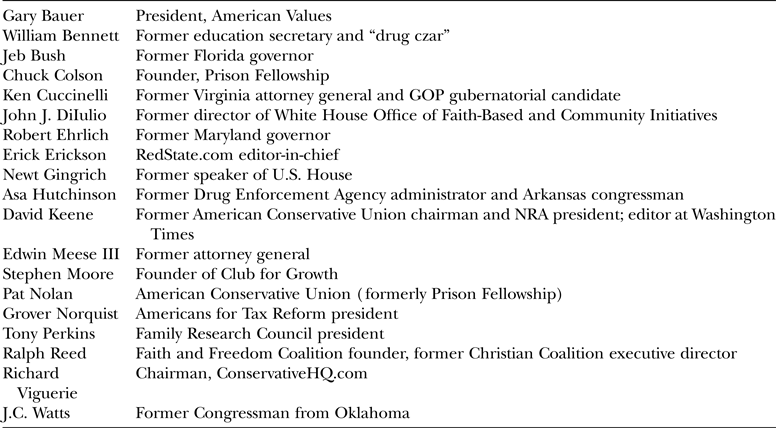
Behind the scenes, Nolan sought advice on how to approach these issues from David Keene and Richard Viguerie. Keene was then chairman of the American Conservative Union, and he would go on to serve as president of the National Rifle Association. Viguerie was an activist known for his pioneering use of direct mail on behalf of conservative causes. Nolan had gotten to know them both decades prior, through Young Americans for Freedom. Keene considered him a friend, and while Nolan was serving his time, it was Viguerie who had introduced his wife to Colson. Both men were already sensitized to the importance of criminal-justice issues. Keene had always been interested in the question as an offshoot of his advocacy for gun rights. A Catholic like Nolan, Viguerie has long advocated abolition of the death penalty. His interest in criminal justice was enhanced, he said, when people he knew went to prison for what he considered excessive terms. Nolan consulted with Keene and Viguerie regularly as his work continued.Footnote 86
Nolan's next major legislative opportunity emerged soon after, thanks to the efforts of Michael Horowitz, a longtime conservative strategist who had played a key role in building the movement's legal infrastructure in the 1980s.Footnote 87 Based at the Hudson Institute, Horowitz was now advocating what he called the “Wilberforce Agenda,” designed to rally religious conservatives around clear-cut moral causes that would undermine perceptions they were uncaring and focused only on issues of sexual morality.Footnote 88 As part of this effort, Horowitz assembled a strange-bedfellows coalition of Left and Right to push for legislation that would reduce the incidence of rape in American prisons. The struggle for what would become the Prison Rape Elimination Act marked the evangelical movement's first major claim to influence over prison policy. The law was championed in the House by Virginia Republican Frank Wolf, a noted religious conservative and supporter of international human rights, and endorsed by a slate of evangelical groups, such as James Dobson's Focus on the Family.Footnote 89 Wolf, who has called Colson a “a dear friend, mentor and brother,” said he carried the bill after Colson approached him about it. Colson's influence on Wolf aside, Prison Fellowship was an important deputy to Horowitz in the antirape effort, working the phones and mobilizing supporters. The measure passed both houses of Congress unanimously in 2003, over the deep reservations of the Bush Justice Department.Footnote 90
On the heels of this success, Prison Fellowship developed a new opportunity to extend the evangelical claim over prison policy and move fully into the role of lead legislative strategist. Nolan collaborated with Gene Guerrero, an official in the Washington office of George Soros's Open Society Institute, on legislation to help prisoners successfully reintegrate into society after their incarceration. The effort got a major boost when President George W. Bush surprisingly urged lawmakers to adopt so-called “reentry” legislation in his 2003 State of the Union speech. That endorsement itself was likely a fruit of Colson's long years of labor: Bush, of course, had been deeply impressed by Prison Fellowship's rehabilitative efforts in Texas. Moreover, the president's chief speechwriter, Michael Gerson, had worked for Colson right out of college. “Apart from my family,” Gerson has written of Colson, “he (was) the single most influential person in my life.”Footnote 91
The ensuing legislation was a bipartisan product whose Republican sponsors included Reps. Rob Portman and Chris Cannon and Senator Sam Brownback. Prison Fellowship took the lead in soliciting evangelical endorsements—bringing along such groups as the National Association of Evangelicals and the Family Research Council—a Focus on the Family offshoot—and recruiting Republican support in Congress.Footnote 92 Prison Fellowship also played an important mediating role between the left- and right-wing supporters of the bill. For example, Prison Fellowship was involved in sustaining a compromise on language affecting the provision of services by faith-based organizations, a potential deal breaker.Footnote 93
The battle for the law would take five years to win, however. During this interregnum, Keene and Viguerie deepened their alliance with Nolan. For Keene, especially, the stakes had risen. His skepticism of government overreach in the criminal process became more pronounced in the period after September 11, 2001. Keene became an outspoken defender of civil liberties, collaborating with left-wing groups to protest aspects of the Bush administration's antiterrorism campaign. And in 2002, Keene's son—then twenty-one years old—was sentenced to ten years in federal prison for firing a gun during a road-rage incident.Footnote 94 The trio of Nolan, Keene, and Viguerie formed the core of a working group that began convening occasional meetings of top conservatives in 2004 to discuss criminal-justice issues.Footnote 95
At this stage, a new player joined the cadre— antitax activist and Republican arbiter of orthodoxy Grover Norquist. Although he had penned an editorial in 1993 urging Republicans to seize on crime as the political replacement for the Cold War, Norquist had given signs over the years that his skepticism of government could also be turned on the justice system.Footnote 96 Like Keene, he had protested abuses of civil liberties by the Bush administration in the wake of the September 11 attacks, even collaborating with the ACLU. He had also privately expressed his support for FAMM to the group's founder over the years, and allowed her to make a presentation at his Wednesday Meeting in the mid-2000s.Footnote 97 Norquist could not pin down a single reason that brought him into the reform coalition, but the repeated flow of unorthodox ideas through his personal networks was likely important. As he explained, “You see this stuff coming like a mirage or something toward you. You see the issue, and then you see it again, and then you see it again. And then sometimes you just say, no, that's not a good idea … And sometimes it just keeps moving into your sight.” As Norquist noted, the vision may look stronger when it is supplied by a friend: “When Dave Keene would say, ‘What about this?’ I'm willing to listen.”Footnote 98
Other regular participants at the working-group meetings included Brian Walsh, who worked with former Attorney General Meese at the Heritage Foundation; Eugene Meyer, president of the Federalist Society; and Tony Blankley, former press secretary to Newt Gingrich.Footnote 99 The meetings were informal and designed to serve as brainstorming sessions; topics covered included overcriminalization, reentry, and pending federal legislation.Footnote 100 The group's discussions were anchored by a strong sense that their role was to legitimate reform. “We found much greater consensus than we thought might have been there,” Keene said. The question “was how we could make those views known to the broader movement, to make it in essence respectable, and … inhibit those who had a tendency to … jump on and exploit law and order.”Footnote 101
In 2010, Keene and Nolan put these ideas into practice in collaboration with the Constitution Project, a bipartisan nonprofit that focuses on justice, immigration, terror, and war-powers issues. In the run-up to that year's elections, the Constitution Project urged gubernatorial candidates from both major parties to avoid tough-on-crime rhetoric that might limit their options to enact reforms once they came into office. Packets sent to Republicans included a letter signed by Republican Governors Association Executive Director Nick Ayres that cited Keene and Nolan's endorsement.Footnote 102 The RGA's chairman at the time Mississippi Governor Haley Barbour. A longtime associate of Keene's, Barbour had quietly made policy changes that significantly cut back incarceration in Mississippi.Footnote 103
The year 2010 would prove to be a watershed year for Nolan's movement. An early sign was the decision by Gingrich—soon to be a presidential candidate—to take up the criminal-justice reform cause. In January of that year, Gingrich hosted a private discussion of sentencing issues at the American Enterprise Institute. Gingrich represents perhaps the clearest case of outright conversion among Nolan's associates. Gingrich, who championed prison construction in his 1994 Contract with America, has become a strong critic of the justice system. “I think race has an enormous impact on decision after decision” in criminal justice, he told CNN in 2013. “And I think it would be very healthy for the country and for the Congress to re-evaluate … the whole way we've dealt with prison.”Footnote 104 Gingrich did not participate in meetings of Nolan's working group. But the former House Speaker said he was strongly influenced by what he viewed as the efficacy of Prison Fellowship's Texas program in cutting recidivism, and credited his evolution to the organization's leaders: “You cannot describe the emergence of conservative thought about prison reform without the work of Chuck Colson and his faith-based ministry and then the work of Pat Nolan, and they were absolutely central certainly in my case. They educated me and brought me along and helped me much better understand things.”Footnote 105
A more visible 2010 breakthrough was the success of a long-running campaign by Alabama Senator Jeff Sessions, a former federal prosecutor, to reduce the disparity in sentences for crack and powder cocaine. Prison Fellowship did not play a role in Sessions's commitment to the issue, and it was not even the lead organization in the coalition whose lobbying finally led to the Fair Sentencing Act of 2010. But Nolan again played an important deputy role, consulting with Sessions's office, submitting hearing testimony or recruiting other speakers, and collecting endorsements. Easing crack penalties was a bolder leap than many religious conservatives were willing to publicly support, but it was remarkable that Nolan still got two religious groups—the National Association of Evangelicals and CitizenLink, the political arm of Focus on the Family—to endorse the change.Footnote 106 Just as important, by this time, Nolan was able to tap supporters beyond the religious community: The key champions he recruited to this cause included not only his longtime ally David Keene, but also Norquist and Asa Hutchinson, a former member of Congress, Drug Enforcement Agency director, and now governor of Arkansas. All three signed a letter to then Minority Leader John Boehner urging him to support the bill; at FAMM's suggestion, Norquist was also invited to a hearing on the issue, where he launched a broadside against mandatory-minimum sentences.Footnote 107
Moreover, the Tea Party wave of the 2010 midterm elections swept into office a new generation of conservatives hungry for causes that could be reframed to contrast “establishment” positions with new, more authentically conservative views. Kentucky Senator Rand Paul became an outspoken, almost radical critic of the criminal-justice system, blaming widespread disenfranchisement of felons on the drug war and comparing it to Jim Crow.Footnote 108 By 2014, Paul and two other Tea Party stalwarts—Utah Senator Mike Lee and Texas Senator Ted Cruz—had teamed up with liberals to push major federal sentencing reforms through the Senate Judiciary Committee.Footnote 109
The lubricant that enabled these legislative victories was relationships. By virtue of Colson's work and towering reputation, Prison Fellowship had access to other major evangelical groups, who at the very least could not reject the group's proposals and had to give them a respectable hearing. Though not planned that way in advance, the sequencing of Nolan's legislative campaign also lured in evangelical groups. The work began with a religious-freedom issue, continued with the obvious moral outrage of prison rape, and only then eased into the problem of reentry, which, though thornier to commit to, has strong overtones of redemption. Along the way, Nolan had proven his ability to manage arm's-length coalitions with left-wing advocates in which conservative principles would not be compromised, a reputation that surely reassured his religious allies as they followed him into deeper water.
Meanwhile, Nolan's personal connections with high-ranking conservatives beyond the evangelical world allowed him to broaden the coalition and deploy additional lobbying muscle at crucial moments. Most of these participants were open or even sympathetic to the idea of rolling back mass incarceration in some way before Nolan recruited them, but none had been focused on it. What produced that focus, in many cases, was a personal connection. Keene and Viguerie, for example, had an interest in criminal justice that preceded Nolan's activism, but both men became more energized when they began to hear regularly about the issue from Nolan, a longtime friend. “Richard Viguerie and I were concerned about doing something, but we hadn't done very much,” Keene said. “Gathering people that shared the concerns was not overly difficult. Getting them to actually take that concern and begin to transform it into public action is a different story. It required someone to say, ‘Let's do this,’ or, ‘We can do something.’”Footnote 110 Similarly, repeated advocacy by highly respected conservatives they knew personally appears to have been crucial in swinging figures such as Newt Gingrich and Grover Norquist to the reform camp.
The combination of personal ties and legislative strategy helped Prison Fellowship nurture a cadre of conservative elites who were deeply committed to criminal-justice reform and to begin “branding” the cause as authentically conservative. Now, these activists were positioned to scale up their identity vouching, heretofore ad hoc and issue-based, into an ongoing campaign.
VI. THE ORGANIZATION OF IDENTITY VOUCHING
While Nolan and his allies were changing the tone in Washington, other activists began building an organizational structure that would do the same in the states. The most important players in this organization-building effort were the Pew Charitable Trusts and the Texas Public Policy Foundation, a conservative think tank in Austin. These organizations would eventually form a loose partnership with one another and with Nolan's network of conservative activists. Their combined efforts produced three major changes in the infrastructure of policy ideas that would deeply embed criminal justice reform within the conservative movement. First, they made decarceration a hot topic for the State Policy Network, a network of libertarian think tanks in all fifty states. Second, they persuaded the American Legislative Exchange Council, a notoriously influential network of conservative state legislators and their business allies, to reverse its commitment to proincarceration policies. And third, they created a new organization, dubbed Right on Crime, to promote criminal justice reform as a core conservative commitment.
In late 2005 Pew founded a unit devoted to criminal-justice reform that came to be known as the “Public Safety Performance Project.” The project was stimulated in part by the observation that some conservative state lawmakers were beginning to critique the criminal-justice status quo. In the wake of the 2001 recession, some states had also enacted moderate policy changes, including efforts to introduce or improve guidelines to rationalize sentencing decisions. That context led Pew officials to believe there might be room to build “unlikely bedfellows” coalitions—a strategy it was also pursuing on another issue, pre-K education.Footnote 111 The heart of Pew's strategy was to provide technical assistance—data analysis and policy expertise—to undergird further reforms. But Pew was also determined to help create the political demand for its own services. Adam Gelb, the criminal-justice expert hired to lead the project, made clear that Pew saw conservatives as key in this regard. “Conservatives hold the cards on this issue,” Gelb said, “and we work closely with them.”Footnote 112 Put more bluntly, since the legacy of “captured crime politics” made the Left perennially vulnerable to charges of weakness, it would take change among conservatives to open up space for reform.
By 2007, the work of reaching out to conservatives with a new message was well under way in Washington, with Nolan taking on the task from the Right and Gelb working the problem from the center. That year, their efforts got a huge boost with the passage of a criminal-justice reform bill in Texas that was explicitly aimed at reducing incarceration. Texas is probably the state with the most recognizable “brand” in the nation, epitomized by the slogan “Don't Mess With Texas.” It is also widely regarded as the national champion of hard-line criminal justice. The Lone Star State executes more people than any other, its incarceration rates were until recently second in the nation (after Louisiana), and it was home to Ruiz v. Estelle, the biggest prison-conditions lawsuit in American history.Footnote 113 This track record made the 2007 reforms in Texas a compelling “man-bites-dog” story and essentially allowed reformers to deploy the reputation of an entire state on behalf of their cause. As Gelb put it: “People think if Texas does something, by definition it's not going to be soft.”Footnote 114
The 2007 overhaul of the system vaporized what had been a projected influx of 17,700 additional prisoners over five years, in part by spending $241 million on programs such as drug-abuse treatment and short-term detention in lieu of revocation to prison for parole violators.Footnote 115 The immediate result was to prevent the construction of three new prisons at a cost of some $440 million in a single budget cycle.Footnote 116 An in-depth account of how the Texas reform passed is beyond the scope of this paper, but the structural changes described above were surely a major factor. Republicans took over the Texas House of Representatives in 2003 for the first time in a century, completing their sweep of statewide offices and reducing the temptation to engage in “tough-on-crime” campaigning by eliminating the Democrats as a plausible threat to take over the legislature. The reform was backed by Speaker Tom Craddick, a noted fiscal hawk who also had close ties to Tim Dunn, the Colson-inspired oilman. This suggests that the party's overall turn to the Right—not a move to the center—played a role in eroding the fiscal “prison exception” in Texas. Finally, Texas was unusually constrained by the legacy of the federal prison lawsuit, Ruiz v. Estelle. The case had left Texas with statutorily enshrined limits on prison overcrowding that could force early releases of inmates.Footnote 117 In other words, prison crowding was preconstructed as a salient problem signal in Texas, and structural changes in the state now produced a radically different interpretation of the proper corrective action than during the 1990s, when, under a Democratic governor, the state had gone on a massive prison-building spree to stem crowding.Footnote 118
The Texas turnaround reverberated deeply through the nation's criminal-justice system. One important consequence was that it helped secure a reliable stream of federal funding for similar efforts in other states, building on the private dollars Pew had already committed to such work. The data underlying the Texas reforms had been produced by the nonprofit Council of State Governments (CSG), which funded the effort with a grant from the U.S. Bureau of Justice Assistance and Pew. Using the same resources, CSG had also done similar work in Kansas in 2007. The organization used the experiences of these two states to push for the federal funding to be scaled up significantly. In 2009, CSG's top justice official, Michael Thompson, testified before a panel of the House Appropriations Committee alongside officials from both states. They made a sufficient impression to secure $10 million in federal funding for “justice reinvestment”—more than ten times the previous amount.Footnote 119 The public money, combined with funding from Pew, ensured that justice-reform wonks would be available to do the analytical grunt work. But, for this wonky, classically good-government initiative to get a hearing, elected officials had to be convinced that there was a problem that needed to be solved.
The key push toward opening the minds of those elected officials would come from conservative policy advocates inside the Lone Star State who began touting the merits of the “Texas model” around the country. The center for this activity was the Austin-based Texas Public Policy Foundation (TPPF). TPPF is a member of the State Policy Network (SPN), an alliance of state-level think tanks with libertarian leanings founded in 1992. In 2005, TPPF hired an Austin lawyer named Marc Levin to serve as a full-time criminal-justice expert. Both the idea and the initial funding for the position came from Tim Dunn.Footnote 120 After the 2007 reforms, Levin and his colleagues at TPPF decided to publicize the state's success. Most conservative state think tanks only have the bandwidth to specialize in one or two major issues. On other matters, they tend to borrow the positions and research of other SPN organizations with a specialty in the area. Once TPPF planted its flag on criminal justice reform, therefore, its position could quickly become authoritative for all the other organizations in the network. As the only SPN think tank that had a full-time staffer working on criminal justice, TPPF soon became the go-to source for advice and information on the subject, helping its brethren draft op-eds and reports and cohosting events for legislators.Footnote 121
Meanwhile, Pew began sending the key Republican legislator behind the Texas reforms, Plano Rep Jerry Madden, to proselytize nationally about his experiences. An engineer who had never before dealt with criminal justice, Madden told audiences how Craddick had surprised him with the chairmanship of the relevant committee and given him simple orders: “Don't build more prisons. They cost too much.” Among Madden's favored venues for these speeches were meetings of the American Legislative Exchange Council (ALEC), of which he was an enthusiastic member. ALEC distributes model bills that are developed by legislative-style committees whose members include state lawmakers and private-sector representatives. The organization has long held an orthodox conservative position on criminal justice, for example, distributing model bills establishing mandatory minimum sentences.
As it happened, ALEC had another good friend who was deeply committed to prison reform: Pat Nolan. Before his incarceration, Nolan had been named an ALEC “Legislator of the Year,” and after he began working for Prison Fellowship, he was invited to join the ALEC committee with jurisdiction over crime. From that perch, Nolan persuaded the organization to endorse the Second Chance Act. In 2007, ALEC hired Michael Hough, a former Maryland legislative aide who knew Nolan and viewed him as a mentor, to staff the committee handling crime. Eventually, Hough, Madden, and Nolan decided to launch a special ALEC subcommittee focused on expanding alternatives to incarceration.Footnote 122 A series of model bills followed within the next few years, lending ALEC's official imprimatur to the reform movement. Much of the legislation has been modeled on proposals from Pew, which also provided funding to ALEC to support its new direction on crime.Footnote 123 Hough and Nolan recall that there was little pushback to the new ideas from legislators, and virtually none from the private-sector members, although Corrections Corporation of American has since withdrawn its membership in the organization.Footnote 124
In 2010, TPPF decided to double down on its criminal justice reform work with a full-blown publicity campaign it dubbed “Right on Crime.” Pew agreed to provide major funding, and Nolan pitched in with big names: The centerpiece of the campaign was a public call to action by high-profile conservatives Nolan and his allies had cultivated over the years. They included members of Nolan's informal working group as well as Gingrich, Hutchinson, Meese, Jeb Bush, and former “drug czar” William Bennett. (While Gingrich and Meese had not been regulars at working-group meetings, close associates of theirs were—Blankley in Gingrich's case and Walsh in Meese's.) Right on Crime went public in December 2010 with an op-ed by Nolan and Gingrich in the Washington Post. Footnote 125 While Nolan had previously rallied his associates to publicly support individual causes, this was the moment at which they announced a fundamental change in the conservative approach to crime. The fact that some of these leaders—Meese and Bennett in particular—were central figures in the expansion of the carceral state makes them, perhaps ironically, especially effective in persuading conservatives to take a second look at mass incarceration. As of January 2015, the Right on Crime “Statement of Principles” had more than seventy signatories; Table 1 lists some of the most prominent.
Prominent Right on Crime “Statement of Principles” signatories

Conservative activists leveraged their relationships and reputations to build a criminal-justice reform network. In the case of Pat Nolan, those relationships and reputations were personal, while with TPPF they were institutional, a function of the think tank's position with the State Policy Network. Simultaneously, TPPF relied on its reputation as a leading SPN member and on Texas's notoriety for harsh justice to woo sister organizations to its cause. Taken together, they could credibly claim that criminal justice reform was the orthodox conservative position, endorsed by many of the key trustees of the movement's brand.
VII. REFORM AS THE NEW CONSERVATIVE ORTHODOXY
Fifty years after Barry Goldwater touched off the “law and order” era in American politics, the United States has a new conservative orthodoxy on criminal justice. Conservatives across state governments—and increasingly at the federal level as well—are now willing and, in some cases, eager, to accept evidence that mass incarceration is a major public problem. Conservatives now regularly recite the “commonsense” observation that prisons are just another form of “big government”—“common sense” they did not embrace just a few years ago. Reformers have provided a distinct conservative language for criminal-justice reform, one that allows movement supporters to endorse measures like reductions in sentences and reentry programs without being viewed as moderating ideologically—in an era when moderation or bipartisanship is political poison.
The new conservative critique of criminal justice asserts that prisons and police are just as much a part of government as any other agency, and hence their growth should be viewed with the same skepticism as any other kind of state expansion. In Pennsylvania, for example, conservative activist Matthew Brouillette coauthored an op-ed arguing that “unprecedented [prison] population growth was caused not by an increase in crime, but by a bureaucratic breakdown.”Footnote 126 At a policy briefing headlined “The Last Sacred Cow,” Norquist told the audience: “Spending more on education doesn't necessarily get you more education. We know that—that's obvious. Well, that's also true about national defense. That's also true about criminal justice and fighting crime.”Footnote 127 In this new, more aggressively libertarian formulation, everything government touches is under suspicion, regardless of conservatives’ instinctive identification with its practitioners. Conservatives have argued for decades that government functions like education should be judged by “outcomes” rather than “inputs,” and that generating results requires applying strict accountability measures to generally untrustworthy public servants, lest they simply increase their empires without adding public value. The innovation of advocates like Norquist is extending this critique to the criminal-justice system. Their rhetorical strategy is one of ideological purification—conservatives were inconsistent before, so that by becoming more critical of incarceration they are correcting deviations from orthodoxy in the past.
This newer frame for criminal justice has become a standard part of conservative discourse, increasingly part of the package of conservative talking points that politicians adopt without deep consideration. The diffusion of these ideas is illustrated by the development of a common language. Conservatives in many different places use the same phrases again and again in describing their efforts: The Right's leadership on criminal justice reform is “like Nixon going to China.”Footnote 128 Police officers and prison wardens are just “bureaucrats with guns.”Footnote 129 Prisons are like Kevin Costner's Field of Dreams: “If you build it, they will come.”Footnote 130 In Georgia, a news article critically noted that several politicians had used another line we have heard frequently in interviews: “We should be locking up the people we're afraid of, not the people we're mad at.” The story alleged that the politicians had swiped this slogan from an ALEC presentation, but it has become so familiar that it is impossible to trace where an individual reformer first heard it.Footnote 131 The repetitive quality of these phrases is a strong indication of an increasingly self-conscious and coordinated movement, capable of generating its own standard discourse and clichés (in much the same way that the coordination of education reformers can be seen in the regular way in which they use phrases like “education is the civil rights issue of our time,” “failing schools,” or “schools should be about the kids and not the grown-ups.”Footnote 132 ) When combined with the moralistic framing of evangelicals, the public choice critique provides a powerful, indigenous foundation for rethinking mass incarceration.
At the same time, reformers have been at pains not to openly abandon the older tough-on-crime rhetoric that proved so central to conservative identity, and would thus be dangerous to confront directly. Family Research Council's Tony Perkins, for example, told us: “It's not just a weak, goody-goody thing, it's a legitimate approach to a growing problem . . . . Again, I'm not weak on crime. We have to take a hard line. We've got some really serious crime issues in this country, so I'm not weak.” In a speech to ALEC members, Norquist said, “There's no bleeding heart whatsoever . . . . This is not moving to the center. This is not being reasonable. This is not being moderate, or any of this nonsense.”Footnote 133 In an interview, Norquist lambasted Democrats as lacking any credibility on the issue—a continuation of his rhetoric from the 1990s. To the extent the reformers acknowledge they have changed their position, then, it is only to stress that they have become more faithful to conservative identity, and indeed more committed to their original cause of fighting crime.Footnote 134
Republican governors and lawmakers across the country have signaled their commitment to the new position by sponsoring and supporting so-called “justice reinvestment” reforms explicitly designed to curb or reverse prison growth. Critics argue that many of these reforms represent mere tinkering or even that they threaten to “institutionalize … mass incarceration.”Footnote 135 But it remains the case that “justice reinvestment” laws are advertised publicly for their effect on reducing imprisonment, not embedding it. At the very least, then, these packages represent a fundamental shift in the definition of the problem. Table 2 illustrates this shift, showing that in five states—chosen for their conservative politics—there was high-profile Republican support for laws explicitly designed to imprison fewer offenders.
Selected State Sentencing Reforms

Impact estimates are as reported at time of passage.
While it is impossible to establish what the speed and depth of the conservative embrace of criminal justice reform would have been in the absence of these efforts, there is strong evidence that carefully vetted language, well-established “proof points,” a slick diffusion network and engaged identity vouchers made a substantial difference. For example, Georgia is in the midst of a multiyear campaign to remake its criminal-justice system. The driving force in this effort has been Governor Nathan Deal, who was deeply impressed by visits to a drug court run by his son and made the cause a priority of his first term.Footnote 141 But the push actually began in the summer of 2010, months before Deal was elected, when a delegation of Georgians attended a Pew-funded conference that included presentations from Jerry Madden, the architect of the Texas reforms, and Bill McInturff, a prominent Republican pollster. Jay Neal, the legislator who would shepherd crucial bills through the state house, was a member of the delegation. Neal said he was open to the idea of criminal-justice reform because of his previous experience working on drug policy, but the conference introduced him to key criminal-justice reform ideas, and its conservative imprimatur may have emboldened him to pursue the cause back home.Footnote 142
Around the same time, the Georgia Public Policy Foundation (GPPF), an SPN member, had also been studying criminal justice, spurred in part by the publication earlier in the year of a Pew report indicating that one in thirteen Georgians were under criminal supervision. That fall, GPPF featured a panel on criminal-justice reform at its annual legislative forum. The speakers were Gelb, of Pew, and Levin and Madden. GPPF also rounded up prominent Georgia conservatives to sign onto a statement in support of reform, including former Christian Coalition leader Ralph Reed.Footnote 143 In 2012, the Georgia Legislature unanimously passed a reform package. The legislation was expected to avoid $264 million in new costs over five years by averting an 8 percent climb in the prison population and actually slashing it by 1,000 inmates. Some $17 million was budgeted for alternative programs such as accountability courts.Footnote 144 A major reform of juvenile justice followed in 2013.Footnote 145
In Mississippi, the legislative team that was responsible for passing a sweeping reform in 2014 said the ideological backing of Right on Crime was invaluable. Lieutenant Governor Tate Reeves explained: “It's helpful when David Keene, it's helpful when Speaker Gingrich, it's helpful when ALEC is on board … My role is to make sure we have the votes on the floor of the Senate to get this passed. And I will tell you this particular group (Right on Crime), and the strength that you bring to the process, really mattered.”Footnote 146 Republican Senator Brice Wiggins recalled being approached by a Tea Party legislator who wondered if the proposed legislation was soft. Wiggins said he told the legislator about Right on Crime and named prominent conservatives who were backing justice reforms. “Once they heard that,” he said, “it was sold.”Footnote 147
Pockets of conservative opposition do remain, of course. In Oklahoma, a reform championed by a Republican House speaker was “gutted, starved, and ignored” at the implementation stage by a hostile GOP governor.Footnote 148 Elected law-enforcement officials such as district attorneys and sheriffs have also been suspicious or openly hostile at times, and in some cases they have been able to significantly slow reforms or scuttle them entirely.Footnote 149 At the federal level, a proposal to roll back mandatory-minimum sentences created a split among the Right on Crime signatories, with the former drug czar Bill Bennett sending an opposing letter. But such opposition has garnered little national notice, and the energy appears to be on the side of the reformers. Every major Republican 2016 presidential contender (save potentially Mitt Romney) has expressed reformist sentiments. In 1994, Jeb Bush campaigned for Florida governor by proposing to spend $1.7 billion to almost double the state's prison system, but he is now a Right on Crime signatory.Footnote 150 Senator Ted Cruz, widely considered the most conservative member of the Senate, has cosponsored a bill rolling back mandatory-minimum sentences.Footnote 151 Even Governor Rick Perry, who was at best a lukewarm participant in the Texas overhaul, is now taking full credit for it.Footnote 152 How deep this shift in conservative position taking will go in actually reducing mass incarceration is a serious question, but the trend in the Republican Party is clearly in the direction of more skepticism of the carceral state.
VIII. CONCLUSION
Undermining feedback does not apply itself. Rather, it occurs on a continuum of preconstruction. Where problem framings and indicators of failure are anchored in formal institutions and shared understandings, policy makers will recognize and adjust to undermining feedback without extensive efforts to focus their attention. When feedback is not preconstructed, however, entrepreneurs trying to problematize an existing policy face a much stiffer challenge. Drawing attention to negative policy consequences becomes a process of persuasion, in many cases one that requires overcoming powerful cognitive, organizational, and political obstacles.
Overcoming the challenges of processing undermining feedback is not, under polarized political conditions, a technical process of accumulating more information, or one driven by persuading the “sensible center” of policy makers or the public. Instead, in highly charged political domains it is a process that occurs within the political movement seen to “own” a policy legacy, and it is a function of shifts in the electoral environment and intra-movement strategizing. When policy makers have wired a policy position into their electoral strategies and developed party and ideological identities around it, they will tend to ignore or dismiss evidence of policy dysfunction. Even after the movement's electoral stakes in a policy decline, it remains difficult for movement identifiers to recognize undermining feedback because of lingering cultural attachments to the old regime. Success in changing partisan minds requires a network that can persuade highly visible movement members to engage in “identity vouching”: proclaiming that the new perspective is consistent with movement values. This persuasion is an incremental process that depends on relationships and learning. It also requires the development of a language that allows leaders to claim they are applying movement principles in a new way—that the new position is dictated by first principles, and not moderation—and without appearing to admit outright that a previous position was wrong.
The process we are describing is different than policy framing, the study of which comes out of behavioral approaches to politics and is oriented to mass opinion. Identity vouching is aimed primarily at movement activists and leaders, rather than the mass public, and the identity of the persuader is as important as the content of the frame being deployed. While one side of the ideological divide may have an interest in the way that those on the other reconstitute policy meaning, they cannot change this meaning for them. Transforming policy meaning works, under conditions of party polarization, only when the change is recognized by core actors as “homegrown” rather than an act of moderation or adoption of the other side's position.
If there are analytical returns from understanding the construction of undermining feedback, that suggests that teasing out the conditions for the construction and institutionalization of positive feedback is an important future line of theorizing. Such work will benefit by drawing on “cultural cognition” to link insights from the agendas literature with those of institutional analysis. Our findings are particularly useful in shedding light on claims that the policy-making system is characterized by punctuated equilibrium, in which attention to an issue will spike suddenly before fading again.Footnote 153 We do not quarrel with this claim in general, but argue that there is much more to the story: Often, the problems that policy makers discover during periods of “alarmed discovery” have been carefully and deliberately preconstructed by entrepreneurs—in many cases, entrepreneurs who consider themselves allies of those same policy makers.Footnote 154 The discovery only happens after policy makers have been persuaded that attending to potentially alarming information is not a threat to identity. Once this occurs, it is possible for previously stable policy positions to suddenly shift, as the ideological meaning that once anchored them gives way, followed by a rapid tip to a new equilibrium position. So behaviorally we may still observe something that looks like punctuated equilibrium, but the mechanism that brings it about may be the result of a very long intra-movement process that precedes the punctuation.
Our argument has considerable implications for the literature on party position change by stressing the consequences of political success. Having scored a profound coup with its populist “frontlash” on crime, the GOP carved out a multidecade advantage on the issue, one that Democrats ultimately responded to by converging on the Republican position during the Clinton presidency.Footnote 155 The “bidding war” process that scholars like Naomi Murakawa have described as driving increasingly punitive prison policies thus resembles the process of “strategic pursuit” that Kent Weaver analyzed in welfare reform as well (and roughly at the same time).Footnote 156 However, at some point positive feedback breaks down – a point that is often overlooked in the “carceral state” literature.Footnote 157 Once Democrats all moved to the Republican position (and as new issues like terrorism took up the “fear space” in electoral politics), the value of the issue in campaigns disappeared. As this convergence reduced the political salience of law-and-order politics, contrarian voices within the GOP were able to make themselves heard, drawing on issue dimensions that had been ignored so long as the issue was generating substantial electoral returns for the party. Figuring out when positive feedback loops break down, and whether it's possible to determine this in advance, is an important future agenda for students of long-term historical change in policies or institutions.
The final and perhaps most important implication of our argument concerns theories of the policy process. For decades, political scientists, students, activists, and funders have been trained to think of the policy-making system in chaotic, uncoordinated, “garbage can” terms, most famously through John Kingdon's classic book Agendas, Alternatives and Public Policies. But Kingdon's model was based on a political system in the mid-to-late 1970s that was very unusual, an era with low party polarization, a weak activist base, and correspondingly low party agenda control in Congress. Coalitions in this era could come from anywhere, and members of Congress and many state legislatures rationally demanded institutional rules that would allow them to enter into whatever coalitions they liked.Footnote 158 A radically uncoordinated political system provided the institutional and coalitional conditions that generated “garbage-can-like” outcomes.
To say the least, these conditions no longer exist in the American political system at the national level, and decreasingly at the state level as well. As is well documented, roll-call voting in legislatures has become increasingly polarized over time, and institutional control of the political agenda by party leaders has gone up in lockstep.Footnote 159 The news media have become increasingly ideological and likely to reinforce rather than attenuate ideological identities. Organized ideological groups are increasingly effective at using primary elections to police defection from party orthodoxy. The world of expertise has been deeply politicized, to the point where there are few if any sources of knowledge with broad-based authority of the kind that microeconomists and to some degree scientists had in the 1970s. Finally, there is greater penetration of party ideological networks into the world of interest groups: Whereas in Kingdon's time political scientists were worrying that interest groups presented a challenge to parties, today they are coordinating their action along party lines, with groups encouraged to sign up for one party team or the other.
These changes, taken together, provide a very different set of structural conditions for the policy-making system than in Kingdon's time. The United States is now governed by highly disciplined, quasi-parliamentary parties (especially on the Republican side) whose tentacles reach deep into civil society and cut across all levels of government. That does not mean that the garbage can model is irrelevant, but that whereas for Kingdon it was a generalized metaphor for policy change, today it may be something closer to a special case.
The garbage can, we should recall, is among other things a metaphor for how a system processes information. In this article we have sought to show how that process occurs in a system in which information processing is increasingly bifurcated along partisan lines—that is, in which it makes more sense to speak of two separate and, to some degree, rival systems for recognizing and classifying information. The emergence of prestigious, consensual bodies of expert knowledge, which was a very important part of the explanations for sudden policy change in areas like deregulation and tax reform, is likely to be much less important in explaining sudden shifts in policy. Instead, processes of “meaning making” within political movements will be more causally important in the future. That is not to say that expertise and the results of policy experiments are irrelevant, but that information generated by these sources can be ignored for a very long time—perhaps indefinitely—if not preceded by a shift in the ideological valence that policies are understood to possess.
This is not a trivial point from the perspective of those trying to effect policy change. For example, an enormous pile of expert studies have been generated to show that global warming is real and man-made, but this has not generated policy change because the meaning of imposing controls on greenhouse gases has gone in the opposite direction. It is not the absence of information that explains the lack of policy change, but the failure of efforts to shift the issue's meaning on the Right, for example, by linking the issue to terrorism or persuading evangelicals of the need for “creation care.”Footnote 160 In a polarized policy environment, therefore, intra-movement meaning precedes and conditions information processing.