



1 Introduction
Let E be a separable Fréchet space. A continuous and linear operator T is said to be hypercyclic if there exists a vector
 $x\in E$
such that the set
 $\{T^{n}(x)\mid n\in \mathbb {N}\}$
, called the orbit of x, is dense in E. Such a vector x is said to be hypercyclic for T. The first known operators to be hypercyclic were the translation operators [Reference Birkhoff6], the differentiation operator [Reference MacLane26], and the multiples of the backward shift [Reference Rolewicz33].
An operator T is chaotic if it is hypercyclic and the set of periodic points is dense.
Bayart and Grivaux [Reference Bayart and Grivaux2] introduced the notion of frequent hypercyclicity. Recall that the lower density of a set
 $A\subseteq \mathbb {N}$
is the quantity
 $\underline {\lim }_{N\to \infty }|A\cap \{0,\ldots ,N\}|/(N+1)$
.
Definition 1.1. Let E be a Fréchet space. An operator
 $T : E\longrightarrow E$
is frequently hypercyclic if there exists
 $x\in E$
such that, for every non-empty open set U of E, the set
 $\{n\in \mathbb {N} \mid T^{n}(x)\in U\}$
has positive lower density. Such a vector is called a frequently hypercyclic vector for T.
Of course, frequent hypercyclicity implies hypercyclicity. All the operators cited above are frequently hypercyclic.
The continuous counterpart of a single operator is the concept of semigroups. A family of operators
 $(T_{t})_{t\geq 0}$
on a Fréchet space E is called a
 $C_0$
-semigroup if
 $T_0=I$
,
 $T_{t+s}=T_{t}T_{s}$
for all
 $s,t\geq 0$
, and
 $\lim _{s\to t}T_{s}(x)=T_{t}(x)$
for all
 $x\in E$
and
 $t\geq 0$
.
Naturally, we say that a
 $C_{0}$
-semigroup
 $(T_{t})_{t\geq 0}$
is hypercyclic if there exists
 $x\in E$
such that the orbit
 $\{T_t(x)\mid t\geq 0\}$
is dense in E. Such a vector is called a hypercyclic vector for
 $(T_{t})_{t\geq 0}$
. A
 $C_{0}$
-semigroup
 $(T_{t})_{t\geq 0} T$
is chaotic if it is hypercyclic and the set of periodic points is dense.
For frequent hypercyclicity, we must redefine the lower density: the lower density of a measurable set
 $A\subseteq \mathopen {[}0,\infty \mathclose {[}$
is the quantity
 $\underline {\lim }_{N\to \infty }\ \unicode{x3bb} (A\cap \mathopen {[}0,N\mathclose {]})/N$
, where
 $\unicode{x3bb} $
is the Lebesgue measure on
 $\mathopen {[}0,\infty \mathclose {[}$
.
Definition 1.2. Let E be a Fréchet space. A
 $C_0$
-semigroup
 $(T_t)_{t\geq 0}$
on E is frequently hypercyclic if there exists
 $x\in E$
such that, for every non-empty open set U of E, the set
 $\{t\geq 0 \mid T_{t}(x)\in U\}$
has positive lower density. Such a vector is called a frequently hypercyclic vector for
 $(T_{t})_{t\geq 0}$
.
Rolewicz [Reference Rolewicz33] was the first to prove the existence of a hypercyclic
 $C_{0}$
-semigroup. Desch, Schappacher, and Webb [Reference Desch, Schappacher and Webb16] initiated the study of dynamical properties of semigroups.
We refer to the books [Reference Bayart and Matheron4, Reference Grosse-Erdmann and Peris Manguillot20] for much more details about linear dynamics. For further reading on semigroups on Banach spaces, see for example the book by Engel and Nagel [Reference Engel and Nagel18]. For the case of Fréchet spaces, see the book by Yosida [Reference Yosida42, Ch. IX], and the papers by Kômura [Reference Kômura24] and Ôuchi [Reference Ôuchi32].
In a previous paper, the author [Reference Agneessens1, Theorems 1.3 and 3.3] proved that for an operator T on a Fréchet space E, under some hypothesis, it is possible to construct a random vector that is almost surely frequently hypercyclic for T. It turns out that the measure induced by this random vector is strongly mixing: a measure
 $\mu $
on the Borel sets
 $\mathscr {B}(E)$
of E is strongly mixing for an operator T if it is T-invariant, that is,
 $\mu (T^{-1}(A))=\mu (A)$
for every
 $A\in \mathscr {B}(E)$
, and
 $\lim _{n\to \infty }\mu (T^{-n}(A)\cap B)=\mu (A)\mu (B)$
for every
 $A,B\in \mathscr {B}(E)$
. An intermediate result states that a random vector with a particular form is necessarily frequently hypercyclic for the operator and its induced measure is strongly mixing.
Proposition 1.1. [Reference Agneessens1, Proposition 2.5]
Let
 $T: E\longrightarrow E$
be an operator and let
 $(u_n)_{n\in \mathbb {Z}}$
be a sequence in E such that
 $T(u_n)=u_{n-1}$
for every
 $n\in \mathbb {Z}$
. Let
 $(X_n)_{n\in \mathbb {Z}}$
be a sequence of independent and identically distributed (i.i.d.) random variables defined on a probability space
 $(\Omega ,\mathcal {A},\mathbb {P})$
. Assume that the random vector
 $$ \begin{align*} v:=\sum_{n=-\infty}^{\infty}X_nu_n \end{align*} $$
is almost surely well defined and v is of full support (that is,
 $\mathbb {P}(v\in O)>0$
for every non-empty open subset O of E). Then, v is almost surely frequently hypercyclic for the operator T and induces a strongly mixing measure with full support for T.
We investigate in this paper the case of
 $C_0$
-semigroups. Two approaches to finding a frequently hypercyclic vector are presented. A measure
 $\mu $
on
 $\mathscr {B}(E)$
is strongly mixing for the
 $C_{0}$
-semigroup if it is
 $(T_t)_{t\geq 0}$
-invariant, that is,
 $\mu (T_t^{-1}(A))=\mu (A)$
for every
 $t\geq 0$
and
 $A\in \mathscr {B}(E)$
, and
 $\lim _{t\to \infty }\mu (T^{-t}(A)\cap B)=\mu (A)\mu (B)$
for every
 $A,B\in \mathscr {B}(E)$
.
The idea of the first approach is to try to mimic what has been done in [Reference Agneessens1]. However, only a result analogous to Proposition 1.1 for semigroups will be proved, namely Proposition 3.2. The sequence of random variables
 $(X_n)_{n\in \mathbb {Z}}$
in [Reference Agneessens1, Proposition 2.5] is replaced by the Brownian motion.
Definition 1.3. Let
 $(B_t^1)_{t\geq 0}$
and
 $(B_t^2)_{t\geq 0}$
be two independent real Brownian motions. The stochastic process
 $(B_t)_{t\geq 0}:=(B_t^1+iB_t^2)_{t\geq 0}$
is called a complex Brownian motion.
This means that for semigroups, we are a priori quite restrictive since only the normal distribution is considered. For a
 $C_{0}$
-semigroup
 $(T_t)_{t\geq 0}$
on a separable Fréchet space E, we will assume that there exists a family
 $(u_t)_{t\in \mathbb {R}}$
of vectors of E such that
 $T_s(u_t)=u_{t-s}$
for every
 $s\geq 0$
and
 $t\in \mathbb {R}$
. Instead of a series as in Proposition 1.1, we will integrate this family of vectors with respect to the Brownian motion, see Proposition 3.2. It is thus a stochastic integral for functions with values in a Fréchet space.
The second approach is inspired by the results of Chakir and El Mourchid [Reference Chakir and EL Mourchid11] who used stochastic integrals for scalar-valued functions and considered the particular case of semigroups on the spaces
 $L^{p}(T,\Sigma ,\sigma )$
, where
 $(T,\Sigma ,\sigma )$
is a
 $\sigma $
-finite measure space. Once again, we will construct a frequently hypercyclic random vector via a stochastic integral, see Theorem 4.1. The family
 $(u_{t})_{t}$
will consist of eigenvectors of the generator of the semigroup with respect to purely imaginary eigenvalues. Consequently, only complex Fréchet spaces will be considered. We have three examples of this approach: the translation semigroups, the exponential of weighted shifts, and the translation semigroup on the space of entire functions. As far as we know, our approach for this last example is new in the literature.
The stochastic integral for scalar-valued functions is the well-known Itô integral, see [Reference Klenke23] or [Reference Øksendal31], for example, for more details. The case of Fréchet space-valued integrands is more delicate and seems to be quite recent in the literature. We will use the definition of van Neerven and Weis [Reference van Neerven and Weis41]. Their stochastic integral is defined in a Pettis manner for Banach space-valued functions defined on a bounded interval. Nevertheless, it can be extended for Fréchet space-valued functions defined on an arbitrary interval, and their results still hold with the same proofs.
Remark 1.2. By the proof of [Reference Mangino and Peris28, Proposition 2.1] and by [Reference Conejero, Müller and Peris13, Theorem 3.2], one can prove that a vector
 $x\in E$
is frequently hypercyclic for
 $(T_t)_{t\geq 0}$
if and only if it is frequently hypercyclic for each
 $T_{t}$
,
 $t>0$
. Therefore, we could apply [Reference Agneessens1, Theorem 3.3] to
 $T_{1}$
, but this would not guarantee that the resulting measure is strongly mixing for the semigroup.
Section 2 defines and states some properties of the stochastic integral for Fréchet space-valued functions. Some proofs that differ from [Reference van Neerven and Weis41] are postponed to an appendix. Sections 3 and 4 present the first and second approaches explained above, respectively. Finally, we will consider an example of a semigroup for which we cannot apply Theorem 4.1 for ‘natural’ choices of
 $(u_{t})_{t}$
in §5, indicating that a more general approach could still be found.
1.1 Notation
In the following, let E be a separable Fréchet space over
 $\mathbb {K}=\mathbb {R}$
or
 $\mathbb {C}$
and let
 $(B_t)_{t\in \mathbb {R}}$
be a Brownian motion over a probability space
 $(\Omega ,\mathcal {A},\mathbb {P})$
. This stochastic process is real (respectively complex) if E is real (respectively complex).
2 Stochastic integral in Fréchet spaces
This section is devoted to the definition and some properties of the stochastic integral in vector spaces developed by van Neerven and Weis [Reference van Neerven and Weis41], generalized to functions on an arbitrary interval and with values in a real or complex Fréchet space. For measurable functions taking values in a separable Banach space, the definition of the stochastic integral from [Reference van Neerven and Weis41] coincides with that of Rosiński and Suchanecki [Reference Rosiński and Suchanecki34], see Theorem 2.3.
For the sake of completeness, proofs of the results from [Reference van Neerven and Weis41] stated below are given in the appendix for the case of Fréchet spaces, and also because the case of Fréchet spaces seems to be new in the literature. In this section, we will only prove some results that are not given in [Reference van Neerven and Weis41].
For the remainder of this section, let
 $I\subseteq \mathbb {R}$
be an interval, which can be unbounded.
Definition 2.1. Let
 $\phi :I\longrightarrow E$
be a weakly
 $L^2$
function. Then,
 $\phi $
is called stochastically integrable if for all measurable sets
 $A\in \mathscr {B}(I)$
, there exists a random vector
 $Y_{A}:\Omega \longrightarrow E$
such that for all
 $x^{*}\in E^{*}$
, one has
 $$ \begin{align*} x^{*}(Y_A)=\int_{I}\mathbf{1}_A(t)x^{*}(\phi(t))\,{d} B_t \end{align*} $$
almost surely. In that case, we write
 $Y_A=\int _{A}\phi (t)\,{d} B_t$
.
The random vectors
 $Y_A$
are Gaussian since
 $x^{*}(Y_{A})$
is a Gaussian random variable for any
 $x^{*}\in E^{*}$
. Furthermore, they are uniquely determined almost surely. Indeed, assume that Y is a random vector such that
 $x^{*}(Y)=0$
almost surely for any
 $x^{*}\in E^{*}$
. Since E is separable and metrizable, the topological space
 $(E^{*},\sigma (E^{*},E))$
is also separable by [Reference Schaefer and Wolff37, §IV.1.7]. Let
 $(x_{n}^{*})_{n\in \mathbb {N}}\subseteq E^{*}$
be a dense sequence in
 $(E^{*},\sigma (E^{*},E))$
, which thus separates points of E. Then, almost surely,
 $x_{n}^{*}(Y)=0$
for all
 $n\in \mathbb {N}$
, which is equivalent to
 $Y=0$
almost surely.
By the Fernique theorem, see [Reference Bogachev7, Corollary 2.8.6], we have
 $Y_{A}\in L^{p}(\Omega ;E)$
for every
 $1\leq p<\infty $
. The spaces
 $L^{p}(\Omega ;E)$
of p-summable functions with values in a Fréchet space E are defined as for Banach spaces, see [Reference Hytönen, van Neerven, Veraar and Weis21, Ch. 1], and the proof of their completeness follows the same lines as for the scalar case, see [Reference Rudin35, Theorem 3.11].
Definition 2.2. Let
 $1\leq p<\infty $
. We define the space
 $L^{p}(\Omega ,\mathcal {A},\mathbb {P};E)$
as the space of all equivalence classes of measurable functions
 $f:\Omega \longrightarrow E$
for which
 $$ \begin{align*} \int_{\Omega}\|f\|^{p}\,{d}\mathbb{P}<\infty \end{align*} $$
for all continuous seminorms
 $\|\cdot \|$
on E. This space is also noted as
 $L^{p}(\Omega ;E)$
.
For a given non-decreasing sequence
 $(\|\cdot \|_k)_{k\geq 1}$
of seminorms of E generating its topology, we define for each real number
 $1\leq p<\infty $
and integer
 $k\geq 1$
, the seminorm
 $\|\cdot \|_{p,k}$
by
 $$ \begin{align*} \|f\|_{p,k}:=\bigg(\!\int_{\Omega}\|f\|_{k}^{p}\,{d}\mathbb{P}\bigg)^{1/p} \end{align*} $$
for every
 $f\in L^{p}(\Omega ;E)$
, and the sequence of seminorms
 $(\|\cdot \|_{p,k})_{k\geq 1}$
defines the topology of
 $L^{p}(\Omega ;E)$
.
Here are two easy consequences of Definition 2.1.
Lemma 2.1. [Reference van Neerven and Weis41, pp. 138 and 139]
Let
 $\phi ,\psi :I\longrightarrow E$
be two stochastically integrable functions, let
 $a,b\in \mathbb {K}$
and
 $T:E\longrightarrow F$
be a continuous linear map, where F is another separable Fréchet space. Then, the functions
 $a\phi +b\psi $
and
 $T\phi $
are stochastically integrable, and we have
 $$ \begin{align*} \int_{I}(a\phi(t)+b\psi(t))\,{d} B_t=a\int_{I}\phi(t)\,{d} B_t+b\int_{I}\psi(t)\,{d} B_t \end{align*} $$
and
 $$ \begin{align*} \int_{I}T\phi(t)\,{d} B_t=T\int_{I}\phi(t)\,{d} B_t. \end{align*} $$
In the case of scalar-valued functions, any square-integrable function is stochastically integrable. For a Banach space, this is no longer true: for every
 $1\leq p<2$
, there exists a bounded measurable function defined on
 $\mathopen {[}0,1\mathclose {]}$
with values in
 $\ell ^p$
that is not stochastically integrable, see [Reference Rosiński and Suchanecki34, Example 3.1].
Definition 2.3. Let
 $\phi :I\longrightarrow E$
be a weakly
 $L^2$
function. We define the conjugate-linear map
 $I_{\phi }:L^2(I)\longrightarrow (E^{*})^{'}$
by
 $$ \begin{align*} I_{\phi}(f): E^{*}\longrightarrow \mathbb{K}, x^{*}\longmapsto\int_{I}x^{*}(\phi(t))\overline{f(t)}\,d t \end{align*} $$
for every
 $f\in L^2(I)$
.
Here,
 $(E^{*})^{'}$
denotes the algebraic dual of
 $E^{*}$
.
We will say that
 $I_{\phi }$
is
 $\gamma $
-radonifying if
 $I_{\phi }$
takes values in E and the linear map
 $I_{\phi }S$
is
 $\gamma $
-radonifying, where
 $S:L^2(I)^{*}\longrightarrow L^2(I)$
is the canonical isometry. This is equivalent to saying that
 $\sum _{n\geq 0}g_{n}I_{\phi }(f_{n})$
converges almost surely in E, where
 $(g_{n})_{n\in \mathbb {N}}$
is a sequence of i.i.d. standard Gaussian random variables and
 $(f_{n})_{n\in \mathbb {N}}$
is an orthonormal basis of
 $L^2(I)$
. Note that
 $L^2(I)$
is separable by [Reference Hytönen, van Neerven, Veraar and Weis21, Proposition 1.2.29]. See [Reference Hytönen, van Neerven, Veraar and Weis22, Ch. 2] for
 $\gamma $
-radonifying operators on Banach spaces.
The map
 $I_{\phi }$
associated with a weakly
 $L^2$
function
 $\phi $
characterizes its stochastic integrability, as the next result says. Its proof is postponed to the appendix.
Theorem 2.2. [Reference van Neerven and Weis41, Theorem 2.3]
Let
 $\phi :I\longrightarrow E$
be a weakly
 $L^2$
function. The following assertions are equivalent, where
 $c=1$
if
 $\mathbb {K}=\mathbb {R}$
and
 $c=2$
if
 $\mathbb {K}=\mathbb {C}$
:
-
(i)
 $\phi $
is stochastically integrable;
-
(ii) there exists a random vector
$Y:\Omega \longrightarrow E$
such that for every
$x^{*}\in E^{*}$
, we have almost surely;
$$ \begin{align*} x^{*}(Y)=\int_{I}x^{*}(\phi(t))\,{d}B_t \end{align*} $$
-
(iii) there exists a Gaussian measure
$\mu $
on E with covariance operator
$Q : E^{*}\longrightarrow E$
such that for every
$x^{*}\in E^{*}$
,
$$ \begin{align*} c\int_{I}|x^{*}(\phi(t))|^2\,{d}t = x^{*}Qx^{*}; \end{align*} $$
-
(iv) there exist a separable Hilbert space H and a
$\gamma $
-radonifying operator
$T:H\longrightarrow E$
such that for every
$x^{*}\in E^{*}$
,
$$ \begin{align*} c\int_{I}|x^{*}(\phi(t))|^2\,{d}t \leq \|T^{*}(x^*)\|_H^2; \end{align*} $$
-
(v) the map
$I_{\phi }$
takes values in E, and is continuous and
$\gamma $
-radonifying.







If one of these assertions holds, then
 $\phi $
is Pettis integrable on every bounded interval included in I, and
 $\mu $
is the distribution of the random vector
 $\int _{I}\phi (t)\,{d}B_t$
.
This theorem also shows that if a function is stochastically integrable with respect to some Brownian motion, then it is stochastically integrable with respect to any Brownian motion.
Although the stochastic integral is defined in a Pettis manner, any stochastically integrable function can be approximated by step functions.
Definition 2.4. A step function
 $\phi :I\longrightarrow E$
is a function of the form
 $\phi =\sum _{i=1}^{n}a_i\mathbf {1}_{\mathopen {]}t_{i-1},t_{i}\mathclose {[}}$
, where
 $a_{i}\in E$
for all
 $1\leq i\leq n$
,
 $n\in \mathbb {N}_{0}$
, and
 $t_0\leq \cdots \leq t_{n}\in I$
.
Theorem 2.3. [Reference van Neerven and Weis41, Theorem 2.5]
Let
 $\phi :I\longrightarrow E$
be a weakly
 $L^2$
function. Then,
 $\phi $
is stochastically integrable if and only if there exists a sequence
 $(\phi _{n})_{n\in \mathbb {N}}$
of step functions such that:
-
(i) for all
$x^{*}\in E^{*}$
,
$\lim _{n\to \infty }x^{*}\phi _n=x^{*}\phi $
in measure; -
(ii) there exists a random vector
$Y:\Omega \longrightarrow E$
such that in probability.
$$ \begin{align*} Y=\lim_{n\to\infty}\int_{I}\phi_n(t)\,{d} B_t \end{align*} $$




In that case, we have
 $Y=\int _{I}\phi (t)\,{d} B_t$
, the convergence in part (i) is in
 $L^{2}(I)$
, and the convergence in part (ii) is in
 $L^{p}(\Omega ;E)$
for every
 $1\leq p<\infty $
.
See the appendix for the proof of Theorem 2.3. This characterization of the stochastic integral has been taken as its definition in [Reference Rosiński and Suchanecki34] for Banach space-valued measurable functions.
The proof of the next result follows the same lines as [Reference van Neerven and Weis41, Corollary 2.8].
Proposition 2.4. Let
 $\phi :\mathopen {[}0,\infty \mathclose {[}\longrightarrow E$
be stochastically integrable. Then,
 $$ \begin{align*} \lim_{t\to\infty}\int_{0}^{t}\phi(s)\,{d}B_{s}=\int_{0}^{\infty}\phi(s)\,{d}B_{s} \end{align*} $$
in
 $L^p(\Omega ;E)$
for every
 $1\leq p<\infty $
.
Proof. Let
 $1\leq p<\infty $
and let
 $\|\cdot \|$
be a continuous seminorm. Let
 $(t_n)_{n\geq 0}$
be a sequence of positive numbers converging to
 $\infty $
. Let
 $n\geq 0$
. Denote by
 $R_n$
the covariance operator of the distribution
 $\nu _n$
of
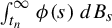 $\int _{t_n}^{\infty }\phi (s)\,{d} B_s$
, and let Q be the covariance operator of the distribution
 $\mu $
of
 $\int _{0}^{\infty }\phi (s)\,{d} B_s$
. By Theorem 2.2(iii), we get
 $$ \begin{align*} x^{*}R_{n}x^{*} = c\int_{t_n}^{\infty}|x^{*}\phi|^2\,{d} s \leq c\int_{0}^{\infty}|x^{*}\phi|^2\,{d} s = x^{*}Qx^{*}, \end{align*} $$
where
 $c=1$
if
 $\mathbb {K}=\mathbb {R}$
and
 $c=2$
if
 $\mathbb {K}=\mathbb {C}$
. By [Reference van Neerven40, Theorem 8.8] (stated for Banach spaces, but the proof given there carries over verbatim to Fréchet spaces), this implies that the sequence
 $(\nu _n)_{n\geq 0}$
is uniformly tight. However, we also have
 $\lim _{n\to \infty }x^{*}R_{n}x^{*}=0$
. By [Reference Bayart and Matheron4, Theorem 5.9(b)] (whose proof also extends to Fréchet spaces), we deduce that
 $\lim _{n\to \infty }\widehat {\nu _n}(x^{*})=1$
for all
 $x^{*}\in E^{*}$
. Therefore, by [Reference Vakhania, Tarieladze and Chobanyan39, Theorems I.3.6 and IV.3.1], we get that
 $\lim _{n\to \infty }\nu _n=\delta _0$
weakly, where
 $\delta _0$
is the Dirac measure at
 $0$
(that is,
 $\delta _{0}(A)=1$
if
 $0\in A$
and
 $\delta _{0}(A)=0$
if
 $0\notin A$
for all
 $A\in \mathscr {B}(E)$
).
We conclude the proof by using [Reference Bogachev7, Corollary 3.8.8]. We just need to check that
 $$ \begin{align*} \lim_{R\to\infty}\sup_{n\in\mathbb{N}}\int_{\{x\in E, \|x\|^{p}>R\}}\|x\|^{p}\,{d}\nu_n(x)=0. \end{align*} $$
Let
 $\varepsilon>0$
. Since
 $(\nu _n)_{n\geq 0}$
is uniformly tight, there exists a compact set
 $K\subseteq E$
, thus bounded, such that
 $\nu _{n}(K)>1-\varepsilon $
for all
 $n\geq 0$
. Let
 $R>0$
be so large that
 $K\subseteq \{x\in E, \|x\|^{p}\leq R\}$
. For all
 $n\geq 0$
, by the Cauchy–Schwarz inequality and [Reference van Neerven40, Theorem 8.8], we get that
 $$ \begin{align*} \int_{\{x\in E, \|x\|^{p}>R\}}\|x\|^{p}\,{d}\nu_n(x) &\leq \bigg(\!\int_{E}\|x\|^{2p}\,{d}\nu_n(x)\bigg)^{1/2} \bigg(\!\int_{E}\mathbf{1}_{\{x\in E, \|x\|^{p}>R\}}^2\,{d}\nu_{n}(x)\bigg)^{1/2}\\ &\leq \bigg(\!\int_{E}\|x\|^{2p}\,{d}\mu(x)\bigg)^{1/2}\varepsilon^{1/2}. \end{align*} $$
We conclude that
 $\sup _{n\geq 0}\int _{\{x\in E, \|x\|^{p}>R\}}\|x\|^{p}\,{d}\nu _n(x)\leq M\varepsilon ^{1/2}$
for some constant
 $M\geq 0$
. Since
 $\varepsilon $
was arbitrary, we are done.
Lemma 2.5. Let
 $\phi :I\longrightarrow E$
be stochastically integrable. Then, for any
 $s\in \mathbb {R}$
,
 $\phi (\cdot -s)$
is stochastically integrable on
 $I+s$
and the random vectors
 $\int _{I+s}\phi (t-s)\,{\text {d}} B_t$
and
 $\int _I\phi (t)\,{\text {d}} B_t$
are identically distributed.
Proof. For all
 $x^{*}\in E^{*}$
, we have by a change of variables and Theorem (2.2) that
 $$ \begin{align*} c\int_{I+s}|x^{*}(\phi(t-s))|^{2}\,{d} t = c\int_{I}|x^{*}(\phi(t))|^{2}\,{d} t = x^{*}Qx^{*}, \end{align*} $$
where
 $c=1$
if
 $\mathbb {K}=\mathbb {R}$
and
 $c=2$
if
 $\mathbb {K}=\mathbb {C}$
, and Q is the covariance operator of the distribution
 $\mu $
of
 $\int _{I}\phi (t)\,{d} B_{t}$
. By Theorem 2.2, we deduce that
 $\phi (\cdot -s)$
is stochastically integrable and
 $\mu $
is the distribution of
 $\int _{I+s}\phi (t-s)\,{d} B_{t}$
.
Lemma 2.6. Let
 $A,B\in \mathscr {B}(I)$
and
 $\phi ,\varphi :I\longrightarrow E$
be two stochastically integrable functions. If A and B are disjoint, then the random vectors
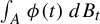 $\int _{A}\phi (t)\,{{d}} B_t$
and
 $\int _{B}\varphi (t)\,{{d}} B_t$
are independent.
Proof. The random vectors
 $X:=\int _{A}\phi (t)\,{d} B_{t}$
and
 $Y:=\int _{B}\varphi (t)\,{d} B_{t}$
are independent if and only if
 $x^{*}(X)$
and
 $y^{*}(Y)$
are independent for all
 $x^{*},y^{*}\in E^{*}$
, see [Reference Buldygin and Solntsev10, p. 23]. By Lemma 2.1 and Itô isometry, we have
 $$ \begin{align*} \langle x^{*}(X), y^{*}(Y)\rangle_{L^{2}(\Omega)} &= \bigg\langle\! \int_{A}x^{*}(\phi(t))\,{d} B_{t}, \int_{B}y^{*}(\varphi(t))\,{d} B_{t}\bigg\rangle_{L^{2}(\Omega)}\\ &= c\langle x^{*}\phi, y^{*}\varphi\rangle_{L^{2}(I)} = 0, \end{align*} $$
where
 $c=1$
if
 $\mathbb {K}=\mathbb {R}$
and
 $c=2$
if
 $\mathbb {K}=\mathbb {C}$
. Since
 $(x^{*}(X),y^{*}(Y))$
is a Gaussian random vector by linearity of the stochastic integral, this implies that
 $x^{*}(X)$
and
 $y^{*}(Y)$
are independent by [Reference Hytönen, van Neerven, Veraar and Weis22, Proposition E.2.12].
We end this section with a result characterizing the stochastically integrable functions with values in a space of functions. This will be useful for concrete examples.
Theorem 2.7. Let
 $(S,\mathcal {B},\mu )$
be a
 $\sigma $
-finite measure space, let
 $1\leq p<\infty $
, and set
 $E:=L^{p}(S,\mathcal {B},\mu )$
. Then, a measurable function
 $\phi :I\longrightarrow E$
is stochastically integrable if and only if
 $$ \begin{align*} \bigg\|\bigg(\!\int_I|\phi(t,\cdot)|^{2}\text{\,{d}}t\bigg)^{1/2}\bigg\|_{E}<\infty. \end{align*} $$
Theorem 2.7 is a direct consequence of [Reference van Neerven and Weis41, Corollary 2.10] by noticing that
 $L^{p}(S,\mathcal {B},\mu )$
has finite cotype for any
 $1\leq p<\infty $
, see [Reference Hytönen, van Neerven, Veraar and Weis22, Proposition 7.1.4].
3 Random vector: first method
The final parts of the proofs of the main results of §§3 and 4 are the same, so we put it in a lemma.
Lemma 3.1. Let
 $(T_t)_{t\geq 0}$
be a
 $C_0$
-semigroup on E. Let
 $v:\Omega \longrightarrow E$
be a random vector such that its probability distribution is ergodic for
 $(T_t)_{t\geq 0}$
and is of full support. Then, v is almost surely frequently hypercyclic for
 $(T_t)_{t\geq 0}$
.
Proof. Let
 $\mu $
be the probability distribution of v. Let O be a non-empty open subset of E. The Birkhoff ergodic theorem for semigroups, see [Reference Cornfeld, Fomin and Sinaĭ14, Ch. 1, §2, Theorem 1], can be applied to T and
 $\mu $
, and gives
 $$ \begin{align*} \lim_{N\to\infty}\frac{1}{N}\int_{0}^{N}(\mathbf{1}_{O}\circ T_t)(x)\,{d} t=\mu(O)\ \mu\text{-almost surely (a.s.)}. \end{align*} $$
Let A be a Borel subset of E such that
 $\mu (A)=1$
and the previous equality holds everywhere on A. Then, if we set
 $B:=v^{-1}(A)\subseteq \Omega $
, we have
 $\mathbb {P}(B)=\mathbb {P}(v^{-1}(A))=\mu (A)=1$
and
 $$ \begin{align*} \lim_{N\to\infty}\frac{1}{N}\int_{0}^{N}(\mathbf{1}_{O}\circ T_t)(v)\,{d} t=\mathbb{P}(v\in O)>0 \end{align*} $$
on B. Since E is separable, we can take a countable base of open subsets of E and get that almost surely, the set
 $\{t\geq 0\mid T_t(v)\in O\}$
has positive lower density for every non-empty open subset O of E. The random vector v is therefore almost surely frequently hypercyclic for
 $(T_t)_{t\geq 0}$
.
The next proposition is the analogous result to Proposition 1.1. Their proofs are the same, but we need to use the Birkhoff ergodic theorem for semigroups through Lemma 3.1, and replace all series with stochastic integrals.
Proposition 3.2. Let
 $(T_t)_{t\geq 0}$
be a
 $C_0$
-semigroup on E and let
 $(u_t)_{t\in \mathbb {R}}$
be a family of vectors in E such that
 $T_s(u_t)=u_{t-s}$
for every
 $s\geq 0$
and
 $t\in \mathbb {R}$
. Let
 $(B_t)_{t\in \mathbb {R}}$
be a Brownian motion. Assume that
 $t\longmapsto u_t$
is stochastically integrable and set
 $$ \begin{align*} v:=\int_{\mathbb{R}}u_t\,{{d}} B_t. \end{align*} $$
If v has full support, then v is almost surely frequently hypercyclic for the
 $C_0$
-semigroup
 $(T_t)_{t\geq 0}$
and it induces a strongly mixing measure with full support for
 $(T_t)_{t\geq 0}$
.
Proof. Define the probability measure
 $$ \begin{align*} \mu : \mathscr{B}(E)\longrightarrow[0,1] , A\longmapsto\mathbb{P}(v\in A). \end{align*} $$
Let
 $s\geq 0$
. We first show that
 $\mu $
is
 $T_s$
-invariant. Let
 $A\in \mathscr {B}(E)$
. By the definitions of
 $\mu $
and v and by Lemmas 2.1 and 2.5, we have
 $$ \begin{align*} \mu(T_s^{-1}(A))=\mathbb{P}(T_s(v)\in A) =\mathbb{P}\bigg(\!\int_{\mathbb{R}}u_{t-s}\,{d} B_t\in A\bigg) =\mathbb{P}\bigg(\!\int_{\mathbb{R}}u_t\,{d} B_t\in A\bigg). \end{align*} $$
We conclude that
 $\mu (T_s^{-1}(A))=\mathbb {P}(v\in A)=\mu (A)$
. The measure
 $\mu $
is thus
 $T_s$
-invariant.
Now, we claim that
 $\mu $
is
 $(T_{t})_{t\geq 0}$
-strongly mixing. Let f and g be two bounded and continuous real-valued functions defined on E. We aim to show that
 $$ \begin{align*} \lim_{t\to\infty}\int_E(f\circ T_t)g\,{d}\mu=\int_E f\,{d}\mu\int_E g\,{d}\mu. \end{align*} $$
Since the set of bounded continuous functions on E is dense in
 $L^2(E,\mu )$
by [Reference Coudène15, Theorem 18.1], this will imply the claim by [Reference Coudène15, p. 26]. First, by definition of
 $\mu $
, this is equivalent to showing that
 $$ \begin{align} \lim_{t\to\infty}\int_{\Omega} f(T_t(v))g(v)\,{d}\mathbb{P}=\int_{\Omega} f(v)\,{d}\mathbb{P}\int_{\Omega} g(v)\,{d}\mathbb{P}. \end{align} $$
Let
 $\varepsilon>0$
. Since f and g are continuous and bounded, by Proposition 2.4 and the dominated convergence theorem, there exists
 $N\geq 0$
such that
 $$ \begin{align} \bigg\|g\bigg(\!\int_{-\infty}^{N}u_t\,{d} B_t\bigg)-g(v)\bigg\|_{L^{1}(\Omega,\mathbb{P})}<\varepsilon \end{align} $$
and
 $$ \begin{align} \bigg\|f\bigg(\!\int_{-N}^{\infty}u_t\,{d} B_t\bigg)-f(v)\bigg\|_{L^{1}(\Omega,\mathbb{P})}<\varepsilon. \end{align} $$
Let
 $s>2N$
and write
 $$ \begin{align} f(T_s(v))g(v) &= f(T_s(v))g(v)-f(T_s(v))g\bigg(\!\int_{-\infty}^{N}u_{t}\,{d} B_t\bigg)\notag\\ &\quad +f(T_s(v))g\bigg(\!\int_{-\infty}^{N}u_{t}\,{d} B_t\bigg)-f\bigg(\!\int_{-N+s}^{\infty}u_{t-s}\,{d} B_t\bigg)g\bigg(\!\int_{-\infty}^{N}u_{t}\,{d} B_t\bigg)\notag\\ &\quad +f\bigg(\!\int_{-N+s}^{\infty}u_{t-s}\,{d} B_t\bigg)g\bigg(\!\int_{-\infty}^N u_t\,{d} B_t\bigg). \end{align} $$
For the first two terms, using the assumption that f is bounded and the inequality (3.2) yields
 $$ \begin{align*} \bigg|\!\int_{\Omega}f(T_s(v))g(v)\,{d}\mathbb{P} &-\int_{\Omega}f(T_s(v))g\bigg(\!\int_{-\infty}^{N}u_{t}\,{d} B_t\bigg)\,{d}\mathbb{P}\bigg|\\ &\leq \|f\|_{\infty}\bigg\|g\bigg(\!\int_{-\infty}^{N}u_{t}\,{d} B_t\bigg)-g(v)\bigg\|_{L^{1}(\Omega,\mathbb{P})} \leq \|f\|_{\infty}\varepsilon. \end{align*} $$
Now, for the third and fourth terms, define the random vectors
 $$ \begin{align*} X&:=\int_{-\infty}^{-N+s}u_{t-s}\,{d} B_{t},\quad Y:=\int_{-N+s}^{\infty}u_{t-s}\,{d} B_{t},\\ U&:=\int_{-\infty}^{-N}u_{t}\,{d} B_{t},\phantom{\,{d} B_{t},}\quad V:=\int_{-N}^{\infty}u_{t}\,{d} B_{t}. \end{align*} $$
Then, Lemma 2.5 implies that X and U are identically distributed, and so are Y and V. By Lemma 2.6, X and Y are independent, and so are U and V. Therefore, the random variables
 $f(X+Y)-f(Y)$
and
 $f(U+V)-f(V)$
are identically distributed. Now, by using Lemma 2.1, we get that
 $$ \begin{align*} \bigg|\!\int_{\Omega}\bigg( f(T_s(v))&g\bigg(\!\int_{-\infty}^{N}u_{t}\,{d} B_t\bigg)-f\bigg(\!\int_{-N+s}^{\infty}u_{t-s}\,{d} B_t\bigg)g\bigg(\!\int_{-\infty}^{N}u_{t}\,{d} B_t\bigg)\bigg)\,{d}\mathbb{P} \bigg|\\ &\quad \leq \|g\|_{\infty} \bigg\|f\bigg(\!\int_{-\infty}^{\infty}u_{t-s}\,{d} B_t\bigg)-f\bigg(\!\int_{-N+s}^{\infty}u_{t-s}\,{d} B_t\bigg) \bigg\|_{L^{1}(\Omega,\mathbb{P})}\\ &\quad = \|g\|_{\infty} \bigg\|f\bigg(\!\int_{-\infty}^{\infty}u_t\,{d} B_t\bigg)-f\bigg(\!\int_{-N}^{\infty}u_t\,{d} B_t\bigg) \bigg\|_{L^{1}(\Omega,\mathbb{P})}\\ &\quad \leq \|g\|_{\infty}\varepsilon, \end{align*} $$
where we have used (3.3) for the last inequality. For the last term of (3.4), since
 $s>2N$
, and by using Lemma 2.6 and then Lemma 2.5, one has
 $$ \begin{align*} \int_{\Omega}&f\bigg(\!\int_{-N+s}^{\infty}u_{t-s}\,{d} B_t\bigg)g\bigg(\!\int_{-\infty}^N u_t\,{d} B_t\bigg)\,{d}\mathbb{P}\\ &=\int_{\Omega}f\bigg(\!\int_{-N+s}^{\infty}u_{t-s}\,{d} B_t\bigg)\,{d}\mathbb{P}\int_{\Omega}g\bigg(\!\int_{-\infty}^{N}u_t\,{d} B_t\bigg)\,{d}\mathbb{P}\\ &=\int_{\Omega}f\bigg(\!\int_{-N}^{\infty}u_t\,{d} B_t\bigg)\,{d}\mathbb{P}\int_{\Omega}g\bigg(\!\int_{-\infty}^{N}u_t\,{d} B_t\bigg)\,{d}\mathbb{P}. \end{align*} $$
Therefore, using again (3.2) and (3.3) gives
 $$ \begin{align*} \bigg|\!\int_{\Omega}&f\bigg(\!\int_{-N+s}^{\infty}u_{t-s}\,{d} B_t\bigg)g\bigg(\!\int_{-\infty}^N u_t\,{d} B_t\bigg)\,{d}\mathbb{P} -\int_{\Omega} f(v)\,{d}\mathbb{P}\int_{\Omega}g(v)\,{d}\mathbb{P}\bigg|\\ &\leq \|f\|_{\infty} \bigg\|g\bigg(\!\int_{-\infty}^N u_t\,{d} B_t\bigg)-g(v) \bigg\|_{L^1(\Omega,\mathbb{P})} +\|g\|_{\infty} \bigg\|f\bigg(\!\int_{-N}^{\infty}u_t\,{d} B_t\bigg)-f(v)\bigg\|_{L^1(\Omega,\mathbb{P})}\\ &\leq\|f\|_{\infty}\varepsilon+\|g\|_{\infty}\varepsilon. \end{align*} $$
We can finally conclude that
 $$ \begin{align*} \bigg|\!\int_{\Omega}f(T_s(v))g(v)\,{d}\mathbb{P}-\int_{\Omega}f(v)\,{d}\mathbb{P} \int_{\Omega}g(v)\,{d}\mathbb{P}\bigg|\leq 2\|f\|_{\infty}\varepsilon+2\|g\|_{\infty}\varepsilon, \end{align*} $$
and since
 $\varepsilon>0$
was arbitrary, we eventually get (3.1). The measure
 $\mu $
is thus
 $(T_t)_{t\geq 0}$
-strongly mixing.
The result now follows by Lemma 3.1.
We have the following corollary.
Theorem 3.3. Let
 $(T_t)_{t\geq 0}$
be a
 $C_0$
-semigroup on a separable Banach space E of type
 $2$
. Let
 $(u_t)_{t\in \mathbb {R}}$
be a family of vectors in E such that
 $T_s(u_t)=u_{t-s}$
for every
 $s\geq 0$
and
 ${t\in \mathbb {R}}$
, and
 $\mathrm{span}\{u_t\mid t\notin A\}$
is dense in E for every
 $A\in \mathscr {B}(\mathbb {R})$
with zero Lebesgue measure. Let
 $(B_t)_{t\in \mathbb {R}}$
be a Brownian motion. Assume that
 $t\longmapsto u_{t}\in L^{2}(\mathbb {R};E)$
. Then, the random vector
 $$ \begin{align*} v:=\int_{\mathbb{R}}u_t\,{{d}} B_t \end{align*} $$
is almost surely well defined and frequently hypercyclic for
 $(T_t)_{t\geq 0}$
, and it induces a strongly mixing measure with full support for
 $(T_t)_{t\geq 0}$
.
Proof. We first prove that v is almost surely well defined. Define the linear map
 $J:\phi \longmapsto \int _{\mathbb {R}}\phi (t)\,{d} B_{t}$
defined on the space of E-valued step functions. Let
 $\phi =\sum _{i=1}^{n}a_{i}\mathbf {1}_{A_{i}}$
be a step function. Since E has type
 $2$
, we have
 $$ \begin{align*} \|J(\phi)\|_{L^{2}(\Omega;E)}^{2} \leq C\sum_{i=1}^{n}\unicode{x3bb}(A_{i})\|a_{i}\|_{E}^{2} = C\|\phi\|_{L^{2}(\mathbb{R};E)}^{2}, \end{align*} $$
where
 $C>0$
is some constant depending only on E and
 $\unicode{x3bb} $
is the Lebesgue measure on
 $\mathbb {R}$
. Therefore, J is a continuous embedding, and the density of the space of step functions in
 $L^{2}(\mathbb {R};E)$
, see [Reference Hytönen, van Neerven, Veraar and Weis21, Remark 1.2.20], allows us to extend J on
 $L^{2}(\mathbb {R};E)$
. Theorem 2.3 then implies that
 $J(\phi )=\int _{\mathbb {R}}\phi (t)\,{d} B_t$
for every
 $\phi \in L^{2}(\mathbb {R};E)$
. This shows that v is almost surely well defined since the map
 $t\longmapsto u_{t}$
belongs to
 $L^{2}(\mathbb {R};E)$
.
Let Q be the covariance operator of the probability distribution
 $\mathbb {P}_v$
of v. By [Reference Bayart and Matheron4, Proposition 5.18], it suffices to show that Q is one-to-one to prove that
 $\mathbb {P}_{v}$
has full support. Let
 $x^{*}\in \text {Ker}(Q)$
. By definition of Q, we have
 $$ \begin{align*} 0=x^{*}(Q(x^{*}))=\int_E|x^{*}|^2\,{d}\mathbb{P}_v=\int_{\Omega}|x^{*}(v)|^2\,{d}\mathbb{P}, \end{align*} $$
implying that
 $x^{*}(v)=0$
almost surely. By Lemma 2.1, we get that
 $$ \begin{align*} 0=x^{*}(v)=\int_{\mathbb{R}}x^{*}(u_t)\,{d} B_{t} \end{align*} $$
almost surely. Therefore, Itô’s isometry yields that
 $x^{*}(u_t)=0$
for every
 $t\in \mathbb {R}$
outside some set of zero Lebesgue measure. By assumption, we get
 $x^{*}=0$
.
The result now follows by Proposition 3.2.
Remark 3.4. In the proof of Theorem 3.3, to show that v is almost surely well defined, we actually proved that
 $L^{2}(\mathbb {R};E)$
is continuously embedded in the space of stochastically integrable functions. This was already known in [Reference Rosiński and Suchanecki34, Proposition 5.2].
As mentioned above, we have not been able to prove analogous results to [Reference Agneessens1, Theorem 1.3] or [Reference Agneessens1, Theorem 3.3] for
 $C_0$
-semigroups. In the proof of Proposition 3.2, the independent and stationary increments of the Brownian motion play a crucial role. The idea was then to prove the existence of a stochastic process with respect to which
 $t\longmapsto u_t$
is stochastically integrable, under some deterministic conditions on
 $(u_t)_{t\in \mathbb {R}}$
. A sought condition was the Pettis integrability of
 $t\longmapsto u_t$
. If this plan could work, one would then hope to find another proof of the frequent hypercyclicity criterion for semigroups [Reference Murillo-Arcila and Peris30, Theorem 3], as we did for operators in [Reference Agneessens1].
4 Random vector: second method
In our second approach, we will make assumptions close to those of the main result of Chakir and El Mourchid [Reference Chakir and EL Mourchid11, Theorem 3.2]. The semigroup will be defined on a complex Fréchet space since we will consider purely imaginary eigenvalues of the generator.
Theorem 4.1. Let
 $(T_t)_{t\geq 0}$
be a
 $C_0$
-semigroup on a separable complex Fréchet space E. Let A be the generator of
 $(T_t)_{t\geq 0}$
and let
 $(u_t)_{t\in I}$
be a family of vectors in
 ${\mathrm {Dom}}(A)$
such that
 $A(u_t)=itu_{t}$
for every
 $t\in I$
, where I is a non-empty interval of
 $\mathbb {R}$
, and
 ${\mathrm {span}}\{u_t\mid t\notin B\}$
is dense in E for every
 $B\in \mathscr {B}(I)$
with zero Lebesgue measure. Let
 $(B_t)_{t\in I}$
be a complex Brownian motion. Assume that
 $t\longmapsto u_t$
is stochastically integrable and set
 $$ \begin{align*} v:=\int_{I}u_t\,{{d}} B_t. \end{align*} $$
Then, v is almost surely frequently hypercyclic for the
 $C_0$
-semigroup
 $(T_t)_{t\geq 0}$
and it induces a strongly mixing measure with full support for
 $(T_t)_{t\geq 0}$
.
Proof. Let Q be the covariance operator of the probability distribution
 $\mathbb {P}_v$
of v.
Let
 $x^{*},y^{*}\in E^{*}$
. By using the definition of Q and Lemma 2.1, we have
 $$ \begin{align} y^{*}Qx^{*}&=\int_{E}y^{*}(x)\overline{x^{*}(x)}\,{d}\mathbb{P}_v(x) =\int_{\Omega}y^{*}\bigg(\!\int_{I}u_t\,{d} B_t\bigg)\overline{x^{*}\bigg(\!\int_{I}u_t\,{d} B_t\bigg)}\,{d}\mathbb{P} \nonumber \\ &=\mathbb{E}\bigg(\!\int_{I}y^{*}(u_t)\,{d} B_t\overline{\int_{I}x^{*}(u_t)\,{d} B_t}\bigg) =2\int_{I}y^{*}(u_t)\overline{x^{*}(u_t)}\,{d} t; \end{align} $$
note that we have used the linearization of the Itô isometry.
We first prove that
 $\mathbb {P}_v$
is
 $(T_t)_{t\geq 0}$
-invariant. Let
 $x^{*},y^{*}\in E^{*}$
and
 $t\geq 0$
. By using (4.1) twice and the assumption on
 $(u_s)_{s\in I}$
, we have
 $$ \begin{align*} y^{*}T_tQT_t^{*}x^{*}&=T_t^{*}y^{*}QT_t^{*}x^{*} =2\int_{I}T_t^{*}y^{*}(u_s)\overline{T_t^{*}x^{*}(u_s)}\,{d} s\\ &=2\int_{I}y^{*}T_t(u_s)\overline{x^{*}T_t(u_s)}\,{d} t =2\int_{I}e^{its}y^{*}(u_s)e^{-its}\overline{x^{*}(u_s)}\,{d} s\\ &=y^{*}Qx^{*}. \end{align*} $$
By [Reference Bayart and Matheron4, Proposition 5.22], this shows that
 $\mathbb {P}_v$
is
 $(T_t)_{t\geq 0}$
-invariant.
Now, let us show that
 $\mathbb {P}_v$
is strongly mixing for
 $(T_t)_{t\geq 0}$
. Let
 $x^{*},y^{*}\in E^{*}$
and
 $t\geq 0$
. By using (4.1) and the assumption on
 $(u_t)_{t\in I}$
, we have
 $$ \begin{align*} y^{*}QT_{t}^{*}(x^{*}) &= 2\int_{I}y^{*}(u_s)\overline{T_t^{*}x^{*}(u_s)}\,{d} s = 2\int_{I}y^{*}(u_s)\overline{x^{*}(e^{its}u_s)}\,{d} s\\ &= 2\int_{I}e^{-its}y^{*}(u_s)\overline{x^{*}(u_s)}\,{d} s. \end{align*} $$
Since
 $s\longmapsto y^{*}(u_s)\overline {x^{*}(u_s)}$
is integrable, by the Riemann–Lebesgue lemma, see [Reference Hytönen, van Neerven, Veraar and Weis21, Lemma 2.4.3], we get that
 $\lim _{t\to \infty }y^{*}QT_{t}^{*}(x^{*})=0$
. We conclude that
 $\mathbb {P}_{v}$
is strongly mixing for
 $(T_t)_{t\geq 0}$
by [Reference Bayart and Matheron4, Theorem 5.24].
Finally,
 $P_{v}$
has full support by the same arguments as in the proof of Theorem 3.3.
We conclude the proof by using Lemma 3.1.
As a first application, let us apply Theorem 4.1 to the chaotic translation semigroups. Let
 $I\in \{\mathopen {[}0,\infty \mathclose {[},\mathbb {R}\}$
. For a given real
 $1\leq p<\infty $
and a measurable function
 $\rho : I \longrightarrow \mathopen {]}0,\infty \mathclose {[}$
, we define the Banach space
 $$ \begin{align*} L_{\rho}^{p}(I):=\bigg\{f:I\longrightarrow\mathbb{K}\mid\int_I|f(x)|^p\rho(x)\,{d} x<\infty\bigg\} \end{align*} $$
endowed with the norm
 $\|f\|_{L_{\rho }^{p}(I)}:=(\int _{I}|f(x)|^p\rho (x)\,{d} x)^{1/p}$
,
 $f\in L_{\rho }^p(I)$
. An admissible weight function
 $\rho $
is a measurable function
 $\rho : I \longrightarrow \mathopen {]}0,\infty \mathclose {[}$
such that there exist
 $M\geq 1$
and
 $w\in \mathbb {R}$
such that
 $\rho (s)\leq M e^{wt}\rho (t+s)$
for every
 $s\in I$
and
 $t\geq 0$
.
For an admissible weight function
 $\rho $
, the translation semigroup on
 $L_{\rho }^{p}(I)$
is defined by
 $$ \begin{align*} T_t(f)(x):=f(x+t),\quad x\in I, t\geq 0, \end{align*} $$
for every
 $f\in L_{\rho }^p(I)$
. Its generator is the differentiation operator defined on the space of absolutely continuous functions in
 $L_{\rho }^p(I)$
with derivative in
 $L_{\rho }^p(I)$
, see [Reference Engel and Nagel18, p. 51, Proposition II.1].
It is shown in [Reference Chakir and EL Mourchid11, Example 4.1] that these semigroups admit a strongly mixing Gaussian measure, by constructing a complex Gaussian process. We reuse their arguments to apply Theorem 4.1.
Theorem 4.2. Let
 $1\leq p<\infty $
,
 $I\in \{\mathopen {[}0,\infty \mathclose {[},\mathbb {R}\}$
, and an admissible weight
 $\rho :I\longrightarrow \mathopen {]}0,\infty \mathclose {[}$
. If the integral
 $\int _{I}\rho (x)\,{{d}}x$
is finite, then for any
 $f\in L^{2}(\mathbb {R};\mathbb {C})$
with
 $f\neq 0$
almost everywhere, the random vector
 $$ \begin{align*} \int_{\mathbb{R}}f(t)e_{t}\,{{d}} B_{t}, \end{align*} $$
where
 $e_t(x)=e^{itx}$
,
 $x\in I,t\in \mathbb {R}$
, is almost surely frequently hypercyclic for the translation semigroup
 $(T_t)_{t\geq 0}$
on
 $L_{\rho }^p(I)$
, and it induces a strongly mixing measure with full support for
 $(T_t)_{t\geq 0}$
.
Proof. For every
 $s\in \mathbb {R}$
, define the function
 $u_{s}:I\longrightarrow \mathbb {C}$
by
 $$ \begin{align*} u_{s}(x):=f(s)e^{isx} \end{align*} $$
for all
 $x\in I$
. Since
 $\int _{I}\rho (x)\,{d} x<\infty $
, we get that
 $u_{s}\in L_{\rho }^{p}(I)$
for all
 $s\in \mathbb {R}$
.
It is clear that
 $T_{t}(u_{s})=e^{ist}u_{s}$
for every
 $s\in \mathbb {R}$
and
 $t\geq 0$
. This implies that
 ${u_{s}\in \text {Dom}(A)}$
and
 $A(u_{s})=isu_{s}$
for every
 $s\in \mathbb {R}$
, where A is the generator of the semigroup.
Now, let
 $\phi \in (L_{\rho }^{p}(I))^{*}=L_{\rho ^{-q/p}}^{q}(I)$
, where
 $1/p+1/q=1$
, be such that
 $\phi (u_{s})=0$
for all
 $s\notin B$
, where
 $B\in \mathscr {B}(\mathbb {R})$
has zero Lebesgue measure. Then,
 $$ \begin{align*} 0=\phi(u_s)=\int_{I}f(s)e^{isx}\phi(x)\,{d} x, \end{align*} $$
and hence,
 $\int _{I}e^{isx}\phi (x)\,{d} x=0$
for all
 $s\notin B$
. Since
 $\phi \in L^{1}(I)$
by the fact that
 $\int _{I}\rho (x)\,{d} x<\infty $
and Hölder’s inequality, we get that
 $\phi =0$
almost everywhere by [Reference Rudin35, Theorem 9.11], and thus,
 $\phi =0$
. This shows that
 $\text {span}\{u_s\mid s\notin B\}$
is dense in
 $L_{\rho }^p(I)$
for any
 $B\in \mathscr {B}(\mathbb {R})$
with zero Lebesgue measure.
We now prove that
 $$ \begin{align*} \bigg\|\bigg(\!\int_{\mathbb{R}}|u_s(\cdot)|^2\,{d} s\bigg)^{1/2}\bigg\|_{L_{\rho}^p(I)}<\infty. \end{align*} $$
For any
 $x\in I$
, we have
 $$ \begin{align*} \int_{\mathbb{R}}|u_s(x)|^{2}\,{d} s=\int_{\mathbb{R}}f(s)^{2}\,{d} s, \end{align*} $$
and thus,
 $$ \begin{align*} \bigg\|\bigg(\!\int_{\mathbb{R}}|u_s(\cdot)|^2\,{d} s\bigg)^{1/2}\bigg\|_{L_{\rho}^p(I)}^{p} = \int_{I}\bigg(\!\int_{\mathbb{R}}f(s)^{2}\,{d} s\bigg)^{p/2}\rho(x)\,{d} x, \end{align*} $$
which is finite since
 $\int _{I}\rho (x)\,{d} x<\infty $
and
 $f\in L^{2}(\mathbb {R};\mathbb {C})$
.
By Theorem 2.7, the map
 $s\longmapsto u_s$
is stochastically integrable. We conclude the proof by applying Theorem 4.1.
Remark 4.3. By [Reference Mangino and Murillo-Arcila27, Theorems 3.9 and 3.10], the translation semigroup on
 $L_{\rho }^{p}(I)$
is chaotic if and only if
 $\int _{I}\rho (x)\,{d} x$
is finite. Therefore, by Theorem 4.2, we have found a frequently hypercyclic random vector for any chaotic translation semigroup on
 $L_{\rho }^{p}(I)$
.
For these chaotic translation semigroups, in the case where the underlying space is of type
 $2$
, one can apply Theorem 3.3 as follows. Define
 $F:\mathbb {R}\longrightarrow L_{\rho }^{p}(I)$
as
 $F(\theta )(x)=\varphi (\theta )e^{i\theta x}$
for all
 $\theta \in \mathbb {R}$
and
 $x\in I$
, where
 $\varphi :\mathbb {R}\longrightarrow \mathbb {R}$
is a positive, smooth, and integrable function on
 $\mathbb {R}$
. This implies that F is Bochner-integrable, and thus,
 $$ \begin{align*} u_{t} :=\int_{\mathbb{R}}e^{-it\theta}F(\theta)\,{d} \theta \end{align*} $$
is well defined for all
 $t\in \mathbb {R}$
. We then have
 $T_{s}F(\theta )=e^{is\theta }F(\theta )$
for all
 $\theta \in \mathbb {R}$
and
 $s\geq 0$
, which implies that
 $T_{s}u_{t}=u_{t-s}$
for all
 $s\geq 0$
and
 $t\in \mathbb {R}$
. The spanning property is proved in a similar way as in the proof of Theorem 4.2. Furthermore, we have
 $\|u_{t}\|\leq C/(1+t^{2})$
for all
 $t\in \mathbb {R}$
for some constant
 $C>0$
if F is twice-differentiable by [Reference Hytönen, van Neerven, Veraar and Weis21, Lemma 2.4.3 and its proof], and this is guaranteed provided that
 $\int _{I}|x|^{2p}\rho (x)\,{d} x$
is finite. Hence, one can apply Theorem 3.3. This idea, suggested by the referee, might also be used to apply Proposition 3.2 or Theorem 3.3 to other examples in subsequent research.
The second example was studied by El Mourchid and Latrach in [Reference Mourchid and Latrach17, Proposition 3.4], who proved the existence of a strongly mixing Gaussian measure for the semigroup under consideration. It turns out that their arguments are the same to check the assumptions of Theorem 4.1.
Theorem 4.4. Let
 $1\leq p<\infty $
and A be the weighted shift on
 $\ell ^{p}$
with sequence of weights
 $(w_{n})_{n\geq 1}$
. Set
 $\beta _{n}:=w_1\cdots w_n$
for all
 $n\geq 1$
and
 $\beta _0:=1$
. If the quantity
 $\limsup _{n\to \infty }(1/|\beta _n|)^{1/n}$
is finite, then there exists
 $\eta>0$
such that the random vector
 $$ \begin{align*} \int_{-\eta}^{\eta}\bigg(\frac{i^nt^n}{\beta_n}\bigg)_{n\geq 0}\,{{d}} B_t \end{align*} $$
is almost surely frequently hypercyclic for the
 $C_0$
-semigroup
 $(T_t)_{t\geq 0}:=(e^{tA})_{t\geq 0}$
, and it induces a strongly mixing measure with full support for
 $(T_t)_{t\geq 0}$
.
Proof. For all
 $\unicode{x3bb} \in \mathbb {C}$
, define the sequence
 $v_{\unicode{x3bb} }:=(\unicode{x3bb} ^n/\beta _n)_{n\geq 0}$
. Then,
 $v_{\unicode{x3bb} }\in \ell ^{p}$
if and only if
 $\sum _{n\geq 0}|\unicode{x3bb} |^{np}/|\beta _n|^p<\infty $
, and in that case, we have
 $A(v_{\unicode{x3bb} })=(\unicode{x3bb} ^{n+1}/\beta _n)_{n\geq 0}=\unicode{x3bb} v_{\unicode{x3bb} }$
. The power series
 $\sum _{n\geq 0}\unicode{x3bb} ^{n}/\beta _n$
has a radius of convergence
 $R:=1/\rho $
, where
 ${\rho :=\limsup _{n\to \infty }(1/|\beta _n|)^{1/n}<\infty }$
.
Let
 $\eta \in \mathopen {]}0,R\mathclose {[}$
and define
 $u_s:=v_{is}$
for every
 $-\eta <s<\eta $
. By our previous calculations, we have
 $u_{s}\in \ell ^{p}$
and
 $A(u_s)=isu_s$
for all
 $-\eta <s<\eta $
.
Let
 $\phi =(\phi _n)_{n\geq 0}\in (\ell ^p)^{*}=\ell ^q$
, where
 $1/p+1/q=1$
, be such that
 $\phi (u_s)=0$
for almost all
 $-\eta <s<\eta $
. Define the analytic function
 $F:D(0,R)\longrightarrow \mathbb {C}$
by
 $$ \begin{align*} F(\unicode{x3bb}):=\sum_{n=0}^{\infty}\frac{\unicode{x3bb}^{n}\phi_{n}}{\beta_{n}}=\phi(v_{\unicode{x3bb}}) \end{align*} $$
for all
 $\unicode{x3bb} \in D(0,R)$
. Since
 $F=0$
almost everywhere on
 $i\mathopen {]}-\eta ,\eta \mathclose {[}$
, we conclude that
 ${F=0}$
on
 $D(0,R)$
and
 $\phi =0$
. This means that
 $\text {span}\{u_t\mid t\notin B\}$
is dense in
 $\ell ^p$
for any
 $B\in \mathscr {B}(\mathopen {]}-\eta ,\eta \mathclose {[})$
with zero Lebesgue measure.
For all
 $n\geq 0$
, we have
 $$ \begin{align*} \int_{-\eta}^{\eta}|u_s(n)|^2\,{d} s=\int_{-\eta}^{\eta}\frac{|is|^{2n}}{|\beta_n|^2}\,{d} s \leq \frac{2\eta\eta^{2n}}{|\beta_n|^2}, \end{align*} $$
implying that
 $$ \begin{align*} \bigg\|\bigg(\!\int_{-\eta}^{\eta}|u_s(\cdot)|^2\,{d} s\bigg)^{1/2}\bigg\|_{\ell^p}^{p}\leq\sum_{n=0}^{\infty}\frac{2^{p/2}\eta^{p/2}\eta^{np}}{|\beta_n|^p}, \end{align*} $$
which is finite since
 $\eta <R$
. Therefore, by Theorem 2.7, the map
 $s\longmapsto u_s$
is stochastically integrable.
We conclude the proof by applying Theorem 4.1.
We now study the translation semigroups on
 $H(\mathbb {C})$
. We will need the notion of Hilbert seminorm: it is a seminorm
 $p:H(\mathbb {C})\longrightarrow \mathopen {[}0,\infty \mathclose {[}$
for which there exists a semi-scalar product
 $\langle \cdot ,\cdot \rangle $
on
 $H(\mathbb {C})$
such that
 $p(x)=\langle x,x\rangle $
for all
 $x\in H(\mathbb {C})$
. If
 $f\in H(\mathbb {C})$
and
 $r>0$
, we define
 $\|f\|_{r}:=\sup _{|z|\leq r}|f(z)|$
.
Theorem 4.5. For each
 $t\geq 0$
, define the translation operator
 $$ \begin{align*} T_t:H(\mathbb{C})\longrightarrow H(\mathbb{C}), f\longmapsto f(\cdot+t). \end{align*} $$
Then, the random vector
 $\int _{0}^{2\pi }e^{itz}\,{{d}} B_t$
is almost surely frequently hypercyclic for the
 $C_0$
-semigroup
 $(T_t)_{t\geq 0}$
, and it induces a strongly mixing measure with full support for
 $(T_t)_{t\geq 0}$
.
Proof. It is easy to check that
 $(T_t)_{t\geq 0}$
is indeed a
 $C_0$
-semigroup. Furthermore, its generator is the differentiation operator
 $D:H(\mathbb {C})\longrightarrow H(\mathbb {C})$
.
For every
 $s\in \mathopen {[}0,2\pi \mathclose {]}$
, set
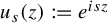 $u_s(z):=e^{isz}$
,
 $z\in \mathbb {C}$
. Clearly,
 $D(u_s)=isu_s$
for any
 ${s\in \mathopen {[}0,2\pi \mathclose {]}}$
. The space
 $\text {span}\{u_s\mid s\notin B\}$
is dense in
 $H(\mathbb {C})$
by [Reference Grosse-Erdmann and Peris Manguillot20, Lemma 2.34] for any
 $B\in \mathscr {B}(\mathopen {[}0,2\pi \mathclose {]})$
with zero Lebesgue measure. Furthermore, the map
 $s\longmapsto u_{s}$
is weakly
 $L^{2}$
since
 $\{u_{s}\mid s\in \mathopen {[}0,2\pi \mathclose {]}\}$
is bounded in
 $H(\mathbb {C})$
. We now show that the map
 $I_{\phi }$
of Definition 2.3 takes values in
 $H(\mathbb {C})$
and is
 $\gamma $
-radonifying, where
 $\phi (s):=u_{s}$
,
 $s\in \mathopen {[}0,2\pi \mathclose {]}$
.
Let
 $f\in L^2(\mathopen {[}0,2\pi \mathclose {]})$
. Define the function
 $F:\mathbb {C}\longrightarrow \mathbb {C}$
by
 $$ \begin{align*} F(z):=\int_0^{2\pi}u_s(z)\overline{f(s)}\,{d} s \end{align*} $$
for every
 $z\in \mathbb {C}$
. It is well defined since the maps
 $s\longmapsto u_s(z)$
and f are in
 $L^{2}(\mathopen {[}0,2\pi \mathclose {]})$
for any
 $z\in \mathbb {C}$
. Let
 $z,h\in \mathbb {C}$
with
 $h\neq 0$
, we have
 $$ \begin{align*} \frac{F(z+h)-F(z)}{h}= \int_{0}^{2\pi}\frac{e^{is(z+h)}-e^{isz}}{h}\overline{f(s)}\,{d} s. \end{align*} $$
An application of the dominated convergence theorem then shows that
 $$ \begin{align*} \lim_{h\to 0}\frac{F(z+h)-F(z)}{h} = \int_{0}^{2\pi}ise^{isz}\overline{f(s)}\,{d} s, \end{align*} $$
and F is holomorphic on
 $\mathbb {C}$
.
Let
 $x^{*}\in H(\mathbb {C})^{*}$
. We show that
 $x^{*}(F)=\int _{0}^{2\pi }x^{*}(u_s)\overline {f(s)}\,{d} s$
. Let
 $N\geq 1$
. By linearity of
 $x^{*}$
and the integral, one has
 $$ \begin{align} x^{*}\bigg(\sum_{k=0}^{N}\frac{i^kz^k}{k!}\int_{0}^{2\pi}s^k\overline{f(s)}\,{d} s\bigg) &= \sum_{k=0}^{N}x^{*}\bigg(\frac{i^kz^k}{k!}\bigg)\int_{0}^{2\pi}s^k\overline{f(s)}\,{d} s \notag \\ &= \int_{0}^{2\pi}\sum_{k=0}^{N}x^{*}\bigg(\frac{i^kz^k}{k!}\bigg)s^k\overline{f(s)}\,{d} s \notag \\ &= \int_{0}^{2\pi}x^{*}\bigg(\sum_{k=0}^{N}\frac{i^ks^kz^k}{k!}\bigg)\overline{f(s)}\,{d} s. \end{align} $$
The right-hand side converges to
 $\int _{0}^{2\pi }x^{*}(u_s)\overline {f(s)}\text {d} s$
by the dominated convergence theorem. As for the left-hand side, let us prove that it converges to
 $x^{*}(F)$
as N goes to
 $\infty $
. Let
 $r>0$
be fixed. Then,
 $$ \begin{align*} \bigg\|\!\sum_{k=0}^{N}&\frac{i^kz^k}{k!}\int_{0}^{2\pi}s^k\overline{f(s)}\,{d} s-F(z)\bigg\|_{r} = \bigg\|\!\int_{0}^{2\pi}\sum_{k=N+1}^{\infty}\frac{i^ks^kz^k}{k!}\overline{f(s)}\,{d} s\bigg\|_{r}\\ &\leq \int_{0}^{2\pi}\sum_{k=N+1}^{\infty}\frac{s^kr^k}{k!}|f(s)|\,{d} s\leq \sum_{k=N+1}^{\infty}\frac{r^k}{k!}\|s^k\|_{L^2(\mathopen{[}0,2\pi\mathclose{]})}\|f\|_{L^{2}(\mathopen{[}0,2\pi\mathclose{]})}, \end{align*} $$
where we have used the Cauchy–Schwarz inequality for the last inequality. The right-hand side converges to
 $0$
when N goes to
 $\infty $
. By continuity of
 $x^{*}$
, we conclude that the left-hand side of (4.2) converges to
 $x^{*}(F)$
. Therefore,
 $x^{*}(F)=I_{\phi }(f)(x^{*})$
, so that
 $I_{\phi }(f)=F$
, and hence,
 $I_{\phi }$
takes values in
 $H(\mathbb {C})$
. The map
 $I_{\phi }$
is also continuous: for every
 $r\geq 0$
, we have
 $\|I_{\phi }(f)\|_{r}\leq \sqrt {2\pi }e^{2\pi r}\|f\|_{L^2(\mathopen {[}0,2\pi \mathclose {]})}$
.
By Theorem 2.2, to prove that
 $t\longmapsto u_{t}$
is stochastically integrable, it remains to show that
 $I_{\phi }$
is
 $\gamma $
-radonifying. Let
 $(f_n)_{n\in \mathbb {Z}}=(e^{ins}/\sqrt {2\pi })_{n\in \mathbb {Z}}$
be the canonical orthonormal basis of
 $L^2(\mathopen {[}0,2\pi \mathclose {]})$
. By [Reference Meise and Vogt29, Example 28.9(4) and Lemma 28.1], the space
 $H(\mathbb {C})$
has a system of Hilbert seminorms generating its topology. Let
 $\|\cdot \|$
be such a seminorm. Since it is continuous, there exist some
 $r>0$
and
 $C>0$
such that
 $\|\cdot \|\leq C\|\cdot \|_r$
. Let
 $(g_n)_{n\in \mathbb {Z}}$
be an i.i.d. Gaussian sequence. Let
 $0\leq N\leq M$
be two positive integers; we have, by using the facts that
 $\|\cdot \|$
is a Hilbert seminorm for the first equality and
 $g_{n}$
,
 $n\geq 0$
, are independent for the second one,
 $$ \begin{align*} \mathbb{E}\bigg(\bigg\|\!\sum_{n=N}^{M}g_{n}I_{\phi}(f_n)\bigg\|^{2}\bigg) &= \sum_{n,m=N}^{M}\mathbb{E}(g_{n}\overline{g_{m}})\langle I_{\phi}(f_n),I_{\phi}(f_m)\rangle\\ &= \sum_{n=N}^{M}\|I_{\phi}(f_n)\|^{2} \leq C\sum_{n=N}^{M}\|I_{\phi}(f_n)\|_{r}^{2}\\ &= C\sum_{n=N}^{M}\bigg\|\!\int_{0}^{2\pi}e^{isz}\overline{f_n(s)}\,{d} s\bigg\|_{r}^{2}, \end{align*} $$
where
 $\langle \cdot ,\cdot \rangle $
is the semi-scalar product associated to
 $\|\cdot \|$
. For each
 $n\in \mathbb {N}$
such that
 $n>r$
and all
 $z\in \mathbb {C}$
such that
 $|z|=r$
, we have
 $$ \begin{align*} \int_{0}^{2\pi}e^{isz}\overline{f_n(s)}\,{d} s = \frac{1}{\sqrt{2\pi}}\int_{0}^{2\pi}e^{isz}e^{-isn}\,{d} s = \frac{1}{\sqrt{2\pi}}\frac{e^{i2\pi(z-n)}-1}{i(z-n)}, \end{align*} $$
and then
 $$ \begin{align*} \mathbb{E}\bigg(\bigg\|\!\sum_{n=N}^{M}g_{n}I_{\phi}(f_n)\bigg\|^{2}\bigg)\leq \frac{C}{2\pi}\sum_{n=N}^{M}\bigg\|\frac{e^{i2\pi(z-n)}-1}{i(z-n)}\bigg\|_{r}^{2} \leq \frac{C}{2\pi}\sum_{n=N}^{M}\frac{(e^{2\pi r}+1)^2}{(n-r)^2} \end{align*} $$
provided that
 $N>r$
. We can conclude that the series
 $\sum _{n=0}^{\infty }g_{n}I_{\phi }(f_n)$
converges in
 $L^{2}(\Omega ;E)$
. The same arguments show that
 $\sum _{n\leq 0}g_{n}I_{\phi }(f_n)$
also converges in
 $L^{2}(\Omega ;E)$
, and hence,
 $I_{\phi }$
is
 $\gamma $
-radonifying by Itô–Nisio’s theorem, see for example [Reference Hytönen, van Neerven, Veraar and Weis22, Corollary 6.4.4] in the case of Banach spaces. By Theorem 2.2, the map
 $s\longmapsto u_{s}$
is thus stochastically integrable.
The result now follows by Theorem 4.1.
Remark 4.6. By [Reference Conejero, Müller and Peris13, Theorem 3.2], any frequently hypercyclic vector for the semigroup
 $(T_t)_{t\geq 0}$
is also a frequently hypercyclic for each
 $T_{t}$
,
 $t>0$
. Therefore, the random vector
 $\int _{0}^{2\pi }e^{itz}\,{d} B_t$
is almost surely frequently hypercyclic for the translation operators
 $T_{t}:H(\mathbb {C})\longrightarrow H(\mathbb {C}), f\longmapsto f(\cdot + t)$
,
 $t\geq 0$
. Bonilla and Grosse-Erdmann [Reference Bonilla and Grosse-Erdmann9, Theorem 4.2] used the frequent hypercyclicity criterion to prove the frequent hypercyclicity of the translation operators. Therefore, one could also use [Reference Agneessens1, Theorem 4.9] to prove that each operator
 $T_{a}$
,
 $a\in \mathbb {C}\setminus \{0\}$
, has an almost surely frequently hypercyclic random vector.
We repeat our remark made at the end of §3: in Theorem 4.1, we still assume that the map
 $t\longmapsto u_t$
is stochastically integrable. Then, one may ask if we could find a deterministic assumption to get the stochastic integrability of
 $t\longmapsto u_t$
, possibly replacing the Brownian motion with another stochastic process.
4.1 Other examples
Some chaotic semigroups associated to differential equations are presented in [Reference Grosse-Erdmann and Peris Manguillot20, §7.5]. It turns out that with essentially the same arguments for the proofs of their chaoticity given in [Reference Grosse-Erdmann and Peris Manguillot20], one can apply Theorem 4.1 to those semigroups. We list the results obtained below.
Theorem 4.7. Let
 $1\leq p<\infty $
,
 $f\in L^{2}(\mathopen {[}0,\infty \mathclose {[})$
and let
 $h:\mathopen {[}0,\infty \mathclose {[}\longrightarrow \mathbb {R}$
be a bounded, continuous function such that
 $x\longmapsto \exp (-\int _{0}^{x}h(s)\,{{d}} s) \in L^{p}(\mathopen {[}0,\infty \mathclose {[})$
. Then, the random vector
 $$ \begin{align*} \int_{\mathbb{R}}e^{itx}\exp\bigg(-\int_{0}^{x}h(s)\,{{d}} s\bigg)f(t)\,{{d}} B_{t}, \end{align*} $$
where
 $f\in L^{2}(\mathbb {R})$
with
 $f(t)\ne 0$
for all
 $t\in \mathbb {R}$
is almost frequently hypercyclic for the semigroup
 $(T_{t})_{t\geq 0}$
on
 $L^{p}(\mathopen {[}0,\infty \mathclose {[})$
given for all
 $\varphi \in L^{p}(\mathopen {[}0,\infty \mathclose {[})$
by
 $$ \begin{align*} T_{t}\varphi(x) = e^{\int_{x}^{x+t}h(s)\,{{d}} s}\varphi(x+t),\quad x,t\in\mathopen{[}0,\infty\mathclose{[}. \end{align*} $$
The previous example is taken from [Reference Grosse-Erdmann and Peris Manguillot20, Proposition 7.34 and Exercise 7.5.2].
Theorem 4.8. Let
 $\alpha ,\tau ,\rho>0$
be such that
 $\alpha \tau \rho ^{2}>2$
. Define for
 $1\leq p<\infty $
the Banach space
 $$ \begin{align*} X_{\rho,p}= \bigg\{f:\mathbb{R}\longmapsto\mathbb{C}, f(x)=\sum_{n=0}^{\infty} \frac{a_{n}\rho^{n}}{n!}x^{n}, (a_{n})_{n\geq 0}\in\ell^{p}\bigg\}, \end{align*} $$
endowed with the norm
 $\|f\|:=\|(a_{n})_{n\geq 0}\|_{p}$
. Let A be the operator on
 $X_{\rho ,p}\oplus X_{\rho ,p}$
given by
 $$ \begin{align*} A =\begin{pmatrix} 0 & I \\ ({\alpha}/{\tau}){\partial^{2}}/{\partial x^{2}} & -({1}/{\tau})I \end{pmatrix}. \end{align*} $$
For all
 $\unicode{x3bb} \in \mathbb {C}$
, define
 $R_{\unicode{x3bb} }=(\tau \unicode{x3bb} ^{2}+\unicode{x3bb} )/\alpha $
and
 $f_{1}(\unicode{x3bb} )=\sum _{n=0}^{\infty }(R_{\unicode{x3bb} }^{n}x^{2n})/(2n)!$
,
 $f_{2}(\unicode{x3bb} )=\sum _{n=0}^{\infty }(R_{\unicode{x3bb} }^{n}x^{2n+1})/(2n+1)!$
. Then, there exists
 $\eta>0$
such that the random vector
 $$ \begin{align*} \int_{-\eta}^{\eta}(f_{1}(it),it f_{1}(it))\,{{d}} B_{t}^{(1)} + \int_{-\eta}^{\eta}(f_{2}(it),it f_{2}(it))\,{{d}} B_{t}^{(2)} \end{align*} $$
is almost surely frequently hypercyclic for the semigroup generated by A, where
 $(B_{t}^{(1)})_{t\geq 0}$
and
 $(B_{t}^{(2)})_{t\geq 0}$
are two independent Brownian motions.
Theorem 4.9. Let
 $1\leq p<\infty $
and let
 $(\alpha _{n})_{n\geq 0},(\beta _{n})_{n\geq 0}\subseteq \mathopen {]}0,\infty \mathclose {[}$
be two bounded sequences such that
 $$ \begin{align*} \sup_{n\geq 0}\alpha_{n} < \liminf_{n\to\infty}\beta_{n}. \end{align*} $$
Let
 $A:\ell ^{p}\longrightarrow \ell ^{p}$
be the map given by
 $$ \begin{align*} A(f)=(-\alpha_{n}f_{n}+\beta_{n}f_{n+1})_{n\geq 0} \end{align*} $$
for all
 $f\in \ell ^{p}$
. Then, there exists
 $\eta>0$
such that the random vector
 $$ \begin{align*} \int_{-\eta}^{\eta}\bigg(\prod_{k=0}^{n-1}\frac{it+\alpha_{k}}{\beta_{k}}\bigg)_{n\geq 0}\,{{d}} B_{t} \end{align*} $$
is almost surely frequently hypercyclic for the semigroup generated by A.
Using similar arguments given in [Reference Grosse-Erdmann and Peris Manguillot20, §7.5], which also allow us to prove the above results, one can apply Theorem 4.1 to the examples given in [Reference Grosse-Erdmann and Peris Manguillot20, Exercise 7.5.3] (wave equation) and [Reference Grosse-Erdmann and Peris Manguillot20, Exercise 7.5.4] (classical heat equation), yielding results in the same way as above.
Finally, let us mention that, once again, by using the arguments given in [Reference Conejero and Mangino12], one can apply Theorem 4.1 to the one-dimensional Ornstein–Uhlenbeck operator.
5 A counterexample
We find in this section a counterexample of semigroups that do not admit a ‘canonical’ frequently hypercyclic random vector.
Let
 $\rho :\mathbb {R}_{+}\longrightarrow \mathbb {R}_{+}$
be a locally bounded positive function on
 $\mathbb {R}_{+}:=\mathopen {[}0,\infty \mathclose {[}$
. Define the Banach space
 $$ \begin{align*} \mathcal{C}_{0}(\mathbb{R}_{+},\rho) = \Big\{f\in\mathcal{C}_{0}(\mathbb{R}_{+})\mid\lim_{x\to\infty}f(x)\rho(x)=0\Big\}, \end{align*} $$
endowed with the norm
 $\|f\|_{\mathcal {C}_{0}(\mathbb {R}_{+},\rho )}:=\|f\rho \|_{\infty }$
,
 $f\in \mathcal {C}_{0}(\mathbb {R}_{+},\rho )$
.
We say that
 $\rho $
is an admissible weight if
 $$ \begin{align*} C(t):=\sup_{x\geq 0}\frac{\rho(x)}{\rho(x+t)}<\infty \end{align*} $$
for all
 $t\geq 0$
and
 $C:\mathbb {R}_{+}\longrightarrow \mathbb {R}_{+}$
is locally bounded on
 $\mathbb {R}_{+}$
.
Define the translation semigroup
 $$ \begin{align*} T_{t}:\mathcal{C}_{0}(\mathbb{R}_{+},\rho)\longrightarrow \mathcal{C}_{0}(\mathbb{R}_{+},\rho), t\longmapsto f(\cdot+t),\quad t\geq 0. \end{align*} $$
A ‘natural choice’ of vectors
 $(u_t)_{t}$
for our example would be
 $u_{t}:=a(t)e^{itx}$
(
 ${a(t)\neq 0}$
), which belongs to
 $\mathcal {C}_{0}(\mathbb {R}_{+},\rho )$
if
 $\lim _{x\to \infty }\rho (x)=0$
for all
 $t\in \mathbb {R}$
. We will assume that
 $\lim _{x\to \infty }\rho (x)=0$
, which is equivalent to saying that
 $(T_{t})_{t\geq 0}$
is strongly mixing in the Gaussian sense by [Reference Bayart and Matheron5, Proposition 8.4]. We then have
 $T_{s}(u_{t})=e^{it(x+s)}=e^{its}u_{t}$
for all
 $s,t\in \mathbb {R}$
.
Lemma 5.1. The space
 $\mathrm{span}\{u_{t}\mid t\in \mathbb {R}\}$
is dense in
 $\mathcal {C}_{0}(\mathbb {R}_{+},\rho )$
.
Proof. Let
 $\varphi :\mathcal {C}_{0}(\mathbb {R}_{+},\rho )\longrightarrow \mathbb {C}$
be linear and continuous such that
 $\varphi (u_{t})=0$
for all
 ${t\in \mathbb {R}}$
. By the Riesz representation theorem, see [Reference Rudin35, Theorem 6.19], there exists a (unique) regular complex Borel measure
 $\mu $
such that
 $$ \begin{align*} \varphi(f) = \int_{0}^{\infty}f(x)\rho(x)\,{d}\mu(x) \end{align*} $$
for all
 $f\in \mathcal {C}_{0}(\mathbb {R}_{+},\rho )$
. Define the measure
 $\text {d}\nu =\rho \,{d}\mu $
. Then,
 $\nu $
is finite and we have
 $$ \begin{align*} 0 = \varphi(u_{t}) = \int_{0}^{\infty}a(t)e^{itx}\rho(x)\,{d}\mu(x) = a(t)\widehat{\nu}(t) \end{align*} $$
for all
 $t\in \mathbb {R}$
. Therefore,
 $\nu =0$
by [Reference Bogachev8, Proposition 3.8.6], and since
 $\rho $
is positive, we deduce that
 $\mu =0$
, implying that
 $\varphi =0$
.
Our aim is to show that
 $(u_t)_{t\in \mathbb {R}}$
is not stochastically integrable; hence, one cannot apply Theorem 4.1. Our arguments are an adaptation of [Reference Bayart and Grivaux3, Example 3.13].
Set
 $\phi :\mathbb {R}\longrightarrow \mathcal {C}_{0}(\mathbb {R}_{+},\rho ),t\longmapsto u_{t}$
. We have
 $$ \begin{align*} I_{\phi}(f)[x^{*}] = \int_{-\infty}^{\infty}x^{*}(u_{t})\overline{f(t)}\,{d} t = \int_{-\infty}^{\infty}a(t)x^{*}(e^{itx})\overline{f(t)}\,{d} t. \end{align*} $$
Let
 $(f_{n})_{n}\subseteq L^{2}(\mathbb {R};\mathbb {C})$
be an orthonormal basis. Assume that
 $\text {Im}(I_{\phi })\subseteq \mathcal {C}_{0}(\mathbb {R}_{+},\rho )$
and that
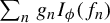 $\sum _{n}g_{n}I_{\phi }(f_{n})$
converges almost surely, that is, that
 $\phi $
is stochastically integrable. Then, we can define the Gaussian process
 $$ \begin{align*} Z_{x^{*}}:=\sum_{n}g_{n}x^{*}(I_{\phi}(f_{n}))\in L^{2}(\Omega;\mathbb{C}), \quad x^{*}\in(\mathcal{C}_{0}(\mathbb{R}_{+},\rho))^{*}. \end{align*} $$
We have
 $\mathbb {E}(\sup _{\|x^{*}\|\leq 1}\|Z_{x^{*}}\|)<\infty $
and thus by [Reference Ledoux and Talagrand25, Theorem 3.18], we deduce that
 $$ \begin{align*} \sup_{\varepsilon>0}\varepsilon\sqrt{\log(N(\varepsilon,B_{(\mathcal{C}_{0}(\mathbb{R}_{+},\rho))^{*}},d))} \end{align*} $$
is finite, where d is the
 $L^{2}$
-metric of the process,
 $$ \begin{align*} d(x^{*},y^{*}) = \|Z_{x^{*}}-Z_{y^{*}}\|_{L^{2}(\Omega;\mathbb{C})},\quad x^{*},y^{*}\in(\mathcal{C}_{0}(\mathbb{R}_{+},\rho))^{*}, \end{align*} $$
and
 $N(\varepsilon ,B_{(\mathcal {C}_{0}(\mathbb {R}_{+},\rho ))^{*}},d)$
is the entropy number.
We have
 $I_{\phi }^{*}=K$
, where
 $K:(\mathcal {C}_{0}(\mathbb {R}_{+},\rho ))^{*}\longrightarrow L^{2}(\mathbb {R};\mathbb {C}), x^{*}\longmapsto x^{*}\circ \phi $
.
For any
 $x^{*},y^{*}\in (\mathcal {C}_{0}(\mathbb {R}_{+},\rho ))^{*}$
, we have
 $$ \begin{align*} \|Z_{x^{*}}-Z_{y^{*}}\|_{L^{2}(\Omega;\mathbb{C})}^{2} = \sum_{n}|\langle K(x^{*}-y^{*}),f_{n}\rangle |^{2} = \|K(x^{*}-y^{*})\|_{L^{2}(\mathopen{[}0,\infty\mathclose{[};\mathbb{C})}^{2}. \end{align*} $$
Define
 $$ \begin{align*} x^{*}:\mathcal{C}_{0}(\mathbb{R}_{+},\rho)\longrightarrow\mathbb{C}, f\longmapsto\int_{0}^{\infty}f(x)h(x)\,{d} x. \end{align*} $$
Then,
 $(x^{*}\in (\mathcal {C}_{0}(\mathbb {R}_{+},\rho ))^{*}$
and
 $\|x^{*}\|\leq 1)$
if
 $\|h/\rho \|_{L^{1}(\mathopen {[}0,\infty \mathclose {[};\mathbb {C})}\leq 1$
. Similarly for
 $$ \begin{align*} y^{*}:\mathcal{C}_{0}(\mathbb{R}_{+},\rho)\longrightarrow\mathbb{C}, f\longmapsto\int_{0}^{\infty}f(x)g(x)\,{d} x. \end{align*} $$
Let us consider
 $\rho =\sum _{j\geq 1}\rho _{j}\mathbf {1}_{\mathopen {[}t_{j},t_{j+1}\mathclose {[}}$
,
 $t_{j}=2\pi j$
,
 $j\geq 1$
, where
 $\rho _{j}:=1/n$
if
 ${j\in \mathopen {[}2^{n^{3}},2^{(n+1)^{3}}\mathclose {[}}$
. We will show that
 $\rho $
is an admissible weight. Note also that
 ${\lim _{x\to \infty }\rho (x)=0}$
.
Let
 $t\geq 0$
. Let
 $x\geq 0$
be large, with
 $x\in \mathopen {[}2\pi j,2\pi (j+1)\mathclose {[}$
,
 $j\in \mathopen {[}2^{n^{3}},2^{(n+1)^{3}}\mathclose {[}$
, and
 $n\geq 1$
. We have
 $t=2\pi k +r$
for some
 $k\geq 0$
and
 $r\in \mathopen {[}0,2\pi \mathclose {[}$
; thus,
 $x+t\in \mathopen {[}2\pi (j+k), 2\pi (j+k+2)\mathclose {[}$
. Now, if j is large, then
 $j+k+2\in \mathopen {[}2^{n^{3}},2^{(n+2)^{3}}\mathclose {[}$
, implying that
 $$ \begin{align*} \frac{\rho(x)}{\rho(x+t)} \leq \frac{n+1}{n} \leq 2. \end{align*} $$
This shows that
 $C(t)=\sup _{x\geq 0}(\rho (x)/\rho (x+t))$
is finite.
Now, we prove that C is locally bounded. Remark that
 $\rho $
is non-increasing. Let
 $t_{0}>0$
. If
 $0\leq t\leq t_{0}$
, then
 $$ \begin{align*} \frac{\rho(x)}{\rho(x+t)} \leq \frac{\rho(x)}{\rho(x+t_{0})} \end{align*} $$
for all
 $x\geq 0$
, and
 $C(t)\leq C(t_{0})$
. This shows that C is locally bounded.
We will try to give a lower bound for
 $$ \begin{align*} \|K(x^{*}-y^{*})\|_{L^{2}(\mathbb{R};\mathbb{C})}^{2} &= \int_{-\infty}^{\infty}|K(x^{*}-y^{*})(t)|^{2}\,{d} t\\ &= \int_{-\infty}^{\infty}\bigg|\!\int_{0}^{\infty}a(t)e^{itx}h(x)\,{d} x-\int_{0}^{\infty}a(t)e^{itx}g(x)\,{d} x\bigg|^{2}\,{d} t. \end{align*} $$
Let
 $\widetilde {n}\geq 0$
. We take
 $h=\rho _{j}\mathbf {1}_{\mathopen {[}t_{j},t_{j+1}\mathclose {[}}e^{inx}$
and
 $g=\rho _{k}\mathbf {1}_{\mathopen {[}t_{k},t_{k+1}\mathclose {[}}e^{imx}$
with
 $j,k\in \mathopen {[}2^{\widetilde {n}^{3}},2^{(\widetilde {n}+1)^{3}}\mathclose {[}$
and
 $j\neq k$
. Then,
 $\|h/\rho \|_{L^{1}}\leq 1, \|g/\rho \|_{L^{1}}\leq 1$
, and
 $x^{*}, y^{*}\in B_{(\mathcal {C}_{0}(\mathbb {R}_{+},\rho ))^{*}}$
. Therefore, we now have
 $$ \begin{align*} &\|K(x^{*}-y^{*})\|_{L^{2}(\mathbb{R};\mathbb{C})}^{2}\geq \int_{0}^{\infty}|a(t)|^{2}\bigg| \rho_{j}\bigg[\frac{e^{inx+itx}}{i(n+t)}\bigg]_{t_{j}}^{t_{j+1}}- \rho_{k} \bigg[\frac{e^{imx+itx}}{i(m+t)}\bigg]_{t_{k}}^{t_{k+1}}\bigg|^{2}\,{d} t\\ &\quad= \int_{0}^{\infty}|a(t)|^{2}\bigg|\rho_{j}\bigg(\frac{e^{i(n+t)2\pi(j+1)}-e^{i(n+t)2\pi j}}{i(n+t)}\bigg) - \rho_{k}\bigg(\frac{e^{i(m+t)2\pi(k+1)}-e^{i(m+t)2\pi k}}{i(m+t)}\bigg)\bigg|^{2}\,{d} t\\ &\quad= \int_{0}^{\infty}|a(t)|^{2}\bigg|\frac{\rho_{j}e^{it2\pi j}}{n+t}(e^{2\pi ti}-1)-\frac{\rho_{k}e^{it2\pi k}}{m+t}(e^{2\pi ti}-1)\bigg|^{2}\,{d} t. \end{align*} $$
Since
 $j,k\in \mathopen {[}2^{\widetilde {n}^{3}},2^{(\widetilde {n}+1)^{3}}\mathclose {[}$
, we then obtain
 $$ \begin{align*} \|K(x^{*}-y^{*})\|_{L^{2}(\mathbb{R};\mathbb{C})}^{2} \geq \widetilde{n}^{-2}\int_{0}^{\infty}|a(t)|^{2}\bigg|\frac{e^{it2\pi j}}{n+t}-\frac{e^{it2\pi k}}{m+t}\bigg|^{2}|e^{2\pi ti}-1|^{2} \,{d} t. \end{align*} $$
Now, we take
 $n=1$
and
 $m=2$
, and we obtain
 $$ \begin{align*} \|K(x^{*}-y^{*})\|_{L^{2}(\mathbb{R};\mathbb{C})}^{2} &\geq \widetilde{n}^{-2}\int_{0}^{\infty}|a(t)|^{2} \bigg(\frac{1}{n+t}-\frac{1}{m+t}\bigg)^{2}|e^{2\pi ti}-1|^{2} \,{d} t\\ &= 2\widetilde{n}^{-2}\int_{0}^{\infty}\frac{|a(t)|^{2}}{(t+1)^{2}(2+t)^{2}}(1-\cos(2\pi t))\,{d} t. \end{align*} $$
The last integral is positive and we conclude that
 $\|K(x^{*}-y^{*})\|_{L^{2}(\mathbb {R};\mathbb {C})}\geq A/\widetilde {n}$
, where
 $A>0$
is some constant.
Set
 $\varepsilon _{\widetilde {n}}=A/(2\widetilde {n})$
for each
 $\widetilde {n}\geq 1$
. We conclude that
 $N(\varepsilon _{\widetilde {n}},B_{(\mathcal {C}_{0}(\mathbb {R}_{+},\rho ))^{*}},d)\geq 2^{\widetilde {n}^{3}}$
for all
 $\widetilde {n}\geq 1$
. This implies that
 $$ \begin{align*} \sup_{\widetilde{n}\geq 1}\varepsilon_{\widetilde{n}}\sqrt{\log(N(\varepsilon_{\widetilde{n}},B_{(\mathcal{C}_{0}(\mathbb{R}_{+},\rho))^{*}},d))} \gtrsim \sup_{\widetilde{n}\geq 1}\widetilde{n}^{1/2} = \infty, \end{align*} $$
which is a contradiction.
This (counter-)example shows that we might expect to integrate the family
 $(u_{t})_{t}$
with respect to another stochastic process than the Brownian motion. Therefore, our example might indicate that a more general criterion might exist, as in the case for single operators studied in [Reference Agneessens1].
Acknowledgements
The author was a Research Fellow of the Fonds de la Recherche Scientifique-FNRS. This work was part of the PhD thesis of the author, except §§4.1 and 5. He would like to greatly thank his supervisor Karl Grosse-Erdmann for his support. The author would also like to thank the referee for their useful remarks; in particular, by giving the idea of how to apply the first method. This might provide further lines of research.
A Appendix. Stochastic calculus in Fréchet spaces
We will give a proof of Theorems 2.2 and 2.3 in this appendix. Their proofs follow the same lines as in [Reference van Neerven and Weis41], but we give them for the sake of completeness. For the definition of weak topologies on Fréchet spaces and their duals, see [Reference Meise and Vogt29, Reference Schaefer and Wolff37].
Recall that a map
 $R:E^{*}\longrightarrow E$
is positive if
 $x^{*}Rx^{*}\geq 0$
for all
 $x^{*}\in E^{*}$
, and is symmetric if
 $x^{*}Ry^{*}=\overline {y^{*}Rx^{*}}$
for all
 $x^{*},y^{*}\in E^{*}$
.
Lemma A.1. [Reference Vakhania and Tarieladze38, Lemma 4 and its proof]
Let
 $R:E^{*}\longrightarrow E$
be a positive symmetric map. Then, there exists a Hilbert space
 $H_R$
and a continuous linear map
 $i_R:H_{R}^{*}\longrightarrow E$
such that
 $R=i_{R}Ii_{R}^{*}$
, where
 $I:H_R\longrightarrow H_R^{*}$
is the canonical conjugate-linear operator. More precisely,
 $H_R$
is the completion of
 $E^{*}/M$
under the norm induced by R, given by
 $\langle x^{*}+M,$
 $y^{*}+M\rangle _{H_{R}}=x^{*}Ry^{*}$
,
 $x^{*},y^{*}\in E^{*}$
, where
 $M=\{x^{*}\in E^{*}\mid x^{*}Rx^{*}=0\}$
, and
 $i_{R}^{*}:E^{*}\longrightarrow H_{R},x^{*}\longmapsto x^{*}+M$
is the inclusion map.
A positive symmetric map
 $Q:E^{*}\longrightarrow (E^{*})^{'}$
is defined in the same way as a positive symmetric map from
 $E^{*}$
to E: for all
 $x^{*},y^{*}\in E^{*}$
, one has
 $(Qx^{*})(x^{*})\geq 0$
and
 $(Qy^{*})(x^{*})=\overline {(Qx^{*})(y^{*})}$
.
Proposition A.2 below is proved in the given reference for Banach spaces, but we give the proof for the sake of completeness.
Proposition A.2. [Reference Goldys and van Neerven19, Proposition 2.2]
Let
 $Q:E^{*}\longrightarrow (E^{*})'$
be a positive symmetric map. Suppose that there exists a positive symmetric map
 $R:E^{*}\longrightarrow E$
such that
 $(Qx^{*})(x^{*})\leq x^{*}Rx^{*}$
for every
 $x^{*}\in E^{*}$
. Then,
 $Q(E^{*})\subseteq E$
.
Proof. Let
 $i_{R}:H_{R}^{*}\longrightarrow E$
be the map given by Lemma A.1. Fix
 $x^{*}\in E^{*}$
and define the linear map
 $$ \begin{align*} \phi_{x^{*}} : i_{R}^{*}(E^{*})\longrightarrow\mathbb{K}, i_{R}^{*}(y^{*})\longmapsto (Qx^{*})(y^{*}). \end{align*} $$
Let
 $y^{*}\in E^{*}$
. By the Cauchy–Schwarz inequality applied to the sesquilinear form
 $(x^{*},y^{*})\longmapsto (Qx^{*})(y^{*})$
, the assumption, and Lemma A.1, we get that
 $$ \begin{align*} |\phi_{x^{*}}(i_{R}^{*}(y^{*}))| \leq ((Qx^{*})(x^{*}))^{1/2}((Qx^{*})(y^{*}))^{1/2} \leq \|i_{R}^{*}(x^{*})\|_{H_{R}}\|i_{R}^{*}(y^{*})\|_{H_{R}}. \end{align*} $$
This shows that
 $\phi _{x^{*}}$
is well defined and continuous on
 $(i_{R}^{*}(E^{*}),\|\cdot \|_{H_{R}})$
. Therefore, we can continuously extend
 $\phi _{x^{*}}$
on
 $H_{R}$
, and the extension is still noted as
 $\phi _{x^{*}}$
. Now, for every
 $y^{*}\in E^{*}$
, we have
 $$ \begin{align*} y^{*}(i_{R}(\phi_{x^{*}})) = (y^{*}\circ i_{R})(\phi_{x^{*}}) = \phi_{x^{*}}(y^{*}\circ i_{R}) = (Qx^{*})(y^{*}). \end{align*} $$
We deduce that
 $Qx^{*}=i_{R}(\phi _{x^{*}})\in E$
.
By convention, the inner product on a vector space is linear in the first argument and conjugate-linear in the second argument.
Proof of Theorem 2.2
The implication
 ${\text {(i)}}\implies \text {{(ii)}}$
is trivial.
Assume that item (ii) holds. Then, for all
 $x^{*}\in E^{*}$
, the random variable
 $x^{*}(Y)$
is Gaussian and, hence, Y is Gaussian. Let Q be the covariance operator of its distribution
 $\mu $
. For every
 $x^{*}\in E^{*}$
, we have by the Itô isometry,
 $$ \begin{align*} x^{*}Qx^{*} = \int_{E}|x^{*}|^2\,{d}\mu = \int_{\Omega}|x^{*}(Y)|^2\,{d}\mathbb{P} = c\int_{I}|x^{*}(\phi(t))|^2\,{d} t, \end{align*} $$
where
 $c=1$
in the real case and
 $c=2$
in the complex case. This shows item (iii).
Now, assume that item (iii) holds. Set
 $H:= (\overline {E^{*}})^{*}$
, where the closure is taken in the space
 $L^2(\mu )$
. It is a separable space by [Reference Hytönen, van Neerven, Veraar and Weis21, Proposition 1.2.29]. Take the
 $\gamma $
-radonifying operator
 $T:=K:H\longrightarrow E$
given by [Reference Bayart and Matheron4, Theorem 5.13] (the proof carries over verbatim to Fréchet spaces). From
 $Q=KJK^{*}$
, where
 $J:H^{*}\longrightarrow H$
is the canonical conjugate-linear identification operator, and by hypothesis, it follows that
 $$ \begin{align*} c\int_{I}|x^{*}(\phi(t))|^2\, d t = x^{*}Qx^{*} &= (x^{*}\circ K)JK^{*}(x^{*})\\ &= \|K^{*}(x^{*})\|_{H}^{2} = \|T^{*}(x^{*})\|_{H}^{2} \end{align*} $$
for all
 $x^{*}\in E^{*}$
, and item (iv) holds.
We now show
 $\text {{(iv)}}\implies \text {{(v)}}$
. Define the conjugate-linear map
 $Q:E^{*}\longrightarrow (E^{*})^{'}$
by
 $$ \begin{align*} Qx^{*}:E^{*}\longrightarrow\mathbb{K}, y^{*}\longmapsto\int_{I}y^{*}(\phi(t))\overline{x^{*}(\phi(t))}\,{d} t \end{align*} $$
for all
 $x^{*}\in E^{*}$
. It is well defined since
 $\phi $
is weakly
 $L^{2}$
and is clearly a positive symmetric map. Let
 $J:H^{*}\longrightarrow H$
be the canonical conjugate-linear identification operator. We finish the proof of the implication in five steps.
(a) By hypothesis, we have for all
 $x^{*}\in E^{*}$
that
 $$ \begin{align*} c\int_{I}|x^{*}(\phi(t))|^2\,{d} t \leq \|T^{*}(x^{*})\|_{H}^{2} = (T^{*}(x^{*}))(JT^{*}(x^{*})) = x^{*}(TJT^{*}(x^{*})). \end{align*} $$
Hence, setting
 $R:=TJT^{*}:E^{*}\longrightarrow E$
, we have
 $$ \begin{align} c(Qx^{*})(x^{*})\leq x^{*}Rx^{*} \end{align} $$
for all
 $x^{*}\in E^{*}$
. By Proposition A.2, we conclude that
 $Q(E^{*})\subseteq E$
.
(b) By hypothesis and [Reference Bayart and Matheron4, Theorem 5.13], R is a Gaussian covariance operator. Then, by [Reference van Neerven40, Theorem 8.8], inequality (A.1), and since
 $Q(E^{*})\subseteq E$
, Q is also a Gaussian covariance operator.
(c) Let us prove that
 $I_{\phi }$
takes values in E. Define
 $G:=\{x^{*}\circ \phi \mid x^{*}\in E^{*}\}\subseteq L^2(I)$
. Let
 $f\in L^2(I)$
. Then,
 $$ \begin{align*} f\in\text{Ker}(I_{\phi}) &\iff I_{\phi}(f)=0,\\&\iff\text{ for all } x^{*}\in E^{*}, I_{\phi}(f)(x^{*})=0,\\&\iff\text{ for all } x^{*}\in E^{*}, \int_{I}x^{*}(\phi(t))\overline{f(t)}\, d t=0,\\&\iff f \in G^{\perp}. \end{align*} $$
Therefore,
 $\text {Ker}(I_{\phi })=G^{\perp }$
and
 $L^2(I)=\overline {G}\oplus \text {Ker}(I_{\phi })$
. Since
 $\text {Im}(Q)\subseteq E$
by step (A), we have that
 $I_{\phi }(G\oplus \text {Ker}(I_{\phi }))\subseteq E$
.
It remains to prove that
 $I_{\phi }(\overline {G})\subseteq E$
. Let
 $g\in \overline {G}$
. There exists a sequence
 $(g_n)_{n\geq 1}\subseteq G$
converging to g in
 $L^2(I)$
. Since
 $I_{\phi }(G)\subseteq E$
, for each
 $n\geq 1$
, there exists
 $x_n\in E$
such that
 $I_{\phi }(g_n)=x_n$
. We show that
 $(x_n)_{n\geq 1}$
is Cauchy in E. Let
 $\|\cdot \|$
be a continuous seminorm on E. For all
 $x^{*}\in E^{*}$
and every integers
 $n,m\geq 1$
, we have
 $$ \begin{align*} |x^{*}(x_n-x_m)| &=|(I_{\phi}(g_n)-I_{\phi}(g_m))(x^{*})|\\ &=\bigg|\!\int_{I}x^{*}(\phi(t))\overline{g_n(t)}\,{d} t-\int_{I}x^{*}(\phi(t))\overline{g_m(t)}\,{d} t \bigg|\\ &\leq \|x^{*}\phi\|_{L^2(I)}\|g_n-g_m\|_{L^2(I)}, \end{align*} $$
where the inequality is justified by the Cauchy–Schwarz inequality. Define the set
 $V:=\{x\in E, \|x\|<1\}$
. By [Reference Rudin36, Theorems 3.15 and 3.16], the polar
 $V^{\circ }$
of V is
 $\sigma (E^{*},E)$
-compact and metrizable in the
 $\sigma (E^{*},E)$
topology; hence, it is sequentially complete and bounded for
 $\sigma (E^{*},E)$
. However, the linear map
 $(E^{*},\sigma (E^{*},E))\longrightarrow L^{2}(I),x^{*}\longmapsto x^{*}\phi $
has a sequentially closed graph. By [Reference Vakhania and Tarieladze38, Lemma 3], we then get
 $\sup _{x^{*}\in V^{\circ }}\|x^{*}\phi \|_{L^2(I)}<\infty $
. Therefore,
 $$ \begin{align*} \|x_n-x_m\| =\sup_{x^{*}\in V^{\circ}}|x^{*}(x_n-x_m)| \leq\sup_{x^{*}\in V^{\circ}}\|x^{*}\phi\|_{L^2(I)}\|g_n-g_m\|_{L^2(I)}, \end{align*} $$
the equality holds by [Reference Rudin36, Theorem 1.34] and [Reference Meise and Vogt29, Proposition 22.14]. Since
 $(g_n)_{n\geq 1}$
is convergent in
 $L^2(I)$
, we conclude that
 $(x_n)_{n\geq 1}$
is Cauchy for
 $\|\cdot \|$
. Since
 $\|\cdot \|$
was arbitrary, the sequence
 $(x_n)_{n\geq 1}$
is thus Cauchy in E. By completeness, there exists
 $x\in E$
such that
 $(x_n)_{n\geq 1}$
converges to x in E. Now, let
 $x^{*}\in E^{*}$
. By continuity of
 $x^{*}$
, we have that
 $\lim _{n\to \infty }I_{\phi }(g_n)(x^{*})=\lim _{n\to \infty }x^{*}(x_{n})=x^{*}(x)$
. However, by the Cauchy–Schwarz inequality, we have
 $$ \begin{align*} |I_{\phi}(g_n)(x^{*})-I_{\phi}(g)(x^{*})| \leq \|x^{*}\phi\|_{L^2(I)}\|g_n-g\|_{L^2(I)}, \end{align*} $$
implying that
 $\lim _{n\to \infty }I_{\phi }(g_n)(x^{*})=I_{\phi }(g)(x^{*})$
. We conclude that
 $I_{\phi }(g)(x^{*})=x^{*}(x)$
for all
 $x^{*}\in E^{*}$
, and
 $I_{\phi }(g)=x\in E$
.
(d) We now prove that
 $I_{\phi }$
is continuous. Define the linear map
 $$ \begin{align*} K:E^{*}\longrightarrow L^2(I),x^{*}\longmapsto x^{*}\circ\phi. \end{align*} $$
Let
 $S:L^{2}(I)^{*}\longrightarrow L^{2}(I)$
be the canonical conjugate-linear identification operator. We first show that
 $K^{*}=I_{\phi }\circ S$
. Let
 $f^{*}\in L^{2}(I)^{*}$
and
 $x^{*}\in E^{*}$
. By definition of
 $K^{*}$
, we have
 $$ \begin{align*} K^{*}(f^{*})(x^{*}) = f^{*}(K(x^{*})) = \langle x^{*}\circ\phi,S(f^{*})\rangle_{L^2(I)} = I_{\phi}(S(f^{*}))(x^{*}). \end{align*} $$
This implies that
 $K^{*}(f^{*})=I_{\phi }(S(f^{*}))$
and, in turn,
 $K^{*}=I_{\phi }\circ S$
. By [Reference Meise and Vogt29, Lemma 23.28], the map
 $K:(E^{*},\sigma (E^{*},E))\longrightarrow (L^2(I),\sigma (L^2(I),L^2(I)^{*}))$
is continuous if and only if
 $K^{*}(L^{2}(I)^{*})\subseteq E$
. Since
 $K^{*}=I_{\phi }\circ S$
and
 $I_{\phi }$
takes values in E by (C), K is indeed continuous with respect to the weak topologies. By [Reference Meise and Vogt29, Lemma 23.29],
 $K^{*}$
is then continuous with respect to the Mackey topologies. Since
 $L^{2}(I)^{*}$
and E are Mackey spaces by [Reference Schaefer and Wolff37, §IV.3.4], that is, their respective original topologies are the Mackey topology, we conclude that
 $K^{*}:L^{2}(I)^{*}\longrightarrow E$
is continuous. Finally,
 $I_{\phi }$
is also continuous thanks to the equality
 $K^{*}=I_{\phi }\circ S$
.
(e) For all
 $x^{*},y^{*}\in E^{*}$
, one has
 $$ \begin{align*} I_{\phi}(K(x^{*}))(y^{*}) = \int_{I} y^{*}(\phi(t))\overline{K(x^{*})}\,{d} t = \int_{I} y^{*}(\phi(t))\overline{x^{*}(\phi(t))}\,{d} t = y^{*}Qx^{*}. \end{align*} $$
Therefore,
 $(I_{\phi }\circ S)\circ S^{-1}\circ K=I_{\phi }\circ K=Q$
. We also have
 $(I_{\phi }\circ S)^{*}=K$
. Since Q is a covariance operator by (B) and any square-root of Q is
 $\gamma $
-radonifying, see [Reference Bayart and Matheron4, Remark 5.16], we deduce that
 $I_{\phi }$
is
 $\gamma $
-radonifying. Note that
 $L^{2}(I)$
is separable by [Reference Hytönen, van Neerven, Veraar and Weis21, Proposition 1.2.29].
We have thus proved item (v).
It remains to show
 $\text {{(v)}}\implies \text {{(i)}}$
. Let
 $A\in \mathscr {B}(I)$
and define
 $\phi _{A}:=\mathbf {1}_{A}\phi $
and
 $$ \begin{align*} M_{A}:L^2(I)\longrightarrow L^2(I), f\longmapsto \mathbf{1}_{A}f. \end{align*} $$
For all
 $f\in L^{2}(I)$
and
 $x^{*}\in E^{*}$
, we have
 $$ \begin{align*} I_{\phi_{A}}(f)(x^{*}) = \int_{I} x^{*}(\phi_{A}(t))\overline{f(t)}\,{d} t = \int_{A} x^{*}(\phi(t))\overline{f(t)}\,{d} t = I_{\phi}(M_{A}(f))(x^{*}). \end{align*} $$
This shows that
 $I_{\phi _{A}} = I_{\phi }\circ M_{A}$
. Since
 $M_{A}$
is obviously continuous, the map
 $I_{\phi _{A}}$
is
 $\gamma $
-radonifying by the ideal property, see [Reference Hytönen, van Neerven, Veraar and Weis22, Theorem 9.1.10].
Let
 $(f_n)_{n\in \mathbb {N}}\subseteq L^{2}(I)$
be an orthonormal basis. Denote by
 $$ \begin{align*} \mathcal{I}:L^2(I)\longrightarrow L^2(\Omega), f\longmapsto\int_{I}f(t)\,{d} B_t \end{align*} $$
the Itô isometry. Since
 $(\mathcal {I}(f_n))_{n\in \mathbb {N}}$
is a standard Gaussian sequence and
 $I_{\phi _A}$
is
 $\gamma $
-radonifying, the random series
 $Y_A:=\sum _{n\geq 0}\mathcal {I}(f_{n})I_{\phi _{A}}(f_{n})$
converges almost surely. Let
 $x^{*}\in E^{*}$
. We have
 $$ \begin{align*} x^{*}(Y_A) &= \sum_{n=0}^{\infty}\mathcal{I}(f_{n})x^{*}(I_{\phi_{A}}f_n) = \sum_{n=0}^{\infty}\mathcal{I}(x^{*}(I_{\phi_{A}}f_n)f_n)\\ &= \sum_{n=0}^{\infty}\mathcal{I}(\langle x^{*}\circ\phi_{A},f_n\rangle_{L^2(I)}f_n) = \mathcal{I}\bigg(\sum_{n=0}^{\infty}\langle x^{*}\circ\phi_{A},f_n\rangle_{L^2(I)}f_n\bigg)\\ &= \int_{I}x^{*}\phi_{A}(t)\,{d} B_t \end{align*} $$
almost surely, where we have used the continuity of
 $x^{*}$
for the first equality, the definition of
 $I_{\phi _{A}}$
for the third one, the linearity and continuity of
 $\mathcal {I}$
in the fourth one, and the fact that
 $(f_n)_{n\in \mathbb {N}}$
is an orthonormal basis and the definition of
 $\mathcal {I}$
for the last one. We then deduce that
 $x^{*}(Y_A)=\int _{I}x^{*}\phi _{A}(t)\,{d} B_t$
almost surely for every
 $x^{*}\in E^{*}$
. In conclusion,
 $\phi $
is stochastically integrable.
As for the Pettis integrability of
 $\phi $
, let
 $A\in \mathscr {B}(I)$
be a set of finite measure. Let
 $x^{*}\in E^{*}$
. Then,
 $\mathbf {1}_A\in L^2(I)$
,
 $I_{\phi }(\mathbf {1}_{A})\in E$
, and
 $$ \begin{align*} x^{*}(I_{\phi}(\mathbf{1}_A)) = I_{\phi}(\mathbf{1}_A)(x^{*}) = \int_{I}x^{*}(\phi(t))\mathbf{1}_A(t)\,{d} t, \end{align*} $$
and
 $\phi $
is Pettis integrable on A.
We state two results from [Reference van Neerven and Weis41], adapted to the case of functions defined on an arbitrary interval and taking values in a Fréchet space.
Theorem A.3. [Reference van Neerven and Weis41, Corollary 2.7]
Let
 $\phi ,\psi :I\longrightarrow E$
be two weakly measurable functions on an interval
 $I\subseteq \mathbb {R}$
. Assume that
 $\phi $
is stochastically integrable and that
 $$ \begin{align*} \int_{I}|x^{*}\psi(t)|^2\,{{d}} t\leq\int_{I}|x^{*}\phi(t)|^2\,{{d}} t \end{align*} $$
for every
 $x^{*}\in E^{*}$
. Then,
 $\psi $
is stochastically integrable, and for all
 $1\leq p<\infty $
and all continuous seminorms
 $\|\cdot \|$
on E, we have
 $$ \begin{align*} \mathbb{E}\bigg(\bigg\|\!\int_{I}\psi(t)\,{{d}}B_t\bigg\|^{p}\bigg) \leq\mathbb{E}\bigg(\bigg\|\!\int_{I}\phi(t)\,{{d}}B_t\bigg\|^{p}\bigg). \end{align*} $$
Proof. By assumption and item (iv) of Theorem 2.2, we get for all
 $x^{*}\in E^{*}$
that
 $$ \begin{align*} c\int_{I}|x^{*}\psi(t)|^2\,{d} t \leq c\int_{I}|x^{*}\phi(t)|^2\,{d} t \leq \|T^{*}x^{*}\|_{H}^2. \end{align*} $$
Again by item (iv) of Theorem 2.2, we can conclude that
 $\psi $
is stochastically integrable.
By item (iii) of Theorem 2.2 applied to both
 $\phi $
and
 $\psi $
, we have
 $x^{*}Rx^{*}\leq x^{*}Qx^{*}$
for all
 $x^{*}\in E^{*}$
, where R and Q are the covariance operators of the distributions
 $\mu _R$
and
 $\mu _Q$
of
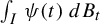 $\int _{I}\psi (t)\,{d} B_t$
and
 $\int _{I}\phi (t)\,{d} B_t$
, respectively. By [Reference van Neerven40, Theorem 8.8], we finally get that
 $$ \begin{align*} \int_{E}\|x\|^{p}\,{d}\mu_{R}(x)\leq\int_{E}\|x\|^{q}\,{d}\mu_Q(x). \\[-42pt] \end{align*} $$
Theorem A.4. [Reference van Neerven and Weis41, Theorem 6.2]
Let
 $(\phi _n)_{n\in \mathbb {N}}$
be a sequence of E-valued stochastically integrable functions defined on an interval
 $I\subseteq \mathbb {R}$
. Assume that there exists a weakly
 $L^2$
function
 $\phi :I\longrightarrow E$
such that for every
 $x^{*}\in E^{*}$
, one has
 $$ \begin{align*} \lim_{n\to\infty}\int_{I}|x^{*}\phi_n(t)-x^{*}\phi(t)|^2\,{{d}} t=0. \end{align*} $$
If there exists a stochastically integrable function
 $\psi :I\longrightarrow E$
such that for every
 $x^{*}\in E^{*}$
and all
 $n\geq 0$
, one has
 $$ \begin{align*} \int_{I}|x^{*}\phi_n(t)|^2\,{{d}} t\leq\int_{I}|x^{*}\psi(t)|^2\,{{d}} t, \end{align*} $$
then
 $\phi $
is stochastically integrable and for every
 $1\leq p<\infty $
, we have, in
 $L^p(\Omega ;E)$
,
 $$ \begin{align*} \lim_{n\to\infty}\int_{I}\phi_n(t)\,{{d}} B_t=\int_{I}\phi(t)\,{{d}} B_t. \end{align*} $$
Proof. By using the assumptions, we get that
 $$ \begin{align*} \int_{I}|x^{*}\phi(t)|^2\,{d} t\leq\int_{I}|x^{*}\psi(t)|^2\,{d} t \end{align*} $$
for all
 $x^{*}\in E^{*}$
. By Theorem A.3,
 $\phi $
is stochastically integrable.
The rest of the proof follows as in [Reference van Neerven and Weis41, Theorem 6.2].
Proof of Theorem 2.3
Assume that such a sequence of step functions exists. Let
 ${x^{*}\in E^{*}}$
. By Lemma 2.1, we have
 $x^{*}(Y) = \lim _{n\to \infty }\int _{I}x^{*}\phi _n(t)\,{d} B_t$
in probability. The random vectors on the right-hand side are Gaussian and, thus, the convergence takes place in
 $L^2(\Omega )$
by [Reference Rosiński and Suchanecki34, Lemma 2.1]. By the Itô isometry, the sequence
 $(x^{*}\phi _n)_{n\in \mathbb {N}}$
is Cauchy in
 $L^2(I)$
. Thus, by item (i), we necessarily have
 $\lim _{n\to \infty } x^{*}\phi _n=x^{*}\phi $
in
 $L^2(I)$
. Again by the Itô isometry, we get that
 $x^{*}(Y)=\int _{I}x^{*}\phi (t)\,{d} B_t$
almost surely. By item (ii) of Theorem 2.2, we conclude that
 $\phi $
is stochastically integrable on I with integral Y.
Assume that
 $\phi $
is stochastically integrable. If I is a bounded interval, the result is proved in [Reference van Neerven and Weis41, Theorem 2.5] when
 $\phi $
is a Banach space-valued function, but the proof carries over verbatim to the case of Fréchet spaces. If I is unbounded, for the sake of simplicity, we assume that
 $I=\mathopen {[}0,\infty \mathclose {[}$
. By Theorem 2.2,
 $\phi $
is Pettis integrable on any bounded intervals. For all integers
 $k\geq 0$
,
 $n\geq 1$
,
 $1\leq j \leq 2^n$
, and
 $N\geq 1$
, define
 $$ \begin{align*} \phi_{n,k,j}:=2^n\int_{k+({j-1})/{2^n}}^{k+{j}/{2^n}}\phi(t)\,{d} t, \end{align*} $$
 $$ \begin{align*} \phi_n^N:=\sum_{k=0}^{N-1}\sum_{j=1}^{2^n}\mathbf{1}_{\mathopen{]}k+({j-1})/{2^n},k+{j}/{2^n}\mathclose{]}}\phi_{n,k,j}, \end{align*} $$
and
 $\varphi _N:=\phi \mathbf {1}_{\mathopen {[}0,N\mathclose {]}}$
. For all
 $n,N\in \mathbb {N}_{0}$
, define also
 $\mathcal {G}_{n,N}$
as the finite
 $\sigma $
-algebra on
 $\mathopen {[}0,N\mathclose {]}$
generated by the intervals of the form
 $\mathopen {]}k+({j-1})/{2^n},k+{j}/{2^n}\mathclose {]}$
,
 $0\leq k\leq N-1$
,
 $1\leq j \leq 2^n$
.
Let
 $x^{*}\in E^{*}$
. It is an easy task to check that
 $\mathbb {E}(x^{*}\varphi _N\mid \mathcal {G}_{n,N})=x^{*}\phi _n^N$
almost everywhere on
 $\mathopen {[}0,N\mathclose {]}$
for every
 $n,N\geq 1$
, see [Reference Bogachev8, Example 10.1.2]. Since
 $(\mathcal {G}_{n,N})_{n\geq 1}$
is increasing and
 $\sigma (\bigcup _{n\geq 1}\mathcal {G}_{n,N})=\mathcal {B}(\mathopen {[}0,N\mathclose {]})$
, we get that
 $\lim _{n\to \infty }x^{*}\phi _n^N=x^{*}\varphi _N$
in
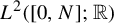 $L^2(\mathopen {[}0,N\mathclose {]};\mathbb {R})$
by [Reference Hytönen, van Neerven, Veraar and Weis21, Theorem 3.3.2].
Now, define the step functions
 $\phi _N:=\phi _N^N\mathbf {1}_{\mathopen {[}0,N\mathclose {]}}$
for every integer
 $N\geq 1$
. Let us show that
 $\lim _{N\to \infty }x^{*}\phi _N=x^{*}\phi $
in
 $L^2(\mathopen {[}0,\infty \mathclose {[})$
. Notice that
 $\phi _{N}^{M}=\phi _{N}^{N}$
on
 $\mathopen {[}0,M\mathclose {]}$
for any
 $N\geq M\geq 1$
. Let
 $\varepsilon>0$
and let
 $N_0\geq 1$
be such that
 $\int _{N}^{\infty }|x^{*}\phi (t)|^2\,{d} t\leq \varepsilon ^2$
for every
 $N\geq N_0$
. Now, let
 $M_0\geq N_0$
be such that
 $\|x^{*}\phi _N^{N_0}-x^{*}\varphi _{N_0}\|_{L^2(\mathopen {[}0,N_0\mathclose {]})}\leq \varepsilon $
for every integer
 $N\geq M_0$
. We have for any
 $N\geq M_0$
,
 $$ \begin{align*} \|x^{*}\phi_N-x^{*}\phi\|_{L^2(\mathopen{[}0,\infty\mathclose{[})} &\leq\|x^{*}\phi_N^{N_0}-x^{*}\varphi_{N_0}\|_{L^2(\mathopen{[}0,N_0\mathclose{]})}\\ &\quad+\|x^{*}\phi_N-x^{*}\phi\|_{L^2(\mathopen{[}N_0,N\mathclose{]})} +\|x^{*}\phi\|_{L^2(\mathopen{[}N,\infty\mathclose{[})}. \end{align*} $$
The first and third terms are smaller than
 $\varepsilon $
since
 $N\geq M_0\geq N_0$
. For the second term, first note that
 $$ \begin{align*} \|x^{*}\phi_N-x^{*}\phi\|_{L^2(\mathopen{[}N_0,N\mathclose{]})}\leq\|x^{*}\phi_N\|_{L^2(\mathopen{[}N_0,N\mathclose{]})} + \|x^{*}\phi\|_{L^2(\mathopen{[}N_0,\infty\mathclose{[})}. \end{align*} $$
The second term on the right-hand side is smaller than
 $\varepsilon $
by definition of
 $N_0$
. For the first term, notice that
 $x^{*}\phi _N=x^{*}\phi _{N}^{N}=\mathbb {E}(x^{*}\phi \mid \mathcal {G}_N)$
almost everywhere on
 $\mathopen {[}N_0,N\mathclose {]}$
, where
 $\mathcal {G}_N$
is the finite
 $\sigma $
-algebra on
 $\mathopen {[}N_0,N\mathclose {]}$
generated by the intervals of the form
 ${\mathopen {]}k+({j-1})/{2^N},k+{j}/{2^N}\mathclose {]}}$
,
 $N_0\leq k\leq N-1$
,
 $1\leq j \leq 2^N$
; see [Reference Bogachev8, Example 10.1.2]. Therefore, by a corollary of the conditional Jensen inequality, see [Reference Hytönen, van Neerven, Veraar and Weis21, Corollary 2.6.30], we have
 $\|x^{*}\phi _N\|_{L^2(\mathopen {[}N_0,N\mathclose {]})}\leq \|x^{*}\phi \|_{L^2(\mathopen {[}N_0,N\mathclose {]})}$
. We then conclude that
 $\|x^{*}\phi _{N}-x^{*}\phi \|_{L^{2}(\mathopen {[}0,\infty \mathclose {[})}\leq 4\varepsilon $
and, thus,
 $\lim _{N\to \infty }x^{*}\phi _{N}=x^{*}\phi $
in
 $L^{2}(\mathopen {[}0,\infty \mathclose {[})$
.
Again by [Reference Hytönen, van Neerven, Veraar and Weis21, Corollary 2.6.30], we have
 $\|x^{*}\phi _{N}\|_{L^2(\mathopen {[}0,\infty \mathclose {[})}\leq \|x^{*}\phi \|_{L^{2}(\mathopen {[}0,\infty \mathclose {[})}$
for every
 $N\geq 1$
. Since every step function is stochastically integrable, Theorem A.4 yields item (ii) with convergence in every
 $L^{p}(\Omega ;E)$
,
 $1\leq p<\infty $
.



