1. Introduction
Stochastic differential games are used to model dynamic competition or cooperation. In [Reference Elliott2, Reference Elliott and Davis3], some noncooperative stochastic differential games are solved with explicit optimal plays. It is shown that values of the games exist if the Isaacs condition holds. In [Reference Fleming and Souganidis5], sub-value and sup-value functions of a finite-horizon game are defined, which are shown to be the unique viscosity solutions of Bellman–Isaacs (BI) equations. In [Reference Browne1], games between two investors are considered using a general payoff function. Conditions under which a game has an achievable value are provided. In some specific games (including an exit probability game) based on diffusion processes, the value functions and equilibrium portfolio strategies are found explicitly, where the optimal plays are constant strategies that are independent of the underlying process. In [Reference Yeung and Petrosyan12], analytically tractable solutions of cooperative stochastic differential games with subgame consistency are derived. In [Reference Mataramvura9], a theorem giving the Hamilton–Jacobi–Bellman–Isaacs conditions for a two-player game in a jump diffusion setting is proved. The result is then used to study risk minimization problems. In [Reference Zeng14], an exit probability game between two insurers is considered for the first time with proportional reinsurance control under a linear diffusion model, where the Nash equilibrium of the game is given. In [Reference Taksar and Zeng11], a nonproportional zero-sum game for insurers is studied. In [Reference Luo7], a proportional reinsurance game with a win scenario of absolute dominance is considered. Parameter conditions under which the game is solvable are given. In each case when the value of the game exists, the value function and the Nash equilibrium strategy are found. A similar game based on uncorrelated quadratic-linear diffusion processes is solved in [Reference Luo8].
In this paper, we study a two-player exit probability game as in [Reference Browne1, Reference Zeng14]. Each player’s controllable process is modeled by a diffusion process with one controllable variable, where the diffusion term and the drift term are both linear in the variable. We note that the controlled process of this form can represent the surplus process of an insurer with proportional reinsurance, or the wealth process of an investor with investment in a Black–Scholes market. We first define a winning event (for player 2) that the difference in the controlled processes (of the two players) hits a given low level l before it hits a given high level u (
 $l<u$
). In the game, player 1 tries to minimize the probability of the winning event of player 2, while player 2 tries to maximize the probability. We define sub-value of the game as the optimized probability of the winning event (of player 2) where player 1 plays first to minimize the probability (of winning by player 2) and player 2 plays second to maximize it. The sup-value of the game is defined as the optimized probability when the plays are in the opposite order, that is, player 2 plays first to maximize the probability (of winning by player 2) and player 1 plays second to minimize it. The sub-value and sup-value of the game can be characterized by two BI equations, which are second-order ordinary differential equations (see, for example, [Reference Fleming and Souganidis5]). With detailed parameter classifications, the BI equations are solved explicitly with classical
 $C^2[l, u]$
solutions given in all possible parameter cases. Using a verification result, the solutions (of the BI equations) are shown to be the sub-value and sup-value functions. By solving the BI equations with supremum and infimum operations, optimizers are derived which yield the optimal plays in a feedback form.
We note that in the exit probability game of [Reference Browne1, Reference Luo7, Reference Taksar and Zeng11, Reference Zeng14], the focus is on the cases when the Nash equilibrium strategy exists with equal sub-value and sup-value functions (in which the order of the players is immaterial). In this paper, we solve the exit probability game completely and investigate the impact of the order of players with full parameter classifications. We solve all the cases to find the sub-value and sup-value functions and give the optimal plays explicitly, based on which the existence (and nonexistence) of Nash equilibrium and the significance of the order of players can be determined. We can compare the sub-value and sup-value functions and also observe close relations of the optimal plays to the model parameters and the underlying process.
The rest of the paper is organized as follows. In Section 2, we introduce the mathematical model and formulate the game. We also define the sub-value and sup-value functions of the game. In Section 3, we provide the BI equations and show a verification result. In Sections 4 and 5, we find the sub-value and sup-value functions and their associated optimal plays. In Section 6, we show examples and demonstrate the game results.
2. Linear diffusion processes and the game problem
In this section, we formulate the game and define the sub- and sup-value functions. We present the mathematical formulation as an investment game, where the controllable variable for each player is the amount of investment in a Black–Scholes stock, and the controlled process for each player is called a wealth process, which is a linear diffusion process. We note that the mathematical model of the paper can cover the case of a proportional reinsurance game with parameter substitutions (see Remark 2.1).
We assume that the wealth processes
 $R_i$
(for player i),
 $i=1,2$
, follow arithmetic Brownian motions (when investment is absent)
 \begin{equation*}dR_i=u_idt+v_idZ_i,\end{equation*}
where
 $u_i$
,
 $i=1,2$
, are drift constants,
 $v_i>0$
are volatilities, and
 $\{Z_i\}_{t\geq 0}$
are standard Brownian motions with correlation
 ${{\mathrm{E}}}(dZ_1dZ_2)=\rho_0dt$
. We note that the arithmetic Brownian motions represent approximate insurance surplus levels under diffusion approximation models (see, for example, [Reference Emanuel, Harrison and Taylor4, Reference Luo7, Reference Taksar and Markussen10, Reference Zeng14]).
Next we assume that for each player i,
 $i=1,2$
, one stock is available for investment. The prices are governed by the geometric Brownian motions
 \begin{align*}dS_i=\alpha_iS_idt+\beta_i S_idw_i,\end{align*}
where
 $\alpha_i$
,
 $i=1,2$
, are stock return rates,
 $\beta_i$
,
 $i=1,2$
, are stock volatilities, and
 $\{w_i\}_{t\geq 0}$
,
 $i=1,2$
, are standard Brownian motions with correlation
 ${{\mathrm{E}}}(dw_1dw_2)=\rho dt$
,
 $-1<\rho<1$
, independent of
 $Z_i$
,
 $i=1,2$
. Suppose that at time t player i invests an amount
 $\pi_i(t)$
in stock i and the rest of that player’s wealth
 $[R_i-\pi_i(t)]$
is invested in a risk-free asset. Denote
 $\Pi_i=\{\pi_i(t)\}_{t\geq 0}$
, the investment amount process of player i. Then the wealth process of player i, under the investment control
 $\Pi_i$
, becomes
 \begin{equation*}dR^{\Pi_i}_i=\big[u_i + r\big(R^{\Pi_i}_i-\pi_i\big) + \alpha_i \pi_i\big]dt+\beta_i \pi_idw_i+v_idZ_i,\end{equation*}
where r is the risk-free rate.
Write the difference between the wealth processes as
 $X^{\Pi_1,\Pi_2}\;:\!=\;R_1^{\Pi_1}-R_2^{\Pi_2}$
, which is then governed by the following stochastic differential equation (SDE):
 \begin{equation}\begin{split}dX^{\Pi_1,\Pi_2}_t&=\big[r\big(X^{\Pi_1,\Pi_2}_t-\pi_1+\pi_2\big)+\alpha_1 \pi_1 -\alpha_2 \pi_2 +u_1-u_2\big]dt\\[5pt] &\quad +\pi_1\beta_1dw_1-\pi_2\beta_2dw_2+v_1dZ_1-v_2dZ_2,\end{split}\end{equation}
with
 $X^{\Pi_1,\Pi_2}_0=x$
, which is the initial wealth difference. For convenience, we write
 \begin{align*}\theta_i=(\alpha_i-r)/\beta_i,\quad a_i(t)=\beta_i\pi_i(t),\end{align*}
 $i=1,2$
, where
 $\theta_i$
is a constant, by assumption, called the Sharpe ratio (or market price of risk) of stock i. We also let
 $\mu=u_1-u_2$
,
 $\sigma=\sqrt{v_1^2-2\rho_0 v_1v_2+v_2^2}$
, and
 $dZ=(v_1dZ_1-v_2dZ_2)/\sigma$
, where Z is a standard Brownian motion independent of
 $w_i$
,
 $i=1,2$
. Denote by
 $\mathcal{A}_i=\{a_i(t)\}_{t\geq 0}$
the investment control process for player i,
 $i=1,2$
. Then the process (2.1) can be rewritten as
 \begin{equation}dX^{\mathcal{A}_1,\mathcal{A}_2}_t=\Big(rX^{\mathcal{A}_1,\mathcal{A}_2}_t+\theta_1a_1 - \theta_2 a_2 + \mu\Big) dt + a_1dw_1-a_2dw_2+\sigma dZ,\end{equation}
with
 $X^{\mathcal{A}_1,\mathcal{A}_2}_0=x$
. In this paper, we assume the parameters
 $\theta_i$
, r, and
 $\sigma$
are positive. We consider constrained investment. Specifically, we assume that short-selling of stocks is not allowed and the amount of investment for each player is limited. We now define admissible controls. A nine-tuple
 $(\Omega,\mathcal{F},\{\mathcal{F}_t\}_{t\geq 0}, {{\mathrm{P}}}, w_1, w_2, Z, \mathcal{A}_1,\mathcal{A}_2)$
, with
 $\mathcal{A}_i=\{a_i(t)\}_{t\ge 0}$
and complete filtered probability space
 $(\Omega,\mathcal{F},\{\mathcal{F}_t\}_{t\geq 0}, {{\mathrm{P}}})$
, is called an admissible control, and
 $(\mathcal{A}_1,\mathcal{A}_2)$
a pair of admissible plays, if, in this space, (i)
 $\mathcal{A}_i$
is progressively measurable to
 $\{\mathcal{F}_t\}_{t\ge 0}$
with
 $0\le a_i(t)\le A_i$
, where
 $A_i$
is a fixed positive number,
 $i=1,2$
; and (ii) SDE (2.2) admits a unique solution. This formulation allows non-Lipschitz controls and is called the weak formulation (see page 64 of [Reference Yong and Zhou13]). We note that
 $A_i/\beta_i$
is the maximal investment amount allowed in stock i,
 $i=1,2$
. We denote by
 $\mathbb{A}_i$
the set of admissible plays
 $\mathcal{A}_i$
for player i.
For an initial difference x in interval (l, u), where l is the lower boundary and u is the upper boundary, we define a hitting time of the controlled difference process under a pair of admissible policies
 $(\mathcal{A}_1,\mathcal{A}_2)$
:
 \begin{equation}\tau_y^{{\mathcal{A}_1,\mathcal{A}_2}}=\inf\Big\{t\ge 0\;:\;X_t^{\mathcal{A}_1,\mathcal{A}_2}=y\Big\},\end{equation}
for any
 $l\leq y\leq u$
. Now we give the definition of a performance function under
 $({\mathcal{A}_1,\mathcal{A}_2})$
:
 \begin{equation}V^{\mathcal{A}_1,\mathcal{A}_2}(x)\;:\!=\;{{\mathrm{P}}}_x\left(\tau_l^{\mathcal{A}_1,\mathcal{A}_2}<\infty,\tau_l^{\mathcal{A}_1,\mathcal{A}_2}<\tau_u^{\mathcal{A}_1,\mathcal{A}_2}\right),\end{equation}
where
 ${{\mathrm{P}}}_x(\!\cdot\!)={{\mathrm{P}}}(\cdot|X^{\mathcal{A}_1,\mathcal{A}_2}_0=x)$
. The performance function can be viewed as the probability that player 2 wins the game, that is, the difference reaches the low target level l (indicating a relatively high wealth level of player 2) at a finite time (before reaching the high target level u). We use a min–max criterion to define the values of the game (the sub-value and sup-value functions):
 \begin{equation}\begin{split}\underline{V}(x)\;:\!=\;&\underset{\mathcal{A}_2\in\mathbb{A}_2}{\sup}\underset{\mathcal{A}_1\in\mathbb{A}_1}{\mathrm{inf}}V^{\mathcal{A}_1,\mathcal{A}_2}(x),\\[5pt] \overline{V}(x)\;:\!=\;&\underset{\mathcal{A}_1\in\mathbb{A}_1}{\mathrm{inf}}\underset{\mathcal{A}_2\in\mathbb{A}_2}{\sup}V^{\mathcal{A}_1,\mathcal{A}_2}(x).\end{split}\end{equation}
Obviously
 $\underline{V}(x)\leq\overline{V}(x)$
for all
 $x\in(l,u)$
. If
 $\underline{V}(x)=\overline{V}(x)$
for all
 $x\in(l,u)$
, we define the function as the value function, denoted by V:
 \begin{equation}V(x)=\underline{V}(x)=\overline{V}(x).\end{equation}
In this paper, we find the sub- and sup-value functions in explicit forms, which are twice continuously differentiable on (l, u). We also find the associated optimal plays.
Remark 2.1. We note that the mathematical formulation of this paper can cover the case of a proportional reinsurance game. Suppose the surplus process of insurer i,
 $i=1,2$
, is represented by the following SDE (see [Reference Luo7, Reference Taksar and Markussen10, Reference Zeng14]):
 \begin{align*}{\mathrm{d}} R_i^{\mathcal{U}_i}=\big[rR_i^{\mathcal{U}_i}+\mu_i-\lambda_i(1-u_i)\big]\,{\mathrm{d}} t+\sigma_iu_i\,{\mathrm{d}} w_i+v_i\,{\mathrm{d}} Z_i,\end{align*}
in a diffusion approximation model with Brownian perturbation
 $Z_i$
, where r is the risk-free rate,
 $\lambda_i$
is the reinsurance premium rate,
 $\mu_i$
is the insurance premium rate, and
 $u_i$
is the controllable risk exposure level. The difference between the surplus processes is governed by
 \begin{align*}{\mathrm{d}} X^{\mathcal{U}_1,\mathcal{U}_2}&=\left[rX^{\mathcal{U}_1,\mathcal{U}_2}+\lambda_1u_1-\lambda_2u_2+(\lambda_2-\lambda_1+\mu_1-\mu_2)\!\right]{\mathrm{d}} t+\sigma_1u_1\,{\mathrm{d}} w_1\\[5pt] &\quad -\sigma_2u_2\,{\mathrm{d}} w_2 +\sigma \,{\mathrm{d}} Z,\end{align*}
which is in the same form as (2.2) by setting
 $a_i=\sigma_i u_i$
,
 $\theta_i=\lambda_i/\sigma_i$
, and
 $\mu=\lambda_2-\lambda_1+\mu_1-\mu_2$
.
3. Bellman–Isaacs equations and verification theorem
In this section, we give the BI equations that govern the sub- and sup-value functions and prove the verification theorem that the classical solutions to the BI equations satisfying appropriate boundary conditions are the sub- and sup-value functions of the game. The second-order ordinary differential equation for the sub-value function is given by (see, for example, [Reference Fleming and Souganidis5])
 \begin{equation}\underset{a_2\in[0,A_2]}{\sup}\underset{a_1\in[0,A_1]}{\mathrm{inf}}L^{a_1,a_2}W(x)=0,\\ \end{equation}
and the sup-value function solves
 \begin{equation}\underset{a_1\in[0,A_1]}{\mathrm{inf}}\underset{a_2\in[0,A_2]}{\sup}L^{a_1,a_2}W(x)=0,\\ \end{equation}
where the operator L is defined by
 \begin{equation}L^{a_1,a_2}W(x)=(rx+\theta_1a_1-\theta_2a_2+\mu)W'(x)+\frac{1}{2}\big(a_1^2+a_2^2-2\rho a_1a_2+\sigma^2\big)W''(x).\end{equation}
In the following, we prove the verification theorem that if a
 $C^2[l, u]$
solution (with continuous second derivative on [l, u]) to (3.1) with boundary conditions
 \begin{equation}W(l)=1,\quad W(u)=0\end{equation}
exists, then the solution coincides with the sub-value function. Likewise, a
 $C^2[l, u]$
solution to (3.2) with boundary conditions (3.4) coincides with the sup-value function.
The following result says that under any pair of admissible plays, the difference process exits the interval (l, u) almost surely.
Lemma 3.1. For any pair of admissible plays
 $(\mathcal{A}_1,\mathcal{A}_2)$
,
 $\mathcal{A}_i=\{a_i(t)\}_{t\ge 0}$
,
 $i=1,2$
, we have
 \begin{align*}{{\mathrm{P}}}_x\left(\tau^{\mathcal{A}_1,\mathcal{A}_2}_{l}\wedge\tau^{\mathcal{A}_1,\mathcal{A}_2}_{u}<\infty\right)=1,\end{align*}
where
 $l<x<u$
.
The proof of Lemma 3.1 is given in Appendix A.
We now give the verification theorem.
Theorem 3.1. Suppose that functions
 $\underline{W}$
and
 $\overline{W}$
are
 $C^2[l, u]$
solutions to the BI equations (3.1) and (3.2), respectively subject to the boundary conditions (3.4). Further suppose that there exist a pair of Borel-measurable functions
 $\underline{a}_1^*(x)\in[0,A_1]$
and
 $\underline{a}_2^*(x)\in[0,A_2]$
satisfying
 \begin{equation}\begin{split}&\underset{a_1\in[0,A_1]}{\mathrm{inf}}L^{a_1,a_2}\underline{W}(x)=L^{\underline{a}^*(x,a_2),a_2}\underline{W}(x),\\[5pt] &\underset{a_2\in[0,A_2]}{\sup}\underset{a_1\in[0,A_1]}{\mathrm{inf}}L^{a_1,a_2}\underline{W}(x)=L^{\underline{a}^*_1(x),\underline{a}^*_2(x)}\underline{W}(x),\end{split}\end{equation}
for some Borel-measurable function
 $\underline{a}^*(x,a_2)\in [0, A_1]$
defined on
 $(l,u)\times[0,A_2]$
with
 $\underline{a}^*(x,\underline{a}^*_2(x))=\underline{a}_1^*(x)$
, and another pair of Borel-measurable functions
 $\overline{a}_1^*(x)\in[0,A_1]$
and
 $\overline{a}_2^*(x)\in[0,A_2]$
satisfying
 \begin{equation}\begin{split}&\underset{a_2\in[0,A_2]}{\sup}L^{a_1,a_2}\overline{W}(x)=L^{a_1,\overline{a}^*(x,a_1)}\overline{W}(x),\\[5pt] &\underset{a_1\in[0,A_1]}{\mathrm{inf}}\underset{a_2\in[0,A_2]}{\sup}L^{a_1,a_2}\overline{W}(x)=L^{\overline{a}^*_1(x),\overline{a}^*_2(x)}\overline{W}(x),\end{split}\end{equation}
for some Borel-measurable function
 $\overline{a}^*(x,a_1)\in[0,A_2]$
defined on
 $(l,u)\times[0,A_1]$
such that
 $\overline{a}^*(x,\overline{a}^*_1(x))=\overline{a}_2^*(x)$
, for all
 $x\in (l,u)$
. Then we have
 $\underline{W}(x)=\underline{V}(x)$
and
 $\overline{W}(x)=\overline{V}(x)$
for
 $x\in[l, u]$
. Furthermore, the plays in the feedback forms of
 $(\underline{\mathcal{A}}_1^*,\underline{\mathcal{A}}_2^*)$
and
 $(\overline{\mathcal{A}}_1^*,\overline{\mathcal{A}}_2^*)$
given by
 $\underline{\mathcal{A}}_i^*=\{\underline{a}_i^*(X^{\underline{\mathcal{A}}_1^*,\underline{\mathcal{A}}_2^*}_t)\}_{t\geq 0}$
, and
 $\overline{\mathcal{A}}_i^*=\{\overline{a}_i^*(X^{\overline{\mathcal{A}}_1^*,\overline{\mathcal{A}}_2^*}_t)\}_{t\geq 0}$
,
 $i=1,2$
, are optimal plays such that
 $V^{\underline{\mathcal{A}}_1^*,\underline{\mathcal{A}}_2^*}(x)=\underline{V}(x)$
and
 $V^{\overline{\mathcal{A}}_1^*,\overline{\mathcal{A}}_2^*}(x)=\overline{V}(x)$
, where
 $\{X^{\underline{\mathcal{A}}_1^*,\underline{\mathcal{A}}_2^*}_t\}_{t\geq 0}$
is the surplus difference process that solves SDE (2.2) under play
 $(\underline{\mathcal{A}}_1^*,\underline{\mathcal{A}}_2^*)$
, and
 $\{X^{\overline{\mathcal{A}}_1^*,\overline{\mathcal{A}}_2^*}_t\}_{t\geq 0}$
solves SDE (2.2) under
 $(\overline{\mathcal{A}}_1^*,\overline{\mathcal{A}}_2^*)$
.
The proof of the theorem is given in Appendix B.
For any
 $C^2[l, u]$
function W with
 $W''(x)\neq 0$
, write
 \begin{equation}\begin{split}\hat{a}_{1,a_2,W}(x)&=-\theta_1\frac{W'(x)}{W''(x)}+\rho a_2,\\[5pt] \hat{a}_{2,a_1,W}(x)&=\theta_2\frac{W'(x)}{W''(x)}+\rho a_1,\end{split}\end{equation}
which satisfy
 \begin{equation*}\frac{{\mathrm{d}} L^{a_1,a_2}W(x)}{{\mathrm{d}} a_1}\Big{|}_{a_1=\hat{a}_{1,a_2,W}(x)}=0,\quad \frac{{\mathrm{d}} L^{a_1,a_2}W(x)}{{\mathrm{d}} a_2}\Big{|}_{a_2=\hat{a}_{2,a_1,W}(x)}=0.\end{equation*}
Noticing that
 $L^{a_1,a_2}W$
is a quadratic function of
 $a_1$
and
 $a_2$
, the expressions in (3.7) are used to determine the optimizers in equations (3.1) and (3.2).
In the next two sections, we assume positive correlation
 $0<\rho<1$
. The case with nonpositive correlation
 $-1<\rho\le 0$
is solved in Appendix C.
4. The sub-value function
In this section, we solve for the sub-value function
 $\underline{V}$
. We assume
 $\underline{V}$
is a classical
 $C^2[l, u]$
solution to the BI equation (3.1) with boundary conditions (3.4). We also assume
 $\underline{V}'(x)<0$
on (l, u) and the function
 $\underline{V}$
has at most one inflection point, denoted by
 $x_0$
, such that
 $V''(x_0)=0$
, on (l, u). The decreasing property of
 $\underline{V}(x)$
is because as surplus difference x increases, player 2 has a less advantageous surplus position and less likely to win. In the following two subsections, we proceed to find
 $\underline{V}$
via two regions – a concave region with
 $\underline{V}''(x)<0$
and a convex region with
 $\underline{V}''(x)>0$
.
4.1. The concave region with
 $\underline{\boldsymbol{V}}''(\boldsymbol{x})<0$

Note that in this region, we have
 $\frac{\underline{V}'}{\underline{V}''}>0$
. Since
 $L^{a_1,a_2}\underline{V}(x)$
is a quadratic function in
 $a_1$
with a negative coefficient on the second-degree term, the minimizer of
 $L^{a_1,a_2}\underline{V}(x)$
in
 $a_1\in[0, A_1]$
is
 $\underline{a}^*(x,a_2)=A_1$
if its vertex point
 $\hat{a}_{1,a_2,\underline{V}}$
satisfies
 \begin{align*}\hat{a}_{1,a_2,\underline{V}}(x)=-\theta_1\frac{\underline{V}'}{\underline{V}''}+\rho a_2\leq\frac{A_1}{2},\end{align*}
or equivalently,
 $a_2\in (\!-\!\infty,\tilde{a}_{2,\underline{V}}(x)]\cap[0,A_2]$
, where
 \begin{eqnarray}\tilde{a}_{2,\underline{V}}(x)=\frac{\theta_1}{\rho}\frac{\underline{V}'}{\underline{V}''}+\frac{A_1}{2\rho},\end{eqnarray}
which is positive in the concave region. Meanwhile, the minimizer in
 $a_1$
is
 $\underline{a}^*(x,a_2)=0$
if
 $\hat{a}_{1,a_2,\underline{V}}(x)=-\theta_1\frac{\underline{V}'}{\underline{V}''}+\rho a_2>\frac{A_1}{2}$
, that is,
 $a_2\in (\tilde{a}_{2,\underline{V}}(x),\infty)\cap[0,A_2]$
.
For convenience, we write the function
 $\tilde{a}_2=\tilde{a}_{2,\underline{V}}(x)$
. The minimizer of
 $L^{a_1,a_2}\underline{V}(x)$
in
 $a_1$
(given
 $a_2\in[0,A_2]$
) can be expressed in the following form:
 \begin{equation}\underline{a}^*(x,a_2)=\begin{cases}0 & \tilde{a}_2 < A_2\ \ a_2\in(\tilde{a}_2, A_2],\\ A_1 & \tilde{a}_2 < A_2\ \ a_2\in[0, \tilde{a}_2],\\ A_1 & \tilde{a}_2\ge A_2\ \ a_2\in[0, A_2], \end{cases}\end{equation}
which takes the boundary values 0 and
 $A_1$
.
We now define two regions:
 \begin{equation}\begin{split}&\mathcal{R}_{1,-}=\{x\in (l,u)\;:\; \underline{V}'' < 0,\ \tilde{a}_2 < A_2\}=\{x\in (l,u)\;:\; \underline{V}'' < 0,\ {\underline{V}'}/{\underline{V}''} < B_1\},\\[5pt] &\mathcal{R}_{2,-}=\{x\in (l,u)\;:\; \underline{V}'' < 0,\ \tilde{a}_2\ge A_2\}=\{x\in (l,u)\;:\; \underline{V}'' < 0,\ {\underline{V}'}/{\underline{V}''}\ge B_1\},\end{split}\end{equation}
where
 \begin{eqnarray}B_1=(\rho A_2-A_1/2)/\theta_1.\end{eqnarray}
Next we give results to find the maximizer in
 $a_2$
of
 $L^{\underline{a}^*(x,a_2),a_2}\underline{V}$
in
 $\mathcal{R}_{1,-}$
and
 $\mathcal{R}_{2,-}$
. Note that the vertex point of
 $L^{A_1,a_2}\underline{V}$
(as a quadratic function of
 $a_2$
) is
 $\hat{a}_{2,A_1,\underline{V}}=\theta_2\frac{\underline{V}'}{\underline{V}''}+\rho A_1 >0$
, and the vertex point of
 $L^{0,a_2}\underline{V}$
is
 $\hat{a}_{2,0,\underline{V}}=\theta_2\frac{\underline{V}'}{\underline{V}''}>0$
.
Considering the maximization in
 $a_2\in[0, \tilde{a}_2]$
of
 $L^{A_1,a_2}\underline{V}$
and in
 $a_2\in(\tilde{a}_2, A_2]$
of
 $L^{0,a_2}\underline{V}$
from (4.2) in
 ${R}_{1,-}$
with
 $\theta_1/\theta_2<\rho$
, we obtain the following lemma.
Lemma 4.1. For
 $x\in\mathcal{R}_{1,-}$
, if
 $\frac{\theta_1}{\theta_2}<\rho$
, we have
 \begin{equation}\underset{a_2\in[0,\tilde{a}_2]}{\sup}\underset{a_1\in[0,A_1]}{\mathrm{inf}}L^{a_1,a_2}\underline{V}=\begin{cases}L^{A_1,\hat{a}_{2,A_1,\underline{V}}}\underline{V}&\ \ \{x\;:\;0 < \hat{a}_{2,A_1,\underline{V}}<\tilde{a}_{2}\} =\Big\{x\;:\;\frac{\underline{V}'}{\underline{V}''}<B_2\Big\},\\[9pt] L^{A_1,\tilde{a}_{2}}\underline{V}=L^{0,\tilde{a}_{2}}\underline{V}&\ \ \{x\;:\;\tilde{a}_{2}\le\hat{a}_{2,A_1,\underline{V}}\}=\Big\{x\;:\;B_2\le\frac{\underline{V}'}{\underline{V}''}\Big\},\end{cases}\end{equation}
and
 \begin{equation}\begin{split}&\underset{a_2\in(\tilde{a}_{2},A_2]}{\sup}\underset{a_1\in[0,A_1]}{\mathrm{inf}}L^{a_1,a_2}\underline{V}\\[5pt] & \quad = \begin{cases}L^{0,\tilde{a}_{2}}\underline{V}=L^{A_1,\tilde{a}_{2}}\underline{V}&\ \ \{x\;:\;\hat{a}_{2,0,\underline{V}}\le\tilde{a}_{2}\}=\Big\{x\;:\;\frac{\underline{V}'}{\underline{V}''}\le B_3\Big\},\\[5pt] L^{0,\hat{a}_{2,0,\underline{V}}}\underline{V}&\ \ \{x\;:\;\tilde{a}_{2}<\hat{a}_{2,0,\underline{V}}<A_2\}=\Big\{x\;:\;B_3<\frac{\underline{V}'}{\underline{V}''}<B_4\Big\},\\[5pt] L^{0,A_2}\underline{V}&\ \ \{x\;:\; A_2\le\hat{a}_{2,0,\underline{V}}\}=\Big\{x\;:\;B_4\le\frac{\underline{V}'}{\underline{V}''}\Big\}\end{cases}\end{split}\end{equation}
where
 \begin{eqnarray}B_2=\frac{A_1(1/2-\rho^2)}{\rho\theta_2-\theta_1},\quad B_3=\frac{A_1/2}{\rho\theta_2-\theta_1},\quad B_4=\frac{A_2}{\theta_2}.\end{eqnarray}
We note that
 \begin{align}&L^{A_1,\tilde{a}_{2}}\underline{V}=L^{0,\tilde{a}_{2}}\underline{V}\nonumber \\[5pt] &\quad =\underline{V}''\left\{\left(\frac{\theta_1^2}{2\rho^2}-\frac{\theta_1\theta_2}{\rho}\right)\left(\frac{\underline{V}'}{\underline{V}''}\right)^2+\left[rx+\mu+\left(\frac{\theta_1}{2\rho^2}-\frac{\theta_1}{2\rho}\right)A_1\right]\frac{\underline{V}'}{\underline{V}''}+\frac{1}{2}\left(\frac{A_1^2}{4\rho^2}+\sigma^2\right)\right\}.\end{align}
We now consider the optimization in
 $\mathcal{R}_{1,-}$
in the case
 $\rho\le\theta_1/\theta_2$
. Note that
 \begin{equation}\underset{a_2\in[0,\tilde{a}_{2}]}{\sup}\underset{a_1\in[0,A_1]}{\mathrm{inf}}L^{a_1,a_2}\underline{V}=\begin{cases}L^{A_1,\hat{a}_{2,A_1,\underline{V}}}\underline{V}&\ \ \big\{x\;:\;0<\hat{a}_{2,A_1,\underline{V}}<\tilde{a}_{2}\big\}=\Big\{x\;:\;B_2<\frac{\underline{V}'}{\underline{V}''}\Big\},\\[9pt] L^{A_1,\tilde{a}_{2}}\underline{V}&\ \ \big\{x\;:\;\tilde{a}_{2}\le\hat{a}_{2,A_1,\underline{V}}\big\}=\Big\{x\;:\;\frac{\underline{V}'}{\underline{V}''}\le B_2\Big\},\end{cases}\end{equation}
for
 $\rho<\theta_1/\theta_2$
, and
 \begin{equation}\underset{a_2\in[0,\tilde{a}_{2}]}{\sup}\underset{a_1\in[0,A_1]}{\mathrm{inf}}L^{a_1,a_2}\underline{V}=\begin{cases}L^{A_1,\hat{a}_{2,A_1,\underline{V}}}\underline{V}&\ \ \big\{x\;:\;0<\hat{a}_{2,A_1,\underline{V}}<\tilde{a}_{2}\big\}\ \ \mbox{if}\ \rho < \sqrt{1/2},\\[5pt] L^{A_1,\tilde{a}_{2}}{\underline{V}}&\ \ \big\{x\;:\;\tilde{a}_{2}\le\hat{a}_{2,A_1,\underline{V}}\big\}\ \ \mbox{if}\ \sqrt{1/2}\le\rho,\end{cases}\end{equation}
for
 $\rho=\theta_1/\theta_2$
in the region
 $\mathcal{R}_{1,-}$
.
Further, from
 $\rho\le\theta_1/\theta_2$
, the inequality
 $0<\hat{a}_{2,0,\underline{V}}\le\tilde{a}_{2}$
always holds, and we have
 \begin{equation}\underset{a_2\in(\tilde{a}_{2},A_2]}{\sup}\underset{a_1\in[0,A_1]}{\mathrm{inf}}L^{a_1,a_2}\underline{V}=\underset{a_2\in(\tilde{a}_{2},A_2]}{\sup}L^{0,a_2}\underline{V}=L^{0,\tilde{a}_{2}}\underline{V}=L^{A_1,\tilde{a}_{2}}\underline{V}\end{equation}
in the region
 $\mathcal{R}_{1,-}$
.
Comparing (4.9) and (4.10) with (4.11), and noticing that
 $L^{A_1,\hat{a}_{2,A_1,\underline{V}}}\underline{V}\ge L^{A_1,\tilde{a}_{2}}\underline{V}$
on
 $\{x\;:\;B_2<\frac{\underline{V}'}{\underline{V}''}\}$
, we obtain the following lemma.
Lemma 4.2. For
 $x\in\mathcal{R}_{1,-}$
and
 $\rho<{\theta_1}/{\theta_2}$
, we have
 \begin{equation}\underset{a_2\in[0,A_2]}{\sup}\underset{a_1\in[0,A_1]}{\mathrm{inf}}L^{a_1,a_2}\underline{V}=\begin{cases}L^{A_1,\hat{a}_{2,A_1,\underline{V}}}\underline{V}&\ \ \big\{x\;:\;0<\hat{a}_{2,A_1,\underline{V}}<\tilde{a}_{2}\big\}=\Big\{x\;:\;B_2<\frac{\underline{V}'}{\underline{V}''}\Big\},\\[9pt] L^{A_1,\tilde{a}_{2}}\underline{V}&\ \ \big\{x\;:\;\tilde{a}_{2}\le\hat{a}_{2,A_1,\underline{V}}\big\}=\Big\{x\;:\;\frac{\underline{V}'}{\underline{V}''}\le B_2\Big\};\end{cases}\end{equation}
for
 $x\in\mathcal{R}_{1,-}$
and
 $\rho=\frac{\theta_1}{\theta_2}$
, we have
 \begin{equation}\underset{a_2\in[0,A_2]}{\sup}\underset{a_1\in[0,A_1]}{\mathrm{inf}}L^{a_1,a_2}\underline{V}=\begin{cases}L^{A_1,\hat{a}_{2,A_1,\underline{V}}}\underline{V}&\ \ \ \rho<\sqrt{1/2},\\[5pt] L^{A_1,\tilde{a}_{2}}\underline{V}&\ \ \ \sqrt{1/2}\le \rho.\end{cases}\end{equation}
For
 $x\in\mathcal{R}_{2,-}$
, the minimizer in
 $a_1$
of
 $L^{a_1,a_2}\underline{V}$
is always
 $\underline{a}^*(x,a_2)=A_1$
, and the vertex point of
 $L^{A_1,a_2}\underline{V}$
(in
 $a_2$
) is
 $\hat{a}_{2,A_1,\underline{V}}=\theta_2\frac{\underline{V}'}{\underline{V}''}+\rho A_1 >0$
. Then we obtain the following result.
Lemma 4.3. For
 $x\in\mathcal{R}_{2,-}$
, we have
 \begin{equation}\underset{a_2\in[0,A_2]}{\sup}\underset{a_1\in[0,A_1]}{\mathrm{inf}}L^{a_1,a_2}\underline{V}=\begin{cases}L^{A_1,\hat{a}_{2,A_1,\underline{V}}}\underline{V}&\ \ \big\{x\;:\;0<\hat{a}_{2,A_1,\underline{V}}<A_2\big\}=\Big\{x\;:\;\frac{\underline{V}'}{\underline{V}''}<B_5\Big\},\\[9pt] L^{A_1,A_2}\underline{V}&\ \ \big\{x\;:\;A_2\le\hat{a}_{2,A_1,\underline{V}}\big\}=\Big\{x\;:\;B_5\le\frac{\underline{V}'}{\underline{V}''}\Big\},\end{cases}\end{equation}
where
 \begin{eqnarray}B_5=(A_2-\rho A_1)/{\theta_2}.\end{eqnarray}
Short calculations yield the following lemma.
Lemma 4.4. If
 $\frac{\theta_1}{\theta_2}<\rho$
, then
 $B_2<B_3$
;
 $B_3<B_4$
if and only if
 $\frac{A_1}{A_2}<2(\rho-\frac{\theta_1}{\theta_2})$
; and
 $B_4<B_1$
if and only if
 $\frac{A_1}{A_2}<2(\rho-\frac{\theta_1}{\theta_2})$
.
From Lemma 4.4, we have
 $B_3<B_4<B_1$
if
 $\frac{\theta_1}{\theta_2}<\rho$
and
 $\frac{A_1}{A_2}<2(\rho-\frac{\theta_1}{\theta_2})$
; and
 $B_1\le B_4\le B_3$
if
 $\frac{\theta_1}{\theta_2}<\rho$
and
 $\frac{A_1}{A_2}\ge 2(\rho-\frac{\theta_1}{\theta_2})$
.
Lemma 4.5. We have
 $B_1<B_2$
if and only if
 $\frac{A_2}{A_1}<\frac{\theta_2-2\rho\theta_1}{2(\rho\theta_2-\theta_1)}$
. If
 $\frac{\theta_1}{\theta_2}<\rho$
then
 $B_1<B_5$
if and only if
 $\frac{A_2}{A_1}<\frac{\theta_2-2\rho\theta_1}{2(\rho\theta_2-\theta_1)}$
. If
 $\rho<\frac{\theta_1}{\theta_2}$
then
 $B_1<B_5$
if and only if
 $\frac{A_2}{A_1}>\frac{\theta_2-2\rho\theta_1}{2(\rho\theta_2-\theta_1)}$
.
Next we consider the following parameter cases to find the expression for
 $\frac{\underline{V}''}{\underline{V}'}$
in the concave region:
-
1.
$2\rho\le\frac{A_1}{A_2}$
(i.e.
$B_1\leq 0$
); -
2.
$\frac{A_1}{A_2}<2\rho$
,
$\frac{\theta_1}{\theta_2}<\rho$
,
$\frac{A_1}{A_2}<2(\rho-\frac{\theta_1}{\theta_2})$
; -
3.
$\frac{A_1}{A_2}<2\rho$
,
$\frac{\theta_1}{\theta_2}<\rho$
,
$\frac{A_1}{A_2}\ge 2(\rho-\frac{\theta_1}{\theta_2})$
; -
4.
$\frac{A_1}{A_2}<2\rho$
,
$\frac{\theta_1}{\theta_2}\ge\rho$
.


In case 1 with
 $B_1\leq 0$
, we have
 $\mathcal{R}_{1,-}=\emptyset$
. We consider two subcases: subcase 11 with
 $B_5\leq 0$
(i.e.
 $\frac{1}{\rho}\le\frac{A_1}{A_2}$
) and subcase 12 with
 $B_5>0$
.
In subcase 11, we have
 $B_1\leq 0$
and
 $B_5\leq 0$
. From Lemma 4.3 (with the first line degenerated) and the assumption that
 $\underline{V}$
solves (3.1), we have
 \begin{equation}\underset{a_2\in[0,A_2]}{\sup}\underset{a_1\in[0,A_1]}{\mathrm{inf}}L^{a_1,a_2}\underline{V}=L^{A_1,A_2}\underline{V}\end{equation}
in the concave region, which gives
 \begin{align*}L^{A_1,A_2}\underline{V}=(rx+\mu+\theta_1 A_1-\theta_2A_2)\underline{V}'+\frac{1}{2}\big(A_1^2+A_2^2-2\rho A_1A_2+\sigma^2\big)\underline{V}''=0\end{align*}
by the BI equation (3.1), yielding
 $\frac{\underline{V}''}{\underline{V}'}=g(x)$
, where
 \begin{equation}g(x)=-\frac{2(rx+\mu+\theta_1 A_1-\theta_2A_2)}{A_1^2+A_2^2-2\rho A_1A_2+\sigma^2}.\end{equation}
Note that inequality
 $g(x)>0$
is equivalent to
 $x<x_0$
, where
 \begin{eqnarray}x_0=-(\theta_1 A_1-\theta_2A_2+\mu)/r,\end{eqnarray}
which is the unique inflection point. Thus, in subcase 11, we have
 \begin{equation}\frac{\underline{V}''}{\underline{V}'}=g1_{(-\infty,x_0)},\end{equation}
which is a continuous, positive, and decreasing function, with the optimizers given in (4.16), in
 $\mathcal{R}_{1,-}\cup\mathcal{R}_{2,-}=(\!-\!\infty,x_0)\cap[l, u]$
, which is the concave region, where
 $1_{\mathcal{S}}$
is the indicator function for a set
 $\mathcal{S}$
of the real line such that
 $1_{\mathcal{S}}(x)=1$
if
 $x\in\mathcal{S}$
and
 $1_{\mathcal{S}}(x)=0$
if
 $x\notin\mathcal{S}$
.
If
 $B_1\leq 0$
and
 $B_5>0$
(subcase 12), from Lemma 4.3 we have
 \begin{equation}\underset{a_2\in[0,A_2]}{\sup}\underset{a_1\in[0,A_1]}{\mathrm{inf}}L^{a_1,a_2}\underline{V}=\begin{cases}L^{A_1,\hat{a}_{2,A_1,\underline{V}}}\underline{V}&\ \ \Big\{x\;:\;\frac{\underline{V}'}{\underline{V}''}<B_5\Big\},\\[5pt] L^{A_1,A_2}\underline{V}&\ \ \Big\{x\;:\;B_5\le\frac{\underline{V}'}{\underline{V}''}\Big\}.\end{cases}\end{equation}
Note that
 \begin{align}L^{A_1,\hat{a}_{2,A_1,\underline{V}}}\underline{V}=-\underline{V}''\left\{\frac{\theta_2^2}{2}\left(\frac{\underline{V}'}{\underline{V}''}\right)^2-[rx+\mu+(\theta_1-\rho\theta_2)A_1]\left(\frac{\underline{V}'}{\underline{V}''}\right)-\frac{1}{2}[(1-\rho^2)A_1^2+\sigma^2]\right\}.\nonumber\\[1pt]\end{align}
The equation
 $L^{A_1,\hat{a}_{2,A_1,\underline{V}}}\underline{V}=0$
yields
 $\frac{\underline{V}'}{\underline{V}''}=f_1$
, where
 \begin{align}f_1(x)=\left[rx+\mu+(\theta_1-\rho\theta_2)A_1+\sqrt{[rx+\mu+(\theta_1-\rho\theta_2)A_1]^2+\theta_2^2[(1-\rho^2)A_1^2+\sigma^2]}\right]/\theta_2^2,\nonumber\\[1pt]\end{align}
which is a positive and increasing function. Thus, the condition
 $\frac{\underline{V}'}{\underline{V}''}=f_1(x)<B_5$
yields
 $x<x_{5,-}$
, where
 \begin{equation}x_{5,-}=-\frac{\theta_2(A_1^2+A_2^2-2\rho A_1A_2+\sigma^2)}{2r(A_2-\rho A_1)}+\frac{-\theta_1A_1+\theta_2A_2-\mu}{r}.\end{equation}
Also,
 $L^{A_1,A_2}\underline{V}=0$
gives
 $\frac{\underline{V}'}{\underline{V}''}=1/g$
, and
 $0<g(x)\le 1/B_5$
yields
 $x_{5,-}\le x<x_0$
. Then we conclude that
 \begin{equation}\frac{\underline{V}''}{\underline{V}'}=\frac{1_{(-\infty,x_{5,-})}}{f_1}+g1_{[x_{5,-},x_0)},\end{equation}
which is a continuous, positive, and decreasing function in the concave region
 $(\!-\!\infty,x_0)\cap[l, u]$
in subcase 12.
In case 2, we compare (4.5) and (4.6) to determine
 $\sup_{a_2\in[0,A_2]}\inf_{a_1\in[0,A_1]}L^{a_1,a_2}\underline{V}$
. From Lemma 4.4 we have
 $B_2<B_3<B_4<B_1$
and
 $B_5<B_1$
. From Lemma 4.3 and
 $B_5<B_1$
, we have
 \begin{equation}\underset{a_2\in[0,A_2]}{\sup}\underset{a_1\in[0,A_1]}{\mathrm{inf}}L^{a_1,a_2}\underline{V}=L^{A_1,A_2}\underline{V},\end{equation}
in the region
 $\mathcal{R}_{2,-}$
. Next we consider the region
 $\mathcal{R}_{1,-}$
. We note that
 \begin{equation}L^{0,\hat{a}_{2,0,\underline{V}}}\underline{V}=\underline{V}''\left[\left(-\frac{\theta_2^2}{2}\right)\left(\frac{\underline{V}'}{\underline{V}''}\right)^2+(rx+\mu)\frac{\underline{V}'}{\underline{V}''}+\frac{\sigma^2}{2}\right]\end{equation}
and
 \begin{eqnarray}L^{0,A_2}\underline{V}=(rx+\mu-\theta_2A_2)\underline{V}'+\frac{1}{2}\big(A_1^2+\sigma^2\big)\underline{V}''.\end{eqnarray}
From (4.8), (4.26), and (4.27), we have
 \begin{equation}L^{A_1,\tilde{a}_{2}}\underline{V}-L^{0,\hat{a}_{2,0,\underline{V}}}\underline{V}=\frac{\underline{V}''}{2}\left[\left(\frac{\theta_1}{\rho}-\theta_2\right)\frac{\underline{V}'}{\underline{V}''}+\frac{A_1}{2\rho}\right]^2\leq 0\end{equation}
and
 \begin{align}L^{A_1,\tilde{a}_{2}}\underline{V}-L^{0,A_2}\underline{V} & = \frac{\underline{V}''}{2}\left[\left(\theta_2-\frac{\theta_1}{\rho}\right)\frac{\underline{V}'}{\underline{V}''}-\frac{A_1}{2\rho}\right]^2-\frac{\underline{V}''}{2}\left(\theta_2\frac{\underline{V}'}{\underline{V}''}-A_2\right)^2\nonumber\\[5pt] & =\frac{\underline{V}''}{2}\left[\frac{\theta_1}{\rho}\left(B_1-\frac{\underline{V}'}{\underline{V}''}\right)\right]\left[\left[\left(\theta_2-\frac{\theta_1}{\rho}\right)\frac{\underline{V}'}{\underline{V}''}-\frac{A_1}{2\rho}\right]+\left(\theta_2\frac{\underline{V}'}{\underline{V}''}-A_2\right) \right]\nonumber\\[5pt] & =\frac{\underline{V}''}{2}\left[\frac{\theta_1}{\rho}\left(B_1-\frac{\underline{V}'}{\underline{V}''}\right)\right]\left[\left[\left(\theta_2-\frac{\theta_1}{\rho}\right)\left(\frac{\underline{V}'}{\underline{V}''}-B_3\right)\right]+\theta_2\left(\frac{\underline{V}'}{\underline{V}''}-B_4\right) \right],\nonumber\\[1pt]\end{align}
which is nonpositive when
 $B_3<B_4<\frac{\underline{V}'}{\underline{V}''}<B_1$
and
 $\frac{\theta_1}{\theta_2}<\rho$
.
If
 $B_2>0$
(i.e.
 $\rho<\sqrt{1/2}$
), from (4.28), (4.29), (4.25) and Lemma 4.1 by comparing (4.5) and (4.6), we conclude that
 \begin{equation}\underset{a_2\in[0,A_2]}{\sup}\underset{a_1\in[0,A_1]}{\mathrm{inf}}L^{a_1,a_2}\underline{V}=\begin{cases}L^{A_1,\hat{a}_{2,A_1,\underline{V}}}\underline{V}&\ \ \Big\{x\;:\;\frac{\underline{V}'}{\underline{V}''}<B_2\Big\},\\[5pt] L^{0,\tilde{a}_{2}}\underline{V}=L^{A_1,\tilde{a}_{2}}\underline{V}&\ \ \Big\{x\;:\;B_2\le\frac{\underline{V}'}{\underline{V}''}\le B_3\Big\},\\[5pt] L^{0,\hat{a}_{2,0,\underline{V}}}\underline{V}&\ \ \Big\{x\;:\;B_3<\frac{\underline{V}'}{\underline{V}''}<B_4\Big\},\\[5pt] L^{0,A_2}\underline{V}&\ \ \Big\{x\;:\; B_4\le\frac{\underline{V}'}{\underline{V}''}<B_1\Big\},\\[5pt] L^{A_1,A_2}\underline{V}&\ \ \Big\{x\;:\; B_1\le\frac{\underline{V}'}{\underline{V}''}\Big\},\end{cases}\end{equation}
in the concave region
 $\mathcal{R}_{1,-}\cup\mathcal{R}_{2,-}=(\!-\!\infty,x_0)\cup[l, u]$
in case 2. In the following, we set (4.30) equal to zero, due to BI equation (3.1), to find
 $\frac{\underline{V}'}{\underline{V}''}$
in the concave region. Note that the equation
 $L^{A_1,\hat{a}_{2,A_1,\underline{V}}}\underline{V}=0$
yields
 $\frac{\underline{V}'}{\underline{V}''}=f_1$
, and the inequality
 $f_1(x)\le B_2$
is equivalent to
 $x<x_{2,-}$
, where
 \begin{equation}x_{2,-}=\frac{B_2^2\theta_2^2-[(1-\rho^2)A_1^2+\sigma^2]}{2rB_2}+\frac{(\rho\theta_2-\theta_1)A_1-\mu}{r}.\end{equation}
Note that from (4.8), the equation
 $L^{0,\tilde{a}_{2}}\underline{V}=0$
yields
 $\frac{\underline{V}'}{\underline{V}''}=f_2$
, where
 \begin{equation}f_2(x)=\frac{\!\left[rx+\mu+\!\left(\frac{\theta_1}{\rho}-\theta_2\right)\frac{A_1}{2\rho}\right]+\sqrt{\left[rx+\mu+\left(\frac{\theta_1}{\rho}-\theta_2\right)\frac{A_1}{2\rho}\right]^2+\frac{\theta_1}{\rho^2}(2\rho\theta_2-\theta_1)\!\left(\frac{A_1^2}{4\rho^2}+\sigma^2\right)}}{\frac{\theta_1}{\rho^2}(2\rho\theta_2-\theta_1)},\end{equation}
which is a positive and increasing function when
 $\theta_1/\theta_2<2\rho$
. Thus,
 $B_2\le\frac{\underline{V}'}{\underline{V}''}=f_2\le B_3$
yields
 $x_{2,-}\le x\le x_{3,-}$
, where
 $x_{2,-}$
is given in (4.31) and
 \begin{equation}x_{3,-}=\frac{1}{2rB_3}\left[\frac{\theta_2^2A_1^2}{4\left(\rho\theta_2-\theta_1\right)^2}-\sigma^2\right]-\frac{\mu}{r}.\end{equation}
From (4.26), the equation
 $L^{0,\hat{a}_{2,0,\underline{V}}}\underline{V}=0$
yields
 $\frac{\underline{V}'}{\underline{V}''}=f_3$
, where
 \begin{equation}f_3(x)=\frac{(rx+\mu)+\sqrt{(rx+\mu)^2+\theta_2^2\sigma^2}}{\theta_2^2},\end{equation}
and
 $B_3<f_3<B_4$
yields
 $x_{3,-}<x<x_{4,-}$
, where
 \begin{equation}x_{4,-}=\frac{\theta_2\big(A_2^2-\sigma^2\big)}{2rA_2}-\frac{\mu}{r}.\end{equation}
From (4.27), the equation
 $L^{0,A_2}\underline{V}=0$
yields
 $\frac{\underline{V}''}{\underline{V}'}=g_2$
, where
 \begin{equation}g_2(x)=-\frac{2(rx+\mu-\theta_2A_2)}{A_2^2+\sigma^2},\end{equation}
and
 $1/B_1<g_2\le 1/B_4$
yields
 $x_{4,-}\le x<x_{1,-}$
, where
 $x_{4,-}$
is given in (4.35) and
 \begin{equation}x_{1,-}=-\frac{A_2^2+\sigma^2}{2rB_1}+\frac{\theta_2A_2-\mu}{r}.\end{equation}
We have
 $\frac{\underline{V}''}{\underline{V}'}=g$
if
 $0<g\le 1/B_1$
, which is equivalent to
 $x_{1,-}\le x<x_0$
. Thus, we obtain
 \begin{equation}\frac{\underline{V}''}{\underline{V}'}=\frac{1_{(-\infty,x_{2,-})}}{f_1}+\frac{1_{[x_{2,-},x_{3,-}]}}{f_2}+\frac{1_{(x_{3,-},x_{4,-})}}{f_3}+g_21_{[x_{4,-},x_{1,-})}+g1_{[x_{1,-},x_0)},\end{equation}
which is a continuous, positive, and decreasing function in the concave region
 $\mathcal{R}_{1,-}\cup\mathcal{R}_{2,-}=(\!-\!\infty,x_0)\cap[l, u]$
if
 $B_2>0$
in case 2.
If
 $B_2\le 0$
(i.e.
 $\rho\ge\sqrt{1/2}$
), the set in the top line of (4.30) degenerates, and we have
 \begin{equation}\underset{a_2\in[0,A_2]}{\sup}\underset{a_1\in[0,A_1]}{\mathrm{inf}}L^{a_1,a_2}\underline{V}=\begin{cases}L^{0,\tilde{a}_{2}}\underline{V}=L^{A_1,\tilde{a}_{2}}\underline{V}&\ \ \Big\{x\;:\;\frac{\underline{V}'}{\underline{V}''}\le B_3\Big\},\\[5pt] L^{0,\hat{a}_{2,0,\underline{V}}}\underline{V}&\ \ \Big\{x\;:\;B_3<\frac{\underline{V}'}{\underline{V}''}<B_4\Big\},\\[5pt] L^{0,A_2}\underline{V}&\ \ \Big\{x\;:\; B_4\le\frac{\underline{V}'}{\underline{V}''}<B_1\Big\},\\[5pt] L^{A_1,A_2}&\ \ \Big\{x\;:\; B_1\le\frac{\underline{V}'}{\underline{V}''}\Big\},\end{cases}\end{equation}
and
 \begin{equation}\frac{\underline{V}''}{\underline{V}'}=\frac{1_{(-\infty,x_{3,-}]}}{f_2}+\frac{1_{(x_{3,-},x_{4,-})}}{f_3}+g_21_{[x_{4,-},x_{1,-})}+g1_{[x_{1,-},x_0)},\end{equation}
which is a continuous, positive, and decreasing function in the concave region in case 2.
In case 3, we have
 $0<B_1\leq B_4\le B_3$
. We consider three subcases: subcase 31 with
 $B_1\le B_2$
, subcase 32 with
 $B_2\le 0<B_1$
, and subcase 33 with
 $0<B_2<B_1$
.
In subcase 31, the assumption
 $B_1\le B_2$
implies
 $B_1\le B_5$
by Lemma 4.5. From Lemma 4.1, noticing degenerated sets in (4.5) and (4.6), and in (4.28), we have
 $\sup{a_2\in[0,A_2]}\inf{a_1\in[0,A_1]}L^{a_1,a_2}\underline{V}=L^{A_1,\hat{a}_{2,A_1,\underline{V}}}\underline{V}$
in
 $\mathcal{R}_{1,-}$
. From Lemma 4.3, in the region
 $\mathcal{R}_{2,-}$
we have
 $\sup{a_2\in[0,A_2]}\inf{a_1\in[0,A_1]}L^{a_1,a_2}\underline{V}=L^{A_1,\hat{a}_{2,A_1,\underline{V}}}\underline{V}$
on
 $B_1\le\frac{\underline{V}''}{\underline{V}'}<B_5$
and
 $\sup{a_2\in[0,A_2]}\inf{a_1\in[0,A_1]}L^{a_1,a_2}\underline{V}=L^{A_1,A_2}\underline{V}$
on
 $B_5\le\frac{\underline{V}''}{\underline{V}'}$
. Thus, (4.20) holds and
 $\frac{\underline{V}''}{\underline{V}'}$
is given in (4.24) in the concave region.
In subcase 32, we have
 $B_1\leq B_4\le B_3$
. From
 $B_2\le 0<B_1$
, we have
 $B_5<B_1$
. From Lemma 4.1, we have
 $\sup{a_2\in[0,A_2]}\inf{a_1\in[0,A_1]}L^{a_1,a_2}\underline{V}=L^{A_1,\tilde{a}_{2}}\underline{V}$
in
 $\mathcal{R}_{1,-}$
. From Lemma (4.3), we have
 $\sup{a_2\in[0,A_2]}\inf{a_1\in[0,A_1]}L^{a_1,a_2}\underline{V}=L^{A_1,A_2}\underline{V}$
in
 $\mathcal{R}_{2,-}$
. Thus, we have
 \begin{equation}\underset{a_2\in[0,A_2]}{\sup}\underset{a_1\in[0,A_1]}{\mathrm{inf}}L^{a_1,a_2}\underline{V}=\begin{cases}L^{0,\tilde{a}_{2}}\underline{V}=L^{A_1,\tilde{a}_{2}}\underline{V}&\ \ \Big\{x\;:\;\le\frac{\underline{V}'}{\underline{V}''}\le B_1\Big\},\\[5pt] L^{A_1,A_2}\underline{V}&\ \ \Big\{x\;:\; B_1\le\frac{\underline{V}'}{\underline{V}''}\Big\},\end{cases}\end{equation}
and
 \begin{equation}\frac{\underline{V}''}{\underline{V}'}=\frac{1_{(-\infty,x_{1,-})}}{f_2}+g1_{[x_{1,-},x_0)},\end{equation}
which is a continuous, positive, and decreasing function in the concave region.
In subcase 33, we have
 $B_1\leq B_4\le B_3$
. From
 $0<B_2<B_1$
, we have
 $B_5<B_1$
. From Lemma 4.1, we have
 \begin{equation*}\underset{a_2\in[0,A_2]}{\sup}\underset{a_1\in[0,A_1]}{\mathrm{inf}}L^{a_1,a_2}\underline{V}=\begin{cases}L^{A_1,\hat{a}_{2,A_1,\underline{V}}}\underline{V}&\ \ \{x\;:\;0<\hat{a}_{2,A_1,\underline{V}}<\tilde{a}_{1,\underline{V}}\}=\Big\{x\;:\;\frac{\underline{V}'}{\underline{V}''}<B_2\Big\},\\[5pt] L^{0,\tilde{a}_{2}}\underline{V}=L^{A_1,\tilde{a}_{2}}\underline{V}&\ \ \{x\;:\;\tilde{a}_{1,\underline{V}}\le\hat{a}_{2,A_1,\underline{V}}\}=\Big\{x\;:\;B_2\le\frac{\underline{V}'}{\underline{V}''}\Big\},\end{cases}\end{equation*}
in
 $\mathcal{R}_{2,-}$
. From Lemma (4.3), we have
 $\sup{a_2\in[0,A_2]}\inf{a_1\in[0,A_1]}L^{a_1,a_2}\underline{V}=L^{A_1,A_2}\underline{V}$
in
 $\mathcal{R}_{1,-}$
. Thus, we obtain
 \begin{equation}\underset{a_2\in[0,A_2]}{\sup}\underset{a_1\in[0,A_1]}{\mathrm{inf}}L^{a_1,a_2}\underline{V}=\begin{cases}L^{A_1,\hat{a}_{2,A_1,\underline{V}}}\underline{V}&\ \ \Big\{x\;:\;\frac{\underline{V}'}{\underline{V}''}<B_2\Big\},\\[5pt] L^{0,\tilde{a}_{2}}\underline{V}=L^{A_1,\tilde{a}_{2}}\underline{V}&\ \ \Big\{x\;:\;B_2\le\frac{\underline{V}'}{\underline{V}''}\le B_1\Big\},\\[5pt] L^{A_1,A_2}\underline{V}&\ \ \Big\{x\;:\; B_1\le\frac{\underline{V}'}{\underline{V}''}\Big\},\end{cases}\end{equation}
and
 \begin{equation}\frac{\underline{V}''}{\underline{V}'}=\frac{1_{(-\infty,x_{2,-})}}{f_1}+\frac{1_{(x_{2,-},x_{1,-})}}{f_2}+g1_{[x_{1,-},x_0)},\end{equation}
which is a continuous, positive, and decreasing function in the concave region
 $\mathcal{R}_{1,-}\cup\mathcal{R}_{2,-}=(\!-\!\infty,x_0)\cap[l, u]$
.
To solve case 4, we consider four subcases. We assume
 $\rho<\theta_1/\theta_2$
for the first three subcases: subcase 41 with
 $B_1\le B_2$
, subcase 42 with
 $B_2\le 0$
, and subcase 43 with
 $0<B_2<B_1$
. The fourth subcase is subcase 44 with
 $\rho=\theta_1/\theta_2$
.
In subcase 41, from
 $B_1\le B_2$
, we have
 $B_5\le B_1$
. From (4.12) and Lemma 4.3, equation (4.41) holds and the sub-value function satisfies (4.42) in the concave region.
In subcase 42, from
 $B_2\leq 0<B_1$
, we have
 $B_1<B_5$
. From (4.12) and Lemma 4.3, equation (4.20) holds and the sub-value function satisfies (4.24) in the concave region.
In subcase 43, from
 $0<B_2<B_1$
, we have
 $B_1<B_5$
. From (4.12) and Lemma 4.3, we have
 \begin{equation}\underset{a_2\in[0,A_2]}{\sup}\underset{a_1\in[0,A_1]}{\mathrm{inf}}L^{a_1,a_2}\underline{V}=\begin{cases}L^{0,\tilde{a}_{2}}\underline{V}=L^{A_1,\tilde{a}_{2}}\underline{V}&\ \ \Big\{x\;:\;\frac{\underline{V}'}{\underline{V}''}<B_2\Big\},\\[5pt] L^{A_1,\hat{a}_{2,A_1,\underline{V}}}\underline{V}&\ \ \Big\{x\;:\;B_2\le\frac{\underline{V}'}{\underline{V}''}\le B_5\Big\},\\[5pt] L^{A_1,A_2}&\ \ \Big\{x\;:\; B_5\le\frac{\underline{V}'}{\underline{V}''}\Big\},\end{cases}\end{equation}
and
 \begin{equation}\frac{\underline{V}''}{\underline{V}'}=\frac{1_{(-\infty,x_{2,-}]}}{f_2}+\frac{1_{(x_{2,-},x_{5,-})}}{f_1}+g1_{[x_{5,-},x_0)},\end{equation}
which is a continuous, positive, and decreasing function in the concave region.
In subcase 44, we have
 $\rho=\theta_1/\theta_2$
. If
 $\rho<\sqrt{1/2}$
, we have
 $B_1<B_5$
. From (4.13) and Lemma 4.3, equation (4.20) holds and the sub-value function is given by (4.24) in the concave region. If
 $\sqrt{1/2}\le\rho$
, we have
 $B_5\le B_1$
. From (4.13) and Lemma 4.3, equation (4.41) holds and
 $\frac{\underline{V}''}{\underline{V}'}$
is given by (4.42) in the concave region.
We have thus found
 $\frac{\underline{V}''}{\underline{V}'}$
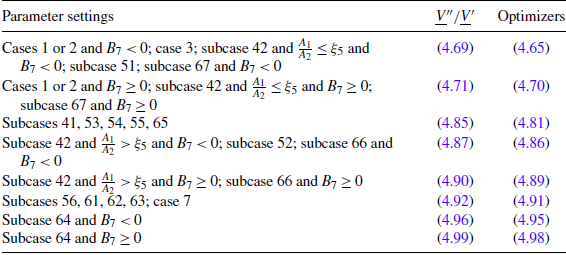
and the optimizers explicitly under all possible parameter cases for the sub-value function in the concave region. The results are summarized in Table 1 of Appendix D.
4.2. The convex region with
$\underline{\boldsymbol{V}}''>0$

In this region, we have
 $\frac{\underline{V}''}{\underline{V}'}<0$
. The quadratic function
 $L^{a_1,a_2}\underline{V}$
(in
 $a_1$
) has a positive coefficient on the second-degree term, and the vertex point
 $\hat{a}_{1,a_2,\underline{V}}(x)=-\theta_1\frac{\underline{V}'}{\underline{V}''}+\rho a_2$
is positive. If the vertex point satisfies
 $\hat{a}_{1,a_2,\underline{V}}(x)=-\theta_1\frac{\underline{V}'}{\underline{V}''}+\rho a_2<A_1$
, which is equivalent to
 $a_2\in(\!-\!\infty,\acute{a}_{2,\underline{V}})\cap[0,A_2]$
, where
 \begin{equation}\acute{a}_{2,\underline{V}}=\frac{\theta_1}{\rho}\frac{\underline{V}'}{\underline{V}''}+\frac{A_1}{\rho},\end{equation}
then the minimizer of
 $L^{a_1,a_2}\underline{V}$
in
 $a_1$
is
 $\underline{a}^*(x,a_2)=\hat{a}_{1,a_2,\underline{V}}(x)$
. If
 $A_1\le \hat{a}_{1,a_2,\underline{V}}(x)$
, that is,
 $a_2\in[\acute{a}_{2,\underline{V}}, \infty)\cap[0,A_2]$
, the minimizer in
 $a_1$
is
 $\underline{a}^*(x,a_2)=A_1$
. Below we write
 $\acute{a}_2=\acute{a}_{2,\underline{V}}$
for convenience. The minimizer
 $\underline{a}^*(x,a_2)$
of
 $L^{a_1,a_2}\underline{V}$
in
 $a_1$
given
 $a_2\in[0,A_2]$
takes the form
 \begin{equation}\underline{a}^*(x,a_2)=\begin{cases}A_1 & \acute{a}_2\le 0\ \ \ \ \ \ \ \ \ \ \ a_2\in[0, A_2],\\[5pt] A_1 & 0<\acute{a}_2<A_2\ \ \ a_2\in[\acute{a}_2, A_2],\\[5pt] \hat{a}_{1,a_2,\underline{V}}& 0<\acute{a}_2<A_2\ \ \ a_2\in[0, \acute{a}_2],\\[5pt] \hat{a}_{1,a_2,\underline{V}}& A_2\le\acute{a}_2\ \ \ \ \ \ \ \ \ a_2\in[0, A_2], \end{cases}\end{equation}
which assumes nonzero values. Note that
 $\hat{a}_{1,\acute{a}_2,\underline{V}}=A_1$
.
We now define three regions which form a partition of the convex region:
 \begin{equation}\begin{split}&\mathcal{R}_{1,+}=\{x\in(l,u)\;:\;\underline{V}''>0, \acute{a}_{2}\le 0\}=\Bigg\{x\in(l,u)\;:\;\underline{V}''>0, \frac{\underline{V}'}{\underline{V}''}\le B_6\Bigg\},\\[5pt] &\mathcal{R}_{2,+}=\{x\in(l,u)\;:\;\underline{V}''>0, 0<\acute{a}_{2}<A_2\}=\Bigg\{x\in(l,u)\;:\;\underline{V}''>0, B_6<\frac{\underline{V}'}{\underline{V}''}<B_7\Bigg\},\\[5pt] &\mathcal{R}_{3,+}=\{x\in(l,u)\;:\;\underline{V}''>0, A_2\le\acute{a}_{2}\}=\Bigg\{x\in(l,u)\;:\;\underline{V}''>0, B_7\le\frac{\underline{V}'}{\underline{V}''}\Bigg\},\end{split}\end{equation}
where
 \begin{equation}B_6=-\frac{A_1}{\theta_1},\quad B_7=\frac{A_2\rho-A_1}{\theta_1}.\end{equation}
We note that
 $B_6<B_7$
and the region
 $\mathcal{R}_{3,+}$
degenerates when
 $B_7\geq 0$
. Next we show results to determine the maximizer in
 $a_2$
of
 $L^{\underline{a}^*(x,a_2),a_2}\underline{V}$
in these three regions.
For
 $x\in\mathcal{R}_{1,+}$
, the minimizer in
 $a_1$
is equal to
 $\underline{a}^*(x,a_2)=A_1$
. The vertex point of
 $L^{A_1,a_2}$
in
 $a_2$
is
 $\hat{a}_{2,A_1,\underline{V}}=\theta_2\frac{\underline{V}'}{\underline{V}''}+\rho A_1$
, and the maximizer in
 $a_2$
is 0 or
 $A_2$
. We obtain the following lemma.
Lemma 4.6. For
 $x\in\mathcal{R}_{1,+}$
, we have
 \begin{equation}\underset{a_2\in[0,A_2]}{\sup}\underset{a_1\in[0,A_1]}{\mathrm{inf}}L^{a_1,a_2}\underline{V}=\begin{cases}L^{A_1,A_2}\underline{V}&\ \ \Big\{x\;:\;\hat{a}_{2,A_1,\underline{V}}\le\frac{A_2}{2}\Big\}=\Big\{x\;:\;\frac{\underline{V}'}{\underline{V}''}\le B_8\Big\},\\[5pt] L^{A_1,0}\underline{V}&\ \ \Big\{x\;:\;\frac{A_2}{2}<\hat{a}_{2,A_1\underline{V}}\Big\}=\Big\{x\;:\;B_8<\frac{\underline{V}'}{\underline{V}''}\Big\},\end{cases}\end{equation}
where
 \begin{equation}B_8=(A_2/2-\rho A_1)/\theta_2.\end{equation}
In
 $\mathcal{R}_{2,+}$
, from (4.48), if
 $a_2\in[0,\acute{a}_{2})$
, the minimizer in
 $a_1$
is
 $\underline{a}^*(x,a_2)=\hat{a}_{1,a_2,\underline{V}}$
. The function
 $L^{\hat{a}_{1,a_2,\underline{V}},a_2}\underline{V}$
simplifies to
 \begin{equation}L^{\hat{a}_{1,a_2,\underline{V}},a_2}\underline{V}=[rx+\mu+(\rho\theta_1-\theta_2)a_2)]\underline{V}'-\frac{\theta_1^2}{2}\frac{\underline{V}'^2}{\underline{V}''}+\frac{1}{2}\big[(1-\rho^2)a_2^2+\sigma^2\big]\underline{V}'',\end{equation}
which is a quadratic function in
 $a_2$
with a positive coefficient on the second-degree term, and its vertex point in
 $a_2$
is given by
 \begin{equation}\breve{a}_{2,\underline{V}}=-\frac{\rho\theta_1-\theta_2}{1-\rho^2}\frac{\underline{V}'}{\underline{V}''},\end{equation}
which is positive when
 $\frac{1}{\rho}<\frac{\theta_1}{\theta_2}$
in the convex region. The maximizer in
 $a_2\in[0,\acute{a}_{2}]$
of
 $L^{\hat{a}_{1,a_2,\underline{V}},a_2}\underline{V}$
is 0 or
 $\acute{a}_{2}$
. If
 $a_2\in [\acute{a}_{2},A_2]$
, the minimizer in
 $a_1$
is
 $\underline{a}^*(x,a_2)=A_1$
. The vertex point of
 $L^{A_1,a_2}\underline{V}$
in
 $a_2$
is
 $\hat{a}_{2,A_1,\underline{V}}$
, and the maximizer in
 $a_2\in[\acute{a}_{2}, A_2]$
of
 $L^{A_1,a_2}\underline{V}$
is
 $\acute{a}_{2}$
or
 $A_2$
. We obtain the following lemma.
Lemma 4.7. For
 $x\in\mathcal{R}_{2,+}$
, if
 $\frac{1}{\rho}<\frac{\theta_1}{\theta_2}$
, we have
 \begin{align}\underset{a_2\in[0,\acute{a}_2)}{\sup}\underset{a_1\in[0,A_1]}{\mathrm{inf}}L^{a_1,a_2}\underline{V}=\begin{cases}L^{\hat{a}_{1,0,\underline{V}},0}\underline{V}&\ \ \{x\;:\;\acute{a}_2/2\le\breve{a}_{2,\underline{V}}\}=\Big\{x\;:\;\frac{\underline{V}'}{\underline{V}''}\le B_9\Big\},\\[9pt] L^{\hat{a}_{1,\acute{a}_2,\underline{V}},\acute{a}_2}\underline{V}=L^{A_1,\acute{a}_2}\underline{V}&\ \ \{x\;:\;\breve{a}_{2,\underline{V}}<\acute{a}_2/2\}=\Big\{x\;:\;B_9<\frac{\underline{V}'}{\underline{V}''}\Big\},\end{cases}\nonumber\\[2pt]\end{align}
where
 \begin{equation}B_9=-\frac{(1-\rho^2)A_1}{\theta_1(1+\rho^2)-2\rho\theta_2};\end{equation}
for
 $x\in\mathcal{R}_{2,+}$
, if
 $\frac{\theta_1}{\theta_2}\le\frac{1}{\rho}$
, we have
 \begin{equation}\underset{a_2\in[0,\acute{a}_2]}{\sup}\underset{a_1\in[0,A_1]}{\mathrm{inf}}L^{a_1,a_2}\underline{V}=L^{\hat{a}_{1,\acute{a},\underline{V}},\acute{a}_2}\underline{V}=L^{A_1,\acute{a}_2}\underline{V}.\end{equation}
For
 $x\in\mathcal{R}_{2,+}$
, if
 $2\rho<\frac{\theta_1}{\theta_2}$
, we have
 \begin{align}\underset{a_2\in[\acute{a}_2,A_2]}{\sup}\underset{a_1\in[0,A_1]}{\mathrm{inf}}L^{a_1,a_2}\underline{V}=\begin{cases}L^{A_1,\acute{a}_2}\underline{V}&\ \ \{x\;:\;(\acute{a}_2+A_2)/2\le\hat{a}_{2,A_1,\underline{V}}\}=\Big\{x\;:\;\frac{\underline{V}'}{\underline{V}''}\le B_{10}\Big\},\\[5pt] L^{A_1,A_2}\underline{V}&\ \ \{x\;:\;\hat{a}_{2,A_1,\underline{V}}<(\acute{a}_2+A_2)/2\}=\Big\{x\;:\;B_{10}<\frac{\underline{V}'}{\underline{V}''}\Big\},\end{cases}\nonumber\\[2pt]\end{align}
where
 \begin{equation}B_{10}=-\frac{\rho A_2+(1-2\rho^2)A_1}{\theta_1-2\rho\theta_2};\end{equation}
for
 $x\in\mathcal{R}_{2,+}$
, if
 $\frac{\theta_1}{\theta_2}<{2\rho}$
, we have
 \begin{align}\underset{a_2\in[\acute{a}_2,A_2]}{\sup}\underset{a_1\in[0,A_1]}{\mathrm{inf}}L^{a_1,a_2}\underline{V}=\begin{cases}L^{A_1,\acute{a}_2}\underline{V}&\ \ \{x\;:\;(\acute{a}_2+A_2)/2\le\hat{a}_{2,A_1,\underline{V}}\}=\Big\{x\;:\;B_{10}\le\frac{\underline{V}'}{\underline{V}''}\Big\},\\[8pt] L^{A_1,A_2}\underline{V}&\ \ \{x\;:\;\hat{a}_{2,A_1,\underline{V}}<(\acute{a}_2+A_2)/2\}=\Big\{x\;:\;\frac{\underline{V}'}{\underline{V}''}<B_{10}\Big\};\end{cases}\nonumber\\[2pt]\end{align}
for
 $x\in\mathcal{R}_{2,+}$
, if
 $\frac{\theta_1}{\theta_2}={2\rho}$
, we have
 \begin{equation}\underset{a_2\in[\acute{a}_2,A_2]}{\sup}\underset{a_1\in[0,A_1]}{\mathrm{inf}}L^{a_1,a_2}\underline{V}=\begin{cases}L^{A_1,\acute{a}_2}\underline{V}&\ \ \ A_2+\big(\frac{1}{\rho}-2\rho\big)A_1\le 0,\\[5pt] L^{A_1,A_2}\underline{V}&\ \ \ A_2+\big(\frac{1}{\rho}-2\rho\big)A_1>0.\end{cases}\end{equation}
To show (4.57), we note that
 $B_9\le B_6$
if
 $\frac{2\rho}{1+\rho^2}<\frac{\theta_1}{\theta_2}\le\frac{1}{\rho}$
and the set
 $\{x\;:\;\acute{a}_2/2\le\breve{a}_{2,\underline{V}}\}$
degenerates in
 $\mathcal{R}_{2,+}$
.
In
 $\mathcal{R}_{3,+}$
, from (4.48), the minimizer of
 $L^{a_1,a_2}\underline{V}$
in
 $a_1$
is
 $\underline{a}^*(x,a_2)=\hat{a}_{1,a_2,\underline{V}}$
for all
 $a_2\in[0,A_2]$
. From (4.53), we note that
 $L^{\hat{a}_{1,a_2,\underline{V}},a_2}\underline{V}$
is a quadratic function of
 $a_2$
and its vertex point is
 $\breve{a}_{2,\underline{V}}$
in (4.54). The maximizer in
 $a_2\in[0,A_2]$
of
 $L^{\hat{a}_{1,a_2,\underline{V}},a_2}\underline{V}$
is 0 or
 $A_2$
. We obtain the following lemma.
Lemma 4.8. For
 $x\in\mathcal{R}_{3,+}$
, if
 $\frac{\theta_1}{\theta_2}>\frac{1}{\rho}$
, we have
 \begin{equation}\underset{a_2\in[0,A_2]}{\sup}\underset{a_1\in[0,A_1]}{\mathrm{inf}}L^{a_1,a_2}\underline{V}=\begin{cases}L^{\hat{a}_{1,0,\underline{V}},0}\underline{V}&\ \ \Big\{x\;:\;\breve{a}_{1,\underline{V}}\ge\frac{A_2}{2}\Big\}=\Big\{x\;:\;\frac{\underline{V}'}{\underline{V}''}\le B_{11}\Big\},\\[5pt] L^{\hat{a}_{1,A_2,\underline{V}},A_2}\underline{V}&\ \ \Big\{x\;:\;\breve{a}_{1,\underline{V}}<\frac{A_2}{2}\Big\}=\Big\{x\;:\;B_{11}<\frac{\underline{V}'}{\underline{V}''}\Big\},\end{cases}\end{equation}
where
 \begin{equation}B_{11}=-\frac{(1-\rho^2)A_2}{2(\rho\theta_1-\theta_2)};\end{equation}
for
 $x\in\mathcal{R}_{3,+}$
, if
 $\frac{\theta_1}{\theta_2}\le\frac{1}{\rho}$
, we have
 \begin{equation}\underset{a_2\in[0,A_2]}{\sup}\underset{a_1\in[0,A_1]}{\mathrm{inf}}L^{a_1,a_2}\underline{V}=L^{\hat{a}_{1,A_2,\underline{V}},A_2}\underline{V}.\end{equation}
In the sequel, we find
 $\frac{\underline{V}''}{\underline{V}'}$
in the convex region via the following parameter cases:
-
1.
$2\rho<\frac{\theta_1}{\theta_2}\le\frac{1}{\rho}$
; -
2.
$\frac{\theta_1}{\theta_2}\le\frac{1}{\rho}, 2\rho$
and
$A_2+(\frac{1}{\rho}-2\rho)A_1>0$
; -
3.
$\frac{\theta_1}{\theta_2}\le\frac{1}{\rho}, 2\rho$
and
$A_2+(\frac{1}{\rho}-2\rho)A_1\le 0$
; -
4.
$\frac{1}{\rho}<\frac{\theta_1}{\theta_2}\le 2\rho$
and
$A_2+(\frac{1}{\rho}-2\rho)A_1>0$
; -
5.
$\frac{1}{\rho}<\frac{\theta_1}{\theta_2}\le 2\rho$
and
$A_2+(\frac{1}{\rho}-2\rho)A_1\le 0$
; -
6.
$\frac{1}{\rho}, 2\rho<\frac{\theta_1}{\theta_2}$
and
$A_2+(\frac{1}{\rho}-2\rho)A_1>0$
; -
7.
$\frac{1}{\rho}, 2\rho<\frac{\theta_1}{\theta_2}$
and
$A_2+(\frac{1}{\rho}-2\rho)A_1\le 0$
.


In case 1, the parameter conditions imply
 $B_6<B_8$
and
 $B_{10}<B_6$
. From Lemma 4.6 and
 $B_6<B_8$
, we have
 $\sup{a_2\in[0,A_2]}\inf{a_1\in[0,A_1]}L^{a_1,a_2}\underline{V}=L^{A_1,A_2}\underline{V}$
in
 $\mathcal{R}_{1,+}$
. From (4.57), (4.58) and
 $B_{10}<B_6$
, we have
 $\sup{a_2\in[0,A_2]}\inf{a_1\in[0,A_1]}L^{a_1,a_2}\underline{V}=L^{A_1,A_2}\underline{V}$
in
 $\mathcal{R}_{2,+}$
. In addition, from (4.64), if
 $B_7<0$
, we have
 $\sup{a_2\in[0,A_2]}\inf{a_1\in[0,A_1]}L^{a_1,a_2}\underline{V}=L^{\hat{a}_{1,A_2,\underline{V}},A_2}\underline{V}$
in
 $\mathcal{R}_{3,+}=\{x\;:\;B_{7}<\frac{\underline{V}'}{\underline{V}''}\}$
. We obtain
 \begin{equation}\underset{a_2\in[0,A_2]}{\sup}\underset{a_1\in[0,A_1]}{\mathrm{inf}}L^{a_1,a_2}\underline{V}=\begin{cases}L^{A_1,A_2}\underline{V}&\ \ \mathcal{R}_{1,+}\cup\mathcal{R}_{2,+}=\Big\{x\;:\;\frac{\underline{V}'}{\underline{V}''}\le B_{7}\Big\},\\[8pt] L^{\hat{a}_{1,A_2,\underline{V}},A_2}\underline{V}&\ \ \mathcal{R}_{3,+}=\Big\{x\;:\;B_{7}<\frac{\underline{V}'}{\underline{V}''}\Big\},\end{cases}\end{equation}
in the convex region. From (4.53), this yields
 \begin{align}L^{\hat{a}_{1,A_2,\underline{V}},A_2}\underline{V}=-\underline{V}''\left\{\frac{\theta_1^2}{2}\left(\frac{\underline{V}'}{\underline{V}''}\right)^2-[rx+\mu+(\rho\theta_1-\theta_2)A_2]\frac{\underline{V}'}{\underline{V}''}-\frac{1}{2}\big[\big(1-\rho^2\big)A_2^2+\sigma^2\big]\right\}.\nonumber\\[2pt]\end{align}
Thus, the equation
 $L^{\hat{a}_{1,A_2,\underline{V}},A_2}\underline{V}=0$
yields
 $\frac{\underline{V}'}{\underline{V}''}=f_5$
, where
 \begin{equation}f_5(x)=\frac{rx+\mu+(\rho\theta_1-\theta_2)A_2-\sqrt{[rx+\mu+(\rho\theta_1-\theta_2)A_2]^2+\theta_1^2\big[(1-\rho^2)A_2^2+\sigma^2\big]}}{\theta_1^2},\end{equation}
which is a negative and increasing function. The inequality
 $f_5(x)>B_7$
gives
 $x>x_{3,+}$
, where
 \begin{equation}x_{3,+}=\frac{B_7^2\theta_1^2-\sigma^2-(1-\rho^2)A_2^2}{2rB_7}-\frac{(\rho\theta_1-\theta_2)A_2+\mu}{r}.\end{equation}
The inequality
 $1/B_7\le g(x)<0$
gives
 $x_0<x<x_{3,+}$
. Thus, in case 1, if
 $B_7<0$
(i.e.
 $\frac{A_1}{A_2}<\rho$
), we have
 \begin{equation}\frac{\underline{V}''}{\underline{V}'}=g1_{(x_0,x_{3,+}]}+\frac{1_{(x_{3,+},\infty)}}{f_5},\end{equation}
which is a continuous, negative, and decreasing function in the convex region
 $\mathcal{R}_{1,+}\cup\mathcal{R}_{2,+}\cup\mathcal{R}_{3,+}=(x_0,\infty)\cap[u,l]$
. If
 $B_7\ge 0$
(i.e.
 $\rho\le\frac{A_1}{A_2}$
), we have
 $\mathcal{R}_{3,+}=\emptyset$
; so we have
 \begin{equation}\underset{a_2\in[0,A_2]}{\sup}\underset{a_1\in[0,A_1]}{\mathrm{inf}}L^{a_1,a_2}\underline{V}=L^{A_1,A_2}\underline{V}\end{equation}
and
 \begin{equation}\frac{\underline{V}''}{\underline{V}'}=g1_{(x_0,\infty)},\end{equation}
which is a continuous, negative, and decreasing function in the convex region.
In case 2, we have
 $B_6<B_8$
and
 $B_{10}< 0$
(if
 $\frac{\theta_1}{\theta_2}<2\rho$
). From Lemma 4.6, (4.57), (4.60) or (4.61), and (4.64), we obtain the same expression for
 $\frac{\underline{V}''}{\underline{V}'}$
as in case 1.
In case 3, we have
 $0<A_2/A_1\leq 2\rho-1/\rho$
and
 $\frac{\theta_1}{\theta_2}\le 1/\rho<2\rho$
. We can show that
 $B_6<B_8$
,
 $B_6<B_{10}$
, and
 $B_7<B_{10}\le 0$
. From Lemma 4.6 and
 $B_6<B_8$
, we have
 $\sup{a_2\in[0,A_2]}\inf{a_1\in[0,A_1]}L^{a_1,a_2}\underline{V}=L^{A_1,A_2}\underline{V}$
in
 $\mathcal{R}_{1,+}$
. From (4.57) and (4.60), we obtain
 $\sup{a_2\in[0,A_2]}\inf{a_1\in[0,A_1]}L^{a_1,a_2}\underline{V}=L^{A_1,A_2}\underline{V}$
in
 $\mathcal{R}_{2,+}$
. From (4.64), we have
 $\sup{a_2\in[0,A_2]}\inf{a_1\in[0,A_1]}L^{a_1,a_2}\underline{V}=L^{\hat{a}_{1,A_2,\underline{V}},A_2}\underline{V}$
in
 $\mathcal{R}_{3,+}$
. Thus, we conclude that
 $\frac{\underline{V}''}{\underline{V}'}$
takes the form (4.69) with the optimizers given in (4.65) in the convex region in case 3.
For the remaining parameter cases, we have
 $\frac{1}{\rho}<\frac{\theta_1}{\theta_2}$
, under which the following quantities are all positive:
 \begin{align}\xi_1=\frac{\theta_1}{2(\rho\theta_1-\theta_2)},\quad\xi_2=\frac{(1+\rho^2)\theta_1-2\rho\theta_2}{2(\rho\theta_1-\theta_2)},\quad\xi_3=\frac{\theta_1-\rho\theta_2}{\rho\theta_1-\theta_2},\quad\xi_4=\frac{(1+\rho^2)\theta_1-2\rho\theta_2}{2\rho^2(\rho\theta_1-\theta_2)}.\nonumber\\[2pt]\end{align}
We give the following lemma which can be shown by simple algebra.
Lemma 4.9. Assume
 $\frac{1}{\rho}<\frac{\theta_1}{\theta_2}$
. Then the following results hold.
-
(i) We have
$\xi_2<\xi_3,\xi_4$
;
$B_6<B_9$
;
$B_9<B_7$
if and only if
$\frac{A_1}{A_2}<\xi_2$
;
$B_{11}<B_7$
if and only if
$\frac{A_1}{A_2}<\xi_2$
;
$B_6<B_8$
if and only if
$\frac{A_1}{A_2}<\xi_1$
. -
(ii) If
$2\rho<\frac{\theta_1}{\theta_2}$
then
$B_{10}<B_6$
if and only if
$\frac{A_1}{A_2}<\xi_1$
;
$B_{10}<B_7$
if and only if
$\frac{A_1}{A_2}<\xi_3$
; and
$B_{10}<B_9$
if and only if
$\frac{A_1}{A_2}<\xi_4$
. -
(iii) If
$\frac{\theta_1}{\theta_2}<2\rho$
then
$B_{10}<B_6$
if and only if
$\frac{A_1}{A_2}>\xi_1$
;
$B_{10}<B_7$
if and only if
$\frac{A_1}{A_2}>\xi_3$
; and
$B_{10}<B_9$
if and only if
$\frac{A_1}{A_2}>\xi_4$
. -
(iv) If
$2\rho<\frac{\theta_1}{\theta_2}$
then
$\xi_1<\xi_3<\xi_4$
. -
(v) If
$\frac{\theta_1}{\theta_2}<2\rho$
then
$\xi_4<\xi_3<\xi_1$
.


In case 4, from Lemma 4.9, we have
 $\xi_2<\xi_4<\xi_3<\xi_1$
. From
 $A_2+(\frac{1}{\rho}-2\rho)A_1>0$
, we have
 $\frac{A_1}{A_2}<\frac{1}{2\rho-1/\rho}<\xi_4$
, where the second inequality is equivalent to
 $\frac{\theta_1}{\theta_2}<2\rho$
. We consider two subcases: subcase 41 with
 $\xi_2<\frac{A_1}{A_2}({<}\xi_4<\xi_3<\xi_1)$
and subcase 42 with
 $\frac{A_1}{A_2}\le\xi_2({<}\xi_4<\xi_3<\xi_1)$
.
In subcase 41, applying Lemma 4.9, we have
 $B_6<B_8$
,
 $B_7\le B_{11}$
, and
 $B_6<B_7<B_9<0<B_{10}$
. From Lemma 4.6 and
 $B_6<B_8$
, we have
 \begin{equation}\underset{a_2\in[0,A_2]}{\sup}\underset{a_1\in[0,A_1]}{\mathrm{inf}}L^{a_1,a_2}\underline{V}=L^{A_1,A_2}\underline{V},\end{equation}
in
 $\mathcal{R}_{1,+}$
. From (4.5), (4.11), and
 $B_6<B_7<B_9<0<B_{10}$
, we have
 $\sup{a_2\in[0,A_2]}\inf{a_1\in[0,A_1]}L^{a_1,a_2}\underline{V}=\max\{L^{A_1,A_2}\underline{V}, L^{\hat{a}_{1,0,\underline{V}},0}\underline{V}\}$
in
 $\mathcal{R}_{2,+}$
. From
 \begin{equation}L^{\hat{a}_{1,0,\underline{V}},0}\underline{V}=\underline{V}''\left[-\frac{\theta_1^2}{2}\left(\frac{\underline{V}'}{\underline{V}''}\right)^2+(rx+\mu)\frac{\underline{V}'}{\underline{V}''}-\frac{1}{2}\sigma^2\right]\end{equation}
we obtain
 \begin{equation}L^{\hat{a}_{1,0,\underline{V}},0}\underline{V}-L^{A_1,A_2}\underline{V}=\underline{V}''G\left(\frac{\underline{V}'}{\underline{V}''}\right)\!,\end{equation}
where G is a quadratic function given by
 \begin{equation}G(A)\;:\!=\;-\frac{\theta_1^2}{2}A^2+(\theta_2A_2-\theta_1A_1)A-\frac{1}{2}\big(A_1^2+A_2^2-2\rho A_1A_2\big).\end{equation}
We have
 $L^{\hat{a}_{1,0,\underline{V}},0}\underline{V}-L^{A_1,A_2}\underline{V}>0$
if and only if
 $A_-<\frac{\underline{V}'}{\underline{V}''}<A_+$
, where
 \begin{equation}A_+,A_-=\frac{\theta_2A_2-\theta_1A_1\pm\sqrt{(\theta_2A_2-\theta_1A_1)^2-\theta_1^2\big(A_1^2+A_2^2-2\rho A_1A_2\big)}}{\theta_1^2}\end{equation}
are roots of the quadratic equation
 $G(A)=0$
, whose discriminant is positive if and only if
 $\frac{A_1}{A_2}>\xi_5$
(provided
 $\frac{1}{\rho}<\frac{\theta_1}{\theta_2}$
), where
 \begin{equation}\xi_5=\frac{\theta_1^2-\theta_2^2}{2\theta_1(\rho\theta_1-\theta_2)}.\end{equation}
By simple computations, we give the following lemmas.
Lemma 4.10. Assume
 $\frac{1}{\rho}<\frac{\theta_1}{\theta_2}$
. Then:
-
(i)
$\frac{\theta_2}{\theta_1}<\xi_5<\xi_2$
;
$\xi_5<\xi_1$
;
$A_-<B_7$
; -
(ii) if
$\frac{A_1}{A_2}>\xi_5$
then the roots
$A_-$
and
$A_+$
are real and
$A_-<A_+<0$
; -
(iii) if
$\frac{A_1}{A_2}>\xi_5$
then
$A_+<B_7$
if and only if
$\frac{A_1}{A_2}<\xi_2$
;
$B_6<A_-$
if and only if
$\frac{A_1}{A_2}<\xi_1$
.


To show (ii), we note that
 $\frac{A_1}{A_2}>\xi_5>\frac{\theta_2}{\theta_1}$
, which yields
 $\theta_2A_2-\theta_1A_1<0$
.
Lemma 4.11. If
 $\frac{1}{\rho}<\frac{\theta_1}{\theta_2}$
and
 $\frac{A_1}{A_2}>\xi_5$
then
 $\frac{A_-+A_+}{2} < B_9$
;
 $A_-<B_9<A_+$
if and only if
 $\xi_2<\frac{A_1}{A_2}<\xi_4$
; and
 $A_-<B_{10}<A_+$
if and only if
 $\xi_1<\frac{A_1}{A_2}<\xi_4$
or
 $\xi_4<\frac{A_1}{A_2}<\xi_1$
.
The inequality
 $\frac{A_-+A_+}{2}<B_9$
is equivalent to
 $\frac{\theta_2\xi_2}{\rho\theta_1}<\frac{A_1}{A_2}$
. It holds by showing
 $\frac{\theta_2\xi_2}{\rho\theta_1}<\xi_5$
, which is equivalent to
 $(\frac{\theta_1}{\theta_2}-\rho)(\frac{\theta_1}{\theta_2}-\frac{1}{\rho})>0$
. The other two results in Lemma 4.11 immediately follow:
 \begin{equation*}\begin{split}G(B_9)&=-\frac{2\rho^2(\rho\theta_1-\theta_2)^2A_2^2}{[\theta_1(1+\rho^2)-2\rho\theta_2]^2}\left(\frac{A_1}{A_2}-\xi_2\right)\left(\frac{A_1}{A_2}-\xi_4\right)\!,\\[5pt] G(B_{10})&=-\frac{2\rho^2(\rho\theta_1-\theta_2)^2A_2^2}{(\theta_1-2\rho\theta_2)^2}\left(\frac{A_1}{A_2}-\xi_1\right)\left(\frac{A_1}{A_2}-\xi_4\right)\!.\end{split}\end{equation*}
From Lemma 4.10, we see that
 $A_-, A_+$
exist and we have
 $B_6 < A_- < B_7 < A_+$
in subcase 41. Thus, we have
 \begin{align}\underset{a_2\in[0,A_2]}{\sup}\underset{a_1\in[0,A_1]}{\mathrm{inf}}L^{a_1,a_2}\underline{V}=\max\big\{L^{A_1,A_2}\underline{V}, L^{\hat{a}_{1, 0, \underline{V}}, 0}\underline{V}\big\}=\begin{cases}L^{A_1,A_2}\underline{V}&\ \ \Big\{x\;:\;B_6<\frac{\underline{V}'}{\underline{V}''}\le A_-\Big\},\\[8pt] L^{\hat{a}_{1,0,\underline{V}},0}\underline{V}&\ \ \Big\{x\;:\;A_-<\frac{\underline{V}'}{\underline{V}''}<B_7\Big\},\end{cases}\nonumber\\[2pt]\end{align}
in
 $\mathcal{R}_{2,+}$
. From (4.62) and
 $B_7<B_{11}$
, we have
 \begin{equation}\underset{a_2\in[0,A_2]}{\sup}\underset{a_1\in[0,A_1]}{\mathrm{inf}}L^{a_1,a_2}\underline{V}=\begin{cases}L^{\hat{a}_{1,0,\underline{V}},0}\underline{V}&\ \ \Big\{x\;:\; B_7\le\frac{\underline{V}'}{\underline{V}''}\le B_{11}\Big\},\\[8pt] L^{\hat{a}_{1,A_2,\underline{V}},A_2}\underline{V}&\ \ \Big\{x\;:\;B_{11}<\frac{\underline{V}'}{\underline{V}''}\Big\},\end{cases}\end{equation}
in
 $\mathcal{R}_{3,+}$
. Thus, from (4.73), (4.79), and (4.80), we obtain
 \begin{equation}\underset{a_2\in[0,A_2]}{\sup}\underset{a_1\in[0,A_1]}{\mathrm{inf}}L^{a_1,a_2}\underline{V}=\begin{cases}L^{A_1,A_2}\underline{V}&\ \ \Big\{x\;:\;\frac{\underline{V}'}{\underline{V}''}\le A_-\Big\},\\[5pt] L^{\hat{a}_{1,0,\underline{V}},0}\underline{V}&\ \ \Big\{x\;:\; A_-\le\frac{\underline{V}'}{\underline{V}''}\le B_{11}\Big\},\\[5pt] L^{\hat{a}_{1,A_2,\underline{V}},A_2}\underline{V}&\ \ \Big\{x\;:\;B_{11}<\frac{\underline{V}'}{\underline{V}''}\Big\},\end{cases}\end{equation}
in the convex region. The inequality
 $1/A_-<g(x)<0$
gives
 $x_0<x<x_{7,+}$
, where
 \begin{equation}x_{7,+}=-\frac{A_1^2+A_2^2-2\rho A_1A_2+\sigma^2}{2rA_-}-\frac{\theta_1A_1-\theta_2A_2+\mu}{r}.\end{equation}
From (4.74), the equation
 $L^{\hat{a}_{1,0,u{V}},0}=0$
yields
 $\frac{\underline{V}'}{\underline{V}''}=f_4$
, where
 \begin{equation}f_4(x)=\frac{rx+\mu-\sqrt{(rx+\mu)^2+\sigma^2\theta_1^2}}{\theta_1^2}.\end{equation}
The inequality
 $A_-\le f_4(x)<B_{11}$
gives
 $x_{7,+}\le x<x_{1,+}$
, where
 \begin{equation}x_{1,+}=-\frac{\sigma^2+(1-\rho^2)A_2^2-\theta_1^2B_{11}^2}{2B_{11}}-(\rho\theta_1-\theta_2)A_2.\end{equation}
And the inequality
 $f_5\ge B_{11}$
gives
 $x\ge x_{1,+}$
, where
 $f_5$
is given by (4.67). Thus, we obtain
 \begin{equation}\frac{\underline{V}''}{\underline{V}'}=g1_{(x_0,x_{7,+})}+\frac{1_{[x_{7,+},x_{1,+})}}{f_4}+\frac{1_{[x_{1,+},\infty)}}{f_5},\end{equation}
which is a continuous, negative, and decreasing function in the convex region in subcase 41.
In subcase 42 with
 $\frac{A_1}{A_2}\le\xi_2(<\xi_4<\xi_3<\xi_1)$
, applying Lemmas 4.9 and 4.10, we have
 $B_6<B_8$
,
 $B_{11}<B_7$
, and
 $B_6<B_9<B_7<B_{10}$
. We also have
 $B_6<A_-<A_+<B_9<B_7$
(if
 $\xi_5<\frac{A_1}{A_2}$
) by Lemma 4.11. From Lemma 4.6, (4.55), (4.60), (4.62), and (4.75), we have
 \begin{equation}\underset{a_2\in[0,A_2]}{\sup}\underset{a_1\in[0,A_1]}{\mathrm{inf}}L^{a_1,a_2}\underline{V}=\begin{cases}L^{A_1,A_2}\underline{V}&\ \ \Big\{x\;:\; \frac{\underline{V}'}{\underline{V}''}\le A_-\Big\},\\[5pt] L^{\hat{a}_{1,0,\underline{V}},0}\underline{V}&\ \ \Big\{x\;:\;A_-<\frac{\underline{V}'}{\underline{V}''}<A_+\Big\},\\[5pt] L^{A_1,A_2}\underline{V}&\ \ \Big\{x\;:\; A_+\le\frac{\underline{V}'}{\underline{V}''}< B_7\Big\},\\[5pt] L^{\hat{a}_{1,A_2,\underline{V}},A_2}\underline{V}&\ \ \Big\{x\;:\; B_7\le\frac{\underline{V}'}{\underline{V}''}\Big\},\end{cases}\end{equation}
and
 \begin{equation}\frac{\underline{V}''}{\underline{V}'}=g1_{(x_0,x_{7,+})}+\frac{1_{[x_{7,+},x_{8,+})}}{f_4}+g1_{[x_{8,+},x_{3,+})}+\frac{1_{[x_{3,+},\infty)}}{f_5},\end{equation}
which is a continuous, negative, and decreasing function in the convex region if
 $\frac{A_1}{A_2}>\xi_5$
and
 $B_7<0$
in subcase 42, where
 \begin{equation}x_{8,+}=-\frac{A_1^2+A_2^2-2\rho A_1A_2+\sigma^2}{2rA_+}-\frac{\theta_1A_1-\theta_2A_2+\mu}{r}.\end{equation}
If
 $\frac{A_1}{A_2}>\xi_5$
and
 $B_7\ge 0$
, the region
 $\mathcal{R}_{3,+}$
degenerates and we obtain
 \begin{equation}\underset{a_2\in[0,A_2]}{\sup}\underset{a_1\in[0,A_1]}{\mathrm{inf}}L^{a_1,a_2}\underline{V}=\begin{cases}L^{A_1,A_2}\underline{V}&\ \ \Big\{x\;:\; \frac{\underline{V}'}{\underline{V}''}\le A_-\Big\},\\[5pt] L^{\hat{a}_{1,0,\underline{V}},0}\underline{V}&\ \ \Big\{x\;:\;A_-<\frac{\underline{V}'}{\underline{V}''}<A_+\Big\},\\[5pt] L^{A_1,A_2}\underline{V}&\ \ \Big\{x\;:\; A_+\le\frac{\underline{V}'}{\underline{V}''}\Big\},\end{cases}\end{equation}
and
 \begin{equation}\frac{\underline{V}''}{\underline{V}'}=g1_{(x_0,x_{7,+})}+\frac{1_{[x_{7,+},x_{8,+})}}{f_4}+g1_{[x_{8,+},\infty)},\end{equation}
which is a continuous, negative, and decreasing function in the convex region if
 $\frac{A_1}{A_2}>\xi_5$
and
 $B_7\ge 0$
in subcase 42. We note that if
 $\frac{A_1}{A_2}\le \xi_5$
, we have
 $L^{A_1,A_2}\underline{V}\ge L^{\hat{a}_{1,0,\underline{V}},0}$
. Thus, we have the same expression for
 $\frac{\underline{V}''}{\underline{V}'}$
as in (4.69) when
 $B_7<0$
and as in (4.71) when
 $B_7\ge 0$
.
In case 5, we have
 $\xi_5<\xi_2<\xi_4<\xi_3<\xi_1$
. From
 $A_2+(\frac{1}{\rho}-2\rho)A_1\le 0$
we obtain
 $B_{10}\le 0$
, and from
 $\frac{A_1}{A_2}>\frac{\rho}{2\rho^2-1}>\rho$
we have
 $B_7<0$
. We consider six subcases (with different ordering relations between
 $\frac{A_1}{A_2}$
and
 $\xi_j$
,
 $j=1,\ldots,5$
) as follows: subcase 51 with
 $\frac{A_1}{A_2}\le\xi_5$
; subcase 52 with
 $\xi_5<\frac{A_1}{A_2}\le\xi_2$
; subcase 53 with
 $\xi_2<\frac{A_1}{A_2}\le\xi_4$
; subcase 54 with
 $\xi_4<\frac{A_1}{A_2}\le\xi_3$
; subcase 55 with
 $\xi_3<\frac{A_1}{A_2}<\xi_1$
; and subcase 56 with
 $\xi_1\le\frac{A_1}{A_2}$
.
In subcase 51, we have
 $B_6<B_8$
,
 $B_6<B_9<B_7<B_{10}$
, and
 $B_{11}<B_7$
. The inequality
 $L^{\hat{a}_{1,0,\underline{V}},0}\underline{V}\le L^{A_1,A_2}\underline{V}$
holds due to
 $\frac{A_1}{A_2}\le\xi_5$
. We conclude (4.65) and the expression for
 $\frac{\underline{V}''}{\underline{V}'}$
is the same as in (4.69).
In subcase 52, we have
 $B_6<B_8$
,
 $B_6<B_9\le B_7<B_{10}$
, and
 $B_{11}\le B_7$
. We also have
 $B_6<A_-<A_+<B_9<B_7$
. Thus, the expression for
 $\frac{\underline{V}''}{\underline{V}'}$
is the same as in (4.87) with the optimizers given in (4.86).
In subcase 53, we have
 $B_6<B_8$
,
 $B_6<B_7<B_9\le B_{10}$
,
 $B_{7}<B_{11}$
, and
 $B_6<A_-<B_7<A_+$
. The expression for
 $\frac{\underline{V}''}{\underline{V}'}$
is the same as in (4.85) with the optimizers given in (4.81).
In subcase 54, from Lemmas 4.9 and 4.10, we have
 $B_6<B_8$
,
 $B_6<B_7\le B_{10}<B_9<0$
,
 $B_7<B_{11}$
, and
 $B_6<A_-<B_7<A_+$
. We conclude that the expression for
 $\frac{\underline{V}''}{\underline{V}'}$
is the same as in (4.85) with the optimizers given in (4.81).
In subcase 55, we have
 $B_6\le B_8$
,
 $B_6\le B_{10}<B_7<B_9<0$
,
 $B_7<B_{11}$
, and
 $B_6\le A_-<B_7<A_+$
. The expression for
 $\frac{\underline{V}''}{\underline{V}'}$
is the same as in (4.85) with the optimizers given in (4.81) in the convex region.
In subcase 56, we have
 $B_8<B_6$
,
 $B_{10}<B_6<B_7<B_9$
, and
 $B_7<B_{11}$
. The inequality
 $A_-<B_6<B_7<A_+$
holds. From Lemma 4.6, (4.55), (4.60), and (4.62), we have
 \begin{equation}\underset{a_2\in[0,A_2]}{\sup}\underset{a_1\in[0,A_1]}{\mathrm{inf}}L^{a_1,a_2}\underline{V}=\begin{cases}L^{A_1,A_2}\underline{V}&\ \ \Big\{x\;:\; \frac{\underline{V}'}{\underline{V}''}\le B_8\Big\},\\[5pt] L^{A_1,0}\underline{V}&\ \ \Big\{x\;:\;B_8<\frac{\underline{V}'}{\underline{V}''}\le B_6\Big\},\\[5pt] L^{\hat{a}_{1,0,\underline{V}},0}\underline{V}&\ \ \Big\{x\;:\; B_6<\frac{\underline{V}'}{\underline{V}''}< B_{11}\Big\},\\[5pt] L^{\hat{a}_{1,A_2,\underline{V}},A_2}\underline{V}&\ \ \Big\{x\;:\; B_{11}\le\frac{\underline{V}'}{\underline{V}''}\Big\},\end{cases}\end{equation}
and
 \begin{equation}\frac{\underline{V}''}{\underline{V}'}=g1_{(x_0,x_{5,+})}+g_11_{[x_{5,+},x_{4,+})}+\frac{1_{[x_{4,+},x_{1,+})}}{f_4}+\frac{1_{[x_{1,+},\infty)}}{f_5},\end{equation}
which is a continuous, negative, and decreasing function in the convex region in subcase 56, where
 \begin{equation}g_1(x)=-\frac{2(rx+\mu+\theta_1A_1)}{A_1^2+\sigma^2},\end{equation}
which is yielded by the equation
 $L^{A_1,0}\underline{V}=0$
, and
 \begin{equation}x_{5,+}=-\frac{A_1^2+\sigma^2}{2rB_8}-\frac{\theta_1A_1+\mu}{r},\quad x_{4,+}=\frac{\theta_1\big(A_1^2+\sigma^2\big)}{2rA_1}-\frac{\theta_1A_1+\mu}{r},\end{equation}
which are computed by solving
 $g_1(x)=1/B_8$
and
 $g_1(x)=1/B_6$
.
In case 6, we have
 $B_{10}<0$
and
 $B_{11}<0$
. From Lemma 4.9, we have
 $\xi_1,\xi_2<\xi_3<\xi_4$
. We consider the following subcases: subcase 61 with
 $(\xi_1,\xi_2<\xi_3{<})\xi_4\le\frac{A_1}{A_2}$
; subcase 62 with
 $(\xi_1,\xi_2{<})\xi_3\le\frac{A_1}{A_2}<\xi_4$
; subcase 63 with
 $\xi_1, \xi_2\le\frac{A_1}{A_2}<\xi_3({<}\xi_4)$
; subcase 64 with
 $\xi_1\le\frac{A_1}{A_2}<\xi_2({<}\xi_3<\xi_4)$
; subcase 65 with
 $\xi_2\le\frac{A_1}{A_2}<\xi_1({<}\xi_3<\xi_4)$
; subcase 66 with
 $\frac{A_1}{A_2}\le\xi_1,\xi_2({<}\xi_3<\xi_4)$
; and subcase 67 with
 $\frac{A_1}{A_2}\le\xi_5$
.
In subcase 61, from Lemma 4.9, we have
 $B_8<B_6$
,
 $B_6<B_7<B_9\le B_{10}$
, and
 $B_7<B_{11}$
. From Lemma 4.6, (4.55), (4.58), and (4.62), equation (4.91) holds. We have the same expression for
 $\frac{\underline{V}''}{\underline{V}'}$
as in (4.92) in the convex region.
In subcase 62, we have
 $B_8<B_6$
,
 $B_6<B_7\le B_{10}<B_9$
, and
 $B_7<B_{11}$
. We have the same expression for
 $\frac{\underline{V}''}{\underline{V}'}$
as in (4.92) in the convex region.
In subcase 63, from Lemma 4.9, we have
 $B_8\le B_6$
,
 $B_6\le B_{10}<B_7\le B_9$
, and
 $B_7\le B_{11}$
. From Lemma 4.10, we have
 $A_-<B_6<B_7<A_+$
. We also have the same expression for
 $\frac{\underline{V}''}{\underline{V}'}$
as in (4.92) with the optimizers given in (4.91) in the convex region.
In subcase 64, from Lemma 4.9, we have
 $B_8\le B_6$
,
 $B_6\le B_{10}<B_9<B_7$
, and
 $B_{11}<B_7$
. From Lemma 4.10, we have
 $A_-<B_6<A_+<B_9<B_7$
. Thus, if
 $B_7<0$
, from Lemma 4.6, (4.55), (4.58), and (4.62), we obtain
 \begin{equation}\underset{a_2\in[0,A_2]}{\sup}\underset{a_1\in[0,A_1]}{\mathrm{inf}}L^{a_1,a_2}\underline{V}=\begin{cases}L^{A_1,A_2}\underline{V}&\ \ \Big\{x\;:\; \frac{\underline{V}'}{\underline{V}''}\le B_8\Big\},\\[5pt] L^{A_1,0}\underline{V}&\ \ \Big\{x\;:\;B_8<\frac{\underline{V}'}{\underline{V}''}\le B_6\Big\},\\[5pt] L^{\hat{a}_{1,0,\underline{V}},0}\underline{V}&\ \ \Big\{x\;:\; B_6<\frac{\underline{V}'}{\underline{V}''}< A_+\Big\},\\[5pt] L^{A_1,A_2}\underline{V}&\ \ \Big\{x\;:\; A_+\le\frac{\underline{V}'}{\underline{V}''}< B_7\Big\},\\[5pt] L^{\hat{a}_{1,A_2,\underline{V}},A_2}\underline{V}&\ \ \Big\{x\;:\; B_7\le\frac{\underline{V}'}{\underline{V}''}\Big\},\end{cases}\end{equation}
and consequently,
 \begin{equation}\frac{\underline{V}''}{\underline{V}'}=g1_{(x_0,x_{5,+})}+g_1 1_{[x_{5,+},x_{4,+})}+\frac{1_{[x_{4,+},x_{8,+})}}{f_4}+g1_{[x_{8,+},x_{2,+})}+\frac{1_{[x_{2,+},\infty)}}{f_5},\end{equation}
which is a continuous, negative, and decreasing function, where
 \begin{equation}x_{2,+}=\frac{\theta_1^2B_7^2-\sigma^2}{2rB_7}-\frac{\mu}{r}.\end{equation}
If
 $B_7\ge 0$
, the region
 $\mathcal{R}_{3,+}$
degenerates and we have
 \begin{equation}\underset{a_2\in[0,A_2]}{\sup}\underset{a_1\in[0,A_1]}{\mathrm{inf}}L^{a_1,a_2}\underline{V}=\begin{cases}L^{A_1,A_2}\underline{V}&\ \ \Big\{x\;:\; \frac{\underline{V}'}{\underline{V}''}\le B_8\Big\},\\[5pt] L^{A_1,0}\underline{V}&\ \ \Big\{x\;:\;B_8<\frac{\underline{V}'}{\underline{V}''}\le B_6\Big\},\\[5pt] L^{\hat{a}_{1,0,\underline{V}},0}\underline{V}&\ \ \Big\{x\;:\; B_6<\frac{\underline{V}'}{\underline{V}''}< A_+\Big\},\\[5pt] L^{A_1,A_2}\underline{V}&\ \ \Big\{x\;:\; A_+\le\frac{\underline{V}'}{\underline{V}''}\Big\},\end{cases}\end{equation}
and
 \begin{equation}\frac{\underline{V}''}{\underline{V}'}=g1_{(x_0,x_{5,+})}+g_1 1_{[x_{5,+},x_{4,+})}+\frac{1_{[x_{4,+},x_{8,+})}}{f_4}+g1_{[x_{8,+},\infty)},\end{equation}
which is a continuous, negative, and decreasing function in the convex region in subcase 64.
In subcase 65, we have
 $B_6<B_8$
,
 $B_{10}<B_6<B_7\le B_9$
, and
 $B_{7}\le B_{11}$
. We also have
 $B_6<A_-<B_7\le A_+$
. Thus, from Lemma 4.6, (4.55), (4.58), and (4.62), equation (4.81) holds and we obtain the same expression for
 $\frac{\underline{V}''}{\underline{V}'}$
as in (4.85).
In subcase 66, we have
 $B_6<B_8$
,
 $B_{10}<B_6<B_9<B_7$
, and
 $B_{11}<B_{7}$
. The inequality
 $B_6<A_-<A_+<B_9<B_7$
holds. From Lemma 4.6, (4.55), (4.58), and (4.62), the function
 $\frac{\underline{V}''}{\underline{V}'}$
is the same as in (4.87) when
 $B_7<0$
, and is the same as in (4.90) when
 $B_7\ge 0$
.
In subcase 67, we have
 $B_6<B_8$
,
 $B_{10}<B_6<B_9<B_7$
, and
 $B_{11}<B_{7}$
. The inequality
 $L^{\hat{a}_{1,0,\underline{V}},0}\le L^{A_1,A_2}$
holds. The function
 $\frac{\underline{V}''}{\underline{V}'}$
is the same as in (4.69) when
 $B_7<0$
, and is the same as in (4.71) when
 $B_7\ge 0$
.
In case 7, we have
 $\xi_1,\xi_2<\xi_3<\xi_4$
. From
 $A_2+(\frac{1}{\rho}-2\rho)\,A_1\le 0$
, we have
 $2\rho^2-$
 $1>0$
and
 $\frac{A_1}{A_2}\ge\frac{\rho}{2\rho^2-1}>\xi_4$
, using
 $2\rho<\frac{\theta_1}{\theta_2}$
. Then we have
 $B_8<B_6$
,
 $B_6<B_7<B_9<B_{10}$
, and
 $B_7<B_{11}<0$
. Thus, equation (4.91) holds and we obtain the same expression for
 $\frac{\underline{V}''}{\underline{V}'}$
as in (4.92).
We have thus found
 $\frac{\underline{V}''}{\underline{V}'}$
and the optimizers explicitly in the convex region for all possible parameter cases. The results are summarized in Table 2 of Appendix D.
4.3. Explicit sub-value function
In this subsection, we use the boundary conditions (3.4) and combine the two regions to give an explicit form of the sub-value function
 $\underline{V}$
in the entire region [l, u].
Let
 $\underline{v}_-$
and
 $\underline{v}_+$
denote the function
 $\frac{\underline{V}''}{\underline{V}'}$
in the concave region and convex region, respectively. From the previous subsections, we see that the concave region is
 $(\!-\!\infty, x_0)\cap[l, u]$
and the convex region is
 $(x_0, \infty)\cap[l, u]$
. Special properties of the functions
 $\underline{v}_-$
and
 $\underline{v}_+$
can be seen from their explicit forms, which are summarized in the following remarks.
Remark 4.1. The function
 $\underline{v}_-$
can take seven possible forms which are given in (4.19), (4.24), (4.38), (4.40), (4.42), (4.44), (4.46), with their associated optimizers given in the equations (4.16), (4.20), (4.30), (4.40), (4.41), (4.43), (4.45), respectively. The function
 $\underline{v}_-$
is a continuous, positive, and decreasing function on
 $(\!-\!\infty, x_0)\cap[l, u]$
.
Remark 4.2. The function
 $\underline{v}_+$
can take eight possible forms which are given in (4.71), (4.69), (4.85), (4.87), (4.90), (4.92), (4.96), and (4.99), with their associated optimizers given in the equations (4.70), (4.65), (4.81), (4.86), (4.89), (4.91), (4.95), and (4.98), respectively. The function
 $\underline{v}_+$
is a continuous, negative, and decreasing function on
 $(x_0, \infty)\cap[l, u]$
.
Remark 4.3. If
 $x_0\in (l,u)$
then the function
 $\underline{v}_-(x)=g(x)$
for
 $x<x_0$
near
 $x_0$
, and
 $\underline{v}_+(x)=g(x)$
for
 $x>x_0$
near
 $x_0$
.
For
 $x\in [l, u]$
, define the function
 \begin{equation}\underline{v}=\underline{v}_-1_{(-\infty,x_0)}+\underline{v}_+1_{(x_0,\infty)},\end{equation}
and let
 $\underline{v}(x_0)=g(x_0)=0$
if
 $x_0\in[l, u]$
. Then the function v is a continuous and decreasing function which satisfies
 $\frac{\underline{V}''}{\underline{V}'}=\underline{v}$
on [l, u]. The point
 $x_0$
is the only inflection point of the function
 $\underline{V}$
, that is,
 $\underline{V}''(x_0)=0$
, if
 $x_0\in (u,l)$
. With the boundary conditions (3.4) we obtain the following theorem.
Theorem 4.1. The sub-value function of the game is given by
 \begin{equation}\underline{V}(x)=\frac{\int_x^u\exp\!\big\{\!\int_l^y\underline{v}(z)\,{\mathrm{d}} z\big\}\,{\mathrm{d}} y}{\int_l^u\exp\!\big\{\!\int_l^y\underline{v}(z)\,{\mathrm{d}} z\big\}\,{\mathrm{d}} y},\end{equation}
where
 $\underline{v}$
is given in (4.100) which can be determined, given any parameter case, by using one of the seven forms in (4.19), (4.24), (4.38), (4.40), (4.42), (4.44), and (4.46) in the concave region, and one of the eight forms in (4.71), (4.69), (4.85), (4.87), (4.90), (4.92), (4.96), and (4.99) in the convex region. The associated optimizers can be found in explicit forms using one of the seven forms in (4.16), (4.20), (4.30), (4.39), (4.41), (4.43), and (4.45) in the concave region, and one of the eight forms in (4.70), (4.65), (4.81), (4.86), (4.89), (4.91), (4.95), and (4.98) in the convex region.
The function
 $\underline{V}$
given in (4.101) has a negative first derivative. Its second derivative satisfies
 $\underline{V}''(x)=\underline{v}(x)\underline{V}'(x)$
, which is continuous on [l, u]. The function
 $\underline{V}$
solves the BI equation (3.5) with optimizers which are bounded and piecewise continuous (thus Borel measurable). Hence, the function given in (4.101) is the sub-value function by the verification theorem, Theorem 3.1.
Below we show some game results when parameter conditions are specified, under which the sub-value function and the optimizers can be obtained explicitly via the concave and convex regions. The following theorems are special cases of Theorem 4.1.
Theorem 4.2. If
 $\rho<\frac{A_1}{A_2}<2(\rho-\frac{\theta_1}{\theta_2})$
and
 $\rho<\sqrt{1/2}$
then the sub-value function is given by (4.101) with
 \begin{equation}\underline{v}=\frac{1_{(-\infty,x_{2,-}]}}{f_1}+\frac{1_{(x_{2,-},x_{3,-}]}}{f_2}+\frac{1_{(x_{3,-},x_{4,-})}}{f_3}+g_21_{[x_{4,-},x_{1,-})}+g1_{[x_{1,-},x_{3,+})}+\frac{1_{[x_{3,+},\infty)}}{f_5}\end{equation}
on [l, u], and the optimizers of the game are given by
 \begin{equation}\left(\underline{a}_1^*(x), \underline{a}_2^*(x)\right)=\begin{cases}(A_1, \theta_2\,f_1(x)+\rho A_1)&\ \ (\!-\!\infty, x_{2,-})\cap[l, u],\\[5pt] \Big(0, \frac{\theta_1}{\rho}f_2(x)+\frac{A_1}{2\rho}\Big) \ \ or \ \ \Big(A_1, \frac{\theta_1}{\rho}f_2(x)+\frac{A_1}{2\rho}\Big)&\ \ [x_{2,-}, x_{3,-})\cap[l, u],\\[5pt] (0, \theta_2\,f_3(x))&\ \ [x_{3,-}, x_{4,-})\cap[l, u],\\[5pt] (0, A_2)&\ \ [x_{4,-},x_{1,-})\cap[l, u],\\[5pt] (A_1, A_2)&\ \ [x_{1,-}, x_{3,+})\cap[l, u],\\[5pt] (\!-\!\theta_1\,f_5(x)+\rho A_2, A_2)&\ \ [x_{3,+}, \infty)\cap[l, u].\end{cases}\end{equation}
Proof. The parameter conditions imply
 $B_7<0$
,
 $B_2>0$
, and
 $\frac{\theta_1}{\theta_2}<\rho, 2\rho, \frac{1}{\rho}$
. This parameter setting satisfies the parameter conditions in case 3 in the concave region, and those in cases 2 and 3 in the convex region. We see that (4.38) and (4.69) hold, which in turn imply (4.102). The optimizers are obtained from (4.30) and (4.65). The function in (4.101) solves BI equations (3.5) with the optimizers
 $(\underline{a}_1^*(x), \underline{a}_2^*(x))$
given in (4.103), and hence it is equal to the sub-value function by Theorem 3.1.
Theorem 4.3. If
 $\frac{\theta_1}{\theta_2}>\frac{2}{\rho}$
,
 $\max\{\rho, \xi_1\}<\frac{A_1}{A_2}<\min\,\{\xi_2, \frac{2(\theta_1-\rho\theta_2)}{2\rho\theta_1-\theta_2}\}$
, and
 $\rho>\sqrt{1/2}$
then the sub-value function is given by (4.101) with
 \begin{align}\underline{v}&=\frac{1_{(-\infty,x_{2,-})}}{f_2}+\frac{1_{[x_{2,-},x_{5,-})}}{f_1}+g1_{[x_{5,-},x_{5,+})}+g_11_{[x_{5,+},x_{4,+})}+\frac{1_{[x_{4,+},x_{8,+})}}{f_4}+g1_{[x_{8,+},x_{2,+})}\nonumber \\&\quad +\frac{1_{[x_{2,+},\infty)}}{f_5}\end{align}
on [l, u], and the optimizers of the game are given by
 \begin{equation}\left(\underline{a}_1^*(x), \underline{a}_2^*(x)\right)=\begin{cases}\Big(0, \frac{\theta_1}{\rho}f_2(x)+\frac{A_1}{2\rho}\Big) \ \ or \ \ \Big(A_1, \frac{\theta_1}{\rho}f_2(x)+\frac{A_1}{2\rho}\Big)&\ \ (\!-\!\infty, x_{2,-})\cap[l, u],\\[5pt] (A_1, \theta_2f_1(x)+\rho A_1)&\ \ [x_{2,-}, x_{5,-})\cap[l, u],\\[5pt] (A_1, A_2)&\ \ [x_{5,-}, x_{5,+})\cap[l, u],\\[5pt] (A_1, 0)&\ \ [x_{5,+},x_{4,+})\cap[l, u],\\[5pt] (\!-\!\theta_1f_4(x), 0)&\ \ [x_{4,+}, x_{8,+})\cap[l, u],\\[5pt] (A_1, A_2)&\ \ [x_{8,+}, x_{2,+})\cap[l, u],\\[5pt] (\!-\!\theta_1f_5(x)+\rho A_2, A_2)&\ \ [x_{2,+}, \infty)\cap[l, u].\end{cases}\end{equation}
Proof. Note that
 $\xi_2<\frac{1}{\rho}$
when
 $\frac{\theta_1}{\theta_2}>\frac{2}{\rho}$
. The parameter conditions imply
 $B_7<0$
,
 $0<B_2<B_1<B_5$
,
 $\frac{A_1}{A_2}<1/\rho, 2\rho, \frac{\rho}{2\rho^2-1}$
, and
 $\frac{\theta_1}{\theta_2}>2/\rho, 2\rho, 1/\rho$
. This parameter setting satisfies the parameter conditions in subcase 43 in the concave region, and those in subcase 64 in the convex region. We see that (4.46) and (4.96) hold, which in turn imply (4.104). The optimizers are obtained from (4.45) and (4.95). The function in (4.101) solves BI equations (3.5) with the optimizers
 $(\underline{a}_1^*(x), \underline{a}_2^*(x))$
given in (4.105), which equals the sub-value function by Theorem 3.1.
5. The sup-value function
In this section, we solve for the sup-value function
 $\overline{V}$
which is assumed to be a classical
 $C^2[l, u]$
solution to the BI equation (3.2) subject to boundary conditions (3.4) with
 $\overline{V}'(x)<0$
on (l, u). We also assume that the function
 $\overline{V}$
has at most one inflection point at
 $x_0$
. Similarly to the previous section, we find
 $\overline{V}$
via two regions: a concave region and a convex region.
5.1. The concave region with
$\overline{\boldsymbol{V}}''(\boldsymbol{x})<0$

In this region, we have
 $\frac{\overline{V}''}{\overline{V}'}>0$
. To find
 $\overline{V}$
, we note that the maximization of
 $L^{a_1,a_2}\overline{V}$
in
 $a_2$
now comes first. The quadratic function
 $L^{a_1,a_2}\overline{V}$
(in
 $a_2$
) has a negative coefficient on the second-degree term. The vertex point (in
 $a_2$
) is
 $\hat{a}_{2,a_1,\overline{V}}(x)=\theta_2\frac{\overline{V}'}{\overline{V}''}+\rho a_1$
, which is positive for all
 $a_1\in [0,A_1]$
. If the vertex point satisfies
 $\hat{a}_{2,a_1,\overline{V}}(x)=\theta_2\frac{\overline{V}'}{\overline{V}''}+\rho a_1<A_2$
, or equivalently,
 $a_1\in(\!-\!\infty,\acute{a}_{1,\overline{V}})\cap[0,A_1]$
, where
 \begin{equation}\acute{a}_{1,\overline{V}}=-\frac{\theta_2}{\rho}\frac{\overline{V}'}{\overline{V}''}+\frac{A_2}{\rho},\end{equation}
then the maximizer in
 $a_2$
is
 $\overline{a}^*(x,a_1)=\hat{a}_{2,a_1,\overline{V}}(x)$
. If the vertex point satisfies
 $\hat{a}_{2,a_1,\overline{V}}(x)\ge A_2$
, that is,
 $a_1\in[\acute{a}_{1,\overline{V}},\infty)\cap[0,A_1]$
, then the maximizer in
 $a_2$
is
 $\overline{a}^*(x,a_1)=A_2$
. For convenience, we write
 $\acute{a}_{1}=\acute{a}_{1,\overline{V}}$
. Then the maximizer in
 $a_2$
is given in the following form:
 \begin{equation}\overline{a}^*(x,a_1)=\begin{cases}A_2 & \acute{a}_1\le 0\ \ \ \ \ \ \ \ \ \ \ a_1\in[0, A_1],\\[5pt] A_2 & 0<\acute{a}_1<A_1\ \ \ a_1\in[\acute{a}_1, A_1],\\[5pt] \hat{a}_{2,a_1,\underline{V}}& 0<\acute{a}_1<A_1\ \ \ a_1\in[0, \acute{a}_1],\\[5pt] \hat{a}_{2,a_1,\underline{V}}& A_1\le\acute{a}_1\ \ \ \ \ \ \ \ \ a_1\in[0, A_1]. \end{cases}\end{equation}
We now define three regions which form a partition of the concave region:
 \begin{equation}\begin{split}&\mathcal{R}_1^-=\{x\in(l,u)\;:\;\overline{V}''<0, A_1\le\acute{a}_{1,\overline{V}}\}=\Bigg\{x\in(l,u)\;:\;\overline{V}''<0, \frac{\overline{V}'}{\overline{V}''}\le B_5\Bigg\},\\[5pt] &\mathcal{R}_2^-=\{x\in(l,u)\;:\;\overline{V}''<0, 0<\acute{a}_{1,\overline{V}}<A_1\}=\Bigg\{x\in(l,u)\;:\;\overline{V}''<0, B_5<\frac{\underline{V}'}{\underline{V}''}<B_4\Bigg\},\\[5pt] &\mathcal{R}_3^-=\{x\in(l,u)\;:\;\overline{V}''<0,\acute{a}_{1,\overline{V}}\le 0\}=\Bigg\{x\in(l,u)\;:\;\overline{V}''<0, B_4\le\frac{\overline{V}'}{\overline{V}''}\Bigg\},\end{split}\end{equation}
where
 $B_4$
and
 $B_5$
(with
 $B_5 < B_4$
and
 $0<B_4$
) are given in (4.7) and (4.15). We note that the region
 $\mathcal{R}_1^-$
degenerates when
 $B_5\leq 0$
.
For
 $x\in\mathcal{R}_1^-$
, the maximizer of
 $L^{a_1,a_2}\overline{V}$
in
 $a_2$
is
 $\overline{a}^*(x,a_1)=\hat{a}_{2,a_1,\overline{V}}$
for all
 $a_1\in[0,A_1]$
. Note that
 \begin{equation}L^{a_1,\hat{a}_{2,a_1,\overline{V}}}\overline{V}=[rx+\mu+(\theta_1-\rho\theta_2)a_1]\overline{V}'-\frac{\theta_2^2}{2}\frac{\overline{V}'^2}{\overline{V}''}+\frac{1}{2}\big[(1-\rho^2)a_1^2+\sigma^2\big]\overline{V}'',\end{equation}
which is a quadratic function of
 $a_1$
. The vertex point of
 $L^{a_1,\hat{a}_{2,a_1,\overline{V}}}\overline{V}$
in
 $a_1$
is
 \begin{equation}\breve{a}_{1,\overline{V}}=\frac{\rho\theta_2-\theta_1}{1-\rho^2}\frac{\overline{V}'}{\overline{V}''},\end{equation}
which is positive when
 $\frac{1}{\rho}<\frac{\theta_2}{\theta_1}$
in the concave region. We obtain the following lemma to find the minimizer in
 $a_1$
(equal to 0 or
 $A_1$
) of
 $L^{a_1,\hat{a}_{2,a_1,\overline{V}}}\overline{V}$
in
 $\mathcal{R}_1^-$
.
Lemma 5.1. For
 $x\in\mathcal{R}_1^-$
, if
 $\frac{1}{\rho}<\frac{\theta_2}{\theta_1}$
, we have
 \begin{equation}\underset{a_1\in[0,A_1]}{\mathrm{inf}}\underset{a_2\in[0,A_2]}{\sup}L^{a_1,a_2}\overline{V}=\begin{cases}L^{0,\hat{a}_{2,0,\overline{V}}}\overline{V}&\ \ \Big\{x\;:\;\breve{a}_{1,\overline{V}}>\frac{A_1}{2}\Big\}=\Big\{x\;:\;C_1<\frac{\overline{V}'}{\overline{V}''}\Big\},\\[5pt] L^{A_1,\hat{a}_{2,A_1,\overline{V}}}\overline{V}&\ \ \Big\{x\;:\;\breve{a}_{1,\overline{V}}\le\frac{A_1}{2}\Big\}=\Big\{x\;:\;\frac{\overline{V}'}{\overline{V}''}\le C_1\Big\},\end{cases}\end{equation}
where
 \begin{equation}C_1=\frac{(1-\rho^2)A_1}{2(\rho\theta_2-\theta_1)};\end{equation}
and for
 $x\in\mathcal{R}_1^-$
, if
 $\frac{\theta_2}{\theta_1}\le\frac{1}{\rho}$
then
 \begin{equation}\underset{a_1\in[0,A_1]}{\mathrm{inf}}\underset{a_2\in[0,A_2]}{\sup}L^{a_1,a_2}\overline{V}=L^{A_1,\hat{a}_{2,A_1,\overline{V}}}\overline{V}.\end{equation}
For
 $x\in\mathcal{R}^-_{2}$
, the maximizer of
 $L^{a_1,a_2}\overline{V}$
in
 $a_2$
is
 $\overline{a}^*(x,a_1)=\hat{a}_{2,a_1,\overline{V}}$
if
 $a_1\in[0,\acute{a}_{1})$
. We note that
 $\hat{a}_{2,\acute{a}_1,\overline{V}}=A_2$
. We also note that the quadratic function
 $L^{a_1,\hat{a}_{2,a_1,\underline{V}}}\underline{V}$
(in
 $a_1$
) has the vertex
 $\breve{a}_{1,\overline{V}}$
in (5.5), which is positive if
 $\frac{1}{\rho}<\frac{\theta_2}{\theta_1}$
in the concave region. If
 $a_1\in [\acute{a}_{1},A_1]$
, the maximizer of
 $L^{a_1,a_2}\overline{V}$
in
 $a_2$
is
 $\overline{a}^*(x,a_1)=A_2$
. The vertex point of
 $L^{a_1,A_2}$
in
 $a_1$
is
 $\hat{a}_{1,A_2,\underline{V}}$
. Then we obtain the following lemma to find the minimizer in
 $a_1\in[0,\acute{a}_{1})$
of
 $L^{a_1,\hat{a}_{2,a_1,\underline{V}}}\underline{V}$
and in
 $a_1\in [\acute{a}_{1},A_1]$
of
 $L^{a_1,A_2}$
in
 $\mathcal{R}_{2}^-$
.
Lemma 5.2. For
 $x\in\mathcal{R}_{2}^-$
, if
 $\frac{1}{\rho}<\frac{\theta_2}{\theta_1}$
, we have
 \begin{align}\underset{a_1\in[0,\acute{a}_1)}{\mathrm{inf}}\underset{a_2\in[0,A_2]}{\sup}L^{a_1,a_2}\overline{V}=\begin{cases}L^{0,\hat{a}_{2,0,\overline{V}}}\overline{V}&\ \ \{x\;:\;\acute{a}_1/2\le\breve{a}_{1,\underline{V}}\}=\Big\{x\;:\;C_2\le\frac{\overline{V}'}{\overline{V}''}\Big\},\\[6pt] L^{\acute{a}_1,\hat{a}_{2,\acute{a}_1,\overline{V}}}\overline{V}=L^{\acute{a}_1,A_2}\overline{V}&\ \ \{x\;:\;\breve{a}_{1,\underline{V}}<\acute{a}_1/2\}=\Big\{x\;:\;\frac{\overline{V}'}{\overline{V}''}<C_2\Big\},\end{cases}\nonumber\\[1pt]\end{align}
where
 \begin{equation}C_2=\frac{(1-\rho^2)A_2}{\theta_2(1+\rho^2)-2\rho\theta_1};\end{equation}
for
 $x\in\mathcal{R}_{2}^-$
, if
 $\frac{\theta_2}{\theta_1}\le\frac{1}{\rho}$
, we have
 \begin{equation}\underset{a_1\in[0,\acute{a}_1]}{\mathrm{inf}}\underset{a_2\in[0,A_2]}{\sup}L^{a_1,a_2}\overline{V}=L^{\acute{a}_1,\hat{a}_{2,\acute{a}_1,\overline{V}}}\overline{V}=L^{\acute{a}_1,A_2}\overline{V}.\end{equation}
For
 $x\in\mathcal{R}_{2}^-$
, if
 $2\rho<\frac{\theta_2}{\theta_1}$
, we have
 \begin{equation}\underset{a_1\in[\acute{a}_1,A_1]}{\mathrm{inf}}\underset{a_2\in[0,A_2]}{\sup}L^{a_1,a_2}\overline{V}=\begin{cases}L^{\acute{a}_1,A_2}\overline{V}&\ \ \{x\;:\;(\acute{a}_1+A_1)/2\le\hat{a}_{1,A_2,\overline{V}}\}=\Big\{x\;:\;C_3\le\frac{\overline{V}'}{\overline{V}''}\Big\},\\[5pt] L^{A_1,A_2}\overline{V}&\ \ \{x\;:\;\hat{a}_{1,A_2,\underline{V}}<(\acute{a}_2+A_2)/2\}=\Big\{x\;:\;\frac{\overline{V}'}{\overline{V}''}<C_3\Big\},\end{cases}\end{equation}
where
 \begin{equation}C_3=\frac{\rho A_1+(1-2\rho^2)A_2}{\theta_2-2\rho\theta_1};\end{equation}
for
 $x\in\mathcal{R}_{2}^-$
, if
 $\frac{\theta_2}{\theta_1}<{2\rho}$
, we have
 \begin{equation}\underset{a_1\in[\acute{a}_1,A_1]}{\mathrm{inf}}\underset{a_2\in[0,A_2]}{\sup}L^{a_1,a_2}\overline{V}=\begin{cases}L^{\acute{a}_1,A_2}\overline{V}&\ \ \{x\;:\;(\acute{a}_1+A_1)/2\le\hat{a}_{1,A_2,\overline{V}}\}=\Big\{x\;:\;\frac{\overline{V}'}{\overline{V}''}\le C_3\Big\},\\[5pt] L^{A_1,A_2}\overline{V}&\ \ \{x\;:\;\hat{a}_{1,A_2,\underline{V}}<(\acute{a}_2+A_2)/2\}=\Big\{x\;:\;C_3<\frac{\overline{V}'}{\overline{V}''}\Big\};\end{cases}\end{equation}
for
 $x\in\mathcal{R}_{2}^-$
, if
 $\frac{\theta_2}{\theta_1}={2\rho}$
, we have
 \begin{equation}\underset{a_1\in[\acute{a}_1,A_1]}{\mathrm{inf}}\underset{a_2\in[0,A_2]}{\sup}L^{a_1,a_2}\overline{V}=\begin{cases}L^{\acute{a}_1,A_2}\overline{V}&\ \ \{x\;:\;(\acute{a}_1+A_1)/2\le\hat{a}_{1,A_2,\overline{V}}\}\ if \ A_1+\left(\frac{1}{\rho}-2\rho\right)A_2\le 0,\\[5pt] L^{A_1,A_2}\overline{V}&\ \ \{x\;:\;\hat{a}_{1,A_2,\underline{V}}<(\acute{a}_2+A_1)/2\} \ if \ A_1+\left(\frac{1}{\rho}-2\rho\right)A_2>0.\end{cases}\end{equation}
For
 $x\in\mathcal{R}_{3}^-$
, the maximizer of
 $L^{a_1,a_2}\overline{V}$
in
 $a_2$
is
 $\overline{a}^*(x,a_1)=A_2$
for all
 $a_1\in[0,A_1]$
. We note that
 $L^{a_1,A_2}\overline{V}$
has the vertex
 $\hat{a}_{1,A_2,\overline{V}}$
. Then we obtain the following lemma to find the minimizer in
 $a_1\in[0, A_1]$
(equal to 0 or
 $A_1$
) of
 $L^{a_1,A_2}\overline{V}$
.
Lemma 5.3. For
 $x\in\mathcal{R}_{3}^-$
, we have
 \begin{equation}\underset{a_1\in[0,A_1]}{\mathrm{inf}}\underset{a_2\in[0,A_2]}{\sup}L^{a_1,a_2}\overline{V}=\begin{cases}L^{0,A_2}\overline{V}&\ \ \Big\{x\;:\;\hat{a}_{1,A_2,\overline{V}}\ge\frac{A_1}{2}\Big\}=\Big\{x\;:\;\frac{\overline{V}'}{\overline{V}''}\le B_1\Big\},\\[8pt] L^{A_1,A_2}\overline{V}&\ \ \Big\{x\;:\;\hat{a}_{1,A_2,\overline{V}}<\frac{A_1}{2}\Big\}=\Big\{x\;:\;B_1<\frac{\overline{V}'}{\overline{V}''}\Big\},\end{cases}\end{equation}
where
 $B_1$
is given in (4.4).
Next we find
 $\frac{\overline{V}''}{\overline{V}'}$
in the concave region via the following parameter cases:
-
1.
$2\rho<\frac{\theta_2}{\theta_1}\le\frac{1}{\rho}$
; -
2.
$\frac{\theta_2}{\theta_1}\le\frac{1}{\rho}, 2\rho$
and
$A_1+(\frac{1}{\rho}-2\rho)\,A_2>0$
; -
3.
$\frac{\theta_2}{\theta_1}\le\frac{1}{\rho}, 2\rho$
and
$A_1+(\frac{1}{\rho}-2\rho)\,A_2\le 0$
; -
4.
$\frac{1}{\rho}<\frac{\theta_2}{\theta_1}\le 2\rho$
and
$A_1+(\frac{1}{\rho}-2\rho)\,A_2>0$
; -
5.
$\frac{1}{\rho}<\frac{\theta_2}{\theta_1}\le 2\rho$
and
$A_1+(\frac{1}{\rho}-2\rho)\,A_2\le 0$
; -
6.
$\frac{1}{\rho}, 2\rho<\frac{\theta_2}{\theta_1}$
and
$A_1+(\frac{1}{\rho}-2\rho)\,A_2>0$
; -
7.
$\frac{1}{\rho}, 2\rho<\frac{\theta_2}{\theta_1}$
and
$A_1+(\frac{1}{\rho}-2\rho)\,A_2\le 0$
.


We note that the condition
 $A_1+(\frac{1}{\rho}-2\rho)A_2\le0$
implies
 $\frac{A_1}{A_2}\le 2\rho-\frac{1}{\rho}<\frac{1}{\rho}$
, which gives
 $B_5 > 0$
.
In case 1, we have
 $B_4<C_3$
and
 $B_1<B_4$
. From (5.8), (5.11), (5.12) and (5.16), we have
 $\inf{a_1\in[0,A_1]}\sup{a_2\in[0,A_2]}L^{a_1,a_2}\overline{V}=L^{A_1,\hat{a}_{2,A_2,\overline{V}}}\overline{V}$
in
 $\mathcal{R}_{1}^-$
, and
 $\inf{a_1\in[0,A_1]}$
 $\sup{a_2\in[0,A_2]}L^{a_1,a_2}\overline{V}=L^{A_1,A_2}\overline{V}$
in
 $\mathcal{R}_{2}^-\cup\mathcal{R}_3^-$
, if
 $B_5 > 0$
. Thus, we have
 \begin{equation}\underset{a_1\in[0,A_1]}{\mathrm{inf}}\underset{a_2\in[0,A_2]}{\sup}L^{a_1,a_2}\overline{V}=\begin{cases}L^{A_1,\hat{a}_{2,A_2,\overline{V}}}\overline{V}&\ \ \Big\{x\;:\;\frac{\overline{V}'}{\overline{V}''}\le B_5\Big\},\\[5pt] L^{A_1,A_2}\overline{V}&\ \ \Big\{x\;:\;B_5<\frac{\overline{V}'}{\overline{V}''}\Big\},\end{cases}\end{equation}
and
 \begin{equation}\frac{\overline{V}''}{\overline{V}'}=\frac{(\!-\!\infty,x_{5,-}]}{f_1}+g1_{(x_{5,-},x_0)},\end{equation}
which is a continuous, positive, and decreasing function, where
 $x_{5,-}$
is given in (4.23),
 $f_1$
is in (4.22) and g is in (4.17), in the concave region if
 $B_5 > 0$
. And if
 $B_5\le 0$
, the region
 $\mathcal{R}_{1}^-$
degenerates and we obtain
 \begin{equation}\underset{a_1\in[0,A_1]}{\mathrm{inf}}\underset{a_2\in[0,A_2]}{\sup}L^{a_1,a_2}\overline{V}=L^{A_1,A_2}\overline{V}\end{equation}
and
 \begin{equation}\frac{\overline{V}''}{\overline{V}'}=g1_{(-\infty,x_0)},\end{equation}
which is a continuous, positive, and decreasing function in the concave region.
In case 2, we have
 $C_3<0$
(if
 $\frac{\theta_2}{\theta_1}< 2\rho$
),
 $B_1<B_4$
. The expression for
 $\frac{\overline{V}''}{\overline{V}'}$
is the same as in case 1.
In case 3, from
 $0<\frac{A_1}{A_2}\le 2\rho-\frac{1}{\rho}$
, we see that
 $\frac{\theta_2}{\theta_1}\leq \frac{1}{\rho}<2\rho$
. It can be shown that
 $0\le C_3<B_5<B_4$
and
 $B_1<B_4$
. From (5.8), (5.11), (5.14), and (5.16), equation (5.17) holds and we obtain the same expression for
 $\frac{\overline{V}''}{\overline{V}'}$
as in (5.18) in the concave region.
For the remaining cases, the parameter condition
 $\frac{1}{\rho}<\frac{\theta_2}{\theta_1}$
holds. Define
 \begin{align}\zeta_1=\frac{\theta_2}{2(\rho\theta_2-\theta_1)},\quad\zeta_2=\frac{(1+\rho^2)\theta_2-2\rho\theta_1}{2(\rho\theta_2-\theta_1)},\quad\zeta_3=\frac{\theta_2-\rho\theta_1}{\rho\theta_2-\theta_1},\quad\zeta_4=\frac{(1+\rho^2)\theta_2-2\rho\theta_1}{2\rho^2(\rho\theta_2-\theta_1)},\nonumber\\[2pt]\end{align}
which are all positive if
 $\frac{1}{\rho}<\frac{\theta_2}{\theta_1}$
. By simple calculations, we have the following lemma.
Lemma 5.4. Assume
 $\frac{1}{\rho}<\frac{\theta_2}{\theta_1}$
. Then the following results hold.
-
(i) We have
$\zeta_2<\zeta_3, \zeta_4$
;
$C_2<B_4$
;
$B_1<B_4$
if and only if
$\frac{A_2}{A_1}<\zeta_1$
;
$B_5 < C_1$
if and only if
$\frac{A_2}{A_1}<\zeta_2$
;
$B_5 < C_2$
if and only if
$\frac{A_2}{A_1}<\zeta_2$
. -
(ii) If
$2\rho<\frac{\theta_2}{\theta_1}$
, then
$B_{4}<C_3$
if and only if
$\frac{A_2}{A_1}<\zeta_1$
;
$B_{5}<C_3$
if and only if
$\frac{A_2}{A_1}<\zeta_3$
; and
$C_2<C_3$
if and only if
$\frac{A_2}{A_1}<\zeta_4$
. -
(iii) If
$\frac{\theta_2}{\theta_1}<2\rho$
, then
$B_{4}<C_3$
if and only if
$\frac{A_2}{A_1}>\zeta_1$
;
$B_{5}<C_3$
if and only if
$\frac{A_2}{A_1}>\zeta_3$
; and
$C_2<C_3$
if and only if
$\frac{A_2}{A_1}>\zeta_4$
. -
(iv) If
$2\rho<\frac{\theta_1}{\theta_2}$
, then
$\zeta_1<\zeta_3<\zeta_4$
. -
(v) If
$\frac{\theta_2}{\theta_1}<2\rho$
, then
$\zeta_4<\zeta_3<\zeta_1$
.


In case 4, from Lemma 5.4, we have
 $\zeta_5<\zeta_2<\zeta_4<\zeta_3<\zeta_1$
and
 $C_3<0$
(if
 $\frac{\theta_2}{\theta_1}<2\rho$
), where
 $\zeta_5$
is given in (5.27). We also have
 $\frac{A_2}{A_1}<\frac{1}{2\rho-1/\rho}<\zeta_4$
. We consider three subcases: subcase 41 with
 $\zeta_5<\frac{A_2}{A_1}<\zeta_2$
; subcase 42 with
 $\zeta_2\le\frac{A_2}{A_1}<\zeta_4$
; and subcase 43 with
 $\frac{A_2}{A_1}\le\zeta_5.$
In subcase 41, we have
 $B_5 < C_1$
,
 $B_5 < C_2<B_4$
,
 $C_3<0$
, and
 $B_1<B_4$
. From (5.6), we have
 \begin{equation}\underset{a_1\in[0,A_1]}{\mathrm{inf}}\underset{a_2\in[0,A_2]}{\sup}L^{a_1,a_2}\overline{V}=L^{A_1,\hat{a}_{2,A_1,\overline{V}}}\overline{V}\end{equation}
in
 $\mathcal{R}_{1}^-$
. From (5.9) and (5.14) (with the first line degenerated due to
 $C_3<0$
), we have
 \begin{equation}\underset{a_1\in[0,A_1]}{\mathrm{inf}}\underset{a_2\in[0,A_2]}{\sup}L^{a_1,a_2}\overline{V}=\begin{cases}\min\,\{L^{0,\hat{a}_{2,0,\overline{V}}}\overline{V}, L^{A_1,A_2}\overline{V}\} &\ \ \Big\{x\;:\;C_2\le\frac{\overline{V}'}{\overline{V}''}<B_4\Big\},\\[8pt] L^{A_1,A_2}\overline{V}&\ \ \Big\{x\;:\;B_5<\frac{\overline{V}'}{\overline{V}''}<C_2\Big\},\end{cases}\end{equation}
in
 $\mathcal{R}_2^-$
. From (5.16), we have
 $\inf{a_1\in[0,A_1]}\sup{a_2\in[0,A_2]}L^{a_1,a_2}\overline{V}=L^{A_1,A_2}\overline{V}\ \ \{x\;:\;B_4\le\frac{\overline{V}'}{\overline{V}''}\}$
in
 $\mathcal{R}_3^-$
. From (4.26), we have
 \begin{equation}L^{0,\hat{a}_{2,0,\overline{V}}}\overline{V}-L^{A_1,A_2}\overline{V}=-\overline{V}''H\left(\frac{\overline{V}'}{\overline{V}''}\right),\end{equation}
which is negative if and only if
 $A^-<\frac{\overline{V}'}{\overline{V}''}<A^+$
, where H is a quadratic function given by
 \begin{equation}H(A)=\frac{\theta_2^2}{2}A^2-(\theta_2A_2-\theta_1A_1)A+\frac{1}{2}\big(A_1^2+A_2^2-2\rho A_1A_2\big),\end{equation}
and
 \begin{equation}A^+,A^-=\frac{\theta_2A_2-\theta_1A_1\pm\sqrt{(\theta_2A_2-\theta_1A_1)^2-\theta_2^2\big(A_1^2+A_2^2-2\rho A_1A_2\big)}}{\theta_2^2},\end{equation}
which are both positive roots of
 $H(A)=0$
when
 $\frac{A_2}{A_1}>\zeta_5$
under which the discriminant of H is positive (provided
 $\frac{1}{\rho}<\frac{\theta_2}{\theta_1}$
), where
 \begin{equation}\zeta_5=\frac{\theta_2^2-\theta_1^2}{2\theta_2(\rho\theta_2-\theta_1)}.\end{equation}
We now give the following lemmas.
Lemma 5.5. Suppose
 $\frac{1}{\rho}<\frac{\theta_2}{\theta_1}$
. Then the following results hold.
-
(i) We have
$\frac{\theta_1}{\theta_2}<\zeta_5<\zeta_2$
;
$\zeta_5<\zeta_1$
;
$B_5 < A^+$
. -
(ii) If
$\frac{A_2}{A_1}>\zeta_5$
then
$B_5 < A^-$
if and only if
$\frac{A_2}{A_1}<\zeta_2$
;
$A^+<B_4$
if and only if
$\frac{A_2}{A_1}<\zeta_1$
.


Lemma 5.6. If
 $\frac{1}{\rho}<\frac{\theta_2}{\theta_1}$
and
 $\frac{A_2}{A_1}>\zeta_5$
then
 $C_2<\frac{A^-+A^+}{2}$
;
 $A^- < C_2 < A^+$
if and only if
 $\zeta_2<\frac{A_2}{A_1}<\zeta_4$
; and
 $A^- < C_3 < A^+$
if and only if
 $\zeta_1<\frac{A_2}{A_1}<\zeta_4$
or
 $\zeta_4<\frac{A_2}{A_1}<\zeta_1$
.
To show
 $C_2<\frac{A^-+A^+}{2}$
, which is equivalent to
 $\frac{\theta_1\zeta_2}{\rho\theta_2}<\frac{A_2}{A_1}$
, we only need to show
 $\frac{\theta_1\zeta_2}{\rho\theta_2}<\zeta_5$
which is equivalent to
 $(\frac{\theta_2}{\theta_1}-\rho)(\frac{\theta_2}{\theta_1}-\frac{1}{\rho})>0$
. For the other two results in Lemma 5.6, we note the following observations:
 \begin{equation*}\begin{split}H(C_2)&=\frac{2\rho^2(\rho\theta_2-\theta_1)^2A_1^2}{[\theta_2(1+\rho^2)-2\rho\theta_1]^2}\left(\frac{A_2}{A_1}-\zeta_2\right)\left(\frac{A_2}{A_1}-\zeta_4\right)\!,\\[5pt] H(C_3)&=\frac{2\rho^2(\rho\theta_2-\theta_1)^2A_1^2}{(\theta_2-2\rho\theta_1)^2}\left(\frac{A_2}{A_1}-\zeta_1\right)\left(\frac{A_2}{A_1}-\zeta_4\right)\!.\end{split}\end{equation*}
From Lemma 5.5, we have
 $B_5 < A^- < A^+ < B_4$
in subcase 41. From Lemma 5.6, we have
 $B_5 < C_2 < A^- < A^+ < B_4$
. From (5.22) and (5.23), we obtain
 \begin{equation}\underset{a_1\in[0,A_1]}{\mathrm{inf}}\underset{a_2\in[0,A_2]}{\sup}L^{a_1,a_2}\overline{V}=\begin{cases}L^{A_1,\hat{a}_{2,A_1,\overline{V}}}\overline{V}&\ \ \Big\{x\;:\;\frac{\overline{V}'}{\overline{V}''}\le B_5\Big\},\\[5pt] L^{A_1,A_2}\overline{V}&\ \ \Big\{x\;:\;B_5<\frac{\overline{V}'}{\overline{V}''}\le A^-\Big\},\\[5pt] L^{0,\hat{a}_{2,0,\overline{V}}}\overline{V}&\ \ \Big\{x\;:\;A^-<\frac{\overline{V}'}{\overline{V}''}\le A^+\Big\},\\[5pt] L^{A_1,A_2}\overline{V}&\ \ \Big\{x\;:\;A^+<\frac{\overline{V}'}{\overline{V}''}\Big\},\end{cases}\end{equation}
and hence
 \begin{equation}\frac{\overline{V}''}{\overline{V}'}=\frac{(\!-\!\infty,x_{5,-}]}{f_1}+g1_{(x_{5,-},x_6^-]}+\frac{1_{(x_6^-,x_7^-]}}{f_3}+g1_{(x_7^-,x_0)},\end{equation}
which is a continuous, positive, and decreasing function in the concave region when
 $B_5>0$
in subcase 41, where
 \begin{equation}\begin{split}x_6^-&=-\frac{A_1^2+A_2^2-2\rho A_1A_2+\sigma^2}{2rA^-}-\frac{\theta_1A_1-\theta_2A_2+\mu}{r},\\[5pt] x_7^-&=-\frac{A_1^2+A_2^2-2\rho A_1A_2+\sigma^2}{2rA^+}-\frac{\theta_1A_1-\theta_2A_2+\mu}{r}.\end{split}\end{equation}
If
 $B_5\le 0$
(
 $\mathcal{R}_1^-$
degenerates), we obtain
 \begin{equation}\underset{a_1\in[0,A_1]}{\mathrm{inf}}\underset{a_2\in[0,A_2]}{\sup}L^{a_1,a_2}\overline{V}=\begin{cases}L^{A_1,A_2}\overline{V}&\ \ \Big\{x\;:\;\frac{\overline{V}'}{\overline{V}''}\le A^-\Big\},\\[5pt] L^{0,\hat{a}_{2,0,\overline{V}}}\overline{V}&\ \ \Big\{x\;:\;A^-<\frac{\overline{V}'}{\overline{V}''}\le A^+\Big\},\\[5pt] L^{A_1,A_2}\overline{V}&\ \ \Big\{x\;:\;A^+<\frac{\overline{V}'}{\overline{V}''}\Big\},\end{cases}\end{equation}
and
 \begin{equation}\frac{\overline{V}''}{\overline{V}'}=g1_{(-\infty,x_6^-]}+\frac{1_{(x_6^-,x_7^-]}}{f_3}+g1_{(x_7^-,x_0)},\end{equation}
which is a continuous, positive, and decreasing function in the concave region in subcase 41.
In subcase 42 with
 $\zeta_2\le\frac{A_2}{A_2}<\zeta_4$
, from Lemmas 5.4 and 5.5, we have
 $C_1\le B_5$
,
 $C_2\le A^-\le B_5 < A^+ < B_4$
,
 $C_3<0$
, and
 $B_1 < B_4$
. Then we obtain
 \begin{equation*}\underset{a_1\in[0,A_1]}{\mathrm{inf}}\underset{a_2\in[0,A_2]}{\sup}L^{a_1,a_2}\overline{V}=\begin{cases}L^{A_1,\hat{a}_{2,A_1,\overline{V}}}\overline{V}&\ \ \Big\{x\;:\;\frac{\overline{V}'}{\overline{V}''}\le C_1\Big\},\\[5pt] L^{0,\hat{a}_{2,0,\overline{V}}}\overline{V}&\ \ \Big\{x\;:\;C_1<\frac{\overline{V}'}{\overline{V}''}\le B_5\Big\},\end{cases}\end{equation*}
in
 $\mathcal{R}_1^-$
, and
 \begin{equation*}\underset{a_1\in[0,A_1]}{\mathrm{inf}}\underset{a_2\in[0,A_2]}{\sup}L^{a_1,a_2}\overline{V}=\begin{cases}L^{0,\hat{a}_{2,0,\overline{V}}}\overline{V}&\ \ \Big\{x\;:\;B_5<\frac{\overline{V}'}{\overline{V}''}\le A^+\Big\},\\[5pt] L^{A_1,A_2}\overline{V}&\ \ \Big\{x\;:\;A^+<\frac{\overline{V}'}{\overline{V}''}\Big\},\end{cases}\end{equation*}
in
 $\mathcal{R}_2^-\cup\mathcal{R}_3^-$
. Thus, we have
 \begin{equation}\underset{a_1\in[0,A_1]}{\mathrm{inf}}\underset{a_2\in[0,A_2]}{\sup}L^{a_1,a_2}\overline{V}=\begin{cases}L^{A_1,\hat{a}_{2,A_1,\overline{V}}}\overline{V}&\ \ \Big\{x\;:\;\frac{\overline{V}'}{\overline{V}''}\le C_1\Big\},\\[5pt] L^{0,\hat{a}_{2,0,\overline{V}}}\overline{V}&\ \ \Big\{x\;:\;C_1<\frac{\overline{V}'}{\overline{V}''}\le A^+\Big\},\\[5pt] L^{A_1,A_2}\overline{V}&\ \ \Big\{x\;:\;A^+<\frac{\overline{V}'}{\overline{V}''}\Big\},\end{cases}\end{equation}
and we obtain
 \begin{equation}\frac{\overline{V}''}{\overline{V}'}=\frac{1_{(-\infty,x_{1}^-]}}{f_1}+\frac{1_{(x_{1}^-,x_{7}^-]}}{f_3}+g1_{(x_7^-,x_0)},\end{equation}
which is a continuous, positive, and decreasing function in the concave region in subcase 42, where
 \begin{equation}x_1^-=\frac{\theta_2^2C_1^2-\sigma^2}{2rC_1}-\frac{\mu}{r}.\end{equation}
In subcase 43, we have
 $B_5<C_1$
,
 $B_5 < C_2 < B_4$
,
 $C_3<0$
,
 $A^- < B_5 < B_4\le A^+$
, and
 $B_4\le B_1$
. Thus, we obtain the same expression for
 $\frac{\overline{V}''}{\overline{V}'}$
as (5.18) when
 $B_5>0$
and as (5.20) when
 $B_5\le 0$
in the convex region.
In case 5, we have
 $B_5>0$
. From Lemma 5.4, we have
 $\zeta_5<\zeta_2<\zeta_4\le\zeta_3\le\zeta_1$
and
 $C_3<0$
. We consider six subcases: subcase 51 with
 $\zeta_1\le\frac{A_2}{A_1}$
; subcase 52 with
 $\zeta_3\le\frac{A_2}{A_1}<\zeta_1$
; subcase 53 with
 $\zeta_4\le\frac{A_2}{A_1}<\zeta_3$
; subcase 54 with
 $\zeta_2\le\frac{A_2}{A_1}<\zeta_4$
; subcase 55 with
 $\zeta_5<\frac{A_2}{A_1}<\zeta_2$
; and subcase 56 with
 $\frac{A_2}{A_2}\le\zeta_5$
.
In subcase 51, we have
 $C_1 < B_5$
,
 $C_2 < B_5 < B_4\le C_3$
, and
 $B_4\le B_1$
. We obtain
 \begin{equation}\underset{a_1\in[0,A_1]}{\mathrm{inf}}\underset{a_2\in[0,A_2]}{\sup}L^{a_1,a_2}\overline{V}=\begin{cases}L^{A_1,\hat{a}_{2,A_1,\overline{V}}}\overline{V}&\ \ \Big\{x\;:\;\frac{\overline{V}'}{\overline{V}''}\le C_1\Big\},\\[5pt] L^{0,\hat{a}_{2,0,\overline{V}}}\overline{V}&\ \ \Big\{x\;:\;C_1<\frac{\overline{V}'}{\overline{V}''}<B_4\Big\},\\[5pt] L^{0,A_2}\overline{V}&\ \ \Big\{x\;:\;B_4\le\frac{\overline{V}'}{\overline{V}''}\le B_1\Big\},\\[5pt] L^{A_1,A_2}\overline{V}&\ \ \Big\{x\;:\;B_1<\frac{\overline{V}'}{\overline{V}''}\Big\},\end{cases}\end{equation}
and
 \begin{equation}\frac{\overline{V}''}{\overline{V}'}=\frac{1_{(-\infty,x_{1}^-]}}{f_1}+\frac{1_{(x_{1}^-,x_{3,-}]}}{f_3}+g_21_{[x_{3,-},x_{4,-}]}+g1_{(x_{4,-},x_0)},\end{equation}
which is a continuous, positive, and decreasing function in the concave region.
In subcase 52, we have
 $C_1 < B_5$
,
 $C_2<B_5\le C_3<B_4$
,
 $A^-<B_5\le C_3<A^+<B_4$
, and
 $B_1<B_4$
. Thus, (5.33) holds and we obtain the same expression for
 $\frac{\overline{V}'}{\overline{V}''}$
as in (5.34).
In subcase 53, we have
 $C_1 < B_5$
,
 $C_2\le C_3<B_5<B_4$
,
 $A^-<B_5<A^+<B_4$
, and
 $B_1<B_4$
. We obtain the same expression for
 $\frac{\overline{V}'}{\overline{V}''}$
as in (5.34).
In subcase 54, we have
 $C_1\le B_5$
,
 $C_3<C_2\le B_5<B_4$
,
 $A^-\le B_5<A^+<B_4$
, and
 $B_1<B_4$
. We also obtain the same expression for
 $\frac{\overline{V}'}{\overline{V}''}$
as in (5.34).
In subcase 55, we have
 $B_5<C_1$
,
 $C_3<B_5<C_2<B_4$
,
 $B_5<C_2<A^-<A^+<B_4$
, and
 $B_1<B_4$
. Thus, we obtain the same expression for
 $\frac{\overline{V}'}{\overline{V}''}$
as in (5.18).
In subcase 56, we have
 $B_5<C_1$
,
 $C_3<B_5<C_2<B_4$
, and
 $B_1<B_4$
. We obtain the same expression for
 $\frac{\overline{V}'}{\overline{V}''}$
as in (5.18).
In case 6, we have
 $\zeta_1,\zeta_2<\zeta_3<\zeta_4$
. Note that
 $C_1>0$
and
 $C_3>0$
. We consider the following subcases: subcase 61 with
 $(\zeta_1,\zeta_2<\zeta_3{<})\zeta_4\le\frac{A_2}{A_1}$
; subcase 62 with
 $(\zeta_1,\zeta_2{<})\zeta_3\le\frac{A_2}{A_1}<\zeta_4$
; subcase 63 with
 $\zeta_1, \zeta_2\le\frac{A_2}{A_1}<\zeta_3({<}\zeta_4)$
; subcase 64 with
 $\zeta_1\le\frac{A_2}{A_1}<\zeta_2({<}\zeta_3<\zeta_4)$
; subcase 65 with
 $\zeta_2\le\frac{A_2}{A_1}<\zeta_1({<}\zeta_3<\zeta_4)$
; subcase 66 with
 $\zeta_5<\frac{A_2}{A_1}\le\zeta_1,\zeta_2({<}\zeta_3<\zeta_4)$
; and subcase 67 with
 $\frac{A_2}{A_1}\le\zeta_5$
.
In subcase 61, we have
 $C_1<B_5$
,
 $C_3\le C_2<B_5<B_4$
, and
 $B_4<B_1$
. From (5.6), (5.9), (5.12), and (5.16), equation (5.36) holds and we obtain the same expression for
 $\frac{\overline{V}'}{\overline{V}''}$
as in (5.37).
In subcase 62, we have
 $C_1<B_5$
,
 $C_2<C_3\le B_5<B_4$
, and
 $B_4<B_1$
. We obtain the same expression for
 $\frac{\overline{V}'}{\overline{V}''}$
as in (5.37).
In subcase 63, we have
 $C_1\le B_5$
,
 $C_2\le B_5<C_3\le B_4$
,
 $A^-\le B_5<B_4\le A^+$
, and
 $B_4\le B_1$
. From (5.6), (5.9), (5.12), and (5.16), we also conclude (5.36) and obtain the same expression for
 $\frac{\overline{V}'}{\overline{V}''}$
as in (5.37).
In subcase 64, we have
 $B_5<C_1$
,
 $B_5<C_2<A^-<C_3\le B_4\le A^+$
, and
 $B_4\le B_1$
. From (5.6), (5.9), (5.12), and (5.16), we obtain
 \begin{equation}\underset{a_1\in[0,A_1]}{\mathrm{inf}}\underset{a_2\in[0,A_2]}{\sup}L^{a_1,a_2}\overline{V}=\begin{cases}L^{A_1,\hat{a}_{2,A_1,\overline{V}}}\overline{V}&\ \ \Big\{x\;:\;\frac{\overline{V}'}{\overline{V}''}\le B_5\Big\},\\[5pt] L^{A_1,A_2}\overline{V}&\ \ \Big\{x\;:\;B_5<\frac{\overline{V}'}{\overline{V}''}\le A^-\Big\},\\[5pt] L^{0,\hat{a}_{2,0,\overline{V}}}\overline{V}&\ \ \Big\{x\;:\;A^-<\frac{\overline{V}'}{\overline{V}''}<B_4\Big\},\\[5pt] L^{0,A_2}\overline{V}&\ \ \Big\{x\;:\;B_4\le\frac{\overline{V}'}{\overline{V}''}\le B_1\Big\},\\[5pt] L^{A_1,A_2}\overline{V}&\ \ \Big\{x\;:\;B_1<\frac{\overline{V}'}{\overline{V}''}\Big\},\end{cases}\end{equation}
and then
 \begin{equation}\frac{\overline{V}''}{\overline{V}'}=\frac{1_{(-\infty,x_{5,-}]}}{f_1}+g1_{(x_{5,-},x_6^-]}+\frac{1_{(x_{6}^-,x_{4,-}]}}{f_3}+g_21_{[x_{4,-},x_{1,-}]}+g1_{(x_{1,-},x_0)},\end{equation}
which is a continuous, positive, and decreasing function in the concave region if
 $B_5>0$
. When
 $B_5\le 0$
, we obtain
 \begin{equation}\underset{a_1\in[0,A_1]}{\mathrm{inf}}\underset{a_2\in[0,A_2]}{\sup}L^{a_1,a_2}\overline{V}=\begin{cases}L^{A_1,A_2}\overline{V}&\ \ \Big\{x\;:\;\frac{\overline{V}'}{\overline{V}''}\le A^-\Big\},\\[5pt] L^{0,\hat{a}_{2,0,\overline{V}}}\overline{V}&\ \ \Big\{x\;:\;A^-<\frac{\overline{V}'}{\overline{V}''}<B_4\Big\},\\[5pt] L^{0,A_2}\overline{V}&\ \ \Big\{x\;:\;B_4\le\frac{\overline{V}'}{\overline{V}''}\le B_1\Big\},\\[5pt] L^{A_1,A_2}\overline{V}&\ \ \Big\{x\;:\;B_1<\frac{\overline{V}'}{\overline{V}''}\Big\},\end{cases}\end{equation}
and
 \begin{equation}\frac{\overline{V}''}{\overline{V}'}=g1_{(-\infty,x_6^-]}+\frac{1_{(x_{6}^-,x_{4,-}]}}{f_3}+g_21_{[x_{4,-},x_{1,-}]}+g1_{(x_{1,-},x_0)},\end{equation}
which is a continuous, positive, and decreasing function in the concave region in subcase 64.
In subcase 65, we have
 $C_1\le B_5$
,
 $C_2\le B_5<B_4<C_3$
,
 $A^-\le B_5<A^+<B_4$
, and
 $B_1<B_4$
. From (5.6), (5.9), (5.12), and (5.16), we see that (5.33) holds and we obtain the same expression for
 $\frac{\overline{V}'}{\overline{V}''}$
as in (5.34).
In subcase 66, we have
 $B_5<C_1$
,
 $B_5<C_2<B_4<C_3$
,
 $B_5<C_2<A^-<A^+<B_4$
, and
 $B_1\le B_4$
. From (5.6), (5.9), (5.12), and (5.16), we obtain the same expression for
 $\frac{\overline{V}'}{\overline{V}''}$
as in (5.29) if
 $B_5>0$
and as in (5.32) if
 $B_5\le 0$
in the concave region.
In subcase 67, we have
 $B_5<C_1$
,
 $B_5<C_2<B_4<C_3$
, and
 $B_1\le B_4$
. From (5.6), (5.9), (5.12), and (5.16), we obtain the same expression for
 $\frac{\overline{V}'}{\overline{V}''}$
as in (5.18) if
 $B_5>0$
, and as in (5.20) if
 $B_5\le 0$
in the concave region.
In case 7, note that
 $C_3\le 0$
and
 $B_5>0$
. From
 $\frac{A_2}{A_1}>\frac{\rho}{2\rho^2-1}>\zeta_4$
due to
 $2\rho<\frac{\theta_2}{\theta_4}$
, we have
 $C_1<B_5$
,
 $C_3\le C_2<B_5<B_4$
, and
 $B_4<B_1$
. Thus, (5.36) holds and we obtain the same expression for
 $\frac{\overline{V}'}{\overline{V}''}$
as in (5.37) in the concave region.
We have thus found the expression for
 $\frac{\overline{V}'}{\overline{V}''}$
in the concave region
 $(\!-\!\infty,x_0)\cap[l, u]$
for all possible parameter cases. The results are summarized in Table 3 of Appendix D.
5.2. The convex region with
$\overline{\boldsymbol{V}}''(\boldsymbol{x})>0$

In this region, we have
 $\frac{\overline{V}'}{\overline{V}''}<0$
. Since
 $L^{a_1,a_2}\underline{V}(x)$
is a quadratic function in
 $a_2$
with a positive coefficient on the second-degree term, the maximizer of
 $L^{a_1,a_2}\overline{V}(x)$
in
 $a_2$
is
 $\overline{a}^*(x,a_1)=A_2$
if the vertex point
 $\hat{a}_{2,a_1,\overline{V}}$
satisfies
 $\hat{a}_{2,a_1,\overline{V}}=\theta_2\frac{\overline{V}'}{\overline{V}''}+\rho a_1\le\frac{A_2}{2}$
, which is equivalent to
 $a_1\in (\!-\!\infty,\tilde{a}_{1,\overline{V}}]\cap[0,A_1]$
, where
 \begin{eqnarray}\tilde{a}_{1,\underline{V}}(x)=-\frac{\theta_2}{\rho}\frac{\overline{V}'}{\overline{V}''}+\frac{A_2}{2\rho},\end{eqnarray}
which is positive in the convex region. And the maximizer in
 $a_2$
is
 $\overline{a}^*(x,a_1)=0$
if
 $\hat{a}_{2,a_1,\overline{V}}=\theta_2\frac{\overline{V}'}{\overline{V}''}+\rho a_1\ge\frac{A_2}{2}$
, which is equivalent to
 $a_1\in [\tilde{a}_{1,\overline{V}}(x),\infty)\cap[0,A_1]$
.
For convenience, below we write
 $\tilde{a}_1=\tilde{a}_{1,\underline{V}}$
. Then the maximizer of
 $L^{a_1,a_2}\overline{V}(x)$
in
 $a_2$
(given
 $a_1\in[0,A_1]$
) can be expressed as
 \begin{equation}\overline{a}^*(x,a_1)=\begin{cases}0 & \tilde{a}_1<A_1\ \ a_1\in[\tilde{a}_1, A_1],\\[5pt] A_2 & \tilde{a}_1<A_1\ \ a_1\in[0, \tilde{a}_1),\\[5pt] A_2 & \tilde{a}_1\ge A_1\ \ a_1\in[0, A_1], \end{cases}\end{equation}
which takes only the boundary values 0 and
 $A_2$
.
We now define two regions which form a partition of the convex region:
 \begin{equation}\begin{split}&\mathcal{R}_{1}^+=\{x\in (l,u)\;:\; \overline{V}''>0,\ \tilde{a}_1\ge A_1\}=\bigg\{x\in (l,u)\;:\; \overline{V}''>0,\ \frac{\overline{V}'}{\overline{V}''}\le B_8\bigg\},\\[5pt] &\mathcal{R}_{2}^+=\{x\in (l,u)\;:\; \overline{V}''>0,\ \tilde{a}_1<A_1\}=\bigg\{x\in (l,u)\;:\; \overline{V}''>0,\ \frac{\overline{V}'}{\overline{V}''}>B_8\bigg\},\end{split}\end{equation}
where
 $B_8$
is given in (4.52).
For
 $x\in\mathcal{R}^+_1$
, the maximizer of
 $L^{a_1,a_2}\overline{V}$
in
 $a_2$
is
 $\overline{a}^*(x,a_1)=A_2$
for all
 $a_1\in [0,A_1]$
. The vertex point of
 $L^{a_1,A_2}\overline{V}$
in
 $a_1$
is
 $\hat{a}_{1,A_2,\overline{V}}=-\theta_1\frac{\overline{V}'}{\overline{V}''}+\rho A_2$
, which is positive in the convex region. We obtain the following lemma to find the minimizer of
 $L^{a_1,A_2}\overline{V}$
in
 $a_1$
.
Lemma 5.7. For
 $x\in\mathcal{R}^+_1$
, we have
 \begin{equation}\underset{a_1\in[0,A_1]}{\mathrm{inf}}\underset{a_2\in[0,A_2]}{\sup}L^{a_1,a_2}\overline{V}=\begin{cases}L^{\hat{a}_{1,A_2,\overline{V}}, A_2}\overline{V}&\ \ \big\{x\;:\;0<\hat{a}_{1,A_2,\overline{V}}<A_1\big\}=\Big\{x\;:\;B_7<\frac{\overline{V}'}{\overline{V}''}\Big\},\\[5pt] L^{A_1,A_2}\overline{V}&\ \ \big\{x\;:\;\hat{a}_{1,A_2,\overline{V}}\ge A_1\big\}=\Big\{x\;:\;\frac{\overline{V}'}{\overline{V}''}\le B_7\Big\},\end{cases}\end{equation}
where
 $B_7$
is given in (4.50).
For
 $x\in\mathcal{R}^+_2$
, the maximizer of
 $L^{a_1,a_2}\overline{V}$
in
 $a_2$
is
 $\overline{a}^*(x,a_1)=A_2$
if
 $a_1\in (0,\tilde{a}_1]$
, and
 $\overline{a}^*(x,a_1)=0$
if
 $a_1\in (\tilde{a}_1,A_1)$
. The vertex point of
 $L^{a_1,0}\overline{V}$
in
 $a_1$
is
 $\hat{a}_{1,0,\overline{V}}=-\theta_1\frac{\overline{V}'}{\overline{V}''}$
, which is positive in the convex region. We obtain the following lemma to find the minimizer in
 $a_1\in (0,\tilde{a}_1]$
of
 $L^{a_1,A_2}\overline{V}$
and
 $a_1\in (\tilde{a}_1,A_1)$
of
 $L^{a_1,0}\overline{V}$
in the region
 $\mathcal{R}^+_{2}$
.
Lemma 5.8. For
 $x\in\mathcal{R}^+_2$
, if
 $\frac{\theta_2}{\theta_1}<\rho$
, we have
 \begin{equation}\underset{a_1\in[0,\tilde{a}_1]}{\mathrm{inf}}\underset{a_2\in[0,A_2]}{\sup}L^{a_1,a_2}\overline{V}=\begin{cases}L^{\hat{a}_{1,A_2,\overline{V}}, A_2}\overline{V}&\ \ \big\{x\;:\;0<\hat{a}_{1,A_2,\overline{V}}<\tilde{a}_1\big\}=\Big\{x\;:\;C_4<\frac{\overline{V}'}{\overline{V}''}\Big\},\\[5pt] L^{\tilde{a}_1,A_2}\overline{V}&\ \ \{x\;:\;\hat{a}_{1,A_2,\overline{V}}\ge\tilde{a}_1\}=\Big\{x\;:\;\frac{\overline{V}'}{\overline{V}''}\le C_4\Big\},\end{cases}\end{equation}
and
 \begin{equation}\underset{a_1\in(\tilde{a}_1,A_1]}{\mathrm{inf}}\underset{a_2\in[0,A_2]}{\sup}L^{a_1,a_2}\overline{V}=\begin{cases}L^{\tilde{a}_1,0}\overline{V}&\ \ \{x\;:\;\hat{a}_{1,0,\overline{V}}\le\tilde{a}_1\}=\Big\{x\;:\;C_5\le\frac{\overline{V}'}{\overline{V}''}\Big\},\\[5pt] L^{\hat{a}_{1,0,\overline{V}}, 0}\overline{V}&\ \ \{x\;:\;\tilde{a}_1<\hat{a}_{1,0,\overline{V}}<A_1\}=\Big\{x\;:\;B_6<\frac{\overline{V}'}{\overline{V}''}<C_5\Big\},\\[5pt] L^{A_1,0}\overline{V}&\ \ \{x\;:\;\hat{a}_{1,0,\overline{V}}\ge A_1\}=\Big\{x\;:\;\frac{\overline{V}'}{\overline{V}''}\le B_6\Big\},\end{cases}\end{equation}
where
 $B_6$
is given in (4.50) and
 \begin{equation}C_4=\frac{(2\rho^2-1)A_2}{2(\rho\theta_1-\theta_2)},\quad C_5=-\frac{A_2}{2(\rho\theta_1-\theta_2)}.\end{equation}
For
 $x\in\mathcal{R}^+_2$
, if
 $\rho<\frac{\theta_2}{\theta_1}$
, we have
 \begin{equation}\underset{a_1\in[0,A_1]}{\mathrm{inf}}\underset{a_2\in[0,A_2]}{\sup}L^{a_1,a_2}\overline{V}=\begin{cases}L^{\hat{a}_{1,A_2,\overline{V}}, A_2}\overline{V}&\ \ \big\{x\;:\;0<\hat{a}_{1,A_2,\overline{V}}<\tilde{a}_1\big\}=\Big\{x\;:\;\frac{\overline{V}'}{\overline{V}''}<C_4\Big\},\\[5pt] L^{\tilde{a}_1,A_2}\overline{V}&\ \ \big\{x\;:\;\hat{a}_{1,A_2,\overline{V}}\ge\tilde{a}_1\big\}=\Big\{x\;:\;\frac{\overline{V}'}{\overline{V}''}\ge C_4\Big\}.\end{cases}\end{equation}
For
 $x\in\mathcal{R}^+_2$
, if
 $\rho=\frac{\theta_2}{\theta_1}$
, we have
 \begin{equation}\underset{a_1\in[0,A_1]}{\mathrm{inf}}\underset{a_2\in[0,A_2]}{\sup}L^{a_1,a_2}\overline{V}=\begin{cases}L^{\hat{a}_{1,A_2,\overline{V}}, A_2}\overline{V}&\ \ \Big\{x\;:\;0<\hat{a}_{1,A_2,\overline{V}}<\tilde{a}_1\Big\}\ if \ \rho<\sqrt{1/2},\\[5pt] L^{\tilde{a}_1,A_2}\overline{V}&\ \ \Big\{x\;:\;\hat{a}_{1,A_2,\overline{V}}\ge\tilde{a}_1\Big\}\ if\ \rho\ge\sqrt{1/2}.\end{cases}\end{equation}
Short calculations yield the following lemma.
Lemma 5.9. If
 $\frac{\theta_2}{\theta_1}<\rho$
then
 $C_5<C_4$
;
 $B_8<B_6$
if and only if
 $\frac{A_2}{A_1}<2(\rho-\frac{\theta_2}{\theta_1})$
; and
 $B_6<C_5$
if and only if
 $\frac{A_2}{A_1}<2(\rho-\frac{\theta_2}{\theta_1})$
.
From Lemma 5.9, we have
 $B_8<B_6<C_5<C_4$
if
 $\frac{\theta_2}{\theta_1}<\rho$
and
 $\frac{A_2}{A_1}<2(\rho-\frac{\theta_2}{\theta_1})$
; on the other hand, we have
 $C_5\le B_6\le B_8$
if
 $\frac{\theta_2}{\theta_1}<\rho$
and
 $\frac{A_2}{A_1}\ge 2(\rho-\frac{\theta_2}{\theta_1})$
.
Lemma 5.10. We have
 $C_4<B_8$
if and only if
 $\frac{A_1}{A_2}<\frac{\theta_1-2\rho\theta_2}{2(\rho\theta_1-\theta_2)}$
. If
 $\frac{\theta_2}{\theta_1}<\rho$
then
 $B_7<B_8$
if and only if
 $\frac{A_1}{A_2}<\frac{\theta_1-2\rho\theta_2}{2(\rho\theta_1-\theta_2)}$
. If
 $\rho<\frac{\theta_2}{\theta_1}$
then
 $B_7<B_8$
if and only if
 $\frac{A_1}{A_2}>\frac{\theta_1-2\rho\theta_2}{2(\rho\theta_1-\theta_2)}$
.
Next we consider the following parameter cases to find the expression for
 $\frac{\overline{V}''}{\overline{V}'}$
in the convex region:
-
1.
$\frac{A_2}{A_1}\ge 2\rho$
(
$B_8\geq 0$
); -
2.
$\frac{A_2}{A_1}<2\rho$
,
$\frac{\theta_2}{\theta_1}<\rho$
,
$\frac{A_2}{A_1}<2(\rho-\frac{\theta_2}{\theta_1})$
; -
3.
$\frac{A_2}{A_1}<2\rho$
,
$\frac{\theta_2}{\theta_1}<\rho$
,
$\frac{A_2}{A_1}\ge 2(\rho-\frac{\theta_2}{\theta_1})$
; -
4.
$\frac{A_2}{A_1}<2\rho$
,
$\frac{\theta_2}{\theta_1}\ge\rho$
.


In case 1, from
 $B_8\geq 0$
, the region
 $\mathcal{R}_2^+$
degenerates. If
 $B_7<0$
, from (5.45), we have
 \begin{equation}\underset{a_1\in[0,A_1]}{\mathrm{inf}}\underset{a_2\in[0,A_2]}{\sup}L^{a_1,a_2}\overline{V}=\begin{cases}L^{\hat{a}_{1,A_2,\overline{V}}, A_2}\overline{V}&\ \ \Big\{x\;:\;0<\hat{a}_{1,A_2,\overline{V}}<\tilde{a}_1\Big\}=\Big\{B_7<\frac{\overline{V}'}{\overline{V}''}\Big\},\\[5pt] L^{A_1,A_2}\overline{V}&\ \ \Big\{x\;:\;\hat{a}_{1,A_2,\overline{V}}\ge\tilde{a}_1\Big\}=\Big\{\frac{\overline{V}'}{\overline{V}''}\le B_7\Big\},\end{cases}\end{equation}
and
 \begin{equation}\frac{\overline{V}''}{\underline{V}'}=g1_{(x_0,x_{3,+}]}+\frac{1_{(x_{3,+},\infty)}}{f_5},\end{equation}
which is a continuous, negative, and decreasing function where
 $x_{3,+}$
is defined in (4.68) and
 $f_5$
in (4.67) in the convex region. If
 $B_7\geq 0$
, we obtain
 \begin{equation}\underset{a_1\in[0,A_1]}{\mathrm{inf}}\underset{a_2\in[0,A_2]}{\sup}L^{a_1,a_2}\overline{V}=L^{A_1,A_2}\overline{V}\end{equation}
and
 \begin{equation}\frac{\overline{V}''}{\underline{V}'}=g1_{(x_0,\infty)},\end{equation}
which is a continuous, negative, and decreasing function in the convex region.
In case 2, we have
 $B_8<B_7$
and
 $B_8<B_6<C_5<C_4$
due to
 $\frac{\theta_2}{\theta_1}<\rho$
and
 $\frac{A_2}{A_1}<2(\rho-\frac{\theta_2}{\theta_1})$
. From (5.45) and
 $B_8<0$
, we have
 $\inf{a_1\in[0,A_1]}\sup{a_2\in[0,A_2]}L^{a_1,a_2}\overline{V}=L^{A_1,A_2}\overline{V}$
in
 $\mathcal{R}_1^+$
. Note that
 \begin{align}&L^{\tilde{a}_1,A_2}\overline{V}=L^{\tilde{a}_1,0}\overline{V}\nonumber\\[5pt] & \quad =\overline{V}''\left\{\left(\frac{\theta_2^2}{2\rho^2}-\frac{\theta_1\theta_2}{\rho}\right)\left(\frac{\overline{V}'}{\overline{V}''}\right)^2+\left[rx+\mu+\left(\theta_1-\frac{\theta_2}{\rho}\right)\frac{A_2}{2\rho}\right]\frac{\overline{V}'}{\overline{V}''}+\frac{1}{2}\left(\frac{A_2^2}{4\rho^2}+\sigma^2\right)\right\}.\end{align}
Note that
 \begin{equation}L^{\tilde{a}_1,0}\overline{V}-L^{\hat{a}_{1,0,\overline{V}},0}\overline{V}=\frac{\overline{V}''}{2}\left[\left(\theta_1-\frac{\theta_2}{\rho}\right)\frac{\overline{V}'}{\overline{V}''}+\frac{A_2}{2\rho}\right]^2\ge 0\end{equation}
and
 \begin{equation}\begin{split}L^{\tilde{a}_1,0}\overline{V}-L^{A_1,0}\overline{V}=&\frac{\overline{V}''}{2}\left[\left[\left(\theta_1-\frac{\theta_2}{\rho}\right)\frac{\overline{V}'}{\overline{V}''}+\frac{A_2}{2\rho}\right]^2-\left(A_1+{\theta_1}\frac{\overline{V}'}{\overline{V}''}\right)^2\right]\\[5pt] =&\frac{\overline{V}''\theta_2}{2\rho}\left(B_8-\frac{\overline{V}'}{\overline{V}''}\right)\left[\left(\theta_1-\frac{\theta_2}{\rho}\right)\left(\frac{\overline{V}'}{\overline{V}''}-C_5\right)+\theta_1\left(\frac{\overline{V}'}{\overline{V}''}-B_6\right)\right],\end{split}\end{equation}
which is nonnegative when
 $B_8\le\frac{\overline{V}'}{\overline{V}''}\le B_6<C_5$
and
 $\frac{\theta_2}{\theta_1}<\rho$
. Hence, if
 $C_4<0$
(i.e.
 $\rho<\sqrt{1/2}$
), we conclude that
 \begin{equation}\underset{a_1\in[0,A_1]}{\mathrm{inf}}\underset{a_2\in[0,A_2]}{\sup}L^{a_1,a_2}\overline{V}=\begin{cases}L^{\hat{a}_{1,A_2,\overline{V}}, A_2}\overline{V}&\ \ \Big\{x\;:\;C_4<\frac{\overline{V}'}{\overline{V}''}\Big\},\\[5pt] L^{\tilde{a}_1,0}\overline{V}&\ \ \Big\{x\;:\;C_5\le\frac{\overline{V}'}{\overline{V}''}\le C_4\Big\},\\[5pt] \inf\{L^{\tilde{a}_1,0}\overline{V}, L^{\hat{a}_{1,0,\overline{V}}, 0}\overline{V}\}=L^{\hat{a}_{1,0,\overline{V}}, 0}\overline{V}&\ \ \Big\{x\;:\;B_6<\frac{\overline{V}'}{\overline{V}''}<C_5\Big\},\\[5pt] \inf\{L^{\tilde{a}_1,0}\overline{V}, L^{A_1,0}\overline{V}\}=L^{A_1,0}\overline{V}&\ \ \Big\{x\;:\;B_8<\frac{\overline{V}'}{\overline{V}''}\le B_6\Big\},\\[5pt] L^{A_1, A_2}\overline{V}&\ \ \Big\{x\;:\;\frac{\overline{V}'}{\overline{V}''}\le B_8\Big\}, \end{cases}\end{equation}
and
 \begin{equation}\frac{\overline{V}''}{\overline{V}'}=g1_{(x_0,x_{5,+}]}+g_11_{(x_{5,+},x_{4,+}]}+\frac{1_{(x_{4,+},x_1^+)}}{f_4}+\frac{1_{[x_1^+,x_2^+]}}{f_6}+\frac{1_{(x_2^+,\infty)}}{f_5},\end{equation}
which is a continuous, negative, and decreasing function in the convex region, where
 $x_{4,+}$
and
 $x_{5,+}$
are given in (4.94),
 \begin{align}&f_6(x)\nonumber \\[5pt] &=\frac{-\left[rx+\mu+\left(\theta_1-\frac{\theta_2}{\rho}\right)\frac{A_2}{2\rho}\right]+\sqrt{\left[rx+\mu+\left(\theta_1-\frac{\theta_2}{\rho}\right)\frac{A_2}{2\rho}\right]^2-\left(\frac{\theta_2^2}{\rho^2}-\frac{2\theta_1\theta_2}{\rho}\right)\left(\frac{A_2^2}{4\rho^2}+\sigma^2\right)}}{\frac{\theta_2^2}{\rho^2}-\frac{2\theta_1\theta_2}{\rho}},\end{align}
which is a negative and increasing function (due to
 $\frac{\theta_2}{\theta_1}<\rho$
) yielded by the equation
 $L^{\tilde{a}_1,0}\overline{V}=0$
, and
 \begin{equation}x_1^+=\frac{\theta_1^2C_5^2-\sigma^2}{2rC_5}-\frac{\mu}{r},\quad x_2^+=\frac{\theta_1^2C_4^2-\sigma^2-(1-\rho^2)A_2^2}{2rC_4}-\frac{\mu+(\rho\theta_1-\theta_2)A_2}{r}.\end{equation}
If
 $C_4\ge 0$
(
 $\rho\geq\sqrt{1/2}$
), the top line of (5.58) degenerates, and we obtain
 \begin{equation}\underset{a_1\in[0,A_1]}{\mathrm{inf}}\underset{a_2\in[0,A_2]}{\sup}L^{a_1,a_2}\overline{V}=\begin{cases}L^{\tilde{a}_1,0}\overline{V}&\ \ \Big\{x\;:\;C_5\le\frac{\overline{V}'}{\overline{V}''}\Big\},\\[5pt] L^{\hat{a}_{1,0,\overline{V}}, 0}\overline{V}&\ \ \Big\{x\;:\;B_6<\frac{\overline{V}'}{\overline{V}''}<C_5\Big\},\\[5pt] L^{A_1,0}\overline{V}&\ \ \Big\{x\;:\;B_8<\frac{\overline{V}'}{\overline{V}''}\le B_6\Big\},\\[5pt] L^{A_1, A_2}\overline{V}&\ \ \Big\{x\;:\;\frac{\overline{V}'}{\overline{V}''}\le B_8\Big\}, \end{cases}\end{equation}
and
 \begin{equation}\frac{\overline{V}''}{\overline{V}'}=g1_{(x_0,x_{5,+}]}+g_11_{(x_{5,+},x_{4,+}]}+\frac{1_{(x_{4,+},x_1^+)}}{f_4}+\frac{1_{[x_1^+,\infty)}}{f_6},\end{equation}
which is a continuous, negative, and decreasing function in the convex region.
In case 3, we have
 $C_5\le B_6\le B_8<0$
due to
 $\frac{\theta_2}{\theta_1}<\rho$
and
 $\frac{A_2}{A_1}\ge 2(\rho-\frac{\theta_2}{\theta_1})$
. We consider three subcases: subcase 31 with
 $B_8<C_4<0$
; subcase 32 with
 $C_4\le B_8<0$
; and subcase 33 with
 $C_4\ge 0$
(
 $\rho\ge\sqrt{1/2}$
).
In subcase 31, we have
 $B_8<C_4<0$
which implies
 $B_8<B_7$
by Lemma 5.10. From (5.45), (5.46) and (5.47), we obtain
 \begin{equation}\underset{a_1\in[0,A_1]}{\mathrm{inf}}\underset{a_2\in[0,A_2]}{\sup}L^{a_1,a_2}\overline{V}=\begin{cases}L^{\hat{a}_{1,A_2,\overline{V}}, A_2}\overline{V}&\ \ \Big\{x\;:\;C_4<\frac{\overline{V}'}{\overline{V}''}\Big\},\\[5pt] L^{\tilde{a}_1,0}\overline{V}=L^{\tilde{a}_1,A_2}\overline{V}&\ \ \Big\{x\;:\;B_8<\frac{\overline{V}'}{\overline{V}''}<C_4\Big\},\\[5pt] L^{A_1,A_2}\overline{V}&\ \ \Big\{x\;:\;\frac{\overline{V}'}{\overline{V}''}\le B_8\Big\},\end{cases}\end{equation}
and
 \begin{equation}\frac{\overline{V}''}{\overline{V}'}=g1_{(x_0,x_{5,+}]}+\frac{1_{(x_{5,+},x_2^+]}}{f_6}+\frac{1_{(x_2^+,\infty)}}{f_5},\end{equation}
which is a continuous, negative, and decreasing function in the convex region.
In subcase 32, from
 $C_4\le B_8<0$
, we have
 $B_7\le B_8$
by Lemma 5.10. Thus, from (5.45), (5.46) and (5.47), equation (5.51) holds and we obtain the same expression for
 $\frac{\overline{V}'}{\overline{V}''}$
as in (5.52) in the convex region.
In subcase 33, from
 $B_8<0\le C_4$
, we have
 $B_8<B_7$
. From (5.45), (5.46) and (5.47), we obtain
 \begin{equation}\underset{a_1\in[0,A_1]}{\mathrm{inf}}\underset{a_2\in[0,A_2]}{\sup}L^{a_1,a_2}\overline{V}=\begin{cases}L^{\tilde{a}_{1}, A_2}\overline{V}=L^{\tilde{a}_{1}, 0}\overline{V}&\ \ \Big\{x\;:\;B_8<\frac{\overline{V}'}{\overline{V}''}\Big\},\\[5pt] L^{A_1,A_2}\overline{V}&\ \ \Big\{x\;:\;\frac{\overline{V}'}{\overline{V}''}\le B_8\Big\},\end{cases}\end{equation}
and
 \begin{equation}\frac{\overline{V}''}{\overline{V}'}=g1_{(x_0,x_{5,+}]}+\frac{1_{(x_{5,+},\infty)}}{f_6},\end{equation}
which is a continuous, negative, and decreasing function in the convex region.
In case 4, we consider four subcases. The first three subcases are with
 $\rho<\frac{\theta_2}{\theta_1}$
: subcase 41 with
 $B_8<C_4<0$
; subcase 42 with
 $C_4\le B_8<0$
; and subcase 43 with
 $C_4\ge 0$
. The fourth subcase is with
 $\rho=\frac{\theta_2}{\theta_1}$
.
In subcase 41, with
 $B_8<C_4<0$
, we have
 $B_7<B_8$
. From (5.45) and (5.49), we obtain
 \begin{equation}\underset{a_1\in[0,A_1]}{\mathrm{inf}}\underset{a_2\in[0,A_2]}{\sup}L^{a_1,a_2}\overline{V}=\begin{cases}L^{\tilde{a}_{1}, A_2}\overline{V}&\ \ \Big\{x\;:\;C_4<\frac{\overline{V}'}{\overline{V}''}\Big\},\\[5pt] L^{\hat{a}_{1,A_2,\overline{V}},A_2}\overline{V}&\ \ \Big\{x\;:\;B_7<\frac{\overline{V}'}{\overline{V}''}<C_4\Big\},\\[5pt] L^{A_1,A_2}\overline{V}&\ \ \Big\{x\;:\;\frac{\overline{V}'}{\overline{V}''}\le B_7\Big\},\end{cases}\end{equation}
and
 \begin{equation}\frac{\overline{V}''}{\overline{V}'}=g1_{(x_0,x_{3,+}]}+\frac{1_{(x_{3,+},x_2^+]}}{f_5}+\frac{1_{(x_2^+,\infty)}}{f_6},\end{equation}
which is a continuous, negative, and decreasing function in the convex region.
In subcase 42, we have
 $C_4\le B_8<0$
which implies
 $B_8\le B_7$
. From (5.45) and (5.49), equation (5.66) holds and we obtain the same expression for
 $\frac{\overline{V}'}{\overline{V}''}$
as in (5.67) in the convex region.
In subcase 43, with
 $B_8<0\le C_4$
, we have
 $B_7<B_8$
. From (5.45) and (5.49), we obtain (5.51) and (5.52) in the convex region.
In subcase 44, from (5.45) and (5.50), when
 $B_7<B_8$
(i.e.
 $\rho<\sqrt{1/2}$
), we obtain (5.51) and (5.52) in the convex region. When
 $B_7\ge B_8$
(i.e.
 $\rho\ge\sqrt{1/2}$
), we obtain (5.66) and (5.67) in the convex region.
We have thus found the expression for
 $\frac{\overline{V}''}{\overline{V}'}$
for the sup-value function in the convex region for all possible parameter cases. The results are summarized in Table 4 of Appendix D.
5.3. Explicit sup-value function
In this subsection, we combine the two regions and find the complete form of the sup-value function
 $\overline{V}$
on [l, u].
We denote by
 $\overline{v}_-$
and
 $\overline{v}_+$
the function
 $\frac{\overline{V}''}{\overline{V}'}$
in the concave region and convex region respectively, where the concave region is
 $(\!-\!\infty, x_0)\cap[l, u]$
and the convex region is
 $(x_0, \infty)\cap[l, u]$
. Below we give some special properties of
 $\overline{v}_-$
and
 $\overline{v}_+$
:
Remark 5.1. The function
 $\overline{v}_-$
can take eight possible forms which are given in (5.20), (5.18), (5.29), (5.32), (5.34), (5.37), (5.39), and (5.41), with their associated optimizers given in the equations (5.19), (5.17), (5.28), (5.31), (5.33), (5.36), (5.38), and (5.40) in the concave region, respectively. The function
 $\overline{v}_-$
is a continuous, positive, and decreasing function on
 $(\!-\!\infty, x_0)\cap[l, u]$
.
Remark 5.2. The function
 $\overline{v}_+$
can take seven possible forms which are given in (5.54), (5.52), (5.59), (5.63), (5.65), (5.67), and (5.69), with their associated optimizers given in the equations (5.53), (5.51), (5.58), (5.62), (5.64), (5.66), and (5.68) in the convex region, respectively. The function
 $\overline{v}_+$
is a continuous, negative, and decreasing function on
 $(x_0, \infty)\cap[l, u]$
.
Remark 5.3. If
 $x_0\in (l,u)$
, the function
 $\overline{v}_-(x)=g(x)$
for
 $x<x_0$
near
 $x_0$
, and
 $\overline{v}_+(x)=g(x)$
for
 $x>x_0$
near
 $x_0$
.
For
 $x\in [l, u]$
, define
 \begin{equation}\overline{v}=\overline{v}_-1_{(-\infty,x_0)}+\overline{v}_+1_{(x_0,\infty)},\end{equation}
and let
 $\overline{v}(x_0)=g(x_0)=0$
if
 $x_0\in[l, u]$
. Then the function
 $\overline{v}$
is continuous and decreasing and satisfies
 $\frac{\overline{V}''}{\overline{V}'}=\overline{v}$
on [l, u]. The point
 $x_0$
is the only inflection point of the function
 $\overline{V}$
, that is,
 $\overline{V}''(x_0)=0$
, if
 $x_0\in (l,u)$
. With the boundary conditions (3.4), we obtain the following theorem.
Theorem 5.1. The sup-value function of the game is given by
 \begin{equation}\overline{V}(x)=\frac{\int_x^u\exp\!\big\{\!\int_l^y\overline{v}(z)dz\big\}dy}{\int_l^u\exp\!\big\{\!\int_l^y\overline{v}(z)dz\big\}dy},\end{equation}
where
 $\overline{v}$
is given in (5.70) which is determined, given any parameter case, by using one of the eight forms in (5.20), (5.18), (5.29), (5.32), (5.34), (5.37), (5.39), and (5.41) in the concave region, and one of the seven forms in (5.54), (5.52), (5.59), (5.63), (5.65), (5.67), and (5.69) in the convex region. The associated optimizers can be found in explicit forms using one of the eight forms in (5.19), (5.17), (5.28), (5.31), (5.33), (5.36), (5.38), and (5.40) in the concave region, and one of the seven forms in (5.53), (5.51), (5.58), (5.62), (5.64), (5.66), and (5.68) in the convex region.
Applying Theorem 5.1, below we give explicit game results under some specific parameter settings.
Theorem 5.2. If
 $\frac{\theta_2}{\theta_1}<\rho<\sqrt{1/2}$
, and
 $2(\rho-\frac{\theta_2}{\theta_1})<\frac{A_2}{A_1}<\frac{2(\rho\theta_1-\theta_2)}{\theta_1-2\rho\theta_2}$
then the sup-value function is given by (5.71) with
 \begin{equation}\overline{v}=\frac{1_{(-\infty,x_{5,-})}}{f_1}+g1_{[x_{5,-},x_{5,+})}+\frac{1_{[x_{5,+},x_2^+)}}{f_6}+\frac{1_{[x_2^+,\infty)}}{f_5}\end{equation}
on [l, u], and the optimizers of the game are given by
 \begin{equation}\left(\overline{a}_1^*(x), \overline{a}_2^*(x)\right)=\begin{cases}(A_1, \theta_2f_1(x)+\rho A_1)&\ \ (\!-\!\infty, x_{5,-})\cap[l, u],\\[5pt] (A_1, A_2)&\ \ [x_{5,-}, x_{5,+})\cap[l, u],\\[5pt] \left(-\frac{\theta_2}{\rho}f_6+\frac{A_2}{\rho}, A_2\right)\ \ or\ \left(-\frac{\theta_2}{\rho}f_6+\frac{A_2}{\rho}, 0\right) &\ \ [x_{5,+},x_2^+)\cap[l, u],\\[5pt] (\!-\!\theta_1f_5(x)+\rho A_2, A_2)&\ \ [x_2^+, \infty)\cap[l, u].\end{cases}\end{equation}
Proof. The parameter conditions imply
 $\frac{A_1}{A_2}>0>2\rho-\frac{1}{\rho}$
,
 $\frac{\theta_2}{\theta_1}<1/\rho, 2\rho$
, and
 $B_8<C_4<0$
. The parameter setting of the theorem satisfies the parameter conditions in case 2 in the concave region, and in subcase 31 in the convex region. The equations (5.18) and (5.65) hold, which in turn imply (5.72). The optimizers are obtained from (5.17) and (5.64). The function in (5.71) solves BI equations (3.6) with the optimizers
 $(\overline{a}_1^*(x), \overline{a}_2^*(x))$
given in (5.73), which is shown to be the sup-value function by the verification theorem, Theorem 3.1.
Theorem 5.3. If
 $\frac{\theta_2}{\theta_1}>\frac{2}{\rho}$
and
 $\max\{2\rho, \zeta_1\}<\frac{A_2}{A_1}<\min\,\{\zeta_2, \frac{1}{\rho}\}$
then the sup-value function is given by (5.71) with
 \begin{equation}\overline{v}=\frac{1_{(-\infty,x_{5,-})}}{f_1}+g1_{[x_{5,-},x_6^-)}+\frac{1_{[x_6^-,x_{4,-})}}{f_3}+g_21_{[x_{4,-},x_{1,-})}+g1_{[x_{1,-},x_{3,+})}+\frac{1_{[x_{3,+},\infty)}}{f_5}\end{equation}
on [l, u], and the optimizers of the game are given by
 \begin{equation}\left(\overline{a}_1^*(x), \overline{a}_2^*(x)\right)=\begin{cases}(A_1, \theta_2f_1(x)+\rho A_1)&\ \ (\!-\!\infty, x_{5,-})\cap[l, u],\\[5pt] (A_1, A_2)&\ \ [x_{5,-}, x_6^-)\cap[l, u],\\[5pt] (0, \theta_2f_3)&\ \ [x_6^-,x_{4,-})\cap[l, u],\\[5pt] (0, A_2)&\ \ [x_{4,-}, x_{1,-})\cap[l, u],\\[5pt] (A_1, A_2)&\ \ [x_{1,-}, x_{3,+})\cap[l, u],\\[5pt] (\!-\!\theta_1f_5(x)+\rho A_2, A_2)&\ \ [x_{3,+}, \infty)\cap[l, u].\end{cases}\end{equation}
Proof. The parameter conditions imply
 $B_7<0$
,
 $0<B_5$
,
 $\frac{A_1}{A_2}>0>2\rho-\frac{1}{\rho}$
and
 $\frac{\theta_2}{\theta_1}>2/\rho, 2\rho, 1/\rho$
. The parameter setting of the theorem satisfies the parameter conditions in subcase 64 in the concave region, and in case 1 in the convex region. We see that (5.39) and (5.52) hold, which in turn imply (5.74). The optimizers are obtained from (5.38) and (5.51). The function in (5.71) solves BI equations (3.6) with the optimizers
 $(\overline{a}_1^*(x), \overline{a}_2^*(x))$
given in (5.75), which equals the sup-value function by Theorem 3.1.
Theorem 5.4. If
 $\frac{1}{\rho}<\frac{\theta_2}{\theta_1}<{2}{\rho}$
and
 $\max\{\rho, \zeta_5, \frac{2(\theta_2-\rho\theta_1)}{2\rho\theta_2-\theta_1}\} <\frac{A_2}{A_1}<\min\,\{2\rho, \zeta_2, \frac{\rho}{2\rho^2-1}\}$
then the sup-value function is given by (5.71) with
 \begin{equation}\overline{v}=\frac{1_{(-\infty,x_{5,-})}}{f_1}+g1_{[x_{5,-},x_6^-)}+\frac{1_{[x_6^-,x_7^-)}}{f_3}+g1_{[x_7^-,x_{5,+})}+\frac{1_{[x_{5,+},\infty)}}{f_6}\end{equation}
on [l, u], and the optimizers of the game are given by
 \begin{equation}\left(\overline{a}_1^*(x), \overline{a}_2^*(x)\right)=\begin{cases}(A_1, \theta_2f_1(x)+\rho A_1)&\ \ (\!-\!\infty, x_{5,-})\cap[l, u],\\[5pt] (A_1, A_2)&\ \ [x_{5,-}, x_6^-)\cap[l, u],\\[5pt] (0, \theta_2f_3)&\ \ [x_6^-,x_{7}^-)\cap[l, u],\\[5pt] (A_1, A_2)&\ \ [x_7^-, x_{5,+})\cap[l, u],\\[5pt] \left(-\frac{\theta_2}{\rho}f_6(x)+ \frac{A_2}{2\rho}, A_2\right)\ \ or \ \left(-\frac{\theta_2}{\rho}f_6(x)+ \frac{A_2}{2\rho}, 0\right)&\ \ [x_{5,+}, \infty)\cap[l, u].\end{cases}\end{equation}
Proof. The parameter conditions imply
 $\rho>\sqrt{1/2}$
,
 $0<B_5$
and
 $C_4<B_8<0$
. The parameter setting satisfies the parameter conditions in subcase 41 in the concave region, and in subcase 42 in the convex region. We see that (5.29) and (5.67) hold, which in turn imply (5.76). The optimizers are obtained from (5.28) and (5.66). The function in (5.71) solves BI equations (3.6) with the optimizers
 $(\overline{a}_1^*(x), \overline{a}_2^*(x))$
given in (5.77), which equals the sup-value function by Theorem 3.1.
Theorem 5.5. If
 $0<\rho<\min\,\{\frac{A_1}{2A_2}, \frac{A_2}{2A_1}, \frac{\theta_1}{2\theta_2}, \frac{\theta_2}{2\theta_1}\}$
then the sup-value function is equal to the sub-value function, given by (5.71) or (4.101) with
 \begin{equation}\underline{v}=\overline{v}=\frac{1_{(-\infty,x_{5,-})}}{f_1}+g1_{[x_{5,-},x_{3,+})}+\frac{1_{[x_{3,+},\infty)}}{f_5}\end{equation}
on [l, u], and the optimizers of the game are given by
 \begin{equation}\left(\underline{a}_1^*(x), \underline{a}_2^*(x)\right)=\left(\overline{a}_1^*(x), \overline{a}_2^*(x)\right)=\begin{cases}(A_1, \theta_2f_1(x)+\rho A_1)&\ \ (\!-\!\infty, x_{5,-})\cap[l, u],\\[5pt] (A_1, A_2)&\ \ [x_{5,-}, x_{3,+})\cap[l, u],\\[5pt] (\!-\!\theta_1f_5(x)+\rho A_2, A_2)&\ \ [x_{3,+}, \infty)\cap[l, u].\end{cases}\end{equation}
Proof. The parameter conditions imply
 $0<B_5$
and
 $B_7<0$
, and the parameter setting satisfies the parameter conditions in case 1 in the concave region and the convex region of
 $\underline{V}$
(also of
 $\overline{V}$
). Thus, (4.24), (5.52), (5.18), and (5.52) hold, which in turn imply (5.78). The optimizers are obtained from (4.20), (4.65), (5.17), and (5.51). From (5.78), we have
 $\underline{V}=\overline{V}=V$
.
We note that the parameter conditions in Theorem 5.5 imply
 $\rho<1/2$
. The saddle point of
 $L^{a_1,a_2}W$
exists and the optimizers do not depend on the order of play in the game. The sub-value and sup-value functions are equal to the value function of the game in (2.6).
6. Examples
In this section, we show two examples when the model parameters are specified. We demonstrate the optimal plays and compare the sup-value and sub-value functions using the explicit results from Sections 4 and 5.
Example 6.1. In this example, the parameter values are
 $A_1=1.5$
,
 $A_2=2$
,
 $\mu=0.08$
,
 $r=0.04$
,
 $\rho=0.6$
,
 $\sigma=0.3$
,
 $\theta_1=0.02$
, and
 $\theta_2=0.1$
. The boundaries of the difference wealth process are
 $l=-4$
and
 $u=5$
. The parameter conditions satisfy those in Theorem 4.2, and hence the sub-value function is obtained using (4.102) with optimizers given in (4.103). The inflection point is
 $x_0=2.25$
, and the threshold points in (4.103) are given by
 $x_{2,-}=-3.466$
,
 $x_{3,-}=0.2838$
,
 $x_{4,-}=0.4438$
,
 $x_{1,-}=0.7278$
, and
 $x_{3,+}=4.5333$
. The parameter settings imply
 $2/\rho<\theta_2/\theta_1$
,
 $2\rho<A_2/A_1<1/\rho$
and
 $\zeta_1=1.25<A_2/A_1<\zeta_2=1.40$
, which satisfy the conditions of subcase 64 in the concave region and case 1 in the convex region for the sup-value game. Thus, the sup-value function is obtained using (5.39) and (5.52) (due to
 $B_7=-15<0$
) with optimizers given in (5.38) and (5.51), which imply
 \begin{align*}\overline{v}=\frac{1_{(-\infty,x_{5,-}]}}{f_1}+g1_{(x_{5,-},x^-_{6}]}+\frac{1_{(x^-_{6},x_{4,-}]}}{f_2}+g_21_{(x_{4,-},x_{1,-}]}+g1_{(x_{1,-},x_{3,+}]}+\frac{1_{(x_{3,+},\infty)}}{f_5}\end{align*}
on [l, u], where
 $x_{5,-}=-0.8636$
and
 $x^-_6=-0.5803$
. See Figures 1 and 2 for the graphs of optimal plays and the sub-value and sup-value functions.
Optimal plays of sup-value and sub-value games in Example 6.1.

Sup-value and sub-value functions (left, with inflection point
 $x_0=2.25$
) and their difference function (right) in Example 6.1.

Example 6.2. In this example, the parameter values are
 $A_1=1$
,
 $A_2=1.4$
,
 $\mu=0.08$
,
 $r=0.04$
,
 $\rho=0.85$
,
 $\sigma=0.3$
,
 $\theta_1=0.1$
, and
 $\theta_2=0.16$
. The boundaries of the difference wealth process are
 $l=-2$
and
 $u=12$
. Note that
 $\zeta_5=1.3542<A_2/A_1<\zeta_2=1.4667$
. The parameter conditions satisfy those in Theorem 5.4, and hence the sup-value function is obtained using (5.76) with optimizers given in (5.77). The inflection point is
 $x_0=1.10$
, and the threshold points in (5.77) are given by
 $x_{5,-}=-1.3364$
,
 $x^-_{6}=-1.0223$
,
 $x^-_{7}=-0.3587$
, and
 $x_{5,+}=10.0333$
. The parameter settings imply
 $\theta_1/\theta_2<\rho$
,
 $2(\rho-\theta_1/\theta_2)\le A_1/A_2<2\rho$
,
 $A_2+(1/\rho-2\rho)A_1>0$
, and
 $B_2=-6.1806\le 0<B_1=6.9$
, which satisfy the conditions of subcase 32 in the concave region and case 2 in the convex region for the sub-value game. Thus, the sub-value function is obtained using (4.42) and (4.71) (due to
 $0<B_7=1.9$
) with optimizers given in (4.41) and (4.70), which yield
 \begin{align*}\underline{v}=\frac{1_{(-\infty,x_{1,-}]}}{f_2}+g1_{(x_{1,-}, \infty)}\end{align*}
on [l, u], where
 $x_{1,-}=-0.1138$
. See Figures 3 and 4 for the graphs of optimal plays and the sub-value and sup-value functions.
Optimal plays of sup-value and sub-value games in Example 6.2.

Sup-value and sub-value functions (left, with inflection point
 $x_0=1.10$
) and their difference function (right) in Example 6.2.

Appendix A. Proof of Lemma 3.1
In this appendix, we prove Lemma 3.1. Let
 $\tau =\tau^{\mathcal{A}_1,\mathcal{A}_2}_l\wedge\tau^{\mathcal{A}_1,\mathcal{A}_2}_u$
. Applying Ito’s formula, we obtain
 \begin{equation}\begin{split}{\mathrm{e}}^{KX^{\mathcal{A}_1,\mathcal{A}_2}_{\tau\wedge T}}-{\mathrm{e}}^{Kx}&=K\int_0^{\tau\wedge T}{\mathrm{e}}^{KX^{\mathcal{A}_1,\mathcal{A}_2}_t}D_t\,{\mathrm{d}} t+K\int_0^{\tau\wedge T}a_1(t){\mathrm{e}}^{KX^{\mathcal{A}_1,\mathcal{A}_2}_t}\,{\mathrm{d}} w_1\\ &\quad -K\int_0^{\tau\wedge T}a_2(t){\mathrm{e}}^{KX^{\mathcal{A}_1,\mathcal{A}_2}_t}\,{\mathrm{d}} w_2+K\sigma\int_0^{\tau\wedge T}{\mathrm{e}}^{KX^{\mathcal{A}_1,\mathcal{A}_2}_t}\,{\mathrm{d}} Z,\end{split}\end{equation}
for any
 $T>0$
and
 $K>0$
, where
 \begin{equation}D_t=rX^{\mathcal{A}_1,\mathcal{A}_2}_t+\theta_1a_1(t)-\theta_2a_2(t)+\mu+\frac{1}{2}K\left[a_1(t)^2-2\rho a_1(t)a_2(t)+a_2(t)^2+\sigma^2\right].\end{equation}
Taking expectation on both sides of (A.1), we obtain
 \begin{equation}{{\mathrm{E}}}_x\left({\mathrm{e}}^{KX^{\mathcal{A}_1,\mathcal{A}_2}_{\tau\wedge T}}\right)-{\mathrm{e}}^{Kx}=K{{\mathrm{E}}}_x\left(\int_0^{\tau\wedge T}{\mathrm{e}}^{KX^{\mathcal{A}_1,\mathcal{A}_2}_t}D_t\,{\mathrm{d}} t\right).\end{equation}
Note that
 \begin{align*}D_t\ge rl-\theta_2 A_2+\mu+\frac{1}{2}K\sigma^2,\end{align*}
for
 $0<t<\tau$
. Now choose K such that
 $rl-\theta_2 A_2+\mu+\frac{1}{2}K\sigma^2>1$
. From (A.3), we have
 \begin{align*}{\mathrm{e}}^{Ku}-{\mathrm{e}}^{Kx}\ge K{{\mathrm{E}}}_x\left(1_{\{\tau>T\}}\int_0^T{\mathrm{e}}^{KX^{\mathcal{A}_1,\mathcal{A}_2}_t}\,{\mathrm{d}} t\right)\ge K{\mathrm{e}}^{Kl}T{{\mathrm{P}}}_x(\tau>T).\end{align*}
Letting
 $T\rightarrow\infty$
, we obtain
 $\lim{T\rightarrow\infty}{{\mathrm{P}}}_x(\tau>T)=0.$
The lemma is proved.
Appendix B. Proof of Theorem 3.1
In this appendix, we prove the verification theorem, Theorem 3.1. For convenience, write the hitting time
 $\tau^{\mathcal{A}_1,\mathcal{A}_2}=\tau^{\mathcal{A}_1,\mathcal{A}_2}_l\wedge\tau^{\mathcal{A}_1,\mathcal{A}_2}_u$
, which is finite almost surely due to Lemma 3.1, for any admissible play
 $(\mathcal{A}_1,\mathcal{A}_2)$
with
 $\mathcal{A}_i=\{a_i(t)\}_{t\geq 0}$
,
 $i=1,2$
. Applying Ito’s formula, for any
 $T>0$
, we obtain
 \begin{align}& \underline{W}\left(X^{\underline{\mathcal{A}}^*,\mathcal{A}_2}_{{T\wedge}\tau^{\underline{\mathcal{A}}^*,\mathcal{A}_2}}\right)-\underline{W}(x)\nonumber \\&\quad=\int_0^{{T\wedge}\tau^{\underline{\mathcal{A}}^*,\mathcal{A}_2}}L^{\underline{a}^*\Big(X^{\underline{\mathcal{A}}^*,\mathcal{A}_2}_t,a_2(t)\Big),a_2(t)}\underline{W}\Big(X^{\underline{\mathcal{A}}^*,\mathcal{A}_2}_t\Big)\,{\mathrm{d}} t\nonumber\\&\qquad +\int_0^{{T\wedge}\tau^{\underline{\mathcal{A}}^*,\mathcal{A}_2}}\underline{W}'\Big(X^{\underline{\mathcal{A}}^*,\mathcal{A}_2}_t\Big)\underline{a}^*\Big(X^{\underline{\mathcal{A}}^*,\mathcal{A}_2}_t,a_2(t)\Big)\,{\mathrm{d}} w_1\nonumber\\&\qquad -\int_0^{{T\wedge}\tau^{\underline{\mathcal{A}}^*,\mathcal{A}_2}}\underline{W}'\Big(X^{\underline{\mathcal{A}}^*,\mathcal{A}_2}_t\Big)a_2(t)\,{\mathrm{d}} w_2+\sigma\int_0^{{T\wedge}\tau^{\underline{\mathcal{A}}^*,\mathcal{A}_2}}\underline{W}'\Big(X^{\underline{\mathcal{A}}^*,\mathcal{A}_2}_t\Big)\,{\mathrm{d}} Z_t\nonumber\\&\quad \leq\int_0^{{T\wedge}\tau^{\underline{\mathcal{A}}^*,\mathcal{A}_2}}\underline{W}'\Big(X^{\underline{\mathcal{A}}^*,\mathcal{A}_2}_t\Big)\underline{a}^*\Big(X^{\underline{\mathcal{A}}^*,\mathcal{A}_2}_t,a_2\Big)\,{\mathrm{d}} w_1\nonumber\\&\qquad-\int_0^{{T\wedge}\tau^{\underline{\mathcal{A}}^*,\mathcal{A}_2}}\underline{W}'\Big(X^{\underline{\mathcal{A}}^*,\mathcal{A}_2}_t\Big)a_2(t)\,{\mathrm{d}} w_2+\sigma\int_0^{{T\wedge}\tau^{\underline{\mathcal{A}}^*,\mathcal{A}_2}}\underline{W}'\Big(X^{\underline{\mathcal{A}}^*,\mathcal{A}_2}_t\Big)\,{\mathrm{d}} Z_t,\end{align}
where the play
 $\underline{\mathcal{A}}^*$
is given by
 $\underline{\mathcal{A}}^*=\{\underline{a}^*(X_t^{\underline{\mathcal{A}}^*,\mathcal{A}_2},a_2(t))\}_{t\geq 0}$
and the inequality is because
 $\underline{W}$
solves (3.1) and
 $\underline{\mathcal{A}}^*$
satisfies (3.5), yielding
 \begin{align*}L^{\underline{a}^*(x, a_2),a_2}\underline{W}(x)\le \sup_{a_2\in[0,A_2]}L^{\underline{a}^*(x, a_2),a_2}\underline{W}(x)=L^{\underline{a}^*(x, a^*_2(x)),a^*_2(x)}\underline{W}(x)=0.\end{align*}
Note that the terms in (B.1) are integrable since
 $\underline{W}'$
and
 $\underline{W}''$
are bounded on [l, u] due to continuity of
 $\underline{W}''$
on [l, u]. Taking expectation on both sides of inequality (B.1), we obtain
 \begin{equation*}\begin{split}\underline{W}(x)&\ge {{\mathrm{E}}}_x\left[\underline{W}\left(X^{\underline{\mathcal{A}}^*,\mathcal{A}_2}_{T\wedge\tau^{\underline{\mathcal{A}}^*,\mathcal{A}_2}}\right)\right]\\[5pt] &={{\mathrm{E}}}_x\left[1_{\{\tau^{\underline{\mathcal{A}}^*,\mathcal{A}_2}<T\}}\underline{W}\left(X^{\underline{\mathcal{A}}^*,\mathcal{A}_2}_{\tau^{\underline{\mathcal{A}}^*,\mathcal{A}_2}}\right)\right]+{{\mathrm{E}}}_x\left[1_{\{\tau^{\underline{\mathcal{A}}^*,\mathcal{A}_2}\ge T\}}\underline{W}\left(X^{\underline{\mathcal{A}}^*,\mathcal{A}_2}_{T}\right)\right]\\[5pt] &={{\mathrm{P}}}_x\left(\tau^{\underline{\mathcal{A}}^*,\mathcal{A}_2}<T,X^{\underline{\mathcal{A}}^*,\mathcal{A}_2}_{\tau^{\underline{\mathcal{A}}^*,\mathcal{A}_2}}=l\right)+{{\mathrm{E}}}_x\left[1_{\{\tau^{\underline{\mathcal{A}}^*,\mathcal{A}_2}\ge T\}}\underline{W}\left(X^{\underline{\mathcal{A}}^*,\mathcal{A}_2}_{T}\right)\right],\end{split}\end{equation*}
using the boundary conditions. Letting
 $T\rightarrow \infty$
, we obtain
 \begin{equation}\underline{W}(x)\geq{{\mathrm{P}}}_x\left(\tau^{\underline{\mathcal{A}}^*,\mathcal{A}_2}<\infty, X^{\underline{\mathcal{A}}^*,\mathcal{A}_2}_{\tau^{\underline{\mathcal{A}}^*,\mathcal{A}_2}}=l\right)=V^{\underline{\mathcal{A}}^*,\mathcal{A}_2}(x).\end{equation}
Thus, we have
 \begin{equation}\underline{W}(x)\geq\underset{\mathcal{A}_2\in\mathbb{A}_2}{\sup}V^{\underline{\mathcal{A}}^*,\mathcal{A}_2}(x)\geq \underset{\mathcal{A}_2\in\mathbb{A}_2}{\sup}\underset{\mathcal{A}_1\in\mathbb{A}_1}{\mathrm{inf}}V^{\mathcal{A}_1,\mathcal{A}_2}(x)=\underline{V}(x).\end{equation}
On the other hand, applying Ito’s formula again, we have
 \begin{equation} {{\mathrm{E}}}_x\left[\underline{W}\left(X^{\mathcal{A}_1,\underline{\mathcal{A}}^*_2}_{{T\wedge}\tau^{\mathcal{A}_1,\underline{\mathcal{A}}^*_2}}\right)\right]-\underline{W}(x)={{\mathrm{E}}}_x\left[\int_0^{{T\wedge}\tau^{\mathcal{A}_1,\underline{\mathcal{A}}^*_2}}L^{a_1(t),\underline{a}^*_2\left(X^{\mathcal{A}_1,\underline{\mathcal{A}}^*_2}_t\right)}\underline{W}\left(X^{\mathcal{A}_1,\underline{\mathcal{A}}^*_2}_t\right)\,{\mathrm{d}} t\right]\geq 0,\end{equation}
where the play
 $\underline{\mathcal{A}}_2^*$
is given by
 $\underline{\mathcal{A}}_2^*=\{\underline{a}_2^*(X_t^{\mathcal{A}_1,\underline{\mathcal{A}}^*_2})\}_{t\geq 0}$
, and the inequality is due to (3.1) and (3.5) that give
 \begin{align*}L^{a_1,\underline{a}^*_2(x)}\underline{W}(x)\ge \inf_{a_1\in[0,A_1]}L^{a_1,\underline{a}^*_2(x)}\underline{W}(x)=L^{\underline{a}^*(x,\underline{a}^*_2(x)),\underline{a}^*_2(x)}\underline{W}(x)=0.\end{align*}
From (B.4), we obtain
 \begin{equation*}\underline{W}(x)\leq {{\mathrm{E}}}_x\!\left[\underline{W}\left(X^{\mathcal{A}_1,\underline{\mathcal{A}}^*_2}_{T\wedge\tau^{\mathcal{A}_1,\underline{\mathcal{A}}^*_2}}\right)\right]={{\mathrm{E}}}_x\!\left[1_{\{\tau^{\mathcal{A}_1,\underline{\mathcal{A}}^*_2}\ge T\}}\underline{W}\left(X^{\mathcal{A}_1,\underline{\mathcal{A}}^*_2}_{T}\right)\right]+{{\mathrm{P}}}_x\!\left(\tau^{\mathcal{A}_1,\underline{\mathcal{A}}^*_2}<T, X^{\mathcal{A}_1,\underline{\mathcal{A}}^*_2}_{\tau^{\mathcal{A}_1,\underline{\mathcal{A}}^*_2}}=l\right)\!.\end{equation*}
Letting
 $T\rightarrow\infty$
, from the boundedness of
 $\underline{W}$
and
 ${{\mathrm{P}}}_x(\tau^{\mathcal{A}_1,\underline{\mathcal{A}}^*_2}\ge T)\rightarrow 0$
by Lemma 3.1, we obtain
 \begin{equation}\underline{W}(x)\le {{\mathrm{P}}}_x\left(\tau^{\mathcal{A}_1,\underline{\mathcal{A}}^*_2}<\infty, X^{\mathcal{A}_1,\underline{\mathcal{A}}^*_2}_{\tau^{\mathcal{A}_1,\underline{\mathcal{A}}^*_2}}=l\right)=V^{\mathcal{A}_1,\underline{\mathcal{A}}^*_2}(x),\end{equation}
whence we have
 \begin{equation}\underline{W}(x)\leq\underset{\mathcal{A}_1\in\mathbb{A}_1}{\mathrm{inf}}V^{\mathcal{A}_1,\underline{\mathcal{A}}^*_2}(x)\leq\underset{\mathcal{A}_2\in\mathbb{A}_2}{\sup}\underset{\mathcal{A}_1\in\mathbb{A}_1}{\mathrm{inf}}V^{\mathcal{A}_1,\mathcal{A}_2}(x)=\underline{V}(x).\end{equation}
From (B.3) and (B.6), we conclude that
 $\underline{W}(x)=\underline{V}(x)$
on [l, u]. To check optimality of
 $(\underline{\mathcal{A}}^*_1,\underline{\mathcal{A}}^*_2)$
, we note that SDE (2.2) is well posed and admits a continuous, progressively measurable solution under
 $(\underline{\mathcal{A}}^*_1,\underline{\mathcal{A}}^*_2)$
due to the boundedness and measurability of the functions
 $\underline{a}^*_1$
and
 $\underline{a}^*_2$
with a uniformly nondegenerate condition
 $\underline{a}_1^*(x)^2-2\rho\underline{a}_1^*(x)\underline{a}_2^*(x)+\underline{a}_2^*(x)^2+\sigma^2\ge\sigma^2>0$
(see Theorem 1 on page 87 in [Reference Krylov6]). Setting
 $\mathcal{A}_2=\underline{\mathcal{A}}_2^*$
in (B.2) and
 $\mathcal{A}_1=\underline{\mathcal{A}}_1^*$
in (B.5), we obtain
 $\underline{W}(x)=V^{\underline{\mathcal{A}}_1^*,\underline{\mathcal{A}}_2^*}(x)$
. The results on
 $\overline{V}$
can be proved similarly and hence the theorem is proved.
Appendix C. The case when
$\rho\le 0$

In this appendix, we solve the case when
 $\rho\le 0$
for the sake of completeness. The procedure of solving the BI equations becomes less complicated, because the saddle-point strategy of
 $L^{a_1, a_2}\underline{V}$
exists and the optimizers are easier to find.
We first consider the case when
 $\rho$
is negative,
 $\rho<0$
. In the concave region with
 $\underline{V}''<0$
, we have
 $\frac{\underline{V}'}{\underline{V}''}>0$
. The vertex point
 $\hat{a}_{1,a_2,\underline{V}}=-\theta_1\frac{\underline{V}'}{\underline{V}''}+\rho a_2$
is negative and hence
 $\hat{a}_{1,a_2,\underline{V}}<A_1/2$
, which yields that the minimizer in
 $a_1$
is always
 $\underline{a}^*_1(x)\equiv A_1$
. Note that the vertex point of
 $L^{A_1, a_2}\underline{V}$
is
 $\hat{a}_{2,A_1,\underline{V}}=\theta_2\frac{\underline{V}'}{\underline{V}''}+\rho A_1$
. Then we obtain
 \begin{equation}\underset{a_2\in[0,A_2]}{\sup}\underset{a_1\in[0,A_1]}{\mathrm{inf}}L^{a_1,a_2}\underline{V}=\begin{cases}L^{A_1,0}\underline{V}&\ \ \{x\;:\;\hat{a}_{2,A_1,\underline{V}}\le 0\}=\Big\{x\;:\;\frac{\underline{V}'}{\underline{V}''}\le B_-\Big\},\\[9pt] L^{A_1,\hat{a}_{2,A_1,\underline{V}}}\underline{V}&\ \ \{x\;:\;0<\hat{a}_{2,A_1,\underline{V}}<A_2\}=\Big\{x\;:\;B_-<\frac{\underline{V}'}{\underline{V}''}<B_5\Big\},\\[9pt] L^{A_1,A_2}\underline{V}&\ \ \{x\;:\;A_2\le\hat{a}_{2,A_1,\underline{V}}\}=\Big\{x\;:\;B_5\le\frac{\underline{V}'}{\underline{V}''}\Big\},\end{cases}\end{equation}
in the concave region, where
 $B_-=-\frac{\rho A_1}{\theta_2}$
.
In the convex region with
 $\underline{V}''>0$
, we have
 $\frac{\underline{V}'}{\underline{V}''}<0$
. The vertex point
 $\hat{a}_{2,a_1,\underline{V}}=\theta_2\frac{\underline{V}'}{\underline{V}''}+\rho a_1$
is negative for all
 $a_1\in[0,A_1]$
, which yields that the maximizer in
 $a_2\in[0,A_2]$
is always
 $\underline{a}^*_2(x)\equiv A_2$
. Note that the vertex point of
 $L^{a_1,A_2}\underline{V}$
is
 $\hat{a}_{1,A_2,\underline{V}}=-\theta_1\frac{\underline{V}'}{\underline{V}''}+\rho A_2$
, and we obtain
 \begin{equation}\underset{a_2\in[0,A_2]}{\sup}\underset{a_1\in[0,A_1]}{\mathrm{inf}}L^{a_1,a_2}\underline{V}=\begin{cases}L^{0, A_2}\underline{V}&\ \ \{x\;:\;\hat{a}_{1,A_2,\underline{V}}\le 0\}=\Big\{x\;:\;B_+\le\frac{\underline{V}'}{\underline{V}''}\Big\},\\[8pt] L^{\hat{a}_{1,A_2,\underline{V}}}\underline{V}&\ \ \{x\;:\;0<\hat{a}_{1,A_2,\underline{V}}<A_1\}=\Big\{x\;:\;B_7<\frac{\underline{V}'}{\underline{V}''}<B_+\Big\},\\[8pt] L^{A_1,A_2}\underline{V}&\ \ \{x\;:\;A_1\le\hat{a}_{1,A_2,\underline{V}}\}=\Big\{x\;:\;\frac{\underline{V}'}{\underline{V}''}\le B_7\Big\},\end{cases}\end{equation}
in the convex region, where
 $B_+=\frac{\rho A_2}{\theta_1}$
.
Hence, if
 $\rho<0$
, from (C.1) and (C.2), we obtain
 \begin{equation}\frac{\underline{V}''}{\underline{V}'}=g_11_{(-\infty,x_-]}+\frac{1_{(x_-,x_{5,-})}}{f_1}+g1_{[x_{5,-},x_{3,+})}+\frac{1_{(x_{3,+},x_{+})}}{f_5}+g_21_{[x_+,\infty)},\end{equation}
for
 $x\in[l, u]$
, which is a continuous and decreasing function, where
 \begin{align*}x_-=\frac{\theta_2(A_1^2+\sigma^2)}{2\rho rA_1}-\frac{\theta_1A_1+\mu}{r}, \quad x_+=-\frac{\theta_1(A_2^2+\sigma^2)}{2\rho rA_2}+\frac{\theta_2A_2-\mu}{r},\end{align*}
which solve
 $g_1(x_-)=1/B_-$
and
 $g_2(x_+)=1/B_+$
.
We note that when
 $\rho=0$
, the top lines of (C.1) and (C.2) degenerate. For
 $x\in[l, u]$
, we obtain (5.78) with the optimizers given in (5.79) in Theorem 5.5.
We also note that the saddle point of
 $L^{a_1,a_2}W$
exists and the optimizers do not depend on the order of play in the game, that is,
 $(\underline{a}_1^*(x), \underline{a}_2^*(x))=(\overline{a}_1^*(x), \overline{a}_2^*(x))$
(which is the Nash equilibrium strategy) when
 $\rho\le 0$
. The sup-value and sub-value functions are equal
 $\underline{V}=\overline{V}=V$
, which is the value function of the game.
Appendix D. Summary of solutions
Tables D1–D4 summarize the solutions in this appendix.
Parametric cases and solutions for the sub-value in the concave region (Section 4.1)

Table D1 Long description
The table presents parameter settings and their corresponding values for various cases. It is divided into two main columns: one for the parameter settings and another for the values of V''/V'. The table includes the following rows: Subcase 11, Subcases 12, 31, Case 2 and ρ < √1/2, Case 2 and ρ ≥ √1/2, Subcases 32, 41, 42, 44, Subcase 33, and Subcase 43. Each row lists specific parameter settings and their associated values of V''/V'. The values are presented in parentheses next to each parameter setting. The table provides a clear and organized summary of the different cases and their corresponding values, aiding in the understanding of the relationships between these parameters.
Parametric cases and solutions for the sub-value in the convex region (Section 4.2)

Table D2 Long description
A table with five rows and three columns. The columns are labeled 'Parameter settings', 'V''/V''''', and 'Optimizers'. The rows list different cases and subcases with specific conditions and corresponding values. Row 1: Cases 1 or 2 and B7<0; case 3; subcase 42 and A1/A2≤ξ5 and B7<0; subcase 51; subcase 67 and B7<0. V''/V'''' value is 4.69. Optimizers value is 4.65. Row 2: Cases 1 or 2 and B7≥0; subcase 42 and A1/A2≤ξ5 and B7≥0; subcase 67 and B7≥0. V''/V'''' value is 4.71. Optimizers value is 4.70. Row 3: Subcases 41, 53, 54, 55, 65. V''/V'''' value is 4.85. Optimizers value is 4.81. Row 4: Subcase 42 and A1/A2>ξ5 and B7<0; subcase 52; subcase 66 and B7<0. V''/V'''' value is 4.87. Optimizers value is 4.86. Row 5: Subcase 42 and A1/A2>ξ5 and B7≥0; subcase 66 and B7≥0. V''/V'''' value is 4.90. Optimizers value is 4.89. Row 6: Subcases 56, 61, 62, 63; case 7. V''/V'''' value is 4.92. Optimizers value is 4.91. Row 7: Subcase 64 and B7<0. V''/V'''' value is 4.96. Optimizers value is 4.95. Row 8: Subcase 64 and B7≥0. V''/V'''' value is 4.99. Optimizers value is 4.98.
Parametric cases and solutions for the sup-value in the concave region (Section 5.1)

Table D3 Long description
A table with two columns and nine rows. The columns are labeled 'Parameter settings' and '${overline{V}''}/{overline{V}'}$ Optimizers'. The rows list different parametric cases and their corresponding solutions. Row 1: Cases 1 or 2 and $B_5>0$; case 3; subcase 43 and $B_5>0$; subcases 55, 56; subcase 67 and $B_5>0$, (5.18), (5.17). Row 2: Cases 1 or 2 and $B_5le 0$; subcase 43 and $B_5le 0$; subcase 67 and $B_5le 0$, (5.20), (5.19). Row 3: Subcase 41 and $B_5>0$; subcase 66 and $B_5>0$, (5.29), (5.28). Row 4: Subcase 41 and $B_5le 0$; subcase 66 and $B_5le 0$, (5.32), (5.31). Row 5: Subcases 42, 52, 53, 54, 65, (5.34), (5.33). Row 6: Subcases 51, 61, 62, 63; case 7, (5.37), (5.36). Row 7: Subcase 64 and $B_5>0$, (5.39), (5.38). Row 8: Subcase 64 and $B_5le 0$, (5.41), (5.40).
Parametric cases and solutions for the sup-value in the convex region (Section 5.2)

Table D4 Long description
A table with two columns and seven rows. The first column is labeled 'Parameter settings' and the second column is labeled 'v''/v Optimizers'. The table compares different parameter settings and their corresponding values for optimizers. Row 1: Case 1 and B7 ≥ 0; (5.54), (5.53). Row 2: Case 1 and B7 < 0; subcases 32, 43; subcase 44 and ρ < √1/2; (5.52), (5.51). Row 3: Case 2 and ρ < √1/2; (5.59), (5.58). Row 4: Case 2 and ρ ≥ √1/2; (5.63), (5.62). Row 5: Subcase 31; (5.65), (5.64). Row 6: Subcases 33, 42; subcase 44 and ρ ≥ √1/2; (5.67), (5.66). Row 7: Subcase 41; (5.69), (5.68).
Acknowledgement
The author is grateful to two referees for their valuable comments.
Funding information
There are no funding bodies to thank relating to the creation of this article.
Competing interests
There are no competing interests to declare which arose during the preparation or publication process of this article.

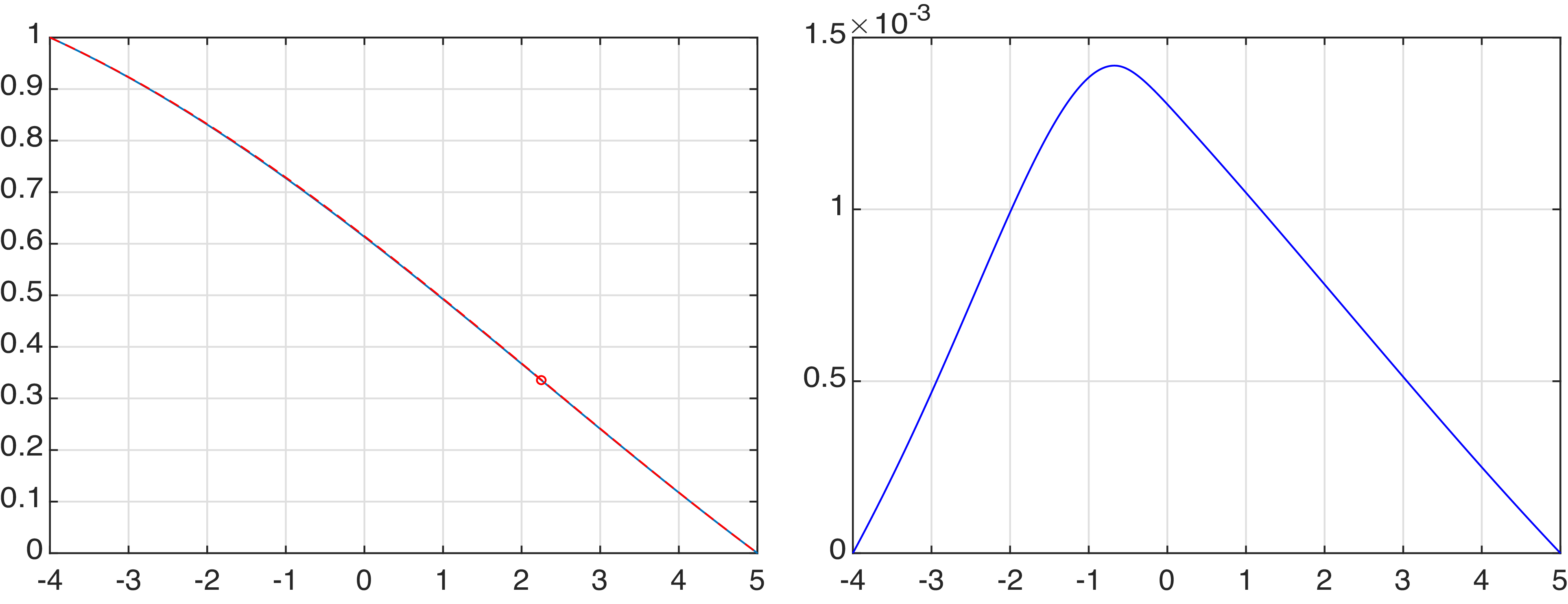
 x0=2.25


 x0=1.10