Introduction
Whenever I sing [‘Heart of the Sunrise’] I always think about the people who are lonely in cities, the people who are lost in big cities and they can't make cities work for them. There are millions of them.
(Jon Anderson in Farley Reference Farley2004, p. 61)Recorded in the late summer of 1971, Yes's ‘Heart of the Sunrise’ was a watershed work for the group. The song was released on the album Fragile, of which singer and composer Jon Anderson noted, ‘It was an inspired time, totally inspired by the music. The music we were working on was so new and so fresh to us that it was pretty easy to get out’ (Morse Reference Morse1996, p. 27). While other band members might disagree with Anderson about the ‘ease’ of the recording process, they generally agree that the music, particularly ‘Heart of the Sunrise’, was ‘new’ and ‘fresh’. In particular, the piece broke new ground in the expressive potential of non-texted passages of rock music to the extent that the music clarifies the meaning hinted at in the allusive lyrics. Yes's expansion in the vocabulary of rock very nearly enables the expression of the human condition unmediated by the word. However, while ‘Heart of the Sunrise’ was new, experimental and, as it turned out, forward-looking, it is a product of its time, rooted in both the hippie ethos and what John Covach has called the ‘hippie aesthetic’ (Covach Reference Covach and Spicer2011).
Three aspects of Covach's hippie aesthetic are operative in ‘Heart of the Sunrise’: musical ambition, technology and virtuosity. ‘Heart of the Sunrise’ betrays the band's musical ambition in its use of large-scale form as well as odd and changing metres. The arrangement includes the relatively new (at the time) Mellotron and the very new Mini-Moog synthesiser. Perhaps most telling is the virtuosic composition and performance, as both the individual parts and the ensemble as a whole require intense concentration and excellent technique. By the time of ‘Heart of the Sunrise’, Yes had developed a musical language sophisticated and expressive enough to convey meaning through both texted and non-texted passages. Whereas the lyrics communicate, obliquely and allusively, the plight of an individual alone in the city, the arrangement and the instrumental passages convey the oppressive ‘persona’ of the faceless, relentless city and the discomfiture of the individual.
A fourth aspect of Covach's hippie aesthetic, ‘serious’ lyrics that address social or cultural issues, or make political statements, applies to ‘Heart of the Sunrise’ as well. The topic of alienation was rooted in the hippie ethos, particularly its mistrust of a modern, industrial society that had lost touch with nature and all that hippies felt was truly human. ‘Heart of the Sunrise’ may be placed firmly in this ethos: both the text and the arrangement explore the idea of alienation in the midst of the teeming city and, as I will demonstrate, the non-texted passages convey the meaning of the song to a perhaps greater degree than the text. Before embarking on an analysis of ‘Heart of the Sunrise’, I think it necessary to consider briefly the development of the culture the hippies rejected and why they ultimately chose to abandon that culture, and why Yes chose ‘the city’ as the locus for their protagonist's alienation from humanity.
Hippies first appeared in the USA and expressed a mistrust of modern life. They typically viewed Western, industrialised, consumerist, uniform society as something akin to a machine: unnatural, ‘plastic’, and bereft of humanity. Contemporary critiques of the consumerist culture noted both the recent economic expansion and its ill effects.Footnote 1
Vance Packard's The Status Seekers (Reference Packard1959) examines the growth of both the economy and advertising in the USA in the years following WWII, describing a general increase in wealth after 1940, and particularly in the 1950s. High taxes on the upper class, held over from the war era, did not slow the increase in upper-level incomes, while middle- and lower-income classes increased their consumption of status-defining goods in order to appear to be of a higher class (Packard Reference Packard1959, pp. 22–4). Between 1950 and 1960 car ownership increased by 21 million, prompted by the Federal government's construction of 40,000 miles of interstate highway in the same period (Marwick Reference Marwick1998, p. 81). Perhaps the greatest force behind the growth of the ‘plastic society’ was the spread of the now-ubiquitous television: in 1946, 7,000 families in the USA had sets; by 1960 this had grown to 50 million (Marwick, Reference Marwick1998).
Steps towards social uniformity occurred in the same period, which saw increases in both white-collar, service industry jobs and ‘large, bureaucratic organisations’ with a parallel decrease in the self-employed. By the end of the 1950s, 87 per cent of the workforce was employed by others (Packard Reference Packard1959, pp. 25–7). The resultant ‘anonymous jobs and standardised wage rates’, as well as the pressure to consume in order to appear successful, were among the reasons hippies (preceded by the Beats) ‘dropped out’ of mainstream society.
Another impetus behind dropping out was the dropouts' observation that their parents were not happy. The ‘machine’ at the heart of the hippies' parents' lives had been in motion for years, and the suspicious, alienated generations that appeared in the mid-1950s (Beats) and mid-1960s (hippies) can be seen as stemming from the aspirations that mainstream culture dictated to its members and the lack of socially structured paths toward these goals. As early as 1949, Robert Merton articulated the dissociation between prescribed desires and their potential realisations (Merton Reference Merton1949, pp. 126ff). Packard describes the purchasers of homes of somewhat greater-than-average expense as ‘striving, frightened people’ who want desperately to be perceived as members of a higher class, but who cannot enjoy their lives, as they are smothered by the trappings and expenses of white-collar life (Packard Reference Packard1959, pp. 63, 309). Thus, the hippie shared with the Beat the sense of being ‘stifled by the city and the culture he had inherited’ (Goldman Reference Goldman1974, pp. 275–6).
It was from this ‘rat race’ of appearances, consumption and disappointment that many middle-class youths dropped out. Pressure to pursue material goods that represent success, and the seemingly ineluctable trend toward corporatisation, fostered what Kenneth Keniston described in 1963 as a ‘widespread feeling of powerlessness’ among college-age people in the USA (Keniston Reference Keniston and Erikson1963, p. 172). Contemporary commentary reveals their disaffection from and mistrust of the social structure built and maintained by their parents.
For his 1968 book, The Hippie Trip, Lewis Yablonsky immersed himself in US hippie culture in search of an explanation for why hippies drop out of mainstream society. Perhaps his most revealing observation, for the present study, is that ‘Most hippie drop-outs have a strong sense of alienation or disaffiliation from the larger society’ (Yablonsky Reference Yablonsky1968, p. 314). Yablonsky describes the society faced by hippies (and everyone else), as ‘a maze of ahuman bureaucracy’, a social structure that ‘approaches the complete elimination of personalised relationships and of non-rational considerations’. The hippies are trying to escape from a system that ‘requires total adherence to the prescriptions of the machine and ultimately the total squelching of human feelings’, or, as Theodore Adorno posited in 1964, ‘the steadily increasing liquidation of the individual’ (Yablonsky Reference Yablonsky1968, p. 315; Adorno Reference Adorno, Leppert and Gillespie2002, p. 653).
When the hippie ethos crossed the Atlantic and arrived on the shores of the UK, the export was not wholesale. For instance, some British hippies were put off by LSD's association with the USA (Davis Reference Davis2006, p. 42). Partly because of this, coupled with the availability of a wide range of drugs, London hippie groups tended to experiment regularly, in search of new hallucinogens, as ‘poly-drug’ use expanded in the city (Young Reference Young1971, p. 186; Davis Reference Davis2006, p. 35). However, the concomitant similarities between US and UK hippies are pertinent to the present study. Primary among these was the mistrust of the modern, expanding consumerist culture, which had been just as robust in the UK as it had in the USA.
By the time of the legendary Royal Albert Hall poetry reading of 11 June 1965, a seminal moment that some mark as the beginning of the counterculture in the UK and Europe in general, strong economic growth had been a fact of life in the UK for at least 15 years (Marwick Reference Marwick1998, pp. 257–8, 481; Green Reference Green1999, xiii, 128, 137–44). Between 1955 and 1969 in the UK, retail prices rose by 63 per cent, while weekly earnings of adult men rose 130 per cent, resulting in increased disposable income, which consumers spent readily (Marwick Reference Marwick1998, p. 258). Unemployment in London was below one per cent in the 1950s, and only 1.4 per cent in the late 1960s (Inwood Reference Inwood1998, pp. 864, 1024 fn. 105). With as much alacrity as people in the USA, UK residents purchased the primary conduit of desire: in 1960, 75 per cent of families in England had television sets (Marwick Reference Marwick1998, p. 81).
On both sides of the Atlantic, cities were perceived as anathema to true humanity and, by late Spring 1968, US hippies began abandoning cities for rural areas, while many UK hippies sought humanity outside their country. In the USA, so many hippies fled cities that Newsweek dubbed 1968 ‘The Year of the Commune’ (Marwick Reference Marwick1998, p. 484). British hippies, however, more often wished to escape to far-flung lands and immerse themselves in new cultures. Paul Willis, in his study of English hippies, found that his subjects deplored ‘the new tower block/impersonal highway, and the human desolation that implied. … In the dust and poverty of India the hippie hoped to find the spiritual values and authentic experiences that were so spectacularly lacking in the West’ (Willis Reference Willis1978, p. 128; italics mine). Richard Mills, interviewing London hippies in 1970, found a common desire to make a pilgrimage to the Orient, which symbolised their rejection of modern, industrial society (Mills Reference Mills1973, p. 35). These observations underscore the hippie belief in the artificiality of cities, as articulated by hippie philosopher Stan Russell, who advocated a return to ‘the natural condition that underlies man-made cultures and societies’ (Yablonsky Reference Yablonsky1968, p. 24; Marwick Reference Marwick1998, p. 482). These and other contemporary voices express concern over the very issues that prompted the counterculture and shed light on its rejection of mainstream culture, as embodied in the city.
It is perhaps ironic that the economic growth fuelling the plastic society arguably made possible the experimentation that led to Yes's musical language. Art colleges in the UK brought broader cultural literacy to a wider public, and the expanding economic prosperity described above allowed growing numbers of young people to take advantage of such opportunities, as well as to attend concerts (Faulk Reference Faulk2010, pp. 11–12). It also enabled people to acquire musical training and a great variety of recordings from around the world. By the time of the first UK hippie festival, the ‘Festival of the Flower Children’, hosted in the summer of 1967 by the Duke of Bedford (and from which, apparently, hippies were barred), a generation had grown up hearing Indian classical music, free-form and avant-garde jazz, 19th and 20th century orchestral music from Europe and the Americas, Baroque-era contrapuntal works, blues, and 1950s and 1960s popular music from both the USA and the UK (Green Reference Green1999, p. 221; Palmer Reference Palmer2001, p. 243). This musically omnivorous, middle-class youth culture fed a hungry, growing recorded music industry in which independent labels sprouted and established labels spawned small, experimental subsidiaries (Frith Reference Frith1978, p. 121; Marshall Cavendish 1990, p. 1563; Moore Reference Moore1993, pp. 60–4; McAleer Reference McAleer1995, pp. 76–159; Macan Reference Macan1997, pp. 18, 190; Palmer Reference Palmer2001, pp. 243–4). As artists who had been performing on the growing college circuit and in ‘underground’ clubs in London and other cities secured recording contracts, their music began to reach a larger and, as it turned out for many, interested audience. Among these artists were Yes.
Yes's early members were characteristic of their generation. The personnel on the first five albums were born between 1944 and 1949 and, with the notable exception of Jon Anderson, were from middle-class backgrounds and were raised in or near London. All were exposed to a wide range of musical styles, and most learned to play an instrument at an early age. Three of them attended college, although they did not finish.Footnote 2 As working musicians, their milieu was the middle-class West End of London, home to the Marquee Club (at 90 Wardour Street after 1964) and Denmark Street's recording studios, music publishers and the Gioconda café, a socialising hub for musicians. This stood (and still stands) in stark contrast to London's East End, which in 1966 was predominantly working class, as was the surrounding inner London (Hamnett Reference Hamnett2003, p. 2413; Davidson and Wyly Reference Davidson and Wyly2012, pp. 404–5). This environment, as well as the combined experiences of the band's members, provided a broad palette of references, musical and otherwise, from which to draw. Perhaps more importantly, Yes's sound is derived in part from another aspect of their time and place: psychedelia.
As the language, influence and legacy of psychedelia and psychedelic rock have been covered effectively and in depth elsewhere, I will discuss these topics only briefly, and specifically concerning UK artists.Footnote 3 As I and others have noted elsewhere, Pink Floyd became the leading UK band to translate the psychedelic experience into music through slow tempos, repetition and minimal harmonic change (Curtis Reference Curtis1987, p. 290; Whiteley Reference Whiteley1992, pp. 3, 8; Hicks Reference Hicks1999, pp. 64–5; Palmer Reference Palmer2001, pp. 244–5). Such procedures led to increasingly longer tracks, as did long solos for guitar and other instruments that were arguably indebted to jazz (Macan Reference Macan1997, p. 15). Other examples of British psychedelic music, more direct antecedents of Yes's sound, often feature abrupt juxtapositions of disparate musical material. ‘Defecting Gray’ by Pretty Things, and ‘Bike’ and ‘See Emily Play’ by Pink Floyd, all released in 1967, are only three examples of such stream-of-consciousness writing.Footnote 4
A few rock bands, particularly in the UK, used the extended format to work more intensely with musical material, combining the characteristics of the stream-of-consciousness psychedelic songs with a wide variety of influences, reflective of their typically middle-class backgrounds (Macan Reference Macan1997, pp. 144–51; Stump Reference Stump1997, pp. 43–50). In concert, bands often performed ‘rave-ups’, or extended jams, a practice indebted to jazz that emphasised instrumental proficiency, bringing about what Richard Middleton has described as the ‘foregrounding’ of instrumentation, as well as extended compositions that are primarily instrumental (Middleton Reference Middleton1990, p. 25). Such primacy of instruments upset earlier, mainstream conceptions of the relationship between voice and accompaniment in rock and roll, and is arguably a legacy of psychedelia and the hippie aesthetic.
Yes undeniably had a psychedelic-rock pedigree. Both guitarist Peter Banks and bassist Chris Squire were members of Mable Greer's Toyshop and, earlier, Syn, whose ‘Grounded’, which seems to describe a bad acid trip, was a modest UK hit in 1967. In 1970, Banks left Yes, and the empty guitar spot was filled by Steve Howe, a former member of Tomorrow, who had often shared bills with (The) Pink Floyd, The Crazy World of Arthur Brown, Jimi Hendrix, and The Animals. With Pretty Things, Soft Machine, Arthur Brown, and many other artists, Tomorrow performed in the 14-Hour Technicolor Dream of 29 April 1967, in the Alexandra Palace, a UK landmark hippie event that Pink Floyd's manager, Pete Jenner, described as ‘a truly psychedelic experience’ (Green Reference Green1999, pp. 219–21). Tomorrow's ‘My White Bicycle’, featuring recorded sound played backward, achieved a measure of popularity in the UK. Their ‘Revolution’, as well as other songs from their first (and only) album, is another excellent example of British psychedelia of the period, with a variety of instruments and abrupt juxtapositions of musically disparate passages. Also, the presence of the acoustic instruments, particularly the guitar, suggests the mingling of folk and psychedelic rock that Edward Macan posits as informing the development of progressive rock (Macan Reference Macan1997, p. 22). Howe, co-writer of ‘Revolution’, would join Yes three years later, but Yes's psychedelic roots were clear from the beginning.
Yes's first two albums, Yes and Time and a Word, include covers of songs by The Byrds and Buffalo Springfield, both representative of US psychedelia.Footnote 5 These and many of the original compositions on both albums feature extended instrumental segments, typically functioning as ‘jams’ that introduce or break up a song such as in ‘Every Little Thing’, ‘Everydays’, or ‘Astral Traveller’. The lengths of the tracks on these two albums range from 2:04 (‘Clear Days’) to 6:33 (‘I See You’) and average between four and five minutes. Yes's third effort, The Yes Album, boasts all original compositions (in part the reason for the album's title), and three of the album's six tracks last nine minutes or longer.Footnote 6 Also, the space allotted to instrumental passages is significantly greater than on the first two albums, and the opening track, ‘Yours is No Disgrace’, is 67 per cent instrumental. The hippie aesthetic permeates The Yes Album, and its long pieces with extended guitar solos (‘Yours Is No Disgrace’, ‘Starship Trooper’), juxtaposition of disparate sections (‘Starship Trooper’, ‘Perpetual Change’), layered thematic material (‘Perpetual Change’), repetition with slow change (the coda of ‘Starship Trooper’), and virtuosic performances of detailed music prompt active listening, as opposed to dancing.
A section of ‘Yours is No Disgrace’ will serve as an example of how the material on The Yes Album album appealed to the hippie aesthetic. The nearly-three-minute instrumental passage beginning at 4:05 is dominated by not only the guitar, but by multiple guitars.Footnote 7 While there is a solo, the passage is not a rave-up, but a composed instrumental section built around a few guitar licks that, importantly, takes advantage of the current studio technology, particularly in the manipulation of instrument placement in the sound stage. At 4:05, the instrumental break begins with a return of the song's introduction. The band moves into stop-time passages at 4:46, and Howe begins a guitar solo, employing the same timbre he has used up to this moment. The solo pans rapidly from right to left and back across the sound stage. Ten seconds later, the band enters, playing rising glissandi as Howe continues his solo, the part bouncing frantically between left and right channels. At 5:08 Howe joins the rest of the band on the rising glissandi, and guitar and organ begin playing a whole-step motive together after each glissando, the guitar rooted firmly in the right channel while the organ shifts from left to right with each statement. An acoustic guitar enters the centre of the soundstage at 5:44, as the electric guitar continues in the right channel, paralleling the acoustic guitar. At 5:56 a second electric guitar part enters in the right channel consisting of long notes played with greater sustain and distortion than the first electric guitar, which continues an accompanimental strum pattern in the right channel. A third electric guitar, with a clean, jazz timbre, enters in the left channel at 6:22, and Howe plays rapid figures into the close of the section. Ten seconds before the return of Anderson's voice at 6:57, the organ pans from right to left, then back to the right before fading out. By the end of this section, the listener has been offered three contrasting electric guitar sounds and a steel-stringed acoustic guitar, in addition to the bass, drums and electric organ. In effect, Howe becomes three guitarists in what he described as a ‘studioized’ solo (Morse Reference Morse1996, p. 23).
Any discussion of ‘Yours is No Disgrace’ must take into account the importance of the sound stage in the song's overall effect.Footnote 8 Such a discussion must also note the changing listening habits of the time, for despite the popularity of Yes and their contemporaries as live acts, private listening, often through headphones, was becoming more common (Moore Reference Moore1997, p. 78). Thus, the level of detail extends beyond that of the multiplicity of guitar sounds to the positions these sounds occupy in the stereo mix. The placement of each instrument and voice, as well as how and when those instruments and voices move through perceived space, is as much a part of the listening experience as any other aspect of the track, and this is the case with Yes's ensuing recordings.
Over the course of their first three albums, Yes expanded the control and invention of the instrumental sections of their songs. The major advance between the third and fourth albums was the manipulation and integration of non-texted passages into a song to the extent that they become essential mediators of meaning, conveying non-verbal responses to the context implied by the lyrics. Yes achieved this integration in ‘Heart of the Sunrise’.Footnote 9
Yes's fourth album, Fragile, was recorded at Advision Studios in London during August and September 1971 by Jon Anderson (vocals), Bill Bruford (drums), Steve Howe (guitars), Chris Squire (bass), and Rick Wakeman (keyboards) (Welch Reference Welch1999, p. 115; Watkinson Reference Watkinson2001, p. 105). It was a period of transition for the band, who were adapting to a new keyboard player, Rick Wakeman, after acquiring Howe the previous year. Wakeman, a successful studio musician and former member of The Strawbs, was well acquainted with the latest electric and electronic keyboards, including the Mellotron and the Mini Moog synthesiser. The potential for increased timbral variety, as well as Wakeman's considerable virtuosity and musicianship, led the members of Yes to approach Wakeman and squeeze out Tony Kaye, the band's first keyboard player.
Wakeman's presence on Fragile is only one of the elements that distinguishes the album from the band's previous release, The Yes Album. Fragile finds the band more prone to experimentation, and playing and writing with greater confidence in the wake of the success of The Yes Album and the resultant 24 June–24 July 1971 tour of North America, supporting Jethro Tull (Watkinson Reference Watkinson2001, p. 104–5). During this tour, Yes had written some of what would be released on Fragile, and ‘Heart of the Sunrise’ and ‘Roundabout’ came together within a week after Wakeman began rehearsals with the group. Wakeman has stated that the bases for both songs developed at his first rehearsal with Yes, and has claimed some compositional credit for ‘Heart of the Sunrise’ (Yesyears 1991; Welch Reference Welch1999, pp. 114, 117; Watkinson Reference Watkinson2001, p. 27).Footnote 10 Fragile also features the first appearance of artwork by Roger Dean, whose covers for Yes and other bands would come to symbolise progressive rock as a whole. Yes had settled on ‘Fragile’ as a title for the album, and had suggested a piece of broken pottery for the cover. Dean drew what he described as ‘a little Bonsai world’ on the front of the cover, with that world breaking into pieces on the back cover. Dean notes, ‘It was literally meant to be a fragile world’ (Welch Reference Welch1999, p. 119). Released on 1 November 1971 in the UK and on 4 January 1972 in the USA (Watkinson Reference Watkinson2001, p. 143), Fragile was the first album to gain Yes a large audience in North America, peaking on the Billboard 200 chart at number 4.Footnote 11 A severely truncated version of the album's opening track, ‘Roundabout’, rose to number 13 on the Billboard Hot 100 singles chart.Footnote 12 ‘Heart of the Sunrise’ is the last listed track on Fragile, and at 10:34, it was the band's longest, and arguably strongest, most non-normative piece yet.Footnote 13
I submit that Yes's ‘Heart of the Sunrise’ captures the hippie perception of the dehumanising tendencies of city life. It stands, therefore, as a snapshot of its time, an amalgam of counter-cultural thought, musical experimentation and technological advancement. Perhaps most telling is that the lyrics are not the only, and perhaps not even the primary, mediator of meaning; rather, the arrangement of the song and the purely instrumental passages lay bare the frustration of an individual unable to establish intimate, human relationships in the ultimate manifestation of the machine-like plastic society: the city. The richness of Yes's instrumental composition and performance owes a great debt to the hippie aesthetic, which made possible the appreciation of, and created an audience for, such music. In the following discussion of ‘Heart of the Sunrise’, I will employ techniques and vocabulary typically associated with the study of other styles of music, particularly tonal harmonic analysis.Footnote 14
In 1989, Anderson noted that ‘the heart of the sunrise is something that energises the within of the beings that we are. We are all the same, we are human functional beings with a soul which is all one’ (Morse Reference Morse1996, p. 32). The city, and its suppression of the emotional and spiritual, is escapable only through love, which can reunite us with our inner, human spirit, which modern, Western, culture has displaced. City life can separate us from humanity, and thus from ourselves. In order to become human again, we must lose ourselves and return to the energy at the heart of the sunrise. In the following analysis I hope to uncover how Yes express the separation of the individual from the unity that makes people whole, as well as the effect of alienation on the individual in the midst of modern, plastic society.
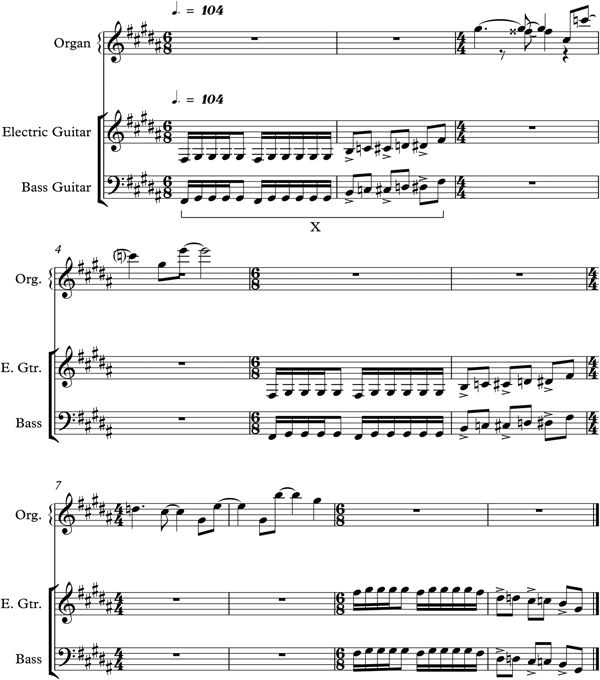
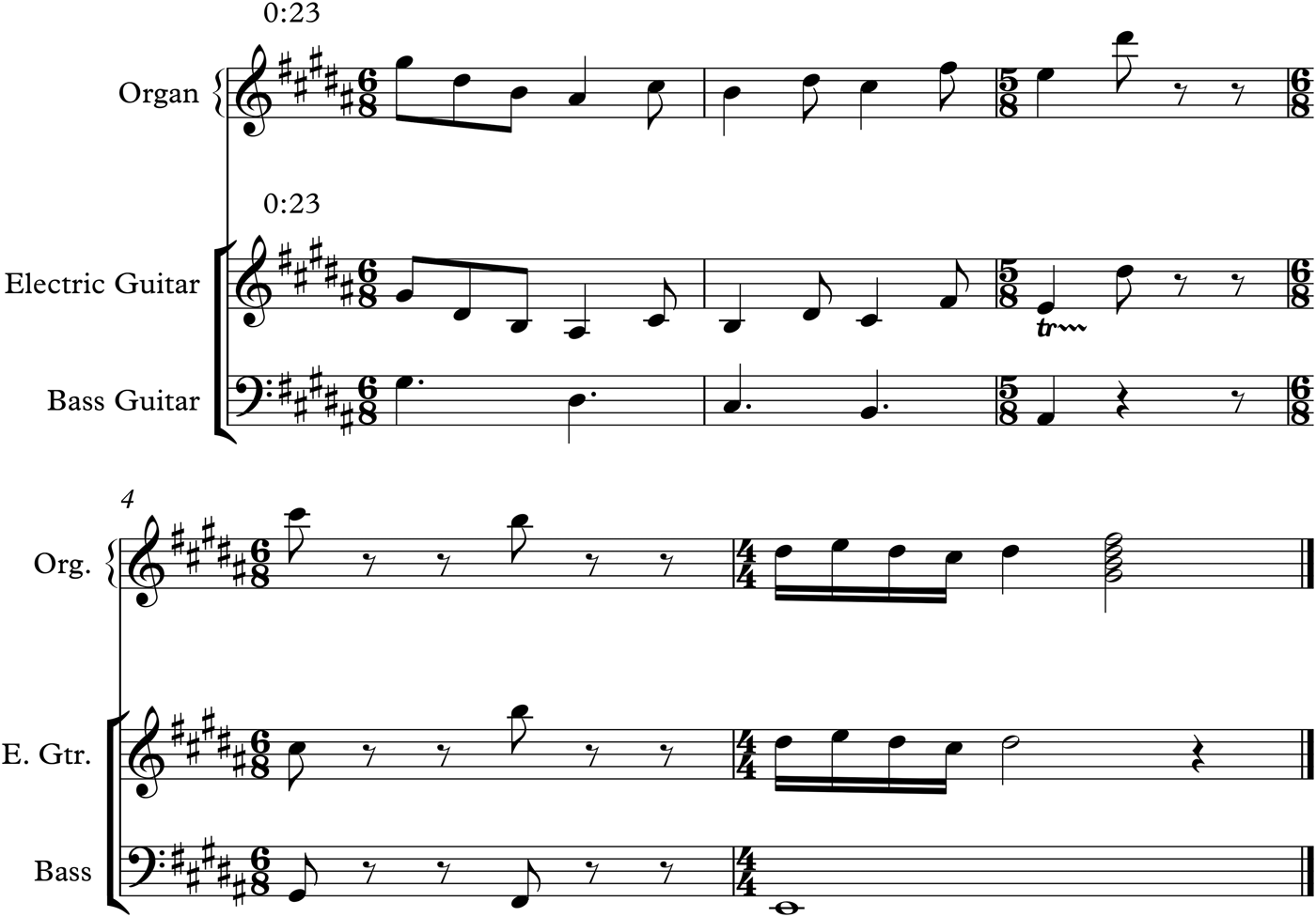
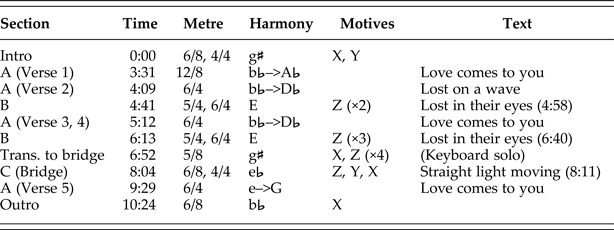
‘Heart of the Sunrise’ (see Table 1) begins with a show of brute force. The rising, bluesy opening riff (X) shifts from a 6/8 feel to 3/4 before being abruptly interrupted by an angular passage on the Hammond organ that swirls around a G♯ for two 4/4 bars (see Example 1).Footnote 15 A return of X is again interrupted by the organ passage, which begins a tritone lower than at its first appearance.Footnote 16 X returns again and continues, both alternating and combining falling and rising scales as it rushes toward a leaping, metrically irregular figure (Y, at 0:23, see Example 2). The 6/8 metre then ‘stumbles’ in a single 5/8 bar as the guitar part climbs higher, in contrary motion with the bass, and the passage closes with an E♮ in the bass and a D♯ in the guitar nearly three octaves higher, the organ filling in the major ninth chord.
Opening of ‘Heart of the Sunrise’ with Motive X.

Motive Y, organ and guitar.

Structure of ‘Heart of the Sunrise’.

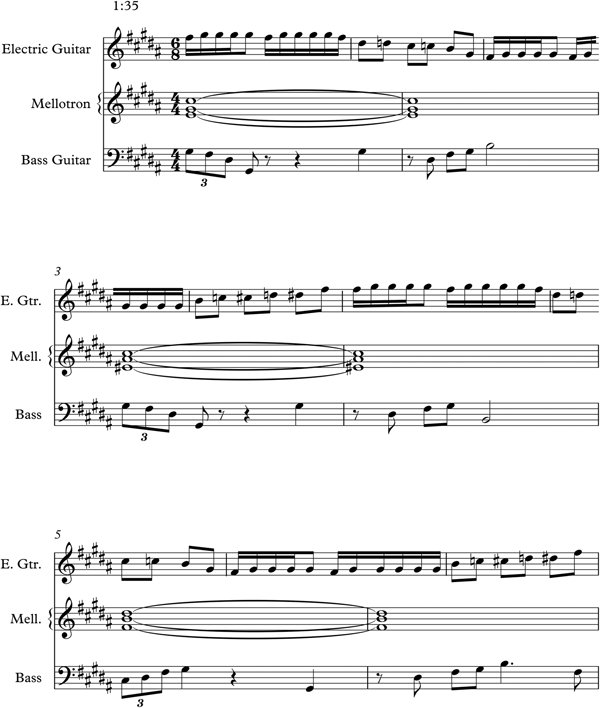
Although the listener cannot yet know it, in the first few seconds of ‘Heart of the Sunrise’, Yes have created an aural representation of the crush of the modern city and its effect on human nature.Footnote 17 Nothing is consistent: there is no groove (yet); the organ displaces a propulsive, bluesy passage in G♯ minor both harmonically and metrically, creating a frustrating ‘hurry-up-and-wait’ effect; and just as the changing metric feel of the scalar passages begins to become predictable, a new figure (Y) brings the entire passage to a dissonant conclusion. Furthermore, the listener gets no time to breathe, for the solo bass immediately moves to new material. Squire's ostinato bass part, although refreshingly regular, obscures the downbeat, which is eventually articulated consistently, although meekly, by Wakeman's chord changes on the Mellotron. The anchoring effect of the bass line allows the drummer, Bill Bruford, space to play around the pulse, and the drum part stubbornly resists any kind of groove until Bruford begins playing a ride cymbal on each beat at 1:12.
As our protagonist, depicted by the ostinato bass, attempts to establish a footing, drums and eventually X encroach on him, gradually undermining the regular ostinato and its metre while creating a polyphonic texture. Metric dissonance is at the heart of the passage, as each 6/8 statement of X encompasses one-and-a-half bars of the 4/4 ostinato (see Example 3). Furthermore, the chromatic X grates against the Dorian chord progression, increasing tension. The atmosphere, particularly before the entrance of X, is similar to that of King Crimson's ‘Epitaph’ and ‘Exiles’, in which, as Allan Moore suggests, the slow pace and use of a Mellotron to provide a harmonic backdrop create ‘a sense of impending doom’ (Moore Reference Moore1993, p. 101). Here, the mood is reinforced by the lack of high-frequency sound. At this moment, however, the listener is not aware of what sort of ‘doom’ the passage anticipates, as no meaning has attached to X. Thus, X forebodes in a Wagnerian sense, as it will acquire meaning later in the song (Wagner Reference Wagner, Goldman, Springchorn and Ellis1964, pp. 222–6). In all, we hear a gradual crescendo through five cycles of the 10-bar passage, the fourth and fifth of these with repetitions of X. The odd number of repetitions of a passage that is a non-normative number of bars long reinforces the awkwardness of the opening bars until, at 2:02, the ostinato gives up and submits to the relentless X. To stress the full return of X, Yes create a strong upbeat to its arrival by shifting the stressed beats in the previous two bars through a rhythmic remnant of the ostinato.
Bass ostinato with Motive X in guitar.

Unpredictability continues to express the effects of alienation when at 2:06 X returns in full force, only to be interrupted three more times by Y, the last of these closing this segment of the song at 3:16. The first two appearances of Y break the repetitions of X into two, 12-bar cycles (six statements of X in each). When the third cycle begins at 2:49, it is accompanied by the five ‘doom’ chords of the bass ostinato section, now re-voiced and performed on the organ. As in the bass ostinato segment, each chord sounds for two bars (one statement of X), then the series of chords repeats, creating 10-bar cycles of X, in contrast to the earlier 12-bar cycles. Yes augment the irregularity by including one more statement of the first chord of the series, G♯sus, for two bars (one statement of X). This 22-bar cycle of X statements conforms to neither the earlier 12-bar cycles nor the series of five ‘doom’ chords, and further links the ominous atmosphere of the bass ostinato section with the aggressive, metrically irregular X and Y passages. As with the first two cycles, the third is interrupted, even less predictably than before, by Y. The ‘doom’ chords have mingled with X before, during the bass ostinato, but at 2:49 the ostinato is absent, as the rush of the city and the sense of approaching doom have eradicated the protagonist, for the moment. Yes have conveyed the process and effect of alienation, but the listener does not yet know who has been alienated, or by what. On a larger scale, Yes have established a context in which to describe the protagonist's situation and emotional state through the incorporation of seemingly incompatible characteristics. The potentially perceived incompatibility of the blues-based riff, X, as an essential element in a non-blues structure built upon non-blues harmonic content can be read as an allegory of the hippies’ perceived incompatibility of the emotional and spiritual life of human beings and the dehumanising tendencies of modernity, symbolised by the city.Footnote 18
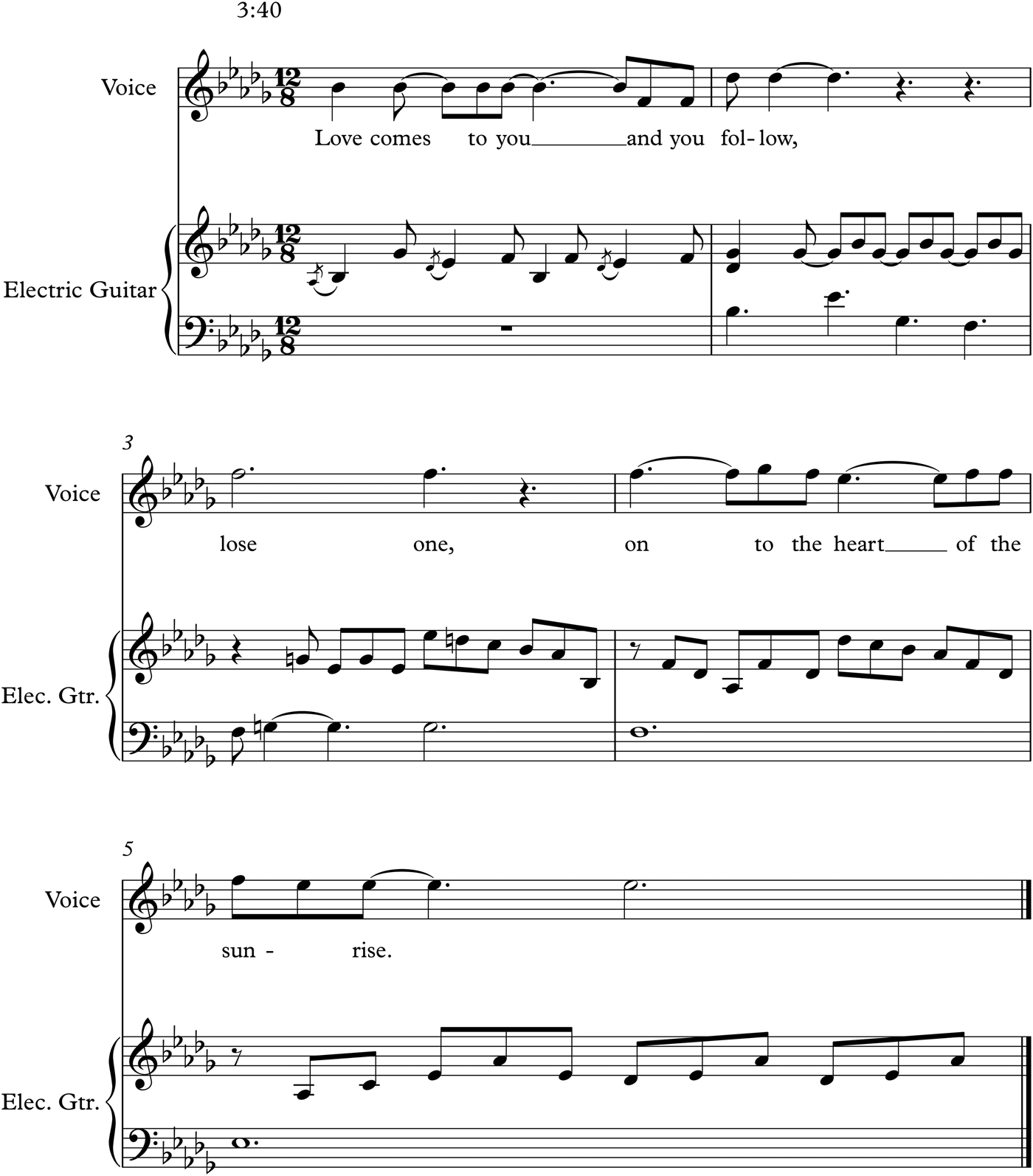
After the last statement of Y, a brief, last gasp of the ostinato sounds in the bass, suggesting a repeat of the section; instead, the bass line descends and the texted section of the piece begins in G♯ minor with a barcarolle-like feel in the guitar (3:31). The guitar figure then rises a step to B♭ minor just before Jon Anderson's entrance at 3:40 (Example 4). Anderson's lyrics, typically vague, allusive and colourful, introduce the protagonist's predicament:Footnote 19
First vocal entrance, with guitar accompaniment.

Our protagonist hurries through the city, observing people who have elected not to have ties with him, or perhaps with each other. The ‘distance’ between him and the surrounding mass of humanity is so wide and painful that it feels ‘sharp’, and he questions how this is possible when the mass of humanity, like the wind, envelops him. He dreams of finding love and escaping to the ‘heart of the sunrise’.
The text of ‘Heart of the Sunrise’ prompts a comparison with another track on Fragile, ‘Long Distance Runaround’. Separated from ‘Heart of the Sunrise’ by ‘the fish’ and ‘Mood for a Day’, ‘Long Distance Runaround’, according to the composer, Jon Anderson, concerns his confusion with religion at the time (Morse Reference Morse1996, p. 31; Wiser Reference Wiser2013). The narrator is ‘waiting to feel the sound’, which is, as Anderson notes, ‘the sound of reality, the sound of God’. The narrator seems disillusioned with, perhaps abandoned by, the religion he has tried to understand: ‘I still remember the dream there / I still remember the time you said goodbye’, as he, a believer, was ‘looking for the sunshine’. Anderson has said that the second verse is a commentary on the May 1970 shootings of students at Kent State University in Ohio, ‘and government cracking down on young people because they were trying to tell the truth about the war in Vietnam’ (Wiser Reference Wiser2013). The trauma of such an event, as well as the trauma of discovering the limitation of one's faith, can lead to an alienation from mainstream society, brought on by both disillusion and fear. The arrangement of ‘Long Distance Runaround’ conveys the discomfiture of someone reeling from such experiences, for the straightforward 4/4 metre is obscured by an accent every five beats, creating metric ambiguity, a significant characteristic of ‘Heart of the Sunrise’ that we have already seen. Also, Anderson's original conception of ‘Long Distance Runaround’ was apparently much slower, which begs comparison with the settings of the verses in ‘Heart of the Sunrise’.Footnote 21
Bill Martin interprets ‘Long Distance Runaround’ as a reflection on a failed relationship, and it is easy to see why (Martin Reference Martin1996, p. 123). Lines such as ‘the time you said goodbye’, and ‘did we really tell lies?’, ‘did we really count to one hundred?’, in the midst of ‘looking for the sunshine’ could well be questioning the honesty of a personal relationship, just as they could question the honesty of a relationship between an individual and his or her faith. In either case, feeling abandoned, or detached from a formerly intimate person or faith can create a sense of being untethered to the world, lost or confused, which is the state in which we find the protagonist of ‘Heart of the Sunrise’.
When Anderson's voice enters in ‘Heart of the Sunrise’, it is not multi-tracked; rather, its solitary presence, sotto voce performance, and moderate amount of reverb are salient characteristics, conveying the solitary existence of the subject. The empty aural space between ‘sharp’ and ‘distance’ speaks more than the words themselves, as each utterance is followed by three beats of rest in the voice part, sonically depicting the emotional chasm between the protagonist and the rest of humanity. Bass guitar and drum kit enter for the second verse (4:09), which shifts metre from 12/8 to 6/4, while the bass line prompts us to interpret some of the harmonies differently from those in the first verse, both of which move from B♭ minor to A♭ major, via an E♭ major chord. Non-normatively, the walking bass is the most active part of the texture, and the couplet is extended through the line, ‘lost in the city’. The new line brings with it significant, symbolic, changes in the musical language that communicate the effects of alienation on the protagonist, effects that the text does not articulate.
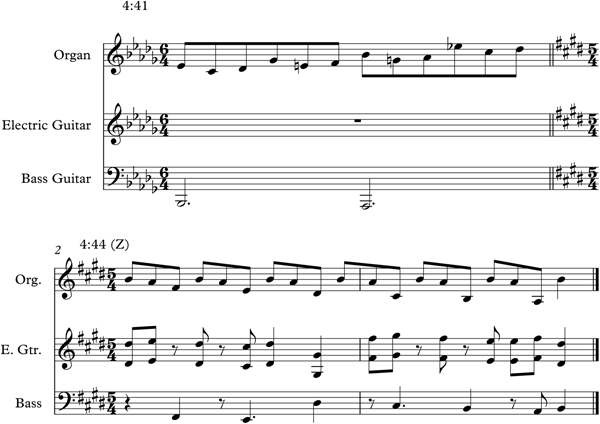
At 4:41, a chromatic organ part transitions to a falling figure in 5/4 that suggests B Mixolydian (Z, see Example 5). The organ part of Z groups eighth notes in threes, reinforced by the descending bass line on the third note of each group, only to reveal the true metre on the last quarter note of the second bar. The guitar counterpoint, however, moves more firmly in 5/4, creating a perception of metric contrast. The switch from the second verse's 6/4 to 5/4 and the metric ambiguity of the 5/4 passage, with accents that disguise the downbeat, suggest a sense of being lost, confused, unable to tread regularly, with any direction or sense of purpose, about the streets of the city. Susan Youens has pointed out a similar illustrative device in Schubert's settings of Wilhelm Müller's poems in Die schöne Müllerin and Winterreise, in which ‘text-interpretive’ use of offbeat accents convey ‘mental turmoil … stumbling footsteps and straying’ (Youens Reference Youens1991, p. 75).
Motive Z in organ and bass, with guitar counterpoint.

Anderson's first reference to ‘the city’ in ‘Heart of the Sunrise’ brings with it chromatic pitches, rhythmic dissonance, irregular metre, and a multiplicity of motives. Combined, these characteristics convey the adverse effects of the protagonist's alienation and his resultant lack of direction and sense of self, of not being in step.
A Bsus chord played on the Mellotron and guitar extends the local dominant introduced by Z as the song moves to a new, temporary tonal centre of E major (4:58).Footnote 22 The cadence on E major is weak, as there is no leading tone, and the voice and instruments avoid a D♯ until the end of the passage (the second syllable of ‘decide’). The choice of E major to set these lines also limns the distance between the protagonist and the humanity around him, as the key relationship between this section and the verses is chromatic, and E major is a tritone removed from the returning B♭ minor at the beginning of verse 3, linked to the E-major passage by a syncopated bass line.
The text of the E-major passage, ‘Lost in their eyes as you hurry by / Counting the broken ties they decide’, articulates the profound sense of loneliness that can occur in the midst of thousands, perhaps millions, of people, exposing a symptom of a social structure that ‘approaches the complete elimination of personalised relationships’ (Yablonsky Reference Yablonsky1968, p. 314). The pain of loneliness is compounded by the fact that the ‘broken ties’ that have alienated our protagonist are decided by others, and are thus beyond his control. Sigmund Freud, in ‘Anxiety’, one of his Introductory Lectures on Psychoanalysis, posits: ‘On what occasions anxiety appears … depend to a large extent on the state of a person's knowledge and on his sense of power vis-à-vis the external world’ (Freud Reference Freud and Strachey1977, p. 394). What were apparently connections between the protagonist and others have been severed by those others (‘they’), not by the narrator, who, as a result, has absolutely no ‘sense of power vis-à-vis the external world’. His insignificance is palpable; his relationships are switched on and off by other people. Freud also notes that anxiety is an inexpedient behaviour, for if it is exceedingly great, ‘… it paralyses all action, including even flight’ (Freud Reference Freud and Strachey1977, p. 394). In ‘Heart of the Sunrise’, the protagonist can do nothing but ask ‘how?’ He is powerless, unable to change his relationship to the world, the city, that surrounds him even as it marginalises him. He cannot leave for another town, and is reduced to wandering (hurriedly) through the city, tossed about by the arms of the wind, which prevents him from walking in a regular, firm stride. His awareness of his circumstances Freud might have considered the real tragedy, for ‘… consciousness of one's own weakness and helplessness …’ can ultimately lead to neuroses (Freud Reference Freud and Strachey1977, p. 406).
‘Heart of the Sunrise’ does not describe the protagonist's anxiety verbally; rather, it depicts it musically through the dissonant organ passage, the ensuing switch to 5/4 metre, and the non-synchronised accents between the organ, guitar and bass parts (4:41–4:52). At the end of the line, ‘Counting the broken ties they decide’ (5:07), the syncopated bass part ‘stumbles’ its way through dotted notes into a return of the verse, not only depicting the disorientation of the protagonist, but anticipating the transition to the bridge, as we will see. Anderson's D♯ on the second syllable of ‘decide’ is a surprise, coming on the heels of two D♮s and thus changing the mode, as well as sounding a dissonance in the immediate context of E major, and emphasises the disconnect between the protagonist and those who have ‘broken ties’ with him.
After the return of the verse, the texture thickens with the addition of a synthesiser, on which Wakeman plays passages that were formerly performed on the bass guitar. Yes skip ‘Sharp distance’ after the third verse, which combines the lyrics of verses 1 and 2, and move on to a fourth verse, which is followed by a climactic return of ‘Sharp distance’. Accompanied only by a snare drum, Anderson's forte ‘Sharp’ and ‘distance’ (5:41) are more detached than before, as there is no guitar pattern or walking bass during the rests in the voice part. Instead, the protagonist meets a stone wall of silence before forte chords punctuate the temporal space between the outbursts.
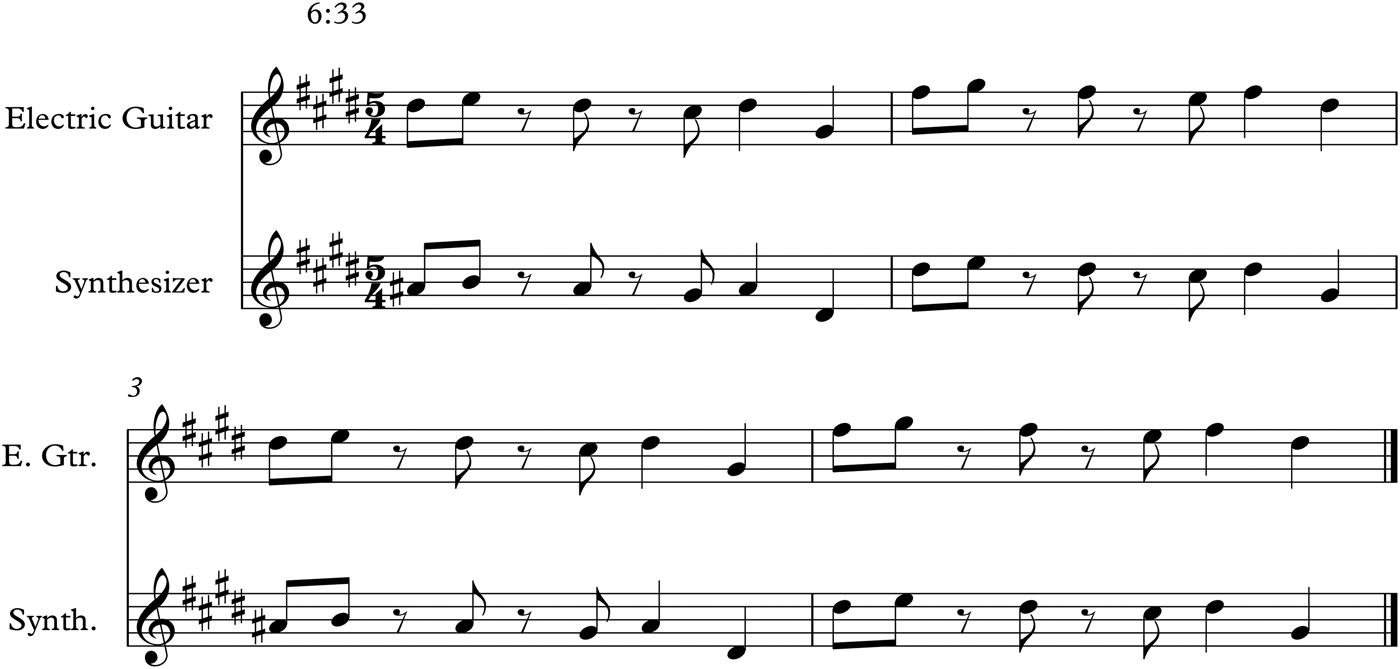
Although still alone, the protagonist seems less resigned to his alienation, and now shouts his questions with greater frustration. Anderson also alters the passage by adding ‘I feel’ just ahead of ‘lost in the city’, making it clear that the speaker's sense of being lost is emotional. As at the end of the previous verse, the line ‘lost in the city’ gives way to the dissonant organ passage that introduces the falling figure in the organ (Z, this time with an ‘extra’ iteration) and the Bmin11 passage on the Mellotron. However, here the progress toward ‘Lost in their eyes’ is interrupted at 6:33 by an isolated appearance of the guitar part that accompanies Z (Example 6), both a reminiscence of the unpredictability of the first three minutes of the song and an anticipation of the quintuple-metre keyboard passage that is to come. Instead of playing parallel octaves, Wes Montgomery style, Howe plays a single line as Wakeman parallels the guitar part at first a fourth and then a third below. Performed over a pedal B♮, the passage extends the dominant preparation for the next section.
Guitar and synthesiser passage based on guitar counterpoint to Motive Z.

When ‘Lost in their eyes’ arrives, Wakeman continues to play an Esus chord while the guitar and bass perform E-major triads, the dissonance underscoring the protagonist's frustration in the face of an indifferent mass of humanity. Adding a sense of resignation to the protagonist's isolation, Anderson changes the last word of the second line to past tense, thus adding a syllable (‘decided’ vs. ‘decide’), as Squire's syncopated bass part, which suggests another return to the verse, now prepares the compound metre of the ensuing instrumental section, the transition to the bridge.
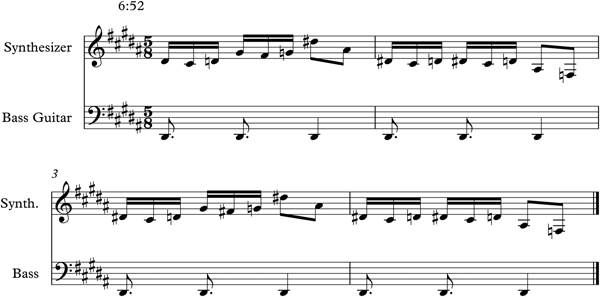
The segment at 6:52 opens with a new idea, presented primarily on keyboard, that further imparts the off-balance, stumbling psyche of the protagonist, excluded from the crowd in the midst of the city (see Example 7). The primary pitches of D♯ and G♯ link the passage to the falling D♯ to G♯ of the earlier guitar part of Z (see Example 5), expanded to include A♯ above and A♯ and E♯ below, and the resultant tetrachord of E♯–A♯–D♯–G♯ creates a link to the suspended-fourth sonorities of the Mellotron transition between the verses and ‘Lost in their eyes’. Also, the rhythm and metre are anticipated by the guitar part in Z, which first appears when the protagonist mentions being ‘lost’. Thus, the entire passage is a development of material from Z that provides a dominant for the ensuing appearance of X on G♯. As in Z, the passage beginning at 6:52 is in 5, enough in itself to suggest irregularity, but the undermining of regularity goes deeper. The pitches, particularly in the second half of the riff, group 16ths in a 3 + 3 + 2 + 2 pattern, and the punctuation in the bass part reinforces this perception. As with X, the listener is first prompted to feel a compound metre, such as 12/16, but hears a shift to simple metre for the D♯5 and A♯4 in the first bar and A♯3 and E♯3 in the second. The asymmetrical pattern conveys the mental turmoil of the alienated protagonist, emphasised after four bars by the entrance of the crushing onslaught of the city, itself alternating between 6/8 and 3/4.
Synthesiser lead, transition to bridge.

It is only at the transition to the bridge, seven minutes into the piece, that the listener discovers the meaning of the opening riff, X, which until now has sounded like the primary material of a huge introduction, unrelated to the core of the song, that has consumed half of the playing time. At 7:00, X becomes imbued with significance: the city rushes, crushes and discombobulates. Whereas the lyrics set the scene, the music communicates the experience of being alienated from humanity. Aware of the import of the opening riff, one cannot hear ‘Heart of the Sunrise’ in the same way after the first acquaintance. The song's message begins with the very first note, but the listener cannot know this until two-thirds of the way through the piece.
At this point, Yes's syntactical musical language becomes paratactic, and the perceived lack of sequential or logical relationship between the small blocks of music in this section constitutes a musical analogue of the effects of the city's relentless assault on the protagonist. Unlike the hypotactic syntax of previous sections, in which contrasting musical events are linked by transitions (such as the dominant passage between the verses and ‘Lost in their eyes …’), the material after 6:52 forms a series of discrete, disparate events. The new keyboard passage abruptly gives way to X, and vice versa. Yes increase the tension and unpredictability of the section by cutting the number of repetitions of each idea in half (7:29), after which the rapid alternation of the two disparate ideas is itself interrupted (again without a conjunctive gesture) by the falling figure (Z). A gradual decrescendo through a fourfold performance of Z leads to a new figure on piano. Nothing about the harmony or voice leading in Z portends the entrance of new material; the decrescendo alone suggests that a section is ending and that one might expect something new.
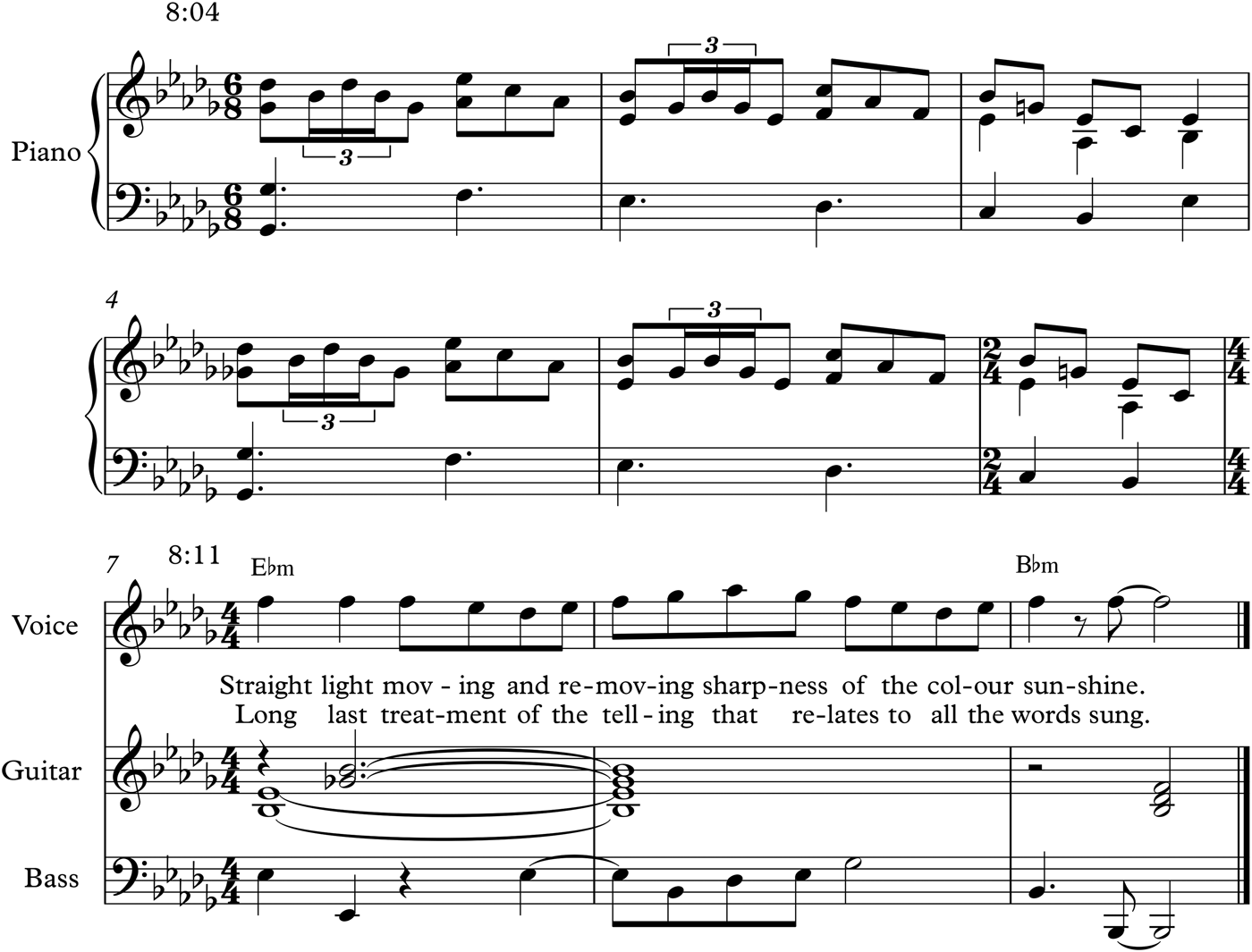
What follows at 8:04 is both new and not new: a solo piano passage that, like X, shifts from a 6/8 feel to 3/4, and closes with a ‘soul cadence’ on a non-committal, open E♭ chord (Example 8).Footnote
23
The cadence is both plagal and not: aside from the ante-penultimate chord, the passage is E♭ Dorian, and the stepwise, Dorian descent in the left hand finds its way to E♭ on a level that is arguably unrelated to the process in the right hand. If we disregard the bass, the chord progression of the right hand, in E♭ Dorian, is III–IV–i–ii–I–IV–i (no third). Incorporating the bass into the analysis changes the progression to III–ii7–i–VII7–vi7–IV (over B♭) –i (no third). Treating the bass note, B♭, of the penultimate chord as a root would suggest a v11 with neither a third nor a fifth, which prompts one to label the harmony as IV over a B♭. Extending this interpretation to the rest of the passage produces the chord progression I give first above, with two instances of IV moving to i, while the descending bass line finds its own path to i, leaping from
 ${\hat 5}$
to
 ${\hat 1}$
. On the first and third chords the bass line does match the root, but these instances are the exceptions, and the voice-leading of the bass seems to take precedence over its fitting, or not fitting, with the chords of the right hand. The disjunction between the two parts is yet another moment in ‘Heart of the Sunrise’ in which musical material conveys the detachment of the protagonist from the mass of humanity around him.
Bridge piano passage and first line of bridge vocal.

In another instance of Yes subverting a briefly established regularity, the final beat of the piano passage is elided with the entrance of a new vocal phrase. When Anderson's voice returns, both the swing feel and the multi-tracked vocals create a strong contrast to anything we have heard thus far, while the lyrics amplify the contrast by introducing a new topic and voice. The text consists of two verses:
Bill Martin interprets the text of the bridge as further commentary on the state of the protagonist. Of ‘Dreamer easy in the chair that really fits you’, he writes, ‘I take this last line as a comment on the possibility of just giving up on any kind of personal depth or committed grappling with the world …’, implying, perhaps, that the protagonist is speaking to and of himself (Martin Reference Martin1996, p. 125). I wish to suggest a different interpretation.
At ‘Straight light moving and removing …’ (8:11; Example 8, measure 7) Yes break the ‘fourth wall’, addressing listeners directly and berating them for the act of deep listening as the song itself reflexively becomes the subject. Voices are panned left and right, in contrast to the central position of Anderson's solo vocal up to this point. The panning of multiple voices to either side of the soundstage eliminates the intimacy established by the earlier vocal passages, as growing numbers of people address the listener from two directions. Furthermore, the use of multiple voices for the first time suggests a different speaker and, potentially, a different audience.
One could argue that the world accosts the protagonist / composer, mocking him for being a ‘dreamer easy in the chair that really fits [him]’, as he attempts to express his suffering poetically. However, the previous lines, ‘Straight light moving and removing / Sharpness of the colour sunshine / Straight light searching all the meanings / of the song’, connote a search for meaning in a song that already exists, not one that is in the process of being written. At no other point prior to this does the text contain a reference to a ‘song’, and I think it reasonable to posit that the ‘song’ Anderson refers to is ‘Heart of the Sunrise’. That being the case, the next two lines, ‘Long last treatment of the telling that relates to all the words sung / Dreamer easy in the chair that really fits you’, are directed at the listener, at us, ridiculing us for doing exactly what the non-normative music and allusive lyrics invite us to do: interpret the song. ‘Heart of the Sunrise’ steps outside the realm of fiction that typifies rock and pop songs, for it is no longer possible for the listener to maintain distance from the subject, as he is being addressed directly.Footnote 24
The ‘straight light’ to which Yes refer is derived from the hippie construct of ‘hip’ vs. ‘straight’, straight culture being mainstream, repressed, in need of order. Straight culture, which removes the ‘sharpness of the colour sunshine’, is the dull existence, the ‘human desolation’, the ‘standardised, affluent democratic drabness’ that hippies had abandoned because it impedes progress toward knowing oneself and, ultimately, toward happiness (Willis Reference Willis1978, p. 128). The passage accuses the listener of being a straight ‘dreamer’, wiping beauty from art by deconstructing it. It is a rhetorical slap in the face, and a rare (arguably the only) instance of Yes confronting their fans (who else would sit through and become engrossed in a ten-and-a-half-minute rock song?). This is perhaps the moment in ‘Heart of the Sunrise’ that most clearly separates the song, and the band, from the realm of ‘pop’. Joshua Clover posits that pop songs and videos tend toward ‘unification … consolidation of meanings’, and ‘the imagining of a single way of being’, as opposed to modernism and its polemical dissonances (Clover Reference Clover2009, p. 12). ‘Heart of the Sunrise’ does the opposite: the text of the bridge makes us question the way, and even the extent to which, we are to interpret the song.
Denial of resolution continues in the bridge, although here it is primarily in the parameter of harmony, as opposed to rhythm. The first line of text is set to an E♭ minor 9th chord, the ninth of which, in the uppermost voice, moves several times to an E♭ from both above and below, but it is clear that Yes had no intention of ‘resolving’ the instability of the harmony in a traditional sense. Instead, Yes pivot through the F♮ in the voice to a harmony (B♭ minor) that shares two pitches, which itself moves to a harmony (G♭ major) that shares two pitches. Furthermore, the second line closes on an A♭ major chord with a seventh in the upper voice (setting ‘meaning of the song’), and neither the seventh nor the chord as a whole resolves, instead pivoting through a common tone (G♭) to G♭ major for a return of the piano flourish.Footnote 25
Referred to by Steve Howe as the ‘Rick-recapitulation’ (Farley Reference Farley2004, p. 61), the ‘outro’ of the bridge begins with the piano flourish and brings back both Y and Z material, paratactically juxtaposing passages in disparate keys and metres. In these striking moments (Z at 8:45 and Y at 8:56) the paratactic syntax clearly supports the meaning of the song. In particular, motive Y, angular and metrically irregular, interrupts the more metrically regular piano passage at its cadential moment, and is itself incomplete. The unpredictability and irregularity that characterise the verses and transition to the bridge, bit by bit, disrupt the regularity of the bridge and suggest the unsettled psyche of the protagonist until the rush of the city squelches the piano passage.
At 9:07, X appears for one statement, this time on E♭, providing the resolution of the cadence at the close of the piano flourish, which itself is then transferred to the entire band, the piano exchanged for the organ. At 9:22, Yes again jolt listeners by substituting a B7sus chord for the now familiar E♭ sonority that hitherto has closed the piano flourish, and the Mellotron chords that first appeared at 4:52 momentarily stop the forward momentum. The passage maintains its function as a local dominant, but instead of leading to ‘Lost in their eyes’, the B7sus chord now introduces a return of the verse, set in E minor, a tritone away from the original B♭ minor. After Anderson's last cry of ‘lost in the city’ the Mellotron again sounds its chords, now built on F7sus (a tritone removed from the previous harmony of B minor), providing a local dominant to the final, B♭ statement of X, which does not close the song so much as stop, abruptly, on a weak beat.
While there is a certain amount of musical synthesis and closure at the end of ‘Heart of the Sunrise’, nothing suggests resolution, or even the idea of an ending. Although the song is rounded off by a return of the verse and X, the harmonic centre has shifted. When the last verse appears in the tonal centre of ‘Lost in their eyes’, but in a different mode, we are again reminded of the distance between the protagonist and the surrounding mass of humanity. We also realise that he has been removed from himself, as the setting of the verse text is a tritone removed from the settings in the first part of the song. The use of E minor for the final verse changes the role of a tonal area (mode aside) that provided striking and meaningful contrast in the first part of the song to one that is fundamental at the end. The tonal centre in which the protagonist reflected on his detachment from society, his invisibility, is now his permanent tonal centre, making his cries of ‘How can the wind with its arms all around me?’ seem less a question in search of an answer than a futile shriek of defeat. Furthermore, the tonal centres of X rise by fifths through the song (G♯ [A♭]–E♭–B♭), increasing tension and, thus, the protagonist's anxiety. In the end, the protagonist is powerless against the machine-like system and has become part of the human desolation represented by the city, whose relentless rush is the last thing we hear. Thus, in the closing measures, Yes depict one of the greatest fears of the counterculture, for the protagonist, as an individual, has ceased to exist.
In the context of Yes's oeuvre thus far, ‘Heart of the Sunrise’ is uncharacteristically pessimistic.Footnote 26 Musically, however, the song is not uncharacteristic, as a similar manipulation of musical material to convey meaning occurs in later recordings such as ‘Close to the Edge’ (1972) and ‘Awaken’ (1977).Footnote 27 A product of its time, ‘Heart of the Sunrise’ is rooted in both the hippie aesthetic, which valued deep listening and ‘serious’ lyrics, and the hippie ethos, which abhorred what it perceived as the dehumanising tendencies of mainstream, consumerist culture. After experimenting in previous albums with extended instrumental passages, Yes were able to produce a track that, through the combination of instrumental and vocal sections, not only describes one of the issues of their generation, but communicates the experience associated with that issue. The poetry alone does not succeed in this, and it is the task of the instruments and the arrangement to express the ineffable.