













Let
${\mathbb N}$
 be the set of positive integers and put
${\mathbb N}_0={\mathbb N}\cup \{0\}$
 . For
$n\in {\mathbb N}$
 and given subsets
$\mathcal {A},\mathcal {M}$
 of
${\mathbb N}$
 , Canfield and Wilf [Reference Canfield and Wilf2] introduced the restricted integer partition function
$p(n,\mathcal {A},\mathcal {M})$
 , defined as the number of representations of n in the form
$ n=\sum _{a\in \mathcal {A}}m_a a, $
 where
$m_a\in \mathcal {M}\cup \{0\}$
 for all
$a\in \mathcal {A}$
 and only finitely many
$m_a$
 are nonzero. The function
$p=p(n,\mathcal {A},\mathcal {M})$
 is said to have polynomial growth if there exist a constant
$c>0$
 and an integer
$n_0$
 such that
$p(n,\mathcal {A},\mathcal {M})\le n^c$
 for all
$n\ge n_0$
 .
Answering a question of Canfield and Wilf [Reference Canfield and Wilf2] in a stronger form, Alon [Reference Alon1] proved that there are two explicit infinite sets
$\mathcal {A}$
 and
$\mathcal {M}$
 of positive integers such that
$p(n, \mathcal {A}, \mathcal {M})=1$
 for all
$n\ge 1$
 . For
$\mathcal {A}=\{n!\}_{n\ge 1}$
 or for
$\mathcal {A}=\{n^n\}_{n\ge 1}$
 , Alon further proved that there exist
$n_0$
 and an infinite set
$\mathcal {M}$
 of positive integers such that

for all
$n>n_0$
 , thereby answering two further problems of Ljujić and Nathanson [Reference Ljujić and Nathanson4] in the affirmative. In 2016, via an elementary inductive argument, Dai and Chen [Reference Dai and Chen3] improved Alon’s exponent from
$8+o(1)$
 to
$2+o(1)$
 . More generally, Dai and Chen obtained a unified result for all subsets
$\mathcal {A}=\{1=a_1<a_2<\cdots \}$
 satisfying

where
$c_2>c_1>0$
 and
$\theta _2\ge \theta _1>0$
 are constants. This led them to the following interesting question.
Question 1 (Dai and Chen, [Reference Dai and Chen3, Question 3.5]).
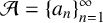
Do there exist two infinite sets
${\mathcal {A}=\{a_n\}_{n=1}^{\infty }}$
 and
$\mathcal {M}$
 of positive integers such that

$p(n,\mathcal {A},\mathcal {M})>0$
 for all sufficiently large n and p has polynomial growth?
In this note, we show that the answer to Question 1 is affirmative. Before proving this corollary, we establish a more general result that relates additive complements to Question 1. Let
$\mathscr {B}$
 and
$\mathscr {S}$
 be subsets of
${\mathbb N}_0$
 . We call
$\mathscr {B}$
 and
$\mathscr {S}$
 complete additive complements if every nonnegative integer can be represented as the sum of an element of
$\mathscr {B}$
 and an element of
$\mathscr {S}$
 , that is,
$\mathscr {B}+\mathscr {S}={\mathbb N}_0$
 . For a set
$\mathcal {Y}\subseteq {\mathbb N}_0$
 , let
$\mathcal {Y}(x)$
 denote the number of elements of
$\mathcal {Y}$
 not exceeding x. Our main result is stated as the following theorem.
Theorem 2. Let
$\mathscr {B}$
 and
$\mathscr {S}$
 be complete additive complements satisfying

Suppose that

Then,
$p(n, \mathcal {A}, \mathcal {M})>0$
 for every
$n\in {\mathbb N}$
 and p has polynomial growth.
Proof. By the hypothesis of the theorem, we have

We first show that
$p(n, \mathcal {A}, \mathcal {M})>0$
 for every
$n\in {\mathbb N}$
 . By the binary expansion of n, there is a finite nonempty set
$\mathcal {J}\subset {\mathbb N}_0$
 such that
$ n=\sum _{j\in \mathcal {J}}2^j. $
 By (1), each
$j\in \mathcal {J}$
 can be written as
$j=s_j+b_j$
 , where
$s_j\in \mathscr {S}$
 and
$b_j\in \mathscr {B}$
 . Thus,

Combining the terms in (2) with the same value of
$b_j$
 ,

For each fixed b, the corresponding
$s_j$
 are distinct, because the j are distinct. Hence, each nonzero inner sum belongs to
$\mathcal {M}$
 . Therefore,
$m_a\in \mathcal {M}\cup \{0\}$
 for every
$a\in \mathcal {A}$
 and only finitely many
$m_a$
 are nonzero.
It remains to show that p has polynomial growth. Let n be sufficiently large and put
$N=\log n/\log 2$
 . Take an arbitrary representation counted by
$p(n,\mathcal {A},\mathcal {M})$
 as

For each b with
$m_{2^b}\ne 0$
 , the uniqueness of the binary expansion gives a unique finite nonempty set
$\mathcal {D}_b\subset \mathscr {S}$
 such that

Thus, the representation (3) determines a finite set

such that

Since all summands are positive, each pair in
$\mathcal {P}$
 satisfies
$s+b\le N$
 . Note that the map from representations to such sets
$\mathcal {P}$
 is injective and so

where

By the hypothesis of our theorem,

where
$c_0>0$
 is a constant. It follows from (4) that

completing the proof that p has polynomial growth.
Now, we turn back to Question 1. We shall use the following result of Ruzsa on additive complements of powers of two.
Proposition 3 (Ruzsa, [Reference Ruzsa5]).
There is a subset
$\mathcal {S}\subset \mathbb {N}$
 with
$\mathcal {S}(x)\ll x/\log x$
 such that every sufficiently large integer is of the form
$2^k+s$
 , where
$k\in \mathbb {N}$
 and
$s\in \mathcal {S}$
 .
Corollary 4. The answer to Question 1 is affirmative.
Proof. Let

By Proposition 3, after adding finitely many nonnegative integers to
$\mathcal {S}$
 if necessary, there exists some
$\mathcal {S}\subseteq {\mathbb N}_0$
 such that
$\mathcal {S}(x)\ll x/\log x$
 and

Indeed, finitely many missing values may be put into
$\mathcal {S}$
 , since
$0\in \mathcal {B}$
 , and this does not affect the estimate
$\mathcal {S}(x)\ll x/\log x$
 . Since
$\mathcal {B}(x)\ll \log x$
 for
$x\ge 2$
 ,

Let

where the elements of
$\mathcal {A}$
 are listed in increasing order. Then,
$a_1=1$
 and
$a_n=2^{2^{n-2}}$
 for every
$n\ge 2$
 . Hence,

Put

The set
$\mathcal {S}$
 is infinite, otherwise
$\mathcal {B}+\mathcal {S}$
 would have counting function
$O(\log x)$
 and could not be all of
${\mathbb N}_0$
 . Hence,
$\mathcal {M}$
 is infinite. By Theorem 2,
$p(n, \mathcal {A}, \mathcal {M})>0$
 for every
$n\in {\mathbb N}$
 and p has polynomial growth, completing the proof of Corollary 4.
Acknowledgement
During the preparation of this work, the author used ChatGPT (OpenAI, GPT-5.5 Thinking) to explore possible approaches to Question 1. In particular, ChatGPT suggested considering sets of the form
$\mathcal {A}=2^{\mathcal {D}}$
 and coefficients represented by binary subset sums, and pointed to a theorem of Ruzsa on additive complements of lacunary sequences. The author rewrote the proof and obtained a more general theorem.

 Open access

