

1. Introduction
Let  $\mathbb {H}^{n}$ be the
 $n$-dimensional hyperbolic space for
 $n \geq 2$. Let
 $G = \operatorname {SO}(n, 1)^{\circ }$, which we recognize as the group of orientation-preserving isometries of
 $\mathbb {H}^{n}$. Let
 $\Gamma < G$ be a Zariski dense torsion-free discrete subgroup. Let
 $X = \Gamma \backslash \mathbb {H}^{n}$. We assume that
 $\Gamma$ is convex cocompact, that is to say, the convex core
 $\operatorname {Core}(X) \subset X$, which is the smallest closed convex subset containing all closed geodesics, is compact. We identify
 $X$, its unit tangent bundle
 $\operatorname {T}^{1}(X)$, and its frame bundle
 $\operatorname {F}(X)$ with
 $\Gamma \backslash G/K$,
 $\Gamma \backslash G/M$, and
 $\Gamma \backslash G$ respectively, where
 $M \cong \operatorname {SO}(n - 1) < K \cong \operatorname {SO}(n)$ are appropriate compact subgroups of
 $G$. Let
 $A = \{a_t: t \in \mathbb {R}\} < G$ be a one-parameter subgroup of semisimple elements such that its right translation action corresponds to the geodesic flow on
 $\Gamma \backslash G/M$ and the frame flow on
 $\Gamma \backslash G$. Let
 $\mathsf {m}$ be the Bowen–Margulis–Sullivan probability measure on
 $\Gamma \backslash G$ which is an
 $M$-invariant lift of the one on
 $\Gamma \backslash G/M$, which is known to be the measure of maximal entropy. Since
 $\Gamma$ is convex cocompact, we note that
 $\mathsf {m}$ is compactly supported. If
 $\Gamma$ is cocompact, then
 $\mathsf {m}$ is simply the
 $G$-invariant probability measure. By the works of Babillot [Reference BabillotBab02] and Winter [Reference WinterWin15], the frame flow is known to be mixing with respect to
 $\mathsf {m}$.
Whether the frame flow is exponentially mixing with respect to  $\mathsf {m}$ is a fundamental question in the study of dynamics because it has many applications including orbit counting, equidistribution, prime geodesic theorems, and shrinking target problems (see, for example, [Reference Duke, Rudnick and SarnakDRS93, Reference Eskin and McMullenEM93, Reference Benoist and OhBO12, Reference Margulis, Mohammadi and OhMMO14, Reference Mohammadi and OhMO15, Reference Kelmer and OhKO21]).
For lattices, exponential mixing of the geodesic flow is due to Moore [Reference MooreMoo87] and Ratner [Reference RatnerRat87]. The proof is based on the  $L^{2}$ spectral gap of the Laplacian. For a general convex cocompact
 $\Gamma$, this approach does not work. However, in this case, Stoyanov [Reference StoyanovSto11] was able to use Dolgopyat's method [Reference DolgopyatDol98] to prove exponential mixing of the geodesic flow.
The main aim of this paper is to prove the following theorem about exponential mixing of the frame flow extending Stoyanov's work.
Theorem 1.1 There exist  $\eta > 0$,
 $C > 0$, and
 $r \in \mathbb {N}$ such that for all
 $\phi \in C_{\mathrm {c}}^{r}(\Gamma \backslash G, \mathbb {R})$,
 $\psi \in C_{\mathrm {c}}^{1}(\Gamma \backslash G, \mathbb {R})$, and
 $t > 0$, we have
 \[ \biggl|\int_{\Gamma \backslash G} \phi(xa_t)\psi(x) \,d\mathsf{m}(x) - \mathsf{m}(\phi) \cdot \mathsf{m}(\psi)\biggr| \leq Ce^{-\eta t} \|\phi\|_{C^{r}} \|\psi\|_{C^{1}}. \]
Let  $\delta _\Gamma \in (0, n - 1]$ be the critical exponent of
 $\Gamma$. If
 $\delta _\Gamma > ({n - 1})/{2}$ for
 $n \in \{2, 3\}$, or if
 $\delta _\Gamma > n - 2$ for
 $n \geq 4$, then Theorem 1.1 has been established for geometrically finite groups by Mohammadi and Oh [Reference Mohammadi and OhMO15] using spectral gap. Recently, for
 $M$-invariant functions, Edwards and Oh [Reference Edwards and OhEO21] have improved the condition to
 $\delta _\Gamma > ({n - 1})/{2}$ for all
 $n \geq 2$. Hence, the novelty of Theorem 1.1 lies in the treatment of all convex cocompact subgroups
 $\Gamma < G$ regardless of the magnitude of
 $\delta _\Gamma$.
Fix a right  $G$-invariant measure on
 $\Gamma \backslash G$ induced from some fixed Haar measure on
 $G$. We denote by
 $m^{\mathrm {BR}}$ and
 $m^{\mathrm {BR}_*}$ the unstable and stable Burger–Roblin measures on
 $\Gamma \backslash G$ respectively, compatible with the choice of the Haar measure. Using Roblin's transverse intersection argument [Reference RoblinRob03, Reference Oh and ShahOS13, Reference Oh and WinterOW16], we can derive the following theorem regarding decay of matrix coefficients from Theorem 1.1.
Theorem 1.2 There exist  $\eta > 0$ and
 $r \in \mathbb {N}$ such that for all
 $\phi \in C_{\mathrm {c}}^{r}(\Gamma \backslash G, \mathbb {R})$ and
 $\psi \in C_{\mathrm {c}}^{1}(\Gamma \backslash G, \mathbb {R})$, there exists
 $C > 0$ such that for all
 $t > 0$, we have
 \[ \biggl|e^{(n - 1 - \delta_\Gamma)t}\int_{\Gamma \backslash G} \phi(xa_t)\psi(x) \, {{d} x} - m^{\mathrm{BR}}(\phi) \cdot m^{\mathrm{BR}_*}(\psi)\biggr| \leq Ce^{-\eta t} \|\phi\|_{C^{r}} \|\psi\|_{C^{1}} \]
where  $C$ depends only on
 $\operatorname {supp}(\phi )$ and
 $\operatorname {supp}(\psi )$.
Remark Theorems 1.1 and 1.2 in fact hold for Hölder functions using the appropriate Hölder norms. The decay exponent  $\eta$ then depends on the Hölder exponent. For the first theorem, this is derived by a convolutional argument, originally by Moore [Reference MooreMoo87] and Ratner [Reference RatnerRat87] and generalized by Kleinbock and Margulis [Reference Kleinbock and MargulisKM96, Appendix] (see also [Reference Gorodnik and SpatzierGS14, Lemma 2.3]). For the second theorem, the convolutional argument does not apply directly. Instead, it must be derived by going through Roblin's transverse intersection argument from the Hölder version of Theorem 1.1.
For all  $T > 0$, define
 \[ \mathcal{G}(T) ={}\#\{\gamma: \gamma \text{ is a primitive closed geodesic in } \Gamma \backslash \mathbb{H}^{n} \text{ with length at most } T\}. \]
For all primitive closed geodesics  $\gamma$ in
 $\Gamma \backslash \mathbb {H}^{n}$, its holonomy is a conjugacy class
 $h_\gamma$ in
 $M$ induced by parallel transport along
 $\gamma$. Fix the Haar probability measure on
 $M$. Recall the function
 $\operatorname{Li}: (2, \infty ) \to \mathbb {R}$ defined by
 $\operatorname{Li}(x) = \int _2^{x} ({1}/{\log (t)}) \, dt$ for all
 $x \in (2, \infty )$. We can also derive the following theorem regarding exponential equidistribution of holonomy of primitive closed geodesics as in the work of Margulis, Mohammadi, and Oh [Reference Margulis, Mohammadi and OhMMO14] from Theorem 1.2.
Remark When following the proof of [Reference Margulis, Mohammadi and OhMMO14, Theorem 1.2], the source of the hypothesis  $\delta _\Gamma > n - 2$ (as
 $\Gamma$ has no parabolic elements) is actually twofold and we can dispense with the hypothesis for both sources. The first source is of course [Reference Margulis, Mohammadi and OhMMO14, Theorem 4.2], quoted from [Reference Mohammadi and OhMO15], which we simply replace with Theorem 1.2. The second source is [Reference Margulis, Mohammadi and OhMMO14, Remark 4.5] which can be replaced with [Reference Das, Fishman, Simmons and UrbańskiDFSU21, Lemma 3.8] for the purposes of the proof of [Reference Margulis, Mohammadi and OhMMO14, Theorem 4.9].
Theorem 1.3 There exists  $\eta > 0$ such that for all class functions
 $\phi \in C^\infty(M, \mathbb R)$, we have
 \[ \sum_{\gamma \in \mathcal{G}(T)} \phi(h_\gamma) = \operatorname{Li} \bigl(e^{\delta_\Gamma T}\bigr) \int_M \phi(m)\, dm + O\bigl(e^{(\delta_\Gamma - \eta)T}\bigr) \quad \text{as}\ T \to +\infty,\]
where the implied constant depends only on  $\|\phi\|_{\mathcal{S}^k}$, the
 $L^2$ Sobolev norm of some sufficiently large order k.
For lattices, Theorem 1.3 was obtained by Sarnak and Wakayama [Reference Sarnak and WakayamaSW99] using the Selberg trace formula. We also remark that the analogue of Theorem 1.3 for hyperbolic rational maps on the Riemann sphere was obtained by Oh and Winter [Reference Oh and WinterOW17] and hence adding to Sullivan's dictionary: holonomies are exponentially equidistributed both for primitive periodic orbits of hyperbolic rational maps on the Riemann sphere and primitive closed geodesics in convex cocompact hyperbolic manifolds.
1.1 Outline of the proof of Theorem 1.1
As  $\Gamma$ is convex cocompact, we have existence of a Markov section on
 $\operatorname {supp}(\mathsf {m})$ by the works of Bowen and Ratner [Reference BowenBow70, Reference RatnerRat73]. This gives a coding for the geodesic flow and immediately provides tools from symbolic dynamics and thermodynamic formalism at our disposal. In particular, denoting by
 $U$ the union of the strong unstable leaves of the Markov section, we have the transfer operators
 $\mathcal {L}_\xi : C(U, \mathbb {C}) \to C(U, \mathbb {C})$ for
 $\xi = a + ib \in \mathbb {C}$ defined by
 \[ \mathcal{L}_\xi(h)(u) = \sum_{u' \in \sigma^{{-}1}(u)} e^{-(a + \delta_\Gamma - ib)\tau(u')} h(u'), \]
where  $\tau$ is the first return time map. Using techniques originally observed by Pollicott [Reference PollicottPol85], we can prove exponential mixing of the geodesic flow if we obtain appropriate spectral bounds for the transfer operators. For small frequencies
 $|b| \ll 1$, the spectral bounds follow from the Ruelle–Perron–Frobenius theorem together with perturbation theory of operators. For large frequencies
 $|b| \gg 1$, the spectral bounds are much more difficult to obtain, but it was achieved by the important work of Dolgopyat [Reference DolgopyatDol98] and later generalized by Stoyanov [Reference StoyanovSto11]. A key ingredient in Dolgopyat's method is the local non-integrability condition (LNIC) from which we can infer that
 $\tau$ is highly oscillating.
We wish now to follow the above framework to prove exponential mixing of the frame flow. In this case, we need to consider instead the transfer operators with holonomy which are twisted by irreducible representations of the compact subgroup  $M$. That is, for a given irreducible representation
 $\rho : M \to \mathrm {U}(V_\rho )$ and
 $\xi = a + ib \in \mathbb {C}$, we consider
 $\mathcal {M}_{\xi , \rho }: C(U, V_\rho ^{\oplus \dim (\rho )}) \to C(U, V_\rho ^{\oplus \dim (\rho )})$ defined by
 \[ \mathcal{M}_{\xi, \rho}(H)(u) = \sum_{u' \in \sigma^{{-}1}(u)} e^{-(a + \delta_\Gamma - ib)\tau(u')} \rho(\vartheta(u')^{{-}1}) H(u'), \]
where  $\vartheta$ is the holonomy. Now we must overcome certain difficulties when following Dolgopyat's method.
The first difficulty is that we need to prove a more general LNIC which deals with both  $\tau$ and
 $\vartheta$ combined together into an
 $AM$-valued map
 $\Phi$ instead of just the
 $A$-valued map
 $\tau$. Working with
 $\Phi$, we need not worry about the competing oscillations of
 $\tau$ and
 $\vartheta$ interfering with each other. We are able to prove this LNIC using Lie theoretic techniques. The arguments also crucially rely on the Zariski density of
 $\Gamma < G$ which is expected as it was already required to show mixing of the frame flow [Reference WinterWin15]. The high oscillations of
 $\Phi$ are then carried through by large
 $|b|$ or non-trivial irreducible representations
 $\rho$.
The second difficulty is that we require a new ingredient which we call the non-concentration property (NCP) which was not required to prove exponential mixing of the geodesic flow [Reference StoyanovSto11]. This property roughly says that given that  $\Gamma < G$ is Zariski dense, its limit set does not concentrate along any particular direction. Note that if
 $\Gamma$ is a lattice, then the limit set is all of
 $\partial _\infty (\mathbb {H}^{n})$, in which case the NCP is trivial.
We also have technical difficulties to overcome in order to execute the argument carefully because we use Riemannian geometry and Lie theory while the limit set and the Markov section at hand are of fractal nature. After these details are taken care of, Dolgopyat's method runs smoothly with the LNIC and NCP and we obtain the desired bounds for the transfer operators with holonomy, completing the proof.
Remark Similar twisted transfer operators have also been considered by Dolgopyat [Reference DolgopyatDol02] but in the context of compact extensions of hyperbolic diffeomorphisms rather than flows.
1.2 Organization of the paper
We start by covering the necessary background and important constructions in §§ 2–5. Next, we prepare for Dolgopyat's method by covering the necessary ingredients in §§ 6 and 7. In §§ 8 and 9, we construct the Dolgopyat operators and go through Dolgopyat's method to obtain spectral bounds for large frequencies or non-trivial irreducible representations of  $M$. Finally, in § 10, we use the obtained spectral bounds to carefully go through arguments by Pollicott along with Paley–Wiener theory to prove exponential mixing of the frame flow.
2. Preliminaries
We will first introduce the basic setup and fix notation for the rest of the paper.
Let  $\mathbb {H}^{n}$ be the
 $n$-dimensional hyperbolic space for
 $n \geq 2$, that is, the unique complete simply connected
 $n$-dimensional Riemannian manifold with constant negative sectional curvature. We denote by
 $\langle \cdot , \cdot \rangle$ and
 $\|\cdot \|$ the inner product and norm respectively on any tangent space of
 $\mathbb {H}^{n}$ induced by the hyperbolic metric. Similarly, we denote by
 $d$ the distance function on
 $\mathbb {H}^{n}$ induced by the hyperbolic metric. Let
 $G = \operatorname {SO}(n, 1)^{\circ } \cong \operatorname {Isom}^{+}(\mathbb {H}^{n})$ and
 $\Gamma < G$ be a Zariski dense torsion-free discrete subgroup. Fix a reference point
 $o \in \mathbb {H}^{n}$ and a reference tangent vector
 $v_o \in \operatorname {T}^{1}(\mathbb {H}^{n})$ at
 $o$. Then we have the stabilizer subgroups
 $K = \operatorname {Stab}_G(o)$ and
 $M = \operatorname {Stab}_G(v_o) < K$. Note that
 $K \cong \operatorname {SO}(n)$ and it is a maximal compact subgroup of
 $G$ and
 $M \cong \operatorname {SO}(n - 1)$. Our base hyperbolic manifold is
 $X = \Gamma \backslash \mathbb {H}^{n} \cong \Gamma \backslash G/K$, its unit tangent bundle is
 $\operatorname {T}^{1}(X) \cong \Gamma \backslash G/M$ and its frame bundle is
 $\operatorname {F}(X) \cong \Gamma \backslash G$ which is a principal
 $\operatorname {SO}(n)$-bundle over
 $X$ and a principal
 $\operatorname {SO}(n - 1)$-bundle over
 $\operatorname {T}^{1}(X)$. Let
 $A = \{a_t: t \in \mathbb {R}\} < G$ be a one-parameter subgroup of semisimple elements, where
 $C_G(A) = AM$, parametrized such that its right translation action on
 $G/M$ and
 $G$ corresponds to the geodesic flow and the frame flow, respectively. We choose a left
 $G$-invariant and right
 $K$-invariant Riemannian metric on
 $G$ [Reference SasakiSas58, Reference MokMok78] which descends down to the previous hyperbolic metric on
 $\mathbb {H}^{n} \cong G/K$, and again use the notation
 $\langle \cdot , \cdot \rangle$,
 $\|\cdot \|$, and
 $d$ on
 $G$ and any of its quotient spaces.
2.1 Limit set
Let  $\partial _\infty (\mathbb {H}^{n})$ denote the boundary at infinity and
 $\overline {\mathbb {H}^{n}} = \mathbb {H}^{n} \cup \partial _\infty (\mathbb {H}^{n})$ denote the compactification of
 $\mathbb {H}^{n}$.
Definition 2.1 (Limit set)
The limit set of  $\Gamma$ is the set of limit points
 $\Lambda (\Gamma ) = \lim (\Gamma o) \subset \partial _\infty (\mathbb {H}^{n}) \subset \overline {\mathbb {H}^{n}}$.
Definition 2.2 (Critical exponent)
The critical exponent  $\delta _\Gamma$ of
 $\Gamma$ is the abscissa of convergence of the Poincaré series
 $\mathscr {P}_\Gamma (s) = \sum _{\gamma \in \Gamma } e^{-s d(o, \gamma o)}$.
Remark It is well known that the above definitions are independent of the choice of  $o \in \mathbb {H}^{n}$.
Definition 2.3 (Convex cocompact)
A torsion-free discrete subgroup  $\Gamma < G$ is called convex cocompact if the convex core
 $\operatorname {Core}(X) = \Gamma \backslash \operatorname {Hull}(\Lambda (\Gamma )) \subset X$, where
 $\operatorname {Hull}$ denotes the convex hull, is compact.
We assume that  $\Gamma$ is convex cocompact in the entire paper.
Remark In our case,  $\delta _\Gamma \in (0, n - 1]$ coincides with the Hausdorff dimension of
 $\Lambda (\Gamma )$.
2.2 Patterson–Sullivan density
Let  $\{\mu ^{\mathrm {PS}}_x: x \in \mathbb {H}^{n}\}$ denote the Patterson–Sullivan density of
 $\Gamma$ [Reference PattersonPat76, Reference SullivanSul79], that is, the set of finite Borel measures on
 $\partial _\infty (\mathbb {H}^{n})$ supported on
 $\Lambda (\Gamma )$ such that
(1)
 $g_*\mu ^{\mathrm {PS}}_x = \mu ^{\mathrm {PS}}_{gx}$ for all $g \in \Gamma$ and $x \in \mathbb {H}^{n}$,
(2)
$({d\mu ^{\mathrm {PS}}_x}/{d\mu ^{\mathrm {PS}}_y})(\xi ) = e^{\delta _\Gamma \beta _{\xi }(y, x)}$ for all $\xi \in \partial _\infty (\mathbb {H}^{n})$ and $x, y \in \mathbb {H}^{n}$





where  $\beta _{\xi }$ denotes the Busemann function at
 $\xi \in \partial _\infty (\mathbb {H}^{n})$ defined by
 $\beta _{\xi }(y, x) = \lim _{t \to \infty } (d(\xi (t), y) - d(\xi (t), x))$, and
 $\xi :\mathbb {R} \to \mathbb {H}^{n}$ is any geodesic such that
 $\lim _{t \to \infty } \xi (t) = \xi$. We allow tangent vector arguments for the Busemann function as well, in which case we will use their basepoints in the definition. Since
 $\Gamma$ is convex cocompact, for all
 $x \in \mathbb {H}^{n}$, the measure
 $\mu ^{\mathrm {PS}}_x$ is the
 $\delta _\Gamma$-dimensional Hausdorff measure on
 $\partial _\infty (\mathbb {H}^{n})$ supported on
 $\Lambda (\Gamma )$ corresponding to the spherical metric on
 $\partial _\infty (\mathbb {H}^{n})$ with respect to
 $x$, up to scalar multiples.
2.3 Bowen–Margulis–Sullivan measure
For all  $u \in \operatorname {T}^{1}(\mathbb {H}^{n})$, let
 $u^{+}$ and
 $u^{-}$ denote its forward and backward limit points. Using the Hopf parametrization via the homeomorphism
 $G/M \cong \operatorname {T}^{1}(\mathbb {H}^{n}) \to \{(u^{+}, u^{-}) \in \partial _\infty (\mathbb {H}^{n}) \times \partial _\infty (\mathbb {H}^{n}): u^{+} \neq u^{-}\} \times \mathbb {R}$ defined by
 $u \mapsto (u^{+}, u^{-}, t = \beta _{u^{-}}(o, u))$, we define the Bowen–Margulis–Sullivan (BMS) measure
 $\mathsf {m}$ on
 $G/M$ [Reference MargulisMar04, Reference BowenBow71, Reference KaimanovichKai90] by
 \[ d\mathsf{m}(u) = e^{\delta_\Gamma \beta_{u^{+}}(o, u)} e^{\delta_\Gamma \beta_{u^{-}}(o, u)} \, d\mu^{\mathrm{PS}}_o(u^{+}) \, d\mu^{\mathrm{PS}}_o(u^{-}) \, dt. \]
Note that this definition depends only on  $\Gamma$ and not on the choice of reference point
 $o \in \mathbb {H}^{n}$. Moreover,
 $\mathsf {m}$ is left
 $\Gamma$-invariant. We now define induced measures on other spaces, all of which we call the BMS measures and denote by
 $\mathsf {m}$ by abuse of notation. By left
 $\Gamma$-invariance,
 $\mathsf {m}$ descends to a measure on
 $\Gamma \backslash G/M$. We normalize it to a probability measure so that
 $\mathsf {m}(\Gamma \backslash G/M) = 1$. Since
 $M$ is compact, we can then use the Haar probability measure on
 $M$ to lift
 $\mathsf {m}$ to a right
 $M$-invariant measure on
 $\Gamma \backslash G$. It can be checked that the BMS measures are invariant with respect to the geodesic flow or the frame flow as appropriate, that is, they are right
 $A$-invariant. We denote the right
 $A$-invariant subset
 $\Omega = \operatorname {supp}(\mathsf {m}) \subset \Gamma \backslash G/M$ which is compact since
 $\Gamma$ is convex cocompact.
3. Coding the geodesic flow
In this section we will review the required background for Markov sections, symbolic dynamics, and thermodynamic formalism.
3.1 Markov sections
We will use a Markov section on  $\Omega \subset \operatorname {T}^{1}(X) \cong \Gamma \backslash G/M$, as developed by Bowen and Ratner [Reference BowenBow70, Reference RatnerRat73], to obtain a symbolic coding of the dynamical system at hand. Recall that the geodesic flow on
 $\operatorname {T}^{1}(X)$ is Anosov. Let
 $W^{\mathrm {su}}(w) \subset \operatorname {T}^{1}(X)$ and
 $W^{\mathrm {ss}}(w) \subset \operatorname {T}^{1}(X)$ denote the leaves through
 $w \in \operatorname {T}^{1}(X)$ of the strong unstable and strong stable foliations, and
 $W_{\epsilon }^{\mathrm {su}}(w) \subset W^{\mathrm {su}}(w)$ and
 $W_{\epsilon }^{\mathrm {ss}}(w) \subset W^{\mathrm {ss}}(w)$ denote the open balls of radius
 $\epsilon > 0$ with respect to the induced distance functions
 $d_{\mathrm {su}}$ and
 $d_{\mathrm {ss}}$, respectively. We use similar notations for the weak unstable and weak stable foliations by replacing ‘su’ with ‘wu’ and ‘ss’ with ‘ws’, respectively. The Anosov property provides a constant
 $C_{\mathrm {Ano}} > 0$ such that for all
 $w \in \operatorname {T}^{1}(X)$, we have
 \[ d_{\mathrm{su}}(ua_{{-}t}, va_{{-}t}) \leq C_{\mathrm{Ano}}e^{{-}t}d_{\mathrm{su}}(u, v),\quad d_{\mathrm{ss}}(ua_t, va_t) \leq C_{\mathrm{Ano}}e^{{-}t}d_{\mathrm{ss}}(u, v) \]
for all  $t \geq 0$, for all
 $u, v \in W^{\mathrm {su}}(w)$ or for all
 $u, v \in W^{\mathrm {ss}}(w)$, respectively. We recall that there exist
 $\epsilon _0, \epsilon _0' > 0$ such that for all
 $w \in \operatorname {T}^{1}(X)$,
 $u \in W_{\epsilon _0}^{\mathrm {wu}}(w)$, and
 $s \in W_{\epsilon _0}^{\mathrm {ss}}(w)$, there exists a unique intersection denoted by
 \begin{equation} [u, s] = W_{\epsilon_0'}^{\mathrm{ss}}(u) \cap W_{\epsilon_0'}^{\mathrm{wu}}(s), \end{equation}
and moreover,  $[\cdot , \cdot ]$ defines a homeomorphism from
 $W_{\epsilon _0}^{\mathrm {wu}}(w) \times W_{\epsilon _0}^{\mathrm {ss}}(w)$ onto its image [Reference RatnerRat73]. Subsets
 $U \subset W_{\epsilon _0}^{\mathrm {su}}(w) \cap \Omega$ and
 $S \subset W_{\epsilon _0}^{\mathrm {ss}}(w) \cap \Omega$ for some
 $w \in \Omega$ are called proper if
 $U = \overline {\operatorname {int}(U)}$ and
 $S = \overline {\operatorname {int}(S)}$, where the interiors and closures are taken in the topology of
 $W^{\mathrm {su}}(w) \cap \Omega$ and
 $W^{\mathrm {ss}}(w) \cap \Omega$, respectively. For any
 $\hat {\delta } > 0$ and proper sets
 $U \subset W_{\epsilon _0}^{\mathrm {su}}(w) \cap \Omega$ and
 $S \subset W_{\epsilon _0}^{\mathrm {ss}}(w) \cap \Omega$ containing some
 $w \in \Omega$, we call
 \[ R = [U, S] = \{[u, s] \in \Omega: u \in U, s \in S\} \subset \Omega \]
a rectangle of size  $\hat {\delta }$ if
 $\operatorname {diam}_{d_{\mathrm {su}}}(U), \operatorname {diam}_{d_{\mathrm {ss}}}(S) \leq \hat {\delta }$, and we call
 $w$ the center of
 $R$. For any rectangle
 $R = [U, S]$, we generalize the notation and define
 $[v_1, v_2] = [u_1, s_2]$ for all
 $v_1 = [u_1, s_1] \in R$ and
 $v_2 = [u_2, s_2] \in R$.
Definition 3.1 (Complete set of rectangles)
Let  $\hat {\delta } > 0$ and
 $N \in \mathbb {N}$. A set
 \[ \mathcal {R} = \{R_1, R_2, \dotsc , R_N\} = \{[U_1, S_1], [U_2, S_2], \dotsc , [U_N, S_N]\} \]
consisting of rectangles in  $\Omega$ is called a complete set of rectangles of size
 $\hat {\delta }$ if:
(1)
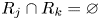
$R_j \cap R_k = \varnothing$ for all $1 \leq j, k \leq N$ with $j \neq k$;(2)
$\operatorname {diam}_{d_{\mathrm {su}}}(U_j), \operatorname {diam}_{d_{\mathrm {ss}}}(S_j) \leq \hat {\delta }$ for all $1 \leq j \leq N$;(3)
$\Omega = \bigcup _{j = 1}^{N} \bigcup _{t \in [0, \hat {\delta }]} R_j a_t$.





Henceforth, we fix
 \begin{equation} 0 < \hat{\delta} < \min(1, \epsilon_0, \epsilon_0'), \end{equation}
where  $\epsilon _0$ and
 $\epsilon _0'$ are from (1). We also fix
 \[ \mathcal{R} = \{R_1, R_2, \dotsc, R_N\} = \{[U_1, S_1], [U_2, S_2], \dotsc, [U_N, S_N]\} \]
to be a complete set of rectangles of size  $\hat {\delta }$ in
 $\Omega$. We denote
 \[ R = \bigsqcup_{j = 1}^{N} R_j,\quad U= \bigsqcup_{j = 1}^{N} U_j. \]
We introduce the distance function  $d$ on
 $U$ defined by
 \[ d(u, v) = \begin{cases} d_{\mathrm{su}}(u, v), & u, v \in U_j \text{ for some } 1 \leq j \leq N, \\ 1, & \text{otherwise,} \end{cases} \quad \text{for all } u, v \in U. \]
We will use  $d_{\mathrm {su}}$ whenever further clarity is required. Denote by
 $\tau : R \to \mathbb {R}$ the first return time map defined by
 \[ \tau(u) = \inf\{t > 0: ua_t \in R\} \quad \text{for all }u \in R. \]
Note that  $\tau$ is constant on
 $[u, S_j]$ for all
 $u \in U_j$ and
 $1 \leq j \leq N$. Denote by
 $\mathcal {P}: R \to R$ the Poincaré first return map defined by
 \[ \mathcal{P}(u) = ua_{\tau(u)} \quad \text{for all}\ u \in R. \]
Let  $\sigma = (\operatorname {proj}_U \circ \mathcal {P})|_U: U \to U$ be its projection, where
 $\operatorname {proj}_U: R \to U$ is the projection defined by
 $\operatorname {proj}_U([u, s]) = u$ for all
 $[u, s] \in R$. Define the cores
 \begin{align*} \hat{R} &= \{u \in R: \mathcal{P}^{k}(u) \in \operatorname{int}(R) \text{ for all } k \in \mathbb{Z}\},\nonumber \\ \hat{U} &= \{u \in U: \sigma^{k}(u) \in \operatorname{int}(U) \text{ for all } k \in \mathbb{Z}_{{\geq} 0}\}, \end{align*}
which are both residual subsets (complements of meager sets) of  $R$ and
 $U$, respectively.
Definition 3.2 (Markov section)
Let  $\hat {\delta } > 0$ and
 $N \in \mathbb {N}$. We call a complete set of rectangles
 $\mathcal {R}$ of size
 $\hat {\delta }$ a Markov section if in addition to properties (1)–(3), the following property, called the Markov property, is satisfied:
(4)
$[\operatorname {int}(U_k), \mathcal {P}(u)] \subset \mathcal {P}([\operatorname {int}(U_j), u])$ and $\mathcal {P}([u, \operatorname {int}(S_j)]) \subset [\mathcal {P}(u), \operatorname {int}(S_k)]$ for all $u \in R$ such that $u \in \operatorname {int}(R_j) \cap \mathcal {P}^{-1}(\operatorname {int}(R_k)) \neq \varnothing$, for all $1 \leq j, k \leq N$.





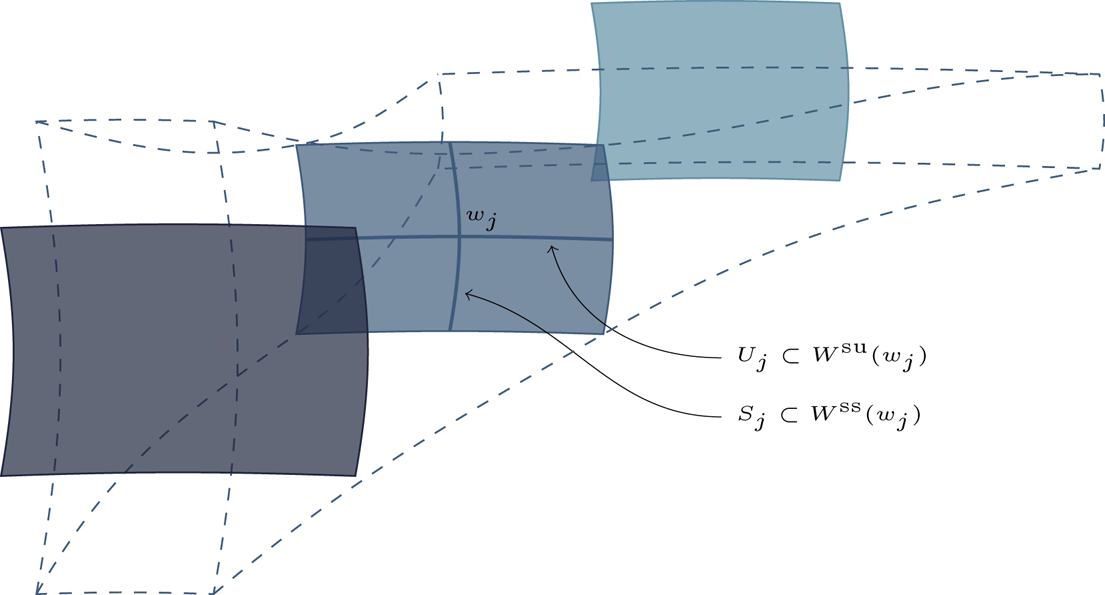
This can be understood pictorially in Figure 1.
The Markov property.

The existence of Markov sections of arbitrarily small size for Anosov flows was proved by Bowen and Ratner [Reference BowenBow70, Reference RatnerRat73]. Thus, we assume henceforth that  $\mathcal {R}$ is a Markov section.
3.2 Symbolic dynamics
Let  $\mathcal {A} = \{1, 2, \dotsc , N\}$ be the alphabet for the coding corresponding to the Markov section. Define the
 $N \times N$ transition matrix
 $T$ by
 \[ T_{j, k} = \begin{cases} 1, & \operatorname{int}(R_j) \cap \mathcal{P}^{{-}1}(\operatorname{int}(R_k)) \neq \varnothing, \\ 0, & \text{otherwise}, \end{cases} \quad \text{for all }1 \leq j, k \leq N. \]
The transition matrix  $T$ is topologically mixing [Reference RatnerRat73, Theorem 4.3], that is, there exists
 $N_T \in \mathbb {N}$ such that all the entries of
 $T^{N_T}$ are positive. This definition is equivalent to the one in [Reference RatnerRat73] in the setting of Markov sections. Define the spaces of bi-infinite and infinite admissible sequences
 \begin{align*} \Sigma &= \{(\dotsc, x_{{-}1}, x_0, x_1, \dotsc) \in \mathcal{A}^{\mathbb{Z}}: T_{x_j, x_{j + 1}} = 1 \text{ for all } j \in \mathbb{Z}\},\\ \Sigma^{+} &= \{(x_0, x_1, \dotsc) \in \mathcal{A}^{\mathbb{Z}_{{\geq} 0}}: T_{x_j, x_{j + 1}} = 1 \text{ for all } j \in \mathbb{Z}_{{\geq} 0}\}, \end{align*}
respectively. We will also use the term admissible sequences for finite sequences in the natural way. For any  $\theta \in (0, 1)$, we can endow
 $\Sigma$ with the distance function
 $d_\theta$ defined by
 $d_\theta (x, y) = \theta ^{\inf \{|j| \in \mathbb {Z}_{\geq 0}: x_j \neq y_j\}}$ for all
 $x, y \in \Sigma$. We can similarly endow
 $\Sigma ^{+}$ with a distance function which we also denote by
 $d_\theta$.
Definition 3.3 (Cylinder)
For all  $k \in \mathbb {Z}_{\geq 0}$ and for all admissible sequences
 $x = (x_0, x_1, \dotsc , x_k)$, we define the corresponding cylinder to be
 \[ \mathtt{C}[x] = \{u \in U: \sigma^{j}(u) \in \operatorname{int}(U_{x_j}) \text{ for all } 0 \leq j \leq k\} \]
with length  $\operatorname {len}(\mathtt{C}[x]) := \operatorname {len}(x) := k$. We will denote cylinders simply by
 $\mathtt {C}$ (or other typewriter-style letters) when we do not need to specify the corresponding admissible sequence.
Although  $\sigma$ and
 $\tau$ are not even continuous, we note that for all admissible pairs
 $(j, k)$, the restricted maps
 $\sigma |_{\mathtt {C}[j, k]}: \mathtt {C}[j, k] \to \operatorname {int}(U_k)$,
 $(\sigma |_{\mathtt {C}[j, k]})^{-1}: \operatorname {int}(U_k) \to \mathtt {C}[j, k]$, and
 $\tau |_{\mathtt {C}[j, k]}: \mathtt {C}[j, k] \to \mathbb {R}$ are Lipschitz in our setting.
By a slight abuse of notation, let  $\sigma$ also denote the shift map on
 $\Sigma$ or
 $\Sigma ^{+}$. There exist natural continuous surjections
 $\zeta : \Sigma \to R$ and
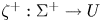 $\zeta ^{+}: \Sigma ^{+} \to U$ defined by
 $\zeta (x) = \bigcap _{j = -\infty }^{\infty } \overline {\mathcal {P}^{-j}(\operatorname {int}(R_{x_j}))}$ for all
 $x \in \Sigma$ and
 $\zeta ^{+}(x) = \bigcap _{j = 0}^{\infty } \overline {\sigma ^{-j}(\operatorname {int}(U_{x_j}))}$ for all
 $x \in \Sigma ^{+}$. Define
 $\hat {\Sigma } = \zeta ^{-1}(\hat {R})$ and
 $\hat {\Sigma }^{+} = (\zeta ^{+})^{-1}(\hat {U})$. Then the restrictions
 $\zeta |_{\hat {\Sigma }}: \hat {\Sigma } \to \hat {R}$ and
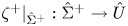 $\zeta ^{+}|_{\hat {\Sigma }^{+}}: \hat {\Sigma }^{+} \to \hat {U}$ are bijective and satisfy
 $\zeta |_{\hat {\Sigma }} \circ \sigma |_{\hat {\Sigma }} = \mathcal {P}|_{\hat {R}} \circ \zeta |_{\hat {\Sigma }}$ and
 $\zeta ^{+}|_{\hat {\Sigma }^{+}} \circ \sigma |_{\hat {\Sigma }^{+}} = \sigma |_{\hat {U}} \circ \zeta ^{+}|_{\hat {\Sigma }^{+}}$.
For  $\theta \in (0, 1)$ sufficiently close to
 $1$, the maps
 $\zeta$ and
 $\zeta ^{+}$ are Lipschitz [Reference BowenBow73, Lemma 2.2] with some Lipschitz constant
 $C_\theta > 0$. We now fix
 $\theta$ to be any such constant. Let
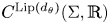 $C^{\operatorname {Lip}(d_\theta )}(\Sigma , \mathbb {R})$ denote the space of Lipschitz functions
 $f: \Sigma \to \mathbb {R}$. We use similar notation for other domains, codomains, and metrics.
Since  $(\tau \circ \zeta )|_{\hat {\Sigma }}$ and
 $(\tau \circ \zeta ^{+})|_{\hat {\Sigma }^{+}}$ are Lipschitz, there exist unique Lipschitz extensions
 $\tau _\Sigma : \Sigma \to \mathbb {R}$ and
 $\tau _{\Sigma ^{+}}: \Sigma ^{+} \to \mathbb {R}$, respectively. Note that the resulting maps are distinct from
 $\tau \circ \zeta$ and
 $\tau \circ \zeta ^{+}$ because they may differ precisely on
 $x \in \Sigma$ for which
 $\operatorname {proj}_U(\zeta (x)) \in \partial (\mathtt {C})$, and
 $x \in \Sigma ^{+}$ for which
 $\zeta ^{+}(x) \in \partial (\mathtt {C})$ respectively, for some cylinder
 $\mathtt {C} \subset U$ with
 $\operatorname {len}(\mathtt {C}) = 1$. Then the previous properties extend to
 $\zeta (\sigma (x)) = \zeta (x)a_{\tau _\Sigma (x)}$ for all
 $x \in \Sigma$ and
 $\zeta ^{+}(\sigma (x)) = \operatorname {proj}_U(\zeta ^{+}(x)a_{\tau _{\Sigma ^{+}}(x)})$ for all
 $x \in \Sigma ^{+}$.
3.3 Thermodynamics
Definition 3.4 (Pressure)
For all potential  $f \in C^{\operatorname {Lip}(d_\theta )}(\Sigma , \mathbb {R})$, the pressure is defined by
 \[ \operatorname{Pr}_\sigma(f) = \sup_{\nu \in \mathcal{M}^{1}_\sigma(\Sigma)}\biggl\{\int_\Sigma f \, d\nu + h_\nu(\sigma)\biggr\}, \]
where  $\mathcal {M}^{1}_\sigma (\Sigma )$ is the set of
 $\sigma$-invariant Borel probability measures on
 $\Sigma$ and
 $h_\nu (\sigma )$ is the measure theoretic entropy of
 $\sigma$ with respect to
 $\nu$.
For all  $f \in C^{\operatorname {Lip}(d_\theta )}(\Sigma , \mathbb {R})$, there is in fact a unique
 $\sigma$-invariant Borel probability measure
 $\nu _f$ on
 $\Sigma$ which attains the supremum in Definition 3.4 called the
 $f$-equilibrium state [Reference BowenBow08, Theorems 2.17 and 2.20] and it satisfies
 $\nu _f(\hat {\Sigma }) = 1$ [Reference ChernovChe02, Corollary 3.2]. In particular, we will consider the probability measure
 $\nu _{-\delta _\Gamma \tau _\Sigma }$ on
 $\Sigma$ which we will denote simply by
 $\nu _\Sigma$ and which has corresponding pressure
 $\operatorname {Pr}_\sigma (-\delta _\Gamma \tau _\Sigma ) = 0$. According to the foregoing,
 $\nu _\Sigma (\hat {\Sigma }) = 1$. Define the corresponding probability measure
 $\nu _R = \zeta _*(\nu _\Sigma )$ on
 $R$ and note that
 $\nu _R(\hat {R}) = 1$. Now consider the suspension space
 $R^{\tau } = (R \times \mathbb {R}_{\geq 0})/\mathord {\sim }$ where
 $\sim$ is the equivalence relation on
 $R \times \mathbb {R}_{\geq 0}$ defined by
 $(u, t + \tau (u)) \sim (\mathcal {P}(u), t)$. Then we have a bijection
 $R^{\tau } \to \Omega$ defined by
 $(u, t) \mapsto ua_t$. We can define the measure
 $\nu ^{\tau }$ on
 $R^{\tau }$ as the product measure
 $\nu _R \times m^{\mathrm {Leb}}$ on
 $\{(u, t) \in R \times \mathbb {R}_{\geq 0}: 0 \leq t < \tau (u)\}$. Then, using the aforementioned bijection, we have the pushforward measure which, by abuse of notation, we also denote by
 $\nu ^{\tau }$ on
 $\operatorname {T}^{1}(X)$ supported on
 $\Omega$. By [Reference SullivanSul84] and [Reference ChernovChe02, Theorem 4.4], we have
 $\mathsf {m} = \nu ^{\tau }/\nu _R(\tau )$ because they are the unique measure of maximal entropy for the geodesic flow on
 $\operatorname {T}^{1}(X)$. Finally, we define the probability measure
 $\nu _U = (\operatorname {proj}_U)_*(\nu _R)$ and note that
 $\nu _U(\hat {U}) = 1$ and
 $\nu _U(\tau ) = \nu _R(\tau )$.
4. Holonomy and representation theory
In this section we define holonomy which is required in addition to the Markov section to deal with the frame flow. Since the holonomy is  $M$-valued, we naturally need to consider
 $L^{2}(M, \mathbb {C})$ and so we also cover the required representation theory.
We do not have a Markov section available for the frame flow. Thus, similar to  $\tau$, we need a map
 $\vartheta$ which ‘keeps track of the
 $M$-coordinate’. We first require an appropriate choice of section
 $F$ on
 $R$ of the frame bundle
 $\operatorname {F}(X)$ over
 $\operatorname {T}^{1}(X)$. Let
 $w_j$ be the center of
 $R_j$ for all
 $j \in \mathcal {A}$. For convenience later on, we will actually define a smooth section
 \[ F: \bigsqcup_{j = 1}^{N} [W_{\epsilon_0}^{\mathrm{su}}(w_j), W_{\epsilon_0}^{\mathrm{ss}}(w_j)] \to \operatorname{F}(X), \]
where without loss of generality we assume  $\epsilon _0$ is sufficiently small so that the union is indeed a disjoint union. Define
 $N^{+} < G$ and
 $N^{-} < G$ respectively to be the expanding and contracting horospherical subgroups, that is,
 \[ N^{{\pm}} = \Bigl\{n^{{\pm}} \in G: \lim_{t \to \pm\infty} a_tn^{{\pm}} a_{{-}t} = e\Bigr\}. \]
First we choose arbitrary frames 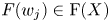 $F(w_j) \in \operatorname {F}(X)$ based at the tangent vector
 $w_j \in \operatorname {T}^{1}(X)$ for all
 $j \in \mathcal {A}$. Then we extend the section
 $F$ such that for all
 $j \in \mathcal {A}$ and
 $u, u' \in W_{\epsilon _0}^{\mathrm {su}}(w_j)$, we have that the frames
 $F(u)$ and
 $F(u')$ are backwards asymptotic, that is,
 $\lim _{t \to -\infty } d(F(u)a_t, F(u')a_t) = 0$. Then we must have
 $F(u') = F(u)n^{+}$ for some unique
 $n^{+} \in N^{+}$. We again extend the section
 $F$ such that for all
 $j \in \mathcal {A}$,
 $u \in W_{\epsilon _0}^{\mathrm {su}}(w_j)$, and
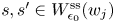 $s, s' \in W_{\epsilon _0}^{\mathrm {ss}}(w_j)$, we have that the frames
 $F([u, s])$ and
 $F([u, s'])$ are forwards asymptotic, that is,
 $\lim _{t \to +\infty } d(F([u, s])a_t, F([u, s'])a_t) = 0$. Then we must have
 $F([u, s']) = F([u, s])n^{-}$ for some unique
 $n^{-} \in N^{-}$. This completes the construction.
Definition 4.1 (Holonomy)
The holonomy is a map  $\vartheta : R \to M$ such that for all
 $u \in R$, we have
 $F(u)a_{\tau (u)} = F(\mathcal {P}(u))\vartheta (u)^{-1}$.
Just as  $\tau$ is constant on the strong stable leaves of the rectangles, the following lemma shows that the same is true for
 $\vartheta$. This allows us to work solely on
 $U$.
Lemma 4.2 The holonomy  $\vartheta$ is constant on
 $[u, S_j]$ for all
 $u \in U_j$ and
 $j \in \mathcal {A}$.
Proof. Let  $j \in \mathcal {A}$ and
 $u \in U_j$. Let
 $s \in S_j$ and
 $u' = [u, s]$. Recall that
 $F(u') = F(u)n^{-}$ for some
 $n^{-} \in N^{-}$. From the definition of the holonomy map, we have
 $F(\mathcal {P}(u)) = F(u)a_{\tau (u)}\vartheta (u)$ and
 $F(\mathcal {P}(u')) = F(u')a_{\tau (u')}\vartheta (u') = F(u)n^{-}a_{\tau (u)}\vartheta (u')$ since
 $\tau (u') = \tau (u)$. Let
 $F(u) = \Gamma g \in \Gamma \backslash G$. Using left
 $G$-invariance and right
 $K$-invariance of the distance function
 $d$ on
 $G$, we have
 \begin{align*} d(F(\mathcal{P}(u))a_t, F(\mathcal{P}(u'))a_t) &= d(F(u)a_{\tau(u) + t}\vartheta(u), F(u)n^{-}a_{\tau(u) + t}\vartheta(u'))\\ &= d(ga_{\tau(u) + t}\vartheta(u), gn^{-}a_{\tau(u) + t}\vartheta(u')) \\ &= d(\vartheta(u), a_{-(\tau(u) + t)}n^{-}a_{\tau(u) + t}\vartheta(u')) \\ &\geq d(\vartheta(u), \vartheta(u')) - d(\vartheta(u'), a_{-(\tau(u) + t)}n^{-}a_{\tau(u) + t}\vartheta(u')) \\ &= d(\vartheta(u), \vartheta(u')) - d(e, a_{-(\tau(u) + t)}n^{-}a_{\tau(u) + t}) \end{align*}
for all  $t \geq 0$. The second equality holds assuming that
 $\epsilon _0$ is sufficiently small without loss of generality. Then
 $\lim _{t \to +\infty } d(F(\mathcal {P}(u))a_t, F(\mathcal {P}(u'))a_t) = 0$ and
 $\lim _{t \to +\infty } d(e, a_{-(\tau (u) + t)}n^{-}a_{\tau (u) + t}) = 0$ imply
 $d(\vartheta (u), \vartheta (u')) = 0$. Thus
 $\vartheta (u') = \vartheta (u)$.
Denote  $\Omega _{\operatorname {F}} = \operatorname {supp}(\mathsf {m}) \subset \Gamma \backslash G$ which is compact since
 $\Gamma$ is convex cocompact. Define
 $R^{\vartheta } \subset \operatorname {F}(X)$ to be the subset of frames over
 $R$ and similarly define
 $U^{\vartheta }$. Via the section
 $F$, we have the natural identifications
 $R^{\vartheta } \cong R \times M$ and
 $U^{\vartheta } \cong U \times M$. We define the measure
 $\nu _{R^{\vartheta }}$ on
 $R^{\vartheta }$ simply by lifting the measure
 $\nu _{R}$ using the Haar probability measure on
 $M$. Using the holonomy
 $\vartheta$, we can define the suspension space
 $R^{\vartheta , \tau } = R^{\vartheta } \times \mathbb {R}_{\geq 0}/{\sim }$ where
 $\sim$ is the equivalence relation on
 $R^{\vartheta } \times \mathbb {R}_{\geq 0}$ defined by
 $(u, m, t + \tau (u)) \sim (\mathcal {P}(u), \vartheta (u)^{-1}m, t)$. Like
 $\nu ^{\tau }$, we can now define the measure
 $\nu ^{\vartheta , \tau }$ on
 $R^{\vartheta , \tau }$. As in § 3.3, we can use the natural bijection
 $R^{\vartheta , \tau } \to \Omega _{\operatorname {F}}$ defined by
 $(u, m, t) \mapsto F(u)a_t m$, to obtain the pushforward measure which, by abuse of notation, we also denote by
 $\nu ^{\vartheta , \tau }$ on
 $\operatorname {F}(X)$ supported on
 $\Omega _{\operatorname {F}}$. Then
 $\mathsf {m} = {\nu ^{\vartheta , \tau }}/{\nu _R(\tau )}$.
We need to deal with the function space  $C(U^{\vartheta }, \mathbb {C})$. We note that
 \[ C(U^{\vartheta}, \mathbb{C}) \cong C(U \times M, \mathbb{C}) \cong C(U, C(M, \mathbb{C})) \subset C(U, L^{2}(M, \mathbb{C})). \]
Define  $\varrho : M \to \mathrm {U}(L^{2}(M, \mathbb {C}))$ to be the unitary left regular representation, that is,
 $\varrho (h)(\phi )(m) = \phi (h^{-1}m)$ for all
 $m \in M$,
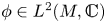 $\phi \in L^{2}(M, \mathbb {C})$, and
 $h \in M$. Denote the unitary dual of
 $M$ by
 $\hat {M}$. Denote the trivial irreducible representation by
 $1 \in \hat {M}$. Define
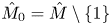 $\hat {M}_0 = \hat {M} \setminus \{1\}$. By the Peter–Weyl theorem, we obtain an orthogonal Hilbert space decomposition
 \[ L^{2}(M, \mathbb{C}) = \operatorname*{\widehat{\bigoplus}}_{\rho \in \hat{M}} V_\rho^{{\oplus} \dim(\rho)} \]
corresponding to the decomposition 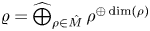 $\varrho = \operatorname *{\widehat {\bigoplus }}_{\rho \in \hat {M}} \rho ^{\oplus \dim (\rho )}$.
For all  $b \in \mathbb {R}$ and
 $\rho \in \hat {M}$, we define the tensored unitary representation
 $\rho _b: AM \to \mathrm {U}(V_\rho )$ by
 \[ \rho_b(a_tm)(z) = e^{{-}ibt}\rho(m)(z) \quad \text{for all }z \in V_\rho,\ t \in \mathbb{R},\ \text{and}\ m \in M. \]
We introduce some notation related to Lie algebras. We denote Lie algebras corresponding to Lie groups by the corresponding Fraktur letters, for example  $\mathfrak {a} = \operatorname {T}_e(A)$,
 $\mathfrak {m} = \operatorname {T}_e(M)$,
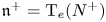 $\mathfrak {n}^{+} = \operatorname {T}_e(N^{+})$, and
 $\mathfrak {n}^{-} = \operatorname {T}_e(N^{-})$. For any unitary representation
 $\rho : M \to \mathrm {U}(V)$ for some Hilbert space
 $V$, we denote the differential at
 $e \in M$ by
 $d\rho = (d\rho )_e: \mathfrak {m} \to \mathfrak {u}(V)$, and define the norm
 \[ \|\rho\| = \sup_{\substack{z \in \mathfrak{m}\\ \text{such that } \|z\| = 1}} \|d\rho(z)\|_{\mathrm{op}} \]
and similarly for any unitary representation  $\rho : AM \to \mathrm {U}(V)$.
Remark The norms remain the same if we replace  $V_\rho$ with
 $V_\rho ^{\oplus \dim (\rho )}$ since the
 $M$-action is identical across all components.
Lemma 4.3 records some useful facts regarding the Lie theoretic norms.
Lemma 4.3 For all  $b \in \mathbb {R}$ and
 $\rho \in \hat {M}$, we have
 \[ \sup_{a \in A, m \in M} \sup_{\substack{z \in \operatorname{T}_{am}(AM)\\ \text{such that } \|z\| = 1}} \|(d\rho_b)_{am}(z)\|_{\mathrm{op}} = \|\rho_b\| \]
and  $\max (|b|, \|\rho \|) \leq \|\rho _b\| \leq |b| + \|\rho \|$.
Proof. Let  $b \in \mathbb {R}$ and
 $\rho \in \hat {M}$. We first show the equality. Let
 $a \in A$,
 $m \in M$, and
 $z \in \operatorname {T}_{am}(AM)$ with
 $\|z\| = 1$. Let
 $m^{\mathrm {L}}_g: G \to G$ be the left multiplication map by
 $g \in G$. By the unitarity of
 $\rho _b$ and the left
 $G$-invariance of the norm on
 $G$, we have
 \begin{align*} \|(d\rho_b)_{am}(z)\|_{\mathrm{op}} &= \big\|\big((d\rho_b)_{am} \circ \big(dm_{am}^{\mathrm{L}}\big)_e \circ \big(dm_{(am)^{{-}1}}^{\mathrm{L}}\big)_{am}\big)(z)\big\|_{\mathrm{op}}\\ &= \big\|\big(\big(dm_{\rho_b(am)}^{\mathrm{L}}\big)_e \circ (d\rho_b)_e \circ \big(dm_{(am)^{{-}1}}^{\mathrm{L}}\big)_{am}\big)(z)\big\|_{\mathrm{op}} \leq \|\rho_b\|. \end{align*}
Taking the supremum and recognizing that we have equality for  $am = e \in AM$, the first equality follows.
Now we show the inequality. The first part is trivial so we focus on the second part. By construction of the Riemannian metric on  $G$, we have
 $\langle w_1, w_2 \rangle = 0$ for all
 $w_1 \in \operatorname {T}_g(gA)$,
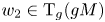 $w_2 \in \operatorname {T}_g(gM)$, and
 $g \in G$. Hence
 $AM \cong A \times M$ not only as Lie groups but also as Riemannian manifolds with the canonical product Riemannian metric. Let
 $z = z_\mathfrak {a} + z_\mathfrak {m} \in \mathfrak {a} \oplus \mathfrak {m}$ with
 $\|z\|^{2} = \|z_\mathfrak {a}\|^{2} + \|z_\mathfrak {m}\|^{2} = 1$. We have
 \[ \|d\rho_b(z)\|_{\mathrm{op}} = \bigl\|{ib\|z_\mathfrak{a}\|\operatorname{Id}_{\mathrm{U}(V_\rho)}} + d\rho(z_\mathfrak{m})\bigr\|_{\mathrm{op}} \leq |b| \cdot \|z_\mathfrak{a}\| + \|\rho\| \cdot \|z_\mathfrak{m}\| \leq |b| + \|\rho\|, \]
and so by taking the supremum, the inequality follows.
It turns out that the source of the oscillations needed in Dolgopyat's method is provided by the local non-integrability condition which will be introduced in § 6.1, and the oscillations themselves are propagated when  $\|\rho _b\|$ is sufficiently large. But this occurs precisely when
 $|b|$ is sufficiently large or
 $\rho \in \hat {M}$ is non-trivial. Let
 $b_0 > 0$, which we fix later. This motivates us to define
 \[ \hat{M}_0(b_0) = \{(b, \rho) \in \mathbb{R} \times \hat{M}: |b| > b_0 \text{ or } \rho \neq 1\}. \]
We fix some related constants. Fix  $\delta _{\varrho } = \inf _{b \in \mathbb {R}, \rho \in \hat {M}_0} \|\rho _b\| = \inf _{\rho \in \hat {M}_0} \|\rho \|$. Note that
 $\delta _{\varrho } > 0$ as
 $M$ is a compact connected Lie group. Furthermore, we can deduce that
 $\inf _{(b, \rho ) \in \hat {M}_0(b_0)} \|\rho _b\| \geq \min (b_0, \delta _{\varrho })$. Hence we fix
 $\delta _{1, \varrho } = \min (1, \delta _{\varrho })$.
The Killing form  $B$ on
 $\mathfrak {m}$ is non-degenerate and negative definite because
 $M$ is a compact semisimple Lie group. We denote the corresponding inner product and norm on both
 $\mathfrak {m}$ and
 $\mathfrak {m}^{*}$ by
 $\langle \cdot , \cdot \rangle _B$ and
 $\|\cdot \|_B$, respectively. By construction of the Riemannian metric on
 $G$, the induced inner product on
 $\mathfrak {m}$ satisfies
 $\langle \cdot , \cdot \rangle _B = C_B\langle \cdot , \cdot \rangle$ for some constant
 $C_B > 0$.
Lemma 4.4 There exists  $\delta > 0$ such that for all
 $b \in \mathbb {R}$,
 $\rho \in \hat {M}$, and
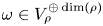 $\omega \in V_\rho ^{\oplus \dim (\rho )}$ with
 $\|\omega \|_2 = 1$, there exists
 $z \in \mathfrak {a} \oplus \mathfrak {m}$ with
 $\|z\| = 1$ such that
 $\|d\rho _b(z)(\omega )\|_2 \geq \delta \|\rho _b\|$.
Proof. Fix  $\delta = {1}/{2}$ if
 $M$ is trivial and
 $\delta = {1}/({2 \dim (\mathfrak {m})})$ otherwise. Let
 $b \in \mathbb {R}$,
 $\rho \in \hat {M}$, and
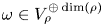 $\omega \in V_\rho ^{\oplus \dim (\rho )}$ with
 $\|\omega \|_2 = 1$. For any
 $z \in \mathfrak {a} \subset \mathfrak {a} \oplus \mathfrak {m}$ with
 $\|z\| = 1$, we have
 \[ \|d\rho_b(z)(\omega)\|_2 = \|ib\omega\|_2 = |b|. \]
If  $M$ is trivial, then
 $|b| = \|\rho _b\| \geq \delta \|\rho _b\|$ so the lemma follows. Otherwise, first consider the case
 $|b| \geq \|\rho \|$. Lemma 4.3 gives
 $|b| \geq ({1}/{2})(|b| + \|\rho \|) \geq \delta \|\rho _b\|$, proving the lemma in this case.
Now consider the case  $|b| \leq \|\rho \|$. By Lemma 4.3, we have
 $\|\rho _b\| \leq 2\|\rho \|$. Let
 $\Phi _\rho$ be the set of weights corresponding to the Lie algebra representation
 $d\rho$ and
 $\lambda \in \Phi _\rho$ be the highest weight. We first show that
 $\|\rho \| \leq C_B \|\lambda \|_B$. Let
 $z \in \mathfrak {m} \subset \mathfrak {a} \oplus \mathfrak {m}$ with
 $\|z\| = 1$. Then consider the Cartan subalgebra
 $\mathfrak {h} \subset \mathfrak {m}$ containing
 $z$, guaranteed by Cartan's maximal tori theorem on
 $M$, and assume without loss of generality that
 $\Phi _\rho \subset \mathfrak {h}^{*}$. We have
 $d\rho (z)(\omega ') = \sum _{\eta \in \Phi _\rho } d\rho (z)(\omega '_\eta ) = \sum _{\eta \in \Phi _\rho } \eta (z)\omega '_\eta$ for all
 $\omega ' \in V_\rho$, where we write
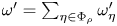 $\omega ' = \sum _{\eta \in \Phi _\rho } \omega '_\eta$ using the weight space decomposition
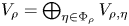 $V_\rho = \bigoplus _{\eta \in \Phi _\rho } V_{\rho , \eta }$. Note that this decomposition is in fact orthogonal because
 $d\rho : \mathfrak {m} \to \mathfrak {u}(V_\rho )$ is diagonalizable by a unitary operator. Thus, we can use the formula
 $\|d\rho (z)\|_{\mathrm {op}} = \max _{\eta \in \Phi _\rho } |\eta (z)|$ for the operator norm to get the bound
 \begin{equation} \|d\rho(z)\|_{\mathrm{op}} \leq \max_{\eta \in \Phi_\rho} \|\eta\|_B \|z\|_B \leq C_B \|\lambda\|_B \end{equation}
since  $\lambda \in \Phi _\rho$ is the highest weight. Since this bound holds for all
 $z \in \mathfrak {m} \subset \mathfrak {a} \oplus \mathfrak {m}$ with
 $\|z\| = 1$, taking the supremum gives
 $\|\rho \| \leq C_B \|\lambda \|_B$ as desired. Hence
 $\|\rho _b\| \leq 2C_B\|\lambda \|_B$. Now, with respect to the inner product
 $\langle \cdot , \cdot \rangle _B$, let
 $(z_1, z_2, \dotsc , z_{\dim (\mathfrak {m})})$ be an orthonormal basis of
 $\mathfrak {m}$ so that it is its own dual basis. Then the negative Casimir element in the center of the universal enveloping algebra of
 $\mathfrak {m}$ is given by
 $\varsigma = \sum _{j = 1}^{\dim (\mathfrak {m})} z_j^{2} \in Z(\mathfrak {m}) \subset U(\mathfrak {m})$. Its action on
 $V_\rho$ via
 $d\rho$ and hence also via
 $d\rho _b$ is simply by the scalar
 $\|\lambda \|_B^{2} + 2\langle \lambda , \upsilon \rangle _B$ where
 $\upsilon = ({1}/{2})\sum _{\eta \in R^{+}} \eta$ and
 $R^{+}$ is the set of positive roots. But
 $\langle \lambda , \upsilon \rangle _B \geq 0$ since
 $\lambda \in \Phi _\rho$ is the highest weight. Thus, we have
 \[ \sum_{j = 1}^{\dim(\mathfrak{m})} \|d\rho_b(z_j^{2})(\omega)\|_2 \geq \|d\rho_b(\varsigma)(\omega)\|_2 \geq \|\lambda\|_B^{2}. \]
Hence, there exists  $z_0 \in \{z_1, z_2, \dotsc , z_{\dim (\mathfrak {m})}\}$ such that
 $\|d\rho _b(z_0^{2})(\omega )\|_2 \geq {\|\lambda \|_B^{2}}/{\dim (\mathfrak {m})}$. Using
 $\|z_0\|_B = 1$ and a similar bound to that in (3), we have
 $\|d\rho _b(z_0)(\omega )\|_2 \geq {\|\lambda \|_B}/{\dim (\mathfrak {m})}$. Let
 $z = {z_0}/{\|z_0\|} \in \mathfrak {m} \subset \mathfrak {a} \oplus \mathfrak {m}$ so that
 $\|z\| = 1$. Along with the above bound
 $\|\rho _b\| \leq 2C_B\|\lambda \|_B$, we have
 \[ \|d\rho_b(z)(\omega)\|_2 \geq \frac{\|\lambda\|_B}{\dim(\mathfrak{m})\|z_0\|} \geq \frac{1}{2 \dim(\mathfrak{m})}\|\rho_b\| \geq \delta \|\rho_b\| \]
which proves the lemma in this case also.
Fix  $\varepsilon _1 > 0$ to be the
 $\delta$ provided by Lemma 4.4.
5. Transfer operators with holonomy and their spectral bounds
In this section our goal is to define transfer operators with holonomy which are the main objects of study in this paper and then present the main technical theorem regarding their spectral bounds. We start with some preparation.
5.1 Modified constructions using the smooth structure on $G$

We need to use the smooth structure on  $G$ to apply Lie theoretic arguments to derive the LNIC later in § 6.1. However, the smooth structure is not readily available on
 $U$ since it is fractal in nature. Thus, we need an appropriately enlarged open set
 $\tilde {U}$ of the strong unstable foliation containing
 $U$. Since the strong unstable foliation is smooth,
 $\tilde {U} \subset \operatorname {T}^{1}(X)$ would then be a smooth submanifold and provide a smooth structure at our disposal. At the same time, we would like to extend
 $\sigma$ to a map on
 $\tilde {U}$, but this is difficult due to the expanding nature. Conveniently, we can avoid this problem altogether by extending the local inverses in the following sense. Let
 $w_j$ be the center of
 $R_j$ for all
 $j \in \mathcal {A}$. Using arguments of [Reference RuelleRue89, Lemma 1.2] with a sufficiently small
 $\delta > 0$, and increasing
 $\hat {\delta }$ if necessary while ensuring that (2) still holds, there exist open sets
 $U_j \subset \tilde {U}_j$ such that
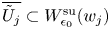 $\overline {\tilde {U}_j} \subset W_{\epsilon _0}^{\mathrm {su}}(w_j)$ with
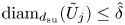 $\operatorname {diam}_{d_{\mathrm {su}}}(\tilde {U}_j) \leq \hat {\delta }$ for all
 $j \in \mathcal {A}$ such that for all admissible pairs
 $(j, k)$, we can naturally extend the inverse
 $(\sigma |_{\mathtt {C}[j, k]})^{-1}: \operatorname {int}(U_k) \to \mathtt {C}[j, k]$ to a smooth injective map
 $\sigma ^{-(j, k)}: \tilde {U}_k \to \tilde {U}_j$. More specifically, assuming that
 $\epsilon _0$ and
 $\delta$ are sufficiently small without loss of generality, taking any
 $u_0 \in U_j$ such that
 $\sigma (u_0) \in U_k$, we can define
 $\sigma ^{-(j, k)}(u)$ to be the unique intersection
 \[ \sigma^{-(j, k)}(u) = \biggl(\bigcup_{t \in (-\tau(u_0) - \inf(\tau), -\tau(u_0) + \inf(\tau))} W_{\epsilon_0}^{\mathrm{ss}}(u)a_t\biggr) \cap W_{\epsilon_0}^{\mathrm{su}}(w_j) \]
for all  $u \in \tilde {U}_k$. We define
 $\tilde {U} = \bigsqcup _{j = 1}^{N} \tilde {U}_j$. Also define the measure
 $\nu _{\tilde {U}}$ on
 $\tilde {U}$ simply by
 $\nu _{\tilde {U}}(B) = \nu _U(B \cap U)$ for all Borel subsets
 $B \subset \tilde {U}$. Let
 $j \in \mathbb {Z}_{\geq 0}$ and
 $\alpha = (\alpha _0, \alpha _1, \dotsc , \alpha _j)$ be an admissible sequence. Define
 $\sigma ^{-\alpha } = \sigma ^{-(\alpha _0, \alpha _1)} \circ \sigma ^{-(\alpha _1, \alpha _2)} \circ \cdots \circ \sigma ^{-(\alpha _{j - 1}, \alpha _j)}: \tilde {U}_{\alpha _j} \to \tilde {U}_{\alpha _0}$ if
 $j > 0$ and
 $\sigma ^{-\alpha } = \operatorname {Id}_{\tilde {U}_{\alpha _0}}$ if
 $j = 0$. Define the cylinder
 $\tilde {\mathtt {C}}[\alpha ] = \sigma ^{-\alpha }(\tilde {U}_{\alpha _j}) \supset \mathtt {C}[\alpha ]$. Define the smooth maps
 $\sigma ^{\alpha } = (\sigma ^{-\alpha })^{-1}: \tilde {\mathtt {C}}[\alpha ] \to \tilde {U}_{\alpha _j}$. These maps are sufficient for our purposes in defining transfer operators. For convenience we define
 $\tilde {R}_j = [\tilde {U}_j, S_j]$ for all
 $j \in \mathcal {A}$.
We define more extended maps. Let  $(j, k)$ be an admissible pair. The maps
 $\tau |_{\mathtt {C}[j, k]}$ and
 $\vartheta |_{\mathtt {C}[j, k]}$ naturally extend to smooth maps
 $\tau _{(j, k)}: \tilde {\mathtt {C}}[j, k] \to \mathbb {R}$ and
 $\vartheta ^{(j, k)}: \tilde {\mathtt {C}}[j, k] \to M$ as follows. In light of the above definition of
 $\sigma ^{-(j, k)}$, using the same notation and writing
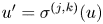 $u' = \sigma ^{(j, k)}(u)$, we define
 $\tau _{(j, k)}(u) \in (\tau (u_0) - \inf (\tau ), \tau (u_0) + \inf (\tau ))$ uniquely such that
 $W_{\epsilon _0}^{\mathrm {ss}}(u')a_{-\tau _{(j, k)}(u)} \cap W_{\epsilon _0}^{\mathrm {su}}(w_k) \neq \varnothing$ for all
 $u \in \tilde {\mathtt {C}}[j, k]$. Similar to before,
 $\vartheta ^{(j, k)}(u)$ is such that
 $F(u)a_{\tau _{(j, k)}(u)} = F\bigl (ua_{\tau _{(j, k)}(u)}\bigr )\vartheta ^{(j, k)}(u)^{-1}$ for all
 $u \in \tilde {\mathtt {C}}[j, k]$. Now for all
 $k \in \mathbb {N}$ and admissible sequences
 $\alpha = (\alpha _0, \alpha _1, \dotsc , \alpha _k)$, we define the smooth maps
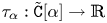 $\tau _\alpha : \tilde {\mathtt {C}}[\alpha ] \to \mathbb {R}$,
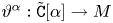 $\vartheta ^{\alpha }: \tilde {\mathtt {C}}[\alpha ] \to M$, and
 $\Phi ^{\alpha }: \tilde {\mathtt {C}}[\alpha ] \to AM$ by
 \begin{align*} \tau_\alpha(u) &= \sum_{j = 0}^{k - 1} \tau_{(\alpha_j, \alpha_{j + 1})}(\sigma^{(\alpha_0, \alpha_1, \dotsc, \alpha_j)}(u)),\\ \vartheta^{\alpha}(u) &= \prod_{j = 0}^{k - 1} \vartheta^{(\alpha_j, \alpha_{j + 1})}(\sigma^{(\alpha_0, \alpha_1, \dotsc, \alpha_j)}(u)),\\ \Phi^{\alpha}(u) &= a_{\tau_\alpha(u)}\vartheta^{\alpha}(u) = \prod_{j = 0}^{k - 1} \Phi^{(\alpha_j, \alpha_{j + 1})}(\sigma^{(\alpha_0, \alpha_1, \dotsc, \alpha_j)}(u)) \end{align*}
for all  $u \in \tilde {\mathtt {C}}[\alpha ]$, where the terms of the products are to be in ascending order from left to right. For all admissible sequences
 $\alpha$ with
 $\operatorname {len}(\alpha ) = 0$, we define
 $\tau _\alpha (u) = 0$ and
 $\vartheta ^{\alpha }(u) = \Phi ^{\alpha }(u) = e \in AM$ for all
 $u \in \tilde {\mathtt {C}}[\alpha ]$. For all
 $u \in U$, there is a corresponding unique admissible sequence in
 $\Sigma ^{+}$ and hence we can instead use the notation
 $\tau _k(u)$,
 $\vartheta ^{k}(u)$, and
 $\Phi ^{k}(u)$ for all
 $k \in \mathbb {Z}_{\geq 0}$.
5.2 Transfer operators
We will use the notation  $\xi = a + ib \in \mathbb {C}$ for the complex parameter for the transfer operators and use the convention that sums over sequences are actually sums over admissible sequences, throughout the paper.
Definition 5.1 (Transfer operator with holonomy)
For all  $\xi \in \mathbb {C}$ and
 $\rho \in \hat {M}$, the transfer operator with holonomy
 $\tilde {\mathcal {M}}_{\xi \tau , \rho }: C(\tilde {U}, V_\rho ^{\oplus \dim (\rho )}) \to C(\tilde {U}, V_\rho ^{\oplus \dim (\rho )})$ is defined by
 \[ \tilde{\mathcal{M}}_{\xi\tau, \rho}(H)(u) = \sum_{\substack{(j, k)\\ u' = \sigma^{-(j, k)}(u)}} e^{\xi\tau_{(j, k)}(u')} \rho(\vartheta^{(j, k)}(u')^{{-}1}) H(u') \]
for all  $u \in \tilde {U}$ and
 $H \in C(\tilde {U}, V_\rho ^{\oplus \dim (\rho )})$.
Let  $\xi \in \mathbb {C}$. We define
 $\tilde {\mathcal {L}}_{\xi \tau } = \tilde {\mathcal {M}}_{\xi \tau , 1}$ and simply call it the transfer operator. For any
 $\rho \in \hat {M}$, denote by
 $|_U: C(\tilde {U}, V_\rho ^{\oplus \dim (\rho )}) \to C(U, V_\rho ^{\oplus \dim (\rho )})$ the restriction map. Then for all
 $\rho \in \hat {M}$, we also define the transfer operator with holonomy
 $\mathcal {M}_{\xi \tau , \rho } = |_U \circ \tilde {\mathcal {M}}_{\xi \tau , \rho } \circ (|_U)^{-1}$, where
 $(|_U)^{-1}$ denotes taking any preimage using the Tietze extension theorem, and the transfer operator
 $\mathcal {L}_{\xi \tau } = \mathcal {M}_{\xi \tau , 1}$.
Remark Let  $\xi \in \mathbb {C}$ and
 $\rho \in \hat {M}$. Then
 $\tilde {\mathcal {M}}_{\xi \tau , \rho }$ preserves
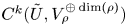 $C^{k}(\tilde {U}, V_\rho ^{\oplus \dim (\rho )})$ for all
 $k \in \mathbb {Z}_{\geq 0}$ and
 $\mathcal {M}_{\xi \tau , \rho }$ preserves
 $C^{\operatorname {Lip}(d)}(U, V_\rho ^{\oplus \dim (\rho )})$. Here we regard the target space as a real vector space.
We recall the Ruelle–Perron–Frobenius theorem along with the theory of Gibbs measures in this setting [Reference BowenBow08, Reference Parry and PollicottPP90].
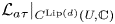
Theorem 5.2 For all  $a \in \mathbb {R}$, the operator
 $\mathcal {L}_{a\tau }: C(U, \mathbb {C}) \to C(U, \mathbb {C})$ and its dual
 $\mathcal {L}_{a\tau }^{*}: C(U, \mathbb {C})^{*} \to C(U, \mathbb {C})^{*}$ have eigenvectors with the following properties. There exist a unique positive function
 $h \in C^{\operatorname {Lip}(d)}(U, \mathbb {R})$ and a unique Borel probability measure
 $\nu$ on
 $U$ such that:
(1)
$\mathcal {L}_{a\tau }(h) = e^{\operatorname {Pr}_\sigma (a\tau _{\Sigma })}h$;(2)
$\mathcal {L}_{a\tau }^{*}(\nu ) = e^{\operatorname {Pr}_\sigma (a\tau _{\Sigma })}\nu$;(3) the eigenvalue
$e^{\operatorname {Pr}_\sigma (a\tau _{\Sigma })}$ is maximal simple and the rest of the spectrum of $\mathcal {L}_{a\tau }|_{C^{\operatorname {Lip}(d)}(U, \mathbb {C})}$ is contained in a disk of radius strictly less than $e^{\operatorname {Pr}_\sigma (a\tau _{\Sigma })}$;(4)
$\nu (h) = 1$ and the Borel probability measure $\mu$ defined by $d\mu = h \, d\nu$ is $\sigma$-invariant and is the projection of the $a\tau _{\Sigma }$-equilibrium state to $U$, that is, $\mu = (\operatorname {proj}_U \circ \zeta )_*(\nu _{a\tau _{\Sigma }})$.






In light of Theorem 5.2, it is convenient to normalize the transfer operators defined above. Let  $a \in \mathbb {R}$. Define
 $\lambda _a = e^{\operatorname {Pr}_\sigma (-(\delta _\Gamma + a)\tau _{\Sigma })}$ which is the maximal simple eigenvalue of
 $\mathcal {L}_{-(\delta _\Gamma + a)\tau }$ by Theorem 5.2 and recall that
 $\lambda _0 = 1$. Define the eigenvectors, the unique positive function
 $h_a \in C^{\operatorname {Lip}(d)}(U, \mathbb {R})$ and the unique probability measure
 $\nu _a$ on
 $U$ with
 $\nu _a(h_a) = 1$ such that
 \[ \mathcal{L}_{-(\delta_\Gamma + a)\tau}(h_a) = \lambda_a h_a,\quad \mathcal{L}_{-(\delta_\Gamma + a)\tau}^{*}(\nu_a) = \lambda_a \nu_a \]
provided by Theorem 5.2. Note that  $d\nu _U = h_0 \, d\nu _0$. Now by Theorem A.2 in the Appendix, the eigenvector
 $h_a \in C^{\operatorname {Lip}(d)}(U, \mathbb {R})$ extends to an eigenvector
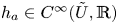 $h_a \in C^{\infty }(\tilde {U}, \mathbb {R})$ with bounded derivatives for
 $\tilde {\mathcal {L}}_{-(\delta _\Gamma + a)\tau }$. For all admissible pairs
 $(j, k)$, we define the smooth map
 \[ f_{(j, k)}^{(a)} ={-}(\delta_\Gamma + a)\tau_{(j, k)} + \log(h_0) - \log(h_0 \circ \sigma^{(j, k)}) - \log(\lambda_a). \]
For all  $k \in \mathbb {N}$ and admissible sequences
 $\alpha = (\alpha _0, \alpha _1, \dotsc , \alpha _k)$, we define the smooth map
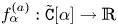 $f_\alpha ^{(a)}: \tilde {\mathtt {C}}[\alpha ] \to \mathbb {R}$ by
 \[ f_\alpha^{(a)}(u) = \sum_{j = 0}^{k - 1} f_{(\alpha_j, \alpha_{j + 1})}^{(a)}(\sigma^{(\alpha_0, \alpha_1, \dotsc, \alpha_j)}(u)) \quad \text{for all }u \in \tilde{\mathtt{C}}[\alpha]. \]
For all admissible sequences  $\alpha$ with
 $\operatorname {len}(\alpha ) = 0$, we define
 $f_\alpha ^{(a)}(u) = 0$. As before, for all
 $u \in U$, we can also use the notation
 $f_k^{(a)}(u)$ for any
 $k \in \mathbb {Z}_{\geq 0}$.
We now normalize the transfer operators for convenience. Let  $\xi \in \mathbb {C}$ and
 $\rho \in \hat {M}$. We define
 $\tilde {\mathcal {M}}_{\xi , \rho }: C(\tilde {U}, V_\rho ^{\oplus \dim (\rho )}) \to C(\tilde {U}, V_\rho ^{\oplus \dim (\rho )})$ by
 \[ \tilde{\mathcal{M}}_{\xi, \rho}(H)(u) = \sum_{\substack{(j, k)\\ u' = \sigma^{-(j, k)}(u)}} e^{(f_{(j, k)}^{(a)} + ib\tau_{(j, k)})(u')} \rho(\vartheta^{(j, k)}(u')^{{-}1}) H(u') \]
for all  $u \in \tilde {U}$ and
 $H \in C(\tilde {U}, V_\rho ^{\oplus \dim (\rho )})$. For all
 $k \in \mathbb {N}$, its
 $k$th iteration is
 \begin{equation} \tilde{\mathcal{M}}_{\xi, \rho}^{k}(H)(u) = \sum_{\substack{\alpha: \operatorname{len}(\alpha) = k\\ u' = \sigma^{-\alpha}(u)}} e^{f_\alpha^{(a)}(u')} \rho_b(\Phi^{\alpha}(u')^{{-}1}) H(u') \end{equation}
for all  $u \in \tilde {U}$ and
 $H \in C(\tilde {U}, V_\rho ^{\oplus \dim (\rho )})$. Again, we denote
 $\tilde {\mathcal {L}}_\xi = \tilde {\mathcal {M}}_{\xi , 1}$ and, using the restriction map
 $|_U$, we get the corresponding normalized operators
 $\mathcal {M}_{\xi , \rho }: C(U, V_\rho ^{\oplus \dim (\rho )}) \to C(U, V_\rho ^{\oplus \dim (\rho )})$ and
 $\mathcal {L}_\xi : C(U, \mathbb {C}) \to C(U, \mathbb {C})$. With this normalization, for all
 $a \in \mathbb {R}$, the maximal simple eigenvalue of
 $\mathcal {L}_a$ is
 $1$ with eigenvector
 ${h_a}/{h_0}$. Moreover, we have
 $\mathcal {L}_0^{*}(\nu _U) = \nu _U$.
We fix some related constants. By perturbation theory of operators (see [Reference KatoKat95, Chapter 7] and [Reference Parry and PollicottPP90, Proposition 4.6]), we can fix  $a_0' > 0$ such that the map
 $[-a_0', a_0'] \to \mathbb {R}$ defined by
 $a \mapsto \lambda _a$ and the map
 $[-a_0', a_0'] \to C(\tilde {U}, \mathbb {R})$ defined by
 $a \mapsto h_a$ are Lipschitz. We then fix
 $A_f > 0$ such that
 $|f_{(j, k)}^{(a)}(u) - f_{(j, k)}^{(0)}(u)| \leq A_f|a|$ for all admissible pairs
 $(j, k)$,
 $u \in \tilde {\mathtt {C}}[j, k]$, and
 $|a| \leq a_0'$. Fix
 $\bar {\tau } = \max _{(j, k)} \sup _{u \in \tilde {\mathtt {C}}[j, k]} \tau _{(j, k)}(u)$ and
 $\underline {\tau } = \min _{(j, k)} \inf _{u \in \tilde {\mathtt {C}}[j, k]} \tau _{(j, k)}(u)$. Fix
 \[ T_0 >{}\max\biggl(\max_{(j, k)} \|\tau_{(j, k)}\|_{C^{1}}, \max_{(j, k)} \sup_{|a| \leq a_0'} \big\|f_{(j, k)}^{(a)}\big\|_{C^{1}}, \max_{(j, k)} \big\|\vartheta^{(j, k)}\big\|_{C^{1}}\biggr) \]
which is possible by [Reference Petkov and StoyanovPS16, Lemma 4.1].
5.3 Spectral bounds with holonomy
We first introduce some norms and seminorms. Let  $\rho \in \hat {M}$ and
 $H \in C(U, V_\rho ^{\oplus \dim (\rho )})$. We will write
 $\|H\| \in C(U, \mathbb {R})$ for the function defined by
 $\|H\|(u) = \|H(u)\|_2$ for all
 $u \in U$, and if
 $\rho = 1$, we will write
 $|H| \in C(U, \mathbb {R})$ for the function defined by
 $|H|(u) = |H(u)| \in \mathbb {R}$ for all
 $u \in U$. We define
 $\|H\|_\infty = \sup \|H\|$. We use similar notation if the domain is
 $\tilde {U}$. We define the Lipschitz seminorm and the Lipschitz norm by
 \[ \operatorname{Lip}_d(H) = \sup_{\substack{u, u' \in U\\ \text{such that } u \neq u'}} \frac{\|H(u) - H(u')\|_2}{d(u, u')}, \quad \|H\|_{\operatorname{Lip}(d)} = \|H\|_\infty + \operatorname{Lip}_d(H), \]
respectively.
As we will mostly use the  $C^{1}$ norm, we avoid defining the
 $C^{k}$ norm for integers
 $k > 1$. Let
 $Y$ be a Riemannian manifold and
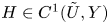 $H \in C^{1}(\tilde {U}, Y)$. We define the
 $C^{1}$ seminorm and the
 $C^{1}$ norm by
 \[ |H|_{C^{1}} = \sup_{u \in \tilde{U}}\|(dH)_u\|_{\mathrm{op}}, \quad \|H\|_{C^{1}} = \|H\|_\infty + |H|_{C^{1}}, \]
respectively. We can define another useful norm by
 \[ \|H\|_{1, b} = \|H\|_\infty + \frac{1}{\max(1, |b|)} |H|_{C^{1}}. \]
Henceforth, by differentiable function spaces on  $\tilde {U}$ or its derived suspension spaces, such as
 $C^{1}(\tilde {U}, Y)$, we will always mean the space of
 $C^{1}$ functions whose
 $C^{1}$ norm is bounded.
For all  $\rho \in \hat {M}$, we define the Banach spaces
 \[ \mathcal{V}_\rho(U) = C^{\operatorname{Lip}(d)}\bigl(U, V_\rho^{{\oplus} \dim(\rho)}\bigr),\quad \mathcal{V}_\rho(\tilde{U}) = C^{1}\bigl(\tilde{U}, V_\rho^{{\oplus} \dim(\rho)}\bigr). \]
Now we can state the following theorem regarding spectral bounds of transfer operators with holonomy.
Theorem 5.3 There exist  $\eta > 0$,
 $C > 0$,
 $a_0 > 0$, and
 $b_0 > 0$ such that for all
 $\xi \in \mathbb {C}$ with
 $|a| < a_0$, if
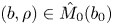 $(b, \rho ) \in \hat {M}_0(b_0)$, then for all
 $k \in \mathbb {N}$ and
 $H \in \mathcal {V}_\rho (\tilde {U})$, we have
 \[ \big\|\tilde{\mathcal{M}}_{\xi, \rho}^{k}(H)\big\|_2 \leq Ce^{-\eta k} \|H\|_{1, \|\rho_b\|}. \]
We reduce Theorem 5.3 to Theorem 5.4 which captures the mechanism of Dolgopyat's method in our setting. Similar theorems have appeared in [Reference DolgopyatDol98, Reference NaudNau05, Reference StoyanovSto11, Reference Oh and WinterOW16]. The main difference from previous works is that we deal with holonomy.
We define the cone
 \[ K_B(\tilde{U}) = \{h \in C^{1}(\tilde{U}, \mathbb{R}): h > 0, \|(dh)_u\|_{\mathrm{op}} \leq Bh(u) \text{ for all } u \in \tilde{U}\}. \]
Remark It is useful to note that we can easily derive the equivalent  $\log$-Lipschitz characterization given by
 $K_B(\tilde {U}) = \{h \in C^{1}(\tilde {U}, \mathbb {R}): h > 0, |\log \circ h|_{C^{1}} \leq B\}$.
Theorem 5.4 There exist  $m \in \mathbb {N}$,
 $\eta \in (0, 1)$,
 $E > \max (1, {1}/{b_0}, {1}/{\delta _\varrho })$,
 $a_0 > 0$,
 $b_0 > 0$, and a set of operators
 $\bigl\{\mathcal {N}_{a, J}^{H}: C^{1}(\tilde {U}, \mathbb {R}) \to C^{1}(\tilde {U}, \mathbb {R}):$
 $H \in \mathcal {V}_\rho (\tilde {U}), |a| < a_0, J \in \mathcal {J}(b, \rho ), (b, \rho ) \in \hat {M}_0(b_0)\bigr\}$, where
 $\mathcal {J}(b, \rho )$ is some finite set for all
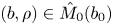 $(b, \rho ) \in \hat {M}_0(b_0)$, such that:
(1)
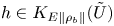
$\mathcal {N}_{a, J}^{H}(K_{E\|\rho _b\|}(\tilde {U})) \subset K_{E\|\rho _b\|}(\tilde {U})$ for all $H \in \mathcal {V}_\rho (\tilde {U})$, $|a| < a_0$, $J \in \mathcal {J}(b, \rho )$, and $(b, \rho ) \in \hat {M}_0(b_0)$;(2)
$\bigl\|\mathcal {N}_{a, J}^{H}(h)\bigr\|_2 \leq \eta \|h\|_2$ for all $h \in K_{E\|\rho _b\|}(\tilde {U})$, $H \in \mathcal {V}_\rho (\tilde {U})$, $|a| < a_0$, $J \in \mathcal {J}(b, \rho )$, and $(b, \rho ) \in \hat {M}_0(b_0)$;(3) for all
$\xi \in \mathbb {C}$ with $|a| < a_0$, if $(b, \rho ) \in \hat {M}_0(b_0)$, and if $H \in \mathcal {V}_\rho (\tilde {U})$ and $h \in K_{E\|\rho _b\|}(\tilde {U})$ satisfy
(1a)
$\|H(u)\|_2 \leq h(u)$ for all $u \in \tilde {U}$,(1b)
$\|(dH)_u\|_{\mathrm {op}} \leq E\|\rho _b\|h(u)$ for all $u \in \tilde {U}$,
$J \in \mathcal {J}(b, \rho )$ such that
(2a)
$\bigl\|\tilde {\mathcal {M}}_{\xi , \rho }^{m}(H)(u)\bigr\|_2 \leq \mathcal {N}_{a, J}^{H}(h)(u)$ for all $u \in \tilde {U}$,(2b)
$\bigl\|(d\tilde {\mathcal {M}}_{\xi , \rho }^{m}(H))_u\bigr\|_{\mathrm {op}} \leq E\|\rho _b\|\mathcal {N}_{a, J}^{H}(h)(u)$ for all $u \in \tilde {U}$.


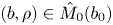



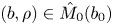


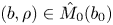










Proof Proof that Theorem 5.4 implies Theorem 5.3
Fix  $m \in \mathbb {N}, a_0 > 0, b_0 > 0, E > 0$ to be the ones from Theorem 5.4 and
 $\tilde {\eta } \in (0, 1)$ to be the
 $\eta$ from Theorem 5.4. Fix
 \[ B = \sup_{|a| \leq a_0, \rho \in \hat{M}} \big\|\tilde{\mathcal{M}}_{\xi, \rho}\big\|_{\mathrm{op}} \leq \sup_{|a| \leq a_0} \big\|\tilde{\mathcal{L}}_\xi\big\|_{\mathrm{op}} \leq Ne^{T_0}, \]
viewing the transfer operators as operators on 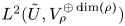 $L^{2}(\tilde {U}, V_\rho ^{\oplus \dim (\rho )})$ and
 $L^{2}(\tilde {U}, \mathbb {R})$, respectively. Fix
 $\eta = ({-\log (\tilde {\eta })})/{m}$ and
 $C = B^{m} \tilde {\eta }^{-1}$. Let
 $\xi \in \mathbb {C}$ with
 $|a| < a_0$. Suppose
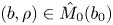 $(b, \rho ) \in \hat {M}_0(b_0)$. Let
 $k \in \mathbb {N}$ and
 $H \in \mathcal {V}_\rho (\tilde {U})$. The theorem is trivial if
 $H = 0$, so suppose that
 $H \neq 0$. First set
 $h_0 \in K_{E\|\rho _b\|}(\tilde {U})$ to be the positive constant function defined by
 $h_0(u) = \|H\|_{1, \|\rho _b\|}$ for all
 $u \in \tilde {U}$. Denote
 $H_0 = H$. Then
 $H_0$ and
 $h_0$ satisfy properties (3)(1a) and (3)(1b) in Theorem 5.4. Thus, Theorem 5.4 allows us to inductively obtain
 $h_j = \mathcal {N}_{a, J_{j - 1}}^{H_{j - 1}}(h_{j - 1}) \in K_{E\|\rho _b\|}(\tilde {U})$ for some
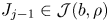 $J_{j - 1} \in \mathcal {J}(b, \rho )$ and
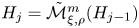 $H_j = \tilde {\mathcal {M}}_{\xi , \rho }^{m}(H_{j - 1})$ which satisfy properties (3)(2a) and (3)(2b) in Theorem 5.4, for all
 $j \in \mathbb {N}$. Now using property (2) in Theorem 5.4, we have
 $\bigl\|\tilde {\mathcal {M}}_{\xi , \rho }^{jm}(H)\bigr\|_2 \leq \|h_j\|_2 \leq \tilde {\eta }^{j}\|h_0\|_2 = \tilde {\eta }^{j}\|H\|_{1, \|\rho _b\|}$ for all
 $j \in \mathbb {Z}_{\geq 0}$. Writing
 $k = jm + l$ for some
 $j \in \mathbb {Z}_{\geq 0}$ and
 $0 \leq l < m$, we have
 \[ \big\|\tilde{\mathcal{M}}_{\xi, \rho}^{k}(H)\big\|_2 \leq B^{l}\big\|\tilde{\mathcal{M}}_{\xi, \rho}^{jm}(H)\big\|_2 \leq B^{l}\tilde{\eta}^{j}\|H\|_{1, \|\rho_b\|} \leq Ce^{-\eta k} \|H\|_{1, \|\rho_b\|}. \]
6. Local non-integrability condition and non-concentration property
This section is devoted to the main tools needed for the proof of Theorem 5.4 in § 9. Non-integrability type conditions have appeared in all previous works employing Dolgopyat's method. We will prove Proposition 6.5 which is the appropriate formulation in our setting and call it the local non-integrability condition as in [Reference StoyanovSto11]. Running Dolgopyat's method with holonomy also requires Proposition 6.6 which we call the non-concentration property.
6.1 Local non-integrability condition
First, we will define a map related to Brin–Pesin moves [Reference Brin and PesinBP74, Reference BrinBri82] which will be needed for the LNIC in our setting. We choose unique isometric lifts  $\tilde {\mathsf {R}}_j = [\tilde {\mathsf {U}}_j, \mathsf {S}_j] \subset \operatorname {T}^{1}(\mathbb {H}^{n})$ of
 $\tilde {R}_j$ for all
 $j \in \mathcal {A}$. Define
 $\tilde {\mathsf {R}} = \bigsqcup _{j \in \mathcal {A}} \tilde {\mathsf {R}}_j$ and
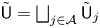 $\tilde {\mathsf {U}} = \bigsqcup _{j \in \mathcal {A}} \tilde {\mathsf {U}}_j$. For all
 $u \in \tilde {R}$, let
 $\tilde {u} \in \tilde {\mathsf {R}}$ denote the unique lift in
 $\tilde {\mathsf {R}}$. We then lift the section
 $F$ to
 $\mathsf {F}: \bigsqcup _{\gamma \in \Gamma } \gamma \tilde {\mathsf {R}} \to \operatorname {F}(\mathbb {H}^{n})$ in the natural way.
Definition 6.1 (Associated sequence of frames)
Let  $z_1 \in \tilde {R}_1$ be the center. Consider some sequence of tangent vectors
 $(z_1, z_2, z_3, z_4, z_1) \in (\tilde {R}_1)^{5}$ such that
 $z_2 \in S_1$,
 $z_4 \in \tilde {U}_1$ and
 $z_3 = [z_4, z_2]$. Its lift to the universal cover is
 $(\tilde {z}_1, \tilde {z}_2, \tilde {z}_3, \tilde {z}_4, \tilde {z}_1) \in (\tilde {\mathsf {R}}_1)^{5} \subset \operatorname {T}^{1}(\mathbb {H}^{n})^{5} \cong (G/M)^{5}$. We define an associated sequence of frames to be the unique sequence
 $(g_1, g_2, \dotsc , g_5) \in \operatorname {F}(\mathbb {H}^{n})^{5} \cong G^{5}$ where
 \begin{align*} g_1 &= \mathsf{F}(\tilde{z}_1), \\ g_2 &= \mathsf{F}(\tilde{z}_2) \in g_1N^{-} \text{ such that } g_2M = \tilde{z}_2 \in \operatorname{T}^{1}(\mathbb{H}^{n}) \cong G/M, \\ g_3 &\in g_2N^{+} \text{ such that } g_3a_tM = \tilde{z}_3 \in \operatorname{T}^{1}(\mathbb{H}^{n}) \cong G/M \text{ for some } t \in (-\underline{\tau}, \underline{\tau}), \\ g_4 &\in g_3N^{-} \text{ such that } g_4a_tM = \tilde{z}_4 \in \operatorname{T}^{1}(\mathbb{H}^{n}) \cong G/M \text{ for some } t \in (-\underline{\tau}, \underline{\tau}), \\ g_5 &\in g_4N^{+} \text{ such that } g_5a_tM = \tilde{z}_1 \in \operatorname{T}^{1}(\mathbb{H}^{n}) \cong G/M \text{ for some } t \in (-\underline{\tau}, \underline{\tau}).\end{align*}
Remark The sequence of frames is obtained by ‘moving the frame  $\mathsf {F}(\tilde {z}_1)$ only along the strong unstable and strong stable directions’ associated to the path represented by
 $(\tilde {z}_1, \tilde {z}_2, \tilde {z}_3, \tilde {z}_4, \tilde {z}_1)$. Using properties of the strong unstable and strong stable leaves, we see that
 $t \in (-\underline {\tau }, \underline {\tau })$ must be the same throughout the sequence in the definition above.
We continue using the notation in the above definition. Define the subsets
 \begin{align*} N_1^{+} &= \{n^{+} \in N^{+}: F(z_1)n^{+} \in F(\tilde{U}_1)\} \subset N^{+}, \\ N_1^{-} &= \{n^{-} \in N^{-}: F(z_1)n^{-} \in F(S_1)\} \subset N^{-}, \end{align*}
where the first is open and the second is compact. Now, if the above sequence  $(z_1, z_2, z_3, z_4, z_1)$ corresponds to some
 $n^{+} \in N_1^{+}$ and some
 $n^{-} \in N_1^{-}$ such that
 $F(z_4) = F(z_1)n^{+}$ and
 $F(z_2) = F(z_1)n^{-}$ respectively, then we can define the map
 $\Xi : N_1^{+} \times N_1^{-} \to AM$ by
 \[ \Xi(n^{+}, n^{-}) = g_5^{{-}1}g_1 \in AM. \]
To view it as a function of the first coordinate for a fixed  $n^{-} \in N_1^{-}$, we write
 $\Xi _{n^{-}}: N_1^{+} \to AM$.
Let  $z_1 \in \tilde {R}_1$ be the center. Let
 $j \in \mathbb {N}$ and
 $\alpha = (\alpha _0, \alpha _2, \dotsc , \alpha _{j - 1}, 1)$ be an admissible sequence. By following definitions, there exists an element which we denote by
 $n_\alpha \in N_1^{-}$ such that
 \[ F(\mathcal{P}^{j}(\sigma^{-\alpha}(z_1))) = F(z_1)n_\alpha. \]
This is well defined since  $\sigma ^{-\alpha }(z_1) \in \mathtt {C}[\alpha ] \subset U$.
In order to derive the LNIC in Proposition 6.5, we first provide a few useful lemmas regarding  $\Xi$.
Lemma 6.2 Let  $j \in \mathbb {N}$,
 $\alpha = (\alpha _0, \alpha _1, \dotsc , \alpha _{j - 1}, 1)$ be an admissible sequence, and
 $n^{-} = n_\alpha \in N_1^{-}$. Let
 $u \in \tilde {U}_1$ and
 $n^{+} \in N_1^{+}$ such that
 $F(u) = F(z_1)n^{+}$ where
 $z_1 \in \tilde {R}_1$ is the center. Then we have
 \[ \Xi(n^{+}, n^{-}) = \Phi^{\alpha}(\sigma^{-\alpha}(z_1))^{{-}1}\Phi^{\alpha}(\sigma^{-\alpha}(u)). \]
Proof. Let  $z_1 \in \tilde {R}_1$ be the center. Let
 $j \in \mathbb {N}$,
 $\alpha = (\alpha _0, \alpha _1, \dotsc , \alpha _{j - 1}, 1)$ be an admissible sequence and
 $n^{-} = n_\alpha \in N_1^{-}$. Let
 $u \in \tilde {U}_1$ and
 $n^{+} \in N_1^{+}$ such that
 $F(u) = F(z_1)n^{+}$. Let
 $s \in S_1$ such that
 $F(s) = F(z_1)n^{-}$. To calculate
 $\Xi (n^{+}, n^{-})$, we first consider
 $(z_1, z_2, z_3, z_4, z_1) = (z_1, s, [u, s], u, z_1) \in (\tilde {R}_1)^{5}$ and then compute the associated sequence of frames
 $(g_1, g_2, g_3, g_4, g_5) \in G^{5}$. Firstly,
 $g_1 = \mathsf {F}(\tilde {z}_1)$. Then using definitions, we have
 \[ g_2 = g_1n^{-} = \mathsf{F}(\tilde{z}_1)n^{-} = \mathsf{F}(\mathcal{P}^{j}(\sigma^{-\alpha}(\tilde{z}_1))) = \mathsf{F}(\sigma^{-\alpha}(\tilde{z}_1))\Phi^{\alpha}(\sigma^{-\alpha}(z_1)). \]
Now  $g_3 = g_2n_2$ for some
 $n_2 \in N^{+}$. So
 \[ g_3 = \mathsf{F}(\sigma^{-\alpha}(\tilde{z}_1))\Phi^{\alpha}(\sigma^{-\alpha}(z_1))n_2 = \mathsf{F}(\sigma^{-\alpha}(\tilde{z}_1)) n_2' \Phi^{\alpha}(\sigma^{-\alpha}(z_1)), \]
where  $n_2' = \Phi ^{\alpha }(\sigma ^{-\alpha }(z_1)) n_2 \Phi ^{\alpha }(\sigma ^{-\alpha }(z_1))^{-1} \in N^{+}$. But the frame
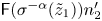 $\mathsf {F}(\sigma ^{-\alpha }(\tilde {z}_1)) n_2'$ must be based at
 $\tilde {v} \in \gamma \tilde {\mathsf {U}}_{\alpha _0}$ for some
 $\gamma \in \Gamma$ such that
 $\tilde {v}a_{\tau _\alpha (\sigma ^{-\alpha }(\tilde {z}_1)) + t} = [\tilde {u}, \tilde {s}]$ for some
 $t \in (-\underline {\tau }, \underline {\tau })$. So
 $\tilde {v} = \sigma ^{-\alpha }(\tilde {u})$ and
 $t = \tau _\alpha (\sigma ^{-\alpha }(\tilde {u})) - \tau _\alpha (\sigma ^{-\alpha }(\tilde {z}_1))$. Moreover,
 $\mathsf {F}(\sigma ^{-\alpha }(\tilde {z}_1)) n_2' = \mathsf {F}(\sigma ^{-\alpha }(\tilde {u}))$ and hence
 $g_3 = \mathsf {F}(\sigma ^{-\alpha }(\tilde {u}))\Phi ^{\alpha }(\sigma ^{-\alpha }(z_1))$. From definitions,
 $\tilde {v}a_{\tau _\alpha (\sigma ^{-\alpha }(\tilde {u}))} = [\tilde {u}, \tilde {s}]$ implies
 $\mathsf {F}(\sigma ^{-\alpha }(\tilde {u})) = \mathsf {F}([\tilde {u}, \tilde {s}])\Phi ^{\alpha }(\sigma ^{-\alpha }(u))^{-1}$. Thus
 \[ g_3 = \mathsf{F}([\tilde{u}, \tilde{s}])\Phi^{\alpha}(\sigma^{-\alpha}(u))^{{-}1}\Phi^{\alpha}(\sigma^{-\alpha}(z_1)). \]
Now  $g_4 = g_3n_3$ for some
 $n_3 \in N^{+}$. So
 \begin{align*} g_4 &= \mathsf{F}([\tilde{u}, \tilde{s}])\Phi^{\alpha}(\sigma^{-\alpha}(u))^{{-}1}\Phi^{\alpha}(\sigma^{-\alpha}(z_1))n_3\\ &= \mathsf{F}([\tilde{u}, \tilde{s}])n_3'\Phi^{\alpha}(\sigma^{-\alpha}(u))^{{-}1}\Phi^{\alpha}(\sigma^{-\alpha}(z_1)), \end{align*}
where  $n_3' = \Phi ^{\alpha }(\sigma ^{-\alpha }(u))^{-1}\Phi ^{\alpha }(\sigma ^{-\alpha }(z_1)) n_3 (\Phi ^{\alpha }(\sigma ^{-\alpha }(u))^{-1}\Phi ^{\alpha }(\sigma ^{-\alpha }(z_1)))^{-1} \in N^{-}$. By similar arguments, the frame
 $\mathsf {F}([\tilde {u}, \tilde {s}])n_3'$ must be based at
 $\tilde {u} \in \tilde {\mathsf {U}}_1$. Thus
 \[ g_4 = \mathsf{F}(\tilde{u})\Phi^{\alpha}(\sigma^{-\alpha}(u))^{{-}1}\Phi^{\alpha}(\sigma^{-\alpha}(z_1)). \]
Finally,  $g_5 = g_4n_4$ for some
 $n_4 \in N^{+}$. So
 \[ g_5 = \mathsf{F}(\tilde{u})\Phi^{\alpha}(\sigma^{-\alpha}(u))^{{-}1}\Phi^{\alpha}(\sigma^{-\alpha}(z_1))n_4 = \mathsf{F}(\tilde{u})n_4'\Phi^{\alpha}(\sigma^{-\alpha}(u))^{{-}1}\Phi^{\alpha}(\sigma^{-\alpha}(z_1)), \]
where  $n_4' = \Phi ^{\alpha }(\sigma ^{-\alpha }(u))^{-1}\Phi ^{\alpha }(\sigma ^{-\alpha }(z_1)) n_4 (\Phi ^{\alpha }(\sigma ^{-\alpha }(u))^{-1}\Phi ^{\alpha }(\sigma ^{-\alpha }(z_1)))^{-1} \in N^{-}$. Again by similar arguments, the frame
 $\mathsf {F}(\tilde {u})n_4'$ must be based at
 $\tilde {z}_1 \in \tilde {\mathsf {U}}_1$. Thus
 \[ g_5 = \mathsf{F}(\tilde{z}_1)\Phi^{\alpha}(\sigma^{-\alpha}(u))^{{-}1}\Phi^{\alpha}(\sigma^{-\alpha}(z_1)). \]
Then by definition, we have the calculation
 \[ \Xi(n^{+}, n^{-}) = g_5^{{-}1}g_1 =\Phi^{\alpha}(\sigma^{-\alpha}(z_1))^{{-}1}\Phi^{\alpha}(\sigma^{-\alpha}(u)). \]
Recall from definitions that  $e \in N_1^{+}$ where
 $N_1^{+} \subset N^{+}$ is an open subset and hence
 $\operatorname {T}_e(N_1^{+}) = \operatorname {T}_e(N^{+}) = \mathfrak {n}^{+}$. Note that
 $AMN^{+}N^{-} \subset G$ is an open dense subset and hence we have the vector space decomposition
 $\mathfrak {g} = \mathfrak {a} \oplus \mathfrak {m} \oplus \mathfrak {n}^{+} \oplus \mathfrak {n}^{-}$. Denote the projection onto
 $\mathfrak {a} \oplus \mathfrak {m}$ with respect to this decomposition by
 $\pi : \mathfrak {g} \to \mathfrak {a} \oplus \mathfrak {m}$. We then have the following lemma where
 $\epsilon _0$ is as in § 3.1 and
 $N_{1, \epsilon _0}^{-} = \{n^{-} \in N^{-}: F(z_1)n^{-} \in F(W_{\epsilon _0}^{\mathrm {ss}}(z_1))\}$ where
 $z_1 \in \tilde {R}_1$ is the center.
Lemma 6.3 For all  $n^{-} \in N_1^{-}$, we have
 \[ (d\Xi_{n^{-}})_e = \pi \circ \operatorname{Ad}_{n^{-}}|_{\mathfrak{n}^{+}} \circ (dh_{n^{-}})_e, \]
where  $h_{n^{-}}: N_1^{+} \to N^{+}$ is a diffeomorphism onto its image which is also smooth in
 $n^{-} \in N_{1, \epsilon _0}^{-}$ and satisfies
 $h_e = \operatorname {Id}_{N_1^{+}}$. Consequently, its image is
 $(d\Xi _{n^{-}})_e(\mathfrak {n}^{+}) = \pi (\operatorname {Ad}_{n^{-}}(\mathfrak {n}^{+})) \subset \mathfrak {a} \oplus \mathfrak {m}$.
Proof. Let  $z_1 \in \tilde {R}_1$ be the center. Let
 $n^{-} \in N_1^{-}$. For all
 $n^{+} \in N_1^{+}$, consider the sequence
 $(z_1, z_2, z_3(n^{+}), z_4(n^{+}), z_1) \in (\tilde {R}_1)^{5}$ such that
 $F(z_2) = F(z_1)n^{-}$ and
 $F(z_4(n^{+})) = F(z_1)n^{+}$ and let
 $(g_1, g_2, g_3(n^{+}), g_4(n^{+}), g_5(n^{+}))$ be the associated sequence of frames. Then for all
 $n^{+} \in N_1^{+}$, the frame
 $g_5(n^{+})a_t$ is based at
 $\tilde {z}_1$ for some
 $t \in (-\underline {\tau }, \underline {\tau })$. By transversality of the smooth foliations, the implicit function theorem on a coordinate chart gives smooth functions
 $f_{n^{-}, 2}: N_1^{+} \to N^{+}, f_{n^{-}, 3}: N_1^{+} \to N^{-}$, and
 $f_{n^{-}, 4}: N_1^{+} \to N^{+}$ which are also smooth in
 $n^{-} \in N_{1, \epsilon _0}^{-}$ such that
 \[ g_5(n^{+}) = g_1n^{-}f_{n^{-}, 2}(n^{+})f_{n^{-}, 3}(n^{+})f_{n^{-}, 4}(n^{+}). \]
Note that  $f_{n^{-}, 2}$ is a diffeomorphism onto its image. Let
 $h_{n^{-}} = h_{n^{-}, 2}: N_1^{+} \to N^{+}, h_{n^{-}, 3}: N_1^{+} \to N^{-}$, and
 $h_{n^{-}, 4}: N_1^{+} \to N^{+}$ be smooth functions which are also smooth in
 $n^{-} \in N_{1, \epsilon _0}^{-}$ defined by the group inverses
 $h_{n^{-}, j}(n^{+}) = f_{n^{-}, j}(n^{+})^{-1}$ for all
 $n^{+} \in N_1^{+}$ and
 $2 \leq j \leq 4$. Then
 $h_{n^{-}, 2}$ is a diffeomorphism onto its image and
 \[ \Xi_{n^{-}}(n^{+}) = g_5(n^{+})^{{-}1}g_1 = h_{n^{-}, 4}(n^{+})h_{n^{-}, 3}(n^{+})h_{n^{-}, 2}(n^{+})(n^{-})^{{-}1}. \]
Note that  $h_{n^{-}, 2}(e) = h_{n^{-}, 4}(e) = e$ and
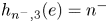 $h_{n^{-}, 3}(e) = n^{-}$. Let
 $m_g^{\mathrm {R}}: G \to G$ be the right multiplication map and
 $C_g: G \to G$ be the conjugation map by
 $g \in G$. Let
 $\omega \in \mathfrak {n}^{+}$. The product rule gives
 \begin{align*} (d\Xi_{n^{-}})_e(\omega) &={} \bigl(\big(dm_{(n^{-})^{{-}1}}^{\mathrm{R}}\big)_{n^{-}} \circ \big(dm_{n^{-}}^{\mathrm{R}}\big)_e\bigr)((dh_{n^{-}, 4})_e(\omega)) + \bigl(dm_{(n^{-})^{{-}1}}^{\mathrm{R}}\bigr)_{n^{-}}((dh_{n^{-}, 3})_e(\omega))\\ &\quad {}+ (dC_{n^{-}})_e((dh_{n^{-}, 2})_e(\omega)) \\ &={} (dh_{n^{-}, 4})_e(\omega) + \bigl(dm_{(n^{-})^{{-}1}}^{\mathrm{R}}\bigr)_{n^{-}}((dh_{n^{-}, 3})_e(\omega)) + \operatorname{Ad}_{n^{-}}((dh_{n^{-}, 2})_e(\omega)). \end{align*}
Since  $(d\Xi _{n^{-}})_e(\omega ) \in \mathfrak {a} \oplus \mathfrak {m}$,
 $(dh_{n^{-}, 4})_e(\omega ) \in \mathfrak {n}^{+}$, and
 $(dm_{(n^{-})^{-1}}^{\mathrm {R}})_{n^{-}}((dh_{n^{-}, 3})_e(\omega )) \in \mathfrak {n}^{-}$, we have
 $(d\Xi _{n^{-}})_e(\omega ) = \pi (\operatorname {Ad}_{n^{-}}((dh_{n^{-}, 2})_e(\omega )))$. Noting that
 $(dh_{n^{-}, 2})_e$ surjects onto
 $\mathfrak {n}^{+}$, we also have
 $(d\Xi _{n^{-}})_e(\mathfrak {n}^{+}) = \pi (\operatorname {Ad}_{n^{-}}(\mathfrak {n}^{+}))$.
Throughout the paper we often use the upper half space model  $\mathbb {H}^{n} \cong \{(x_1, x_2, \dotsc , x_n) \in \mathbb {R}^{n}: x_n > 0\}$ with boundary at infinity
 $\partial _\infty (\mathbb {H}^{n}) \cong \{(x_1, x_2, \dotsc , x_n) \in \mathbb {R}^{n}: x_n = 0\} \cup \{\infty \} \cong \mathbb {R}^{n - 1} \cup \{\infty \}$. We also use the isomorphism
 $\operatorname {T}(\mathbb {H}^{n}) \cong \mathbb {H}^{n} \times \mathbb {R}^{n}$. Let
 $(e_1, e_2, \dotsc , e_n)$ be the standard basis on
 $\mathbb {R}^{n}$. We assume without loss of generality that the identifications are made such that the reference vector is
 $v_o = (e_n, e_n)$ and the reference frame is
 $F_o = ((e_n, e_1), (e_n, e_2), \dotsc , (e_n, e_n))$, where the first entries of the tangent vectors are their basepoints. Let
 $d_{\mathrm {E}}$ denote the Euclidean distance. Let
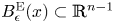 $B^{\mathrm {E}}_\epsilon (x) \subset \mathbb {R}^{n - 1}$ denote the open Euclidean ball of radius
 $\epsilon > 0$ centered at
 $x \in \mathbb {R}^{n - 1}$.
Lemma 6.4 There exist  $n_1^{-}, n_2^{-}, \dotsc , n_{j_{\mathrm {m}}}^{-} \in N_1^{-}$ for some
 $j_{\mathrm {m}} \in \mathbb {N}$ and
 $\delta > 0$ such that if
 $\eta _1^{-}, \eta _2^{-}, \dotsc , \eta _{j_{\mathrm {m}}}^{-} \in N_1^{-}$ with
 $d_{N^{-}}(\eta _j^{-}, n_j^{-}) \leq \delta$ for all
 $1 \leq j \leq j_{\mathrm {m}}$, then
 \[ \sum_{j = 1}^{j_{\mathrm{m}}} \pi\big(\operatorname{Ad}_{\eta_j^{-}}(\mathfrak{n}^{+})\big) = \mathfrak{a} \oplus \mathfrak{m}. \]
Proof. First we show that  $\sum _{n^{-} \in N^{-}} \pi (\operatorname {Ad}_{n^{-}}(\mathfrak {n}^{+})) = \mathfrak {a} \oplus \mathfrak {m}$, that is, there exist
 $n_1^{-}, n_2^{-}, \dotsc , n_{j_{\mathrm {m}}}^{-} \in N^{-}$ for some
 $j_{\mathrm {m}} \in \mathbb {N}$ such that
 $\sum _{j = 1}^{j_{\mathrm {m}}} \pi (\operatorname {Ad}_{n_j^{-}}(\mathfrak {n}^{+})) = \mathfrak {a} \oplus \mathfrak {m}$. We use the formula
 \[ \operatorname{Ad}_{e^{n^{-}}}(n^{+}) = e^{\mathrm{ad}_{n^{-}}}(n^{+}) = \sum_{j = 0}^{\infty} \frac{1}{j!}(\mathrm{ad}_{n^{-}})^{j}(n^{+}) = n^{+} + [n^{-}, n^{+}] + \frac{1}{2!}[n^{-}, [n^{-}, n^{+}]] + \dotsb \]
for all  $n^{+} \in \mathfrak {n}^{+}$ and
 $n^{-} \in \mathfrak {n}^{-}$. Note that
 $\exp : \mathfrak {n}^{-} \to N^{-}$ is surjective since
 $N^{-} \cong \mathbb {R}^{n - 1}$. Examining the formula above term by term, our first objective follows if we show that there exist
 $n_1^{+}, n_2^{+}, \dotsc , n_{j_{\mathrm {m}}}^{+} \in \mathfrak {n}^{+}$ and
 $n_1^{-}, n_2^{-}, \dotsc , n_{j_{\mathrm {m}}}^{-} \in \mathfrak {n}^{-}$ for some
 $j_{\mathrm {m}} \in \mathbb {N}$ such that
 $\operatorname {span}\{[n_j^{-}, n_j^{+}] \in \mathfrak {g}: j \in \{1, 2, \dotsc , j_{\mathrm {m}}\}\} = \mathfrak {a} \oplus \mathfrak {m}$ and
 $[n_j^{-}, [n_j^{-}, n_j^{+}]] \in \mathfrak {n}^{-}$ for all
 $1 \leq j \leq j_{\mathrm {m}}$.
We use the upper half space model. Recall  $M = \operatorname {Stab}_G(v_o) \cong \operatorname {SO}(n - 1)$ whose elements act on
 $\mathbb {H}^{n}$ by rotations in
 $\mathbb {R}^{n}$ which keep the
 $n$th coordinate fixed. It is a fact that for any chosen basis of
 $\mathbb {R}^{n}$, any rotation can be expressed as a composition of planar rotations where the planes are generated by any two distinct basis vectors. Using our standard basis
 $(e_1, e_2, \dotsc , e_n)$, this means that
 $M$ is generated by the subgroups
 $M_{j, k} = \{m \in M: m(e_l) = e_l \text { for all } l \in \{1, 2, \dotsc , n\} \setminus \{j, k\}\} \cong \operatorname {SO}(2)$ for all
 $1 \leq j, k \leq n - 1$ with
 $j \neq k$. Then we have the corresponding sum of vector spaces
 $\mathfrak {m} = \sum _{\substack {1 \leq j, k \leq n - 1,\ j \neq k}} \mathfrak {m}_{j, k}$ where
 $\mathfrak {m}_{j, k} \cong \mathfrak {so}(2) \cong \mathbb {R}$ is the Lie algebra of
 $M_{j, k}$ for all
 $1 \leq j, k \leq n - 1$ with
 $j \neq k$. Let
 $1 \leq j, k \leq n - 1$ with
 $j \neq k$ and consider the totally geodesic submanifold
 $P_{j, k} = \operatorname {span}(e_j, e_k, e_n) \cap \mathbb {H}^{n} \subset \mathbb {H}^{n}$. Let
 $H_{j, k} = \{g \in G: g(P_{j, k}) = P_{j, k}\} < G$ be the subgroup of isometries of
 $P_{j, k}$. Then,
 $P_{j, k} \cong \mathbb {H}^{3}$ is the upper half space of
 $\operatorname {span}(e_j, e_k, e_n) \cong \mathbb {R}^{3}$ which induces the canonical identifications of Lie groups and their Lie algebras,
 $H_{j, k} \cong \operatorname {PSL}_2(\mathbb {C})$ and
 $\mathfrak {h}_{j, k} \cong \mathfrak {sl}_2(\mathbb {C})$. Let
 $N_{j, k}^{+} = \{n^{+} \in N^{+}: n^{+} e_n \in P_{j, k}\} = N^{+} \cap H_{j, k}$ and
 $N_{j, k}^{-} = \{n^{-} \in N^{-}: n^{-} e_n \in P_{j, k}\} = N^{-} \cap H_{j, k}$ be the expanding and contracting horospherical subgroups of
 $H_{j, k}$, with corresponding Lie algebras
 $\mathfrak {n}_{j, k}^{+} \subset \mathfrak {n}^{+}$ and
 $\mathfrak {n}_{j, k}^{-} \subset \mathfrak {n}^{-}$, respectively. Note that
 $M_{j, k}, N_{j, k}^{+}, N_{j, k}^{-} < H_{j, k}$ and hence also
 $\mathfrak {m}_{j, k}, \mathfrak {n}_{j, k}^{+}, \mathfrak {n}_{j, k}^{-} \subset \mathfrak {h}_{j, k}$. Now it suffices to show that
 $[\mathfrak {n}_{j, k}^{-}, \mathfrak {n}_{j, k}^{+}] = \mathfrak {a} \oplus \mathfrak {m}_{j, k}$ and
 $[\mathfrak {n}_{j, k}^{-}, \mathfrak {a} \oplus \mathfrak {m}_{j, k}] = \mathfrak {n}_{j, k}^{-}$. This is simply a matter of calculations. Using the canonical identifications, we can explicitly write the Lie algebras as
 \begin{align*} \mathfrak{a} &\cong \biggl\{ \begin{pmatrix} t & 0 \\ 0 & -t \end{pmatrix} : t \in \mathbb{R}\biggr\}, \quad \mathfrak{m}_{j, k} \cong \biggl\{ \begin{pmatrix} i\theta & 0 \\ 0 & -i\theta \end{pmatrix} : \theta \in \mathbb{R}\biggr\}, \\ \mathfrak{n}_{j, k}^{+} &\cong \biggl\{ \begin{pmatrix} 0 & 0 \\ n^{+} & 0 \end{pmatrix} : n^{+} \in \mathbb{C}\biggr\}, \quad \mathfrak{n}_{j, k}^{-} \cong \biggl\{ \begin{pmatrix} 0 & n^{-} \\ 0 & 0 \end{pmatrix} : n^{-} \in \mathbb{C}\biggr\}. \end{align*}
Now for all  $n^{+} \in \mathfrak {n}_{j, k}^{+}$ and
 $n^{-} \in \mathfrak {n}_{j, k}^{-}$, using the corresponding matrices
 $\big (\begin {smallmatrix}0 & n^{-} \\ 0 & 0 \end {smallmatrix} \big )$ and
 $\big (\begin {smallmatrix} 0 & 0 \\ n^{+} & 0\end {smallmatrix} \big )$, we have the calculation
 \[ \begin{pmatrix} 0 & n^{-} \\ 0 & 0 \end{pmatrix} \begin{pmatrix} 0 & 0 \\ n^{+} & 0 \end{pmatrix} - \begin{pmatrix} 0 & 0 \\ n^{+} & 0 \end{pmatrix} \begin{pmatrix} 0 & n^{-} \\ 0 & 0 \end{pmatrix} = \begin{pmatrix} n^{-} n^{+} & 0 \\ 0 & -n^{-} n^{+} \end{pmatrix} \]
for the matrix corresponding to  $[n^{-}, n^{+}]$. Thus,
 $[\mathfrak {n}_{j, k}^{-}, \mathfrak {n}_{j, k}^{+}] = \mathfrak {a} \oplus \mathfrak {m}_{j, k}$. Similarly, for all
 $n^{-} \in \mathfrak {n}_{j, k}^{-}$ and
 $a + m \in \mathfrak {a} \oplus \mathfrak {m}_{j, k}$, using the corresponding matrices
 $\big ( \begin {smallmatrix}0 & n^{-} \\ 0 & 0 \end {smallmatrix}\big )$ and
 $\big (\begin {smallmatrix} z & 0 \\ 0 & -z \end {smallmatrix} \big )$, we have the calculation
 \[ \begin{pmatrix} 0 & n^{-} \\ 0 & 0 \end{pmatrix} \begin{pmatrix} z & 0 \\ 0 & -z \end{pmatrix} - \begin{pmatrix} z & 0 \\ 0 & -z \end{pmatrix} \begin{pmatrix} 0 & n^{-} \\ 0 & 0 \end{pmatrix} = \begin{pmatrix} 0 & -2zn^{-} \\ 0 & 0 \end{pmatrix} \]
for the matrix corresponding to  $[n^{-}, a + m]$. Thus,
 $[\mathfrak {n}_{j, k}^{-}, \mathfrak {a} \oplus \mathfrak {m}_{j, k}] = \mathfrak {n}_{j, k}^{-}$.
Now we show that we can choose  $n_1^{-}, n_2^{-}, \dotsc , n_{j_{\mathrm {m}}}^{-}$ to be in
 $N_1^{-}$. By way of contradiction, suppose this is false. Then
 $V = \sum _{n^{-} \in N_1^{-}} \pi (\operatorname {Ad}_{n^{-}}(\mathfrak {n}^{+})) \subset \mathfrak {a} \oplus \mathfrak {m}$ is a proper subspace. Hence, there is a functional
 $L: \mathfrak {a} \oplus \mathfrak {m} \to \mathbb {R}$ with
 $\ker (L) = V$. But we have already proved that
 $\sum _{n^{-} \in N^{-}} \pi (\operatorname {Ad}_{n^{-}}(\mathfrak {n}^{+})) = \mathfrak {a} \oplus \mathfrak {m}$ and so we can choose
 $\hat {n}^{+} \in \mathfrak {n}^{+}$ and
 $\hat {n}^{-} \in N^{-}$ such that
 $\pi (\operatorname {Ad}_{\hat {n}^{-}}(\hat {n}^{+})) \in \mathfrak {a} \oplus \mathfrak {m} \setminus V$. Let
 $z_1 \in \tilde {R}_1$ be the center. Without loss of generality, we can assume
 $\mathsf {F}(\tilde {z}_1) = e$. Consider the map
 $N^{-} \to \mathbb {R}^{n - 1}$ defined by
 $n^{-} \mapsto (n^{-})^{-}$ which is just mapping the frame
 $n^{-}$ to its backward limit point
 $(n^{-})^{-} \in \mathbb {R}^{n - 1} \subset \partial _\infty (\mathbb {H}^{n})$. Its inverse is a Lie group isomorphism
 $\mathbb {R}^{n - 1} \to N^{-}$. Since
 $\exp : \mathbb {R}^{n - 1} \to \mathbb {R}^{n - 1}$ is simply the identity map, the previous Lie group isomorphism induces the Lie algebra isomorphism
 $\mathbb {R}^{n - 1} \to \mathfrak {n}^{-}$ where we can still view the domain as the boundary at infinity
 $\mathbb {R}^{n - 1} \subset \partial _\infty (\mathbb {H}^{n})$. Denote the image of
 $x \in \mathbb {R}^{n - 1}$ under this map by
 $n_x^{-} \in \mathfrak {n}^{-}$. Now consider the function
 $P: \mathbb {R}^{n - 1} \to \mathbb {R}$ defined by
 $P(x) = L (\pi (\operatorname {Ad}_{e^{n_x^{-}}}(\hat {n}^{+})))$ for all
 $x \in \mathbb {R}^{n - 1}$. Since using the basis
 $(e_1, e_2, \dotsc , e_n)$ above was arbitrary, we can see from the calculations that in fact
 $\pi (\operatorname {Ad}_{e^{n^{-}}}(n^{+})) = [n^{-}, n^{+}]$ for all
 $n^{+} \in \mathfrak {n}^{+}$ and
 $n^{-} \in \mathfrak {n}^{-}$, and so in particular
 $\pi (\operatorname {Ad}_{e^{n_x^{-}}}(\hat {n}^{+})) = [n_x^{-}, \hat {n}^{+}] = -\mathrm {ad}_{\hat {n}^{+}}(n_x^{-})$ for all
 $x \in \mathbb {R}^{n - 1}$. Then
 $P(x) = -L(\mathrm {ad}_{\hat {n}^{+}}(n_x^{-}))$ for all
 $x \in \mathbb {R}^{n - 1}$, which is a composition of linear maps. Now
 $\Lambda (\Gamma ) \cap B_\epsilon ^{\mathrm {E}}((\tilde {z}_1)^{-}) \subset \ker (P)$ for some
 $\epsilon > 0$, but
 $P$ is non-trivial because
 $P(x_0) \neq 0$ where
 $x_0 \in \mathbb {R}^{n - 1}$ such that
 $\hat {n}^{-} = e^{n_{x_0}^{-}}$. But this is a contradiction by [Reference WinterWin15, Proposition 3.12] since
 $\Gamma < G$ is Zariski dense. Finally, it is clear that
 $n_1, n_2, \dotsc , n_{j_{\mathrm {m}}}$ satisfying the result is an open set and so the lemma follows.
We fix  $j_{\mathrm {m}} \in \mathbb {N}$ as in Lemma 6.4 for the rest of the paper.
The following proposition is the required LNIC in our setting.
Proposition 6.5 (LNIC)
There exist  $\epsilon \in (0, 1)$,
 $m_0 \in \mathbb {N}$,
 $j_{\mathrm {m}} \in \mathbb {N}$, and an open neighborhood
 $\mathcal {U} \subset \tilde {U}_1$ of the center
 $z_1 \in \tilde {R}_1$ with
 $\mathcal {U} \cap \Omega \subset U_1$ such that for all
 $m \geq m_0$, there exist sections
 $v_j = \sigma ^{-\alpha _j}: \tilde {U}_1 \to \tilde {U}_{\alpha _{j, 0}}$ for some admissible sequences
 $\alpha _j = (\alpha _{j, 0}, \alpha _{j, 1}, \dotsc , \alpha _{j, m - 1}, 1)$ for all integers
 $0 \leq j \leq j_{\mathrm {m}}$ such that for all
 $u \in \mathcal {U}$ and
 $\omega \in \mathfrak {a} \oplus \mathfrak {m}$ with
 $\|\omega \| = 1$, there exist
 $1 \leq j \leq j_{\mathrm {m}}$ and
 $Z \in \operatorname {T}_u(\tilde {U}_1)$ with
 $\|Z\| = 1$ such that
 \[ |\langle (d\operatorname{BP}_{j, u})_u(Z), \omega \rangle| \geq \epsilon, \]
where we define  $\operatorname {BP}_j: \tilde {U}_1 \times \tilde {U}_1 \to AM$ by
 \[ \operatorname{BP}_j(u, u') = \Phi^{\alpha_0}(v_0(u))^{{-}1} \Phi^{\alpha_0}(v_0(u')) \Phi^{\alpha_j}(v_j(u'))^{{-}1} \Phi^{\alpha_j}(v_j(u)) \]
and we denote  $\operatorname {BP}_{j, u} = \operatorname {BP}_j(u, \cdot )$ for all
 $u, u' \in \tilde {U}_1$ and
 $1 \leq j \leq j_{\mathrm {m}}$. Moreover, the images
 $v_0(\mathcal {U}), v_1(\mathcal {U}), \dotsc , v_{j_{\mathrm {m}}}(\mathcal {U})$ are mutually disjoint.
Proof. By Lemma 6.4, there exist distinct non-trivial  $n_1^{-}, n_2^{-}, \dotsc , n_{j_{\mathrm {m}}}^{-} \in N_1^{-}$ for some
 $j_{\mathrm {m}} \in \mathbb {N}$ and a sufficiently small
 $\delta _1 > 0$ such that for all
 $\eta _1^{-}, \eta _2^{-}, \dotsc , \eta _{j_{\mathrm {m}}}^{-} \in N_1^{-}$ with
 $d_{N^{-}}(\eta _j^{-}, n_j^{-}) \leq \delta _1$ for all
 $1 \leq j \leq j_{\mathrm {m}}$, we have
 \[ \sum_{j = 1}^{j_{\mathrm{m}}} \pi\big(\operatorname{Ad}_{\eta_j^{-}}(\mathfrak{n}^{+})\big) = \mathfrak{a} \oplus \mathfrak{m}. \]
This property allows us to define a positive constant
 \begin{equation} \epsilon_1 ={}\inf_{\substack{\eta_1^{-}, \eta_2^{-}, \dotsc, \eta_{j_{\mathrm{m}}}^{-} \in N_1^{-} \text{ such that}\\ d_{N^{-}}(\eta_j^{-}, n_j^{-}) \leq \delta_1 \, \forall j \in \{1, 2, \dotsc, j_{\mathrm{m}}\}}} \inf_{\substack{\omega \in \mathfrak{a} \oplus \mathfrak{m}\\ \text{such that}\\ \|\omega\| = 1}} \sup_{\substack{n^{+} \in \mathfrak{n}^{+}\\ \text{such that } \|n^{+}\| = 1,\\ j \in \{1, 2, \dotsc, j_{\mathrm{m}}\}}} \bigl|\bigl\langle \pi\bigl(\operatorname{Ad}_{\eta_j^{-}}(n^{+})\bigr), \omega \bigr\rangle\bigr|. \end{equation}
Let  $z_1 \in \tilde {R}_1$ be the center. Define the diffeomorphism
 $\psi : \tilde {U}_1 \to N_1^{+}$ by
 $\psi (u) = n^{+}$ such that
 $F(u) = F(z_1)n^{+}$ for all
 $u \in \tilde {U}_1$. Fix
 $C_1 = \|(d\psi )_{z_1}\|_{\mathrm {op}} > 0$. Recall
 $h_{n^{-}}: N_1^{+} \to N^{+}$ from Lemma 6.3 which is a diffeomorphism onto its image which is also smooth in
 $n^{-} \in N_{1, \epsilon _0}^{-}$ and satisfies
 $h_e = \operatorname {Id}_{N_1^{+}}$. Since
 $N_1^{-}$ is compact, there exists
 $C_2 > 1$ such that
 ${1}/{C_2} \leq \|(dh_{n^{-}})_e\|_{\mathrm {op}} \leq C_2$ for all
 $n^{-} \in N_1^{-}$. Fix
 $\epsilon \in (0, \min ({C_1\epsilon _1}/{4C_2}, 1))$ and
 $\epsilon _2 \in (0, {\epsilon }/{C_1C_2})$. Observe that
 $(\pi \circ \operatorname {Ad}_{n^{-}})|_{\mathfrak {n}^{+}}: \mathfrak {n}^{+} \to \mathfrak {a} \oplus \mathfrak {m}$ is linear and also smooth in
 $n^{-} \in N_{1, \epsilon _0}^{-}$. Since
 $(\pi \circ \operatorname {Ad}_e)|_{\mathfrak {n}^{+}} = 0$, it follows that there exists
 $\delta _2 > 0$ such that
 $\|(\pi \circ \operatorname {Ad}_{n^{-}})|_{\mathfrak {n}^{+}}\|_{\mathrm {op}} \leq \epsilon _2$ for all
 $n^{-} \in N^{-}$ with
 $d_{N^{-}}(n^{-}, e) \leq \delta _2$. Without loss of generality, we can assume that
 $\# \mathcal{A}=N\geq j_{\rm m}$. Now, using the Markov property and the topological mixing property of
 $T$, we can fix
 $m_0 \in \mathbb {N}$ such that, given any
 $m \geq m_0$, there exist distinct
 $\eta _0^{-}, \eta _1^{-}, \dotsc , \eta _{j_{\mathrm {m}}}^{-} \in N_1^{-}$ with
 $d_{N^{-}}(\eta _0^{-}, e) < \delta _2$ and
 $d_{N^{-}}(\eta _j^{-}, n_j^{-}) < \delta _1$ for all
 $1 \leq j \leq j_{\mathrm {m}}$, such that
 $\mathcal {P}^{m}(u_j) = s_j \in S_1$ with
 $F(s_j) = F(z_1)\eta _j^{-}$, for some
 $u_j \in \hat {U}_{\alpha _{j, 0}}$ and
 $\alpha _{j, 0} \in \mathcal {A}$ for all
 $0\leq j\leq j_{\rm m}$, where
 $\alpha_{0,0},\alpha_{1,0}, \dotsc, \alpha_{j_{\rm m},0}$ are distinct. Then for all
 $0 \leq j \leq j_{\mathrm {m}}$, the associated trajectory of the geodesic flow of
 $u_j$ through the Markov section gives a corresponding admissible sequence
 $\alpha _j = (\alpha _{j, 0}, \alpha _{j, 1}, \dotsc , \alpha _{j, m - 1}, 1)$. We define the sections
 $v_j = \sigma ^{-\alpha _j}: \tilde {U}_1 \to \tilde {U}_{\alpha _{j, 0}}$ for all
 $0 \leq j \leq j_{\mathrm {m}}$. Note that the last criterion of the proposition will be automatically satisfied. We define
 $\operatorname {BP}_j: \tilde {U}_1 \times \tilde {U}_1 \to AM$ for all
 $1 \leq j \leq j_{\mathrm {m}}$ as in the proposition. The equation
 \[ F(\mathcal{P}^{m}(\sigma^{-\alpha_j}(z_1))) = F(\mathcal{P}^{m}(v_j(z_1))) = F(\mathcal{P}^{m}(u_j)) = F(s_j) = F(z_1)\eta_j^{-} \]
implies that  $\eta _j^{-} = n_{\alpha _j}$ for all
 $0 \leq j \leq j_{\mathrm {m}}$. Hence by Lemma 6.2, we have
 \begin{align} \operatorname{BP}_j(u, u') = \Xi_{\eta_0^{-}}(\psi(u))^{{-}1}\Xi_{\eta_0^{-}}(\psi(u'))\Xi_{\eta_j^{-}}(\psi(u'))^{{-}1}\Xi_{\eta_j^{-}}(\psi(u)) \end{align}
for all  $u, u' \in \tilde {U}_1$ and
 $1 \leq j \leq j_{\mathrm {m}}$. Starting with the case
 $u = z_1 \in \tilde {U}_1$, we have
 \[ \operatorname{BP}_{j, z_1}(u') = \Xi_{\eta_0^{-}}(\psi(u'))\Xi_{\eta_j^{-}}(\psi(u'))^{{-}1} \quad \text{for all }u' \in \tilde{U}_1\ \text{and}\ 1 \leq j \leq j_{\mathrm{m}}. \]
By Lemma 6.3, the differential  $(d\operatorname {BP}_{j, z_1})_{z_1}: \operatorname {T}_{z_1}(\tilde {U}_1) \to \mathfrak {a} \oplus \mathfrak {m}$ is given by
 \begin{align*} (d\operatorname{BP}_{j, z_1})_{z_1}(Z) &= \big(d\Xi_{\eta_0^{-}}\big)_e((d\psi)_{z_1}(Z)) - \big(d\Xi_{\eta_j^{-}}\big)_e((d\psi)_{z_1}(Z))\\ &= \pi\big(\operatorname{Ad}_{\eta_0^{-}}\big(\big(dh_{\eta_0^{-}}\big)_e((d\psi)_{z_1}(Z))\big)\big) - \pi\big(\operatorname{Ad}_{\eta_j^{-}}\big(\big(dh_{\eta_j^{-}}\big)_e((d\psi)_{z_1}(Z))\big)\big) \end{align*}
for all  $Z \in \operatorname {T}_{z_1}(\tilde {U}_1)$ and
 $1 \leq j \leq j_{\mathrm {m}}$. Define
 $S(\mathfrak{a} \oplus \mathfrak{m})= \{\omega \in \mathfrak {a} \oplus \mathfrak {m}: \|\omega \| = 1\}$ and let
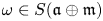 ${\omega \in S(\mathfrak{a} \oplus \mathfrak{m})}$. Using the above formula, we have
 \begin{align} |\langle (d\operatorname{BP}_{j, z_1})_{z_1}(Z), \omega \rangle| & \geq{}\bigl|\bigl\langle \pi\big(\operatorname{Ad}_{\eta_j^{-}}\big(\big(dh_{\eta_j^{-}}\big)_e((d\psi)_{z_1}(Z))\big)\big), \omega \bigr\rangle\bigr|\nonumber\\ &\quad {}- \bigl|\bigl\langle \pi\big(\operatorname{Ad}_{\eta_0^{-}}\big(\big(dh_{\eta_0^{-}}\big)_e((d\psi)_{z_1}(Z))\big)\big), \omega \bigr\rangle\bigr| \end{align}
for all  $Z \in \operatorname {T}_{z_1}(\tilde {U}_1)$ and
 $1 \leq j \leq j_{\mathrm {m}}$. We first deal with the first term in (7). Since
 $d_{N^{-}}(\eta _j^{-}, n_j^{-}) < \delta _1$ for all
 $1 \leq j \leq j_{\mathrm {m}}$, using (5), there exist
 $1 \leq j_\omega \leq j_{\mathrm {m}}$ and
 $n_\omega ^{+} \in \mathfrak {n}^{+}$ with
 $\|n_\omega ^{+}\| = 1$ such that
 $|\langle \pi (\operatorname {Ad}_{\eta _{j_\omega }^{-}}(n_\omega ^{+})), \omega \rangle | \geq \epsilon _1$. Since
 $(dh_{\eta _{j_\omega }^{-}})_e$ and
 $(d\psi )_{z_1}$ are invertible linear maps, there exists
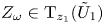 $Z_\omega \in \operatorname {T}_{z_1}(\tilde {U}_1)$ with
 $\|Z_\omega \| = 1$ such that
 $(dh_{\eta _{j_\omega }^{-}})_e((d\psi )_{z_1}(Z_\omega ))$ is a scalar multiple of
 $n_\omega ^{+}$. The operator norm bounds on the linear maps give
 \[ \bigl|\bigl\langle \pi\bigl(\operatorname{Ad}_{\eta_{j_\omega}^{-}}\bigl(\bigl(\bigl(dh_{\eta_{j_\omega}^{-}}\bigr)_e((d\psi)_{z_1} (Z_\omega))\bigr)\bigr), \omega \bigr\rangle\bigr| \geq C_1C_2^{{-}1}\epsilon_1 \geq 4\epsilon. \]
Now we turn to the second term in (7). Since  $d_{N^{-}}(\eta _0^{-}, e) < \delta _2$, we use the Cauchy–Schwarz inequality and then again the operator norm bounds to get
 \[ \bigl|\bigl\langle \pi\bigl(\operatorname{Ad}_{\eta_0^{-}}\bigl(\bigl(dh_{\eta_0^{-}}\bigr)_e((d\psi)_{z_1}(Z_\omega))\bigr)\bigr), \omega \bigr\rangle\bigr| \leq C_1C_2\epsilon_2 \leq \epsilon. \]
With these bounds, we conclude that for all 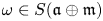 $\omega \in S(\mathfrak{a} \oplus \mathfrak{m})$, there exist
 $1 \leq j_\omega \leq j_{\mathrm {m}}$ and
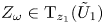 $Z_\omega \in \operatorname {T}_{z_1}(\tilde {U}_1)$ with
 $\|Z_\omega \| = 1$ such that
 $|\langle (d\operatorname {BP}_{j_\omega , z_1})_{z_1}(Z_\omega ), \omega \rangle | \geq 3\epsilon$. Since the map
 $S(\mathfrak{a} \oplus \mathfrak{m}) \to \mathbb {R}$ defined by
 $\omega \mapsto |\langle \omega ', \omega \rangle |$ is continuous for all
 $\omega ' \in \mathfrak {a} \oplus \mathfrak {m}$ and
 $S(\mathfrak{a} \oplus \mathfrak{m})$ is compact, there exist some absolute
 $k_0\in \mathbb{N}$ and
 $\omega _1, \omega _2, \dotsc , \omega _{k_0} \in S(\mathfrak{a} \oplus \mathfrak{m})$ contained in corresponding open sets
 $V_1, V_2, \dotsc , V_{k_0} \subset S(\mathfrak{a} \oplus \mathfrak{m})$ which cover
 $S(\mathfrak{a} \oplus \mathfrak{m})$ such that
 $|\langle (d\operatorname {BP}_{j_{\omega _k}, z_1})_{z_1}(Z_{\omega _k}), \omega \rangle | \geq 2\epsilon$ for all
 $\omega \in \overline {V_k}$ and
 $1 \leq k \leq k_0$. Now, for all
 $1 \leq k \leq k_0$, extend
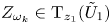 $Z_{\omega _k} \in \operatorname {T}_{z_1}(\tilde {U}_1)$ to any smooth unit vector field
 $Z_k: \mathcal{U}'\to \operatorname {T}(\tilde {U}_1)$ for some open set
 $\mathcal{U}' \subset \tilde {U}_1$ containing
 $z_1$, that is,
 $Z_k$ satisfies
 $Z_k(z_1) = Z_{\omega _k}$ and
 $\|Z_k(u)\| = 1$ for all
 $u \in \mathcal{U}'$. We can ensure that their
 $C^1$ norms are always bounded above by an absolute constant. Since
 $\operatorname {BP}_{j_{\omega _k}}$ is smooth, the map
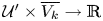 $\mathcal{U}' \times \overline {V_k} \to \mathbb {R}$ defined by
 $(u, \omega ) \mapsto |\langle (d\operatorname {BP}_{j_{\omega _k}, u})_u(Z_k(u)), \omega \rangle |$ is also smooth for all
 $1 \leq k \leq k_0$. Hence, by compactness of
 $\overline {V_k}$, there exists an open subset
 $\mathcal {U} \subset \mathcal{U}'$ containing
 $z_1$ such that we can extend the inequality to
 \[ |\langle (d\operatorname{BP}_{j_{\omega_k}, u})_u(Z_k(u)), \omega \rangle| \geq \epsilon \quad \text{for all }u \in \mathcal{U},\ \omega \in \overline{V_k},\ \text{and}\ 1 \leq k \leq k_0. \]
Note that  $\mathcal{U}$ is absolute and, in particular, is not dependent on the sections
 $v_0, v_1, \dotsc, v_{j_{\mathrm{m}}}$ nor their length m due to (6) and compactness of
 $N_1^-$. Shrinking it so that
 $\mathcal{U} \cap \Omega \subset U_1$ finishes the proof.
Fix  $\varepsilon _2 \in (0, 1)$,
 $m_0 \in \mathbb {N}$,
 $j_{\mathrm {m}} \in \mathbb {N}$, and the open subset
 $\mathcal {U} \subset \tilde {U}_1$ containing the center
 $z_1 \in \tilde {R}_1$ to be the
 $\epsilon$,
 $m_0$,
 $j_{\mathrm {m}}$, and
 $\mathcal {U}$ provided by Proposition 6.5.
6.2 Non-concentration property
In the upper half space model, applying an appropriate isometry, we assume that the vectors in  $\tilde {\mathsf {U}}_1$ have direction
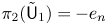 $\pi _2(\tilde {\mathsf {U}}_1) = -e_n$ and their basepoints lie on the hyperplane
 $\langle \pi _1(\tilde {\mathsf {U}}_1), e_n\rangle = 1$. We will often view the limit set as
 $\Lambda (\Gamma ) \subset \mathbb {R}^{n - 1} \cup \{\infty \}$ in the rest of the paper. The following proposition is the required NCP.
Proposition 6.6 (NCP)
There exists  $\delta \in (0, 1)$ such that for all
 $\epsilon \in (0, 1)$,
 $w \in \mathbb {R}^{n - 1}$ with
 $\|w\| = 1$, and
 $x \in \Lambda (\Gamma ) \cap \mathbb {R}^{n - 1}$, there exists
 $y \in \Lambda (\Gamma ) \cap B_\epsilon ^{\mathrm {E}}(x)$ such that
 $|\langle y - x, w \rangle | \geq \epsilon \delta$.
Proof. By way of contradiction, suppose the proposition is false. Then for all  $j \in \mathbb {N}$, taking
 $\delta _j = {1}/{j}$, there exist
 $\epsilon _j \in (0, 1)$,
 $w_j \in \mathbb {R}^{n - 1}$ with
 $\|w_j\| = 1$, and
 $x_j \in \Lambda (\Gamma ) \cap \mathbb {R}^{n - 1}$ such that
 $|\langle y - x_j, w_j \rangle | \leq \epsilon _j \delta _j = \epsilon _j/j$ for all
 $y \in \Lambda (\Gamma ) \cap B_{\epsilon _j}^{\mathrm {E}}(x_j)$. Hence, we can rewrite this as
 \begin{equation} \Lambda(\Gamma) \cap B_{\epsilon_j}^{\mathrm{E}}(x_j) \subset \biggl\{y \in \mathbb{R}^{n - 1}: |\langle y - x_j, w_j \rangle| \leq \frac{\epsilon_j}{j}\biggr\} \quad \text{for all }j \in \mathbb{N}. \end{equation}
We want to use the self-similarity property of the fractal set  $\Lambda (\Gamma )$. Note that
 $A < G$ is such that
 $a_t$ acts on
 $\overline {\mathbb {H}^{n}}$ by dilation by
 $e^{t}$ for all
 $t \in \mathbb {R}$, and elements of
 $N^{-}$ act on
 $\overline {\mathbb {H}^{n}}$ by translation. For all
 $x \in \mathbb {R}^{n - 1}$, denote by
 $n_x^{-} \in N^{-}$ the element which acts on
 $\overline {\mathbb {H}^{n}}$ by translation by
 $x$. For all
 $j \in \mathbb {N}$, we have
 $(n_{x_j}^{-})^{+} = \infty \in \Lambda (\Gamma )$ and
 $(n_{x_j}^{-})^{-} = x_j \in \Lambda (\Gamma )$, and hence
 $\Gamma n_{x_j}^{-} \in \Omega _{\operatorname {F}} \subset \Gamma \backslash G$ which we recall is compact. Also recalling that
 $\Omega _{\operatorname {F}}$ is invariant under the frame flow, we have
 $n_{x_j}^{-} a_t \in \Gamma \Omega _0$ for all
 $t \in \mathbb {R}$ and
 $j \in \mathbb {N}$, where
 $\Omega _0 \subset G$ is some compact subset. Then for all
 $j \in \mathbb {N}$, setting
 $t_j = \log (\epsilon _j)$, there exist
 $\gamma _j \in \Gamma$ and
 $g_j \in \Omega _0$ such that
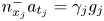 $n_{x_j}^{-} a_{t_j} = \gamma _j g_j$. Now, for all
 $j \in \mathbb {N}$, we have
 $g_j a_{-t_j} n_{-x_j}^{-} = \gamma _j^{-1}$ whose action on
 $\partial _\infty (\mathbb {H}^{n})$ preserves
 $\Lambda (\Gamma )$. This captures the self-similarity property of the fractal set
 $\Lambda (\Gamma )$.
Now applying  $g_j a_{-t_j} n_{-x_j}^{-}$ in (8) gives
 \[ \Lambda(\Gamma) \cap g_j \cdot B_1^{\mathrm{E}}(0) \subset g_j \cdot \biggl\{y \in \mathbb R^{n - 1}: |\langle y, w_j \rangle| \leq \frac{1}{j}\biggr\} \quad \text{for all}\ j \in \mathbb N. \]
By compactness, we can pass to subsequences so that  $\lim _{j \to \infty } w_j = w \in \mathbb {R}^{n - 1}$ with
 $\|w\| = 1$ and
 $\lim _{j \to \infty } g_j = g \in \Omega _0$. In the limit
 $j \to \infty$, we have
 $\Lambda(\Gamma) \cap g \cdot B_1^{\mathrm{E}}(0) \subset g \cdot \bigl\{y \in \mathbb R^{n - 1}: \langle y, w \rangle = 0\bigr\}$, which contradicts [Reference WinterWin15, Proposition 3.12] since
 $\Gamma < G$ is Zariski dense.
Fix  $\varepsilon _3 \in (0, 1)$ henceforth to be the
 $\delta$ provided by Proposition 6.6.
7. Preliminary lemmas and constants
In this section we cover some more lemmas and then fix many constants which are needed to construct the Dolgopyat operators and prove Theorem 5.4.
Let  $\Psi _1: \tilde {\mathsf {U}}_1 \to \mathbb {R}^{n - 1}$ be the diffeomorphism defined by
 $\Psi _1(u) = u^{+}$ for all
 $u \in \tilde {\mathsf {U}}_1$. Let
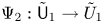 $\Psi _2: \tilde {\mathsf {U}}_1 \to \tilde {U}_1$ be the isometry obtained from the covering map. Define the diffeomorphism
 $\Psi : \Psi _1(\tilde {\mathsf {U}}_1) \to \tilde {U}_1$ by
 $\Psi (x) = \Psi _2(\Psi _1^{-1}(x))$ for all
 $x \in \Psi _1(\tilde {\mathsf {U}}_1)$. Then
 $(d\Psi )_x^{*}$ is invertible for all
 $x \in \Psi _1(\tilde {\mathsf {U}}_1)$. By continuity, we can fix
 $\delta _\Psi > 0$ such that
 $\inf _{x \in \Psi _1(\tilde {\mathsf {U}}_1)} \inf _{\|w\| = 1} \|(d\Psi )_x^{*}(w)\| \geq \delta _\Psi$. We also fix
 $C_\Psi > 1$ such that
 $({1}/{C_\Psi }) d_{\mathrm {E}}(x, y) \leq d(\Psi (x), \Psi (y)) \leq C_\Psi d_{\mathrm {E}}(x, y)$ for all
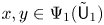 $x, y \in \Psi _1(\tilde {\mathsf {U}}_1)$.
We now introduce a technical lemma. Denote  $\check {x} = \Psi ^{-1}(x)$ for all
 $x \in \tilde {U}_1$. Let
 $x, y \in \tilde {U}_1$,
 $z = (\check {x}, \check {y} - \check {x}) \in \operatorname {T}_{\check {x}}(\mathbb {R}^{n - 1})$ such that
 $\{\check {x} + tz \in \mathbb {R}^{n - 1}: t \in [0, 1]\} \subset \Psi ^{-1}(\tilde {U}_1)$, and
 $1 \leq j \leq j_{\mathrm {m}}$. Define the curve
 $\varphi ^{\mathrm {BP}}_{j, x, z}: [0, 1] \to AM$ by
 $\varphi ^{\mathrm {BP}}_{j, x, z}(t) = \operatorname {BP}_{j, x}(\Psi (\check {x} + tz))$, for all
 $t \in [0, 1]$, which has endpoints
 $\varphi ^{\mathrm {BP}}_{j, x, z}(0) = e$ and
 $\varphi ^{\mathrm {BP}}_{j, x, z}(1) = \operatorname {BP}_j(x, y)$. There exists
 $\delta _0 > 0$ such that any pair of points in
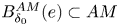 $B_{\delta _0}^{AM}(e) \subset AM$ has a unique geodesic through them. Fix
 $C_{\operatorname {BP}, \Psi } = \sup _{x, y \in \tilde {U}_1, j \in \{1, 2, \dotsc , j_{\mathrm {m}}\}} \|d(\operatorname {BP}_{j, x} \circ \Psi )_{\check {y}}\|_{\mathrm {op}}$.
Lemma 7.1 There exists  $C > 0$ such that for all
 $1 \leq j \leq j_{\mathrm {m}}$ and
 $x, y \in \tilde {U}_1$ with
 $d(x, y) < {\delta _0}/({C_\Psi C_{\operatorname {BP}, \Psi }})$ such that
 $\{\check {x} + tz \in \mathbb {R}^{n - 1}: t \in [0, 1]\} \subset \Psi ^{-1}(\tilde {U}_1)$, we have
 \[ d_{AM}\big(\exp(Z), \varphi_{j, x, z}^{\mathrm{BP}}(1)\big) \leq C d(x, y)^{2}, \]
where  $z = (\check {x}, \check {y} - \check {x}) \in \operatorname {T}_{\check {x}}(\mathbb {R}^{n - 1})$ and
 $Z = d(\operatorname {BP}_{j, x} \circ \Psi )_{\check {x}}(z)$.
Proof. Fix 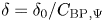 $\delta = {\delta _0}/{C_{\operatorname {BP}, \Psi }}$. Let
 $1 \leq j \leq j_{\mathrm {m}}$ and
 $x, y \in \tilde {U}_1$ with
 $d(x, y) < {\delta }/{C_\Psi }$ such that
 $\{\check {x} + tz \in \mathbb {R}^{n - 1}: t \in [0, 1]\} \subset \Psi ^{-1}(\tilde {U}_1)$ where
 $z = (\check {x}, \check {y} - \check {x}) \in \operatorname {T}_{\check {x}}(\mathbb {R}^{n - 1})$. Note that the bound implies
 $\|z\| = d_{\mathrm {E}}(\check {x}, \check {y}) \leq \delta$. Let
 $\hat {z} = {z}/{\|z\|}$,
 $Z = d(\operatorname {BP}_{j, x} \circ \Psi )_{\check {x}}(z)$, and
 $\hat {Z} = {Z}/{\|z\|} = d(\operatorname {BP}_{j, x} \circ \Psi )_{\check {x}}(\hat {z})$. Define
 $L: [0, \|z\|] \to \mathbb {R}$ by
 $L(t) = d_{AM}(\exp (t\hat {Z}), \varphi _{j, x, \hat {z}}^{\mathrm {BP}}(t))$ for all
 $t \in [0, \|z\|]$. We can fix
 $C_0 > 0$ such that
 $({1}/{2})\sup _{t \in [0, \|z\|]}|L''(t)| \leq C_0$ holds independently of the choice of
 $j$,
 $x$, and
 $y$ because the geodesics
 $\varphi _{j, x, \hat {z}}^{\mathrm {BP}}$ depend smoothly on
 $x$ and
 $\hat {z}$. Fix
 $C = C_0 C_\Psi ^{2}$. Define
 $\tilde {L}: [0, \|z\|] \to \mathbb {R}$ by
 $\tilde {L}(t) = ({1}/{2})L(t)^{2} = ({1}/{2})d_{AM}(\exp (t\hat {Z}), \varphi _{j, x, \hat {z}}^{\mathrm {BP}}(t))^{2}$ for all
 $t \in [0, \|z\|]$. For all
 $t \in [0, \|z\|]$, define
 $\gamma _t: [0, 1] \to AM$ to be the unique constant-speed geodesic with endpoints
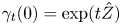 $\gamma _t(0) = \exp (t\hat {Z})$ and
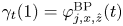 $\gamma _t(1) = \varphi _{j, x, \hat {z}}^{\mathrm {BP}}(t)$. Then we have
 \[ L(t) = \int_0^{1} \|\gamma_t'(s)\| \, ds, \quad \tilde{L}(t) = \int_0^{1} \frac{1}{2}\|\gamma_t'(s)\|^{2} \, ds, \]
for all  $t \in [0, \|z\|]$. Since
 $\tilde {L}$ is the energy along the variation of geodesics
 $\gamma : [0, 1] \times (0, \|z\|) \to AM$, we can use the first variation formula to get the derivative
 \begin{align*} \tilde{L}'(t_0) &= \biggl\langle \biggl.\frac{d}{dt}\biggr|_{t = t_0} \gamma_t(1), \gamma_{t_0}'(1) \biggr\rangle - \biggl\langle \biggl.\frac{d}{dt}\biggr|_{t = t_0} \gamma_t(0), \gamma_{t_0}'(0) \biggr\rangle\\ &= \bigl\langle \bigl(\varphi_{j, x, \hat{z}}^{\mathrm{BP}}\bigr)'(t_0), {\gamma_{t_0}}'(1) \bigr\rangle - \biggl\langle \biggl.\frac{d}{dt}\biggr|_{t = t_0} \exp(t\hat{Z}), \gamma_{t_0}'(0) \biggr\rangle \end{align*}
for all  $t_0 \in (0, \|z\|)$. Hence, we calculate that
 \begin{equation} L'(t_0) = \frac{\tilde{L}'(t_0)}{L(t_0)} = \biggl\langle \bigl(\varphi_{j, x, \hat{z}}^{\mathrm{BP}}\bigr)'(t_0), \frac{\gamma_{t_0}'(1)}{\|\gamma_{t_0}'(1)\|} \biggr\rangle - \biggl\langle \biggl.\frac{d}{dt}\biggr|_{t = t_0} \exp(t\hat{Z}), \frac{\gamma_{t_0}'(0)}{\|\gamma_{t_0}'(0)\|} \biggr\rangle \end{equation}
for all  $t_0 \in (0, \|z\|)$. It is easy to see that
 $(\varphi _{j, x, \hat {z}}^{\mathrm {BP}})'(0) = {d}/{dt}|_{t = 0} \exp (t\hat {Z}) = \hat {Z}$. Using the distance function
 $d_{\operatorname {T}(AM)}$ on
 $\operatorname {T}(AM)$ induced by the Sasaki metric on
 $\operatorname {T}(AM)$, we see that
 \[ \lim_{t_0 \searrow 0} d_{\operatorname{T}(AM)}\biggl(\frac{\gamma_{t_0}'(0)}{\|\gamma_{t_0}'(0)\|}, \frac{\gamma_{t_0}'(1)}{\|\gamma_{t_0}'(1)\|}\biggr) = \lim_{t_0 \searrow 0} L(t_0) = 0. \]
It follows from (9) that  $\lim _{t_0 \searrow 0} L'(t_0) = 0$. Taylor's theorem immediately gives
 \[ L(t) \leq \frac{1}{2}\biggl(\sup_{t_0 \in [0, \|z\|]}|L''(t_0)|\biggr)t^{2} \leq C_0t^{2} \]
for all  $t \in [0, \|z\|]$. The lemma follows by taking
 $t = \|z\|$.
Fix  $C_{\exp , \operatorname {BP}} > 0$ to be the
 $C$ provided by Lemma 7.1.
Remark Shrinking  $\mathcal {U} \subset \tilde {U}_1$ if necessary, we can assume that
 $\Psi ^{-1}(\mathcal {U}) \subset \mathbb {R}^{n - 1}$ is a convex open subset so that Lemma 7.1 applies for our purposes.
The following Lemma 7.2 is derived from the hyperbolicity of the geodesic flow.
Lemma 7.2 There exist  $c_0 \in (0, 1)$ and
 $\kappa _1 > \kappa _2 > 1$ such that for all
 $j \in \mathbb {N}$ and admissible sequences
 $\alpha = (\alpha _0, \alpha _1, \dotsc , \alpha _j)$, we have
 \[ \frac{c_0}{\kappa_1^{j}} \leq \|(d\sigma^{-\alpha})_u\|_{\mathrm{op}} \leq \frac{1}{c_0\kappa_2^{j}} \quad \text{for all }u \in \tilde{U}_{\alpha_j}. \]
We fix constants  $c_0 \in (0, 1)$ and
 $\kappa _1 > \kappa _2 > 1$ as in Lemma 7.2 for the rest of the paper and use these inequalities without further comment.
Recall that Dolgopyat's method can be successfully carried out when the derivative of  $\rho _b$ is large, which motivated the definition of
 $\hat {M}_0(b_0)$ for all
 $b_0 > 0$. This criterion is ultimately manifested in the following lemma which is a Lasota–Yorke type inequality [Reference Lasota and YorkeLY73].
Lemma 7.3 There exists  $A_0 > 0$ such that for all
 $\xi \in \mathbb {C}$ with
 $|a| < a_0'$, if
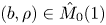 $(b, \rho ) \in \hat {M}_0(1)$, then for all
 $k \in \mathbb {N}$, we have:
(1) if
$h \in K_B(\tilde {U})$ for some $B > 0$, then we have $\tilde {\mathcal {L}}_a^{k}(h) \in K_{B'}(\tilde {U})$ where $B' = A_0({B}/{\kappa _2^{k}} + 1)$;(2) if
$H \in \mathcal {V}_\rho (\tilde {U})$ and $h \in C^{1}(\tilde {U}, \mathbb {R})$ satisfy $\|(dH)_u\|_{\mathrm {op}} \leq Bh(u)$ for all $u \in \tilde {U}$, for some $B > 0$, then we have
\[ \bigl\|\big(d\tilde{\mathcal{M}}_{\xi, \rho}^{k}(H)\big)_u\bigr\|_{\mathrm{op}} \leq A_0\biggl(\frac{B}{\kappa_2^{k}}\tilde{\mathcal{L}}_a^{k}(h)(u) + \|\rho_b\|\tilde{\mathcal{L}}_a^{k}\|H\|(u)\biggr) \quad \text{for all }u \in \tilde{U}. \]


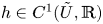



Proof. Fix  $A_0 > \max ({4T_0}/{c_0(\kappa _2 - 1)}, {2T_0}/{\delta _{1, \varrho }c_0(\kappa _2 - 1)}, {1}/{c_0})$. Let
 $\xi \in \mathbb {C}$ with
 $|a| < a_0'$,
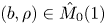 $(b, \rho ) \in \hat {M}_0(1)$, and
 $k \in \mathbb {N}$. To prove property (1), let
 $h \in K_B(\tilde {U})$ for some
 $B > 0$. Let
 $u \in \tilde {U}_{\alpha _k}$ for some
 $\alpha _k \in \mathcal {A}$. Let
 $z \in \operatorname {T}_u(\tilde {U})$ with
 $\|z\| = 1$. Taking the differential and using the product rule, we have
 \begin{align*} \big(d\tilde{\mathcal{L}}_a^{k}(h)\big)_u(z) &={}\sum_{\alpha: \operatorname{len}(\alpha) = k} e^{f_\alpha^{(a)}(\sigma^{-\alpha}(u))} d\bigl(f_\alpha^{(a)} \circ \sigma^{-\alpha}\bigr)_u(z) \cdot h(\sigma^{-\alpha}(u))\\ &\quad {}+ \sum_{\alpha: \operatorname{len}(\alpha) = k} e^{f_\alpha^{(a)}(\sigma^{-\alpha}(u))} \cdot d(h \circ \sigma^{-\alpha})_u(z). \end{align*}
We need to estimate  $|d(f_\alpha ^{(a)} \circ \sigma ^{-\alpha })_u(z)|$. From definitions, we have
 \[ f_\alpha^{(a)}(\sigma^{-\alpha}(u)) = \sum_{j = 0}^{k - 1} f_{(\alpha_j, \alpha_{j + 1})}^{(a)}\big(\sigma^{-(\alpha_j, \alpha_{j + 1}, \dotsc, \alpha_k)}(u)\big) \]
for all admissible sequences  $\alpha$ with
 $\operatorname {len}(\alpha ) = k$. Thus, we have the bound
 \begin{equation} \big|d\bigl(f_\alpha^{(a)} \circ \sigma^{-\alpha}\bigr)_u(z)\big| \leq \sum_{j = 0}^{k - 1} \bigl|f_{(\alpha_j, \alpha_{j + 1})}^{(a)}\bigr|_{C^{1}} \big|\sigma^{-(\alpha_j, \alpha_{j + 1}, \dotsc, \alpha_k)}\big|_{C^{1}} \leq \sum_{j = 0}^{k - 1} \frac{T_0}{c_0 \kappa_2^{k - j}} \leq \frac{T_0}{c_0(\kappa_2 - 1)} \leq \frac{A_0}{4} \end{equation}
for all admissible sequences  $\alpha$ with
 $\operatorname {len}(\alpha ) = k$. Using the bound, we get
 \begin{align*} \bigl|\big(d\tilde{\mathcal{L}}_a^{k}(h)\big)_u(z)\bigr| \leq{}&\sum_{\alpha: \operatorname{len}(\alpha) = k} e^{f_\alpha^{(a)}(\sigma^{-\alpha}(u))} h(\sigma^{-\alpha}(u)) \big|d\bigl(f_\alpha^{(a)} \circ \sigma^{-\alpha}\bigr)_u(z)\big|\\ &\quad+ \sum_{\alpha: \operatorname{len}(\alpha) = k} e^{f_\alpha^{(a)}(\sigma^{-\alpha}(u))} \|(dh)_{\sigma^{-\alpha}(u)}\|_{\mathrm{op}} \|(d\sigma^{-\alpha})_u\|_{\mathrm{op}}\\ &\leq{}A_0\sum_{\substack{\alpha: \operatorname{len}(\alpha) = k\\ u' = \sigma^{-\alpha}(u)}} e^{f_\alpha^{(a)}(u')} h(u') + \frac{B}{c_0\kappa_2^{k}}\sum_{\substack{\alpha: \operatorname{len}(\alpha) = k\\ u' = \sigma^{-\alpha}(u)}} e^{f_\alpha^{(a)}(u')} h(u')\\ &\leq{}A_0\biggl(\frac{B}{\kappa_2^{k}} + 1\biggr)\tilde{\mathcal{L}}_a^{k}(h)(u). \end{align*}
Now to prove property (2), suppose  $H \in \mathcal {V}_\rho (\tilde {U})$ and
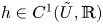 $h \in C^{1}(\tilde {U}, \mathbb {R})$ satisfy
 $\|(dH)_u\|_{\mathrm {op}} \leq Bh(u)$ for all
 $u \in \tilde {U}$, for some
 $B > 0$. Let
 $u \in \tilde {U}_{\alpha _k}$ for some
 $\alpha _k \in \mathcal {A}$. Let
 $z \in \operatorname {T}_u(\tilde {U})$ with
 $\|z\| = 1$. Recall (4). Taking the differential and using the product rule, we have
 \begin{align} \big(d\tilde{\mathcal{M}}_{\xi, \rho}^{k}(H)\big)_u(z) &={}\sum_{\alpha: \operatorname{len}(\alpha) = k} e^{f_\alpha^{(a)}(\sigma^{-\alpha}(u))} d\bigl(f_\alpha^{(a)} \circ \sigma^{-\alpha}\bigr)_u(z) \cdot \rho_b(\Phi^{\alpha}(\sigma^{-\alpha}(u))^{{-}1}) H(\sigma^{-\alpha}(u))\nonumber\\ &\quad {}- \sum_{\alpha: \operatorname{len}(\alpha) = k} e^{f_\alpha^{(a)}(\sigma^{-\alpha}(u))} \cdot d(\rho_b \circ \Phi^{\alpha} \circ \sigma^{-\alpha})_u(z) H(\sigma^{-\alpha}(u))\nonumber\\ &\quad {}+ \sum_{\alpha: \operatorname{len}(\alpha) = k} e^{f_\alpha^{(a)}(\sigma^{-\alpha}(u))} \rho_b(\Phi^{\alpha}(\sigma^{-\alpha}(u))^{{-}1}) d(H \circ \sigma^{-\alpha})_u(z)\nonumber\\ &=:{}K_1 - K_2 + K_3. \end{align}
Then  $\|(d\tilde {\mathcal {M}}_{\xi , \rho }^{k}(H))_u(z)\|_2 \leq \|K_1\|_2 + \|K_2\|_2 + \|K_3\|_2$ and we can bound each of these terms in a similar fashion as before. Using a previous bound and recalling that
 $\rho _b$ is a unitary representation, we estimate the first term
 $\|K_1\|_2$ as
 \begin{align*} \|K_1\|_2 &\leq{}\sum_{\alpha: \operatorname{len}(\alpha) = k} e^{f_\alpha^{(a)}(\sigma^{-\alpha}(u))} \big|d\bigl(f_\alpha^{(a)} \circ \sigma^{-\alpha}\bigr)_u(z)\big| \cdot \bigl\|H(\sigma^{-\alpha}(u))\bigr\|_2\nonumber\\ &\leq{}\frac{A_0}{2} \delta_{1, \varrho} \sum_{\substack{\alpha: \operatorname{len}(\alpha) = k\\ u' = \sigma^{-\alpha}(u)}} e^{f_\alpha^{(a)}(u')} \|H(u')\|_2 \leq \frac{A_0}{2} \delta_{1, \varrho} \tilde{\mathcal{L}}_a^{k}\|H\|(u). \end{align*}
To estimate the second term  $\|K_2\|_2$, we first obtain bounds for
 $\|d(\Phi ^{\alpha } \circ \sigma ^{-\alpha })_u(z)\|$. From definitions, we have
 \[ \Phi^{\alpha}(\sigma^{-\alpha}(u)) = a_{\tau_{\alpha}(\sigma^{-\alpha}(u))} \prod_{j = 0}^{k - 1} \vartheta^{(\alpha_j, \alpha_{j + 1})}(\sigma^{-(\alpha_j, \alpha_{j + 1}, \dotsc, \alpha_k)}(u)) \]
for all admissible sequences  $\alpha$ with
 $\operatorname {len}(\alpha ) = k$. Denote by
 $a_{\boldsymbol {\cdot }}: \mathbb {R} \to A$ the map defined by
 $t \mapsto a_t$. Let
 $m^{\mathrm {L}}_g, m^{\mathrm {R}}_g: G \to G$ be the left and right multiplication maps respectively, by
 $g \in G$. For convenience, we also introduce the notation
 \begin{align*} L^{\alpha, j} &= a_{\tau_{\alpha}(\sigma^{-\alpha}(u))} \prod_{l = 0}^{j - 1} \vartheta^{(\alpha_l, \alpha_{l + 1})}(\sigma^{-(\alpha_l, \alpha_{l + 1}, \dotsc, \alpha_k)}(u)),\\ C^{\alpha, j} &= \vartheta^{(\alpha_j, \alpha_{j + 1})}(\sigma^{-(\alpha_j, \alpha_{j + 1}, \dotsc, \alpha_k)}(u)),\\ R^{\alpha, j} &= \prod_{l = j + 1}^{k - 1} \vartheta^{(\alpha_l, \alpha_{l + 1})}(\sigma^{-(\alpha_l, \alpha_{l + 1}, \dotsc, \alpha_k)}(u)) \end{align*}
for all  $0 \leq j \leq k - 1$ and admissible sequences
 $\alpha$ with
 $\operatorname {len}(\alpha ) = k$, with the convention
 $L^{\alpha , 0} = R^{\alpha , k - 1} = e$. Taking the differential and using the product rule, we calculate that
 \begin{align*} d(\Phi^{\alpha} \circ \sigma^{-\alpha})_u(z)&={} \big(\big(dm_{\vartheta^{\alpha}(\sigma^{-\alpha}(u))}^{\mathrm{R}}\big)_{a_{\tau_\alpha(\sigma^{-\alpha}(u))}} \circ (da_{\boldsymbol{\cdot}})_{\tau_\alpha(\sigma^{-\alpha}(u))} \circ d(\tau_\alpha \circ \sigma^{-\alpha})_u\big)(z)\\ &\quad {}+ \sum_{j = 0}^{k - 1} \big(d\big(m^{\mathrm{R}}_{R^{\alpha, j}} \circ m^{\mathrm{L}}_{L^{\alpha, j}}\big)_{C^{\alpha, j}} \circ d(\vartheta^{(\alpha_j, \alpha_{j + 1})} \circ \sigma^{-(\alpha_j, \alpha_{j + 1}, \dotsc, \alpha_k)})_u\big)(z). \end{align*}
Hence by left  $G$-invariance and right
 $K$-invariance of the Riemannian metric on
 $G$, and the fact that
 $\|(da_{\boldsymbol {\cdot }})_t(1)\| = 1$ for all
 $t \in \mathbb {R}$ since
 $a_{\boldsymbol {\cdot }}$ is the geodesic flow, we have
 \[ \|d(\Phi^{\alpha} \circ \sigma^{-\alpha})_u(z)\| \leq \bigl|d(\tau_\alpha \circ \sigma^{-\alpha})_u(z)\bigr| + \sum_{j = 0}^{k - 1} \big|\vartheta^{(\alpha_j, \alpha_{j + 1})}\big|_{C^{1}} \big|\sigma^{-(\alpha_j, \alpha_{j + 1}, \dotsc, \alpha_k)}\big|_{C^{1}}. \]
By similar calculations to those in (10), we get  $\|d(\Phi ^{\alpha } \circ \sigma ^{-\alpha })_u(z)\| \leq {2T_0}/({c_0(\kappa _2 - 1)}) \leq {A_0}/{2}$. Thus, we have
 \begin{align*} \|K_2\|_2 &\leq \sum_{\alpha: \operatorname{len}(\alpha) = k} e^{f_\alpha^{(a)}(\sigma^{-\alpha}(u))} \bigl\|d(\rho_b \circ \Phi^{\alpha} \circ \sigma^{-\alpha})_u(z)\bigr\|_{\mathrm{op}} \|H(\sigma^{-\alpha}(u))\|_2\\ &\leq \sum_{\alpha: \operatorname{len}(\alpha) = k} e^{f_\alpha^{(a)}(\sigma^{-\alpha}(u))} \|\rho_b\| \cdot \|d(\Phi^{\alpha} \circ \sigma^{-\alpha})_u(z)\| \cdot \|H(\sigma^{-\alpha}(u))\|_2\\ &\leq \frac{A_0}{2}\|\rho_b\|\sum_{\substack{\alpha: \operatorname{len}(\alpha) = k\\ u' = \sigma^{-\alpha}(u)}} e^{f_\alpha^{(a)}(u')} \|H(u')\|_2 \leq \frac{A_0}{2}\|\rho_b\|\tilde{\mathcal{L}}_a^{k}\|H\|(u). \end{align*}
Finally, recalling that  $\rho _b$ is a unitary representation, we estimate the last term
 $\|K_3\|_2$ as
 \begin{align*} \|K_3\|_2 &\leq \sum_{\alpha: \operatorname{len}(\alpha) = k} e^{f_\alpha^{(a)}(\sigma^{-\alpha}(u))} \|(dH)_{\sigma^{-\alpha}(u)}\|_{\mathrm{op}} \|(d\sigma^{-\alpha})_u\|_{\mathrm{op}}\\ &\leq \frac{B}{c_0\kappa_2^{k}}\sum_{\substack{\alpha: \operatorname{len}(\alpha) = k\\ u' = \sigma^{-\alpha}(u)}} e^{f_\alpha^{(a)}(u')} h(u') \leq \frac{A_0B}{\kappa_2^{k}}\tilde{\mathcal{L}}_a^{k}(h)(u). \end{align*}
We combine all three bounds and recall that they hold for all  $z \in \operatorname {T}_u(\tilde {U})$ with
 $\|z\| = 1$, to obtain
 \begin{align*} \bigl\|\big(d\tilde{\mathcal{M}}_{\xi, \rho}^{k}(H)\big)_u\bigr\|_{\mathrm{op}} &\leq \frac{A_0}{2}\delta_{1, \varrho} \tilde{\mathcal{L}}_a^{k}\|H\|(u) + \frac{A_0}{2}\|\rho_b\| \tilde{\mathcal{L}}_a^{k}\|H\|(u) + \frac{A_0B}{\kappa_2^{k}}\tilde{\mathcal{L}}_a^{k}(h)(u)\\ &\leq A_0\biggl(\frac{B}{\kappa_2^{k}}\tilde{\mathcal{L}}_a^{k}(h)(u) + \|\rho_b\| \tilde{\mathcal{L}}_a^{k}\|H\|(u)\biggr). \end{align*}
Fix  $A_0 > 0$ provided by Lemma 7.3. Fix
 $m_1 \in \mathbb {N}$ sufficiently large and, for all
 $k \in \mathcal {A}$, fix a cylinder
 $\mathtt {C}_k \subset U_1$ with
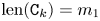 $\operatorname {len}(\mathtt {C}_k) = m_1$ such that
 $\overline {\mathtt {C}_k} \subset \mathcal {U}$ and
 $\sigma ^{m_1}(\mathtt {C}_k) = \operatorname {int}(U_k)$. Fix
 $C_{\mathrm {Vit}} = \min _{k \in \mathcal {A}}d(\overline {\mathtt {C}_k}, \partial (\mathcal {U}))$. Let the corresponding sections be
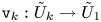 $\mathtt {v}_k: \tilde {U}_k \to \tilde {U}_1$ for all
 $k \in \mathcal {A}$. Now fix positive constants
 \begin{align} b_0 &= 1, \end{align}
 \begin{align} E &> \frac{2A_0}{\delta_{1, \varrho}}, \end{align}
 \begin{align} \delta_1 &< \frac{\varepsilon_1\varepsilon_2\varepsilon_3\delta_\Psi }{14C_\Psi}, \end{align}
 \begin{align} \epsilon_1 &< \min\biggl(C_{\mathrm{Vit}}, \frac{2\delta_0 \delta_{1, \varrho}}{C_\Psi C_{\operatorname{BP}, \Psi}}, \frac{4\delta_1}{(C_\Psi C_{\operatorname{BP}, \Psi})^{2}}, \frac{4\delta_1 \delta_{1, \varrho}}{C_{\exp, \operatorname{BP}}}, \frac{1}{\delta_1},\frac{c_0C_{\mathrm{Ano}}C_\phi\hat{\delta}e^{\hat{\delta}}}{5\kappa_1^{m_1}C_\Psi^{2}\delta_{1, \varrho}}\biggr), \end{align}
 \begin{align} \epsilon_2 &< \min\biggl(\frac{\varepsilon_3\epsilon_1}{4NC_\Psi^{2}}, \frac{\delta_1\epsilon_1}{4N(A_0 + \delta_1)}\biggr), \end{align}
 \begin{align} \epsilon_3 &= \frac{c_0\kappa_2^{m_1}\epsilon_2}{2}, \end{align}
 \begin{align} \epsilon_4 &= 10c_0^{{-}1}\kappa_1^{m_1}C_\Psi^{2}\epsilon_1, \end{align}
 \begin{align} m_2 &> m_0 \text{ such that } \kappa_2^{m_2} > \max\biggl(8A_0, \frac{4EN\epsilon_2}{c_0\log(2)}, \frac{32EN\epsilon_2}{c_0}, \frac{4E}{c_0\delta_1}\biggr), \end{align}
 \begin{align} \mu &< \min\biggl(\frac{E\epsilon_2}{2N}, \frac{1}{4N}, \frac{1}{16 \cdot 16e^{2m_2 T_0} \cdot N}\arccos\biggl(1 - \frac{(\delta_1 \epsilon_1)^{2}}{2}\biggr)^{2}\biggr). \end{align}
We defer the definition of  $C_\phi$, which only depends on the Markov section, until § 9.2 where it is needed. Fix
 $m = m_1 + m_2$. Fix admissible sequences
 $\alpha _j = (\alpha _{j, 0}, \alpha _{j, 1}, \dotsc , \alpha _{j, m_2 - 1}, 1)$ and corresponding sections
 $v_j = \sigma ^{-\alpha _j}: \tilde {U}_1 \to \tilde {U}_{\alpha _{j, 0}}$ provided by Proposition 6.5 for all
 $0 \leq j \leq j_{\mathrm {m}}$. Fix corresponding maps
 $\operatorname {BP}_j: \tilde {U}_1 \times \tilde {U}_1 \to AM$ provided by Proposition 6.5 for all
 $1 \leq j \leq j_{\mathrm {m}}$.
8. Construction of Dolgopyat operators
We now have the tools to construct the Dolgopyat operators and prove Theorem 5.4.
Let  $(b, \rho ) \in \hat {M}_0(b_0)$ and
 $k \in \mathcal {A}$. We can use the map
 $\Psi$ and the Vitali covering lemma on
 $\mathbb {R}^{n - 1}$ to choose a finite subset
 $\{x_{k, r, 1}^{(b, \rho )} \in \mathtt {C}_k: r \in \{1, 2, \dotsc , r_k^{(b, \rho )}\}\} \subset \mathtt {C}_k$ for some
 $r_k^{(b, \rho )} \in \mathbb {N}$ and corresponding open balls
 $C_{k, r}^{(b, \rho )} = W_{\epsilon _1/\|\rho _b\|}^{\mathrm {su}}(x_{k, r, 1}^{(b, \rho )}) \subset \mathcal {U}$ and
 $\hat {C}_{k, r}^{(b, \rho )} = W_{5C_\Psi ^{2}\epsilon _1/\|\rho _b\|}^{\mathrm {su}}(x_{k, r, 1}^{(b, \rho )})$ for all
 $1 \leq r \leq r_k^{(b, \rho )}$ such that
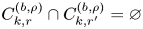 $C_{k, r}^{(b, \rho )} \cap C_{k, r'}^{(b, \rho )} = \varnothing$ for all
 $1 \leq r, r' \leq r_k^{(b, \rho )}$ with
 $r \neq r'$ and
 $\mathtt {C}_k \subset \bigcup _{r = 1}^{r_k^{(b, \rho )}} \hat {C}_{k, r}^{(b, \rho )}$. Recall the notation
 $\check {x}_{k, r, 1}^{(b, \rho )} = \Psi ^{-1}(x_{k, r, 1}^{(b, \rho )})$ for all
 $1 \leq r \leq r_k^{(b, \rho )}$.
Lemma 8.1 For all 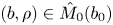 $(b, \rho ) \in \hat {M}_0(b_0)$,
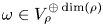 $\omega \in V_\rho ^{\oplus \dim (\rho )}$ with
 $\|\omega \|_2 = 1$,
 $k \in \mathcal {A}$, and
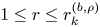 $1 \leq r \leq r_k^{(b, \rho )}$, there exist
 $1 \leq j \leq j_{\mathrm {m}}$ and
 $\check {x}_2 \in \Lambda (\Gamma ) \cap (B_{s_1}^{\mathrm {E}}(\check {x}_{k, r, 1}^{(b, \rho )}) \setminus B_{s_2}^{\mathrm {E}}(\check {x}_{k, r, 1}^{(b, \rho )}))$ such that
 \[ \bigl\|d\rho_b\big(d(\operatorname{BP}_{j, x_{k, r, 1}^{(b, \rho)}} \circ \Psi)_{\check{x}_{k, r, 1}^{(b, \rho)}}(z)\big)(\omega)\bigr\|_2 \geq 7\delta_1\epsilon_1 \]
where  $s_1 = {\epsilon _1}/{2C_\Psi \|\rho _b\|}$,
 $s_2 = {\varepsilon _3\epsilon _1}/{2C_\Psi \|\rho _b\|}$, and
 $z = (\check {x}_{k, r, 1}^{(b, \rho )}, \check {x}_2 - \check {x}_{k, r, 1}^{(b, \rho )}) \in \operatorname {T}_{\check {x}_{k, r, 1}^{(b, \rho )}}(\mathbb {R}^{n - 1})$.
Proof. Let 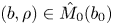 $(b, \rho ) \in \hat {M}_0(b_0)$,
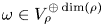 $\omega \in V_\rho ^{\oplus \dim (\rho )}$ with
 $\|\omega \|_2 = 1$,
 $k \in \mathcal {A}$, and
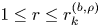 $1 \leq r \leq r_k^{(b, \rho )}$. Fix
 $s_1 = {\epsilon _1}/({2C_\Psi \|\rho _b\|})$,
 $s_2 = {\varepsilon _3\epsilon _1}/({2C_\Psi \|\rho _b\|})$. Denote
 $x_{k, r, 1}^{(b, \rho )}$ by
 $x_1$ and
 $\check {x}_{k, r, 1}^{(b, \rho )}$ by
 $\check {x}_1$. Define the linear maps
 $L_1 = (d\Psi )_{\check {x}_1}$,
 $L_{2, j} = (d\operatorname {BP}_{j, x_1})_{x_1}: \operatorname {T}_{x_1}(\tilde {U}_1) \to \mathfrak {a} \oplus \mathfrak {m}$, and
 $L_3: \mathfrak {a} \oplus \mathfrak {m} \to V_\rho ^{\oplus \dim (\rho )}$ by
 $L_3(w) = d\rho _b(w)(\omega )$ for all
 $w \in \mathfrak {a} \oplus \mathfrak {m}$. It suffices to find
 $1 \leq j \leq j_{\mathrm {m}}$ and
 $\check {x}_2 \in \Lambda (\Gamma ) \cap (B_{s_1}^{\mathrm {E}}(\check {x}_1) \setminus B_{s_2}^{\mathrm {E}}(\check {x}_1))$ such that
 \[ |\langle (L_3 \circ L_{2, j} \circ L_1)(z), \omega_0 \rangle| = |\langle z, (L_1^{*} \circ L_{2, j}^{*} \circ L_3^{*})(\omega_0) \rangle| \geq 7\delta_1\epsilon_1 \]
for some  $\omega _0 \in V_\rho ^{\oplus \dim (\rho )}$ with
 $\|\omega _0\|_2 = 1$, where
 $z = (\check {x}_1, \check {x}_2 - \check {x}_1) \in \operatorname {T}_{\check {x}_1}(\mathbb {R}^{n - 1})$. By Lemma 4.4,
 $\|L_3\|_{\mathrm {op}} \geq \varepsilon _1\|\rho _b\|$ which implies
 $\|L_3^{*}\|_{\mathrm {op}} \geq \varepsilon _1\|\rho _b\|$. Hence there exists
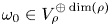 $\omega _0 \in V_\rho ^{\oplus \dim (\rho )}$ with
 $\|\omega _0\|_2 = 1$ such that
 $\|L_3^{*}(\omega _0)\| \geq \varepsilon _1\|\rho _b\|$. Now, Proposition 6.5 implies that there exists
 $1 \leq j \leq j_{\mathrm {m}}$ such that
 $\|L_{2, j}^{*}(L_3^{*}(\omega _0))\| \geq \varepsilon _2 \varepsilon _1\|\rho _b\|$. Recalling the constant
 $\delta _\Psi$, we get
 $\|L_1^{*}(L_{2, j}^{*}(L_3^{*}(\omega _0)))\| \geq \delta _\Psi \varepsilon _1\varepsilon _2 \|\rho _b\|$. Finally, by Proposition 6.6, there exists
 $\check {x}_2 \in \Lambda (\Gamma ) \cap (B_{s_1}^{\mathrm {E}}(\check {x}_1) \setminus B_{s_2}^{\mathrm {E}}(\check {x}_1))$ such that
 \begin{align*} |\langle z, (L_1^{*} \circ L_{2, j}^{*} \circ L_3^{*})(\omega_0) \rangle| &\geq \frac{\epsilon_1}{2C_\Psi \|\rho_b\|} \cdot \varepsilon_3 \cdot \|L_1^{*}(L_{2, j}^{*}(L_3^{*}(\omega_0)))\|\\ &\geq \frac{\epsilon_1}{2C_\Psi \|\rho_b\|} \cdot \varepsilon_1\varepsilon_2\varepsilon_3\delta_\Psi \|\rho_b\| \geq 7\delta_1\epsilon_1, \end{align*}
where  $z = (\check {x}_1, \check {x}_2 - \check {x}_1) \in \operatorname {T}_{\check {x}_1}(\mathbb {R}^{n - 1})$.
Let 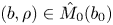 $(b, \rho ) \in \hat {M}_0(b_0)$,
 $H \in \mathcal {V}_\rho (\tilde {U})$,
 $k \in \mathcal {A}$, and
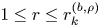 $1 \leq r \leq r_k^{(b, \rho )}$. Corresponding to
 \[ \omega = \frac{\rho_b\big(\Phi^{\alpha_0}\big(v_0\big(x_{k, r, 1}^{(b, \rho)}\big)\big)^{{-}1}\big)H\big(v_0\big(x_{k, r, 1}^{(b, \rho)}\big)\big)}{\big\|H\big(v_0\big(x_{k, r, 1}^{(b, \rho)}\big)\big)\big\|_2} \in V_\rho^{{\oplus} \dim(\rho)}, \]
denote by  $j_{k, r}^{(b, \rho ), H}$ and
 $x_{k, r, 2}^{(b, \rho ), H}$ the
 $j$ and
 $\Psi (\check {x}_2) \in U_1 \cap (W_{s_1}^{\mathrm {su}}(x_{k, r, 1}^{(b, \rho )}) \setminus W_{s_2}^{\mathrm {su}}(x_{k, r, 1}^{(b, \rho )}))$ provided by Lemma 8.1, where
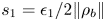 $s_1 = {\epsilon _1}/{2\|\rho _b\|}$ and
 $s_2 = {\varepsilon _3\epsilon _1}/{2C_\Psi ^{2} \|\rho _b\|}$. Define
 \begin{align*} D_{k, r, 1}^{(b, \rho)} &= W_{\epsilon_2/\|\rho_b\|}^{\mathrm{su}}\big(x_{k, r, 1}^{(b, \rho)}\big) \subset C_{k, r}^{(b, \rho)}, & D_{k, r, 2}^{(b, \rho), H} &= W_{\epsilon_2/\|\rho_b\|}^{\mathrm{su}}\big(x_{k, r, 2}^{(b, \rho), H}\big) \subset C_{k, r}^{(b, \rho)},\\ \not{\!D}_{k, r, 1}^{(b, \rho)} &= W_{\epsilon_2/2\|\rho_b\|}^{\mathrm{su}}\big(x_{k, r, 1}^{(b, \rho)}\big) \subset C_{k, r}^{(b, \rho)}, & \not{\!D}_{k, r, 2}^{(b, \rho), H} &= W_{\epsilon_2/2\|\rho_b\|}^{\mathrm{su}}\big(x_{k, r, 2}^{(b, \rho), H}\big) \subset C_{k, r}^{(b, \rho)}, \\ \hat{D}_{k, r, 1}^{(b, \rho)} &= W_{2N\epsilon_2/\|\rho_b\|}^{\mathrm{su}}\big(x_{k, r, 1}^{(b, \rho)}\big) \subset C_{k, r}^{(b, \rho)}, & \hat{D}_{k, r, 2}^{(b, \rho), H} &= W_{2N\epsilon_2/\|\rho_b\|}^{\mathrm{su}}\big(x_{k, r, 2}^{(b, \rho), H}\big) \subset C_{k, r}^{(b, \rho)}. \end{align*}
Denote by  $\psi _{k, r, 1}^{(b, \rho )}, \psi _{k, r, 2}^{(b, \rho ), H} \in C^{\infty }(\tilde {U}, \mathbb {R})$ bump functions such that
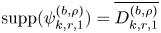 $\operatorname {supp}(\psi _{k, r, 1}^{(b, \rho )}) = \overline {D_{k, r, 1}^{(b, \rho )}}$ and
 $\operatorname {supp}(\psi _{k, r, 2}^{(b, \rho ), H}) = \overline {D_{k, r, 2}^{(b, \rho ), H}}$, they attain the maximum values
 $\psi _{k, r, 1}^{(b, \rho )}\bigl|_{\overline {\not{\!D}_{k, r, 1}^{(b, \rho )}}} = \psi _{k, r, 2}^{(b, \rho ), H}\bigr|_{\overline {\not{\!D}_{k, r, 2}^{(b, \rho ), H}}} = 1$, and they attain the minimum values
 $\psi _{k, r, 1}^{(b, \rho )}\bigl|_{\tilde {U} \setminus D_{k, r, 1}^{(b, \rho )}} = \psi _{k, r, 2}^{(b, \rho ), H}\bigr|_{\tilde {U} \setminus D_{k, r, 2}^{(b, \rho ), H}} = 0$. We can further assume that
 $\bigl|\psi _{k, r, 1}^{(b, \rho )}\bigr|_{C^{1}}, \bigl|\psi _{k, r, 2}^{(b, \rho ), H}\bigr|_{C^{1}} \leq {4\|\rho _b\|}/{\epsilon _2}$. It can be checked that
 $D_{k, r_1, p_1}^{(b, \rho )} \cap D_{k, r_2, p_2}^{(b, \rho ), H} = \varnothing$ for all
 $(r_1, p_1), (r_2, p_2) \in \{1, 2, \dotsc , r_k^{(b, \rho )}\} \times \{1, 2\}$ with
 $(r_1, p_1) \neq (r_2, p_2)$ and
 ${k \in \mathcal {A}}$. Define
 $\Xi _1(b, \rho ) = \{(k, r) \in \mathbb {Z}^{2}: k \in \mathcal {A}, r \in \{1, 2, \dotsc , r_k^{(b, \rho )}\}\}$ and
 $\Xi _2 = \{1, 2\} \times \{1, 2\}$. Define
 ${\Xi (b, \rho ) = \Xi _1(b, \rho ) \times \Xi _2}$. For all
 $(k, r, p, l) \in \Xi (b, \rho )$, denoting
 $j_{k, r}^{(b, \rho ), H}$ by
 $j$ for convenience, we define the smooth function
 $\tilde {\psi }_{(k, r, p, l)}^{(b, \rho ), H} \in C^{\infty }(\tilde {U}, \mathbb {R})$ by
 \begin{align*} \tilde{\psi}_{(k, r, p, l)}^{(b, \rho), H} = \begin{cases} \chi_{\tilde{\mathtt{C}}[\alpha_0]} \cdot \big(\psi_{k, r, 1}^{(b, \rho)} \circ \sigma^{\alpha_0}\big), & p = 1, l = 1, \\ \chi_{\tilde{\mathtt{C}}[\alpha_j]} \cdot \big(\psi_{k, r, 1}^{(b, \rho)} \circ \sigma^{\alpha_j}\big), & p = 1, l = 2, \\ \chi_{\tilde{\mathtt{C}}[\alpha_0]} \cdot \big(\psi_{k, r, 2}^{(b, \rho), H} \circ \sigma^{\alpha_0}\big), & p = 2, l = 1, \\ \chi_{\tilde{\mathtt{C}}[\alpha_j]} \cdot \big(\psi_{k, r, 2}^{(b, \rho), H} \circ \sigma^{\alpha_j}\big), & p = 2, l = 2, \end{cases} \end{align*}
where using  $\sigma ^{\alpha _0}$ and
 $\sigma ^{\alpha _j}$ is indeed justified because of the indicator functions
 $\chi _{\tilde {\mathtt {C}}[\alpha _0]} = \chi _{v_0(\tilde {U}_1)}$ and
 $\chi _{\tilde {\mathtt {C}}[\alpha _j]} = \chi _{v_j(\tilde {U}_1)}$. For all subsets
 $J \subset \Xi (b, \rho )$, we define the smooth function
 \[ \beta_J^{H} = \chi_{\tilde{U}} - \mu\sum_{(k, r, p, l) \in J} \tilde{\psi}_{(k, r, p, l)}^{(b, \rho), H} \in C^{\infty}(\tilde{U}, \mathbb{R}). \]
Remark We will often include the superscript  $H$ even when there is no dependence on it for a more uniform notation to simplify exposition.
See Figure 2 for a visualization of the following lemma.
Lemma 8.2 Let  $(b, \rho ) \in \hat {M}_0(b_0)$,
 $H \in \mathcal {V}_\rho (\tilde {U})$, and
 $J \subset \Xi (b, \rho )$. Then any connected component of
 \[ \bigcup \bigl\{D_{k, r, p}^{(b, \rho), H}: (k, r, p, l) \in J \text{ for some } l \in \{1, 2\}\bigr\} \]
is a union of at most  $N$ terms and hence contained in
 $\hat {D}_{k, r, p}^{(b, \rho ), H}$ for any
 $(k, r, p, l) \in J$ corresponding to one of those terms.
Proof. Let  $(b, \rho ) \in \hat {M}_0(b_0)$,
 $H \in \mathcal {V}_\rho (\tilde {U})$, and
 $J \subset \Xi (b, \rho )$. We drop superscripts
 $(b, \rho )$ and
 $H$ to simply notation. Define
 \[ D_\cup{=} \{D_{k, r, p}: (k, r, p, l) \in J \text{ for some } l \in \{1, 2\}\} \]
and  $D_\cup ^{\mathrm {conn}} = D_\cup /{\sim }$ where
 $\sim$ is the equivalence relation defined by
 $D_{k_1, r_1, p_1} \sim D_{k_2, r_2, p_2}$ if
 $D_{k_1, r_1, p_1} \cap D_{k_2, r_2, p_2} \neq \varnothing$, for all distinct
 $D_{k_1, r_1, p_1}, D_{k_2, r_2, p_2} \in D_\cup$ and then extended by transitivity. Let
 $[D_{k, r, p}] \in D_\cup ^{\mathrm {conn}}$ be any equivalence class. It suffices to show that it has cardinality
 $\#[D_{k, r, p}] \leq N$. The cardinality must be finite, and, by way of contradiction, suppose
 $\#[D_{k, r, p}] > N$. Consider the connected graph
 $G_{[D_{k, r, p}]} = ([D_{k, r, p}], E_{[D_{k, r, p}]})$ where
 \begin{align*} E_{[D_{k, r, p}]} &={}\big\{(D_{k_1, r_1, p_1}, D_{k_2, r_2, p_2}): D_{k_1, r_1, p_1}, D_{k_2, r_2, p_2} \in [D_{k, r, p}] \\ &\qquad \text{are distinct and } D_{k_1, r_1, p_1} \cap D_{k_2, r_2, p_2} \neq \varnothing \big\}. \end{align*}
Let  $T_{[D_{k, r, p}]}$ be any spanning tree of the graph
 $G_{[D_{k, r, p}]}$. If the number of vertices of
 $T_{[D_{k, r, p}]}$ is greater than
 $N + 1$, then we can repeatedly delete leaves (vertices with only one emanating edge) and their corresponding edges until we obtain a subtree
 $T'_{[D_{k, r, p}]}$ with
 $N + 1$ vertices. This is possible since all trees have at least one leaf and deleting one results in a subtree. Since
 $\#\mathcal {A} = N$, by the pigeonhole principle there must be some
 $D_{k_0, r_1, p_1} \subset C_{k_0, r_1}$ and
 $D_{k_0, r_2, p_2} \subset C_{k_0, r_2}$ which are vertices of
 $T'_{[D_{k, r, p}]}$. Hence, there is a path between them of length at most
 $N$. But this represents a sequence of consecutive pairs of balls with non-empty intersections. This implies
 \[ d(x_{k_0, r_1, p_1}, x_{k_0, r_2, p_2}) < \frac{2N\epsilon_2}{\|\rho_b\|}. \]
This is a contradiction using (16) by construction of  $x_{k_0, r_1, p_1}$ and
 $x_{k_0, r_2, p_2}$.
Corollary 8.3 Let  $(b, \rho ) \in \hat {M}_0(b_0)$,
 $H \in \mathcal {V}_\rho (\tilde {U})$, and
 $J \subset \Xi (b, \rho )$. Then we have
 \[ 1 - N\mu \leq \beta_J^{H} \leq 1,\quad \big|\beta_J^{H}\big|_{C^{1}} \leq \frac{4N\mu\|\rho_b\|}{\epsilon_2}. \]
Proof. Let 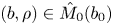 $(b, \rho ) \in \hat {M}_0(b_0)$,
 $H \in \mathcal {V}_\rho (\tilde {U})$, and
 $J \subset \Xi (b, \rho )$. We drop superscripts
 $(b, \rho )$ and
 $H$ to simply notation. Let
 $u \in \tilde {U}$. If
 $u \notin v_j(D_{k, r, p})$ for all
 $0 \leq j \leq j_{\mathrm {m}}$ and
 $(k, r, p, l) \in J$, then from definitions we have
 $\beta _J(u) = 1$ and
 $\|(d\beta _J)_u\|_{\mathrm {op}} = 0$. Otherwise, suppose
 $u \in v_j(D_{k, r, p})$ for some
 $0 \leq j \leq j_{\mathrm {m}}$ and
 $(k, r, p, l) \in J$. By Lemma 8.2, using the same notations, we have
 $\#[D_{k, r, p}] \leq N$. By the last criterion in Proposition 6.5, we also have
 $u \notin v_{j'}(D_{k', r', p'})$ if
 $j' \neq j$ or
 $D_{k', r', p'} \notin [D_{k, r, p}]$. The corollary now follows from definitions.
Definition 8.4 (Dolgopyat operator)
For all  $\xi \in \mathbb {C}$ with
 $|a| < a_0'$, if
 $(b, \rho ) \in \hat {M}_0(b_0)$, then for all
 $J \subset \Xi (b, \rho )$ and
 $H \in \mathcal {V}_\rho (\tilde {U})$, we define the Dolgopyat operator
 $\mathcal {N}_{a, J}^{H}: C^{1}(\tilde {U}, \mathbb {R}) \to C^{1}(\tilde {U}, \mathbb {R})$ by
 \[ \mathcal{N}_{a, J}^{H}(h) = \tilde{\mathcal{L}}_{a}^{m}\big(\beta_J^{H}h\big) \quad \text{for all}\ h \in C^{1}(\tilde{U}, \mathbb{R}). \]
Definition 8.5 (Dense)
For all 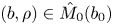 $(b, \rho ) \in \hat {M}_0(b_0)$, a subset
 $J \subset \Xi (b, \rho )$ is said to be dense if for all
 $(k, r) \in \Xi _1(b, \rho )$, there exists
 $(p, l) \in \Xi _2$ such that
 $(k, r, p, l) \in J$.
(a) This example illustrates the Vitali covering of two cylinders which are depicted by the two dark gray regions. Although the smaller balls for a fixed cylinder are mutually disjoint, they may intersect the smaller balls of other cylinders. (b) This example illustrates that the chain of intersecting  $D_{k, 1, 1}^{(b, \rho )}$ is contained in
 $\hat {D}_{1, 1, 1}^{(b, \rho )}$.

For all 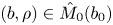 $(b, \rho ) \in \hat {M}_0(b_0)$, define
 $\mathcal {J}(b, \rho ) = \{J \subset \Xi (b, \rho ): J \text { is dense}\}$.
9. Proof of Theorem 5.4
We devote this section to the proof of Theorem 5.4. We do this by proving all the properties in the theorem in the following subsections.
For this section recall the positive constant  $a_0'$ from the end of § 5.2 and that we already fixed
 $b_0 = 1$.
9.1 Proof of properties (1) and (3)(2b) in Theorem 5.4
Lemma 9.1 For all  $\xi \in \mathbb {C}$ with
 $|a| < a_0'$, if
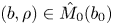 $(b, \rho ) \in \hat {M}_0(b_0)$, then for all
 $J \in \mathcal {J}(b, \rho )$ and
 $H \in \mathcal {V}_\rho (\tilde {U})$, we have
 $\mathcal {N}_{a, J}^{H}(K_{E\|\rho _b\|}(\tilde {U})) \subset K_{E\|\rho _b\|}(\tilde {U})$.
Proof. Let  $\xi \in \mathbb {C}$ with
 $|a| < a_0'$ and suppose
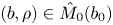 $(b, \rho ) \in \hat {M}_0(b_0)$. Let
 $J \in \mathcal {J}(b, \rho )$ and
 $H \in \mathcal {V}_\rho (\tilde {U})$. Let
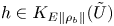 $h \in K_{E\|\rho _b\|}(\tilde {U})$ and
 $u \in \tilde {U}$. Corollary 8.3 and (20) give
 \begin{align*} \big\|d\big(\beta_J^{H} h\big)_u\big\|_{\mathrm{op}} &= \big\|\big(d\beta_J^{H}\big)_u\big\|_{\mathrm{op}} \cdot h(u) + \beta_J^{H}(u) \cdot \|(dh)_u\|_{\mathrm{op}} \leq \frac{4N\mu \|\rho_b\|}{\epsilon_2} h(u) + E\|\rho_b\|h(u)\\ &\leq (2E + E) \|\rho_b\|h(u) \cdot \frac{\beta_J^{H}(u)}{1 - N\mu} \leq 4E\|\rho_b\|\big(\beta_J^{H} h\big)(u). \end{align*}
So  $\beta _J^{H} h \in K_{4E\|\rho _b\|}(\tilde {U})$. Now applying Lemma 7.3 and (13) and (19), we have
 \begin{align*} \big\|\big(d\mathcal{N}_{a, J}^{H}(h)\big)_u\big\|_{\mathrm{op}} &= \big\|\big(d\tilde{\mathcal{L}}_a^{m}\big(\beta_J^{H} h\big)\big)_u\big\|_{\mathrm{op}} \leq A_0\biggl(\frac{4E\|\rho_b\|}{\kappa_2^{m}} + 1\biggr) \tilde{\mathcal{L}}_a^{m}\big(\beta_J^{H} h\big)(u)\\ &\leq A_0\biggl(\frac{4E\|\rho_b\|}{8A_0} + \frac{E\|\rho_b\|}{2A_0}\biggr) \tilde{\mathcal{L}}_a^{m}\big(\beta_J^{H} h\big)(u)\\ &= E\|\rho_b\|\mathcal{N}_{a, J}^{H}(h)(u). \end{align*}
Lemma 9.2 For all  $\xi \in \mathbb {C}$ with
 $|a| < a_0'$, if
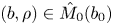 $(b, \rho ) \in \hat {M}_0(b_0)$, and if
 $H \in \mathcal {V}_\rho (\tilde {U})$ and
 $h \in C^{1}(\tilde {U}, \mathbb {R})$ satisfy properties (3)(1a) and (3)(1b) in Theorem 5.4, then for all
 $J \in \mathcal {J}(b, \rho )$ we have
 \[ \big\|\big(d\tilde{\mathcal{M}}_{\xi, \rho}^{m}(H)\big)_u\big\|_{\mathrm{op}} \leq E\|\rho_b\|\mathcal{N}_{a, J}^{H}(h)(u) \quad \text{for all }u \in \tilde{U}. \]
Proof. Let  $\xi \in \mathbb {C}$ with
 $|a| < a_0'$ and suppose
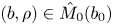 $(b, \rho ) \in \hat {M}_0(b_0)$. Suppose
 $H \in \mathcal {V}_\rho (\tilde {U})$ and
 $h \in C^{1}(\tilde {U}, \mathbb {R})$ satisfy properties (3)(1a) and (3)(1b) in Theorem 5.4. Let
 $J \in \mathcal {J}(b, \rho )$ and
 $u \in \tilde {U}$. Applying Lemma 7.3 and (13), (19), and (20), we have
 \begin{align*} \big\|\big(d\tilde{\mathcal{M}}_{\xi, \rho}^{m}(H)\big)_u\big\|_{\mathrm{op}} &\leq A_0\biggl(\frac{E\|\rho_b\|}{\kappa_2^{m}}\tilde{\mathcal{L}}_a^{m}(h)(u) + \|\rho_b\|\tilde{\mathcal{L}}_a^{m}\|H\|(u)\biggr)\\ &\leq A_0\biggl(\frac{E}{8A_0} + \frac{E}{2A_0}\biggr) \|\rho_b\|\tilde{\mathcal{L}}_a^{m}(h)(u)\\ &\leq \biggl(\frac{E}{8(1 - N\mu)} + \frac{E}{2(1 - N\mu)}\biggr) \|\rho_b\|\tilde{\mathcal{L}}_a^{m}\big(\beta_J^{H}h\big)(u)\\ &\leq \biggl(\frac{E}{6} + \frac{2E}{3}\biggr) \|\rho_b\|\mathcal{N}_{a, J}^{H}(h)(u) \\ &\leq E\|\rho_b\|\mathcal{N}_{a, J}^{H}(h)(u). \end{align*}
9.2 Proof of property (2) in Theorem 5.4
Recall the constants from (17) and (18) and note that  $\epsilon _4 > 80\epsilon _3$. Let
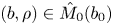 $(b, \rho ) \in \hat {M}_0(b_0)$ and
 $H \in \mathcal {V}_\rho (\tilde {U})$. For all
 $k \in \mathcal {A}$ and
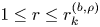 $1 \leq r \leq r_k^{(b, \rho )}$, define the open sets
 \[ Z_{k, r, 1}^{(b, \rho)} = W_{\epsilon_3/\|\rho_b\|}^{\mathrm{su}}\big(\sigma^{m_1}\big(x_{k, r, 1}^{(b, \rho)}\big)\big) \cap \tilde{U}_k,\quad Z_{k, r, 2}^{(b, \rho), H} = W_{\epsilon_3/\|\rho_b\|}^{\mathrm{su}}\big(\sigma^{m_1}\big(x_{k, r, 2}^{(b, \rho), H}\big)\big) \cap \tilde{U}_k \]
which then satisfy 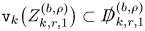 $\mathtt {v}_k\big (Z_{k, r, 1}^{(b, \rho )}\big ) \subset \not{\!D}_{k, r, 1}^{(b, \rho )}$ and
 $\mathtt {v}_k\big (Z_{k, r, 2}^{(b, \rho ), H}\big ) \subset \not{\!D}_{k, r, 2}^{(b, \rho ), H}$. First we need to prove the crucial Corollary 9.5.
We begin with definitions for this subsection. For all  $w \in \operatorname {T}^{1}(X)$, the Patterson–Sullivan density induces the measure
 $\mu ^{\mathrm {PS}}_{W^{\mathrm {su}}(w)}$ on the leaf
 $W^{\mathrm {su}}(w)$ defined by
 \[ d\mu^{\mathrm{PS}}_{W^{\mathrm{su}}(w)}(u) = e^{\delta_\Gamma \beta_{(\tilde{u})^{+}}(o, \tilde{u})} \, d\mu^{\mathrm{PS}}_{o}((\tilde{u})^{+}). \]
Let  $k \in \mathcal {A}$ and
 $w_k \in R_k$ be the centers. Then we have
 \[ \frac{d\big(\nu_{\tilde{U}}|_{\tilde{U}_k}\big)}{d\big(\mu^{\mathrm{PS}}_{W^{\mathrm{su}}(w_k)}\big|_{\tilde{U}_k}\big)}(u) = C \int_{[u, S_k]} e^{\delta_\Gamma \beta_{[\tilde{u}, \tilde{s}]^{-}}(o, [\tilde{u}, \tilde{s}])} \, d\mu^{\mathrm{PS}}_o([\tilde{u}, \tilde{s}]^{-}) \]
for all  $u \in \tilde {U}_k$, for some
 $C > 0$. In particular, by positivity and continuity of the integrand, there exists
 $C_{\mathrm {PS}}^{\nu } > 0$ such that
 ${1}/{C_{\mathrm {PS}}^{\nu }} \leq {d(\nu _{\tilde {U}}|_{\tilde {U}_k})}/{d(\mu ^{\mathrm {PS}}_{W^{\mathrm {su}}(w_k)}|_{\tilde {U}_k})} \leq C_{\mathrm {PS}}^{\nu }$. Recall the trajectory isomorphism
 $\psi$ from [Reference RatnerRat73, Definition 1.1]. For all
 $w \in [W_{\epsilon _0}^{\mathrm {su}}(w_k), W_{\epsilon _0}^{\mathrm {ss}}(w_k)]$, we define another map
 $\phi _w: U_k \to W^{\mathrm {su}}(w)$ by
 $\phi _w(u) = \psi _w^{-1}([u, w])$ for all
 $u \in U_k$. The maps
 $\phi _w$ are Lipschitz and smooth in
 $w \in [W_{\epsilon _0}^{\mathrm {su}}(w_k), W_{\epsilon _0}^{\mathrm {ss}}(w_k)]$, and hence there exists
 $C_\phi = \max _{k \in \mathcal {A}}\sup _{w \in R_k} \operatorname {Lip}_d(\phi _w)$.
Lemma 9.3 For all  $j \in \mathcal {A}$, let
 $w_j \in R_j$ be the centers. There exists
 $C > 0$ such that for all
 $j \in \mathcal {A}$,
 $u \in U_j$, and
 $\epsilon \in (0, 2C_{\mathrm {Ano}}C_\phi \hat {\delta }e^{\hat {\delta }})$, we have
 \[ \nu_{\tilde{U}}(W^{\mathrm{su}}_\epsilon(u) \cap \tilde{U}_j) \geq C\mu^{\mathrm{PS}}_{W^{\mathrm{su}}(w_j)}(W^{\mathrm{su}}_\epsilon(u)). \]
Proof. By continuity, we fix  $C_1 = \min _{k \in \mathcal {A}} \inf _{u \in U_k, u' \in R_k} e^{\delta _\Gamma \beta _{(\tilde {u})^{+}}(\tilde {u}, \widetilde {\phi _{u'}(u)})}$ so that we have the bound
 \begin{align*} \mu^{\mathrm{PS}}_{W^{\mathrm{su}}(u')}(\phi_{u'}(U_k)) &= \int_{\phi_{u'}(U_k)} e^{\delta_\Gamma \beta_{(\tilde{u})^{+}}(o, \tilde{u})} \, d\mu^{\mathrm{PS}}_o((\tilde{u})^{+}) = \int_{U_k} e^{\delta_\Gamma \beta_{(\tilde{u})^{+}}(o, \widetilde{\phi_{u'}(u)})} \, d\mu^{\mathrm{PS}}_o((\tilde{u})^{+})\\ &= \int_{U_k} e^{\delta_\Gamma \beta_{(\tilde{u})^{+}}(\tilde{u}, \widetilde{\phi_{u'}(u)})} e^{\delta_\Gamma \beta_{(\tilde{u})^{+}}(o, \tilde{u})} \, d\mu^{\mathrm{PS}}_o((\tilde{u})^{+})\\ &\geq C_1 \int_{U_k} e^{\delta_\Gamma \beta_{(\tilde{u})^{+}}(o, \tilde{u})} \, d\mu^{\mathrm{PS}}_o((\tilde{u})^{+}) = C_1 \mu^{\mathrm{PS}}_{W^{\mathrm{su}}(w_k)}(U_k) \end{align*}
for all  $u' \in R_k$ and
 $k \in \mathcal {A}$. Fix
 $C_2 = \min _{k \in \mathcal {A}} \mu ^{\mathrm {PS}}_{W^{\mathrm {su}}(w_k)}(U_k)$. By continuity of the Busemann function, finiteness of the Patterson–Sullivan density, and compactness of
 $R$, we can fix
 $C_3 = \sup _{u' \in R} \mu ^{\mathrm {PS}}_{W^{\mathrm {su}}(u')}(W^{\mathrm {su}}_{2C_{\mathrm {Ano}}^{2}C_\phi \hat {\delta }e^{\hat {\delta }}}(u'))$. Fix
 $C = {C_1 C_2}/{C_{\mathrm {PS}}^{\nu } C_3}$. Let
 $j \in \mathcal {A}$,
 $u \in U_j$, and
 $\epsilon \in (0, 2C_{\mathrm {Ano}}C_\phi \hat {\delta }e^{\hat {\delta }})$. Let
 $\alpha = (\alpha _0, \alpha _1, \dotsc , \alpha _l)$ for some
 $l \in \mathbb {N}$ be any admissible sequence with
 $\alpha _0 = j$ such that
 $u \in \overline {\mathtt {C}[\alpha ]}$ and
 $2C_{\mathrm {Ano}}C_\phi \hat {\delta } \leq e^{t} \epsilon < 2C_{\mathrm {Ano}}C_\phi \hat {\delta }e^{\hat {\delta }}$ where
 $t = \tau _\alpha (u)$. Let
 $k = \alpha _l$ and
 $u' = ua_t \in R_k$. Note that
 $\overline {\mathtt {C}[\alpha ]} = \sigma ^{-\alpha }(U_k) = \phi _{u'}(U_k)a_{-t}$. In fact, since
 $\operatorname {diam}_{d_{\mathrm {su}}}(\phi _{u'}(U_k)) \leq C_\phi \hat {\delta }$, we have
 $\overline {\mathtt {C}[\alpha ]} \subset W^{\mathrm {su}}_{C_{\mathrm {Ano}}e^{-t}C_\phi \hat {\delta }}(u) \cap U_j \subset W^{\mathrm {su}}_\epsilon (u) \cap U_j$. Note that
 $W^{\mathrm {su}}(w_j) = W^{\mathrm {su}}(u)$. Thus, we calculate that
 \begin{align*} \nu_{\tilde{U}}(W^{\mathrm{su}}_\epsilon(u) \cap \tilde{U}_j) &\geq \nu_{\tilde{U}}(\overline{\mathtt{C}[\alpha]}) \geq \frac{1}{C_{\mathrm{PS}}^{\nu}} \mu^{\mathrm{PS}}_{W^{\mathrm{su}}(u)}(\overline{\mathtt{C}[\alpha]}) = \frac{1}{C_{\mathrm{PS}}^{\nu}}e^{-\delta_\Gamma t} \mu^{\mathrm{PS}}_{W^{\mathrm{su}}(u')}(\overline{\mathtt{C}[\alpha]}a_t)\\ &\geq \frac{C_1}{C_{\mathrm{PS}}^{\nu}}e^{-\delta_\Gamma t} \mu^{\mathrm{PS}}_{W^{\mathrm{su}}(w_k)}(U_k) \geq \frac{C_1C_2}{C_{\mathrm{PS}}^{\nu}}e^{-\delta_\Gamma t}. \end{align*}
On the other hand,
 \[ \mu^{\mathrm{PS}}_{W^{\mathrm{su}}(u)}(W^{\mathrm{su}}_\epsilon(u)) = e^{-\delta_\Gamma t} \mu^{\mathrm{PS}}_{W^{\mathrm{su}}(u')}(W^{\mathrm{su}}_\epsilon(u) a_t) \leq e^{-\delta_\Gamma t} \mu^{\mathrm{PS}}_{W^{\mathrm{su}}(u')}\big(W^{\mathrm{su}}_{2C_{\mathrm{Ano}}^{2}C_\phi\hat{\delta}e^{\hat{\delta}}}(u')\big) \leq C_3e^{-\delta_\Gamma t}. \]
Combining the two inequalities above, the lemma follows.
Corollary 9.4 The measure  $\nu _{\tilde {U}}$ satisfies the doubling/Federer property, that is, there exists
 $C > 0$ such that for all
 $k \in \mathcal {A}$,
 $u \in U_k$, and
 $\epsilon \in \bigl (0, 2C_{\mathrm {Ano}}C_\phi \hat {\delta }e^{\hat {\delta }}\bigr )$, we have
 \[ \nu_{\tilde{U}}(W^{\mathrm{su}}_{2\epsilon}(u) \cap \tilde{U}_k) \leq C\nu_{\tilde{U}}(W^{\mathrm{su}}_{\epsilon}(u) \cap \tilde{U}_k). \]
Proof. By [Reference Paulin, Pollicott and SchapiraPPS15, Proposition 3.12], we know that  $\mu ^{\mathrm {PS}}_{W^{\mathrm {su}}(w_k)}$ satisfies the doubling/Federer property for all
 $k \in \mathcal {A}$. Fix
 $C_1 > 0$ to be an upper bound for the corresponding doubling constants for all
 $k \in \mathcal {A}$. Fix
 $C_2 > 0$ to be the constant from Lemma 9.3. Fix
 $C = {C_1 C_{\mathrm {PS}}^{\nu }}/{C_2}$. Let
 $k \in \mathcal {A}$,
 $u \in U_k$, and
 $\epsilon \in (0, 2C_{\mathrm {Ano}}C_\phi \hat {\delta }e^{\hat {\delta }})$. We have
 \begin{align*} \nu_{\tilde{U}}(W^{\mathrm{su}}_{2\epsilon}(u) \cap \tilde{U}_k) &\leq C_{\mathrm{PS}}^{\nu} \mu^{\mathrm{PS}}_{W^{\mathrm{su}}(w_k)}(W^{\mathrm{su}}_{2\epsilon}(u)) \leq C_1 C_{\mathrm{PS}}^{\nu} \mu^{\mathrm{PS}}_{W^{\mathrm{su}}(w_k)}(W^{\mathrm{su}}_{\epsilon}(u))\\ &\leq \frac{C_1 C_{\mathrm{PS}}^{\nu}}{C_2}\nu_{\tilde{U}}(W^{\mathrm{su}}_\epsilon(u) \cap \tilde{U}_k) = C\nu_{\tilde{U}}(W^{\mathrm{su}}_\epsilon(u) \cap \tilde{U}_k). \end{align*}
Corollary 9.5 There exists  $C > 1$ such that for all
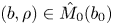 $(b, \rho ) \in \hat {M}_0(b_0)$,
 $k \in \mathcal {A}$, and
 $u \in U_k$, we have
 \[ \nu_{\tilde{U}}\big(W_{\epsilon_4/\|\rho_b\|}^{\mathrm{su}}(u) \cap \tilde{U}_k\big) \leq C\nu_{\tilde{U}}\big(W_{\epsilon_3/\|\rho_b\|}^{\mathrm{su}}(u) \cap \tilde{U}_k\big). \]
For all 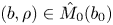 $(b, \rho ) \in \hat {M}_0(b_0)$,
 $H \in \mathcal {V}_\rho (\tilde {U})$, and
 $J \in \mathcal {J}(b, \rho )$, define the set
 $Z_J^{H} = \bigcup _{(k, r, p, l) \in J} Z_{k, r, p}^{(b, \rho ), H}$.
Lemma 9.6 There exists  $\eta \in (0, 1)$ such that for all
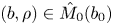 $(b, \rho ) \in \hat {M}_0(b_0)$,
 $J \in \mathcal {J}(b, \rho )$,
 $H \in \mathcal {V}_\rho (\tilde {U})$, and
 $h \in K_{2E\|\rho _b\|}(\tilde {U})$, we have
 \[ \int_{Z_J^{H}} h \, d\nu_{\tilde{U}} \geq \eta \int_{\tilde{U}} h \, d\nu_{\tilde{U}}. \]
Proof. Fix  $C$ to be the one provided by Corollary 9.5 and
 $\eta = (Ce^{4E\epsilon _4})^{-1} \in (0, 1)$. Let
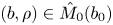 $(b, \rho ) \in \hat {M}_0(b_0)$,
 $J \in \mathcal {J}(b, \rho )$,
 $H \in \mathcal {V}_\rho (\tilde {U})$, and
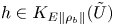 $h \in K_{E\|\rho _b\|}(\tilde {U})$. Denote
 $\epsilon _j' = {\epsilon _j}/{\|\rho _b\|}$ and
 $W_{j, k}(u) = W_{\epsilon _j'}^{\mathrm {su}}(u) \cap \tilde {U}_k$ for all
 $u \in \tilde {U}_k$,
 $k \in \mathcal {A}$, and
 $j \in \{3, 4\}$. Define
 \[ P_k = \big\{\sigma^{m_1}\big(x_{k, r, p}^{(b, \rho), H}\big) \in U: (k, r, p, l) \in J \text{ for some } l \in \{1, 2\}\big\}. \]
Since  $\{\hat {C}_{k, r}^{(b, \rho )} \subset W^{\mathrm {su}}(w_1): 1 \leq r \leq r_k^{(b, \rho )}\}$, where
 $w_1 \in R_1$ is the center, covers
 $\mathtt {C}_k$ for all
 $k \in \mathcal {A}$ and
 $J \subset \Xi (b, \rho )$ is dense, it follows that
 $\{W_{\epsilon _4'}^{\mathrm {su}}(x) \subset \tilde {U}_k: x \in P_k\}$ covers
 $\operatorname {int}(U_k)$ for all
 $k \in \mathcal {A}$. Let
 $l_x = \inf _{u \in W_{4, k}(x)} h(u)$ and
 $L_x = \sup _{u \in W_{4, k}(x)} h(u)$ for all
 $x \in P_k$ and
 $k \in \mathcal {A}$. Using
 $|\log \circ h|_{C^{1}} \leq 2E\|\rho _b\|$, we can derive that
 $L_x \leq l_x e^{2E\|\rho _b\| \operatorname {diam}_d (W_{\epsilon _4'}^{\mathrm {su}}(x))} = l_x e^{4E\epsilon _4}$. Hence, by Corollary 9.5, we have
 \begin{align*} \int_{\tilde{U}} h(u) \, d\nu_{\tilde{U}}(u) &\leq \sum_{k \in \mathcal{A}} \sum_{x \in P_k} \int_{W_{4, k}(x)} h(u) \, d\nu_{\tilde{U}}(u) \leq \sum_{k \in \mathcal{A}} \sum_{x \in P_k} L_x \cdot \nu_{\tilde{U}}(W_{4, k}(x))\\ &\leq Ce^{4E\epsilon_4} \sum_{k \in \mathcal{A}} \sum_{x \in P_k} l_x \cdot \nu_{\tilde{U}}(W_{3, k}(x)) \leq Ce^{4E\epsilon_4} \sum_{k \in \mathcal{A}} \sum_{x \in P_k} \int_{W_{3, k}(x)} h(u) \, d\nu_{\tilde{U}}(u)\\ &\leq \frac{1}{\eta} \int_{Z_J^{H}} h(u) \, d\nu_{\tilde{U}}(u). \end{align*}
Lemma 9.7 There exist  $a_0 > 0$ and
 $\eta \in (0, 1)$ such that for all
 $\xi \in \mathbb {C}$ with
 $|a| < a_0$, if
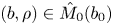 $(b, \rho ) \in \hat {M}_0(b_0)$, then for all
 $J \in \mathcal {J}(b, \rho )$,
 $H \in \mathcal {V}_\rho (\tilde {U})$, and
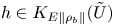 $h \in K_{E\|\rho _b\|}(\tilde {U})$, we have
 $\bigl\|\mathcal {N}_{a, J}^{H}(h)\bigr\|_2 \leq \eta \|h\|_2$.
Proof. Fix  $\eta ' \in (0, 1)$ to be the
 $\eta$ provided by Lemma 9.6. Fix a positive constant (see § 5.2 for the definition of
 $A_f$)
 \[ a_0 < \min\biggl(a_0', \frac{1}{mA_f}\log\biggl(\frac{1}{1 - \eta'\mu e^{{-}mT_0}}\biggr)\biggr) \]
so that we can also fix  $\eta = \sqrt {e^{mA_fa_0}(1 - \eta '\mu e^{-mT_0})} \in (0, 1)$. Let
 $\xi \in \mathbb {C}$ with
 $|a| < a_0$. Suppose
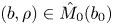 $(b, \rho ) \in \hat {M}_0(b_0)$. Let
 $J \in \mathcal {J}(b, \rho )$,
 $H \in \mathcal {V}_\rho (\tilde {U})$, and
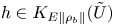 $h \in K_{E\|\rho _b\|}(\tilde {U})$. We have the estimate
 $\mathcal {N}_{a, J}^{H}(h)^{2} \leq e^{mA_fa_0}\mathcal {N}_{0, J}^{H}(h)^{2}$ and, by the Cauchy–Schwarz inequality, we have
 \[ \mathcal{N}_{0, J}^{H}(h)^{2} = \tilde{\mathcal{L}}_0^{m}\big(\beta_J^{H} h\big)^{2} \leq \tilde{\mathcal{L}}_0^{m}\Big(\big(\beta_J^{H}\big)^{2}\Big) \tilde{\mathcal{L}}_0^{m}(h^{2}). \]
It is easy to see that 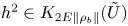 $h^{2} \in K_{2E\|\rho _b\|}(\tilde {U})$. Then Lemma 7.3 gives
 $\tilde {\mathcal {L}}_0^{m}(h^{2}) \in K_{B'}(\tilde {U})$ where
 $B' = A_0({2E|b|}/{\kappa _2^{m}} + 1) \leq A_0({2E|b|}/{8A_0} + {E|b|}/{2A_0}) \leq 2E|b|$. So
 $\tilde {\mathcal {L}}_0^{m}(h^{2}) \in K_{2E\|\rho _b\|}(\tilde {U})$. Now Lemma 9.6 gives
 $\int _{Z_J^{H}} \tilde {\mathcal {L}}_0^{m}(h^{2}) \, d\nu _{\tilde {U}} \geq \eta ' \int _{\tilde {U}} \tilde {\mathcal {L}}_0^{m}(h^{2}) \, d\nu _{\tilde {U}}$. Note that
 \[ \tilde{\mathcal{L}}_0^{m}\big((\beta_J^{H})^{2}\big)(u) \leq \tilde{\mathcal{L}}_0^{m}\Big(\chi_{\tilde{U}} - \mu \tilde{\psi}_{(k, r, p, l)}^{(b, \rho), H}\Big)(u) \leq 1 - \mu e^{{-}mT_0} \]
for all  $u \in Z_J^{H}$ by choosing any
 $(k, r, p, l) \in J$. Putting everything together and using
 $\tilde {\mathcal {L}}_0^{*}(\nu _{\tilde {U}}) = \nu _{\tilde {U}}$ (which is easily derived from
 $\mathcal {L}_0^{*}(\nu _U) = \nu _U$), we have
 \begin{align*} \int_{\tilde{U}} \mathcal{N}_{a, J}^{H}(h)^{2} \, d\nu_{\tilde{U}} &\leq \int_{\tilde{U}} e^{mA_fa_0}\mathcal{N}_{0, J}^{H}(h)^{2} \, d\nu_{\tilde{U}}\\ &\leq e^{mA_fa_0}\biggl(\int_{Z_J^{H}} \tilde{\mathcal{L}}_0^{m}\big(\big(\beta_J^{H}\big)^{2}\big) \tilde{\mathcal{L}}_0^{m}(h^{2}) \, d\nu_{\tilde{U}} + \int_{\tilde{U} \setminus Z_J^{H}} \tilde{\mathcal{L}}_0^{m}\big(\big(\beta_J^{H}\big)^{2}\big) \tilde{\mathcal{L}}_0^{m}(h^{2}) \, d\nu_{\tilde{U}}\biggr)\\ &\leq e^{mA_fa_0}\biggl(\big(1 - \mu e^{{-}mT_0}\big)\int_{Z_J^{H}} \tilde{\mathcal{L}}_0^{m}(h^{2}) \, d\nu_{\tilde{U}} + \int_{\tilde{U} \setminus Z_J^{H}} \tilde{\mathcal{L}}_0^{m}(h^{2}) \, d\nu_{\tilde{U}}\biggr)\\ &= e^{mA_fa_0}\biggl(\int_{\tilde{U}} \tilde{\mathcal{L}}_0^{m}(h^{2}) \, d\nu_{\tilde{U}} - \mu e^{{-}mT_0}\int_{Z_J^{H}} \tilde{\mathcal{L}}_0^{m}(h^{2}) \, d\nu_{\tilde{U}}\biggr)\\ &\leq e^{mA_fa_0}\big(1 - \eta'\mu e^{{-}mT_0}\big)\int_{\tilde{U}} \tilde{\mathcal{L}}_0^{m}(h^{2}) \, d\nu_{\tilde{U}}\\ &= \eta^{2} \int_{\tilde{U}} h^{2} \, d\nu_{\tilde{U}}. \end{align*}
9.3 Proof of property (3)(2a) in Theorem 5.4
Now, for all  $\xi \in \mathbb {C}$ with
 $|a| < a_0'$, if
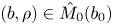 $(b, \rho ) \in \hat {M}_0(b_0)$, then for all
 $H \in \mathcal {V}_\rho (\tilde {U})$,
 $h \in K_{E\|\rho _b\|}(\tilde {U})$, and
 $1 \leq j \leq j_{\mathrm {m}}$, we define the functions
 $\chi _{j, 1}^{[\xi , \rho , H, h]}, \chi _{j, 2}^{[\xi , \rho , H, h]}: \tilde {U}_1 \to \mathbb {C}$ by
 \begin{align*} \chi_{j, 1}^{[\xi, \rho, H, h]}(u) &= \frac{\big\|e^{f_{\alpha_0}^{(a)}(v_0(u))} \rho_b(\Phi^{\alpha_0}(v_0(u))^{{-}1})H(v_0(u)) + e^{f_{\alpha_j}^{(a)}(v_j(u))} \rho_b(\Phi^{\alpha_j}(v_j(u))^{{-}1})H(v_j(u))\big\|_2}{(1 - N\mu)e^{f_{\alpha_0}^{(a)}(v_0(u))}h(v_0(u)) + e^{f_{\alpha_j}^{(a)}(v_j(u))}h(v_j(u))},\\ \chi_{j, 2}^{[\xi, \rho, H, h]}(u) &= \frac{\big\|e^{f_{\alpha_0}^{(a)}(v_0(u))} \rho_b(\Phi^{\alpha_0}(v_0(u))^{{-}1})H(v_0(u)) + e^{f_{\alpha_j}^{(a)}(v_j(u))} \rho_b(\Phi^{\alpha_j}(v_j(u))^{{-}1})H(v_j(u))\big\|_2}{e^{f_{\alpha_0}^{(a)}(v_0(u))}h(v_0(u)) + (1 - N\mu)e^{f_{\alpha_j}^{(a)}(v_j(u))}h(v_j(u))} \end{align*}
for all  $u \in \tilde {U}_1$.
Lemma 9.8 Let 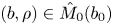 $(b, \rho ) \in \hat {M}_0(b_0)$. Suppose that
 $H \in \mathcal {V}_\rho (\tilde {U})$ and
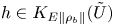 $h \in K_{E\|\rho _b\|}(\tilde {U})$ satisfy properties (3)(1a) and (3)(1b) in Theorem 5.4. Then for all
 $(k, r, p, l) \in \Xi (b, \rho )$, denoting
 $0$ by
 $j$ if
 $l = 1$ and
 $j_{k, r}^{(b, \rho ), H}$ by
 $j$ if
 $l = 2$, we have
 \[ \frac{1}{2} \leq \frac{h(v_j(u))}{h(v_j(u'))} \leq 2 \quad \text{for all }u, u' \in \hat{D}_{k, r, p}^{(b, \rho), H} \]
and also either of the alternatives
(1)
$\|H(v_j(u))\|_2 \leq ({3}/{4})h(v_j(u))$ for all $u \in \hat {D}_{k, r, p}^{(b, \rho ), H}$,(2)
$\|H(v_j(u))\|_2 \geq ({1}/{4})h(v_j(u))$ for all $u \in \hat {D}_{k, r, p}^{(b, \rho ), H}$.



Proof. Let 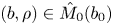 $(b, \rho ) \in \hat {M}_0(b_0)$. Suppose that
 $H \in \mathcal {V}_\rho (\tilde {U})$ and
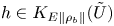 $h \in K_{E\|\rho _b\|}(\tilde {U})$ satisfy properties (3)(1a) and (3)(1b) in Theorem 5.4. Let
 $(k, r, p, l) \in \Xi (b, \rho )$. We show the first inequality. Let
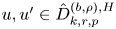 $u, u' \in \hat {D}_{k, r, p}^{(b, \rho ), H}$. Since
 $|\log \circ h|_{C^{1}} \leq E\|\rho _b\|$, using (19), we have
 \begin{align*} |\log(h(v_j(u))) - \log(h(v_j(u')))| &\leq |\log \circ h|_{C^{1}} \cdot |v_j|_{C^{1}} \cdot d(u, u')\\ &\leq E\|\rho_b\| \cdot \frac{1}{c_0\kappa_2^{m_2}} \cdot \operatorname{diam}_d\big(\hat{D}_{k, r, p}^{(b, \rho), H}\big) \leq \frac{4EN\epsilon_2}{c_0\kappa_2^{m_2}} \leq \log(2). \end{align*}
Hence  $|\log ({h(v_j(u))}/{h(v_j(u'))})| \leq \log (2)$ which implies the first inequality.
Now we show the alternatives. If  $\|H(v_j(u))\|_2 \geq ({1}/{4})h(v_j(u))$ for all
 $u \in \hat {D}_{k, r, p}^{(b, \rho ), H}$, then we are done. Otherwise, there exists
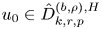 $u_0 \in \hat {D}_{k, r, p}^{(b, \rho ), H}$ such that
 $\|H(v_j(u_0))\|_2 \leq ({1}/{4})h(v_j(u_0))$. Let
 $u \in \hat {D}_{k, r, p}^{(b, \rho ), H}$,
 $D = d(u_0, u) \leq \operatorname {diam}_d(\hat {D}_{k, r, p}^{(b, \rho ), H}) = {4N\epsilon _2}/{\|\rho _b\|}$, and
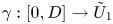 $\gamma : [0, D] \to \tilde {U}_1$ be a unit-speed geodesic from
 $\gamma (0) = u_0$ to
 $\gamma (D) = u$. Note that
 $H(v_j(u)) = H(v_j(u_0)) + \int _0^{D} (H \circ v_j \circ \gamma )'(t) \, dt$. Then, using the first proven inequality and (19), we have
 \begin{align*} \|H(v_j(u))\|_2 &\leq \|H(v_j(u_0))\|_2 + \int_0^{D} \|(dH)_{v_j(\gamma(t))}\|_{\mathrm{op}} |v_j|_{C^{1}} \, dt\\ &\leq \frac{1}{4}h(v_j(u_0)) + \int_0^{D} E\|\rho_b\|h(v_j(\gamma(t))) \cdot \frac{1}{c_0\kappa_2^{m_2}} \, dt\\ &\leq \frac{1}{2}h(v_j(u)) + \frac{E\|\rho_b\|}{c_0\kappa_2^{m_2}}\int_0^{D} 2h(v_j(\gamma(D))) \, dt\\ &\leq \biggl(\frac{1}{2} + \frac{8EN\epsilon_2}{c_0\kappa_2^{m_2}}\biggr) h(v_j(u)) \\ &\leq \frac{3}{4}h(v_j(u)). \end{align*}
For any  $k \geq 2$, let
 $\Theta : (\mathbb {R}^{k} \setminus \{0\}) \times (\mathbb {R}^{k} \setminus \{0\}) \to [0, \pi ]$ be the map which gives the angle defined by
 $\Theta (w_1, w_2) = \arccos (({\langle w_1, w_2\rangle })/({\|w_1\| \cdot \|w_2\|}))$ for all
 $w_1, w_2 \in \mathbb {R}^{k} \setminus \{0\}$, where we use the standard inner product and norm. The following lemma can be proven by elementary trigonometry.
Lemma 9.9 Let  $k \geq 2$. If
 $w_1, w_2 \in \mathbb {R}^{k} \setminus \{0\}$ such that
 $\Theta (w_1, w_2) \geq \alpha$ and
 ${\|w_1\|}/{\|w_2\|} \leq L$ for some
 $\alpha \in [0, \pi ]$ and
 $L \geq 1$, then we have
 \[ \|w_1 + w_2\| \leq \biggl(1 - \frac{\alpha^{2}}{16L}\biggr)\|w_1\| + \|w_2\|. \]
Lemma 9.10 Let  $\xi \in \mathbb {C}$ with
 $|a| < a_0'$ and
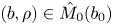 $(b, \rho ) \in \hat {M}_0(b_0)$. Suppose
 $H \in \mathcal {V}_\rho (\tilde {U})$ and
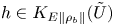 $h \in K_{E\|\rho _b\|}(\tilde {U})$ satisfy properties (3)(1a) and (3)(1b) in Theorem 5.4. For all
 $(k, r) \in \Xi _1(b, \rho )$, denoting
 $j_{k, r}^{(b, \rho ), H}$ by
 $j$, there exists
 $(p, l) \in \Xi _2$ such that
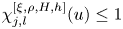 $\chi _{j, l}^{[\xi , \rho , H, h]}(u) \leq 1$ for all
 $u \in \hat {D}_{k, r, p}^{(b, \rho ), H}$.
Proof. Let  $\xi \in \mathbb {C}$ with
 $|a| < a_0'$ and
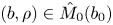 $(b, \rho ) \in \hat {M}_0(b_0)$. Suppose
 $H \in \mathcal {V}_\rho (\tilde {U})$ and
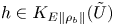 $h \in K_{E\|\rho _b\|}(\tilde {U})$ satisfy properties (3)(1a) and (3)(1b) in Theorem 5.4. Let
 $(k, r) \in \Xi _1(b, \rho )$. Denote
 $j_{k, r}^{(b, \rho ), H}$ by
 $j$,
 $x_{k, r, 1}^{(b, \rho )}$ by
 $x_1$,
 $x_{k, r, 2}^{(b, \rho ), H}$ by
 $x_2$, and
 $\hat {D}_{k, r, p}^{(b, \rho ), H}$ by
 $\hat {D}_p$. Now, suppose (1) in Lemma 9.8 holds for
 $(k, r, p, l) \in \Xi (b, \rho )$ for some
 $(p, l) \in \Xi _2$. Then it is easy to check that
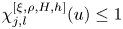 $\chi _{j, l}^{[\xi , \rho , H, h]}(u) \leq 1$ for all
 $u \in \hat {D}_p$. Otherwise, (2) in Lemma 9.8 holds for
 $(k, r, 1, 1), (k, r, 1, 2), (k, r, 2, 1), (k, r, 2, 2) \in \Xi (b, \rho )$. We would like to use Lemma 9.9 but first we need to establish bounds on relative angle and relative size. We start with the former. Define
 $\omega _\ell (u) = {H(v_\ell (u))}/{\|H(v_\ell (u))\|_2}$ and
 $\phi _\ell (u) = \Phi ^{\alpha _\ell }(v_\ell (u))$ for all
 $u \in \tilde {U}_1$ and
 $\ell \in \{0, j\}$. Let
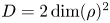 $D = 2\dim (\rho )^{2}$ and define the map
 $\varphi : \mathbb {R}^{D} \setminus \{0\} \to \mathbb {R}^{D}$ by
 $\varphi (w) = {w}/{\|w\|}$ for all
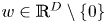 $w \in \mathbb {R}^{D} \setminus \{0\}$, where we use the standard inner product and norm on
 $\mathbb {R}^{D}$. Then we note that
 $\|(d\varphi )_w\|_{\mathrm {op}} = {1}/{\|w\|}$ for all
 $w \in R^{D}$. We can write
 $\omega _\ell = \varphi \circ H \circ v_\ell$ using the isomorphism
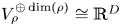 $V_\rho ^{\oplus \dim (\rho )} \cong \mathbb {R}^{D}$ of real vector spaces. Then using Lemma 7.2 and (19), we calculate that
 \begin{align*} \|(d\omega_\ell)_u\|_{\mathrm{op}} &\leq \|(d\varphi)_{H(v_\ell(u))}\|_{\mathrm{op}} \|(dH)_{v_\ell(u)}\|_{\mathrm{op}} \|(dv_\ell)_u\|_{\mathrm{op}}\\ &\leq \frac{1}{\|H(v_\ell(u))\|_2} \cdot E\|\rho_b\|h(v_\ell(u)) \cdot \frac{1}{c_0\kappa_2^{m_2}} \leq \frac{4E\|\rho_b\|}{c_0\kappa_2^{m_2}} \leq \delta_1\|\rho_b\| \end{align*}
for all  $u \in \hat {D}_p$,
 $\ell \in \{0, j\}$, and
 $p \in \{1, 2\}$. In other words,
 $\omega _0$ and
 $\omega _j$ are Lipschitz on
 $\hat {D}_p$ with Lipschitz constant
 $\delta _1\|\rho _b\|$ for all
 $p \in \{1, 2\}$. Define
 \[ \begin{array}{l} V_\ell(u) = e^{f_{\alpha_\ell}^{(a)}(v_\ell(u))} \rho_b(\phi_\ell(u)^{{-}1})H(v_\ell(u)), \\ \hat{V}_\ell(u) = \dfrac{V_\ell(u)}{\|V_\ell(u)\|_2} = \rho_b(\phi_\ell(u)^{{-}1})\omega_\ell(u), \end{array} \quad \text{for all}\ u \in \tilde{U}_1\text{ and }\ell \in \{0, j\}. \]
Since  $\omega _0$ and
 $\omega _j$ are Lipschitz and
 $d(x_1, x_2) \leq {\epsilon _1}/{2\|\rho _b\|}$, we have
 \begin{align*} &\big\|\hat{V}_0(x_2) - \hat{V}_j(x_2)\big\|_2 \\ &\quad={}\|\rho_b(\phi_0(x_2)^{{-}1})\omega_0(x_2) - \rho_b(\phi_j(x_2)^{{-}1})\omega_j(x_2)\|_2\\ &\quad={}\|\rho_b(\phi_j(x_2)\phi_0(x_2)^{{-}1})\omega_0(x_2) - \omega_j(x_2)\|_2 \\ &\quad\geq{}\|\rho_b(\phi_j(x_2)\phi_0(x_2)^{{-}1})\omega_0(x_1) - \omega_j(x_1)\|_2 \\ &\qquad {}- \|\rho_b(\phi_j(x_2)\phi_0(x_2)^{{-}1})\omega_0(x_2) - \rho_b(\phi_j(x_2)\phi_0(x_2)^{{-}1})\omega_0(x_1)\|_2 - \|\omega_j(x_2) - \omega_j(x_1)\|_2\\ &\quad={}\|\rho_b(\phi_j(x_2)\phi_0(x_2)^{{-}1})\omega_0(x_1) - \omega_j(x_1)\|_2 - \|\omega_0(x_2) - \omega_0(x_1)\|_2 - \|\omega_j(x_2) - \omega_j(x_1)\|_2\\ &\quad\geq{}\|\rho_b(\phi_j(x_2)\phi_0(x_2)^{{-}1})\omega_0(x_1) - \rho_b(\phi_j(x_1)\phi_0(x_1)^{{-}1})\omega_0(x_1)\|_2\\ &\qquad {}- \|\rho_b(\phi_j(x_1)\phi_0(x_1)^{{-}1})\omega_0(x_1) - \omega_j(x_1)\|_2 - \delta_1\epsilon_1\\ &\quad={}\|\rho_b(\phi_0(x_1)^{{-}1})\omega_0(x_1) - \rho_b(\phi_0(x_1)^{{-}1}\phi_0(x_2)\phi_j(x_2)^{{-}1}\phi_j(x_1)\phi_0(x_1)^{{-}1})\omega_0(x_1)\|_2\\ &\qquad {}- \|\rho_b(\phi_0(x_1)^{{-}1})\omega_0(x_1) - \rho_b(\phi_j(x_1)^{{-}1})\omega_j(x_1)\|_2 - \delta_1\epsilon_1\\ &\quad\geq{}\|\rho_b(\phi_0(x_1)^{{-}1})\omega_0(x_1) - \rho_b(\operatorname{BP}_j(x_1, x_2))\rho_b(\phi_0(x_1)^{{-}1})\omega_0(x_1)\|_2 - \big\|\hat{V}_0(x_1) - \hat{V}_j(x_1)\big\|_2 - \delta_1\epsilon_1. \end{align*}
Denote  $\omega = \rho _b(\phi _0(x_1)^{-1})\omega _0(x_1)$ and
 $Z = d(\operatorname {BP}_{j, x_1} \circ \Psi )_{\check {x}_1}(z)$ where
 $z = (\check {x}_1, \check {x}_2 - \check {x}_1) \in \operatorname {T}_{\check {x}_1}(\mathbb {R}^{n - 1})$. Recall the curve
 $\varphi ^{\mathrm {BP}}_{j, x_1, z}: [0, 1] \to AM$ defined by
 $\varphi ^{\mathrm {BP}}_{j, x_1, z}(t) = \operatorname {BP}_{j, x_1}(\Psi (\check {x}_1 + tz))$ for all
 $t \in [0, 1]$. Recall
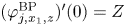 $(\varphi ^{\mathrm {BP}}_{j, x_1, z})'(0) = Z$,
 $\varphi ^{\mathrm {BP}}_{j, x_1, z}(0) = \operatorname {BP}_{j, x_1}(x_1) = e$, and
 $\varphi ^{\mathrm {BP}}_{j, x_1, z}(1) = \operatorname {BP}_j(x_1, x_2)$. Continuing to bound the first term above, we apply Lemmas 8.1 and 7.1 and (15) to get
 \begin{align*} &\|\omega - \rho_b(\operatorname{BP}_j(x_1, x_2))(\omega)\|_2\\ &\quad\geq{}\|\omega - \rho_b(\exp(Z))(\omega)\|_2 - \big\|\rho_b(\exp(Z))(\omega) - \rho_b\big(\varphi^{\mathrm{BP}}_{j, x_1, z}(1)\big)(\omega)\big\|_2\\ &\quad\geq{}\|\omega - \exp(d\rho_b(Z))(\omega)\|_2 - \|\rho_b\| \cdot d_{AM}\big(\exp(Z), \varphi^{\mathrm{BP}}_{j, x_1, z}(1)\big)\\ &\quad\geq{}\|d\rho_b(Z)(\omega)\|_2 - \|\rho_b\|^{2} \|Z\|^{2} - \|\rho_b\| \cdot d_{AM}\big(\exp(Z), \varphi^{\mathrm{BP}}_{j, x_1, z}(1)\big)\\ &\quad\geq{}\|d\rho_b(Z)(\omega)\|_2 - \|\rho_b\|^{2} (C_{\operatorname{BP}, \Psi} C_{\Psi})^{2} d(x_1, x_2)^{2} - C_{\exp, \operatorname{BP}} \cdot \|\rho_b\| \cdot d(x_1, x_2)^{2}\\ &\quad\geq{}7\delta_1\epsilon_1 - \delta_1\epsilon_1 - \delta_1\epsilon_1 \geq 5\delta_1\epsilon_1. \end{align*}
Hence, we have
 \[ \big\|\hat{V}_0(x_1) - \hat{V}_j(x_1)\big\|_2 + \big\|\hat{V}_0(x_2) - \hat{V}_j(x_2)\big\|_2 \geq 4\delta_1\epsilon_1. \]
Then  $\|\hat {V}_0(x_p) - \hat {V}_j(x_p)\|_2 \geq 2\delta _1\epsilon _1$ for some
 $p \in \{1, 2\}$. Recalling estimates from Lemma 7.3, (16), and that
 $\omega _\ell$ is Lipschitz, we have
 \begin{align*} \big\|\hat{V}_\ell(x_p) - \hat{V}_\ell(u)\big\|_2 &= \|(\rho_b(\phi_\ell(x_p)^{{-}1}) - \rho_b(\phi_\ell(u)^{{-}1}))\omega_\ell(x_p) + \rho_b(\phi_\ell(u)^{{-}1})(\omega_\ell(x_p) - \omega_\ell(u))\|_2\\ &\leq \|(\rho_b(\phi_\ell(x_p)^{{-}1}) - \rho_b(\phi_\ell(u)^{{-}1}))\omega_\ell(x_p)\|_2 + \|\omega_\ell(x_p) - \omega_\ell(u)\|_2 \\ &\leq A_0 \|\rho_b\| d(x_p, u) + \delta_1\|\rho_b\| d(x_p, u) \\ &\leq (A_0 + \delta_1)\|\rho_b\| \cdot \frac{2N\epsilon_2}{\|\rho_b\|} = 2N\epsilon_2(A_0 + \delta_1) \leq \frac{\delta_1\epsilon_1}{2} \end{align*}
for all  $u \in \hat {D}_p$ and
 $\ell \in \{0, j\}$. Hence
 $\big \|\hat {V}_0(u) - \hat {V}_j(u)\big \|_2 \geq \delta _1\epsilon _1 \in (0, 1)$ for all
 $u \in \hat {D}_p$. Then, using the cosine law, the required bound for relative angle is
 \[ \Theta(V_0(u), V_j(u)) = \Theta(\hat{V}_0(u), \hat{V}_j(u)) \geq \arccos\biggl(1 - \frac{(\delta_1\epsilon_1)^{2}}{2}\biggr) \in (0, \pi). \]
For the bound on relative size, let  $(\ell , \ell ') \in \{(0, j), (j, 0)\}$ such that
 $h(v_\ell (u_0)) \leq h(v_{\ell '}(u_0))$ for some
 $u_0 \in \hat {D}_p$. Let
 $l = 1$ if
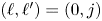 $(\ell , \ell ') = (0, j)$ and
 $l = 2$ if
 $(\ell , \ell ') = (0, j)$. Recalling that
 $\rho _b$ is a unitary representation, by Lemma 9.8, we have
 \begin{align*} \frac{\|V_\ell(u)\|_2}{\|V_{\ell'}(u)\|_2} &= \frac{e^{f_{\alpha_\ell}^{(a)}(v_\ell(u))}\|H(v_\ell(u))\|_2}{e^{f_{\alpha_{\ell'}}^{(a)}(v_{\ell'}(u))}\|H(v_{\ell'}(u))\|_2} \leq \frac{4e^{f_{\alpha_\ell}^{(a)}(v_\ell(u)) - f_{\alpha_{\ell'}}^{(a)}(v_{\ell'}(u))}h(v_{\ell}(u))}{h(v_{\ell'}(u))}\\ &\leq \frac{16e^{2m_2 T_0}h(v_{\ell}(u_0))}{h(v_{\ell'}(u_0))} \leq 16e^{2m_2 T_0} \end{align*}
for all  $u \in \hat {D}_p$, which is the required bound on relative size. Now using Lemma 9.9, (20), and
 $\|H\| \leq h$ on
 $\|V_\ell (u) + V_{\ell '}(u)\|_2$ gives
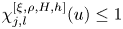 $\chi _{j, l}^{[\xi , \rho , H, h]}(u) \leq 1$ for all
 $u \in \hat {D}_p$.
Lemma 9.11 For all  $\xi \in \mathbb {C}$ with
 $|a| < a_0'$, if
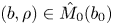 $(b, \rho ) \in \hat {M}_0(b_0)$, and if
 $H \in \mathcal {V}_\rho (\tilde {U})$ and
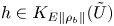 $h \in K_{E\|\rho _b\|}(\tilde {U})$ satisfy properties (3)(1a) and (3)(1b) in Theorem 5.4, then there exists
 $J \in \mathcal {J}(b, \rho )$ such that
 \[ \big\|\tilde{\mathcal{M}}_{\xi, \rho}^{m}(H)(u)\big\|_2 \leq \mathcal{N}_{a, J}^{H}(h)(u) \quad \text{for all }u \in \tilde{U}. \]
Proof. Let  $\xi \in \mathbb {C}$ with
 $|a| < a_0'$ and suppose
 $(b, \rho ) \in \hat {M}_0(b_0)$. Suppose
 $H \in \mathcal {V}_\rho (\tilde {U})$ and
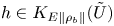 $h \in K_{E\|\rho _b\|}(\tilde {U})$ satisfy properties (3)(1a) and (3)(1b) in Theorem 5.4. We drop superscripts
 $(b, \rho )$ and
 $H$ to simply notation. For all
 $(k, r) \in \Xi _1(b, \rho )$, there exists
 $(p_{k, r}, l_{k, r}) \in \Xi _2$ as guaranteed by Lemma 9.10. Let
 $J_0 = \{(k, r, p_{k, r}, l_{k, r}) \in \Xi (b, \rho ): (k, r) \in \Xi _1(b, \rho )\} \subset \Xi (b, \rho )$ which is then dense by construction and so
 $J_0 \in \mathcal {J}(b, \rho )$. Now, we make necessary modifications to
 $J_0$ to define
 $J \in \mathcal {J}(b, \rho )$. Recall the notation from the proof of Lemma 8.2. For all equivalence classes
 $[D_{k, r, p}] \in D_\cup ^{\mathrm {conn}}$, we do the following. Choose any representative, say
 $D_{k, r, p} \in [D_{k, r, p}]$, and make the modification
 $j_{k', r'} = j_{k, r}$ and
 $l_{k', r'} = l_{k, r}$ for all
 $(k', r') \in \Xi _1(b, \rho )$ with
 $D_{k', r', p'} \in [D_{k, r, p}]$ for some
 $p' \in \{1, 2\}$. Define
 $J \in \mathcal {J}(b, \rho )$ by
 $J = \{(k, r, p_{k, r}, l_{k, r}) \in \Xi (b, \rho ): (k, r) \in \Xi _1(b, \rho )\} \subset \Xi (b, \rho )$. Now let
 $u \in \tilde {U}$. If
 $u \notin D_{k, r, p}$ for all
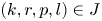 $(k, r, p, l) \in J$, then
 $\beta _J^{H}(v) = 1$ for all branches
 $v = \sigma ^{-\alpha }(u)$ where
 $\alpha$ is an admissible sequence with
 $\operatorname {len}(\alpha ) = m_2$. Hence
 $\|\tilde {\mathcal {M}}_{\xi , \rho }^{m_2}(H)(u)\|_2 \leq \tilde {\mathcal {L}}_a^{m_2}(\beta _J^{H} h)(u)$ follows trivially from definitions. Otherwise, by construction, there exist
 $(k, r), (k_0, r_0) \in \Xi _1(b, \rho )$ such that
 $u \in D_{k, r, p_{k, r}} \in [D_{k_0, r_0, p_{k_0, r_0}}]$ corresponding to
 $(k, r, p_{k, r}, l_{k, r}) \in J$, and such that
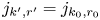 $j_{k', r'} = j_{k_0, r_0}$ and
 $l_{k', r'} = l_{k_0, r_0}$ for all
 $D_{k', r', p_{k', r'}} \in [D_{k_0, r_0, p_{k_0, r_0}}]$. Denote
 $j_{k_0, r_0}$ by
 $j_0$ and
 $l_{k_0, r_0}$ by
 $l_0$. Let
 $(\ell , \ell ') = (0, j_0)$ if
 $l_0 = 1$ and
 $(\ell , \ell ') = (j_0, 0)$ if
 $l_0 = 2$. Then, by construction of
 $J$, we have
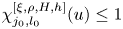 $\chi _{j_0, l_0}^{[\xi , \rho , H, h]}(u) \leq 1$,
 $\beta _J^{H}(v_\ell (u)) \geq 1 - N\mu$, and
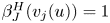 $\beta _J^{H}(v_j(u)) = 1$ for all
 $0 \leq j \leq j_{\mathrm {m}}$ with
 $j \neq \ell$. Hence, we compute that
 \begin{align*} &\big\|\tilde{\mathcal{M}}_{\xi, \rho}^{m_2}(H)(u)\big\|_2 \nonumber\\ &\quad={}\biggl\|\sum_{\substack{\alpha: \operatorname{len}(\alpha) = m_2\\ v = \sigma^{-\alpha}(u)}} e^{f_\alpha^{(a)}(v)} \rho_b(\Phi^{\alpha}(v)^{{-}1}) H(v)\biggr\|_2\\ &\quad\leq{}\sum_{\substack{\alpha: \operatorname{len}(\alpha) = m_2\\ v = \sigma^{-\alpha}(u) \notin \{v_0(u), v_{j_0}(u)\}}} \big\|e^{f_\alpha^{(a)}(v)} \rho_b(\Phi^{\alpha}(v)^{{-}1}) H(v)\big\|_2\\ &\qquad {}+ \big\|e^{f_{\alpha_\ell}^{(a)}(v_\ell(u))} \rho_b(\Phi^{\alpha_\ell}(v_\ell(u))^{{-}1}) H(v_\ell(u)) + e^{f_{\alpha_{\ell'}}^{(a)}(v_{\ell'}(u))} \rho_b(\Phi^{\alpha_{\ell'}}(v_{\ell'}(u))^{{-}1}) H(v_{\ell'}(u))\big\|_2\\ &\quad\leq{}\sum_{\substack{\alpha: \operatorname{len}(\alpha) = m_2\\ v = \sigma^{-\alpha}(u) \notin \{v_0(u), v_{j_0}(u)\}}} e^{f_{\alpha}^{(a)}(v)} h(v) + \Bigl((1 - N\mu)e^{f_{\alpha_\ell}^{(a)}(v_\ell(u))}h(v_\ell(u)) + e^{f_{\alpha_{\ell'}}^{(a)}(v_{\ell'}(u))}h(v_{\ell'}(u))\Bigr)\\ &\quad\leq{}\tilde{\mathcal{L}}_a^{m_2}\big(\beta_J^{H} h\big)(u). \end{align*}
Thus, we have
 \begin{align*} \big\|\tilde{\mathcal{M}}_{\xi, \rho}^{m}(H)(u)\big\|_2 &\leq \bigl\|\big(\tilde{\mathcal{M}}_{\xi, \rho}^{m_1} \circ \tilde{\mathcal{M}}_{\xi, \rho}^{m_2}\big)(H)(u)\bigr\|_2 \leq \tilde{\mathcal{L}}_a^{m_1}\big\|\tilde{\mathcal{M}}_{\xi, \rho}^{m_2}(H)\big\|(u)\\ &\leq \tilde{\mathcal{L}}_a^{m_1}\big(\tilde{\mathcal{L}}_a^{m_2}\big(\beta_J^{H} h\big)\big)(u) = \tilde{\mathcal{L}}_a^{m}\big(\beta_J^{H} h\big)(u) = \mathcal{N}_{a, J}^{H}(h)(u). \end{align*}
10. Exponential mixing of the frame flow
The aim of this section is to prove Theorem 1.1 using the proven spectral bounds in Theorem 5.3. We will use techniques originally due to Pollicott [Reference PollicottPol85] to write the correlation function in terms of transfer operators with holonomy and then apply Paley–Wiener theory.
Similar to  $R^{\vartheta , \tau }$, consider the suspension space
 $U^{\vartheta , \tau } = (U \times M \times \mathbb {R}_{\geq 0})/\mathord {\sim }$ where
 $\sim$ is the equivalence relation on
 $U \times M \times \mathbb {R}_{\geq 0}$ defined by
 $(u, m, t + \tau (u)) \sim (\sigma (u), \vartheta (u)^{-1}m, t)$ for all
 $(u, m, t) \in U \times M \times \mathbb {R}_{\geq 0}$. Also consider
 $\tilde {U}^{\vartheta , \tau } = \{(u, m, t) \in \tilde {U} \times M \times \mathbb {R}_{\geq 0}: t \in [0, \tau (u))\}$. For simplicity, we say that
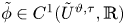 $\tilde {\phi } \in C^{1}(\tilde {U}^{\vartheta , \tau }, \mathbb {R})$ is an extension of
 $\phi \in C(U^{\vartheta , \tau }, \mathbb {R})$ whenever
 $\tilde {\phi }(u, m, t) = \phi (u, m, t)$ for all
 $t \in [0, \tau (u))$,
 $m \in M$, and
 $u \in U$.
Let  $\phi \in C(U^{\vartheta , \tau }, \mathbb {R})$ and
 $\xi \in \mathbb {C}$. Define a bounded function
 $\hat {\phi }_\xi \in B(U, L^{2}(M, \mathbb {C}))$ by
 \[ \hat{\phi}_\xi(u)(m) = \int_0^{\tau(u)} \phi(u, m, t)e^{-\xi t} \, dt \quad \text{for all }m \in M \ \text{and}\ u \in U. \]
We can decompose it further as  $\hat {\phi }_\xi (u) = \sum _{\rho \in \hat {M}} \hat {\phi }_{\xi , \rho }(u) \in \operatorname *{\widehat {\bigoplus }}_{\rho \in \hat {M}} V_\rho ^{\oplus \dim (\rho )}$ for all
 $u \in U$. Let
 $\rho \in \hat {M}$. Defining
 $\phi _\rho \in C(U^{\vartheta , \tau }, \mathbb {C})$ by the projection
 $\phi _\rho (u, \cdot , t) = [\phi (u, \cdot , t)]_\rho \in V_\rho ^{\oplus \dim (\rho )}$ for all
 $u \in U$ and
 $t \in \mathbb {R}_{\geq 0}$, we have
 \[ \hat{\phi}_{\xi, \rho}(u)(m) = \int_0^{\tau(u)} \phi_\rho(u, m, t) e^{-\xi t} \, dt \quad \text{for all }m \in M\ \text{and}\ u \in U. \]
Remark Let  $\phi \in C(U^{\vartheta , \tau }, \mathbb {R})$ and
 $\xi \in \mathbb {C}$. Because of
 $\tau$ involved in the definition of
 $\hat {\phi }_{\xi , \rho }$, it is not Lipschitz. However, in Lemma 10.2 we will see that
 $\mathcal {M}_{\xi , \rho }(\hat {\phi }_{-\bar {\xi }, \rho }) \in \mathcal {V}_\rho (U)$ with an extension
 $\mathcal {M}_{\xi , \rho }(\hat {\phi }_{-\bar {\xi }, \rho })^{\sim } \in \mathcal {V}_\rho (\tilde {U})$.
10.1 Correlation function and its Laplace transform
Let  $\phi , \psi \in C(U^{\vartheta , \tau }, \mathbb {R})$. Define
 $\Upsilon _{\phi , \psi } \in L^{\infty }(\mathbb {R}_{\geq 0}, \mathbb {R})$ by
 \[ \Upsilon_{\phi, \psi}(t) = \int_U \int_M \int_0^{\tau(u)} \phi(u, m, r + t) \psi(u, m, r) \, dr \, dm \, d\nu_U(u) \]
for all  $t \in \mathbb {R}_{\geq 0}$. We can decompose this into
 $\Upsilon _{\phi , \psi } = \Upsilon _{\phi , \psi }^{0} + \Upsilon _{\phi , \psi }^{1}$ where we define
 \begin{align*} \Upsilon_{\phi, \psi}^{0}(t) &= \int_U \int_M \int_{\max(0, \tau(u) - t)}^{\tau(u)} \phi(u, m, r + t) \psi(u, m, r) \, dr \, dm \, d\nu_U(u), \\ \Upsilon_{\phi, \psi}^{1}(t) &= \int_U \int_M \int_0^{\max(0, \tau(u) - t)} \phi(u, m, r + t) \psi(u, m, r) \, dr \, dm \, d\nu_U(u) \end{align*}
for all  $t \in \mathbb {R}_{\geq 0}$. Recall that the Laplace transform
 $\hat {\Upsilon }_{\phi , \psi }^{0}: \{\xi \in \mathbb {C}: \Re (\xi ) > 0\} \to \mathbb {C}$ is given by
 \[ \hat{\Upsilon}_{\phi, \psi}^{0}(\xi) = \int_0^{\infty} \Upsilon_{\phi, \psi}^{0}(t) e^{-\xi t} \, dt \quad \text{for all }\xi \in \mathbb{C}\ \text{with}\ a > 0. \]
The above decomposition is useful because of Lemma 10.1 while  $\Upsilon _{\phi , \psi }(t) = \Upsilon _{\phi , \psi }^{0}(t)$ for all
 $t \geq \bar {\tau }$. The proof of Lemma 10.1 is similar to [Reference Oh and WinterOW16, Lemma 5.2].
Lemma 10.1 For all  $\phi , \psi \in C(U^{\vartheta , \tau }, \mathbb {R})$ and
 $\xi \in \mathbb {C}$ with
 $a > 0$, we have
 \[ \hat{\Upsilon}_{\phi, \psi}^{0}(\xi) = \sum_{k = 1}^{\infty} \sum_{\rho \in \hat{M}} \lambda_a^{k} \bigl\langle \hat{\phi}_{\xi, \rho}, \mathcal{M}_{\xi, \rho}^{k}\big(\hat{\psi}_{-\bar{\xi}, \rho}\big) \bigr\rangle. \]
10.2 Exponential decay of the correlation function
Lemma 10.2 There exists  $C > 0$ such that for all
 $\rho \in \hat {M}$, and
 $\phi , \psi \in C(U^{\vartheta , \tau }, \mathbb {R})$ with some extensions
 $\tilde {\phi } \in C^{r + 1}(\tilde {U}^{\vartheta , \tau }, \mathbb {R})$ for some
 $r \in \mathbb {Z}_{\geq 0}$ and
 $\tilde {\psi } \in C^{1}(\tilde {U}^{\vartheta , \tau }, \mathbb {R})$, and
 $\xi \in \mathbb {C}$ with
 $|a| \leq a_0'$, we have that
 $\mathcal {M}_{\xi , \rho }\big (\hat {\psi }_{-\bar {\xi }, \rho }\big ) \in \mathcal {V}_\rho (U)$ has an extension
 $\mathcal {M}_{\xi , \rho }\big (\hat {\psi }_{-\bar {\xi }, \rho }\big )^{\sim } \in \mathcal {V}_\rho (\tilde {U})$ and
 \[ \sup_{u \in U} \big\|\hat{\phi}_\xi(u)\big\|_{C^{r}} \leq C \frac{\|\tilde{\phi}\|_{C^{r + 1}}}{\max(1, |b|)}, \quad \big\|\mathcal{M}_{\xi, \rho}\big(\hat{\psi}_{-\bar{\xi}, \rho}\big)^{{\sim}}\big\|_{1, \|\rho_b\|} \leq C \frac{\|\tilde{\psi}\|_{C^{1}}}{\max(1, |b|)}. \]
Proof. Fix  $C_1 = (2 + \bar {\tau })e^{a_0'\bar {\tau }}$ and
 $C = Ne^{T_0}C_1 + ({4NT_0e^{T_0}C_1})/{c_0 \kappa _2} + ({Ne^{T_0}e^{a_0'\bar {\tau }}(\bar {\tau } + T_0)})/{c_0 \kappa _2}$. Let
 $\rho \in \hat {M}$, and
 $\phi , \psi \in C(U^{\vartheta , \tau }, \mathbb {R})$ with some extensions
 $\tilde {\phi } \in C^{r + 1}(\tilde {U}^{\vartheta , \tau }, \mathbb {R})$ for some
 $r \in \mathbb {Z}_{\geq 0}$ and
 $\tilde {\psi } \in C^{1}(\tilde {U}^{\vartheta , \tau }, \mathbb {R})$, and
 $\xi \in \mathbb {C}$ with
 $|a| \leq a_0'$. We show the first inequality. If
 $|b| \leq 1$, we simply have
 \[ \sup_{u \in U} \big\|\hat{\phi}_\xi(u)\big\|_{C^{r}} \leq \bar{\tau}e^{a_0'\bar{\tau}}\|\tilde{\phi}\|_{C^{r}} \leq C_1 \|\tilde{\phi}\|_{C^{r + 1}}. \]
If  $|b| \geq 1$, integrating by parts gives
 \begin{align*} \nabla^{k} \hat{\phi}_\xi(u) &={}\int_0^{\tau(u)} \nabla^{k} \phi(u, \cdot, t)e^{-\xi t} \, dt \\ &={}\biggl[-\frac{1}{\xi} \nabla^{k} \phi(u, \cdot, t)e^{-\xi t}\biggr]_{t = 0}^{t \nearrow \tau(u)} + \frac{1}{\xi}\int_0^{\tau(u)} \biggl.\frac{d}{dt'}\biggr|_{t' = t} \nabla^{k} \phi(u, \cdot, t') \cdot e^{-\xi t} \, dt \end{align*}
for all  $u \in U$ and
 $0 \leq k \leq r$. Hence
 \[ \sup_{u \in U} \big\|\hat{\phi}_\xi(u)\big\|_{C^{r}} \leq \biggl(\frac{2}{|b|}\|\tilde{\phi}\|_{C^{r}} e^{a_0'\bar{\tau}} + \frac{\bar{\tau}}{|b|}\|\tilde{\phi}\|_{C^{r + 1}} e^{a_0'\bar{\tau}}\biggr) \leq C_1 \frac{\|\tilde{\phi}\|_{C^{r + 1}}}{|b|}. \]
Now we show the second inequality. Define  $\hat {\psi }_{-\bar {\xi }, \rho }^{(j, k)} \in C^{1} (\tilde {\mathtt {C}}[j, k], V_\rho ^{\oplus \dim (\rho )})$ by
 \[ \hat{\psi}_{-\bar{\xi}, \rho}^{(j, k)}(u)(m) = \int_0^{\tau_{(j, k)}(u)} \tilde{\psi}_\rho(u, m, t)e^{\bar{\xi} t} \, dt \quad \text{for all }m \in M\text{ and }u \in \tilde{\mathtt{C}}[j, k] \]
and  $\hat {\psi }_{-\bar {\xi }}^{(j, k)} \in C^{1}(\tilde {\mathtt {C}}[j, k], L^{2}(M, \mathbb {C}))$ in a similar fashion, for all admissible pairs
 $(j, k)$. Then
 $\hat {\psi }_{-\bar {\xi }, \rho }^{(j, k)}$ and
 $\hat {\psi }_{-\bar {\xi }}^{(j, k)}$ are extensions of
 $\hat {\psi }_{-\bar {\xi }, \rho }|_{\mathtt {C}[j, k]}$ and
 $\hat {\psi }_{-\bar {\xi }}|_{\mathtt {C}[j, k]}$ respectively, for all admissible pairs
 $(j, k)$. Define
 $\mathcal {M}_{\xi , \rho }(\hat {\psi }_{-\bar {\xi }, \rho })^{\sim } \in \mathcal {V}_\rho (\tilde {U})$ by
 \begin{align*} \mathcal{M}_{\xi, \rho}\big(\hat{\psi}_{-\bar{\xi}, \rho}\big)^{{\sim}}(u) = \sum_{\substack{(j, k)\\ u' = \sigma^{-(j, k)}(u)}} e^{f_{(j, k)}^{(a)}(u')} \rho_b(\Phi^{(j, k)}(u')^{{-}1}) \hat{\psi}_{-\bar{\xi}, \rho}^{(j, k)}(u') \end{align*}
for all  $u \in \tilde {U}$, which is then an extension of
 $\mathcal {M}_{\xi , \rho }(\hat {\psi }_{-\bar {\xi }, \rho })$. Now, we first bound the
 $L^{\infty }$ norm. Using similar estimates to those for the first proven inequality, we have
 \begin{equation} \bigl\|\hat{\psi}_{-\bar{\xi}, \rho}^{(j, k)}(u)\bigr\|_2 \leq \bigl\|\hat{\psi}_{-\bar{\xi}}^{(j, k)}(u)\bigr\|_2 \leq \bigl\|\hat{\psi}_{-\bar{\xi}}^{(j, k)}(u)\bigr\|_\infty \leq C_1 \frac{\|\tilde{\psi}\|_{C^{1}}}{\max(1, |b|)} \end{equation}
for all  $u \in \tilde {\mathtt {C}}[j, k]$, and admissible pairs
 $(j, k)$. So, by unitarity of
 $\rho _b$, we have
 \[ \big\|\mathcal{M}_{\xi, \rho}\big(\hat{\psi}_{-\bar{\xi}, \rho}\big)\big\|_\infty \leq Ne^{T_0}C_1 \frac{\|\tilde{\psi}\|_{C^{1}}}{\max(1, |b|)}. \]
Now we deal with the  $C^{1}$ norm. Let
 $u \in \tilde {U}$ and
 $z \in \operatorname {T}_u(\tilde {U})$ with
 $\|z\| = 1$. We have a similar formula for
 $(d\mathcal {M}_{\xi , \rho }(\hat {\psi }_{-\bar {\xi }, \rho })^{\sim })_u(z)$ to that in (11) except that the summations are over admissible pairs
 $(j, k)$ and
 $H$ is replaced by
 $\hat {\psi }_{-\bar {\xi }, \rho }^{(j, k)}$. We use the same notation
 $K_1$,
 $-K_2$, and
 $K_3$ for the terms. Using (21), the first two terms can be bounded as
 \[ \|K_1\|_2 \leq \frac{NT_0e^{T_0}}{c_0\kappa_2} \cdot C_1 \frac{\|\tilde{\psi}\|_{C^{1}}}{\max(1, |b|)}, \quad \|K_2\|_2 \leq \frac{2NT_0e^{T_0}}{c_0\kappa_2} \|\rho_b\| \cdot C_1 \frac{\|\tilde{\psi}\|_{C^{1}}}{\max(1, |b|)}. \]
Now we bound the third term. First, we have
 \[ d\big(\hat{\psi}_{-\bar{\xi}}^{(j, k)}({\cdot})(m)\big)_u = \int_0^{\tau_{(j, k)}(u)} d\big(\tilde{\psi}({\cdot}, m, t)\big)_u \cdot e^{\bar{\xi} t} \, dt + \tilde{\psi}(u, m, \tau_{(j, k)}(u))e^{\bar{\xi} \tau_{(j, k)}(u)} \cdot \big(d\tau_{(j, k)}\big)_u \]
for all  $m \in M$ and
 $u \in \tilde {\mathtt {C}}[j, k]$. Thus
 $|\hat {\psi }_{-\bar {\xi }}^{(j, k)}|_{C^{1}} \leq e^{a_0'\bar {\tau }}(\bar {\tau } + T_0)\|\tilde {\psi }\|_{C^{1}}$ and so
 \[ \|K_3\|_2 \leq \frac{Ne^{T_0}}{c_0\kappa_2} \sup_{(j, k)} \biggl|\hat{\psi}_{-\bar{\xi}}^{(j, k)}\biggr|_{C^{1}} \leq \frac{Ne^{T_0}e^{a_0'\bar{\tau}}(\bar{\tau} + T_0)}{c_0\kappa_2} \|\tilde{\psi}\|_{C^{1}}. \]
Using definitions and  $({1 + \|\rho _b\|})/{\max (1, \|\rho _b\|)} \leq 2$ and
 ${1}/{\max (1, \|\rho _b\|)} \leq {1}/{\max (1, |b|)}$, we have
 \begin{align*} \big\|\mathcal{M}_{\xi, \rho}\big(\hat{\psi}_{-\bar{\xi}, \rho}\big)^{{\sim}}\big\|_{1, \|\rho_b\|} &\leq{}Ne^{T_0}C_1 \frac{\|\tilde{\psi}\|_{C^{1}}}{\max(1, |b|)} + \frac{2NT_0e^{T_0}}{c_0\kappa_2} \cdot \frac{1 + \|\rho_b\|}{\max(1, \|\rho_b\|)} \cdot C_1 \frac{\|\tilde{\psi}\|_{C^{1}}}{\max(1, |b|)}\\ &\quad {}+ \frac{Ne^{T_0}e^{a_0'\bar{\tau}}(\bar{\tau} + T_0)}{c_0\kappa_2} \cdot \frac{\|\tilde{\psi}\|_{C^{1}}}{\max(1, \|\rho_b\|)}\\ &\leq{} C \frac{\|\tilde{\psi}\|_{C^{1}}}{\max(1, |b|)}. \end{align*}
Remark Unlike the geodesic flow case, in the frame flow case we have to correctly estimate  $L^{2}$ norms and also take care of its convergence over all
 $\rho \in \hat {M}$ in Lemma 10.3. However, this is not a problem due to Lemma 10.2 and [Reference WarnerWar72, Lemmas 4.4.2.2 and 4.4.2.3]. For all
 $\rho \in \hat {M}$, the number
 $\lambda _{1 + \varsigma (\rho )} > 1$ which appears in Lemma 10.3 is in fact the eigenvalue of
 $1 + \varsigma (\rho ) \in Z(\mathfrak {m})$ where
 $\varsigma (\rho )$ is the negative Casimir operator as defined in Lemma 4.4. [Reference WarnerWar72, Lemma 4.4.2.3] states that
 $\sum _{\rho \in \hat {M}} {\dim (\rho )^{2}}/{(\lambda _{1 + \varsigma (\rho )})^{s}} < \infty$ for some
 $s \in \mathbb {N}$ which is essentially a direct consequence of the Weyl dimension formula.
Lemma 10.3 There exist  $C > 0$,
 $\eta > 0$, and
 $r \in \mathbb {N}$ such that for all
 $\phi , \psi \in C(U^{\vartheta , \tau }, \mathbb {R})$ with some extensions
 $\tilde {\phi } \in C^{r + 1}(\tilde {U}^{\vartheta , \tau }, \mathbb {R})$ and
 $\tilde {\psi } \in C^{1}(\tilde {U}^{\vartheta , \tau }, \mathbb {R})$ such that
 $\int _M \tilde {\psi }(u, m, t) \, dm = 0$ for all
 $(u, t) \in \tilde {U}^{\tau }$, for all
 $t > 0$, we have
 \[ |\Upsilon_{\phi, \psi}(t)| \leq C e^{-\eta t} \|\tilde{\phi}\|_{C^{r + 1}} \|\tilde{\psi}\|_{C^{1}}. \]
Proof. Fix  $C_1 \geq 1$,
 $\tilde {\eta } > 0$, and
 $a_0'' > 0$ to be the
 $C$,
 $\eta$, and
 $a_0$ from Theorem 5.3 and
 $C_2 > 0$ to be the
 $C$ from Lemma 10.2. Fix
 $\eta = a_0 \in (0, ({1}/{2})\min (a_0', a_0''))$ such that
 $\sup _{|a| \leq 2a_0} \log (\lambda _a) \leq {\tilde {\eta }}/{2}$. Fix
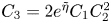 $C_3 = 2e^{\tilde {\eta }}C_1C_2^{2}$. By [Reference WarnerWar72, Lemma 4.4.2.3], there exists
 $s \in \mathbb {N}$ such that
 $\sum _{\rho \in \hat {M}} {\dim (\rho )^{2}}/{(\lambda _{1 + \varsigma (\rho )})^{s}} < \infty$ where
 $\lambda _{1 + \varsigma (\rho )} > 1$ are constants in the lemma corresponding to each
 $\rho \in \hat {M}$. Fix
 $r = 2s$,
 $C_4 = C_3\sum _{\rho \in \hat {M}} ({\dim (\rho )^{2}}/{(\lambda _{1 + \varsigma (\rho )})^{s}})$, and
 $C = \max (C_4\sum _{k = 1}^{\infty } e^{-({\tilde {\eta }}/{2})k}, 2\bar {\tau }e^{\eta \bar {\tau }})$. Let
 $\phi , \psi \in C(U^{\vartheta , \tau }, \mathbb {R})$ with some extensions
 $\tilde {\phi } \in C^{r + 1}(\tilde {U}^{\vartheta , \tau }, \mathbb {R})$ and
 $\tilde {\psi } \in C^{1}(\tilde {U}^{\vartheta , \tau }, \mathbb {R})$ such that
 $\int _M \tilde {\psi }(u, m, t) \, dm = 0$ for all
 $(u, t) \in \tilde {U}^{\tau }$. By Lemma 10.1, we have
 \[ \hat{\Upsilon}_{\phi, \psi}^{0}(\xi) = \sum_{k = 1}^{\infty} \sum_{\rho \in \hat{M}_0} \lambda_a^{k} \bigl\langle \hat{\phi}_{\xi, \rho}, \mathcal{M}_{\xi, \rho}^{k}\big(\hat{\psi}_{-\bar{\xi}, \rho}\big) \bigr\rangle \quad \text{for all }\xi \in \mathbb{C}\ \text{with}\ a > 0. \]
Note that for all  $k \geq 1$ and
 $\rho \in \hat {M}_0$, the map
 $\xi \mapsto \lambda _a^{k} \langle \hat {\phi }_{\xi , \rho }, \mathcal {M}_{\xi , \rho }^{k}(\hat {\psi }_{-\bar {\xi }, \rho }) \rangle$ is entire. Hence, to show that
 $\hat {\Upsilon }_{\phi , \psi }^{0}$ has a holomorphic extension to the half plane
 $\{\xi \in \mathbb {C}: \Re (\xi ) > -2a_0\}$, it suffices to show that the above sum is absolutely convergent for all
 $\xi \in \mathbb {C}$ with
 $|a| < 2a_0$. Recall that
 $\mathcal {M}_{\xi , \rho }(\hat {\psi }_{-\bar {\xi }, \rho }) \in \mathcal {V}_\rho (U)$ and by Lemma 10.2 there is an extension
 $\mathcal {M}_{\xi , \rho } (\hat {\psi }_{-\bar {\xi }, \rho })^{\sim } \in \mathcal {V}_\rho (\tilde {U})$ for all
 $\rho \in \hat {M}_0$. Using [Reference WarnerWar72, Lemma 4.4.2.2], we first calculate
 \begin{align*} \big\|\hat{\phi}_{\xi, \rho}\big\|_2 &\leq \biggl(\int_U \big\|\hat{\phi}_{\xi, \rho}(u)\big\|_2^{2} \, d\nu_U(u)\biggr)^{{1}/{2}} \leq \biggl(\int_U \big\|\hat{\phi}_{\xi, \rho}(u)\big\|_\infty^{2} \, d\nu_U(u)\biggr)^{{1}/{2}}\\ &\leq \biggl(\int_U \frac{\dim(\rho)^{4}}{(\lambda_{1 + \varsigma(\rho)})^{2s}}\big\|\hat{\phi}_\xi(u)\big\|_{C^{r}}^{2} \, d\nu_U(u)\biggr)^{{1}/{2}} \leq \frac{\dim(\rho)^{2}}{(\lambda_{1 + \varsigma(\rho)})^{s}} \sup_{u \in U} \big\|\hat{\phi}_\xi(u)\big\|_{C^{r}}. \end{align*}
Also noting  ${1}/{\max (1, |b|)^{2}} \leq {2}/({1 + b^{2}})$, we use Theorem 5.3 and Lemma 10.2 to get
 \begin{align*} \biggl|\lambda_a^{k} \biggl\langle \hat{\phi}_{\xi, \rho}, \mathcal{M}_{\xi, \rho}^{k}\big(\hat{\psi}_{-\bar{\xi}, \rho}\big) \biggr\rangle\biggr| &\leq \lambda_a^{k} \big\|\hat{\phi}_{\xi, \rho}\big\|_2 \cdot \big\|\tilde{\mathcal{M}}_{\xi, \rho}^{k - 1}\big(\mathcal{M}_{\xi, \rho}\big(\hat{\psi}_{-\bar{\xi}, \rho}\big)^{{\sim}}\big)\big\|_2\\ &\leq \lambda_a^{k} \frac{\dim(\rho)^{2}}{(\lambda_{1 + \varsigma(\rho)})^{s}} \sup_{u \in U} \big\|\hat{\phi}_\xi(u)\big\|_{C^{r}} \cdot C_1e^{-\tilde{\eta}(k - 1)} \big\|\mathcal{M}_{\xi, \rho}\big(\hat{\psi}_{-\bar{\xi}, \rho}\big)^{{\sim}}\big\|_{1, \|\rho_b\|}\\ &\leq \lambda_a^{k} \frac{\dim(\rho)^{2}}{(\lambda_{1 + \varsigma(\rho)})^{s}} C_2\frac{\|\tilde{\phi}\|_{C^{r + 1}}}{\max(1, |b|)} \cdot C_1e^{-\tilde{\eta}(k - 1)} \cdot C_2\frac{\|\tilde{\psi}\|_{C^{1}}}{\max(1, |b|)}\\ &\leq \frac{C_3e^{-(\tilde{\eta}/2)k}}{1 + b^{2}} \cdot \frac{\dim(\rho)^{2}}{(\lambda_{1 + \varsigma(\rho)})^{s}} \|\tilde{\phi}\|_{C^{r + 1}} \|\tilde{\psi}\|_{C^{1}}. \end{align*}
Now summing over all  $\rho \in \hat {M}_0$, we have
 \begin{align*} \sum_{\rho \in \hat{M}_0} \biggl|\lambda_a^{k} \biggl\langle \hat{\phi}_{\xi, \rho}, \mathcal{M}_{\xi, \rho}^{k}\big(\hat{\psi}_{-\bar{\xi}, \rho}\big) \biggr\rangle\biggr| &\leq \frac{C_3e^{-({\tilde{\eta}}/{2})k}}{1 + b^{2}} \|\tilde{\phi}\|_{C^{r + 1}} \|\tilde{\psi}\|_{C^{1}} \sum_{\rho \in \hat{M}_0} \frac{\dim(\rho)^{2}}{(\lambda_{1 + \varsigma(\rho)})^{s}}\\ &\leq \frac{C_4e^{-({\tilde{\eta}}/{2})k}}{1 + b^{2}} \|\tilde{\phi}\|_{C^{r + 1}} \|\tilde{\psi}\|_{C^{1}} \end{align*}
for all  $\xi \in \mathbb {C}$ with
 $|a| < 2a_0$, whose sum over
 $k \geq 1$ converges as desired. The above calculation also gives the important bound
 $|\hat {\Upsilon }_{\phi , \psi }^{0}(\xi )| \leq ({C}/({1 + b^{2}})) \|\tilde {\phi }\|_{C^{r + 1}} \|\tilde {\psi }\|_{C^{1}}$ for all
 $\xi \in \mathbb {C}$ with
 $|a| < 2a_0$. Since
 $\Upsilon _{\phi , \psi }^{0}$ is continuous and in
 $L^{\infty }(\mathbb {R}_{\geq 0}, \mathbb {R})$, we use the holomorphic extension and the inverse Laplace transform formula along the line
 $\{\xi \in \mathbb {C}: \Re (\xi ) = -a_0\}$ to obtain
 \[ \Upsilon_{\phi, \psi}^{0}(t) = \frac{1}{2\pi i} \lim_{B \to \infty} \int_{{-}a_0 - iB}^{{-}a_0 + iB} \hat{\Upsilon}_{\phi, \psi}^{0}(\xi) e^{\xi t} \, d\xi = \frac{1}{2\pi} \int_{-\infty}^{\infty} \hat{\Upsilon}_{\phi, \psi}^{0}({-}a_0 + ib) e^{({-}a_0 + ib) t} \, db \]
for all  $t > 0$. Using the above bound, we have
 \begin{align*} \bigl|\Upsilon_{\phi, \psi}^{0}(t)\bigr| &\leq \frac{1}{2\pi} e^{{-}a_0 t} \int_{-\infty}^{\infty} \bigl|\hat{\Upsilon}_{\phi, \psi}^{0}({-}a_0 + ib)\bigr| \, db \leq \frac{1}{2\pi} e^{{-}a_0 t} \int_{-\infty}^{\infty} \frac{C}{1 + b^{2}} \|\tilde{\phi}\|_{C^{r + 1}} \|\tilde{\psi}\|_{C^{1}} \, db \\ &\leq \frac{C}{2} e^{-\eta t} \|\tilde{\phi}\|_{C^{r + 1}} \|\tilde{\psi}\|_{C^{1}} \end{align*}
for all  $t > 0$. Now
 $\Upsilon _{\phi , \psi }(t) = \Upsilon _{\phi , \psi }^{0}(t)$ for all
 $t \geq \bar {\tau }$ while
 $|\Upsilon _{\phi , \psi }^{1}(t)| \leq \bar {\tau } \|\tilde {\phi }\|_{C^{r + 1}} \|\tilde {\psi }\|_{C^{1}} \leq ({C}/{2}) e^{-\eta t} \|\tilde {\phi }\|_{C^{r + 1}} \|\tilde {\psi }\|_{C^{1}}$ for all
 $t \in [0, \bar {\tau }]$ and hence
 $|\Upsilon _{\phi , \psi }(t)| \leq C e^{-\eta t} \|\tilde {\phi }\|_{C^{r + 1}} \|\tilde {\psi }\|_{C^{1}}$.
10.3 Integrating out the strong stable direction and the proof of Theorem 1.1
Given a  $\phi \in C^{1}(\Gamma \backslash G, \mathbb {R})$, we can convert it to a function in
 $C(U^{\vartheta , \tau }, \mathbb {R})$. By Rokhlin's disintegration theorem with respect to the projection
 $\operatorname {proj}_U: R \to U$, the probability measure
 $\nu _R$ disintegrates to give the set of conditional probability measures
 $\{\nu _u: u \in U\}$. For all
 $j \in \mathcal {A}$ and
 $u \in U_j$, the measure
 $\nu _u$ is actually defined on the fiber
 $\operatorname {proj}_U^{-1}(u) = [u, S_j]$ but we can push forward via the map
 $[u, S_j] \to S_j$ defined by
 $[u, s] \mapsto s$ to think of
 $\nu _u$ as a measure on
 $S_j$. For all
 $t \geq 0$, we define
 $\phi _t \in C(U^{\vartheta , \tau }, \mathbb {R})$ by
 \[ \phi_t(u, m, r) = \int_{S_j} \phi(F([u, s])a_{t + r}m) \, d\nu_u(s) \]
for all  $r \in [0, \tau (u))$,
 $m \in M$,
 $u \in U_j$, and
 $j \in \mathcal {A}$, and in order to ensure that indeed
 $\phi _t \in C(U^{\vartheta , \tau }, \mathbb {R})$, we must define
 $\phi _t(u, m, r) = \phi _t(\sigma ^{k}(u), \vartheta ^{k}(u)^{-1}m, r - \tau _k(u))$ for all
 $r \in [\tau _k(u), \tau _{k + 1}(u))$ and
 $k \geq 0$.
Let  $\phi \in C^{k}(\Gamma \backslash G, \mathbb {R})$ for some
 $k \in \mathbb {N}$ and
 $t > 0$. Then
 $\phi _t \in C(U^{\vartheta , \tau }, \mathbb {R})$ has a natural extension
 $\tilde {\phi }_t \in C^{k}(\tilde {U}^{\vartheta , \tau }, \mathbb {R})$ defined by
 \[ \tilde{\phi}_t(u, m, r) = \int_{S_j} \phi(F([u, s])a_{t + r}m) \, d\nu_u(s) \]
for all  $r \in [0, \tau (u))$,
 $m \in M$,
 $u \in U_j$, and
 $j \in \mathcal {A}$, where we clarify the notation
 $\nu _u$ in the following remark. This justifies using Lemma 10.4 later.
Remark We need to deal with some technicalities. Let  $j \in \mathcal {A}$. By smoothness of the strong unstable and strong stable foliations, there exists
 $C_1 > 1$ such that
 $d([u, s], [u', s]) \leq C_1d(u, u')$ for all
 $u, u' \in \tilde {U}_j$ and
 $s \in S_j$. Now, for all
 $u \in \tilde {U}_j$, the Patterson–Sullivan density induces the measure
 $d\mu ^{\mathrm {PS}}_{[u, S_j]}([u, s]) = e^{\delta _\Gamma \beta _{[\tilde {u}, \tilde {s}]^{-}}(o, [\tilde {u}, \tilde {s}])} \, d\mu ^{\mathrm {PS}}_o([\tilde {u}, \tilde {s}]^{-})$ on
 $[u, S_j]$ and pushing forward via the map
 $[u, S_j] \to S_j$ mentioned above gives the measure
 $\mu ^{\mathrm {PS}}_u(s) = e^{\delta _\Gamma \beta _{(\tilde {s})^{-}}(o, [\tilde {u}, \tilde {s}])} d\mu ^{\mathrm {PS}}_o((\tilde {s})^{-})$ on
 $S_j$, using
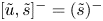 $[\tilde {u}, \tilde {s}]^{-} = (\tilde {s})^{-}$. In fact, from the definition of the BMS measure, we have
 $\nu _u = \mu ^{\mathrm {PS}}_u/\mu ^{\mathrm {PS}}_u(S_j)$ for all
 $u \in U_j$. Hence, we use this as the definition of
 $\nu _u$ for any
 $u \in \tilde {U}_j$. The non-trivial consequence is that
 $({d\nu _{u'}}/{d\nu _u})(s) \propto e^{\delta _\Gamma \beta _{(\tilde {s})^{-}}([\tilde {u}', \tilde {s}], [\tilde {u}, \tilde {s}])}$ for all
 $s \in S_j$ and smooth in
 $u, u' \in \tilde {U}_j$. Hence, there exists
 $C_2 > 0$ such that
 $|1 - ({d\nu _{u'}}/{d\nu _u})(s)| \leq C_2d(u, u')$ for all
 $u, u' \in \tilde {U}_j$ and
 $s \in S_j$. The two inequalities easily give
 $\|\tilde {\phi }_t\|_{C^{1}} \leq C\|\phi \|_{C^{1}}$ for some
 $C > 1$, for all
 $\phi \in C_{\mathrm {c}}^{1}(\Gamma \backslash G, \mathbb {R})$ and
 $t \geq 0$.
Lemma 10.4 There exist  $C > 0$ and
 $\eta > 0$ such that for all
 $\phi \in C_{\mathrm {c}}^{1}(\Gamma \backslash G, \mathbb {R})$, we have
 \[ |\phi(F([u, s])a_{2t + r}m) - \phi_t(u, m, t + r)| \leq Ce^{-\eta t}\|\phi\|_{C^{1}} \]
for all  $[u, s] \in R$,
 $m \in M$, and
 $t, r \geq 0$.
Proof. There exists  $C_F > 0$ such that
 $d(F(w_1), F(w_2)) < C_F$ for all
 $w_1, w_2 \in R_j$ and
 $j \in \mathcal {A}$. Fix
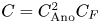 $C = C_{\mathrm {Ano}}^{2}C_F$ and
 $\eta = 1$. Let
 $\phi \in C_{\mathrm {c}}^{1}(\Gamma \backslash G, \mathbb {R})$. Let
 $j \in \mathcal {A}, [u, s] \in R_j$, and
 $t, r \geq 0$. Let
 $l \in \mathbb {Z}_{\geq 0}$ such that
 $t + r \in [\tau _l(u), \tau _{l + 1}(u))$ and let
 $u_1 = \sigma ^{l}(u) \in U_k$ for some
 $k \in \mathcal {A}$. Let
 $s_1 \in S_k$. Then
 $[u, s]a_{\tau _l(u)} = \mathcal {P}^{l}([u, s])$ and
 $[u_1, s_1]$ are both in
 $[u_1, S_k]$. Noting that
 $\tau _l(u) \leq t + r$, we use the above property and recall Lemma 4.2 to get
 \begin{align*} &d(F([u, s])a_{2t + r}m, F([u_1, s_1])a_{2t + r - \tau_l(u)}\vartheta^{l}(u)^{{-}1}m) \\ &\quad \leq{}C_{\mathrm{Ano}}^{2} e^{-(2t + r - \tau_l(u))}d(F([u, s])a_{\tau_l(u)}\vartheta^{l}(u), F([u_1, s_1])) \\ &\quad ={}C_{\mathrm{Ano}}^{2} e^{-(2t + r - \tau_l(u))}d(F(\mathcal{P}^{l}([u, s])), F([u_1, s_1])) \\ &\quad \leq{}C_{\mathrm{Ano}}^{2} C_F e^{-(2t + r - \tau_m(u))} \leq Ce^{{-}t}. \end{align*}
Thus
 \[ |\phi(F([u, s])a_{2t + r}m) - \phi(F([u_1, s_1])a_{2t + r - \tau_l(u)}\vartheta^{l}(u)^{{-}1}m)| \leq Ce^{-\eta t}\|\phi\|_{C^{1}}. \]
The lemma follows by integrating over  $s_1 \in S_k$ with respect to the probability measure
 $\nu _{u_1}$.
Corollary 10.5 There exist  $C > 0$ and
 $\eta > 0$ such that for all
 $\phi , \psi \in C_{\mathrm {c}}^{1}(\Gamma \backslash G, \mathbb {R})$, we have
 \[ \biggl|\int_{\Gamma \backslash G} \phi(xa_{2t})\psi(x) \, d\mathsf{m}(x) - \frac{1}{\nu_U(\tau)}\Upsilon_{\phi_t, \psi_0}(t)\biggr| \leq C e^{-\eta t} \|\phi\|_{C^{1}} \|\psi\|_{C^{1}}. \]
Proof Proof of Theorem 1.1
Fix  $C_4 > 1$ to be the
 $C$ described in the remark before Lemma 10.4. Fix
 $C_1, \eta _1, C_2, \eta _2 > 0$ to be the
 $C$ and
 $\eta$ from Corollary 10.5 and Lemma 10.3, respectively. Fix
 $r' \in \mathbb {N}$ to be the
 $r$ from Lemma 10.3. Fix
 $r = r' + 1$,
 $C_3 = {C_2}/{\nu _U(\tau )}$,
 $\eta = ({1}/{2})\min (\eta _1, \eta _2)$, and
 $C = C_1 + C_3C_4^{2}$. Let
 $\phi \in C_{\mathrm {c}}^{r}(\Gamma \backslash G, \mathbb {R})$ and
 $\psi \in C_{\mathrm {c}}^{1}(\Gamma \backslash G, \mathbb {R})$. Consider the decomposition
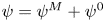 $\psi = \psi ^{M} + \psi ^{0}$ where
 $\psi ^{M}$, defined by
 $\psi ^{M}(x) = \int _M \psi (xm) \, dm$ for all
 $x \in \Gamma \backslash G$, is
 $M$-invariant and consequently
 $\psi ^{0}$ satisfies
 $\int _M \psi ^{0}(xm) \, dm = 0$ for all
 $x \in \Gamma \backslash G$. We use similar notation for
 $\phi$. Then
 \begin{align*} &\biggl|\int_{\Gamma \backslash G} \phi(xa_t)\psi(x) \, d\mathsf{m}(x) - \int_{\Gamma \backslash G} \phi \, d\mathsf{m} \cdot \int_{\Gamma \backslash G} \psi \, d\mathsf{m}\biggr|\\ &\quad \leq{}\biggl|\int_{\Gamma \backslash G} \phi^{M}(xa_t)\psi^{M}(x) \, d\mathsf{m}(x) - \int_{\Gamma \backslash G} \phi^{M} \, d\mathsf{m} \cdot \int_{\Gamma \backslash G} \psi^{M} \, d\mathsf{m}\biggr| + \biggl|\int_{\Gamma \backslash G} \phi(xa_t)\psi^{0}(x) \, d\mathsf{m}(x)\biggr|. \end{align*}
Exponential mixing of the geodesic flow has been established by Stoyanov [Reference StoyanovSto11] also using Dolgopyat's method. Thus, we know the first term is bounded by  $C'e^{-\eta 't}\|\phi \|_{C^{1}} \|\psi \|_{C^{1}}$ for some
 $C', \eta ' > 0$. So it suffices to assume that
 $\psi = \psi ^{0}$, that is,
 $\int _M \psi (xm) \, dm = 0$ for all
 $x \in \Gamma \backslash G$. Thus, we have corresponding functions
 $\phi _t, \psi _0 \in C(U^{\vartheta , \tau }, \mathbb {R})$ with some extensions
 $\tilde {\phi }_t \in C^{r}(\tilde {U}^{\vartheta , \tau }, \mathbb {R})$ and
 $\tilde {\psi }_0 \in C^{1}(\tilde {U}^{\vartheta , \tau }, \mathbb {R})$ with
 $\int _M \tilde {\psi }_0(u, m, t) \, dm = 0$ for all
 $(u, t) \in \tilde {U}^{\tau }$ and
 $\|\tilde {\phi }_t\|_{C^{r}} \leq C_4\|\phi \|_{C^{r}}$ for all
 $t \geq 0$ and
 $\|\tilde {\psi }_0\|_{C^{1}} \leq C_4\|\psi \|_{C^{1}}$. Hence by Corollary 10.5 and Lemma 10.3, for all
 $t > 0$, letting
 $t' = {t}/{2}$, we have
 \begin{align*} \biggl|\int_{\Gamma \backslash G} \phi(xa_t)\psi(x) \, d\mathsf{m}(x)\biggr| &\leq{}\frac{1}{\nu_U(\tau)}\biggl|\Upsilon_{\phi_{t'}, \psi_0}(t')\biggr| + C_1 e^{- \eta_1 t'} \|\phi\|_{C^{1}} \|\psi\|_{C^{1}}\\ &\leq{}C_3C_4^{2} e^{- \eta_2 t'} \|\phi\|_{C^{r}} \|\psi\|_{C^{1}} + C_1 e^{- \eta_1 t'} \|\phi\|_{C^{1}} \|\psi\|_{C^{1}}\\ &\leq{}C e^{-\eta t} \|\phi\|_{C^{r}} \|\psi\|_{C^{1}}. \end{align*}
Acknowledgements
First and foremost, Winter would like to thank Ralf Spatzier, without whom this paper could in no way have been completed. He was a large part of the development of the underlying ideas, provided very extensive technical help, and was a source of encouragement and good humor throughout. Winter is also particularly grateful to Mark Pollicott both for several useful conversations and for his patience during them. Sarkar and Winter also thank others for technical advice and helpful conversations, among them Hee Oh, Michael Magee, Ilya Gekhtman, and Wenyu Pan. We are extremely thankful to Hee Oh for her patient and careful reading of the manuscript. Her suggestions have improved the quality of our exposition.
Appendix A. Ruelle–Perron–Frobenius theorem for the smooth setting
We need to work on compact sets and hence, without loss of generality, we assume that  $\tilde {U}$ from § 5.1 is closed by taking the closures
 $\overline {\tilde {U}_j}$ for all
 $j \in \mathcal {A}$. We note that the maps
 $\sigma ^{-(j, k)}$ and
 $\tau _{(j, k)}$ can be extended to the closures and they are smooth, for all admissible pairs
 $(j, k)$. Recall that we have a Riemannian metric on
 $\tilde {U}$ which is induced from the one chosen on
 $G$. By Lemma 7.2, the inverse maps
 $\sigma ^{-\alpha }$ are eventually contracting for all admissible sequences
 $\alpha$. We now need to slightly modify the Riemannian metric on
 $\tilde {U}$ to ensure that they are strictly contracting. Such a Riemannian metric is called an adapted metric and can be constructed by a technique which involves averaging the original Riemannian metric on
 $\operatorname {T}^{1}(X)$ over sufficiently long orbits of the forward and backward geodesic flow. This is a standard trick which is originally due to Mather [Reference MatherMat68] in the case of diffeomorphisms, but the flow version is similar and can be found in [Reference MangumMan98, Lemma 2.2], for example. Then the new Riemannian metric induces the desired modified Riemannian metric on
 $\tilde {U}$ and we use this henceforth. Now we can assume
 $c_0 = 1$ in Lemma 7.2, that is, for all
 $j \in \mathbb {Z}_{\geq 0}$ and admissible sequences
 $\alpha = (\alpha _0, \alpha _1, \dotsc , \alpha _j)$, we have
 \[ \frac{1}{\kappa_1^{j}} \leq \|(d\sigma^{-\alpha})_u\|_{\mathrm{op}} \leq \frac{1}{\kappa_2^{j}} < 1 \quad \text{for all }u \in \tilde{U}_{\alpha_j}. \]
We denote by  $\nabla : \Gamma (\operatorname {T}(\tilde {U})) \to \Gamma (\operatorname {T}(\tilde {U}) \otimes \operatorname {T}^{*}(\tilde {U}))$ the Levi-Civita connection corresponding to the Riemannian metric on
 $\tilde {U}$. This extends to the connection
 $\nabla : \Gamma (E) \to \Gamma (E \otimes \operatorname {T}^{*}(\tilde {U}))$ for any tensor bundle
 $E$ over
 $\tilde {U}$. Let
 $|\cdot |$ denote the pointwise norm of tensors on
 $\tilde {U}$ so that applying it gives non-negative functions in
 $C^{\infty }(\tilde {U}, \mathbb {R})$. We first have the following lemma which shows that transfer operators preserve a certain cone.
Lemma A.1 For all  $a \in \mathbb {R}$, there exists
 $\{C_k > 0: k \in \mathbb {Z}_{\geq 0}\}$ with
 $C_0 = 1$ such that
 $\tilde {\mathcal {L}}_{a\tau }(\Lambda ) \subset \Lambda$ for the cone
 \[ \Lambda = \{h \in C^{\infty}(\tilde{U}, \mathbb{R}): |\nabla^{k} h| \leq C_k h \text{ for all } k \in \mathbb{Z}_{{\geq} 0}\}. \]
Proof. Let  $a \in \mathbb {R}$. It suffices to inductively construct
 $\{C_k > 0: k \in \mathbb {Z}_{\geq 0}\}$ such that for all
 $k \in \mathbb {Z}_{\geq 0}$ and
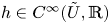 $h \in C^{\infty }(\tilde {U}, \mathbb {R})$, if
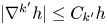 $|\nabla ^{k'} h| \leq C_{k'} h$ for all
 $0 \leq k' \leq k$, then
 $|\nabla ^{k} (\tilde {\mathcal {L}}_{a\tau }(h))| \leq C_k \tilde {\mathcal {L}}_{a\tau }(h)$. The base case
 $k = 0$ is trivial by choosing
 $C_0 = 1$. Now assume we have chosen appropriate
 $C_0, C_1, \dotsc , C_{k - 1} > 0$ for some
 $k \in \mathbb {N}$. Let
 $C_k > 0$ be some constant. Suppose
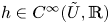 $h \in C^{\infty }(\tilde {U}, \mathbb {R})$ such that
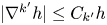 $|\nabla ^{k'} h| \leq C_{k'} h$ for all
 $0 \leq k' \leq k$. We will show that we also have
 $\big |\nabla ^{k} (\tilde {\mathcal {L}}_{a\tau }(h))| \leq C_k \tilde {\mathcal {L}}_{a\tau }(h)$ if
 $C_k$ is sufficiently large. It can be computed using coordinate charts and by induction on
 $k$ that the
 $k$th covariant derivative of
 $\tilde {\mathcal {L}}_{a\tau }(h)$ is the tensor of the form
 \[ \nabla^{k} \big(\tilde{\mathcal{L}}_{a\tau}(h)\big) = \sum_{\alpha: \operatorname{len}(\alpha) = 1} e^{a (\tau_\alpha \circ \sigma^{-\alpha})} \big(T_{\alpha, k} + \nabla^{k} h \circ \underbrace{d\sigma^{-\alpha} \otimes d\sigma^{-\alpha} \otimes \dotsb \otimes d\sigma^{-\alpha}}_{k}\big) \]
where  $T_{\alpha , k}$ is a tensor which is a sum of terms composed of
 $a$, covariant derivatives of
 $\tau _\alpha$, various derivatives of
 $\sigma ^{-\alpha }$, and covariant derivatives of
 $h$ of orders strictly less than
 $k$. Moreover, each term has exactly one factor of the covariant derivative
 $\nabla ^{k'}h$ for some
 $k' < k$. Note that all orders of derivatives of
 $\tau _\alpha$ and
 $\sigma ^{-\alpha }$ are bounded on the compact set
 $\tilde {U}$ for all admissible sequences
 $\alpha$. Hence, taking the norm and using the induction hypothesis, we see that there exists a constant
 $C > 0$ such that
 \begin{align*} &\big|\nabla^{k} \big(\tilde{\mathcal{L}}_{a\tau}(h)\big)\big| \\ &\quad \leq{}\sum_{\alpha: \operatorname{len}(\alpha) = 1} e^{a (\tau_\alpha \circ \sigma^{-\alpha})} \big(C(h \circ \sigma^{-\alpha}) + (|\nabla^{k} h| \circ \sigma^{-\alpha}) \cdot \underbrace{|\sigma^{-\alpha}|_{C^{1}} \cdot |\sigma^{-\alpha}|_{C^{1}} \dotsb |\sigma^{-\alpha}|_{C^{1}}}_{k}\big)\\ &\quad \leq{}\sum_{\alpha: \operatorname{len}(\alpha) = 1} e^{a (\tau_\alpha \circ \sigma^{-\alpha})} \biggl(C\big(h \circ \sigma^{-\alpha}\big) + C_k \big(h \circ \sigma^{-\alpha}\big) \cdot \frac{1}{\kappa_2^{k}}\biggr)\\ &\quad \leq{}\biggl(C + \frac{C_k}{\kappa_2^{k}}\biggr) \sum_{\alpha: \operatorname{len}(\alpha) = 1} e^{a (\tau_\alpha \circ \sigma^{-\alpha})} \big(h \circ \sigma^{-\alpha}\big)\\ &\quad\leq{}\biggl(C + \frac{C_k}{\kappa_2^{k}}\biggr) \tilde{\mathcal{L}}_{a\tau}(h). \end{align*}
Thus, we have  $|\nabla ^{k} (\tilde {\mathcal {L}}_{a\tau }(h))| \leq C_k \tilde {\mathcal {L}}_{a\tau }(h)$ if
 $C + {C_k}/{\kappa _2^{k}} \leq C_k$. Since
 ${1}/{\kappa _2^{k}} \in (0, 1)$, this is possible so long as
 $C_k \geq C(1 - {1}/{\kappa _2^{k}})^{-1}$.
The following theorem shows that the eigenvector  $h_a \in C^{\operatorname {Lip}(d)}(U, \mathbb {R})$ for
 $\mathcal {L}_{-(\delta _\Gamma + a)\tau }$ corresponding to its maximal simple eigenvalue can indeed be extended to a smooth positive eigenvector
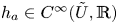 $h_a \in C^{\infty }(\tilde {U}, \mathbb {R})$ for
 $\tilde {\mathcal {L}}_{-(\delta _\Gamma + a)\tau }$. We follow the proof of [Reference Parry and PollicottPP90, Theorem 2.2].
Theorem A.2 For all  $a \in \mathbb {R}$, the operator
 $\tilde {\mathcal {L}}_{a\tau }$ has a positive eigenvector
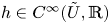 $h \in C^{\infty }(\tilde {U}, \mathbb {R})$ corresponding to its maximal eigenvalue which coincides with that of
 $\mathcal {L}_{a\tau }$.
Proof. Let  $a \in \mathbb {R}$. Let
 $\{C_k > 0: k \in \mathbb {N}\}$ be the corresponding set of constants provided by Lemma A.1. Consider the convex set
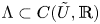 $\Lambda \subset C(\tilde {U}, \mathbb {R})$ defined by
 \[ \Lambda = \{h \in C^{\infty}(\tilde{U}, \mathbb{R}): 0 \leq h \leq 1, |\nabla^{k} h| \leq C_k h \text{ for all } k \in \mathbb{N}\}. \]
Note that all covariant derivatives are uniformly bounded over all  $h \in \Lambda$ by virtue of the scaling
 $0 \leq h \leq 1$. Then
 $\Lambda$ is equicontinuous and uniformly bounded and hence, by Arzelà–Ascoli,
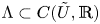 $\Lambda \subset C(\tilde {U}, \mathbb {R})$ is precompact. Thus, to show that
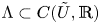 $\Lambda \subset C(\tilde {U}, \mathbb {R})$ is compact, it suffices to show that
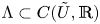 $\Lambda \subset C(\tilde {U}, \mathbb {R})$ is closed. To show this, let
 $\{\phi _j\}_{j \in \mathbb {N}} \subset \Lambda$ be a sequence which converges in
 $C(\tilde {U}, \mathbb {R})$ to some
 $\phi$. Then
 $\{\phi _j\}_{j \in \mathbb {N}}$ converges uniformly to
 $\phi$. Now, using coordinate charts and the Landau–Kolmogorov inequality, we can deduce that
 $\{\partial _\alpha \phi _j\}_{j \in \mathbb {N}}$ is also uniformly convergent for all multi-indices
 $\alpha$. This implies that in fact
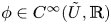 $\phi \in C^{\infty }(\tilde {U}, \mathbb {R})$ and
 $\{\partial _\alpha \phi _j\}_{j \in \mathbb {N}}$ converges uniformly to
 $\partial _\alpha \phi$ for all multi-indices
 $\alpha$. It is then easy to see that we also have
 $0 \leq \phi \leq 1$ and
 $|\nabla ^{k} \phi | \leq C_k \phi$ for all
 $k \in \mathbb {N}$, which implies
 $\phi \in \Lambda$. So
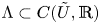 $\Lambda \subset C(\tilde {U}, \mathbb {R})$ is closed and hence compact.
Let  $j \in \mathbb {N}$. Define the map
 $\tilde {\mathcal {L}}_{a\tau , j}: \Lambda \to C^{\infty }(\tilde {U}, \mathbb {R})$ by
 \[ \tilde {\mathcal {L}}_{a\tau , j}(h) = \frac{\tilde {\mathcal {L}}_{a\tau }(h + {1}/{j})}{\|\tilde {\mathcal {L}}_{a\tau }(h + {1}/{j})\|_\infty } \]
for all  $h \in \Lambda$. Then,
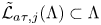 $\tilde {\mathcal {L}}_{a\tau , j}(\Lambda ) \subset \Lambda$ by Lemma A.1 where
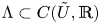 $\Lambda \subset C(\tilde {U}, \mathbb {R})$ is a compact convex set. Now, by the Schauder–Tychonoff fixed point theorem, we obtain
 $h_j \in \Lambda$ such that
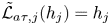 $\tilde {\mathcal {L}}_{a\tau , j}(h_j) = h_j$ which implies
 $\tilde {\mathcal {L}}_{a\tau }(h_j + {1}/{j}) = \|\tilde {\mathcal {L}}_{a\tau }(h_j + {1}/{j})\|_\infty h_j$. By compactness of
 $\Lambda$, we can choose
 $h \in \Lambda$ to be any limit point of the sequence
 $\{h_j\}_{j \in \mathbb {N}}$. Then, by continuity, we have
 $\tilde {\mathcal {L}}_{a\tau }(h) = \|\tilde {\mathcal {L}}_{a\tau }(h)\|_\infty h$ which shows that
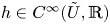 $h \in C^{\infty }(\tilde {U}, \mathbb {R})$ is an eigenvector of
 $\tilde {\mathcal {L}}_{a\tau }$. From the proof of [Reference Parry and PollicottPP90, Theorem 2.2], we see that
 $h|_U \in C^{\operatorname {Lip}(d)}(U, \mathbb {R})$ is a positive eigenvector for
 $\mathcal {L}_{a\tau }$ corresponding to its maximal simple eigenvalue which must coincide with
 $\|\tilde {\mathcal {L}}_{a\tau }(h)\|_\infty$. The eigenvalue is also maximal for
 $\tilde {\mathcal {L}}_{a\tau }$ because any eigenvector of
 $\tilde {\mathcal {L}}_{a\tau }$ restricts via
 $|_U: C(\tilde {U}, \mathbb {R}) \to C(U, \mathbb {R})$ to an eigenvector of
 $\mathcal {L}_{a\tau }$. Now, ensuring that
 $\delta > 0$ used to enlarge
 $U$ to
 $\tilde {U}$ in § 5.1 is sufficiently small, we can guarantee that
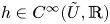 $h \in C^{\infty }(\tilde {U}, \mathbb {R})$ is also positive by uniform continuity.