


In much of the developing world, legal rules are ignored. Businesses skirt tax and labor regulations, unlicensed street vendors clog city streets, and squatters build houses on private property. This gap between lived reality and parchment law often is taken to reflect a weak state. As Levitsky and Murillo (Reference Levitsky and Murillo2009, 121) summarize, “a major cause of weak enforcement is limited state capacity to monitor and sanction.” Indeed, classic definitions of state capacity center on whether authorities can make and enforce binding rules for society (e.g., Mann Reference Mann1984, 188). The size of informal economies even proxies for state capacity in empirical work (e.g., Polidano Reference Polidano2000).
Different forms of state weakness take the blame for limited enforcement. On the one hand, a state can deter and penalize all offenses with sufficient police, judges, and bureaucrats. Few states, particularly in low-income countries, have this fiscal luxury. In this spirit, classic models in law and economics, such as Becker (Reference Becker1968), emphasize how budgets constrain enforcement. Budget cuts have taken the blame for widespread regulatory violations in the wake of economic crises in the developing world (Centeno and Portes Reference Centeno, Portes, Fernández-Kelly and Shefner2006; Grindle Reference Grindle1996; O'Donnell Reference O'Donnell1993). On the other hand, enforcement can lag due to principal-agent problems. Politicians struggle to monitor the behavior of bureaucrats. Agents shirk or predate. As North (Reference North1990, 59) puts it, “Enforcement in Third World economies is uncertain not only because of ambiguity of legal doctrine (a measurement cost), but because of uncertainty with respect to the behavior of the agent.” Weak administrative capacity thus limits enforcement.
Capacity-based approaches assume that politicians attempt to enforce the law and fail. Yet in an important class of cases, states have the fiscal and administrative capacity to enforce their laws. Politicians choose not to do so. This article introduces the concept of forbearance to describe the intentional and revocable nonenforcement of law. Forms of forbearance differ in their distributive incidence and mode of delivery, ranging from a well-studied corrupt subtype in which politicians carve out legal exemptions for their cronies to a less expected subtype in which laws are waived for the poor as a form of informal welfare provision. Across subtypes, I argue that forbearance has three distinct features that make it a powerful form of distribution: it can be revoked, hidden from legislative debate and oversight, and used to target resources to those willing to bear the costs of illegality.
To be clear, the idea that politicians manipulate law enforcement is not new. A rich literature describes the politics around the enforcement of specific laws.Footnote 1 The primary contribution of this article is to bring these isolated observations together into a single conceptual framework and propose empirical strategies to identify forbearance. Popper (Reference Popper2002 [1935]) famously argued that the meaning of concepts results from their falsifiability. Especially in developing countries where forbearance must be separated from institutional weakness, a series of challenges complicate empirical work. Given that perfect control is unachievable and offense levels vary, how do we compare enforcement effort? And how can we separate circumstances when a government chooses not to enforce from those when it cannot enforce? I show how an equilibrium framework drawn from price theory distinguishes the often-confused issues of compliance and enforcement. I then focus on three ways to identify forbearance based on patterns of spatial variation, enforcement elasticities, and political bottlenecks. In Popper's spirit, I present these methods not because they constitute an exhaustive set, but rather because they best clarify and differentiate the concept's theoretical content.
The second part of this article applies the empirical strategies to enforcement against two common legal violations by the poor, street vending and squatting. I first analyze enforcement in Santiago, Chile. Capacity-based theories struggle to explain extensive street vending because Chile boasts one of the strongest police forces and economies in Latin America. Drawing on an original dataset on police operations and street vending, I demonstrate how mayors in poor districts systematically prevent the police from using existing enforcement resources as a way to build electoral support. I then put the empirical strategies to a harder test by analyzing enforcement against squatting in weaker institutional contexts, Bogotá, Colombia and Lima, Peru. Administrative data reveal that enforcement drops off at moments when politicians intervene, even after overstretched bureaucrats and courts complete their jobs. Rich qualitative data confirm that local politicians use forbearance to boost welfare and signal their commitment to poor constituents when social policies are insufficient. The picture that emerges is that forbearance toward laws that the poor violate is common in many developing countries not because police power or administrative resources lag, but rather because welfare states fail to provide for basic social needs.
Forbearance toward laws that the poor tend to violate, in particular, deserves scholarly attention because of the benefits at stake and their electoral impacts. Just reflect on a few descriptive statistics: Permitting illegal immigrants to work in the United States redistributes more income globally than all American foreign aid (Weyl Reference Weyl2015). Consumption taxes in Peru are regressive on paper, but somewhat equalize incomes in practice because poorer households escape taxes by purchasing their goods from informal vendors (Jaramillo Reference Jaramillo2014, 406). The tolerance of squatter settlements has been called the primary “subsidy” to win urban votes in Turkey (Keyder Reference Keyder1999, 147) and has been a pivotal issue in the Zambian presidential elections (Resnick Reference Resnick2013, Chap. 3). Hence, the ways that laws are enforced should not be treated as trivial—or apolitical—choices.
THE CONCEPT
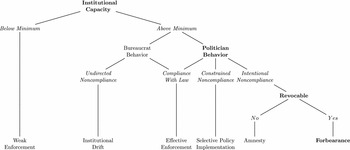
This article focuses on forbearance, or intentional and revocable government leniency toward violations of the law, as a distinct phenomenon from weak enforcement. There are three components to this definition—capacity, intention, and revocability—that I walk through and use to distinguish forbearance from related concepts in Figure 1.
Defining Forbearance

First, institutional capacity distinguishes forbearance from forms of weak enforcement in which actors cannot enforce the law. It is nonsensical to talk about forbearance in parts of Sierra Leone or Haiti where the state apparatus barely penetrates society. Very corrupt bureaucracies likewise preclude enforcement. Surpassing a minimum level of institutional capacity does not require that a government can control all offenses, or that it allocates resources or institutions to enforce at present. The theoretical bar is that politicians plausibly must be able to muster the infrastructure to sanction offenses if they so desire. If they lack the resources, fail to control predatory bureaucrats, or cannot revive neglected institutions, the outcome is uniformly weak enforcement.
Second, and most critically, forbearance requires a political choice not to enforce a law. A politician must act in some way to change the enforcement outcome, be it an attempt to demote bureaucrats who enforce or stall sanctions for a type of offense or group. I recognize the high evidentiary bar associated with showing political intent, but it is necessary to separate forbearance from other ways in which limited enforcement can be observed. Mahoney and Thelen (Reference Mahoney, Thelen, Mahoney and Thelen2010: 13), for instance, view enforcement as a locus for institutional change because state agents must enforce laws that they do not design. What they call “institutional drift” results from bureaucratic noncompliance, as state agents reinterpret or ignore formal rules. In contrast, as illustrated in Figure 1, forbearance suggests that politicians, not their agents, do not comply with the law. To pass to this branch, politicians must enjoy discretion (formally or informally) over enforcement. If politicians face an insulated bureaucracy, then forbearance becomes impossible.Footnote 2 Hence, forbearance depends on a bureaucracy with sufficient strength to execute politicians’ desires, but imperfect autonomy so that executives can intervene in enforcement.
Political intent also distinguishes forbearance from selective policy implementation, which refers to a decision to prioritize certain policies or laws and ignore others due to budget constraints. For example, O'Brien and Li (Reference O'Brien and Li1999) develop the idea of selective policy implementation to describe the behavior of Chinese local cadres. Officials are assigned an array of policy targets, which they then choose among given limited time and money. Selective policy implementation thus can be thought of as a variant of weak enforcement in which politicians have the capacity to enforce if they divert resources and attention to an issue. Politicians engage in constrained noncompliance, meaning that they let enforcement fall by the wayside due to their focus on other priorities. The implication is that a politician is willing to enforce if resources or competing demands change. In contrast, what forbearance—or intentional noncompliance—means is that a politician is unwilling to change enforcement, even as resource constraints or competing policy demands ease. As qualitative categories, I create a sharp dichotomy between these behaviors, but the quantitative indicators below allow for a continuum based on elasticity measures. I give the fuzzy notion of intent concrete empirical meaning as a politician's limited responsiveness to shifts in resources or policy burdens.
These conceptual distinctions matter in practice, as seen in a borderline case. In 2012, President Barack Obama issued an executive action to stay the deportation of young undocumented immigrants.Footnote 3 On the one hand, many argue that Obama decided to prioritze the deportation of felons, which required reallocating law enforcement resources away from children. This description—favored by the government—suggests that Obama would have deported childhood arrivals if granted additional congressional appropriations. If so constrained by resources, selective policy implementation best describes Obama's action. On the other hand, some stress that Obama spoke out against the deportations on the grounds that they were “unjust.” Under this interpretation, even if the number of felons dropped or Congress increased the enforcement budget, Obama still would have avoided the deportations. This action would be forbearance. Which interpretation finds greater support is an empirical matter, but the motivations are distinct.
A third core definitional element is that forbearance is revocable. The state reserves the right to enforce the law and offenders believe that the rules can carry a sanction. This flexibility differentiates forbearance from cases of amnesty. There, the state surrenders its enforcement rights. A revocable decision can be formal, as potentially was the case with Obama's immigration action. More commonly, forbearance is expressed informally. For example, Indian politicians gave verbal directives not to call in the police to suppress violence against Muslim protesters (Wilkinson Reference Wilkinson2006, 61). The ease with which forbearance can be revoked in practice varies. It is easiest to recognize forbearance when politicians maintain the resources and infrastructure to enforce at whim, as with refusals to call in police forces or choices to transfer bureaucrats that try to do their jobs. But politicians also can stop funding enforcement institutions as a means of forbearance, as we will see in the case of squatting in Lima. As long as politicians credibly can step up enforcement, even if it requires them to build or resuscitate defunct institutions or procedures, these choices also constitute forbearance.Footnote 4
A Typology of Forbearance
Enforcement (and its absence) has distributive consequences. More specifically, forbearance can be divided into subtypes based on its distributive effects and mode of distribution. I define the distributive incidence as in the economic analysis of taxes and transfers. Economically progressive forbearance occurs when lower tranches of the income distribution receive greater absolute or relative benefits through the tolerance of law breaking than upper tranches. Regressive forbearance implies that upper tranches capture greater benefits.
Just as with tax or social welfare programs, how to calculate distributive benefits can be tricky. Some laws are hard to categorize because the physical incidence (who violates the law and benefits directly from forbearance) differs from the economic incidence (who benefits indirectly once market prices have adjusted). I focus on the direct effects on those who violate the law because they tend to be most salient for enforcement politics and transparent to calculate. As Wilson (Reference Wilson1980) stresses, enforcement imposes concentrated costs on clearly identifiable individuals. It follows that politicians are sensitive to whom they are seen as sanctioning (or sparing), even when enforcement is intended to prevent other groups from absorbing ancillary benefits. This dynamic contrasts with the legislative arena, where politicians debate the overall desirability of regulation and thus consider the indirect benefits.Footnote 5 While including the indirect effects can reveal additional interest groups with a stake in enforcement, there also tends to be little agreement about which effects to calculate or how to judge their magnitudes, as I discuss in the Appendix.
There are two ways that a government impacts progressivity through its enforcement decisions. First, choices about which laws to enforce have distributive consequences. In this case, progressivity depends on how the marginal utility of an offense changes with income. Forbearance must be directed toward laws that the poor tend to violate to distribute resources progressively. The criminalization of homelessness clarifies the point. Although facially neutral, vagrancy laws have a discriminatory impact on the poor, given that few wealthy individuals sleep on the streets when they have a home at their disposal. Enforcement of laws that the wealthy tend to violate (white-collar crimes), like those against pure cocaine use, foreign tax shelters, or insider trading, has the opposite distributive consequences.
Other laws can benefit all income groups if ignored. In these cases, progressivity depends on which groups are targeted for enforcement. Consider the case of enforcement against squatting, meaning the unauthorized occupation of vacant land or buildings. If a government does nothing to prevent squatting, then the wealthy can take valuable pieces of land to build large houses and absorb the greatest absolute benefit from government leniency. However, the poor may receive the maximum relative benefit given that they spend a greater share of their income on housing and they are potentially judgment proof in the case of prosecution. Weak enforcement thus has mixed distributive effects: it is likely regressive in absolute terms, and progressive in relative terms. However, if the government prosecutes upper-class squatters and ignores houses in poor neighborhoods, as I demonstrate in Bogotá, the result is solidly progressive. If only the very wealthy are allowed to violate land laws, as Sun (Reference Sun2015) finds in China, it is regressive. The incidence depends not on the type of law, but rather on how governments use their discretion in enforcement.Footnote 6
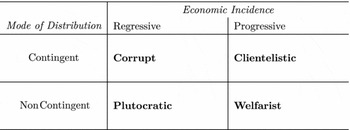
The second dimension distinguishes between modes of distribution. Forbearance can be provided in a contingent manner to individuals or groups as a reward for other political behaviors, such as campaign contributions, bribes, votes, or turnout. But, forbearance also can be extended in a transparent and unbiased way. I distinguish this mode as noncontingent in that forbearance is granted to individuals or groups regardless of whether they supported or opposed a politician.Footnote 7
These dimensions combine to generate four subtypes of forbearance shown in Figure 2. The left side corresponds to familiar regressive subtypes. When legal exemptions are provided to specific wealthy individuals, forbearance constitutes a standard form of corruption or cronyism, as shown in the upper left. It is the flipside of targeted enforcement against political enemies. The quote ascribed to Brazilian President Getúlio Vargas best captures the sentiment: “For my friends, everything; for my enemies, the law.” The lower-left corner corresponds to circumstances where forbearance extends to the rich as a class. The distinction from corruption is that the rich or powerful gain a general impunity that need not be negotiated by specific individuals. Gordon and Hafer (Reference Gordon, Hafer, Carpenter and Moss2014) show that some American politicians reduce enforcement of coal mining regulations industrywide to attract probusiness voters. In highly unequal contexts, such as Latin America, legal immunity for the wealthy can extend to most areas of law (Méndez, O'Donnell, and Pinheiro Reference Méndez, O'Donnell and Pinheiro1999). I refer to such enforcement exemptions for powerful groups as plutocratic forbearance.
A Typology of Forbearance

The typology also yields two progressive types of forbearance. The upper right, which corresponds to a particularistic distribution of forbearance to favor the poor, is a clientelistic subtype. The poor's primary political assets are votes, not money. They can offer their political support in exchange for favorable legal treatment, and run the risk of enforcement if they switch loyalties. Classic accounts of urban machine politics, such as Chubb's (Reference Chubb1982) study of how the Italian Christian Democrats won support in Palermo, recognize that politicians manipulate enforcement to reward and punish voters. As Scott (Reference Scott1969, 1142) notes, “A large portion of individual demands, and even group demands, in developing nations reach the political system, not before laws are passed, but rather at the enforcement stage.” Last, forbearance can be extended to the poor in a generalized manner. Politicians may use notions of economic deservingness in their enforcement choices and hope to be rewarded at the polls, but they do not demand political behaviors in exchange. Zambian presidential candidate Michael Sata, for instance, pledged to stop enforcement against all street vendors and squatters to appeal to the urban poor in 2006. As Sata justified his position, “If you fail to provide for [the poor], don't bring punitive measures against them” (Resnick Reference Resnick2013, 78).Footnote 8 Forbearance functions as an informal welfare policy when directed at the poor as a class. I focus on this welfarist subtype below.
There are limitations to this distributive typology, especially those that come from the moral values of a society. It may make little sense to think in a purely economic way about, say, whether to kill bankers or sell organs, because these are construed as moral prohibitions whose relevance is independent of the economic position of the individuals involved. In contrast, many property laws and economic regulations primarily raise distributive concerns. Our moral judgments turn on the needs and alternatives available to those who violate the law. This division follows Rawls (Reference Rawls1999 [1971]), who separates some values, such as freedom from violence, as inviolable and therefore not subject to principles of distributive justice. Although the concept of forbearance applies to moral and symbolic regulations, this typology works best for laws not subject to such deontological constraints. Even in this distributive realm, citizens and politicians hold divergent views on whether laws represent binding goals to be defended over recalcitrant social conditions, analogous to moral prohibitions, or whether laws need to take into account the circumstances of those who violate them, closer to social policy. As I turn to next, many politicians take the latter view when they lack access to other distributive instruments.
THE DISTRIBUTIVE ROOTS OF FORBEARANCE
Forbearance occurs when politicians choose not to enforce the law, but what motivates these decisions? I emphasize three general features that can lead politicians to favor forbearance as a distributive tool: the transfers can be (1) revoked, (2) adjusted informally, and (3) targeted to those willing to violate the law. These advantages are not to suggest that politicians prefer forbearance; it often is a second-best option to change the resource distribution when they cannot change law or policy. In particular, I argue that forbearance toward laws that the poor violate is more prevalent in developing countries because social policy remains inadequate and hard to expand locally. In the absence of welfare alternatives, forbearance is an attractive tool to mobilize voters, while enforcement carries high electoral costs.
First, by definition, politicians can extend and retract forbearance at will. For contingent subtypes, revocability is important because it permits a durable dependent exchange. Most clientelistic exchanges raise credible commitment problems: a politician can renege on her promises of particularistic rewards once she wins an election, but if goods are provided prior to the elections, then voters can ignore the rewards they already received and vote for their preferred candidate. While monitoring voter behavior can surmount this problem, another possibility is to tie voters’ utility to a politician's actual success in office (Robinson and Verdier Reference Robinson and Verdier2013). Voters need a politician to take office to receive forbearance, and a politician can withdraw forbearance at any point if voters stray from their promises, even after elections pass. As often noted in the context of property rights protection (Boone Reference Boone2009; Collier Reference Collier1976; Onoma Reference Onoma2010), politicians prefer the insecure assignment of resources to legal entitlements. Forbearance cements political dependency.
However, revocability also has a more benign interpretation in the context of noncontingent exchanges. Enforcement preferences often vary by electoral districts or with economic conditions over time. In this case, politicians bend laws not to cultivate the dependency of those who violate them, but to make law more responsive to local preferences. In the cases of squatting below, what stands out is the rarity of evictions and the decreasing turnaround time to receive property title. The time to receive legal recognition in Bogotá plummeted from twenty years in the 1960s to four years in the 2000s (Camargo and Hurtado Reference Camargo and Hurtado2013, 98). Land invasions chased by legalization make no sense for politicians who want to exploit the legal vulnerability of the poor. Rather, politicians use forbearance to tailor the rules to those groups that they affect most.
Second, forbearance can be provided outside of the normal budgetary and legislative process, making it both an ideal source of corruption and informal welfare provision. It is a “hidden” transfer. Benefits come through negative action—withholding state enforcement—rather than through positive provision that generates media, interest group, and legislative attention. The costs do not show up on government balance sheets. For these reasons, politicians can pursue unacceptable goals that would not survive the legislative process, such as forgoing tax payments or environmental regulations in exchange for campaign contributions. But the low visibility also permits distributions that powerful actors otherwise organize to veto. For example, the redistribution of private (and even state land) has been blocked by elites when proposed as formal legislation. Squatting can achieve similar effects, but it provokes less elite ire and allows the poor to exert greater influence at a local level.
Last, while forbearance tends to be associated with discretionary favors for the rich, it also can target the poor. Illegality can be thought of as a type of “ordeal” to differentiate those in need. Nichols and Zeckhauser (Reference Nichols and Zeckhauser1982) propose that many welfare programs impose deadweight costs to guarantee that only those who need a transfer will receive it. A classic case is a long line at a social assistance office. While recipients waste their time in line, reducing the program's productive efficiency, only those who depend on the benefit bother, improving the program's target efficiency. Likewise, violating the law can be thought of as a type of ordeal that improves targeting at a cost to the beneficiaries and society. For example, the poor are willing to live in squatter settlements without running water in the hopes of eventual property title and a foothold in urban life. As one former city council member puts it, “If you have even slightly more money, you look for other options with the advantages of services and legal security.”Footnote 9 Middle-class groups will not stand for the rough living conditions, and have more to lose in the case of a conviction. Of course, those who take legal risks often are not the poorest, and exploitative intermediaries can capture some of the rents. But social programs in many developing countries historically have focused on formal sector workers, who do not represent the poorest segment of the income distribution (De Ferranti, Perry, and Ferreira Reference De Ferranti, Perry, Ferreira and Walton2004). Forbearance sometimes can target those near the bottom of the income distribution more effectively than tax-based “redistribution.”
How distribution occurs—through revocable, hidden, and illegal transfers—thus distinguishes forbearance from other distributive tools. While these features create some political advantages, forbearance often is a second-best mode of distribution. I expect progressive subtypes of forbearance to be most common precisely when other distributive devices are foreclosed. In many multilevel democracies, local politicians take charge of enforcement, while national legislators craft the law and welfare policies. When social policy is limited in scale or coverage, politicians use forbearance to cater to local social needs and mobilize electoral support. Conversely, enforcement removes needed benefits and carries heavy political costs among low-income voters. Incentives for progressive forbearance therefore should be strongest in policy areas where the state does not offer effective welfare substitutes, and in electoral districts composed primarily of poor voters who demand informal welfare provision.
Prior to testing explanations for forbearance, we need to establish whether and when it occurs. The very nature of forbearance—an intentional withholding of the law—means that it is easily confounded with societal noncompliance and institutional weakness. The next section proposes how these phenomena can be distinguished from one another empirically before illustrating how distributive incentives better explain enforcement variation.
IDENTIFICATION AND MEASUREMENT
I propose three strategies to identify forbearance that also serve to underscore its conceptual meaning. Each method offers indicative, but partial, evidence of forbearance. When combined, these strategies can compensate for their individual weaknesses to identify forbearance.
Cross-Equilibrium Correlations
A necessary, but not sufficient, condition for forbearance is that government actions, rather than offense levels, drive enforcement variation. As in work on law and economics, I model enforcement as an equilibrium outcome determined by the interaction between offenses and sanctions. The goal is to characterize the related, but distinct, phenomenon of variation in sanctions due to government choices and due to the level of offenses, just as a supply and demand framework separates changes in production inputs from changes in consumer preferences in economic markets. This method on its own cannot establish why the political supply of enforcement varies, but it can rule out differences in societal compliance as the driving factor.
All studies of enforcement struggle with an issue of reverse causality between offenses and sanctions. This endogeneous relationship has led some scholars to interchange the concepts of compliance and enforcement, as well as their measures. For example, Levitsky and Murillo (Reference Levitsky and Murillo2009, 117, 129) define enforcement as “the degree to which parchment rules are complied with in practice,” and advocate operationalizing enforcement through measures of offenses or sanctions. But this approach to measurement provides limited leverage to understand whether citizens voluntarily comply with the law, reducing the need for sanctions, or whether politicians cannot or will not enforce the law.
Instead, sanctions and offenses are better thought of as functions of each other. On the one hand, the most basic assumption of crime control is that fewer individuals will violate the law as governments invest more in punishing offenses. We therefore can think of a demand curve (Compliance), which represents the level of offenses in a society as a function of government sanctions. This curve slopes downward because offenses decline with sanctions. On the other hand, the equilibrium is also determined by a government supply curve (Enforcement), which traces out the level of sanctions as a positive function of the level of offenses.Footnote 10 Even governments that are not keen to enforce will do more sanctions as the offense level increases because the negative externalities multiply, creating a rationale for additional sanctions, and more offenses are caught for a given resource investment.Footnote 11 The slopes of the enforcement curves vary because a government that engages in forbearance responds less to changes in offenses than one eager to enforce.
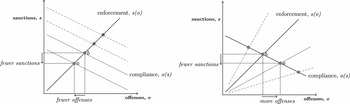
Figure 3 visualizes the two ways in which limited sanctions can be observed, through differences in the level of offenses or in government behavior. Think about two political units, a and b, which are alike in most ways. Citizens in a may have strong social norms against a given legal violation so the entire compliance curve is shifted inward relative to district b, as in the left panel of Figure 3. So, for any level of sanctions that government a does, it faces fewer offenses. Another possibility is that a has a similar culture of compliance as b, but government a cannot or will not enforce. The entire supply curve is shifted outwards and flattened, as in the right panel of Figure 3. For any level of legal violations, district a does fewer sanctions than b. A comparison of sanctions alone gives us limited leverage to distinguish these two scenarios. Similarly, data only on offenses do not allow us to draw inferences about sanctions.
Compliance-Demand (left) and Enforcement-Supply (right) Shifts

The key insight, which is often overlooked, is that information about the distribution of both offenses and sanctions can distinguish different causes of limited enforcement. Classic theory of identification of supply and demand curves in economics, such as Working (Reference Working1927), recognizes that supply-side shifts present different patterns of prices and quantities than those driven by consumer-side dynamics. In the same way, suppose the variation across units, such as political districts, is driven primarily by the demand (compliance) curve rather than the supply (enforcement) curve.Footnote 12 In this case, we see each unit has its own compliance curve, represented by the shifted dotted lines in the left panel of Figure 3. When we look across units (each in their own equilibrium marked by a point), the units trace out an upward sloping relationship. This positive correlation corresponds to a “rational” enforcement model in the sense that governments engage in more sanctions when there are more offenses. As we will see below in Santiago, hard crime follows this pattern across districts. If, on the other hand, the enforcement choices of governments fluctuate more than compliance (corresponding formally to more variation in the supply curves across units), a different pattern emerges. A line drawn to fit a range of political units will slope downward, as shown in the right panel. A “political” enforcement model predicts that governments exert less effort against offenses, which in turn encourages more legal violations. As we will see in the case of street vending, mayors face different electoral pressures that lead some to oppose enforcement. Lax enforcement then encourages more residents to work as street vendors. Put another way, a positive correlation suggests that political units follow the same enforcement policy, with sanctions allocated in proportion to offenses (compliance-side variation), while a negative correlation indicates that units follow different enforcement policies (enforcement-side variation).
The fact that enforcement variation stems from the government supply of sanctions does not isolate whether politicians are unable or unwilling to enforce the law. One strategy is to control for observable differences in resources. Another, as we will see in Santiago, is to select political units that share enforcement institutions. But, given possible unobserved institutional variation, this equilibrium strategy is most effective when there are exogenous shifters in the motivations for enforcement, such as those used in work on distributive politics like electoral cycles across time or reelection incentives across districts. I now suggest how changes in enforcement patterns in response to such shifters can distinguish the reasons for government-side variation.
Resource and Electoral Elasticity
The main hurdle to show forbearance is evidence of political intent. Simply asking politicians why enforcement lags raises concerns about “cheap talk.” Politicians may blame a lack of resources when they use forbearance to extract votes or resources, or they may claim benevolent welfare motivations to mask institutional weakness. Due to this risk, I consider a strategy to infer intent from the elasticity of enforcement. Elasticity refers to how responsive one variable, in this case enforcement, is to a change in another, like budgets, enforcement costs, or competing social concerns. Building off the equilibrium framework, I examine which factors lead to small or large shifts in the enforcement supply. A theory of forbearance implies that resources produce minimal changes in enforcement, while electoral factors result in large disturbances.
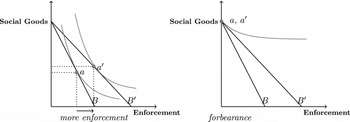
To walk through this reasoning, start with a budget constraint, representing government resources that can be spent on a set of goods and services. A politician allocates resources between enforcement and all other social goods, as shown by the budget constraint B. An exogenous change may reduce the cost of enforcement. For example, a technological advance like satellite imagery has decreased the costs to detect and sanction illegal logging activity. Such a reduction moves the budget constraint to B′. If a politician wants to enforce the law, but previously was constrained by funds, the elasticity of response will be large. This responsiveness to changes in costs is represented visually by a steep indifference curve in which the politician is willing to trade substantial social goods for improvements in enforcement. In this case, the fall in the price of enforcement leads to an increase in the amount of enforcement, as shown by the move from a to a′ in the left panel of Figure 4. This scenario corresponds to theories of selective policy implementation where the limiting factor is resources to provide a range of social goods and enforcement.
Elastic (left) and Inelastic (right) Responses to Changes in Enforcement Costs

Conversely, a politician who does not want to enforce has an almost horizontal indifference curve. Additional enforcement requires a substantial sacrifice in other social goods, as shown in the right panel of Figure 4. The same change in resources from B to B′ produces little increase in the level of enforcement (here a and a′ are equivalent). Forbearance thus can be distinguished by a relatively inelastic response to changes in the cost or budget available for enforcement. This point reinforces the empirical meaning of intent: a politician is unwilling to increase enforcement no matter how cheaply it can be done, or the extent to which other social problems command attention. It also makes clear that selective policy implementation and forbearance fall on a continuum: the less willing politicians are to dedicate resources to enforcement as they become available, the more their behavior looks like forbearance.
While forbearance implies inelastic responses to resource changes, it involves a high elasticity to changes in the political costs of enforcement. Forbearance can be distinguished by many of the same electoral patterns predicted for other distributive goods, such as political enforcement cycles. Observations of electoral patterns suggest institutional slack to change enforcement along with shifting political conditions, rather than binding resource constraints.
Elasticity measurements suggest the causes of enforcement variation. Still, finding valid instruments where enforcement resources or electoral incentives shift without other major changes in conditions can be tricky even with the best data, let alone often-patchy data available in developing countries. The elasticity approach also paints a stark, and sometimes unrealistic, dichotomy between institutional weakness and political incentives. The final empirical strategy takes another approach to the endogeneity problem suited to data-poor environments in which capacity constraints and political incentives intermingle.
Enforcement Process Tracing
Enforcement process tracing tackles the endogeneity between offenses and sanctions by looking at government behavior in response to a given set of legal violations. Enforcement entails a sequence of behaviors that runs from the detection of an offense to administrative action to the imposition of a sanction. Much like using a lagged variable, isolating reactions to a set of cases lets us set aside the issue of how past enforcement affects the offense level. The drawback is that we need strong assumptions about the enforcement process to identify forbearance.
Empirical studies of forbearance must have some notion of enforcement under institutional constraints as a counterfactual. Perfect enforcement is impossible. In any country, rich or poor, we expect some natural “loss” to occur at each step of an enforcement process. The challenge is that we do not know how hard each part of the process is, or more technically speaking, the functional form of the loss. A reasonable null hypothesis is one of constant attrition, or a log-linear function in which the same proportion of cases fails at each stage of the enforcement process. For count data, constant proportional differences are a more plausible and typical assumption than absolute differences. A government that arrests 1,000 people for 100,000 offenses is unlikely to convict 1,000 of 2,000 people charged with a crime. With a constant hazard rate, the same percentage would hold for both. A government that makes 1,000 of 100,000 arrests also prosecutes 20 of 2,000 people charged. Constant attrition seems a sensible baseline assumption, but a more precise approach might calibrate the loss function using data on other offenses or governments.
Compared to an alternative theory of institutional weakness, forbearance implies that enforcement procedures stop at political bottlenecks. Politicians should make decisions to halt enforcement, even when bureaucrats and police perform their jobs. A sharp deviation from a log-linear trend occurs at the points at which politicians influence the enforcement process. The empirical challenge is that bottlenecks also can occur because some procedural steps are harder than others. Additional causal process observations, such as evidence that politicians engage in direct actions to bring about the bottleneck, larger drops for politically sensitive cases, or information about the relative difficulty of each step, can strengthen a claim of forbearance.
In sum, none of these empirical approaches is a silver bullet. But they all offer falsifiable predictions that distinguish forbearance from often-confused theories of limited enforcement, such as societal compliance and selective policy implementation. To confirm all three observations, preferably through a combination of qualitative and quantitative data, in which various types of evidence corroborate one another, amounts to a gold standard in a challenging empirical context. I now apply these strategies as a way to make their use and mixture more concrete.
STREET VENDING AND SQUATTING IN URBAN LATIN AMERICA
Street vending and squatting are some of the most common legal violations by the poor in developing countries. I selected the city cases with two aims. I begin with an “easy” case from a measurement perspective—street vending in Santiago, Chile—as a proof of concept. Chile has a highly capable police force, yet mayors eschew police assistance depending on the electoral costs. I then turn to “hard” cases where institutional weakness complicates empirical identification. I focus on a paired comparison of squatting in Bogotá and Lima to show how the empirical strategies proposed can improve the coding of cases. Across these cities, state capacity cannot explain the results. A purely particularistic view of enforcement also holds little weight. Many politicians block enforcement when cases involve the poor in general, not just as quid pro quo favors for loyal voters or financial backers. The results, buttressed by qualitative interviews, suggest that forbearance functions as a form of informal welfare provision, which mayors rely on to win votes when they run for office in low-income districts. Given the emphasis on empirical identification here, descriptions of the data sources and procedures can be found in the Appendix.
Street Vending in Santiago, Chile
On standard measures of state capacity, such as bureaucratic quality and tax collection, Chile excels (Bergman Reference Bergman2009, 4–5). High levels of institutional capacity make it unlikely to observe weak enforcement under capacity-based theories. Yet, an estimated 53,000 unlicensed street vendors work selling everything from feather dusters to used clothing in Santiago (Appendix). Why do these public violations of the law persist? I suggest that politicians rely on forbearance in low-income districts as a way to win votes and signal their commitments to the poor.
Features of Santiago's institutional design make it an ideal case to identify forbearance through an equilibrium analysis. On the one hand, Santiago is divided into dozens of districts (comunas), each of which elects a local mayor. Mayors therefore can select enforcement policies consistent with their electorate's preferences. On the other hand, a single national police force (Carabineros) controls enforcement of legal violations, including street vending. If most variation comes from mayors tailoring enforcement policy to their constituents’ needs, then I expect to observe a negative correlation between offenses and sanctions across districts. At least formally, there are no differences in institutions across space to generate this supply-side variation. This prediction contrasts with a null hypothesis that most variation comes from compliance rates, such as how profitable it is to work as a street vendor. Demand-side variation would lead to a positive correlation between offenses and sanctions.
Second, beyond a basic correlation, district demographics permit an elasticity analysis. My fieldwork indicated that the electoral costs of enforcement against street vending vary with district composition. On material grounds, the poor tend to favor less enforcement than the nonpoor because they are more likely to work as street vendors and purchase goods from vendors. While all districts run employment programs of varying quality (Pribble Reference Pribble2015), mayors stressed that they cannot find sufficient positions for job seekers and receive no national funding. Mayors tolerated unlicensed vendors as a way to assist constituents. As one mayor expressed, “The level of education in [this district] is fifth-grade so it's hard to find other stable jobs. Maybe I can find someone a job for a month, but it ends and they are back to the streets so you have to let them stay to work.”Footnote 13 Beyond direct employment benefits, mayors use forbearance to signal their affinity with poor voters. Politicians in low-income districts feared being seen as “anti-poor”Footnote 14 and sacrificing their “reputation for understanding social realities”Footnote 15 if they called in the police. Those in middle-income districts, in contrast, stressed that residents do not need to work as vendors and “applaud control.”Footnote 16 To draw more general conclusions, I surveyed bureaucrats in 34 districts and asked whether they believed that mayors lost or gained political support when they removed street vendors. The perceived electoral costs diverged: only bureaucrats in poor districts believed that mayors lost support (Appendix). As such, I expect enforcement to decrease with district poverty.
In most contexts, a prediction that low-income districts enforce less also is consistent with capacity-based explanations. While a common police force controls enforcement in Santiago, there still may be informal institutional differences if the police are less attentive to low-income areas of the city. As a type of placebo test for this competing explanation, I look at enforcement patterns for a valence issue that all citizens want to control, hard crime. I expect the level of offenses, not political choices, to be the main determinant of enforcement in Santiago.Footnote 17 The relationship between sanctions and offenses should be positive if the police are equally responsive across districts, and there should be no differences by district type. If the police ignore poor districts, then a negative relationship between offenses and sanctions will emerge, and poverty also will correlate with enforcement against hard crime.
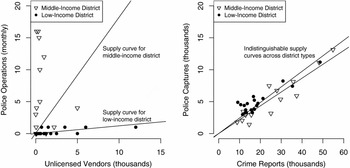
Figure 5 presents the results of a comparison of enforcement patterns across district types and offenses. I focus on the patterns in the raw data here to convey the strategy to identify forbearance, and use regression analysis to show that these results are robust to a number of controls and replicate across cities in separate work (Holland Reference Holland2015). The left panel plots the number of unlicensed vendors (offenses) and police operations (sanctions) in each district in Santiago. Consistent with my electoral interpretation, low-income districts, marked by filled circles, both have more street vendors and do less enforcement. Middle-income districts, represented by open triangles, generally have fewer street vendors and do more police operations. The correlation between vendors and police operations thus is negative across districts, suggesting that most variation indeed comes from differences in the government supply of enforcement. To see this more clearly, I estimate a simultaneous equations model that quantifies the theoretical intuition presented in Figure 3 (see Appendix for details). In an average low-income district, police operations barely increase with the number of vendors. As the left panel of Figure 5 shows, the estimated supply curve is nearly flat. In contrast, in a typical middle-income district police operations are predicted to increase substantially with a change in the number of vendors. The fact that the supply curves account for much of the variation can be seen by the fact that these structural supply curves fit quite closely through the cross-sectional relationship between vendors and operations in the two types of districts. Demand curves are suppressed for ease of presentation and account for the residual variation along the supply curve. However, overall the supply curves fluctuate more and thus account for the negative correlation between vendors and police operations.
Patterns of Sanctions and Offenses, Street Vending (left) and Crime (right) in Santiago

A clear contrast emerges between street vending and hard crime that all citizens want to control. The right panel of Figure 5 shows that the relationship between reported crimes (offenses) and police captures (sanctions) is positive. Crucially, minimal differences exist between low- and middle-income districts. The very similar estimated supply curves suggest that most variation across districts must come from variation in the demand to commit crimes. They show that police responsiveness does not differ across these district types for a less politically controlled form of offenses. Thus, the spatial patterns are consistent with my theory that variation in enforcement against street vending stems primarily from the choices of local mayors to respond to divergent constituency pressures.
A loose version of enforcement process tracing confirms that mayors intervene in poor districts to produce these results. While the police can initiate operations, they rarely do so. As one mayor described, “The police don't obey the mayor by law, but they also don't enforce unless I ask them to. . .[because] all the fallout of operations hits the mayor.”Footnote 18 If enforcement flags in poor districts because the police are less responsive to these areas, I should observe that mayors demand police presence and wait for an institutional response. This is not the case. Rather, in 13 of 19 low-income districts, mayors never called the police. In several districts that conducted operations, I also found evidence that enforcement dropped off in election years. For instance, operations went from three per month to zero in the low-income district of La Florida prior to the 2012 election. The mayor allegedly transferred bureaucrats that attempted to enforce vending regulations to different offices and curbed their responsibilities. As one bureaucrat explained, “The mayor thinks that these are poor people who don't have jobs and he needs to help, but I was unwilling to mix up social criteria with the law so he decided to appoint his own person for the sensitive [election] period.”Footnote 19
The lack of enforcement is suggestive of the subtype and motivations for forbearance in Santiago. If mayors negotiated contingent exchanges, they would enforce selectively against particular vendors or groups that did not support them. Out of two-dozen street vendors that I interviewed, not a single one reported paying a bribe or fearing eviction if they voted against the mayor. Politicians described something closer to constituency service in which they used forbearance to expand the goods at their disposal, and further softened enforcement as elections neared to reinforce their reputation among less well-off voters. Nevertheless, few politicians proposed changing the law or legalizing vendors because they preferred the flexibility to exert control if economic or social policy conditions were to change. Additionally, some officials stressed that legal authorizations require local council approval, and business owners tended to oppose authorizations near their properties in public debate. Forbearance thus allowed politicians to boost the level of employment assistance covertly.
Taken together, these results are more consistent with a theory of forbearance than alternatives rooted in state capacity. Using a unique dataset on both vendors and control operations, I documented a telltale negative correlation between offenses and sanctions, despite common and capable institutions. I also found that enforcement mapped on to electoral pressures, which decline in poor districts for street vending but not for valence issues like hard crime. There also were clear political bottlenecks in which mayors refused to call in the police to control street vending. Electorally motivated enforcement choices, however, cannot be reduced to a contingent exchange for votes. Instead, qualitative evidence suggests that politicians used forbearance to expand the welfare goods they could provide and signal a commitment to poor voters.
Squatting in Bogotá and Lima
I now compare squatting in Bogotá and Lima to illustrate the problems with standard enforcement measures, and the identification challenges present in weak institutional environments. Evictions are the required, but infrequent, sanctions for squatting. Given their rarity, an equilibrium approach provides limited analytic leverage. Enforcement process tracing, as well as elasticity measures, are best suited to the complex administrative environment. I collected data on each step of the enforcement process over a five-year time period (2006–11). Because of the weakness in institutional procedures, there is much greater uncertainty about how cases move through the enforcement process in Lima. Nevertheless, in both cases, I find evidence that mayors engage in forbearance to win votes and expand housing options.
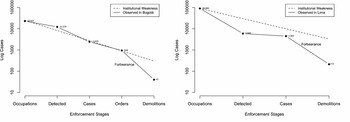
Enforcement process tracing begins by measuring the universe of offenses against which a government could have acted. An offense involves a single construction on land for which a household lacks building rights. In Bogotá, a plausible measure of offenses comes from the number of “provisional” water connections. Each household almost immediately applies to receive water, and the city's water company acquiesces to avoid service theft and comply with court mandates. According to the water company, there were about 23,000 new provisional connections in Bogotá. Lima does not automatically grant squatters access to water so the same measure cannot be used. However, the Peruvian household survey does ask respondents if they live in a house formed through a land invasion and if they have (or have applied for) a property title. In 2011, only squatter settlements formed prior to 2004 were eligible for property titles so most untitled invasions likely formed after that date. By this metric, there were almost 90,000 offenses in Lima.
Next, government officials must detect the offenses that occur. In 2003, Bogotá created an agency to monitor squatting through a combination of satellite images and teams of engineers. The agency registered almost 14,000 illegal land occupations, spotting around 60 percent of offenses. In contrast, calculating how many squatters are detected in Lima is complex because no single agency monitors them. By law, the Lima metropolitan government is supposed to report squatters to the state agency that owns the land. But the city follows land invasions through newspaper reports, and not a single inspector monitors invasions. Other levels of government do little more. In 2011, the national land agency had no monitoring procedures, or even a complete registration of its holdings. Likewise, only a handful of subcity governments (distritos) engage in proactive monitoring. Combined across institutions, I found that roughly 5,900 cases, or just 6 percent of squatters, came to the attention of authorities.
After detection, bureaucrats open an administrative case against illegal land occupations. In Bogotá, detection is the responsibility of the city government, but subcity districts (localidades) take responsibility for subsequent proceedings. District bureaucrats face obstacles unique to enforcement in a context without addresses. District officials rely on photographs and approximate locations to match constructions to the geographic coordinates provided by the city. They struggle to identify land occupations because physical appearances change rapidly. Between visits by officials, an isolated, tin shack can be expanded or enclosed by hundreds of similar ones. Once located, all legal correspondence must be hand-delivered, which means that the identification process needs to be repeated multiple times. Given these obstacles, roughly 20 percent of detected occupations result in administrative actions. Administrative procedures to identify legal claimants greatly slow enforcement in Lima too. Unlike in Bogotá, cases are filed against entire settlements, to which claimants are then added as the settlement expands and changes. The Attorney General filed 180 legal dockets involving an estimated 4,500 claimants in Lima during the period studied.
Courts must approve a sanction after an administrative process is open. In Bogotá, the court process allows those affected by enforcement to file constitutional appeals (tutelas), which can delay and stymie sanctions. Once the court authorizes an action, the case returns to the district government. About 39 percent of administrative actions make it through the judicial review to end in a demolition order. Unfortunately, determining the number of cases with eviction orders is impossible in Lima due to the fragmentation of court filing procedures.
The final step in the enforcement process—and the one most commonly measured—involves the imposition of a sanction. In both cities, politicians play a key role in this stage. In Bogotá, mayors must sign and schedule the removal of an illegal construction. But mayors largely refuse to sign or postpone evictions until cases pass their statute of limitations. Only 4 percent of court orders result in a sanction being imposed, which is the lowest rate of efficacy in the entire enforcement process. In Lima, mayors also try to stall police action, often by lobbying the state to purchase seized land. The data again are less clear, but roughly 5 percent of cases end with an eviction.
Figure 6 visually summarizes the “leakage” at each step of the enforcement process, ending in almost no sanctions. On the vertical axis, I log the number of cases so the change can be interpreted as the percent decline at each step. The straight dotted line represents the proposed counterfactual of constant attrition. What is most important is that a sharp deviation occurs from the log-linear trend when mayors have important roles in the enforcement process. In Bogotá, the bottleneck comes at the very end, when mayors decide whether to sign eviction orders. In Lima, a major drop-off occurs in the number of cases that enter the legal system in the first place, and then again when mayors coordinate evictions.
Enforcement Process Tracing of Squatting in Bogotá (left) and Lima (right)

This exercise highlights how standard indicators of enforcement can lead to misleading conclusions. Think what happens when we measure enforcement through offenses, bureaucrats, or budgets. On all of these measures, we would infer that Bogotá engages in much more enforcement than Lima. Bogotá has a third of the number of squatters and an entire agency dedicated to monitoring. But Lima actually does more sanctions in absolute terms. Following each step leads us to the more accurate conclusion that both governments do very little enforcement, albeit with different institutional expressions.
Another empirical challenge is to determine if the observed bottlenecks represent political interventions, rather than just administratively challenging procedures. Several facts suggest the former. First, particularly in Bogotá, bureaucrats lamented that politicians blocked the enforcement process. They engaged in “Orwellian” jobs. Despite bureaucrats’ efforts to bring cases, eviction orders sit on mayors’ desks because signing them would create an “unfavorable image of the mayor with the community.”Footnote 20 More generally, bureaucrats stressed the political, not technical, challenges of evictions. I surveyed 41 housing bureaucrats, asking whether resources or mayoral intervention posed a greater constraint on enforcement. In Bogotá, about two-thirds of bureaucrats saw political intervention as the primary obstacle. In Lima, bureaucrats divided. About half discussed resource constraints including the availability of cars, maps, and staff, and half complained about the lack of political support.
Second, even in the case of Lima, the incoherent detection procedures likely reflect political preferences for forbearance, not capacity constraints. Relatively simple reorganizations of the bureaucracy, such as the assignment of monitoring responsibilities to a single authority, could vastly improve enforcement capacity.Footnote 21 But officials, such as the director of city planning, said these reforms make little sense because, “We can't repress invasions until there are other housing options.”Footnote 22 The low rate of detection results from failures to pass information to enforcement authorities, not a lack of underlying knowledge. Squatters register their associations with the district, approach the police to verify the physical occupation of land, and ask local authorities for municipal services. Mayors use this information to report invasions to authorities when the cases involve valuable resources, such as land reserved for public goods, but they see little reason to act in most cases. This is not to say that mayors want to allow squatting. Rather, they see high electoral costs to evictions when the national government offers no housing alternative. One mayor captured a common view: “I'd love to stop invasions and put the land to more productive use, but I can't when there is no policy from the central government to offer housing to poor people. . .I'd only have a handful of votes in the next elections.”Footnote 23
Analysis of the elasticity of enforcement further confirms that politicians intentionally oppose enforcement, and maintain latitude to act otherwise. In Bogotá, for instance, both the poor and rich have built illegal constructions in the environmental preserve that abuts the city. The typical view is that enforcement against the rich is harder, given their superior access to lawyers and political connections. Yet wealthy squatters garner little public sympathy. A “tough” test of my theory, then, is that mayors should enforce more against illegal constructions by the rich. Indeed, I find that none of the evictions conducted in Bogotá involved poor claimants, while several involved wealthy property owners. The political logic of targeting the upper class comes out in the comments of bureaucrats: “The city mayor doesn't want to disrupt things, where are you going to move all these poor people to?. . . It's different when wealthy people decide to build weekend chalets in the forest preserve. We took down 16 elegant homes last year because there is no reason that they should be there.”Footnote 24 These actions are hard to reconcile with capacity-based theories, or a view that politicians only manipulate enforcement for pecuniary gains. Instead, Bogotá’s mayor, Enrique Peñalosa, perhaps best captures the paradox of states with institutional capacity to enforce their laws but not to address social demands: “The problem is that as the city becomes more sophisticated and richer, there are more controls and this is very bad because we can control informal construction but we are not offering any alternative.”Footnote 25
In contrast to the sensitivity to electoral costs, enforcement behavior is unresponsive to changes in administrative costs. Consider how the Peruvian government has responded to the introduction of drones that take aerial photographs. For decades, local and national authorities have fought squatters on archeological sites with limited success. With the increasing availability of drones, the government is able to monitor encroachments. Evictions of squatters on archeological land have increased.Footnote 26 This change in enforcement activity in response to a reduction in the cost of monitoring shows that the government prefers to enforce on archeological sites, but previously faced constraints. Yet, the same technology has not been used to control squatting in peripheral urban areas where the poor tend to occupy land for housing purposes. Interviews with local mayors confirmed this split approach in which “empty land” could be turned over to the poor for housing purposes, while archeological land demanded cooperation with national authorities. As one politician expressed, “How can I say that I support the poor and then go behind their back to try to get people who need housing taken off their land?”Footnote 27 Hence, Peru's incomplete adoption of new technology that reduces the costs of enforcement suggests that administrative constraints are not the full story. Political calculations motivate enforcement choices.
To wrap up, this paired comparison of squatting demonstrates how to identify forbearance in weak institutional environments. Traditional measures of bureaucrats and budgets produce misleading conclusions because, on the one hand, institutional investments do not translate neatly into sanctions, and on the other, weak institutions can reflect endogenous (and mutable) political choices. Enforcement process tracing, combined with elasticity analysis, reveals that politicians intervene to block sanctions that carry electoral costs, even when other agencies do their jobs and technology improves.
CONCLUSION
Many scholars interpret the gap between law and behavior in developing countries as a state failure. Limited budgets and human resources undoubtedly thwart enforcement in many contexts. Yet for a range of laws, enforcement also has profound distributive consequences. In this article, I introduced the concept of forbearance to describe intentional and revocable choices not to enforce the law. In many circumstances, politicians decide whether and against whom to enforce, just as they decide whether to provide schools and water pipes. Because forbearance can be reversed and ramped up without legislative approval or budgetary allocations, it is a useful tool to mobilize electoral support. And, forbearance is not just a tool to favor for the wealthy. Quite the opposite, forbearance can hide resource transfers to the lower tranches of the income distribution.
Concepts require empirical legs. Although intuitive to many scholars working in the developing world, tests for political explanations of enforcement have been relatively few. This article put forward a new empirical approach rooted in the premise that forbearance shares much in common with other distributive tools. I adopted an equilibrium model to make explicit the ways in which enforcement and compliance interact to generate recognizable patterns of sanctions and offenses across political units. This approach allowed me to distinguish variation due to government action and societal compliance, if not the precise reasons that government enforcement choices diverged. I then operationalized often-vague notions of political intent through observations of how politicians react to resource and electoral conditions, as well as how they intervene in the enforcement process.
To see how the strategies perform, I presented original data on street vending and squatting in urban Latin America. The results suggest that forbearance better explains variation in enforcement than alternatives focused on institutional capacity or societal compliance alone. Instead, politicians saw forbearance as a way to mobilize votes and provide basic goods, such as jobs and housing, to their constituents when social policy was deficient. Measurement and identification challenges remain inherent to studies of illegal behavior and, as the case of Lima reinforces, they multiply when politicians sap institutions of funding and personnel to block enforcement. Nevertheless, this framework provides a natural way to reason about enforcement politics and to document an overlooked form of distribution.
This article raises questions about the frequency of forbearance across space and types of law. While the empirical referent here was Latin America, the strategies could be employed in diverse contexts. For example, several studies of taxation (Bergman Reference Bergman2009; Levi Reference Levi1988; Lieberman Reference Lieberman2003) suggest that differences in cultures of compliance, rather than enforcement, drive tax collection. The equilibrium approach advocated allows for a more precise test of these competing explanations. Immigration is another important application. Dozens of American mayors have joined the “sanctuary city” movement in which they instruct local law enforcement not to share information from routine policing with federal immigration authorities. If variation in deportations stems primarily from political choices, rather than offense rates, I expect larger undocumented populations in cities where mayors hinder information sharing. The sensitivity of enforcement to electoral conditions also can be further probed. Already, researchers have documented electoral cycles for electricity theft in India (Min and Golden Reference Min and Golden2014) and illegal land sales in Greece (Skouras and Christodoulakis Reference Skouras and Christodoulakis2014). As empirical identification improves, future work might analyze the wider connection between social policy and forbearance. Anecdotal evidence suggests that progressive forbearance occurs even in advanced economies when welfare states are under stress. Local governments in Spain, for instance, temporarily have stopped squatter evictions during the economic crisis.
Another important task is to quantify the distributive importance of forbearance. Informal welfare benefits for the poor, for instance, do not appear on government ledgers. Yet they often surpass state social expenditures in magnitude. Looking beyond Latin America, the majority of low-income households in urban Turkey have acquired their property through land invasions or illegal sales, not through state housing programs. One calculation suggests that the rent saved through squatting provides three times more income to the urban poor relative to all Turkish social programs (Başlevent and Dayıoğlu Reference Başlevent and Dayıoğlu2005, 37). Taking a broader view of the ways resources are transferred thus may present a very different view of how politicians establish electoral linkages, and how much distribution occurs in a society.
That said, it is worth stressing that forbearance is not equivalent to other distributive transfers. Law breaking results in negative externalities, which often motivate the passage of restrictions in the first place. Forbearance also can impose costs on the same low-income groups that receive the material benefits in the form of constrained citizenship rights and physical risks. Forcing the poor to break laws to secure basic goods is the opposite of a commitment to social rights embodied in many welfare policies. These material and abstract costs raise a series of questions: Under what circumstances do politicians favor forbearance over other tax-based distributive tools? When do governments move away from reliance on forbearance as a form of clientelism or informal welfare provision? Do different subtypes of forbearance occur together? For example, is forbearance toward the rich used to justify and promote forbearance toward the poor? Such questions constitute the frontier for research on enforcement. But we can only begin to answer them if we interpret existing and future empirical results with the recognition that politicians can and do choose to enforce the law separate from the institutional resources at their disposal.
SUPPLEMENTARY MATERIAL
To view supplementary material for this article, please visit http://dx.doi.org/10.1017/S0003055416000083.




Comments
No Comments have been published for this article.