





1 Introduction
A generalized Baumslag-Solitar group (GBS group) of rank d is a group that acts cocompactly on an oriented tree such that the vertex and edge stabilizers are isomorphic to
$\mathbb {Z}^d$
 . As a consequence of Bass-Serre theory, a generalized Baumslag-Solitar group is defined by a finite iteration of HNN extensions and amalgamated free products of
$\mathbb {Z}^d$
 over
$\mathbb {Z}^d$
 .
GBS groups of rank
$d> 1$
 are a generalization of GBS groups of rank
$1$
 , which arise as a natural generalization of Baumslag-Solitar groups
$\mathrm {BS}(m,n) = \langle b, t \mid tb^mt^{-1} =~b^n \rangle $
 . Baumslag-Solitar groups were introduced in [Reference Baumslag and SolitarBS62] to give the first examples of two-generated finitely presented non-Hopfian groups. GBS groups have been widely studied in relation to various properties. In [Reference LevittLev15], Levitt computed the minimal number of generators of a GBS group of rank
$1$
 . He studied their automorphism groups in [Reference LevittLev07]. The classification up to quasi-isometry of GBS groups of rank 1 is known (see [Reference WhyteWhy01]) and the classification up to measure equivalence of Baumslag-Solitar groups has been announced by the authors of [GPT+]. In [Reference de Gamiz Zearra and ShepherdLdGZS25], the authors determined which GBS groups (of arbitrary rank) are residually finite and which are LERF.
To any GBS group G of rank d is associated its modular homomorphism
$\Delta _G : G \to \mathrm {GL}_d(\mathbb {Q})$
 , which was introduced in [Reference ButtonBut25]. Starting from a vertex v of the Bass-Serre tree, the conjugation by any element g of G induces a homomorphism
$\mathrm {Stab}(v) \to \mathrm {Stab}(g \cdot v)$
 . As all vertex stabilizers are commensurable, this homomorphism can be seen as an element of
$\mathrm {GL}_d(\mathbb {Q})$
 . This defines a homomorphism
$\Delta _G^{(v)} : G \to \mathrm {GL}_d(\mathbb {Q})$
 . Two such homomorphisms
$\Delta _G^{(v)}$
 ,
$\Delta _G^{(w)}$
 are conjugate. Up to conjugation, this defines the modular homomorphism
$\Delta _G : G \to \mathrm {GL}_d(\mathbb {Q})$
 . A GBS group G is called unimodular if
$\mathrm {Im}\left (\det \circ \Delta _G\right ) \subseteq \{1,-1\}$
 . As an example, one characterization of unimodularity for a GBS group of rank
$1$
 is the existence of an infinite cyclic normal subgroup (see [Reference LevittLev07][Section 2] for instance).
In this article, we will focus on the set of subgroups
$\mathrm {Sub}(G)$
 of a GBS group G from a topological point of view. This means that we are more interested in the topological structure of
$\mathrm {Sub}(G)$
 , seen as a closed subset of the Cantor set
$\{0,1\}^{G}$
 , than in the algebraic properties of the subgroups of G. Cantor-Bendixson theory (see [Reference KechrisKec95]) leads to a unique decomposition
$\mathrm {Sub}(G) = \mathcal {K}(G) \sqcup C$
 into a closed subspace without isolated points called the perfect kernel of G and a countable set C. As the action by conjugation of G induces a homeomorphism of
$\mathrm {Sub}(G)$
 , the perfect kernel is G-invariant. We are interested in the computation of the perfect kernel and the dynamics induced by the action by conjugation of G on it.
The perfect kernel of any finitely generated abelian group is empty. In [Reference Cornulier, Guyot and PitschCGP10], the authors classified the set of subgroups of all countable abelian groups up to homeomorphism. In [Reference Bowen, Grigorchuk and KravchenkoBGK12], the authors proved that the perfect kernel of the lamplighter group
$(\mathbb {Z}/p\mathbb {Z})^n \wr \mathbb {Z}$
 (where p is a prime number) is the set of subgroups of
$\bigoplus _{\mathbb {Z}}\left (\mathbb {Z}/p\mathbb {Z}\right )^n$
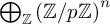 .
If G is a finitely generated group, then finite-index subgroups are isolated. Thus the perfect kernel of G is included in the set of infinite-index subgroups of G. The authors of [Reference Carderi, Gaboriau and Le MaîtreCGLM23] observed that equality holds for the non-abelian finitely generated free group
$\mathbb {F}_r$
 on r generators, and that the action of
$\mathbb {F}_r$
 on its perfect kernel is topologically transitive. Recall that an action of a group G on a topological space X is topologically transitive if for all non-empty open subsets
$U, V \subseteq X$
 , there exists
$g \in G$
 such that
$gU \cap V \neq \emptyset $
 . In the case where X is Polish, this is equivalent to the existence of a dense orbit. The authors of [Reference Azuelos and GaboriauAG24] extended this result to a large class of groups acting on trees. They proved that the perfect kernel of a finitely generated group G with infinitely many ends is also equal to the set of infinite-index subgroups, and that the action by conjugation is topologically transitive on the perfect kernel as soon as G does not contain any non-trivial finite normal subgroup. More generally, they proved that for any finitely generated group G that acts (minimally and irreducibly) on a tree
$\mathcal {T}$
 such that the action of G on
$\mathcal {T}$
 is acylindrical, any subgroup H of G such that the quotient graph
$H \backslash \mathcal {T}$
 is infinite belongs to the perfect kernel of G. In this case, they also proved that the action by conjugation of G on the closure of the set of subgroups H acting on
$\mathcal {T}$
 with infinitely many orbits of edges is topologically transitive. Recall that an action of a group G on a tree
$\mathcal {T}$
 is acylindrical if there exists
$R> 0$
 such that the stabilizer of any path of length larger than R is trivial.
GBS groups of rank d are typical examples of groups whose action on their Bass-Serre tree is not acylindrical, because the stabilizer of any finite subtree of the Bass-Serre tree is isomorphic to
$\mathbb {Z}^d$
 . The authors of [Reference Carderi, Gaboriau, Le Maître and StalderCGLMS25] (who studied Baumslag-Solitar groups) and of [Reference BontempsBon26] (who extended some results obtained by the aforementioned authors to GBS groups of rank
$1$
 ) observed that this leads to very different dynamics for the action by conjugation of a non-amenable GBS group G of rank
$1$
 on its perfect kernel. More precisely, they showed that
$\mathcal {K}(G) = \mathrm {Sub}_{[\infty ]}(G)$
 if and only if G is not unimodular. They also described a countably infinite G-invariant partition of
$\mathcal {K}(G)$
 , such that G acts topologically transitively on each piece. One piece is closed and all the other ones are open (and also closed if and only if G is unimodular). To obtain this decomposition, the authors of [Reference Carderi, Gaboriau, Le Maître and StalderCGLMS25] introduced the phenotype, which is a G-invariant function
$\mathrm {Sub}(G) \to \mathbb {N}^* \cup \{\infty \}$
 , and which was generalized in [Reference BontempsBon26]. This function is explicit and encodes the decomposition of the perfect kernel.
In this article, we will extend these results to non-amenable GBS groups of an arbitrary rank d, that is to say, those that are neither isomorphic to
$\mathbb {Z}[\mathrm {A}, \mathrm {A}^{-1}](\mathbb {Z}^d)~\rtimes ~\mathbb {Z}$
 for some
$\mathrm {A} \in \mathrm {M}_d(\mathbb {Z}) \cap \mathrm {GL}_d(\mathbb {Q})$
 (where
$\mathbb {Z}[\mathrm {A}, \mathrm {A}^{-1}](\mathbb {Z}^d)$
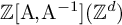 is the subgroup of
$\mathbb {Q}^d$
 defined by
$\{\mathrm {A}^ku, k \in \mathbb {Z}, u \in \mathbb {Z}^d\}$
 and
$\mathbb {Z}$
 acts on
$\mathbb {Z}[\mathrm {A}, \mathrm {A}^{-1}](\mathbb {Z}^d)$
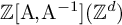 by multiplication by
$\mathrm {A}$
 ) nor to any amalgamated free product
$\mathbb {Z}^d*_{\mathbb {Z}^d}\mathbb {Z}^d$
 where both injections are defined by matrices of determinant
$\pm 2$
 (cf. Proposition 3.19). Understanding the space of subgroups of amenable GBS groups is a different problem: it requires an understanding of the space of subgroups of the abelian group
$\mathbb {Z}\left [\mathrm {A}, \mathrm {A}^{-1}\right ](\mathbb {Z}^d)$
 . We think that this should be tackled using the results of Cornulier, Guyot and Pitsch about the space of subgroups of an abelian group (cf. [Reference Cornulier, Guyot and PitschCGP10]), but this lies beyond the scope of our methods, which crucially make use of the action on the Bass-Serre tree.
More precisely, we prove the following result (cf. Theorem 5.2):
Theorem 1. Let G be a non-amenable GBS group of rank d defined by a reduced graph of groups
$\mathscr {H}$
 and let
$\mathcal {T}$
 be the Bass-Serre tree of
$\mathscr {H}$
 . Then

We also give some sufficient conditions that depend on the modular homomorphism (see Section 3.2) for the perfect kernel to be equal to
$\mathrm {Sub}_{[\infty ]}(G)$
 . Namely, we prove the following (cf. Corollary 5.5):
Theorem 2. Let G be a non-amenable and non-unimodular GBS group of rank d such that the finite-index subgroups of
$\mathrm {Im}\left (\Delta _{G}^{(v)}\right )$
 are
$\mathbb {Q}$
 -irreducible. Then

Recall that a subgroup
$\Gamma $
 of
$\mathrm {GL}_d(\mathbb {K})$
 is called
$\mathbb {K}$
 -irreducible if it does not stabilize any non-trivial proper vector subspace of
$\mathbb {K}^d$
 .
We also obtain a generalization of the main results of [Reference Carderi, Gaboriau, Le Maître and StalderCGLMS25] and [Reference BontempsBon26] (cf. Equation 6.4 and Theorem 6.5 if G is not a semidirect product, and Theorem 6.15 otherwise):
Theorem 3. Let G be a non-amenable GBS group of rank d. There exists a countably infinite partition of the perfect kernel of G into G-invariant pieces that contain dense orbits.
This implies in particular that the action is topologically transitive on each piece.
We also investigate the topology of the pieces that appear in this decomposition, which is slightly different depending on whether G is a semidirect product
$\mathbb {Z}^d \rtimes \mathbb {F}_r$
 (cf. Theorem 6.15 – keeping the notation of this theorem, the pieces will be the sets
$\mathcal {P}_{\mathscr {C}} \smallsetminus \mathcal {D}_{\mathscr {C}}$
 and the orbits in the countable sets
$\mathcal {D}_{\mathscr {C}}$
 under the G-conjugation, for
$\mathscr {C}$
 varying in
$Conj(G_v)$
 ) or not (cf. Proposition 6.6 – keeping the notation of this proposition, the pieces of the decomposition of the perfect kernel will be given by the sets
$\mathcal {K}(G) \cap \mathrm {Ph}_{\mathscr {H},v}^{-1}(\pi _v(\Lambda ))$
 , for
$\Lambda $
 varying in
$\mathrm {Sub}(\mathbb {Z}^d)$
 ). However, as all these pieces of this partition are
$F_{\sigma }$
 subsets, they turn out to be
$G_{\delta }$
 subsets (hence Polish).
The main challenge raised by the generalization of the results of [Reference BontempsBon26] to GBS groups of arbitrary rank is that, while injections of the edge groups into the vertex groups were simply encoded by non-zero integers in the rank
$1$
 case, they are now encoded by matrices. Understanding the space of subgroups of a higher-rank GBS group thus requires a more subtle analysis of the action of the group via the modular homomorphism on the set of vector subspaces of
$\mathbb {Q}^d$
 , and a more careful analysis of partial actions. In particular, while the decomposition of Theorem 3 was explicit in the case of GBS groups of rank
$1$
 (and encoded by the “phenotype”, see [Reference BontempsBon26, Definition 5.2 and 5.5, Theorem 6.6]), it is now encoded by an abstract equivalence relation on the set of subgroups of
$\mathbb {Z}^d$
 . Moreover, we do not know whether the topological transitivity can be strengthened into high topological transitivity (while the action on each piece was proved to be highly topologically transitive in [Reference BontempsBon26, Theorem 2]). Also notice that the need to provide a separate analysis for semidirect products
$\mathbb {Z}^d \rtimes \mathbb {F}_r$
 is a conceptual difference with the case of GBS groups of rank
$1$
 (see Section 6.2).
The paper is organized as follows. Given a graph of groups
$\mathscr {H}$
 of fundamental group G, we extend the notion of
$\mathscr {H}$
 -preactions and of
$\mathscr {H}$
 -graphs in Section 3.1. They were introduced in [Reference Fima, Le Maître, Moon and StalderFLMMS22] in the case where G is an amalgamated free product or an HNN-extension (i.e. if
$\mathscr {H}$
 consists of a single edge), and adapted in [Reference Carderi, Gaboriau, Le Maître and StalderCGLMS25] in the case of Baumslag-Solitar groups and in [Reference BontempsBon26] in the case of GBS groups of rank 1. These graphs can be thought of as a generalization of Schreier graphs in the case of free groups: any subgroup H of a free group
$\mathbb {F}_r$
 can be encoded by a covering of the bouquet of r circles (which is the Schreier graph of the action
$(H \backslash \mathbb {F}_r, H) \curvearrowleft \mathbb {F}_r$
 , with respect to the standard generating set). When H has infinite index, this covering is infinite, and perturbing this graph very far from the origin amounts to building a subgroup of
$\mathbb {F}_r$
 that is close to H. In Section 5, we prove Theorem 1 and Theorem 2. Finally, in Section 6, we show the existence of the decomposition of Theorem 3 and investigate the topology of the pieces. This gives rise to a natural generalization of the phenotype defined in [Reference Carderi, Gaboriau, Le Maître and StalderCGLMS25] and in [Reference BontempsBon26]. However, we do not know if this decomposition is still explicit in this wider context, and we do not know if our arguments can be used to prove high topological transitivity results as in [Reference Gaboriau, Le Maître and StalderGLMS24] for Baumslag-Solitar groups and in [Reference BontempsBon26] for GBS groups of rank
$1$
 .
2 Preliminaries and notation
We denote by
$\mathcal {P}$
 the set of prime numbers in
$\mathbb {N}$
 . For every integer N and
$p \in \mathcal {P}$
 , we denote by
$|N|_p$
 the p-adic valuation of N, that is, the largest
$n \in \mathbb {N}$
 such that
$p^n$
 divides N. By “countable” we mean finite or in bijection with
$\mathbb {N}$
 . Given a group G, we denote by
$\mathrm {Sub}(G)$
 the set of subgroups of G and by
$\mathrm {Sub}_{[\infty ]}(G)$
 the subset of
$\mathrm {Sub}(G)$
 that consists of infinite-index subgroups. If
$H \leq G$
 is a subgroup, we denote by
$[H]_{G}$
 the G-conjugacy class of H. For any
$d \in \mathbb {N}^*$
 , we denote by
$\mathcal {L}(\mathbb {Z}^d)$
 the set of lattices of
$\mathbb {Z}^d$
 , i.e. the set of finite-index subgroups of
$\mathbb {Z}^d$
 . If
$\mathbb {K}$
 is a field and
$\mathrm {M} \in \mathrm {M}_d(\mathbb {K})$
 , we denote by
$\mathrm {Spec}_{\mathbb {K}}(\mathrm {M})$
 the spectrum of
$\mathrm {M}$
 in
$\mathbb {K}$
 , i.e. the set of elements
$\lambda \in \mathbb {K}$
 such that
$\det (\mathrm {M}-\lambda I_d) = 0$
 . If
$\Gamma $
 is a subgroup of
$\mathrm {GL}_d(\mathbb {K})$
 , we say that
$\Gamma $
 is
$\mathbb {K}$
 -irreducible if
$\Gamma $
 does not stabilize any non-trivial vector subspace of
$\mathbb {K}^d$
 . Likewise, an element
$\gamma \in \mathrm {GL}_d(\mathbb {K})$
 is
$\mathbb {K}$
 -irreducible if it stabilizes no non-trivial vector subspace of
$\mathbb {K}^d$
 .
2.1 Graphs
We refer to [Reference BontempsBon26], Section 2 for the notation and definitions around graphs and Schreier graphs. We add the following terminology: given a graph
$\mathscr {H}$
 , an element of
${\mathcal {E}}$
 $({\mathscr {H}}) \times \{\mathbf {s}, \mathbf {t}\}$
 is called a half-edge. The inferior half-edge of
$e \in {\mathcal {E}}$
 $(\mathscr {H})$
 is
$(e, \mathbf {s})$
 and its superior half-edge is
$(e, \mathbf {t})$
 . Given a graph
$\mathscr {H}$
 and a spanning tree
$\mathscr {T}$
 of
$\mathscr {H}$
 , for any vertices
$u, v \in \mathcal {V}$
 $(\mathscr {H})$
 , we denote by
$[u; v]_{\mathscr {T}}$
 the unique edge path in
$\mathscr {T}$
 that connects u to v.
2.2 Space of subgroups of a countable group
Let G be an infinite countable group. Endowed with the
$\textbf {Chabauty topology}$
 , the set of subgroups
$\mathrm {Sub}(G)$
 of G is a closed subspace of the Cantor set
$\{0,1\}^{G}$
 . An explicit basis of open sets is given by the following clopen sets:

for any finite subsets
$O,I \subseteq G$
 .
We will make use of the following lemma that describes the topology of some subsets of
$\mathrm {Sub}(G)$
 .
Lemma 2.1. Let G be a countable group and let
$G_0$
 be any subgroup of G. Then, for any subgroup
$H_0 \leq G_0$
 , the set

is closed in
$\mathrm {Sub}(G)$
 . If moreover the group
$H_0$
 is finitely generated and has finite index in
$G_0$
 , then it is also open.
Proof. One has

which is closed as an intersection of basic clopen subsets of
$\mathrm {Sub}(G)$
 .
If
$H_0$
 is finitely generated and has finite index in
$G_0$
 , let
$\{h_1, \ldots , h_n\}$
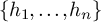 be a finite generating set of
$H_0$
 and let us write
$G_0/H_0 = \{H_0, g_1H_0, \ldots , g_mH_0\}$
 . We then have

which is open as a finite intersection of basic clopen sets.
Applying the Cantor-Bendixson Theorem (see [Reference KechrisKec95, Section 6, Chapter 1] for instance) to the Polish space
$\mathrm {Sub}(G)$
 leads to a unique decomposition
$\mathrm {Sub}(G) = K \bigsqcup C$
 where C is countable and K is a closed subspace of
$\mathrm {Sub}(G)$
 without isolated points. The set K is called the perfect kernel of G and denoted by
$\mathcal {K}(G)$
 . It is the largest closed subset of
$\mathrm {Sub}(G)$
 without isolated points, or equivalently, the set of subgroups all of whose neighbourhoods are uncountable.
If G is finitely generated, then finite-index subgroups are isolated. In particular, we get the following inclusion
$\mathcal {K}(G) \subseteq \mathrm {Sub}_{[\infty ]}(G)$
 . The converse inclusion is true in the case of finitely generated free groups (see [Reference Carderi, Gaboriau and Le MaîtreCGLM23][Proposition 2.1] and [Reference Azuelos and GaboriauAG24][Corollary 5.17]):
Proposition 2.2. Let
$\mathbb {F}_r$
 be the free group on r generators (
$2 \leq r \leq \infty $
 ). Then
-
• if $r < \infty $
 , then
$\mathcal {K}(\mathbb {F}_r) = \mathrm {Sub}_{[\infty ]}(\mathbb {F}_r)$
;
-
• $\mathcal {K}(\mathbb {F}_{\infty }) = \mathrm {Sub}(\mathbb {F}_{\infty })$
.


Moreover, there exists a dense orbit for the action by conjugation of
$\mathbb {F}_r$
 on
$\mathcal {K}(\mathbb {F}_r)$
 .
Remark 2.3. The key point of the proof of Proposition 2.2 is the identification of subgroups of
$\mathbb {F}_r = \langle (a_i)_{i \in [\![ 1, r ]\!] }\rangle $
 with coverings of the bouquet
$B_r$
 of r circles (which are exactly the Schreier graphs of subgroups of
$\mathbb {F}_r$
 with respect to the generating set
$\{a_i, i \in [\![ 1, r ]\!] \}$
 ). More precisely, this relies on the two following facts. Let B be a (possibly infinite) graph. Then:
-
• for every covering $E \to B$
and every connected finite subgraph
$K \subsetneq E$
, there exists a covering
$p : E' \to B$
whose degree is infinite and such that
$E'$
contains a subgraph
$K'$
which is isomorphic to K as a labelled graph (this allows one to obtain the aforementioned explicit description of the perfect kernel); -
• for all coverings $E_i \to B$
(
$i \in \mathbb {N}$
), given any connected finite subgraph
$K_i \subsetneq E_i$
(for every
$i \in \mathbb {N}$
), there exists a covering
$p : E \to B$
whose degree is infinite and such that E contains disjoint subgraphs
$(K_i')_{i \in \mathbb {N}}$
such that
$K_i'$
and
$K_i$
are isomorphic as labelled graphs for every
$i \in \mathbb {N}$
(this allows one to build a dense orbit).


This point of view will be useful in the study of the action by conjugation of a semidirect product
$\mathbb {Z}^d \rtimes \mathbb {F}_r$
 on its perfect kernel (cf. Section 6.2).
2.3 Graphs of groups
In this section, we recall the fundamentals of Bass-Serre theory. We refer to [Reference SerreSer83] for more details. A graph of groups is an oriented graph
$\mathscr {H}$
 equipped with a collection of vertex groups
$G_v, v \in \mathcal {V}\left (\mathscr {H}\right )$
 , a collection of edge groups
$G_e, e \in \mathcal {E}\left (\mathscr {H}\right )$
 such that
$G_e = G_{\overline {e}}$
 for every edge
$e \in \mathcal {E}\left (\mathscr {H}\right )$
 and, for
$\mathbf {u} \in \{\mathbf {s}, \mathbf {t}\}$
 , injective homomorphisms
$\iota _{e,\mathbf {u}}: G_e \hookrightarrow G_{\mathbf {u}(e)}$
 such that
$\iota _{e, \mathbf {s}} = \iota _{\overline {e}, \mathbf {t}}$
 for every edge e.
The fundamental group of a graph of groups
$\mathscr {H}$
 is defined by the following presentation: let us fix a spanning tree
$\mathscr {T}$
 in
$\mathscr {H}$
 . Denote by
$\{t_e, e \in \mathcal {E}\left (\mathscr {H}\right )\}$
 a generating set of the free group
$\mathbb {F}_{|\mathcal {E}\left (\mathscr {H}\right )|}$
 of rank
$|\mathcal {E}\left (\mathscr {H}\right )|$
 and define

The isomorphism class of the group G defined as above does not depend on the choice of the spanning tree (cf. Proposition 20 in [Reference SerreSer83], Section 5.1).
There exists a (unique up to unique isomorphism) oriented tree
$\mathcal {T}$
 , called the Bass-Serre tree of
$\mathscr {H}$
 on which G acts without inversion with quotient
$\mathscr {H}$
 and such that there exist sections
$\mathcal {V}\left (\mathscr {H}\right ) \to \mathcal {V}\left (\mathcal {T}\right )$
 and
$\mathcal {E}\left (\mathscr {H}\right ) \to \mathcal {E}\left (\mathcal {T}\right )$
 (which we denote by
$v \to \tilde {v}$
 and
$e \to \tilde {e}$
 respectively) of the projection
$\pi : \mathcal {T} \to \mathscr {H}$
 satisfying the following conditions:


More precisely (cf. [Reference SerreSer83][Section 5.3]), the set of vertices of
$\mathcal {T}$
 is

and its set of edges is

Conversely, any group action
$G \curvearrowright \mathcal {T}$
 without inversion is obtained by this construction (cf. [Reference SerreSer83, Section 5]).
3
$\mathscr {H}$
-preactions and
$\mathscr {H}$
-graphs


In this section we generalize the interpretation of graphs of subgroups as “blown up and shrunk” Schreier graphs obtained for HNN-extensions or amalgamated free products in [Reference Fima, Le Maître, Moon and StalderFLMMS22], for Baumslag-Solitar groups in [Reference Carderi, Gaboriau, Le Maître and StalderCGLMS25] and for rank
$1$
 GBS groups in [Reference BontempsBon26].
This gives us a tool to approximate some subgroups of iterated HNN-extensions and amalgamated free products that we will apply to GBS groups.
3.1 General setting
In this section, we fix a graph of groups
$\mathscr {H}$
 endowed with a spanning tree
$\mathscr {T}$
 and we denote by G the fundamental group of
$\mathscr {H}$
 , defined by Presentation (2.4). To any subgroup of G, we will associate a “
$\mathscr {H}$
 -graph”, which is a labelled graph that satisfies some combinatorial conditions. It will reduce the problem of approximating a subgroup of G to that of approximating its
$\mathscr {H}$
 -graph.
First, we introduce the notion of
$\mathscr {H}$
 -preaction of G. Informally, this is a collection of partial bijections (each of these corresponding to an edge generator or an element of a vertex group in the presentation (2.4)) such that the partial bijections associated to generators of a vertex group
$G_v$
 define a genuine
$G_v$
 -action. The following definition generalizes the notion of an
$\mathcal {H}$
 -preaction introduced for GBS groups of rank
$1$
 in [Reference BontempsBon26, Definition 3.1].
Definition 3.1. An
$\mathscr {H}$
 -preaction on a countable set X is a collection of (possibly non-transitive) right
$G_v$
 -actions
$\alpha _v$
 defined on subsets
$D_v$
 of X for every
$v \in \mathcal {V}(\mathscr {H})$
 (i.e. homomorphisms
$\alpha _v : G_v \to \mathrm {Sym}(D_v)$
 ) and of partial bijections
$\beta _e : \mathrm {dom}(\beta _e) \to \mathrm {rng}(\beta _e)$
 for every
$e \notin {\mathcal {E}}$
 $(\mathscr {T})$
 satisfying the following conditions:
-
1. for every $e \in {\mathcal {E}}$
$(\mathscr {H}) \setminus {\mathcal {E}}$
$(\mathscr {T})$
,-
• $\mathrm {dom}(\beta _e) \subseteq D_{\mathbf {s}(e)}$
; -
• $\mathrm {dom}(\beta _e)$
is
$\alpha _{\mathbf {s}(e)}(\iota _{e, \mathbf {s}}(G_e))$
-stable; -
• $\mathrm {dom}(\beta _{\overline {e}}) = \mathrm {rng}(\beta _e)$
and
$\beta _{\overline {e}} = \beta _e^{-1}$
;
-
-
2. for every $e \in \mathcal {E}\left (\mathscr {T}\right )$
, for every
$g \in G_e$
and
$x \in D_{\mathbf {s}(e)} \cap D_{\mathbf {t}(e)}$
, one has $$\begin{align*}x \cdot \alpha_{\mathbf{s}(e)}\left(\iota_{e, \mathbf{s}}(g)\right) = x \cdot \alpha_{\mathbf{t}(e)}\left(\iota_{e, \mathbf{t}}(g)\right);\end{align*}$$
-
3. for every $e \in {\mathcal {E}}$
$(\mathscr {H}) \setminus {\mathcal {E}}$
$(\mathscr {T})$
, for every
$g \in G_e$
and
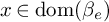
$x \in \mathrm {dom}(\beta _e)$
, one has $$\begin{align*}x \cdot \alpha_{\mathbf{s}(e)}\left(\iota_{e, \mathbf{s}}(g)\right) \cdot \beta_e = x \cdot \beta_e \cdot \alpha_{\mathbf{t}(e)}\left(\iota_{e, \mathbf{t}}(g)\right);\end{align*}$$
-
4. for all vertices $v, w \in \mathcal {V}(\mathscr {H})$
, for every vertex
$u \in [v;w]_{\mathscr {T}}$
, one has $$\begin{align*}D_v \cap D_w \subseteq D_u.\end{align*}$$









As an example, any G-action is an
$\mathscr {H}$
 -preaction.
We say that an
$\mathscr {H}$
 -preaction
$\alpha ' = \{D_v' \curvearrowleft ^{\alpha _v'} G_v, \beta _e': v \in \mathcal {V}(\mathscr {H}), e \in {\mathcal {E}}$
 $(\mathscr {H}) \smallsetminus {\mathcal {E}}$
 $(\mathscr {T}) \}$
 on a countable set
$X'$
 extends an
$\mathscr {H}$
 -preaction
$\alpha = \{D_v \curvearrowleft ^{\alpha _v} G_v, \beta _e: v \in \mathcal {V}(\mathscr {H}), e \in {\mathcal {E}}$
 $(\mathscr {H}) \smallsetminus {\mathcal {E}}$
 $(\mathscr {T}) \}$
 on a countable set X if there exists an injection
$\iota : X \hookrightarrow X'$
 such that
-
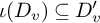
• for every $v \in \mathcal {V}\left ({\mathscr {H}}\right )$
,
$\iota (D_v) \subseteq D_v'$
, and on
$D_v$
one has
$\alpha ^{\prime }_v(g) \circ \iota = \iota \circ \alpha _v(g)$
for every
$g \in G_v$
; -
• for every edge $e \in \mathcal {E}\left ({\mathscr {H}}\right ) \setminus {\mathcal {E}}$
$(\mathscr {T})$
, one has
$\iota (\mathrm {dom}(\beta _e)) \subseteq \mathrm {dom}(\beta _e')$
, and on
$\mathrm {dom}(\beta _e)$
one has
$\beta ^{\prime }_e \circ \iota = \iota \circ \beta _e$
.








We then call
$\alpha $
 a sub-
$\mathscr {H}$
 -preaction of
$\alpha '$
 .
To alleviate notations, given an
$\mathscr {H}$
 -preaction
$\alpha $
 defined on a countable set X, we will simply denote by
$x \cdot g$
 the element
$x \cdot \alpha _v(g)$
 if
$x \in D_v$
 and
$g \in G_v$
 , and by
$x \cdot t_e$
 the element
$x \cdot \beta _e$
 if
$x \in \mathrm {dom}(\beta _e)$
 . Likewise, we will write
$\mathrm {dom}(t_e)$
 and
$\mathrm {dom}(\beta _e)$
 interchangeably.
Given an
$\mathscr {H}$
 -preaction
$\alpha $
 defined on a countable set X, one can define its Schreier graph
$\mathrm {Sch}(\alpha )$
 in a similar way to that for genuine actions: its set of vertices is X and
-
• for every $v \in \mathcal {V}(\mathscr {H})$
and every
$x \in D_v$
, there is an edge labelled g with source x and target
$x \cdot g$
for every
$g \in G_v$
; -
• for every $e \in {\mathcal {E}}$
$(\mathscr {H}) \smallsetminus {\mathcal {E}}$
$(\mathscr {T})$
and every
$x \in \mathrm {dom}(t_e)$
, there is an edge labelled
$t_e$
with source x and target
$x \cdot t_e$
.


To any
$\mathscr {H}$
 -preaction
$\alpha $
 on a pointed countable set
$(X,x)$
 is associated its stabilizer
$\mathrm {Stab}_{\alpha }(x)$
 : any cycle c of
$\mathrm {Sch}(\alpha )$
 based at x defines an element
$\varphi (c)$
 of G, obtained by multiplying the labels of the edges of c. The stabilizer
$\mathrm {Stab}_{\alpha }(x)$
 is the subgroup of G generated by all the elements
$\varphi (c)$
 , for c varying in the set of cycles of
$\mathrm {Sch}(\alpha )$
 based at x.
Now we turn to the definition of
$\mathscr {H}$
 -graphs. Informally, the
$\mathscr {H}$
 -graph of an
$\mathscr {H}$
 -preaction
$\alpha $
 is obtained from the Schreier graph of
$\alpha $
 in the following way: for every vertex
$v \in \mathcal {V}\left (\mathscr {H}\right )$
 , shrink every
$G_v$
 -orbit
$x \cdot G_v$
 (with
$x \in D_v$
 ) to one vertex, and then label the obtained vertex by the action
$x \cdot G_v \curvearrowleft G_v$
 . As the isomorphism class of a transitive right action of a countable group on a countable set X is uniquely determined by the stabilizer of any point of X, these labels will be
$G_v$
 -conjugacy classes of subgroups of
$G_v$
 . For any two vertices
$x \cdot G_v$
 ,
$x' \cdot G_w$
 , we put some edges labelled
$e \in {\mathcal {E}}$
 $(\mathscr {H})$
 between
$x \cdot G_v$
 and
$x' \cdot G_w$
 if and only if
$(\mathbf {s}(e), \mathbf {t}(e)) = (v,w)$
 and
-
• either $e \in \mathscr {T}$
and
$x \cdot G_v \cap x' \cdot G_w \neq \emptyset $
; -
• or $e \notin \mathscr {T}$
and
$x \in \mathrm {dom}(t_e)$
and
$x \cdot G_v t_e \cap x' \cdot G_w \neq \emptyset $
.


More specifically, denoting by
$s_e$
 the element of G equal to
$t_e$
 if
$e \notin {\mathcal {E}}$
 $(\mathscr {T})$
 and to
$\mathrm {id}$
 otherwise, the number of such edges is precisely the number of
$G_e$
 -orbits of
$x \cdot G_v $
 which are sent by
$s_e$
 onto
$x' \cdot G_w$
 . Because of the fact that vertex groups need not be commutative for the moment, we also add a label to the inferior and the superior half-edge in order to remember “where” the two orbits
$x \cdot G_vs_e$
 and
$x' \cdot G_w$
 intersect.
We now give the formal definition, which is a generalization of the notion of
$\mathcal {H}$
 -graph introduced in [Reference BontempsBon26, Definition 3.4]:
Definition 3.2. Let
$\alpha $
 be an
$\mathscr {H}$
 -preaction of G on a countable set X. One defines the
$\mathscr {H}$
 -graph
$\mathcal {G}$
 of
$\alpha $
 as follows:
-
1. its vertex set is the set of $G_v$
-orbits for v varying in
$\mathcal {V}(\mathscr {H})$
: $$\begin{align*}\mathcal{V}(\mathcal{G}) = \bigsqcup_{v \in \mathcal{V}(\mathscr{H})}D_v/G_v;\end{align*}$$
-
2. its edge set is $\mathcal {E}(\mathcal {G}) = \mathcal {E}^+(\mathcal {G}) \sqcup \mathcal {E}^-(\mathcal {G})$
where $$\begin{align*}\mathcal{E}^+(\mathcal{G}) = \bigsqcup_{e \in \mathcal{E}^+(\mathscr{T})}\left(D_{\mathbf{s}(e)} \cap D_{\mathbf{t}(e)}\right)/\iota_{e, \mathbf{s}}(G_e) \bigsqcup \bigsqcup_{e \in \mathcal{E}^+(\mathscr{H}) \setminus {\mathcal{E}}{}(\mathscr{T})}\mathrm{dom}(t_e) / \iota_{e, \mathbf{s}}(G_e) \end{align*}$$
and
$$\begin{align*}\mathcal{E}^-(\mathcal{G}) = \bigsqcup_{e \in \mathcal{E}^+(\mathscr{T})}\left(D_{\mathbf{s}(e)} \cap D_{\mathbf{t}(e)}\right)/\iota_{e, \mathbf{t}}(G_e) \bigsqcup \bigsqcup_{e \in \mathcal{E}^+(\mathscr{H}) \setminus {\mathcal{E}}{}(\mathscr{T})}\mathrm{rng}(t_e) / \iota_{e, \mathbf{t}}(G_e) \end{align*}$$
with
-
• for every $e \in \mathcal {E}^+(\mathscr {T})$
, for every
$x \in D_{\mathbf {s}(e)} \cap D_{\mathbf {t}(e)}$
: $$\begin{align*}\mathbf{s} \left(x \cdot \iota_{e, \mathbf{s}}(G_e)\right) = x \cdot G_{\mathbf{s}(e)}\end{align*}$$
and
$$\begin{align*}\mathbf{t} \left(x \cdot \iota_{e, \mathbf{t}}(G_e)\right) = x \cdot G_{\mathbf{t}(e)}.\end{align*}$$
Moreover
$$\begin{align*}\overline{x \cdot \iota_{e, \mathbf{s}}(G_e)} = x \cdot \iota_{e, \mathbf{t}}(G_e); \end{align*}$$
-
• for every $e \in \mathcal {E}^+(\mathscr {H}) \setminus {\mathcal {E}}$
$(\mathscr {T})$
, for every
$x \in D_{\mathbf {s}(e)} \cap \mathrm {dom}(t_e) \left (D_{\mathbf {t}(e)}\right )$
: $$\begin{align*}\mathbf{s} \left(x \cdot \iota_{e, \mathbf{s}}(G_e)\right) = x \cdot G_{\mathbf{s}(e)}\end{align*}$$
and
$$\begin{align*}\mathbf{t} \left(x \cdot \iota_{e, \mathbf{t}}(G_e)\right) = x t_e \cdot G_{\mathbf{t}(e)}.\end{align*}$$
Moreover
$$\begin{align*}\overline{x \cdot \iota_{e, \mathbf{s}}(G_e)} = x t_e \cdot \iota_{e, \mathbf{t}}(G_e); \end{align*}$$
-
-
3. each vertex $x \cdot G_v$
is labelled
$\left ([\mathrm {Stab}_{G_v}(x)]_{G_v}, v\right )$
(where
$[\mathrm {Stab}_{G_v}(x)]_{G_v}$
denotes the conjugacy class of the subgroup
$\mathrm {Stab}_{G_v}(x)$
in
$G_v$
); -
4. for every vertex $x \cdot G_v$
, we fix an identification between
$x \cdot G_v$
and the quotient set
$\mathrm {Stab}_{G_v}(x) \backslash G_v$
(in a
$G_v$
-equivariant way). Each edge
$(\mathrm {Stab}_{G_v}(x)g) \iota _{e, \mathbf {s}}(G_e)$
is labelled e and its inferior half-edge is labelled
$(\mathrm {Stab}_{G_v}(x)g) \iota _{e, \mathbf {s}}(G_e)$
; in particular (applying this last condition to
$\overline {e}$
), it is labelled
$\overline {(\mathrm {Stab}_{G_v}(x)g) \iota _{e, \mathbf {s}}(G_e) }$
at its target.











Remark 3.3. In Item 3, the data of
$[\mathrm {Stab}_{G_v}(x)]_{G_v}$
 is equivalent to the data of the isomorphism class of the
$G_v$
 -action
$\mathrm {Stab}_{G_v}(x) \backslash G_v \curvearrowleft G_v$
 , or equivalently, of the isomorphism class of the
$G_v$
 -action on
$x \cdot G_v$
 .
Example 3.4. Let us consider the HNN-extension G of some group
$G_v$
 over a group
$G_e$
 defined by the two inclusions
$i : G_e \hookrightarrow G_v$
 and
$j : G_e \hookrightarrow G_v$
 . It is the fundamental group of the graph of groups defined in Figure 1.
Graph of groups
$\mathscr {H}$
 defining an HNN-extension.

Figure 1 Long description
It consists of a single oriented loop labelled $G_e$ based at a vertex labelled $G_v$, whose source is labelled $i$ and target is labelled $j$.
The group G inherits the following presentation

Let us consider an
$\mathscr {H}$
 -preaction that consists of two
$G_v$
 -orbits
$x \cdot G_v$
 ,
$y \cdot G_v$
 , and such that
$t_e$
 sends two points of
$x \cdot G_v$
 (say
$x,x'$
 ) that lie in two different
$i(G_e)$
 -orbits to two other points in
$y \cdot G_v$
 (say
$y,y'$
 ) that lie in two different
$j(G_e)$
 -orbits (see Figure 2).
Schreier graph of an
$\mathscr {H}$
 -preaction (here
$g,g' \in G_v$
 and
$g_e \in G_e$
 ).

Figure 2 Long description
There are two $G_v$-orbits (represented as yellow ovals). The $G_v$-orbit on the left contains the $i(G_e)$-orbits of two points $x$ and $x'$ (represented as two orange ovals), and the $G_v$-orbit contains the $j(G_e)$-orbits of two points $y$ and $y'$ (also as two orange ovals). A red edge labelled $g$ (resp, $g'$) connects $x$ to $x'$ (resp, $y$ to $y'$). Black dashed edges labelled $i(g_e)$ (resp. $j(g_e)$) connect $x$ to $x \cdot i(g_e)$ and $x'$ to $x' \cdot i(g_e)$ (resp. $y$ to $y \cdot i(g_e)$ and $y'$ to $y' \cdot i(g_e)$ ). Four red edges labelled $t_e$ connect $x$ to $y$, $x'$ to $y'$, $x \cdot i(g_e)$ to $y \cdot j(g_e)$, and $x' \cdot i(g_e)$ to $y' \cdot j(g_e)$.
The
$\mathscr {H}$
 -graph of the above action consists of
-
• two vertices that correspond to the two $G_v$
-orbits; -
• two edges between those vertices that correspond to the $i(G_e),j(G_e)$
-orbits.


This graph is represented in Figure 3.


Figure 3 Long description
There are two yellow vertices, the one on the left being labelled $([\Stab_{G_v}(x)]_{G_v}, v)$, and the one on the right being labelled $([\Stab_{G_v}(y)]_{G_v}, v)$. There are two dashed red edges labelled $e$ with source the vertex on the left and target the vertex on the right. The source of the top (resp., bottom) red edge is labelled $\Stab_{G_v}(x) g i(G_e)$ (resp., $\Stab_{G_v}(x)1_{G_v}i(G_e)$) and its target is labelled $\Stab_{G_v}(y) g' j(G_e)$ (resp., $\Stab_{G_v}(y) 1_{G_v} j(G_e)$). These four labels are orange.
Notice that the chosen identifications required in Item 4 send x (resp. y) to the coset
$\mathrm {Stab}_{G_v}(x)1$
 (resp.
$\mathrm {Stab}_{G_v}(y)1$
 ) of
$\mathrm {Stab}_{G_v}(x) \backslash G_v$
 (resp.
$\mathrm {Stab}_{G_v}(y) \backslash G_v$
 ).
Similarly, one defines the
$\mathscr {H}$
 -graph of a subgroup H using the correspondence between subgroups and right actions:
Definition 3.6. The
$\mathscr {H}$
 -graph of a subgroup H of G is the
$\mathscr {H}$
 -graph of the right action of G on
$H \backslash G$
 .
Remark 3.7. As observed in [Reference BontempsBon26, Section 3] in the case of infinite cyclic vertex and edge groups, the data of the graph of groups of H is equivalent to its
$\mathscr {H}$
 -graph: recall that the set of vertices of the Bass-Serre tree
$\mathcal {T}$
 associated to a graph of groups
$\mathscr {H}$
 of fundamental group G is
$\bigsqcup _{v \in \mathcal {V}(\mathscr {H})}G/G_v$
 , and its set of edges is
$\bigsqcup _{e \in {\mathcal {E}}{}(\mathscr {H})}G/G_e$
 . Thus, for any subgroup H of G, the set of vertices (resp. of edges) of
$H \backslash \mathcal {T}$
 is exactly

(resp.
$\bigsqcup _{e \in {\mathcal {E}}{}(\mathscr {H})}H \backslash (G/G_e) = \bigsqcup _{e \in {\mathcal {E}}{}(\mathscr {H})}(H \backslash G)/G_e$
 ), which is exactly the set of vertices (resp. of edges) of the
$\mathscr {H}$
 -graph of H (taking the quotient
$H \backslash G$
 amounts to taking the Schreier graph of H, then taking the disjoint union over the vertices of
$\mathscr {H}$
 amounts to “blowing it up”, and taking the quotient by every vertex (resp. edge) group amounts to shrinking the orbits of vertex groups (resp. edge groups), which amounts to constructing the vertices (resp. edges) of the
$\mathscr {H}$
 -graph of H).
Now we want to define an abstract notion of
$\mathscr {H}$
 -graph. To achieve this, we first prove the following lemma, which gives a combinatorial condition on the labels of the vertices of the
$\mathscr {H}$
 -graph of a preaction.
Lemma 3.8. Let
$\mathcal {G}$
 be the
$\mathscr {H}$
 -graph of an
$\mathscr {H}$
 -preaction
$\alpha $
 defined on a set
$X_0$
 . For every
$E \in \mathcal {E}(\mathcal {G})$
 , denoting by e the label of E, by
$([\Lambda _0]_{G_{\mathbf {s}(e)}}, \mathbf {s}(e))$
 (resp.
$([\Lambda _1]_{G_{\mathbf {t}(e)}}, \mathbf {t}(e))$
 ) the label of
$\mathbf {s}(E)$
 (resp.
$\mathbf {t}(E)$
 ), by
$\Lambda _0 g_0 \iota _{e, \mathbf {s}}(G_e)$
 (resp.
$\Lambda _1 g_1 \iota _{e, \mathbf {t}}(G_e)$
 ) the label of the inferior (resp. superior) half-edge of E, one has

Proof. For every
$e \in {\mathcal {E}}$
 $(\mathscr {H})$
 , let us define
$s_e = \left \{ \begin {array}{ll} t_e & \text {if } e \notin {\mathcal {E}}{}(\mathscr {T}) \\ id & \text {otherwise} \end {array} \right .$
 . By construction, there exist
$x, y \in X_0$
 and
$g,g' \in G_e$
 such that
-
• $\mathrm {Stab}_{G_{\mathbf {s}(e)}}(x) = \Lambda _0$
; -
• $\mathrm {Stab}_{G_{\mathbf {t}(e)}}(y) = \Lambda _1$
; -
• $x \cdot g_0 \iota _{e, \mathbf {s}}(g) s_e = y \cdot g_1 \iota _{e, \mathbf {t}}(g')$
.



Hence, denoting by
$X = x \cdot g_0 \iota _{e, \mathbf {s}}(g)$
 and
$Y = y \cdot g_1 \iota _{e, \mathbf {t}}(g')$
 , one has
$Y=Xs_e$
 ; thus,

so, taking the preimage under
$\iota _{e, \mathbf {t}}$
 , we get

which amounts to saying that

which proves the statement.
Using this lemma, one can extend the notion of
$\mathscr {H}$
 -graph as follows:
Definition 3.9. An
$\mathscr {H}$
 -graph
$\mathcal {G}$
 is a labelled graph satisfying the following conditions:
-
• every vertex is labelled $\left ([\Lambda ]_{G_v}, v\right )$
for some
$v \in \mathcal {V}(\mathscr {H})$
and some subgroup
$\Lambda $
of
$G_v$
; -
• every edge $E \in \mathcal {E}(\mathcal {G})$
is labelled by an edge
$e \in {\mathcal {E}}$
$(\mathscr {H})$
such that
$\mathbf {s}(E)$
is labelled
$(C, \mathbf {s}(e))$
(for some
$G_{\mathbf {s}(e)}$
-conjugacy class C of subgroups of
$G_{\mathbf {s}(e)}$
) and
$\mathbf {t}(E)$
is labelled
$(C', \mathbf {t}(e))$
(for some
$G_{\mathbf {t}(e)}$
-conjugacy class
$C'$
of subgroups of
$G_{\mathbf {t}(e)}$
); -
• the inferior half-edge of an edge labelled e with source labelled $\left ([\Lambda ]_{G_v}, v\right )$
is labelled by an element of
$\Lambda \backslash G_v / \iota _{e, \mathbf {s}}(G_e)$
; -
• every edge labelled e whose inferior half-edge is labelled $\Lambda _0 g_0 \iota _{e, \mathbf {s}}(G_e)$
(with
$\Lambda _0 \leq G_{\mathbf {s}(e)}$
) and whose superior half-edge is labelled
$\Lambda _1 g_1 \iota _{e, \mathbf {t}}(G_e)$
(with
$\Lambda _1 \leq G_{\mathbf {t}(e)}$
) satisfies $$\begin{align*}\left[\iota_{e, \mathbf{s}}^{-1}\left(g_0^{-1} \Lambda_0 g_0\right)\right]_{G_e} = \left[\iota_{e, \mathbf{t}}^{-1}\left(g_1^{-1} \Lambda_1 g_1\right)\right]_{G_e};\end{align*}$$
-
• inferior (resp. superior) half-edges of different edges labelled e (for some $e \in {\mathcal {E}}$
$(\mathscr {H})$
) sharing the same source (resp. target) cannot share the same label.





A vertex V of an
$\mathscr {H}$
 -graph labelled
$([\Lambda ]_{G_v},v)$
 is called saturated relative to an edge
$e \in {\mathcal {E}}$
 $(\mathscr {H})$
 if and only if
$\mathbf {s}(e) = v$
 and the set of labels of the inferior half-edges of edges labelled e with source V is the whole
$\Lambda \backslash G_v / \iota _{e, \mathbf {s}}(G_e)$
 . The vertex V is called saturated if it is saturated relative to every edge with source v. An
$\mathscr {H}$
 -graph is called saturated if all its vertices are saturated. In the case where edge groups have finite index in vertex groups, notice that this holds if and only if every vertex labelled
$([\Lambda ]_{G_v},v)$
 has exactly
$\left |\Lambda \backslash G_v / \iota _{e, \mathbf {s}}(G_e)\right |$
 outgoing edges labelled e for every edge
$e \in {\mathcal {E}}$
 $(\mathscr {H})$
 satisfying
$\mathbf {s}(e) = v$
 . Finally, an
$\mathscr {H}$
 -action is called saturated if its
$\mathscr {H}$
 -graph is saturated, namely if it is a genuine G-action.
In the formalism of Bass, who introduced the right notion of coverings in the setting of graphs of groups in [Reference BassBas93], an
$\mathscr {H}$
 -graph
$\mathcal {G}$
 is the base space of an immersion
$\mathcal {G} \to \mathscr {H}$
 of the graph of groups
$\mathscr {H}$
 . This immersion is a covering if and only if
$\mathcal {G}$
 is saturated, that is to say,
$\mathcal {G}$
 is the
$\mathscr {H}$
 -graph of a subgroup of G. Notice, however, that the notion of coverings of graphs of groups introduced by Bass is finer than our notion of
$\mathscr {H}$
 -graphs, as he establishes a correspondence between
$\mathrm {Sub}(G)$
 and coverings of the graph of groups
$\mathscr {H}$
 . Here, different subgroups can share the same
$\mathscr {H}$
 -graph: consider for instance a graph of groups
$\mathscr {H}$
 defined by a loop based at a vertex labelled H (for some abstract group H), and take the edge group to be equal to H, and both inclusions to be the identity. The fundamental group of
$\mathscr {H}$
 is
$H \times \mathbb {Z}$
 and for any element h of H, the
$\mathscr {H}$
 -graph of the cyclic subgroup
$\langle (h,1) \rangle $
 consists of a single loop based at a vertex labelled
$H \cap \langle (h,1) \rangle = \{\mathrm {id}\}$
 . However, the subgroups
$\langle (h,1) \rangle $
 are pairwise different when h varies in H.
The following three Lemmas (3.10, 3.11 and 3.14) give rise to a useful tool to approximate subgroups of G. We show that, under some conditions, an approximation of the
$\mathscr {H}$
 -graph of a subgroup gives rise to an approximation of the subgroup itself. More specifically, if we start from a subgroup H of G and any non-saturated sub-
$\mathscr {H}$
 -preaction
$\alpha _1$
 of the corresponding
$\mathscr {H}$
 -preaction, Lemma 3.14 and Lemma 3.10 will allow one to extend
$\alpha _1$
 into a saturated
$\mathscr {H}$
 -preaction
$\beta _1$
 whose
$\mathscr {H}$
 -graph
$\mathcal {G}$
 contains the
$\mathscr {H}$
 -graph
$\mathcal {G}_1$
 of
$\alpha _1$
 , and such that
$\mathcal {G} / \mathcal {G}_1$
 is a tree. If moreover we were able to build a finite connected
$\mathscr {H}$
 -graph that contains both a cycle
$\mathcal {L}$
 and
$\mathcal {G}_1$
 as disjoint subgraphs, then Lemma 3.11, together with Lemma 3.14 and Lemma 3.10 would yield a saturated
$\mathscr {H}$
 -preaction
$\beta _2$
 that extends
$\alpha _1$
 and whose
$\mathscr {H}$
 -graph
$\mathcal {G}'$
 contains
$\mathcal {G}_1$
 , such that
$\mathcal {G}'/\mathcal {G}_1$
 contains the single cycle
$\mathcal {L}$
 . Those two preactions
$\beta _1$
 and
$\beta _2$
 will extend
$\alpha _1$
 . Moreover, they will be non-isomorphic because the underlying graphs of their
$\mathscr {H}$
 -graphs do not share the same homotopy type.
The proofs of these are very similar to the ones given in the case of GBS groups of rank
$1$
 in [Reference BontempsBon26] (Lemma 3.3, Lemma 3.4 and Lemma 3.5). For the convenience of the reader, we adapt the main ingredients of the proofs to our wider setting.
Lemma 3.10. Let
$(\alpha _i)_{i \in \mathbb {N}}$
 be a collection of
$\mathscr {H}$
 -preactions whose
$\mathscr {H}$
 -graphs
$(\mathcal {G}_i)_{i \in \mathbb {N}}$
 are contained in a saturated
$\mathscr {H}$
 -graph
$\mathcal {G}$
 as pairwise disjoint subgraphs such that the quotient
$\mathcal {G} / \left (\bigsqcup _{i \in \mathbb {N}} \mathcal {G}_i\right )$
 is a tree. There exists a G-action
$\alpha $
 whose
$\mathscr {H}$
 -graph is
$\mathcal {G}$
 and that extends
$\alpha _i$
 for every
$i \in \mathbb {N}$
 .
Lemma 3.11. Let
$\mathcal {F}$
 be a finite
$\mathscr {H}$
 -graph. There exists an
$\mathscr {H}$
 -preaction whose
$\mathscr {H}$
 -graph is
$\mathcal {F}$
 .
The proofs of Lemma 3.10 and Lemma 3.11 rely on straightforward inductions based on the following proposition:
Proposition 3.12. Let
$\alpha _0$
 be an
$\mathscr {H}$
 -preaction defined on a countable set
$X_0$
 whose
$\mathscr {H}$
 -graph
$\mathcal {G}_0$
 is contained in an
$\mathscr {H}$
 -graph
$\mathcal {G}$
 such that:
-
• $\mathcal {V}(\mathcal {G}) = \mathcal {V}(\mathcal {G}_0)$
; -
• $\mathcal {E}(\mathcal {G}) = \mathcal {E}(\mathcal {G}_0) \sqcup \{E\}$
for some edge E such that
$\mathbf {s}(E), \mathbf {t}(E) \in \mathcal {V}(\mathcal {G}_0)$
.



Then, there exists an
$\mathscr {H}$
 -preaction
$\alpha $
 whose
$\mathscr {H}$
 -graph is
$\mathcal {G}$
 . Moreover, if
$\mathbf {s}(E)$
 and
$\mathbf {t}(E)$
 belong to two different connected components of
$\mathcal {G}_0$
 (that is to say,
$\alpha _0 = \alpha _1 \sqcup \alpha _2$
 for some sub-
$\mathscr {H}$
 -preactions
$\alpha _1$
 and
$\alpha _2$
 , and
$\mathbf {s}(E)$
 (resp.
$\mathbf {t}(E)$
 ) corresponds to a vertex orbit for
$\alpha _1$
 (resp.
$\alpha _2$
 )), the constructed preaction
$\alpha $
 extends both
$\alpha _1$
 and
$\alpha _2$
 .
Proof. We adapt Constructions
$\mathrm {A}$
 and
$\mathrm {B}$
 defined in [Reference BontempsBon26, Section 3]. Let e be the label of E and let us denote by
$(V_1, V_2) := (\mathbf {s}(E), \mathbf {t}(E))$
 , and by
$(v_1,v_2) := (\mathbf {s}(e), \mathbf {t}(e))$
 . Let
$([\Lambda _i]_{G_{v_i}}, v_i)$
 be the label of
$V_i$
 (for
$i \in \{1,2\}$
 ) and let
$\Lambda _1 g_1 \iota _{e, \mathbf {s}}(G_e)$
 and
$\Lambda _2 g_2 \iota _{e, \mathbf {t}}(G_e)$
 be the label of the inferior half-edge and of the superior half-edge of E, respectively. One has
$[\iota _{e, \mathbf {s}}^{-1}(g_1^{-1}\Lambda _1 g_1)]_{G_e} = [\iota _{e, \mathbf {t}}^{-1}(g_2^{-1}\Lambda _2 g_2)]_{G_e}$
 , i.e. there exists
$h \in G_e$
 such that

We distinguish two cases:
Construction A: If
$e \notin {\mathcal {E}}$
 $(\mathscr {T})$
 , then there exist
$x_1,x_2 \in X_0$
 such that:
-
• $x_i \in \mathrm {dom}(G_{v_i})$
for
$i \in \{1,2\}$
; -
• $\mathrm {Stab}_{G_{v_i}}(x_i) = \Lambda _i$
for
$i \in \{1,2\}$
; -
• $x_1 \cdot g_1 \notin \mathrm {dom}(t_e)$
and
$x_2 \cdot g_2 \notin \mathrm {rng}(t_e)$
.





We extend
$t_e$
 and
$t_e^{-1}$
 on a subset of
$X:=X_0$
 by defining, for every
$g \in G_e$
 :

which is well-defined by Equation 3.13. The resulting
$\mathscr {H}$
 -preaction is suitable.
Construction B: If
$e \in {\mathcal {E}}$
 $(\mathscr {T})$
 , then there exist
$x_1,x_2 \in X_0$
 such that:
-
• $x_i \in \mathrm {dom}(G_{v_i})$
for
$i \in \{1,2\}$
; -
• $\mathrm {Stab}_{G_{v_i}}(x_i) = \Lambda _i$
for
$i \in \{1,2\}$
; -
• $x_1 \cdot g_1 \notin \mathrm {dom}(G_{v_2})$
and
$x_2 \cdot g_2 \notin \mathrm {dom}(G_{v_1})$
.






We let

and we let
$\alpha $
 be the
$\mathscr {H}$
 -preaction induced by
$\alpha_0 $
 on X. As previously, it is well-defined by Equation 3.13. By construction, the
$\mathscr {H}$
 -graph of
$\alpha $
 is
$\mathcal {G}$
 .
Finally we explain how to saturate an
$\mathscr {H}$
 -graph in our new setting.
Lemma 3.14. For every (non-saturated)
$\mathscr {H}$
 -graph
$\mathcal {G}$
 , there exists a saturated
$\mathscr {H}$
 -graph
$\tilde {\mathcal {G}}$
 that contains
$\mathcal {G}$
 and such that the quotient
$\tilde {\mathcal {G}} / \mathcal {G}$
 is an infinite forest.
Proof. We build an increasing sequence of
$\mathscr {H}$
 -graphs
$(\mathcal {G}_n)_{n \mathbb {N}}$
 such that the union
$\bigcup _{n \in \mathbb {N}}\mathcal {G}_n$
 is the desired
$\mathscr {H}$
 -graph. This works by induction using the following construction: if V is a non-saturated vertex labelled
$([\Lambda _0]_{G_v}, v)$
 , whose non-saturation is witnessed by
-
• an edge $e \in {\mathcal {E}}$
$(\mathscr {H})$
with source v; -
• an element $g_0 \in G_v$
such that there is no inferior half-edge labelled
$\Lambda _0 g_0 \iota _{e, \mathbf {s}}(G_e)$
with source V


then, denoting by
$w = \mathbf {t}(e)$
 , one defines

and one builds a new vertex W labelled
$([\Lambda _1]_{G_w}, w)$
 and a new edge E labelled e with source V and target W such that
-
• the inferior half-edge $(E, \mathbf {s})$
is labelled
$\Lambda _0 g_0 \iota _{e, \mathbf {s}}(G_e)$
; -
• the superior half-edge $(E, \mathbf {t})$
is labelled
$\Lambda _1 \iota _{e, \mathbf {t}}(G_e)$
.


3.2 Generalized Baumslag-Solitar groups
In this section, we will apply the tools we introduced in the previous section to GBS groups.
A GBS group of rank d is the fundamental group of a finite graph of groups whose vertex and edge stabilizers are isomorphic to
$\mathbb {Z}^d$
 . As any injective homomorphism
$\mathbb {Z}^d \to \mathbb {Z}^d$
 is represented by an element of
$\mathrm {M}_d(\mathbb {Z}) \cap \mathrm {GL}_d(\mathbb {Q})$
 , a GBS group can be represented by an oriented graph
$\mathscr {H}$
 endowed with a function that associates an integer matrix whose determinant is non-zero to each half-edge:

and that satisfies
$\mathrm {M}_{\overline {e}, \mathbf {t}} = \mathrm {M}_{e, \mathbf {s}}$
 for every
$e \in {\mathcal {E}}$
 $(\mathscr {H})$
 . Up to shrinking some edges, we can assume that the graph
$\mathscr {H}$
 is reduced, that is to say, the only edges
$e \in \mathcal {E}(\mathscr {H})$
 one of whose labels is in
$\mathrm {GL}_d(\mathbb {Z})$
 are loops.
Given a GBS group G defined by a graph of groups
$\mathscr {H}$
 , let us denote by
$\mathcal {T}$
 its Bass-Serre tree and let us define the modular homomorphism as follows (cf. [Reference de Gamiz Zearra and ShepherdLdGZS25]): fix a vertex
$v \in \mathcal {V}(\mathcal {T})$
 . Observe that for any
$g \in G$
 , the group
$G_{gv} \cap G_v$
 has finite index in
$G_v$
 , hence g belongs to the abstract commensurator of
$G_v$
 . Define
$\Delta _{G}^{(v)}(g)$
 as the equivalence class of the homomorphism
$\begin {array}{ccccc} G_v \cap G_{g^{-1}v} & \to & G_v \cap G_{gv} \\ h & \mapsto & ghg^{-1} \\ \end {array}$
 . As
$G_v$
 is isomorphic to
$\mathbb {Z}^d$
 , the homomorphism
$\Delta _{G}^{(v)}$
 can be identified with a homomorphism
$\Delta _{G}^{(v)} : G \to \mathrm {GL}_d(\mathbb {Q})$
 . The definition of the modular homomorphism does not depend on the choice of the vertex v up to conjugation by an element of
$\mathrm {GL}_d(\mathbb {Q})$
 . Practically, the image of the modular homomorphism (based at some vertex v) is generated by the matrices
$\mathrm {A}_1\mathrm {B}_1^{-1} \cdots \mathrm {A}_n \mathrm {B}_n^{-1}$
 for every edge path
$e_1,\ldots ,e_n$
 labelled
$(\mathrm {A}_1,\mathrm {B}_1)$
 , …,
$(\mathrm {A}_n,\mathrm {B}_n)$
 and based at v. In particular, the modular homomorphism of a GBS group defined by a tree of groups is trivial. A GBS group G of rank d is unimodular if
$\mathrm {Im}(\det \circ \Delta _G) \subseteq \{1,-1\}$
 .
Example 3.15. Let us consider the GBS group of rank
$2$
 defined in Figure 4.
A graph of a GBS group.

Figure 4 Long description
There are two vertices $v$ and $w$ (resp. a pink circle and a blue square). A black full edge labelled $e$ connects $v$ to $w$ and is labelled by the 2*2 matrix with entries 1,5,-2,0 at its source and -1,8,4,5 at its target. The entries of the matrices are read from left to right and top to bottom. Another red dotted edge labelled $f$ connects $v$ to $w$ and is labelled by the matrix with entries 7,-1,-3,-3 at its source and -4,1,3,9 at its target.
Let us choose the edge f as a spanning tree in the graph represented in Figure 4. Then, the presentation of G associated to this choice is the following:

The modular homomorphism is trivial on the vertex generators
$x_v,y_v,x_w,y_w$
 and sends
$t_e$
 to the product
$\begin {pmatrix} 1 & 5\\ -2 & 0 \end {pmatrix} \cdot \begin {pmatrix} -1 & 8\\ 4 & 5 \end {pmatrix}^{-1} \cdot \begin {pmatrix} -4 & 1\\ 3 & 9 \end {pmatrix} \cdot \begin {pmatrix} 7 & -1\\ -3 & -3 \end {pmatrix}^{-1}$
 :

In the case where the vertex stabilizers are abelian, the definition of an
$\mathscr {H}$
 -graph simplifies as follows. An
$\mathscr {H}$
 -graph
$\mathcal {G}$
 is then a labelled graph satisfying the following conditions:
-
1. every vertex is labelled $(\Lambda , v)$
for some
$v \in \mathcal {V}(\mathscr {H})$
and some subgroup
$\Lambda $
of
$G_v$
; -
2. every edge $E \in \mathcal {E}(\mathcal {G})$
is labelled e for some
$e \in {\mathcal {E}}$
$(\mathscr {H})$
such that
$\mathbf {s}(E)$
is labelled
$(\Lambda _0, \mathbf {s}(e))$
(for some
$\Lambda _0 \leq G_{\mathbf {s}(e)}$
) and
$\mathbf {t}(E)$
is labelled
$(\Lambda _1, \mathbf {t}(e))$
(for some
$\Lambda _1 \leq G_{\mathbf {t}(e)}$
); -
3. every edge labelled e whose source (resp. target) is labelled $(\Lambda _0, \mathbf {s}(e))$
(resp.
$(\Lambda _1, \mathbf {t}(e))$
) satisfies $$\begin{align*}\iota_{e, \mathbf{s}}^{-1}\left(\Lambda_0\right) = \iota_{e, \mathbf{t}}^{-1}\left(\Lambda_1\right);\end{align*}$$
-
4. every vertex labelled $(\Lambda , v)$
has at most
$\left |\Lambda \backslash G_v / \iota _{e, \mathbf {s}}(G_e)\right |$
outgoing edges labelled e (with
$\mathbf {s}(e) = v$
) and at most
$\left |\Lambda \backslash G_v / \iota _{e, \mathbf {t}}(G_e)\right |$
incoming edges labelled e (with
$\mathbf {t}(e) = v$
).





Hence, for a GBS group of rank d, the definition of an
$\mathscr {H}$
 -graph becomes the following:
Definition 3.16. Let
$d \geq 1$
 and let
$\mathscr {H}$
 be a finite graph of groups all of whose vertex and edge groups are isomorphic to
$\mathbb {Z}^d$
 . An
$\mathscr {H}$
 -graph is a labelled graph that satisfies the following four conditions:
-
1. every vertex is labelled $(\Lambda , v)$
for some
$v \in \mathcal {V}(\mathscr {H})$
and some subgroup
$\Lambda $
of
$\mathbb {Z}^d$
; -
2. every edge $E \in \mathcal {E}(\mathcal {G})$
is labelled e for some
$e \in {\mathcal {E}}$
$(\mathscr {H})$
such that
$\mathbf {s}(E)$
is labelled
$(\Lambda _0, \mathbf {s}(e))$
(for some
$\Lambda _0 \leq G_{\mathbf {s}(e)}$
) and
$\mathbf {t}(E)$
is labelled
$(\Lambda _1, \mathbf {t}(e))$
(for some
$\Lambda _1 \leq G_{\mathbf {t}(e)}$
); -
3. Transfer Equation every edge labelled e whose source (resp. target) is labelled $(\Lambda _0, \mathbf {s}(e))$
(resp.
$(\Lambda _1, \mathbf {t}(e))$
) satisfies $$\begin{align*}\left(\mathrm{M}_{e, \mathbf{s}}^{-1}\Lambda_0\right) \cap \mathbb{Z}^d = \left(\mathrm{M}_{e, \mathbf{t}}^{-1}\Lambda_1\right) \cap \mathbb{Z}^d;\end{align*}$$
-
4. every vertex labelled $(\Lambda , v)$
has at most
$\left |\mathbb {Z}^d / \langle \Lambda , \mathrm {M}_{e, \mathbf {s}}\mathbb {Z}^d \rangle \right |$
incident edges labelled e (with
$\mathbf {s}(e) = v$
) and at most
$\left |\mathbb {Z}^d / \langle \Lambda , \mathrm {M}_{e, \mathbf {t}}\mathbb {Z}^d \rangle \right |$
incident edges labelled e (with
$\mathbf {t}(e) = v$
);


It is saturated if and only if equality holds for every vertex and edge in the last item.
Definition 3.17. An
$\mathscr {H}$
 -path is an
$\mathscr {H}$
 -graph whose underlying graph
$E_1, \ldots , E_r$
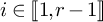
 is an edge path. It is said to be reduced if the underlying graph is reduced, namely, there is no
$i \in [\![ 1, r-1 ]\!] $
 such that
$E_i = \overline {E_{i+1}}$
 .
Example 3.18. Let
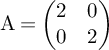
$\mathrm {A} = \begin {pmatrix} 2 & 0 \\ 0 & 2 \end {pmatrix}$
 and
$\mathrm {B} = \begin {pmatrix} 1 & 1 \\ 1 & 4 \end {pmatrix}$
 . Let us define the GBS group
$G_0$
 as the fundamental group
$\pi _1(\mathscr {H}_0)$
 of the following graph of groups defined in Figure 5.
The graph of groups
$\mathscr {H}_0$
 .

Figure 5 Long description
There are two vertices (a pink circle and an orange square). A red dashed edge labelled A at its source and B at its target connects the pink vertex to the orange vertex. There is a blue loop based at the pink vertex labelled A at its source and $I_2$ at its target.
The labelled graph represented in Figure 6 is a (non-saturated)
$\mathscr {H}_0$
 -graph.
An example of an
$\mathscr {H}_0$
 -graph.

Figure 6 Long description
There are four vertices. Three of them are pink circles; for the convenience of the description, we will call them x,y, and z. The fourth vertex is an orange square. X and y are labelled by the subgroup of $\mathbb{Z}^2$ generated by (1 0), z is labelled by the subgroup of $\mathbb{Z}^2$ generated by (2 0), and the last vertex is labelled by the subgroup of $\mathbb{Z}^2$ generated by (1 1). There is a blue edge that connects x to y, and a blue loop based at z. Two red dashed edges connect x to the orange square, and a red dashed edge connects z to the orange square.
We will focus on non-amenable GBS groups. They are characterized by the following proposition:
Proposition 3.19. Let G be a GBS group of rank d defined by a reduced graph of groups
$\mathscr {H}$
 . Then G is amenable if and only if
$\mathscr {H}$
 is a single loop one of whose labels is in
$\mathrm {GL}_d(\mathbb {Z})$
 , or a single edge e with
$\mathbf {s}(e) \neq \mathbf {t}(e)$
 , both of whose labels have determinant
$\pm 2$
 .
Proof. Let us assume that
$\mathscr {H}$
 consists of a single loop e labelled
$(\mathrm {A}, \mathrm {B})$
 with
$\mathrm {B} \in \mathrm {GL}_d(\mathbb {Z})$
 . Denoting by
$\mathrm {M} := \mathrm {A}\mathrm {B}^{-1}$
 , the group G is isomorphic to
$\mathbb {Z}[\mathrm {M}, \mathrm {M}^{-1}]\mathbb {Z}^d \rtimes \mathbb {Z}$
 , where
$\mathbb {Z}$
 acts on
$\mathbb {Z}[\mathrm {M}, \mathrm {M}^{-1}]\mathbb {Z}^d$
 by multiplication by
$\mathrm {M}$
 . As an extension of an abelian group by an abelian group, G is amenable.
Now let us assume that
$\mathscr {H}$
 consists of an edge e which is not a loop such that the labels
$\mathrm {A}$
 and
$\mathrm {B}$
 of e have determinant
$\pm 2$
 . The Bass-Serre tree
$\mathcal {T}$
 of
$\mathscr {H}$
 is a bi-infinite line on which G acts with kernel N isomorphic to
$\mathbb {Z}^d$
 . The action of
$G/N$
 on
$\mathcal {T}$
 also has a single orbit of edges. The stabilizer of any edge is trivial, and, as
$\mathrm {A}$
 and
$\mathrm {B}$
 have determinant
$\pm 2$
 , the stabilizer of any vertex is isomorphic to
$\mathbb {Z}/2\mathbb {Z}$
 . Thus, Bass-Serre theory tells us that
$G/N$
 is isomorphic to
$(\mathbb {Z}/2\mathbb {Z}) * (\mathbb {Z}/2\mathbb {Z})$
 , which is virtually isomorphic to
$\mathbb {Z}$
 . Hence, N and
$G/N$
 are amenable, so G is amenable.
Conversely, let us assume that
$\mathscr {H}$
 is neither a single loop one of whose labels is in
$\mathrm {GL}_d(\mathbb {Z})$
 , nor a single edge e with
$\mathbf {s}(e) \neq \mathbf {t}(e)$
 , both of whose labels have determinant
$\pm 2$
 . Then the action of G on its Bass-Serre tree
$\mathcal {T}$
 is of general type; thus, G contains a free group on two generators. In particular, G is non-amenable.
4 An equivalence relation on
$\boldsymbol{\mathrm {Sub}(\mathbb {Z}^d)}$

In this section, we assume that G is a non-amenable GBS group that is not the fundamental group of any graph of groups defined by a single vertex and a collection of loops labelled by invertible integer matrices. In other words, G is neither amenable nor isomorphic to a semidirect product
$\mathbb {Z}^d \rtimes \mathbb {F}_r$
 .
First, we introduce an equivalence relation that will give the decomposition of Theorem 3 (the fact that it is indeed an equivalence relation will be proved in Corollary 4.3).
Definition 4.1. Let
$\Lambda _0$
 and
$\Lambda _1$
 be two subgroups of
$\mathbb {Z}^d$
 . We say that
$\Lambda _0$
 and
$\Lambda _1$
 are
$\mathscr {H}$
 -equivalent with respect to a vertex
$v \in \mathcal {V}(\mathscr {H})$
 (denoted w.r.t. v) if there exists a connected
$\mathscr {H}$
 -graph that contains two vertices labelled
$(\Lambda _0, v)$
 and
$(\Lambda _1, v)$
 , respectively.
Lemma 4.2. Suppose that there exists an
$\mathscr {H}$
 -path
$E_1, \ldots , E_r$
 that connects two vertices labelled
$(\Lambda _0, v)$
 and
$(\Lambda _1, w)$
 , respectively. Then, for all edges
$e,f \in {\mathcal {E}}$
 $(\mathscr {H})$
 satisfying
$\mathbf {s}(e) = v$
 and
$\mathbf {t}(f) = w$
 , there exists an
$\mathscr {H}$
 -path of type
$e,\ldots ,e_1, \ldots , e_r, \ldots , f$
 that connects two vertices labelled
$(\Lambda _0, v)$
 and
$(\Lambda _1, w)$
 and that contains
$E_1, \ldots , E_r$
 as a subpath.
Proof. Let
$E_1, \ldots , E_r$
 be an
$\mathscr {H}$
 -path labelled
$e_1, \ldots , e_r$
 (with
$e_i \in {\mathcal {E}}$
 $(\mathscr {H})$
 for every
$i \in [\![ 1, r ]\!] $
 ) such that
-
• $\mathbf {s}(E_1)$
is labelled
$(\Lambda _0, v)$
; -
• $\mathbf {t}(E_r)$
is labelled
$(\Lambda _1, w)$
.


Without loss of generality, one can assume this
$\mathscr {H}$
 -path to be reduced. We first prove that there exists a reduced
$\mathscr {H}$
 -path labelled
$e,\ldots ,e_1, \ldots , e_r$
 that connects a vertex labelled
$(\Lambda _0, v)$
 to a vertex labelled
$(\Lambda _1, w)$
 , and that contains
$E_1,\ldots ,E_r$
 as a subpath. If
$e = e_1$
 , then the edge path
$E_1, \ldots , E_r$
 is suitable.
Otherwise, let us denote by
$(\mathrm {A}, \mathrm {B}) = (\mathrm {M}_{e, \mathbf {s}}, \mathrm {M}_{e, \mathbf {t}})$
 and
$v' = \mathbf {t}(e)$
 . Let us define

By construction,
$(\Lambda _0, v)$
 and
$(\Lambda _0', v')$
 satisfy the Transfer Equation 3

Hence there exists an
$\mathscr {H}$
 -graph that consists of a single edge
$E_0'$
 labelled e connecting a vertex
$V_0$
 labelled
$(\Lambda _0, v)$
 to a vertex
$V_1$
 labelled
$(\Lambda _0', v')$
 .
Case 1: let us first assume that
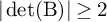
$|\det (\mathrm {B})| \geq 2$
 . As
$|\det (B)| \geq 2$
 and
$\Lambda _0' \subseteq \mathrm {B}\mathbb {Z}^d$
 , one has

Hence the labelled graph which consists of
-
• the edge $E_0'$
; -
• an edge $E_1'$
labelled
$\overline {e}$
connecting
$V_1$
to a vertex
$V_2$
labelled
$(\Lambda _0, v)$


is an
$\mathscr {H}$
 -graph of type
$e, \overline {e}$
 that connects a vertex labelled
$(\Lambda _0, v)$
 to a vertex labelled
$(\Lambda _0, v)$
 . Finally, as
$e \neq e_1$
 by assumption, the labelled graph obtained by the concatenation of the
$\mathscr {H}$
 -paths
$E_0', E_1'$
 and
$E_1, \ldots , E_r$
 is an
$\mathscr {H}$
 -graph of type
$e, \overline {e}, e_1, \ldots , e_r$
 that connects a vertex labelled
$(\Lambda _0, v)$
 to a vertex labelled
$(\Lambda _1, w)$
 as required.
Case 2: otherwise,
$|\det (\mathrm {B})| =1$
 . In particular, the graph
$\mathscr {H}$
 being reduced, e is a loop. We distinguish two subcases:
Subcase 2.1: There exists an edge
$f \neq \overline {e}$
 with source v such that
$|\det (\mathrm {M}_{f, \mathbf {t}})| \geq 2$
 . Hence we can apply Case 1 to obtain an
$\mathscr {H}$
 -path
$E_1', E_2'$
 of type
$f, \overline {f}$
 that connects a vertex labelled
$(\Lambda _0', v)$
 to a vertex labelled
$(\Lambda _0', v)$
 . As
$f \neq \overline {e}$
 and
$(\Lambda _0, v)$
 and
$(\Lambda _0', v')$
 satisfy the Transfer Equation 3, the labelled graph which consists of
-
• the concatenation of the $\mathscr {H}$
-path
$E_0'$
with the
$\mathscr {H}$
-path
$E_1', E_2'$
; -
• an edge $E_3'$
labelled
$\overline {e}$
with source
$\mathbf {t}(E_2')$
and target a new vertex labelled
$(\Lambda _0,v)$


is an
$\mathscr {H}$
 -graph. As
$e \neq e_1$
 , we can concatenate the
$\mathscr {H}$
 -path
$E_0',E_1',E_2',E_3'$
 and the
$\mathscr {H}$
 -path
$E_1, \ldots , E_r$
 to obtain an
$\mathscr {H}$
 -path labelled
$e, f, \overline {f}, \overline {e}, e_1, \ldots , e_r$
 that connects a vertex labelled
$(\Lambda _0,v)$
 to a vertex labelled
$(\Lambda _1, w)$
 .
Subcase 2.2: Otherwise, as G is non-amenable, Proposition 3.19 implies that
$\mathscr {H}$
 consists of a collection of at least two loops based at a single vertex such that every label (except possibly
$\mathrm {A}$
 ) is in
$\mathrm {GL}_d(\mathbb {Z})$
 . As G is not a semidirect product
$\mathbb {Z}^d \rtimes \mathbb {F}_r$
 , one necessarily has
$|\det (A)| \geq 2$
 . Let
$f \in \mathscr {H} \setminus \{e, \overline {e}\}$
 . Subcase 2.1 delivers an
$\mathscr {H}$
 -path
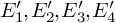
$E_1',E_2',E_3',E_4'$
 of type
$f, \overline {e}, e, \overline {f}$
 that connects a vertex labelled
$(\Lambda _0', v)$
 to a vertex labelled
$(\Lambda _0', v)$
 . As
$f \neq \overline {e}$
 , the
$\mathscr {H}$
 -graph which consists of
-
• the concatenation of the $\mathscr {H}$
-path
$E_0'$
with the
$\mathscr {H}$
-graph
$E_1', E_2', E_3', E_4'$
; -
• an edge $E_5'$
of type
$\overline {e}$
that connects
$\mathbf {t}(E_4')$
to a new vertex labelled
$(\Lambda _0, v)$




is an
$\mathscr {H}$
 -path. As
$e \neq e_1$
 , we can concatenate the
$\mathscr {H}$
 -path
$E_0',E_1',E_2',E_3', E_4', E_5'$
 and the
$\mathscr {H}$
 -path
$E_1, \ldots , E_r$
 to obtain an
$\mathscr {H}$
 -path labelled
$e, f, \overline {e}, e, \overline {f}, \overline {e}, e_1, \ldots , e_r$
 that connects a vertex labelled
$(\Lambda _0,v)$
 to a vertex labelled
$(\Lambda _1, w)$
 .
Hence we have proved that there exists an
$\mathscr {H}$
 -path labelled
$e, \ldots , e_1, \ldots , e_r$
 that connects a vertex labelled
$(\Lambda _0, v)$
 to a vertex labelled
$(\Lambda _1, w)$
 . Using this result on the reverse path (that connects a vertex labelled
$(\Lambda _1, w)$
 to a vertex labelled
$(\Lambda _0, v)$
 ) leads to an
$\mathscr {H}$
 -path of type
$e, \ldots , e_1, \ldots , e_r, \ldots , f$
 that connects a vertex labelled
$(\Lambda _0, v)$
 to a vertex labelled
$(\Lambda _1, w)$
 , which leads to the conclusion.
Corollary 4.3.
$\mathscr {H}$
 -equivalence with respect to a prescribed vertex v is an equivalence relation.
More precisely, the following holds: if
$E_1, \ldots , E_r$
 (resp.
$F_1, \ldots , F_s$
 ) is an
$\mathscr {H}$
 -path that connects a vertex labelled
$(\Lambda _0, v)$
 (resp.
$(\Lambda _1, v)$
 ) to a vertex labelled
$(\Lambda _1, v)$
 (resp.
$(\Lambda _2, v)$
 ), then there exists an
$\mathscr {H}$
 -path that contains
$E_1, \ldots , E_{r-1}$
 and
$F_2,\ldots , F_s$
 as disjoint (labelled) subpaths.
Proof. Let
$\Lambda _0, \Lambda _1, \Lambda _2 \leq \mathbb {Z}^d$
 .
As the empty path is an
$\mathscr {H}$
 -path that connects any vertex labelled
$(\Lambda _0, v)$
 to itself,
$\Lambda _0$
 is
$\mathscr {H}$
 -equivalent to itself (w.r.t. v).
If
$\Lambda _0$
 is
$\mathscr {H}$
 -equivalent to
$\Lambda _1$
 w.r.t. v, then there exists a reduced
$\mathscr {H}$
 -path
$E_1, \ldots , E_r$
 with source labelled
$(\Lambda _0, v)$
 and target labelled
$(\Lambda _1, v)$
 . The reversed
$\mathscr {H}$
 -path
$\overline {E_r}, \ldots , \overline {E_1}$
 has its source labelled
$(\Lambda _1, v)$
 and its target labelled
$(\Lambda _0, v)$
 . Thus,
$\Lambda _1$
 is
$\mathscr {H}$
 -equivalent to
$\Lambda _0$
 w.r.t. v.
Let us assume that
$\Lambda _0$
 is
$\mathscr {H}$
 -equivalent to
$\Lambda _1$
 w.r.t. v and that
$\Lambda _1$
 is
$\mathscr {H}$
 -equivalent to
$\Lambda _2$
 w.r.t. v. Let
$E_1, \ldots , E_r$
 be a reduced
$\mathscr {H}$
 -path of type
$e_1, \ldots , e_r$
 with source labelled
$(\Lambda _0, v)$
 and target labelled
$(\Lambda _1, v)$
 and let
$F_1, \ldots , F_s$
 be a reduced
$\mathscr {H}$
 -path of type
$f_1, \ldots , f_s$
 with source labelled
$(\Lambda _1, v)$
 and target labelled
$(\Lambda _2, v)$
 .
Case 1: let us assume that
$f_1 \neq \overline {e_r}$
 . Then, the concatenation of these
$\mathscr {H}$
 -paths delivers an
$\mathscr {H}$
 -path with source labelled
$(\Lambda _0, v)$
 and target labelled
$(\Lambda _2, v)$
 .
Case 2: otherwise, let us denote by
$e = e_r = \overline {f_1}$
 .
Subcase 2.1: first, we assume that there exists an edge
$g \neq e_r$
 such that
$\mathbf {t}(g) = v$
 . By Lemma 4.2, there exists an
$\mathscr {H}$
 -path
$E_1', \ldots , E_t'$
 of type
$e_1, \ldots , e_r, \ldots , g$
 that contains
$E_1, \ldots , E_r$
 and that connects a vertex labelled
$(\Lambda _0, v)$
 to a vertex labelled
$(\Lambda _1, v)$
 . As
$g \neq \overline {f_1}$
 , the concatenation of the
$\mathscr {H}$
 -paths
$E_1', \ldots , E_t'$
 and
$F_1, \ldots , F_s$
 delivers an
$\mathscr {H}$
 -path with source labelled
$(\Lambda _0, v)$
 and target labelled
$(\Lambda _2, v)$
 .
Subcase 2.2: now we assume that e is the unique edge with target v. Notice that in this case, e cannot be a loop. If
$r=0$
 or
$s=0$
 , we are done. Hence we assume that
$r, s \geq 1$
 . Let
$u = \mathbf {s}(e)$
 and
$(\mathrm {A}, \mathrm {B}) := (\mathrm {M}_{e, \mathbf {s}}, \mathrm {M}_{e, \mathbf {t}})$
 . Let
$\left (\widetilde {\Lambda _1}, u\right )$
 and
$\left (\widetilde {\Lambda _2}, u\right )$
 be the labels of
$\mathbf {s}(E_r)$
 and
$\mathbf {t}(F_1)$
 , respectively. By the Transfer Equation 3 we have

Let us define

As e is not a loop and
$\mathscr {H}$
 is reduced, one has
$|\det (B)| \geq 2$
 . Hence the labelled graph which consists of
-
• an edge $E_0'$
labelled e with source labelled
$\left (\widetilde {\Lambda _1}, u\right )$
and target V labelled
$(\Lambda _1', v)$
; -
• an edge $E_1'$
labelled
$\overline {e}$
with source V and target a vertex labelled
$\left (\widetilde {\Lambda _2}, u\right )$


is an
$\mathscr {H}$
 -graph. Hence the concatenation of the
$\mathscr {H}$
 -path
$E_1, \ldots , E_{r-1}$
 , the
$\mathscr {H}$
 -path
$E_0', E_1'$
 and the
$\mathscr {H}$
 -path
$F_2, \ldots , F_s$
 delivers an
$\mathscr {H}$
 -path that connects a vertex labelled
$(\Lambda _0, v)$
 to a vertex labelled
$(\Lambda _2, v)$
 .
In any case, we have proved that
$\Lambda _0$
 is
$\mathscr {H}$
 -equivalent to
$\Lambda _2$
 w.r.t. v.
Lemma 4.4. Let
$\Lambda _0$
 be a subgroup of
$\mathbb {Z}^d$
 and
$v \in \mathcal {V}(\mathscr {H})$
 . There exists a finite
$\mathscr {H}$
 -graph
-
• that is not simply connected;
-
• that contains a vertex labelled $(\Lambda _0, v)$
; -
• that contains at least two non-saturated vertices.

Proof. We distinguish two cases:
Case 1: assume that there exists a loop
$e_0 \in {\mathcal {E}}$
 $(\mathscr {H})$
 based at v. Let us consider an
$\mathscr {H}$
 -path
$E_1, E_2$
 labelled
$e_0, e_0$
 such that
-
• the vertex $\mathbf {t}(E_1) = \mathbf {s}(E_2)$
is labelled
$(\Lambda _0, v)$
; -
• the vertex $\mathbf {s}(E_1)$
is labelled
$(\Lambda _1,v)$
, where
$\Lambda _1 = \mathrm {M}_{e_0, \mathbf {s}}\left (\mathrm {M}_{e_0, \mathbf {t}}^{-1}\Lambda _0 \cap \mathbb {Z}^d\right )$
(so that
$\Lambda _1$
,
$\Lambda _0$
and
$e_0$
satisfy the Transfer Equation (3)); -
• the vertex $\mathbf {t}(E_2)$
is labelled
$(\Lambda _2,v)$
, where
$\Lambda _2 = \mathrm {M}_{e_0, \mathbf {t}}\left (\mathrm {M}_{e_0, \mathbf {s}}^{-1}\Lambda _0 \cap \mathbb {Z}^d\right )$
(so that
$\Lambda _0$
,
$\Lambda _2$
and
$e_0$
satisfy the Transfer Equation (3)).





We apply Lemma 4.2 to get an
$\mathscr {H}$
 -path labelled
$e_0, \ldots , e_0$
 with source
$\mathbf {t}(E_2)$
 and target
$\mathbf {s}(E_1)$
 .
Subcase 1.a: If there exists
$f_0 \in {\mathcal {E}}$
 $(\mathscr {H}) \setminus \{e_0, \overline {e_0}\}$
 , then the vertices
$\mathbf {t}(E_2)$
 and
$\mathbf {s}(E_1)$
 are neither saturated relative to
$f_0$
 nor to
$\overline {f_0}$
 , which leads to the conclusion in this particular case.
Subcase 1.b: Otherwise, as G is non-amenable, one has
$|\det (\mathrm {M}_{e_0, \mathbf {s}})|\geq 2$
 and
$|\det (\mathrm {M}_{e_0, \mathbf {t}})|\geq 2$
 by Proposition 3.19. In particular:
-
• as $\mathbf {s}(E_1)$
is labelled by a subgroup
$\Lambda _1$
of
$\mathrm {M}_{e_0, \mathbf {s}}\mathbb {Z}^d$
, one has $$ \begin{align*}\left|\mathbb{Z}^d/\left\langle \Lambda_1, \mathrm{M}_{e_0, \mathbf{s}}\mathbb{Z}^d\right\rangle \right|&= \left|\det(\mathrm{M}_{e_0, \mathbf{s}})\right| \\&\geq 2,\end{align*} $$
so, as $\mathbf {s}(E_1)$
has a single outgoing edge labelled
$e_0$
, the vertex
$\mathbf {s}(E_1)$
is non-saturated relative to
$e_0$
; -
• likewise, the vertex $\mathbf {t}(E_2)$
is non-saturated relative to
$\overline {e_0}$
.


Case 2: otherwise, we fix an edge
$e_0 \in {\mathcal {E}}$
 $(\mathscr {H})$
 with source v such that
$w :=\mathbf {t}(e_0) \neq v$
 . In particular, the graph of groups
$\mathscr {H}$
 being reduced, denoting by
$(\mathrm {A}, \mathrm {B}) := \left (\mathrm {M}_{e_0, \mathbf {s}}, \mathrm {M}_{e_0, \mathbf {t}}\right )$
 , one has
$|\det (A)| \geq 2$
 and
$|\det (B)| \geq 2$
 . Let us define an
$\mathscr {H}$
 -path
$E_1, E_2, E_3, E_4, E_5,E_6,E_7,E_8$
 as follows:
-
• $E_1$
,
$E_3$
,
$E_5$
,
$E_7$
are labelled
$e_0$
and
$E_2$
,
$E_4$
,
$E_6$
,
$E_8$
are labelled
$\overline {e_0}$
; -
• $\mathbf {s}(E_1)$
is labelled
$(\Lambda _0, v)$
; -
• the vertices $\mathbf {t}(E_1)$
,
$\mathbf {t}(E_3)$
,
$\mathbf {t}(E_5)$
and
$\mathbf {t}(E_7)$
are all labelled
$(\mathrm {B}(\mathrm {A}^{-1}\Lambda _0 \cap \mathbb {Z}^d), v)$
; -
• the vertices $\mathbf {t}(E_2)$
,
$\mathbf {t}(E_4)$
,
$\mathbf {t}(E_6)$
and
$\mathbf {t}(E_8)$
are labelled
$(\Lambda _0 \cap \mathrm {A}\mathbb {Z}^d, v)$
.


Notice that at least four vertices are non-saturated relative to some edge
$\widehat {e} \in {\mathcal {E}}$
 $(\mathscr {H})$
 . Indeed, by Proposition 3.19, as G is non-amenable and
$\mathscr {H}$
 is reduced:
-
• either $|\det (\mathrm {A})|\geq 3$
. In this case, the vertices
$\mathbf {t}(E_2)$
,
$\mathbf {t}(E_4)$
,
$\mathbf {t}(E_6)$
and
$\mathbf {t}(E_8)$
are non-saturated relative to
$e_0$
; -
• or $|\det (\mathrm {B})| \geq 3$
. In this case,
$\mathbf {t}(E_1)$
,
$\mathbf {t}(E_3)$
,
$\mathbf {t}(E_5)$
and
$\mathbf {t}(E_7)$
are non-saturated relative to
$\overline {e_0}$
; -
• or there exists an edge $f_0 \neq e_0$
with source v. In this case, the vertices
$\mathbf {t}(E_2)$
,
$\mathbf {t}(E_4)$
,
$\mathbf {t}(E_6)$
and
$\mathbf {t}(E_8)$
are non-saturated relative to
$f_0$
; -
• or there exists an edge $f_0 \neq \overline {e_0}$
with target w. In this case,
$\mathbf {t}(E_1)$
,
$\mathbf {t}(E_3)$
,
$\mathbf {t}(E_5)$
and
$\mathbf {t}(E_7)$
are non-saturated relative to
$f_0$
.


In any case, denoting by
$V_1,V_2,V_3,V_4$
 four non-saturated vertices relative to some edge
$\widehat {e}$
 , Lemma 4.2 delivers a reduced
$\mathscr {H}$
 -path
$F_1, \ldots , F_r$
 of type
$\widehat {e}, \ldots , \overline {\widehat {e}}$
 with source and target labelled by the label of
$V_1$
 and
$V_2$
 , respectively. Gluing its source to
$V_1$
 and its target to
$V_2$
 leads to an
$\mathscr {H}$
 -graph
$\mathcal {C}$
 in which the vertices
$V_3$
 and
$V_4$
 are non-saturated relative to
$\widehat {e}$
 . Hence
$\mathcal {C}$
 is suitable.
5 Perfect kernel of non-amenable GBS groups
The goal of this section is to give an explicit description of the perfect kernel in the case where the GBS group G is non-amenable, i.e. is defined neither by a single loop with at least one invertible matrix nor by a segment with two matrices having determinant
$\pm 2$
 .
We start with the following lemma that gives an inclusion in a more general setting:
Lemma 5.1. Let G be the fundamental group of a finite graph of groups
$\mathscr {H}$
 such that, for every
$v \in \mathcal {V}(\mathscr {H})$
 , the group
$G_v$
 is Noetherian (i.e. every subgroup of
$G_v$
 is finitely generated (e.g. the groups
$G_v$
 are finitely generated abelian groups)). Let us denote by
$\mathcal {T}$
 the Bass-Serre tree of
$\mathscr {H}$
 . Then

Proof. Let H be a subgroup of G whose graph of groups
$H \backslash \mathcal {T}$
 is finite. Let us show that under the assumptions of the lemma, the set

is a countable neighbourhood of H in
$\mathrm {Sub}(G)$
 .
First notice that every element of
$\Omega $
 has a finite graph of groups. In particular, any element of
$\Omega $
 is finitely generated: denoting by
$\mathscr {K}$
 its graph of groups, Bass-Serre theory tells us that it is generated by a finite number of subgroups of the groups
$G_v$
 (one for each vertex of
$\mathscr {K}$
 , each of these being finitely generated by noetherianity of the groups
$G_v$
 ), and by one element per edge of
$\mathscr {K}$
 . In particular:
-
• as H belongs to $\Omega $
, it is finitely generated, so
$\Omega $
is an open neighbourhood of H; -
• $\Omega $
is included in the subset of finitely generated subgroups, hence is countable.


This proves that H has a countable neighbourhood, thus
$H \notin \mathcal {K}(G)$
 .
Now we prove Theorem 1:
Theorem 5.2. Let G be a non-amenable GBS group defined by a reduced graph of groups
$\mathscr {H}$
 and let
$\mathcal {T}$
 be the associated Bass-Serre tree. Then

Proof. The inclusion
$\mathcal {K}(G) \subseteq \{H \leq G \mid H \backslash \mathcal {T} \text { is infinite} \}$
 follows from Lemma 5.1. By the correspondence between
$\mathscr {H}$
 -graphs and quotients of
$\mathcal {T}$
 by subgroups of G established in Remark 3.7, it suffices to show that any subgroup H of G whose
$\mathscr {H}$
 -graph
$\mathcal {G}$
 is infinite belongs to
$\mathcal {K}(G)$
 . Let us fix
$v \in \mathcal {V}(\mathscr {H})$
 . Let us denote by
$\alpha $
 the associated
$\mathscr {H}$
 -preaction. Let
$\beta $
 be a sub-
$\mathscr {H}$
 -preaction of
$\alpha $
 whose
$\mathscr {H}$
 -graph is a finite subgraph K of
$\mathcal {G}$
 . By assumption, K has a vertex
$V_0$
 labelled
$(\Lambda _0, v_0)$
 for some
$\Lambda _0 \leq \mathbb {Z}^d$
 and some
$v_0 \in \mathcal {V}\left (\mathscr {H}\right )$
 , which is not saturated relative to some edge
$e_0$
 with source
$v_0$
 . By Lemma 3.14, there exists a saturated
$\mathscr {H}$
 -graph
$\mathcal {G}_0$
 that contains K and such that the quotient
$\mathcal {G}_0/K$
 is an infinite forest. Hence, by Lemma 3.10, there exists a saturated
$\mathscr {H}$
 -preaction
$\alpha _0$
 that extends
$\beta $
 and whose
$\mathscr {H}$
 -graph is
$\mathcal {G}_0$
 .
Let us first assume that
$\mathscr {H}$
 does not consist of a single vertex and a collection of loops labelled by matrices in
$\mathrm {GL}_d(\mathbb {Z})$
 . By Lemma 4.4, there exists a non-simply connected finite
$\mathscr {H}$
 -graph
$\mathcal {C}$
 that contains
-
• a vertex labelled $(\Lambda _0, v)$
; -
• two vertices V and W labelled $(\Lambda _1, v_1)$
and
$(\Lambda _2, v_2)$
that are non-saturated relative to some edges denoted by
$e, f$
, respectively.


By Lemma 3.11,
$\mathcal {C}$
 is the
$\mathscr {H}$
 -graph of an
$\mathscr {H}$
 -preaction
$\gamma $
 . Lemma 4.2 delivers an
$\mathscr {H}$
 -path
$\mathcal {P}$
 of type
$e_0,\ldots ,\overline {e}$
 that connects
$V_0$
 to V. The vertex W is non-saturated relative to f in the
$\mathscr {H}$
 -graph
$K' := K \cup \mathcal {P} \cup \mathcal {C}$
 . By Lemma 3.14, there exists a saturated
$\mathscr {H}$
 -graph
$\mathcal {G}_1$
 that contains
$K'$
 and such that the quotient
$\mathcal {G}_1/K'$
 is a forest. Hence, by Lemma 3.10, there exists a saturated
$\mathscr {H}$
 -preaction
$\alpha _1$
 that extends both
$\beta $
 and
$\gamma $
 and whose
$\mathscr {H}$
 -graph is
$\mathcal {G}_1$
 . As
$\mathcal {G}_0$
 and
$\mathcal {G}_1$
 are non-isomorphic (because they do not share the same homotopy type), the (saturated)
$\mathscr {H}$
 -preactions
$\alpha _0$
 and
$\alpha _1$
 both extend
$\beta $
 and their stabilizers in G are not conjugate. We proved that any neighbourhood of
$\alpha $
 (or equivalently, of H) contains two non-isomorphic G-actions
$\alpha _0$
 ,
$\alpha _1$
 (equivalently, two non-conjugate subgroups
$H_0$
 ,
$H_1$
 of G) whose
$\mathscr {H}$
 -graphs
$\mathcal {G}_0$
 ,
$\mathcal {G}_1$
 are infinite (i.e., the quotient graphs
$H_0 \backslash \mathcal {T}$
 ,
$H_1 \backslash \mathcal {T}$
 are infinite). This proves that the space
$\{H \leq G \mid H \backslash \mathcal {T} \text { is infinite} \}$
 has no isolated point. Thus, this space is included in
$\mathcal {K}(G)$
 .
Otherwise, our group G is of the form
$\mathbb {Z}^d \rtimes \mathbb {F}_r$
 (where
$r \geq 2$
 denotes the number of loops) and each generator of
$\mathbb {F}_r$
 acts on
$\mathbb {Z}^d$
 by multiplication by an invertible integer matrix. Denoting by
$\pi : G = \mathbb {Z}^d \rtimes \mathbb {F}_r \to \mathbb {F}_r$
 the canonical surjection, every subgroup H of G is fully determined by its intersection
$H_0 = H \cap \mathbb {Z}^d$
 with
$\mathbb {Z}^d$
 , its image
$\pi (H) \leq \mathbb {F}_r$
 under
$\pi $
 satisfying

and, given a basis
$(a_i)_{i \in I}$
 of
$\pi (H)$
 (the set I being countable), elements
$(u_i, a_i) \in H$
 for every
$i \in I$
 . Notice that in this case, the Bass-Serre tree of G is the Cayley graph of
$\mathbb {F}_r$
 with respect to the standard generating set, and that for any subgroup H of G, the quotient graph
$H \backslash \mathcal {T}$
 is infinite if and only if
$\pi (H) \in \mathrm {Sub}_{[\infty ]}(\mathbb {F}_r)$
 . We distinguish two cases:
-
1. Let us first assume that $\mathrm {rk}(H_0) = d$
. Let us denote by
$(\mathrm {A}, \mathrm {B}) = (\mathrm {M}_{e_0, \mathbf {s}}, \mathrm {M}_{e_0, \mathbf {t}})$
, let us consider an edge
$f_0 \neq e_0$
and let us write
$(\mathrm {C}, \mathrm {D}) = (\mathrm {M}_{f_0, \mathbf {s}}, \mathrm {M}_{f_0, \mathbf {t}})$
. As the subgroup of
$\mathrm {GL}_d(\mathbb {Z})$
generated by
$\mathrm {D}\mathrm {C}^{-1}$
acts on the (finite) set of lattices of determinant
$\pm \det (H_0)$
, there exists an integer
$k \in \mathbb {N}^*$
satisfying $$\begin{align*}\left(\mathrm{D}\mathrm{C}^{-1}\right)^kH_0 = H_0.\end{align*}$$
In particular, there exists an $\mathscr {H}$
-cycle
$\mathcal {C} = E_1,\ldots ,E_k$
all of whose edges are of type
$f_0$
such that
$\mathbf {s}(E_i)$
is labelled
$\left (\left (\mathrm {D}\mathrm {C}^{-1}\right )^iH_0, \mathbf {s}(e_0)\right )$
for every
$i \in [\![ 1, k ]\!] $
. As no vertex of
$\mathcal {C}$
is saturated relative to
$e_0$
, Lemma 4.2 delivers an
$\mathscr {H}$
-path
$\mathcal {P}$
of type
$e_0,\ldots ,\overline {e_0}$
that connects
$V_0$
to a vertex V of
$\mathcal {C}$
. Any other vertex of
$\mathcal {C}$
is not saturated relative to
$e_0$
in
$K' := K \cup \mathcal {P} \cup \mathcal {C}$
. Hence we can conclude as in the previous case. -
2. If $\mathrm {rk}(H_0) < d$
, let us write
$H_0$
in its Smith normal form: $$\begin{align*}H_0 = \mathrm{P} \mathrm{diag}(d_1,\ldots,d_r,0,\ldots,0)\mathbb{Z}^d\end{align*}$$
(with $\mathrm {P} \in \mathrm {GL}_d(\mathbb {Z})$
,
$r < d$
and
$d_i |d_{i+1}$
for every
$i \in [\![ 1,r-1 ]\!] $
). For every
$N \in \mathbb {N}$
, define $$\begin{align*}H_0^{(N)} = \mathrm{P}\mathrm{diag} \left(d_1,\ldots,d_r, N\prod_{i=1}^rd_i,\ldots,N\prod_{i=1}^rd_i \right) \mathbb{Z}^d. \end{align*}$$
Claim. Every matrix stabilizing the subgroup $H_0$
also stabilizes
$H_0^{(N)}$
.Proof of the claim.
Denoting by $\mathrm {M}$
a matrix stabilizing
$H_0$
, and by
$e_1, \ldots , e_d$
the canonical basis of
$\mathbb {Z}^d$
, the matrix
$\mathrm {P}^{-1}\mathrm {M}\mathrm {P}$
stabilizes
$\langle d_1e_1, \ldots , d_re_r\rangle $
. In particular: $$ \begin{align*} &\mathrm{P}^{-1}\mathrm{M}\mathrm{P} \left\langle d_1e_1, \ldots, d_re_r, \left(N\prod_{i=1}^rd_i\right) e_{r+1}, \ldots, \left(N\prod_{i=1}^rd_i\right) e_{d} \right\rangle \\ &\leq \left\langle d_1e_1, \ldots, d_re_r , \left(N\prod_{i=1}^rd_i\right) \mathbb{Z}^d \right\rangle. \end{align*} $$
Now, $\left (N\prod _{i=1}^rd_i\right ) \mathbb {Z}^d \leq \left \langle d_1e_1, \ldots , d_re_r, \left (N\prod _{i=1}^rd_i\right ) e_{r+1}, \ldots , \left (N\prod _{i=1}^rd_i\right ) e_{d} \right \rangle $
: if
$j~\leq ~r$
, then $$ \begin{align*}\left(N\prod_{i=1}^rd_i \right)e_j = \left(N\prod_{i \neq j}d_i\right) (d_je_j) \in d_j e_j \mathbb{Z}.\end{align*} $$
Thus, $\mathrm {P}^{-1}\mathrm {M}\mathrm {P}$
stabilizes
$\left \langle d_1e_1, \ldots , d_re_r, \left (N\prod _{i=1}^rd_i\right ) e_{r+1}, \ldots , \left (N\prod _{i=1}^rd_i\right ) e_{d} \right \rangle $
, hence
$\mathrm {M}$
stabilizes
$H_0^{(N)}$
.In particular, $H_0^{(N)}$
is
$\pi (H)$
-stable. Moreover, as
$(a_i)_{i \in I}$
is a free basis of
$\langle ~a_i,~i~\in ~I~\rangle $
, one has $$\begin{align*}\left( \mathbb{Z}^d \times 1 \right) \cap \langle (u_i, a_i), i \in I \rangle = \{1\}.\end{align*}$$
This implies that
$$ \begin{align*} \widetilde{H}_N &:= \left\langle H_0^{(N)}, (u_i,a_i)_{i \in I} \right\rangle \\ &= H_0^{(N)} \rtimes \left\langle \left(u_i,a_i\right)_{i \in I} \right\rangle. \end{align*} $$
As moreover $H_0^{(N)}$
tends to
$H_0$
in
$\mathrm {Sub}(\mathbb {Z}^d)$
as N tends to
$+\infty $
, we deduce that the sequence of subgroups
$ \widetilde {H}_N $
converges to H (non-trivially, because
$\widetilde {H}_N~\cap\ \mathbb {Z}^d~=~H_0^{(N)}$
). As
$\pi \left (\widetilde {H}_N\right ) = \pi (H)$
, the
$\mathscr {H}$
-graphs of
$\widetilde {H}_N$
and H have isomorphic skeletons (in particular, the subgroups
$\widetilde {H}_N$
have infinite
$\mathscr {H}$
-graphs).


Remark 5.4. Notice that we did not make use of the cocompactness of the action
$G \curvearrowright \mathcal {T}$
 . Thus, Theorem 5.2 extends to a larger class of groups that includes GBS groups of rank d, i.e. the class of non-amenable groups acting (not necessarily cocompactly) on an oriented tree with vertex and edge stabilizers isomorphic to
$\mathbb {Z}^d$
 . In particular, in the case of a non-cocompact action on the Bass-Serre tree, the perfect kernel consists of the whole set of subgroups
$\mathrm {Sub}(G)$
 .
The following corollary gives a class of GBS groups that satisfy the equality
$\mathcal {K}(G) = \mathrm {Sub}_{[\infty ]}(G)$
 . Recall that in rank
$1$
 , the authors of [Reference Carderi, Gaboriau, Le Maître and StalderCGLMS25] and [Reference BontempsBon26] proved that this equality is true for non-unimodular GBS groups only. Let v be a vertex of
$\mathscr {H}$
 and recall that the modular homomorphism
$\Delta _G^{(v)}$
 based at v is defined by the following data:
-
• $\Delta _G^{(v)}$
is trivial on the vertex groups; -
• for every edge generator $t_e$
, denoting by
$e_1,\ldots ,e_r$
the unique reduced edge path in
$\mathscr {T}$
with source v and target
$\mathbf {s}(e)$
, and by
$e_{r+1},\ldots ,e_s$
the unique reduced edge path in
$\mathscr {T}$
with source
$\mathbf {t}(e)$
and target v, one has $$\begin{align*}\Delta_G^{(v)}(t_e) = \mathrm{M}_{e_1, \mathbf{s}}\mathrm{M}_{e_1, \mathbf{t}}^{-1} \ldots \mathrm{M}_{e_r,\mathbf{s}}\mathrm{M}_{e_r, \mathbf{t}}^{-1} \mathrm{M}_{e, \mathbf{s}}\mathrm{M}_{e, \mathbf{t}}^{-1} \mathrm{M}_{e_{r+1},\mathbf{s}}\mathrm{M}_{e_{r+1}, \mathbf{t}}^{-1} \ldots \mathrm{M}_{e_s, \mathbf{s}}\mathrm{M}_{e_s, \mathbf{t}}^{-1}.\end{align*}$$


Corollary 5.5. Let G be a non-amenable and non-unimodular GBS group of rank d such that the finite-index subgroups of
$\mathrm {Im}\left (\Delta _{G}^{(v)}\right )$
 are
$\mathbb {Q}$
 -irreducible. Then

Before proving Corollary 5.5, we give an explicit example of a GBS group G of rank
$2$
 whose perfect kernel consists of the set of infinite-index subgroups of G. Let us define
$\mathrm {A} = \begin {pmatrix} 2 & 2 \\ 2 & 4 \\ \end {pmatrix}$
 and
$\mathrm {B} = \begin {pmatrix} 1 & 0 \\ 0 & 2 \\ \end {pmatrix}$
 and let us define
$G=\pi _1(\mathscr {H})$
 as the fundamental group of the graph of groups defined in Figure 7. In other words, G is defined by the following presentation:

The graph of groups
$\mathscr {H}$
 .

Figure 7 Long description
It is a graph consisting of a single vertex and a loop labelled $e$ with source labelled A and target labelled B.
The image of the modular homomorphism
$\Delta _{G}$
 is the subgroup of
$\mathrm {GL}_2(\mathbb {Q})$
 generated by
$\mathrm {A}\mathrm {B}^{-1} = \begin {pmatrix} 2 & 1 \\ 2 & 2 \\ \end {pmatrix}$
 . Hence
$\mathrm {Im}(\det \circ \Delta _G) = 2^{\mathbb {Z}}$
 ; thus, G is not unimodular. Finite-index subgroups of
$\mathrm {Im}(\Delta _G)$
 are of the form
$\left \langle \left (\mathrm {A}\mathrm {B}^{-1}\right )^n \right \rangle $
 (where
$n \in \mathbb {Z} \smallsetminus \{0\}$
 ). Notice that
$\mathrm {Spec}_{\mathbb {R}}(\mathrm {A}\mathrm {B}^{-1}) = \left \{2+\sqrt {2}, 2-\sqrt {2}\right \}$
 , so
$\mathrm {Spec}_{\mathbb {R}}((\mathrm {A}\mathrm {B}^{-1})^n) = \left \{\left (2+\sqrt {2}\right )^n, \left (2-\sqrt {2}\right )^n\right \}$
 for every
$n \in \mathbb {Z}$
 . Thus, for any
$n \in \mathbb {Z} \setminus \{0\}$
 , one has
$\mathrm {Spec}_{\mathbb {Q}}((\mathrm {A}\mathrm {B}^{-1})^n) = \emptyset $
 , i.e. the subgroup
$\left \langle \left (\mathrm {A}\mathrm {B}^{-1}\right )^n \right \rangle $
 does not stabilize any non-trivial proper vector subspace of
$\mathbb {Q}^2$
 . Hence, by Corollary 5.5, one has
$\mathcal {K}(G) = \mathrm {Sub}_{[\infty ]}(G)$
 .
Now let us prove Corollary 5.5. To begin with, we prove the following lemma:
Lemma 5.6. Let H be a subgroup of G and let us denote by
$\mathcal {G}$
 its
$\mathscr {H}$
 -graph. Let
$v \in \mathcal {V}(\mathscr {H})$
 and let
$(\Lambda _0, v)$
 be the label of a vertex
$V_0$
 of
$\mathcal {G}$
 . Then:

Proof. Let us prove that

Let
$g \in G$
 . Let us consider a cycle
$e_1, \ldots , e_r$
 based at v in
${\mathscr {H}}$
 and elements
$g_i \in G_{\mathbf {s}(e_i)}$
 for every i and
$g_{r+1} \in G_v$
 such that

(where
$s_{e_i} = t_{e_i}$
 if
$e_i \notin \mathscr {T}$
 and
$1$
 otherwise). Denoting by
$(\mathrm {A}_i,\mathrm {B}_i)$
 the label of
$e_i$
 for every
$i \in [\![ 1,r ]\!] $
 , one has:

Let us consider an edge path
$E_1, \ldots , E_r$
 based at
$V_0$
 and labelled
$\overline {e_r}, \ldots , \overline {e_1}$
 in
$\mathcal {G}$
 . For every
$i \in [\![ 1, r ]\!] $
 , let
$(\Lambda _i, \mathbf {t}(e_i))$
 be the label of
$\mathbf {t}(E_{i})$
 . By the Transfer Equation 3, we get

for every
$i \in [\![ 0,r-1]\!] $
 , which implies that

Thus

which implies, with Equation (5.7), that
$\Lambda _0' := \Lambda _r$
 satisfies
$\Lambda _0' \otimes \mathbb {Q} = \Delta _{G}^{(v)}(g) \cdot \Lambda _0 \otimes \mathbb {Q}$
 .
If there exists a vertex
$V \in \mathcal {V}(\mathcal {G})$
 labelled
$(\Lambda _0', v)$
 , then
$\Lambda _0'$
 is
${\mathscr {H}}$
 -equivalent to
$\Lambda _0$
 w.r.t. v by connectedness of
$\mathcal {G}$
 . This proves that

Finally, let us prove that

Let
$\Lambda _0'$
 be a subgroup that is
${\mathscr {H}}$
 -equivalent to
$\Lambda _0$
 w.r.t. v. Let us consider an
${\mathscr {H}}$
 -path
$E_1, \ldots , E_r$
 labelled
$e_1, \ldots , e_r$
 whose source is labelled
$(\Lambda _0, v)$
 and whose target is labelled
$(\Lambda _0', v)$
 . For
$i \in [\![ 1, r ]\!] $
 , let us denote by
$(\Gamma _i, \mathbf {s}(e_i))$
 the label of
$\mathbf {s}(E_i)$
 (hence
$\Gamma _1 = \Lambda _0$
 ). By the Transfer Equation 3, denoting by
$(\mathrm {A}_i, \mathrm {B}_i)$
 the label of
$e_i$
 in
${\mathscr {H}}$
 , we get, as before,

Thus, denoting by
$g = s_{e_1}\cdots s_{e_r}$
 (where
$s_{e_i} = t_{e_i}$
 if
$e_i \notin \mathscr {T}$
 and
$1$
 otherwise), one has:

which concludes the proof of the lemma.
Proof of Corollary 5.5.
Let H be a subgroup of G whose graph of groups is finite. Let us show that H has finite index under the assumptions of the corollary. Let
$\mathcal {G}$
 be the
$\mathscr {H}$
 -graph of H. Let us denote by
$(\Lambda _0,v)$
 the label of a vertex of
$\mathcal {G}$
 . By Lemma 5.6, the orbit of
$\Lambda _0 \otimes \mathbb {Q}$
 under the action of G via
$\Delta _{G}^{(v)}$
 is finite. The stabilizer

has finite index in G. This implies that
-
• either $\Lambda _0 \otimes \mathbb {Q} = \mathbb {Q}^d$
, i.e.
$\Lambda _0$
has finite index in
$\mathbb {Z}^d$
; -
• or $\Lambda _0 = 0$
.


Let us assume by contradiction that
$\Lambda _0 = \{0\}$
 . By commensurability of the vertex stabilizers, this is equivalent to

(or equivalently, all the labels of the vertices of
$\mathcal {G}$
 are trivial).
As the image of the homomorphism
$\left | \det \circ \Delta _{G}^{(v)} \right |$
 is non-trivial, there exists a (reduced) cycle of edges
$e_1,\ldots ,e_n$
 in
$\mathscr {H}$
 based at v and satisfying

Let
$n_i$
 be the number of vertices of
$\mathcal {G}$
 labelled
$\mathbf {s}(e_i)$
 . Every vertex labelled
$\mathbf {s}(e_i)$
 (resp.
$\mathbf {t}(e_i)$
 ) has
$|\det (\mathrm {A}_i)|$
 (resp.
$|\det (\mathrm {B}_i)|$
 ) outgoing (resp. incoming) edges labelled
$e_i$
 . Hence the number of edges labelled
$e_i$
 in
$\mathcal {G}$
 is

Combining these equalities for
$i=1,\ldots ,n$
 , we get

hence a contradiction. Thus,
$\Lambda _0$
 has finite index in
$G_{\mathbf {s}(e_1)}$
 . By commensurability of the vertex stabilizers, this implies that
$H \cap G_w$
 has finite index in
$G_w$
 for every
$w \in \mathcal {V}(\mathscr {H})$
 , which implies that
$H \backslash G$
 is finite (because
$\mathcal {G}$
 is also finite).
Using Theorem 5.2, we finally deduce the equality

Remark 5.9. If G is a non-unimodular GBS group such that every non-trivial element of the image of the linear modular homomorphism
$\Delta _{G}^{(v)}$
 is
$\mathbb {Q}$
 -irreducible, then the assumptions of Corollary 5.5 are satisfied. Let us explain why. As G is non-unimodular, there exists
$g \in G$
 such that
$\left |\det \left (\Delta _{G}^{(v)}(g)\right )\right | \neq 1$
 . In particular,
$\Delta _{G}^{(v)}(g)$
 has infinite order. Now assume by contradiction that there exists a non-trivial proper vector subspace V of
$\mathbb {Q}^d$
 that is stabilized by a finite-index subgroup
$\Gamma $
 of
$\Delta _{G}^{(v)}(G)$
 . As
$\Gamma $
 has finite index, there exists some
$n \in \mathbb {N}^*$
 such that
${\Delta _G^{(v)}(g)}^n \in \Gamma $
 . Consequently, V is stabilized by the non-trivial element
$\Delta _G^{(v)}(g)^n$
 of
$\mathrm {Im}\left (\Delta _G^{(v)}\right )$
 , which contradicts the assumption made on G.
6 A dynamical partition of the perfect kernel
The goal of this section is to extend the decomposition of the perfect kernel obtained in [Reference Carderi, Gaboriau, Le Maître and StalderCGLMS25] and in [Reference BontempsBon26] for non-amenable GBS groups of rank
$1$
 .
6.1 Case where G is not a semidirect product
$\boldsymbol{\mathbb {Z}^d \rtimes \mathbb {F}_r}$

In this section, we assume that G is not a semidirect product
$\mathbb {Z}^d \rtimes \mathbb {F}_r$
 , i.e.
$\mathscr {H}$
 does not consist of a single vertex with a collection of loops all of whose labels are in
$\mathrm {GL}_d(\mathbb {Z})$
 . This allows us to make use of the equivalence relation on
$\mathrm {Sub}(\mathbb {Z}^d)$
 defined in Section 4.
Let us fix a vertex
$v \in \mathcal {V}(\mathscr {H})$
 . We identify
$G_v$
 with
$\mathbb {Z}^d$
 . Let us denote by
$\simeq $
 the
$\mathscr {H}$
 -equivalence relation with respect to v and by
$\pi _v : \mathrm {Sub}(\mathbb {Z}^d) \to \mathrm {Sub}(\mathbb {Z}^d)/\simeq $
 the canonical projection. Notice that the rank is constant on each fibre of
$\pi _v$
 . We have the following statement:
Proposition 6.1. The set
$\mathrm {Sub}(\mathbb {Z}^d)/\simeq $
 is countably infinite.
Proof. As
$\mathrm {Sub}(\mathbb {Z}^d)$
 is countable, the set
$\mathrm {Sub}(\mathbb {Z}^d)/\simeq $
 is also countable. Let us show that it is infinite. Let us define the finite subset
$\mathcal {P}_{\mathscr {H}}$
 of prime numbers

Let us define

The image of
$\delta $
 is exactly the set of integers that are divisible by no element of
$\mathcal {P}_{\mathscr {H}}$
 , hence is infinite. Let us show that
$\delta $
 is constant on the fibres of
$\pi _v$
 , i.e. that we have a factorization

which will imply that
$\mathcal {L}(\mathbb {Z}^d)/\simeq $
 is infinite (hence
$\mathrm {Sub}(\mathbb {Z}^d)/ \simeq $
 is infinite).
By a straightforward induction on the length of an
$\mathscr {H}$
 -path, it suffices to prove that for any
$\mathscr {H}$
 -edge labelled
$e \in {\mathcal {E}}$
 $(\mathscr {H})$
 with source labelled
$(\Lambda _0, \mathbf {s}(e))$
 and target labelled
$(\Lambda _1, \mathbf {t}(e))$
 , one has
$\delta (\Lambda _0) = \delta (\Lambda _1)$
 . Let E be such an edge. By the Transfer Equation 3, denoting by
$(\mathrm {A}, \mathrm {B}) = (\mathrm {M}_{e, \mathbf {s}}, \mathrm {M}_{e, \mathbf {t}})$
 , one has

Let
$p \in \mathcal {P} \setminus \mathcal {P}_{\mathscr {H}}$
 . We have

hence, as
$p \nmid \det (\mathrm {A})$
 and
$p \nmid \det (\mathrm {B})$
 :

From
$\det (\mathrm {A})\Lambda _0 \leq \Lambda _0 \cap \mathrm {A}\mathbb {Z}^d \leq \Lambda _0$
 , we get

Thus, as
$p \nmid \det (\mathrm {A})$
 :

Likewise

so by Equation 6.2 we finally get

As this is true for any
$p \notin \mathcal {P}_{\mathscr {H}}$
 , this implies that

as required.
Let us define the
$\mathscr {H}$
 -phenotype with respect to v as the following function:

Proposition 6.3. The
$\mathscr {H}$
 -phenotype
$\mathrm {Ph}_{\mathscr {H},v}$
 is surjective and invariant under conjugation by any element of G.
Proof. The surjectivity of
$\mathrm {Ph}_{\mathscr {H}, v}$
 results from the surjectivity of
$\pi _v$
 and of the function
$\begin {array}{ccccc} \mathrm {Sub}(G) & \to & \mathrm {Sub}(G_v) \\ H & \mapsto & H \cap G_v \\ \end {array}.$

Let H be a subgroup of G and
$g \in G$
 . Let
$\Lambda _0 := H \cap G_v \leq \mathbb {Z}^d$
 and
$\Lambda _1 := gHg^{-1} \cap G_v \leq \mathbb {Z}^d$
 . Let
$\mathcal {G}$
 be the
$\mathscr {H}$
 -graph of H. By definition, there exist two vertices labelled
$(\Lambda _0, v)$
 and
$(\Lambda _1, v)$
 in
$\mathcal {G}$
 . Hence, by connectedness of
$\mathcal {G}$
 , one has
$\pi _v(\Lambda _0) = \pi _v(\Lambda _1)$
 .
As the group
$G_v$
 acts non-cocompactly on the Bass-Serre tree
$\mathcal {T}$
 , any subgroup of
$G_v$
 lies in the perfect kernel
$\mathcal {K}(G)$
 by Theorem 5.2. In particular, the restriction
$\begin {array}{ccccc} \mathcal {K}(G) & \to & \mathrm {Sub}(G_v)/\simeq \\ H & \mapsto & \pi _v(H \cap G_v) \\ \end {array}$
 remains surjective and invariant under conjugation.
This function leads to a dynamical partition of the perfect kernel

By the previous remark and Proposition 6.1, this partition is infinite countable. Now we are able to prove Theorem 3 which gives a description of the dynamics induced on each piece of the aforementioned decomposition:
Theorem 6.5. For any
$\Lambda _0 \leq \mathbb {Z}^d$
 , there exists a dense orbit in
$\mathrm {Ph}_{\mathscr {H},v}^{-1}(\pi _v(\Lambda _0)) \cap \mathcal {K}(G)$
 .
Proof. Let
$\Lambda \leq \mathbb {Z}^d$
 and let
$(H_i)_{i \in \mathbb {N}} \in \left (\mathcal {K}(G) \cap \mathrm {Ph}_{\mathscr {H},v}^{-1}(\pi _v(\Lambda ))\right )^{\mathbb {N}}$
 be the sequence of finitely generated subgroups lying in
$\mathcal {K}(G) \cap \mathrm {Ph}_{\mathscr {H},v}^{-1}(\pi _v(\Lambda ))$
 . For
$i \in \mathbb {N}$
 , let
$\alpha _i$
 be the saturated
$\mathscr {H}$
 -preaction associated to
$H_i$
 and let
$\mathcal {G}_i$
 be the
$\mathscr {H}$
 -graph of
$\alpha _i$
 . Let
$\beta _i$
 be a sub-
$\mathscr {H}$
 -preaction of
$\alpha _i$
 whose stabilizer is
$H_i$
 and whose
$\mathscr {H}$
 -graph
$K_i$
 is finite (legit, because
$H_i$
 is finitely generated). As
$H_i \in \mathcal{K}(G)$
 , Theorem 5.2 implies that there exists a vertex
$V_i \in \mathcal{V}(K_i)$
 labelled
$(\Lambda_i, v_i)$
 which is non-saturated relative to some edge
$e_i \in \mathcal{E}(\mathscr{H})$
 . Up to extending
$\beta_i$
 , one can assume that
$v_i=v$
 and that there exists another vertex
$W_i$
 labelled
$(\Gamma_i, v)$
 which is non-saturated relatively to some edge
$f_i$
 . In particular, the subgroups
$(\Lambda_i)_{i \in \mathbb{N}}, (\Gamma_i)_{i \in \mathbb{N}}$
 are pairwise
$\mathscr{H}$
 -equivalent w.r.t. v, so by Lemma 4.2, there exists an
$\mathscr{H}$
 -path
$E_{1,i}, \ldots, E_{r_i, i}$
 labelled
$f_i, \ldots, \overline{e_{i+1}}$
 that connects
$W_i$
 to
$V_{i+1}$
 for every
$i \in \mathbb{N}$
 . Denoting by
$\mathcal {G}$
 the resulting
$\mathscr {H}$
 -graph, Lemma 3.14 delivers an
$\mathscr {H}$
 -graph
$\mathcal {F}$

-
• that contains $(K_i)_{i \in \mathbb {N}}$
as disjoint subgraphs; -
• such that the quotient $\mathcal {F} / \bigsqcup _{i \in \mathbb {N}}K_i$
is a forest.


Hence, by Lemma 3.10, there exists a saturated
$\mathscr {H}$
 -preaction
$\beta $
 that extends
$\beta _i$
 for every
$i \in \mathbb {N}$
 and whose
$\mathscr {H}$
 -graph is
$\mathcal {F}$
 . This proves that the conjugacy class of the subgroup of G that is associated with
$\beta $
 is dense in
$\mathcal {K}(G) \cap \mathrm {Ph}_{\mathscr {H},v}^{-1}(\pi _v(\Lambda ))$
 .
Now we study the topology of the pieces of the partition

Proposition 6.6. For any
$\Lambda _0 \leq \mathbb {Z}^d$
 :
-
1. if $\Lambda _0$
has finite index in
$\mathbb {Z}^d$
, then the fibre
$\mathrm {Ph}_{\mathscr {H},v}^{-1}(\pi _v(\Lambda _0))$
is open; -
2. $\mathrm {Ph}_{\mathscr {H},v}^{-1}(\pi _v(\Lambda _0))$
is an
$F_{\sigma }$
; -
3. $\mathrm {Ph}_{\mathscr {H},v}^{-1}(\pi _v(\Lambda _0))$
is closed if and only if
$\{\Lambda _1 \leq \mathbb {Z}^d \mid \Lambda _1 \simeq \Lambda _0 \}$
is finite.


Remark 6.7. In particular,
$\mathrm {Ph}_{\mathscr {H},v}^{-1}(\pi _v(\{0\}))$
 is closed.
Remark 6.8. If the image of the modular homomorphism is trivial, then the third item of Proposition 6.6 together with Lemma 5.6 implies that all pieces are closed.
Proof of Proposition 6.6.
Notice that we have

By Lemma 2.1, this is an
$F_{\sigma }$
 as a countable union of closed subsets of
$\mathrm {Sub}(G)$
 . Hence, we get the second point.
If
$\Lambda _0$
 has finite index in
$\mathbb {Z}^d$
 , this is an open subset of
$\mathrm {Sub}(G)$
 as a union of open sets by Lemma 2.1. This proves the first point.
If
$\{\Lambda _1 \leq \mathbb {Z}^d \mid \Lambda _1 \simeq \Lambda _0 \}$
 is finite, then
$\mathrm {Ph}_{\mathscr {H},v}^{-1}(\pi _v(\Lambda _0))$
 is closed as a finite union of closed subsets by Lemma 2.1. Otherwise, there exists a sequence of subgroups
$(\Lambda _n)_{n\in \mathbb {N}} \in (\pi _v^{-1}(\pi _v(\Lambda _0)))^{\mathbb {N}}$
 that converges to a subgroup
$\Lambda \leq \mathbb {Z}^d$
 whose rank is strictly less than
$\mathrm {rk}(\Lambda _0)$
 . By a straightforward induction using Corollary 4.3, there exists an
$\mathscr {H}$
 -path
$E_1, \ldots , E_n, \ldots $
 such that: for every
$n \in \mathbb {N}$
 , there exists
$k_n \in \mathbb {N}$
 such that
$\mathbf {s}\left (E_{k_n}\right )$
 is labelled
$(\Lambda _n, v)$
 . Thus, by Lemma 3.14, there exists a saturated
$\mathscr {H}$
 -graph that is a forest that contains
$E_1, \ldots , E_n, \ldots $
 as a sub-
$\mathscr {H}$
 -graph. Hence by Lemma 3.10, there exist a subgroup
$H \leq G$
 and elements
$g_n \in G$
 such that
$g_n H g_n^{-1} \cap G_v = \Lambda _n$
 for every
$n \in \mathbb {N}$
 . Up to extracting, the sequence
$g_n H g_n^{-1}$
 converges to a subgroup
$K \leq G$
 that satisfies
$K \cap G_v = \Lambda $
 . In particular, as the rank is constant on the fibres of
$\pi _v$
 , one has
$K \notin \mathrm {Ph}_{\mathscr {H},v}^{-1}(\pi _v(\Lambda ))$
 , which proves that
$\mathrm {Ph}_{\mathscr {H},v}^{-1}(\pi _v(\Lambda _0))$
 is not closed.
Remark 6.9. The definition of the equivalence relation
$\simeq $
 still makes sense if the graph
$\mathscr {H}$
 is infinite and the same proof extends to the class of groups that act (not necessarily cocompactly) on an oriented tree with vertex and edge stabilizers isomorphic to
$\mathbb {Z}^d$
 . In the case of a non-cocompact action on the Bass-Serre tree, we thus obtain a dynamical partition of the whole set of subgroups by Remark 5.4.
6.2 Case where
$\boldsymbol{G = \mathbb {Z}^d \rtimes \mathbb {F}_r}$

Now we assume that
$\mathscr {H}$
 consists of a collection of r loops
$e_1,\ldots ,e_r$
 based at a single vertex v such that, for every
$i \in [\![ 1,r ]\!] $
 , the label
$(\mathrm {A}_i,\mathrm {B}_i)$
 of
$e_i$
 satisfies
$\mathrm {A}_i \in \mathrm {GL}_d(\mathbb {Z})$
 and
$\mathrm {B}_i \in \mathrm {GL}_d(\mathbb {Z})$
 . Denoting by

the group G is isomorphic to the semidirect product of
$G_v = \mathbb {Z}^d$
 with the free group
$\mathbb {F}_r = \langle a_1,\ldots ,a_r \rangle $
 of rank r, where the generator
$a_i$
 acts on
$\mathbb {Z}^d$
 by multiplication by
$\mathrm {P}_i$
 . Let us denote by
$\rho : \mathbb {F}_r \to \mathrm {GL}_d(\mathbb {Z})$
 the homomorphism that satisfies
$\rho (a_i) = \mathrm {P}_i$
 for every
$i \in [\![ 1, r ]\!] $
 and by
$\Gamma = \rho (\mathbb {F}_r)$
 . Observe that this
$\mathbb {F}_r$
 -action induces an
$\mathbb {F}_r$
 -action on
$\mathrm {Sub}(G_v)$
 defined as follows: for any subgroup
$\Lambda \leq G_v$
 and any
$\gamma \in \mathbb {F}_r$
 :

(when identifying
$G_v$
 with
$G_v \times \{1\}$
 in
$G_v \rtimes \mathbb {F}_r$
 ).
Remark 6.10. If
$\Lambda $
 is a finite-index subgroup of
$G_v$
 , then for every
$\gamma \in \mathbb {F}_r$
 , one has
$|\det (\rho (\gamma )\Lambda )| = |\det (\Lambda )|$
 . As there exist only finitely many lattices of
$\mathbb {Z}^d$
 of a given determinant, the orbit
$\mathbb {F}_r \cdot \Lambda = \{\rho (\gamma )\Lambda \mid \gamma \in \mathbb {F}_r\}$
 is finite.
Let us denote by
$\pi : \mathbb {Z}^d \rtimes \mathbb {F}_r \to \mathbb {F}_r$
 the projection.
Our goal is to decompose the perfect kernel of G into countably many pieces on which the action by conjugation contains a dense orbit. Let us recall that (by Theorem 5.2), one has

Notice that, as the subgroup
$G_v$
 is normal, denoting by
$Conj(G_v)$
 the set of classes for the action of G on
$\mathrm {Sub}(G_v)$
 by conjugation, the following partition

is G-invariant. Denoting by
$\mathscr {C} = \{\rho (\gamma )\Lambda _0, \gamma \in \mathbb {F}_r\}$
 for some
$\Lambda _0 \leq G_v$
 , we get that

Notice that
$|\det |$
 is constant on
$\mathscr {C}$
 for every
$\mathscr {C} \in Conj(G_v)$
 . In particular, there are infinitely many pieces in the decomposition (6.11).
This partition leads to a G-invariant partition of the perfect kernel into countably many pieces

Notice that this is exactly the decomposition (6.4) we obtained in the previous case of a GBS group G which is not
$\mathbb {Z}^d$
 -by-free: two subgroups
$\Lambda _0$
 ,
$\Lambda _1$
 of
$G_v$
 can arise as the labels of two vertices of some connected
$\mathscr {H}$
 -graph if and only if there exists some
$\gamma \in \mathbb {F}_r$
 such that
$\rho (\gamma )\Lambda _0=\Lambda _1$
 , or equivalently, if and only if
$\Lambda _0$
 and
$\Lambda _1$
 belong to the same orbit under the G-conjugation. However, the proof of Theorem 6.5 does not extend to our new setting, because the relation
$\simeq $
 need not be transitive any more. This difficulty turns out to be a real obstruction: the conjugation action need not be topologically transitive on each piece in our new setting. This comes from the fact that the skeleton of the
$\mathscr {H}$
 -graph of a subgroup of G is related to its intersection with the vertex group
$G_v$
 as follows:
Lemma 6.12. Let H be a subgroup of G. Then
$\pi (H) \leq \mathrm {Stab}_{\mathbb {F}_r}(H \cap G_v)$
 .
Proof. Let
$\gamma \in \pi (H)$
 . There exists
$u \in \mathbb {Z}^d$
 such that
$(u, \gamma ) \in H$
 . For any
$(w, 1) \in H \cap G_v$
 , one has

which implies that
$\rho (\gamma )(w) \in H \cap G_v$
 . Consequently,
$\rho (\gamma )(H\cap G_v) = H \cap G_v$
 ; thus,
$\gamma \in \mathrm {Stab}_{\mathbb {F}_r}(H \cap G_v)$
 . Hence,
$\pi (H) \leq \mathrm {Stab}_{\mathbb {F}_r}(H \cap G_v)$
 .
Let us fix
$\mathscr {C} \in Conj(G_v)$
 . Lemma 6.12 allows us to decompose

each of these two pieces being invariant under G-conjugation. Notice that the second piece

of this last decomposition is always countable and open for the induced topology on
$\mathcal {P}_{\mathscr {C}}$
 .
Remark 6.13. More precisely, two cases can occur:
-
• If $\mathrm {Stab}_{\mathbb {F}_r}(\Lambda _0)$
is infinitely generated or
$\mathrm {Stab}_{\mathbb {F}_r}(\Lambda _0)$
has finite index in
$\mathbb {F}_r$
(for some, equivalently for all
$\Lambda _0 \in \mathscr {C}$
), then
$\mathcal {D}_{\mathscr {C}}$
is empty; -
• Otherwise, it consists of
$$\begin{align*}\{H \in \mathcal{K}(G) \mid H \cap G_v \in \mathscr{C} \text{ and } \pi(H) \notin \mathrm{Sub}_{[\infty]}(\mathrm{Stab}_{\mathbb{F}_r}(H \cap G_v))\}\end{align*}$$if $\mathrm {Stab}_{\mathbb {F}_r}(\Lambda _0)$
is not infinite cyclic, and of
$\mathcal {P}_{\mathscr {C}}$
otherwise.


Lemma 6.14. For every
$\mathscr {C} \in Conj(G_v)$
 , there exists a dense orbit in

To prove this lemma, we will use the formalism of
$\mathscr {H}$
 -graphs. Notice that in this context, the
$\mathscr {H}$
 -graph
$\mathcal {G}$
 of a subgroup
$H \leq G$
 will be uniquely determined by
$\pi (H)$
 and
$H \cap G_v$
 . It is the Schreier graph of the subgroup
$\pi (H) \leq \mathbb {F}_r$
 (with respect to the generating set
$\{a_1,\ldots , a_r\}$
 ) whose labels are defined as follows: if
$V_0$
 is a vertex labelled
$\Lambda _0 := H \cap G_v$
 , and V is any other vertex of
$\mathcal {G}$
 , then, denoting by
$E_1,\ldots ,E_s$
 an edge path labelled
$f_1,\ldots ,f_s$
 that connects
$V_0$
 to V, the Transfer Equation 3 tells us that the label of V is the subgroup
$\left (\mathrm {M}_{f_s, \mathbf {t}}\mathrm {M}_{f_s, \mathbf {s}}^{-1} \ldots \mathrm {M}_{f_1, \mathbf {t}}\mathrm {M}_{f_1, \mathbf {s}}^{-1} \right )\Lambda _0$
 of
$\mathbb {Z}^d$
 . In particular, the set of labels of the vertices of
$\mathcal {G}$
 is exactly
$\{\rho (\gamma )\Lambda _0, \gamma \in \mathbb {F}_r\}$
 .
Proof. Let
$\mathscr {C} \in Conj(G_v)$
 and let
$\Lambda _0 \in \mathscr {C}$
 . Let us denote by
$\Gamma _0 := \mathrm {Stab}_{\mathbb {F}_r}(\Lambda _0)$
 . Let
$(H_i)_{i \in \mathbb {N}^*} \in (\mathcal {P}_{\mathscr {C}} \setminus \mathcal {D}_{\mathscr {C}})^{\mathbb {N}}$
 be the sequence of finitely generated subgroups such that
$H_i \cap G_v = \Lambda _0$
 for every
$i \in \mathbb {N}^*$
 . For every
$i \in \mathbb {N}^*$
 , let
$\alpha _i$
 be the saturated
$\mathscr {H}$
 -preaction associated to
$H_i$
 , and let
$\mathcal {G}_i$
 be its
$\mathscr {H}$
 -graph (based at a vertex
$V_i$
 ). Let
$\beta _i$
 be a sub-
$\mathscr {H}$
 -preaction of
$\alpha _i$
 whose stabilizer is
$H_i$
 and whose
$\mathscr {H}$
 -graph
$K_i$
 is a finite subgraph of
$\mathcal {G}_i$
 that contains
$V_i$
 (legit, because
$H_i$
 is finitely generated). Let
$S_i$
 be the graph obtained by forgetting the labels of the vertices of
$\mathcal {G}_i$
 , pointed at the vertex
$V_i$
 . The graph
$S_i$
 is the Schreier graph of
$\pi (H_i)$
 with respect to the generating set
$\{a_1,\ldots ,a_r\}$
 of
$\mathbb {F}_r$
 . As
$\pi (H_i)$
 is a subgroup of
$\Gamma _0$
 , denoting by
$S_0$
 the Schreier graph of
$\Gamma _0$
 , the graph
$S_i$
 is in fact a covering of the graph
$S_0$
 (for every
$i \in \mathbb {N}^*$
 ). As
$\pi (H_i)$
 belongs to
$\mathcal {K}(\Gamma _0)$
 , one has the following dichotomy:
-
• either $\Gamma _0$
is not finitely generated; -
• or $\Gamma _0$
is finitely generated and the covering map
$S_i \to S_0$
has infinite degree for every
$i \in \mathbb {N}^*$
.


Let us define
$F_i$
 as the subgraph of
$S_i$
 obtained by forgetting the labels of the subgraph
$K_i$
 of
$\mathcal {G}_i$
 . In both cases, Remark 2.3 provides a covering map
$S \to S_0$
 such that S contains
$(F_i)_{i \in \mathbb {N}^*}$
 as disjoint subgraphs and such that the quotient
$S/\bigsqcup _{i \in \mathbb {N}^*}F_i$
 is a tree. This covering corresponds to an infinite-index subgroup
$\Gamma \in \mathrm {Sub}_{[\infty ]}(\Gamma _0)$
 . After labelling the vertex
$V_1$
 by the subgroup
$\Lambda _0$
 (and all the other vertices of S so that the Transfer Equation 3 is satisfied), we obtain an infinite
$\mathscr {H}$
 -graph
$\mathcal {F}$
 :
-
• that contains $(K_i)_{i \in \mathbb {N}^*}$
as disjoint subgraphs; -
• such that the quotient $\mathcal {F}/\bigsqcup _{i \in \mathbb {N}^*}K_i$
is a tree.


Thus, by Lemma 3.10, there exists a saturated
$\mathscr {H}$
 -preaction
$\gamma $
 on a pointed countable set
$(X,x)$
 that extends
$\beta _i$
 for every
$i \in \mathbb {N}^*$
 and whose
$\mathscr {H}$
 -graph
$\mathcal {F}$
 is infinite. Denoting by L the stabilizer of
$\gamma $
 , as the
$\mathscr {H}$
 -graph of L contains a vertex labelled
$\Lambda _0$
 , one moreover has
$L \cap G_v \in \mathscr {C}$
 . Thus,
$L \in \mathcal {P}_{\mathscr {C}}$
 . As the covering map
$S \to S_0$
 has infinite degree, one also has
$\pi (L) \in \mathrm {Sub}_{[\infty ]}(\mathbb {F}_r) \cap \mathcal {K}(\mathrm {Stab}_{\mathbb {F}_r}(L \cap G_v))$
 , thus
$L \in \mathcal {P}_{\mathscr {C}} \smallsetminus \mathcal {D}_{\mathscr {C}}$
 . The fact that
$\gamma $
 extends all the
$\mathscr {H}$
 -preactions
$\beta _i$
 implies that the conjugacy class of L accumulates on all the finitely generated subgroups of
$\mathcal {P}_{\mathscr {C}} \smallsetminus \mathcal {D}_{\mathscr {C}}$
 whose intersection with
$G_v$
 is
$\Lambda _0$
 . For any other element K of
$\mathcal {P}_{\mathscr {C}} \smallsetminus \mathcal {D}_{\mathscr {C}}$
 , there exists a conjugate
$gKg^{-1}$
 whose intersection with
$G_v$
 is
$\Lambda _0$
 . Writing
$gKg^{-1}$
 as the limit of an increasing sequence of finitely generated subgroups whose intersection with
$G_v$
 is
$\Lambda _0$
 , we finally get that
$gKg^{-1}$
 is the limit of a sequence of conjugates of L. Thus, K is itself the limit of a sequence of conjugates of L, so the orbit of L under the conjugation action is dense in
$\mathcal {P}_{\mathscr {C}} \smallsetminus \mathcal {D}_{\mathscr {C}}$
 .
Hence we obtain the following decomposition of
$\mathcal {K}(G)$
 :
Theorem 6.15. There exists a G-invariant countable partition

into
$F_{\sigma }$
 -subsets of
$\mathcal {K}(G)$
 , and, for every
$\mathscr {C} \in Conj(G_v)$
 , a countable G-invariant open subset
$\mathcal {D}_{\mathscr {C}} \subseteq \mathcal {P}_{\mathscr {C}}$
 (for the induced topology on
$\mathcal {P}_{\mathscr {C}}$
 ) such that there exists a dense orbit in
$\mathcal {P}_{\mathscr {C}} \setminus \mathcal {D}_{\mathscr {C}}$
 . Moreover, denoting by
$\mathscr {C} = \{\rho (\gamma )\Lambda _0, \gamma \in \mathbb {F}_r\}$
 for some
$\Lambda _0 \leq \mathbb {Z}^d$
 :
-
1. if $\Lambda _0$
has finite index in
$\mathbb {Z}^d$
, then
$\mathcal {P}_{\mathscr {C}}$
is a clopen set; -
2. $\mathcal {P}_{\mathscr {C}}$
is closed if and only if
$\mathrm {Stab}_{\mathbb {F}_r}(\Lambda _0)$
has finite index in
$\mathbb {F}_r$
; -
3. if $\mathrm {Stab}_{\mathbb {F}_r}(\Lambda _0)$
either is infinitely generated or has finite index in
$\mathbb {F}_r$
, then
$\mathcal {D}_{\mathscr {C}} = \emptyset $
.


Proof. The existence of a dense orbit in
$\mathcal {P}_{\mathscr {C}} \smallsetminus \mathcal {D}_{\mathscr {C}}$
 is provided by Lemma 6.14. The fact that
$\mathcal {P}_{\mathscr {C}}$
 is an
$F_{\sigma }$
 results from Lemma 2.1.
If
$\Lambda _0$
 has finite index in
$\mathbb {Z}^d$
 , then
$\mathscr {C}$
 is finite (because it is a set of finite-index subgroups of prescribed finite index). Thus,
$\mathcal {P}_{\mathscr {C}} = \bigsqcup _{C \in \mathscr {C}}\{H \in \mathcal {K}(G) \mid H \cap G_v = C \}$
 is a finite union of clopen sets by Lemma 2.1, so is itself clopen. This proves the first item.
Now let us turn to the proof of the second item. Let
$\Lambda _0 \leq \mathbb {Z}^d$
 and let
$\mathscr {C}$
 be the G-conjugacy class of
$\Lambda _0$
 . The fact that
$\mathrm {Stab}_{\mathbb {F}_r}(\Lambda _0)$
 has finite index in
$\mathbb {F}_r$
 is equivalent to the finiteness of the orbit
$\{\rho (g)\Lambda _0, g \in G\}$
 . In particular, if
$\mathrm {Stab}_{\mathbb {F}_r}(\Lambda _0)$
 has finite index in
$\mathbb {F}_r$
 , then

is closed as a finite union of closed sets by Lemma 2.1. Conversely, let us assume that the set
$\{\rho (g)\Lambda _0, g \in G\}$
 is infinite. In particular, there exists a sequence
$(g_n)_{n \in \mathbb {N}} \in \mathbb {F}_r^{\mathbb {N}}$
 such that
$\rho (g_n)\Lambda _0$
 converges to a subgroup
$\Lambda \leq G_v$
 of rank strictly less than the one of
$\Lambda _0$
 . In particular,
$\rho (g_n)\Lambda _0 \in \mathcal {P}_{\mathscr {C}}$
 for every n, but
$\Lambda \notin \mathcal {P}_{\mathscr {C}}$
 which implies that
$\mathcal {P}_{\mathscr {C}}$
 is not closed.
The third item results from Remark 6.13.
Remark 6.16. Again, we did not use the cocompactness of the action of G on its Bass-Serre tree. In other words, Theorem 6.15 extends to the case where
$r=\infty $
 .
To conclude, we give an explicit example where the set
$\mathcal {D}_{\mathscr {C}}$
 is non-empty, and where the conjugation action has no dense orbit for the induced topology on
$\mathcal {P}_{\mathscr {C}}$
 :
Example 6.17. Let
$\mathrm {P}_1$
 and
$\mathrm {P}_2$
 be two matrices that generate a free subgroup of
$\mathrm {SL}_2(\mathbb {Z})$
 ; for instance,
$\mathrm {P}_1=\begin {pmatrix} 1 & 2 \\ 0 & 1 \end {pmatrix}$
 and
$\mathrm {P}_2 = \begin {pmatrix} 1 & 0 \\ 2 & 1 \end {pmatrix}$
 . Let G be the semidirect product
$\mathbb {Z}^2 \rtimes \mathbb {F}_2$
 , where, denoting by
$\{a_1, a_2\}$
 a basis of
$\mathbb {F}_2$
 , the generator
$a_i$
 acts by multiplication by
$\mathrm {P}_i$
 on
$\mathbb {Z}^2$
 .
Let
$\Lambda _0= \begin {pmatrix} 1 \\ 0 \end {pmatrix}\mathbb {Z}$
 . Then, any matrix of
$\mathrm {SL}_2(\mathbb {Z})$
 stabilizing the subgroup
$\Lambda _0$
 of
$\mathbb {Z}^2$
 is a power of
$\begin {pmatrix} 1 & 1 \\ 0 & 1 \end {pmatrix}$
 . As the homomorphism
$\rho : \begin {array}{ccccc} & \mathbb {F}_2 & \to & \mathrm {SL}_2(\mathbb {Z}) \\ & a_1 & \mapsto & \mathrm {P}_1 \\ & a_2 & \mapsto & \mathrm {P}_2 \end {array}$
 is injective, the stabilizer
$\mathrm {Stab}_{\mathbb {F}_2}(\Lambda _0)$
 is also infinite cyclic (in fact, it is the subgroup generated by
$a_1$
 ). In particular, its perfect kernel is empty, so, denoting by
$\mathscr {C}:=\mathbb {F}_2 \cdot \Lambda _0$
 the G-conjugacy class of
$\Lambda _0$
 , one has

Let us show that there is no dense orbit for the conjugation action
$G \curvearrowright \mathcal {P}_{\mathscr {C}}$
 . For any
$v \in \mathbb {Z}^2$
 , let us consider the following invariant subset

The set
$U_v$
 is open as a union of clopen sets:

Claim 6.18. For every
$v,w \in \mathbb {Z}^2$
 such that
$v-w \notin \Lambda _0$
 , one has
$U_v \cap U_w = \emptyset $
 .
As the quotient
$\mathbb {Z}^2/\Lambda _0$
 is infinite, this will imply the existence of an infinite countable set of pairwise disjoint G-invariant open subsets, making the existence of a dense orbit impossible.
Proof of the claim.
By contraposition, let
$v, w \in \mathbb {Z}^2$
 be such that
$U_v \cap U_w \neq \emptyset $
 . Let
$H \in \mathcal {P}_{\mathscr {C}}$
 . Up to conjugating H, there exists
$g \in G$
 such that
-
• $(v,a_1) \in H$
; -
• $g(w,a_1)g^{-1} \in H$
.


As
$H \in \mathcal {P}_{\mathscr {C}}$
 , there exists
$\gamma \in \mathbb {F}_2$
 such that
$H \cap \mathbb {Z}^2 = \rho (\gamma ) \Lambda _0$
 . Thus,
$\mathrm {Stab}_{\mathbb {F}_2}(H \cap \mathbb {Z}^2) = \gamma \langle a_1 \rangle \gamma ^{-1}$
 . Denoting by
$g = (u_0,\gamma _0)$
 , one deduces that
$a_1, \gamma _0 a_1 \gamma _0^{-1} \in \gamma \langle a_1 \rangle \gamma ^{-1}$
 . This forces
$\gamma $
 and
$\gamma _0$
 to belong to
$\langle a_1 \rangle $
 . In particular,
$H \cap \mathbb {Z}^2 = \Lambda _0$
 . Let
$k \in \mathbb {Z}$
 be such that
$\gamma _0 = a_1^k$
 . One has

Thus,
$u_0 - \mathrm {P}_1u_0 + \mathrm {P}_1^kw - v \in \Lambda _0$
 . Notice that
$(I_2 - \mathrm {P}_1)\mathbb {Z}^2 \subseteq \Lambda _0$
 . Thus,

and

which implies that
$w-v \in \Lambda _0$
 .
Acknowledgements
I am very grateful to my PhD advisor Damien Gaboriau for his support and for insightful conversations on this subject. I also warmly thank Martín Gilabert Vio for one particularly fruitful discussion. I thank Rémi Coulon and Ashot Minasyan for their careful reading and valuable suggestions. Finally, I warmly thank the anonymous referee for their cautious reading that significantly improved the quality of this text. This work was supported by a CDSN from ENS de Lyon.
Competing interests
None.
Data availability statement
None.
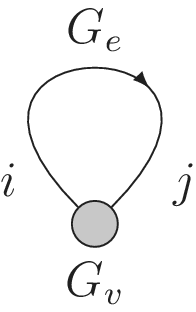

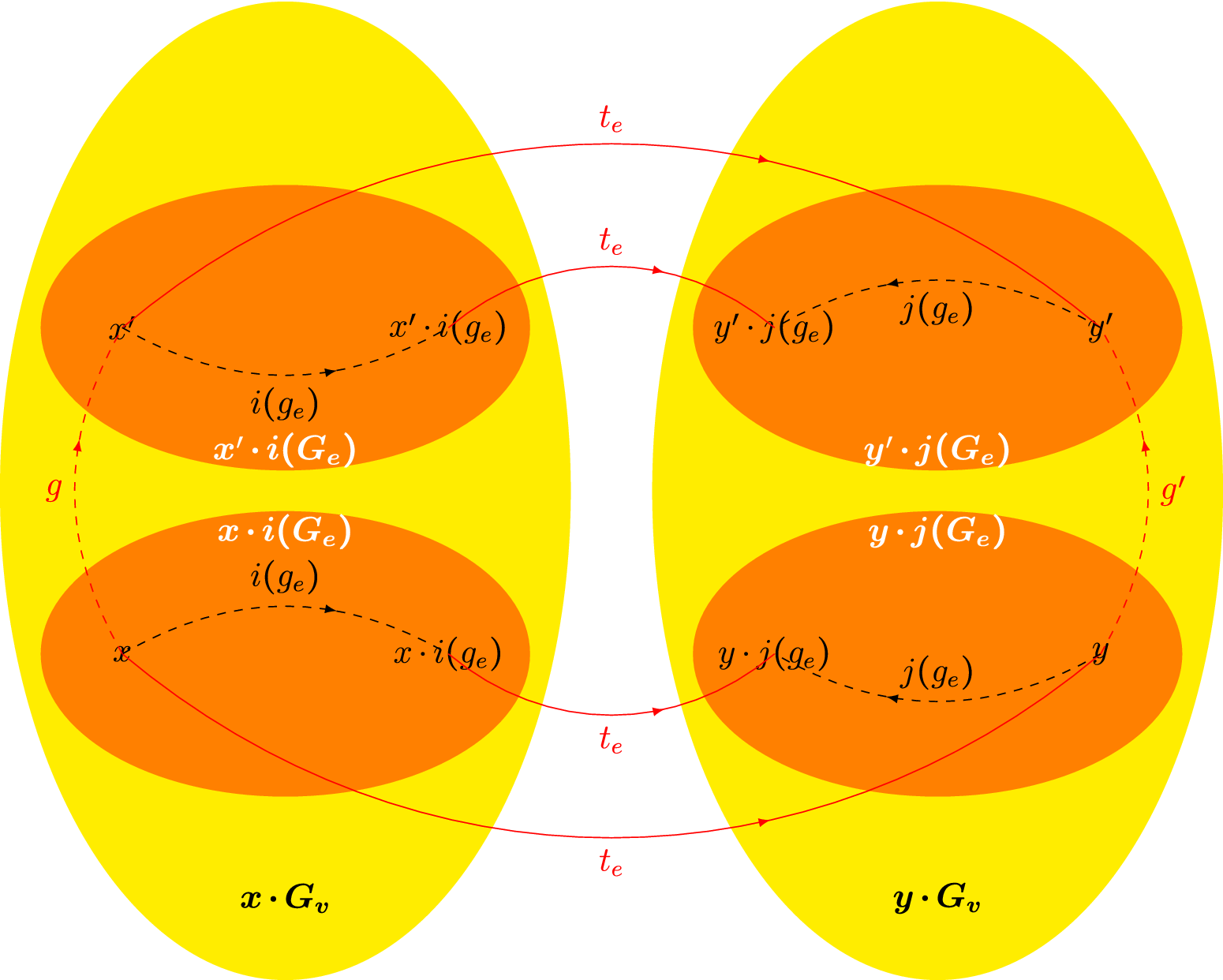


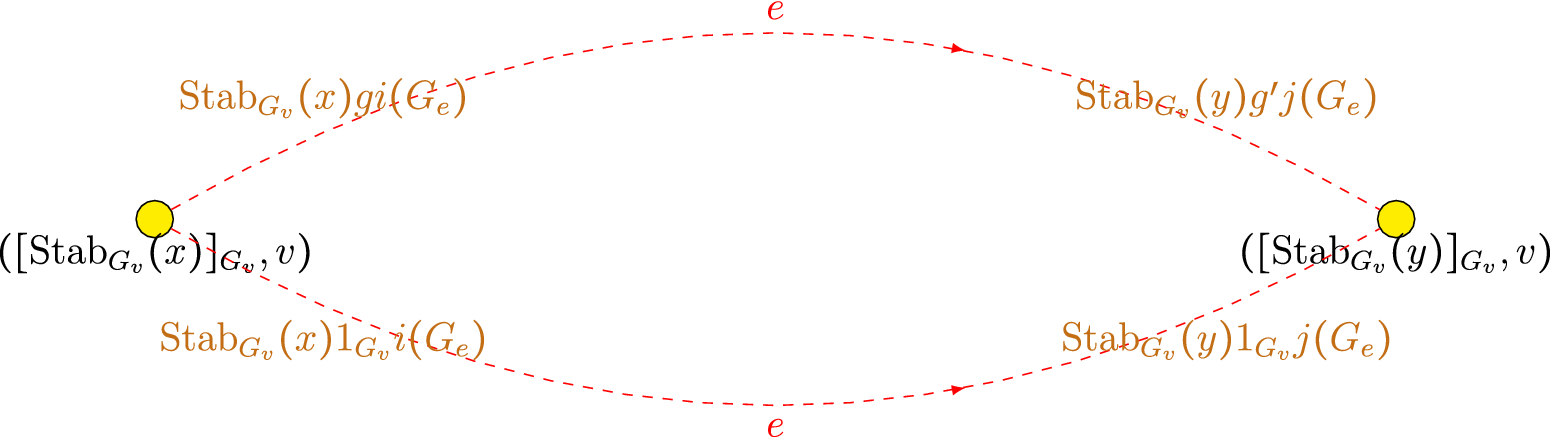


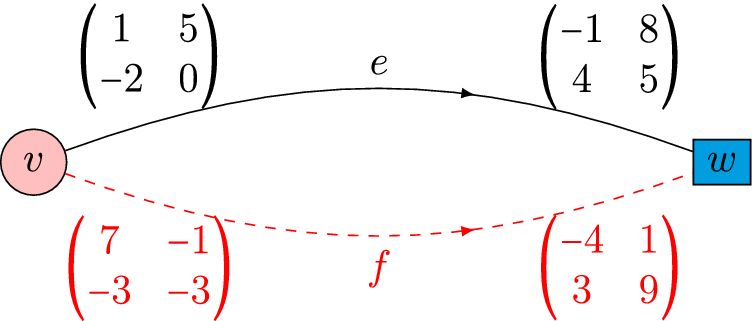
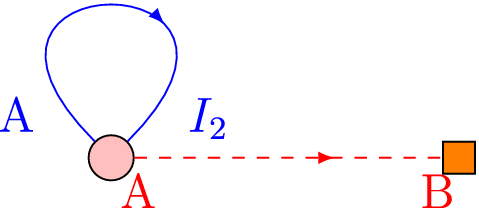

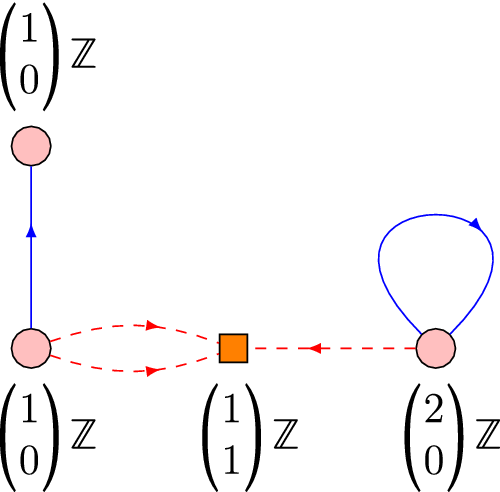

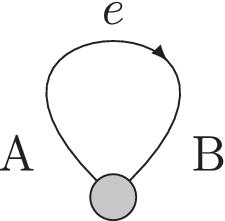


 Open access

