

L'astrolabe est un instrument mathématique qui permet de résoudre des problèmes de trigonométrie sphérique, tels que la détermination des heures inégales ou temporaires, des longitudes et des latitudes célestes des différents astres, ou encore de la Qibla,Footnote 1 par des méthodes de géométrie plane euclidienne: tracé de cercles circonscrits à des triangles, calculs d'arcs dans un cercle, similitude de triangles et calculs de proportions. Parmi les multiples études sur l'astrolabe menées depuis l'antiquité, on peut distinguer celles qui expliquent son usage de celles qui justifient sa construction. C'est à ces dernières que nous allons nous intéresser dans cet article. Le principe de cet instrument consiste à projeter une sphère, représentant la sphère céleste, sur un plan. On peut le faire de différentes façons. Le modèle d'astrolabe qui s'est le plus répandu, de la fin de l'antiquité jusqu'au XIIe siècle, résulte d'une projection conique à partir de l'un des pôles de la sphère sur le plan de l'équateur, que l'on nomme aujourd'hui projection stéréographique.Footnote 2
Si l'étude de la construction de l'astrolabe a débuté dans l'antiquité, elle a connu un essor sans précédent à partir du IXe siècle, et retenu l'attention des plus grands géomètres de l'Orient méditerranéen. Les noms d'al-Ṣāghānī, al-Sijzī, al-Qūhī, Ibn Sahl et Ibn Ἱrāq, auxquels on peut peut-être ajouter Ibn Sinān,Footnote 3 sont associés à cette recherche qui va s'étendre à d'autres types de projections: des projections coniques dont le pôle n'est plus situé à la surface de la sphère, et des projections cylindriques, orthographiques ou non, des plus générales qui soient.Footnote 4
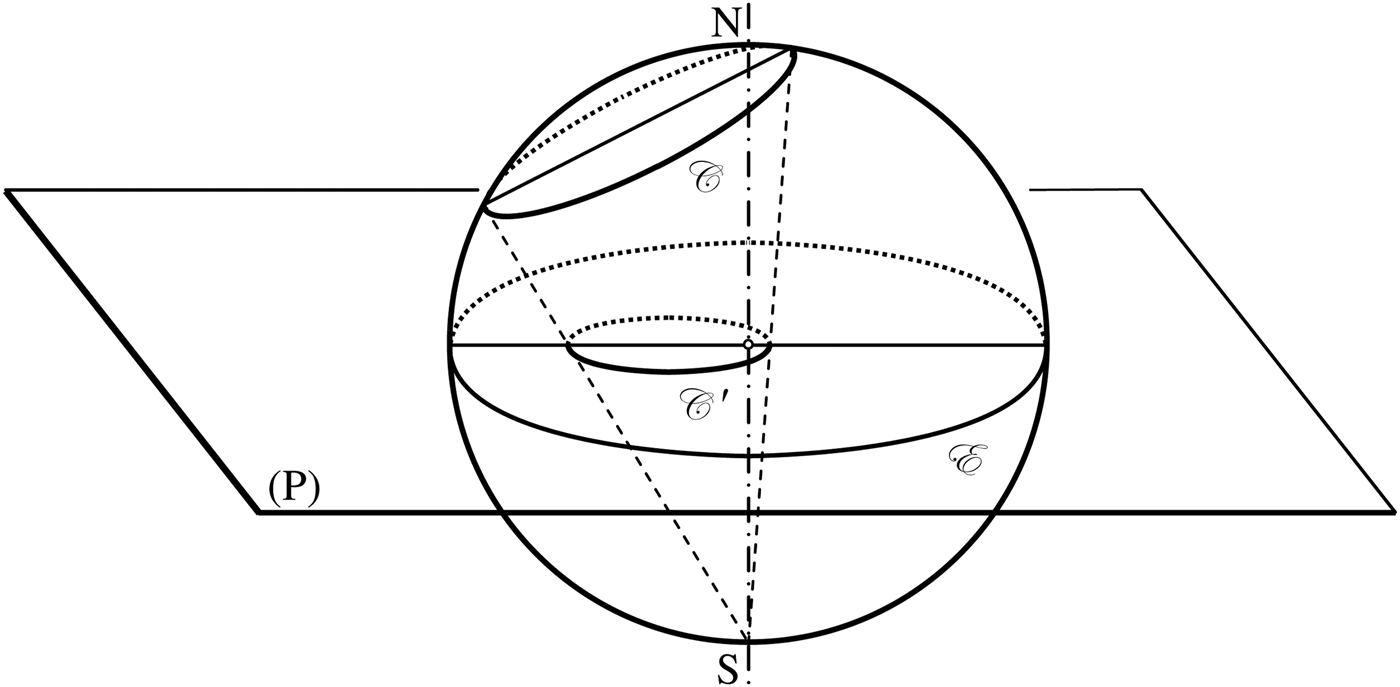
Rappelons brièvement certains principes de la projection stéréographique, tels qu'ils sont connus aujourd'hui. Si l'on choisit de projeter la sphère à partir du pôle sud, S, sur son plan équatorial (P), alors l'image d'un cercle  de la sphère est l'intersection du cône de sommet S et de base ce cercle , avec le plan (P). C'est le cercle ′, si ne passe pas par le pôle S (Fig. 1).Footnote 5
Fig. 1.

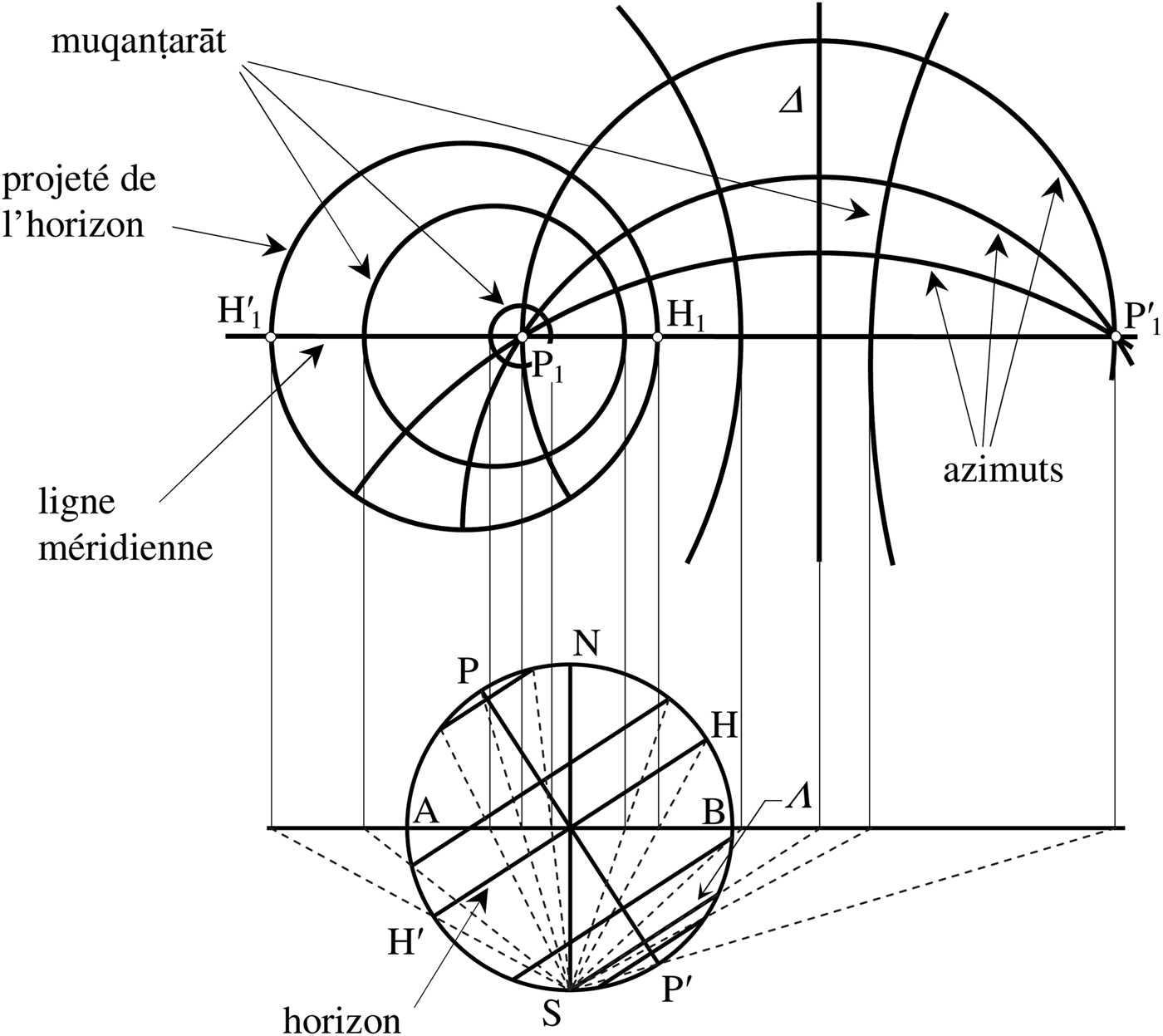
Par cette transformation, l'équateur  est invariant point par point, le tropique du Cancer se projette en un cercle intérieur à l'équateur, et le tropique du Capricorne, en un cercle extérieur. Les trois cercles obtenus dans le plan (P) sont concentriques, comme le sont les projetés de tous les cercles parallèles à l'équateur. Outre ces trois cercles, le tracé d'un astrolabe reposant sur une telle projection consiste avant tout à construire les projetés des cercles parallèles et des cercles orthogonaux à un horizon donné, sur le plan (P). Considérons le méridien NASB d'un lieu donné, et l'horizon de ce lieu, de diamètre HH′ dans le plan du méridien. Si P et P′ sont les pôles de cet horizon, alors leurs projetés P 1 et P′ 1 peuvent être placés sur la ligne méridienne qui représente, dans le plan rabattu, le méridien projeté.Footnote 6 Le projeté d'un cercle de la sphère, dont le plan est orthogonal à celui du méridien, est centré sur la ligne méridienne.Footnote 7 C'est le cas de l'horizon, qui se projette selon le cercle de diamètre H 1H′ 1, dont les extrémités sont les projetés des points H et H′ (Fig. 2).
Les projetés des cercles parallèles à l'horizon, qu'on appelle les muqanṭarāt, forment un faisceau de cercles à points limites P 1 et P′ 1. Le cercle Λ, parallèle à l'horizon et passant par le pôle S, se projette selon une droite Δ, perpendiculaire à la ligne méridienne. Tous les autres cercles parallèles à l'horizon se projettent, comme l'horizon lui-même, selon des cercles centrés sur la ligne méridienne. Les projetés de tous ceux qui sont situés entre Λ et le pôle P, auront leur convexité tournée vers P 1 et les projetés de tous ceux qui sont situés entre Λ et le pôle P′, vers P′ 1. Les grands cercles perpendiculaires à l'horizon, appelés cercles de hauteur, se projettent, quant à eux, selon un faisceau de cercles à points de base P 1 et P′ 1,Footnote 8 les azimuts (al-sumūt). Ainsi, tout point de la sphère peut être placé sur l'astrolabe en transférant ses coordonnées horizontales sur ce nouveau réseau de cercles du plan, formé par les deux faisceaux conjugués.
Depuis les travaux d'O. Neugebauer,Footnote 10 on peut conjecturer qu'Hipparque de Nicée, astronome du IIe siècle avant le début de l'ère chrétienne (c. –160/–125), connaissait la projection stéréographique, et que ses recherches ont pu constituer une source pour Ptolémée quand il a rédigé son Planisphère, mais cette affirmation reste controversée.Footnote 11 Cela ne nous permet pas de situer précisément l'origine de cette projection, et nous ne chercherons pas ici à traiter cette question. Ce qui nous occupe est plutôt de comprendre comment les Anciens s'y prenaient pour reporter sur un plan la géométrie de la sphère, en nous plaçant du point de vue conceptuel. Pour cela, nous nous proposons de mettre en évidence et d'analyser les principes qui étaient à la base des procédés géométriques qu'ils ont employés, afin de mieux comprendre le contexte mathématique dans lequel chacun d'eux se plaçait et d'apporter des éléments de réponse aux questions suivantes:
Quand la projection stéréographique a-t-elle été conçue? Est-ce équivalent de concevoir une telle projection et d'en écrire la théorie? Comment cette théorie a-t-elle évoluée au cours de l'histoire?
L'exposé et la discussion que nous voulons mener se feront exclusivement à partir de textes dont on dispose aujourd'hui, à commencer par le plus ancien d'entre eux.
I. LE PLANISPHÈRE DE PTOLÉMÉE
Cet ouvrage, que l'astronome alexandrin rédigea au cours du IIe siècle de l'ère chrétienne, est perdu en grec. Il nous est parvenu dans une traduction arabeFootnote 12 ainsi que dans une traduction latine faite sur une version arabe qui présente des différences avec celle que l'on possède.Footnote 13 Dans son introduction, Ptolémée expose brièvement le but de son ouvrage, et certains des principes qui président à son étude. Il veut reproduire sur un plan, les différents cercles de la sphère solide. Il précise qu'il a voulu écrire “un livre d'une manière abrégée, dans lequel [il] montre par quelle voie il est possible de tracer l'écliptique, les cercles parallèles à l'équateur et les cercles connus comme les méridiens” (§ 1, p. 55, l. 6–7; trad. p. 82),Footnote 14 et que tout ce qui sera fait dans le plan sera “conforme à ce qui apparaît dans la sphère solide” (§ 1, p. 55, l. 8; trad. p. 82). En fait, il étudiera également la position relative des trois grands cercles de la sphère sur lesquels reposent la plupart des problèmes cosmographiques: l'équateur, l'écliptique et l'horizon d'un lieu (§ 2 et § 3), ainsi que le tracé des cercles parallèles et perpendiculaires à l'écliptique (§ 16 à 19), ce qu'il n'annonce pas ici.
L'une des propriétés fondamentales de la projection stéréographique est qu'elle conserve la forme des cercles, exception faite des cercles de la sphère qui passent par le pôle de projection et dont les projetés sont alors des droites. Cette propriété est traitée par Ptolémée comme un postulat implicite: jamais il ne l'énonce en tant que telle, et encore moins ne la démontre.Footnote 15
Dans ce texte, ou du moins dans la version arabe que l'on peut considérer comme la plus proche de l'original du Planisphère parmi les versions que l'on peut lire, on trouve différents termes pour désigner la relation entre un cercle de la sphère et la ligne, cercle ou droite, qui lui est associée sur le plan. Tous sont empruntés au vocabulaire commun, et signifient que la ligne du plan prend la place ou est à la place du cercle de la sphère.Footnote 16 Un autre terme employé à plusieurs reprises, est le terme naẓīr, que l'on peut traduire par correspondant.Footnote 17 Nous exprimerons indifféremment ces propos trouvés dans le Planisphère, par les tournures suivantes: “un cercle de la sphère est remplacé par un cercle ou une droite sur le plan” ou “un cercle du plan est le correspondant d'un cercle de la sphère”.Footnote 18
Ptolémée ne définit pas ce plan dans lequel il trace les cercles. Une des difficultés de ce texte, pour comprendre les raisonnements de son auteur et éviter les erreurs d'interprétation, réside dans l'ambiguïté de la relation géométrique entre la construction dans le plan et ce que l'on observe à la surface de la sphère solide. Du début du texte jusqu'au § 15 inclus, Ptolémée pose un cercle ABCD pour l'équateur.Footnote 19 Celui-ci n'est jamais remplacé par un cercle du plan, et l'on peut penser que le plan est celui de l'équateur. Dans toute la suite du texte, il pose dans le plan, au début des constructions, le cercle ABCD pour le colure des solstices, et deux diamètres perpendiculaires de ce cercle pour l'axe et le diamètre de l'équateur.Footnote 20
Revenons aux principes sur lesquels Ptolémée fait reposer son étude. Parmi ces principes, certains sont explicités en introduction, mais d'autres restent sous-entendus. L'auteur admet que les cercles parallèles à l'équateur sont remplacés, dans le plan, par des cercles concentriques, mais il n'exprime pas cette propriété.Footnote 21 En revanche, il précise que les méridiens sont remplacés par des droites.Footnote 22 Dès les premières lignes du texte, on comprend donc que l'auteur base son étude sur les cercles de la sphère définis à partir de l'équateur: les parallèles et les méridiens. Et l'on peut penser que sa réflexion a débuté, elle aussi, par cela, étant donné le caractère fondamental, pour un astronome, de ces cercles qui définissent la déclinaison et l'ascension droite. Mais quelle connaissance pouvait-il avoir de la forme que prennent ces cercles dans le plan? Une connaissance intuitive pourrait expliquer que les cercles parallèles à l'équateur deviennent des cercles concentriques dans le plan, et les méridiens, des droites passant par le centre de l'équateur où vient se superposer le pôle nord. Elle pourrait être fondée sur la vision de la sphère que l'on peut imaginer à partir du pôle sud, selon un cône dont l'axe est l'axe de la sphère, sans induire pour autant une théorie mathématique des coniques, telle qu'on peut la trouver dans l'œuvre d'Apollonius, ou même chez l'un de ses prédécesseurs. Mais elle pourrait aussi résulter des recherches sur les cadrans solaires, problèmes traités par ailleurs par Ptolémée, et qui, alors, induirait une réflexion sur les coniques, comme peuvent nous inciter à le penser les travaux de Neugebauer.Footnote 23 Néanmoins, on ne trouve aucune trace d'une théorie des coniques dans le texte de Ptolémée.
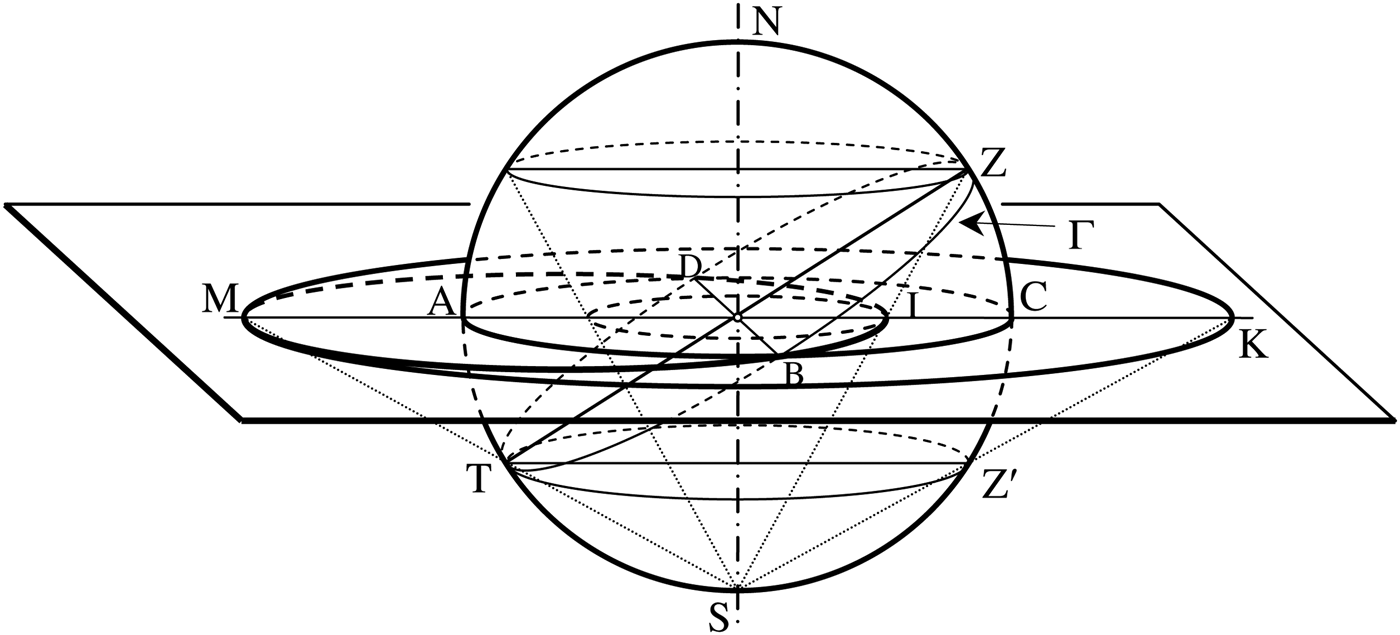
Celui-ci commence par construire dans le plan, le correspondant de l'écliptique Γ, en utilisant les deux cercles parallèles à l'équateur auxquels Γ est tangent sur la sphère. Si l'on note Z et T les extrémités du diamètre de Γ dans le plan du colure des solstices, les deux cercles parallèles définissent la déclinaison des points Z et T et Ptolémée les caractérise comme “des cercles parallèles à l'équateur, situés de part et d'autre de celui-ci, à la même distance” (§ 1, p. 55, l. 11–12; trad. p. 82), car évidemment les arcs de déclinaison CZ et Z′C sont égaux. Le cercle IBMD, correspondant de Γ dans le plan, est tracé à partir du point I et du point M, qui se trouvent sur le diamètre AC de l'équateur, perpendiculaire à l'autre diamètre BD, et respectivement sur les droites SZ et ST (Fig. 3).
Fig. 3.
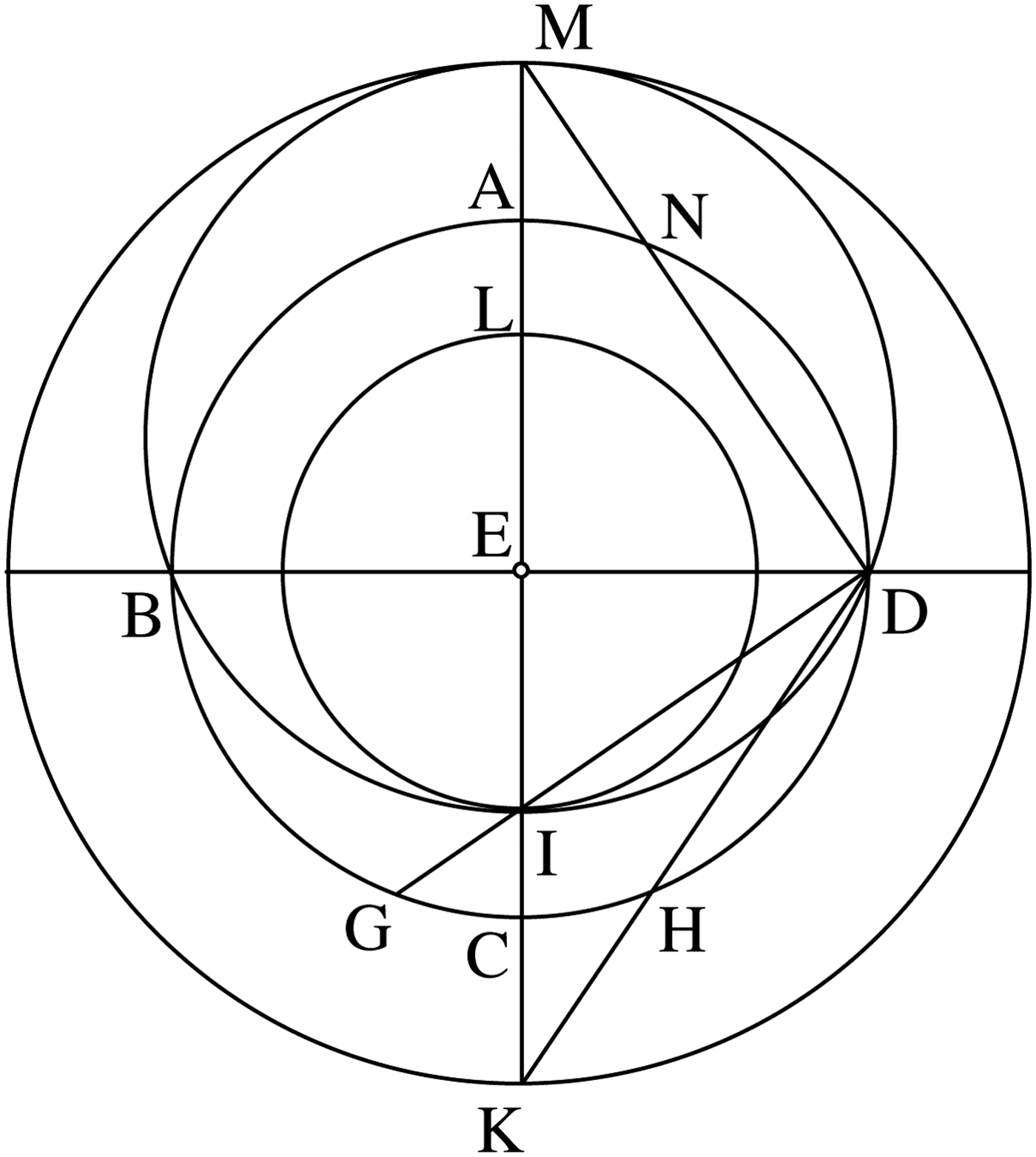
La construction que nous venons de donner n'est pas celle que décrit Ptolémée. La Figure 3 illustre le point de vue projectif, tel qu'on peut le concevoir aujourd'hui, mais Ptolémée ne se place jamais dans l'espace à trois dimensions. Après avoir tracé le cercle ABCD de centre E, pour l'équateur, puis les deux diamètres perpendiculaires, AC et BD, à la place des méridiens, il explique que le point E est aussi un pôle de l'équateur, et qu'il est préférable de choisir le pôle nord car c'est le pôle toujours visible dans les contrées que l'on habite.Footnote 24 Il découpe ensuite sur le cercle ABCD à partir du point C, deux arcs égaux CG et CH, et mène les droites joignant le point D à chacun des deux points G et H (Fig. 4). Ces deux droites coupent AC respectivement en I et K. Il trace alors les cercles de centre E et passant respectivement par I et K, et affirme qu'ils sont “les correspondants de deux des cercles qui sont sur la sphère solide, de part et d'autre de l'équateur, à la même distance” (§ 1, p. 55, l. 23–24; trad. p. 82).
Fig. 4.
Ptolémée conclut en affirmant que l'écliptique est représenté par le cercle dont le centre est le milieu de IM et qui est tangent aux deux cercles précédents en I et en M, et que ce cercle coupe l'équateur ABCD en deux moitiés, aux points B et D.Footnote 25 La seule chose qu'il démontre alors, est cette dernière propriété.
Pour cela, il mène la droite DM, place le point N là où elle coupe le cercle ABCD, affirme que les arcs AN et CH sont égaux,Footnote 26 et en déduit que les points N et G sont diamétralement opposés sur l'équateur.Footnote 27 Il peut en conclure que le cercle de diamètre IM passe par D, du fait que l'angle MDI est droit. Par symétrie, ce même cercle passe également par le point B.
Revenons à la construction que donne Ptolémée des points I et M. Il est clair que l'on peut voir le point D de la Figure 4, à la place du point S de la Figure 3, et les points G, H, N à la place des points Z, Z′, T, respectivement. Mais peut-on pour autant en conclure qu'il superpose le plan du colure des solstices au plan de la figure? Rien, dans ce qu'il écrit, ne nous le permet. Dans le plan de la figure, qui représente le plan de l'équateur, il trace simplement une construction auxiliaire, les points D, G et H, disposés comme le sont les points S, Z et Z′ dans le plan du colure des solstices, pour construire les points I et M en utilisant seulement la donnée essentielle, celle de la déclinaison des cercles parallèles à l'équateur, disposés symétriquement par rapport à lui.
Cette démonstration est la toute première du traité. Elle revient à démontrer que, dans le plan, le cercle correspondant à tout grand cercle incliné de la sphère coupe l'équateur en deux points diamétralement opposés, propriété observée sur la sphère. Au cours de sa construction, Ptolémée a employé un autre principe que ceux que nous avons déjà relevés, et qu'il n'a pas formulé: un grand cercle incliné de la sphère, tangent à deux cercles parallèles à l'équateur et disposés symétriquement par rapport à lui, est remplacé, dans le plan, par un cercle également tangent aux deux cercles qui remplacent les deux cercles parallèles. Pourquoi emploie-t-il ce principe? S'il avait seulement voulu tracer le cercle correspondant du grand cercle incliné, il lui aurait suffi de placer les points I et M, extrémités de son diamètre. Il avait les moyens de le faire à partir du point D, à condition qu'il conçoive de placer les points de la sphère isolément sur le plan.Footnote 28 Or, ce n'est pas ainsi qu'il procède, comme on l'a vu.Footnote 29 C'est comme si le point G n'était pas un point particulier du cercle parallèle septentrional, mais qu'il jouait le rôle d'un point quelconque de ce cercle, dont la seule donnée importante est la déclinaison. C'est comme si l'auteur concevait avant tout le tracé dans le plan, du cercle d'égale déclinaison tout entier. De plus, la conservation de la tangence du cercle incliné avec les cercles parallèles, de la sphère au plan, principe qui relève de la même intuition que celle que nous avons évoquée précédemment à propos des méridiens et des parallèles, est aussi un principe qui assure à IM d'être le diamètre du cercle qu'il trace dans le plan. Ainsi, la manière dont il définit un cercle incliné par les déclinaisons extrêmes de ses points, c'est-à-dire les deux cercles parallèles tangents, associée au principe de la disposition des cercles parallèles dans le plan, prend tout son sens.
Deux questions demeurent au sujet de cette construction et de cette démonstration: Pourquoi le correspondant d'un grand cercle incliné de la sphère, comme l'écliptique, est-il un cercle? Pourquoi Ptolémée démontre-t-il que ce cercle coupe l'équateur en deux points diamétralement opposés?
Raisonnons sur l'exemple de l'écliptique. Dans la sphère, ce cercle passe par les quatre points caractéristiques: les deux points équinoxiaux et les deux points solsticiaux. Donc on doit retrouver ce même fait dans le plan: la ligne qui remplace l'écliptique passe par les correspondants de ces quatre points.Footnote 30 Ou plus exactement, l'écliptique est remplacé par une ligne, dont a priori on ne connaît pas la nature; une ligne qui passe par les points I et M de manière à être tangente aux deux cercles correspondants, et qui passe par les points B et D, les points équinoxiaux. En démontrant que ces quatre points sont sur un cercle, ou plus exactement que le cercle de diamètre IM, passe par les points B et D, Ptolémée ne démontre pas que la ligne qui passe par B, I, D et M est nécessairement un cercle,Footnote 31 mais il s'assure qu'en prenant ce cercle pour remplacer l'écliptique dans le plan, il ne contredit pas le fait que ce qu'il trace dans le plan est conforme à ce que l'on constate sur la sphère. Ce cercle est effectivement le projeté de l'écliptique selon la projection stéréographique, mais l'aspect projectif n'apparaît jamais dans le raisonnement de Ptolémée. Il emploie la propriété selon laquelle l'écliptique, ou tout autre grand cercle de la sphère, coupe l'équateur en deux points diamétralement opposés, dans le plan, comme un principe de cohérence. S'il avait eu la preuve ou la connaissance certaine, que l'écliptique est remplacé par un cercle, il n'aurait pas eu besoin de démontrer cela.
Il généralise ensuite cette propriété à deux grands cercles quelconques de la sphère, en démontrant que “tous les horizons, que l'on trace d'une manière semblable à celle par laquelle on a tracé l'écliptique, divisent non seulement l'équateur en deux moitiés, mais divisent également en puissance, l'écliptique en deux moitiés” (§ 2, p. 57, l. 51–52; trad. p. 84).Footnote 32
Sa démonstration repose sur la caractérisation de deux points d'un grand cercle de la sphère, diamétralement opposés: ils sont à la fois sur un même méridien et sur deux cercles parallèles à l'équateur et symétriquement disposés par rapport à lui. En s'appuyant sur sa première proposition et sur les principes concernant les cercles parallèles et les méridiens que nous avons mis en évidence, Ptolémée montre que cette caractérisation s'applique à la situation dans le plan. Si un cercle du plan coupe l'équateur en deux points diamétralement opposés, cela suffit à ce qu'il soit le correspondant d'un grand cercle de la sphère, et une droite passant par le centre E de l'équateur, coupera ce cercle en deux points qui seront sur des cercles parallèles symétriques par rapport à l'équateur. Les deux points où se coupent deux cercles du plan, correspondants de deux grands cercles de la sphère, sont sur une droite passant par E. L'auteur montre en fait la cohérence de son système de principes avec la situation sur la sphère, c'est ce qu'il entend par “être conforme à ce qui apparaît sur la sphère solide”.
Au § 16, on retrouve le procédé que Ptolémée a employé au § 1, mais pour tracer, cette fois, un cercle Γ parallèle à l'écliptique. En effet, il considère:
1. les deux cercles parallèles à l'équateur et tangents à Γ,
2. les points d'intersection de Γ avec les deux colures, obtenant ainsi quatre points, dont il montre qu'ils sont sur un même cercle.Footnote 33
On constate un changement de point de vue.Footnote 34 Cette fois, Ptolémée pose “le méridien qui passe par les deux pôles, le cercle ABCD autour du centre E.Footnote 35 Que l'axe soit BED. Imaginons le point D le pôle caché, le diamètre de l'équateur AEC et le diamètre de l'un des cercles parallèles à l'écliptique, la droite GHI” (§ 16, p. 76, l. 440–442; trad. p. 104).Footnote 36
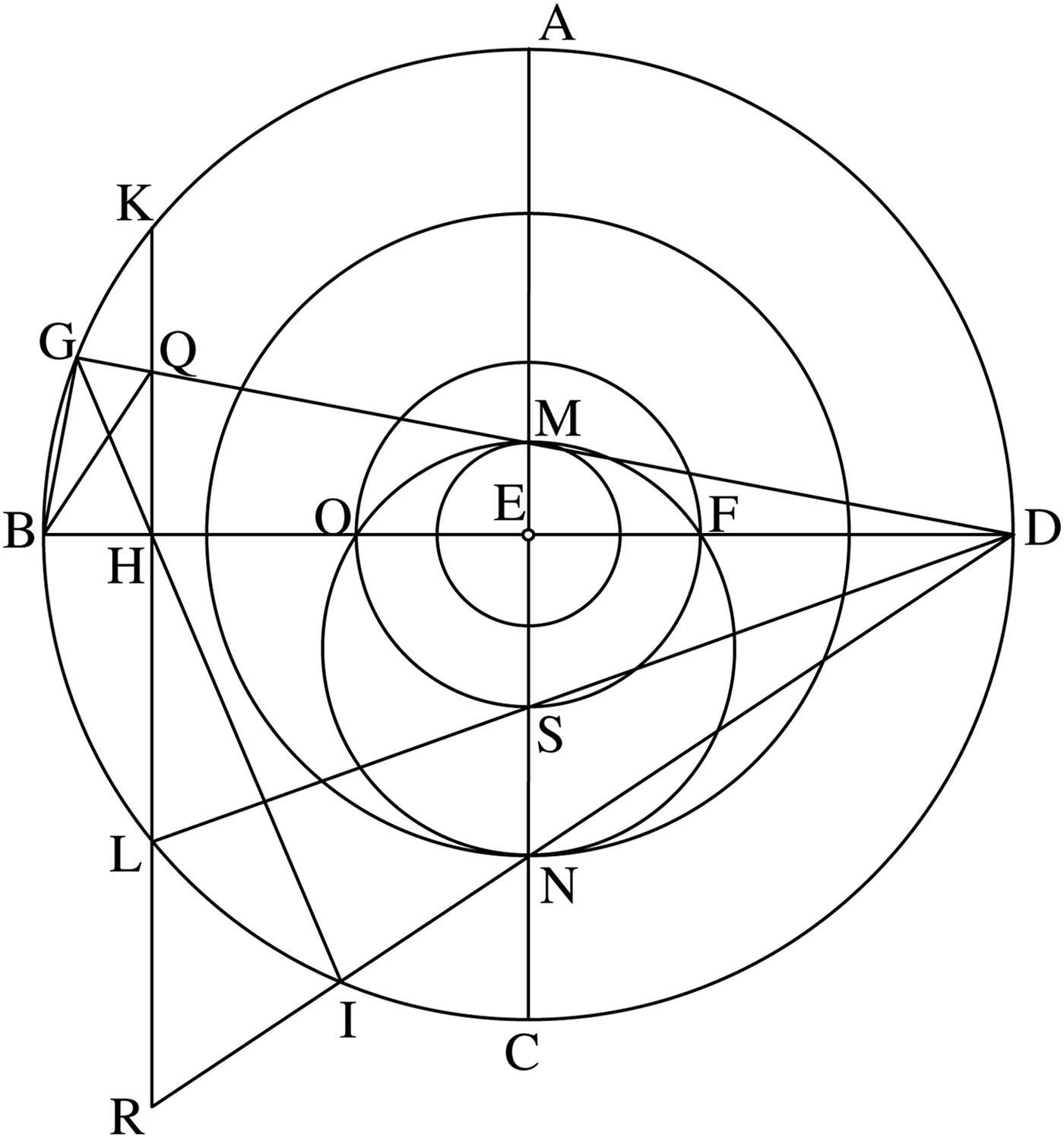
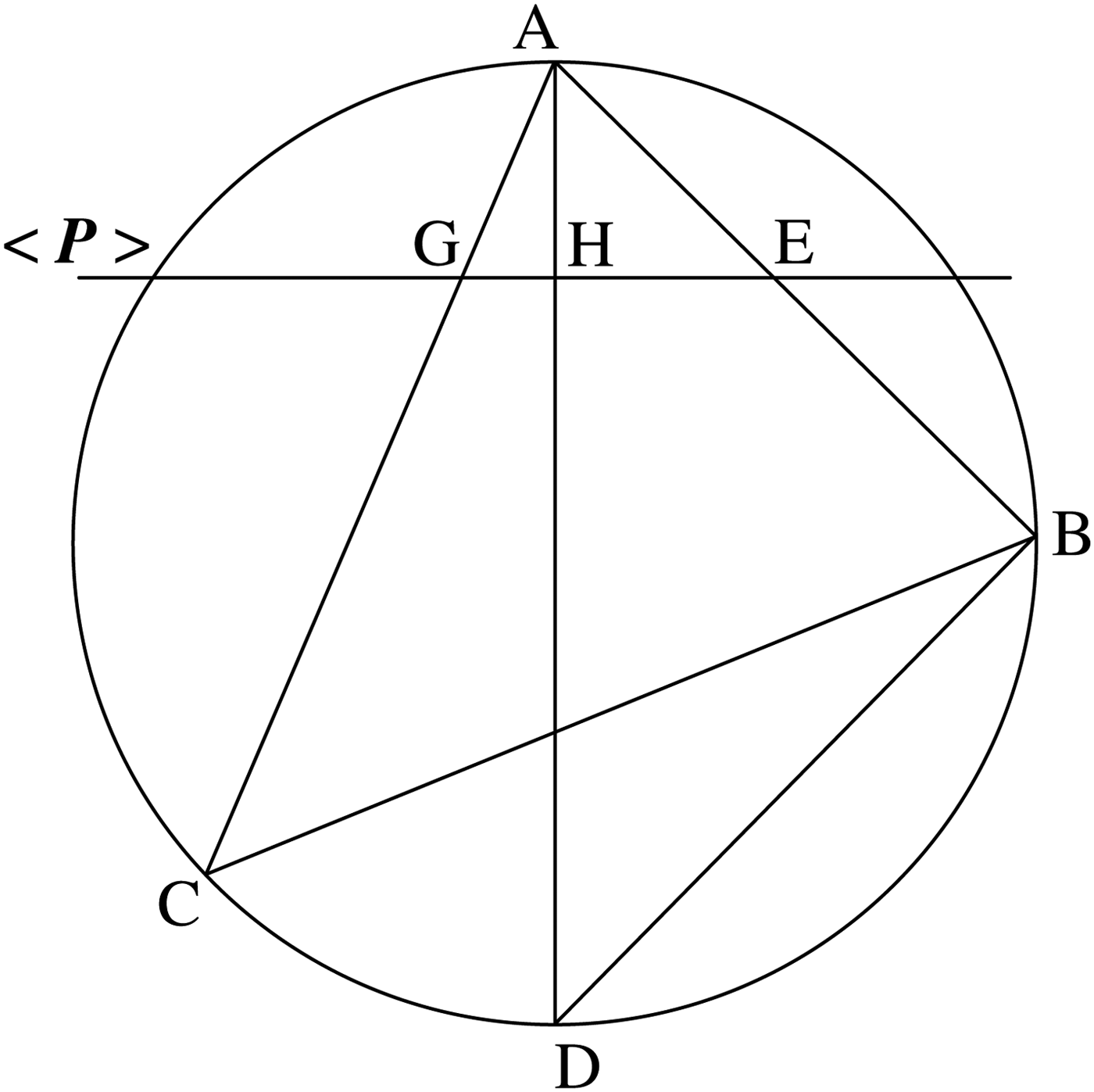
Ptolémée considère le diamètre de Γ dans le plan du colure des solstices, GI. Ces deux points sont les points de tangence avec les cercles parallèles à l'équateur, donc les points d'extrême déclinaison sur Γ. Il trace alors les cercles d'égale déclinaison pour les deux points G et I, qui sont dans le plan les cercles de centre E, passant respectivement par M et N. Il affirme que Γ est tracé dans le plan selon le cercle de diamètre MN, tangent aux deux cercles précédemment tracés. Mais il ne s'arrête pas là, il doit vérifier que ce cercle présente dans le plan la même propriété que sur la sphère, à savoir que Γ divise l'un des cercles parallèles à l'équateur en deux moitiés. Cela confirme, comme à la lecture du § 1, que Ptolémée n'a pas de preuve que Γ est remplacé par un cercle dans le plan. Au § 1, quand il a étudié l'écliptique, ce cercle parallèle était l'équateur lui-même. Dans le cas présent, au § 16, c'est le cercle parallèle à l'équateur que Γ rencontre dans le plan du colure des équinoxes. Les deux points de Γ qui se situent sur ce méridien ont la même déclinaison, et ce méridien, comme tous les méridiens, divise tous les cercles parallèles à l'équateur en deux moitiés. Le cercle parallèle à l'équateur a pour diamètre KL, droite qui passe par le point H, intersection de GI et de BD, parallèlement au diamètre AC de l'équateur (Fig. 5). Il écrit: “le cercle parallèle à l'écliptique, dont le diamètre est la droite GI, divise le cercle parallèle à l'équateur dont le diamètre est LK, en deux moitiés sur le méridien dont le diamètre est la droite BD” (§ 16, p. 76, l. 448–449; trad. p. 104).Footnote 37
Fig. 5.
Le cercle de diamètre KL, est tracé dans le plan selon le cercle SOF, à l'aide de la droite DSL. Ptolémée démontre donc que le cercle de diamètre MN passe par les points O et F.Footnote 38 Il commence par établir que les points B, G, Q, H sont cocycliques,Footnote 39 d'où il déduit que  $B \hat{Q}\;R = B \hat{G}\; I$. D'autre part
 $B \hat{G}\;I = B \hat {D}\; R$,Footnote 40 d'où
 $B \hat{Q}\;R = B \hat{D}\;R$, donc les points B, Q, D, R sont cocycliques. Ptolémée en déduit que QH × HR = BH × HD, puis que QH × HR = HL 2.Footnote 41 Donc, par similitude des figures triangulaires DQHLR et DMESN, il obtient ME × EN = ES 2, ou encore ME × EN = FE × EO.Footnote 42 Cela prouve que les quatre points M, O, N et F sont sur le cercle de diamètre MN (Fig. 5).
Quelle place occupe ce texte du Planisphère dans l'histoire de la projection stéréographique? Pour étayer l'interprétation que l'on peut faire du texte, nous avons commenté les parties où Ptolémée développe sa méthode de représentation de la sphère sur un plan, car il s'agit plus d'une méthode que d'une théorie. Différentes interprétations ont été formulées pour comprendre le sens de ce texte, mais elles nous paraissent soit défendre exagérément l'idée que Ptolémée concevait la projection stéréographique, soit être insuffisamment développées.Footnote 43
S'il est clair que la représentation d'une sphère dans un plan que Ptolémée élabore dans son Planisphère, coïncide avec celle que l'on obtient par une projection stéréographique, il est tout aussi clair, nous l'avons montré, que Ptolémée ne se situe jamais dans un contexte projectif, ni ne fait apparaître le moindre cône. Il adopte des principes qui lui permettent de tracer selon des cercles et des droites, les cercles de la sphère dont il a besoin pour résoudre les problèmes d'astronomie qui l'intéressent. Ce n'est pas seulement parce qu'on ne trouve aucun terme désignant cette projection, ni aucun objet s'y rapportant, que nous pouvons dire qu'il ne la conçoit pas. C'est surtout parce qu'il n'établit pas géométriquement la relation entre un cercle de la sphère et ce qui lui correspond dans le plan. C'est précisément parce qu'il ne conçoit pas cette relation, qu'il doit s'appuyer sur des propriétés que possèdent notamment les grands cercles de la sphère, et vérifier celles qui leur correspondent dans le plan. Ces propriétés, qui concernent notamment deux points diamétralement opposés d'un grand cercle de la sphère, deviennent évidentes lorsqu'on traduit mathématiquement que tous les points de la sphère se placent dans le plan de l'équateur à l'endroit où il est coupé par la droite qui joint chacun d'eux au pôle. Ce n'est pas ce qu'il fait lorsqu'il place l'un des points qui lui permet de tracer le correspondant d'un cercle parallèle. Même s'il a l'idée de joindre le point D à l'extrémité de l'arc de déclinaison, il n'en donne pas les raisons, ne l'explique pas, et ne s'intéresse qu'au cercle d'égale déclinaison ainsi défini. Il n'y a pas de principe général qui lui permettrait d'établir cette relation entre un point et son projeté.Footnote 44
C'est pour ces raisons que nous pouvons dire qu'il n'y a pas de concept projectif dans l'ouvrage de Ptolémée. Les principes qu'il pose ou parfois qu'il sous-entend, sont des propriétés de la projection stéréographique, qui échappent à son étude en tant que telles. Ptolémée adopte le point du vue de l'astronome et non du géomètre, il s'intéresse aux avantages que cette manière d'aplanir la sphère procure aux astronomes dans leurs calculs.
On trouve une formulation explicite de cette relation géométrique entre sphère et plan, définie mathématiquement, dans un traité de sept siècles postérieur au Planisphère de Ptolémée. Cette fois, pour représenter un cercle de la sphère sur un plan, le point de vue projectif ne fait aucun doute. Il est fondé sur la définition du cône qui a pour sommet le pôle de la sphère et pour base le cercle considéré sur la sphère, et assuré par le mouvement de la droite qui définit la surface conique.
II. AL-KĀMIL D'AL-FARGHĀNĪ
Le traité sur la construction de l'astrolabe écrit par al-Farghānī au IXe siècle, al-Kāmil, est connu pour contenir la forme la plus ancienne qui nous soit parvenue d'une démonstration de la conservation de la forme des cercles par projection stéréographique.Footnote 45 Mais ce sont surtout les principes sur lesquels al-Farghānī construit son étude qui vont retenir, ici, notre attention. Dans l'introduction de son ouvrage, l'auteur fait état de la cohérence entre les constructions effectuées par les Anciens pour donner à l'astrolabe sa forme et ce qui peut être observé, mais il affirme qu'il n'existe aucune démonstration de son exactitude ni aucune preuve de la cause de cette exactitude. C'est pour y remédier, précise-t-il, qu'il a rédigé ce livre.Footnote 46
Au deuxième chapitre de son livre, il montre comment construire tous les cercles de la sphère sur le plan de l'astrolabe, en précisant dès le début de ce chapitre que ces cercles “prennent la forme de cercles dans le plan de l'astrolabe, exceptés les grands cercles qui se coupent dans la sphère céleste aux deux pôles,Footnote 47 et qui prennent la forme de droites”.Footnote 48 Il commence par expliquer quelle partie de la sphère se retrouvera sur l'astrolabe, en supposant que la circonférence du tympan de celui-ci correspond à un cercle de la sphère, parallèle à l’équateur.Footnote 49 Alors, on retrouvera sur le tympan de l'astrolabe tout ce qui est situé, sur la sphère, entre ce cercle parallèle et le pôle nord. L'auteur ajoute que les cercles de la sphère, entièrement situés sur cette partie de la sphère, prennent la forme de cercles entiers sur le plan de l'astrolabe, et que les cercles de la sphère découpés par le cercle parallèle désigné sur la sphère, seront découpés dans le plan de l'astrolabe par le cercle qui délimite le tympan.
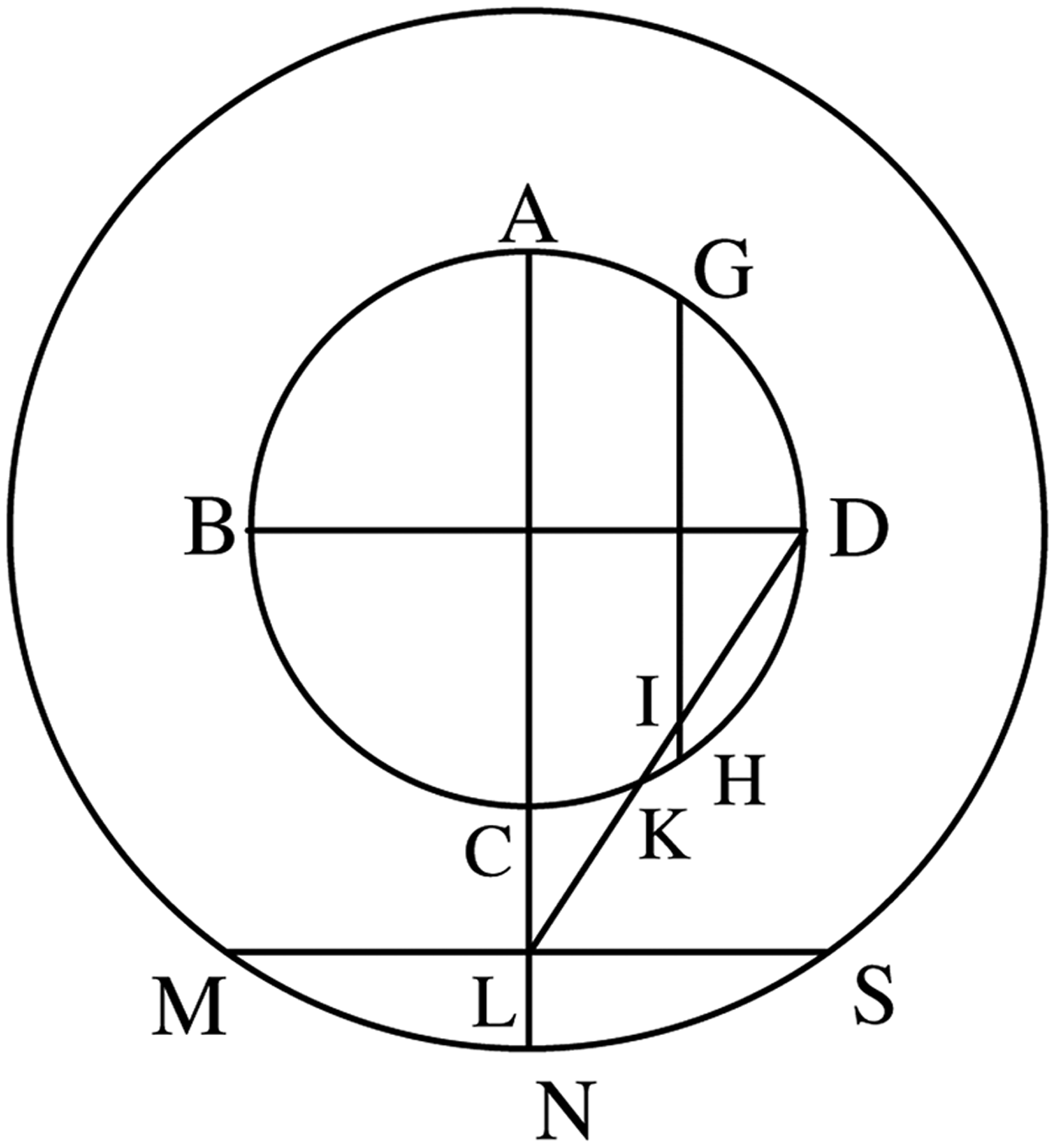
Pour démontrer cela, il représente géométriquement le cercle méridien ABCD de centre E, le pôle nord D, le pôle sud B, et le diamètre de l'équateur AC. Il se place dans le plan du méridien et ne fait pas intervenir de sphère dans ses démonstrations. Au passage, il définit géométriquement le plan de l'astrolabe: c'est le cercle de centre D et de rayon DH, tracé perpendiculairement au cercle ABCD (Fig. 7).Footnote 50
Fig. 6.
Fig. 7.
Al-Farghānī démontre d'abord que les méridiens prennent la forme de droites qui passent toutes par le point D dans le plan de l'astrolabe, résultat qu'il avait annoncé précédemment. Pour cela, il emploie deux raisonnements différents pour construire le méridien ABCD dans le plan de l'astrolabe. Le premier de ces raisonnements repose sur le principe de la définition de la surface conique à partir du point B et du cercle ABCD. C'est donc le mouvement de la droite BD, dont le point B est fixe et dont le point D décrit le cercle ABCD, qui lui permet de conclure que le prolongement de cette droite jusqu'au plan de l'astrolabe décrit la droite HG.Footnote 51 Le second repose sur l'intersection du plan ABCD et du plan de l'astrolabe. Dans les deux cas, il obtient pour ligne méridienne la droite GH.
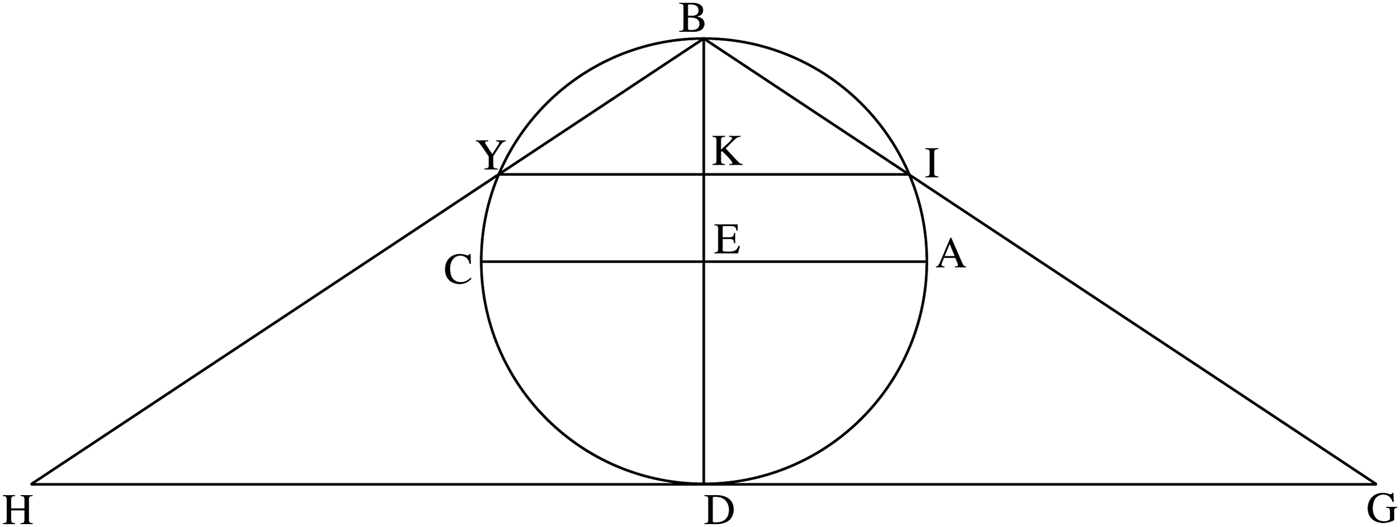
En menant les droites BG et BH à partir des extrémités du diamètre GH du tympan de l'astrolabe dont la circonférence est donnée, il détermine ensuite la droite IY, diamètre d'un cercle parallèle à l'équateur. Puis il démontre que si l'on prolonge la surface du cône de sommet B et de base le cercle de diamètre IY jusqu'au plan de l'astrolabe, alors cette surface coupe ce plan selon un cercle de centre D, qui n'est autre que le cercle qu'il s'est donné au départ pour délimiter le tympan. Son raisonnement repose à nouveau sur le mouvement de la droite BG suivant le contour du cercle de diamètre IY, le point B étant fixe, mouvement qui engendre une surface conique. Le cône inscrit dans la sphère, ayant pour sommet le pôle sud B, joue ici un rôle essentiel. C'est ce même cône, sur lequel repose la conceptualisation géométrique de la projection, que l'on retrouve dans les données de la proposition fondamentale qu'al-Farghānī énonce et démontre au chapitre 1 et que nous examinerons plus bas.
Il emploie exactement le même raisonnement pour montrer comment tracer l'écliptique dans le plan de l'astrolabe, à partir de la donnée de son inclinaison sur l'équateur qu'il reporte selon l'arc AI.
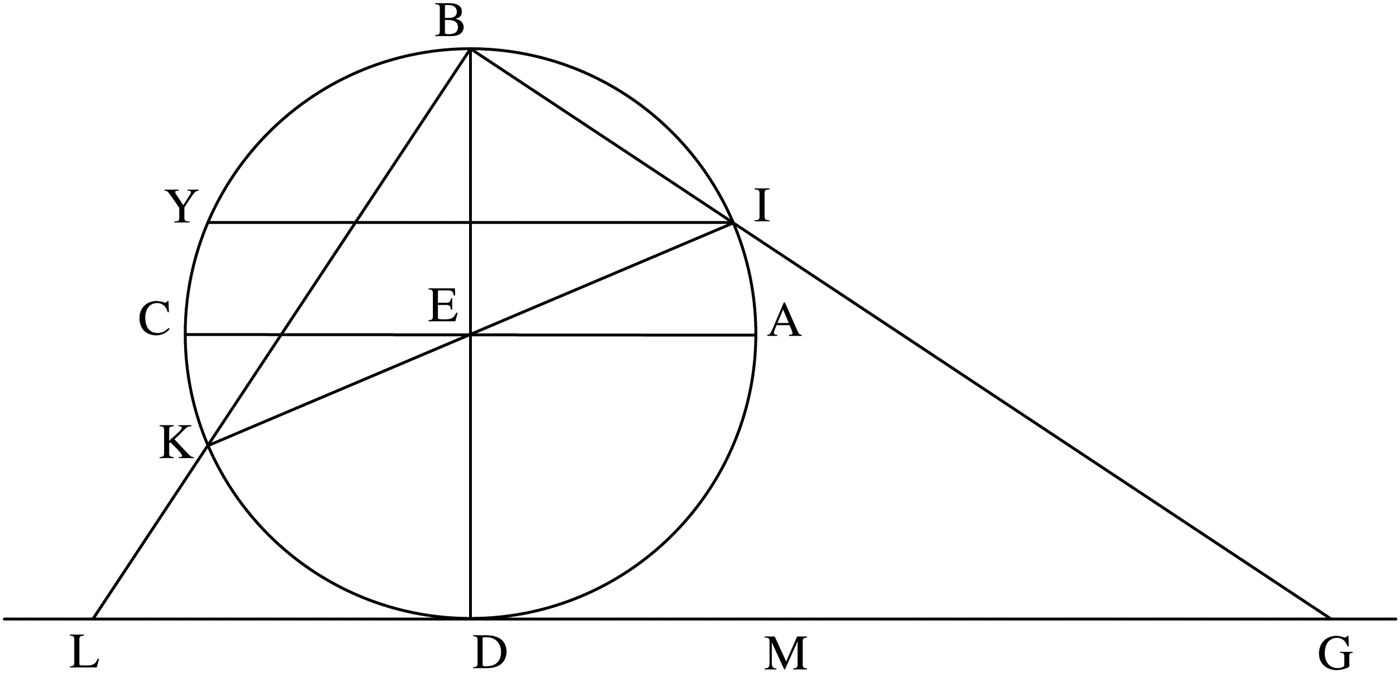
Il mène IK le diamètre de l'écliptique, puis les droites BK et BI qu'il prolonge jusqu'à la droite GL, et démontre que l'écliptique prend forme selon le cercle de diamètre GL sur le tympan, en introduisant le cône de sommet B et de base l'écliptique et en s'appuyant sur les principes du chapitre 1. Il ajoute que le centre de ce cercle, M, milieu de GL, n'est pas au centre D du tympan, car l'écliptique, sur la sphère, n'est pas parallèle au tympan (Fig. 8).Footnote 52
Fig. 8.
Dans la suite du chapitre 2, al-Farghānī détermine géométriquement, dans le plan de l'astrolabe, le cercle de l'horizon d'un lieu de la Terre, caractérisé par sa latitude, puis les cercles parallèles à cet horizon. Il démontre que tous ces cercles ont leur centre sur la ligne méridienne; et après avoir placé sur cette ligne le point correspondant au zénith, pôle de l'horizon, il montre, par un raisonnement géométrique détaillé, que plus le cercle parallèle à l'horizon est éloigné du zénith, plus son centre sera éloigné du point du zénith sur le tympan. Il poursuit son étude géométrique en s'intéressant aux autres cercles qui apparaissent sur le tympan de l'astrolabe: les cercles azimuts pour un horizon et les cercles qui divisent inégalement les ascensions des signes du zodiaque. Nous insistons sur le fait que ce chapitre 2, consacré à la détermination de tous les cercles que l'on trace sur le plan de l'astrolabe, repose sur des démonstrations géométriques.Footnote 53 De plus, tout au long de ce chapitre, l'auteur utilise la propriété fondamentale selon laquelle un cercle de la sphère prend la forme d'un cercle (ou d'une droite) sur le plan de l'astrolabe. Cette propriété est précisément démontrée dans le premier chapitre de son ouvrage, où il expose, sous la forme d'un lemme et de deux théorèmes, des résultats de pure géométrie, sans aucune référence à l'astrolabe.Footnote 54
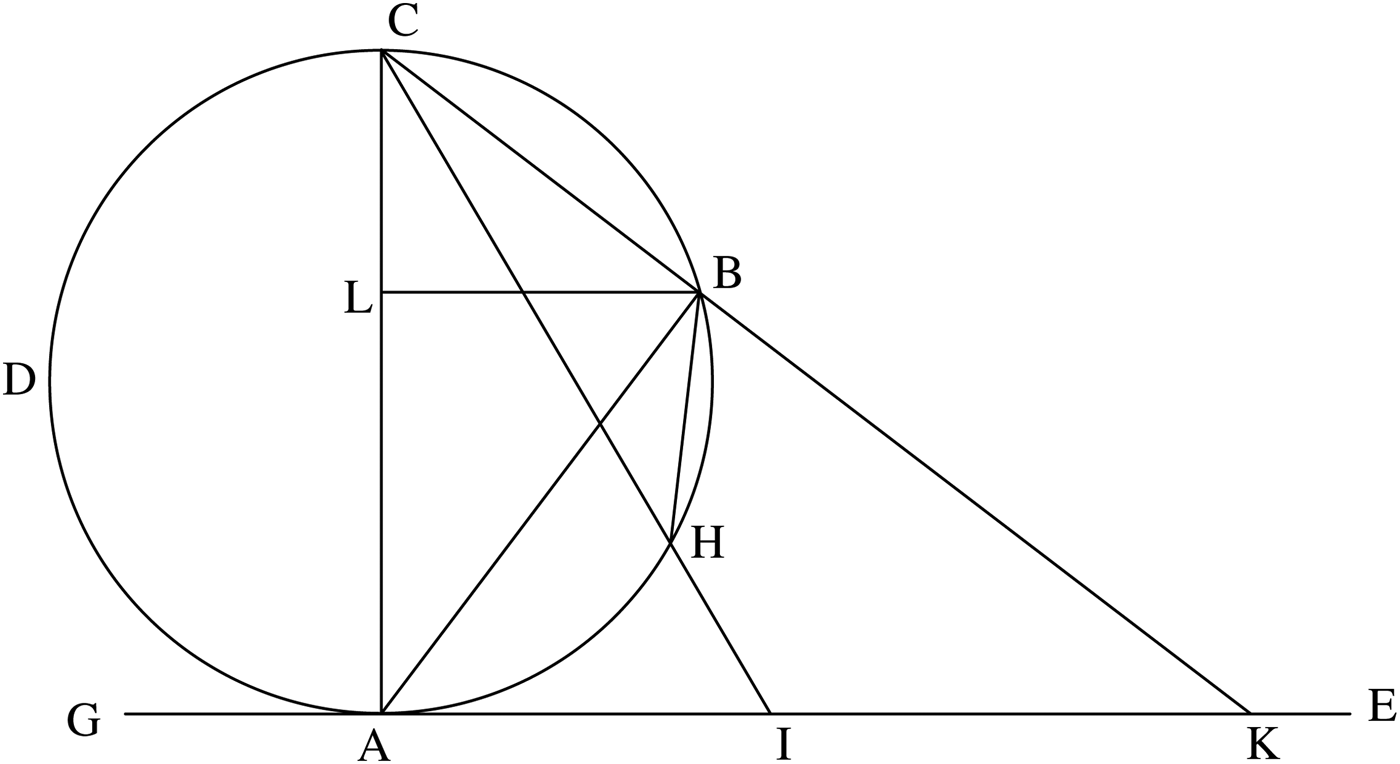
Au chapitre 1, al-Farghānī démontre tout d'abord qu'étant donnés une corde quelconque BH d'un cercle ABCD, et les points I et K, intersections des droites CB et CH avec la droite EG tangente au cercle en A, diamétralement opposé à C, les triangles CKI et CHB sont semblables (Fig. 9).
Fig. 9.
En effet, les triangles ABL et LBC sont semblables puisque BL est perpendiculaire à AC,Footnote 55 donc les angles BAC et LBC sont égaux. On en déduit que l'angle AKC est égal à l'angle BAC, lui-même égal à l'angle BHC. Possédant un angle commun en C, les deux triangles CKI et CHB sont donc semblables.
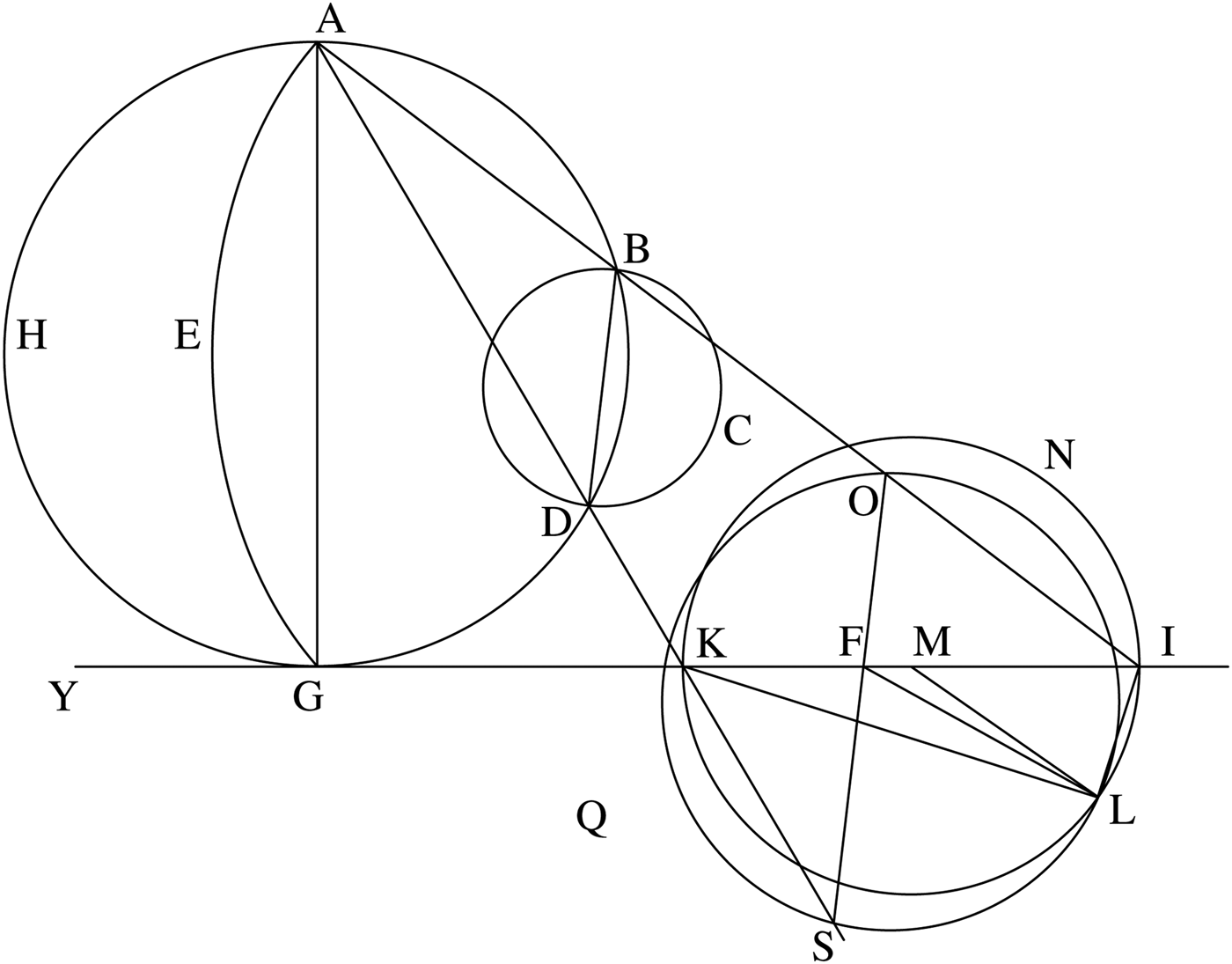
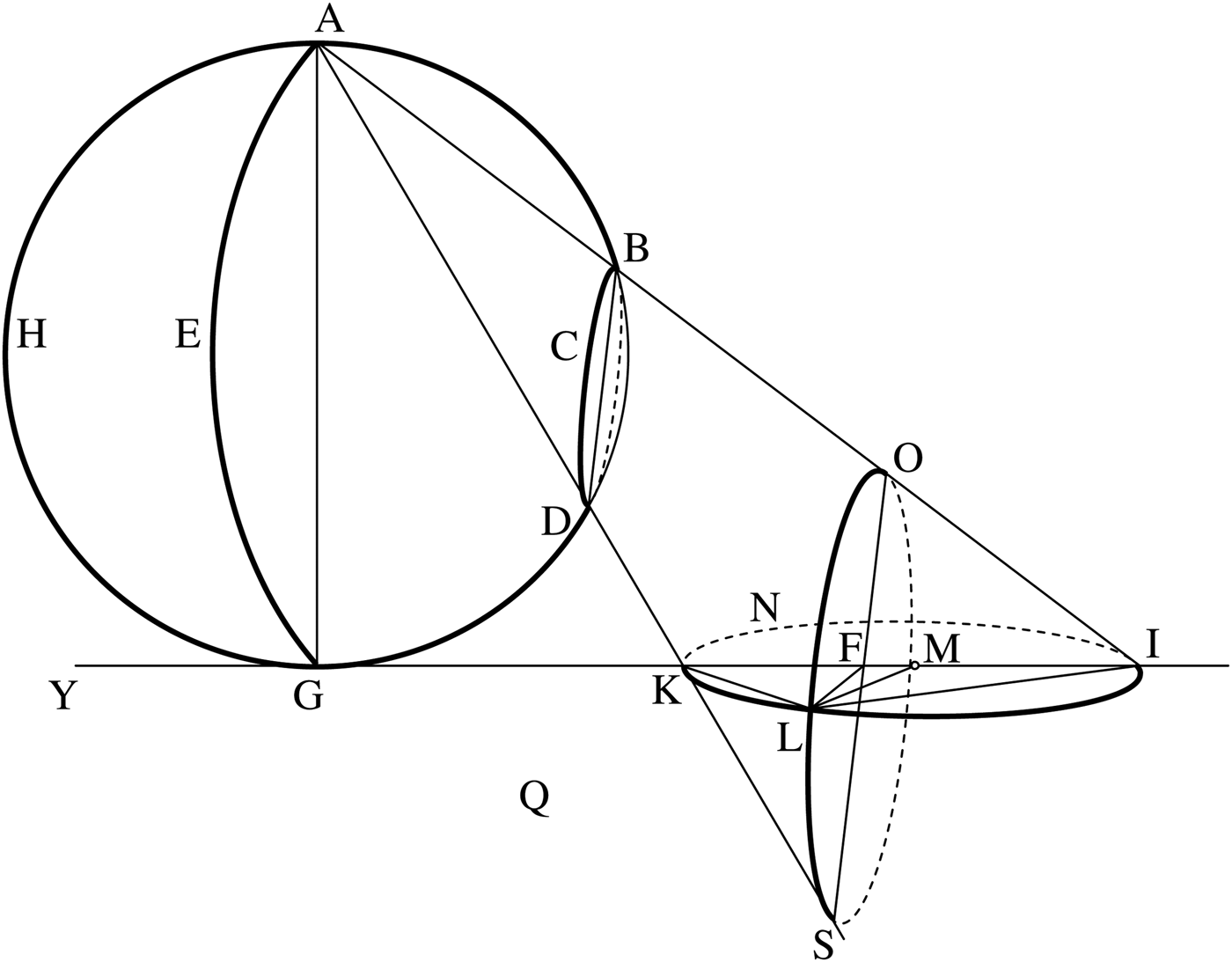
La deuxième proposition du premier chapitre concerne précisément la propriété fondamentale de la projection stéréographique. Étant donné un cône de sommet A et de base un cercle BCD, inscrit dans une sphère ABGHE, si l'on trace le diamètre AG de la sphère et le plan tangent IQY, et si la surface du cône est prolongée jusqu'à ce plan, alors leur intersection sera le cercle KLIN (Fig. 10).
Fig. 10.
Pour démontrer ce résultat, al-Farghānī considère la ligne KLIN, intersection de la surface du cône et du plan. Il construit le milieu M du segment IK et trace la droite ML depuis un point quelconque L de cette ligne KLIN. Il veut prouver que ML = KM. Il considère le plan parallèle au cercle BCD, coupant la surface du cône et le plan KLIN en L. La ligne SLO, intersection de ce plan et du cône est un cercle.Footnote 56 La droite SO, diamètre du cercle SLO,Footnote 57 est l'intersection de ce cercle et du plan AGI; elle coupe la droite KI au point F et LF est perpendiculaire au plan AGI. Footnote 58 Alors les deux triangles SFK et FIO sont semblables.Footnote 59
Donc KF × FI = SF × FO, mais SF × FO = LF 2, puisque la droite LF est perpendiculaire à la droite SO et que SO est le diamètre du cercle SLO. Donc KF × FI = LF 2. Donc il est clair que l'angle KLI est droit. Mais le diamètre KI a été coupé en deux moitiés au point M et on a mené du point M la droite ML, donc la droite ML est égale à chacune des deux droites KM, MI. Par ce même raisonnement, on montre que toute droite menée du point M à n'importe quel endroit de la ligne KLIN est égale à chacune des deux droites KM, MI. Donc la ligne KLIN est la circonférence d'un cercle de diamètre KI et de centre M.Footnote 60
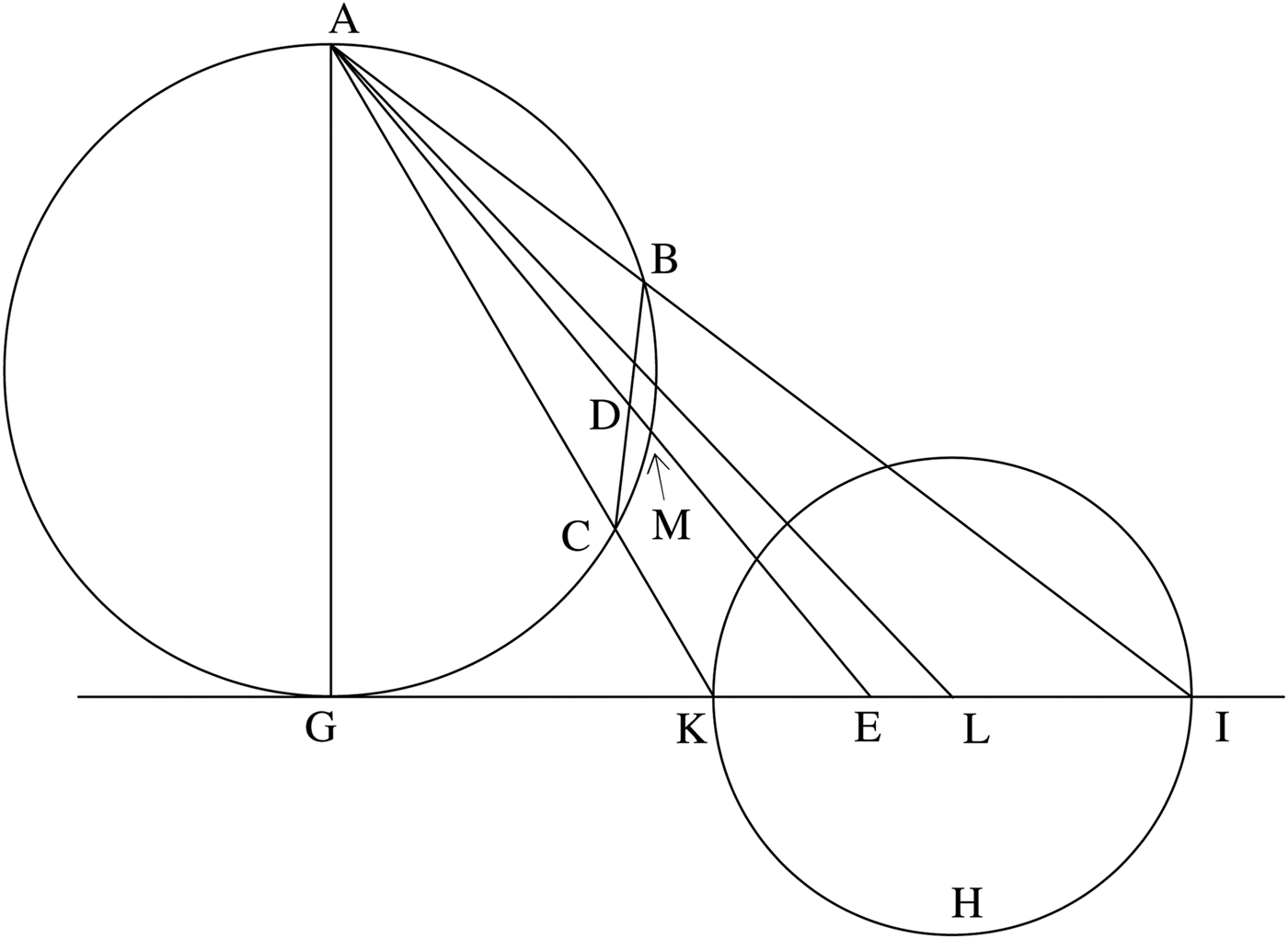
Pour clore ce chapitre, al-Farghānī démontre que le sommet du cône, le centre de sa base et le centre de l'intersection avec le plan tangent à la sphère, ne sont pas alignés. Il le fait en précisant la position du centre de ce dernier cercle. Si l'on appelle D le centre du cercle de diamètre BC, base du cône, le centre du cercle de diamètre KI, que l'on obtient dans le plan tangent, est le point L tel que l'angle LAI est égal à l'angle DAC (Fig. 12).Footnote 61
Fig. 11.
Fig. 12.
Al-Farghānī a volontairement isolé et démontré au tout début de son traité, les propositions géométriques sur lesquelles repose son étude de la construction des cercles tracés sur l'astrolabe. Comme il le précise, c'est la première fois que l'on démontre cette propriété fondamentale des cercles. Les objets qu'il utilise relèvent du domaine des coniques,Footnote 62 mais il se place dans un contexte clairement projectif, caractérisé par l'usage qu'il fait de la définition d'une surface conique, telle qu'on la trouve dans l'ouvrage d'Apollonius.Footnote 63 L'introduction du cône et l'usage qu'il fait du mouvement de la droite qui définit la surface conique, marquent nettement la rupture avec la méthode de Ptolémée que nous avons commentée plus haut. Les principes employés et les objets mathématiques introduits pour établir la relation entre sphère et plan, diffèrent totalement.Footnote 64 Même s'il n'introduit pas de nouveaux termes propres à fonder un nouveau chapitre sur les projections, la manière dont il sépare nettement les deux domaines de la géométrie et de l'astronomie mathématique, en appliquant la première à la seconde, marque l'apparition d'une nouvelle théorie en tant que telle, construite solidement sur ses bases.Footnote 65 Cette nouvelle théorie sera amplement développée au siècle suivant.
III. LE TRAITÉ SUR L'ASTROLABE D'AL-QŪHĪ ET SON COMMENTAIRE PAR IBN SAHL
On trouve la première théorie générale de la projection locale de la sphère, dans un traité qu'Abū Sahl al-Qūhī a rédigé au cours de la seconde moitié du Xe siècle et intitulé: Sur l'art de l'astrolabe par la démonstration. Cette ouvrage, composé en deux livres, a pour objet la projection de la sphère, et rompt avec toutes les études antérieures consacrées à l'astrolabe. Si son auteur ne s'intéresse pas à l'histoire des recherches sur l'astrolabe, s'il ne cite aucun des auteurs d'ouvrages sur ce sujet, c'est parce que son projet est bien différent. S'il présente en introduction les principes de l'instrument, son étude ne porte pas sur l'astrolabe en tant qu'instrument d'astronomie. Dans cet ouvrage, complété de manière décisive par le commentaire qu'en a rédigé Ibn Sahl à la même époque,Footnote 66 la projection stéréographique apparaît comme un cas particulier d'une théorie plus générale de la projection de la sphère qu'al-Qūhī expose au premier chapitre de son traité, en introduisant tous les types de projections coniques et cylindriques, sur tous les types de surfaces compatibles avec le mouvement de l'astrolabe:
La sphère se projette sur des surfaces de genres différents à partir de positions diverses, mais l'une des deux surfaces ne se meut sur l'autre par le mouvement de la sphère que si elle est une des surfaces coniques ou cylindriques ou une de leurs analogues – qui ont un axe et dont l'axe est celui de la sphère – ou si elle est une surface plane à laquelle l'axe de la sphère est perpendiculaire. Dans le cas des surfaces coniques ou cylindriques, les projections des cercles de la sphère sont des sections communes à des surfaces, l'une conique et l'autre cylindrique, ou à deux surfaces coniques ou à deux surfaces cylindriques, car la projection de la sphère se sépare en deux: l'une cylindrique et l'autre conique.Footnote 67
Auparavant, al-Qūhī a expliqué que l'astrolabe est formé de deux surfaces, l'une fixe, le tympan, et l'autre mobile, l'araignée, sur laquelle on place l'écliptique et les astres que l'on peut observer. Le mouvement de l'une sur l'autre représente le mouvement de rotation de la sphère céleste vue par un observateur. Pour que la projection soit compatible avec l'instrument, il faut que les deux surfaces sur lesquelles on projette la sphère, puisse tourner l'une sur l'autre. Cette condition porte à la fois sur la nature des surfaces, comme on vient de le voir, mais aussi sur la nature de la projection. Elle amène l'auteur à ne conserver que certaines projections: les projections cylindriques d'axe parallèle à celui de la sphère, ou coniques dont le sommet est sur l'axe. Al-Qūhī précise la nature des projetés des cercles de la sphère pour les projections retenues. “Si la projection de la sphère est cylindrique d'axe parallèle à celui de la sphère, ou conique dont le sommet est sur l'axe, sans être sur un pôle de la sphère, alors […] les cercles de la sphère, autres que les cercles auxquels l'axe de la sphère est perpendiculaire, ne se projettent pas […] comme des cercles mais comme des sections de cône”;Footnote 68 cela si la surface sur laquelle se fait la projection est un plan.Footnote 69 Il poursuit plus loin:
si la projection est conique dont le sommet est sur un pôle de la sphère et que la projection se fait sur un plan auquel l'axe de la sphère est perpendiculaire, […] les cercles de la sphère sur cette surface ne seront pas des sections coniques, mais bien des cercles ou des droites si la projection est à partir des cercles qui passent par ce même pôle.Footnote 70
Ainsi, la projection stéréographique est définie comme un cas particulier des projections coniques de la sphère, celle qui conserve la forme des cercles de la sphère. Toute la suite de l'ouvrage sera consacrée à l'étude complète de cette transformation.
La première proposition que l'auteur démontre concerne la propriété fondamentale de la projection stéréographique qu'il vient d'énoncer et qui occupe, comme dans l'ouvrage d'al-Farghānī, la première place.
Il considère un cercle passant par l'axe AD de la sphère, le cercle ABCD, et veut projeter sur un plan quelconque perpendiculaire à l'axe, le cercle de diamètre BC et dont le pôle est sur le cercle ABCD. Il définit alors le cône de sommet A et de base le cercle de diamètre BC, et montre que l'intersection du cône avec le plan P, perpendiculaire à l'axe AD mais placé où l'on veut, est le cercle de diamètre EG (Fig. 13).
Fig. 13.
Sa démonstration repose sur la proposition I, 5 des Coniques d'Apollonius,Footnote 71 qu'al-Qūhī cite explicitement. Celui-ci montre la similitude des triangles AGE et ABC, en commençant par les triangles rectangles AEH et ADB. Puisque ces deux derniers ont un angle commun en A, ils sont semblables, donc les angles AEH et ADB sont égaux. Or l'angle ACB est égal à l'angle ADB, donc les angles AEG et ACB sont égaux. Puisque par ailleurs les triangles AGE et ABC ont un angle commun en A, ils sont semblables. Ensuite, al-Qūhī montre que la configuration des plans est la même que dans la proposition des Coniques: le plan du triangle ABC, le triangle passant par l'axe du cône, est perpendiculaire au plan de sa base et au plan sécant, P. Cela lui permet d'appliquer le résultat de la proposition d'Apollonius. Donc le projeté du cercle de diamètre BC sur la sphère est le cercle de diamètre EG dans le plan P. On retrouve dans cette démonstration les mêmes arguments que dans celle d'al-Farghānī, mais elle est exposée de manière beaucoup plus concise et elle est surtout plus générale notamment dans l'emploi d'un plan de projection quelconque.
Il consacre ensuite le chapitre 2 de son traité, à la définition de: “la terminologie nécessaire pour construire l'astrolabe”.Footnote 72 En particulier, il définit le terme “homologue” (naẓīr) que l'on a déjà rencontré dans la version arabe du Planisphère de Ptolémée.Footnote 73 Mais ici, ce mot acquiert un sens mathématique précis qui désigne un cercle ou un point de la sphère par rapport à son projeté.Footnote 74 Par ailleurs, le mot projeté, ou “projection” (tasṭīḥ), prend également un sens mathématique, par l'usage systématique que l'auteur fera de lui. Ainsi la relation entre un élément de la sphère et son image dans le plan, est désignée par deux termes différents, employés systématiquement dans les mêmes situations, avec un sens précis, qui permettent de distinguer deux sens réciproques dans cette relation. Ce fait est tout à fait nouveau, et ne se trouve dans aucun autre texte consulté jusqu'à maintenant.
La suite de son étude est purement géométrique. Il termine le livre I de son traité par l'étude du tracé des cercles parallèles et des cercles perpendiculaires d'un horizon, c'est-à-dire au tracé des muqanṭarāt et des azimuts.
Mais ce qui fait de cet ouvrage un témoin incontournable de l'histoire de la projection stéréographique, en dehors des faits que nous venons d'analyser, apparaît au livre II, dans lequel la projection stéréographique devient un objet mathématique à part entière. Al-Qūhī étudie la projection en tant que transformation géométrique, devenue aujourd'hui une inversion.Footnote 75 C'est même une étude “réciproque” de la projection, en quelque sorte, qui est entreprise.
Les problèmes du second livre sont destinés à retrouver les éléments qui définissent la sphère projetée, son centre et son rayon, à partir de la donnée du plan et de trois éléments particuliers qu'il va considérer de manière systématique parmi les données possibles de l'ensemble sphère-plan. C'est ainsi dans les trois chapitres conservés: le 1, le 2 et le 6, et on peut supposer qu'il en était de même dans les chapitres perdus.Footnote 76 La structure des chapitres 1 et 2 est absolument similaire. Tous les deux comportent six problèmes dont al-Qūhī rédige la synthèse.
Donnons pour exemple le chapitre 1 du second livre, où sont regroupés les problèmes pour lesquels l'auteur se donne un point image dans le plan de l'astrolabe et la distance angulaire de son homologue au pôle de la sphère.Footnote 77 La donnée de la distance angulaire de cet homologue au pôle de la sphère, revient à donner sa latitude, donc à le situer sur un cercle parallèle à l'équateur de la sphère. La troisième donnée est alors prise, successivement au cours des six problèmes, parmi les suivantes:
1. le pôle de la sphère,
2. le centre de la sphère, qui est aussi celui de l'astrolabe,
3. le rayon de la sphère,
4. la distance, sur le plan de l'astrolabe, du pôle à un point dont l'homologue est à une distance angulaire connue de ce pôle,
5. la distance, sur le plan de l'astrolabe, du centre de la sphère à un point dont l'homologue est à une distance angulaire connue du pôle de la sphère,
6. un autre point image et la distance angulaire de son homologue au pôle de la sphère.Footnote 78
Bien que cet ouvrage se présente comme traitant de la construction de l'astrolabe, al-Qūhī étudie en fait la structure mathématique sous-jacente à l'instrument, c'est-à-dire la projection stéréographique, sur son plan équatorial, d'une sphère définie par son centre et son rayon. Sous la plume d'al-Qūhī et d'Ibn Sahl, la projection stéréographique est devenue l'objet à part entière d'une théorie mathématique, et la question de savoir si ces auteurs conçoivent une telle projection ne se pose pas. Par l'étude qu'il en fait dans le second livre de son traité, al-Qūhī la place même au rang des transformations géométriques.
Ce travail s'inscrit dans un ensemble de recherches portant sur les projections d'une part, et sur les transformations géométriques, d'autre part, recherches qui ont été entreprises un siècle auparavant, et qui connaissent une expansion importante à cette époque comme en témoignent notamment certains ouvrages écrits par al-Bīrūnī au XIe siècle.Footnote 79 Dans le traité qu'il rédigea à la même période, ou un peu après, al-Ṣaghānī étudie les projections coniques dont le pôle décrit l'axe de la sphère, sans jamais occuper la place de l'un des pôles de cette sphère.Footnote 80 La projection cylindrique qu'al-Qūhī et Ibn Sahl étudient dans leur théorie générale et nomment ici pour la première fois, bien qu'al-Bīrūnī en revendiquera plus tard l'invention, était déjà présente dans le traité de Thābit ibn Qurra Sur les sections du cylindre et sur sa surface latérale.Footnote 81 Et c'est d'ailleurs précisément pour établir une relation entre un cercle et une ellipse, ou entre deux figures semblables, que Thābit a introduit une telle projection. C'est le contexte scientifique dans lequel il travaillait, sous l'égide des Banū Mūsā, qui l'a conduit à employer des transformations ponctuelles, déjà connues ou nouvelles.Footnote 82 Cette étude des transformations n'a cessé de se développer par la suite, avec les travaux d'Ibrāhīm Ibn Sinān, d'al-Khāzin, d'al-Qūhī, d'al-Sijzī, entre autres, et Ibn al-Haytham, au début du XIe siècle, cherchera à caractériser ces nouveaux objets géométriques, et portera une attention toute particulière au mouvement et à la place que celui-ci doit occuper en géométrie.Footnote 83