Keven & Akins (K&A) suggest that neonate tongue protrusion and retraction (TP/R) participates in the acquisition of tongue control: Specifically, it “begins as an activity ‘for’ tongue protrusion itself, that tongue protrusion begets tongue protrusion of a ‘more better’ kind” (sect. 6.3, para. 1). They discuss this primarily in a neurological context, whereby spontaneous TP/R leads to incremental circuit formation in central pattern generators (CPGs), fostering the transition from “uncertain movements” to “robust rhythmic motor sequences.” Neuromuscular primitives used as starting points for more complex movements are not unique to the aerodigestive tract, nor to humans: Wolpert et al. (Reference Wolpert, Ghahramani and Flanagan2001) noted that innate motor behaviours are common across species, allowing faster acquisition of motor skills by providing a starting point for motor learning, for which behavioral evidence has been found in human and animal locomotion (Dominici et al. Reference Dominici, Ivanenko, Cappellini, d'Avella, Mondi, Cicchese, Fabiano, Silei, Di Paolo, Giannini, Poppele and Lacquaniti2011).
This refinement of innate, spontaneous actions for use in more complex motor behaviours mirrors a largely untested but appealing hypothesis in speech research which proposes that phylogenetically encoded structures like swallowing and suckling may bootstrap speech learning (e.g., MacNeilage Reference MacNeilage2008; Studdert-Kennedy & Goldstein Reference Studdert-Kennedy, Goldstein, Christiansen and Kirby2003). This proposal appears plausible in view of the accumulated evidence that digestive and speech movements share not only kinematic similarities (Green et al. Reference Green, Moore, Higashikawa and Steeve2000), but also many of the same neurological structures. Both types of movements exhibit large areas of shared brain activation (e.g., Martin et al. Reference Martin, MacIntosh, Smith, Barr, Stevens, Gati and Menon2004), as well as similar critical periods in early development and correlations between disorders in each domain (McFarland & Tremblay Reference McFarland and Tremblay2006). Clinical studies have shown that language impairment is a predictor of previous feeding and swallowing difficulties (Malas et al. Reference Malas, Trudeau, Giroux, Gauthier, Poulin and McFarland2017) and that treatment of dysphagia has resulted in concomitant improvements in dysphonia (LaGorio et al. Reference LaGorio, Carnaby-Mann and Crary2008).
The bootstrapping proposal is based on the idea that speech movements share more than kinematic or neurological similarities with digestive movements, but rather that there are at least some core speech movements which are direct ontogenetic adaptations of preexisting digestive movements. This implies that aspects of the two activities must plausibly be driven by common specific sets of muscle activations (Gick & Stavness Reference Gick and Stavness2013). If we represent muscle activation space as a high-dimensional space where each muscle has a corresponding dimension whose value is that muscle's activation level, learning speech movements can be modeled as a search for points in this space that satisfy task-specific criteria relevant to the speech learner. The dimensionality and size of this space are large enough to pose significant problems for an unstructured search, even for a single speech movement in isolation: The sets of activations that result in a solution for a given task are few in number relative to all possible sets of activations (see Gick et al. Reference Gick, Allen, Roewer-Despres and Stavness2017), and muscle activation is difficult to predict due to the number of redundant solutions for a given task (Loeb Reference Loeb2012). Factors such as muscle contraction dynamics, tissue mechanics, tissue incompressibility, and tongue-palate contact also mean that task-level similarities do not necessarily imply similar activations. Establishing such similarities adds significant weight to the argument that primitives help constrain possible muscle activation patterns for speech learning.
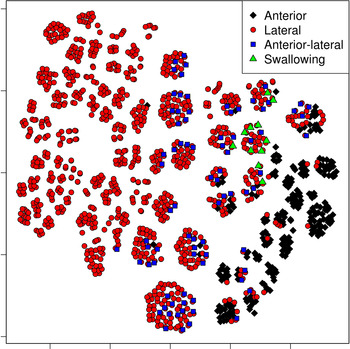
We explored these ideas using the 3D biomechanical modelling platform ArtiSynth (www.artisynth.org; e.g., Gick et al. Reference Gick, Anderson, Chen, Chiu, Kwon, Stavness, Tsou and Fels2014; Stavness et al. Reference Stavness, Lloyd and Fels2012) in the context of tongue bracing, where active muscle support keeps the sides of the tongue in almost constant contact with the upper molars during speech (Gick et al.Reference Gick, Allen, Roewer-Despres and Stavness2017). Simulations were conducted to examine the muscles activated for various types of tongue-palate contact. All possible muscle combinations were activated at three activation levels (0%, 20%, 50%) out of a group of 10 speech and swallowing muscles: superior and inferior longitudinal, transverse, verticalis, hyoglossus, mylohyoid, styloglossus, and posterior, medial, and anterior genioglossus. This generated approximately 60,000 activations. Virtual contact sensors were positioned on the hard palate and upper teeth of the model to detect tongue contact. We partitioned the activation space into four different contact types (Fig. 1). Only about 2% of the activations matched any of these. “Lateral” indicates tongue contact on the sides of the palate, as for speech bracing. “Anterior” indicates contact in the anterior region of the palate, as in the production of the sound [l]. “Anterior-lateral” indicates simultaneous lateral and anterior contact, as in the production of the sound [n]. “Swallowing” indicates lateral, back, and mid-contact, representing the end of the oral transport phase of swallowing, immediately after the tongue has moved the bolus into the hypopharynx. See Gick et al. (Reference Gick, Allen, Roewer-Despres and Stavness2017) for a detailed description of a similar simulation with different analysis.
Figure 1.
A two-dimensional t-SNE plot of the 2% of the activation space that matched one of the target contact types.
Results indicate that activations resulting in swallowing contacts were a subset of activations that resulted in tongue bracing contacts. The superior longitudinal and mylohyoid muscles played the most significant roles in both swallowing and bracing contacts, but with additional activations occurring to produce the more complex tongue shapes required by bracing contacts such as depressing the midline and raising the tip. We also found that the activations that resulted in swallowing contact were contiguous with clusters of activations resulting in bracing contact, indicating similar activations. This is shown in Figure 1 using the dimensionality reduction technique t-Distributed Stochastic Neighbor Embedding (t-SNE; van der Maaten & Hinton Reference van der Maaten and Hinton2008). The t-SNE technique maps from high-dimensional to low-dimensional space using an optimization function that prioritizes maintaining distances between each point and its neighbours.
Although it has become increasingly well established that swallowing and speech movements are neurologically related, it does not immediately follow that they have similar neuromuscular activation patterns: The nonlinearity of the muscular activation space offers no guarantees that task-level similarities necessarily translate into similarities in activation space. The simulations presented here suggest similarities in neuromuscular activation between tongue bracing and swallowing, filling the gap between previous kinematic and neuroimaging findings. Such biomechanical simulations, taken in the context of proposals such as that of K&A, will provide an essential part of the evidence for establishing the role of innate stereotypies like TP/R in facilitating the development of semi-closed movement routines such as swallowing as well as serving as a basis for learned speech movement.





Keven & Akins (K&A) suggest that neonate tongue protrusion and retraction (TP/R) participates in the acquisition of tongue control: Specifically, it “begins as an activity ‘for’ tongue protrusion itself, that tongue protrusion begets tongue protrusion of a ‘more better’ kind” (sect. 6.3, para. 1). They discuss this primarily in a neurological context, whereby spontaneous TP/R leads to incremental circuit formation in central pattern generators (CPGs), fostering the transition from “uncertain movements” to “robust rhythmic motor sequences.” Neuromuscular primitives used as starting points for more complex movements are not unique to the aerodigestive tract, nor to humans: Wolpert et al. (Reference Wolpert, Ghahramani and Flanagan2001) noted that innate motor behaviours are common across species, allowing faster acquisition of motor skills by providing a starting point for motor learning, for which behavioral evidence has been found in human and animal locomotion (Dominici et al. Reference Dominici, Ivanenko, Cappellini, d'Avella, Mondi, Cicchese, Fabiano, Silei, Di Paolo, Giannini, Poppele and Lacquaniti2011).
This refinement of innate, spontaneous actions for use in more complex motor behaviours mirrors a largely untested but appealing hypothesis in speech research which proposes that phylogenetically encoded structures like swallowing and suckling may bootstrap speech learning (e.g., MacNeilage Reference MacNeilage2008; Studdert-Kennedy & Goldstein Reference Studdert-Kennedy, Goldstein, Christiansen and Kirby2003). This proposal appears plausible in view of the accumulated evidence that digestive and speech movements share not only kinematic similarities (Green et al. Reference Green, Moore, Higashikawa and Steeve2000), but also many of the same neurological structures. Both types of movements exhibit large areas of shared brain activation (e.g., Martin et al. Reference Martin, MacIntosh, Smith, Barr, Stevens, Gati and Menon2004), as well as similar critical periods in early development and correlations between disorders in each domain (McFarland & Tremblay Reference McFarland and Tremblay2006). Clinical studies have shown that language impairment is a predictor of previous feeding and swallowing difficulties (Malas et al. Reference Malas, Trudeau, Giroux, Gauthier, Poulin and McFarland2017) and that treatment of dysphagia has resulted in concomitant improvements in dysphonia (LaGorio et al. Reference LaGorio, Carnaby-Mann and Crary2008).
The bootstrapping proposal is based on the idea that speech movements share more than kinematic or neurological similarities with digestive movements, but rather that there are at least some core speech movements which are direct ontogenetic adaptations of preexisting digestive movements. This implies that aspects of the two activities must plausibly be driven by common specific sets of muscle activations (Gick & Stavness Reference Gick and Stavness2013). If we represent muscle activation space as a high-dimensional space where each muscle has a corresponding dimension whose value is that muscle's activation level, learning speech movements can be modeled as a search for points in this space that satisfy task-specific criteria relevant to the speech learner. The dimensionality and size of this space are large enough to pose significant problems for an unstructured search, even for a single speech movement in isolation: The sets of activations that result in a solution for a given task are few in number relative to all possible sets of activations (see Gick et al. Reference Gick, Allen, Roewer-Despres and Stavness2017), and muscle activation is difficult to predict due to the number of redundant solutions for a given task (Loeb Reference Loeb2012). Factors such as muscle contraction dynamics, tissue mechanics, tissue incompressibility, and tongue-palate contact also mean that task-level similarities do not necessarily imply similar activations. Establishing such similarities adds significant weight to the argument that primitives help constrain possible muscle activation patterns for speech learning.
We explored these ideas using the 3D biomechanical modelling platform ArtiSynth (www.artisynth.org; e.g., Gick et al. Reference Gick, Anderson, Chen, Chiu, Kwon, Stavness, Tsou and Fels2014; Stavness et al. Reference Stavness, Lloyd and Fels2012) in the context of tongue bracing, where active muscle support keeps the sides of the tongue in almost constant contact with the upper molars during speech (Gick et al.Reference Gick, Allen, Roewer-Despres and Stavness2017). Simulations were conducted to examine the muscles activated for various types of tongue-palate contact. All possible muscle combinations were activated at three activation levels (0%, 20%, 50%) out of a group of 10 speech and swallowing muscles: superior and inferior longitudinal, transverse, verticalis, hyoglossus, mylohyoid, styloglossus, and posterior, medial, and anterior genioglossus. This generated approximately 60,000 activations. Virtual contact sensors were positioned on the hard palate and upper teeth of the model to detect tongue contact. We partitioned the activation space into four different contact types (Fig. 1). Only about 2% of the activations matched any of these. “Lateral” indicates tongue contact on the sides of the palate, as for speech bracing. “Anterior” indicates contact in the anterior region of the palate, as in the production of the sound [l]. “Anterior-lateral” indicates simultaneous lateral and anterior contact, as in the production of the sound [n]. “Swallowing” indicates lateral, back, and mid-contact, representing the end of the oral transport phase of swallowing, immediately after the tongue has moved the bolus into the hypopharynx. See Gick et al. (Reference Gick, Allen, Roewer-Despres and Stavness2017) for a detailed description of a similar simulation with different analysis.
A two-dimensional t-SNE plot of the 2% of the activation space that matched one of the target contact types.
Results indicate that activations resulting in swallowing contacts were a subset of activations that resulted in tongue bracing contacts. The superior longitudinal and mylohyoid muscles played the most significant roles in both swallowing and bracing contacts, but with additional activations occurring to produce the more complex tongue shapes required by bracing contacts such as depressing the midline and raising the tip. We also found that the activations that resulted in swallowing contact were contiguous with clusters of activations resulting in bracing contact, indicating similar activations. This is shown in Figure 1 using the dimensionality reduction technique t-Distributed Stochastic Neighbor Embedding (t-SNE; van der Maaten & Hinton Reference van der Maaten and Hinton2008). The t-SNE technique maps from high-dimensional to low-dimensional space using an optimization function that prioritizes maintaining distances between each point and its neighbours.
Although it has become increasingly well established that swallowing and speech movements are neurologically related, it does not immediately follow that they have similar neuromuscular activation patterns: The nonlinearity of the muscular activation space offers no guarantees that task-level similarities necessarily translate into similarities in activation space. The simulations presented here suggest similarities in neuromuscular activation between tongue bracing and swallowing, filling the gap between previous kinematic and neuroimaging findings. Such biomechanical simulations, taken in the context of proposals such as that of K&A, will provide an essential part of the evidence for establishing the role of innate stereotypies like TP/R in facilitating the development of semi-closed movement routines such as swallowing as well as serving as a basis for learned speech movement.
ACKNOWLEDGMENT
We thank David McFarland, University of Montreal, for his valuable comments. We acknowledge funding from NSERC Discovery Grants to the third and fourth authors.