

In EXEGI MONVMENTVM (C. 3.30), the final poem of his first three books of Odes, Horace famously boasts that he has completed a poetic monument more lasting than bronze and loftier than the pyramids.Footnote 1 The comparison of his work to this markedly un-Roman architectural form has given pause to many readers, who have proposed interpretations as varied as the figurative triumph of Augustus over Cleopatra, the imitation of an Egyptian topos likening books to pyramids, and even an oblique reference to the political ambition and subsequent downfall of the elegiac poet and prefect of Egypt Cornelius Gallus.Footnote 2 While Horace's evocation of Egypt is clearly au courant in the wake of Actium, a second, complementary explanation for his pointed comparison can be found not at Giza but on Delos, where an inscription lists among wooden objects housed in the treasury of Andros ‘a triangular casket holding books of Alcaeus’.Footnote 3 Most scholars agree that this casket must have contained the standard ten-book edition of Alcaeus compiled by Aristarchus, since ‘4, 3, 2, 1 fits a triangle nicely’.Footnote 4 In mathematical, musical and mystical terms, this arrangement is ideally suited to a poetic monument insofar as it instantiates the cosmic harmony of the Pythagorean τετρακτύς, which was widely revered in antiquity for its triangular form in two dimensions (Fig. 1) and its pyramidal form in three (Fig. 2).Footnote 5
The τετρακτύς of the decad as the fourth triangular number (1 + 2 + 3 + 4 = 10)

The τετρακτύς of the decad rearranged as the third pyramidal number (1 + 3 + 6 = 10)

Indeed, according to the author of the Theology of Arithmetic formerly attributed to Iamblichus, Plato's nephew Speusippus devoted no less than half of his booklet On Pythagorean Numbers to the natural, teleological and poetic qualities of the sacred decad:
ὅτι καὶ Σπεύσιππος ὁ Πωτώνης μὲν υἱὸς τῆς τοῦ Πλάτωνος ἀδελφῆς, διάδοχος δὲ Ἀκαδημίας πρὸ Ξενοκράτου, ἐκ τῶν ἐξαιρέτως σπουδασθεισῶν ἀεὶ Πυθαγορικῶν ἀκροάσεων, μάλιστα δὲ τῶν Φιλολάου συγγραμμάτων, βιβλίδιόν τι συντάξας γλαφυρὸν ἐπέγραψε μὲν αὐτὸ Περὶ Πυθαγορικῶν ἀριθμῶν, ἀπ' ἀρχῆς δὲ μέχρι ἡμίσους περὶ τῶν ἐν αὐτοῖς γραμμικῶν ἐμμελέστατα διεξελθὼν πολυγωνίων τε καὶ παντοίων τῶν ἐν ἀριθμοῖς ἐπιπέδων ἅμα καὶ στερεῶν περί τε τῶν πέντε σχημάτων, ἃ τοῖς κοσμικοῖς ἀποδίδοται στοιχείοις, ἰδιότητός <τε> αὐτῶν καὶ πρὸς ἄλληλα κοινότητος, <περὶ> ἀναλογίας τε καὶ ἀντακολουθίας, μετὰ ταῦτα λοιπὸν θάτερον τὸ τοῦ βιβλίου ἥμισυ περὶ δεκάδος ἄντικρυς ποιεῖται φυσικωτάτην αὐτὴν ἀποφαίνων καὶ τελεστικωτάτην τῶν ὄντων, οἷον εἶδός τι τοῖς κοσμικοῖς ἀποτελέσμασι τεχνικὸν ἀφ' ἑαυτῆς (ἀλλ' οὐχ ἡμῶν νομισάντων ἢ ὡς ἔτυχε) θεμέλιον ὑπάρχουσαν καὶ παράδειγμα παντελέστατον τῷ τοῦ παντὸς ποιητῇ θεῷ προεκκειμένην.
Speusippus, the son of Plato's sister Potone and head of the Academy before Xenocrates, assembled an elegant little book out of a choice selection of ever-handy Pythagorean lectures (particularly from the works of Philolaus) and called it On Pythagorean Numbers, in the first half of which he expounds in most harmonious and orderly fashion the nature of linear numbers, polygonal numbers, and all sorts of plane numbers, together with solid numbers and the five forms that are assigned to the cosmic elements, their uniquenesses and their similarities, their proportionalities and their reciprocities. After that, in the remaining half of the book he proceeds straight to the decad, which he demonstrates is the most natural and fulfilling of all things both perceptible and actual insofar as it is inherently (and not by human contrivance or chance) conducive to making orderly finished products, and provides the foundation and perfect paradigm as preordained by God, the Maker of All [τῷ τοῦ παντὸς ποιητῇ θεῷ].Footnote 6
Thus, from a Pythagorean perspective, the Andrian dedication of the Alcaic casket to Delian Apollo was triply appropriate, comprising the gift of a mortal poet to a divine poet in the most poetic form possible.Footnote 7 As I shall argue, it is to this sacred Apolline form as instantiated by the Alcaic ‘pyramid’ of ten scrolls in Aristarchus' edition that Horace at least partially alludes when boasting over the superiority of his own ‘orderly finished product’ at the consummation of his first three books of Odes.Footnote 8
For even if Horace's personal copy of Alcaeus was not housed in a triangular casket such as the one offered to Apollo on Delos (presumably an honour reserved for deluxe editions, suitable for dedication), the studied polyvalence of Odes 3.30.1–2 suggests that the Roman poet both knew of the Aristarchean edition's capacity for pyramidal arrangement and regarded it as a fitting comparandum for the presentation of his own monumental achievement.Footnote 9 Like θήκη and its various synonyms in both Greek and Latin, monumentum simultaneously evokes two types of commemorative vessel: funerary, for the memorialisation of the dead; and literary, for the preservation of knowledge through writing.Footnote 10 The poet's initial comparison of his work to bronze similarly recalls both tablet and tomb.Footnote 11 Horace's unusual application of the masculine noun situs further reinforces this semantic doubling, since the term normally denotes physical position or even arrangement on a page (e.g., of the gods' names in two verses of Ennius at Apul. Soc. 2), while the perfect passive participle from sinere occurs regularly in sepulchral contexts (e.g., in the epitaphic formula hic situs est).Footnote 12 The adjective regali similarly calls to mind not just the royal tombs of Egypt, but also the highest grade of papyrus used in deluxe editions.Footnote 13 Even the verb exegi contributes to the effect, since in architectural contexts exigere means ‘to set [straight]’, as in the erection of a funerary monument such as a column (e.g., Cic. Verr. 2.1.133), while elsewhere in Augustan poetry the word more commonly connotes ‘to perfect’, as in the polishing of a literary work (e.g., Hor. Epist. 2.1.71–2).Footnote 14 The comparative adjective altius likewise pertains to both structural height and stylistic elevation (or even profundity, given the dual nature of altus/a/um).Footnote 15
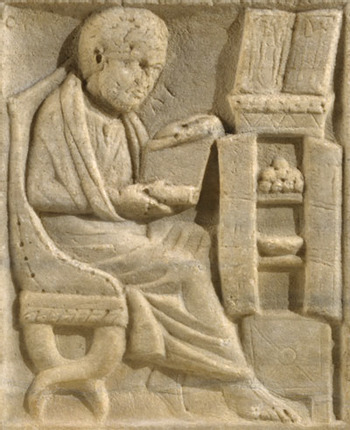
Sarcophagus with a Greek physician (Ostia, early 300s CE).

Situated among these polyvalent pointers, Horace's pyramids invite contemporary bibliophiles to compare his first three books of Odes not just to the wondrous tombs of Pharaonic Egypt, but also to the poetic contents of Aristarchus' edition of Alcaeus.Footnote 16 In other words, if we grant pyramidum the same literary valence present in exegi, monumentum, aere, regali, situ and altius, we can understand Odes 3.30.1–2 to mean not only ‘I have completed a monument more lasting than bronze | and loftier than the kingly site of the pyramids’, but also ‘I have perfected a casket/collection [of scrolls] more lasting than bronze [tablets] | and more [stylistically] elevated/profound than the deluxe arrangement of [Alcaeus’] pyramids'.Footnote 17 Thus, in the final ode of his three-scroll collection, Horace subtly and wittily asserts his superiority over Alcaeus through the application of the very Alexandrian bookishness through which he filters his aemulatio of the Greek lyric poet elsewhere.Footnote 18
If correct, this interpretation prompts two speculations. First, let us imagine for a moment the day in 23 BCE when either Horace or his messenger arrived at the ‘kingly site’ of the turris Maecenatiana bearing the dedication copy of Odes 1–3 to Maecenas, ‘scion of Etruscan kings’.Footnote 19 When the poet's eminent friend removed the lid from its case, what did he see? In my view it is possible (though of course ultimately unverifiable) that he was confronted with three scrolls arranged in an exiguous pyramid on the Alcaic model (Fig. 4). Such a presentation would certainly befit a collection aspiring to Archaic lyric grandeur on an Alexandrian scale.Footnote 20
The exiguous Horatian ‘pyramid’ of Odes 1–3?

Secondly (and even more speculatively), it is perhaps relevant that, when Horace put down his stylus for the last time a year or two before his death in 8 BCE, his complete oeuvre—two books of Satires, one book of Epodes, four books of Odes, two books of Epistles and the so-called Ars poetica—might have filled ten scrolls in their own right.Footnote 21 Could the phrase exegi monumentum apply not just retrospectively to Odes 1–3, but also prospectively to a planned ten-book edition of the poet's complete works, to be housed in a triangular casket resembling his Greek predecessor's, and likewise instantiating the cosmic harmony of the τετρακτύς? In light of the numerous uncertainties, it is a riddle I am not prepared to answer, though one perhaps worthy of both Horace and the Sphinx.