1 Introduction
1.1 Apéry-like sequences
In his ingenious proof of the irrationality of
 $\zeta (3)$
and
 $\zeta (2)$
, Apéry [Reference Apéry2] introduced two particular sequences
 $\{a_n\}_{n\ge 0}$
and
 $\{b_n\}_{n\ge 0}$
through
 $3$
-term recurrences with given initial values:
 $$ \begin{align} &(n+1)^3 a_{n+1}- (2n+1)(17n^2+17n+5)a_n+n^3 a_{n-1}=0,\quad (a_0=1,a_1=5), \end{align} $$
 $$ \begin{align} &(n+1)^2b_{n+1}-(11n^2+11n+3)b_n-n^2b_{n-1}=0,\quad(b_0=1,b_1=3). \end{align} $$
Apéry also showed that the sequences
 $\{a_n\}_{n\ge 0}$
and
 $\{b_n\}_{n\ge 0}$
possess explicit formulas:
 $$ \begin{align*} &a_n=\sum_{k=0}^n{n\choose k}^2{n+k\choose k}^2,\\[5pt] &b_n=\sum_{k=0}^n{n\choose k}^2{n+k\choose k}. \end{align*} $$
These sequences are known as the famous Apéry numbers.
Let
 $F_{\mathbf {a}}(y)$
and
 $F_{\mathbf {b}}(y)$
be the generating functions for the sequences
 $\{a_n\}_{n\ge 0}$
and
 $\{b_n\}_{n\ge 0}$
, respectively,
 $$ \begin{align*} &F_{\mathbf{a}}(y)=\sum_{n=0}^{\infty}a_n y^n,\\ &F_{\mathbf{b}}(y)=\sum_{n=0}^{\infty}b_n y^n. \end{align*} $$
The recurrences (1.1) and (1.2) can be rewritten in forms of differential equations for the generating functions
 $F_{\mathbf {a}}(y)$
and
 $F_{\mathbf {b}}(y)$
. In other words,
 $F_{\mathbf {a}}(y)$
is annihilated by the differential operator:
 $$ \begin{align*} \mathcal{L}_{\mathbf{a}}=\theta_y^3-y(2\theta_y+1)(17\theta_y^2+17\theta_y+5)+y^2(\theta_y+1)^3, \end{align*} $$
and
 $F_{\mathbf {b}}(y)$
is annihilated by the differential operator:
 $$ \begin{align*} \mathcal{L}_{\mathbf{b}}=\theta_y^2-y(11\theta_y^2+11\theta_y +3)-y^2(\theta_y+1)^2, \end{align*} $$
where
 $\theta _y=y\frac {d}{dy}$
.
It is a surprise that the solutions of the recurrences (1.1) and (1.2) are integers. Motivated by the two interesting examples, Zagier [Reference Zagier14] searched for triples
 $(A,B,\lambda )\in \mathbb {Z}^3$
such that the solution of the recurrence:
 $$ \begin{align} (n+1)^2u_{n+1}-(An^2+An+\lambda)u_n+Bn^2u_{n-1}=0,\quad (u_{-1}=0,u_0=1) \end{align} $$
is an integer sequence
 $\{u_n\}_{n\ge 0}$
. The generating function
 $F(y)=\sum _{n=0}^{\infty }u_n y^n$
for the sequence defined by (1.3) is annihilated by the differential operator:
 $$ \begin{align} \mathcal{L}_1=\theta_y^2-y(A\theta_y^2+A\theta_y+\lambda)+By^2(\theta_y+1)^2. \end{align} $$
In Zagier’s computer search, six sporadic solutions are found, the integrality of which are not explained easily. For
 $(A,B,\lambda )=(11,-1,3)$
, we already know that there is a desired solution
 $\{b_n\}_{n\ge 0}$
.
The six sporadic sequences are called Apéry-like sequences of the second kind, which are listed in Table 1 (see [Reference Gorodetsky9, p. 642]).
Apéry-like sequences of the second kind.

Almkvist and Zudilin [Reference Almkvist and Zudilin1] conducted similar searches related to
 $\{a_n\}_{n\ge 0}$
. They searched for triples
 $(a,b,c)\in \mathbb {Z}^3$
such that the solution of the recurrence:
 $$ \begin{align} (n+1)^3u_{n+1}-(2n+1)(an^2+an+b)u_n+cn^3u_{n-1}=0,\quad (u_{-1}=0,u_0=1) \end{align} $$
is an integer sequence
 $\{u_n\}_{n\ge 0}$
. Six sporadic sequences
 $(\delta ),(\eta ),(\alpha ),(\epsilon ),(\zeta )$
and
 $(\gamma )$
were found, which include the desired sequence
 $\{a_n\}_{n\ge 0}$
.
Cooper [Reference Cooper6] added a parameter d to the recurrence (1.5), and studied a more general recurrence:
 $$ \begin{align} (n+1)^3u_{n+1}-(2n+1)(an^2+an+b)u_n+n(cn^2+d)u_{n-1}=0, \end{align} $$
with
 $u_{-1}=0$
and
 $u_0=1$
. Note that the case
 $d=0$
in (1.6) reduces to (1.5). The generating function
 $F(y)=\sum _{n=0}^{\infty }u_n y^n$
for the sequence defined by (1.6) is annihilated by the differential operator:
 $$ \begin{align} \mathcal{L}_2=\theta_y^3-y(2\theta_y+1)(a\theta_y^2+a\theta_y+b)+y^2\left(c(\theta_y+1)^3+d(\theta_y+1)\right). \end{align} $$
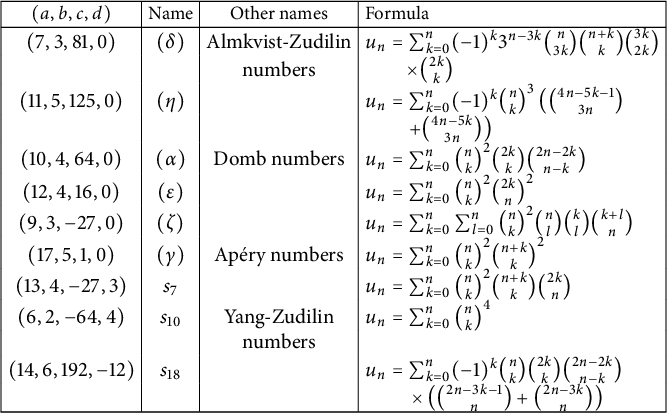
In Cooper’s search, three additional sporadic sequences were found, named
 $s_7,s_{10}$
, and
 $s_{18}$
.
The nine sporadic sequences are called Apéry-like sequences of the first kind, which are listed in Table 2 (see [Reference Gorodetsky9, pp. 642–643]).
Apéry-like sequences of the first kind.

1.2 Motivation
Chowla et al. [Reference Chowla, Cowles and Cowles5] investigated congruence properties for the Apéry numbers
 $\{a_n\}_{n\ge 0}$
, and conjectured that
 $a_{2n}\equiv 1\ \pmod {8},a_{2n+1}\equiv 5\ \pmod {8},a_{2n}\equiv 1\ \pmod {3}$
and
 $a_{2n+1}\equiv 2\ \pmod {3}$
for all non-negative integers n, all of which were proved by Gessel [Reference Gessel8] in the forms:
 $$ \begin{align} &a_n\equiv 5^n\quad\pmod{8}, \end{align} $$
 $$ \begin{align} &a_n\equiv (-1)^n \quad\pmod{3}. \end{align} $$
Since
 $(3,8)=1$
, congruences (1.8) and (1.9) can be restated in a unified form:
 $$ \begin{align} a_n\equiv 5^n\quad\pmod{24}, \end{align} $$
for all non-negative integers n.
In 2016, Malik and Straub [Reference Malik and Straub11, Corollary 5.2] established the following three interesting results:
-
(1) If
 $\{u_n\}_{n\ge 0}$
is one of the
$15$
Apéry-like sequences, we have
$u_n\equiv u_1\ \pmod {2}$
for all
$n\ge 1$
.
-
(2) If
$\{u_n\}_{n\ge 0}$
is one of
$\textbf {C},\textbf {B},\textbf {F},(\delta ),(\alpha ),(\epsilon ),(\zeta )$
and
$s_{18}$
, we have
$u_n\equiv u_1\ \pmod {3}$
for all
$n\ge 1$
. If
$\{u_n\}_{n\ge 0}$
is
$\textbf {A}$
or
$(\gamma )$
, we have
$u_n\equiv (-1)^n\ \pmod {3}$
for all
$n\ge 0$
. -
(3) If
$\{u_n\}_{n\ge 0}$
is
$\textbf {D}$
, we have
$u_n\equiv 3^n\ \pmod {5}$
for all
$n\ge 0$
. If
$\{u_n\}_{n\ge 0}$
is
$(\eta )$
, we have
$u_n\equiv 0\ \pmod {5}$
for all
$n\ge 1$
.


From the above results due to Malik and Straub [Reference Malik and Straub11], we find that
 $$ \begin{align} b_n\equiv 3^n\quad\pmod{10}, \end{align} $$
for all non-negative integers n.
The two interesting examples (1.10) and (1.11) motivate us to find more congruences of this type for all of the
 $15$
Apéry-like sequences
 $\{u_n\}_{n\ge 0}$
.
For an Apéry-like sequence
 $\{u_n\}_{n\ge 0}$
and an integer
 $\alpha $
, let
 $N_{\alpha }$
be the largest positive integer such that
 $$ \begin{align} u_n\equiv \alpha^n \quad\pmod{N_{\alpha}}, \end{align} $$
for all non-negative integers n. Since all of the
 $15$
Apéry-like sequences are not geometric sequences, we conclude that the set
 $\{d\in \mathbb {N}:\forall n\ge 0~u_n\equiv \alpha ^n \ \pmod {d}\}$
is bounded, and so
 $N_{\alpha }$
is well-defined.
The main purpose of the article is to determine the values of
 $\beta \in \mathbb {Z}$
such that
 $N_{\beta }=\max \{N_{\alpha }|\alpha \in \mathbb {Z}\}$
and the values of
 $\max \{N_{\alpha }|\alpha \in \mathbb {Z}\}$
for all of the
 $15$
Apéry-like sequences
 $\{u_n\}_{n\ge 0}$
. The binomial transforms of Apéry-like sequences provide us a unified approach to this type of congruence (1.12) for Apéry-like sequences.
We remark that Gessel proved (1.10) through Lucas congruences, and we shall reprove (1.10) by using the binomial transforms. The two approaches are essentially different.
1.3 Main results
For a sequence
 $\{u_n\}_{n\ge 0}$
with
 $u_0=1$
and a complex number x, the binomial transform of
 $\{u_n\}_{n\ge 0}$
is defined by
 $$ \begin{align} v_{n}(x)=\sum_{k=0}^n{n\choose k}(-x)^{n-k} u_k, \end{align} $$
for all non-negative integers n. Note that
 $v_{n}(x)$
is a polynomial of degree n with integer coefficients. Throughout the article, given a sequence
 $\{u_n\}_{n\ge 0}$
, the polynomial sequence
 $\{v_{n}(x)\}_{n\ge 0}$
denotes its corresponding binomial transform (1.13).
For a positive integer M, let
 $\operatorname {\mathrm {rad}}(M)$
denote the radical of M:
 $$ \begin{align*} \operatorname{\mathrm{rad}}(M)=\prod_{\substack{p|M\\p~\text{prime}}}p. \end{align*} $$
For an Apéry-like sequence
 $\{u_n\}_{n\ge 0}$
and an integer
 $\alpha $
, let
 $$ \begin{align} M_{\alpha}= \begin{cases} (v_1(\alpha),v_2(\alpha),v_3(\alpha))\quad&\text{if }\{u_n\}_{n\ge 0}\text{ is of the second kind},\\[5pt] (v_1(\alpha),v_2(\alpha),v_3(\alpha),v_4(\alpha))\quad&\text{if }\{u_n\}_{n\ge 0}\ \mathrm{is\ of\ the\ first\ kind}, \end{cases} \end{align} $$
where
 $(n_1,n_2,\cdots ,n_r)$
denotes the greatest positive common divisor of integers
 $n_1,n_2,\ldots ,n_r$
.
The main results of the article consist of the following two theorems.
Theorem 1.1 Let
 $\{u_n\}_{n\ge 0}$
be one of the
 $15$
Apéry-like sequences and
 $\alpha $
be an integer. For all non-negative integers n, we have
 $$ \begin{align} u_n\equiv \alpha^n \quad\pmod{\operatorname{\mathrm{rad}}(M_{\alpha})}. \end{align} $$
Theorem 1.2 Let
 $\{u_n\}_{n\ge 0}$
be one of the
 $15$
Apéry-like sequences. For all integers
 $\alpha $
,
 $N_{\alpha }$
divides
 $N_{u_1}$
and
 $$ \begin{align} N_{u_1}=M_{u_1}= \begin{cases} (v_2(u_1),v_3(u_1))\quad&\text{if }\{u_n\}_{n\ge 0}\text{ is of the second kind},\\ (v_2(u_1),v_3(u_1),v_4(u_1))\quad&\text{if }\{u_n\}_{n\ge 0}\text{ is of the first kind}, \end{cases} \end{align} $$
where
 $N_{\alpha }$
is defined by (1.12).
Remark From Theorem 1.2, we deduce that
 $$ \begin{align*} N_{u_1}=\max\{N_{\alpha}|\alpha \in \mathbb{Z}\}. \end{align*} $$
In particular, the congruence
 $u_n\equiv u_1^n \ \pmod {N_{u_1}}$
includes all of the congruences
 $u_n\equiv \alpha ^n \ \pmod {N_{\alpha }}$
as special cases for all integers
 $\alpha $
.
1.4 Values of
$N_{u_1}$

By (1.16), we can determine the values of
 $N_{u_1}$
for all of the
 $15$
Apéry-like sequences. The values of
 $u_1$
and
 $N_{u_1}$
for the Apéry-like sequences of the second kind are listed in Table 3.
The values of
 $u_1$
and
 $N_{u_1}$
for the Apéry-like sequences of the first kind are listed in Table 4.
From Tables 3 and 4, we show the novel fact that Gessel congruence (1.10) and Malik-Straub congruence (1.11) are already optimal.
Values of
 $u_1$
and
 $N_{u_1}$
.

Values of
 $u_1$
and
 $N_{u_1}$
.

1.5 Structure of the article
In Section 2, we investigate the binomial transforms of Apéry-like sequences, which are important ingredients in the proof of Theorems 1.1 and 1.2. We first establish a key equivalent condition for (1.12) through binomial transforms of Apéry-like sequences. Secondly, we prove that all of the binomial transforms of Apéry-like sequences satisfy the Gauss congruences through constant term sequences. Thirdly, we compute the generating functions for the binomial transforms of Apéry-like sequences, and the annihilating differential operators for these generating functions. Section 3 is devoted to the proof Theorem 1.1. In Section 4, we establish an auxiliary result and prove Theorem 1.2 in detail.
2 Binomial transforms
2.1 A key equivalent condition
Lemma 2.1 Let
 $\alpha $
be an integer and N be a positive integer. For all non-negative integers n,
 $$ \begin{align*} u_n\equiv \alpha^n \quad\pmod{N}, \end{align*} $$
if and only if for all positive integers n,
 $$ \begin{align*} v_n(\alpha)\equiv 0 \quad\pmod{N}. \end{align*} $$
Proof If
 $u_n\equiv \alpha ^n \ \pmod {N}$
for all non-negative integers n, then
 $$ \begin{align*} v_n(\alpha)\equiv \alpha^{n}\sum_{k=0}^n{n\choose k}(-1)^{n-k}=0\quad\pmod{N}, \end{align*} $$
for all positive integers n.
If
 $v_n(\alpha )\equiv 0 \ \pmod {N}$
for all positive integers n, then for all non-negative integers n,
 $$ \begin{align*} u_n=\sum_{k=0}^n {n\choose k}\alpha^{n-k}v_k(\alpha)\equiv \alpha^n\quad\pmod{N}, \end{align*} $$
where we have used the binomial inversion formula in the first step.
2.2 Gauss congruences
A sequence
 $\{u_n\}_{n\ge 1}$
is said to satisfy the Gauss congruences if
 $u_{np^k}\equiv u_{np^{k-1}}\ \pmod {p^k}$
for all primes p and all positive integers
 $n,k$
. A sequence
 $\{u_n\}_{n\ge 1}$
is called the constant term sequence of a Laurent polynomial
 $\Lambda \in \mathbb {C}[x_1^{\pm 1},\ldots ,x_d^{\pm 1}]$
if
 $u_n$
is the constant term of
 $\Lambda ^n$
for every
 $n\ge 1$
. It is well-known that Gauss congruences hold for the constant term sequence of a integral Laurent polynomial (see, for instance, [Reference Bostan, Straub and Yurkevich4, Lemma 3.1]).
Recently, Gorodetsky [Reference Gorodetsky9] showed that all of the
 $15$
Apéry-like sequences are constant term sequences.
Lemma 2.2 (See [Reference Gorodetsky9, Theorem 1.1].) Let
 $\{u_n\}_{n\ge 0}$
be one of the
 $15$
Apéry-like sequences. Then
 $\{u_n\}_{n\ge 0}$
is a constant term sequence of a Laurent polynomial with integer coefficients in
 $2$
or
 $3$
variables.
Theorem 2.3 Let
 $\{u_n\}_{n\ge 0}$
be one of the
 $15$
Apéry-like sequences and
 $\alpha $
be an integer. Then the corresponding binomial transform
 $\{\kern-1pt v_{n}(\alpha )\kern-1pt\}_{n\ge 0}$
satisfies the Gauss congruences:
 $$ \begin{align} v_{np^k}(\alpha)\equiv v_{np^{k-1}}(\alpha)\quad\pmod{p^k}, \end{align} $$
for all primes p and all positive integers
 $n,k$
.
Proof It suffices to show that the binomial transform
 $\{v_{n}(\alpha )\}_{n\ge 0}$
is a constant term sequence of a Laurent polynomial with integer coefficients.
For a Laurent series
 $f(x_1,\ldots ,x_k)$
, let
 $CT(f(x_1,\ldots ,x_k))$
denote the constant term of the Laurent series. By Lemma 2.2, for all non-negative integers n,
 $$ \begin{align*} u_n=CT(\Lambda^n), \end{align*} $$
where
 $\Lambda $
is a Laurent polynomial with integer coefficients in
 $2$
or
 $3$
variables. It follows that for all non-negative integers n,
 $$ \begin{align*} CT\left(\left(\Lambda-\alpha\right)^n\right) &=CT\left(\sum_{k=0}^n {n\choose k}(-\alpha)^{n-k}\Lambda^{k}\right)\\[5pt] &=\sum_{k=0}^n {n\choose k}(-\alpha)^{n-k}CT\left(\Lambda^{k}\right)\\[5pt] &=\sum_{k=0}^n {n\choose k}(-\alpha)^{n-k}u_k\\[5pt] &=v_{n}(\alpha). \end{align*} $$
We conclude that the binomial transform
 $\{v_{n}(\alpha )\}_{n\ge 0}$
is a constant term sequence of the integral Laurent polynomial
 $\Lambda -\alpha $
.
2.3 Differential operators
Lemma 2.4 For a sequence
 $\{u_n\}_{n\ge 0}$
and a complex number x, let
 $F(y)=\sum _{n=0}^{\infty }u_n y^n$
and
 $G(z)=\sum _{n=0}^{\infty }v_n(x)z^n$
. Then
 $$ \begin{align} G(z)=\frac{1}{1+xz}F\left(\frac{z}{1+xz}\right). \end{align} $$
Proof By (1.13), we have
 $$ \begin{align} G(z) &=\sum_{n=0}^{\infty}z^n \sum_{k=0}^n{n\choose k}(-x)^{n-k} u_k\notag\\[7pt] &=\sum_{k=0}^{\infty}\frac{u_k}{(-x)^k}\sum_{n=k}^{\infty}{n\choose k}(-xz)^n\notag\\[7pt] &=\sum_{k=0}^{\infty}u_k z^{k}\sum_{n=0}^{\infty}{n+k\choose k}(-xz)^{n}. \end{align} $$
Note that
 $$ \begin{align} \sum_{n=0}^{\infty}{n+k\choose k}(-xz)^{n}=(1+xz)^{-k-1}. \end{align} $$
Theorem 2.5 For an Apéry-like sequence
 $\{u_n\}_{n\ge 0}$
and a complex number x, let
 $F(y)=\sum _{n=0}^{\infty }u_n y^n$
and
 $G(z)=\sum _{n=0}^{\infty }v_n(x)z^n$
.
If
 $F(y)$
is annihilated by the differential operator (1.4), then
 $G(z)$
is annihilated by the differential operator:
 $$ \begin{align} &\theta_z^2+z\left((3x-A)\theta_z^2+(3x-A)\theta_z+x-\lambda\right) -z^2(\theta_z+1)^2(2Ax-3x^2-B)\notag\\ &\quad -z^3x(\theta_z+1)(\theta_z+2)(Ax-x^2-B). \end{align} $$
If
 $F(y)$
is annihilated by the differential operator (1.7), then
 $G(z)$
is annihilated by the differential operator:
 $$ \begin{align} &\theta_z^3-z(2\theta_z+1)((a-2x)\theta_z^2+(a-2x)\theta_z+b-x)\notag\\ &\quad-z^2(\theta_z+1)((6ax-6x^2-c)\theta_z^2+(12ax-12x^2-2c)\theta_z\notag\\&\quad+6ax+2bx-7x^2-c-d)\notag\\ &\quad-z^3x(\theta_z+1)(\theta_z+2)(2\theta_z+3)(3ax-2x^2-c)\notag\\ &\quad-z^4x^2(\theta_z+1)(\theta_z+2)(\theta_z+3)(2ax-x^2-c). \end{align} $$
Proof Let
 $$ \begin{align} y=\frac{z}{1+xz}. \end{align} $$
Then (2.2) can be rewritten as
 $$ \begin{align} F(y)=(1+xz)G(z). \end{align} $$
Differentiating both sides of (2.8) with respect to z, we obtain
 $$ \begin{align} \theta_yF(y)=\left((1+xz)^2\theta_z+xz(1+xz)\right)G(z). \end{align} $$
Differentiating both sides of (2.9) with respect to z, we arrive at
 $$ \begin{align} \theta_y^2F(y)=\left((1+xz)^3\theta_z^2+3xz(1+xz)^2\theta_z+xz(1+xz)(1+2xz)\right)G(z). \end{align} $$
Differentiating both sides of (2.10) with respect to z, we get
 $$ \begin{align} \theta_y^3 F(y)&=((1+xz)^4\theta_z^3+6xz(1+xz)^3\theta_z^2\notag\\ &\quad+xz(1+xz)^2(11xz+4)\theta_z+xz(1+xz)(6(xz)^2+6xz+1))G(z). \end{align} $$
Finally, substituting (2.7)–(2.11) into the annihilating differential operators (1.4) and (1.7) for
 $F(y)$
, after simplifications, we are led to the annihilating differential operators (2.5) and (2.6) for
 $G(z)$
.
From the annihilating differential operators (2.5) and (2.6) for
 $G(z)$
, we immediately get the recurrences for the binomial transforms
 $\{v_{n}(\alpha )\}_{n\ge 0}$
of Apéry-like sequences
 $\{u_n\}_{n\ge 0}$
.
Corollary 2.6 Let
 $\{u_n\}_{n\ge 0}$
be an Apéry-like sequence and
 $\alpha $
be an integer. If
 $\{u_n\}_{n\ge 0}$
is of the second kind, then
 $\{v_n(\alpha )\}_{n\ge 0}$
satisfies a recurrence in the form:
 $$ \begin{align} n^2v_n(\alpha)+f_1(n)v_{n-1}(\alpha)+f_2(n)v_{n-2}(\alpha)+f_3(n)v_{n-3}(\alpha)=0, \end{align} $$
where
 $f_i(x)$
is a polynomial of degree
 $2$
with integer coefficients for
 $i=1,2,3$
.
If
 $\{u_n\}_{n\ge 0}$
is of the first kind, then
 $\{v_n(\alpha )\}_{n\ge 0}$
satisfies a recurrence in the form:
 $$ \begin{align} n^3v_n(\alpha)+g_1(n)v_{n-1}(\alpha)+g_2(n)v_{n-2}(\alpha)+ g_3(n)v_{n-3}(\alpha)+g_4(n)v_{n-4}(\alpha)=0, \end{align} $$
where
 $g_i(x)$
is a polynomial of degree
 $3$
with integer coefficients for
 $i=1,2,3,4$
.
3 Proof of Theorem 1.1
We shall prove the case that
 $\{u_n\}_{n\ge 0}$
is an Apéry-like sequence of the second kind. The proof for the Apéry-like sequences of the first kind runs analogously, and we omit the details.
Assume that
 $\{u_n\}_{n\ge 0}$
is an Apéry-like sequence of the second kind. We shall prove that for all non-negative integers n,
 $$ \begin{align*} u_n\equiv \alpha^n \quad\pmod{\operatorname{\mathrm{rad}}((v_1(\alpha),v_2(\alpha),v_3(\alpha)))}, \end{align*} $$
which is equivalent, by Lemma 2.1, to
 $$ \begin{align} v_n(\alpha)\equiv 0 \quad\pmod{\operatorname{\mathrm{rad}}((v_1(\alpha),v_2(\alpha),v_3(\alpha)))}, \end{align} $$
for all positive integers n.
Since
 $\operatorname {\mathrm {rad}}((v_1(\alpha ),v_2(\alpha ),v_3(\alpha )))$
is square-free, let
 $\operatorname {\mathrm {rad}}((v_1(\alpha ),v_2(\alpha ),v_3(\alpha )))=p_1 p_2\ldots p_s$
where
 $p_1,p_2,\ldots ,p_s$
are distinct primes.
It is clear that (3.1) holds for
 $n=1,2,3$
. Let
 $i\in \{1,2,\ldots ,s\}$
. If
 $p_i$
divides n, then, by (2.1), we have
 $$ \begin{align} v_n(\alpha)\equiv v_{n/p_i}(\alpha)\quad\pmod{p_i}. \end{align} $$
If
 $p_i$
does not divide n, then
 $1/n^2$
is invertible modulo
 $p_i$
. It follows from (2.12) that
 $$ \begin{align} v_n(\alpha)\equiv c_1v_{n-1}(\alpha)+c_2v_{n-2}(\alpha)+c_3v_{n-3}(\alpha)\quad\pmod{p_i}, \end{align} $$
where
 $c_1,c_2,c_3$
are elements of
 $\mathbb {Z}/p_i\mathbb {Z}$
.
Using (3.2), (3.3) and the induction on n, we obtain
 $$ \begin{align*} v_n(\alpha)\equiv 0\quad\pmod{p_i}, \end{align*} $$
for all positive integers n.
Since
 $p_1,p_2,\ldots ,p_s$
are distinct primes, we have
 $$ \begin{align*} v_n(\alpha)\equiv 0\quad\pmod{p_1p_2\ldots p_s}, \end{align*} $$
for all positive integers n. This completes the proof of (3.1).
4 Proof of Theorem 1.2
4.1 An auxiliary result
Lemma 4.1 Let c be an integer and
 $f(x)$
be a polynomial with integer coefficients. For all integers
 $\alpha $
, we have
 $$ \begin{align} \left(-\alpha+c,f(\alpha)\right)=\left(-\alpha+c,f(c)\right). \end{align} $$
Proof Assume that
 $f(x)=a_s x^s+a_{s-1}x^{s-1}+\ldots +a_1 x+a_0\in \mathbb {Z}[x]$
. Note that
 $$ \begin{align} f(x)-f(c)=a_s (x^s-c^s)+a_{s-1}(x^{s-1}-c^{s-1})+\ldots+a_1(x-c). \end{align} $$
We rewrite (4.2) in the form:
 $$ \begin{align*} f(x)=(-x+c)g(x)+f(c), \end{align*} $$
where
 $g(x)$
is a polynomial with integer coefficients. It follows that
 $$ \begin{align*} \left(-\alpha+c,f(\alpha)\right)=\left(-\alpha+c,(-\alpha+c)g(\alpha)+f(c)\right)=\left(-\alpha+c,f(c)\right), \end{align*} $$
as desired.
4.2 Proof of Theorem 1.2
Assume that
 $\{u_n\}_{n\ge 0}$
is an Apéry-like sequence of the second kind. Using the fact
 $v_1(\alpha )=-\alpha +u_1$
and (4.1), we have
 $$ \begin{align*} M_{\alpha}&=(v_1(\alpha),v_2(\alpha),v_3(\alpha))\\[5pt] &=\left((v_1(\alpha),v_2(\alpha)),(v_1(\alpha),v_3(\alpha))\right)\\[5pt] &=\left((-\alpha+u_1,v_2(\alpha)),(-\alpha+u_1,v_3(\alpha))\right)\\[5pt] &=\left((-\alpha+u_1,v_2(u_1)),(-\alpha+u_1,v_3(u_1))\right)\\[5pt] &=\left(-\alpha+u_1,v_2(u_1),v_3(u_1)\right)\\[5pt] &=\left(-\alpha+u_1,(v_2(u_1),v_3(u_1))\right), \end{align*} $$
and so
 $M_{u_1}=(v_2(u_1),v_3(u_1))$
and
 $M_{\alpha }$
divides
 $M_{u_1}$
for all integers
 $\alpha $
.
Similarly, we can show that for an Apéry-like sequence
 $\{u_n\}_{n\ge 0}$
of the first kind,
 $$ \begin{align*} M_{\alpha}=\left(-\alpha+u_1,(v_2(u_1),v_3(u_1),v_4(u_1))\right), \end{align*} $$
and so
 $M_{u_1}=(v_2(u_1),v_3(u_1),v_4(u_1))$
and
 $M_{\alpha }$
divides
 $M_{u_1}$
for all integers
 $\alpha $
. It follows that for all integers
 $\alpha $
,
 $$ \begin{align} M_{\alpha}{\big |}M_{u_1}, \end{align} $$
and
 $$ \begin{align*} M_{u_1}= \begin{cases} (v_2(u_1),v_3(u_1))\quad&\text{if }\{u_n\}_{n\ge 0}\text{ is of the second kind},\\[5pt] (v_2(u_1),v_3(u_1),v_4(u_1))\quad&\text{if }\{u_n\}_{n\ge 0}\text{ is of the first kind}. \end{cases} \end{align*} $$
By Lemma 2.1, we conclude that
 $N_{\alpha }$
is the largest positive integer such that
 $$ \begin{align} v_n(\alpha)\equiv 0 \quad\pmod{N_{\alpha}}, \end{align} $$
for all positive integers n. By (4.4) and the definition (1.14), we have
 $$ \begin{align} N_{\alpha}{\big |} M_{\alpha}, \end{align} $$
for all integers
 $\alpha $
. Combining (4.3) and (4.5), we obtian
 $$ \begin{align} N_{\alpha}{\big |} M_{u_1}, \end{align} $$
for all integers
 $\alpha $
. It remains to prove that
 $$ \begin{align} N_{u_1}=M_{u_1}. \end{align} $$
By (4.6), we have
 $N_{u_1} |M_{u_1}$
. To prove (4.7), it suffices to show that
 $M_{u_1}| N_{u_1}$
, which is equivalent to
 $$ \begin{align} u_n\equiv u_1^n \quad\pmod{M_{u_1}}, \end{align} $$
for all non-negative integers n. Next, we shall prove that (4.8) is true for all of the
 $15$
Apéry-like sequences.
By (1.15), we have
 $$ \begin{align} u_n\equiv u_1^n \quad\pmod{\operatorname{\mathrm{rad}}(M_{u_1})}, \end{align} $$
for all non-negative integers n. If
 $M_{u_1}$
is square-free, then
 $M_{u_1}=\operatorname {\mathrm {rad}}(M_{u_1})$
, and so (4.8) obviously holds. It follows from the values of
 $M_{u_1}$
in Tables 3 and 4 that (4.8) is true for Apéry-like sequences A, B, C, D, F, (
 $\eta $
), (
 $\zeta $
) and
 $s_{10}$
.
Next, we shall prove that (4.8) is also true for the remaining seven Apéry-like sequences. Let
 $M_{u_1}^{*}$
denote the square-free part in the prime factorization of
 $M_{u_1}$
:
 $$ \begin{align*} M_{u_1}^{*}=\prod_{\substack{p\mid M_{u_1},p^2\nmid M_{u_1}\\p~\text{prime}}}p. \end{align*} $$
Since
 $M_{u_1}^{*}$
divides
 $\operatorname {\mathrm {rad}}(M_{u_1})$
, by (4.9), we have
 $$ \begin{align} u_n\equiv u_1^n \quad\pmod{M_{u_1}^{*}}, \end{align} $$
for all non-negative integers n. Moreover, we have
 $$ \begin{align} (M_{u_1}^{*},M_{u_1}/M_{u_1}^{*})=1. \end{align} $$
To prove (4.8), by (4.10) and (4.11) it suffices to show that
 $$ \begin{align} u_n\equiv u_1^n \quad\pmod{M_{u_1}/M_{u_1}^{*}}, \end{align} $$
for all non-negative integers n.
For the remaining seven Apéry-like sequences, (4.12) reads
 $$ \begin{align} &\sum_{k=0}^n{n\choose k}^2{n+k\choose k}^2\equiv 5^n\quad\pmod{8}, \end{align} $$
 $$ \begin{align} &\sum_{k=0}^n4^{n-2k}{n\choose 2k}{2k\choose k}^2\equiv 4^n \quad\pmod{4}, \end{align} $$
 $$ \begin{align} &\sum_{k=0}^n{n\choose k}^2{2k\choose k}{2n-2k\choose n-k}\equiv 4^n\quad\pmod{4}, \end{align} $$
 $$ \begin{align} &\sum_{k=0}^n(-1)^k{n\choose k}{2k\choose k}{2n-2k\choose n-k}\left({2n-3k-1\choose n}+{2n-3k\choose n}\right)\equiv 12^n \quad\pmod{4}, \end{align} $$
 $$ \begin{align} &\sum_{k=0}^n{n\choose k}^2{2k\choose n}^2\equiv 4^n\quad\pmod{8}, \end{align} $$
 $$ \begin{align} &\sum_{k=0}^n{n\choose k}^2{n+k\choose k}{2k\choose n}\equiv 4^n \quad\pmod{8}, \end{align} $$
 $$ \begin{align} &\sum_{k=0}^n(-1)^k3^{n-3k}{n\choose 3k}{n+k\choose k}{3k\choose 2k}{2k\choose k} \equiv 3^n\quad\pmod{8}. \end{align} $$
We remark that Gessel [Reference Gessel8, Theorem 3(ii)] proved (4.13). Next, we shall prove (4.14)–(4.19) respectively.
Proof of (4.14)
It suffices to show that for all positive integers n,
 $$ \begin{align} \sum_{k=0}^n4^{n-2k}{n\choose 2k}{2k\choose k}^2\equiv 0 \quad\pmod{4}. \end{align} $$
If n is an odd positive integer, then (4.20) clearly holds. If n is an even positive integer, then
 $$ \begin{align*} \sum_{k=0}^{n}4^{n-2k}{n\choose 2k}{2k\choose k}^2\equiv {n\choose n/2}^2=4{n-1\choose n/2-1}^2\equiv 0 \quad\pmod{4}, \end{align*} $$
as desired.
Proof of (4.15)
It suffices to show that for all positive integers n,
 $$ \begin{align*} \sum_{k=0}^n{n\choose k}^2{2k\choose k}{2n-2k\choose n-k}\equiv 0\quad\pmod{4}. \end{align*} $$
Since
 ${2k\choose k}=2{2k-1\choose k-1}\equiv 0\ \pmod {2}$
for all positive integers k, we have
 $$ \begin{align*} \sum_{k=0}^n{n\choose k}^2{2k\choose k}{2n-2k\choose n-k}\equiv 2{2n\choose n}\equiv 0\quad\pmod{4}, \end{align*} $$
as desired.
Proof of (4.16)
It suffices to show that for all positive integers n,
 $$ \begin{align*} \sum_{k=0}^n(-1)^k{n\choose k}{2k\choose k}{2n-2k\choose n-k}\left({2n-3k-1\choose n}+{2n-3k\choose n}\right)\equiv 0 \quad\pmod{4}. \end{align*} $$
Since
 ${2k\choose k}\equiv 0\ \pmod {2}$
for all positive integers k, we have
 $$ \begin{align*} &\sum_{k=0}^n(-1)^k{n\choose k}{2k\choose k}{2n-2k\choose n-k}\left({2n-3k-1\choose n}+{2n-3k\choose n}\right)\\[5pt] &\equiv {2n\choose n}\left({2n-1\choose n}+{2n\choose n}\right)+(-1)^n{2n\choose n}\left({-n-1\choose n}+{-n\choose n}\right)\\[5pt] &=2{2n\choose n}\left({2n-1\choose n}+{2n\choose n}\right)\\[5pt] &\equiv 0 \quad\pmod{4}, \end{align*} $$
as desired.
Proof of (4.17)
It is easy to check that (4.17) holds for
 $n=0,1,2$
. Let
 $$ \begin{align*} a_n=\sum_{k=0}^n{n\choose k}^2{2k\choose n}^2. \end{align*} $$
It suffices to show that for all integers
 $n\ge 3$
,
 $$ \begin{align} a_n\equiv 0\quad\pmod{8}. \end{align} $$
By the recurrence (1.6), we have
 $$ \begin{align*} (2n+1)^3a_{2n+1}-4(4n+1)(12n^2+6n+1)a_{2n}+128n^3a_{2n-1}=0. \end{align*} $$
It follows that
 $$ \begin{align*} (4n^2+6n+1)a_{2n+1}+4a_{2n}\equiv 0\quad\pmod{8}, \end{align*} $$
and so
 $$ \begin{align} a_{2n+1}\equiv \frac{4}{4n^2+6n+1}a_{2n}\equiv 4a_{2n}\quad\pmod{8}. \end{align} $$
On the other hand, we have
 $$ \begin{align} a_{2n}&=\sum_{k=0}^{2n}{2n\choose k}^2{2k\choose 2n}^2\notag\\[2pt] &=\sum_{k=0}^{n}{2n\choose 2k}^2{4k\choose 2n}^2+\sum_{k=0}^{n}{2n\choose 2k+1}^2{2(2k+1)\choose 2n}^2\notag\\[2pt]&=\sum_{k=0}^{n}{2n\choose 2k}^2{4k\choose 2n}^2+4n^2\sum_{k=0}^{n}\frac{1}{(2k+1)^2}{2n-1\choose 2k}^2{2(2k+1)\choose 2n}^2\notag\\[2pt] &\equiv \sum_{k=0}^{n}{n\choose k}^2{2k\choose n}^2+4n^2\sum_{k=0}^{n}{2n-1\choose 2k}^2{2k+1\choose n}^2\quad\pmod{8}, \end{align} $$
where we have used the following congruence (see [Reference Kazandzidis10]):
 $$ \begin{align} {2s\choose 2t}\equiv {s\choose t} \quad\pmod{4}. \end{align} $$
Furthermore, for
 $n\ge 2$
we have
 $$ \begin{align} &n^2\sum_{k=0}^{n}{2n-1\choose 2k}^2{2k+1\choose n}^2\notag\\[2pt] &=\sum_{k=0}^{n}(2k+1)^2{2(n-1)+1\choose 2k}^2{2k\choose n-1}^2\notag\\[2pt] &\equiv \sum_{k=0}^{n-1}{n-1\choose k}^2{2k\choose n-1}^2\notag\\[2pt] &= 4\sum_{k=1}^{n-1}{n-2\choose k-1}^2{2k-1\choose n-2}^2\notag\\[2pt] &\equiv 0\quad\pmod{2}, \end{align} $$
where we have used (4.24). Finally, combining (4.23) and (4.25), we arrive at
 $$ \begin{align} a_{2n}\equiv a_n\quad\pmod{8}, \end{align} $$
for all integers
 $n\ge 2$
.
By using the induction on n, (4.22) and (4.26), we complete the proof of (4.21).
Proof of (4.18)
It is easy to check that (4.18) holds for
 $n=0,1,2,3$
. Let
 $$ \begin{align*} b_n=\sum_{k=0}^n{n\choose k}^2{n+k\choose k}{2k\choose n}. \end{align*} $$
It suffices to show that for all integers
 $n\ge 4$
,
 $$ \begin{align} b_n\equiv 0\quad\pmod{8}. \end{align} $$
By the recurrence (1.6), we have
 $$ \begin{align*} (2n+1)^3b_{2n+1}-2(4n+1)(26n^2+13n+2)b_{2n}-6n(6n-1)(6n+1)b_{2n-1}=0. \end{align*} $$
It follows that
 $$ \begin{align*} (4n^2+6n+1)b_{2n+1}+2(2n^2+3n+2)b_{2n}+6nb_{2n-1}\equiv 0\quad\pmod{8}, \end{align*} $$
which can be rewritten in the form:
 $$ \begin{align} b_{2n+1}\equiv \beta_1 b_{2n}+\beta_2 b_{2n-1}\quad\pmod{8}, \end{align} $$
where
 $\beta _1,\beta _2$
are elements of
 $\mathbb {Z}/8\mathbb {Z}$
.
On the other hand, we have
 $$ \begin{align} b_{2n}&=\sum_{k=0}^{2n}{2n\choose k}^2{2n+k\choose k}{2k\choose 2n}\notag\\[5pt] &=\sum_{k=0}^{n}{2n\choose 2k}^2{2n+2k\choose 2k}{4k\choose 2n} +\sum_{k=0}^{n}{2n\choose 2k+1}^2{2n+2k+1\choose 2n}{2(2k+1)\choose 2n}\notag\\[5pt] &=\sum_{k=0}^{n}{2n\choose 2k}^2{2n+2k\choose 2k}{4k\choose 2n}\notag\\& \quad+4n^2\sum_{k=0}^{n}\frac{1}{(2k+1)^2}{2n-1\choose 2k}^2{2n+2k+1\choose 2n}{2(2k+1)\choose 2n}\notag\\[5pt] &\equiv \sum_{k=0}^{n}{n\choose k}^2{2n+2k\choose 2k}{4k\choose 2n}\notag\\& \quad+4n^2\sum_{k=0}^{n}{2n-1\choose 2k}^2{2n+2k+1\choose 2n}{2(2k+1)\choose 2n}\quad\pmod{8}, \end{align} $$
where we have used (4.24).
Since for
 $n\ge 1$
and
 $k\ge 1$
,
 $$ \begin{align*} {n\choose k}{4k\choose 2n}=2{n-1\choose k-1}{4k-1\choose 2n-1}\equiv 0\quad\pmod{2}, \end{align*} $$
and
 $$ \begin{align*} {n\choose k}{n+k\choose k}={n+k\choose 2k}{2k\choose k}=2{n+k\choose 2k}{2k-1\choose k-1}\equiv 0\quad\pmod{2}, \end{align*} $$
we have
 $$ \begin{align} &\sum_{k=0}^{n}{n\choose k}^2{2n+2k\choose 2k}{4k\choose 2n}\notag\\[5pt] &\equiv \sum_{k=0}^{n}{n\choose k}^2{n+k\choose k}{4k\choose 2n}\notag\\[5pt] &\equiv \sum_{k=0}^{n}{n\choose k}^2{n+k\choose k}{2k\choose n}\quad\pmod{8}, \end{align} $$
where we have also used (4.24).
Furthermore, for
 $n\ge 2$
we have
 $$ \begin{align} &n^2\sum_{k=0}^{n}{2n-1\choose 2k}^2{2n+2k+1\choose 2n}{2(2k+1)\choose 2n}\notag\\[5pt] &=n^2\sum_{k=0}^{n}{2(n-1)+1\choose 2k}^2{2n+2k+1\choose 2n}{2(2k+1)\choose 2n}\notag\\[5pt] &\equiv n^2\sum_{k=0}^{n-1}{n-1\choose k}^2{n+k\choose n}{2k+1\choose n}\notag\\[5pt] &=2n\sum_{k=0}^{n-1}(2k+1){n-1\choose k}{n+k\choose n}{n-2\choose k-1}{2k-1\choose n-2}\notag\\[5pt] &\equiv 0\quad\pmod{2}. \end{align} $$
Finally, combining (4.29)–(4.31) gives
 $$ \begin{align} b_{2n}\equiv b_n\quad\pmod{8}, \end{align} $$
for all integers
 $n\ge 2$
.
By using the induction on n, (4.28) and (4.32), we complete the proof of (4.27).
Proof of (4.19)
Let
 $$ \begin{align*} c_n=\sum_{k=0}^n(-1)^k3^{n-3k}{n\choose 3k}{n+k\choose k}{3k\choose 2k}{2k\choose k}. \end{align*} $$
Since
 ${2k\choose k}\equiv 0\ \pmod {2}$
for
 $k\ge 1$
, we have
 $$ \begin{align} c_n\equiv 3^{n}\sum_{k=0}^n{n\choose 3k}{n+k\choose k}{3k\choose 2k}{2k\choose k}\quad\pmod{8}. \end{align} $$
By the recurrence (1.6), we have
 $$ \begin{align*} (2n+1)^3c_{2n+1}-(4n+1)(28n^2+14n+3)c_{2n}+648n^3c_{2n-1}=0. \end{align*} $$
It follows that
 $$ \begin{align*} (4n^2+6n+1)c_{2n+1}+(4n^2+6n+5)c_{2n}\equiv 0\quad\pmod{8}, \end{align*} $$
and so
 $$ \begin{align} c_{2n+1}&\equiv -\frac{4n^2+6n+5}{4n^2+6n+1}c_{2n}\notag\\[5pt] &=-\left(1+\frac{4}{4n^2+6n+1}\right)c_{2n}\notag\\[5pt] &\equiv 3c_{2n}\quad\pmod{8}. \end{align} $$
On the other hand, by (4.33), we have
 $$ \begin{align} c_{2n}&\equiv 3^{2n}\sum_{k=0}^{2n}{2n\choose 3k}{2n+k\choose k}{3k\choose 2k}{2k\choose k}\notag\\[5pt] &=3^{2n}\sum_{k=0}^{n}{2n\choose 6k}{2n+2k\choose 2k}{6k\choose 4k}{4k\choose 2k}\notag\\[5pt] &+3^{2n}\sum_{k=0}^{n}{2n\choose 3(2k+1)}{2n+2k+1\choose 2k+1}{3(2k+1)\choose 2(2k+1)}{2(2k+1)\choose 2k+1}\quad\pmod{8}. \end{align} $$
Since
 ${4k\choose 2k}\equiv 0\ \pmod {2}$
and
 ${n\choose 3k}{n+k\choose k}{3k\choose 2k}={2k\choose k}{4k\choose 2k}{n+k\choose 4k}\equiv 0\ \pmod {4}$
for
 ${k\ge 1}$
, we have
 $$ \begin{align} &3^{2n}\sum_{k=0}^{n}{2n\choose 6k}{2n+2k\choose 2k}{6k\choose 4k}{4k\choose 2k}\notag\\[5pt] &\equiv 3^{2n}\sum_{k=0}^{n}{n\choose 3k}{n+k\choose k}{3k\choose 2k}{4k\choose 2k}\notag\\[5pt] &\equiv 3^{2n}\sum_{k=0}^{n}{n\choose 3k}{n+k\choose k}{3k\choose 2k}{2k\choose k}\notag\\[5pt] &\equiv 3^n c_n\quad\pmod{8}, \end{align} $$
where we have used (4.24).
Furthermore, noting that for
 $k\ge 1$
,
 $$ \begin{align*} {4k+1\choose 2k}=\frac{2(4k+1)}{2k-1}{4k-1\choose 2k-2}\equiv 0\quad\pmod{2}, \end{align*} $$
we have
 $$ \begin{align} &3^{2n}\sum_{k=0}^{n}{2n\choose 3(2k+1)}{2n+2k+1\choose 2k+1}{3(2k+1)\choose 2(2k+1)}{2(2k+1)\choose 2k+1}\notag\\[5pt] &=3^{2n}4n\sum_{k=0}^{n}\frac{1}{6k+3}{2n-1\choose 6k+2}{2n+2k+1\choose 2k+1}{6k+3\choose 4k+2}{4k+1\choose 2k}\notag\\[5pt] &\equiv 4n(n-1)\notag\\[5pt] &\equiv 0 \quad\pmod{8}. \end{align} $$
Finally, combining (4.35)–(4.37) gives
 $$ \begin{align} c_{2n}\equiv 3^nc_n\quad\pmod{8}. \end{align} $$
By using the induction on n, (4.34) and (4.38), we complete the proof of (4.19).
We remark that one can also prove (4.14)–(4.19) through an alternative approach using automata (see, for instance, [Reference Beukers3, Reference Denef and Lipshitz7, Reference Rowland and Yassawi12, Reference Straub13]).
Acknowledgements
The author is grateful to the anonymous referee for both the careful reading of the manuscript, and also the valuable comments and suggestions, which well improve the exposition of the paper.