







1 Introduction
Given
$z=(z_1,z_2,\ldots ,z_n)$
 and
$\zeta =(\zeta _1,\zeta _2,\ldots ,\zeta _n)$
 , two vectors of the complex space
$\mathbb {C}^n$
 , we denote

We set
$|z|=\sqrt {\langle z,z\rangle }$
 and let
$\mathbb {B}_n=\{z\in \mathbb {C}^n:|z|<1\}$
 be the open unit ball, and
$\mathbb {S}_n=\partial \mathbb {B}_n=\{z\in \mathbb {C}^n: |z|=1\}$
 its boundary, the unit sphere. Let
$H(\mathbb {B}_n)$
 denote the space of all holomorphic functions on
$\mathbb {B}_n$
 , equipped with the topology of uniform convergence on compact sets. We use notation R for the radial derivative:

Given
$g \in H(\mathbb {B}_n),$
 the operators
$T_g$
 and
$S_g$
 acting on
$H(\mathbb {B}_n)$
 given by

are well-defined. The operator
$T_g$
 is called the (generalized) Volterra integration operator, while
$S_g$
 is called the Volterra companion operator. Pommerenke [Reference Pommerenke29] was the first to study
$T_g$
 in one dimension; the variant we use for the unit ball appears first in the work of Hu [Reference Hu20].
Assume now that X and Y are two topological vector spaces of holomorphic functions on
$\mathbb {B}_n$
 . Inspired by [Reference Siskakis and Zhao32], we consider

Clearly,
$V_{X,Y}$
 is always a vector space. If X and Y are quasi-Banach spaces, then
$V_{X,Y}$
 is a quasinormed space equipped with the topology coming from
$\|g\|_{V_{X,Y}}=\|T_g\|_{X\to Y}+|g(0)|$
 . Moreover, if convergence in both X and Y implies uniform convergence on compact sets (i.e., X and Y continuously embed into
$H(\mathbb {B}_n)$
 ), and they both contain the constants, then
$V_{X,Y}$
 is also complete. This fact is proven in [Reference Siskakis and Zhao32] in the setting of one complex variable when
$T_g$
 acts
$X\to X$
 , with a slightly less restrictive requirements on X. The reader should have no difficulties verifying that it also holds for
$T_g:X\to Y$
 under the assumptions above.
The classical problem for
$T_g$
 is to study its boundedness between two Hardy spaces. We recall that for
$0<p<\infty $
 , the Hardy space
$H^p$
 consists of
$f \in H(\mathbb {B}_n)$
 with

where
$d\sigma $
 is the normalized surface measure on
$\mathbb {S}_n$
 . We also denote by
$H^\infty $
 the space of bounded holomorphic functions on
$\mathbb {B}_n$
 with the usual sup norm
$\|f\|_{H^\infty }$
 . When
$p\geq 1$
 , the norm
$\|\cdot \|_{H^p}$
 makes
$H^p$
 a Banach space. When
$0<p<1$
 , the space
$H^p$
 is a complete quasi-Banach space. Moreover, in that case,
$d_p(f,g)=\|f-g\|_{H^p}^p$
 is a complete translation invariant metric on
$H^p$
 , making it an F-space in the sense it is used by Rudin [Reference Rudin31] (F-spaces need not be locally convex). For basic properties of these spaces, we refer the reader to [Reference Duren17, Reference Zhu35, Reference Zhu36].
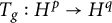
For
$T_g:H^p\to H^q$
 , we write
$V_{p,q}=V_{H^p,H^q}$
 . These spaces are completely known. In fact (see [Reference Aleman and Cima5, Reference Aleman and Siskakis6] or [Reference Pau27] for earlier proofs in the case
$n=1$
 ),
-
• $p=q$
 :
$V_{p,q}=BMOA$
;
-
• $p<q$
:
$V_{p,q}=\mathcal {B}^\alpha $
; -
• $p>q$
:
$V_{p,q}=H^r$
.


Here,
$r=pq/(p-q)$
 ,
$\alpha =1+n/q-n/p,$
 and
$\mathcal {B}^\alpha $
 is the Bloch-type space consisting of analytic functions g with

and we understand this space to consist of constants only, if
$\alpha <0$
 (in which case
$T_g$
 is the zero operator). The space
$BMOA$
 is the space of holomorphic functions of bounded mean oscillation, which consists of
$g \in H(\mathbb {B}_n)$
 with

where the supremum is taken over all non-isotropic metric balls

and
$g_Q$
 denotes the average of g over Q (see [Reference Zhu35]). For
$BMOA$
 in one complex variable, see [Reference Duren17, Reference Zhu36].
Given X, Y, and
$g \in V_{X,Y}$
 , we may ask which holomorphic functions f are mapped into Y by
$T_g$
 . This vector space of holomorphic functions will be called the optimal domain of
$T_g$
 and denoted

This space
$[g:Y]$
 can be equipped with the quasinorm
$\|f\|_{[g:Y]}=\|T_gf\|_Y$
 . The study of optimal domains for integration operators was initiated by Curbera and Ricker [Reference Curbera and Ricker14, Reference Curbera and Ricker15], who looked into this concept for the Cesáro operator. In the recent years, there has been a number of interesting papers on the topic (see [Reference Albanese, Bonet and Ricker2, Reference Albanese, Bonet and Ricker3, Reference Bellavita, Daskalogiannis, Nikolaidis and Stylogiannis10] or [Reference Bellavita, Belli, Nikolaidis and Stylogiannis9, Reference Liu and Sun22] for meromorphic optimal domains in the context of Hardy and Bergman–Morrey spaces). We mention that all the aforementioned papers are written in the setting of the unit disk. We also remark that our notation differs slightly from them. However, in the context of Volterra operators only, this notation should not confuse the reader. We have chosen it because it makes the notation
$[V_{X,Y}:Y]$
 that is given below more convenient.
From the definitions, it follows that we always have
$X\subseteq [g:Y]$
 for
$g \in V_{X,Y}$
 , and if, for instance,
$X=Y=H^p$
 and
$n=1$
 , the inclusion is known to be proper [Reference Bellavita, Daskalogiannis, Nikolaidis and Stylogiannis10]. However, another interesting question is whether the intersection of all the optimal domains agrees with X. That is, whether
$[V_{X,Y}:Y]=X$
 , where

We understand this problem in the following way. While X and Y uniquely define
$V_{X,Y}$
 , when is it true that Y and
$V_{X,Y}$
 uniquely define X? Or, in other words, can X be recovered from the optimal domains of bounded Volterra operators
$X\to Y$
 .
Before going further, let us offer a simple example. Let
$X=A(\mathbb {B}_n)$
 be the ball algebra and
$Y=\mathcal {B}^1$
 be the standard Bloch space. It is easy to see that
$V_{X,Y}=\mathcal {B}^1$
 , and that for every
$g \in V_{X,Y}$
 , one has
$H^\infty \subseteq [g:\mathcal {B}^1]$
 , so clearly
$X \subsetneq [V_{X,Y}:Y]$
 in that case. But one might argue that an example such as this one is tailor-made for the identity to fail. So what happens in the Hardy spaces?
We will prove that the spaces
$[g:H^q]$
 are always complete in their respective topologies, and that if
$T_g:H^p\to H^q$
 is bounded, then
$H^p$
 is strictly contained in
$[g:H^q]$
 . In [Reference Bellavita, Daskalogiannis, Nikolaidis and Stylogiannis10], it is proven that

when
$n=1$
 . In this work, we work in the setting of the unit ball and prove that if
$p>q$
 and
$r=pq/(p-q)$
 , then

which means that
$H^p$
 can be recovered from the optimal domains of bounded
$T_g:H^p\to H^q$
 for
$p>q$
 . On the other hand, when
$p<q$
 and
$\alpha =1+n/q-n/p$
 , we prove

and moreover
$[\mathcal {B}^\alpha :H^q]$
 has a simple description as a tent space. We also establish (1.1) for the unit ball.
The results indicate, in particular, that
$H^p$
 cannot be recovered from optimal domains of bounded
$T_g:H^p\to H^q$
 for
$p<q$
 . Other properties of optimal domains of this type were very recently considered in [Reference Albanese, Bonet and Ricker3] for
$n=1$
 .
In Section 2, we focus on the case
$p>q$
 , but we also prove some basic results on optimal domains such as the fact that
$[g:H^q]$
 is always a quasi-Banach space whose pointwise multipliers are functions in
$H^\infty $
 (Theorem 2.1). For the full characterization of the intersection of optimal domains in the case
$p>q$
 , which is Theorem 2.2, we will also characterize the boundedness of
$S_g$
 between two Hardy spaces. This is key to studying optimal domains using the approach in [Reference Bellavita, Daskalogiannis, Nikolaidis and Stylogiannis10]. Section 3 is devoted to the study of the case
$p<q$
 , most notably Theorem 3.1, where we also characterize the intersection of the optimal domains, providing the necessary tent space definitions.
Section 4 deals with the case
$p=q$
 , where the problem was originally studied. We verify that
$H^p$
 is always strictly contained in the corresponding optimal domain and record as a consequence of this and the previous results that is always the case for a bounded
$T_g:H^p\to H^q$
 in Corollary 4.1. Finally, we show that
$H^p$
 can be recovered for the optimal domains of
$T_g$
 for every
$p>0$
 (see Theorem 4.2). Perhaps surprisingly, this is the most difficult of the three main proofs, and that is why it is saved for the last. This proof, as well as the other two main proofs, makes use of the theory on tent spaces, together with Kahane and Khinchine inequalities and atomic decompositions. In Section 5, we present some corollaries that directly follow from the results of this article, but can be of interest.
When studying
$[V_{p,q}:H^q]$
 , we characterize the boundedness of
$S_g:V_{p,q}\to H^q$
 . For such proofs, we can assume that g is already in the desired space. This idea is widely applied in [Reference Miihkinen, Pau, Perälä and Wang25, Reference Pau27] and can be used since, for the dilations
$g_s(z)=g(sz),$
 one has the pointwise convergences
$S_{g_s}f(z)\to S_gf(z)$
 and
$g_s(z) Rf(z)\to g(z)Rf(z)$
 . Then the result follows from Fatou’s lemma. This works, when the norms of the dilations
$g_s$
 in the corresponding space are uniformly dominated by the norm of g itself. The spaces we are studying are like this, and it is mostly standard (for tent spaces, see Lemma 7 of [Reference Perälä28]).
We are going to need comparisons between different quantities. As is standard, by
$A\lesssim B$
 (or equivalently
$B\gtrsim A$
 ), we mean that there exists
$C>0$
 so that
$A\leq CB$
 . If both
$A \lesssim B$
 and
$B\gtrsim A$
 are true, we write
$A\asymp B$
 . Given
$1<p<\infty $
 , we also write
$p'$
 for its Hölder conjugate,
$p'=p/(p-1)$
 .
2 The case
$\boldsymbol{p>q}$

We begin by proving that the optimal domains
$[g:H^q]$
 for a non-constant holomorphic g are always quasi-Banach spaces, and Banach spaces, if
$q\geq 1$
 . If g is constant, then the optimal domain is trivially all of
$H(\mathbb {B}_n)$
 , and the construction gives it the trivial topology, making this case meaningless for further analysis. We also describe the multiplier space.
Theorem 2.1 Let
$0<q<\infty $
 and g be holomorphic and non-constant. Then the optimal domain
$[g:H^q]$
 is a quasi-Banach space. It is further a Banach space if
$q\geq 1$
 . The multiplication operator
$M_h f=hf$
 is bounded on
$[g:H^q]$
 if and only if
$h \in H^\infty $
 .
Proof The map
$f\mapsto T_gf$
 is linear. Therefore, it is clear that the topology in
$[g:H^q]$
 is given by a norm or a quasi-norm, whenever the topology of
$H^q$
 is. We next investigate the completeness of
$[g:H^q]$
 . The argument is largely the same as in Theorem 1 of [Reference Bellavita, Daskalogiannis, Nikolaidis and Stylogiannis10].
Let
$f \in [g:H^q]$
 . Let
$Z_{Rg}=\{z\in \mathbb {B}_n: Rg(z)=0\}$
 . For each point
$z \notin Z_{Rg}$
 , we have

which follows from using the boundedness of the functional
$h\mapsto Rh(z)$
 on
$H^q$
 . The positive constants
$C_z$
 depend on
$1/|Rg(z)|$
 and q but vary continuously on
$\mathbb {B}_n\setminus Z_{Rg}$
 .
Let now
$z \in Z_{Rg}$
 . This case needs some extra effort, since the zeros of holomorphic functions of several complex variables need not be isolated inside the domain. We proceed as follows. Since g is not constant, there exists
$\zeta \in \mathbb {C}^n$
 with
$|\zeta |=1$
 , and
$\varepsilon>0$
 , so that the one variable analytic slice
$h_\zeta (w)=Rg(z+w\zeta )$
 satisfies
$|h_\zeta (w)|>\varepsilon $
 when
$r<|w|<R$
 for some
$0<r<R$
 . We can use subharmonicity of
$\log |h_\zeta |$
 to arrive at an upper bound for
$|f(z)|$
 similar to that in [Reference Bellavita, Daskalogiannis, Nikolaidis and Stylogiannis10]. This upper bound can be chosen to be uniform in some neighborhood of z (regardless if the new point belongs to
$Z_{Rg}$
 or not).
From these observations, it follows that Cauchy sequences in
$[g:H^q]$
 converge to a holomorphic function uniformly on compact subsets. Now that this has been achieved, the rest of the argument in the cited paper carries over.
For the second claim of the proof, the reader can follow the argument of Theorem 4 in [Reference Bellavita, Daskalogiannis, Nikolaidis and Stylogiannis10], which also works in the present setting.
Let
$ 0<q<p<\infty $
 and
$ r= pq/(p-q)$
 . We show that if
$T_g:H^p\to H^q$
 is bounded, then
$H^p$
 is always strictly contained in the optimal domain
$[g:H^q]$
 .
Proposition 2.1 Let
$ 0<q<p<\infty $
 ,
$g \in H^r$
 . Then
$H^p\subsetneq [g:H^q]$
 .
Proof One can argue as in [Reference Bellavita, Daskalogiannis, Nikolaidis and Stylogiannis10]. Indeed, for any
$g \in H^r$
 , it is trivially true that
$H^p$
 is contained in
$[g:H^q]$
 . If there were a
$g \in H^r$
 with
$H^p=[g:H^q]$
 , the identity map would be bounded and onto
$H^p\to [g:H^q]$
 . The open mapping theorem (which holds also for F-spaces [Reference Rudin31]) then implies that
$T_g:H^p\to H^q$
 is bounded below.
Since
$H^p$
 is a subspace of
$[g:H^q]$
 and embeds there boundedly, if there was a
$g \in H^r$
 with
$H^p=[g:H^q]$
 , one would have that
$T_g:H^p\to H^q$
 is bounded below. It is well-known [Reference Pau27] that for this range of p and q,
$T_g:H^p\to H^q$
 is bounded if and only if it is compact. A compact operator cannot be bounded below.
We now proceed with the proofs of the results mentioned in Section 1.
Theorem 2.2 Let
$ 0<q<p<\infty $
 and
$ r= pq/(p-q)$
 . Then
$ H^p = [H^r:H^q]$
 .
Proof We follow the reasoning in [Reference Bellavita, Daskalogiannis, Nikolaidis and Stylogiannis10]. Let
$ g\in V_{p,q} = H^r$
 and
$f\in [H^r: H^q]$
 . Now,
$ T_g f $
 belongs to
$H^q$
 , or equivalently,
$S_f g \in H^q$
 . It follows from the closed graph theorem (for F-spaces if necessary; see [Reference Rudin31]) that
$S_f:H^r\to H^q$
 is bounded. The claim now follows from the next theorem.
We will formulate the following theorem in the standard form. That is, for
$S_g:H^p\to H^q$
 . Note that if
$p>q$
 , the roles of p and r are symmetric, so are be able to finish the proof once this result is obtained.
Theorem 2.3 Let
$ 0<q<p<\infty $
 ,
$ r= pq/(p-q),$
 and
$g \in H(\mathbb {B}_n)$
 . Then
$S_g: H^p \to H^q$
 is bounded if and only if
$ g\in H^r $
 . Moreover, if
$g(0)=0$
 , we have

Proof We note that this result is probably known to experts, at least when
$n=1$
 . Since we have been unable to find its proof in the literature, one is given here.
We first consider the sufficiency. In fact, it follows easily from the corresponding results for
$T_g$
 and the multiplication operator
$M_g$
 . We provide a direct proof, similar to one for
$T_g$
 in [Reference Pau27], by methods that will be used for the necessity. For
$\gamma>1$
 and
$|\zeta |=1$
 , we denote by
$\Gamma (\zeta )=\Gamma _{\gamma }(\zeta )$
 the approach region

For
$\beta \in \mathbb {R}$
 , we write
$dV_\beta (z)=(1-|z|^2)^\beta dV(z)$
 , where V is the normalized
$2n$
 -dimensional Lebesgue measure on
$\mathbb {B}_n$
 . Now assume
$g\in H^r $
 with
$ r= pq/(p-q)$
 . If
$f\in H^p $
 , then by the area function description of Hardy spaces [Reference Ahern and Bruna1, Reference Pau27], we have

We use Hölder’s inequality and get

Equivalently, this means

giving the sufficiency.
For the necessity, we proceed with the argument from [Reference Miihkinen, Pau, Perälä and Wang25], based on the Kahane and Khinchine inequalities [Reference Luecking24], atomic decomposition [Reference Coifman and Rochberg13, Reference Pau27], area function description of Hardy spaces [Reference Ahern and Bruna1, Reference Pau27], and factorization of tent spaces [Reference Cohn and Verbitsky11, Reference Coifman, Meyer and Stein12, Reference Miihkinen, Pau, Perälä and Wang25]. The proof follows the outline of either Theorem 7 or Theorem 8 of [Reference Miihkinen, Pau, Perälä and Wang25], except that it is simpler. The proof is somewhat sketchy; an interested reader can take a look at [Reference Miihkinen, Pau, Perälä and Wang25].
Let
$Z=\{a_k\}\subseteq \mathbb {B}_n$
 be a
$\rho $
 -lattice in the Bergman metric. Most of the argument below works for any
$\rho>0$
 , but in the very last stage, we shall assume that
$\rho $
 is very small. Let
$b>n\max (1,2/p)$
 . We consider a family of test functions of the form

where the sequence
$ \{\lambda _k\} $
 belongs to
$ T_2^p$
 , a tent space of sequences indexed by the lattice, and
$r_k : [0,1]\to \{-1 , +1\} $
 are the Rademacher functions. By the comment at the end of Section 1, we may assume that g is already in
$H^r$
 and focus on establishing
$\|g\|_{H^r}\lesssim \|S_g\|$
 . The general claim follows from pointwise convergence and a limit argument. For essentially the same reason, we may assume that the sum defining
$F_t$
 is a finite one. This is a valid simplification, since replacing the elements of
$\{\lambda _k\}$
 by zeros cannot increase the
$T^p_2$
 norm, and the sum converges pointwise.
By the area function description of the Hardy spaces, integrating with respect to t, where
$ t\in [0,1], $
 and using Fubini’s theorem, we have

Now, using Kahane’s inequality and Fubini’s theorem, this gives

We use Khinchine’s inequality to obtain

Replacing the integral over
$ \Gamma (\zeta ) $
 by an integral over Bergman metric balls
$B(a_k, \rho )$
 , and switching to an approach region with a smaller aperture, also denoted by
$\Gamma (\zeta )$
 ,

We proceed by using subharmonicity and
$|1-\langle z,a_k\rangle | = 1-|a_k|^2 $
 for every
$ z\in B(a_k, r)$
 , arriving at the estimate

Denoting
$\nu _k = |a_k|^2 |g(a_k)|,$
 we want to prove that
$ \{\nu _k\} \in T^r_\infty $
 . This would lead to a discrete way to express that
$g\in H^r$
 .
Let
$s>0$
 be big enough so that
$2s>1$
 and
$qs>1$
 hold. We are done if we can prove that
$\{\nu _k^{1/s}\}\in T^{rs}_\infty $
 . By duality of tent spaces (see [Reference Arsenović8, Reference Jevtić21]), since
$rs>1$
 , this can be shown if we prove

To this end, we assume that
$\lambda _k$
 and
$\tau _k$
 are positive. Indeed, since
$\nu _k$
 are positive, the above dual pairing is clearly at its biggest for a positive sequence
$\{\mu _k\}$
 , and the sign change on individual elements does not affect the norm of the corresponding tent space. We get

Next, using Hölder’s inequality, yields

Consider
$ 2s/(2s-1) = (2s)' $
 and doing another H
$ \ddot{\text{l}} $
 der’s inequality for
$qs$
 and
$qs/(qs-1) = (qs)'$
 gives us now that the expression is dominated by

The first part is the norm
$\|\tau \|_{T^{(qs)'}_{(2s)'}}.$
 By using (2.1) for the second part, to get the upper bound
$\|S_g\|^{1/s} \|\lambda \|^{1/s}_{T^p_2} = \|S_g\|^{1/s} \|\lambda \|_{T^{ps}_{2s}}$
 . Altogether, we have

By factorization of tent spaces (essentially due to Cohn and Verbitsky [Reference Cohn and Verbitsky11], but the present variant is taken from [Reference Miihkinen, Pau, Perälä and Wang25]) and considering
$\mu _k =\tau _k \lambda _k^{1/s}$
 as an arbitrary positive element of the space
$T^{(rs)'}_1,$
 using duality, we have
$\{\nu _k^{1/s}\} \in T^{rs}_\infty $
 . By the discussion and calculation above, this leads to
$\|\nu \|_{T^r_\infty } \lesssim \|S_g\|,$
 which is what we wanted to prove.
Now, choosing
$\rho>0$
 small enough and invoking Lemma 3 of [Reference Miihkinen, Pau, Perälä and Wang25], we get

for every
$i\in \{1,2,\ldots ,n\}$
 (since
$z_i^2g(z)$
 is holomorphic), yielding that

By the admissible maximal function description of Hardy spaces, we see that
$H^r$
 and the tent space of holomorphic functions defined by (2.2) are in bijective correspondence. By the bounded inverse theorem for F-spaces, we get that
$\|g\|_{H^r}\lesssim \|S_g\|$
 .
3 The case
$\boldsymbol{p<q}$

If
$0<p<q<\infty $
 and
$T_g:H^p\to H^q$
 is compact, then Proposition 3.19 of [Reference Albanese, Bonet and Ricker3] states that
$H^p\subsetneq [g:H^q]$
 . In fact, the result in the cited paper is formulated on the unit disk, but extends to several complex variables without extra efforts. In this section, we are going to show that the same is true for the intersection of the optimal domains, even when taken over all bounded
$T_g$
 . Moreover, we completely describe this intersection.
As an appetizer, we present a short proof that the intersection of the optimal domains is always larger than
$H^p$
 , when
$p<q$
 . We need to introduce the standard weighted Bergman spaces. Let
$\beta>-1$
 and
$0<p<\infty $
 . The weighted Bergman space
$A^p_\beta $
 consists of
$f \in H(\mathbb {B}_n)$
 with

See [Reference Zhu35, Reference Zhu36] for some basic theory of
$A^p_\beta $
 . We need the following inclusion between Hardy and Bergman spaces for
$p<s$
 :

In the unit disk, this result goes back at least to 1932 paper of Hardy and Littlewood [Reference Hardy and Littlewood19]. It is also a special case of Duren’s theorem [Reference Duren16]. It is moreover known that the spaces
$A^s_{n\frac {s}{p}-n-1}$
 increase in size as s increases. A simple proof of (3.1) can be found in [Reference Zhu35] (see Theorem 4.48).
Proposition 3.1 Let
$ 0<p<q<\infty $
 and
$\alpha =1+n/q-n/p$
 . Then one has
$ H^p \subsetneq [\mathcal {B}^\alpha : H^q]$
 .
Proof Assume
$p<q$
 and
$g\in \mathcal {B}^{\alpha }$
 . We consider two cases,
$q>2$
 and
$q\leq 2$
 . For the case
$q>2$
 , let
$s\in (2,q)\cap (p,q)$
 . Then we have
$2<s<q$
 and from Theorem 1(1) of [Reference Miihkinen, Pau, Perälä and Wang25], it follows that
$T_g: A^s_{n\frac {s}{p}-n-1} \to H^q$
 is bounded. Therefore,
$ A^s_{n\frac {s}{p}-n-1} \subseteq [g : H^q]$
 .
Let us next assume that
$q\leq 2 $
 . Here, we could also proceed by taking
$s\in (p,q)$
 , in which case
$s\leq \min \{2,q\}$
 . But in fact, we can let
$s=q$
 , obtaining a larger space. According to case (1) of Theorem 1 in [Reference Miihkinen, Pau, Perälä and Wang25] (in fact, in the unit disk, this case was obtained earlier by Wu [Reference Wu33]), the boundedness of
$T_g : A^q_{n\frac {q}{p}-n-1} \to H^q$
 is equivalent to
$ g\in \mathcal {B}^{\alpha }$
 .
Now, by using (3.1), the space
$H^p$
 embeds into
$A^s_{n\frac {s}{p}-n-1}$
 or
$A^q_{n\frac {q}{p}-n-1}$
 , whichever we want. The inclusion is also strict as Bergman functions need not have boundary values almost everywhere. Therefore, the proof is complete.
The following result clearly follows from the above theorem. We record it here.
Corollary 3.1 If
$0<p<q<\infty $
 and
$T_g:H^p\to H^q$
 is bounded, then
$H^p\subsetneq [g:H^q]$
 .
It turns out that, unless
$q=2$
 , even the Bergman spaces above are smaller than the intersection. In fact, the space
$[\mathcal {B}^\alpha :H^q]$
 has a convenient description as a tent space.
Let
$\omega \geq 0$
 be a measurable function. We denote by
$AT^p_q(\omega )$
 the weighted tent space (based on the original construction by Coifmanet al. [Reference Coifman, Meyer and Stein12]) consisting of analytic functions f with

These spaces are very useful for a great number of problems on the unit ball (see [Reference Ahern and Bruna1, Reference Arsenović8, Reference Jevtić21, Reference Miihkinen, Pau, Perälä and Wang25–Reference Perälä28]).
When we have a standard weight
$\omega (z)=(1-|z|^2)^\beta $
 , we write
$AT^p_q(\omega )=AT^p_{q,\beta }$
 . These spaces will be F-spaces, at least when
$q\geq 1$
 . We note that, like the Bergman space
$A^q_\beta $
 , this space is nontrivial if
$\beta>-1$
 . We can now precisely describe the intersection of the optimal domains in the case
$p<q$
 .
Theorem 3.1 Let
$0<p<q<\infty $
 and
$\alpha =1+n/q-n/p\geq 0$
 . We then have

If
$\alpha <0$
 , then
$[\mathcal {B}^\alpha :H^q]$
 consist of all holomorphic functions on the ball.
Proof We first prove that
$AT^p_{2,1-2\alpha }$
 is contained in
$[\mathcal {B}^\alpha :H^q]$
 . Using the area description of
$H^q$
 , one obtains

Bearing in mind
$g \in \mathcal {B}^\alpha $
 , we use the pointwise estimate

We get

This gives exactly that
$T_g:AT^q_{2,1-2\alpha }\to H^q$
 is bounded. Observe that
$\alpha <1$
 , so
$1-2\alpha>-1$
 , and the space is nontrivial. We see that
$AT^p_{2,1-2\alpha }$
 is contained in
$[\mathcal {B}^\alpha :H^q]$
 .
We prove the other inclusion. It suffices to show that
$S_g:\mathcal {B}^\alpha \to H^q$
 being bounded implies that
$g \in AT^q_{2,1-2\alpha }$
 . So let us assume that
$S_g$
 is bounded. Let us first deal with the case
$\alpha =0$
 . In that case, we test with
$F_i(z)=z_i$
 and use the area description of
$H^q$
 as above. This shows that
$z_i g(z)$
 belongs to
$AT^q_{2,1}$
 for every
$i=1,2,\ldots ,n$
 . As in the end of the proof of Theorem 2.3, this leads to
$g \in AT^q_{2,1}$
 .
We now turn to the case
$0<\alpha <1$
 . The idea is similar to that of Theorem 2.3, and to this end, we use the atomic decomposition of
$\mathcal {B}^\alpha $
 . This result can be found in [Reference Zhao and Zhu34] (if
$0<\alpha <1$
 , the space
$\mathcal {B}^\alpha $
 is the same as the Lipschitz space
$\Lambda _{1-\alpha }$
 in the notation and terminology of the reference), where it is explained how it directly follows from the atomic decomposition of the Bloch space [Reference Zhu35]. Let
$\{a_k\}$
 be a
$\rho $
 -lattice in the Bergman metric. For every
$\{\lambda _k\}\in \ell ^\infty $
 , the functions

belong to
$\mathcal {B}^\alpha $
 , when
$b>n$
 . The functions
$r_k$
 are the Rademacher functions like in Theorem 2.3.
By using the set of techniques demonstrated in the proof of Theorem 2.3, and the calculations leading up to (2.1) to control
$S_gF_t$
 , one arrives at the estimate

If we select
$\lambda _k=1$
 for every k, we get the discrete variant of what we want. Assuming
$\rho>0$
 is small enough, we can use Lemma 3 of [Reference Miihkinen, Pau, Perälä and Wang25] and reason as in the proof of Theorem 2.3 to get that
$ g \in AT^q_{2,1-2\alpha }$
 .
The latter claim is clear: If
$\alpha <0$
 , then
$\mathcal {B}^\alpha $
 consists of the constant functions only, and
$T_g$
 is the zero operator.
We note that if
$q<2$
 , then

whereas if
$q>2$
 and
$s<q$
 , we have

These inclusions can be proven as Lemma 15 in [Reference Perälä28]. We also have

so the simple argument in Proposition 3.1 is enough to find the correct intersection in this case. Letting
$p\to q^-$
 , we have
$\alpha \to 1^-$
 . The space
$AT^q_{2,-1-n}$
 consists only of the zero function, but considering how the derivatives act on tent spaces [Reference Perälä28], the phenomenon is somewhat comparable to how one often interprets
$H^q=A^q_{-1}$
 .
4 The case
$\boldsymbol{p=q}$

Since the case
$p=q$
 is where the problem was initially studied for the unit disk, investigation of this case is in order for higher dimension. We first observe that if
$g \in BMOA$
 , then
$H^p\subsetneq [g:H^p]$
 . The proof follows the same reasoning as the one-dimensional proof in [Reference Bellavita, Daskalogiannis, Nikolaidis and Stylogiannis10], where it can be reduced to the case
$p=q=2$
 and a theorem due to Anderson [Reference Anderson7].
When
$n=1$
 , one can use monomials
$z^k$
 as test functions. In fact, these functions being suitable is closely related to them being inner functions on the unit disk. When
$n\geq 2$
 , one needs to employ inner functions on the unit ball. The existence of non-constant inner functions in higher dimension is by no means a trivial matter. The first construction was in 1982 and due to Aleksandrov [Reference Aleksandrov4], but around the same time, the works of Hakim and Sibony [Reference Hakim and Sibony18] and Løw [Reference Løw23] obtained the same result independently. A reader interested in the development of this interesting topic might want to look at the following paper of Rudin [Reference Rudin30].
Theorem 4.1 Let
$0<p<\infty $
 and
$g \in BMOA$
 . Then
$H^p\subsetneq [g:H^p]$
 .
Proof By the same reasoning as in Theorem 2 of [Reference Bellavita, Daskalogiannis, Nikolaidis and Stylogiannis10] – see also the proof of Theorem 2.1 in the present article – it suffices to show that
$T_g:H^p\to H^p$
 is not bounded below.
We first consider the case
$p=2$
 . If
$f \in H^2$
 , then the
$H^2$
 norm of
$T_gf$
 is comparable to

Note that
$g \in BMOA$
 if and only if the measure
$d\mu _g(z)=|Rg(z)|^2(1-|z|^2)dV(z)$
 is a Carleson measure, meaning that
$H^2$
 embeds boundedly into
$L^2_{\mu _g}$
 (see Theorem 5.14 of [Reference Zhu35]). Now, let
$\varphi $
 be an inner function on the unit ball, and consider
$f_k=\varphi ^k$
 . With these choices, one has
$|\varphi (z)|< 1$
 for every point
$z \in \mathbb {B}_n$
 and
$\|f_k\|_{H^2}=1$
 for every k. By the dominated convergence theorem, the equivalent norms (4.1) tend to zero as
$k\to \infty $
 . This shows that
$T_g:H^2\to H^2$
 is not bounded below.
Now, if
$p\neq 2$
 , the argument of Lemma 1 of [Reference Bellavita, Daskalogiannis, Nikolaidis and Stylogiannis10] shows how to reduce this case to the case
$p=2$
 above.
We can collect Theorem 2.1, Corollary 3.1, and Theorem 4.1 as one corollary.
Corollary 4.1 Let
$0<p,q<\infty $
 and
$T_g:H^p\to H^q$
 be bounded. Then we have
$H^p\subsetneq [g:H^q]$
 .
As mentioned in the beginning of the article, when
$n=1,$
 the identity
$H^p=[BMOA:H^p]$
 for
$p\geq 1$
 was proved in [Reference Bellavita, Daskalogiannis, Nikolaidis and Stylogiannis10]. We extend this result to the Hardy spaces of the unit ball for the full range
$0<p<\infty $
 . We note that the proof is completely different from [Reference Bellavita, Daskalogiannis, Nikolaidis and Stylogiannis10], which is based on recovering g from
$S_g$
 by feeding the operator suitable simple test functions. We have not been able to carry out the same proof in the unit ball.
Theorem 4.2 Let
$0<p<\infty $
 . We have
$H^p=[BMOA:H^p]$
 .
Proof We only need to show that each element in
$[BMOA:H^p]$
 is an
$H^p$
 function. To show this, it is sufficient to show that the boundedness of
$S_g:BMOA\to H^p$
 implies
$g \in H^p$
 .
Again, we invoke the machinery used in Theorem 2.3. Let again
$Z=\{a_k\}$
 be a
$\rho $
 -lattice in the Bergman metric. By Theorem 5.29 of [Reference Zhu35], if
$b>n$
 , then the function

belongs to
$BMOA$
 , if the sequence
$\{\lambda _k\}$
 is chosen so that

is a Carleson measure. In the language of tent spaces, this means that
$\{\lambda _k\} \in T^{\infty }_2$
 or
$\{\lambda _k^2\} \in T^\infty _1$
 . This is a well-known fact about tent spaces (see Section 2.6 of [Reference Miihkinen, Pau, Perälä and Wang25] for the formulation on the unit ball).
We assume boundedness of
$S_g:BMOA\to H^p$
 , test with
$S_gF_t$
 , and estimate as we did leading up to (2.1), to obtain

Now, writing
$\nu _k=|a_k|^2 |g(a_k)|$
 , we aim to show that
$\{\nu _k\} \in T^p_\infty $
 . This is the same as showing that
$\{\nu _k^{2/s}\}\in T^{ps/2}_\infty $
 . We choose s big enough so that
$ps/2>1$
 and
$s>1$
 hold true. This means that we need to show that
$\{\nu _k^{2/s}\}$
 belongs to the dual of
$T^{(ps/2)'}_1$
 . According to the formula in the beginning of the proof of Proposition 6 in [Reference Miihkinen, Pau, Perälä and Wang25], we can factorize

Therefore, we look at

where
$\{\tau _k\} \in T^{(ps/2)'}_\infty $
 .
We now make the split
$\lambda _k^2=\lambda _k^{2/s'}\lambda _k^{2/s}$
 , observe that
$\{\lambda _k^{2/s'}\}\in T^\infty _{s'}$
 , and conclude that if
$\alpha _k=\tau _k \lambda _k^{2/s'}$
 , then
$\{\alpha _k\}\in T^{(ps/2)'}_{s'}$
 .
With these preparations, we do Hölder’s inequality with
$s'$
 and s and arrive at

Finally, we do another Hölder’s inequality with
$(ps/2)'$
 and
$ps/2$
 , so that we have proven

Since

we return to the estimate (4.2) and see that

By factorization, we finally get

Therefore,
$\{\nu _k^{2/s}\}$
 must belong to
$T^{ps/2}_\infty $
 , with the norm bound
$\|\nu ^{2/s}\|_{T^{(ps/2)}_\infty }\lesssim \|S_g\|^{2/s}$
 . This is equivalent to the membership of
$\{\nu _k\}$
 in
$T^p_\infty $
 and
$\|\nu \|_{T^p_\infty }\lesssim \|S_g\|$
 . We can use the same reasoning as in the end of the proof of Theorem 2.3 to see how this leads to
$g \in H^p$
 with the appropriate norm bound.
5 Concluding remarks
The companion operator
$S_g$
 has had a central role in this article. In fact, we have proven the following three results.
Corollary 5.1 Let g be a holomorphic function on the ball.
-
• If $0<q<p<\infty $
, then
$S_g:H^p\to H^q$
is bounded if and only if
$g \in H^r$
, where
$r=pq/(p-q)$
. -
• If $\kern1.2pt0\leq \alpha <1$
and
$0<q<\infty $
, then
$S_g:\mathcal {B}^\alpha \to H^q$
is bounded if and only if
$g \in AT^q_{2,1-2\alpha }$
. -
• If $0<p<\infty $
, then
$S_g:BMOA\to H^p$
is bounded if and only if
$g \in H^p$
.


In each of the cases, if
$g(0)=0$
 , then
$\|g\|_X\asymp \|S_g\|$
 , where X is the space corresponding to each case.
The area description of the Hardy spaces shows that
$[g:H^q]$
 always coincides with a tent space:

where
$\omega _g(z)=|Rg(z)|^2(1-|z|^2)$
 . The findings of this article can be expressed equivalently as follows.
Corollary 5.2 Let
$0<p,q<\infty $
 . We have the following identities:
-
• If $0<q<p<\infty $
and
$r=pq/(p-q)$
, then $$ \begin{align*}H^p=\bigcap_{g \in H^r}AT^q_2(\omega_g).\end{align*} $$
-
• If $\kern1.2pt 0<p<q<\infty $
and
$\alpha =1+n/q-n/p \in [0,1)$
, then $$ \begin{align*}AT^q_{2,1-2\alpha}=\bigcap_{g \in \mathcal{B}^\alpha}AT^q_{2}(\omega_g).\end{align*} $$
-
• We have
$$ \begin{align*}H^p=\bigcap_{g \in BMOA}AT^p_{2}(\omega_g).\end{align*} $$


Acknowledgements
We would like to thank the anonymous referee for the valuable comments that have improved the article.


 Open access

