1. Introduction
Given graphs
 $G$
and
 $F$
, if
 $G$
does not contain a copy of
 $F$
, then we say that
 $G$
is
 $F$
-free. We call an
 $n$
-vertex
 $F$
-free graph with maximum number of edges an extremal graph for
 $F$
. Turán [Reference Turán22] showed that the
 $n$
-vertex complete
 $(t-1)$
-partite graph with part sizes as equal as possible, denoted by
 $T(n,t-1)$
, is the unique extremal graph for
 $K_{t}$
, where
 $K_{t}$
is the complete graph on
 $t$
vertices. Over the following decades, determining the extremal graphs for a given graph (possibly under additional constraints) has developed into one of the central topics in extremal combinatorics.
In this paper we study a multi-partite version of Turán’s problem: we consider
 $F$
-free subgraphs of
 $K_{n_1,\ldots ,n_r}$
, the complete
 $r$
-partite graph with parts of sizes
 $n_1,\ldots ,n_r$
and
 $n_1 \ge \cdots \ge n_r$
. Denote by
 $\mathrm{ex}(n_1,\ldots ,n_r,F)$
the maximum number of edges in an
 $F$
-free subgraph of
 $K_{n_1,\ldots ,n_r}$
. Throughout the paper, we write
 $\mathcal{V} = (V_1, \ldots , V_r)$
for the vertex partition of
 $K_{n_1,\ldots ,n_r}$
, where
 $|V_i| = n_i$
for each
 $i$
.
Research on extremal problems in multi-partite graphs can be traced back to the work of Zarankiewicz [Reference Zarakiewicz23] on ex
 $(n,n,K_{2,2})$
. Later, Kövári, Sós, and Turán [Reference Kövári, Sós and Turán15] gave an upper bound of ex
 $(n,n,K_{s,t})$
. The above two results are strongly connected to the Turán numbers of bipartite graphs. Very recently, based a quantitative variant of the random algebraic method, Conlon [Reference Conlon5] gave good lower bounds for ex
 $(n,m,K_{s,t})$
when
 $n,m$
satisfy some additional conditions. For related topics of the Zarankiewicz problems, we refer the interested readers to [Reference Conlon5] and references therein.
Beyond bipartite settings, extremal problems in multi-partite graphs have been extensively studied from both edge and degree perspectives. Bollobás, Erdős, and Szemerédi [Reference Bollobás, Erdős and Szemerédi2] showed that if the minimum degree in a 3-partite graph with sizes
 $n$
,
 $n$
,
 $n$
is at least
 $n+1$
, then it contains at least
 $\min \{4,n\}$
triangles. This problem has since been thoroughly explored, often through its equivalent formulation in terms of independent transversals; see [Reference Haxell12–Reference Jin14, Reference Szabó and Tardos21].
We now turn to edge extremal problems for non-bipartite graphs. Bollobás, Erdős, and Straus [Reference Bollobás, Erdős and Straus1] determined
 $\mathrm{ex}(n_1,\ldots ,n_r; \, K_t)$
for
 $r \geq t$
. A natural candidate for extremal graphs is to take a partition of the
 $r$
parts into
 $(t-1)$
groups and consider the induced complete
 $(t-1)$
-partite subgraph. This motivates the following definition.
Let
 $ G$
be a graph with a vertex partition
 $ \mathcal{P} = (P_1, \ldots , P_{t-1})$
. We define
 $ G[\mathcal{P}]$
to be the spanning subgraph obtained by removing all edges within the parts of
 $ \mathcal{P}$
; that is,
 \begin{equation*} E\big(G[\mathcal{P}]\big) = E(G) \setminus \bigcup _{i=1}^{t-1} \binom {P_i}{2}. \end{equation*}
Equivalently,
 $ G[\mathcal{P}]$
is the intersection of
 $ G$
with the complete
 $(t-1)$
-partite graph on
 $ V(G)$
with parts
 $ \mathcal{P}$
.
Now fix integers
 $ r \geq t \geq 3$
, and let
 $ \mathcal{V} = (V_1, \ldots , V_r)$
be the partition of the vertex set of the complete
 $r$
-partite graph
 $ K_{n_1, \ldots , n_r}$
, with
 $ |V_i| = n_i$
and
 $ n_1 \ge \cdots \ge n_r$
. Given a (
 $t-1$
)-partition
 $ \mathcal{Q} = (I_1, \ldots , I_{t-1})$
of the index set
 $[r]\, :\!= \{1,\ldots ,r\}$
, we write
 $ \mathcal{P}_{\mathcal{Q}} = (V_{I_1}, \ldots , V_{I_{t-1}})$
, where
 $ V_I \, :\!= \bigcup _{i \in I} V_i$
. Then
 $ K_{n_1, \ldots , n_r}[\mathcal{P}_{\mathcal{Q}}]$
denotes the complete
 $(t{-}1)$
-partite spanning subgraph formed this way.
We define
 \begin{equation*} f(n_1, \ldots , n_r, 1, t)\, :\!= \max _{\mathcal{Q}} e(K_{n_1, \ldots , n_r}[\mathcal{P}_{\mathcal{Q}}]), \end{equation*}
where the maximum is taken over all partitions
 $ \mathcal{Q}$
of
 $[r]$
into
 $(t{-}1)$
parts. For example,
 $f(n+1, n, n, 1, 3) = (n+1) \times 2n$
. This is achieved by the partition
 $ \mathcal{Q} = \big(\{1\}, \{2, 3\}\big)$
, where the subgraph
 $ K_{n+1, n+n}$
has
 $ (n+1) \times 2n$
edges.
Bollobás, Erdős, and Straus [Reference Bollobás, Erdős and Straus1] showed that these constructions are optimal for avoiding
 $K_t$
in the multi-partite setting.
Theorem 1.1
(Bollobás, Erdős, and Straus [Reference Bollobás, Erdős and Straus1]). Let
 $r\geq t\geq 3$
. Then
 \begin{equation*}\textrm {ex}(n_1,\ldots ,n_r,K_{t})=f(n_1,\ldots ,n_r,1,t).\end{equation*}
Any partition
 $ \mathcal{P}$
of
 $V(K_{n_1, \ldots , n_r})$
(it is possible that
 $\mathcal{P}\neq \mathcal{P}_{\mathcal{Q}}$
for any
 $(t-1)$
-partition
 $\mathcal{Q}$
of
 $[r]$
, see Theorem1.12) achieving the maximum in Theorem1.1 is called an extremal
 $(t{-}1)$
-partition.
Our first theorem shows that the extremal graphs in Theorem1.1 are all (
 $t-1$
)-partite.
Theorem 1.2.
Let
 $r\geq t$
and
 $n_1,\ldots ,n_{t-1}$
be sufficiently large. Each extremal graph in Theorem1.1 is of form
 $K_{n_1,\ldots ,n_r}[\mathcal{P}]$
, where
 $\mathcal{P}$
is an extremal
 $(t-1)$
-partition for
 $K_{n_1,\ldots ,n_r}$
.
In Section 1.1, we will provide a precise structural characterization of the extremal graphs in the Bollobás–Erdős–Straus theorem (see Theorem1.12).
We will also consider the extremal problem for
 $kK_t$
, the disjoint union of
 $k$
copies of
 $K_t$
. Chen, Li, and Tu [Reference Chen, Li and Tu4] determined the value of
 $ \mathrm{ex}(n_1, n_2, kK_2)$
. Later, De Silva, Heysse, and Young [Reference De Silva, Heysse, Kapilow, Schenfisch and Young20] extended this to the general problem of determining
 $ \mathrm{ex}(n_1, \ldots , n_r, kK_t)$
for
 $ r \gt t$
. To prove a lower bound on
 $ \mathrm{ex}(n_1, \ldots , n_r, kK_t)$
for
 $ r \gt t$
, Han and Zhao [Reference Han and Zhao11] constructed a
 $kK_t$
-free graph by starting from
 $K_{n_1,\ldots ,n_r}[\mathcal{P}_{\mathcal{Q}}]$
and adding all possible edges incident to
 $ k-1$
fixed vertices in some part
 $ V_i$
, where
 $ \mathcal{Q}$
is a
 $(t-1)$
-partition of
 $[r]$
. They showed that this construction is optimal for
 $ \mathrm{ex}(n_1, n_2, n_3, n_4, kK_3)$
when
 $n_4$
is sufficiently large.
For any
 $ I \subseteq [r]$
, define
 $ m_I = \min _{i \in I} n_i, n_I = \sum _{i \in I} n_i.$
For a partition
 $ \mathcal{Q}$
of
 $ [r]$
, let
 $ n_{\mathcal{Q}} = \max _{I \in \mathcal{Q}} (n_I - m_I).$
Define
 \begin{equation*} f(n_1, \ldots , n_r, k, t)\, :\!= \max _{\mathcal{Q}} \left \{ (k-1)n_{\mathcal{Q}} + \sum _{I \neq I' \in \mathcal{Q}} n_I n_{I'} \right \}, \end{equation*}
where the maximum is over all partitions
 $ \mathcal{Q}$
of
 $ [r]$
into
 $ t-1$
parts.
Conjecture 1.3.
Let
 $ r \geq t \geq 3$
and
 $ k \geq 2$
, and suppose
 $ n_1,\ldots ,n_r$
are sufficiently large. Then
 \begin{equation*} \mathrm{ex}(n_1, \ldots , n_r, kK_t) = f(n_1, \ldots , n_r, k, t). \end{equation*}
Note that if
 $n_{i}\lt k-1$
for some
 $i\in [r]$
, then it is possible that there is no graph corresponding to
 $f(n_1, \ldots , n_r, k, t)$
. Hence, we introduce the following family of graphs. Let
 $ \mathcal{H}$
be the set of all
 $(t{-}1)$
-partite subgraphs of
 $ K_{n_1, \ldots , n_r}$
. Let
 $ \mathcal{H}^{k-1}$
be the family of graphs obtained from some
 $ H \in \mathcal{H}$
by adding all edges incident to
 $ k-1$
fixed vertices. Define
 \begin{equation*} g(n_1, \ldots , n_r, k, t) \, :\!= \max \{ e(F) \, : \, F \in \mathcal{H}^{k-1} \}. \end{equation*}
We will prove Han and Zhao’s conjecture in the following strongerFootnote 1 form.
Theorem 1.4.
Let
 $ r \geq t \geq 3$
and
 $ k \geq 2$
, and
 $n_1,\ldots , n_{t-1}$
are sufficiently large. Then
 \begin{equation*} \mathrm{ex}(n_1, \ldots , n_r, kK_t) = g(n_1, \ldots , n_r, k, t). \end{equation*}
Moreover, every extremal graph is obtained from
 $ K_{n_1, \ldots , n_r}[\mathcal{P}]$
by adding all edges incident to
 $ k-1$
fixed vertices for some
 $(t{-}1)$
-partition
 $ \mathcal{P}$
.
Theorems1.2 and 1.4 follow from our stability theorem (see Theorem1.17 later).
Remark 1.5. In Theorem1.4, some extremal graphs for
 $ kK_t$
are not obtained by adding edges to an extremal
 $(t{-}1)$
-partition. For example, let
 $ K = K_{n_1, \ldots , n_6}$
with parts
 $ V_1, \ldots , V_6$
, where
 $ n_1 = n_2 = m + 1$
and
 $ n_3 = \cdots = n_6 = m$
for large
 $ m$
. One extremal graph for
 $ 3K_3$
is obtained using the partition
 $ \mathcal{P} = (V_1 \cup V_2 \cup V_3, V_4 \cup V_5 \cup V_6)$
, which is not an extremal
 $2$
-partition.
1.1 Near-extremal configurations
To state Theorem1.17, we first describe the structure of graphs that are close to extremal.
We begin by presenting an instructive phenomenon: in a multi-partite graph
 $ K_{n_1, \ldots , n_r}$
, an
 $ H$
-free subgraph
 $ G$
that is nearly extremal in terms of edge count may still differ significantly from any extremal graph for
 $ H$
. Such a graph
 $ G$
may closely resemble a structured form like
 $ K_{n_1, \ldots , n_r}[\mathcal{P}]$
, where
 $ \mathcal{P}$
is a partition with a certain recognisable pattern – but the structure of
 $ \mathcal{P}$
may not close any extremal configuration.
To illustrate this phenomenon, we consider the case
 $ H = K_3$
and use the multi-partite host graph
 $ K_{n+1, n, n}$
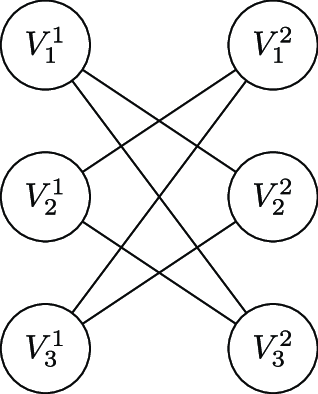
as an example; see Example1.6 and Figure 1.
Example 1.6. Let
 $ n$
be a positive integer. Consider the host graph
 $ K_{n+1, n, n}$
with parts
 $ (V_1, V_2, V_3)$
. By Theorem1.12, the subgraph
 $ K_{n+1, n, n}[(V_1, V_2 \cup V_3)]$
is the unique edge-maximum
 $ K_3$
-free subgraph of
 $ K_{n+1, n, n}$
. However, for any partition
 $ V_3 = V_3^1 \cup V_3^2$
, the graph
 $ K_{n+1, n, n}\big[\big(V_1 \cup V_3^1, V_2 \cup V_3^2\big)\big]$
is also
 $ K_3$
-free, and its number of edges is close to that of
 $ K_{n+1, n, n}[(V_1, V_2 \cup V_3)]$
.
Illustration of Example1.6.

In the near-extremalFootnote
2
partition
 $\mathcal{P} = (V_1 \cup V_3^1, V_2 \cup V_3^2)$
from Example1.6, the set
 $ V_3$
is split across both parts of
 $\mathcal{P}$
, whereas
 $ V_1$
and
 $ V_2$
lie entirely within one part. To describe such behaviour in general, we now introduce the notions of partial and integral sets with respect to a partition.
We say that a vertex partition of a graph is proper if there are no edges within any partite set. Let
 $ \mathcal{V} = (V_1, \ldots , V_r)$
be a fixed proper vertex partition of a graph
 $ G$
, and let
 $ \mathcal{P} = (P_1, \ldots , P_{t-1})$
be a vertex partition of a subset of
 $ V(G)$
. Given a pair
 $ (\mathcal{V}, \mathcal{P})$
,Footnote
3
we make the following definitions:
Definition 1.7
(partial and integral). We say that a part
 $ V_i$
is integral in
 $ P_j$
(or simply integral) if
 $ V_i \subseteq P_j$
, and partial in
 $ P_j$
(or simply partial) if
 $ V_i \cap P_j \neq \emptyset$
but
 $ V_i \not \subseteq P_j$
.
Definition 1.8
(partial and integral part). For each
 $ P_j \in \mathcal{P}$
, define the integral part of
 $ P_j$
, denoted
 $ I_{\mathcal{V}}(P_j)$
, to be the union of all
 $ V_i$
such that
 $ V_i \subseteq P_j$
. Define the partial part, denoted
 $ P_{\mathcal{V}}(P_j)$
, to be the union of all non-empty intersections
 $ V_i \cap P_j$
for which
 $ V_i \not \subseteq P_j$
.
When the reference partition
 $ \mathcal{V}$
is clear from context, we omit the subscript. We say that
 $ P_j$
is integral with respect to
 $ \mathcal{V}$
(or simply integral) if
 $ I(P_j) = P_j$
, and partial if
 $ P(P_j) \neq \emptyset$
.
For the pair
 $ (\mathcal{V}, \mathcal{P}) = ( (V_1, V_2, V_3),(V_1 \cup V_3^1,\, V_2 \cup V_3^2) )$
in Example1.6, the sets
 $ V_1$
and
 $ V_2$
are integral in their respective parts of the partition, while
 $ V_3$
is partial in both.
This example suggests a typical near-extremal configuration, where most partite sets are entirely contained in one part (integral), and only a small portion (e.g.,
 $ V_3$
) is split (partial). A natural question is whether all near-extremal configurations follow this structure, or whether more complex patterns with many partial sets can also occur – such as the one illustrated in Figure 2, where
 $ V_i = V_i^1 \cup V_i^2$
for each
 $ i \in [3]$
.
A hypothetical configuration with multiple partial sets.

While Figure 2 illustrates a hypothetical configuration with many partial parts, such complexity is rarely seen in actual near-extremal graphs. In practice, even though several partial sets may appear globally, the structure tends to be more controlled: each part typically contains at most one partial
 $ V_i$
. This observation motivates the following definition, which captures the structured nature of near-extremal configurations.
Definition 1.9
(
 $\textbf{1}$
-partial). A partition
 $\mathcal{P} = (P_1, \ldots , P_{t-1})$
is said to be
 $1$
-partial to
 $\mathcal{V} = (V_1, \ldots , V_r)$
(or simply
 $1$
-partial) if each part
 $P_j$
contains at most one set
 $ V_i$
that is partial in
 $ P_j$
.
Beyond this structural simplicity, we also observe a balance in sizes: integral parts tend to be of similar size, and partial sets are generally no larger. In other words, near-extremal partitions are not only simple in structure but also well balanced in size.
We formalise this idea with the following definition of
 $M$
-stable partitions.
Definition 1.10
(
 $\textbf{M}$
-stable). Let
 $r\geq t\geq 3$
be integers. Given a
 $(t-1)$
-partition
 $\mathcal{P}=(P_1,\ldots ,P_{t-1})$
and an
 $r$
-partition
 $\mathcal{V}=(V_1,\ldots .V_r)$
. Let
 $m= \min _{i\in [t-1]}|I(P_i)|$
. We say
 $\mathcal{P}$
is
 $M$
-stable to
 $\mathcal{V}$
, if the followings hold,
-
•
 $\mathcal{P}$
is
$1$
-partial to
$\mathcal{V}$
,
-
•
$|I(P_i)|\leq m+M$
if
$P_i$
is partial,
-
•
$|V_j|\leq m+M$
if
$V_j$
is partial,
-
•
$|P_j\setminus V_i|\leq m+M$
if
$V_i$
is integral in
$P_j$
.


In particular, if
 $M=0$
, then we simply say that
 $\mathcal{P}$
is stable to
 $\mathcal{V}$
.
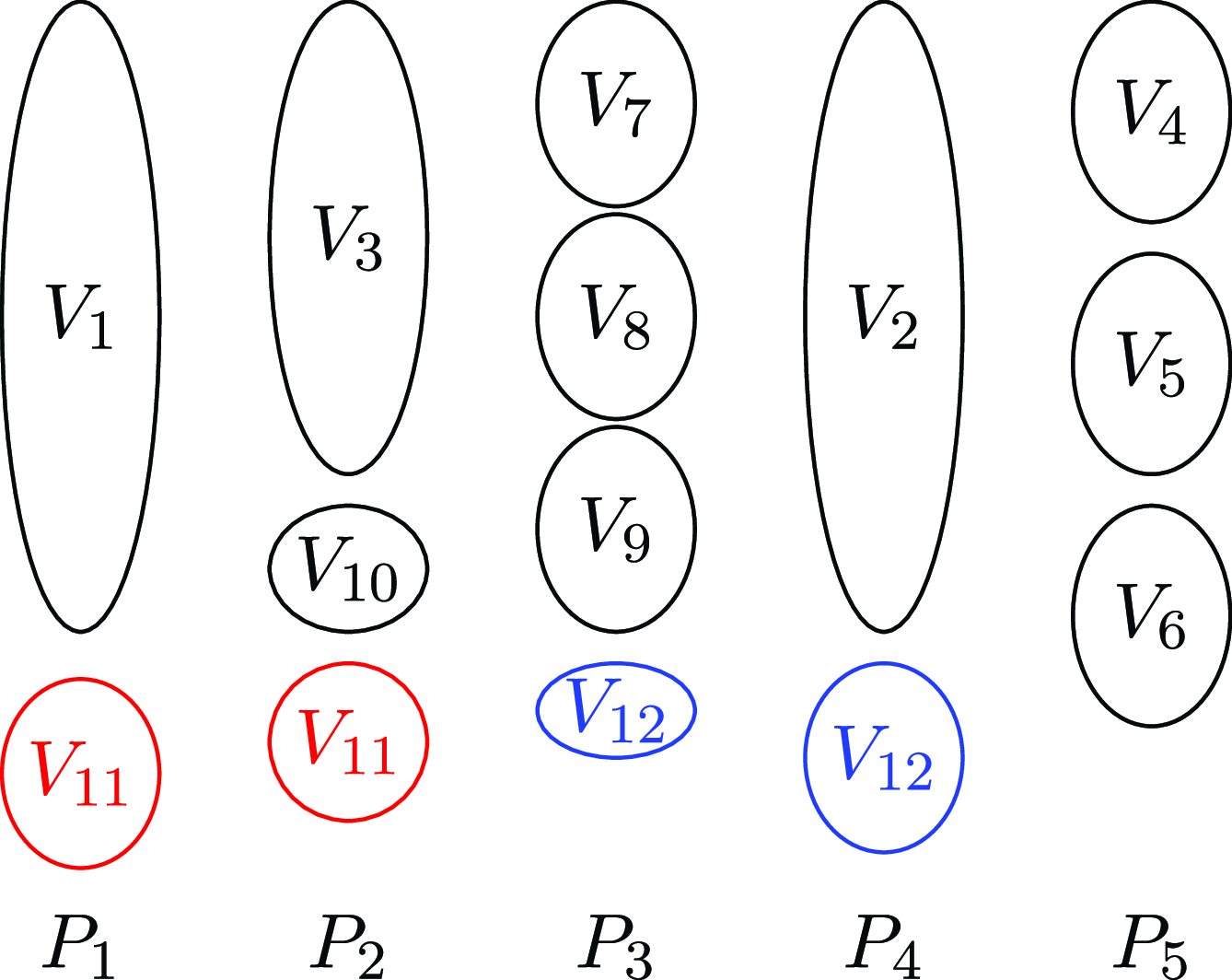
Figure 3 below provides a concrete example of a stable partition.
A partition
 $ \mathcal{P}=(P_1,\ldots ,P_5)$
that is stable to
 $ \mathcal{V} = (V_1, \ldots , V_{12})$
.

Remark 1.11. In Figure 3, the partition
 $ \mathcal{P}$
is stable to
 $ \mathcal{V}$
. Specifically:
-
•
$ V_1, \ldots , V_{10}$
are integral; -
•
$ V_{11}$
and
$ V_{12}$
are partial; -
•
$ |V_1| = |V_2| = m, \quad |V_3| = 0.7m, \quad |V_4| = |V_5| = |V_6| = 0.4m,$
$ |V_7| = |V_8| = |V_9| = m/3, \quad |V_{10}| = |V_{11}| = |V_{12}| = 0.3m.$


We now apply the stable structure defined above to describe the extremal configurations in Theorem1.1. To make this precise, we introduce the notion of normalisation: given a partition
 $ \mathcal{P}$
, its normalisation, denoted
 $ \mathcal{N}(\mathcal{P})$
, is the set of partitions obtained by moving all vertices of each partial
 $ V_i$
into a single part
 $ P_j$
that already intersects
 $ V_i$
. The extremal graph structure in Theorem1.1 is fully characterised by Theorem1.12.
Theorem 1.12.
Let
 $r\geq t\geq 3$
and
 $\mathcal{V}$
be a proper
 $r$
-partition of
 $K_{n_1,\ldots ,n_r}$
. A
 $(t-1)$
-partition
 $\mathcal{P}$
is an extremal
 $(t-1)$
-partition for
 $K_{n_1,\ldots ,n_r}$
if and only if
-
•
$\mathcal{P}$
is stable to
$\mathcal{V}$
and
-
• each partition in
$\mathcal{N}(\mathcal{P})$
is still an extremal
$(t-1)$
-partition for
$\mathcal{V}$
.


1.2 Stability results
Stability is a central concept in extremal graph theory. A classical theorem of Erdős and Simonovits [Reference Erdős6, Reference Erdős7, Reference Simonovits19] shows that any graph with nearly extremal edge count and forbidden subgraph
 $ F$
must resemble an extremal configuration. These stability results have been widely applied in various areas, such as determining extremal graphs and addressing supersaturation problems.
For example, Erdős and Simonovits [Reference Erdős and Simonovits8] applied their stability theorem to determine the extremal graphs for
 $ K_{2,2,2}$
, while Mubayi [Reference Mubayi16], Pikhurko and Yilma [Reference Pikhurko and Yilma18] used it to investigate supersaturation problems, specifically determining the minimum number of copies of a forbidden graph
 $ F$
in an
 $ n$
-vertex graph
 $ H$
with
 $ \textrm {ex}(n,F) + q$
edges, where
 $ \textrm {ex}(n, F)$
represents the extremal number of edges for
 $ F$
. These theorems are particularly useful when considering extremal problems for non-bipartite graphs, extending far beyond Turán-type problems. While we do not aim to list all applications of these results, it is clear that such stability results are essential tools in extremal graph theory.
As a starting point, we recall the classical result by Erdős and Simonovits to motivate our multi-partite version of stability (see Theorems1.15 and 1.17).
Let
 $ K_t^s = T(st, t)$
. Erdős and Stone [Reference Erdős and Stone9] showed that the extremal graphs for
 $ K_t^s$
have
 $ e(T(n,t-1)) + o(n^2)$
edges. In 1968, Erdős and Simonovits [Reference Erdős6, Reference Erdős7, Reference Simonovits19] proved the following well-known stability theorem.
Theorem 1.13
(Erdős–Simonovits Weak Stability Theorem [Reference Erdős6, Reference Erdős7, Reference Simonovits19]). Let
 $ F$
be a graph with chromatic number
 $ t \geq 3$
. Then every
 $ F$
-free graph on
 $ n$
vertices with
 $ e(T(n, t-1)) - o(n^2)$
edges contains a
 $ (t-1)$
-partite subgraph with
 $ e(T(n, t-1)) - o(n^2)$
edges and can be obtained from an extremal
 $F$
-free graph by changing only
 $o(n^2)$
edges.
Building on the classical weak stability result, we now consider a similar concept for multi-partite graphs. The following definitions will be crucial in establishing weak stability results in the multi-partite setting.
For a vertex set
 $X\subseteq V(G)$
and a partition
 $\mathcal{P}$
of
 $V(G)$
, we define:
 \begin{equation*}\mathcal{P}_X:\!=(P_1\setminus X,\ldots , P_{t-1}\setminus X).\end{equation*}
Given
 $a,b \in (0,1)$
, we use
 $a\mathop {\ll }b$
to denote that
 $a\lt b^N$
for some sufficient large constant
 $N$
. Let
 $A\bigtriangleup B$
stand for the symmetric difference of the sets
 $A$
and
 $B$
. Given two graphs
 $H$
and
 $F$
on the same vertex set, we say
 $F$
is
 $M$
-close to
 $H$
for some
 $M$
, if every vertex
 $v$
satisfies
 $|N_H(v) \bigtriangleup N_F(v)|\leq M$
.
Definition 1.14
(
 $(X,\epsilon )$
-stable). Given integers
 $t,r,n_1,\ldots ,n_r$
with
 $r\ge t\ge 3,n_1\ge \cdots \ge n_r$
. For a given spanning subgraph
 $G$
of
 $K_{n_1,\ldots ,n_r}$
, let
 $\mathcal{P}=(P_1,\ldots ,P_{t-1})$
be a
 $(t-1)$
-partition of
 $V(G)$
and
 $\mathcal{V}=(V_1,\ldots ,V_r)$
be the proper
 $r$
-partition of
 $K_{n_1,\ldots ,n_r}$
. We say
 $\mathcal{P}$
is an
 $(X,\epsilon )$
-stable partition for some constant
 $0\lt \epsilon \lt 1$
, if there exists a vertex set
 $X\subseteq V(G)$
with
 $|X|\leq \epsilon n_{t-1}$
such that
-
•
$G-X$
is
$\epsilon n_{t-1}$
-close to
$K_{n_1,\ldots ,n_r}[\mathcal{P}]-X$
and
-
•
$\mathcal{P}_X$
is stable to
$\mathcal{V}_X$
.


We now establish a stability result for near-extremal subgraphs of multi-partite graphs. Theorem1.15 shows that any such graph
 $G$
admits a well-structured partition
 $\mathcal{P}$
.
Theorem 1.15
(Weak Multi-partite Stability Theorem). Let
 $ F$
be a graph with chromatic number
 $ t \geq 3$
, and let
 $ G$
be an
 $ F$
-free subgraph of
 $ K_{n_1, \ldots , n_r}$
, where
 $ n_1 \geq \cdots \geq n_r$
and
 $ r \geq t$
. If
 \begin{equation*} e(G) = f(n_1, \ldots , n_r, 1, t) - o\big(n_{t-1}^2\big), \end{equation*}
then, after removing
 $ o(n_{t-1}^2)$
edges,
 $ G$
admits a
 $(t-1)$
-partition
 $ \mathcal{P} = (P_1, \ldots , P_{t-1})$
that is
 $ (X, o(1))$
-stable with
 $ |I(P_i \setminus X)| \geq (1 - o(1))n_{t-1}$
for all
 $ i \in [t-1]$
.
Remark. Different from Theorem1.13, our Theorem1.15 shows that there exist graphs
 $H$
with
 $\chi (H)=t$
such that if
 $e(G)\geq f(n_1,\ldots ,n_r,1,t)-\delta n_{t-1}^2,$
then
 $G$
may be far away from the extremal graph for
 $H$
, see the Example1.6.
Erdős and Simonovits essentially got a more detailed version of Theorem1.13 when
 $H$
is an extremal graph for
 $F$
.
Theorem 1.16
(Erdős–Simonovits Strong Stability Theorem [Reference Erdős6, Reference Erdős7, Reference Simonovits19]). Let
 $F$
be a graph with chromatic number
 $t\geq 3$
. For every
 $0\lt \epsilon \lt 1$
there exists a constant
 $\delta \gt 0$
such that every extremal
 $F$
-free graph
 $H$
with
 $n\geq 1/\delta$
vertices can be partitioned into
 $t-1$
classes each containing
 $n/(t-1)+o(n)$
vertices, and, with the exception of at most
 $c_\epsilon$
vertices, each vertex of
 $H$
is joined to at most
 $\epsilon n$
vertices in its own class and to all but
 $\epsilon n$
vertices in the other classes. Moreover, we have
 $\delta (H)=((t-2)/(t-1))n+o(n)$
.
Following this pattern, we present a stronger structural result for multi-partite graphs, which is particularly useful in the analysis of extremal configurations. Theorem1.17 shows that all the exceptional vertices in an extremal graph can be confined to a constant-sized set
 $Y$
, while the remainder of the graph admits a nearly optimal
 $(t-1)$
-partite structure (see (a) and (c) in Theorem1.17). Moreover, each vertex in
 $Y$
is highly connected across all partition classes, collectively forming a nearly complete
 $(t\!-\!1)$
-partite graph (see (d) in Theorem1.17). This makes
 $Y$
not a source of irregularity, but a structured and useful component for embedding the forbidden subgraph
 $F$
.
Theorem 1.17
(Strong Multi-partite Stability Theorem). Let
 $F$
be a graph with chromatic number
 $t\geq 3$
and
 $K_{n_1,\ldots ,n_r}$
be a complete
 $r$
-partite graph with a partition
 $V_1\cup \ldots \cup V_r$
, where
 $|V_i|=n_i$
,
 $n_1\geq \ldots \geq n_r$
and
 $r\geq t$
. If
 $G \subseteq K_{n_1,\ldots ,n_r}$
is an extremal graph for
 $F$
, then for any
 $\epsilon \gt 0$
there exist constants
 $\delta _1 \ll \delta _2 \ll \delta _3 \ll \epsilon$
and
 $c_{r,\epsilon ,F}$
depending on
 $r$
,
 $\epsilon$
and
 $F$
such that if
 $n_{t-1}\geq 1 / \delta _1$
then
-
(a) there exists an
$(X,\delta _2)$
-stable
$(t-1)$
-partition
$\mathcal{P}=(P_1,\ldots ,P_{t-1})$
such that
$|I(P_i\setminus X)|\geq (1-\delta _2 )n_{t-1}$
for any
$i\in [t-1]$
, -
(b) for each vertex
$v$
in
$V_j$
,
$d_G(v)\geq \max\big\{ \! \sum _{i\neq \ell }|P_i\setminus V_j| \, : \, 1\leq \ell \leq t-1 \big \}-\epsilon n_{t-1}$
, -
(c) there exists a set
$Y$
with
$|Y|\leq c_{r,\epsilon ,F}$
such that
$G-Y$
is
$\epsilon n_{t-1}$
-close to
$K_{n_1,\ldots ,n_r}[\mathcal{P}_Y]$
, and
-
(d) every vertex of
$Y$
is adjacent to at least
$1/\delta _3$
vertices of each class of
$\mathcal{P}$
such that they induce a complete
$(t-1)$
-partite graph.


The organisation of this paper is as follows. In Section 2, we introduce some lemmas. In Section 3, we present the properties of extremal graphs for
 $K^s_t$
and prove Theorem1.12. In Sections 4 and 5, we give the proofs of Theorems1.15, 1.17, 1.2, and 1.4.
2. Preliminaries
2.1 Definition and notation
Recall that we mostly consider
 $r$
-partite graphs with a proper partition
 $\mathcal{V}=(V_1,\ldots ,V_r)$
. Let
 $V=\bigcup _{i=1}^rV_i$
. For given integer
 $a$
, let
 $V_{i\le a}$
be some
 $V_i$
with
 $i\le a$
. Similarly, we define
 $V_{i\neq a},V_{i\geq a}$
. Let
 $x$
be any vertex of a given graph
 $G$
and
 $A$
be a subset of
 $V(G)$
. The neighbourhood of
 $x$
in
 $G$
is denoted by
 $N_G(x)=\{y\in V(G)\, : \,(x,y)\in E(G)\}$
. The degree of
 $x$
in
 $G$
, denoted by
 $d_{G}(x)$
, is the size of
 $N_G(x)$
. Let
 $N_A(x)$
be set of neighbours of
 $x$
in
 $A$
and
 $d_A(x)=|N_A(x)|$
. Let
 $N_G[A]=\bigcap _{x\in A}N_G(x)$
. Given two disjoint sets
 $A,B$
of
 $G$
, let
 $G_{A\rightarrow B}$
be the graph obtained from
 $G$
by deleting edges incident with
 $A$
and adding each edge between
 $A$
and
 $B$
. For an independent set
 $A$
of
 $G$
, let
 $G_{A}=G_{A\rightarrow N_G(u)}$
where
 $u$
is a vertex with maximum degree in
 $A$
.
Given a partition
 $\mathcal{P}=(P_1,\ldots ,P_{t-1})$
of
 $V$
, we define
 $\mathcal{P} \wedge \mathcal{V}$
as a refinement of
 $\mathcal{V}$
:
 \begin{equation*}\mathcal{P} \wedge \mathcal{V}:\!=(P_i\cap V_j \, : \,i\in [t-1],j\in [r]).\end{equation*}
Graph Removal Lemma is widely used in extremal graph theory and related topics. We will apply the following simple form of Graph Removal Lemma.
Lemma 2.1
(A simple form of Graph Removal Lemma [Reference Füredi10]). For every
 $\alpha \gt 0$
,
 $s$
and
 $t\geq 3$
, there is a
 $\delta$
such that if
 $n\gt 1/\delta$
and
 $G$
is an
 $n$
-vertex
 $K_t^s$
-free graph then it contains a
 $K_t$
-free subgraph
 $H$
with
 $e(H)\gt e(G)-\alpha n^2$
.
The following lemma can be found in the classic book of Bollobás [Reference Bollobás3].
Lemma 2.2
(Selection lemma [Reference Bollobás3]). Let
 $\epsilon _1,\ldots ,\epsilon _k$
be positive numbers,
 $0\lt \alpha \lt 1$
and
 $t$
be a natural number. There exists a natural number
 $N=N(\epsilon _1,\ldots ,\epsilon _k; \, \alpha ; \,t)$
with the following property. For
 $V_1,\ldots ,V_k$
with
 $|V_i|=n_i$
and
 $A_{ij}\subset V_i$
with
 $j\in [N]$
, if
 \begin{equation*}\frac {1}{N}\sum \nolimits _{j=1}^N |A_{ij}|\geq \epsilon _i n_i \quad \mbox{ for }\quad i=1,\ldots ,k,\end{equation*}
then there is a subset
 $T\subset [N]$
with
 $|T|=t$
, such that if
 $S\subseteq T$
then
 \begin{equation*}\left |\bigcap \nolimits _{j\in S} A_{ij}\right |\geq (\alpha \epsilon _i)^{|S|}n_i \quad \mbox{ for }\quad i=1,\ldots ,k.\end{equation*}
The following proposition will be used when the size differences of
 $V_i$
’s are large.
Proposition 2.3.
Let
 $0\leq u_1\leq \ldots \leq u_m$
be integers and
 $N\leq \sum \nolimits _{i=1}^m u_i$
. If
 $ {\epsilon }\lt (1/m)^{10^m}$
, then there exists an
 $\eta \in [\epsilon ,\sqrt [10^m]{\epsilon }]$
such that either
 $u_i\lt \eta N$
or
 $u_i\geq \sqrt [10]{\eta }N$
for each
 $i\in [m]$
.
Proof.
Let
 $0=u_0\leq u_1\leq \ldots \leq u_m$
. If
 $u_i\leq \sqrt [10^i]{\epsilon }N$
and
 $u_{i+1}\geq \sqrt [10^{i+1}]{\epsilon }N$
for some
 $i\in \{0,1,\ldots ,$
 $m-1\}$
, then let
 $\eta =\sqrt [10^i]{\epsilon }$
. Otherwise, we have
 $\sum \nolimits _{i=1}^m u_i\leq m\sqrt [10^m]{\epsilon }N\lt N$
, a contradiction. The proof of Proposition2.3 is complete.
Given a graph
 $G$
with two partitions
 $\mathcal{V}=(V_1,\ldots ,V_r)$
and
 $\mathcal{P}=(P_1,\ldots ,P_{t-1})$
. If
 $\mathcal{P}$
is stable to
 $\mathcal{V}$
, then
 $\mathcal{P} \wedge \mathcal{V}$
has some good properties. We need the following propositions concerning the properties when
 $\mathcal{P}$
is
 $M$
-stable to
 $\mathcal{V}$
.
Proposition 2.4.
Let
 $\mathcal{P}=(P_1,\ldots ,P_{t-1})$
be stable to
 $\mathcal{V}=(V_1,\ldots ,V_r)$
with
 $r\geq t\geq 3$
, where
 $|V_i|=n_i$
and
 $n_1\geq n_2\geq \ldots \geq n_r$
. Then
 $|I(P_i)|\geq n_{t-1}$
for each
 $i\in [t-1]$
.
Proof.
Let
 $m=\min _{i\in [t-1]}\{|I(P_i)|\}$
. Suppose that
 $m=|I(P_i)|\lt n_{t-1}$
for some
 $i\in [t-1]$
. If
 $V_j$
is partial, then by
 $\mathcal{P}$
is stable to
 $\mathcal{V}$
, we have
 $|V_j|\leq m\lt n_{t-1}$
, i.e.,
 $j\geq t$
. Thus
 $V_j$
is integral for
 $j\leq t-1$
. If there are no two of integral
 $V_j$
s in one part of
 $P_i$
, then
 $|I(P_i)|\geq n_{t-1}\gt m$
, a contradiction. Thus without loss of generality, we may assume that
 $V_1$
and
 $V_2$
are integral in
 $P_1$
, whence
 $|P_1\setminus V_1|\geq |V_2|\gt m$
, a contradiction to that
 $\mathcal{P}$
is stable to
 $\mathcal{V}$
.
Proposition 2.5.
Let
 $r\geq t\geq 3.$
Let
 $G$
be an
 $r$
-partite graph with a proper partition
 $\mathcal{V}=(V_1,\ldots ,V_r)$
with
 $|V_i|=n_i$
and
 $n_1\geq \ldots \geq n_r$
, and let
 $\mathcal{P}=(P_1,\ldots ,P_{t-1})$
Footnote
4
be
 $\epsilon n_{t-1}$
-stable to
 $\mathcal{V}$
, where
 $0\lt \epsilon \ll 1$
is a small constant and
 $n_{t-1}$
is sufficiently large. Suppose that each class of
 $\mathcal{P}\wedge \mathcal{V}$
is of size at least
 $\sqrt {\epsilon } n_{t-1}$
. If a vertex
 $v \in P_\alpha \cap V_\beta$
is adjacent to at least
 $d_{K_{n_1,\ldots ,n_r}[\mathcal{P}]}(v)-\epsilon n_{t-1}$
vertices of
 $\mathcal{V} \setminus V_\beta$
, then there exists a
 $j\in [r]$
such that
 $d_{I(P_i)}(v)\geq \big(\sqrt {\epsilon }/4\big) n_{t-1}$
for each
 $i\neq j$
.
Proof.
Let
 $v \in P_\alpha \cap V_\beta$
be adjacent to at least
 $d_{K_{n_1,\ldots ,n_r}[\mathcal{P}]}(v)-\epsilon n_{t-1}$
vertices of
 $\mathcal{V} \setminus V_\beta$
, i.e.,
 $v$
is adjacent to at least
 $|\bigcup \nolimits _{i\neq \alpha } \left(P_i \setminus V_\beta \right)|- \epsilon n_{t-1}$
vertices of
 $\mathcal{V} \setminus V_\beta$
.
Similar to the proof of Proposition2.4, by
 $\mathcal{P}$
is
 $\epsilon n_{t-1}$
-stable to
 $\mathcal{V}$
,
 $|I(P_{i})|\geq (1-\epsilon ) n_{t-1}$
. Suppose that
 $v \in P_\alpha \cap V_\beta$
has less than
 $\left(\sqrt {\epsilon }/4\right) n_{t-1}$
neighbours in both
 $I(P_{i_1})$
and
 $I(P_{i_2})$
with
 $i_1\neq i_2$
and
 $\{i_1,i_2\}\subseteq [t-1]$
. We divide our proof into the following cases.
Case 1.
 $V_{\beta }$
is partial in both of
 $P_{i_1}$
and
 $P_{i_2}$
.
Then
 $|I(P_{i_1})|\geq |P_{\alpha }\setminus V_{\beta }|-\epsilon n_{t-1}$
and
 $|I(P_{i_2})|\geq |P_{\alpha }\setminus V_{\beta }|-\epsilon n_{t-1}$
due to
 $\mathcal{P}$
is
 $\epsilon n_{t-1}$
-stable to
 $\mathcal{V}$
. Therefore,
 $v$
is adjacent to less than
 \begin{align*} &\left |\bigcup \nolimits _{i\neq i_1,i_2} \left(P_i \setminus V_\beta \right)\right |+ \left(\sqrt {\epsilon }/2\right) n_{t-1}\\[5pt] & \quad = \left |\bigcup \nolimits _{i\neq \alpha } \left(P_i \setminus V_\beta \right)\right |- |I\left(P_{i_1}\right)|-|I\left(P_{i_2}\right)|+ |P_{\alpha }\setminus V_{\beta }| +\left(\sqrt {\epsilon }/2\right) n_{t-1}\\[5pt]& \quad \leq \left |\bigcup \nolimits _{i\neq \alpha } \left(P_i \setminus V_\beta \right)\right |+ \epsilon n_{t-1}-|I\left(P_{i_2}\right)| +\left(\sqrt {\epsilon }/2\right) n_{t-1}\\[5pt] & \quad \lt \left |\bigcup \nolimits _{i\neq \alpha } \left(P_i \setminus V_\beta \right)\right |- \epsilon n_{t-1} \end{align*}
vertices of
 $\mathcal{V} \setminus V_\beta$
, where the last strict inequality holds by
 $|I(P_{i_2})|\geq (1-\epsilon ) n_{t-1}$
, a contradiction. We finish the proof for this case.
If
 $P(P_{i_2})=\emptyset$
, then
 $|P(P_{i_2})|\leq |I(P_{i_1}) |-(\sqrt {\epsilon }-\epsilon ) n_{t-1}$
by
 $|I(P_{i_1})|\geq (1-\epsilon ) n_{t-1}$
. Suppose that
 $P(P_{i_2})=P_{i_2}\cap V_\gamma \neq \emptyset$
. Since each class of
 $\mathcal{P}\wedge \mathcal{V}$
is of size at least
 $\sqrt {\epsilon } n_{t-1}$
,
 $|P(P_{i_2})|\leq |V_\gamma |-\sqrt {\epsilon } n_{t-1}\leq |I(P_{i_1}) |+\epsilon n_{t-1}-\sqrt {\epsilon } n_{t-1}\leq |I(P_{i_1}) |-(\sqrt {\epsilon }-\epsilon ) n_{t-1}$
, where the second inequality holds by
 $\mathcal{P}$
is
 $\epsilon n_{t-1}$
-stable to
 $\mathcal{V}$
. From the above two cases, we have
 $|P(P_{i_1})|+|P(P_{i_2})|\leq |I(P_{i_1}) |+|P(P_{i_1})|-(\sqrt {\epsilon }-\epsilon ) n_{t-1}=|P_{i_1}|-(\sqrt {\epsilon }-\epsilon ) n_{t-1}$
. Similarly,
 $|P(P_{i_1})|+|P(P_{i_2})|\leq |P_{i_2}|-(\sqrt {\epsilon }-\epsilon ) n_{t-1}$
. Therefore, we have
 \begin{equation} |P(P_{i_1})|+|P(P_{i_2})|+(\sqrt {\epsilon }/2) n_{t-1} \lt \min \left \{|P_{i_1}|,|P_{i_2}|\right \}-(\sqrt {\epsilon }/4) n_{t-1}. \end{equation}
We continue our proof by the following two remainder cases.
Case 2.
 $V_{\beta }$
is integral in one of
 $P_{i_1},P_{i_2}$
.
Let
 $V_{\beta }$
be integral in
 $P_{i_1}$
. Then
 $\alpha =i_1$
and
 $|P_{i_2}|=|P_{i_2}\setminus V_\beta |$
. By (1),
 $v$
is adjacent to less than
 \begin{align*} &\left |\bigcup \nolimits _{i\neq i_1,i_2} \big(P_i \setminus V_\beta \big)\right |+|P\big(P_{i_1}\big)|+|P\big(P_{i_2}\big)|+(\sqrt {\epsilon }/2) n_{t-1} \\[5pt]&\quad \leq \left |\bigcup \nolimits _{i\neq i_1,i_2} \big(P_i \setminus V_\beta \big)\right |+|P_{i_2}|-(\sqrt {\epsilon }/4)n_{t-1}\\[5pt] & \quad = \left |\bigcup \nolimits _{i\neq \alpha ,i_2} \big(P_i \setminus V_\beta \big)\right |+|P_{i_2}\setminus V_\beta |-(\sqrt {\epsilon }/4)n_{t-1}\\[5pt] & \quad \lt \left |\bigcup \nolimits _{i\neq \alpha } \big(P_i \setminus V_\beta \big)\right |- \epsilon n_{t-1} \end{align*}
vertices of
 $\mathcal{V} \setminus V_\beta$
, a contradiction. We finish the proof of this case.
Case 3.
 $V_{\beta }$
is not partial in one of
 $P_{i_1}$
and
 $P_{i_2}$
, and
 $V_{\beta }$
is not integral in
 $P_{i_1}$
and
 $P_{i_2}$
.
Without loss of generality, suppose
 $V_{\beta }\cap P_{i_1}=\emptyset$
, i.e.,
 $|P_{i_1}|= |P_{i_1} \setminus V_{\beta }|$
, and
 $V_{\beta }$
is not integral in
 $P_{i_2}$
. Since
 $\mathcal{P}$
is
 $\epsilon n_{t-1}$
-stable to
 $\mathcal{V}$
, we have
 \begin{equation*}|P_\alpha \setminus V_\beta |\leq |I(P_{i_2})|+\epsilon n_{t-1}= |P_{i_2}\setminus V_\beta |+\epsilon n_{t-1}.\end{equation*}
By (1),
 $v$
is adjacent to at most
 \begin{align*} &\left |\bigcup \nolimits _{i\neq i_1,i_2} \big(P_i \setminus V_\beta \big)\right |+ |P\big(P_{i_1}\big)|+|P\big(P_{i_2}\big)|+\left(\sqrt {\epsilon }/2\right) n_{t-1}\\[5pt] & \quad \le \left |\bigcup \nolimits _{i\neq i_1,i_2} \big(P_i \setminus V_\beta \big)\right |+|P_{i_1}|-\left(\sqrt {\epsilon }/4\right)n_{t-1} \end{align*}
 \begin{align*} & = \left |\bigcup \nolimits _{i=1}^{t-1} \big(P_i \setminus V_\beta \big)\right |-|P_{i_2} \setminus V_\beta |-\left(\sqrt {\epsilon }/4\right)n_{t-1}\\[5pt]& \le \left |\bigcup \nolimits _{i=1}^{t-1} \big(P_i \setminus V_\beta \big)\right |-|P_\alpha \setminus V_\beta |-\left(\sqrt {\epsilon }/4-\epsilon \right)n_{t-1}\\[5pt]& \lt \left |\bigcup \nolimits _{i\neq \alpha } \big(P_i \setminus V_\beta \big)\right |- \epsilon n_{t-1} \end{align*}
vertices of
 $\mathcal{V} \setminus V_\beta$
, a contradiction. Therefore, there exists a
 $j$
such that
 $d_{I(P_i)}(v)\geq (\sqrt {\epsilon }/4) n_{t-1}$
holds for each
 $i\neq j$
. We finish the proof of Proposition2.5.
Lemma 2.6.
Let
 $r\geq t \geq 3$
. If the partition
 $\mathcal{P}=(P_1,\ldots ,P_{t-1})$
is
 $M$
-stable to
 $\mathcal{V}=(V_1,\ldots ,V_r)$
and each class of
 $\mathcal{P}\wedge \mathcal{V}$
is of size at least
 $4trM$
, then there exists a set
 $Z$
with
 $|Z|\leq 3trM$
such that
 $\mathcal{P}_Z$
is stable to
 $\mathcal{V}_Z$
.
Proof.
Let
 $P_{1},P_2,\ldots ,P_s$
be the partial classes and
 $P_{s+1},P_{s+2},\ldots ,P_{t-1}$
be the integral classes of
 $\mathcal{P}$
. Let
 $m=\min \{|I(P_{i})| \, : \, i\in [t-1]\}$
. Since
 $\mathcal{P}$
is
 $M$
-stable to
 $\mathcal{V}$
, we have (a).
 $\mathcal{P}$
is
 $1$
-partial to
 $\mathcal{V}$
, (b).
 $|I(P_i)|\leq m+M$
for
 $i\in [s]$
, (c). if
 $V_i$
is partial, then
 $|V_i|\leq m+M$
and (d). if
 $V_i$
is integral in
 $P_j$
, then
 $|P_j\setminus V_i|\leq m+M$
.
We will find the partition
 $\mathcal{P}_i^\ast =(P^\ast _1,\ldots ,P^\ast _{t-1})$
such that
 $P^\ast _i\subseteq P_i$
and
 $\min \{|I(P^\ast _{i})| \, : \,i\in [t-1]\}=m$
.Footnote
5
We first consider partial classes of
 $\mathcal{P}$
. By (b), we can take
 $X^\ast _i\subseteq I(P_i)$
with
 $|X^\ast _i|=m$
such that
 $|I(P_i)\setminus X_i^\ast |\leq M$
for each
 $i\in [s]$
. Let
 $V_j$
be partial in
 $P_i$
for each
 $i\in J\subseteq [s]$
. Then by (c) we can take
 $V^\ast _j \subseteq V_j$
with
 $|V^\ast _j|=\min \{m,|V_j|\}$
such that
 $|(V_j\setminus V_j^\ast )\cap P_\ell |=|V_j|-m\leq M$
for some
 $\ell \in J$
. Since each class of
 $\mathcal{P}\wedge \mathcal{V}$
is of size at least
 $4trM$
, for each
 $i\in J$
by (d) we can take
 $Y_i^\ast \subseteq V_j^\ast \cap P_i \subseteq P(P_i)$
with
 $|P(P_i) \setminus Y_i^\ast |\leq 2M$
such that
 $|(X^\ast _i\cup Y_i^\ast ) \setminus V_\ell |\leq m$
for each integral
 $V_\ell$
in
 $P_i$
. Let
 $P^\ast _i=X^\ast _i\cup Y_i^\ast$
for each
 $i\in [s]$
.
Now we consider the integral classes of
 $\mathcal{P}$
. Let
 $i\geq s+1$
and
 $I(P_i)=P_i=V_{i_1}\cup \ldots \cup V_{i_\ell }$
. For
 $\alpha \in [\ell ]$
, if
 $|P_i|\geq 4trM+m$
, then let
 $V^\ast _{i_\alpha }\subseteq V_{i_\alpha }$
such that
 $|V_{i_\alpha }\setminus V^\ast _{i_\alpha }|=2M$
; otherwise, let
 $V^\ast _{i_\alpha }=V_{i_\alpha }$
. Let
 $P_i^\ast =V^\ast _{i_1}\cup \ldots V^\ast _{i_\ell }$
. Since each class of
 $\mathcal{P}\wedge \mathcal{V}$
is of size at least
 $4trM$
, by (d) it is easy to check that
 $|P_i^\ast \setminus V^\ast _{i_\alpha }|\leq m$
for any
 $1\leq \alpha \leq \ell$
.
Let
 $Z=\bigcup _{i=1}^{t-1} P_i\setminus P_i^\ast$
. Then
 $|Z|\leq 3trM$
. By (a),
 $\mathcal{P}_Z$
is
 $1$
-partial to
 $\mathcal{V}_Z$
. From above all, we see that
 $\mathcal{P}_Z$
is stable to
 $\mathcal{V}_Z$
. We complete the proof of Lemma2.6.
3. Properties of extremal graphs in multi-partite graphs
First we present some properties of the extremal graphs for
 $K_t$
in multi-partite graphs.
Proposition 3.1.
Given integers
 $n_1\geq \ldots \geq n_r$
with
 $r\geq t$
. Then
 $f(n_1,\ldots ,n_r,1,t)\geq f(n_1,\ldots ,n_r,1,t-1)+n_{t-1}^2$
.
Proof.
Let
 $\mathcal{P}=(P_1,\ldots ,P_{t-2})$
be a
 $(t-2)$
-partition of
 $[r]$
which attains
 $f(n_1,\ldots ,n_r,1,t-1)$
. Thus, by the Pigeonhole Principle, one part of
 $\mathcal{P}$
, say
 $P_s$
, contains at least two integers
 $i,j\in [t-1]$
. Hence
 $\mathcal{P}^\ast =(P_1,\ldots ,\{i\},P_s\setminus \{i\},\ldots ,P_{t-2})$
is a
 $(t-1)$
-partition of
 $[r]$
. Note that
 $n_i\geq n_{t-1}$
and
 $n_j\geq n_{t-1}$
. Therefore, we have
 $f(n_1,\ldots ,n_r,1,t-1)+n_{t-1}^2\leq f(n_1,\ldots ,n_r,1,t-1)+n_i n_j \leq f(n_1,\ldots ,n_r,1,t)$
, where the last inequality holds by
 $\mathcal{P}^\ast$
is a
 $(t-1)$
-partition of
 $[r]$
and the definition of
 $f(n_1,\ldots ,n_r,1,t)$
. The proof of this proposition is complete.
Now we present some properties of the extremal graphs for
 $K_t^s$
.
Proposition 3.2.
Given an integer
 $t$
with
 $t \geq 3$
. Let
 $G$
be an
 $r$
-partite graph with parts
 $\mathcal{V}=(V_1,\ldots ,V_r)$
. Suppose that
 $G$
is
 $K_t$
-free with two disjoint sets
 $A,B$
. If
 $G[B]$
is
 $(t-2)$
-partite, then
 $G_{A \rightarrow B}$
is also
 $K_t$
-free.
Proof.
Suppose for a contradiction that
 $G_{A \rightarrow B}$
contains a copy of
 $K_t$
. Clearly,
 $V(K_t)\cap A$
is not empty, as otherwise
 $G$
contains a copy of
 $K_t$
, a contradiction. Since
 $A$
is independent in
 $G_{A \rightarrow B}$
, we have
 $|V(K_t)\cap A|=1$
. However, every vertex of
 $A$
is adjacent to a
 $(t-2)$
-partite graph in
 $G_{A \rightarrow B}$
. Thus there is no copy of
 $K_t$
in
 $G_{A \rightarrow B}$
. The result follows.
Proposition 3.3.
Given a graph
 $F$
with
 $\chi (F) \geq 3$
. Let
 $G$
be an
 $r$
-partite graph with parts
 $\mathcal{V}=(V_1,\ldots ,V_r)$
. Suppose that
 $G$
is
 $F$
-free with two vertex-disjoint independent sets
 $A,B$
with
 $|B| \geq |V(F)|$
. Let
 $X=N_G[B]\setminus A$
. Then
 $G_{A \rightarrow X}$
is also
 $F$
-free. In particular, if
 $G$
is
 $K_t$
-free for some
 $t\ge 3$
, then
 $G_{V_i}$
is still
 $K_t$
-free.
Proof.
Suppose for a contradiction that
 $G_{A \rightarrow X}$
contains a copy of
 $F$
. Clearly,
 $V(F)\cap A$
is not empty, as otherwise
 $G$
contains a copy of
 $F$
, a contradiction. We can see that
 $G[X]$
contains a copy of
 $F-A$
, implying
 $G[X\cup B]$
contains a copy of
 $F$
(note that
 $A$
is an independent set in
 $G_{A \rightarrow X}$
), a contradiction (
 $G$
is
 $F$
-free). The proof of the moreover part is similar and is omitted. We finish the proof of this proposition.
Now we are ready to prove Theorem1.12.
Proof of Theorem 1.12.
Let
 $G=K_{n_1,\ldots ,n_r}[\mathcal{P}]$
and
 $\mathcal{P}=(P_1,\ldots ,P_{t-1})$
be an extremal
 $(t-1)$
-partition of
 $V(G)$
. We denote
 $X_{i,j}=V_i\cap P_j$
for
 $i\in [r],j\in [t-1]$
. We only prove the “only if” part of Theorem1.12 since the “if” part is trivial.
First, if
 $V_i\cap P_j\neq \emptyset$
, then in any
 $P_{j^\prime }$
with
 $j\neq j^\prime$
we have
 \begin{equation} |P_j\setminus V_i|\leq |P_{j^\prime }\setminus V_i|. \end{equation}
Otherwise, let
 $F$
be the graph obtained from
 $G$
by deleting edges between
 $X_{i,j}$
and
 $P_{j^\prime }\setminus V_i$
and adding each edge between
 $X_{i,j}$
and
 $P_j\setminus V_i$
. Since
 $F$
is
 $(t-1)$
-partite,
 $F$
is
 $K_t$
-free and has more edges than
 $G$
, a contradiction to the maximality of
 $G$
. Thus if
 $V_i$
is partial in
 $P_j,P_{j^\prime }$
with
 $j\neq j^\prime$
, then
 \begin{equation} |P_j\setminus V_i|=|P_{j^\prime }\setminus V_i|, \end{equation}
and if
 $V_i$
is integral in
 $P_j$
then for every distinct
 $P_{j^\prime }$
, we have
 \begin{equation} |P_j\setminus V_i|\leq |P_{j^\prime }|. \end{equation}
Assume that there exists a part
 $P_{j_1}$
such that two sets
 $V_{i_1},V_{i_2}$
with
 $i_1\neq i_2$
are both partial in it. Let
 $V_{i_1}$
be partial in
 $P_{j_2}$
with
 $j_2\neq j_1$
and
 $V_{i_2}$
be partial in
 $P_{j_3}$
with
 $j_3\neq j_1$
(it is possible that
 $j_2=j_3$
). From (3), we have
 $|P_{j_1}\setminus V_{i_1}|=|P_{j_2}\setminus V_{i_1}|$
and
 $|P_{j_1}\setminus V_{i_2}|=|P_{j_3}\setminus V_{i_2}|$
. Hence
 $G^1=G_{X_{i_1,j_2}\rightarrow N_G[X_{i_1,j_1}]}=K_{n_1,\ldots ,n_p}[\mathcal{P}^\prime ]$
has the same number of edges as
 $G$
, where
 $\mathcal{P}^\prime =(P_1,\ldots ,P_{j_1}\cup X_{i_1,j_2},\ldots ,P_{j_2}\setminus X_{i_1,j_2},\ldots ,P_{t-1})$
. Let
 \begin{equation*}\mathcal{P}^\ast =(P_1,\ldots ,(P_{j_1}\cup X_{i_1,j_2})\setminus X_{i_2,j_1},\ldots ,P_{j_2}\setminus X_{i_1,j_2},\ldots ,P_{j_3}\cup X_{i_2,j_1},\ldots ,P_{t-1}).\end{equation*}
Thus
 $K_{n_1,\ldots ,n_p}[\mathcal{P}^\ast ]$
has
 $e(G^1)+ |X_{i_2,j_1}|\cdot |X_{i_1,j_2}|\gt e(G^1)$
edges, and hence has more edges than
 $G$
, a contradiction. Therefore,
 $\mathcal{P}$
is
 $1$
-partial.
Let
 \begin{equation*}m=\min _{i\in [t-1]} |I(P_i)|.\end{equation*}
Let
 $i_m$
be an integer such that
 $|I(P_{i_m})|=m$
. We will show that
 $|I(P_i)|= m$
for any partial
 $P_i$
. Without loss of generality, we consider the partial
 $P_1$
with
 $V_1$
partial in it. By
 $1$
-partial we have
 $I(P_1)=P_1\setminus V_1$
, and by definition of
 $m$
we have
 $|I(P_1)|\ge m$
. Thus we only need to show
 $|P_1\setminus V_1|\le m$
. If
 $P_{i_m}$
is integral, then by (2) we have
 $|P_1\setminus V_1|\le |P_{i_m}\setminus V_1|=m$
, and we are done. Thus
 $P_{i_m}$
is partial. If
 $V_1$
is partial in
 $P_{i_m}$
, then by (3) we have
 $|I(P_1)|=I(P_{i_m})|=m$
. So we suppose some set
 $V_2$
is partial in
 $P_{i_m}$
. Let
 $P_2$
be the other part in which
 $V_2$
is partial. Thus
 $|I(P_2)|=|I(P_{i_m})|=m$
. By Proposition3.3,
 $H=G_{X_{2,i_m}\to N_G[X_{2,2}]}$
is the
 $K_t$
-free with same number of edges. Using (2) to the partition
 $(P_1,P_2\cup X_{2,i_m},\ldots ,P_{i_m}\setminus X_{2,i_m},\ldots ,P_{t-1})$
of graph
 $H$
, we have
 $|P_1\setminus V_1|\le |P_{i_m}\setminus V_2|=|I(P_{i_m})|=m.$
Therefore,
 $|I(P_i)|= m$
for any partial
 $P_i$
.
Let
 $V_i$
be partial in
 $P_j$
and
 $P_{j^\prime }$
. Thus
 $P_j\setminus V_i$
and
 $P_{j^\prime }\setminus V_i$
are integral part with
 $|P_j\setminus V_i|=|P_{j^\prime }\setminus V_i|=m$
. In
 $G$
, we join each vertex of
 $V_i$
to all other vertices and delete all the edges between
 $P_j\setminus V_i$
and
 $P_{j^\prime }\setminus V_i$
and denote the new graph by
 $H^\prime$
. Note that
 $H^\prime$
is still a
 $(t-1)$
-partite graph. Thus
 $e(H)=e(G)- |P_j\setminus V_i| |P_{j^\prime }\setminus V_i| + m |V_i| \leq e(G)$
, implying
 $|V_i|\leq m$
.
Let
 $V_i$
be integral in
 $P_\ell$
. If there exists a set
 $V_j$
which is partial in
 $P_s$
and
 $P_{s^\prime }$
, then let
 $H=G_{X_{j,s}\to N_G[X_{j,s^\prime }]}$
. Since
 $|P_{s^\prime }\setminus V_j|=|P_s\setminus V_j|$
, by Proposition3.3 we can easily see that
 $H$
is still an extremal
 $K_t$
-free graph. Consider the partition
 $(P_1,\ldots ,P_s\setminus X_{j,s},\ldots ,P_{s^\prime }\cup X_{j,s},\ldots ,P_{t-1})$
, by (4) we have
 $|P_\ell \setminus V_i|\leq |P_s\setminus V_j|=m$
. It remains to consider the simplest case: there is no partial class in
 $\mathcal{P}$
. Then
 $|P_\ell \setminus V_i| \leq |P_{j\neq \ell }|$
by (4). Above all, we confirm that
 $\mathcal{P}$
is stable to
 $\mathcal{V}$
.
Since the integral part of partial class equals to each other, it is easy to check that each partition in
 $\mathcal{N}(\mathcal{P})$
is still an extremal partition. We finish the proof.
Given integers
 $ n_1 \ge \cdots \ge n_r$
, when the part sizes are highly unbalanced – in the sense that a few of the largest parts are much bigger than the rest – we can often decompose the extremal number
 $ \mathrm{ex}(n_1,\ldots ,n_r,F)$
into two parts: one corresponding to the large parts, and the other to a residual subproblem on the smaller parts. To formalize this idea, we divide the sequence
 $ n_1,\ldots ,n_r$
into consecutive segments
 $ B_1, B_2, \ldots$
, where the numbers within each segment are of similar size, and there is a noticeable drop between segments. This canonical segmentation enables us to define the parameter
 $ \tau (n_1,\ldots ,n_r,t,L)$
, which identifies the threshold between dominant and subordinate parts in the extremal analysis. This leads to the following definition.
We say a non-increasing sequence of positive numbers
 $ a_1 \geq a_2 \geq \cdots \geq a_s$
is
 $L$
-balance if it satisfies
 $ a_i \geq a_{i-1}/L^4$
for each
 $ i \in \{2,3,\ldots ,s\}$
.
Given a sequence
 $ n_1 \geq \cdots \geq n_r$
, we partition it into consecutive maximal
 $L$
-balance families
 $ B_1, B_2, \ldots , B_k$
, such that each
 $ B_i$
is
 $L$
-balance, and every element of
 $ B_i$
is strictly less than every element of
 $ B_{i-1}$
for
 $ i \geq 2$
. This partition is uniquely determined by scanning the sequence from left to right and extracting maximal
 $L$
-balance segments in order.
We define
 \begin{equation*} \tau (n_1,\ldots ,n_r,t,L)\, :\!= \max \left \{ \sum _{i=1}^{x} |B_i| \,:\, x \in \mathbb{Z}_{\geq 0},\ \sum _{i=1}^{x} |B_i| \le t - 2 \right \}. \end{equation*}
Clearly,
 $ \tau (n_1,\ldots ,n_r,t,L) \le t - 2$
. In particular,
 $ \tau (n_1,\ldots ,n_r,t,L) = 0$
when
 $ |B_1| \ge t - 1$
.
The following proposition helps us to get the extremal
 $(t-1)$
-partition of a multi-partite complete graph when the difference of its part sizes is large.
Proposition 3.4.
Let
 $K=K_{n_1,\ldots ,n_r}$
with parts
 $V_1,\ldots , V_{r}$
of sizes
 $n_1\geq \ldots \geq n_r$
and
 $n_{t-1}$
be sufficiently large. Let
 $\tau =\tau (n_1,\ldots ,n_r,t,r)$
. If
 $\tau \neq 0$
, then for each
 $0\leq s\leq \tau$
, we have
 \begin{equation*}\textrm {ex}(n_1,\ldots ,n_r,K_t)=\textrm {ex}(n_{s+1},\ldots ,n_r,K_{t-s})+\prod \nolimits _{1\leq i\lt j\leq s}n_in_j+\sum \nolimits _{i=1}^s n_i\sum \nolimits _{i=s+1}^rn_i.\end{equation*}
Moreover, each extremal
 $(t-1)$
-partition of
 $K$
contains
 $V_s$
for each
 $1\leq s\leq \tau$
.
Proof.
The proposition holds trivially for
 $s=0$
. Let
 $1\leq s\leq \tau$
. Take an extremal
 $(t-1)$
-partition
 $\mathcal{P}=(P_1,\ldots , P_{t-1})$
of
 $K$
with
 $|P_1| \geq \ldots \geq |P_{t-1}|$
. By Theorem1.12,
 $\mathcal{P}$
is stable to
 $\mathcal{V}$
. It is sufficient to show that
 $P_i=V_i$
for
 $i=1,\ldots ,\tau$
. Theorem1.1 implies that
 $H=K_{n_1,\ldots ,n_r}[\mathcal{P}]$
is an extremal graph for
 $K_t$
. By the definition of
 $\tau$
, we have
 $\sum _{i=\tau +1}^{r} n_i \leq rn_{\tau }/r^4\lt n_{\tau }/r.$
We can conclude that each
 $V_{s\leq \tau }$
is integral in
 $\mathcal{P}$
. Otherwise, there is a partial class with size at least
 $n_{\tau }$
in
 $\mathcal{V}$
, and hence the integral part of each class (
 $t-1$
classes) of
 $\mathcal{P}$
is of size at least
 $n_{\tau }$
(since
 $\mathcal{P}$
is stable to
 $\mathcal{V}$
), which is impossible since
 $\tau \leq t-2$
and
 $\sum _{i=\tau +1}^{r} n_i\lt n_{\tau }/r.$
Thus
 $|P_{t-1}|\leq \sum _{i=\tau +1}^{r} n_i \leq n_{\tau }/r$
. Moreover, if
 $P_j$
contains
 $V_s$
and some other vertices, then the integral
 $V_s$
has a size larger than
 $|P_{t-1}|\geq |I(P_{t-1})|$
, which is a contradiction (since
 $\mathcal{P}$
is stable to
 $\mathcal{V}$
). Therefore, we must have
 $P_i=V_i$
for
 $i=1,\ldots ,\tau$
. The proof of Proposition3.4 is complete.
4. Proof of Theorems1.15 and 1.17
Proof outline of Theorem 1.15
. All the graphs
 $G$
appearing in this outline are
 $r$
-partite
 $F$
-free graphs with parts
 $\mathcal{V}=(V_1,\ldots ,V_r)$
of sizes
 $n_1\geq \ldots \geq n_r$
. Also, we require
 $e(G)\geq f(n_1,\ldots ,n_r,1,t)-\delta n_{t-1}^2$
.
Base c
ase:
 $F=K_t$
. In order to prove Theorem1.15, we first prove the stability result for
 $K_t$
-free graphs in Theorem4.1. The main tool used to prove Theorem4.1 is the Zykov’s symmetrisation method [Reference Zykov24]. By applying Proposition3.3 recursively to the sets
 $V_1,\ldots ,V_r$
, we obtain
 $K_t$
-free graphs
 $G^1,\ldots ,G^r$
. By symmetrisation operations,
 $G^r$
has a good structure. Thus it is quite easy to show that
 $G^r$
has an
 $(X_r,\epsilon _r)$
-stable
 $(t-1)$
-partition
 $\mathcal{P}_r$
(See Claim4.2).
Next, we use mathematical induction to
 $G^r$
. We can show for
 $k\in [r]$
, if
 $G^{k}$
has an
 $(X_k,\epsilon _r)$
-stable
 $(t-1)$
-partition
 $\mathcal{P}_k$
, then
 $G^{k-1}$
also has an
 $(X_{k-1},\epsilon _{k-1})$
-stable
 $(t-1)$
-partition
 $\mathcal{P}_{k-1}$
(by Claim4.4,…,Claim4.8). Thus by induction, we obtain
 $G^{r-1},\ldots ,G^1$
all have required stable partitions. Eventually, we show
 $G$
have an
 $(X,\epsilon )$
-stable
 $(t-1)$
-partition.
All cases: Theorem 1.15. We only need to use Graph Removal Lemma to remove
 $\epsilon n^2$
edges in
 $G$
to obtain a
 $K_t$
-free graph
 $\widetilde {G}$
with
 $e(\widetilde {G})\ge e(G)-\epsilon n^2$
. However, we cannot use Theorem4.1 directly to
 $\widetilde {G}$
to obtain the required partition
 $\mathcal{P}$
, because it is possible that
 $n\gg n_{t-1}$
. Thus we consider the cases of
 $n_{t-1}=\theta (n)$
and
 $n_{t-1}=o(n)$
. If
 $n_{t-1}=\theta (n)$
(see Case 1 in the proof of Theorem1.15), then we immediately prove it. If
 $n_{t-1}=o(n)$
(see Case 2 in the proof of Theorem1.15), we can use Proposition3.4 to remove all the big
 $V_i$
of
 $G$
. The resulting graph
 $G[S]$
has the vertices number close to
 $n_{t-1}$
. Thus we can use the Theorem4.1 to
 $G[S]$
and obtain a partition
 $\mathcal{P}^S$
. Then we extend
 $\mathcal{P}^S$
to the desired partition of
 $G$
.
We begin our proofs with the following theorem.
Theorem 4.1.
Let
 $G$
be a
 $K_t$
-free
 $r$
-partite graph with the proper partition
 $\mathcal{V}=(V_1,\ldots ,V_r)$
of sizes
 $n_1\geq \ldots \geq n_r$
. For any
 $0\lt \epsilon \lt 1$
, there exists
 $\delta \gt 0$
depending on
 $t$
,
 $r$
and
 $\epsilon$
such that if
 $n_{t-1}\geq 1/\delta$
and
 $e(G)\geq f(n_1,\ldots ,n_r,1,t)-\delta n_{t-1}^2$
, then
 $G$
has an
 $(X,\epsilon )$
-stable
 $(t-1)$
-partition
 $\mathcal{P}$
. Moreover, the integral part of each class of
 $\mathcal{P}_X$
has size larger than
 $(1-\epsilon )n_{t-1}$
.
Proof. Let
 \begin{equation*}\delta \ll \epsilon _r \ll \epsilon _{r-1} \ll \ldots \ll \epsilon _1 \ll \epsilon _0=\epsilon {\quad and \quad } n_{t-1}\geq 1/\delta .\end{equation*}
Let
 $G$
be a
 $K_t$
-free spanning subgraph of
 $K_{n_1,\ldots ,n_r}$
with
 $e(G)\geq f(n_1,\ldots ,n_r,1,t)-\delta n_{t-1}^2$
. Let
 $G^0=G$
and define
 $G^i=G^{i-1}_{V_i}$
recursively. Clearly, by Proposition3.3 all of
 $G^0$
,
 $G^1$
, …,
 $G^r$
are
 $K_t$
-free and
 \begin{equation} e(G^r)\geq \ldots \geq e(G^0)=e(G)\geq f(n_1,\ldots ,n_r,1,t)-\delta n_{t-1}^2. \end{equation}
Claim 4.2.
 $G^r$
has an
 $(X_r,\epsilon _r )$
-stable
 $(t-1)$
-partition
 $\mathcal{P}^r$
.
Proof.
The hierarchy of constants in the proof satisfies
 $\delta \ll \xi \ll \epsilon _r$
. Since
 $\delta$
is sufficiently small, by Proposition2.3 for
 $\delta$
there exists a
 $\xi \in [\delta ,\sqrt [10^{r}]{\delta }]$
, such that every class of
 $\mathcal{V}$
is of size either less than
 $\xi n_{t-1}$
or at least
 $\sqrt [10]{\xi } n_{t-1}$
. Let
 $b$
be the minimum integer such that
 $n_b\leq \xi n_{t-1}$
. Let
 $\widetilde {X}$
be the union of sets in
 $\mathcal{V}$
with size less than
 $\xi n_{t-1}$
and let
 $|\widetilde {X}|=m_r= \sum _{i=b}^{r}n_i$
. Let
 $H_0=G^r-\widetilde {X}$
.
We next construct the partition
 $\mathcal{P}^r$
. Define
 $H_{i+1}$
to be the subgraph of
 $H_i$
induced by the neighbours of a vertex with maximum degree in
 $H_{i}$
recursively. Suppose that the above progress stops when
 $e(H_{s-1})=0$
and let
 $V(H_s)=\emptyset$
. Let
 $A_i=V(H_{i-1}) \setminus V(H_{i})$
for
 $i \in [s]$
. Let
 \begin{equation*}\mathcal{P}^r= \left (A_1,\ldots ,A_{s-1},A_s\cup \widetilde {X}\right ).\end{equation*}
Thus
 $\mathcal{P}^r_{\widetilde {X}}=(A_1,\ldots ,A_s)$
.
We first show
 $s= t-1$
. Clearly,
 $A_s$
is an independent set in
 $G^r$
. Since
 $G^r$
is
 $K_t$
-free, we have
 $s\leq t-1$
. Otherwise, any vertex in
 $A_s$
can form a copy of
 $K_t$
with those vertices picked with maximum degree in
 $H_i$
’s.
Note that every set of
 $\mathcal{V}_{\widetilde {X}}$
is integral in
 $\mathcal{P}^r_{\widetilde {X}}$
(each vertex in
 $V_i$
has common neighbours in
 $G^r$
by the construction of
 $G^r$
). In fact, let
 $x$
be the vertex with maximum degree in
 $H_0$
. Then
 $V_i$
which contains
 $x$
belongs to
 $A_1$
and if
 $x$
is not adjacent to
 $V_j$
, then
 $V_j$
belongs to
 $A_1$
. Continue this arguments for
 $A_2, \ldots , A_s$
, we can show that every set of
 $\mathcal{V}_{\widetilde {X}}$
is integral in
 $\mathcal{P}^r_{\widetilde {X}}$
.
Thus
 \begin{equation} e(H_0)\leq \sum \limits _{i=1}^{s-1} \left (\sum \limits _{v\in A_i}\frac {d_{A_i}(v)}{2}+d_{H_i}(v)\right )\leq \sum \limits _{1\leq i\lt j\leq s}|A_i||A_j|\leq f(n_1,\ldots ,n_{b-1},1,s+1). \end{equation}
We will show that
 \begin{equation} f(n_1,\ldots ,n_{r},1,t)\geq f(n_1,\ldots ,n_{b-1},1,t)+m_r \sum _{i=1}^{t-2}n_i. \end{equation}
Let
 $\mathcal{Q}=(Q_1,\ldots ,Q_{t-1})$
be a maximal
 $(t-1)$
-partition of
 $\{n_1,n_2,\ldots ,n_{b-1}\}$
. Without loss of generality, we may assume that
 $Q_{t-1}$
does not contain any element in
 $\{n_1,n_2,\ldots ,n_{t-2}\}$
. Then
 $\mathcal{Q}^\ast =(Q_1,\ldots ,Q_{t-1}\cup \{n_b,n_{b+1},\ldots ,n_r\})$
is a
 $(t-1)$
partition of
 $\{n_1,n_2,\ldots ,n_r\}$
. Thus (7) follows by the definition of the function
 $f$
and
 $|\bigcup _{i=1}^{t-2}Q_i| \geq \sum _{i=1}^{t-2}n_i$
.
If
 $s\lt t-1$
, then by (6), (7),
 $b\geq t$
and Proposition3.1, we have
 \begin{eqnarray*} e(G^r) &\overset {(6)}\leq & f(n_1,\ldots ,n_{b-1},1,s+1)+m_r^2+m_r\sum \nolimits _{i=1}^{b-1}n_i\\ &\leq & f(n_1,\ldots ,n_{b-1},1,t-1)+m_r^2+m_r\sum \nolimits _{i=1}^{b-1}n_i\\ &\overset {Prop.\,3.1}{\leq } & f(n_1,\ldots ,n_{b-1},1,t)-n^2_{t-1}+ m_r^2+m_r\sum \nolimits _{i=1}^{b-1}n_i\\ &\overset {(7)}{\leq } & f(n_1,\ldots ,n_{r},1,t)+ m_r \sum \nolimits _{i=t-1}^{b-1}n_i -n^2_{t-1}+ m_r^2\\ &\leq & f(n_1,\ldots ,n_{r},1,t)-(1-\epsilon _r)n_{t-1}^2 \end{eqnarray*}
contradicting (5). Therefore, we have
 $s=t-1$
.
We next show
 $G^r-\widetilde {X}$
is
 $0$
-close to
 $K_{n_1,\ldots ,n_r}[\mathcal{P}^r]-\widetilde {X}$
, i.e., every vertex in
 $V(H_{i})$
for
 $i\in [s-1]$
is incident with all the vertices of
 $A_i$
in graph
 $H_{i-1}$
. Otherwise, suppose that
 $v_{j_1}\in V(H_{i})\cap V_{j_1}$
is not incident with some vertex
 $v_{j_2}\in A_i\cap V_{j_2}$
. Then there is no edge between
 $V_{j_1}$
and
 $V_{j_2}$
in
 $G^r$
by our construction. Therefore, we have
 \begin{equation*} \begin{aligned} \sum \limits _{v\in A_i}\frac {d_{A_i}(v)}{2}+d_{H_i}(v)&\leq |A_i||V(H_i)|- \frac { |V_{j_1}||V_{j_2}|}{2}\leq |A_i||V(H_i)|-(\sqrt [10]{\xi }n_{t-1})^2. \end{aligned} \end{equation*}
It follows from (6) that
 $e(H_0)\leq f(n_1,\ldots ,n_{b-1},1,t)-\sqrt [5]{\xi }n_{t-1}^2$
. Since
 $\xi$
is sufficiently small, similar as the proof of
 $s=t-1$
, by (7), we have
 $e(G^r)\le e(H_0)+ m_r^2+m_r\sum \nolimits _{i=1}^{b-1}n_i\leq f(n_1,\ldots ,n_{r},1,t)-\sqrt [4]{\xi }n_{t-1}^2$
, a contradiction to (5). Note that every vertex in
 $A_i$
has at most
 $|V(H_{i})|$
neighbours in
 $H_{i-1}$
. Thus
 $A_i$
is an independent set in
 $H_{i-1}$
. Therefore,
 $\mathcal{P}^r_{\widetilde {X}}$
induces a complete
 $(t-1)$
-partite subgraph in
 $H_0$
.
Note that each
 $V_i$
either belongs to
 $\widetilde {X}$
or is integral in
 $\mathcal{P}^r_{\widetilde {X}}$
. Given
 $A_i$
and distinct
 $A_{i^\prime }$
, let
 $V_j$
be an integral set in
 $A_i$
. Let
 $S \, :\!= \bigcup _{\iota \neq i^\prime }A_{\iota }$
. Since each vertex in
 $A_{i^\prime }$
is adjacent to each vertex in
 $S$
and
 $A_{i^\prime }$
is an independent set with size at least
 $\xi n_{t-1}$
, it follows from Proposition3.3 that
 $G^r_{V_j\to S}$
is
 $K_t$
-free and hence
 $e(G^r_{V_j\to S}) \leq f(n_1,\ldots ,n_r,1,t)$
. Combining with (5), we have
 $|A_i\setminus V_j|- |A_{i^\prime }|\le \delta n_{t-1}^2/|V_j|\le \delta n_{t-1}/ \xi \le \epsilon _r^2 n_{t-1}$
. Thus
 $\mathcal{P}^r_{\widetilde {X}}$
is
 $\epsilon _r^2 n_{t-1}$
-stable to
 $\mathcal{V}_{\widetilde {X}}$
. Applying Lemma2.6, we obtain the required
 $X_r$
such that
 $\mathcal{P}^r_{X_r}$
is stable to
 $\mathcal{V}_{X_r}$
. By above,
 $\mathcal{P}^r$
is the
 $(X_r,\epsilon _r)$
-stable
 $(t-1)$
-partition of
 $G^r$
.
Note in the proof of Claim4.2 we showed that
 $V_i\setminus X_r$
for
 $i\in [k]$
is integral in
 $\mathcal{P}^r_{X_r}$
and
 $G^r-X_r$
is
 $(t-1)$
-partite. That is, we have proved the case
 $k=r$
of the following mathematical induction.
Induction h ypothesis.
Suppose that
 $G^k$
has an
 $(X_k,\epsilon _{k} )$
-stable
 $(t-1)$
-partition
 $\mathcal{P}^k$
; each
 $V_{j\leq k}\setminus X_k$
is integral in
 $\mathcal{P}^k_{X_k}$
and
 $G^k-X_k$
is
 $(t-1)$
-partite.
We will show that
-
(a)
$G^{k-1}$
has an
$(X_{k-1},\epsilon _{k-1} )$
-stable
$(t-1)$
-partition
$\mathcal{P}^{k-1}$
; -
(b) each
$V_{j\leq k-1}\setminus X_{k-1}$
is integral in
$\mathcal{P}^{k-1}_{X_{k-1}}$
; -
(c)
$G^{k-1}-X_{k-1}$
is
$(t-1)$
-partite.


We first do some pre-processes. For
 $i\in [t-1]$
, let
 $P_i^k$
denote the set of
 $i^{th}$
part of
 $\mathcal{P}^k$
. By induction hypothesis,
 $\mathcal{P}^k$
is
 $(X_k,\epsilon _{k})$
-stable and
 $V_k\setminus X_k\subseteq P^k_{i_k}$
. Then by
 $|X_k| \leq \epsilon _{k} n_{t-1}$
each
 $v \in V_k\setminus X_k$
satisfies
 \begin{equation} d_{G^k}(v)\geq \sum \nolimits _{i\neq i_k} |P_i^k\setminus X_k|- \epsilon _{k} n_{t-1}\ge \sum \nolimits _{i\neq i_k} |P_i^k|-2\epsilon _{k} n_{t-1}. \end{equation}
Let
 \begin{equation*}Z_1= \left \{v\in V_k \colon d_{G^{k-1}}(v)\le \sum _{i\neq i_k}|P_i^k|-\sqrt {\epsilon _{k}}n_{t-1} \right \}.\end{equation*}
By (5), (8) and our construction, we have
 \begin{align*} \delta n_{t-1}^2&\ge e(G^k)- e(G^{k-1})\\ &\ge |Z_1|\left (\left (\sum \nolimits _{i\neq i_k } |P_i^k|- 2\epsilon _{k} n_{t-1}\right )- \left (\sum \nolimits _{i\neq i_k}|P_i^k|-\sqrt {\epsilon _{k}}n_{t-1}\right )\right ) \\ &\geq |Z_1| \big(\sqrt {\epsilon _{k}}- 2\epsilon _{k-1}\big)n_{t-1}, \end{align*}
implying
 $|Z_1|\leq \sqrt {\epsilon _{k}} n_{t-1}$
. Thus every vertex
 $v$
of
 $V_k\setminus Z_1$
satisfies
 \begin{equation} d_{G^{k-1}}(v)\geq \sum \nolimits _{i\neq i_k} |P_{i}^k|- \sqrt {\epsilon _{k}} n_{t-1}. \end{equation}
Now we try to construct the desired
 $(t-1)$
-partition of
 $G^{k-1}$
by partition vertices in
 $V^\prime _k=V_{k}\setminus (X_k\cup Z_1)$
into
 $B_1\cup \ldots \cup B_{t-1}$
such that if
 $x\in B_i$
, then
 $x$
has minimum number of neighbours in
 $P^k_i\setminus (X_k\cup Z_1)$
. Let
 $P_j^{k-1}= (P^k_j\setminus V^\prime _k)\cup B_j$
for
 $j\in [t-1]$
. We construct the
 $(t-1)$
-partition
 \begin{equation*}\mathcal{P}^{k-1}=\left (P_1^{k-1},\ldots ,P_{t-1}^{k-1} \right ).\end{equation*}
By Proposition2.3, for
 $\sqrt [4]{\epsilon _{k}}$
there exists a
 $\xi \in [\sqrt [4]{\epsilon _{k}},\sqrt [4 \times 10^{(t-1)r}]{\epsilon _{k}}]$
such that every set of
 $(\mathcal{P}^{k-1}\wedge \mathcal{V})_{X_k \cup Z_1}$
is of size either less than
 $\xi n_{t-1}$
or more than
 $\sqrt [10]{\xi } n_{t-1}$
. Let
 $Z_2$
be the union of sets in
 $(\mathcal{P}^{k-1}\wedge \mathcal{V})_{X_k \cup Z_1}$
with size less than
 $\xi n_{t-1}$
. Let
 $\overline {X}= X_{k}\cup Z_1\cup Z_2$
. Thus
 $|\overline {X}|\leq 4tr\xi n_{t-1}$
.
For
 $i\in [r],j\in [t-1]$
, let
 \begin{equation*}\overline {V}_i= V_i\setminus \overline {X}, \ \overline {P}_j= P^{k-1}_j\setminus \overline {X}\text{ and }X_{i,j}= \overline {V}_i\cap \overline {P}_j.\end{equation*}
By
 $Z_2\subseteq \overline {X}$
, every non-empty
 $X_{i,j}$
satisfies
 \begin{equation} |X_{i,j}|\ge \sqrt [10]{\xi }n_{t-1}. \end{equation}
We first show that such
 $\mathcal{P}^{k-1}$
and
 $\overline {X}$
satisfy item
 $(c)$
.
Claim 4.3.
 $G^{k-1}-\overline {X}$
is
 $(t-1)$
-partite.
Proof.
Let
 $\widetilde {P}_i=P_i\setminus (\overline {X}\cup V_k)$
. By induction hypothesis,
 $G^k-X_k$
is edgeless in each part of
 $\mathcal{P}_{X_k}^k$
. By our construction,
 $G^k-V_k=G^{k-1}-V_k$
. Thus, we only need to show that
 $G^{k-1}$
is edgeless between
 $\widetilde {P}_i$
and
 $X_{k,i}$
for
 $i\in [t-1]$
.
Clearly, we may suppose that
 $|\widetilde {P}_i|\geq \sqrt [10]{\xi }n_{t-1}$
. Otherwise, by the definition of
 $Z_2$
, we have
 $\widetilde {P}_i=\emptyset$
. We immediately finish the proof. Let
 $a\in X_{k,i}$
. By
 $|\overline {X}|\leq 4tr \xi n_{t-1}$
and
 $\mathcal{P}^k_{X_{k}}$
is stable to
 $\mathcal{V}_{X_k}$
(
 $\mathcal{P}^k$
is
 $(X_k,\epsilon _{k})$
-stable),
 $\mathcal{P}^k_{\overline {X}}$
is
 $\sqrt {\xi } n_{t-1}$
-stable to
 $\mathcal{V}_{\overline {X}}$
. Since
 $V_k\setminus X_k\subseteq P^k_{i_k}$
, by (10) each part of
 $(\mathcal{P}^{k}\wedge \mathcal{V})_{\overline {X}}$
has size at least
 $\sqrt [10]{\xi }n_{t-1}$
. By (9) we have
 \begin{eqnarray*} d_{G^{k-1}}(a)&\geq & \sum \nolimits _{\ell \neq i_k} |P_{\ell }^k|- \sqrt {\epsilon _{k}} n_{t-1}\\ &\geq &\sum \nolimits _{\ell \neq i_k} |P_{\ell }^k|-\sqrt {\xi } n_{t-1} \\ &\geq &\sum \nolimits _{\ell \neq i_k}|\overline {P}_\ell \setminus \overline {V}_k|- |\overline {X}|-\sqrt {\xi } n_{t-1}\\ &\geq & \sum \nolimits _{\ell \neq i_k}|\overline {P}_\ell \setminus \overline {V}_k| -\sqrt [5]{\xi } n_{t-1} . \end{eqnarray*}
Thus applying Proposition2.5 (here we consider the edges in
 $G^{k-1}$
and the partition
 $(\mathcal{P}^{k}\wedge \mathcal{V})_{\overline {X}}$
), there exists an
 $m(a)$
such that
 $a$
has more than
 $(\sqrt [10]{\xi }/4)n_{t-1}$
neighbours in the integral part of every
 $P^k_{i\neq m(a)}\setminus \overline {X}$
. If there is an edge between
 $a$
and
 $\widetilde {P}_i$
, then by the definition of
 $X_{k,i}=B_i$
, there is an edge
 $ab$
with
 $b \in \widetilde {P}_{m(a)}$
. Since
 $\mathcal{P}^k_{X_k}$
is
 $(X_k,\epsilon _{k})$
-stable, we can construct a copy of
 $K_t$
in
 $G^{k-1}$
with vertices
 $a,b$
and their common neighbours in the integral parts of
 $\widetilde {P}_{i\neq m(a)}$
’s, a contradiction. Hence we finish the proof of Claim4.3.
To prove item (a), we will first show that
 $\mathcal{P}^{k-1}_{\overline {X}}$
is
 $\sqrt [8]{\xi }n_{t-1}$
-stable to
 $\mathcal{V}_{\overline {X}}$
. The proofs of the following claims are quite similar to the proof in Theorem1.12.
Claim 4.4.
If
 $\overline {V}_i$
is partial in distinct
 $\overline {P}_s,\overline {P}_\ell$
, then
 $\left ||\overline {P}_s\setminus \overline {V}_i|-|\overline {P}_\ell \setminus \overline {V}_i|\right |\leq \sqrt {\xi } n_{t-1}$
.
Proof.
Without loss of generality, suppose for a contradiction that
 $\overline {V}_1$
(we do not consider the size of each
 $\overline {V}_i$
) is partial in parts
 $\overline {P}_{i_1},\overline {P}_{i_2}$
with
 $|\overline {P}_{i_2}\setminus \overline {V}_1|-|\overline {P}_{i_1}\setminus \overline {V}_1|\gt \sqrt {\xi } n_{t-1}$
. Let
 $S=\bigcup \nolimits _{i\neq i_1} (\overline {P}_i\setminus \overline {V}_1)$
. Note that
 $|X_{1,i_2}|\geq \sqrt [10]{\xi }n_{t-1}$
by (10). By Claim4.3,
 $G^{k-1}[S]$
is
 $(t-2)$
-partite. Hence by (5) and Proposition3.2,
 $H=G^{k-1}_{X_{1,i_2}\to S}$
is a
 $K_t$
-free graph with
 \begin{eqnarray*} e(H)&\geq & e(G^{k-1})+ \left (\sqrt {\xi }n_{t-1}-|\overline {X}|\right )|X_{1,i_2}|\\ &\geq & f(n_1,\ldots ,n_r,1,t)-\delta n_{t-1}^2+ \left (\sqrt {\xi } n_{t-1}-4tr\xi n_{t-1}\right ) \sqrt [10]{\xi } n_{t-1}\\ &\gt & f(n_1,\ldots ,n_r,1,t), \end{eqnarray*}
a contradiction. We finish the proof of Claim4.4.
Now we start to show the correctness of item (a). From Claims4.5-4.8, we verify that
 $\mathcal{P}^{k-1}_{\overline {X}}$
is
 $\sqrt [8]{\xi }n_{t-1}$
-stable to
 $\mathcal{V}_{\overline {X}}$
.
Claim 4.5.
 $\mathcal{P}^{k-1}_{\overline {X}}$
is
 $1$
-partial to
 $\mathcal{V}_{\overline {X}}$
.
Proof.
Without loss of generality, suppose for a contradiction that both
 $\overline {V}_1,\overline {V}_2$
are partial in
 $\overline {P}_1$
(as in Claim 3, we do not consider the size of each
 $\overline {V}_i$
). Let
 $\overline {V}_1$
be partial in
 $\overline {P}_{s}$
and
 $\overline {V}_2$
be partial in
 $\overline {P}_{\ell }$
(it is possible that
 $s=\ell$
). Since
 $\overline {V}_2$
is partial in
 $\overline {P}_1,\overline {P}_{\ell }$
, it follows from Claim4.4 that
 $|\overline {P}_1\setminus \overline {V}_2|-|\overline {P}_{\ell }\setminus \overline {V}_2|\geq -\sqrt {\xi } n_{t-1}$
. Let
 $S_1=\bigcup _{i\neq \ell } (\overline {P}_i\setminus \overline {V}_2)$
. By Claim4.3,
 $G^{k-1}[S_1]$
is
 $(t-2)$
-partite. Thus by Proposition3.2,
 $H^1=G^{k-1}_{X_{2,1}\to S_1}$
is a
 $K_t$
-free graph with
 \begin{equation*}e(H^1)\geq e(G^{k-1})+ (|\overline {P}_1\setminus \overline {V}_2|-|\overline {P}_{\ell }\setminus \overline {V}_2|-|\overline {X}|)|X_{2,1}| \geq e(G^{k-1}) -2\sqrt {\xi }n_{t-1}|X_{2,1}|.\end{equation*}
Let
 $S_2=\bigcup _{i=2}^{t-2}(\overline {P}_i\setminus \overline {V}_1)\cup X_{2,1}$
. Then by Claim4.3,
 $H^1[S_2]$
is
 $(t-2)$
-partite. Hence by Proposition3.2,
 $H^2=H^1_{X_{1,s}\to S_2}$
is a
 $K_t$
-free graph. Since
 $\overline {V}_1$
is partial in
 $\overline {P}_1,\overline {P}_{s}$
, Claim4.3 implies
 $|\overline {P}_1\setminus X_{1,1}|-|\overline {P}_{s}\setminus X_{1,s}|\leq \sqrt {\xi } n_{t-1}$
. By (10), we have
 $|X_{2,1}|,|X_{1,s}|\geq \sqrt [10]{\xi }n_{t-1}$
. Thus we have
 \begin{eqnarray*} e(H^2)&\geq & e(H^1)+\left (|X_{2,1}|-\sqrt {\xi }n_{t-1}-|\overline {X}|\right )|X_{1,s}|\\ &\geq & e(G^{k-1})-2\sqrt {\xi }n_{t-1}|X_{2,1}|+\dfrac {1}{2}|X_{2,1}||X_{1,s}|\\ & \geq & e(G^{k-1})+\dfrac {1}{3}\sqrt [5]{\xi }n_{t-1}^2\\ &\gt &f(n_1,\ldots ,n_r,1,t), \end{eqnarray*}
a contradiction. Thus
 $\mathcal{P}^{k-1}_{\overline {X}}$
is
 $1$
-partial to
 $\mathcal{V}_{\overline {X}}$
.
By Claim4.5 we know that if
 $\overline {V}_i$
is partial in
 $\overline {P}_j$
, then
 $I(\overline {P}_j)=\overline {P}_j\setminus \overline {V}_i$
. Let
 \begin{equation*}m= \min _{i\in [t-1]}\left | I(\overline {P}_i) \right | \mbox{ and $i_m$ be an integer such that $\left |I(\overline {P}_{i_m})\right |=m$}.\end{equation*}
Claim 4.6.
If
 $\overline {P}_{i}$
is partial, then
 $\left |I(\overline {P}_i)\right |\le m+\sqrt [5]{\xi } n_{t-1}$
.
Proof.
Suppose that
 $\overline {V}_1$
is partial in
 $\overline {P}_{i_1}$
and
 $\left |I(\overline {P}_{i_1})\right |\ge m+\sqrt [5]{\xi } n_{t-1}$
. If
 $\overline {P}_{i_m}$
is integral, then let
 $S=\bigcup _{i\neq i_m}(\overline {P}_i\setminus \overline {V}_1)$
. By Claim4.3,
 $G^{k-1}[S]$
is
 $(t-2)$
-partite. Thus by Proposition3.2,
 $G^{k-1}_{X_{1,i_1}\to S}$
is a
 $K_t$
-free graph with
 $e(G^{k-1})+ \left (\sqrt [5]{\xi }n_{t-1}-\overline {X}\right ) \sqrt [10]{\xi }n_{t-1}\gt f(n_1,\ldots ,n_r,1,t)$
edges, a contradiction. Thus
 $\overline {P}_{i_m}$
must be partial. By Claims4.4 and
 $4$
,
 $\overline {V}_1$
cannot be partial in
 $\overline {P}_{i_m}$
. Let
 $\overline {V}_2$
be the set that is partial in
 $\overline {P}_{i_m}$
. Let
 $a\in \overline {V}_2$
be a vertex with maximum number of neighbours in
 $G^{k-1}$
. Without loss of generality, let
 $a\in P_{\ell _1}$
and
 $\overline {V}_2\cap P_{\ell _2}\neq \emptyset$
, where
 $\ell _1\neq \ell _2$
(it is possible that
 $\ell _1=i_m$
or
 $\ell _2=i_m$
). Clearly,
 $H=G^{k-1}_{\overline {V}_2\to N_{G^{k-1}}(a)}$
is
 $K_t$
-free by Proposition3.3 and has more number of edges than
 $G^{k-1}$
. By Claim4.4,
 $|I(\overline {P}_{\ell _2})|\le |I(\overline {P}_{i_m})|+\sqrt {\xi }n_{t-1}= m+\sqrt {\xi }n_{t-1}.$
Let
 $S'=(\bigcup _{i\neq \ell _2} \overline {P}_i)\cup \overline {V}_2$
. Then
 $H[S']$
is
 $(t-2)$
-partite by Claim4.3. By Proposition3.2,
 $H_{X_{1,i_1}\to S'}$
is a
 $K_t$
-free graph with more than
 \begin{align*} e(H)& +\left (|S'|-\left |\bigcup \nolimits _{i\neq i_1}\overline {P}_i\setminus \overline {V}_1\right |-|\overline {X}|\right )\cdot |X_{1,i_1}|\\& \ge e(H)+\left (|I(\overline {P}_{i_1})|-|I(\overline {P}_{\ell _2})|-|\overline {X}|\right )\cdot \sqrt [10]{\xi }n_{t-1}\\ & \ge e(G^{k-1})+\sqrt {\xi }n^2_{t-1}\gt f(n_1,\ldots ,n_r,1,t) \end{align*}
edges, a contradiction. The proof of Claim4.6 is complete.
Claim 4.7.
If
 $\overline {V}_i$
is partial, then
 $|\overline {V}_i|\le m+\sqrt [7]{\xi }n_{t-1}$
.
Proof.
Without out loss of generality, suppose that
 $\overline {V}_1$
is partial in
 $\overline {P}_{i_1},\overline {P}_{i_2}$
. Suppose otherwise that
 $|\overline {V}_1|\ge m+\sqrt [7]{\xi }n_{t-1}$
. By Claims4.5 and 4.6, we have
 \begin{equation*}|\overline {P}_{i_1}\setminus \overline {V}_1|=I(\overline {P}_{i_1})\le m+\sqrt [5]{\xi }n_{t-1}\le |\overline {V}_1|- \sqrt [7]{\xi }n_{t-1} +\sqrt [5]{\xi }n_{t-1} \le |\overline {V}_1|-\sqrt [6]{\xi }n_{t-1}.\end{equation*}
In
 $G^{k-1}$
, we delete the edges incident with
 $\overline {V}_1$
first and then join every vertex of
 $\overline {V}_1$
to each vertex of
 $\bigcup _{j=1}^{t-1} (\overline {P}_j\setminus \overline {V}_1)$
and delete the edges between
 $\overline {P}_{i_1}\setminus \overline {V}_1$
and
 $\overline {P}_{i_2}\setminus \overline {V}_1$
. Denote the resulting graph by
 $J$
. Since the common neighbours of each added edge induces a
 $(t-3)$
-partite subgraph graph in
 $J$
,
 $J$
is a
 $K_t$
-free graph. By Claim4.6, we have
 \begin{equation} |\overline {P}_j\setminus \overline {V}_1|-|\overline {P}_{i_1}\setminus \overline {V}_1|\geq -\sqrt [5]{\xi }n_{t-1} \:\mbox{ for any }\:j\neq i_1 \end{equation}
and by Claim4.4 we have
 \begin{equation} |\overline {P}_{i_1}\setminus \overline {V}_1|-|\overline {P}_{i_2}\setminus \overline {V}_1|\geq -\sqrt [5]{\xi }n_{t-1}. \end{equation}
Set
 $a=|\overline {V}_1|-|\overline {P}_{i_1}\setminus \overline {V}_1|$
. Then
 $a\ge \sqrt [6]{\xi }n_{t-1}$
. Thus
 \begin{align} e(J)&\geq e(G^{k-1})+\sum \nolimits _{j=1}^{t-1}\left (|\overline {P}_j\setminus \overline {V}_1||X_{1,j}|\right )-|\overline {V}_1||\overline {X}|-|\overline {P}_{i_1}\setminus \overline {V}_1||\overline {P}_{i_2}\setminus \overline {V}_1| \nonumber \\ &\overset {(11)}{\geq } e(G^{k-1})+\left (|\overline {P}_{i_1}\setminus \overline {V}_1|- \sqrt [5]{\xi }n_{t-1}-4tr\xi n_{t-1}\right )|\overline {V}_1|-|\overline {P}_{i_1}\setminus \overline {V}_1||\overline {P}_{i_2}\setminus \overline {V}_1| \nonumber \\ &\geq e(G^{k-1})+ |\overline {P}_{i_1}\setminus \overline {V}_1|\left (|\overline {V}_1|-|\overline {P}_{i_2}\setminus \overline {V}_1|\right )- 2\sqrt [5]{\xi }n_{t-1}|\overline {V}_1| \nonumber \\ &\overset {(12)}\geq e(G^{k-1})+|\overline {P}_{i_1}\setminus \overline {V}_1|\left (a-\sqrt [5]{\xi }n_{t-1}\right )-2 \sqrt [5]{\xi } n_{t-1}\left (|\overline {P}_{i_1}\setminus \overline {V}_1|+a\right ) \nonumber \\ &\geq e(G^{k-1})+|\overline {P}_{i_1}\setminus \overline {V}_1|\left (a-3\sqrt [5]{\xi }n_{t-1}\right )-2 \sqrt [5]{\xi } n_{t-1}a \nonumber \\ &\geq e(G^{k-1})+\sqrt [10]{\xi }n_{t-1}\cdot \dfrac {a}{2}- 2 \sqrt [5]{\xi } n_{t-1}a\gt f(n_1,\ldots ,n_r,1,t), \end{align}
a contradiction, where the last inequality holds since
 $\xi$
is sufficiently small and
 $|\overline {P}_{i_1}\setminus \overline {V}_1|\geq \sqrt [10]{\xi } n_{t-1}$
. The proof of Claim4.7 is complete.
Claim 4.8.
If
 $\overline {V}_i$
is integral in
 $\overline {P}_j$
, then
 $|\overline {P}_j \setminus \overline {V}_i| \leq m+\sqrt [7]{\xi }n_{t-1}$
.
Proof.
For convenience of notations, let
 $i=1$
. Suppose
 $|\overline {P}_j \setminus \overline {V}_1| \geq m+\sqrt [7]{\xi }n_{t-1}$
. If
 $\overline {P}_{i_m}$
is integral, then
 $i_m\neq j$
. Let
 $S=\bigcup _{i\neq i_m}\overline {P}_i\setminus \overline {V}_1$
. Then
 $G^{k-1}[S]$
is
 $(t-2)$
-partite by Claim4.3. By (10), we have
 $|\overline {V}_1|\ge \sqrt [10]{\xi }n_{t-1}$
. By Proposition3.2,
 $G^{k-1}_{\overline {V}_1\to S}$
is a
 $K_t$
-free graph with more than
 \begin{equation*} e(G^{k-1})+|\overline {V}_1|\cdot \left ( |\overline {P}_j \setminus \overline {V}_1|-m-|\overline {X}|\right ) \ge e(G^{k-1})+\sqrt {\xi }n^2_{t-1}\overset {(5)}\gt f(n_1,\ldots ,n_r,1,t)\end{equation*}
edges, a contradiction. Thus
 $\overline {P}_{i_m}$
must be partial. Without loss of generality, assume that
 $\overline {V}_2$
is partial in
 $\overline {P}_{i_m}$
.
Suppose that
 $\overline {V}_2$
is partial in
 $\overline {P}_j$
. Note that it is possible that
 $j=i_m$
. Then we may assume that
 $\overline {V}_2$
is partial in
 $\overline {P}_{j}$
and
 $\overline {P}_{i_m^\prime }$
, where
 $ j\neq i^\prime _m$
. By Claim4.6, we have
 $|I(\overline {P}_{i_m^\prime })|\le m+\sqrt [5]{\xi }n_{t-1}$
. Let
 $S= \bigcup _{i\neq i^\prime _m}\overline {P}_i\setminus \overline {V}_1$
. By Claim4.3,
 $G^{k-1}[S]$
is
 $(t-2)$
-partite. By Proposition3.2,
 $H= G^{k-1}_{\overline {V}_1\to S}$
is a
 $K_t$
-free graph. By definition,
 \begin{align*} e(H)\ge & e(G^{k-1})+\left (|\overline {P}_j\setminus \overline {V}_1|-|\overline {P}_{i^\prime _m}|-|\overline {X}|\right )|\overline {V}_1|\\ \ge & e(G^{k-1})+\left (|\overline {P}_j\setminus \overline {V}_1|-|I(\overline {P}_{i^\prime _m})|-|X_{2,i^\prime _m}|-|\overline {X}|\right )|\overline {V}_1|\\ \ge & e(G^{k-1})+\left (\sqrt [6]{\xi }n_{t-1}-|X_{2,i^\prime _m}|\right )|\overline {V}_1|, \end{align*}
the last inequality holds by the assumption
 $|\overline {P}_j\setminus \overline {V}_1|\ge m+\sqrt [7]{\xi }n_{t-1}$
and
 $|\overline {X}|\le \sqrt {\xi }n_{t-1}$
.
Let
 $M_1= \bigcup _{i\neq j,i^\prime _m}\overline {P}_i\setminus \overline {V}_2$
and
 $M= \left (\overline {P}_{i^\prime _m}\setminus \overline {V}_2\right )\cup \overline {V}_1\cup M_1$
. By Claim4.3,
 $H[M]$
is
 $(t-2)$
-partite. By Proposition3.2,
 $F=H_{X_{2,i^\prime _m}\to M}$
is a
 $K_t$
-free graph. Observe that the degree of every vertex of
 $X_{2,i^\prime _m}$
in
 $H$
is less than
 $|\overline {X}|+|M_1|+|\overline {P}_j\setminus (\overline {V}_1\cup \overline {V}_2)|$
. By the
 $1$
-partialness of
 $\mathcal{P}^{k-1}_{\overline {X}}$
and Claim4.6, we have
 $|\overline {P}_j\setminus \overline {V}_2|=|I(\overline {P}_j)|\le m+\sqrt [5]{\xi }n_{t-1}$
. By
 $\overline {V}_1$
is integral in
 $\overline {P}_j$
, we have
 $|\overline {P}_j\setminus (\overline {V}_1\cup \overline {V}_2)|\le m+\sqrt [5]{\xi }n_{t-1}-|\overline {V}_1|$
. Thus the degree of every vertex of
 $X_{2,i^\prime _m}$
in
 $H$
is less than
 $|M_1|+m-|\overline {V}_1|+\sqrt [5]{\xi }n_{t-1}+\sqrt {\xi }n_{t-1}$
. Thus
 \begin{align*} e(F)\ge & e(H)+\left (|M|-|M_1|-m+|\overline {V}_1|-\sqrt [6]{\xi }n_{t-1}\right )|X_{2,i^\prime _m}|\\ \ge & e(H)+\left (|\left (\overline {P}_{i^\prime _m}\setminus \overline {V}_2\right )\cup \overline {V}_1|-m+|\overline {V}_1|-\sqrt [6]{\xi }n_{t-1}\right )|X_{2,i^\prime _m}|\\ \ge & e(H)+\left (2|\overline {V}_1|-\sqrt [6]{\xi }n_{t-1}\right )|X_{2,i^\prime _m}|\\ \overset {(10)}\ge & e(G^{k-1})+\sqrt [5]{\xi }n_{t-1}^2 \overset {(5)}\gt f(n_1,\ldots ,n_r,1,t), \end{align*}
a contradiction. Thus
 $\overline {V}_2$
is not partial in
 $\overline {P}_j$
.
Let
 $a$
be a vertex in
 $\overline {V}_2$
with maximum number of neighbours in
 $G^{k-1}$
. Let
 $a\in \overline {P}_{\ell _1}$
and
 $\overline {V}_2$
be partial in
 $\overline {P}_{\ell _2}$
with
 $i_m\in \{\ell _1,\ell _2\}$
. By Proposition3.3,
 $H=G^{k-1}_{\overline {V}_2\to N_{G^{k-1}}(a)}$
keeps
 $K_t$
-freeness with
 $e(H)\geq e(G^{k-1})$
. From Claim4.6, we have
 $|I(\overline {P}_{\ell _2})|\leq m+\sqrt [5]{\xi }n_{t-1}$
. Let
 $S^\prime = (\bigcup _{i=1}^{t-1}\overline {P}_{i}) \setminus (V_1\cup I(\overline {P}_{\ell _2}))$
. Note that
 $H[S^\prime ]$
is
 $(t-2)$
-partite by Claim4.3. By Proposition3.3,
 $H^1=H_{\overline {V}_1\to S^\prime }$
is
 $K_t$
-free with more than
 \begin{align*} &e(G^{k-1})+\left ( |I(\overline {P}_j)|-| I(\overline {P}_{\ell _2})| -|\overline {X}| \right )\cdot |\overline {V}_1| \\ \ge & e(G^{k-1})+ \left (\sqrt [7]{\xi }- \sqrt [5]{\xi }-4tr\xi \right )n_t\cdot |\overline {V}_1|\\ \overset {(5)}\gt & f(n_1,\ldots ,n_r,1,t) \end{align*}
edges, a contradiction. We finish the proof of this claim.
Next we show the correctness of item (a).
Claim 4.9.
 $\mathcal{P}^{k-1}$
is an
 $(X_{k-1},\epsilon _{k-1})$
-stable partition of
 $G^{k-1}$
.
Proof.
We only need to find the required
 $X_{k-1}$
. For
 $i\in [r], j\in [t-1]$
, let
 \begin{equation*}Z_3^{i,j}= \left \{ v\in X_{i,j}\colon d_{G^{k-1}}(v)\le \sum _{\ell \neq j}|\overline {P}_\ell \setminus \overline {V}_i|-\sqrt {\epsilon _k}n_{t-1} \right \}.\end{equation*}
Let
 $S= \bigcup _{\ell \neq j} \overline {P}_\ell \setminus \overline {V}_i$
. By Claim4.3 and Proposition3.2,
 $G^{k-1}_{Z_3^{i,j}\to S}$
is
 $K_t$
-free. By (5),
 \begin{equation*}\delta n_{t-1}^2\ge f(n_1,\ldots ,n_r,1,t)-e(G^{k-1})\ge e(G^{k-1}_{Z_3^{i,j}\to S}) - e(G^{k-1})\ge |Z_3^{i,j}|\cdot \sqrt {\epsilon _k}n_{t-1},\end{equation*}
implying
 $|Z_3^{i,j}|\le \sqrt {\epsilon _k}n_{t-1}.$
Let
 \begin{equation*}Z_3= \bigcup _{i\in [r],j\in [t-1]}Z_3^{i,j}.\end{equation*}
Thus
 $|Z_3|\le rt\sqrt {\epsilon _k}n_{k-1}$
. By Claims4.4-4.8,
 $\mathcal{P}^{k-1}_{\overline {X}}$
is
 $\sqrt [8]{\xi }n_{t-1}$
-stable to
 $\mathcal{V}_{\overline {X}}$
. Thus
 $\mathcal{P}^{k-1}_{\overline {X}\cup Z_3}$
is
 $2\sqrt [8]{\xi }n_{t-1}$
-stable to
 $\mathcal{V}_{\overline {X}\cup Z_3}$
.
By Lemma2.6, we can remove at most
 $4tr\sqrt [7]{\xi }n_{t-1}$
vertices, say
 $Z_4$
, to ensure that
 $\mathcal{P}^{k-1}_{\overline {X}\cup Z_3\cup Z_4}$
is stable to
 $\mathcal{V}_{\overline {X}\cup Z_3\cup Z_4}$
. Let
 \begin{equation*}X_{k-1}=\overline {X}\cup Z_3\cup Z_4.\end{equation*}
Thus
 $|X_{k-1}|\leq \sqrt [8]{\xi }n_{t-1}\leq \epsilon _{k-1} n_{t-1}$
. By the choice of
 $X_{k-1}$
, we know that
 $\mathcal{P}^{k-1}_{X_{k-1}}$
is stable to
 $\mathcal{V}_{X_{k-1}}$
. Since
 $Z_3\subseteq X_{k-1}$
,
 $G^{k-1}-X_{k-1}$
is
 $\sqrt {\epsilon _k}n_{t-1}$
-close to
 $K_{n_1,\ldots ,n_r}[\mathcal{P}^{k-1}]-X_{k-1}$
. Thus
 $\mathcal{P}^{k-1}$
is an
 $(X_{k-1},\epsilon _{k-1})$
-stable partition of
 $G$
.
By the operations of symmetrisation, every
 $V_{i\leq k-1}\setminus X_{k-1}$
keeps integral in
 $\mathcal{P}^{k-1}_{X_{k-1}}$
, and we prove the item (b).
Thus recursively, we obtain an
 $(X,\epsilon )$
-stable partition
 $\mathcal{P}$
of
 $G$
. By
 $\mathcal{P}_X$
is stable to
 $\mathcal{V}_X$
, it follows from Proposition2.4 that the size of integral part of each class of
 $\mathcal{P}_{X}$
is at least
 $(1-\epsilon ) n_{t-1}$
. We finish the proof of Theorem4.1.
Now we start to prove Theorem1.15.
Proof of Theorem 1.15.
Note that each graph with chromatic number
 $t$
is a subgraph of a
 $t$
-partite graph. We only need to prove that the theorem holds for
 $K_t^s$
, where
 $s$
is an integer depending on
 $F$
.
Let
 $G$
be a
 $K_t^s$
-free
 $r$
-partite graph with parts
 $\mathcal{V}=(V_1,\ldots ,V_r)$
. Let
 $0\lt \delta \ll \delta _1 \ll \epsilon \lt 1$
, where
 $\delta$
and
 $\delta _1$
will be determined later by
 $\epsilon$
, Lemma2.1 and Theorem4.1. Let
 $n \geq 1/\delta$
. Suppose that
 \begin{equation} e(G)\geq f(n_1,\ldots ,n_r,1,t)-\delta n^2_{t-1}. \end{equation}
We shall show that
 $G$
has an
 $(X,\epsilon )$
-stable
 $(t-1)$
-partition
 $\mathcal{P}$
after removing
 $ \epsilon n_{t-1}^2$
edges. Let
 \begin{equation*}\tau =\tau (n_1,\ldots ,n_r,t,tr).\end{equation*}
Case 1.
 $\tau =0$
. Since
 $\tau =0$
, by the definition of
 $\tau$
, we have
 $n_{t-1}\geq (1/tr)^{4t-1}n_1\geq (1/tr)^{4t}n$
. For
 $\alpha =(1/tr)^{8t}\delta _1$
, by Lemma2.1,
 $G$
contains a
 $K_t$
-free graph
 $\widetilde {G}$
with
 $e(\widetilde {G})\geq e(G)-(1/tr)^{8t}\delta _1 n^2 \geq e(G)-\delta _1 n_{t-1}^2$
edges. Hence by (19), the resulting graph
 $\widetilde {G}$
is
 $K_t$
-free with
 $e(\widetilde {G})\geq f(n_1,\ldots ,n_t,1,t)- 2\delta _1 n^2_{t-1}$
. Therefore, by Theorem4.1,
 $\widetilde {G}$
has an
 $(X,\epsilon )$
-stable
 $(t-1)$
-partition
 $\mathcal{P}$
and each class of
 $\mathcal{P}$
has size larger than
 $(1-\epsilon ) n_{t-1}$
. Thus we finish the proof of the theorem in this case.
Case 2.
 $\tau \geq 1$
. Let
 $U_L=V_1\cup \ldots \cup V_{\tau }$
and
 $U_S=V(K)-V_L$
. Clearly, we have
 $\tau \leq t-2$
(recall the definition of
 $\tau$
). Hence,
 \begin{equation} f(n_1,\ldots ,n_r,1,t)\geq e(K_{n_1,\ldots ,n_\tau })-|U_S|^2\geq e(K_{n_1,\ldots ,n_r})-(r n_{\tau +1})^2. \end{equation}
Let
 $Z_i^1$
be the vertices of large
 $V_i$
with degree less than
 $n-|V_i|-2rn_{\tau +1}$
. Thus
 $e(G)\leq e(K_{n_1,\ldots ,n_r})-2rn_{\tau +1}|Z_i^1|$
. Hence by (19) and (20), we have
 $2rn_{\tau +1}|Z_i^1|\leq 2(rn_{\tau +1})^2$
and thus
 $|Z_i^1|\leq rn_{\tau +1}\leq r(1/tr)^4n_\tau \leq (1/tr)^3n_\tau$
. Note that every vertex of
 $V_i$
except
 $Z_i^1$
is adjacent to all but at most
 $2rn_{\tau +1}\leq 2rn_\tau /(tr)^4$
vertices in other classes of
 $K_{n_1,\ldots ,n_\tau }$
. Therefore, we can easily find a copy of
 $K_\tau ^s$
in the subgraph of
 $G$
induced by
 $V_1,\ldots ,V_\tau$
. In fact, for any
 $si$
vertices from
 $(V_1\setminus Z_1^1)\cup \ldots \cup (V_i \setminus Z_i^1)$
, their common neighbours in
 $V_{i+1}\setminus Z_{i+1}^1$
is at least
 $s$
. Thus we can find a copy of
 $K_\tau ^s$
from
 $V_1\setminus Z_1^1$
,
 $\ldots$
,
 $V_\tau \setminus Z_\tau ^1$
recursively.
Now we will prove that
 $G[U_S]$
can be made
 $K^s_{t-\tau }$
-free by removing at most
 $\delta _1 n_{\tau +1}^2$
edges. Suppose
 $G[U_S]$
contains a copy of
 $K^s_{t-\tau }$
. Then there is at least one vertex of
 $K^s_{t-\tau }$
having neighbours less than
 $|U_L|-2tr n_{\tau +1}$
in
 $U_L$
, as otherwise all vertices of
 $K^s_{t-\tau }$
will have more than
 $n_i-2(tr)^2 n_{\tau +1}$
common neighbours in each set of
 $V_1,\ldots ,V_{\tau }$
. Thus we can extend
 $K^s_{t-\tau }$
to
 $K_t^s$
with some
 $s$
vertices from each
 $V_i$
as in the end of last paragraph, a contradiction to that
 $G$
is
 $K_{t}^s$
-free. Therefore, at least one vertex
 $v_1$
of
 $K^s_{t-\tau }$
has degree at most
 $|U_L|-2tr n_{\tau +1}$
in
 $U_L$
, implying
 $d_G(v_1)\leq |U_L|-tr n_{\tau +1}$
.
Let
 $H^1=G_{\{v_1\}\to U_L}$
. Thus
 $e(H^1)\geq e(G)+|U_L|-d_G(v_1)\geq e(G)+trn_{\tau +1}$
. Since
 $G$
is
 $K_t^s$
-free and
 $v_1$
is not adjacent to any copy of
 $K_{t-1}$
in
 $H^1$
,
 $H^1$
is still
 $K_t^s$
-free.
If there is a copy of
 $K^s_{t-\tau }$
in
 $H^1[U_S]$
, then let
 $H^{2}=H^1_{\{v_2\}\to U_L}$
, where
 $v_2$
is a vertex in
 $K^s_{t-\tau }$
with
 $d_{H_1}(v_2)\leq |U_L|-tr n_{\tau +1}$
. We repeat this process recursively and obtain graph
 $H^{\ell }$
such that
 $H^\ell [U_S]$
is
 $K_{t-\tau }^s$
-free. By Lemma2.1,
 $H^\ell [U_S]$
contains a
 $K_{t-\tau }$
-free subgraph
 $H_S$
with
 $e(H_S)\geq e(H^\ell [U_S])-(1/tr)^{8t}\delta _1 n_{\tau +1}^2$
. Thus by Theorem1.1, we have
 \begin{equation} e(H^\ell [U_S])\leq f(n_{\tau +1},\ldots ,n_r,1,t-\tau )+(1/tr)^{8t}\delta _1 n_{\tau +1}^2. \end{equation}
It follows from Proposition3.4 and (19) that
 \begin{align} e(H^\ell [U_S])\geq &e(H^\ell )-\sum \nolimits _{1\leq i\lt j\leq \tau }n_i n_j-\sum \nolimits _{i=1}^{\tau }n_i \sum \nolimits _{i=\tau +1 }^{r}n_i\nonumber \\ \geq & e(G)+\ell trn_{\tau +1}-\sum \nolimits _{1\leq i\lt j\leq \tau }n_i n_j-\sum \nolimits _{i=1}^{\tau }n_i \sum \nolimits _{i=\tau +1 }^{r}n_i \\ \nonumber \geq & f(n_1,\ldots ,n_r,1,t)-\delta n^2_{t-1}+\ell trn_{\tau +1} \\ \nonumber &-\sum \nolimits _{1\leq i\lt j\leq \tau }n_i n_j-\sum \nolimits _{i=1}^{\tau }n_i \sum \nolimits _{i=\tau +1 }^{r}n_i\\ \geq &f(n_{\tau +1},\ldots ,n_r,1,t-\tau )+\ell trn_{\tau +1}-\delta n_{t-1}^2. \end{align}
Therefore, by (21) and (23) we have
 $\ell trn_{\tau +1}\leq ( 1/tr )^{8t}\delta _1 n_{\tau +1}^2+\delta n_{t-1}^2 \leq ( 1/tr )^{8t}tr\delta _1 n_{\tau +1}^2$
. By the definition of
 $\tau$
, we have
 $n_{\tau +1}\leq (tr)^{t-1} n_{t-1}$
. Thus we only need to remove in total
 \begin{equation*}\ell |U_S|\le \ell \cdot rn_{\tau +1}\leq (1/tr)^{8t}tr\delta _1 n_{\tau +1}^2= \dfrac {\delta _1 n_{\tau +1}^2}{(tr)^{8t-1}}\leq \delta _1 n_{t-1}^2\end{equation*}
edges to make
 $G[U_S]$
 $K^s_{t-\tau }$
-free.
We denote the new graph by
 $\widetilde {G}$
after removing these
 $\delta _1 n_{t-1}^2$
edges in
 $G$
. Thus
 \begin{eqnarray*} e(\widetilde {G}[U_S])&\geq &e(G[U_S])-\delta _1 n_{t-1}^2\\ &\geq &e(G)-\sum \nolimits _{1\leq i\lt j\leq \tau }n_i n_j-\sum \nolimits _{i=1}^{\tau }n_i \sum \nolimits _{i=\tau +1 }^{r}n_i-\delta _1 n_{t-1}^2\\ &\geq &f(n_1,\ldots ,n_r,1,t)-\sum \nolimits _{1\leq i\lt j\leq \tau }n_i n_j-\sum \nolimits _{i=1}^{\tau }n_i \sum \nolimits _{i=\tau +1 }^{r}n_i-2\delta _1 n_{t-1}^2\\ &\geq &f(n_{\tau +1},\ldots ,n_r,1,t-\tau )-2\delta _1 n_{t-1}^2. \end{eqnarray*}
Hence by Theorem4.1 there exists an
 $(X_S,\epsilon /2)$
-stable
 $(t-\tau -1)$
-partition
 $\mathcal{P}$
of
 $\widetilde {G}[U_S]$
and each integral class of
 $\mathcal{P}_{X_S}$
has size larger than
 $(1-\epsilon /2)n_{t-1}$
.
Let
 $Z_i^2$
be the vertices of large
 $V_i$
with degree less than
 $n-|V_i|-2\sqrt {\delta }n_{t-1}$
. Recall that
 $\widetilde {G}[U_S]$
is
 $K_{t-\tau }^s$
-free. By Theorem1.1, we have
 $e(\widetilde {G}[U_S])\le f(n_{\tau +1},\ldots ,n_r,1,t-\tau )$
. From (19) and Proposition3.4, we have
 \begin{align*} e(\widetilde {G})-e(\widetilde {G}[U_S])&\ge f(n_1,\ldots ,n_t,1,t)-\delta n^2_{t-1}-f(n_{\tau +1},\ldots ,n_r,1,t-\tau )\\ &\ge \sum _{1\leq i\lt j\leq \tau }n_i n_j-\sum _{i=1}^{\tau }n_i \sum _{i=\tau +1 }^{r}n_i-\delta n_{t-1}^2. \end{align*}
By definition of
 $Z_i^2$
, we have
 \begin{equation*}e(\widetilde {G})-e(\widetilde {G}[U_S])\le \sum _{1\leq i\lt j\leq \tau }n_i n_j-\sum _{i=1}^{\tau }n_i \sum _{i=\tau +1 }^{r}n_i-|Z_i^2|\cdot 2\sqrt {\delta }n_{t-1}.\end{equation*}
Thus we have
 $|Z^2_i|\leq 2\sqrt {\delta }n_{t-1}$
. Let
 $X=X_S\cup Z_1^2\cup \ldots \cup Z_\tau ^2$
. Therefore,
 $\mathcal{P}$
is an
 $(X, \epsilon )$
-stable
 $(t-1)$
-partition of
 $G$
after removing
 $\epsilon n_{t-1}^2$
edges with
 $|X|\leq (2r\sqrt {\delta }+\epsilon /2) n_{t-1} \leq \epsilon n_{t-1}$
and the size of each integral class of
 $\mathcal{P}$
is larger than
 $(1-\epsilon )n_{t-1}$
. We finish the proof of Theorem1.15.
Proof of Theorem 1.17.
Let
 $F$
be a graph with chromatic number
 $t\geq 3$
and
 $G \subseteq K_{n_1,\ldots ,n_r}$
be an extremal graph for
 $F$
. Let
 $\epsilon \gg \delta _3 \gg \delta _2 \gg \delta _1\gt 0$
and
 $n_{t-1}\geq 1 / \delta _1$
.
By Theorem1.1, there is an extremal graph for
 $K_{t}$
which is
 $(t-1)$
-partite, implying
 $e(G)\geq f(n_1,\ldots ,n_r,1,t)$
(since every
 $(t-1)$
-partite graph is
 $F$
-free). Since
 $\delta _2 \gg \delta _1$
, by Theorem1.15, after removing at most
 $\delta _2n_{t-1}^2$
edges, the resulting graph
 $\widetilde {G}$
has an
 $(X,\delta _2)$
-stable
 $(t-1)$
-partition
 $\mathcal{P}=(P_1,\ldots ,P_{t-1})$
. Moreover,
 $|I(P_i\setminus X)|\geq (1-\delta _2)n_{t-1}$
for any
 $i\in [t-1]$
. Thus we finish the proof of Theorem1.17(a). Moreover, we may edit
 $\mathcal{P}$
such that
 $X_i\subseteq P_i$
and each vertex of
 $X$
has the smallest number of neighbours in its own class of
 $\mathcal{P}$
.
By Proposition2.3 there exists an
 $\eta \in [\delta _2,\sqrt [10^{(t-1)r}]{\delta _2}]$
such that every set of
 $(\mathcal{P}\wedge \mathcal{V})_{X}$
with size either less than
 $\eta n_{t-1}$
or more than
 $\sqrt [10]{\eta } n_{t-1}$
. Let
 $Z^\prime$
be the union of sets in
 $(\mathcal{P}\wedge \mathcal{V})_{X}$
with size less than
 $\eta n_{t-1}$
and
 $Z=Z^\prime \cup X$
. Thus
 $|Z|\leq tr\eta n_{t-1}+\delta _2 n_{t-1}\leq 2tr\eta n_{t-1}$
and
 $\mathcal{P}_Z$
is
 $\sqrt {\eta } n_{t-1}$
-stable to
 $\mathcal{V}_Z$
. Let
 \begin{equation*}\widetilde {V}_i= V_i\setminus Z,\, \widetilde {P}_i= P_i\setminus Z,\, X_{i,j}= \widetilde {V}_i\cap \widetilde {P}_j, \,\widetilde {\mathcal{P}}= (\widetilde {P}_1,\ldots ,\widetilde {P}_{t-1})\, \mbox{ and } \,\widetilde {\mathcal{V}}= (\widetilde {V}_1,\ldots ,\widetilde {V}_r).\end{equation*}
Let
 $v\in V_k$
and
 $P_{i_k}$
be a set with
 $\sum \nolimits _{i\neq i_k}|\widetilde {P}_{i}\setminus \widetilde {V}_k|=\max \{ \sum \nolimits _{i\neq \ell }|\widetilde {P}_i\setminus \widetilde {V}_k|\,:\,1\leq \ell \leq t-1\}$
. Note that it is possible that
 $\widetilde {V}_k=\emptyset$
. For any integral
 $\widetilde {V}_s$
in
 $\widetilde {P}_{i_k}$
, we can choose
 $B \subseteq \widetilde {V}_s$
with size
 $|F|\leq \sqrt [10]{\eta }n_{t-1}$
. Since
 $\mathcal{P}$
is an
 $(X,\delta _2)$
-stable
 $(t-1)$
-partition of
 $G$
and
 $X\subseteq Z$
, we have
 $|N_{\widetilde {G}}[B]| \geq \sum \nolimits _{i\neq i_k}|\widetilde {P}_{i}\setminus \widetilde {V}_k|-\delta _2 |F|n_{t-1}.$
By Proposition3.3,
 $G_{\{v\} \to N_{\widetilde {G}}[B]}$
is also
 $F$
-free. Since
 $G$
is an extremal graph, we have
 \begin{equation*} d_G(v)\geq |N_{\widetilde {G}}[B]| \geq \sum \nolimits _{i\neq i_k}|\widetilde {P}_{i}\setminus \widetilde {V}_k|-\delta _2|F| n_{t-1}, \end{equation*}
as otherwise
 $G_{\{v\} \to N_{\widetilde {G}}[B]}$
is
 $F$
-free with more edges, a contradiction. Thus, if
 $v\in V_j$
, then we have
 \begin{equation} d_G(v)\geq \max \left \{\sum \nolimits _{i\neq \ell }|P_i\setminus V_j| \, : \,1\leq \ell \leq t-1\right \}-\epsilon n_{t-1}, \end{equation}
where
 $\epsilon = \sqrt [5]{\eta }$
. We finish the proof of Theorem1.17(b).
For any
 $v\in V_k\cap Z$
, let
 $\widehat {\mathcal{P}}= (\widetilde {P}_1,\ldots ,\widetilde {P}_{i_k}\cup \{v\},\ldots ,\widetilde {P}_{t-1})$
and
 $\widehat {\mathcal{V}}= (\widetilde {V}_1,\ldots ,\widetilde {V}_{j_k}\cup \{v\}\ldots ,\widetilde {V}_{t-1})$
, where
 $\widetilde {V}_{j_k}$
is integral in
 $\widetilde {P}_{i_k}$
. Let
 $G^\ast = G[\widehat {\mathcal{P}}]$
. Since
 $\mathcal{P}_X$
is stable to
 $\mathcal{V}_X$
,
 $\widetilde {\mathcal{P}}$
is
 $\sqrt {\eta } n_{t-1}$
-stable to
 $\widetilde {\mathcal{V}}$
. Moreover, the size of each part of
 $\widetilde {\mathcal{P}} \wedge \widetilde {\mathcal{V}}$
is at least
 $\sqrt [10]{\eta } n_{t-1}$
. Note that
 $\sqrt {\eta }\ll \sqrt [5]{\eta }$
. By (24), we can apply Proposition2.5 to
 $G^\ast$
to get that there exists an integer
 $m(v)\in [t-1]$
such that
 $v$
is adjacent to
 $\sqrt [10]{\eta }n_{t-1}/4$
vertices from the integral part of each
 $\widetilde {P}_{i\neq m(v)}$
. Thus we can partition
 $Z$
into
 $Z_1,\ldots ,Z_{t-1}$
such that
 $v\in Z_i$
is adjacent to
 $\sqrt [10]{\eta }n_{t-1}/4$
vertices from the integral part of each
 $\widetilde {P}_{j\neq i}$
. Moreover, by
 $\mathcal{P}=(P_1,\ldots ,P_{t-1})$
is an
 $(X,\delta _2)$
-stable
 $(t-1)$
-partition and
 $\delta _2\ll \sqrt [10]{\eta }$
, we can edit
 $P_i=\widetilde {P}_i\cup Z_i$
for
 $i\in [t-1]$
.
Let
 $Y_i$
be the vertices of
 $P_i$
with more than
 $\sqrt [4]{\eta } n_{t-1}$
neighbours in their own part in
 $G$
, and let
 $Y=\bigcup _{i=1}^{t-1}Y_i$
. We will show that
 $Y$
satisfies (c) and (d). For
 $v\in Y_i$
, let
 $Q_{j\neq i}(v)$
be the neighbours of
 $v$
in the integral part of
 $\widetilde {P}_j$
and
 $Q_i$
be the neighbours of
 $v$
in
 $\widetilde {P}_i$
. From the last paragraph, we see that
 $|Q_i(v)|\geq \sqrt [3]{\eta } n_{t-1}$
for each
 $i\in [t-1]$
. Since
 $\mathcal{P}$
is an
 $(X,\delta _2 )$
-stable partition of
 $\widetilde {G}$
, we can choose
 $1/\delta _3$
vertices from
 $Q_i$
and recursively pick up
 $1/\delta _3$
vertices from
 $Q_j(v)$
for each
 $j\neq i$
such that they induce a copy of
 $K_{t-1}^{1/\delta _3}$
(similar as the proof in the first paragraph of Case 2 in Theorem1.15). Thus Theorem1.17(d) holds.
Let
 $\mathcal{Q}(v)=(Q_1(v),\ldots ,Q_{t-1}(v))$
. For a set of vertices
 $R$
, let
 \begin{equation*}\bigcap \nolimits _{v\in R} \mathcal{Q}(v)=\left (\bigcap \nolimits _{v\in R}Q_1(v),\ldots ,\bigcap \nolimits _{v\in R}Q_{t-1}(v)\right ).\end{equation*}
Let
 $\tau =\tau (n_1,\ldots ,n_r,t,r)$
,
 $\alpha =\sqrt [4]{\eta }/r^{4t}$
and
 \begin{equation*}c_{r,\epsilon ,F}=tN(\alpha _,\ldots ,\alpha; \, 1/2; \,|F|),\end{equation*}
where the
 $N$
function is defined by Lemma2.2.
Case 1. If
 $\tau =0$
, then
 $n_{t-1}\geq (1/r)^{4t}n$
. Recall that for
 $i\in [t-1]$
, every
 $v\in Y$
satisfies
 $|Q_i(v)|\ge \sqrt [4]{\eta }n_{t-1}$
. Thus
 $|Q_i(v)|\ge \sqrt [4]{\eta }n_{t-1}\ge \sqrt [4]{\eta }(1/r)^{4t}n\ge \sqrt [4]{\eta }/r^{4t}\cdot |P_i|=\alpha |P_i|.$
If
 $|Y_1|\geq N(\alpha ,\ldots ,\alpha; \,1/2; \,|F|)$
, then by Lemma2.2 there exist
 $|F|$
vertices, say
 $C_F$
, of
 $Y_1$
such that every part of
 $\bigcap _{v\in C_F} \mathcal{Q}(v)$
has size larger than
 $(\sqrt [4]{\eta } /2r^{4t})^{|F|}n_{t-1}$
. By the definition of
 $\bigcap _{v\in C_F} \mathcal{Q}(v)$
, at least
 $(t-2)$
parts of
 $\bigcap _{v\in C_F} \mathcal{Q}(v)$
belong to the integral parts of
 $\mathcal{P}_Z$
. As in the previous proofs, we can choose
 $|F|$
vertices from
 $\bigcap \nolimits _{v\in C_F}Q_1(v)$
and pick up to
 $|F|$
from
 $\bigcap \nolimits _{v\in C_F}Q_i(v)$
for
 $i=2,\ldots ,t-1$
recursively such that they induce a copy of
 $K_{t-1}^{|F|}$
. Together with
 $C_F$
, there is a copy of
 $K_t^{|F|}$
, implying
 $F\subset G$
, a contradiction. Hence
 $\sum _{i=1}^{t-1}|Y_i|\lt tN(\alpha ,\ldots ,\alpha; \, 1/2; \, |F|)\leq c_{r,\epsilon ,F}$
.
Case 2. Suppose
 $\tau \geq 1$
. Then
 $1\leq \tau \leq t-2$
. We will show that large sets
 $V_1,\ldots ,V_\tau$
are parts of
 $\mathcal{P}$
. We first show
 $\widetilde {V}_1,\ldots ,\widetilde {V}_\tau$
are parts of
 $\mathcal{P}_Z$
. Let
 $j\in [\tau ]$
be the minimum integer such that
 $\widetilde {V}_{j}$
is not a part of
 $\mathcal{P}_Z$
. Without loss of generality, let
 $\widetilde {V}_{j}\cap \widetilde {P}_1\neq \emptyset$
. If
 $\widetilde {V}_{j}$
is partial in
 $\widetilde {P}_1$
, then since
 $\mathcal{P}_Z$
is
 $\sqrt {\eta } n_{t-1}$
-stable to
 $\mathcal{V}_Z$
we have
 $|I(\widetilde {P}_i)|=|\widetilde {P}_i\setminus \widetilde {V}_{j}|\geq |\widetilde {V}_{j}|-\sqrt {\eta } n_{t-1}$
and each part of
 $\mathcal{P}_Z$
has size larger than
 $|\widetilde {V}_{j}|-2\sqrt {\eta } n_{t-1}$
. If
 $\widetilde {V}_{j}$
is integral in
 $\widetilde {P}_1$
, then since
 $\mathcal{P}_Z$
is
 $\sqrt {\eta } n_{t-1}$
-stable to
 $\mathcal{V}_Z$
, each part of
 $\mathcal{P}_Z$
has size larger than
 $|\widetilde {P}_1\setminus \widetilde {V}_{i_\ast }|-\sqrt {\eta } n_{t-1}\geq |\widetilde {V}_{j}|-2\sqrt {\eta } n_{t-1}$
, where
 $\widetilde {V}_{i_\ast }\cap \widetilde {P}_1\neq \emptyset$
. In either case, from the definition of
 $\tau$
, we have
 $|\bigcup _{i=1}^{t-1}\widetilde {P}_i|\geq |\bigcup _{i=1}^{j-1}\widetilde {V}_i|+(t-j)(|\widetilde {V}_{j}|-2\sqrt {\eta } n_{t-1})\gt n$
, a contradiction. Thus we have
 $\widetilde {P}_1=\widetilde {V}_1,\ldots ,\widetilde {P}_\tau =\widetilde {V}_\tau$
. By (24) and
 $n_{\tau }\gt (tr)^4n_{\tau +1}$
, we obtain
 $P_1=V_1,\ldots ,P_\tau =V_\tau$
.
Since each vertex in every
 $P_{i\leq \tau }$
has no neighbour in its own part, we only need to consider the sets
 $Y_{i\gt \tau }$
’s. Note that
 $n_{t-1}\geq (1/r)^{4t}n_{\tau +1}$
(by the definition of
 $\tau$
). Thus
 $|P_i|\leq rn_{\tau +1}\leq r^{5t}n_{t-1}$
for
 $i\gt \tau$
. For each vertex
 $a\in Y_i$
with
 $i\geq \tau +1$
, each part of
 $\mathcal{Q}(a)$
in
 $P_{i\gt \tau }$
has size larger than
 $\sqrt [4]{\eta }n_{t-1}\geq \alpha |P_i|$
. If
 $|Y_i|\geq N(\alpha _1,\ldots ,\alpha _{t-\tau -1};1/2;|F|)$
, as the proof in Case 1, there is a copy of
 $K_{t-\tau }^{|F|}$
in
 $P_{i\gt \tau }$
’s. Note that each vertex of
 $K_{t-\tau }^{|F|}$
has at least
 $|V_{i}|-\delta _2 n_{t-1}$
neighbours in each
 $V_{i}$
for each
 $i\leq \tau$
. As in the previous proofs, we can extend this copy of
 $K_{t-\tau }^{|F|}$
to a copy of
 $K_{t}^{|F|}$
, implying
 $F\subset G$
, a contradiction. Thus we have
 $|Y_i|\lt N(\alpha _1,\ldots ,\alpha _{t-\tau -1}; \, 1/2; \,|F|)$
, implying
 $|Y|\leq c_{r,\epsilon ,F}$
.
For vertex
 $v\in V_k\setminus Y$
with
 $k\in [r]$
, since the size of the neighbours of
 $a$
in its own part is less than
 $\sqrt [4]{\eta } n_{t-1}$
, by (24) we have
 $|N_{K[\mathcal{P}_Y]}(v)\bigtriangleup N_{G-Y}(v)|\leq \epsilon n_{t-1}$
. Thus Theorem1.17(c) holds and we finish the proof the strong stability theorem.
5. Applications
Proofs of Theorems 1.2 and 1.4.
Given
 $r \geq t \geq 3$
and
 $k \geq 2$
, let
 $n_1 \geq \ldots \geq n_r$
and
 $n_{t-1}$
be sufficiently large. Let
 $G \subseteq K_{n_1,\ldots ,n_r}$
be an extremal graph for
 $kK_t$
. We will show that
 $e(G)=g(n_1,\ldots ,n_r,k,t).$
Moreover, the extremal graphs are obtained from
 $(t-1)$
-partite graphs by joining all possible edges incident with
 $k-1$
fixed vertices.
Since the graphs are obtained from
 $(t-1)$
-partite graphs by joining all possible edges incident with
 $k-1$
fixed vertices are
 $kK_t$
-free, we have
 \begin{equation} e(G)\geq g(n_1,\ldots ,n_r,k,t)\geq f(n_1,\ldots ,n_r,1,t), \end{equation}
where the second inequality follows by the definition of
 $g(n_1,\ldots ,n_r,1,t)$
. Let
 $\epsilon \gt 0$
be a small constant. By Theorem1.17 there exist constants
 $\delta _1 \ll \delta _2 \ll \delta _3 \ll \epsilon$
and
 $c_{r,\epsilon ,F}$
depending on and
 $r$
,
 $\epsilon$
and
 $F$
such that if
 $n_{t-1}\geq 1 / \delta _1$
, then
-
(a) there exists an
$(X,\delta _2)$
-stable
$(t-1)$
-partition
$\mathcal{P}$
, -
(b)
$d_G(v)\geq \max \{\sum _{i\neq \ell }|P_i\setminus V_k| \,: \,1\leq \ell \leq t-1\}-\epsilon n_{t-1}$
for each
$v\in V_k$
, -
(c) there exists a set
$Y$
with
$|Y|\leq c_{r,\epsilon ,F}$
such that every vertex
$v$
of
$G-Y$
satisfies
$|N_G(v)\bigtriangleup N_{K_{n_1,\ldots ,n_r}[\mathcal{P}_Y]}(v)|\leq \epsilon n_{t-1}$
and -
(d) every vertex of
$Y$
is adjacent to at lest
$1/\delta _3$
vertices of each class of
$\mathcal{P}$
such that they induce a complete
$(t-1)$
-partite graph.


For an edge
 $xy$
inside
 $P_s \setminus Y$
, we say
 $xy$
good if
 $x$
and
 $y$
are adjacent to each vertex of a copy of
 $K_{t-2}^{kt}$
consisting of edges between different
 $P_i$
’s and say
 $xy$
bad otherwise (see Figure 4). Let
 $E$
be the set of good edges.
A bad edge
 $xy$
with
 $x\in V_{i_1},y\in V_{i_2}$
.

Claim 1.
 $|E|\leq 2k\epsilon n_{t-1}$
.
Proof.
Clearly, there is no matching on
 $k$
edges in
 $E$
, as otherwise we can easily find a copy of
 $kK_t$
. Since each vertex is adjacent to at most
 $ \epsilon n_{t-1}$
vertices in their own class of
 $\mathcal{P}$
, we have
 $|E|\leq 2k\epsilon n_{t-1}$
.
Claim 2. If
 $Y=\emptyset$
, then
 $e(G)-|E| \leq g(n_1,\ldots ,n_r,1,t)$
. Moreover, if the equality holds, then
 $G-E$
is a
 $(t-1)$
-partite graph.
Proof.
Let
 $\widetilde {V}_i=V_i \setminus X$
,
 $\widetilde {P}_j= P_j \setminus X$
,
 $X_{i,j}=\widetilde {V}_i\cap \widetilde {P}_j$
and
 $X_i=X \cap P_i$
. Let
 $m$
be the minimum size of the integral part of all classes of
 $\mathcal{P}_X$
. Let
 $xy$
be a bad edge in
 $P_s$
with
 $x \in V_{i_1}$
and
 $y\in V_{i_2}$
(it is possible that
 $x\in X$
or
 $y\in X$
). We will show that there exists a unique
 $\ell =\ell (i_1,i_2)\neq s$
such that
 \begin{equation} \mbox{$|X_{i_1,\ell }| = m+\Theta ( \epsilon n_{t-1})$, $|X_{i_2,\ell }| = m+\Theta ( \epsilon n_{t-1})$ and $P_{\ell }\setminus (V_{i_1}\cup V_{i_2})=\emptyset $.} \end{equation}
First, we will show that there exists an
 $\ell \neq s$
such that
 $m- 6\epsilon n_{t-1}\leq |X_{i_1,\ell }|$
. Suppose
 $|X_{i_1,j}|\lt m- 6\epsilon n_{t-1}$
for each
 $j\in [t-1]$
distinct from
 $s$
. Since
 $Y=\emptyset$
, by
 $(c)$
 $x$
is adjacent to at least
 $|\widetilde {P}_{j}\setminus \widetilde {V}_{i_1}|- \epsilon n_{t-1}$
vertices of
 $\widetilde {P}_{j}$
for any
 $j\neq s$
. Hence, by (a)
 $x$
is adjacent to at least
 $m-|X_{i_1,j}|-\epsilon n_{t-1}\geq 5\epsilon n_{t-1}$
vertices of each integral part of
 $\widetilde {P}_{j}$
for any
 $j\neq s$
. We divide the proof into the following cases.
Case 2.1.
 $V_{i_2}\subseteq X$
or
 $\widetilde {V}_{i_2}$
is integral in
 $\widetilde {P}_s$
. By (c),
 $y$
is adjacent to all but at most
 $\epsilon n_{t-1}$
vertices of
 $\widetilde {P}_{j\neq s}\setminus V_{i_2}$
and hence
 $x$
and
 $y$
are adjacent to a copy of
 $K_{t-2}^{kt}$
consisting of edges between different
 $P_{j\neq s}$
’s, a contradiction to that
 $xy$
is a bad edge.
Case 2.2.
 $\widetilde {V}_{i_2}$
is partial in
 $\mathcal{P}_X$
. By (c),
 $y$
is adjacent to all but at most
 $\epsilon n_{t-1}$
vertices of each integral part of
 $\widetilde {P}_{j\neq s}$
. Again,
 $x$
and
 $y$
are adjacent to a copy of
 $K_{t-2}^{kt}$
consisting of edges between different integral parts of
 $P_{j\neq s}$
’s, a contradiction to that
 $xy$
is a bad edge.
Case 2.3.
 $\widetilde {V}_{i_2}$
is integral in
 $\widetilde {P}_{q}$
with
 $q\neq s$
. It follows from (b), (c) and
 $Y=\emptyset$
that
 $\sum _{i\neq q}|\widetilde {P}_i\setminus V_{i_2}|-\epsilon n_{t-1}\leq d_{G}(y)\leq \sum _{i\neq s}|\widetilde {P}_{i}\setminus V_{i_2}|+|X|+\epsilon n_{t-1}.$
Thus we have
 $|\widetilde {P}_s|\leq |\widetilde {P}_{q} \setminus \widetilde {V}_{i_2}| +3\epsilon n_{t-1}$
. Note that
 $|\widetilde {P}_{s}|\geq m$
and
 $|\widetilde {P}_{q} \setminus \widetilde {V}_{i_2}| \leq m$
(by (a),
 $\mathcal{P}_X$
is stable to
 $\mathcal{V}_X$
). Therefore,
 $m \leq |\widetilde {P}_s |\leq m+3\epsilon n_{t-1}$
and
 $m-3\epsilon n_{t-1} \leq |\widetilde {P}_{q} \setminus \widetilde {V}_{i_2}|=|\widetilde {P}_{q}|-|X_{i_2,q}| \leq m$
. Recall that
 $|X_{i_1,q}|\lt m- 6\epsilon n_{t-1}$
. Then
 $|\widetilde {P}_{q}|-|X_{i_2,q}|-|X_{i_1,q}|\geq 3\epsilon n_{t-1}$
. By (c), we can easily see that
 $x$
and
 $y$
have at least
 $kt$
common neighbours in
 $\widetilde {P}_{q}\setminus (X_{i_2,q}\cup X_{i_1,q})$
. Hence
 $x$
and
 $y$
are adjacent to each vertex of a copy of
 $K_{t-2}^{kt}$
consisting of edges between different
 $P_{j\neq s}$
’s (at least
 $t-3$
parts of
 $K_{t-2}^{kt}$
are from integral parts in
 $P_{j\neq s,q}$
’s), a contradiction to that
 $xy$
is a bad edge.
Therefore, there exist
 $\ell _1,\ell _2 \neq s$
such that
 \begin{equation} m- 6\epsilon n_{t-1}\leq |X_{i_1,\ell _1}| {\quad and \quad } m- 6\epsilon n_{t-1}\leq |X_{i_2,\ell _2}|. \end{equation}
Moreover, for
 $\eta =1,2$
if there is an
 $\alpha \notin \{\ell _{\eta },s\}$
such that
 $|X_{i_{\eta },\alpha }| \geq m- 6\epsilon n_{t-1}$
, then
 $\widetilde {V}_{i_{\eta }}$
is partial with size at least
 $2m-12\epsilon n_{t-1}$
, a contradiction to (a).
Now we will show that
 $\ell _1=\ell _2=\ell$
and
 $|X_{i_1,\ell }|=m+\Theta (\epsilon n_{t-1})$
and
 $|X_{i_2,\ell }|=m+\Theta (\epsilon n_{t-1})$
. Consider vertices
 $x\in V_{i_1}$
and
 $z\in X_{i_1,\ell _1}$
. Applying (c), we have
 $d_G(x)=\sum _{i\neq s}|\widetilde {P}_i\setminus V_{i_1}|+\Theta ( \epsilon n_{t-1})$
and
 $d_G(z)=\sum _{i\neq \ell _1}|\widetilde {P}_i\setminus V_{i_1}|+\Theta ( \epsilon n_{t-1})$
. Combining with (b) we have
 \begin{equation*}\max \left \{\sum _{i\neq j}|\widetilde {P}_i\setminus V_{i_1}| \, : \,j\in [t-1]\right \}=\sum _{i\neq s}|\widetilde {P}_i\setminus V_{i_1}|+\Theta ( \epsilon n_{t-1})=\sum _{i\neq \ell _1}|\widetilde {P}_i\setminus V_{i_1}|+\Theta ( \epsilon n_{t-1}),\end{equation*}
implying
 \begin{equation} |\widetilde {P}_{\ell _1}|-|X_{i_1,\ell _1}|=|\widetilde {P}_s|-|X_{i_1,s}| +\Theta ( \epsilon n_{t-1}). \end{equation}
Note that
 $|\widetilde {P}_s| \geq m$
,
 $|\widetilde {P}_{\ell _1}|-|X_{i_1,\ell _1}| \leq m$
and
 $|X_{i_1,s}|\leq 6 \epsilon n_{t-1}$
(by (a),
 $\mathcal{P}_X$
is stable to
 $\mathcal{V}_X$
). Thus (28) implies
 $|\widetilde {P}_s|=m+\Theta ( \epsilon n_{t-1})$
and
 $|\widetilde {P}_{\ell _1}|-|X_{i_1,\ell _1}|=m+\Theta ( \epsilon n_{t-1})$
. By symmetry, we have
 $|\widetilde {P}_{\ell _2}|-|X_{i_2,\ell _2}|=m+\Theta ( \epsilon n_{t-1})$
. If
 $\ell _1=\ell _2=\ell$
, then combining with (27), we have
 $|X_{i_2,\ell }|=m+\Theta ( \epsilon n_{t-1})$
and
 $|X_{i_2,\ell }|=m+\Theta ( \epsilon n_{t-1})$
and we are done. Assume that
 $\ell _1\neq \ell _2$
. Then
 $|X_{i_1,i\neq \ell _1}|=\Theta ( \epsilon n_{t-1})$
and
 $|X_{i_2,i\neq \ell _2}|=\Theta ( \epsilon n_{t-1})$
for each
 $i\in [t-1]$
by
 $\mathcal{P}_X$
is stable to
 $\mathcal{V}_X$
and (27). Recall that the size of each partial sets
 $\widetilde {V}_i$
in
 $\mathcal{P}_X$
is at most
 $m$
. It follows from (c) and
 $|\widetilde {P}_{\ell _{\eta }}|-|X_{i_{\eta },\ell _{\eta }}|=m+\Theta ( \epsilon n_{t-1})$
for
 $\eta =1,2$
that
 $x$
and
 $y$
are adjacent to each vertex of a copy of
 $K_{t-2}^{kt}$
, a contradiction.
Finally, we show that
 $ P_{\ell }\setminus (V_{i_1}\cup V_{i_2})=\emptyset$
. Suppose that there exists a vertex
 $z\in P_{\ell }\setminus (V_{i_1}\cup V_{i_2})$
and let
 $z\in V_{i_3}$
. Thus by
 $(c)$
and
 $Y=\emptyset$
, we have
 $d_G(z)= \sum _{i\neq \ell }|P_i\setminus V_{i_3}|+\Theta (\epsilon n_{t-1})\leq n-2m+\Theta (\epsilon n_{t-1})$
. Since
 $|\widetilde {P}_s|=m+\Theta ( \epsilon n_{t-1})$
, it follows from (b) that
 $d_G(z)\geq \sum _{i\neq s}|\widetilde {P}_i|+\Theta (\epsilon n_{t-1})=n-m+\Theta (\epsilon n_{t-1})$
, a contradiction. Thus
 $P_{\ell }\setminus (V_{i_1}\cup V_{i_2})=\emptyset$
, proving (26).
We call such
 $P_{\ell (i_1,i_2)}$
a bad class of the bad edge
 $xy$
and call such
 $(i_1,i_2)$
bad pair. We conclude that
 \begin{equation} \mbox{there is no $i\in [r]$ which appears in two bad pairs.} \end{equation}
Otherwise, we have bad pairs
 $(i_1,i_2),(i_2,i_3)$
, and hence
 $\ell (i_1,i_2)\neq \ell (i_2,i_3)$
by (26). Therefore,
 $X_{i_2,\ell (i_1,i_2)}$
and
 $X_{i_2,\ell (i_2,i_3)}$
are partial classes with size
 $m+\Theta (\epsilon n_{t-1})$
in
 $\mathcal{P}_X$
, implying
 $|\widetilde {V}_{i_2}|=2m+\Theta (\epsilon n_{t-1})$
a contradiction to (a).
Let
 $G^\prime =G-E$
. Suppose that there is a bad edge in
 $G^\prime$
. Let
 $K_\alpha$
be any maximal clique in
 $G^\prime$
. By (29),
 $K_\alpha$
contains at most one bad edge in
 $P_i$
for any
 $i\in [t-1]$
, and by (26) if
 $K_\alpha$
contains
 $\beta$
bad edges in different
 $P_i$
’s, then it cannot contain vertices in
 $\beta$
corresponding bad classes of those
 $\beta$
edges. Therefore,
 $\alpha \leq 2\beta +(t-1-\beta )-\beta \leq t-1$
, whence
 $G^\prime$
is
 $K_t$
-free.
Suppose that there is a bad edge
 $v_iv_j$
in
 $P_1$
with
 $v_i\in V_i$
and
 $v_j\in V_j$
, and let
 $\ell =\ell (i,j)$
. By (29), there is no bad edge between
 $P_1 \setminus (V_i \cup V_j)$
and
 $P_1\cap (V_i \cup V_j)$
. Moreover, there is no bad edge between
 $V_i$
and
 $V_j$
in
 $P_\ell$
, as otherwise by (26) there exists an
 $\alpha \neq \ell$
such that
 $|X_{i_1,\alpha }|=m+\Theta (\epsilon n_{t-1})$
, a contradiction to (a) since
 $|X_{i_1,\ell }|=m+\Theta (\epsilon n_{t-1})$
and
 $\widetilde {V}_{i_1}$
is partial in
 $\mathcal{P}_X$
.
If
 $|P_1 \setminus (V_i \cup V_j)|\gt |V_j\cap P_{\ell }|$
, then let
 $H_1=G^\prime _{V_i\cap P_1 \rightarrow S}$
with
 $S=\bigcup _{\iota \neq \ell }P_\iota \setminus V_i$
. By Proposition3.3,
 $H_1$
is
 $K_t$
-free with
 $e(G^\prime )=e(H_1)+|V_i\cap P_1|(|P_1 \setminus (V_i \cup V_j)|-|V_j\cap P_{\ell }|)$
. Hence, by Theorem1.1,
 $e(G^\prime ) \lt e(H_1)\leq g(n_1,\ldots ,n_r,1,t)$
. Thus we may assume that
 $|P_1 \setminus (V_i \cup V_j)| \leq \min \{|V_i\cap P_{\ell }|,|V_j\cap P_{\ell }|\}$
.
Let
 $H_2$
be the graph obtained from
 $G^\prime$
by deleting all edges between
 $ P_1\setminus (V_i\cup V_j)$
and
 $V_i\cap P_\ell$
, then adding all possible edges between
 $V_j\cap P_{\ell }$
and
 $V_i\cap P_{\ell }$
and all possible edges between
 $V_j\cap P_1$
and
 $P_1\setminus (V_i\cap V_j)$
. Let
 $A=(P_1\cup P_\ell )\cap V_j$
and
 $B=(P_1\cup P_\ell )\setminus V_j$
. Then
 $H_2[A\cup B]$
is a bipartite graph since no bad edge between
 $P_1 \setminus (V_i \cup V_j)$
and
 $P_1\cap (V_i \cup V_j)$
. Similar as the proof for that
 $G^\prime$
is
 $K_t$
-free,
 $H_2[V(G^\prime \setminus (A\cup B)]$
is
 $K_{t-2}$
-free, implying
 $H_2$
is
 $K_t$
-free. Let
 $|V_i\cap P_{\ell }|=a$
,
 $|V_j\cap P_{\ell }|=b$
,
 $|P_1\cap V_j|=c$
and
 $|P_1\setminus (V_i\cup V_j)|=d$
. Then
 $e(H_2)\geq e(G^\prime )+ ab+cd-ad\gt e(G^\prime )$
, where the last strict inequality holds by
 $b\geq d$
and
 $cd\gt 1$
. By Theorem1.1,
 $e(G^\prime ) \lt e(H_2)\leq g(n_1,\ldots ,n_r,1,t)$
, a contradiction. Therefore, there is no bad edge. Then
 $e(G^\prime )\leq g(n_1,\ldots ,n_r,1,t)$
and
 $G-E$
is a
 $(t-1)$
-partite graph. We finish the proof of Claim2.
We first prove Theorem1.2. Clearly,
 $(d)$
implies that
 $Y$
is empty. Moreover, by Claim 2 and (25) we have
 $|E|=0$
and
 $G[P_i]$
is an independent set for each
 $i\in [t-1]$
, and hence the result follows by Theorem1.1.
We prove Theorem1.4 by induction on
 $k$
. Suppose that the theorem holds for
 $k-1$
. If there is a vertex
 $a \in Y$
, i.e.,
 $Y$
is not empty, then by
 $(d)$
,
 $a$
is adjacent to a copy of
 $K_{t-1}^{kt}$
. Thus
 $G-\{a\}$
must be
 $(k-1)K_t$
-free. Let
 $a \in V_{\alpha }$
. By induction hypothesis, we have
 \begin{equation*}e(G)\leq e(G-\{a\})+n-n_\alpha \leq g(n_1,\ldots ,n_\alpha -1,\ldots ,n_r,k-1,t)+n-n_\alpha \leq g(n_1,\ldots ,n_r,k,t),\end{equation*}
where the last inequality holds by the definition of
 $ g(n_1,\ldots ,n_r,k,t)$
. Moreover, the inequality holds only if
 $d_G(a)=n-n_\alpha$
(
 $\alpha$
depends on
 $n_1,\ldots ,n_r,k,t$
) and
 $G-\{a\}$
is obtained from
 $K_{n_1,\ldots ,n_\alpha -1,\ldots ,n_r}[\mathcal{P_{\alpha }}]$
by joining all possible edges incident with
 $k-2$
fixed vertices, where
 $\mathcal{P_\alpha }$
is a
 $(t-1)$
-partition for
 $K_{n_1,\ldots ,n_\alpha -1,\ldots ,n_r}$
(by induction hypothesis). Thus, the extremal graphs are obtained from
 $K_{n_1,\ldots ,n_r}[\mathcal{P}]$
by joining all possible edges incident with
 $k-1$
fixed vertices, where
 $\mathcal{P}$
is a
 $(t-1)$
-partition for
 $K_{n_1,\ldots ,n_r}$
.
Therefore, we may assume that
 $Y$
is empty. Combining with Claims 1 and 2, we have
 $e(G)\leq g(n_1,\ldots ,n_r,1,t)+k\epsilon n_{t-1}\lt g(n_1,\ldots ,n_r,k,t)$
, a contradiction, hence we finish the proof of Theorem1.4.
Acknowledgments
The authors would like to thank the anonymous referee for many helpful and constructive suggestions to an earlier version of this paper.
Funding statement
This work is supported by National Natural Science Foundation of China (No. 12271169 and 12331014), Science and Technology Commission of Shanghai Municipality (No. 22DZ2229014) and Fundamental Research Funds for the Central Universities.