

Introduction
India continues to witness one of the lowest female labour force participation rates (FLFPR) in the world despite an increase in recent years (15.87% in 2017–2018 and 20.25% in 2022–2023). It is argued that FLFPR is negatively related with household consumption expenditure (Abraham Reference Abraham2009). This implies that a higher share of women work at lower levels of monthly per capita expenditure (MPCE). This is expected to hold in slum areas where household incomes are low and uncertain; however, we make two observations in this regard. First, the Periodic Labour Force Survey (PLFS) data show that FLFPR for the lowest quintile of MPCE in urban areas is the least across all quintiles of expenditure, and this pattern has remained from 2017–2018 to 2022–2023. Second, the Census of India (2011) data show that the female work participation rate (FWPR) in slum areas is only marginally higher than the urban areas (17.08% as against 15.44%). It is crucial to explore the puzzling observation of low FWPR among slum women. This paper seeks to do so, and underscores the influence of non-economic factors on women’s labour market participation decisions. In particular, we examine the processes involved in slum women’s workforce participation through the lens of space.
Space is produced socially, whereby individuals both comprise and produce space through their actions, beliefs, and practices (Richardson Reference Richardson1982; Lefebvre Reference Lefebvre, Gieseking, Mangold, Katz, Low and Saegert2014), which in turn induce and constrain individuals’ choices (Phadke et al Reference Phadke, Khan and Ranade2011). With the practice of gendered spaces in patriarchal societies ( Rosaldo Reference Rosaldo, Rosaldo and Lamphere1974; Spain Reference Spain1993), space and gender shape each other in everyday life (Abraham Reference Abraham2010; Niranjana Reference Niranjana2001). While gender relations are argued to vary over space (Massey Reference Massey2013), women’s employment is observed to differ across localities within a city (Hanson and Pratt Reference Hanson and Pratt1995; Vakulabharanam and Motiram Reference Vakulabharanam and Motiram2023). In fact, Chatterjee and Desai (Reference Chatterjee, Desai, Mu and Yeung2022) find that women’s economic activity in India is a function of both the geographical community (that is, the place where they reside) and the ‘communities of mind’ to which their families belong. Thus, in addition to individual and household level factors, space enables or disables women’s employment choices whereby women’s workforce participation decisions depend on both the type of employment available and the culture of acceptability of women’s work in a locality (Hanson and Pratt Reference Hanson and Pratt1995; Kabeer Reference Kabeer, Grantham, Dowie and de Haan2021).
Slum areas constitute a space that accords their dwellers a distinct spatial identity. Slum residents – often migrants and refugees belonging to marginalised socio-religious groups – are viewed as an ‘unwanted, non-productive, and troublemaker’ homogeneous entity that illegally occupies public space, turning slums into breeding grounds for informal and mostly criminal and immoral activities (Chandola Reference Chandola2012; Sandhu and Sekhon Reference Sandhu, Sekhon and Jayaram2017). Women’s labour market participation and employment type are observed to vary across slum locations and regional groups within slums (Narayan and Sekharan Reference Narayan and Sekharan2020; Basu Reference Basu1992; Coelho et al Reference Coelho, Chandrika and Venkat2012). Moreover, in their survey of industrial estates in Delhi, Sharma and Kunduri (Reference Sharma and Kunduri2015) note that slum homogeneity restricts women’s mobility which affects the type of employment accessible to them. The stigmatised conceptions of non-slum residents (Chatterjee Reference Chatterjee2015) coupled with patriarchal norms adversely affect the employment opportunities and corresponding wages of slum women seeking outside paid work (Devika Reference Devika2016).
A limited range of primarily low-paid and low-skilled jobs are available to slum women, including vending, domestic work, ayah work, and petty manufacturing (Bose Reference Bose1999, Reference Bose2005). While these explain the demand side of the labour market, poor educational attainment, uncertain household earnings, and lack of alternative ‘feminine’ employment opportunities are argued to distress-drive slum women to such low-skilled and low-paying jobs. Women often express their dissatisfaction with the lack of control over the terms and conditions of their work and their desire to quit working in harsh conditions (Bose Reference Bose1999; Sen and Sengupta Reference Sen and Sengupta2016; Lingam Reference Lingam1998). However, the overemphasis on distress-driven employment may lead to hasty conclusions about women’s (in)ability to exercise any choice in this regard. Engagement in low-paid work, such as domestic work, is sometimes, an outcome of a joint decision of family members, and a result of women’s agency within households (Sen and Sengupta Reference Sen and Sengupta2016). Moreover, slum women make conscious choices in the type of employment (Sharma and Kunduri Reference Sharma and Kunduri2015; De et al Reference De, Kumar and Shylendra2019; Kunduri Reference Kunduri2018).
We relate women’s ability to make conscious choices to their agency, whereby, agency is the ability of an individual to be and to do that which they intrinsically value and to attain multiple goals which may not necessarily improve their well-being (Sen Reference Sen1987; Alkire Reference Alkire2008). Agency need not necessarily transgress boundaries; rather it is discerned as a ‘continuum between conformity and overt resistance’ such that conformity to norms need not imply the individual’s lack of a sense of agency (Sharma and Kunduri Reference Sharma and Kunduri2015). Kabeer (Reference Kabeer2005) lays out the nuances among different forms of agency, such that effective agency is exercised when individuals act in accordance to the norms while transformative agency requires purposeful behaviour of the oppressed group to challenge socially acceptable responsibilities.
The extant literature analyses women’s labour market decisions in rural areas and/or of employed women (Carswell Reference Carswell2016; Kabeer Reference Kabeer2000; Sharma and Kunduri Reference Sharma and Kunduri2015). However, studies that explore slum women’s labour market decisions are limited. Moreover, the literature is inadequate in emphasising on how the distinct space constituting slums influence women’s decisions to participate in the labour market. Additionally, few studies examine the similarities or differences among slum residents – interstate migrants, intrastate migrants, and non-migrants – with regard to work participation and type of employment.Footnote 1 The present paper attempts to address these limitations and analyse the influence of the place and space of slum areas on women’s labour market participation in India.
For this purpose, a survey was conducted in select slums of Kolkata metropolitan city in India to explore the dynamics of labour market participation decisions made by slum women and their intrinsic valuation of paid work throughout their life cycle. The paper notes three major findings. First, the location of slums crucially determines the employment opportunities available and accessible to women. Secondly, interstate migrant women have the lowest work participation rates, across slum locations, caste groups, and religions. A notable finding is that place of origin plays a critical role in influencing women’s labour market participation decisions. Interstate migrants reproduce norms of their place of origin in the space they reside. These norms actively discourage women from participating in the labour market, particularly in outside paid employment. Thus, both the location and space constituting slums critically influence women’s labour market decisions. Thirdly, and importantly, there is a lack of evidence in our sample, of the commonly held view that women of low-income households work only out of compulsion and withdraw from the workforce in the absence of financial need. While their entry point might be distress-driven, women develop an intrinsic valuation of work as their right, and as a means of livelihood in the process of employment.
The paper is divided into four sections including the introduction. The following section elaborates on the methods of data collection and description of the survey sites. The third section presents and analyses the results of the survey, while the final section summarises the findings and suggests policy prescriptions.
Data source and methods
The location under study is Kolkata city, situated in the eastern state of West Bengal, India. It has the highest share (21.96%) of the state’s slum population. There are 141 wards in Kolkata district. Using ward-level data on FWPR from Census of India (2011), two categories were defined – wards with higher and lower than average FWPR. Thereafter, two slums, one from each category, were selected and field survey was conducted during March–December 2023. Data were collected using mixed-method approach which is widely used in studies that analyse the ‘lived experiences of women,’ enabling researchers to correct androcentric biases in survey data (Starr Reference Starr2014; Creswell and Clark Reference Creswell and Clark2017). Semi-structured questionnaires captured demographic aspects, specifics of labour market participation/non-participation, and women’s intrinsic valuation of paid work. Individual-level interviews were conducted with one ever-married working-age (15–59 years) woman from each household. Owing to the difficulty in accessing slum areas, household selection was based on the snowball sampling technique. Participation in the survey was voluntary; participants were assured of anonymity, with informed verbal consent provided by every respondent. Interviews were conducted in Bangla and Hindi, with each interview ranging between 30 to 90 minutes. The survey yielded a total sample of 384 women.
Contextualising the study location
Kolkata is one of the oldest cities in India with a rich history of migration. Industrialisation during the colonial rule induced an influx of male migrants from neighbouring states of Bihar, Odisha, and Uttar Pradesh who settled near the factories they worked at (De Haan Reference De Haan2002). Gradually, the amalgamation of factors including a consistent decline of traditional crafts, the inflow of interstate migrants, and male-centric household decision-making, brought a significant shift in the society; notable change was a sharp decline in the proportion of females in the industrial workforce (Sen Reference Sen1999; De Haan Reference De Haan, Arya and Roy2006). Refugees during the Partition of India mostly settled in any available vacant land across the northern, central, and southern parts of the city (Schenk Reference Schenk2010). During this time, the insufficiency of men’s earnings led to distress-driven employment of the displaced women (Chakravarty and Chakravarty Reference Chakravarty and Chakravarty2015). Finally, the Liberation of Bangladesh in 1971 witnessed another flow of refugees leading to not only the expansion of existing slums but also emergence of new slums, particularly in the southern part of the city. Thus, each of these events gave rise to slums in different locations, and has had ramifications on women’s participation in the labour market (Sen Reference Sen1997, Reference Sen1999; Schenk Reference Schenk2010).
Description of survey sites
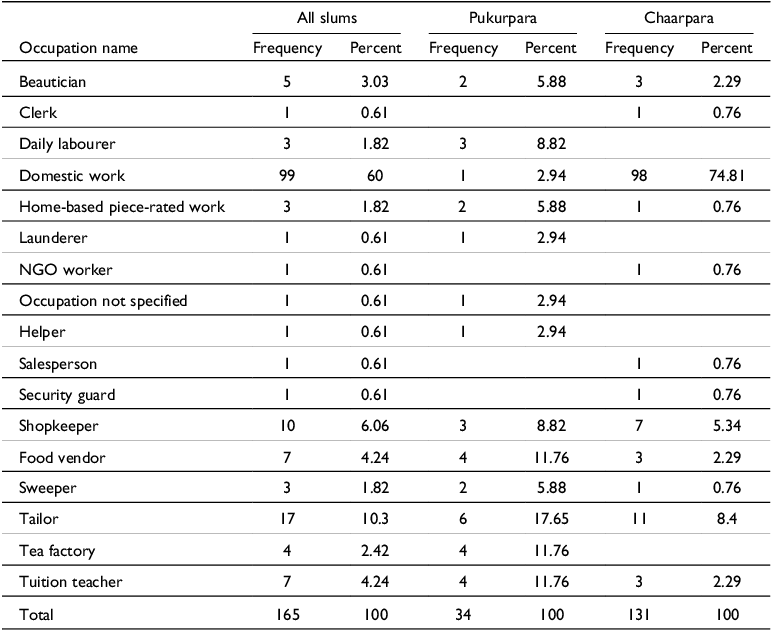
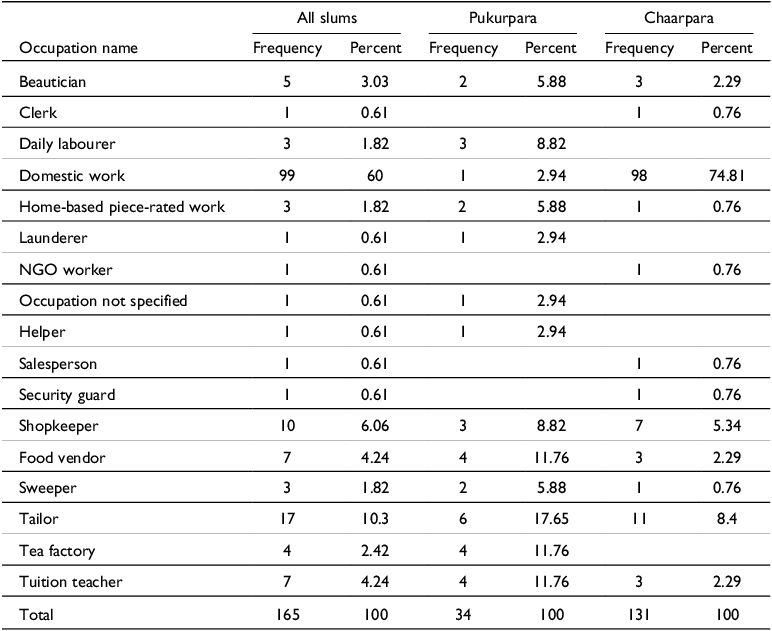
The slum names mentioned in the study are pseudonyms to maintain anonymity. The slum selected from one of the wards with high FWPR is called ‘Chaarpara.’ It is masked away from the main road and lies behind middle-and-upper-middle class residences in the neighbourhood, in the vicinity of a sports complex. While slum men are employed as waged/salaried workers in the sports complex and private drivers to upper-class resident employers, slum women take up domestic work in the surrounding residences. The second survey site is ‘Pukurpara’ which has historically been used as a wet dock area. The surveyed slum lies in the vicinity of tea and tobacco factories. While the male residents are either truck drivers on a regular and/or piece-rate basis or work in the dock, both men and women work in factories and are employed as daily wage labourers. Table A.1 in the Appendix provides a list of occupations of the respondents.
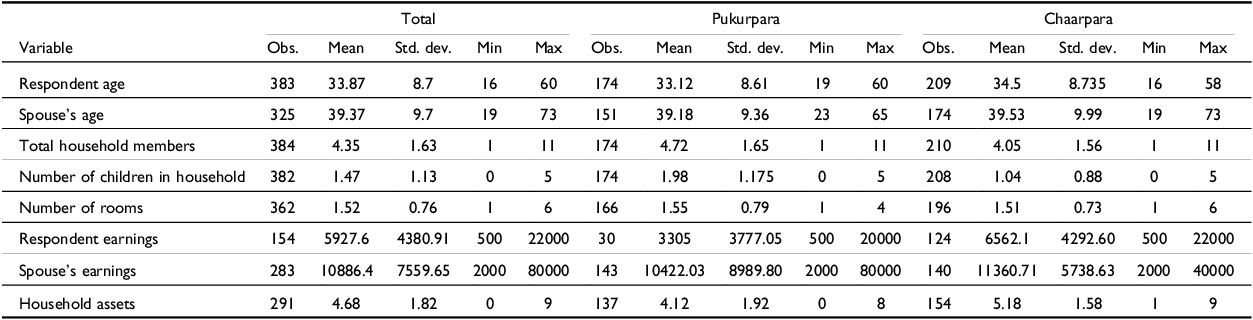
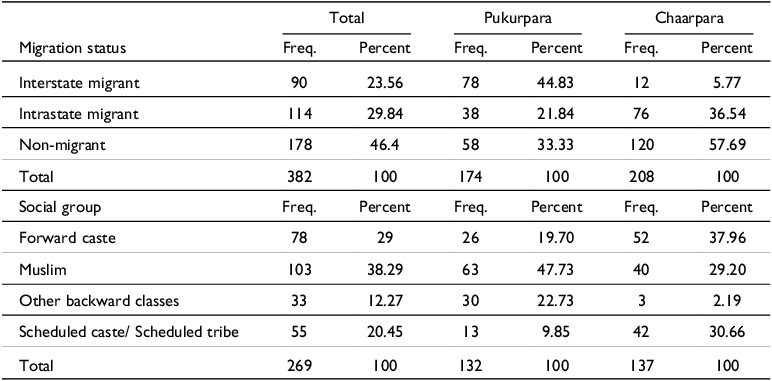
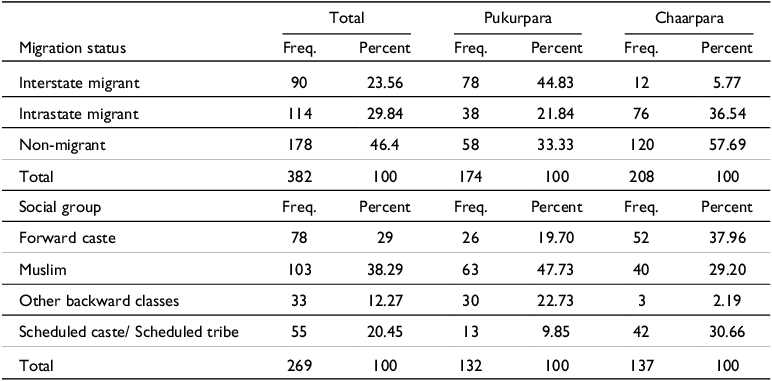
Table 1 provides the descriptive statistics for the sample. The figures are similar for both slums except for the monthly average earnings of both respondents and spouses, which is much lesser in Pukurpara (Rs. 3777 and Rs. 8989) than in Chaarpara (Rs.6562 and Rs.11360). The regional composition of the slums (see Table 2) highlights that Pukurpara has a high percentage of interstate migrants whereas Chaarpara has mainly non-migrants. In terms of caste groups and religions (henceforth, socio-religious group), Pukurpara has a high representation of Muslims while the sample in Chaarpara has a fairly equal representation among the groups except for Other Backward Classes (OBCs).Footnote 2 , Footnote 3
Summary statistics of total sample

Source: Author’s calculations based on field survey data.
Regional and socio-religious composition
Source: Author’s calculations based on field survey data.
The total sample is divided into three groups of women – never worked, currently working, and ever worked but currently not working. Here, work refers to any form of market activity remunerated with cash.Footnote 4 Following the definition of usual activity status, any person who has worked for 30 days or more in the year preceding the date of survey was counted as working/employed (NSO 2021).
Results and analysis
Never worked women
There were 131 women (34.11%) in the total sample who have never worked, with a marked difference between the slums – 54.6% in Pukurpara and 17.14% in Chaarpara. One of the reasons that women report is spousal objection (56.92%). For interstate migrants, this stems from the community norm in their place of origin where women’s work participation is considered shameful. Lalita is a 45-year-old woman who migrated from Bihar to Pukurpara after marriage:
In our place (Bihar), there is no culture of women working. Irrespective of whether households are rich or poor, women do not go out for work.
Even intrastate and non-migrant women are expected to abide by these norms when they are married to men of the same community. Kaveri is an intrastate migrant in Pukurpara who married into a Bihari household:
Biharis never allow their wives to go out for work, regardless of the difficulty to meet household expenses.
For interstate migrants, irrespective of the slum, financial distress is seemingly insufficient to override the community norm of restricting women to the household. In contrast, among the few (28) women in Chaarpara who never worked (except interstate migrants), 16 report ‘no financial need’ or ‘lack of a desirable job.’ The remaining cite familial objection either because of the position of the daughter-in-law in joint families or their spouse’s perception that their earnings are sufficient to meet the respondents’ needs. Malti, a non-migrant in Chaarpara, wishes to supplement her marital family’s earnings but her husband forbids her, fearing a backlash from her natal family for marrying her out of choice and ‘making her work’. Radha is a 27-year-old intrastate migrant who resides with her in-laws:
A lot of women in the locality are engaged in outside work; even my mother-in-law is a domestic worker. I want to work and have my own earnings as well, but my husband doesn’t allow me because he thinks that there is no need since he gives me a monthly allowance. I was thinking of starting my own tailoring business at home but there is hardly any place here to keep the sewing machine.
Thus, while a family’s honour and status are associated with the daughters-in-law’s non-participation in the labour market (Deshingkar and Tripathi Reference Deshingkar and Tripathi2022), women also report constricted living space and/or lack of capital to purchase sewing machines as constraints to home-based self-employment.
Apart from spousal objection, time spent on childcare constitutes another reason for women who never worked (32.31%). Despite being a college graduate, Damini jointly decided with her husband that she should start working once their children were old enough to look after themselves. They are willing to be thrifty instead of opting for additional household earnings as their children’s safety is non-negotiable. Respondents also cite the unavailability of ‘desirable’ jobs (20%), which includes both home-based wage work and respectable jobs unlike domestic work. Kobita is an intrastate migrant in Chaarpara who is unwilling to be a domestic worker which is a common occupation among the locality women.Footnote 5
My natal family is well-respected. We never thought of working in other people’s homes; if I could accept it, I would have already been working by now.
Finally, 22.31% of women cite that they never felt the need to work. For example, 35-year-old Suraiya is a non-migrant residing in the Pukurpara slum:
Working outside and earning money is my husband’s responsibility. If I start working, my husband will just sit at home doing nothing and ask me to work.
Suraiya’s apprehensions regarding work reflect not only the adherence to the breadwinner norm (Tichenor Reference Tichenor2005) but also the concern about the potential for her spouse’s complete withdrawal from workforce. Her insistence on refusing to work despite financial distress exhibits her agency whereby she refuses to relinquish her role within the household and accept a possible situation of double burden.
Non-participation of women in outside work in the northern states of Bihar and Uttar Pradesh is a norm that is reproduced in the slums they migrate to (Basu Reference Basu1992; De Haan Reference De Haan, Arya and Roy2006; Kunduri Reference Kunduri2018). Pukurpara is primarily formed by interstate migrants from Bihar and Uttar Pradesh who have reproduced their community norms in the slum.Footnote 6 It is a space that actively discourages women’s labour market participation, often, irrespective of the financial situation of the household and migrant status of the respondents. The adherence to, and maintenance of this community norm by interstate migrants and non-migrants (particularly the descendants of earlier interstate migrants settled in the slum.) spill over to intrastate migrant women married into the slum community. Women’s willingness to work remains unfulfilled, thereby divesting them of any agency. In comparison, Chaarpara constitutes a space where it is common for women to work. However, the space alone is insufficient to overcome community norms (for interstate migrants), requirements of maintaining familial status, and unavailability of desirable jobs. Thus, women in our sample are restrained by norms that not only discourage women’s labour market participation (imposed by the household or the community they reside in or both), but also accord the primary responsibility of childcare to women and reflect women’s trepidation regarding the possibility of a spouse’s economic inactivity.
Currently working women
42.97% (165 women) of women in the total sample are currently working, with a stark difference between the slums – 62% Chaarpara and 19.5% in Pukurpara.
In the overall sample, we find that Scheduled Caste/Scheduled Tribe (SCST) women are most likely to be working followed by Forward caste (FC) women. Additionally, the percentage of migrant women working is less than that of non-migrants. However, Figure 1 notes two caveats. First, interstate migrants record the lowest participation rates with intrastate migrant and non-migrant women reporting similar rates of non-participation (participation) in Pukurpara (Chaarpara). Thus, the type of migration (whether within or across states) appears to be crucial in influencing women’s employment status. Second, while 70% of women in Pukurpara report non-participation, at least 50% of women in Chaarpara are currently working across all socio-religious groups.
Percentage of respondents currently working by slums, types of migrant, and socio-religious groups.
Source: Author’s compilation based on field survey data.

Type of employment and workplace location
Over 70% of the currently working women are in wage/salaried work (73.33%), and the remainder is in self-employment. Those who are self-employed are workers who operate their enterprises on their own with or without paid/unpaid workers. Wage/salaried workers are those who engage in others’ farm and/or non-farm enterprises and receive cash remuneration on a regular, daily, or periodic basis. A majority (more than 70%) of the employed women in Chaarpara are wage/salaried workers. In contrast, self-employment is predominant in Pukurpara except for 80% and 38.89% of employed FC and Muslim women, respectively. Combining Figures 2 and 3, we observe that interstate migrants are mostly engaged in home-based wage and self-employment irrespective of the slum.
Type of employment across slums, types of migrant, and socio-religious groups in percentage.
Source: Author’s compilation based on field survey data.

Workplace location by slums, types of migrant, and socio-religious groups in percentage.
Source: Author’s compilation based on field survey data.

In fact, all the currently working interstate migrants in Pukurpara report household/slum premises as their workplace. This includes private tuition teachers, tailors, grocery shop owners and street food vendors within respondents’ dwellings. Anjum is a home-based self-employed tailor in Pukurpara:
My husband often gets angry because of the space my work occupies but I ignore him. My earnings act as a safety net since my husband’s work is uncertain.
Home-based work supports a spouse’s disapproval of outside work, enables women to manage reproductive tasks, ensures childcare in the absence of kinship networks, and acts as a source of earnings (Sharma and Kunduri Reference Sharma and Kunduri2015; De Neve Reference De Neve2012). It is expressed as the most viable form of employment for women, given the imposition of spatial restrictions by community norms and the sole responsibility of reproductive tasks (Bose Reference Bose2007). However, the assumption that this work allows effective management of productive and reproductive tasks comes along with some caveats. Home-based working women like Anjum report their spouse’s dissatisfaction with raw materials taking up space in their one room dwelling. Moreover, they mention that the restricted space of their dwelling precludes them from carrying out productive (tailoring work) and reproductive (example, cooking) tasks simultaneously. As a result, home-based workers in slum areas often report the loss of customers who require prompt services.
Intrastate migrants and non-migrants primarily report wage/salaried employment and the neighbourhood as their workplace. Chaarpara’s location in the vicinity of an upper-middle-class neighbourhood and the flexibility in part-time domestic work enable women to manage both productive and reproductive work. Barsha is a graduate who has been a domestic worker since the past year:
Given my qualifications, I can get a much better job but domestic work gives me the flexibility to manage my household chores, look after my son, and have my own earnings. Any other outside work would require me to devote 6-8 hours a day.
Unlike Chaarpara, the location of Pukurpara in a non-residential area necessitates domestic workers to undertake daily commute of half an hour or more. Accordingly, despite their willingness, women are unable to take up domestic work. Only one woman in our sample of Pukurpara reports domestic work as her occupation. Shabnam is a non-migrant who has been working alongside her mother as a domestic help since her childhood and, now, travels every day for an hour to reach her workplace. She continued working post-marriage not only to remain financially independent but also to avert any ‘catastrophic’ situation owing to her spouse’s uncertain earnings and his financial obligations to look after his first wife who stays in rural Bihar (an information she was not privy to before marriage).
The remaining women in Pukurpara reporting ‘others’ or neighbourhood as their workplace include daily wage labourers, casual workers employed by the municipality, and tea factory workers. The slum’s proximity to factories fails to encourage employment among the women dwellers primarily because factory work is discouraged among women in communities from Bihar and Uttar Pradesh (De Haan Reference De Haan2002, Reference De Haan, Arya and Roy2006). Such work requires women to go outside which is forbidden because it is considered dishonourable and unsafe for women to share workspaces with men. Moreover, working conditions are poor with adverse health effects, wages are low, and the long work hours lack the flexibility for women to manage their reproductive tasks. It is accepted only in extreme circumstances of widowhood/separation or non-participation of spouses in the workforce. In our sample, only two currently married women work at the tea factory in their neighbourhood. Ayatun grew up in Pukurpara and started working post-pandemic. Although her spouse never objected to her working at the factory, Ayatun wishes to engage in some form of well-paid home-based wage work. Kaveri is an intrastate migrant who started working with her spouse at the tea factory after he quit his daily wage job and took up factory work. Her workforce participation is distress driven and she wishes to withdraw once the household is financially sound.
In contrast, Rakhi is a 35-year-old FC intrastate migrant in Pukurpara who started working as a corporation employee to fund her sons’ higher education said:
I have been working for the past five years but my marital family (in Bihar) is still unaware of this. Initially, my husband was opposed to this job because he was worried that I would become a bad woman. I convinced him by saying that I will stop working if he ever feels this way.
Women make conscious choices regarding their type of employment. Anjum, Barsha, and Rakhi chose to participate in the workforce despite their spouse’s objections and disapproval. Anjum’s choice reflects a form of agency where she remains within the household but at the same time disregards her husband’s dissatisfaction with her work. In contrast, Rakhi negotiates with her spouse to allow her to work, overcomes the community norms of her marital family, and stands out in a space where majority of women in her locality are restricted to home-based work. Similarly, Barsha is aware of the potential jobs she can be employed in but makes the conscious choice for domestic work because of prior claims of reproductive work. Thus, women strategise their labour market participation decisions in ways that preserve familial hierarchies (convincing their husbands to grant permission to work, self-disciplining, and so on) and maintain a certain degree of community and social norms while simultaneously accomplishing their desires (Deshingkar and Tripathi Reference Deshingkar and Tripathi2022).
Intrinsic valuation of work
About 78% of currently working women wish to continue working, with 49% of them expressing their desire to shift occupations. Women wanting to discontinue work arenecessarily distress driven into the workforce. Tania is a domestic worker by day and runs a grocery shop in Chaarpara during the evening. Her husband is a drug addict and is currently in the rehabilitation centre:
I have been working since my childhood. I do not wish to work anymore. I hope my husband’s health improves soon and he takes over this responsibility.
Pakhi’s case (a domestic worker in Chaarpara) is slightly different. Once her husband resumed work after the pandemic-induced lockdowns, she quit working in all houses except one:
We are currently not in financial distress but I am working even though I do not like the job. My employer runs a private school and he ensured the sponsorship of both my daughters. I am thankful to them for this; also, they are becoming older and will be unable to manage themselves if I quit. Additionally, my earnings can be invested in my daughters’ future. Moreover, I contribute money to my ailing mother now, something I could not do before.
Pakhi’s ambivalence regarding continuing work stems from her guilt for being unable to devote requisite time to her daughters, moral obligation and affinity towards her employers, and the monetary perquisites of the work. Unlike Tania and Pakhi, Rashmi started working as a domestic worker because she desired her own source of earnings. Her five years of work and savings has enabled her to purchase some land in her name in a southern district of West Bengal.
Financial independence is important to Parul but she wishes to discontinue domestic work:
I have always wanted to be financially independent but there is no certainty in domestic work. A month back, I was working in 7-8 houses and then suddenly three houses laid me off. I wish to engage in some form of regular permanent job.
Women’s entry into the labour market might be distress driven, but it is hasty and erroneous to assume that they will withdraw once the distress subsides. While some wish to withdraw due to the low pay and low status associated with the jobs, others are obstinate about discontinuing work once they are granted permission by their husbands. Often, they continue working to ensure a fallback option to comfortably meet the increasing cost of living (Carswell Reference Carswell2016). In our sample, the majority of currently working women appreciate the financial independence that enables them to make their own investments and purchases. These factors act as catalysts that induce women to continue working, with or without shifting their occupation.
Slums as place
It is worthwhile to mention that slums have a local economy of their own – grocery shops, tailoring shops, and other knick-knacks which are necessary for daily survival. These services are provided in the slums by their own residents. The high presence of tailoring shops in Pukurpara (owing to the predominance of self-employed home-based work) deters women from initiating a similar business. Rubaina says:
I know tailoring but there is no point in starting a business here. There are a lot of women in the slum who are already doing this work and since we cater to the demands of only the slum residents, there is not much market for it.
The issue of market demand within the slum is a concern noted by respondents in Chaarpara slum as well. Sunaina is currently a domestic worker who says,
For a long time, I have wanted to start a clothing business in the slum but I have seen businesses failing in the locality. I know that my business will not do well since the demand here is extremely erratic and not sufficient to continue a business.
Along similar lines, Shiuli shares her ambivalence regarding starting tuition classes for the slum’s children:
My husband won’t let me go out and work. I am thinking of starting tuition classes but the experiences of other tuition teachers in the slum is discouraging me. The children here do not take their studies seriously, I’ll be compelled to charge excessively low amount of fees, and parents here are often unable or unwilling to pay the fees on time.
Thus, spousal objection of outside work restricts women within household/slum premises while the confluence of localised nature of the slum market and the lack of physical space in dwellings (mentioned by Radha before) preclude women from engaging in home-based work and/or acquiesce to poor remuneration.
Slums as space
The slum in Pukurpara constitutes a space where women’s employment within the dwelling or the slum is predominant, and outside work is rare, perceived as ‘unfortunate,’ and is only acceptable in dire circumstances of households. The overwhelming influence of norms of origin communities in this space further dwindles the possibility of negotiations for granting permission to work. Notwithstanding these restrictions, women’s agency is reflected in their willingness to work.
In contrast, the slum in Chaarpara comprises intrastate migrants who originate from communities that do not necessarily encourage but accept women’s participation in outside work particularly in situations of financial distress. It is akin to the observation made by Basu (Reference Basu1992) of South Indian women considering themselves to be equally responsible as their spouses to financially support their families. This explains the high percentage of currently working women in Chaarpara, thereby creating a space that normalises their work participation. Women in this slum would often report,
Everybody in this slum works. We do not have the privilege of sitting at home, whether man or woman.
The normalisation of women’s work along with the slum’s location in a residential neighbourhood facilitate women’s agency in defying/negotiating spousal objections and engage in work. The space, thus formed in the Chaarpara slum, also enables women to continue working (with or without shifting occupations). However, observations from our survey highlight that interstate migrants in the slum are mainly employed in home-based work. They mirror their counterparts in Pukurpara when they report that women’s outside work is frowned upon in their community, thereby restricting them to home-based employment. Thus, community norms supersede factors that facilitate women’s work in the slum and prevent interstate migrant women from negotiating outside work. Therefore, as Chatterjee and Desai (2021) note, we find that women’s work participation is influenced by both the ‘geographical community’ or the community of their residence, as well as the ‘communities of mind to which their families belong’. In effect, the ‘communities of mind’ has an overarching influence in Pukurpara that actively discourages women’s work. Conversely, the geographical community imperatives predominate in Chaarpara for intrastate and non-migrant women, while ‘communities of mind’ takes precedence for interstate migrants.
Currently not working women
Approximately 23% of women in the total sample are currently not working. Marriage and childcare are the two major reasons for women’s withdrawal from the workforce.Footnote 7 Additionally, while 23.3% women in Chaarpara report ailing health and/or old age as reasons for withdrawing from the workforce, objection by male members of household is reported by 24.4% of women in Pukurpara.Footnote 8 These remain the primary reasons irrespective of women’s place of origin (Figure 4). Sharmeela used to work in a factory in Delhi along with her natal family members before she got married and shifted to Pukurpara. She wants to resume working:
I cannot work in the tea factory; it is a bad place, my husband says. The only work I am allowed to do is something within the household premises but there is no home-based wage work available here either.
Reasons for withdrawal from workforce across slums, types of migrant, and socio-religious groups in percentage.
Source: Author’s compilation based on field survey data.

Women’s withdrawal and consequent non-participation in the labour market post-marriage is a symbol of their well-being (Carswell Reference Carswell2016). Basu (Reference Basu1992) notes that women’s ‘economic and non-economic dependence on men’ is appreciated and families are accorded higher status among North Indian communities. This explains the high percentage (55.55%) of respondents in Pukurpara reporting marriage and spousal objection as reasons for discontinuing work. Concurrently, women are unable to make time from reproductive tasks of household chores and childcare. Neelanjana is a FC non-migrant who started working as a nurse at a private hospital during the pandemic when her husband was out of work. However, she discontinued since it was difficult for her to manage the household, children, work, and the commute involved.
Deshpande and Singh (Reference Deshpande and Singh2021) contend that the repeated entry into, and exit from, the workforce in India is a result of changing demand for women’s labour instead of fluctuating household incomes and social norms. Our survey reveals that both demand-side (respondents reporting work-related issues like lack of a desirable job, and being laid off) and supply-side (respondents reporting objection by male members, childcare, and marriage) factors explain their temporary withdrawal from the workforce. In fact, the type of employment desired by this sample of women is linked to the reasons for which they discontinued working. 65% of women reporting childcare wish to engage in wage/salaried work. Payel is a 30-year-old non-migrant resident of Chaarpara slum who started working as a domestic worker after the birth of her first son:
I quit because of my second pregnancy. He is too young for me to leave him in the house unsupervised. I plan on resuming work once he is a little older.
The prevalence of distrust among the locality residents, dissatisfaction with the available creche facilities, lack of childcare support within households/families, objection by spouses to their children being in creches, and the guilt of leaving a young child at home are some of the reasons that delay women’s re-entry into the workforce after childbirth. In comparison, the majority of the women reporting marriage and objection by male members express their desire to either engage in home-based work or completely withdraw from the workforce. Hanson and Pratt (Reference Hanson and Pratt1995) emphasise the spatial, in addition to temporal aspect, of women seeking to rejoin the labour market after withdrawing due to marriage, childbirth and other demands. In our sample, Tulsi recounts quitting her work at a beauty salon and rejoining work as a domestic help after childbirth. While she considers her former job more respectable, domestic work allows her to cater to her son’s needs. Thus, while currently not working women plan on rejoining the workforce, their employment opportunities are more likely to be limited and associated with ‘downward occupational mobility’ (Hanson and Pratt Reference Hanson and Pratt1995).
Discussion and policy implications
Space is formed by the various practices and specifics of language, festivals, values, and culture, constituting the lived space of individuals (Sharma and Kunduri Reference Sharma and Kunduri2015; Lefebvre Reference Lefebvre, Gieseking, Mangold, Katz, Low and Saegert2014). Slum areas – which have been formed by the settlement of early and present migrants – often reproduce the villages or the places of origin of the residents. While this brings about a ‘sense of togetherness’, it also replicates and maintains restrictive gender norms. While previous studies have highlighted the empowerment potential of migration for women (Neetha Reference Neetha2004; Kaur Reference Kaur, Arya and Roy2006), our study findings underscore the intertwined influence of the location, the place, and the space of slums on women’s agency in relation to labour market participation.
Once a space is formed by social relations comprising certain beliefs and perceptions, it continues to have ramifications on the labour market decisions of its residents. When slums are composed of primarily interstate migrants who originate in communities that disapprove women’s participation in outside work, the same norm is reproduced and invariably become applicable to both migrants and non-migrants. The space, thus formed in these slums, disables women to negotiate their employment. Women either do not work outside or they take up home-based work. The adherence to norms of ‘communities of mind’ in Pukurpara, thereby, supersedes the physical realities (here, the set of employment opportunities available to women). On the other hand, despite hailing from communities of restrictive gender norms, the location and the space constituting Chaarpara enable women to negotiate these norms. Women in the slum report that the materialisation of aspirations by other working women in their locality was a catalyst in their decisions to opt for employment and for negotiating with household members. Thus, even if women are originally from communities where outside work is disapproved, the norms become negotiable when they migrate to this slum.
We emphasise that whether gender norms are negotiable and can be re-written post-migration essentially depends on the space they reside in. Greater homogeneity of a space potentially restricts women’s ability to work because of the necessary maintenance of kinship relations. However, our study accentuates some caveats to this argument. First, greater homogeneity sometimes induces women to participate in the workforce if it is predominant for women to work in the geographical community. This is observed particularly for the intrastate migrants in Chaarpara. Second, homogeneity provides an inadequate explanation for low participation rates of certain groups of women. If ‘communities of mind’ sufficiently overpowers the physical reality of women, space no longer influences their labour market participation decisions. This explains the non-participation or restriction to home-based employment among interstate migrants of Chaarpara slum.
In addition to the nature of space constituting slums, women’s labour market participation is affected by domestic chores, childcare, physical space, economic capital, ‘desirable jobs’, and negotiability of norms regarding women’s work with household members. In effect, our study highlights that these factors are intertwined with the place and the space women reside in. Chaarpara’s location in a residential neighbourhood enables women to manage their productive and reproductive tasks. Pukurpara women, on the other hand, are restricted by norms that forbid outside work but the predominance of self-employed workers and the localised demand for such services further discourage women’s labour market participation. The issue of a bleak market demand holds in Chaarpara as well, for women who refuse, are not allowed, or wish to discontinue domestic work. Waged and self-employed work within the household premises and within the slum maintain spousal/familial objection of outside work. However, the lack of physical space, capital, and/or skills, along with the erratic work, low earnings, and poor market demand of slum residents discourage women to consider occupations alternative to domestic work. Thus, we see an amalgamation of individual-level factors, the location, the place and space comprising slums having a bearing on women’s participation in the labour market and the type of employment accessible to them.
The variability that exists within a city with regard to slum women’s employment underscores the need for tailormade policies suited to locality-specific needs. While jobs that involve minimum commute and allow flexible work hours are a common policy prescription, it might only be a short-term solution to the issue of low FWPR in urban slums in India. Based on our sample observations, even short-term policies to encourage women’s employment differ between slums owing to their differential regional and socio-religious compositions that necessitate adherence to community norms. Availability of home-based wage work has the potential to improve FWPR in the slum located in a non-residential area but both home-based wage work and greater institutional support by the State in the form of daycare centres and creches are necessary to enable women in slums located in residential neighbourhoods to continue working. This emphasises the role of local governments who are responsible to meet locality-specific needs and demands (here, of employment) to ensure a bottom-up approach to inclusive development. Concurrently, a shift towards more gender-inclusive norms is expected to ameliorate the norm of restricting women to households, cease the demand for flexible jobs by women throughout their life-cycle, and bring about changes in the gender-segregated labour market thereby enabling equal opportunity to participate and continue engagement in every kind of work for women.
One limitation of the study is that the sample is non-representative. Household selection using random sampling technique would have ensured generalisable results. However, due to both difficulties in accessing slum areas and lack of resources, we resorted to snowball sampling technique. This, along with the challenges faced in capturing the caste group of respondents, may have also resulted in an inadequate representation of certain social groups. While not wholly representative, the findings highlight the often-concealed variations that exist not only between slums in the same city but also among residents within each slum including those driven by differences in respondents’ places of origin. These distinctions noted at a disaggregated level warrant further exploration to ensure the implementation of needful policies. Additionally, our sample was restricted to ever-married women. It is possible that unmarried women residing in slums face similar or separate set of challenges in their labour market participation. Future studies can explore whether slums as place and space have differential influence on labour market participation of married and unmarried women.
Acknowledgements
I am thankful to all the women who devoted their time to participate in the survey and shared their lived experiences with me. I would also like to thank Prof. Praveena Kodoth and Prof. Vinoj Abraham for their guidance and support and the anonymous reviewers for their valuable comments and suggestions.
Competing interests
The author declares no potential conflicts of interest with respect to the research, authorship, and/or publication of this article.
Appendices
List of occupations that women engage in
Source: Field survey data
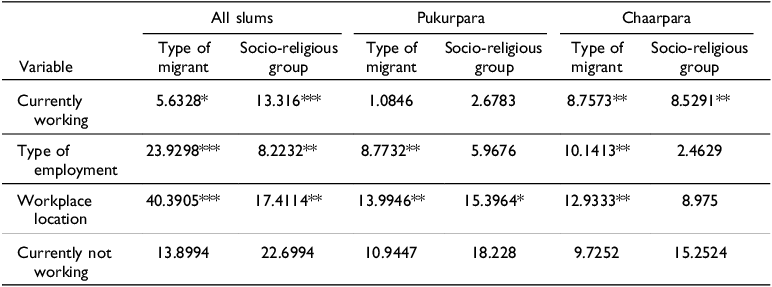
Pearson chi-square coefficients for cross-tabulations

Note: *, **, *** implies that the coefficient is significant at 10%, 5%, and 1% respectively.
Source: Field survey data.
Annesha Mukherjee is a final year Ph.D. scholar of Economics at the Centre for Development Studies, Kerala, India. She currently works on labour and gender economics using an interdisciplinary approach. Her broad research interests are development economics and spatial economics.